




Abstract
Co-production is now an established part of public service delivery. Despite its popularity, there is only a limited understanding about how co-production works in practice, particularly with marginalised groups. This paper identifies and explores insights from three case studies of a successful co-productive approach in Glasgow, Scotland. Operation Modulus is a criminal justice initiative involving public and third sector partners in the co-production of services with marginalised young people to reduce their involvement in crime and antisocial behaviour. The data highlighted the importance of leadership, the role of public service professionals and the process of working with marginalised young people; these are explored, all within the context of the authorising environment created at the level of a collaborative governance body. The findings underscore, first, the importance of distributed leadership and process in developing trust amongst partners and in turn in the relationships of partners with young people. Second, the essential role of effective co-management amongst service providers in creating the requisite conditions for meaningful co-production with marginalised citizens. Third, the potential for and importance of shared management to facilitate changes in professional relationships and ways of working, even if these do not lead to organisational systems change. Fourth, the significance of public service professionals having the authority and agency to explore collaborative ways of working.
Keywords
Introduction
The design, delivery and management of public services are no longer the preserve of professionals and policy makers. There has been a shift to shared or collaborative governance in which the public, third and private sectors work alongside service users and citizens to co-produce services. Premised on the idea that the involvement of service users and community members in all stages of the public service cycle produces more effective services, co-production is now a critical part of new public governance (Pestoff, 2021). Co-production changes the role of civil society in “a relationship where professionals and citizens share power to plan and deliver support together, recognising that both have vital contributions to make in order to improve quality of life for people and communities” (Slay and Penny, 2014:7) (emphasis added). However, the work to flatten historic power dynamics between public services and citizens can involve an ongoing, uncertain, and challenging renegotiation amongst multiple actors (Loeffler and Bovaird, 2021; Schlappa et al., 2021).
Despite its popularity, co-production remains a maturing concept, “one of a series of ‘woolly words’” used to describe public policy (Osborne et al., 2018:18). Similarly, while research in co-production is “proliferating furiously” (Ersoy, 2017:201), significant gaps remain. Many of the processes that underpin co-production are unexplored (Turnhout et al., 2020; Vennik et al., 2016), much of the work of co-production is ‘blackboxed’, its actual workings made invisible, risking the assumption that co-production just works once a commitment to it has been made. For example, gaps in knowledge include the role of public professionals (Fledderus, 2018; Steen and Tuurnas, 2018; Van Eijk and Steen, 2014; Vennik et al., 2016), the role of leadership (Schlappa and Imani, 2018), the dynamics of power relationships in co-production in contemporary public governance contexts (e.g. Strokosch and Osborne, 2021; Turnhout et al., 2020), and the involvement of marginalised social groups (Brandsen, 2021; Loeffler and Bovaird, 2021; Vanleene et al., 2018; Verschuere et al., 2018).
In this paper we aim to go some way to filling these gaps. We draw on case studies of a co-produced public service intervention, Operation Modulus (OM), aimed at tackling anti-social behaviour and criminal activities of young people in three geographical areas of multiple deprivation in Glasgow, Scotland’s largest city. The initial success of the model resulted in its adaptation in two other communities. We focus on three key themes that emerged from the data: the role of leadership, the role of public service professionals and the process of working with marginalised groups (specifically young people) in co-production. We explore the actual mechanics and dynamics of co-production to unpack the relationships and power dynamics between and amongst the public service professionals who worked collaboratively to co-produce the programmes with young people and show how the collaborative governance context of the process was central to its success. Collaborative governance denotes a governance arrangement initiated by public bodies, engaging non-state actors in formal decision making related to public policy or the management of assets (Ansell and Gash, 2007). In this study, OM was sanctioned through Glasgow’s Community Planning Partnership (CPP), an example of a collaborative governance arrangement.
There is little that brings together the literature on co-production with that of collaborative governance. The literature on co-production, and in particular efforts to create typologies, uses co-production approaches as the unit of analysis (e.g. Loeffler and Bovaird, 2021). Existing and emerging typologies focus less on the relationships between the different stakeholders and how these relationships shape the co-production experience of service users (Turnhout et al., 2020). For example, Nabatchi et al. (2017) specifically exclude collaborative governance arrangements from their co-production typology as such governance forms typically exclude lay actors (also Loeffler and Bovaird 2016).
Given that our study explores co-production within a broader collaborative governance context, current co-production typologies do not lend themselves to our analytical requirements. Instead, we use an approach that brings together analysis of the different service provider roles in public services, namely co-governance, co-management and co-production (drawing on the work of Brandsen and Pestoff, 2006 and Pestoff, 2012), with levels of governance (Pestoff, 2021). This allows us to combine analysis of levels of governance (macro, meso and micro) with the different service provider roles (co-governance, co-management and co-production). These together enable us to analyse the dynamics and interplay of public services professionals engaged through collaborative governance arrangements with each other and with the young people. Co-governance, operating at the macro level (in this case, the CPP), is associated with the design and planning of services involving senior level public service professionals, elected officials and non-state actors; co-management, at the meso level, relates to the resourcing and delivery of services involving mid-level and front-line public service professionals; and co-production, at the micro level, relates to the process of mid-level and front-line public service professionals working with citizens or service users in the production and shaping of services (Brandsen and Pestoff, 2006). It is through what Loeffler and Timm-Arnold (2021) term networks that citizens, service providers and commissioners come together to plan and co-produce services. This paper highlights the work that goes into setting up these networks and the interplay between the three levels. We suggest that co-governance provides an essential collaborative authorising environment for effective co-management amongst service providers, which in turn is essential in creating the requisite conditions for meaningful co-production with citizens.
The paper opens with a review of relevant literature around the key themes that emerged from the data, highlighting the role and leadership of public service professionals and how this interplay shaped the co-production work with marginalised young people. It then moves on to provide a description of OM and describes the methods used to collect and analyse the data, before presenting the findings. The paper finishes with a critical discussion of the key themes.
Setting the context
The role of leadership
One of the aims of co-production is to challenge hierarchies, changing power relationships and decision-making structures. It requires the development of new collaborative arrangements, governance, goals and outcome measures, staff roles, support networks, management structures and procurement processes (SCIE, 2015). Central to this is the development of new approaches to leadership, a concept which has, to date, received only limited attention in the context of co-production (Parker et al. 2021). Schlappa and Imani (2018) suggest that for co-production to work, leadership has to become what they term distributed, a form of leadership that is much discussed but rarely explored in depth (Parker et al. 2021). This idea presents leadership as a “social construct that emerges from the interaction between members and the organizational context” (Vogel and Masal, 2015:1183). Leadership is not placed in the hands of an individual, rather it is dispersed and distributed across individuals, organisations and sectors. Everyone who takes part in the process is both a leader and a follower, breaking down hierarchies without actually changing the structures in which they operate, giving individuals the opportunity to emerge as leaders when appropriate or when required (Sun and Anderson, 2012). The role of so-called formal leaders under this model is to put in place systems that enable people to lead themselves, developing systems in which formal leadership is no longer required (Sørensen and Torfing, 2013; Van Wart, 2013). It fosters both engagement and commitment and helps organisations work together and become flexible (Van Wart 2013).
Leadership styles can change during the lifetime of a co-produced project. Vangan and Huxham (2003) describe the role of leaders in collaborative projects as ‘partnership managers’; their role is to organise and sustain partnerships. Co-production, we argue, calls for a similar approach. At the start of a project the role of a leader is to bring partners together to create a network with a shared understanding of the philosophy. As the partnership matures the role is about being politically astute and navigating the tensions that can arise between different organisations (Parker et al., 2021). Power relations at the start of a project are uneven and often top down, in part because decisions taken to fund and shape a project are taken by those in power (Turnhout et al., 2020). Leadership in co-production is about establishing and maintaining the right environment for co-governance to emerge and thrive (Loeffler and Timm-Adams, 2021). Such an approach brings together professionals across a range of sectors and it is to a discussion of their role that the paper now turns.
The role of public service professionals
The shift from government to governance has heralded significant change in the role of public service professionals. Previously conceptualised as ‘providers’ within the traditional public administration and as ‘commissioners’ under new public management, public service professionals have evolved to become ‘directors and mediators’ in new public governance (Sicilia et al., 2016:11). Professionals occupy a more strategic role with a focus on managing multiple relationships and interdependencies between and amongst citizens, public servants and other actors, operating within a context of networks and interorganisational collaboration and negotiation (Sicilia et al., 2016; Steen and Tuurnas, 2018). The conceptualisation of who constitutes a public service professional is also challenged by governance through networks, extending the definition to include non-state actors such as third and private sector partners.
Co-production places different demands on professionals, influencing the environments and contexts within which they work. They become part of multi-stakeholder governance networks, some of which include citizens. Professionals have to become enablers as they navigate multiple and complex relationships, negotiating individual, organisational and network priorities. Networks challenge traditional lines of communication and hierarchy, requiring actors to “negotiate rules, norms and institutional frameworks rather than taking the rules of the game as given” (Bovaird, 2007:858). Professionals become both leaders and followers, reflecting patterns of distributed leadership. Co-production has contributed to changes in the role and demands of public service professionals; this is particularly so for professionals working with marginalised groups, as explored in the following section.
The process of co-production with marginalised groups
While there is much literature on users and citizens in co-production, initiatives tend to favour “qualified citizens”, considered more likely to generate successful outcomes (Fledderus, 2018:260). Those viewed as qualified tend to be middle-class and educated, excluding those from low socio-economic backgrounds who are often the target of such efforts (Vanleene et al., 2018; Verschuere et al., 2018). There is a dearth of literature on co-production with marginalised groups in general (Brandsen, 2021; Loeffler and Bovaird, 2021), with some emergent literature on the potential for co-production with marginalised young people (e.g. Dixon et al., 2019). In contrast, traditional approaches to youth participation create what Burns refers to as “false empowerment” (2019:350), reflecting a vertical relationship where adults retain power and expertise. However, transformative approaches, including co-production, offer horizontal relationships where power is shared and trust is developed and maintained (Burns, 2019).
The actual process of co-production, the ways in which public service professionals engage with citizens, particularly those who are marginalised, plays an important role in the development of trust (Fledderus, 2018; Strokosch and Osborne, 2016). Fledderus argues that “processes might be much more important for citizens’ trust in public institutions than actual outcomes” (2018:260). The significance of process is echoed by Strokosch and Osborne (2016) who, in their work on co-production with asylum seekers, highlight the importance of “continuous and equal dialogue” and a “close but professional relationship of trust” (Strokosch and Osborne, 2016:685).
Vanleene et al. (2018:210) conclude that there is potential for co-production to “move beyond the usual suspects” to promote inclusion, equity and empowerment. The literature highlights the significance of the process of co-production; managing this process is the domain of public service professionals. This article adds further insight to the literature, exploring the work done by professionals working collaboratively at the meso level to animate co-production with a marginalised group at the micro level. In the following section we describe OM and detail our methodological approach.
Case study and methodology
We adopted a case study approach (Stake, 2006; Yin, 2014). This allowed us to examine OM in a real-world setting and explore the mechanics of co-production, in turn allowing us to unpack both the workings of OM itself and the intersection with the structures in which it was integrated. Our approach was broadly interpretivist as we sought to identify emergent themes from our data and understand the processes, practices, relationships and structures that impacted on the development and implementation of OM. In the next section we present OM as a case and explain our methods of data collection and analysis.
Operation modulus
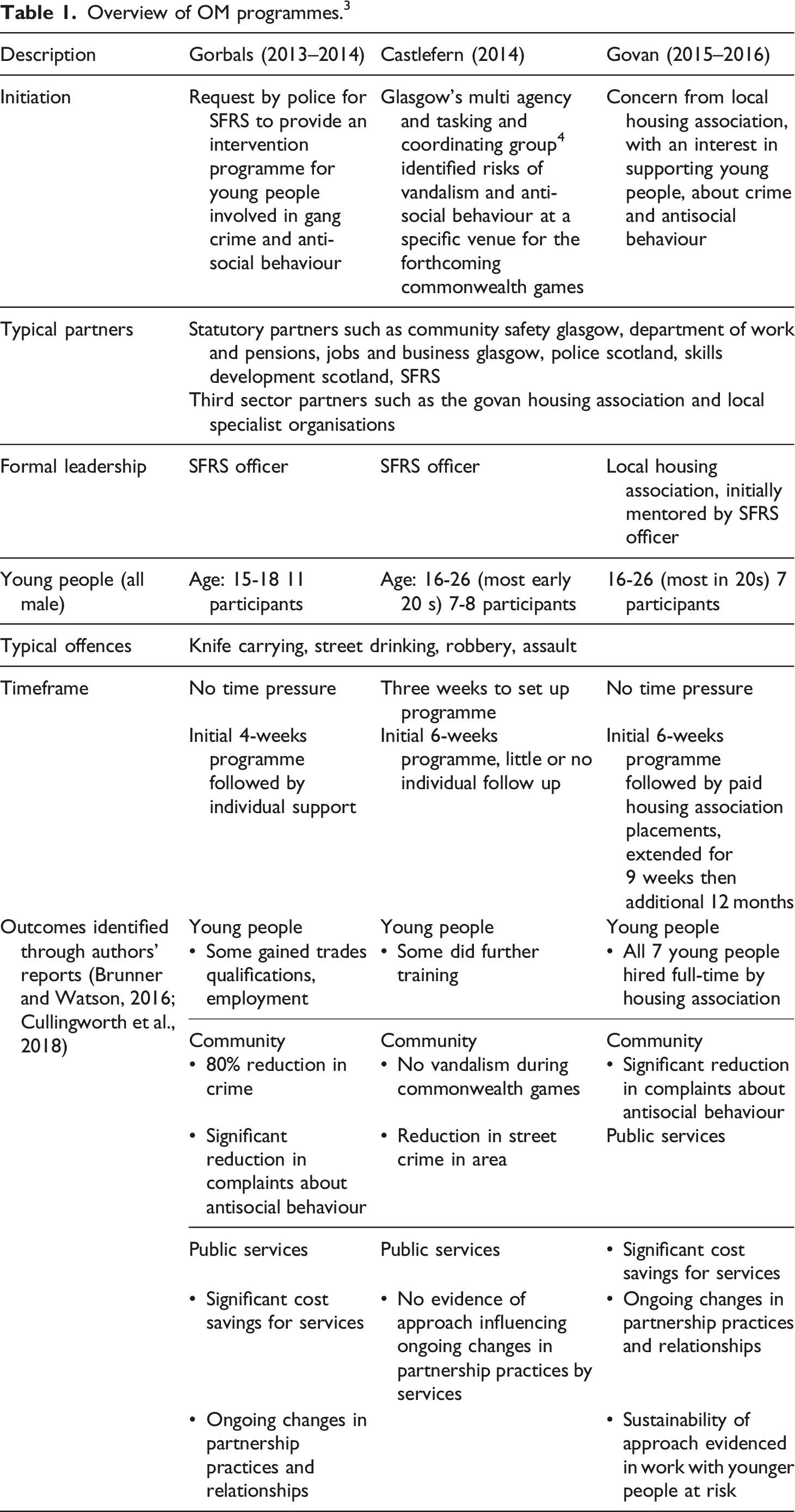
OM 1 is an award-winning co-produced crime reduction intervention that targeted young people involved in crime and anti-social behaviour in three economically and socially deprived communities in Glasgow. Originally developed in Gorbals in 2013–2014, the approach was later adapted in Castlefern (2014), followed by Govan (2015–2016). While the approach was not restrictive, only young males participated in the interventions researched.
The OM intervention was conceived and initiated by Bob Mackenzie, 2 an officer from the Scottish Fire and Rescue Service (SFRS) seconded to the city’s CPP to help facilitate partnership working. In 2013, Mackenzie was approached by the police, concerned that traditional criminal justice approaches were not facilitating behaviour change in a group of young people from Gorbals involved in numerous offences. Mackenzie already ran a generic engagement and intervention programme called Fire Reach but suspected that this would not be sufficient due to “the level of prolific offending that these young guys were involved in” (Mackenzie, SFRS, interview 1). Using his wide-ranging remit and authority within the CPP, he brought together a partnership of statutory bodies and organisations from the third and private sectors to work collaboratively to engage with the young people using a new approach.
Overview of OM programmes. 3
Method
Research into OM was originally undertaken as part of a larger research programme, What Works Scotland, exploring dimensions of public service reform. In Scotland, public service reform was designed to produce streamlined and improved public services with better outcomes. As part of this work, case studies were conducted of Gorbals ((Brunner and Watson, 2016), and of Castlefern and Govan (Cullingworth et al., 2018) in order to explore the initiative in depth and within the context of people’s lives (Flyvberg, 2006). The case studies were conducted in two different time periods, with the initial Gorbals case study undertaken in 2014–2015, and the two other sites during 2016–2018. Two methods were employed: semi structured interviews and document analysis, with most of the data gathered through interviews. A standard interview guide was developed for the interviews, with some customisation to reflect the individual participant’s specific connection to OM.
Overview of interview participants and their association. 5
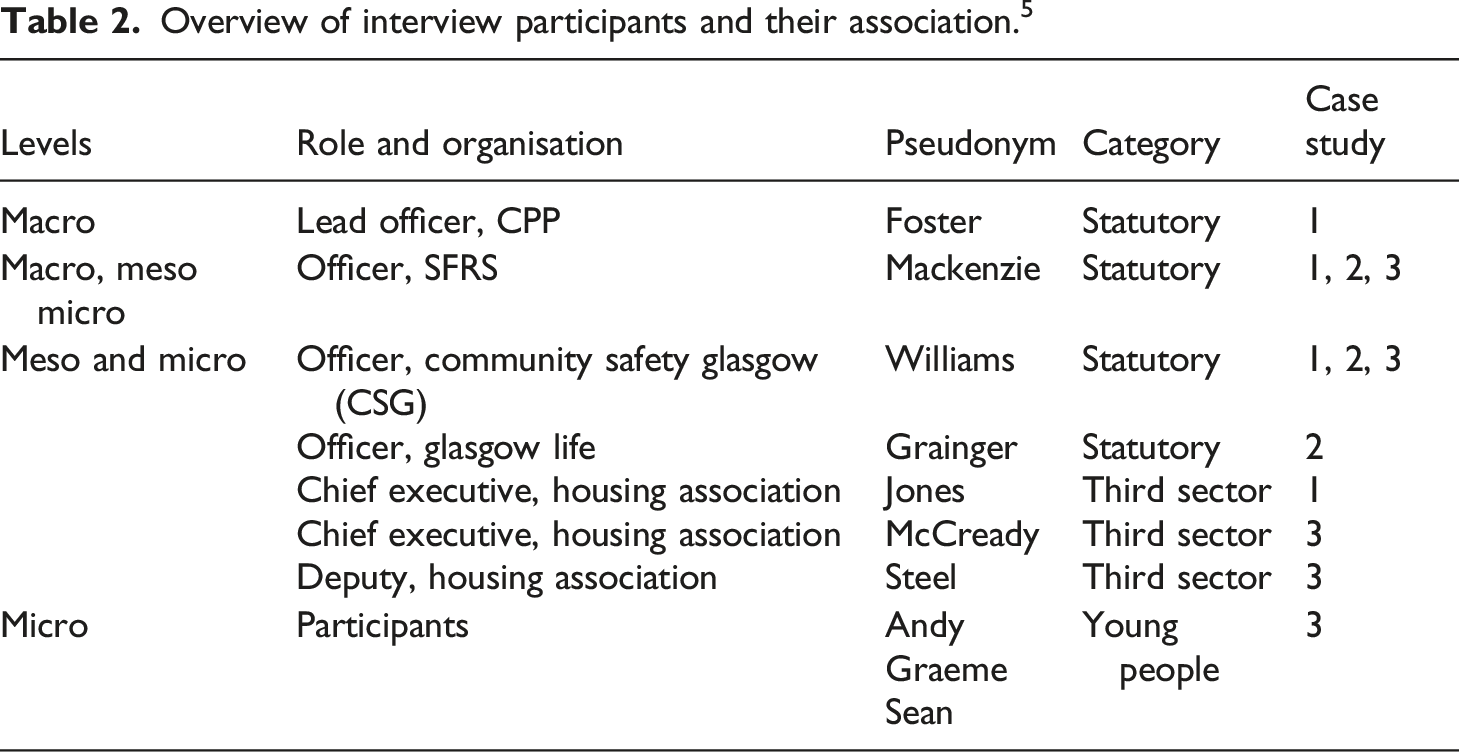
Workers selected were public service professionals with active co-management and co-production roles in the initiative; Mackenzie was the only person also involved in co-governance at the macro level through the city wide CPP; Foster was able to offer an overview of Mackenzie’s wide-ranging role. Our aim in Gorbals and Castlefern was to gain an understanding from the perspective of the professionals; in Govan we sought to widen our lens to include some of the young people, made possible because they were still involved when the research was undertaken. In addition to the interviews, document analysis was undertaken of meeting minutes, reports, presentations and media coverage.
The inclusion of the young people in the Govan case study provided an added level of insight. We did not ask to audio-record the young people given their history with criminal justice and the potential for negative association. Rather, consent was secured verbally for the researchers to note-take, with care taken to maximise understanding of the study.
Inductive thematic analysis was used as a framework for the research given its strength in capturing the depth and complexity of textual data (Guest et al., 2012). Initial coding was undertaken using NVivo by the primary researcher to identify key categories and themes; these were, in turn, discussed and further analysed by the research team. Through an iterative process, the key analytical themes of co-production within a collaborative governance environment, leadership, the role of public service professionals and the involvement of young people emerged from the data. These are presented in the next section.
Findings
OM was a new way of working, as Foster described: What’s unique about this is that it’s broken down barriers, that people are working together in a more cohesive way, in a more integrated way than I’ve seen before (Foster, CPP).
Our data suggests there were three key elements to this; new styles of leadership, changes in working practice, and co-production. These are unpacked below.
The role of leadership
The role and style of leadership changed through the course of the project. At times it was directive, while at others it was distributed and shared across the group. As trust developed between and among the partners, leadership became more open and shared; it was, as Vangen and Huxham (2003) describe, a cyclical process. Creating new ways of working was at the heart of the decision to appoint someone from outside the traditional agencies involved in anti-social behaviour: “We wanted to break the barriers between the partners and have a collective approach to community planning” (Foster, CPP).
The decision to lead the first iteration of OM through SFRS rather than an officer from a more traditional agency, such as Community Safety Glasgow or the police, initially created tensions. Concerns were expressed about a firefighter’s suitability for the role, alongside disquiet that he was encroaching on other services’ jurisdiction: Some people initially said ‘what on earth is a firefighter doing working on engagement with difficult-to-reach young people?’ … a couple of times I had to say to people ‘…That’s what fire and rescue are about, it’s a preventative approach … it’s not territorial, it’s not mission creep’ … it needs to be somebody with that skillset, it doesn’t matter what agency they work for (Foster, CPP).
It was the approach, rather than the occupational remit, that was key to enabling OM to develop and be delivered as a co-produced intervention. Mackenzie had to both prove that he had the knowledge and ability to carry out the role demanded of him and that his approach was the correct one. The style of leadership changed over time and locality as the project evolved and all those involved gained more confidence. In the first OM iteration in Gorbals, Mackenzie invited local and city-wide agencies that he felt could contribute to solving the gang crime issue: “Some partners I knew and there were others I didn’t know.......it was well, maybe fairly brave to say, right, I’m just going to bring everybody in who’s got a remit for this’’ (Mackenzie, SFRS, interview one). He had to be fairly directive at this stage as he shaped the group, proving his suitability and developing OM’s ethos and strategies: It was fairly difficult to get some of those individuals to understand, ‘well listen, I’m bringing a community planning issue to the table here, regardless of who’s bringing the issue’ … I wasn’t for a minute saying I should always be the lead agency to deal with this…’ (Mackenzie, SFRS, interview 1).
He used his authority to highlight the importance of focusing on and working with the young people: “I said to the partners … it’s not about keeping your chief executive happy … It’s about the individuals at the end of this programme” (Mackenzie, SFRS, interview one). As the network developed, his leadership style became more distributed “having that discussion and conversation with different partners … listen if we come together, we share resources, we work for a change together cohesively instead of this working and doing our own thing” (Mackenzie, SFRS interview one). He had to engage in what Vangen and Huxham (2003) term ‘collaborative thuggery’ to change people’s ways of working and challenge their values to enable the environment for co-management to emerge across the partners, at this meso level. One of the involved partners described the change:
It’s making sure that you've got people around about you … OM succeeds with that… Jobs and Business Glasgow know how to deal with the employment side… Glasgow Life … know what services to put in there, to engage with people… And you’ve got the third sector agencies, who are on the ground, who are actually dealing with those individuals, and families, and the wider community. And then we've got ourselves, who are going in to try and reduce re-offending (Williams, CSG, interview one)
Only when the partners were working together with a shared vision could he move to this more distributed leadership style
In the third iteration, Govan Housing Association took over the leadership role. There was much more confidence in OM; the public service professionals did not have to be convinced of the value of the programme and there was less resistance to breaking down traditional silos and hierarchies. This shift in ethos was the necessary groundwork to enable co-production with the marginalised young people but contained multiple tensions. It is to an exploration of these that we now move.
The role of public service professionals
In all three OM iterations, the initial call to interested organisations at the meso level was wide, but targeted, inviting local services (public, third and private sector) to join a discussion about how to work collaboratively to address the needs of a specific group of young people. In all three, there was a broader partnership group that included a diversity of organisations, and a smaller core group that drove the implementation and delivery; one partner described this as a “feathered approach” that enabled third sector organisations in particular to be involved as and when they could. In Gorbals and Govan, a consistent characteristic was that individuals involved in the co-management of the project also delivered on the ground, engaging directly with the young people. This challenged traditional hierarchical ways of working: That was the good thing about it, it was the people who were actually going to be working with these boys who were involved in the planning of the programme rather than somebody that sits in the ivory tower, as I call it, and sends a programme into us saying ‘this is what you must do’ (Grainger, Glasgow Life).
In Castlefern, however, some of the staff tasked to deliver the OM programme at the micro level were not partnership members at the meso level and did not share the ethos of co-production. This was reflected in a more traditional, authoritative approach to working with the young people; for example, staff delivering the programme sent one of the young people home for talking during a workshop. This conflict in ethos led to tensions: To say the least I wasn’t happy about that. The whole point was getting them there in the first place and the fact that he did turn up is one of the barriers we managed to overcome. This is what the guys have faced all their life – being excluded. I let the agency know that I was not happy at all… I said to that agency these are not easy targets that you’re probably used to dealing with (Mackenzie, SFRS, interview two).
Here Mackenzie again had to use a directive approach to tackle a breach of the co-production philosophy, reinforcing the necessity for a shared and consistent ethos in programme development at the meso level and delivery at the micro level. Working in a co-productive manner was fundamental but also challenging and some organisations could not adapt because of the differences in philosophy.
The programme was able to draw external partners into its ethos. For example, in Govan, the Department of Work and Pensions, not traditionally noted for its flexibility, agreed to waive benefit conditionality so that the young people could participate without fear of sanctioning. 6 Working with the ethos was sometimes dependent on the individual professional involved. For example, in Govan one of the statutory partners was dropped because of an inflexible programme delivery model. However, the same partner had been a key contributor in Gorbals where the officer involved was able to adopt a more flexible approach to meeting individuals’ needs. One interviewee noted: “It’s not the organisations you work with, it’s the people within the organisations” (McCready, HA).
OM highlights the complexity of working in a co-productive context where partners negotiate competing demands and accountabilities between their organisation and those of the partnership. OM required a time-intensive individualised approach that, at times, conflicted with public service delivery models that were based on generic, inflexible models that often required participants to sit in a classroom for a set number of weeks. Grainger noted, Initially all these partners came round the table and were all saying, “Oh I’ll do this” and “I’ll do that.” And we never saw them again. I don’t know whether these boys were just too disengaged, and it was apparent straight away they would require intensive input from all partners. … they were certainly not going to be ticking boxes overnight (Grainger, Glasgow Life).
OM also had impact beyond the immediate programme, changing the attitude to co-production in organisations directly involved. For example, in one of the housing associations it stimulated a strategic change in their approach to partnership working to manage housing-related issues. The Housing Advice Team implemented a weekly ‘hub meeting’ involving the emergency services, parks, cleansing, ‘…everything that’s to do with the area that will have an effect and an impact on people’s standard of living within the area’ (Jones, HA). They also now hold a separate, regular meeting with social work and police, the partnership approach helps them to prevent small problems becoming big issues: That meeting’s really useful in terms of finding out what’s been going on in the area on a weekly basis, not weeks and months… Social Work can check straight away if one of these kids that's been mentioned has maybe got other issues that we were unaware of… And we get together and we can deal with it… (Jones, Housing Association)
Co-production is a relational process, requiring animation, directed leadership, a shared ethos, and an extension into distributed leadership within a partnership to overcome risks of collaborative inertia and silo thinking. It is this foundational work at the macro and meso levels which allowed the potential for co-production with marginalised groups at the micro-level, to which we now turn.
Process of co-production with marginalised young people
An individualised recruitment process was used with the young people, an active process of ‘reaching out’ (Durose, 2011), establishing a very different dynamic with authority than the young people were used to. They were visited in their homes and engaged in a conversation, sometimes with their families present, about what they had been doing and the impact it was having on services and the local community. They were asked “If you had an opportunity, if you … wanted to develop the skills, what would that look like? If you had a chance of a job, what would that be?” (Mackenzie, SFRS, interview two). Mackenzie reflected: I think the guys found it strange that there was me in uniform sitting within their homes talking to them, talking to their mothers, their fathers, about we know what you’re up to but I’m not here to enforce the law or anything else… Here was an opportunity for them to work with us and possibly better their own lives (Mackenzie, SFRS, interview two).
Andy, who had previously participated in a course offered by one of the partners, described the difference of the approach: “They asked us ‘what you want to do?’ We got to choose. The last time we were told what we should do.” Another participant, Sean, noted: “The fact that we had a choice felt like it was our own decision … if people tell you, you’re more likely to go ‘I aren’t doing that’….” Their responses highlight the qualitative difference that co-production made in facilitating the young people’s sense of agency and ‘voice’.
The young people actively shaped the programmes in Gorbals and Govan. For example, the young people had a week of work experience at Govan Housing Association, which was to be followed training elsewhere. When the young people expressed a strong desire to continue their work experience, a senior staff member reflected: We thought about it, because we were like, are we cutting off their opportunities because we’re not allowing them to go, or are we actually allowing them to dictate what the programme should be? And we thought well, let's let them dictate what the programme is (Steel, HA).
The work placements ultimately led to all seven young people gaining full-time employment at Govan Housing Association. As the only third sector organisation leading on OM, Govan Housing Association ‘enabled’ their service users (Mazzei et al. 2020). The co-production ethos facilitated some degree of horizontal power sharing between the partnership and the marginalised young people, leading to socially valued outcomes for the young people.
Time influenced the ability to co-produce. In Castlefern the initiative was precipitated by concerns within and beyond the CPP about anti-social behaviour at the forthcoming Commonwealth Games. This pressure meant the time to develop and deliver the programme was compressed and after the success of the Games, the OM intervention ended. Williams summarised the significance of time in co-production with marginalised groups:
You’re having to take it at their pace, you can’t say hurriedly ‘come on, let’s move along here, there’s Games happening soon’ … it’s something I will always say when we sit down at meetings we have to take our time and make sure we get this right. Not just from a selfish point of view, but … it is always for the benefit of the community and the individuals (Williams, CSG, interview two).
Because the focus was on short-term macro-level goals, rather than long-term and co-produced micro-level goals for the young people, the ethos of the programme was compromised and the transformative potential of co-production for the young people was lost. Co-production can be undermined by different political priorities within and beyond co-governance arrangements (Loeffler and Timm-Arnold, 2021).
In Gorbals and Govan in particular, the young people were treated by the public service professionals as asset holders, a core principle of co-production (Slay and Penny, 2014): “Because it’s a voluntary programme, you want to make sure that you’ve explained everything fully, and they totally understand, and they’re comfortable and happy about coming along” (Williams, CSG, interview one). There was recognition of the systemic barriers the young people traditionally faced. To animate and sustain the involvement of this marginalised group in co-production, the partnership provided assertive mentoring throughout. The partnership at the meso level created the conditions to support the young people, putting co-production into action at the micro level, a dynamic process ultimately enabling some horizontal sharing of power. These elements develop the findings of Fledderus (2018) who argues that fairness, participation, equity, respect and honesty are key in the co-productive relationship.
Discussion
The evidence above demonstrates some of the dynamics of co-production across a multi-agency collaboration with a marginalised group. It highlights the importance of the interplay between co-governance, co-management and co-production at the macro, meso and macro levels. This interplay is complex, involving individuals from different positions within organisations, participating in partnerships at different levels, cutting across sectors (Bovaird 2007). The power dynamics varied by time and by location, they were unequal, especially at the start, but as the programmes matured so the hierarchies flattened. This gave all those involved the freedom to co-produce the service with the young people and as a group they were able to ‘face down’ non-co-productive service delivery norms and deal with political pressures (Parker et al., 2021).
As the programme evolved, leadership could become more distributed: once all those involved had bought into the programme and its philosophy, those working in different public agencies were able to take the lead in their own domain (Parker et al., 2021). While the organisational structures and accountabilities of the professionals did not change, the partnership enabled them to work in a different way; change was facilitated through partnership rather than by a change in structures. While partners came from different organisations with diverse hierarchies, the co-management of OM gave public service professionals autonomy to prioritise co-production with the young people (though, as in Castlefern, this autonomy had limits).
Our data demonstrates the challenges to organisational traditions and adaptations to leadership style that were necessary to effectively distribute co-production with marginalised young people. People’s professional roles and their lines of accountability had to adapt in order to successfully co-produce the programme in each context (Brandsen and Honingh, 2015). Partners had to step back and accept leadership from organisations outside their own. At times, especially to get the programme off the ground, the formal lead had to be directive and authoritative. As it became evident that the programme was successful and the value of the approach became clear, so partners were more willing to cede power (Parker et al., 2021). Co-management amongst disparate stakeholders at the meso level enabled partners to work effectively together, a necessary precursor to operationalising the programme at the micro level.
At the micro level trust was central to the development of this process both in working with young people and to the emergence of distributed leadership (Fledderus, 2018). All partners had to learn to trust each other in order to allow the programme to evolve; trust built a sense of common purpose. For the young people, the co-productive approach both offered them choice and some power in shaping the programmes. To succeed, this co-productive process also demanded time and resource, and the role of ongoing dialogue between the partners, including the young people, was central (Strokosch and Osborne, 2016). Persistent dialogue, negotiation and responsiveness developed a shared understanding of the value of co-production in the design and delivery of the programmes.
While OM is an example of the flattening of power dynamics between public services and citizens, the initiative was ultimately a top-down one as the initial concern was identified by senior level public service professionals. Pre-existing power imbalances between professionals and the young people remained, not least because the professionals were paid for their involvement, and they were the ultimate judges of whether the programme was successful (Turnhout et al., 2020). While it could be argued that this is an example of co-production with young people rather than by young people, it was nonetheless an experience where young people were able to exert some power and agency. By valuing the young people’s views and perspectives and treating them as agents, OM involved the young people in a meaningful process of co-production. OM changed relationships and ways of working at the individual, community and local level, affecting both culture and practice. We can also point to the wider impact it has had on the development of other services by those involved in the initiative and demonstrate the way it has acted as a catalyst for further reform, a key expectation of co-production (Turnhout et al., 2020).
The evidence from these studies leads us to suggest that in order for co-production to work effectively with marginalised citizens, the three levels of governance (macro, meso and micro) have to work in tandem. Effective governance and management are interdependent processes that provide the bedrock for meaningful engagement with citizens. The study echoes Pestoff’s (2021) claim that participatory models of governance involving multiple stakeholders contribute to better services and encourage greater staff autonomy. In turn, such models lead to the potential for transformative, rather than instrumental, co-production.
The three iterations of OM demonstrate that successfully distributing co-production with a marginalised group requires adapting the process, as opposed to replicating a programme. It is an iterative process that has to take account of the specific local context, accounting for the needs and wishes of marginalised citizens or communities and bringing the most relevant organisations into the collaboration. Within each local context, the negotiation of relationships at the macro, meso and micro level is essential to building effective co-production – which, as seen in Castlefern, can still be undermined by macro-level power dynamics in particular.
There are, of course, limitations to this study which involved only small numbers of young people, all of whom were male. While power dynamics and traditional ways of working were challenged by the OM approach, it is difficult, without further research, to ascertain the extent of the impact and its legacy. We also do not know the ongoing impact on the young people.
Conclusion
OM offers evidence to demonstrate how the meaningful involvement of marginalised social groups in co-production can be engendered by public service professionals (Brandsen, 2021; Vanleene et al., 2018; Verschuere et al., 2018), moving “beyond the usual suspects” (Vanleene et al., 2018:210). It supports Cockburn’s (2007) claim that co-production can be a vehicle for promoting citizenship and enabling ‘voice’ amongst marginalised young people.
We have also shed some light on the role and style of leadership required in co-production. Co-production is complex, it brings together new partnerships, creates new tensions and requires open negotiation across different sectors and interests. Leadership has to take this complexity into account and so too do those working to co-produce services and outcomes. They have to be adaptive and able to work in new environments, taking on new roles and placing trust in others. In his seminal paper on co-production, Bovaird (2007:858) argues that for co-production to work the central role of professionals is to ‘support, encourage, and coordinate the co-production capabilities of service users and the communities’. This requires a shared commitment to an ethos of co-production; it is as much about professionals working across public services with each other, as it is about working with citizens. This also requires, at the macro-level, an authorising environment to facilitate the building and sustaining of networks across and between different organisations and partners, where individual professionals have the power and autonomy to co-produce. In order to effect co-production with citizens, an approach is needed in which partners working at the macro, meso and micro levels can work together, challenging and operating beyond traditional siloed approaches. We have argued that co-production initiatives can change the practices of professionals without changing organisational structures. Future research is needed to explore how initiatives such as OM contribute towards culture change in organisations, so driving co-productive transformations in organisational structures.
Footnotes
Declaration of conflicting interests
The author(s) declared no potential conflicts of interest with respect to the research, authorship, and/or publication of this article.
Funding
The author(s) disclosed receipt of the following financial support for the research, authorship, and/or publication of this article: This work was supported by the Economic and Social Research Council (ES/M003922/1)
