




Abstract
Do street-level bureaucrats exercise discretion to encourage clients’ political participation? If so, how, and in what way is it demonstrated? This study examines these questions empirically through 36 semi-structured in-depth interviews with LGBTQ+ (lesbian, gay, bisexual, transgender, and queer) teachers in Israel. Findings reveal that these street-level bureaucrats encourage clients to participate politically through strategies they adopt both inside and outside the work environment. In the classroom their lessons contain political content and expressions of political protest. Outside school they employ digital media to influence students. Clients’ political participation is manifested both jointly with street-level bureaucrats and independently of them.
Introduction
Street-level bureaucrats are policymakers who have a unique impact on the lives and fates of the citizens they serve (Hupe and Hill, 2007; Lipsky, 2010; Maynard-Moody and Musheno, 2000). On the one hand, these public servants, such as teachers, counselors, police officers and tax officials, serve as state representatives in charge of implementing rules, regulations, and procedures (Raaphorst, 2018; Thoumann, 2015). On the other hand, their unique hierarchical position allows them to identify in the field the needs of citizens and to adapt formulated policy to what is required (Gofen, 2014). The decisions they make for clients, which are determined, inter alia, by the nature of the relationship between the parties, emphasize the duality and reciprocity whereby each may influence the other (Davidovitz and Cohen, 2022a; Keulemans and Van de Walle, 2020).
Street-level bureaucrats affect the lives of clients in different ways. They can determine how resources are distributed in society and whether or not to promote values such as social equity, equality, and fairness (Davidovitz and Cohen, 2021a; Hagelund, 2010; Maynard-Moody and Musheno, 2012; Rice, 2013). They may base the decisions they make for clients on their own ideological positions (Keiser, 2010), even when these are counter to the guidelines of their supervisors and may jeopardize their situation in the workplace (Maynard-Moody and Musheno, 2000). However, the literature has not yet examined how street-level bureaucrats use their discretion to encourage clients to act so as to influence policy outcomes. More specifically, no study has examined whether street-level bureaucrats may encourage clients to participate politically to influence public policy.
My goal in this study is to examine whether street-level bureaucrats encourage clients to participate politically. If so, what strategies are they adopting for this purpose, and how is the political participation of citizens reflected? I examine my questions empirically through semi-structured in-depth interviews with 36 Israeli LGBTQ+ (lesbian, gay, bisexual, and transgender and queer) teachers. Although in recent decades there has been a significant improvement in the civil rights of LGBTQ+ people in liberal democratic western countries, such as the United States (Sabharwal et al., 2019), Canada (Browne and Nash, 2014), Germany (Davidson-Schmich, 2017), and Israel (Hartal, 2020), this population still suffers from discrimination and inequality in aspects of their personal and family lives as well as in the workplace (Sabharwal et al., 2019). In the United States, for example, although the Supreme Court upheld the right to same-sex marriage in a 2015 decision, LGBTQ+ individuals still labor under an absence of universal workplace antidiscrimination laws and experience incidents of homophobia, transphobia, and violence (Sabharwal et al., 2019; Sears and Mallort, 2011). Although in Israel LGBTQ+ individuals are in theory equal under the law, in reality they are often treated unequally, especially with regard to domestic issues such as parenting (Ilany and Ilany, 2021). Moreover, in the last decade there have been occurrences of violence and homophobia (Hartal and Sasson-Levi, 2018).
I argue that since LGBTQ+ street-level bureaucrats may be personally impacted by state policy, which is inequitable and even discriminatory towards them, they will have a personal interest in encouraging clients to participate politically to shape public policy in a way that advances their agenda. In other words, they may use clients as a political channel to influence policies regarding LGBTQ+ issues. Teachers are a unique example of street-level bureaucrats since their pedagogical role allows them to influence the nature of their clients’ critical thinking and perceptions (Harrell-Levy and Kerpelman, 2010). Thus, this case study may be particularly relevant for examining the phenomena.
This study contributes to the literature in three ways. First, it demonstrates that street-level bureaucrats encourage clients to participate politically. Second, it distinguishes the strategies that street-level bureaucrats adopt to motivate clients to do so both within and outside their work environment. Third, it demonstrates how clients are led to participate in political activity both independently of street-level bureaucrats and jointly with them.
Literature review
Political participation
Political participation refers to legal acts committed by private citizens that are aimed at influencing the elections of government officials and their actions (Verba et al., 1978). According to Parry et al., (1992), it is defined as the actions of citizens designed to influence decisions that in most cases are made by public representatives and officials. According to Ekman and Amnå (2012), political participation refers to attempts to influence the decisions of any type of powerful players, groups or business enterprises in society which deal with social issues. Political participation has four dimensions: voting, campaign activity, contacting officials, and collective activities (Gil De Zúñiga et al., 2010). Verba et al. (1995) consider different ways through which citizens may express their voice politically such as voting, getting involved in campaigns, making political contributions, working informally in the community, and contacting government officials.
Civic participation is at the heart of democracy (Verba et al., 1995). It allows citizens to develop their capabilities, express their demands, and enable decision-making to be legitimized (Deth, 2016). According to Verba et al. (1995) political participation provides a mechanism through which citizens can convey a message about their preferences, needs and interests and exert pressure for a response.
There is an extensive body of literature examining the effects of various factors on political participation. Some studies demonstrate the influence of social factors, such as age (Sloam, 2016), gender (Verba et al., 1997), race and ethnicity (Leighley and Vedlitz, 1999). Others focus on environmental influences such as education (Kam and Palmer, 2008), religion (Jones-Correa and Leal, 2001) or citizenship norms (Dalton, 2008). Studies also highlight how various media outlets affect political participation. Research shows the role played by the internet (Polat, 2005; Tolbert and McNeal, 2003), mass media (Mcleod et al., 1999), digital media (Boulianne, 2020) and social media (Halpern et al., 2017). Verba et al. (1995) emphasize the direct connection between political life and social life and point to the role that institutions (e.g. the family unit, schools, workplaces, and religious institutions) play in fostering political participation.
However, because street-level bureaucrats are critical players in influencing policy outcomes and have a strong impact on the lives of the clients they serve, this raises the question whether they might also encourage them to participate politically.
LGBTQ+ street-level bureaucrats’ representative role and influences on clients’ political participation
It is known that street-level bureaucrats can express their views and perceptions through public policy implementation processes. The unique position of these players in the hierarchy and the discretion they possess allow them to implement policies that they interpret to be correct and meaningful (Tummers and Bekkers, 2014), even when they contradict the decisions of their supervisors (Gofen, 2014; Mavrot and Hadorn, 2021).
An extensive body of literature takes note of their ability to express their attitudes towards a policy through day-to-day interactions with clients. For example, they may express their position by bending and breaking rules because they think it is the right thing to do (Maynard-Moody and Musheno, 2000), or they may adopt practices to assist clients overcome the injustices that they believe a policy creates (Lavee et al., 2018). These actions may occur when they feel, for example, that a policy does not suit the needs of their clients (Tummers and Bekkers, 2014), or when it is in contradiction or alien to their own value system (Tummers et al., 2009).
Studies also demonstrate that street-level bureaucrats may adopt unbureaucratic behavior through bending rules to improve procedures (Brockmann, 2017). They may speak up and proactively resist the pressures exerted on them (Van Loon et al., 2018). On the other hand, they may succumb to challenging organizational conditions and, in order to survive in the workplace, deal with clients in a way that reduces conflicts (Davidovitz and Cohen, 2022b).
Studies also show that street-level bureaucrats may attempt to make a decisive impact on policy outcomes through political actions. For example, social workers may adopt strategies of political participation (such as advocacy or lobbying) (Fargion, 2018; Weiss-Gal, 2016). Studies demonstrate that these actions may occur when they are motivated by personal values (Gal and Weiss-Gal, 2013), or when their vision of social justice leads them to feel an obligation to change policy (Weiss-Gal and Gal, 2008). Such striving to promote social justice and equity is particularly relevant to LGBTQ+ street-level bureaucrats who are the focus of this study. In this context the representative role they may play in promoting these values among the clientele they serve should not be overlooked.
The prevailing assumption in the literature is that when street-level bureaucrats share a demographic, social, or gender identity with a particular client population, they passively represent those clients (Kennedy, 2014; Meier, 2019). Passive representation may become active representation when street-level bureaucrats use the discretion available to them to benefit the social group with whom they share a common identity (Mosher, 1968; Sowa and Selden, 2003). Discretion in this context has a critical weight because it allows street-level bureaucrats to ‘shape outputs’ (Wilkins and Wenger, 2015: p. 157). Street-level bureaucrats may use their discretion in different ways to achieve a significant effect. For example, Holt and Gershenson (2019) have shown that racial representation of street-level bureaucrats in North Carolina primary schools reduces the suspensions and absences of students from the represented group. A study by Diab and Cohen (2021) on Arab civics teachers in Arab schools in Israel has demonstrated how they actively represent their students by deviating from the formal curriculum. Headley and Wright II (2020) found that New Orleans police officers of color are less likely to use excessive force on civilians of color. The importance of minority bureaucrats in representing clients with whom they share a social identity is critical and has significant implications for how public services are delivered. However, this study does not focus on the representative role played by street-level bureaucrats, but on the way in which LGBTQ+ street-level bureaucrats use their discretion to encourage clients to participate politically.
As described, in many cases street-level bureaucrats are players who are driven, among other things, by the desire to influence policy and even actively amend it when, in their opinion, it is necessary. The relationship between street-level bureaucrats and clients is asymmetrical (with the bureaucracy empowered to decide to whom and when to allocate resources) (Cohen and Gershgoren, 2016). However, studies have highlighted the reciprocity that may characterize this relationship, particularly when trust and collaboration are needed between parties to maintain exchanges (Davidovitz and Cohen, 2022a; Raaphorst, 2018). Reciprocity may also exist when street-level bureaucrats represent clients with whom they share a common social or demographic identity. Therefore, while examining the behavior of LGBTQ+ street-level bureaucrats, I argue that they may identify in clients a channel for political participation and an opportunity to influence policy outcomes.
The context – LGBTQ+ teachers in Israel
Teachers in Israel are considered street-level bureaucrats who have extensive discretion that they use when delivering public services through their daily face-to-face interactions with clients (Gassner and Gofen, 2018). As is the case with street-level bureaucrats in countries around the world, teachers in Israel operate under significant pressures, such as lack of resources and growing demands from decision makers to implement vague policy goals under challenging organizational conditions (Davidovitz and Cohen, 2021b).
As other LGBTQ+s worldwide, Israeli LGBTQ+s are still fighting for equal rights. Since the 1980s, the LGBTQ+ community in Israel has undergone revolutionary changes. Prior to this period, Israel was conservative in its treatment of LGBTQ+ individuals (Misgav, 2019). In 1988, new legislation totally changed their status, repealing the Penal Code prohibiting homosexual intercourse (Kama, 2011). This law, borrowed from that of the United Kingdom, heralded the beginning of a revolutionary period for the LGBTQ+ population in Israel (Harel, 1999). It was characterized by ongoing political and legal activity (Hartal, 2020), along with increased advocacy efforts, the establishment of support groups and social movements that have gained momentum in recent decades (Kama, 2011). Therefore, in recent years, as with other Western countries, the policies regarding LGBTQ+ people in Israel have been significantly liberalized (Pizmony-Levy et al., 2019). However, the existence of an ongoing tension and conflict between the ultra-Orthodox religious establishment and secular society in Israel has an impact upon the expression of LGBTQ+ rights (Shilo et al., 2015).
The literature examines LGBTQ+ issues in the field of education in Israel. However, these studies focus mainly on how LGBTQ+ students and teachers deal with LGBTQ+ concerns within the school environment (see e.g. Eick et al., 2016; Pizmony-Levy and Kosciw, 2016). To my knowledge, there is no study that has examined the broader issues regarding the work of LGBTQ+ teachers in Israel. This study seeks to fill this gap in the literature and contribute empirically by exploring whether they encourage clients to participate politically, if so how, and the ways that this participation is manifested in the latter’s behavior.
Research design
Data collection
The study was anchored in grounded theory (Charmaz, 2008; Corbin and Strauss, 2014) in order to produce reliable descriptions and make sense of participants’ actions and words (Kempster and Parry, 2011). Following Charmaz (2008), the aim was to allow the theory to be ‘constructed’ through the researcher’s reflexive interpretation of data representing the participants’ lived experiences and meaning derived from situated knowledge conditioned by time and context. Semi-structured, in-depth interviews were conducted between July 2019 and December 2020 with street-level bureaucrats from the field of education – specifically, teachers who defined themselves as LGBTQ+s. Considering the sensitivity of the research questions and the challenge of reaching the subject population, a convenience sample was used that included a range of geographical and social groups within Israeli society. Potential interviewees were recruited through personal and professional connections. Contact was made with them by phone and through the social network of Facebook. All but one of the teachers who were approached expressed willingness to participate in the study. A total of 36 teachers (13 women and 23 men) were interviewed. The average age of the participants was 36.2 years old. The teachers were employed in public schools in different regions in Israel. Three of the participants taught in elementary schools, and 33 in middle and high schools. All had professional qualifications. They gave instruction in subjects including physical education, history, citizenship, art, foreign languages, mathematics, and Hebrew language. They met with their students in classes on a regular basis.
Given the limitations of the COVID-19, nine face-to-face interviews were held in participants’ homes or workplace, while the rest of the interviews were conducted face-to-face using Zoom software. Interviews lasted between 45 min and an hour and a half. All were digitally recorded and transcribed. Respondents were promised complete anonymity.
Throughout the interview process, an interactive and reflexive approach was taken, such that the guide questions evolved over time based on the data that emerged during earlier interviews. Participants were asked to describe whether, in their interactions with clients, they encourage them to engage in political participation and, if so, in what ways. They were also asked whether actions they performed led clients (intentionally or unintentionally) to political participation and, if so, how and why clients participated. To increase the validity of the study and ensure that interviewees understood the meaning of political participation, a definition was provided to participants: actions of citizens designed to influence decisions that are usually made by public representatives and officials (Parry et al., 1992). In addition, participants were given examples of political participation based on the dimensions of participation described by Verba et al. (1995) (getting involved in campaigns, making political contributions, contacting government officials, and attending demonstrations or protests).
Analytical procedure
As with other qualitative studies, the analysis process focused on reviewing the data collected, coding, and emerging themes. Grounded theory was used (Corbin and Strauss, 2014) to deduce findings from the data without relying on previous assumptions or expectations. ATLAS. ti 9.0 software was used in the analysis process. To avoid biases and ensure consistency in coding, the data were coded by the study author and another research assistant trained for this purpose. After the data encoding performed by the author, the transcripts were sent to the research assistant who also examined the data, their reliability, and the method of encoding. When there was a dispute over coding, it was resolved through a discussion between the author and the research assistant.
Three types of coding ‘open’, ‘axial’ and ‘selective,’ (Corbin and Strauss, 2014) were used during the study with the aim of creating and developing a series of connections to a theoretical framework. First, using ‘open coding’, all interview statements that matched the classification were compiled together and tagged by the same codes. At this stage, the main codes relating to the ways in which street-level bureaucrats encourage the political participation of clients and the ways in which clients participate politically were classified and consolidated. For example, a statement such as: ‘I speak [in the classroom] about topics of racism, homophobia. I connect these topics to a particular lesson. For example, in a practical lesson dealing with the expression of emotions, where I can connect my curriculum and adapt it to that discourse, these are things I did’, was classified as conducting classes with political content in the classroom. In addition, statements such as: ‘My students throughout the years marched in the Pride Parades in Haifa [a city in Israel]. Even when I was not present [at the parade] because I was abroad several times, they sent me pictures because it was important to them that I be shown that they were doing it’, was classified as political participation of clients in demonstrations.
Next, ‘axial coding’ was used to create connections between groups of codes by identifying the conditions, contexts, and consequences of the phenomenon. At this point all the codes that addressed the strategies in which street-level bureaucrats encourage clients for political participation were classified with respect to the environment under which they were adopted. For example, statements such as: ‘I got to use [protest] elements of pride [inside the school environment] … [I wore] a pride shirt, [I put] a pride pin on the bag, took with me a pride flag, sunglasses with stripes of pride, and all sorts of accessories [with a flag Pride on them]’, were classified as strategies to encourage clients to participate politically within the work environment. In addition, all the codes that referred to the types of political participation by clients were classified while distinguishing whether done independently or together with street-level bureaucrats. For example, the statement: ‘My students throughout the years marched in the Pride Parades in Haifa [a city in Israel]. Even when I was not present [at the parade] because I was abroad several times, they sent me pictures because it was important to them that I be shown that they were doing it’, was classified as political participation of clients independently and separately from street-level bureaucrats.
Next, ‘selective coding’ took part in which one central category was selected that captured a major trend that recurred in the study data. At this point, the environments in which street-level bureaucrats encourage clients to engage in political participation were classified under one broad category. In addition, the types of political participation of clients were also classified under one broad category. After completing the three stages of the analysis, the data were merged into one narrative centered around the categories created above. The narrative created demonstrated in what environment street-level bureaucrats encouraged clients to participate politically, what strategies they adopted and, how clients participated politically following the encouragement of street-level bureaucrats.
Findings
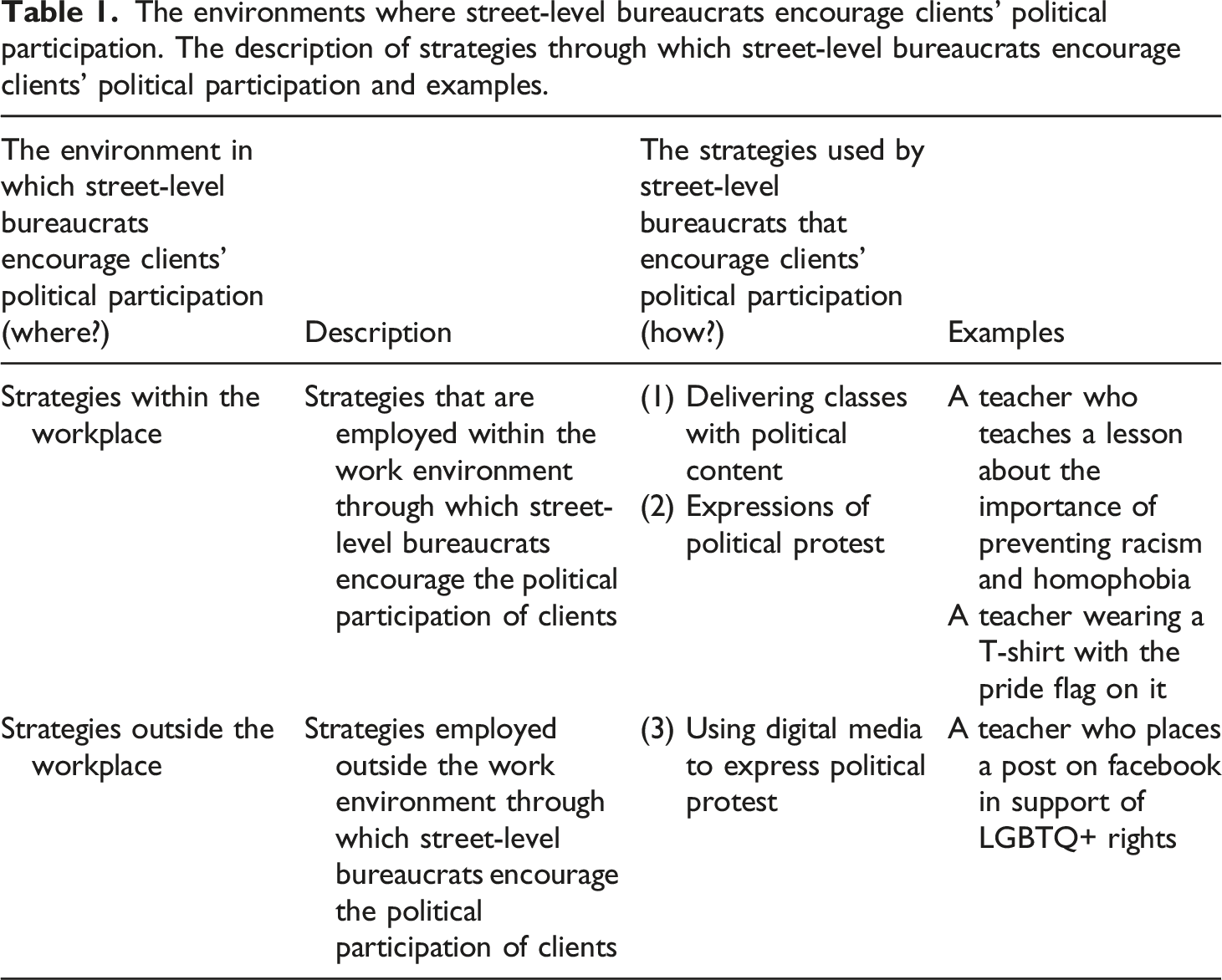
The environments where street-level bureaucrats encourage clients’ political participation. The description of strategies through which street-level bureaucrats encourage clients’ political participation and examples.
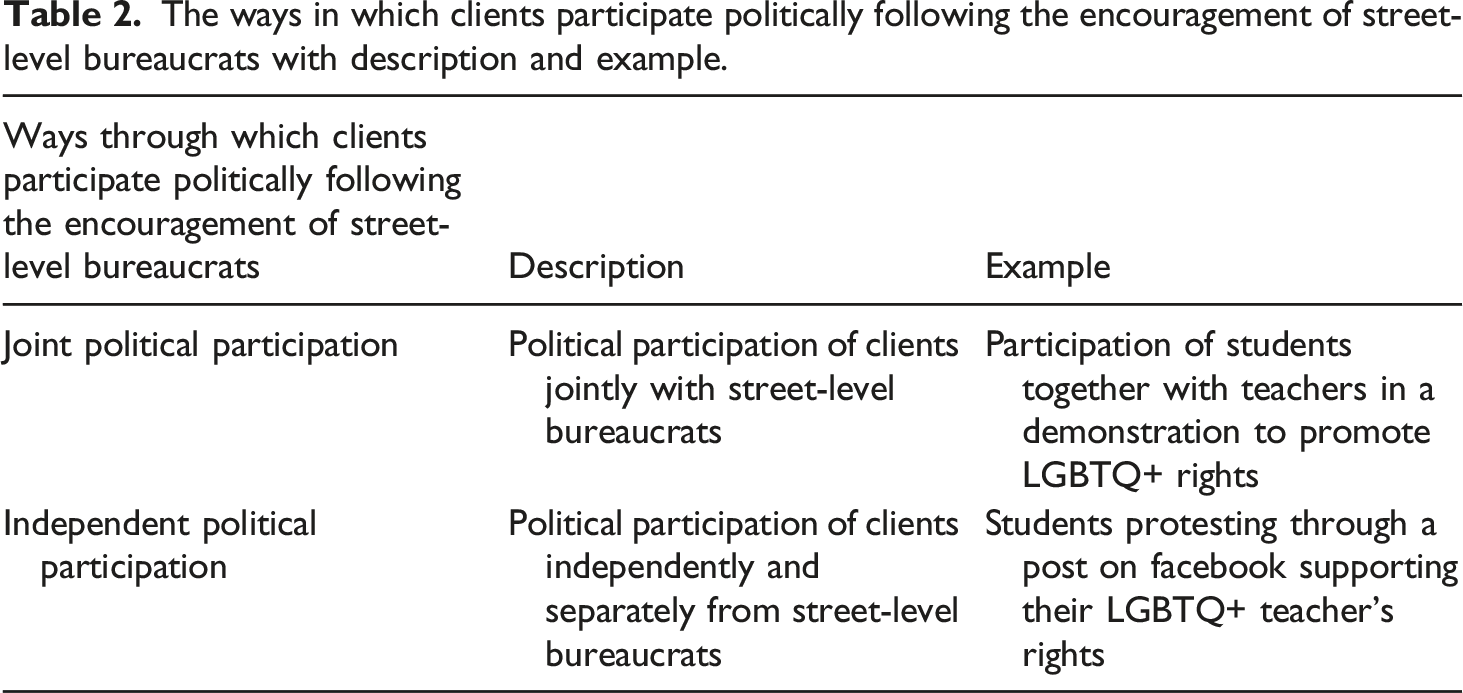
The ways in which clients participate politically following the encouragement of street-level bureaucrats with description and example.
Strategies of street-level bureaucrats within the workplace that encourage clients’ political participation
Street-level bureaucrats’ delivering classes with political content
Street-level bureaucrats in the study described how they hold classes with political content in order to expose students to political and social issues and influence their critical thinking towards pro-LGBTQ+ public policy. They stressed that the purpose of these lessons was to strengthen the values of tolerance and pluralism, increase awareness of issues of racism and discrimination, and shape the attitudes of the future generation. They described how they used their discretion to decide how to integrate this content into the curriculum in a creative way. According to one interviewee: I speak [in the classroom] about topics of racism, homophobia. I connect these topics to a particular lesson. For example, in a practical lesson dealing with the expression of emotions, where I can connect my curriculum and adapt it to that discourse, these are things I did. For example - I talked to classes [in school] about different types of families. In older classes I talked about social issues and gave examples from different plays about changing social reality.
Another interviewee stated: I am a very political person and I think we should talk politics in class and express an opinion … The students feel what I feel, and I also tell them things about LGBTQ+ issues. I must point out that I am in a good level school, where most parents belong to the left side of the political spectrum… Maybe the students are less [active] than the parents but they hear and understand what I say [in class] about tolerance and inclusion and my political opinion.
Another interviewee described: When I started teaching, [the administration] ‘put brakes on me’ so that I would not ‘come out of the closet’ in front of my students in class. At one point I got tired and decided ‘to come out of the closet’ in front of the classes [that I teach] at school so that the place would be safer for students. and so that they would not be afraid ‘to come out of the closet.’ I paid a personal price for it, because I [feel] that I must share with the students what it means to be gay, to talk about everyday life with my family … I make sure to use the language of both male and female, I always use examples of LGBTQ+s in classroom exercises I give my students. It’s part of the mindfulness and agenda consciousness I bring to school.
Participants stated that in many cases the purpose of these classes was to get clients to participate politically. As one interviewee explained: ‘We teach students the “art of protest” … We teach this content and try to get students interested and to research the subject with the aspiration that they will also want to be involved [politically] themselves.’
Street-level bureaucrats’ political protest expressions
The participants noted that to convey political messages and advance their LGBTQ+ political agenda, they use protest measures within the workplace. For example, to voice their LGBTQ+ message in the school environment, they hold pride flags (regularly or at special events) or wear shirts that are painted in pride colors. They explain that they do so out of an idealistic aim to raise awareness of LGBTQ+ issues and bring them to the center of attention. According to one interviewee: ‘I have Pride flag shirts, so I just wear them during Pride Week.’ Another stated: ‘At our school, a flag of pride hangs almost all year round.’ Another teacher remarked: ‘When it was Teachers’ Day [an international day in which teachers are thanked] I came [to school] with a shirt [with the logo] “Proud Teacher.”’
Another teacher mentioned: ‘I got to use [protest] elements of pride [inside the school environment] … [I wore] a pride shirt, [I put] a pride pin on my bag, took with me a pride flag, sunglasses with stripes of pride, and all sorts of accessories [with a flag Pride on them] …’
The participants described how unique political events led them to demonstrate their messages in the school environment. For example, one of the teachers described that when public political statements were made against the LGBTQ+ community, he chose to respond by conveying a clear message of protest to the school community: ‘I wear pride shirts [to school] when there are cases like the one when the Minister of Education spoke out against the LGBTQ+ community … I also come with these shirts during Pride Week. This is how I treat such unique days.’
Strategies of street-level bureaucrats outside the work environment that encourage clients’ political participation
Street-level bureaucrats’ use of digital media to express political protest
The participants described how they use digital media and social networks to voice their political agenda in a way that conveys pro-LGBTQ+ political messages to their clients. Although street-level bureaucrats engage with clients using social networks as part of their daily formal classroom work, the study findings demonstrated that they also used digital media outside the formal work environment to encourage political participation by their clients. They described how they send messages through the social network WhatsApp and through posts on the social network Facebook. According to one interviewee: ‘I posted a post on Facebook as part of [my participation] in the Surrogacy Act protest [a law designed to allow LGBTQ+ couples to have children through a surrogate mother].’
Another interviewee described: ‘I know that parents [of students] participated in the [Surrogacy] protest following a post I wrote on Facebook and they also shared the post and participated by expressing support.’ One interviewee related how she conveyed messages via social media in the context of a protest unrelated to LGBTQ+ issues: ‘recently there was the black shirt protest [a public protest dealing with the security situation in southern Israel] so I came with a black shirt and wrote [to students] on WhatsApp to arrive in black … but all the teachers led it, it’s not that I personally swept them away, everyone chose for themselves [whether to participate] …’
The street-level bureaucrats in the study also highlighted how through digital media they urged former clients (students who had already graduated) to keep them in mind and what they had been taught about LGBTQ+ rights when they went to the polls on election day to vote for a new Prime Minister.
The teachers’ encouragement of students to participate politically continued even after the end of the formal relationship between the parties. As one of the teachers described: ‘One year, right after my [high school] students finished 12th grade, I sent them a message on our WhatsApp group. I asked them to think of me when they vote [in the election] and I meant it only in the context of LGBTQ+ rights.’
Clients’ political participation jointly with street-level bureaucrats in response to street-level bureaucrats’ encouragements
Joint political participation of clients with street-level bureaucrats
The study findings demonstrated that when clients participated politically in response to encouragement by street-level bureaucrats, it was often in the form of joint activities. The participants described how they participated together with clients in demonstrations and protests combining their efforts to bring about changes in policies toward LGBTQ+s. According to one teacher: ‘There have been several instances where there has been violence against proud [LGBTQ+] couples and it also happened to be directed at one of the educators at our school. We did not remain indifferent, we turned to the police, we made a demonstration [together]’
In some cases, the joint political participation of street-level bureaucrats with clients was the result of an initiative by clients to voice support for street-level bureaucrats. An act of common protest allowed them to support and identify with each other. As one interviewee stated: ‘We [the students and I] participated in the student demonstration that took place against the Minister of Education [who spoke out against the LGBTQ+ people] … The students felt it was appropriate to address and say things [on the subject] to the teachers [through participation in the demonstration].’
Another interviewee stated: Our students were among the organizers of the student demonstration against Minister Rafi Peretz [former Minister of Education who spoke out against the LGBTQ+ community and noted, among other things, that a normative family consists only of parents who are a man and a woman]. Students from our student council [of the school] spoke there, they organized buses for the demonstration … The teachers [at our school] have also made it a part of their educational mission.
Political participation of clients independently and separately from street-level bureaucrats
The street-level bureaucrats in the study described that in some cases, their actions motivated their clients to engage in independent political activity without the street-level bureaucrats’ involvement. For example, clients participated in and even initiated demonstrations and protests, as well as voiced their own expressions of political protest through digital media. According to one teacher: When we went to fetch our baby, who was born in Thailand [through a surrogate mother] we got stuck there with another group of proud parents like us and were prevented from returning to the country [to Israel] … There was a protest demonstration in which both celebrities and ordinary people were photographed holding a ‘Bring the babies home’ sign to put pressure on Gideon Saar, who served as interior minister at the time, to authorize us [the gay parents] to get passports to go back to Israel. The Israeli authorities claimed that the Thai authority would accuse us [the Israeli gay parents] of abducting babies from Thailand because in Thailand the biological mother is registered as the mother of the child even though she is a surrogate mother… [Following this] the students took a picture of the whole class as well to express sympathy with the protest. The students received thousands of likes [on Facebook] from people who were excited about their social awareness and their support for their teacher to return to Israel. The students also shared the photo on their personal Facebook profile pages and their parents also expressed support [in the fight] on Facebook.
In some cases, the encouragement of street-level bureaucrats led clients to take the initiative themselves to engage in political activity. The cooperation between the parties in speaking with a common voice created a significant protest force. According to one interviewee: ‘The students took it upon themselves to go out and participate in the Pride events and hang Pride flags [at school] following the activity we conducted [about LGBTQ+ rights].’
The participants also stressed that when clients participated in protests and demonstrations without the presence of street-level bureaucrats, clients made sure to update them in real time and send testimonies expressing support and sympathy. For example, they sent text messages to street-level bureaucrats with photos and live video from the demonstration. As one interviewee described: ‘My students throughout the years marched in the Pride Parades in Haifa [a city in Israel]. Even when I was not present [at the parade] because I was abroad several times, they sent me pictures because it was important to them that I be shown that they were doing it.’
Another teacher related: ‘I see students participating in Pride Parades to show me they are there. It is important to them to show me that they [participate] in the parades even though they are straight. Students from the [LGBTQ+] community also want me to see them there [at the Pride Parades].’
Discussion
Through semi-structured in-depth interviews with 36 LGBTQ+ street-level bureaucrats, this study sought to examine whether they encouraged clients to participate politically, if so, by what means, and how this political participation of clients was manifested. The case study that was used to explore these phenomena focused on LGBTQ+ teachers in Israel.
The study findings revealed that street-level bureaucrats encourage clients to participate politically through strategies they adopt both within and outside their workplace. Within the classroom, teachers deliver lessons with political content and voice expressions of political protest. Outside their work environment, they use digital media to express political protest. It also emerged that the political participation of clients following the encouragement of street-level bureaucrats takes place both jointly with the street-level bureaucrats and independently of them.
What are the contributions of this study? First, in line with studies examining how street-level bureaucrats use their discretion to influence the lives of their clients (Lavee et al., 2018; Tummers and Bekkers, 2014), this study reveals that street-level bureaucrats encourage clients to take initiative and participate politically identifying them as a channel for influencing the advancement of a political agenda. Second, consistent with studies that have observed the tendency of street-level bureaucrats to express their voice and use their discretion actively (Brockmann, 2017; Van Loon et al., 2018), this study takes existing knowledge a step further and reveals the strategies that street-level bureaucrats adopt to communicate their political agenda to clients in order to encourage their political participation. Third, the study reinforces previous research findings that demonstrate that street-level bureaucrats adopt practices to promote and influence policy outcomes (Fargion, 2018; Gal and Weiss-Gal, 2013; Weiss-Gal, 2016). The study reveals that clients participate in political activity in response to the encouragement of street-level bureaucrats. They do so not only in conjunction with the street-level bureaucrats, but also are motivated to engage in and even initiate independent political activity. Fourth, the study validates the observation through the case of LGBTQ+ teachers in Israel. In contrast to previous studies that dealt with the LGBTQ+ context from the clients’ point of view (Baker et al., 2020), this is the first study, to my knowledge, that focuses on LGBTQ+ street-level bureaucrats themselves. This case study is particularly interesting, as it makes it possible to identify that when street-level bureaucrats have an interest in acting to advance policies that concern them personally (Davidovitz and Cohen, 2022b), it may play a role in their inclination to recruit clients to advance their political agenda.
Together, the research contributes to understanding the impact that street-level bureaucrats have on clients and how through cooperation between the parties ‘the whole becomes greater than the sum of its parts.’ It demonstrates that the unique relationship between the parties may be a channel for joint influence on policy outcomes that should be encouraged to promote social values and contribute to social welfare.
Research limitations and recommendations for future studies
As with other studies, this study has several limitations. First, it is difficult to make a causal link between the strategies that street-level bureaucrats adopt that encourage clients’ participation and the political participation itself. There may be other explanations that play a role in this relationship, such as the influence of parents or the degree of political awareness of clients. Further studies are needed to examine this, for example through experimental research that neutralizes alternative explanations. Another limitation is related to the research unit used for the study. The data were collected through interviews with street-level bureaucrats. I am aware that there may be a bias regarding participants’ interpretations regarding the weight of their impact on clients’ political participation. Further research is needed to examine this from the perspective of clients. Furthermore, the findings collected relate specifically to teachers whose pedagogical role allows them to influence the formation of clients’ perceptions and attitudes. Further studies are needed to explore this with relation to other types of street-level bureaucrats, such as social workers and nurses, the nature of whose interactions with clients is different. The LGBTQ+ case is one with unique characteristics. Further studies should examine the phenomenon regarding other street-level bureaucrats who experience inequality or discrimination on the part of the state (for example, on ethnic or religious grounds). Studies are also needed to examine whether street-level bureaucrats’ encouragement of clients to participate politically will have a lasting impact and whether it will lead to active engagement in LGBTQ+ or other political issues over the course of time. There is also the question of what motivates street-level bureaucrats to encourage clients to participate politically. Are there major reasons that lead them to do so? Finally, teachers may encourage students’ political activism with regard to other causes about which they feel strongly such as climate change, pacifism, racism, violence against women, and even better pay for members of their own profession. Teachers who are not LGBTQ+ may also encourage their students to participate politically in these as well as LGBTQ+ causes. Future studies should address these additional issues.
Footnotes
Declaration of conflicting interests
The author(s) declared no potential conflicts of interest with respect to the research, authorship, and/or publication of this article.
Funding
The author(s) received no financial support for the research, authorship, and/or publication of this article.
