




Abstract
This paper studies the intended and unintended effects of street-level bureaucrats’ enforcement style. More specifically, it answers to what extent street-level bureaucrats’ enforcement style affects citizens’ obedience (i.e. intended effect) during face-to-face encounters and willingness to publicly shame bureaucrats (i.e. unintended effect). Building on insights from street-level enforcement and the social interactionist theory of coercive actions, a trade-off is theorized between the effect of enforcement style on citizens’ on-the-spot obedience and on public shaming. Results of an experiment (n = 318) and replication (n = 311) in The Netherlands reveal that (1) neither the legal nor facilitation dimension has an effect on on-the-spot obedience; (2) the legal dimension does not affect public shaming but (3) the facilitation decreases it. These findings are robust across both the experiment and replication.
Introduction
Why street-level bureaucrats behave the way they do is a central topic in public management and public administration research (e.g. Lipsky, 2010; Petersen et al., 2018; Tummers et al., 2015; Van Engen et al., 2016). There is also growing attention for how bureaucrats assess citizens (Harrits, 2018; Jilke and Tummers, 2018; Keulemans and van der Walle, 2020; Pedersen et al., 2018; Raaphorst et al., 2018). What is lacking from this debate, however, is how citizens assess street-level bureaucrats. Citizens’ assessment of street-level bureaucrats is relevant to explore since bureaucrats’ behaviour if often perceived more negative than intended (Mascini and Van Wijk, 2009). Such assessments by citizens matter because they can affect service provision by, for instance, increasing efforts by citizens during bureaucrat–citizen encounters (Guul, 2018; Riccucci et al., 2016). This is especially prevalent for bureaucrats working in enforcing professions such as police officers, traffic wardens, conductors or inspectors who deal with disobedience which has been labelled a ‘negative’ citizen behaviour (Gofen et al., 2019). These enforcing bureaucrats limit citizens’ freedom by sanctioning non-compliant behaviour (Sparrow, 2000) making them especially prone for negative assessments of citizens.
The frontline enforcement of bureaucrats is often referred to as enforcement style which is defined as their attitude during public encounters towards citizens while enforcing public policies and issuing sanctions (De Boer, 2018; May and Winter, 1999, 2000). Most scholarship investigates the effect of the compliers’ motivations or regulatory structures on citizens’ (dis)obedience (Ayres and Braithwaite, 1995; Kagan, 1994; May, 2005; Winter and May, 2001) but rarely focuses on what bureaucrats do during public encounters to ensure immediate or ‘on-the-spot’ obedience (i.e. compliance) (Gofen et al., 2019). In turn, surprisingly, few studies test the direct effect of enforcement style on obedience during face-to-face encounters and, in turn, no uniform conclusions can be drawn.
More importantly, scholars largely ignore that street-level bureaucrats’ enforcement style can result in other citizens’ behaviour such as negative assessments (see Mascini and Van Wijk, 2009; May and Winter, 2011) which happen largely in the online public sphere. Governments are increasingly showing the public via online channels how they are performing which empowers citizens to hold them accountable (see Grimmelikhuijsen and Meijer, 2012; Hupe and Hill, 2016). There is, indeed, growing indication that citizens do. To illustrate, police departments across the globe are active in social media to enhance their perceptions among citizens (Grimmelikhuijsen and Meijer, 2015). On top of that, citizens actively provide feedback via social media platforms about the quality of services (Griffiths and Leaver, 2018; Trigg, 2014; Van de Wale, 2016; Van Erp and Loyens, 2018). Moreover, citizens also film and photograph police and share it on social media in order to expose police misconduct (see Potere, 2012). There is also a rise of citizens organizing ‘cop-watching’ groups who record the behaviour of police officers with smartphones and publish their collected material online (Bock, 2016; Simonson, 2016). In other words, citizens are increasingly ‘watching the watchmen’ by shaming them publicly online (see Potere, 2012).
In essence, during public encounters, street-level bureaucrats must use their enforcement style to ensure citizens obey when given a sanction while at the same time avoid the potential consequences of negative citizen assessments by getting publicly shamed. In this study, insights from relational distance (see Black, 2010; De Boer and Eshuis, 2018; Grimmelikhuijsen et al., 2019; Trope et al., 2007) and social interactionist theory of coercive actions (Tedeschi and Felson, 1994) are used to theorize a trade-off between the intended effect of a bureaucrats’ enforcement style (i.e. obedience) and the unintended effect (i.e. public shaming). Using this theorized tension, this study answers to the question, To what extent does street-level bureaucrats’ enforcement style influence citizens’ obedience and public shaming of bureaucrats online? Theoretically, this study contributes to our understanding of implications of street-level bureaucrats’ enforcement during public encounters for the ways citizens assess bureaucrats (e.g. Pedersen et al., 2018). Methodologically, an experimental test and replication are conducted. Replications of experiments remain rare while the necessity of replication is increasingly recognized for (dis)confirming theories under (dis)similar conditions (Walker et al., 2017). This study, therefore, adheres to the call for more replication.
The remainder of this study is structured as follows: The conceptual underpinnings and hypothesized relations will be discussed first. Then, the methodological considerations and the experimental design will be explained followed by a discussion of the findings. This study concludes with a discussion and conclusion section addressing the implications of the findings for understanding street-level enforcement and policy implementation across different public management contexts.
Conceptualizing enforcement style
A street-level bureaucrats’ enforcement style is composed of multiple dimensions. During encounters with citizens, street-level bureaucrats will use their discretion to decide how to best combine the different enforcement style dimensions in a specific context which, in the end, makes up their enforcement style. Which constellation of dimensions is combined depends on the context at hand and the street-level bureaucrat him/herself (Mascini and Van Wijk, 2009; May and Winter, 2000; Nielsen, 2015). A bureaucrats’ enforcements style depends, thus, to a large degree on the social dynamics between bureaucrat and citizens (see Pedersen et al., 2018; Raaphorst and Loyens, 2020), such as, for instance, the social distance in their relationship due to socio-economic status (Black, 2010). There is no clear consensus in the literature yet concerning the number of dimensions of enforcement style (see May and Winter, 2011). To illustrate, while on the one hand May and Winter (1999, 2000) empirically reveal two dimensions, Lo et al. (2009) on the other hand find five dimensions. Recent research provides empirical evidence that, in a Western context, street-level bureaucrats’ enforcement style is composed of three dimensions, namely a (1) legal, (2) facilitation and (3) accommodation dimension (De Boer, 2018; De Boer et al., 2018).
First, the legal dimension concerns both formal and coercive elements of enforcement. Street-level bureaucrats applying this dimension in their style are generally rigid in their enforcement of policies and threatening by stressing negative consequences of disobedience such as sanctions (see also Kagan, 1994; May and Winter, 1999, 2000; May and Wood, 2003). Second, the facilitation dimension addresses predominately a communicative attitude towards enforcement (see also Lo et al., 2009). To illustrate, street-level bureaucrats adhering to this dimension focus on transferring professional knowledge to help citizens obey regulations. Finally, the accommodation dimension concerns the extent to which opinions about enforcing of others, such as co-workers or team leaders, are considered during encounters with citizens by street-level bureaucrats (see also Lo et al., 2009). Notably, this dimension slightly differs from the first two since it is cognitive and not behavioural in nature. In other words, the accommodation enforcement style dimension will not be directly visible to citizens and, therefore, not directly affect citizens’ behaviour whereas the legal and facilitation dimensions will (De Boer, 2018; De Boer et al., 2018).
Intended effect: On-the-spot obedience
Often enforcing bureaucrats have to secure obedience with rules, regulations or sanctions directly while interacting with citizens face-to-face. These citizens are not powerless and may hold the power to decide to obey or not. Unlike organizational interventions, street-level bureaucrats often encounter citizens before or while they are non-compliant and are, thus, sanctioned. To illustrate, police officers fining citizens often need to secure obedience on the spot by having the offenders pay directly or fail by having them wait and object which, in turn, raises bureaucratic paperwork. Ultimately, street-level bureaucrats can use their enforcement style during policy delivery to secure on-the-spot obedience with sanctions (see May and Winter, 1999, 2000). Though little studies test the effect of variations in enforcement style on citizens’ on-the-spot obedience with sanctions and the results are not uniform (see May and Winter, 2011), there is a long tradition of evidence indicating that both the legal and the facilitation dimensions positively affect citizens’ obedience. A positive effect is expected from both the legal and facilitation dimensions of enforcement style on citizens’ obedience.
On the one hand, the legal dimension can stimulate citizens’ obedience with sanctions (May and Winter, 1999, 2000; Van Parys and Struyven, 2018) because it, among others, signals predictability (Liu et al., 2018). There is, indeed, some empirical support in the classic compliance literature. Nielsen and Parker (2009) find that a legal or ‘tit for that’ approach rarely occurs in practice, but when it does it improves compliance. Moreover, May and Winter (1999) investigate the direct effect of enforcement style on farmers’ compliance with agro-environmental regulations and find a modest positive effect of a legal style (labelled by them as coercion). In addition, Winter and May (2001) investigate compliance of homebuilders. They also find a modest effect of a legal style (labelled by them as formalism) on compliance, especially when the knowledge of regulations and sanctions by homebuilders is low. May and Wood (2003), however, study homebuilders’ compliance capacity but do not find any direct effect of enforcement style. Nevertheless, their results do indicate that a legal enforcement style can indirectly affect obedience by increasing future cooperation.
On the other hand, Van Parys and Struyven (2018) state whereas it was formerly assumed that citizens or firms can only be motivated to [obey with sanctions] by use of coercion, motivation is now considered a much more complex phenomenon downsizing the relative performance of coercive approaches and favouring more cooperative approaches (p. 4).
A growing body of scholarship addresses these cooperative aspects, which are central components of the facilitation dimension and, more specifically, the relationship that forms because of it during enforcing encounters between the street-level bureaucrat and those they regulate (e.g. Ayres and Braithwaite, 1995; Pautz and Wamsley, 2012; Pautz et al., 2017). There is, indeed, growing evidence that a facilitative attitude fosters trust and cooperation (Pautz, 2009; Pautz and Wamsley, 2012) and, in that way, obedience (see Pautz et al., 2017).
Regardless, scholars have started to acknowledge that the effectiveness of how policies are enforced and wrongdoings sanctioned also depends on the social dynamics between street-level bureaucrat and citizens (e.g. Raaphorst and Loyens, 2020; Van de Walle and Raaphorst, 2019). Therefore, it is expected that the strength of the positive effect of a legal and facilitation enforcement style differ, because the social dynamics differ in repeated and occasional (i.e. one-shot) enforcement interactions. Scholars have stressed the importance of using relational distance to differentiate between repeated and one-shot interactions between bureaucrat and citizens because it may affect how they (intend to) behave (see De Boer and Eshuis, 2018; Liu et al., 2018). We theorize our expected difference by drawing on the notion of relational distance (Black, 2010).
Drawing on the notion of relational distance by Black (2010), De Boer and Eshuis (2018) define relational distance as ‘the degree to which the [bureaucrat] and the [citizen] participate in each other’s (professional) lives)’ (p. 5). Relational distance has been linked to a greater feeling of intimacy, sympathy and trust between actors (see Black, 2010; Hood et al., 1999; Pautz and Wamsley, 2012). Relational distance is affected by multiple dimensions, such as similarities in personal characteristics (e.g. job), frequency of interactions and likelihood of meeting (see Black, 2010; Trope et al., 2007). This study primarily focuses on the distance between two individuals and, thus, the ‘distance between the perceiver and a social target, that is, another individual or group’ (Grimmelikhuijsen et al., 2019: 5).
In repeated interactions, the relational distance is low because the frequency of citizen–bureaucrat interactions is high. The bureaucrat and citizen can get to know each other through these repeated interactions and form a relationship which can be used by bureaucrats to persuade citizens towards obedient behaviour (see Baldwin et al., 2012; Black, 2010; Boyne et al., 2002). To illustrate, veterinary inspectors, some of whom are permanently based in slaughter houses, have frequent interactions with the slaughter house owners. In one-shot enforcement interactions, however, the relational distance is high because the frequency of interactions is low. The bureaucrat and citizen interact only on occasions, and interactions between the same citizen and the same bureaucrat are rare (Baldwin et al., 2012; Black, 2010; Boyne et al., 2002). There will, thus, be little opportunity for the bureaucrats to adequately communicate cooperative intentions or form a long-lasting relationship (see Mascini and Van Wijk, 2009; Pautz et al., 2017). An example of this type of encounter is between conductors of public transport and citizens. When citizens board a train, their ticket will be checked by a train conductor but the chance of encountering the same conductor regularly is exceptional.
All in all, it is expected that, as mentioned above, both the legal and facilitation dimensions positively affect citizens’ obedience with sanctions. However, the effectiveness of the facilitation dimension is expected to depend on its ability to foster and nurture trust and a cooperative relationship (see Pautz, 2009; Pautz and Wamsley, 2012) while the effectiveness of the legal dimension does not. It is, therefore, expected that in one-shot enforcement encounters, there is almost no real bureaucrat–citizen relationship to begin with and, in turn, a facilitation style will have a weaker effect on on-the-spot obedience because it cannot succeed in fostering a cooperative and trusting relationship. H1: In one-shot bureaucrat–citizen encounters, the legal enforcement style dimension will have a stronger positive effect on citizens’ on-the-spot obedience with sanctions than the facilitation enforcement style dimension.
Unintended effects: Public shaming
Scholars often neglect, that there is also indication that a legal enforcement style may have consequences in terms of perverse behaviours by citizens. One way citizens can make their perverse behaviours know is by public shaming. Shaming has a long tradition in the regulation literature as a regulatory instrument where regulators can disclose names of non-compliant businesses in order to steer them towards more favourable behaviours (e.g. Ayres and Braithwaite, 1995; Hood, 2007; Van Erp, 2013). However, citizens increasingly also provide feedback through formal complaints or informal shaming on social media (Griffiths and Leaver, 2018; Trigg, 2014; Van de Wale, 2016; Van Erp and Loyens, 2018). Public shaming is a form of criticizing public organizations or their bureaucrats ‘which either seeks to induce shame in that person, or at least express a judgement that the person ought to feel ashamed of themselves’ (Rowbottom, 2013: 1). Even when this feeling of shame is not evoked, public shaming can result in reputational damage and ‘blame’ for both organizations and individual bureaucrats (De Boer et al., 2018; Hood, 2010; Van Erp, 2011). On top of that, citizens’ (negative) feedback plays an increasingly important role in the way regulators enforce (Griffiths and Leaver, 2018; Van Erp and Loyens, 2018). An important goal of public shaming is critiquing and negative assessments. This goal is important when investigating citizens since this aspect of public shaming includes a subjective view of the person doing the shaming of actions of the one being shamed. In other words, it included a perceptual judgement of citizens. Public shaming is often done via (online) media outlets (Rowbottom, 2013). But how does a bureaucrat’s enforcement style influence public shaming by citizens online?
Two streams of literature help form expectations about public shaming of bureaucrats by citizens. First, there is also indication that a legal enforcement style has a boomerang-effect. Notably, it is hard for street-level bureaucrats to determine when being legal in their style boomerangs. Mascini and Van Wijk (2009) study the applicability of assumptions in responsive regulation theories among Dutch inspectors and the citizen-clients they regulate. They find that citizens perceive the attitude of the inspectors they interact with as more punitive and negative than the inspectors intended. Citizens tend to focus on the strict and coercive elements of their encounter, such as being threatened with a fine, rather than on positive signals. Mascini and Van Wijk (2009), thus, show that enforcing street-level bureaucrats are unable to fully control the negative consequences of their enforcement style.
Moreover, May and Winter (1999) find that street-level bureaucrats should ‘get tough up to a point’ (May and Winter, 1999: 625) but not go beyond that point. In other words, overly applying the legal dimension can stimulate citizens’ conformity but only when it is below certain threshold. May and Winter (1999) find that when these thresholds are surpassed, threatening with sanctions (i.e. a core component of the legal dimension) negatively affects obedience and, thus, backfires because it may be perceived as bullying by citizens (see also May and Winter, 2011). Citizens could, in turn, react by resisting with disobedient behaviour such as verbal aggression both offline and online (see Belvedere et al., 2005; Engel, 2003). To put it differently, it is expected that a solely legal enforcement style will have a boomerang-effect and, in turn, perverse effects will occur in the form of publicly shaming bureaucrats. H2a: In one-shot bureaucrat–citizen encounters, the legal enforcement style dimension increases willingness to publicly shame bureaucrats.
To illustrate, when citizens are threatened with consequences of violating laws (i.e. a central component of the legal enforcement style) during traffic stops, citizens may disrespect the police officer verbally in public (see Engel, 2003). Building on Tedeschi and Felson’s (1994) social interactionist theory of coercive actions, it is expected that in one-shot public enforcement encounters, where bystanders are present, the facilitation dimension is expected not to backfire because it will not be perceived as overly punitive but rather as more positive and, in turn, does not challenge citizens’ authority (Mascini and Van Wijk, 2009; May and Winter, 2011; Tedeschi and Felson, 1994). This, in turn, is expected to lead citizens to decrease their public shaming of bureaucrats. H2b: In one-shot bureaucrat–citizen encounters, the facilitation enforcement dimension decreases willingness to publicly shame bureaucrats.
Method
Data collection
To test the hypothesized relations, two survey experiments were sent to a representative sample of citizens of the Dutch population. Experiment 1 was used to test hypothesized mechanism and experiment 2 served as replication to see whether the hypothesized effects hold in a different context (see Walker et al., 2017). Both survey set-ups followed recommendations and requirements by public management and administration research (Lee et al., 2012; Podsakoff et al., 2012). More specifically, both experiments were pre-tested with a pilot study; dependent and independent variables were separated; items of multiple-item questions were highlighted to enhance respondent focus; anonymity of answers was guaranteed, and response bias was minimized by including an introductory statement.
Both experiments and pilot studies were conducted via the online panel organization Qualtrics. Minor adjustments were made based on the results of the pilots (n1 = 150; n2 = 150). Experiment 1 (n3 = 318) was conducted in May 2018 and experiment 2 (n4 = 311) in July 2018. On top of Qualtrics own quality checks, an attention check was included as well as one screener to ensure that participants had at least one social media account (see Appendix I). Respondents who failed to answer the attention check correctly or had zero social media accounts were excluded from the sample.
Settings
In experiment 1, all respondents were subjected to a hypothetical scenario about getting fined by a train conductor for not having a valid train ticket. In experiment 2 (i.e. replication), only the context was altered to getting fined by a city watch officer for not having a valid parking ticket. Both contexts were chosen for four main reasons. First and foremost, both train conductors and city watch officers are classic street-level bureaucrats enforcing public laws (i.e. buitengewoon opsporingsambtenaar) and sanction wrongdoers accordingly. Second, when you get fined by train conductors and city watch officers, this will happen in a public space and, therefore, there will be third parties present. Third, all citizens are likely to have travelled by train or car at least once in their lifetime making it a realistic scenario. Finally, it is rare that a citizen interacts with the same train conductor or city watch officer on multiple occasions ensuring the one-shot nature of the public encounter.
Procedure
First, respondents were asked to fill in questionnaire items about demographics and several confounding factors (i.e. perceived procedural fairness and compliance motivations). Second, respondents were exposed to the treatment which started with a clear introduction to make clear that (1) they needed to read the hypothetical scenario carefully; (2) their answers would be kept confidential and, more importantly, (3) that though it is a hypothetical situation that they should really try to answer as though a similar situation occurred in their life (see Jilke and Tummers, 2018). Third, respondents were randomly assigned to a control or one of two treatment groups. In each of the three groups the information about the enforcement style of the bureaucrat (i.e. the independent variable in this study) differed. The control group was included to isolate the effect of enforcement style and rule out any other potential explanations. Figure 1 displays the survey experiment design. Finally, after the treatment, all respondents filled in identical questions about the dependent variables as well as the manipulation checks.
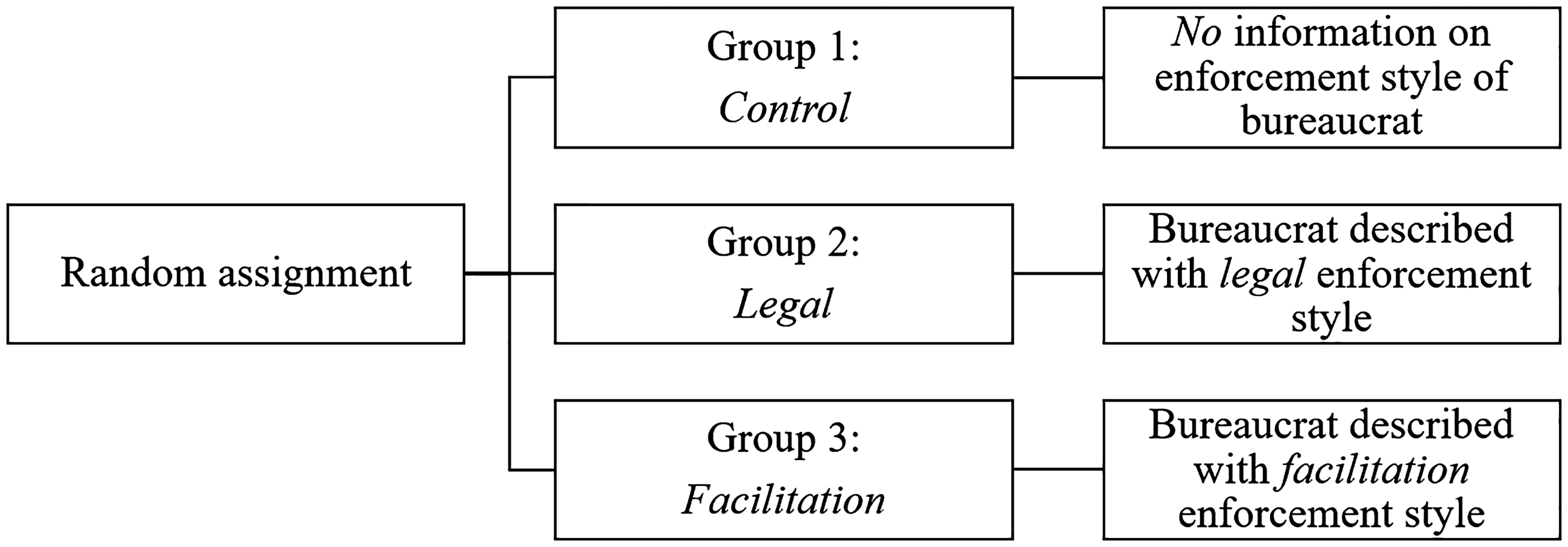
Experimental design.
Measures
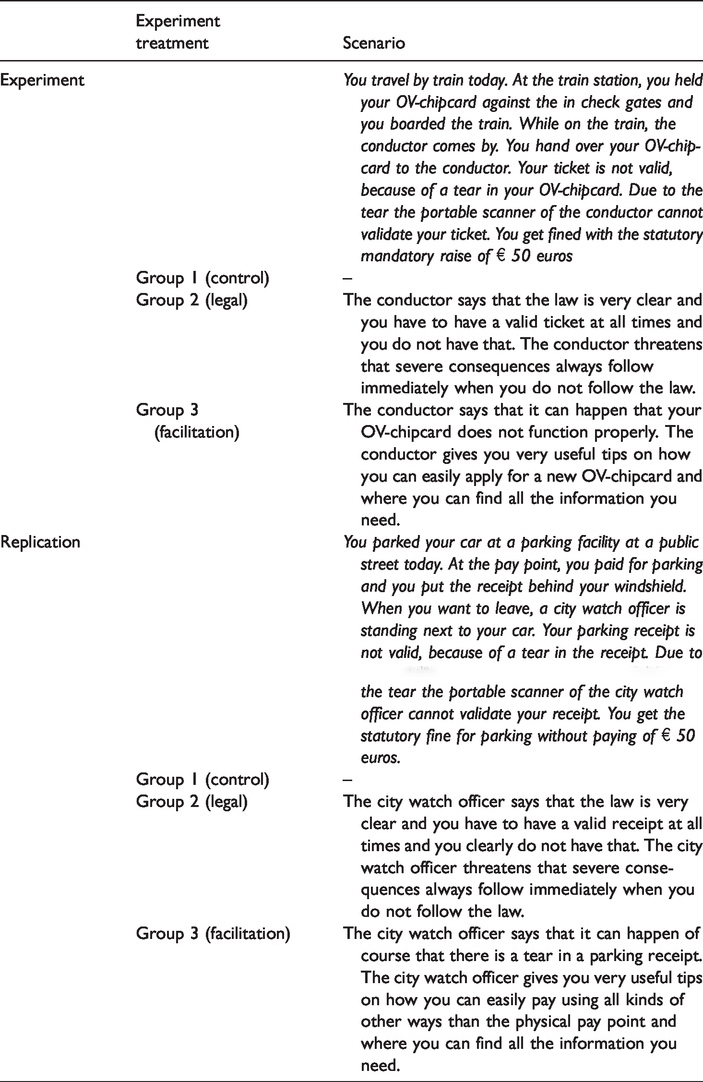
Enforcement style: The independent variable is enforcement style. This study builds on recent empirical evidence that it consists of three dimensions, namely (1) legal, (2) facilitation and (3) accommodation (De Boer, 2018). This experiment focuses on the legal and facilitation dimensions, since these have behavioural implications for citizens while the accommodation dimension is more cognitive in nature and, therefore, not directly visible to citizens (see De Boer, 2018). For each, treatment scenarios were developed (see Table 1).
Experiment scenarios (varies independent variable: enforcement style).
Treatment checks: To ensure the treatments were perceived by respondents as intended, three items were formulated to measure the legal and facilitation style as perceived by respondents. Respondents were asked to rate on a 10-point scale to what extent the street-level bureaucrat was ‘threatening’ (i.e. legal style) or ‘advising’ (i.e. facilitation style). Principal Component Analysis (PCA) indicated that both three-item scales measure one underlying construct and the scales indicated good reliability (in n3, α = .882 for legal and α = .907 for facilitation; in n4, α = .852 for legal and α = .797 for facilitation).
Citizens’ obedience: Obedient behaviours are hard to measure and has been measured in many different ways (see May and Winter, 2011; Parker and Nielsen, 2009). This study builds on Gofen et al. (2019) who take a bottom-up perspective to citizen obedience which entails a focus on interventions taken by bureaucrats during public encounters and, in turn, on situations where citizens can be sanctioned. In this study, respondents are exposed to a vignette in which they did not have a valid ticket. On-the-spot obedience is, then, operationalized as one dichotomous item giving respondents two options, namely (1) pay the bureaucrat the fine immediately (i.e. obedience) or (2) object to the fine and not pay the bureaucrat the fine immediately (i.e. disobedience). This latter is understood as disobedience since the citizen is choosing a behaviour which is not in line with full cooperation (i.e. paying the fine immediately) and poses more administrative burdens on both bureaucrat and citizen.
Public shaming of bureaucrats by citizens: Building on the idea of ‘naming and shaming’ (see Rowbottom, 2013; Van Erp, 2011) public shaming of street-level bureaucrats by citizens is understood as a citizen’s criticizing bureaucrats and their individual characteristics via online platforms. Respondents were asked to answer three items about what they would write in an online review about their interaction with the conductor. The first item (‘what is the tone of your review’) addressed the tone of the review and taps into the criticizing aspect of public shaming of bureaucrats. The second item (‘how do you describe the interaction with the conductor’) addressed the interaction with the conductor and focuses on the behaviour of the bureaucrat. The third item (‘how do you describe the conductor’) focuses on individual characteristics of the bureaucrat. All items had polar opposites. The scale was reversed for analysis for interpretation purposes. The lower the score, the lower is the public shaming. PCA indicated that all three items measured one underlying construct which is highly reliable (in n3, α = .835; in n4, α = .890).
Potential covariates: On top of demographic controls (i.e. age, gender, education level and ethnicity), two main potential covariates were identified based on previous literature, namely (1) perceived procedural fairness and (2) compliance motivations (i.e. calculative, normative and social) (see Grimmelikhuijsen and Meijer, 2015; Nielsen and Parker, 2009).
A complete overview of all items can be found in the Appendix and of the factor analyses in Appendix II.
Results
Descriptive statistics
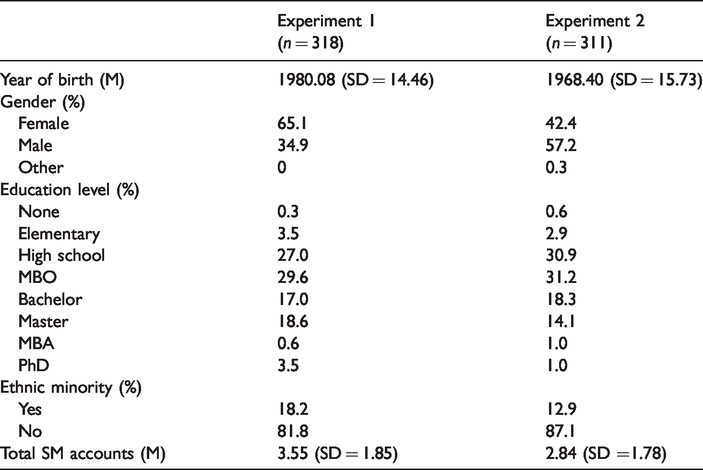
Table 2 depicts the descriptive statistics for both samples concerning year of birth, gender, education level, ethnicity and number of social media accounts. Both samples are largely similar with the exception of the distribution of gender. 1
Sample characteristics.
Balance and manipulation checks
First, a series of ANOVA’s and chi-squared tests were used to test whether the experimental groups were balanced concerning demographics (age, gender, education level, ethnicity) and possible covariates (total number of social media accounts, daily social media use, extent of usage of train/car, previous experience with train/car fines, compliance motivations and procedural fairness 2 ). In experiment 1, the mean response in the control and legal treatment groups differed concerning normative compliance motivation (F (2, 315) = 3.7, p = .026). Normative compliance motivation was, therefore, included as a covariate in the hypotheses testing of experiment 1 as a robustness check.
Second, respondents were asked to respond to two sets of questions right after the experimental scenarios to measure the effectiveness of the treatment. A MANOVA as well as post-hoc analyses confirm that the treatments influenced the respondents as intended in both experiments. In both experiments 1 (V = .32, F (4, 630) = 29.6, p = .000) and 2 (V = .16, F (4, 616) = 13.69, p = .000), there is a significant effect of the treatment on the manipulation perception. For experiment 1, the mean score of legal treatment group is highest for the legal items (M = 6.75, SD = 2.54) and this mean differs significantly from the control group (p = .005). 3 Likewise, the mean score of the facilitation treatment group is highest for the facilitation items (M = 7.30, SD = 2.59) and this mean score differs significantly from the control group (p = .000). Table 3 shows that this pattern is identical in experiment 2. It has to be noted that respondents in experiment 2 perceive the enforcement style, on average, as more legal (M = 6.40, SD = 2.44 compared to M = 5.55, SD = 2.64 in experiment 1) and less facilitating (M = 4.97, SD = 2.17 compared to M = 5.44, SD = 2.59 in experiment 1) than respondents in experiment 1. This difference should be taken into account when interpreting the results (Table 4).
Descriptive statistics treatments.
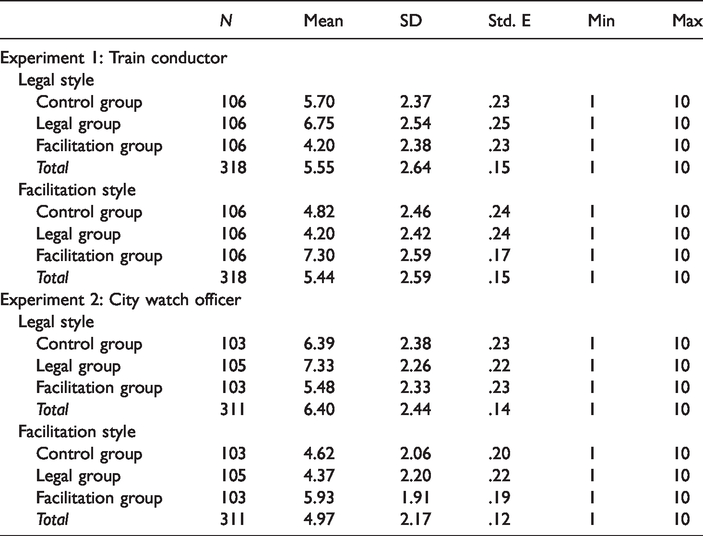
Manipulation check.
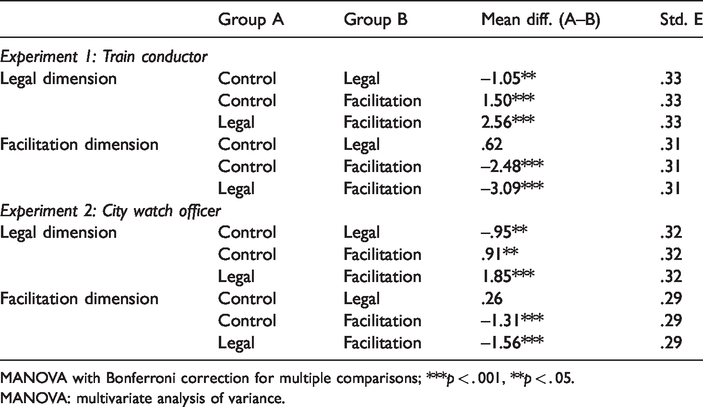
MANOVA with Bonferroni correction for multiple comparisons; ***p < . 001, **p < . 05.
MANOVA: multivariate analysis of variance.
Hypotheses testing
Hypothesis 1 predicted that a legal style would have a stronger positive effect on citizens’ obedience than the facilitation style dimension. Table 5 reports the contingency table for experiment 1 showing that, regardless of the assigned group, the majority of respondents disobey. The percentage of respondents who report non-compliance ranges between 72 and 75. In other words, contrary to our expectation formulated in H1, experiment 1 finds no significant differences between groups exposed to the legal dimension. Likewise, the facilitation dimension does not affect obedience. Results from experiment 2 confirm this result and also indicate that the majority of respondents report disobedience (with a range from 80% till 87%) and there are no significant differences between groups (see Table 5). Hypothesis 1 is, therefore, rejected.
Contingency table citizens’ obedience.
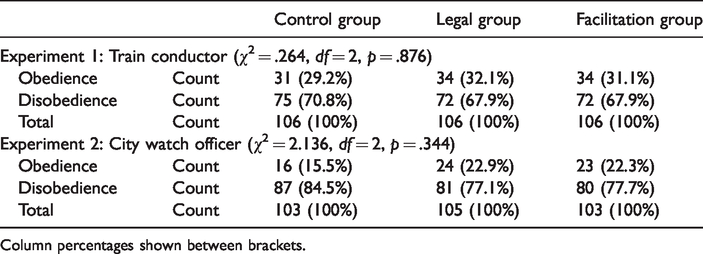
Column percentages shown between brackets.
Hypothesis 2a predicted that the legal style dimension would increase public shaming of bureaucrats by citizens online while hypothesis 2b predicted that the facilitation style dimension would have no effect on public shaming of bureaucrats. For both experiment 1 (F(2, 315) = 20.01, p = .000) and experiment 2 (F(2, 310) = 10.22, p = .000), the ANOVA indicates an overall significant effect of street-level bureaucrats’ enforcement style on citizens’ public shaming of bureaucrats online. Since the overall effect is statistically significant in both experiments, follow-up analyses are conducted.
Regarding hypothesis 2a, Table 6 shows that in experiment 1 citizens’ public shaming is highest in the legal treatment group (M = 6.30, SD = 2.05). Nevertheless, Table 7 reveals that the mean difference between the control and legal treatment groups is not statistically significant (p = .066 for ANOVA and p = .292 for ANCOVA with normative motivation as a covariate). These findings are identical in experiment 2. In experiment 2, public shaming is also highest in the legal treatment group (M = 6.77, SD = 2.29). Similar to experiment 1, the mean differences between groups are not statistically significant (p = .199). To put it differently, citizens’ do not publicly shame street-level bureaucrats more via only platforms when they uphold the legal dimension. Hypothesis 2a is, thus, not confirmed.
Descriptive statistics of public shaming of bureaucrats by citizens.
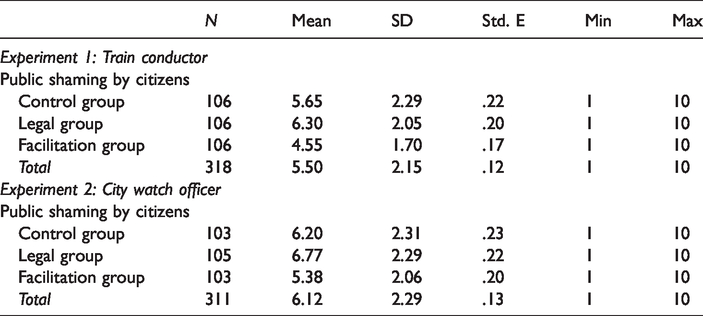
Main effect.
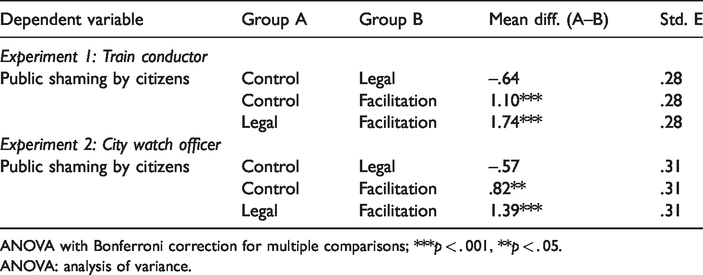
ANOVA with Bonferroni correction for multiple comparisons; ***p < . 001, **p < . 05.
ANOVA: analysis of variance.
In addition, with regard to experiment 1, Table 6 indicates that citizens’ public shaming is lowest in the facilitation treatment group (M = 4.55, SD = 1.70). The ANOVA results indicate that the mean difference between the control and facilitation treatment groups is statistically significant (p = .000 for both ANOVA and ANCOVA with normative motivation as covariate). The mean of public shaming by citizens online is 1.10 lower in the facilitation group than in the control group. The second experiment also confirms these findings. Table 7 shows that, similar to experiment 1, public shaming is lowest in the facilitation treatment group (M = 5.38, SD = 2.06). On top of that, the mean difference between the facilitation and control groups is statistically significant (p = .026). The mean public shaming is .82 lower than the control group. The results from both experiments confirm hypothesis 2b and show that the facilitation enforcement style dimension has a negative effect (i.e. decreases) on public shaming.
In sum, results indicate that, in one-shot encounters, the enforcement style of street-level bureaucrats does not significantly impact citizens’ obedience (H1). In addition, when street-level bureaucrats uphold the legal dimension, citizens will not publicly shame them online (H2a). However, when bureaucrats use the facilitation dimension, citizens will be more positive in their online review and, thus, publicly shame them less (H2b). The findings, thus, indicate that a legal style does not backfire and does not result in public shaming of bureaucrats by citizens but a facilitation style does diminish public shaming. All findings were consistent across the experiment and its replication (i.e. experiment 2).
Discussion and conclusion
This study experimentally investigated the effect of street-level bureaucrats’ enforcement style on two intentions of citizens, their obedience with sanctions and assessments of street-level bureaucrats in the form of publicly shaming bureaucrats online. Building on street-level enforcement literature and active role of citizens in bureaucrat–citizens encounters, it is theorized that there is a tension for bureaucrats between ensuring on-the-spot obedience (i.e. the intended effect) and getting publicly shamed online (i.e. the unintended effect). Based on a survey experiment and replication, three main conclusions can be drawn.
First and foremost, this study indicates that in one-shot public encounters where the relational distance between citizen and bureaucrat is high, neither a legal nor a facilitation style stimulates citizen intentions to obey. A possible explanation for this finding can be formulated by building on the notion of interactional justice which addresses quality of the treatment individuals receive by authorities and, specifically, the extent to which individuals affected by decisions from authorities are treated respectfully and with dignity (see Bies, 2005; Grimmelikhuijsen and Meijer, 2012; Tyler, 2003). In this line of reasoning, it could be theorized that, for instance, the threatening aspect of a legal enforcement style may be perceived as illegitimate and disrespectful by citizens who, in the end, will resist and not comply. Future research needs to move beyond solely controlling for the covariate effect of procedural justice, which we did in this study, and test the feasibility of interactional justice as an explanation by using it as a treatment or dependent variable in an experimental design. For practitioners, this implies when getting fined, street-level bureaucrats cannot use their enforcement style to ensure citizens’ obey with paying immediately.
In this study, the covariate effect of compliance motivations was controlled for and there is no indication that this explains citizens’ (non-)compliance. However, compliance motivation researchers could still be correct in that citizens’ obedience is primarily determined by their compliance motivations (e.g. May, 2005; Nielsen and Parker, 2012; Parker and Nielsen, 2009, 2012; Winter and May, 2001) and not by the enforcement style of the street-level bureaucrat that fines them. In this study, compliance motivations scales are self-assessed motivations. Future research could set out to manipulate the compliance motivations of citizens and distil if these do explain their (dis-)obedient behaviours. For instance by offering respondents more or less money if they comply. Scholars could also study compliance motivations as dependent variables to test whether street-level bureaucrats’ enforcement style or other enforcement instrument is able to alter them and, in this way, nudge citizens towards more obedience. Experimental methods will be especially helpful.
Secondly, it can be concluded that street-level enforcement style does not boomerang in one-shot encounters in the form of shaming of street-level bureaucrats by citizens online. A potential explanation is that, in this study, citizens did not experience the tipping point beyond which enforcement style would backfire. The shape of the boomerang-effect differs in the studies indicating that it may occur as a consequence of getting too ‘tough’ (see Liu et al., 2018; Winter and May, 2015). Future research is needed to fully distil this boomerang mechanism. More research is also needed to explore other potential negative consequences for street-level bureaucrats than public shaming when they get too ‘tough’ or ‘soft’ while interacting with citizens, for instance in terms of physical aggression. Observational studies will especially be fruitful because they allow the researcher to make sense of negative consequences first hand. For practitioners, this implies that, at least in one-shot encounters, the likelihood of getting shamed online when fining a citizen is low.
Third and finally, the experimental findings do show that their enforcement style results in less public shaming and, perhaps even ‘public faming’. When street-level bureaucrats execute a facilitation style, the shaming in the online review decreases and, ultimately, citizens express themselves more positive online about the bureaucrat they interact with. Tying this finding back to the lack of support for a legal style to result in public shaming, this study could indicate that citizens may not have a strong negativity bias (see Hood, 2007) when it comes to one-shot public encounters with street-level bureaucrats. More research is needed to test this idea and dissect how negativity bias works at the street-level. Scholars could, for instance, conduct comparative research aimed at dissecting how negative and positive experiences with enforcing bureaucrats are viewed by citizens and, ultimately, their behaviours towards governments.
This study has, like any research, both theoretical and methodological limitations. A first theoretical limitation is that this research is conducted in a Western context, namely The Netherlands, and it is unclear how these results translate to non-Western context. There is already substantive body of research addressing enforcement of street-level bureaucrats in non-Western contexts (e.g. Liu et al., 2018; Lo et al., 2009) but not regarding unintended consequences such as public shaming. More comparative research is needed to determine how the Dutch context influences the results and how its implications can be generalized to other countries. Second, this study specifically explored the effect of enforcement style in one-shot bureaucrat–citizen encounters. It may be, however, that a bureaucrat’s enforcement style only matters in bureaucrat–citizen encounters where there are repeated interactions (see Baldwin et al., 2012; Boyne et al., 2002, Black, 2010) with trust and familiarity between bureaucrat and citizen (Pautz, 2009; Pautz and Wamsley, 2012). Future research may investigate this mechanism in repeated interactions, for instance through experimental research with multiple rounds or set up observational research comparing both one-shot and repeated bureaucrat–citizen encounters.
Methodologically, the first limitation is that, though there seems to be consensus that street-level bureaucrats combine different dimensions of enforcement style during public encounters (Mascini and Van Wijk, 2009; May and Winter, 2000; Nielsen, 2015), the interaction between both enforcement styles was not incorporated in the experimental design. It is, therefore, not possible to draw conclusions about the effects of combined enforcement styles. Nevertheless, there is only limited research addressing the impact of enforcement style on citizen obedience (e.g. May and Winter, 1999, 2000; May and Wood, 2003; Nielsen and Parker, 2009). Testing the direct effects is necessary before indirect effects can be included. Second, both dependent variables in this study are a behavioural intention and not actual behaviour. It remains unclear how citizens actually behave. Future research could use machine learning techniques to study actual online reviews written by citizens about public services. Third, citizens did not have the option to not shame the bureaucrat via the online review. This could affect our results because only a small portion of the respondents may actually shame bureaucrats if we would have offered an exit option. We tried to minimize this limitation by including a selection criterion to ensure respondents had at least one social media account ensuring they could envision writing an online review. Replications of our findings including a design improvement allowing citizens to not fill in an online review at all are needed to verify our findings.
Fourth, this experiment focuses on public shaming as the negative assessment and it could be that only a small group of citizens actually interact with street-level bureaucrats online (Grimmelikhuijsen and Meijer, 2015) raising questions about the external validity which is a common weakness of experimental studies (James et al., 2017). There is, however, a digital street (De Graaf and Meijer, 2019) and substantive indication that citizens do write online reviews to evaluate services they receive (Chan, 2016; Trigg, 2014). More importantly, both the experiment and replication were piloted, and respondents indicated that the depicted situation could occur in real life indicating that in a Dutch context, citizens deemed it realistic. Fifth, this study did neither control for personality characteristics nor usage of social media. In this way, this study cannot provide an explanation for why some respondent do (not) shame bureaucrats online. Finally, the experiment includes a scenario in which the disobedience of the respondent is not as clear-cut which makes it ideal for testing variations chosen by the bureaucrat regarding enforcement style. However, it could influence the dependent variables in this study. Future research would benefit from comparative work including both clear-cut and less clear-cut violating behaviour of citizens. This could, for instance, be done by assigning clear roles to subjects about their (dis)obedience.
Despite its limitations, this study provides experimental evidence which is robust across two different one-shot public encounters with enforcing street-level bureaucrats (i.e. train conductor and a city watch officer). Moreover, it is, to our knowledge, the first of its kind to investigating how citizens assess behaviour of street-level bureaucrats through public shaming and provides evidence that how bureaucrats sanction (i.e. enforcement style) does not matter for citizen obedience with sanctions but does matter for how citizens assess bureaucrats.
Supplemental Material
ppa905005_supplemental_appendix - Supplemental material for The (un)intended effects of street-level bureaucrats’ enforcement style: Do citizens shame or obey bureaucrats?
Supplemental material, ppa905005_supplemental_appendix for The (un)intended effects of street-level bureaucrats’ enforcement style: Do citizens shame or obey bureaucrats? by Noortje de Boer in Public Policy and Administration
Footnotes
Acknowledgements
The author would want to thank Professor Dr. Erik Hans Klijn and Dr. Jasper Eshuis for their helpful comments on earlier versions of this manuscript. Any remaining shortcomings are author's own.
Declaration of conflicting interests
The author(s) declared no potential conflicts of interest with respect to the research, authorship, and/or publication of this article.
Funding
The author(s) disclosed receipt of the following financial support for the research, authorship, and/or publication of this article: this work was supported by The Netherlands Food and Consumer Product Safety Authority (NVWA).
Notes

References
Supplementary Material
Please find the following supplemental material available below.
For Open Access articles published under a Creative Commons License, all supplemental material carries the same license as the article it is associated with.
For non-Open Access articles published, all supplemental material carries a non-exclusive license, and permission requests for re-use of supplemental material or any part of supplemental material shall be sent directly to the copyright owner as specified in the copyright notice associated with the article.
