




Abstract
Administrative reform policies cutting across several sectors are commonplace in the public sector. However, reform policies do not necessarily result in organizational change. This article examines intra-organizational change within the Austrian Ministry of Agriculture in a longitudinal case study covering a period of three decades, which allows us to study short-term and long term-effects of administrative reforms. Whereas existing research mainly uses single-factor explanations for inter- and intra-organizational change, this article emphasizes the interplay of various drivers of organizational change within government organizations. In analytical terms, we draw on the multiple streams framework to study intra-organizational decision-making which is embedded in government-wide administrative reform policies. We find that reform leads to intra-organizational change when a political entrepreneur is able to couple solutions and problems in a decision window, which may happen decades after the initial reform attempts, underscoring that short-term reform failure may turn into success in a long-term perspective.
Keywords
Introduction
The last decades have witnessed changing reform doctrines in the public sector and different waves of structural changes. Administrative reforms have become an everyday activity in the public sector. There is an increasing body of knowledge about structural changes in ministerial departments (Davis et al., 1999; Derlien, 1996; Mortensen and Green-Pedersen, 2015; Pollitt, 1984). In contrast, few scholars have paid attention to the dynamics of intra-organizational changes in ministerial departments (Christensen 1997; Hustedt, 2013). Moreover, most authors focus on single-factor explanations of structural change, such as administrative reforms (Rolland and Roness, 2012), Europeanization (Dimitrova and Toshkov, 2007; Zubek and Staroňová, 2012), or political explanations such as political turnover (Holmgren, 2018; James et al., 2016) and changes in political attention (Mortensen and Green-Pedersen, 2015). These studies are important, yet they potentially disregard the interplay of various drivers of structural change in government organizations.
Much of the literature takes a macro perspective on the entire population of a specific type of organization such as ministerial departments (Davis et al., 1999; Mortensen and Green-Pedersen, 2015; Pollitt, 1984), while case studies of long-term dynamics of structural changes unfolding within the same organization are largely missing (but see Corbett and Howard, 2017). Despite governments’ ubiquitous reform efforts, we know little about the short- and long-term effects of structural reform policies (but see Christensen, 1997; March and Olsen, 1983). As we argue in more detail below, a longitudinal case study design is suitable to address those challenges, namely to investigate several explanatory factors for structural change within a single organization. This allows us to assess their interactions and the conditions under which different explanations provide most analytical leverage (MacCarthaigh et al., 2012).
Another challenge for analyzing the determinants of structural change is the gap between the time horizon of theoretical explanations and the dynamics of structural change. Although organizational studies show that change is a long-term process (Donaldson, 1996), it is striking that structural changes in public organizations are primarily studied as short-term processes (Dimitrova and Toshkov, 2007). We argue that scholars should differentiate between explanatory factors that immediately affect change, and factors that unfold their explanatory power over time. To illustrate, Derlien (1996) shows that political factors such as changes in the governing coalition increase the size of ministries, whereas ministerial structures are adjusted over time as response to intra-organizational coordination problems. In a similar vein, we lack sound theoretical explanations and empirical studies addressing the timing of structural change responding to internal dysfunctions. For example, contingency theory assumes that environmental change leads to internal dysfunctions (“misfit”) which will result in structural adaptation (Donaldson, 1996). However, contingency theory does not elaborate on the timing of structural change.
In order to fill these gaps, this article asks when and how deliberate administrative reforms lead to structural changes, as well as how they interact with other theoretically relevant drivers of structural change. More specifically, we ask how administrative reforms, intra-organizational coordination problems, changes in political priorities, and external pressure shape both the timing and the extent of structural changes inside ministries. Those structural changes are operationalized as (changes in) the allocation of tasks inside the ministry and (changes in) the number of distinct types of organizational units as a result of the creation of new units, the merger of existing units, or the splitting-up of existing units.
We study these questions through an in-depth analysis of the Austrian Ministry of Agriculture between 1986 and 2015. This case is highly insightful since the country’s European Union (EU) accession in 1995 resulted in various coordination problems, with wholesale administrative reform initiatives taking place at the same time. External pressure for change was particularly high for this portfolio given the high degree of EU integration in agricultural policy. However, despite a substantial change of the ministry’s environment, several attempts at internal reorganization failed, but eventually resulted in a major reorganization. Those dynamics make this ministry an interesting case to study the conditions for successful reforms. The aim of this article is to understand the dynamics behind (un)successful reforms of government organizations.
The article draws on multiple data sources, including 15 interviews with seasoned employees and document analysis (reform proposals, organizational charts, etc.) gathered during a one-month stay by Lichtmannegger in the ministry. In theoretical terms, the article applies central insights of the multiple streams framework (Herweg et al., 2017; Kingdon, 2003) for explaining structural change in a dynamic perspective, while simultaneously drawing on existing studies of changes in the machinery of government. We make a novel contribution by adjusting the multiple streams framework to explain intra-organizational change. The existing literature applying the multiple streams framework associates the decision-making stage of the policy process with parliamentary decision-making (Herweg et al., 2017). We expand the scope of the multiple streams framework by studying decisions that largely remain within the executive sphere. The next section introduces the article’s analytical model and highlights the distinct contribution of the multiple streams perspective on structural changes. After introducing methods and data, we provide an account of four key episodes of intra-organizational structural change. Finally, we discuss theoretical implications of our findings.
Administrative reforms and structural changes: A modified multiple streams model
The machinery of government literature identifies three important drivers of reorganization (Davis et al., 1999; Mortensen and Green-Pedersen, 2015; Pollitt, 1984): policy challenges that result from adaptation to external pressure such as EU membership; administrative challenges such as a perceived lack of efficiency and coordination; and political motives like marking a change of political priorities or the distribution of portfolios in coalition bargaining. In this article, we link these categories to the different elements of the multiple streams model (Herweg et al., 2015; Kingdon, 2003). This model was originally developed to explain agenda setting processes in the United States and was subsequently applied to various other political systems, e.g. parliamentary systems and the European Union (Herweg et al., 2017). Recent scholarship also uses the model to analyze the decision-making stage of the policy processes (Herweg et al., 2015). However, so far no adaptions have been made for agenda setting and decision processes which do not leave the executive sphere. The present article draws on the expanded multiple streams framework suggested by Herweg et al. (2017) and broadens the framework’s scope by analyzing the conditions under which government-wide reform policies lead to intra-organizational change.
Administrative reforms can be defined as “deliberate attempts by political and administrative leaders” to change structures of organizations (Christensen et al., 2007: 122). Typically, administrative reforms are attempts to improve government organizations in terms of effectiveness, efficiency, or user-friendliness, targeting the entire government bureaucracy (March and Olsen, 1983). In consequence, reform decisions at the governmental (cabinet) level tend to be fairly general, and require subsequent decisions at the organizational level. This is particularly relevant under conditions of high ministerial autonomy, which is commonplace in parliamentary democracies. Against this background, organizational change is what “actually happens to such features” (Christensen et al., 2007: 122), i.e. organizational structures. Major administrative reforms can result in organizational changes, but these changes often are minor when compared to reform ambitions (March and Olsen, 1983). In the language of policy analysis, administrative reforms are comparable with policy proposals, and organizational change with the final policy output. In the following, we outline the core elements of the multiple streams framework, elaborate on the model’s adaptation to the decision-making stage of the policy process (Herweg et al., 2015), and combine this literature with the literature on the main drivers of reorganizations.
The multiple streams framework conceptualizes policymaking as consisting of three independent streams—societal problems, policy alternatives, and political support (Kingdon, 2003). According to the model, major policy change results from the coupling of the three different streams by policy entrepreneurs under favorable conditions (“window of opportunity”). An important implication of the model is that policy alternatives exist independently from policy problems. They are linked to societal problems as a result of being available at a given point of time, rather than as a result of an instrumental problem-solving process. 1
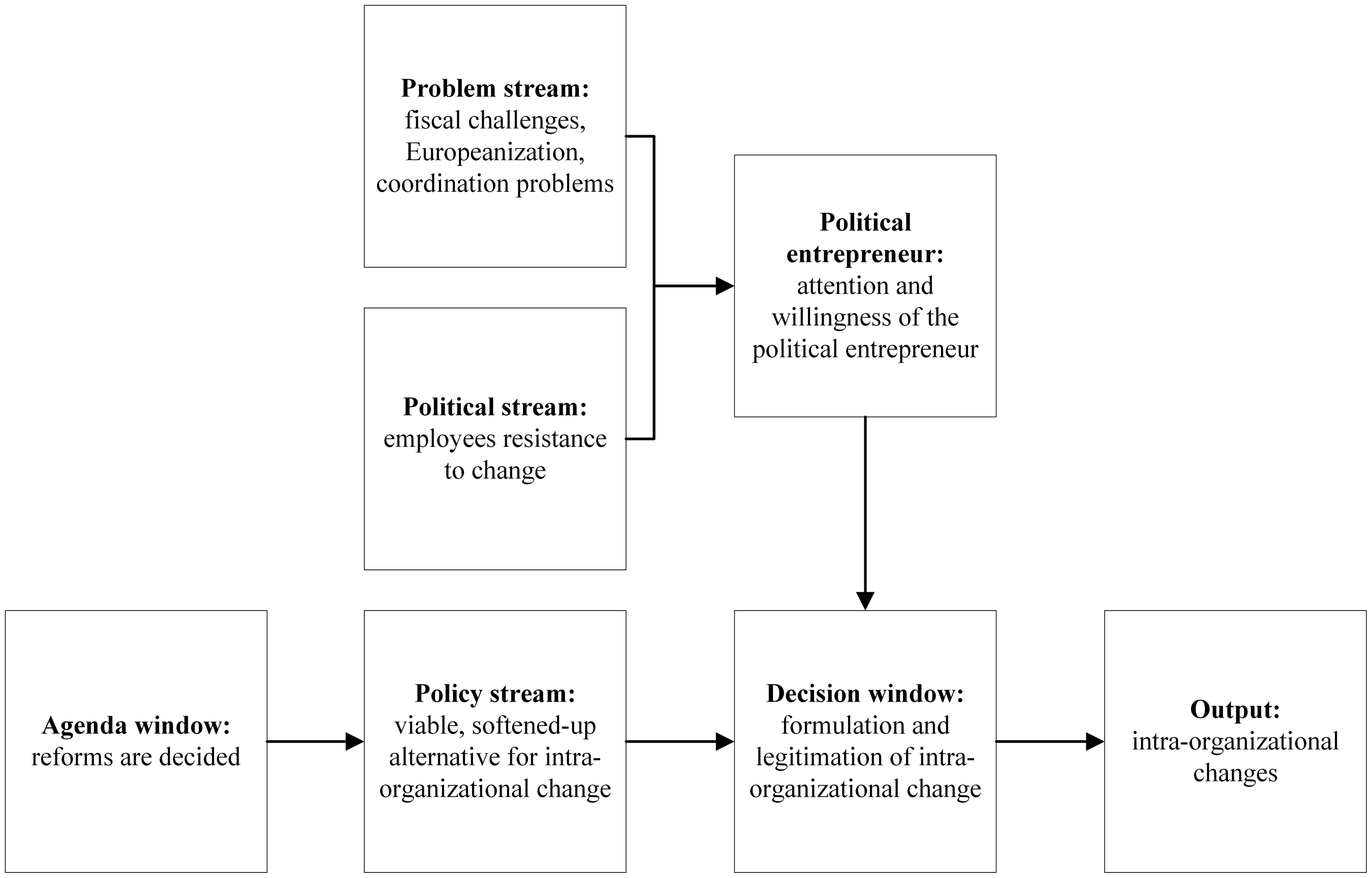
In its original version, the multiple streams framework aims at explaining changes on the policy agenda. In a recent contribution, Herweg et al. (2015) distinguish between agenda and decision windows. They argue that a successful coupling of the streams by a policy entrepreneur opens up an “agenda window” which subsequently results in a “decision window” (Herweg et al., 2015). The final policy output will result from the successful coupling of the three different streams by political entrepreneurs at the decision-making stage (Zohlnhöfer, 2016: 89). While a policy entrepreneur will try to frame a problem as urgent and to attract support for a policy proposal, a political entrepreneur—i.e. a policy entrepreneur with formal decision-making powers, such as an elected official—will take over at the decision-making stage and try to find a majority in parliament for the policy alternative. In order to gain a majority, the political entrepreneur may try to frame the proposal as highly necessary to ensure the support of potential veto players (Zohlnhöfer, 2016: 89). This implies that the political stream plays a more decisive role in the decision stage compared to the agenda stage (Herweg et al., 2017).
However, while parliamentary support may be needed to enact major administrative reforms cutting across multiple policy sectors, the final decision about intra-organizational changes will be taken at the ministry level. Those policy decisions require the support of the minister in charge who is the key political actor. For intra-organizational change, no formal veto players exist, yet bureaucrats are typically consulted before structures are changed. The latter have been found to have a strong self-interest in preserving the status quo (Christensen, 1997). The minister’s successful framing of structural changes as necessary to address a given problem is a key aspect of reducing bureaucratic resistance to change (Fernandez and Rainey, 2006). In the following, we develop an analytical framework linking the different elements of the modified multiple streams model—problems, solutions, politics, and political entrepreneurs—to the literature on the politics of structural reform.
There are always several problems politicians or public officials could pay attention to. However, the question is why some problems get attention and some do not (Kingdon, 2003). A common indicator of a potential problem is budgetary deficits. In addition, focusing events (e.g. crises) sometimes lead to the immediate prominence of a problem, pushing other problems off the agenda. However, problems are not fully self-evident. The framing of a “condition” as a problem is important for attracting attention, and for the solution that is chosen. The literature on structural changes emphasizes external problem pressure as a driver of structural changes (MacCarthaigh et al., 2012: 847). There are many changes in a ministry’s environment potentially leading to internal reorganization. For instance, we know that the process of EU integration (“Europeanization”) is one of the main drivers of organizational change within EU countries and therefore a “problem maker” (MacCarthaigh et al., 2012). As shown by Lichtmannegger (2017, 2019), major changes of the EU context, e.g. the revision of the EU founding Treaties, lead to new EU-related tasks for national ministries and the subsequent creation of new organizational structures to accommodate increased environmental complexity. Likewise, EU integration may involve the delegation of decision-making powers to EU institutions, leading to a loss of existing tasks for ministries. However, following the idea that pressure for change depends on the (mis)fit of a member state’s policy with EU legislation (Padgett, 2003), we expect that a change of the task portfolio within ministries takes place only if there is a misfit between the national and EU policy. In the light of major changes in the ministry’s task portfolio, we expect policy makers to consider the present organizational structure as problematic and propose the following hypothesis: H1: Europeanization which results in a misfit between national and EU level policies increases pressure for intra-organizational change because of changes in the organizational task portfolio. H2: The more an indicator changes to the negative, the more likely a political entrepreneur will be able to frame a condition as a problem. H3: The longer reform ideas are softened up, the higher the chance that they are adopted.
For intra-organizational reforms, however, the role of the minister is decisive, who has the formal authority to decide on change. Therefore, intra-organizational change depends on the attention of the minister to coordination problems, and his willingness to implement reforms addressing those problems against ministry bureaucrats’ opposition. Public management scholars underline the importance of leadership to successfully conduct reforms (Fernandez and Rainey, 2006). According to this literature, it is essential that leaders care about reforms (Harokopus, 2001), and that they express the necessity for reforms to reduce employees’ resistance against change (Fernandez and Rainey, 2006). However, even though ministers may have the formal authority to push through administrative reforms, they are extremely busy people, and reforming administrations is usually not high on their agenda. They may simply be distracted from reorganization efforts by more salient policy problems (March and Olsen, 1983), or they may get frustrated by civil servants’ zealous defense of the status quo (Christensen, 1997). Therefore, for the timing and extent of intra-organizational change, the role of the minister as political entrepreneur is decisive. H4: Intra-organizational change requires the attention and willingness of a minister to implement reform ideas.
Adapting the multiple streams model for intra-organizational change.Source: Own further model development based on the extensions of the multiple streams approach by Herweg et al. (2017).
H5: Administrative reform leads to intra-organizational change if (1) organization-specific problem pressure is perceived as high, if (2) a viable policy solution exists; and (3) if a minister supports intra-organizational change.
Data and methods
This article analyses intra-organizational change in the Austrian Ministry of Agriculture over three decades (1986–2015) as the dependent variable. The first explanatory variable is administrative reform, which is operationalized by different national wholesale reform initiatives between 1986 and 2015. Next, Europeanization is studied as external pressure and operationalized as Austria’s EU accession in 1995 and major reforms of the Common Agricultural Policy (CAP). We operationalize coordination problems as explicit complaints by respondents about coordination problems or explicit reference to coordination problems in policy documents. Finally, in terms of the political entrepreneur, we analyze ministerial turnover as well as minister’s attention to problems and reform ambitions, as indicated by interview respondents and document analysis. The longitudinal research design allows us to study the long-term effects and interactions of different explanatory factors, whereas a shorter period would most likely provide a biased picture regarding which factors were instrumental for causing change (Pettigrow, 1990). Since administrative structures are sticky, it can take decades until organizational change comes about (Donaldson, 1996).
The study employs several instruments for data collection, including retrospective expert interviews, internal documents, stenographic protocols, news articles, and secondary literature. Most data were gathered during a one-month stay by the first author in the ministry in September 2015 to become conversant with the policy field, to identify informants, and to get access to internal documents. Fourteen semi-structured interviews were conducted with heads of sections, and one interview with an external consultant. Informants were selected based on length of service—several individuals have worked in the ministry since the 1970s—as well as dispersion across different units. Moreover, access was given to schedules of responsibility and organizational charts for each year between 1986 and 2015, as well as decisive reorganization documents describing and explaining planned changes.
The organizational charts were compared from year to year to check when actual change took place prior to the interviews. Likewise, internal documents explaining reforms were consulted before conducting interviews. In addition, these documents were used during most interviews to inform the conversation. Moreover, we systematically searched stenographic protocols of parliamentary debates for keywords such as reorganization, the name of the ministry, the ministers’ names, and European Union, between 1986 and 2015. In addition, we consulted news articles of the widely read “Kronen Zeitung” between 2002 and 2015 (other periods were not available) and collected bibliographical information on the ministers from the parliament’s webpages.
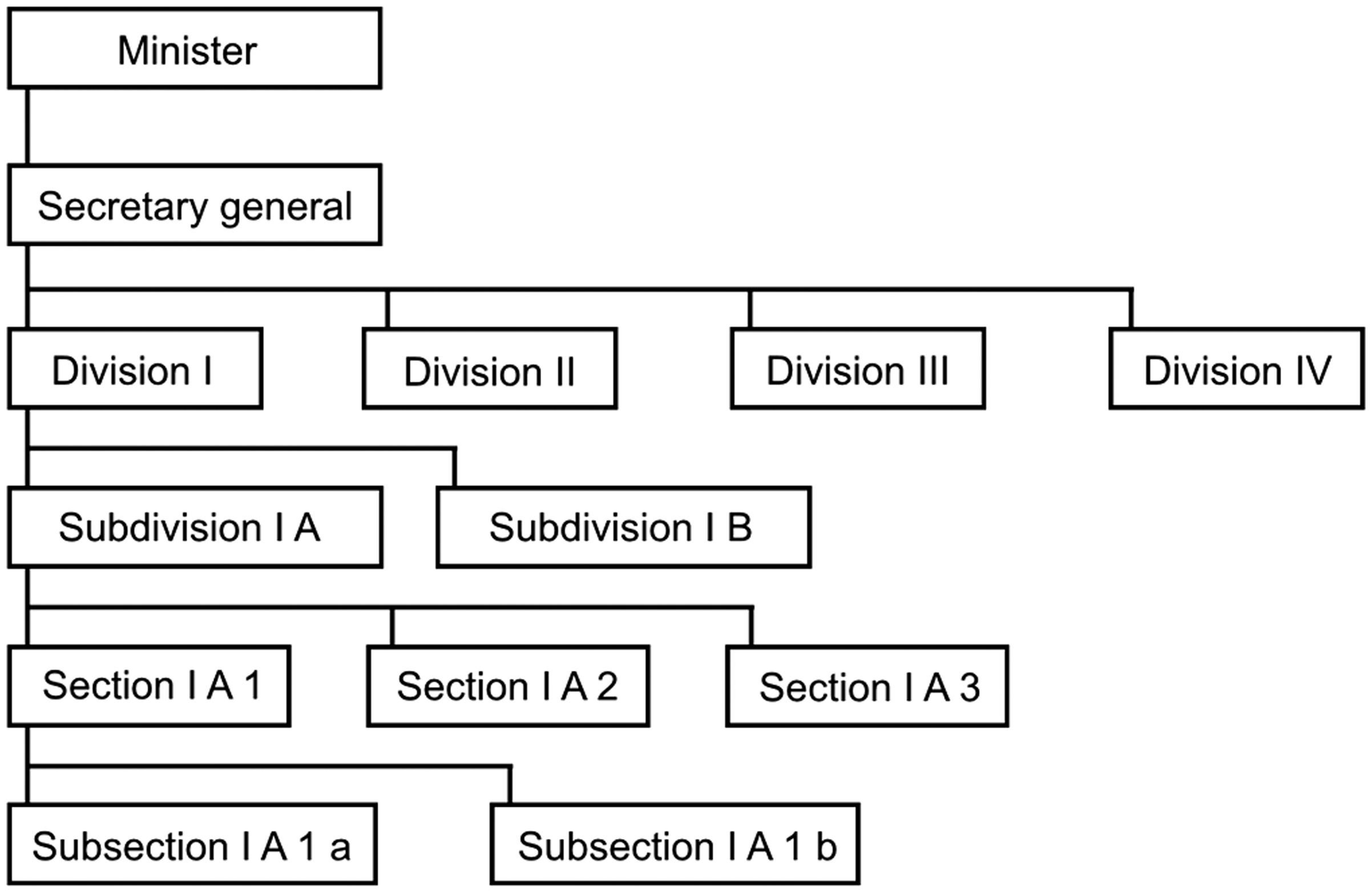
Before moving to the empirical analysis, we introduce key features of the Austrian machinery of government. In Austria, a parliamentary democracy with frequent coalition cabinets, the Federal Chancellor determines the number of ministers and decides about their portfolio. The ministries’ internal organization, however, is within the individual ministers’ sphere of responsibility (Strehl and Hugl, 1997). We therefore suggest that our analytical framework can inform studies in similar contexts characterized by a combination of parliamentary government, coalition cabinets, and high degrees of ministerial autonomy (e.g. Germany). Austrian ministries have a standard hierarchical structure, with subsections as hierarchically lowest unit, followed by sections, subdivisions, and divisions as the highest-level units below the political leadership (Figure 2).
Stylized organizational structure of Austrian ministries.
Analysis: Administrative reform and structural change in an Austrian ministry
Administrative reform, coalition change, and looming EU membership (1986–1993)
The empirical analysis focuses on four episodes characterized by different dynamics of reform and change: whereas intra-organizational units increased significantly despite cutback reform policies in two episodes, the others are characterized by substantial decreases in intra-organizational units.
The first episode illustrates how political factors and external pressure may turn deliberate reforms upside down, leading to a mismatch between governmental reform objectives and what is happening inside the ministry. Between 1980 and 1987, Austria’s net deficit of public finances more than doubled (Dearing, 1998). The government’s diagnosis was a lack of efficiency and effectiveness in the administration (Dearing, 1998; Strehl and Hugl, 1997). In response, the government Vranitzky I embarked on an ambitious, wholesale administrative reform program to reduce organizational units, reorganize tasks, and cutback staff numbers in 1986. Shortly after entrusting a special unit in the Austrian Federal Chancellery to coordinate the encompassing “Verwaltungsmanagement” (“administrative management”) reform in 1986, an election resulted in a coalition change in 1987. The government changed from the Social Democratic Party of Austria (SPÖ) and the Freedom Party of Austria (FPÖ) to the SPÖ and the Peoples’ Party (ÖVP). This led to the replacement of a social-democratic minister in the Ministry of Agriculture and Forestry.
The new minister came from the conservative party, which subsequently controlled the ministry throughout the entire period under scrutiny. This political turnover resulted in the reshuffling of senior bureaucrats loyal to the social-democratic party to positions where they had no real influence anymore, allowing for the promotion of officials who were loyal to the minister’s conservative party (Interview#1; NR-PlPr. 17/24: 2777). An informant explains this as follows: There has been a certain backlog for civil servants related to the [conservative party] and the reorganization has been bloated in my opinion. This was done by creating subdivisions. The heads of subdivisions, which did not have any real responsibilities, even partly became free-floating (Interview#1).
Number of organizational units in the Ministry of Agriculture and Forestry (1986–2000)/Ministry of Agriculture and Forestry, Environment and Water Management (2000–2014).
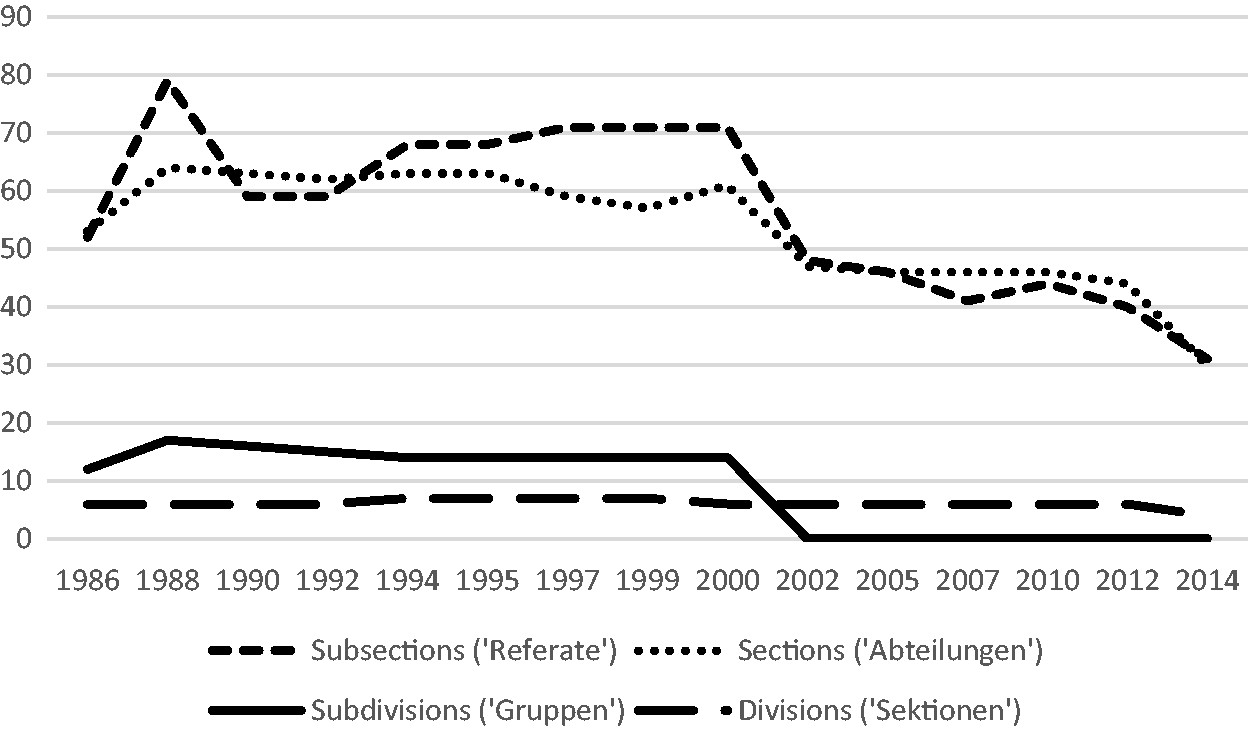
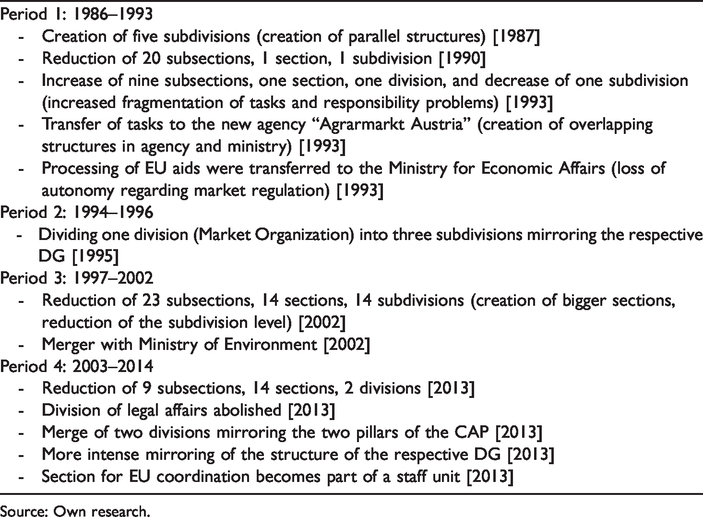
However, the reduction of the number of units inside the ministry was short-lived, except at the subdivision level. Austria’s looming EU membership posed new challenges to the ministry, with preparations for negotiations with the EU starting in 1993. Those negotiations made the recruitment of new employees necessary, since the existing ones could not speak any of the EU working languages, English and French (Interview#2). To allow for the recruitment of new employees, the number of statutory posts (as defined in the national budget) was raised from 703 to 732 between 1992 and 1994, and several units were created in 1993 (Figure 3). According to an internal document from 1995, the creation of an additional EU division increased the already existing strong fragmentation of tasks within the ministry (BMLF, 1995) (see Table 1 for a detailed overview of structural changes). The diagnosis was that it had become almost impossible for external stakeholders to find out who was responsible for what. In addition, the document underlines that coordination requirements had increased especially for EU affairs at all hierarchical levels.
Internal changes over time.
Source: Own research.
At the same time, Europeanization also resulted in a loss of tasks. An executive agency “Agrarmarkt Austria” was created due to the EU accession in 1993, which involved the delegation of various tasks to the agency (NR-PlPr. 19/34: 61). In consequence, several overlapping structures emerged, since sections in the ministry were not abolished despite their loss of responsibilities (NR-PlPr. 19/34: 43). In addition, the processing of EU aids was transferred to the Ministry for Economic Affairs (NR-PlPr. 19/9: 221). Ultimately, the ministry itself lost substantial autonomy in terms of market regulation. Another indicator for the loss of formal powers can be found in parliamentary debates, where legislators claimed that the ministry would have “almost no tasks” and would be therefore become “superfluous” (NR-PlPr. 19/9: 221) and “full of white elephants” (NR-PlPr. 19/34: 43). However, despite the loss of tasks, the number of units and staff increased (NR-PlPr. 19/34: 44).
Next to the organization of EU affairs, another major problem is the concentration of legal affairs in one division, which existed already before EU accession (Interview#2). This specialization resulted in perceived task overlap, double work, and an increase of coordination at higher hierarchical levels (BMLF, 1995).
In sum, this episode illustrates how new organizational units were added to the ministry, instead of reducing them, which was the objective of the wholesale administrative reform policy at that time. The reasons for the significant increase of units were competing problems at the organizational level, namely the creation of patronage positions and the creation of new units and positions due to EU membership. These ad hoc structural solutions increased existing coordination problems, such as those between legal affairs and line units (see below).
Joining the EU (1994–1996)
The second episode shows that the capacity enlargement and simultaneous loss of tasks following EU accession increased the ministry’s perceived ineffectiveness and therefore pressure for change. In addition, the problems of fiscal pressure remained stable. As determined within the reform project at the end of the 1980s, detailed plans for how to reorganize the ministry were made, which eventually were only realized to a small extent.
After EU accession, a reorganization plan was developed, which included key reform ideas to address coordination problems within the ministry (BMLF, 1995). The aim of the reorganization was to adapt the ministry’s internal structure to the new requirements of EU membership by concentrating strongly dispersed EU-related tasks. In addition, the aim was to abolish organizational units which had lost their tasks due to EU accession and to merge small units. For example, the plan included the creation of three EU-related sections and to divide the division responsible for “Market Organization” into three subdivisions, thereby mirroring the structure of the respective EU Directorate-General. The reorganization also projected the abolishment of the division for legal affairs and to transfer these tasks to line sections, e.g. moving forestry law to the division for forestry. A quote from the reorganization plan of 1995, paraphrasing the comments of bureaucrats from neighboring Germany, underlines the importance of this element for effective coordination: The German colleagues expressed their bewilderment and amazement regarding the construction of a division for legal affairs as they discussed about the reorganization of the Ministry for Agriculture and Forestry (BMLF, 1995: 11).
Wilhelm Molterer was minister during this reform. He entered office in November 1994 and had been personal adviser to two of his predecessors in office, thus having in-depth knowledge about the ministry. He was a political heavyweight and was elected head of his party a few years later. He had also been director of the Austrian Farmer’s Association between 1990 and 1993, which possibly contributed to the fact that he kept sections without substantial responsibilities intact and accepted double structures. One informant explained that farmers were against abolishing the section for milk marketing since they would lose “their” section for lobbying (Interview#1).
This episode shows that the country’s EU accession resulted in new responsibilities and the loss of existing ones. In the light of this significant change of responsibilities, only small internal reorganizations were made, despite more comprehensive reform ambitions. In addition, the concentration of legal affairs issues in one division remained. As we will see below, several of the abovementioned reorganization ideas were realized up to twenty years later. Therefore, despite growing pressure in the problem stream, intra-organizational change hardly reflected reform ideas. In the light of our theoretical expectations, those ambitious reorganization plans had not been softened up. The plans encountered resistance of bureaucrats, and the minister did not embrace those plans either, which possibly was related to his professional background.
Departmental merger and coalition change (1997–2002)
The following episode provides insights into when pressure ends up in realizing recurring reform ideas. After EU accession, fiscal pressure and rising costs found their way back onto the political agenda in 1998. The government embarked on another reform of the federal bureaucracy inspired by New Public Management reforms (Hammerschmid and Meyer, 2005). Its main elements related to structural changes were critical assessment of tasks, process evaluation, and effective personnel management (Dearing, 1998). The reform was projected for a short period only (1998–1999) and limited to a few ministries. Structural changes in the ministry of agriculture are hardly worth mentioning in this short period (Figure 3). In 2000, however, the SPÖ left government for the first time after 56 years, and detailed reorganization proposals were developed for the ministry of agriculture. The prospect of reorganization was not only increased by the new coalition of the ÖVP and the populist FPÖ, but also by the opportunity to give golden handshakes to top officials (Interview#2), and not the least due to a merger with the ministry of environment.
In addition to fiscal pressure and political turnover, the lack of encompassing adaptations due to EU accession had resulted in pressing problems of organizational design. “It would have been absolutely necessary to have a huge reorganization after EU accession” (Interview#1). However, in 2000, the necessity for reform “became too obvious, it was unavoidable, it has been visible for everybody that the structure did not work anymore” (Interview#1). In 1999, the EU agreed upon the “Agenda 2000” reform of the CAP, which replaced support prices by direct payments, put a greater emphasis on environmental aims, and defined rural development as the second pillar of the CAP (Snyder, 2012). These changes in priorities increased adaptation pressure (Interview#4).
Wilhelm Molterer (ÖVP) remained in office and commissioned a reform plan to a consultancy (Interview#5). According to an internal document, a key objective of the reform was to improve processes cutting across sections such as the coordination of international, EU, and law responsibilities through the increase of section size and the abolishment of subdivisions. He framed the reform as unavoidable: “Minister Molterer said, if I remember correctly, ‘if I do not reorganise, the finance minister will do it for me’.” (Interview#1).
The reform objective to create bigger sections and to reduce one hierarchical level led to a substantial reduction of ministerial units in the merged ministry in 2000/2001 (see also Figure 2, which only includes units related to agriculture, excluding units belonging to the former ministry of environment). The reorganization also terminated all subdivisions, including those created in 1987 to provide patronage positions for the coalition partner. The plan to create bigger sections and to abolish those subdivisions had been discussed repeatedly, but was implemented following the ministry merger only (Table 1). Moreover, the reorganization entailed several mergers at lower levels, e.g. of the sections for “milk processing” and “milk marketing.” According to one informant, milk marketing had lost most of its responsibilities already in 1995 (Interview#1). Likewise, the idea to merge the environmental and agricultural ministry was mentioned for the first time in 1995. The argument was that both ministries hardly had any substantial responsibilities (NR-PlPr. 15/30: 92). The ministry of environment had always been a ministry with few tasks and the ministry of agriculture lost many tasks due to EU accession.
This episode shows that it may take several years or even decades until obvious inefficiencies are addressed by structural change and until recurrently discussed reform ideas are implemented. This was possible due to several factors which were not present in the former episodes. The minister framed internal coordination as a major problem. In addition, five years had passed since EU accession, during which bureaucrats had experienced increasing coordination problems. Furthermore, several conditions facilitated change, such as governmental turnover, which resulted in the merger with another ministry. Nevertheless, the reorganization was not entirely successful (judged by its own objectives), since some allegedly superfluous units remained and the legal affairs division remained untouched.
Major change at last (2003–2014)
The above episodes showed that reform implementation is seldom in accordance with reform plans. The plans for how to reorganize internally due to newly emerging tasks and obsolete tasks following EU membership were not fully realized. This final episode covers a long period of inaction and finally radical reform, where both old and new problems were solved. In addition, this episode provides evidence of the importance of a political entrepreneur to explain major structural change.
In between 2003 and 2013, hardly any structural changes took place in the ministry (Figure 3). In 2003, following a change of the government coalition, Josef Pröll (ÖVP) replaced Wilhelm Molterer. Pröll had already been involved in the reform in 2000/2001 as chief advisor of the minister and was director of the Austrian Farmer’s Association. These two aspects are plausible explanations for why he did not choose to reorganize the ministry. In 2007, following another change in coalition, Nikolaus Berlakovich became the new minister. In contrast to Pröll, Berlakovich was known as a poorly performing minister (NR-PlPr. 24/187: 230, 284; Kronen Zeitung, 21 May 2009). As one informant pointed out, this minister would have never dared to reorganize the ministry substantially (Interview#7).
In December 2013, Andrä Rupprechter (ÖVP) became Minister of Agriculture and Forestry, Environment and Water Management in the wake of a government turnover. He was considered as a brave person who likes to be in the center of attention and takes fast decisions (Die Zeit, 2014). In the context of a next round of comprehensive administrative reform in Austria, Rupprechter described himself as a pioneer of administrative reform (Kurier, 2014). Putting words into action, he pushed for an encompassing reorganization in his ministry, which according to an informant in another ministry could never have taken place in the latter’s own ministry (Interview#6). Again, the aim was to consolidate organizational units, tasks, and personnel, as well as the expression of new priorities through structure, and addressing cross-sectional coordination issues. This episode stands out by the minister’s approach to explain the need for reform to create efficient structures and reduce budgetary pressure in public (Interview#3). However, while some informants question that fiscal pressure triggered the reform, they agree that pertinent problems regarding coordination and control were the reason for change (Interview#1, #4). In the field of agriculture, you have to adapt automatically. Well, if the EU changes the CAP, then I [the ministry] get a problem if I do not change. Then it happens that I create structures that have nothing to do with reality. If tasks are abolished [due to Europeanization], then I can chose to do nothing, but I really get an efficiency problem (Interview#4).
While external and fiscal pressure figured prominently in reform talk, interviews revealed political motives, too. These include gaining a profile as a new minister, and reshuffling personnel (Interview#3). In addition, the minister arguably scored high in terms of understanding the problem pressure in the ministry. He had spent most of his career as a bureaucrat in the Ministry for Agriculture, among others being a member of the negotiation group for EU accession and later head of division for “Agriculture and Nutrition” where he was responsible for concentrating EU and international affairs in 2000/2001. Before becoming a minister, he had been a senior official in the Council of the European Union for several years.
Like in the former episode, a comprehensive reduction of organizational units took place (see also Figure 3). The reorganization of tasks even resulted in personnel taking over completely new tasks, which were not even closely related to their old ones (Interview#3). The two divisions “Sustainability and Rural Areas” and “Agriculture and Nutrition” were merged into a new division “Agriculture and Rural Development”. Like in the previous episode, several mergers and terminations took place at the level of sections. For instance, mirroring the EU’s division for wine, fruits, vegetables, and special crops had already been suggested in 1995 and had only been partially implemented, yet the full merger took place only in 2014. Moreover, the section once responsible for negotiating with the WTO was merged with another section, as it had lost important competencies due to EU accession (Interview#5). The unit for EU coordination became a staff unit directly reporting to the minister, including the sections “EU coordination agriculture” and “EU coordination environment” previously allocated in different divisions. In addition, the legal affairs division was eventually abolished, and legal affairs were decentralized in 2014 after two decades of fruitless reform efforts and persisting coordination problems (Table 1). These latter reorganizations allegedly enhanced the effective coordination of EU affairs (Interview#2).
This final episode demonstrates that major intra-organizational change is possible. The conditions for change to occur are the willingness and attention of a political entrepreneur, the availability of viable policy solutions, and high problem pressure. Moreover, the comparison of all episodes shows that structures can only be streamlined in the absence of competing problems that are addressed by creating new structures.
Discussion
The discussion is organized along the different hypotheses. A first result is that Europeanization which results in a misfit between national and EU level policies increases pressure for intra-organizational change because of changes in the organizational task portfolio (H1). We find that additional organizational units were created as negotiations for EU accession started and after EU accession, since the ministry had to perform new tasks. In line with existing research (Lichtmannegger, 2017, 2019), we see that the number of units increases either shortly before or after major changes of the EU context. Yet Europeanization also leads to a loss of tasks due to delegation to the Commission (Müller and Wright, 1994). However, the analysis shows that it takes time until this loss of tasks translates into new organizational structures.
We find that EU accession initially leads to increasing specialization by adding new units, which over time are adjusted (merged, abolished) to address coordination problems. Before Austria started EU membership negotiations, severe coordination problems already existed, e.g. due to the specialized legal affairs division. In addition, EU negotiations and accession exacerbated coordination problems at higher hierarchical levels. Coordination problems resulted from several units’ loss of functions to the EU Commission and the newly created executive agency, as well as the additional hierarchical layer created in the wake of the 1987 coalition change. Moreover, CAP reforms led to the continuing change of priorities and therefore pressure for change. These issues were addressed only when a substantial proportion of bureaucrats perceived them as pressing coordination problems, which can be gleaned from the reforms initiated by minister Molterer in 2000. As suggested by H2, the more obvious coordination problems became, the more likely a political entrepreneur will be successful in framing this condition as a problem.
The third hypothesis suggested that ideas have to soften up through repeated discussions to gain legitimacy (March and Olsen, 1983). Hence, reforms will typically consist of old ideas, rather than new solutions. This study showed that the first reorganization plan resulted in incremental change only, and reform results were disappointing. In line with H3, we find that those reform ideas were implemented after several years (e.g. creation of bigger sections, merger of ministries) and even decades (e.g. dispersal of legal affairs). This also means that wholesale administrative reforms are unlikely to result in immediate changes, but they are important and meaningful activities in their own right that may pave the way for structural changes in the future (March and Olsen, 1983).
According to H4, we expect that structural changes require a substantial commitment by the responsible minister. This explanation directed our attention to the potential effects of ministerial turnover on structural changes (Holmgren, 2018; James et al., 2016), as well as to assessments of ministers’ commitment to reform. Our analysis shows that major structural changes occurred both after a new minister had come into office (2014) and after a long-term minister’s reappointment (2000). This suggests that reform commitment, rather than turnover, as such contributes toward explaining intra-organizational change. Overall, our analysis indicates that only few ministers in the period under study were committed to structural changes.
Finally, we hypothesized that the combination of a viable solution that has been softened up, high organization-specific problem pressure, and a committed minister is required for major intra-organizational change. In particular, the last episode showed the decisive role of a dedicated minister as political entrepreneur in order to bring about decisive intra-organizational change. Rupprechter was responsible for parts of the reform in 2000/2001 (as evidenced by internal documents) and had worked in Brussels before assuming the post as minister. Hence, this minister was not only committed to structural reform; he also had in-depth knowledge about persistent coordination problems inside the ministry, which arguably is not a common situation for incoming ministers. Rupprechter framed budget problems as highly pressing and proposed structural reforms that had been discussed since 1995. In contrast, long-time minister Molterer evokes the impression of a less committed political entrepreneur in 2000/2001. He commissioned a reorganization proposal in 1995 and again in 2000/2001 to a consultancy. However, in 1995, hardly any changes took place, but in 2000/2001 internal pressure for change was so compelling that he had to commit to several reform measures.
Conclusion
This article analyzed the interplay of various theoretically relevant drivers of structural change and tracked actual structural change inside a ministry in a parliamentary democracy over a period of 30 years. In addition to its empirical contribution, it demonstrated how the multiple streams framework can be leveraged to analyze decision windows about intra-organizational administrative reforms. What does the case teach us about theories of reform and change? For instance, research on the influence of Europeanization explains that intra-organizational effects are few, ambiguous, and indirect (Bulmer and Burch, 1998; Jordan, 2003). In contrast, this article demonstrates various short-term and long-term impacts of Europeanization on intra-organizational structures. We show that the implementation of reform ideas on how to respond to a mismatch between internal structure and organizational environment takes time. Administrative reforms may be unsuccessful in the short run, but reform ideas have a life of their own and may be coupled to new reforms at a later point of time after they have been softened up (Kingdon, 2003).
This is the first article that studies reform processes and adjustment of structural intra-organizational dysfunctions through the analytical lens of a modified multiple streams framework. In line with Herweg et al. (2017), we differentiate between a decision and an agenda window. However, in order to explain when reform ideas end up in intra-organizational change, we focused on and adapted the concept of the decision window. In our context of structural reforms the key political entrepreneur is the minister. Therefore, in order to bring about change, he (or she) does not have to gain a majority in parliament, but has to be willing to push through change in a context where ministry officials will typically prefer the status quo (Christensen, 1997). That being said, while we did not find any indications for variation in employees’ resistance to change, this may be different in other empirical settings.
This article made a novel contribution to the multiple streams framework literature by adapting the framework to decision-making processes that remain in the executive sphere. The theory underlines that reform ideas have to be softened up and that intra-organizational change consists of “old solutions” and “old problems” of administrative coordination. The multiple streams model allowed us to specify conditions under which internal dysfunctions are addressed by structural changes in a systematic way. Public organizations often are perceived as inflexible and resistant to reform. We showed that change is possible through a complex interplay of problem pressure, policy solutions, and political entrepreneurship.
Footnotes
Declaration of conflicting interests
The author(s) declared no potential conflicts of interest with respect to the research, authorship, and/or publication of this article.
Funding
The author(s) received no financial support for the research, authorship, and/or publication of this article.
