



Abstract
The Apocalypse of John and 2 Baruch are Jewish apocalypses in which the authors and their communities wrestle with the question of what Israel’s being chosen as God’s people means in view of the destruction of the second temple and shifting historical circumstances. Both works uphold God’s faithfulness toward Israel but define it in different ways. While 2 Baruch stresses the validity of Torah, the Apocalypse of John emphasizes the role of the Messiah for his people. Both apocalypses, however, uphold that God’s people can only be defined as the people of the twelve tribes and thus try to put the Israel of their works in the closest possible continuity with the Israel of the Hebrew scriptures. On a form-critical level, visionary depictions of Israel are combined with letter-writing forms, making both works an interesting phenomenon of “epistolary apocalypses.”
Setting the stage
2 Baruch and the Apocalypse of John are both artful literary works that were composed after the destruction of the Second Temple in 70 C.E. 1 Both works are generally classified as belonging to the genre “apocalypse,” which is a category of modern scholars but has its roots already in ancient discourses. 2 As such both apocalypses belong to the literature of the Second Temple period and participate in its larger multiple discourses even if both works have been preserved exclusively by Christian circles of transmission. The Apocalypse of John quickly spread among the communities of the early Jesus movement in the Roman empire, 3 while 2 Baruch—its earliest textual history is so far hidden to us—was preserved by monastic circles of Syriac Christianity. 4
The different paths of transmission of these apocalypses hide their many common concerns and might be a reason why an in-depth comparison of both works has not been undertaken so far. 5 Since Friedrich Lücke, scholars have placed John’s work in the context of ancient Jewish apocalypticism, among them Adolf Hilgenfeld, Hermann Gunkel, Wilhelm Bousset, Robert H. Charles, and in more recent times John Collins, Richard Bauckham, and David Aune. 6 2 Baruch, however, has been somewhat an outsider, with a possible reason being its Syriac transmission, and another that it always stood behind its twin brother 4 Ezra. It has been brought into the scholarly discourse by the first commentary by Pierre-Maurice Bogaert and in major works by Wolfgang Harnisch, Albertus Frederik Klijn, Frederick Murphy, Gwendolyn B. Sayler, and, more recently, Mark Whitters, Liv Lied, Lutz Doering, and the standard work on 2 Baruch by Matthias Henze. 7
The time after the temple’s destruction was a time of great distress and uncertainty. At the same time, “it generated an enormous potential for creativity” 8 because a new path forward had to be imagined. The author of 2 Baruch is one among those who refuses to give up on God’s promises, and this is why he creates a work that can be read as a story of God’s chosen people, Israel, using many biblical motifs in order to encourage his addressees to identify with this people he imagines. The same is true for the author of Revelation, who, like his contemporary, is deeply grounded in the traditions of Israel’s scriptures and picks up the pen to express his agenda for God’s chosen people. According to Adela Yarbro Collins, Revelation “provides a story in and through which the people of God discover who they are and what they are to do.” 9 One central motif for this story is the motif of the twelve tribes, which points to the larger story of Israel’s past that is also remembered and re-imagined in 2 Baruch.
In the following, I will show how 2 Baruch and the Apocalypse of John can be read as a story of God’s people imagined as the twelve tribes. By using this central motif, which was widely used in Second Temple literature, they participate in a larger discourse on how God’s people are constituted and contribute their distinct answers. To anticipate an important insight. None of these writings imagines some tribes to be “lost tribes.” Quite the contrary: For God to be faithful, he must gather all Israel, which means all twelve tribes. Our authors and their communities do not limit their view on the question of Jewishness but draw the widest possible horizon by remembering, reimaging, and shaping the story of Israel in the first century C.E.
In a second step, I will analyze both works on a form-critical basis in order to understand how they convey their stories of God’s people for their addressees as God’s people. Here, I will focus on the uniqueness of both works combining their visionary corpus with the form of a letter. Both authors do not only write a story for the story’s sake but have very pragmatic concerns. They want their addressees to share in the story world they draw and to identify with the Israel of twelve tribes. They do this by choosing the form of a letter to create a direct dialogue with their communities and thus to get them involved. 2 Baruch and Revelation have not yet been explored in scholarship on this form-critical ground. Indeed, they are the only apocalypses that combine their visionary corpus with epistolary features, which invites an in-depth comparative analysis.
By using this comparative approach, I hope to contribute to the debate of placing Revelation in its Jewish context and to understand its message and form-critical aspects in light of other Jewish works of the same genre. The same applies, mutatis mutandis, to 2 Baruch, which is deeply rooted in Israel’s scriptures and literary conventions of Second Temple literature. By carefully considering similarities and differences, each work’s uniqueness comes to light and can fully be appreciated.
God’s people as a people of twelve tribes in 2 Baruch and Revelation
The case of 2 Baruch
2 Baruch starts by describing the fictive setting of how the ten tribes were led into captivity and how the two remaining tribes sinned and eventually suffered the same destiny (1:1–5). 10 In the first chapter, the designation of a people as twelve tribes is given in a Deuteronomistic framework: the people have sinned, hence they are now exiled and punished by God, but they will be brought back and restored.
After destruction and exile are described in the first part of the book (1:1–21:1), the second part tells the story of those remaining in the Kidron Valley (21:2–77:17). The people are instructed by their leader Baruch, who receives visions and in three speeches admonishes his people to remain faithful to Torah. In the first speech, Baruch addresses his people: “Hear, Israel, and I will speak to you! And you, seed of Jacob, listen, and I will instruct you!” (31:3). 11 In his second speech, the elders are instructed (44:1–45:2), and in the third speech again the people in the Kidron Valley are addressed as Israel (77:2–3): “Hear, children of Israel! See how many are left of the twelve tribes of Israel. For to you and to your fathers the Almighty has given the Torah 12 more than to all nations.” Although it is only a remnant that is left in the valley after the destruction of the temple, Baruch defines this remnant as a people of twelve tribes that stands pars pro toto for the whole Israel. Additionally, what defines this people is Torah and common descent (31:3: “seed of Jacob”). The tribes are further defined as a community of “brothers” (77:6), and Baruch expresses the hope that in the end, “your brothers” (the brothers of the remnant) will finally return to their homeland, which is Israel. The third speech takes up the motif of the twelve tribes and refers to the beginning of the work, and prepares the final part, the letter, in which the motif of the twelve tribes figures prominently.
The speeches and visions in this main part of the work are interwoven. All three speeches are preceded by a visionary and auditory revelation that Baruch receives from God. Before his first address to the people, he receives a revelation concerning the tribulations of the end-times (21:2–34:1). In his second vision, he sees a vine and a fountain, which eventually grows into a great river that destroys a forest. At the end, a large and mighty cedar remains, which is burned, and the whole plain is filled with the vine and flowers. In the interpretation, Baruch learns that the cedar represents the last evil ruler whom the Messiah will destroy (35:1–47:2). The third vision and its interpretation are the longest (48:1–77:17): Baruch sees a cloud ascending from the sea. It is filled with black and bright waters which alternately rain upon the earth. In the interpretation, Baruch learns that Israel’s history is divided into periods of black and bright waters according to whether Israel obeyed Torah or not. The long interpretation and visionary view on Israel’s history, which ends with the Messiah’s advent (55:1–74:4), emphasizes the constitution of Israel as Torah and thus perfectly underlines Baruch’s exhortations to obey Torah in his addresses and the letter. Earlier researchers have tried to show the incongruency between the eschatological tone of the visions and the parenetic one of the speeches. More recent views see the interdependency between both tones, as Lutz Doering writes:
I suggest that eschatology and Torah observance substantiate one another mutually: the thematic development and the structural relations of visions and instructions clearly suggest the materially foundational role of eschatology; conversely, the speeches and particularly the epistle focus on Torah observance as the practicable experiential token that carries the promise of the announced future.
13
The letter comprises the last part of the whole work and is carefully integrated into the overall literary structure. 14 When Baruch has finished his third speech, the people ask Baruch to write a “letter of instruction and a writing of hope” to their exiled brothers in Babylon (77:12:ܐܓܪܬܐ ܕܝܘܠܦܢܐ ܘܟܪܟܐ ܕܣܒܪܬܐ). Baruch agrees to write to the exiled brothers in Babylon, and he adds that he will also write a letter to the nine and a half tribes (77:17) which have been exiled earlier, as has been told in chapter one of the book. Thus, the following letter is no surprise for the readers/hearers. With the letter that follows in 2 Baruch 78:2–86:1–3 and which is addressed to the nine and a half tribes beyond the river Euphrates (78:1), Baruch reaches the most distant tribes with the help of an eagle which delivers the letter (77:20–26).
By overcoming the geographical distances that separate God’s people, Baruch creates a new space in which the remnant in the Kidron Valley is united with the diaspora and vice versa. On the one side, geographical distance is relativized because all, be it in the Land or outside of it, are equally affected by Zion’s fate, and at the same time, they all are “bound by one bond” (78:4), which I interpret as referring to Torah, and connected by “one father,” Jacob. On the other side, the Land does not lose its significance because restoration and return to the Land are expected (77:6).
15
Also, the exiles are drawn into the story of the twelve tribes. They are addressed as if they were the generation that wandered through the wilderness and as if Moses spoke to them:
84:2 Remember that Moses once called heaven and earth as witness against you, and he said: “If you transgress the Torah, you will be dispersed. But if you keep it, you will be planted.” 3 Also, other things he told you when you all were together, twelve tribes in the desert.
As the remnant in the valley is addressed as the Israel of the twelve tribes, likewise, the diaspora community is addressed (ܫܒ̈ܛܐ: 78:1.4; 84:3). All Israel is constituted by their common father Jacob and by being identified as the twelve tribes. The letter combines the story of the twelve tribes with the kinship metaphor of “brothers” (ܐܚ̈ܐ: 78:2.3.5; 79:1; 80:1.4; 82:1; 84:8; 85:6) to stress the togetherness of all Israel no matter of geographical conditions.
To summarize this section, the literary remnant presented in the Kidron Valley may well hint at a community in Jerusalem or nearby after the destruction of the temple in 70 C.E. This community was led by a charismatic leader and scribe, who wrote a work known to us as “2 Baruch.” The author, however, does not only see his small community facing difficult circumstances. He has a wider view of God’s people because his Torah is still valid: God’s promises have not failed, 16 and he will eventually bring his people home and unite all the tribes. By the power of Torah obedience, the exile will find an end, and until then, the people are instructed by its leaders to hear the word of God. In the meantime, all tribes are united by being brothers to each other and expecting God to fulfill his promises of restoration in the future.
The case of the Apocalypse of John
In the Apocalypse of John, God’s people are at the beginning (1:6) addressed as “a kingdom” (βασιλείαν) and “priests” (ἱερεῖς), which refers to Exod 19:6.
17
In so doing, John firmly places his story of God’s people in the Exodus-narrative: they are a people who have been freed from evil powers. It is in this doxology that God’s people are mentioned for the first time. The second time they are mentioned in a doxological song that is sung by the heavenly chorus (5:9–10):
9 And they sing a new song: Worthy are you to take the scroll and to open its seals, because you were slaughtered and you have purchased for God by your blood from every tribe and language, people and nation. 10 And you have made them a kingdom and priests for our God, and they will reign on the earth.
During the great throne vision of Revelation 4–5, the protagonist of the whole book, namely the ram 18 (ἀρνίον), is introduced (5:6). As the narrative unfolds, it becomes clearer that the destiny of the people of God is closely connected to the figure of the ram until the final part where the close connection between the ram and its people is described with the image of a marriage, “the wedding feast of the ram” (19:7). Important for Revelation is the sevenfold expression to express the universal scope of God’s people (5:9; 7:9; 10:11; 11:9; 13:7; 14:6; 17:15): it is a people from every people, nation, tribe, and language, freed from the evil powers and from their sins to serve the One who sits on the throne.
Until this point of the narrative, God’s people have been sung about, but this collective has not yet appeared on stage as an independent character. The grand visionary corpus starts in Revelation 4 and goes throughout chapter 22. In chapter 7, God’s people appear for the first time as an independent character, more closely defined as the people of the twelve tribes. 19 What is the context of the chapter? The ram has been introduced in Revelation 5 as the one who is worthy of taking the scroll and opening its seals (5:9), and indeed, it opens the seals, and the judgments come upon the earth—seal by seal in chapter 6.
By the sixth seal the readers/hearers expect the seventh seal and thereby the total collapse of the cosmos. However, it is exactly at this point that John interrupts his story to answer the question of the kings of the earth (6:17): “Who is able to withstand [the wrath of God and the ram]”? John answers that it is the twelve tribes which the seal of God seals. John hears the number of those who are “sealed from all the tribes of the sons of Israel” (7:4: ἐσφραγισμένοι ἐκ πάσης φυλῆς υἱῶν Ἰσραήλ): twelve thousand from every tribe. When compared to other lists of tribes in Second Temple literature, some striking aspects stand out. 20 If we assume that John took a list that is ordered according to the maternal principle as his Vorlage, which is most often the case when, for instance, considering Josephus and other Jewish sources, he might have changed the list as following:
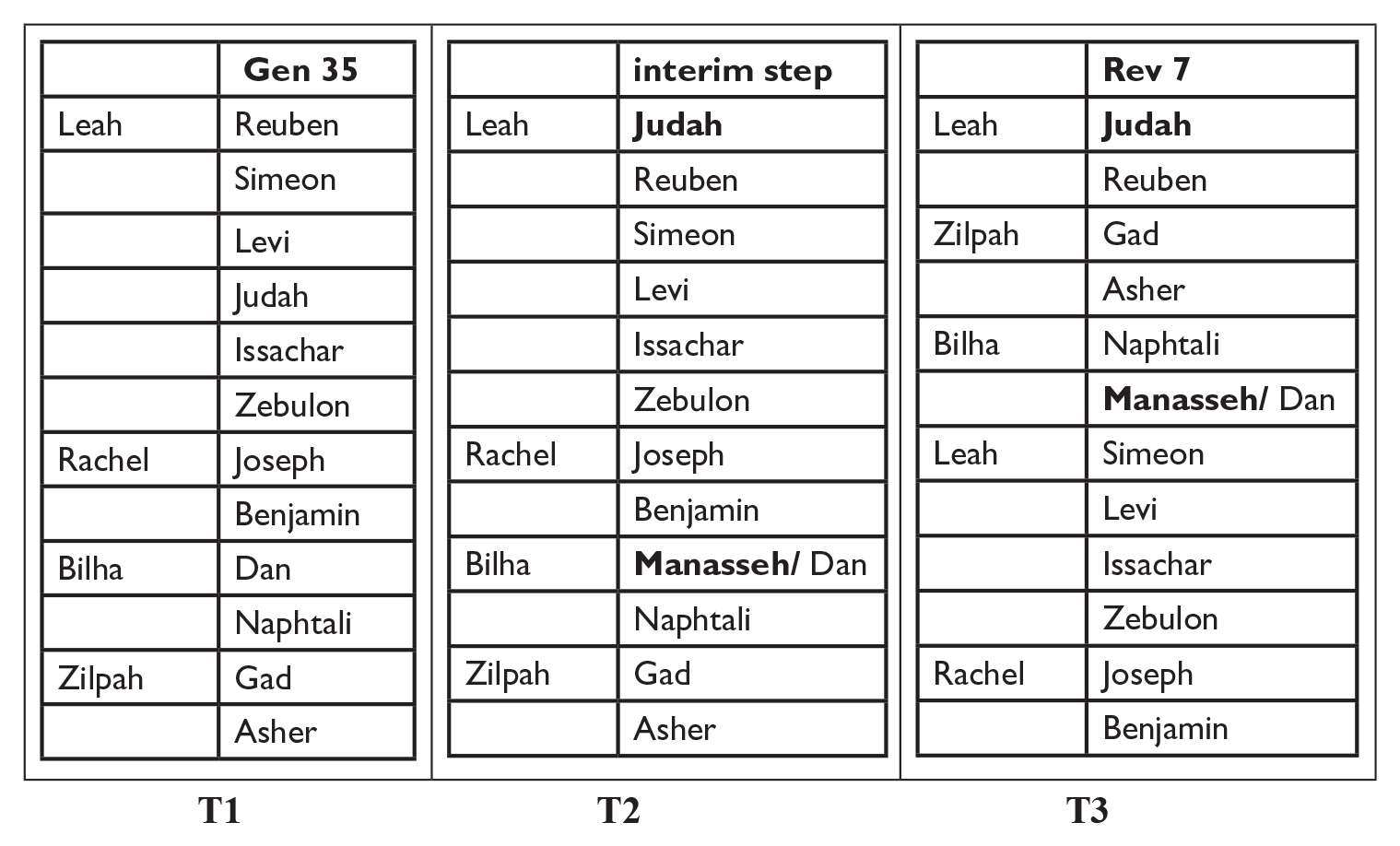
Judah leads the tribes, which hints at the Christological character of God’s people, referring to the Lion from Judah in Rev 5:5. Dan is replaced by Manasseh, which is best explained by the dubious characterization Dan gets in the Old Testament tradition (see Jud 18; 1 Kings 12:29) where he is connected to idolatry. This also fits nicely with John adding Manasseh rather than his younger brother Ephraim. Whereas in the story of Jacob in the Genesis account, Ephraim fares better (Gen 48), in the prophetic literature, it is Ephraim who, as a collective naming for the Northern tribes, is connected to the cult of Jeroboam (especially in Hosea 4:17; 5:3; 8:9.11; 13:1; 14:8). The omission of both Dan and Ephraim fits quite well the overall context of John’s work and his polemics against every form of syncretism and participation in the Roman cult (cf. 2:14.20; 9:20; 13:4.8.14; 14:11; 21:8; 22:5). John is clear: those who sympathize with the Roman cult are excluded from God’s people since the worship of the One who sits on the throne is the all-determining reality for John (Rev 4–5). Last, but not least, the shift of Leah’s and Rachel’s sons is noticeable, whereas the sons of the concubines are upgraded, which points to the fact that inherited rights do not matter for belonging to John’s christologically defined Israel, which is opened for all nations.
Important to note is that Israel’s election as God’s people is emphasized by John by presenting Israel as a twelve-tribe people first, and second as the great multitude before the throne of God (7:9–17). The relationship between the Israel passage (vv. 1–8) and the multitude passage (vv. 9–17) has been controversial among scholars. Although it is beyond the scope of this article to engage the question in its entirety, I want to stress two points. First, the primacy of Israel is preserved (Rev 7:1–8). It is about God’s saving action for his people in an eschatological perspective. Israel is not disinherited, nor does “the church” step into Israel’s role. God fulfills his promises to his people, to Israel. For John, as a Christ-following Jew in the first century C.E., there could not have been any other people. Second, from an eschatological perspective, the nations are given a share in this Israel by belonging to it (Rev 7:9–17). For the ethnic Israel, this, in turn, means that its ethnic borders are relativized. It is Israel, renewed by its Messiah, whose destiny to be a light to the nations (Is 42:6; 49:6; 51:4) comes to its fulfillment. With Peter Hirschberg, one could say that a distinction is made between Israel and the nations regarding salvation history, whereby soteriologically, any distinction is abolished. 21
John shares the eschatological outlook of God’s gathering of all twelve tribes with many other Jewish texts. However, he creates his very own list of these tribes to indicate that this people are already christologically defined and thus open for those from the nations who follow the Jewish Messiah. That John’s purpose was not to neatly separate Israel from a people called “the church” becomes most evident in his final vision of the New Jerusalem, which has “the names of the twelve tribes of Israel written on the gates” (21:12) and “the names of the twelve apostles of the ram written on its foundations” (21:14). As a Christ-following Jew of the first century, John sees himself and his communities as naturally sharing in the inheritance of Israel which he sees coming fully to its fulfillment through Israel’s Messiah. 22
A comparative interlude
The use of the motif of the twelve tribes in Revelation and 2 Baruch differs in its details. The Deuteronomistic scheme is lacking in Revelation, and 2 Baruch does not have a list of tribes but takes up the history of the two and ten tribes. Moreover, Baruch’s people are not defined christologically but rather by obedience to Torah. It is striking, however, that both authors use the motif of the twelve tribes at crucial points of their narrative to underline the completeness and eschatological dimension of God’s people. Their authors care about “all Israel” (Rom 11:26) and have to define this Israel in the light of historically shifting circumstances. The community of 2 Baruch and the one of Revelation found themselves as small minorities within a Greco-Roman society on the one hand, and among other Jewish and Christian groups on the other hand. Our authors want to encourage their addressees by zooming out from the modest historical circumstances to the widest promise of the God of Israel, who cares for all his people. Whether they disagree on the exact determination of this people (Torah/Messiah), they agree on the fact that this people is to be sharply distinguished from all kinds of Roman cultic practices because God’s people is called to worship the one who chose them (cf. 2 Bar 41). 23 Both writings ground their view on God’s people, in the monotheistic beliefs of Israel’s scriptures, and the chosenness of Israel.
It is important to mention that our authors do not define Israel as solely consisting of “Jews,” in the sense of people from the descendants of Judah. Sometimes, the debate on the terminology of ’Ἰουδαῖος (Jew/Judean) narrows the wider perspective which is found in our sources, namely that our authors and their communities were not only concerned with the Jewishness of their communities but about their pan-Israel identity. 24 Other than some modern scholars, for whom the ten tribes do not matter and who speak of the “lost tribes,” our ancient authors are very much concerned about all tribes, and the ten tribes were not at all lost but very present in their expectations for the eschatological unification of God’s chosen people.
Our authors also take up a biblical motif to describe their communities as Israel, even if they find themselves in different times than the biblical Israel. They are very much aware of the different historical situations and challenges in which they find themselves but still use this motif to demonstrate the unity of God’s people over the centuries. Baruch can even address the remnant and tell them that “the Lord has given the Torah to you and to your fathers” (77:3), that the addressees of the letter “were together, twelve tribes in the desert” (84:3), and that Moses spoke to them (85:5). In 2 Baruch’s case, the whole narrative setting is placed within the biblical story so that the addressees can identify with the Israel of the past and cope with their own challenges. Some challenges, after all, are structurally very similar, for instance, the loss of the first temple and that of the second. Thus, by identifying with the Israel of the past, which overcame similar crises, the addressees go through a process of katharsis and eventually overcome their grief by feeling belonging to the Israel of all centuries.
John does not use the pseudepigraphical strategy of describing the protagonist as a biblical figure of the past but creates his own story. As has been analyzed, however, in multiple studies, 25 his story is in every sentence grounded in the biblical story-worlds and their motifs and metaphors to create the connection between his communities and the “biblical Israel.” Using the motif of the twelve tribes is one such connection among many others. As has been demonstrated, John not only receives this motif but also transforms it in the light of the Christ event: on the one side, his people are deeply grounded in God’s story with the biblical Israel; on the other side, the constraints of an Israel determined by birth (which the very motif of the tribes suggests!) is expanded to integrate those from the nations who leave their idols and follow the Ram. While the possibility for those of the nations to join Israel also exists in 2 Baruch (cf. chapter 41), it remains an exception and is not a central concern of the work as a whole. Both 2 Baruch and Revelation think in the central categories of “Israel and the nations” but differ in how they define this relationship in their respective nuances.
Addressing God’s people via letter-writing
God’s people and letter-writing in 2 Baruch
Even if the letter of 2 Baruch was separated from the visionary corpus in the history of its transmission, both parts belong together. On the level of content, the letter takes up the important topic of Torah obedience. On the form-critical level, the letter takes up the three speeches of Baruch, to which it bears many resemblances, as Mark Whitters observes:
Ep2B constitutes the promulgation of the whole 2 (Syriac) Baruch message or of the last long vision and interpretation (chs. 53–74). This similarity is intentionally designed to highlight the fact that both the public addresses of ApB and the moral exhortations of Ep2B are in fact elements of preaching.
26
Lutz Doering speaks of the letter as “the paraenetic summation of the final vision and thus of the entire apocalypse.” 27 The introductory formula of the letter mentions the “nine and a half tribes, those who are across the river” (78:1) as the addressees of the letter and thereby takes up the motif of the tribes as it is introduced in the narrative opening of the whole work (2 Bar 1:1–5). The letter proper starts with the superscription, “Thus says Baruch, son of Neriah” (78:2), and continues with the adscription, “to the brothers who were taken into captivity.” What follows is the salutation, “mercy and peace be with you.” The Syriac for “mercy” is, ܪ̈ܚܡܼܐand renders the Greek ἔλεος rather than χάρις. 2 Baruch is thus not using the Pauline salutation that is echoed in Revelation. 28 With “peace,” 2 Bar places itself in the Jewish tradition of the concept of shalom and what it implies within the background of Israel’s tradition.
Following the prescript is a proem with traditional elements. The author uses the epistolary and personal “I” which is brought into relationship with “my brothers.” He is remembering the love of God expressed for all creation and the whole people instructed by Torah: “I remember, my brothers, the love of him who created me, who has loved us from the beginning and has never hated us, but above all disciplined us” (2 Bar 78:3). As in John’s Apocalypse, we have a focus on the relational dimension of God’s people and God’s goodness toward the people. The author deepens the topic of God’s people in verse four: “And surely I know, that, behold, all of us, the twelve tribes, are bound by one bond as we also descend from one father.” Baruch goes on to explain the reason for writing his letter (v. 5): “that you may be comforted concerning the evil things which have come upon you and that you may also be grieved concerning the evil things which have come upon your brothers.” Again and again, the relational term “brothers” is used, which has striking parallels with the letter of 2 Macc and some rabbinical letters, for example, t.Sanh. 2,6. The proem ends with an eschatological outlook (78:7): “But with many compassions he will again gather those who were dispersed.”
As a last point, Baruch advises his addressees to read his letter in a liturgical setting (86:1–2): “Therefore, when you receive this letter, read it in your congregations with care. And meditate upon it, especially on the days of your fasts.” Baruch’s letter is thus an example for communal reading of letters as we find references to the practice also in early Christian and Qumranic letters. 29 Letters served as a form of communication, and beyond that, they also served as community-forming documents that were read in totally new circumstances. The letter of 2 Baruch as attached to a visionary corpus demonstrates how the author combined this corpus in the form of the letter to bring his message home and to involve his addressees in a setting of direct communication.
God’s people and letter-writing in the Revelation of John
John of Patmos begins his work with the word Ἀποκάλυψις (Rev 1:1), which does not designate a genre but states that the following, which he is going to report, is something he has received through a disclosure or revelation. 30 In verse four, however, he starts a second time with a letter opening, the prescript, containing the traditional elements of superscription (“John”), adscription (“to the seven churches that are in Asia”), and the salutation in typical Pauline manner with χάρις ὑμῖν καὶ εἰρήνη. The salutation is expanded, describing the source of grace and peace as “He who is, and who was, and who is coming, and from the seven spirits who are before His throne, and from Jesus Christ, the faithful witness, the firstborn from among the dead, and the ruler over the kings of the earth” (Rev 1:4–5).
All these divine attributes reccur throughout the book and point to central theological motifs of the work. Instead of personal or introductory remarks as we know them from other letters, John places a doxology right after his prescript (vv. 5b–6):
To the One who loves us and has set us free from our sins by the power of his blood, and made us a kingdom, priests for God, his father, to him be the glory and the power for ever and ever. Amen.
31
Instead of personal words, he presents Christ’s saving work and its results, including the author, John, and the addressees. By using the personal pronouns “who loves us,” “has set us free from our sins,” and “made us a kingdom,” the author establishes a strong relationship between himself and his addressees and stresses their new standing as kingdom and priests called to worship the initiator of this saving act, who is God.
The proem is then extended by an eschatological perspective, presenting the main theme of the letter, the second coming of Christ (v. 7), and the guarantee of the letter’s content by God himself who says: “I am the Alpha and the Omega, the One who is, and who was, and who is coming, the Almighty” (v. 8). In verse nine, the relationship between John and the addressees is further developed since both share in the distress but also the kingdom of Jesus Christ. One possible ending of the proem could be seen in verse 11 because it mentions the seven ekklesiai and thus builds an inclusion with verse four.
The letter ending is much shorter. It takes up the salutation and simply states: “The grace of the Lord Jesus be with all” (22:21: Ἡ χάρις τοῦ κυρίου Ἰησοῦ μετὰ πάντων). 32 This epistolary frame is far from being “quite superficial,” as Adela Yarbo Collins puts it, 33 since the whole apocalypse becomes a letter. In addition to this epistolary frame, also the seven missives to the individual churches from Revelation 2–3 have epistolary features and take up the tradition of prophetic letters (cf. 2 Chr 21:21 LXX and Jer 36:4 LXX). How the author combines, however, the different forms into one letter/message is unique in the whole corpus of Jewish and Christian literature. Each of its messages consists of an adscription, the command to write, the τάδε λέγει formula, the christological predications, the narration, the disposition, the proclamation formula, and the promise-to-the-victor formula. 34 By placing the individual letters within a grander letterform (Rev 1:4–11; 22:21), John makes his letter both a circular letter, which is addressed to many communities, and at the same time, each community is addressed individually, which is usually avoided in circular letters, like for instance in 1 Peter or Ephesians. Thus, the whole visionary corpus becomes embedded within the letterform and communicated by it. As unusual as it might appear, writing a lengthy visionary account within a letter is just as creative and original.
Comparative remarks on letter-writing in 2 Baruch and Revelation
Let us first consider the general structure of both letters and, in a second step, see how the letters are connected to the visionary corpus.
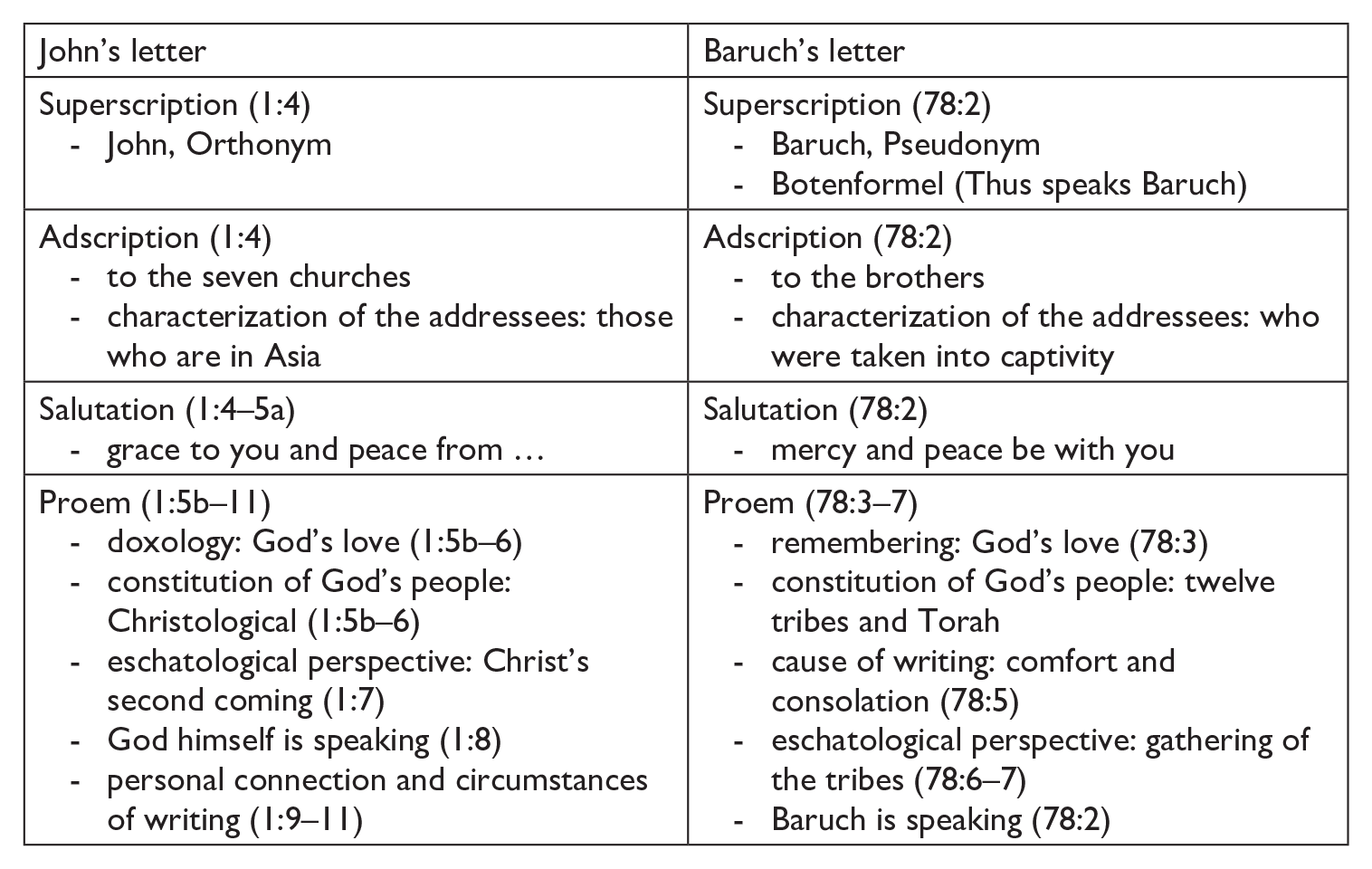
Both letters follow a structure of prescript (superscription, adscription, salutation) and proem, showing their deep embeddedness in ancient Greek, Jewish, and Christian letter-writing practices. 35 There are some interesting parallels in the proem. There is no doxology in 2 Baruch, but instead a recollection of God’s love. Striking, both proems start with God’s love to his people. In John’s letter, the Christ event further defines God’s love; in 2 Baruch, God’s love is shown through creation and tokens of favor to his people, Israel. Moreover, both letters stress the constitution and identity of God’s people right at the beginning. In John’s letter opening, they are a kingdom, and priests are called to worship the Almighty. In 2 Baruch, they are a people of twelve tribes who are called to follow Torah. Whereas 2 Baruch is very personal in tone and mentions reasons for writing, such as consolation and comfort, John is rather reserved but mentions the bond between him and his addressees in 1:9. Moreover, both letters point to an eschatological perspective at the end of their proems. For 2 Baruch, the great event will be when God gathers His people. For John the great eschatological event is the second coming of Christ.
The letter endings are quite different. The advice for communal reading which is found in 2 Baruch at the end of the letter can be compared to the beginning of John’s Apocalypse, which also contains a reference to communal reading in verse three, although not in the form of advice but in the form of a macarism (“Blessed is the one who reads . . . and blessed are those who hear . . .”). So far, the letter opening and ending express a clear concern for God’s people.
Second, let us see how both letters are connected to the visionary corpus. Matthias Henze has termed the letter of 2 Baruch “apocalyptic epistolography” 36 and refers to the apocalyptic program of the letter. The term “apocalyptic epistolography” also applies to John’s letter and many other letters, for instance, in the New Testament canon. The difficulty, however, is that each letter has a different apocalyptic program, and scholars have no consensus on what the adjective “apocalyptic” means. 37 Regarding 2 Baruch and the Apocalypse of John, their genre designation has been intensively discussed, and there is good reason to classify both works as “apocalypses.” 38
When both works are considered in the contexts of all other Jewish and Christian apocalypses, their epistolary features stand out.
39
Both works use the form of a letter to communicate the message of their visionary corpus and to apply it to their addressees. This is why, in his time, Pierre-Maurice Bogaert had tried to explain the parallels with a reception trajectory going from 2 Baruch to Revelation:
J’expliquerais volontiers le double recours de l’Apocalypse johannique à la forme épistolaire par une imitation de II Baruch. Les sept lettres de Jean aux Églises d’Asie correspondent à la lettre finale de Baruch aux tribus orientales, tandis que l’adresse et la souscription qui font de l’Apocalypse tout entière une lettre mettent en évidence le fait que II Baruch était lui-même tout entier considéré comme une lettre.
40
According to my comparison, however, there is not enough evidence to conclude that John imitates the letter form of 2 Baruch because the details are too different. Whereas Revelation is a letter in its entirety, including the visionary corpus in the main part of the letter, 2 Baruch attaches the letter to the visionary corpus; thus, it is not the whole work that becomes a letter. Furthermore, the similar structure of the letters is best explained by their embeddedness in contemporaneous (Greek and Jewish) letter-writing practices. Even so, it is significant that both works reveal similar literary techniques of combining the visionary corpus with the letter and using the latter for primarily consolatory functions. Moreover, in both letters, the addressees are addressed as God’s people, which is defined not in sectarian terms as a small minority but in broad categories. 2 Baruch tries to reach all of Israel by addressing the entire diaspora, and Revelation tries to make its message relevant for all of God’s people by choosing seven communities as explicit addressees and thus demonstrating the message’s relevance for all communities at any given time at any given place. 41
Even if we do not find exact parallels of combining a visionary corpus with the form of a letter—this is also not what we would expect if we assume original and creative authors—the comparison of 2 Baruch and Revelation confirms what Doering had suggested earlier, namely “that Jewish ‘apocalyptic’ letters are of greater relevance for the interpretation of Rev than sometimes claimed.” 42 The salutation in Revelation clearly shows Pauline influence, and other elements show its specific Christian character. Nonetheless, the letter of 2 Baruch can illuminate the traditional-historical context of Revelation when it comes to writing literary vision accounts and embedding it within letters. Likewise, Revelation is an important source for understanding the wider literary context of 2 Baruch.
Concluding remarks
My comparative analysis has shown that both works, 2 Baruch and John’s Apocalypse, creatively and originally combine their literary visionary accounts with forms of letter-writing. I therefore suggest that both works can not only be categorized as “apocalypses” but more accurately as “epistolary apocalypses.” 43 Both the visionary account and the epistolary features are connected to reach the widest audience possible and encourage it to identify themselves with God’s chosen people Israel. Both authors place their stories of God’s people firmly in the Heilsgeschichte of Israel and its scriptures and thus show the continuity of God’s dealings then and now. Their message is that God’s story has not ended with the temple’s destruction and that he remains faithful to his people according to his promises. More concretely, God’s faithfulness is discovered with the motif of the twelve tribes. By no means are the tribes lost, but both works maintain that God has chosen Israel (not only Judah), which is revealed in the expectation of an eschatological gathering of all tribes. In Revelation, the people are more specifically defined from a christological perspective, while in 2 Baruch, they are foremost constituted by Torah obedience. At the same time, both works remain grounded in Jewish monotheism and polemically engage practices of the Roman imperial cult.
Footnotes
Declaration of conflicting interests
The author(s) declared no potential conflicts of interest with respect to the research, authorship, and/or publication of this article.
Funding
The author(s) received no financial support for the research, authorship, and/or publication of this article.

1.
For introductory questions concerning 2 Baruch, see Matthias Henze, Jewish Apocalypticism in Late First Century Israel. Reading Second Baruch in Context (Tübingen: Mohr Siebeck, 2011); further Pierre-Maurice Bogaert, L’Apocalypse syriaque de Baruch. Introduction, traduction, et commentaire, 2 vols. (Paris: Cerf, 1969); Mark F. Whitters, The Epistle of Second Baruch: A Study in Form and Message JSPSup 42 (Sheffield: Sheffield Academic Press, 2003); Lutz Doering, “The Epistle of Baruch and its Role in 2 Baruch,” in Fourth Ezra and Second Baruch. Reconstruction after the Fall, ed. Matthias Henze and Gabriele Boccaccini (Leiden/Boston: Brill, 2013), 151–73. For Revelation, see the commentary by David Aune, Revelation, WBC 52, 3 vols. (Dallas, TX: Word Books, 1993–1998) and multiple other works. In this article, I use “Revelation” and “the Apocalypse of John” interchangeably.
2.
The designation “apocalypse” goes back to Rev 1:1. It is not yet a genre designation. In the following centuries, all kinds of works, also 2 Baruch, were provided with the heading “apocalypse.” Thus, ancient writers sensed similarities of certain type of works with Revelation. We do not have, however, a genre debate as it is developed from the nineteenth century onwards. For a widely discussed definition, see John J. Collins, “Towards the Morphology of a Genre,” Semeia 14 (1979): 1–21, 9: “‘Apocalypse’ is a genre of revelatory literature with a narrative framework, in which a revelation is mediated by an otherworldly being to a human recipient, disclosing a transcendent reality which is both temporal, insofar as it envisages eschatological salvation, and spatial, insofar as it involves another, supernatural world.”
3.
The earliest evidence for Revelation read by Christian communities as belonging to authoritative and prophetic writings is probably the Martyrdom Letter of Lyon and Vienne. For this letter and its reception, see John Dik, “Apocalyptic Letter Writing in Early Christianity: The Letter of Lyon and Vienne and its Reception of the Apocalypse of John,” ZAC 29 (2025).
4.
For the transmission of the text in Syriac, see Liv I. Lied, Invisible Manuscripts: Textual Scholarship and the Survival of 2 Baruch, STAC 128 (Tübingen: Mohr Siebeck, 2021).
5.
A thorough comparison of 2 Baruch and Revelation is available in my dissertation “Transformationen von Volk-Gottes-Vorstellungen. Eine vergleichende Untersuchung apokalyptischer Schriften aus der Zeit nach der Zerstörung des zweiten Tempels,” which will be published with Brill in the series “Ancient Judaism and Early Christianity” (AJEC).
6.
See Friedrich Lücke, Versuch einer vollständigen Einleitung in die Offenbarung des Johannes [. . .], (Bonn: Eduard Weber, 1832), Adolf Hilgenfeld, Die jüdische Apokalyptik in ihrer geschichtlichen Entwickelung (Jena: Mauke, 1857), Hermann Gunkel, Schöpfung und Chaos in Urzeit und Endzeit: eine religionsgeschichtliche Untersuchung über Gen 1 und Ap Joh 12 (Göttingen: Vandenhoeck & Ruprecht, 1895), Wilhelm Bousset, Die Offenbarung Johannis (Göttingen: Vandenhoeck & Ruprecht, 1896), Robert H. Charles, A Critical and Exegetical Commentary on the Revelation of St. John (Edinburgh: Clark, 1920), John J. Collins, The Apocalyptic Imagination: An Introduction to Jewish Apocalyptic Literature (Chicago: Eerdmans, 2016), Richard Bauckham, The Climax of Prophecy (Edinburgh: T&T Clark, 1993), Aune, Revelation.
7.
Bogaert, L’Apocalypse syriaque, Wolfgang Harnisch, Verhängnis und Verheißung der Geschichte. Untersuchungen zum Zeit- und Geschichtsverständnis im 4. Buch Esra und in der syr. Baruchapokalypse (Göttingen: Vandenhoeck & Ruprecht, 1969), Albertus F. Klijn, “The Sources and the Redaction of the Syriac Apocalypse of Baruch,” JSJ 1 (1970): 65–76, Frederick Murphy, The Structure and Meaning of Second Baruch SBLDS 78 (Atlanta: Scholars Press, 1984), Gwendolyn W. Sayler, Have the Promises Failed? A Literary Analysis of 2 Baruch SBLDS 72 (Chico: Scholars Press, 1982). Liv I. Lied, The Other Lands of Israel: Imaginations of the Land in 2 Baruch (Boston: Brill, 2008). For the other works, see n. 1.
8.
Henze, Apocalypticism, 11.
9.
Adela Y. Collins, “Reading the Book of Revelation in the Twentieth Century,” Int 40 (1986): 229–42, 242.
10.
In 2 Baruch, both enumerations are used for the twelve tribes: ten tribes plus two tribes; and nine and a half plus two and a half tribes. For the nine and a half tribes, cf. 2 Bar 62:5, 77:19, and 78:1.
11.
If not otherwise noted, the translations are my own.
12.
What exactly Torah in 2 Baruch (syr. ܢܡܘܣܐ) means is a topic for a separate article. The author of 2 Baruch never defines it because he assumes his readers to know what he means. A good working hypothesis to start with for 2 Baruch is to assume that Torah refers to the laws and statues which have been given to Moses by God. This Torah is still valid for God’s people, even after the temple’s destruction, and has salvific potential for the present and for the future. For the close connection of Torah and eschatology in 2 Baruch, see Rebecca L. Harris, “Torah and Transformation: The Centrality of the Torah in the Eschatology of 2 Baruch,” JAJ 10.1 (2019): 99–144.
13.
Doering, “The Epistle of Baruch,” 168 [italics original].
14.
See Doering, “The Epistle of Baruch,” 151–73.
15.
For further ideas on the significance of the Land in 2 Baruch, see Lied, The Other Lands of Israel and Jacobus C. de Vos, Heiliges Land und Nähe Gottes. Wandlungen alttestamentlicher Landvorstellungen in frühjüdischen und neutestamentlichen Schriften FRLANT 244 (Göttingen: Vandenhoeck & Ruprecht, 2012), 80–83.
16.
The validity of God’s promises in 2 Baruch is also underscored by Sayler, Have the Promises Failed?
17.
For the reception of Exod 19:6 and its various textual forms, see John H. Elliot, The Elect and the Holy. An Exegetical Examination of 1 Peter 2:4–10 and the Phrase βασίλειον ἱεράτευμα (Leiden: Brill, 1966); and Stephanie Schabow, Gemacht zu einem Königreich und Priestern für Gott WMANT 147 (Neukirchen: Neukirchener Theologie, 2016).
18.
ἀρνίον is a young ram which can also be rendered as “lamb” as most translations do. However, I opt for “ram” in this contribution in order to not too quickly mingle Revelation’s portrait of Jesus as a young ram with the portrait of Jesus in the Gospel of John as ἀμνός. The problem with the translation of “lamb” is that it rather suggests the sacrificial and weak side of the animal which is clearly present in passages like Rev 7:9.10.14; 12:11; 13:8; 14:4. Other passages like 6:1.16, 14:10, and 17:14 rather stress the judicial and powerful side of the animal which is rather expressed by the translation “ram.” Additionally, a young ram can also be a sacrificial animal. Both aspects are interwoven in the book which is also expressed in 5:6 where John sees a slaughtered ram (sacrificial side) with seven horns (powerful side). For further details, see Otfried Hofius, “Ἀρνίον – Widder oder Lamm? Erwägungen zur Bedeutung in der Johannesapokalypse,” in Neutestamentliche Studien, ed. Otfried Hofius WUNT 132 (Tübingen: Mohr Siebeck, 2000), 241–52; see also Aune, Revelation, 367–73, who offers arguments for both translations.
19.
At this point, I differ from Stephen Pattemore’s important contribution to the question of the people of God in the Apocalypse of John. He sees the people of God depicted already in the fifth seal of ch. 6. See Stephen Pattemore, The People of God in the ApocalypseSNTS 128 (Cambridge: Cambridge University Press, 2004), 113: “In fact, seen from the perspective of 6:9–11, the rest of the book is an answer to the cry of the martyrs.”
20.
For a detailed comparison with other such lists, see my dissertation, which also takes up earlier research on this question; Richard Bauckham, “The Book of Revelation as a Christian War Scroll,” NEOT 22 (1988): 17–40; Richard Bauckham, “The List of the Tribes in Revelation 7 Again,” JSNT 42 (1991): 99–115; André Feuillet, “Les 144,000 Israélites marqués d’un sceau,” NovT 9 (1967): 191–224; Albert Geyser, “The Twelve Tribes in Revelation: Judean and Judeo-Christian Apocalypticism,” NTS 28 (1982): 388–99; Stephen Goranson, “The Exclusion of Ephraim in Rev. 7:4–8 and Essene Polemic against Pharisees,” DSD 2 (1995): 80–85; Christopher R. Smith, “The Portrayal of the Church as the New Israel in the Names and Order of the Tribes in Revelation 7.5–8,” JSNT 39 (1990): 111–18; Christopher R. Smith, “The Tribes of Revelation 7 and the Literary Competence of John the Seer,” JETS 38 (1995): 212–18; Ross E. Winkle, “Another Look at the list of Tribes in Revelation 7,” AUSS 27 (1989): 53–67; Gert J. Steyn, “The Order of the Twelve Tribes of Israel and its Reception in Revelation 7,” in New Perspectives on the Book of Revelation, ed. Adela Yarbro Collins (Leuven: Peeters, 2017), 523–43.
21.
Peter Hirschberg, Das eschatologische Israel. Untersuchungen zum Gottesvolkverständnis der Johannesoffenbarung (Neukirchen: Neukirchener Verlag, 1999), 194.
22.
It is only in subsequent centuries in which most of the Christ-followers were no longer Jews, that such texts were no longer read through an Israel-lens but rather by a paradigm of clear-cut opposition between Israel and “the church.”
23.
For the importance of leaving idols in order to belong to Israel, see John Dik, “Israel and the Nations: Proselytes and Apostates in 2 Baruch,” JSJ 54 (2023): 1–19.
24.
For the nomenclature of “Jew” and “Israelite,” see Nathan Thiel, “‘Israel’ and ‘Jew’ as Markers of Jewish Identity in Antiquity: The Problems of Insider/Outsider Classification,” JSJ 45 (2014): 80–99; Jason A. Staples, The Idea of Israel in Second Temple Judaism. A New Theory of People, Exile, and Israelite Identity (Cambridge: Cambridge University Press, 2021).
25.
For example, Gregory K. Beale, John’s Use of the Old Testament in Revelation (Sheffield: Sheffield Academic Press, 2014); Steve Moyise, The Old Testament in the Book of Revelation (Sheffield: Sheffield Academic Press, 1995); Beate Kowalski, Die Rezeption des Propheten Ezechiel in der Offenbarung des Johannes (Stuttgart: Katholisches Bibelwerk, 2001).
26.
Whitters, The Epistle of Second Baruch, 63; and Doering, “The Epistle of Baruch,” 159–61.
27.
Doering, “The Epistle of Baruch,” 161. [italics original]
28.
ἔλεος in the salutation can also be found in NT letters, cf. the pastoral letters 1 Tim and 2 Tim: χάρις, ἔλεος, εἰρήνη ἀπὸ θεοῦ.
29.
For more details, see Lutz Doering, Ancient Jewish Letters and the Beginning of Christian Epistolography WUNT 289 (Tübingen: Mohr Siebeck, 2012), 170–214 and 377–497.
30.
To receive revelations is nothing extraordinary in Greco-Roman, Jewish and NT literature. The Greek ἀποκάλυψις occurs eighteen times as a noun in the New Testament (Luke 2:32; Rom 2:5; 8:19; 16:25; 1 Cor 1:7; 14:6, 26; 2 Cor 12:1, 7; Gal 1:12; 2:2; Eph 1:17; 3:3; 2 Thess 1:7; 1 Pet 1:7, 13; 4:13; Rev 1:1). As a verb (ἀποκαλύπτω), the term occurs about twenty-six times in the NT (Matt 10:26; 11:25, 27; 16:17; Luke 2:35; 10:21, 22; 12:2; 17:30; Joh 12:38; Rom 1:17, 18; 8:18; 1 Cor 2:10; 3:13; 14:30; Gal 1:16; 3:23; Eph 3:5; Phil 3:15; 2 Thess 2:3, 6, 8; 1 Pet 1:5, 12; 5,1).
31.
A beginning of a letter with a doxology is not as unusual as one might think. Paul does the same in Galatians: “Grace and peace to you from God the Father and our Lord Jesus Christ, who gave himself for our sins to rescue us from this present evil age according to the will of our God and Father, to whom be glory forever and ever! Amen” (Gal 1:3–5). We know of more letters in which a eulogy or doxology is also placed in the proem (cf. 2 Cor, Eph, 1 Pet, 2 Macc). For more details, see Franz Schnider and Werner Stenger, Studien zum neutestamentlichen Briefformular (Leiden: Brill, 1987), 42–49 and 168–81.
32.
This general conclusion is attested by A and is probably to be taken as lectio brevior and lectio difficilior for the original one. With A, πάντων is still attested by vg and Bea. Already in א the discomfort with this universality, which is, however, explained by the use in worship, is evident when πάντων is replaced by τῶν ἁγίων. David Aune, following R.H. Charles, opts for τῶν ἁγίων, see Aune, Revelation, 1239: “[. . .] it is difficult to accept the notion that John would have pronounced this concluding charis-benediction indiscriminately upon all without restricting its scope to Christians alone [. . .].” However, whereas the common version is explicable from the contextual use of the manuscripts, it is inexplicable why the tradition represented by A should have substituted τῶν ἁγίων.
33.
Adela Yarbro Collins, “The Early Christian Apocalypses,” Semeia 14 (1979): 61–121, 71.
34.
For a closer analysis of the individual forms of each letter, see Aune, Revelation, 119–24.
35.
See the chart below.
36.
Henze, Apocalypticism, 369.
37.
For one among many other suggestions cf. Lorenzo DiTomaso, “Apocalyptic Historiography,” EC 10 (2019): 435–60, 437: “‘Apocalyptic’ is an expression of a fundamental cognitive orientation or worldview, called apocalypticism. The apocalyptic worldview is defined by an integrated set of axioms about the nature of space, time, and human existence.”
38.
In brief, all criteria of Collins’ definition (see footnote 2) can be applied to the Apocalypse of John: It is certainly a piece of revelatory literature (1) as the very first word of the work strongly suggests; it has a narrative framework (2); the revelation is mediated by a heavenly being (God, Jesus, angelus interpes) to a human recipient (John) (3); a transcendent reality is disclosed which envisages an eschatological salvation (Jesus coming on a white horse to save his people from their enemies, Rev 19:11–21) (4); and a spatial dimension (coming down of the New Jerusalem and transformation of the cosmos into a temple, Rev 21–22) (5).
39.
The Epistle of Enoch could also be compared with the letter-writing in 2 Baruch and the Apocalypse of John; however, this is a topic for another study.
40.
Bogaert, L’Apocalypse syriaque, 55.
41.
As noted by previous exegetes, for instance, Richard Bauckham, The Theology of the Book of Revelation (Cambridge: Cambridge University Press, 2003), 16: “By addressing seven churches John indicates that his message is addressed to specific churches as representatives of all churches.”
42.
Doering, Ancient Jewish Letters, 497.
43.
It applies to many Jewish letters as the one in 2 Baruch but likewise to most of the NT letters. For the New Testament letters and their apocalyptic character, see Benjamin E. Reynolds and Loren T. Stuckenbruck, The Jewish Apocalyptic Tradition and the Shaping of New Testament Thought (Minneapolis: Fortress Press, 2017), 155–360. Matthias Henze uses the term “apocalyptic epistolography” to refer to the letter of 2 Baruch and the like. See Henze, Apocalypticism, 369.