



Abstract
Whereas many of the so-called Jewish Pseudepigrapha still wait for a critical edition, the Life of Adam and Eve—or the Apocalypse of Moses, as the Greek version is captioned in some manuscripts—has received more than three critical editions in recent years. While the question which manuscript or version comes closest to the original form of the story is still under debate, this article argues that the manifold manuscript tradition opens a window into an ancient discussion on Satan’s, Eve’s, and Adam’s role in the story of their expulsion from Paradise. I will concentrate my discussion on Eve’s account of the story in GLAE 15–30 and LLAE 45–60. The three texts differ in their representation of gender roles in Eve’s own account of the fall. None of these versions only exonerates or denigrates Eve, nor is one with the most emancipatory potential easily identified. All three texts, however, document a constant discussion on Eve’s role in Paradise.
“From a woman is the beginning of sin, and because of her we all die” (Sir 25:24). This, in the context of Jesus Sirach, even though a singular statement, might be the first witness of manifold stories that blame Eve as the (only) originator of sin.
1
In the first-century C.E., Pseudo-Philo adds, the first “man transgressed my ways and was persuaded by his wife; and she was deceived by the serpent. And then death was ordained for the generations of men.”
2
And in the second century, 1 Timothy declares, “Adam was not deceived, but the woman was deceived and became a transgressor” (1 Tim 2:14). It would be easy to increase the number of examples in postbiblical Jewish and Christian traditions blaming the first woman for her transgression. Yet, some countertraditions exist as well. The Apocalypse of Adam, a text from the Nag Hammadi library that likely originated in some Jewish quarters, narrates Adam’s teaching to his son Seth: When God had created me out of the earth along with Eve, your mother, I went about with her in a glory that she had seen in the aeon from which we had come forth. She taught me a word of knowledge (γνῶσις) of the eternal God.
3
This paper addresses Eve’s own account of the fall. It is included in a cluster of texts narrating her and her husband’s fate after their expulsion from Paradise. The writing is known today as the Life of Adam and Eve, or, in the Greek version, the Apocalypse of Moses. Judging from the number of manuscripts and versions, for example, 107 Latin, twenty-seven Greek, as well as many more Coptic, Armenian, Slavonic, and Georgian copies, the story must have been extremely popular in late antiquity. Moreover, Ethiopian and Arabic versions, manifold Armenian books about Adam with similar content from the fifth to the seventeenth century edited by Michael E. Stone, and rewritings and expansions in vernacular European languages, collected and discussed by Brain Murdoch, demonstrate the extraordinary interest in the progenitor’s life beyond Paradise, their repentance, and death in post-antique Christian quarters. 4 Of course, storytelling and rewriting never stop at religious or ethnic borders. At least some episodes and narrative features can be traced also in rabbinic and Islamic tradition. 5
It is no wonder that the Life of Adam and Eve has been discussed in feminist scholarship for some decades. Yet assessments vary broadly. John Levison observes that at least some parts of the story provide an “exoneration of Eve.” 6 To the contrary, Gary Anderson reads in the first line a story on the “culpability of Eve.” 7 Some attribute contradicting images of Eve to different redactional layers in the history of the text’s formation, 8 while others see conflicting and ambiguous representations of the first woman in every version. 9 While some argue that “repetitions, abrupt changes of narrators, inconsistencies in content and interruptions in the narrative flow as well as the document’s affinity with several genres” reveal the composite nature of the document, 10 others argue that it is “a complete literary text that ‘desires and deserves’ to be approached as a unified work.” 11
Broadly speaking, feminist scholarship on the Life of Adam and Eve can be separated into two groups. First, those who read a kind of “end-text”—that is, the Greek version of forty-three chapters or even the recently expanded Latin version of seventy-three chapters—of the narrative as the original, or at least its intended form with a “complex and sometimes contradicting representation of women in male-stream discourses of these times.” 12 And second, those who allow for a literary development that attributes the different representations of Eve to different literary layers of the text. 13
Most scholars agree that the post-Paradise adventures and speeches of Adam, Eve, and their third son Seth belong to an interrelated narrative circle. However, its original text as well as the sequence of episodes remain disputed. The story uses Genesis 1:1–5:6 LXX as its basic text and therefore was originally written in Greek. 14 Yet some manuscripts contain episodes and features that others lack, and all differ in their specific wording.
In the following, I hope to demonstrate that the manifold textual traditions open a window into an ancient discussion on Satan’s, Eve’s, and Adam’s role in the story of their expulsion from Paradise. I will concentrate my discussion on Eve’s account of the story in GLAE 15–30 and LLAE 45–60. First, however, I must provide an overview of the editions and what can be said about its most original form, before I step more narrowly into an analysis of the text of GLAE/Apocalypse of Moses 15–30/LLAE 45–60. 15
Texts and editions of the Greek Life of Adam and Eve
Whereas many of the so-called Jewish Pseudepigrapha still wait for a critical edition, the Life of Adam and Eve—or the Apocalypse of Moses, as the Greek version is captioned in some manuscripts—has received no less than three critical editions of the whole text, an additional one for more than half of it, and three synoptic presentations of texts, text families, or versions over the last 30 years. While most critical editions of the Greek text follow Marcel Nagel’s classification of the Greek manuscripts in four text families (Ia [DSV (K,P,G,B)]; Ib [ATLC]; II [R, M, Slav]; and III), they differ on which of the two text families, Ia or Ib, comes closest to the hypothetical textual archetype. 16 Yet after the rediscovery of the Armenian Penitence of Adam, a text that concurs partly with the Latin yet also includes Eve’s account of the fall, like the GLAE, Michael Stone proposed the Greek archetype of this text as well as its Georgian version as the oldest form of the text. 17 With Gary Anderson, he provides a synopsis of the Latin, Greek, Armenian, Georgian, and Slavonian versions. 18 Already since the early-twentieth century, it had been a standard to print translations of the Latin and Greek side by side. 19 John R. Levison printed Nagel’s text families, represented by the best one or two witnesses, synoptically in four columns side by side. 20 Most recently, Jean-Pierre Pettorelli edited the Latin version and discovered besides the 105 manuscripts of the Vulgata Version Latin-V two manuscripts, which he called Latin-P, that read parts of Eve’s account of the fall in GLAE 15–30 (LLAE-P 45–61). 21 And Jean-Daniel Kaestli provided another synopsis of the two Latin versions beside the Greek, Armenian, Georgian, and Slavonic texts and argues that the Greek ancestor of the Latin-P-version provides the most ancient textual tradition. 22
The question whether the manifold textual traditions and versions of the Life of Adam and Eve go back to one archetype written by a single author at a certain point in history and which text-form or manuscript comes close to this archetype is still open. On one hand, each text represents an integrated story placed between the protoplasts’ expulsion from Paradise and their death. On the other hand, every single manuscript tradition provides some specific details or lacunae and therefore its own narrative flow. The following provides a short overview to the narrative content.
Pluriform texts and oral contexts
Almost all versions of the Life of Adam and Eve start after the protoplasts’ expulsion from Paradise. 23 Yet some episodes are unique to some versions or are represented only in parts of other versions. In general, the Vulgate Version (Latin-V), the Armenian, and Georgian versions concur, as do the Greek and Slavonic versions. Viewed in more detail, all versions and manuscripts have some extra material as well as lacunae, when compared to each other. Only the Latin, Armenian, and Georgian versions start with Adam and Eve’s lament and desperate search for food, Eve’s request to Adam to kill her, and Adam’s advice to repent for about 40 days while standing silently in the river Jordan and Tigris, respectively (LLAE, ArmLAE, GeoLAE 1–8). Yet Satan, in the guise of an angel, deceives Eve a second time, and Adam blames her for being “again seduced by our adversary” (LLAE 10:3; cf. ArmLAE, GeoLAE). Satan confesses that he was expelled out of heaven because he was jealous of Adam (LLAE; ArmLAE; GeoLAE 12–17).
All versions provide an account of the birth of Cain, Abel, and Seth. The murder of Abel is foretold by Eve’s dream in the Greek, Latin, Armenian, and Georgian versions, yet the Slavonian has it as Adam’s dream (SlavLAE 2), and the Georgian is the most extensive account (GeoLAE 23). Only the Latin tradition has the archangel Michael explain to Adam how to become a farmer (LLAE 22:2), a story with an extensive history of reception in the medieval retellings of the West. Only the Latin-V text family has an additional two revelations of Adam to Seth, an account of God’s arrival on the Merkabah chariot in the garden after the fall and a vision of heaven and future judgment (LLAE 25–29). All versions, again, have a short testament of Adam, in which he briefly recounts the fall to his children (GLAE 7–8, SavLAE 5–10; LLAE, AramLAE, GeoLAE 30–34). And all versions have Adam send Seth and Eve to Paradise to obtain some oil that might help Adam to ease his pain, yet entrance was denied (GLAE 9–14, SlavLAE 11–17; LLAE, AramLAE, GeoLAE 35–44).
At this point, the Greek, Slavonic, Latin-P, Armenian, and Georgian traditions, that is, all versions except the Latin-V, introduce Eve’s account of the fall, the text that is of interest in this paper. The last part of the Life of Adam and Eve includes in all versions—yet not in all manuscripts of each version—a confession of Eve’s sin (GLAE, SlavLAE 32; Latin-P, AramLAE, GeoLAE 45). This litany with a repeated liturgical confessional formula “I sinned, oh God/Lord, I have sinned” appears only here and in Aseneth’s psalm in Joseph and Aseneth 21:10–21. 24 Thereafter, Eve sees the Merkabah chariot coming down to earth to bring Adam (or his soul) into heaven, explained to her by her son Seth. God forgives Adam and brings him back to Paradise (GLAE, SlavLAE 33–34; Latin-V; AramLAE; GeoLAE 46–47). The story ends in all versions with the burial of Adam’s body and in some texts also with Eve’s death and burial.
Those who opt for a single textual archetype argue that all episodes are integrated in a similar narrative frame, that some motifs reappear in different parts of the story, and that some parts seem to mirror each other like Adam’s account of the fall before his children and Eve’s account in GLAE 7–8 and GLAE 15–30. 25 However, tensions and contradiction in the flow of the narrative cannot be denied either. Therefore, some suggest that from the perspective of its composition, the Life of Adam and Eve “is a compilation of stories and mini-stories which may have had their original context in everyday discourse.” 26 The author “knew more stories than he (or she) used for his (or her) document.” 27 Some features allude to details not narrated in the textual evidence known today. Some episodes contradict each other. Adam, for example, blames Eve in GLAE 14.2: “What have you made in us? You have brought upon us great wrath, which is death, lording it over all our race.” 28 In Eve’s version of the story, following the consequence of the transgression is not death but expulsion. 29 Later, the account of Adam’s or his soul’s accent to heaven includes manifold perspectives, a Merkabah vision seen first by Eve yet explained by her suddenly appearing son Seth, who also buries Adam’s body, which should be already in heaven (GLAE 33–37). Therefore, many recent interpreters assume that whatever appears in manuscripts today originated in oral storytelling. 30
Such textual fluidity and changes in the narrative flow from one text to another can be observed not only between the translated versions but often also between manuscripts of the same language version. Upon closer inspection, every text family of the Greek Life of Adam and Eve introduces its own set of episodes and features. In her work on the Acts of Peter, Christine Thomas explains similar fluidity between manuscripts as an updating of the story for new social contexts and by multiple performances. In her view, it is advisable to view each manuscript of a given text, Jewish, Greek, novel, or an apocryphal acts, “as a separate performance, similar to descriptions of oral tradition”: 31
Even if we grant the existence of an “original text” written by a single author, we must reckon with a series of readers who did not strive to preserve this original text, but took the liberty to go about rewriting it in their own fashion. The original text is not a monolith, but functions as a basis for further retellings.
32
More recently, Patricia Ahearne-Kroll included Thomas’ concept in her analysis of the Jewish novel Joseph and Aseneth. 33 Instead of adapting a specific reconstruction of a most original text, Ahearne-Kroll extracts a set of narrative features as a common fabula, that is, a sequence of episodes and details that builds a core story. While one might dispute whether Joseph and Aseneth, despite all differences between manuscripts, indeed resemble a clustered episodic narrative or whether there is at least an integrated basic story line shared by all text families, 34 the Life of Adam and Eve obviously shares the episodic style with the Acts of Peter. While manuscripts and versions of the Life of Adam and Eve share a basic narrative setting—an account about Adam and Eve after their expulsion of Paradise until their death—there is no fixed sequence or number of episodes, nor do manuscripts’ respective retellings find all episodes and motifs of equal importance.
Discrepancies between versions and texts can be used as a resource in feminist scholarship. They uncover what writers, hearers, and those who transmit a given story orally consider necessary to adjust to their understanding of a given story, that is, the deeds, acts, and speeches of the narrated characters. 35 Already in 1989, John R. Levison observed,
the characterization of Eve in the Apoc. Mos. [Greek Life of Adam and Eve] 15–30 differs markedly from that of the remainder of the Apocalypse of Moses. The narrator of the former exonerates her while the narrator of the latter denigrates her.
36
In 2000, Levison refined his thesis by the observation that the “characterization of Eve differs in the respective text forms.” 37
Following this line, I am going to investigate three manuscripts from the respective text families of Eve’s testament in GLAE 15–30/LLAE 45–60. For the Greek text, I selected versions Ia and II, as represented by the manuscripts D/S and R in Levison’s synopsis in his Text in Transition. For Latin, I use the new edition by Pettorelli and Kaestli. I choose Nagel’s text family Ia, a text family that is not only identified by many as the best witness to a hypothetical archetype but also, according to Levison’s assessment, one that depicts Eve in an exonerating way. 38 Next comes II (RMSlav), a text that includes a shorter version of Eve’s account and also the protoplasts’ second repentance in the river Jordan and Tigris, respectively (GLAE II 29:7–13). Also for this version, Levison identifies tendencies that “incorporate substantial elements that exonerate Eve.” 39 The third text is the version Latin-P, a text that is most recently identified as a witness to the most original text by its editors. I present the text in three columns in my translation. 40
Eve’s testament in the Greek manuscripts D and S (Family Ia), R (Family II), and in the Latin-P-Text
The narrative frame of Eve’s testament
In GLAE 15–30, Eve recounts her and her partner Adam’s expulsion from Paradise. Such first-person retrospect of famous progenitors near the end of their life, their farewell speeches or testaments, became a popular literary genre in postbiblical literature. 41 Some testaments of Adam are known as well; one is included in GLAE 7–9 and has parallels in all versions. 42 In his account, Adam claims that the enemy gets the chance to approach Eve because Eve’s guarding angels had ascended into heaven and worshipped God. 43 The devil seduced Eve in the moment she lacks male supervising. The juxtaposition of Adam’s and Eve’s testament led Levison to his thesis that GLAE 15–30 exonerates Eve, while the rest of the writing and its Latin version denigrate the first woman.
The genre covers a broad range of writings, such as the Testament of Job, the Testament of Abraham, the Testaments of the Twelve Patriarchs, and related texts from Qumran as well as Acts 20:17–34, 2 Peter, John 13–17, and, from the Greco-Roman literature, Xenophon Cyropaedia 8.7.6–28, among others. 44 Some texts highlight ethical advice, others let the dying person look into the future of his (or her) family or people, while a third group of writings is most interested in the development of its main character’s inner and outer struggles. Like the Testament of Job and the Testament of Abraham, Eve’s testament belongs to the latter category. Yet beyond implicit warning, there is also some explicit advice at the end of Eve’s speech at least in some manuscripts.
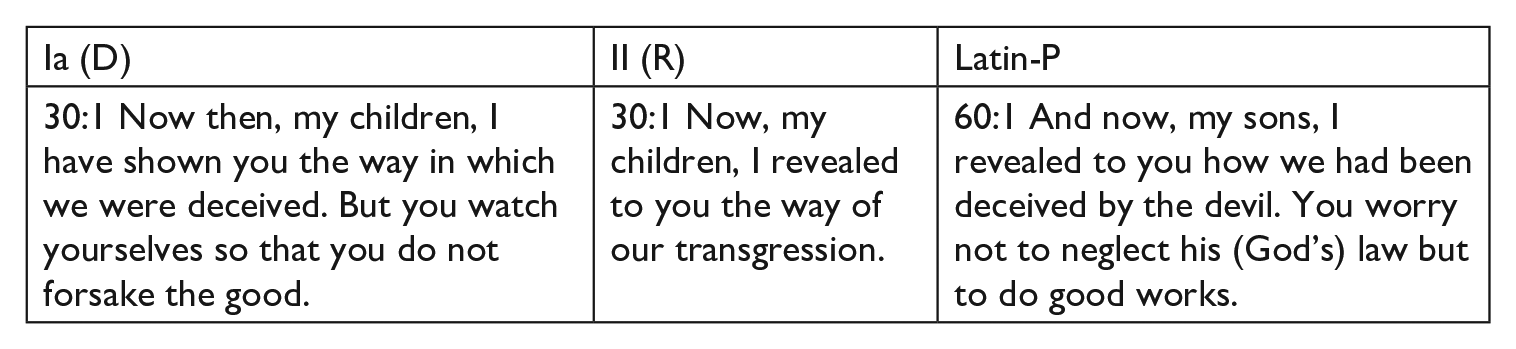
At the end of Eve’s speech, LLAE Latin-P version and GLAE Ia present Eve’s ethical advice for the next generations. While this is typical for the testament genre, the Latin thwarts this impression by depicting her as lamenting and mourning and thereby undercuts the sovereignty of the speaker. In GLAE II, she gives just a summary of her foregoing narrative without intensifying it by formal advice. At the beginning of Eve’s monologue, however, she does as a sovereign speaker in both Greek texts.
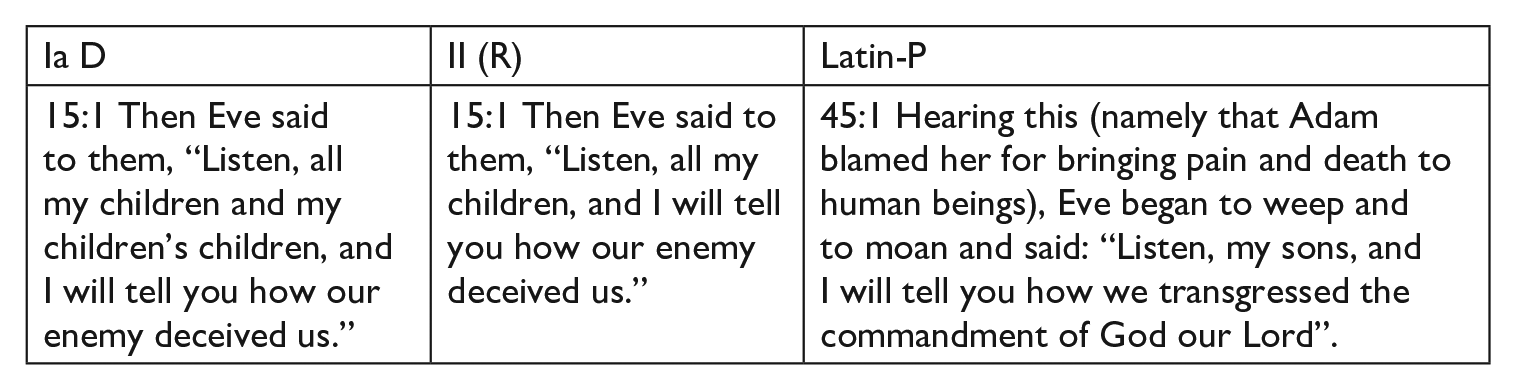
Both Greek manuscripts start as a typical farewell address to one’s children and grandchildren. The Latin-P tradition presents Eve again as a weeping penitent. Contrary to the Greek tradition and her own report at the beginning of her speech in LLAE 45:1, she blames herself alone for the fall. 45 Whether Eve, or Adam and Eve, or the devil is the most active agent in this transgression of God’s command is one of the main controversies discussed between the manuscripts. 46
The dialogue between the devil and the snake
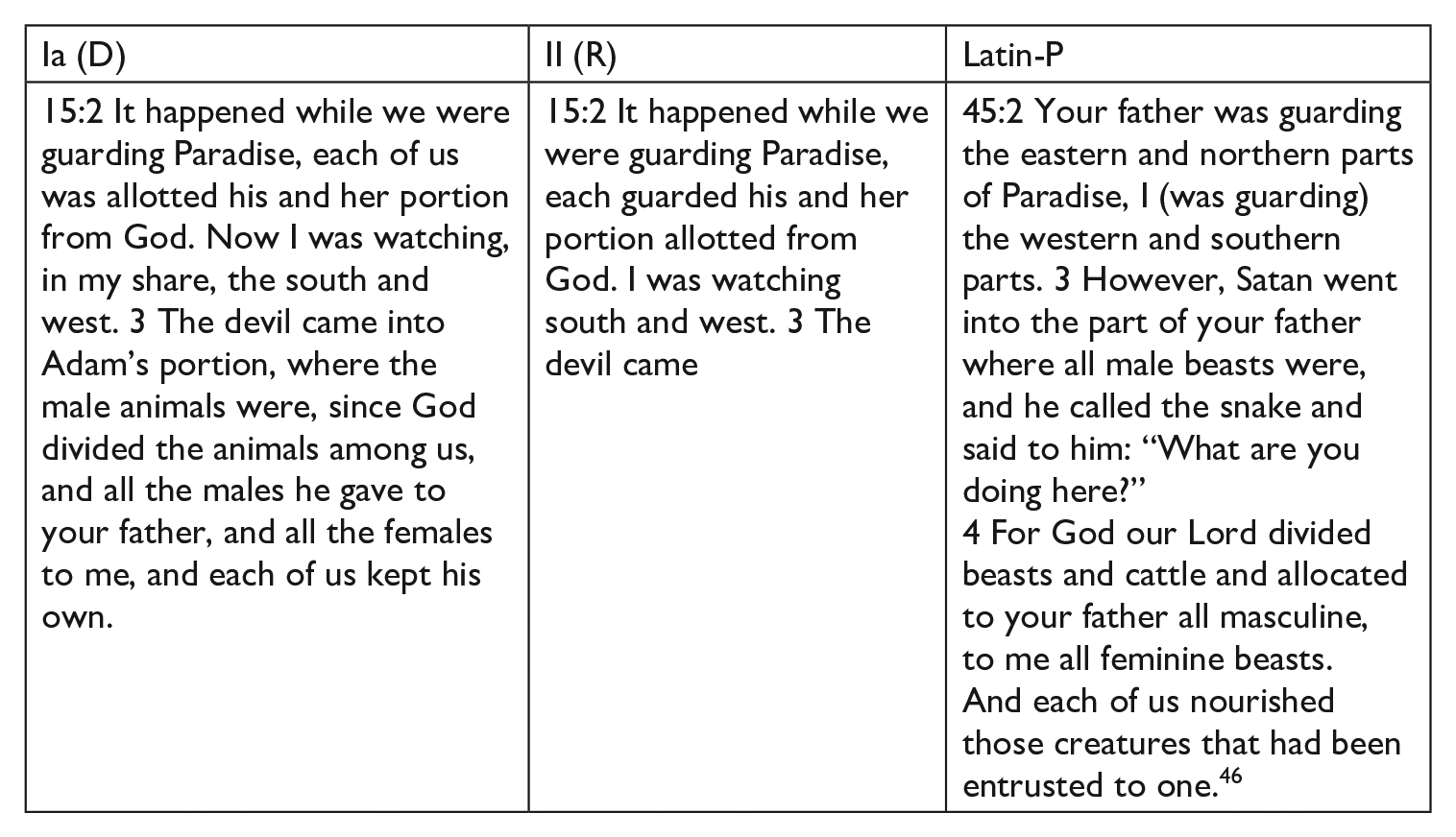
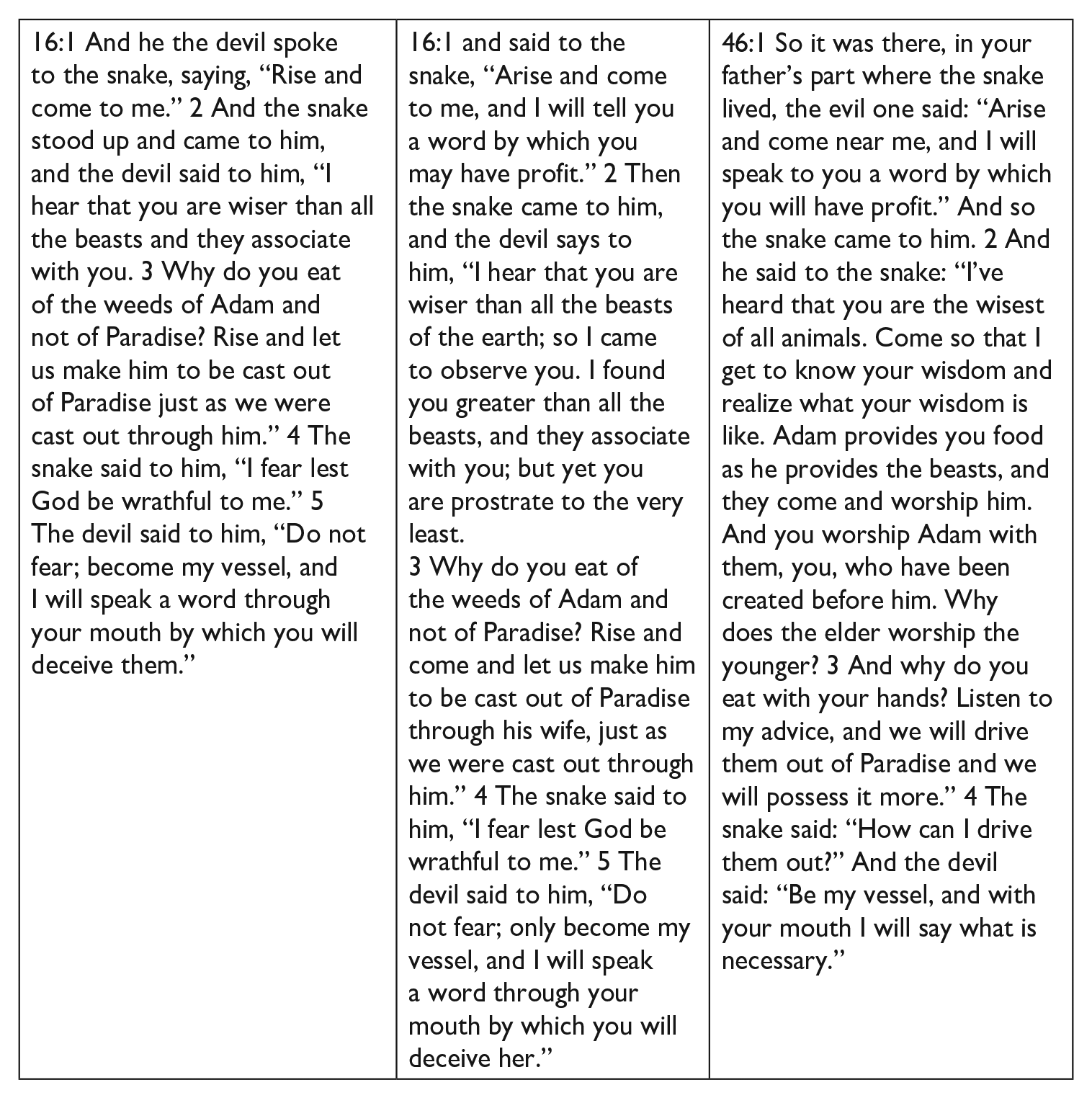
First of all, Eve informs those who listen to her why the snake or serpent became a vessel for the devil. The source of Eve’s information remains hidden. All three versions presuppose an account of Satan’s expulsion from Paradise that motivates his hostility against Adam. The Greek versions allude to such a story only vaguely (δι᾽ αὐτοῦ; GLAE 16:3). 47 GLAE II adds some motivation for the snake. The devil flatters the snake with its alleged cleverness and superiority over human beings. Yet no rationale for Satan’s ideas on the order and hierarchy in creation is given in this text. The Latin version provides in its previous chapters a prehistory of Satan’s relationship to Adam. In LLAE 12–17, Satan explains to Adam that he was expelled from his original status among the angels because he refused to worship him (cf. Ps 8:6–7). Specifically, Satan had countered the archangel Michael’s request to worship: “I will not worship him who is lower and later than me. I am prior to that creature. Before he was made, I had already been made. He ought to worship me” (LLAE Latin-V 14:3). 48 It seems that LLAE Latin-P 46:2–3 refers more directly to this account of Satan himself. This observation provides one of the major arguments for those who argue for the priority of the Armenian, Georgian, and Latin tradition. 49 However, as Levison has shown by comparison of the GLAE Ia, II, and a third version (GLAE III) that reads here similar to LLAE Latin-P, the two accounts do not refer to the same myth of the prehistory of Satan. 50 Arbel assumes a conflation of the myth of the fallen angels (Gen 6:1–4/1 En. 9–16) with the garden story of Genesis 2–3. 51
The Greek version Ia and the Latin-P tradition, yet not GLAE II, depict Paradise as a gender-segregated space. The snake, in Greek a masculine noun, belongs therefore to the species guarded by Adam. This could mean that Adam did a bad job in guarding his part of Paradise. In GLAE II, the devil’s target is Adam’s wife Eve alone (cf. GLAE II 16:3). This difference reminds one of the controversies, documented especially in later Christian dogmatic, on whether the male Adam or the female Eve bears more responsibility for the fall. The Latin version seems not much interested in this question at this point. While Satan enters Adam’s part of the garden in this version as well (LLAE 45:4), his extensive dialogue with the snake proves him theologically well informed. He convinces the snake with arguments from the chronological order of creation, countering the human mandate over all animals (Gen 1:28), and establishes the idea to own Paradise for himself and the snake. By expanding on Satan’s cleverness, the narrative decenters Eve in her own account. 52
The dialogue between the snake and Eve
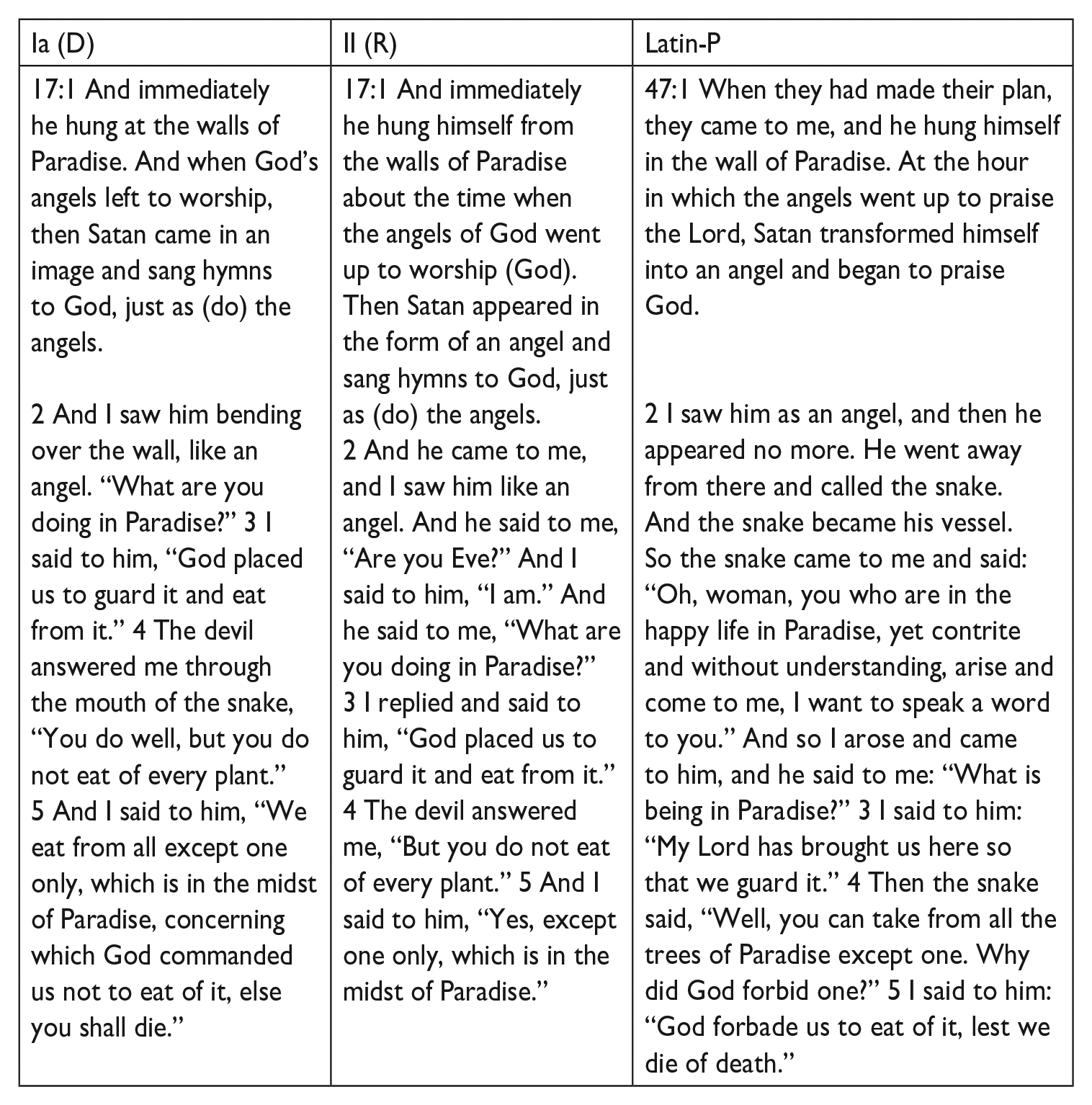
While the whole story evokes the question of responsibilities, Eve’s role remains ambivalent. Should Eve have been able to read the devil’s character? And if this was not possible to her because of the devil’s disguise, does that prove her feminine weakness or that she is not to blame for providing him entrance into Paradise? Recent scholarship illustrates how silence can lead to contradicting assessments and evaluations of Eve’s role in the story.
Especially GLAE 17:1 has been discussed in feminist scholarship because it corresponds to a similar passage in Adam’s account. Adam tells his children: 53
GLAE 7:2 And the hour drew near for the angels who were guarding your mother to ascend and worship the Lord. And the enemy [only D-txt: found her alone and] gave to her and she ate from the tree, since he knew that neither I nor the holy angels were near her.
As John Levison argued already in 1989: “Implicit in Adam’s account is Eve’s subordination to him and her need for him and the angels for protection.” 54 Satan can seduce her only when male and imaginary male angels protect her. In her testament, however, Eve guards her own part of Paradise, and “only by entering Adam’s portion of Paradise and employing the male snake could Satan gain access to Eve’s portion of the Paradise.” 55 So in her version, Eve counters Adam’s account. Jan Dochhorn, however, excludes GLAE 17:1b–2 from the original text as a later interpolation, because, in his view, it crosses the logic of the narrative. It is not too obvious how the devil can at the same time worship God and bend over from the wall of Paradise. 56 More recently, Magdalena Diáz Araujo has countered Dochhorn’s argumentation by observing that the actions of the devil and those of the snake are paralleled, and that the Greek text defends Eve being deceived by someone who appeared as an angel. 57 She furthermore observed that the same motif also appears when Eve repents a second time in GLAE II 29:7–13. 58 So for her, the passage demonstrates a certain exoneration of Eve.
The Latin-P version clarifies that it is not Satan in angelic shape who approaches Eve but the snake. 59 Yet this version also expands on Satan worshipping among the angels among the heavenly hosts. Eve might be distracted or seemingly calmed by Satan’s disguising transformation. However, there is no further expansion on this motif. The Latin snake sounds rather provocative in alluding to misogynistic stereotypes when he alleges that she lives in the joy of Paradise “contrite and without understanding.” Again, it must remain open whether this narrator uses the trope affirmatively or critically.
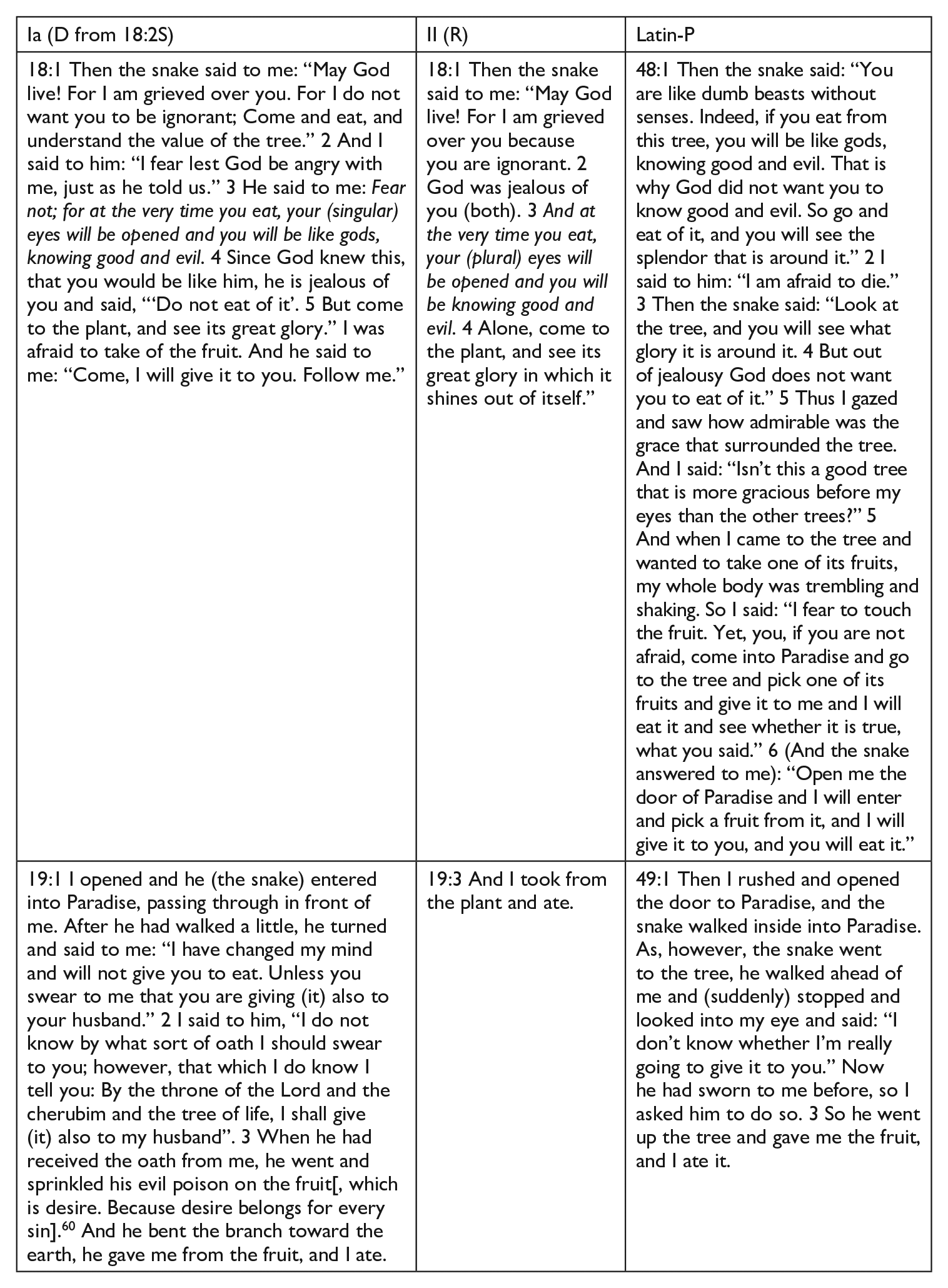
All three versions expand 60 on Genesis 3:5–6. While two versions concentrate on the inner psychological tension that leads the first woman into transgression, the short GLAE II tradition seems to lack such interest at all. To the biblical template, this tradition adds only the snake’s blaming of Eve: “you are ignorant.” What follows is a quotation of Genesis 3:5 with its original plural: “for God knows that on the day you eat of it, your (plural) eyes would be opened, and you would be like gods knowing good and evil.” GLAE II even shortens the next biblical verse, which already expands on the woman’s psychology: “And the woman saw that the tree was good for food and that it was pleasing for the eyes to look upon and was beautiful to contemplate” (Gen 3:6). After Eve is prompted by the snake to look at the tree, she just takes and eats.
To the contrary, the Latin-P tradition expands most on Eve’s inner psychological movements of desire and fear. There is even an inner monologue in LLAE 48:5–6 to illustrate the tensions in Eve’s inside self. In LLAE 49, even the snake mirrors Eve’s emotion by stopping and then moving again forward. Strikingly—at least in comparison to the Greek Ia version—it is not Eve but the Latin-speaking snake that swears and promises and therefore is bound to its oath, besides some skeptical distancing considerations at the very last moment (LLAE 49:3).
While in the Latin-P text, the snake alias the devil approaches Eve provocatively, sicut enim bruta animalia estis sine sensu (“You are like dumb beasts without senses,” LLAE-P 48:1), in the Greek versions the snake is a liar. The vessel of Satan falsely maintains that he is grieving over Adam and Eve. He also wrongly asserts that God is jealous (φθονέω) of the first human beings. As Anne Marie Sweet has shown, both accusations are made against the creator God in some Nag Hammadi and related texts. 61 She argues the Life of Adam and Eve was invented to counter those theological positions. 62 GLAE Ia expands not so much on Eve’s inner self but on her struggle with Satan alias the snake. The snake bends her with an oath, a feature that might reflect oath-criticism of many Jewish and Christian writings. 63 Another interesting detail is that the snake “sprinkled his evil poison on the fruit.” In other words, death cannot originally grow out from a tree in God’s perfect Paradise but must be added either by disobedience or by some poison of the devil. 64
The poison the snake sprinkles into the fruit is finally identified as desire (GLAE Ia 19:3). Some identify this general statement as marginal glosses.
65
Yet there is a widespread multifaceted identification of Eve’s sexuality with the snake or Eve with the snake.
66
And some even argue that Satan is seducing Eve sexually.
67
Therefore, Vita Daphna Arbel reads GLAE 19:3 as a key that conflates the myth of the fallen angels (Gen 6:1–4) with the garden story, or, more explicitly, Eve and the fallen angel Satan.
68
Indeed, some ancient interpreters associate the serpent and ἐπιθυμία (desire) in their allegorical readings of Genesis.
69
Some modern interpreters attribute this feature to Platonizing Judaism(s) and Christianities. Famously, Daniel Boyarin stated in Carnal Israel: There were two types of androcentric social formations in late-antique Judaism: Hellenistic Judaism(s), in which the flesh was abhorred and women and sexuality were feared as a central theme of culture, and rabbinic Judaism, in which the flesh was greatly valued and women and sexuality were controlled as highly prized essentials.
70
The example for the first position is Philo’s exegesis of Genesis 2: The love (ἔρως) that ensures brings together the two separate halves of a single living being as it were, and joins them into unity, thereby establishing in both a desire (πόθος) for union with the other in order to produce a being similar to themselves. But this desire (πόθος) also gave rise to bodily pleasure (ἡδονή), which is the starting-point of wicked (ἀδίκημα) and law-breaking (παρανόμημα) deeds, and on its account, they exchange the life of immortality and well-being for the life of mortality and misfortune.
71
For Philo, at least, there are two forms of desire (πόθος) and love, the good one, which produces legitimate offspring, and the bad one, which gives rise to lust (ἡδονή) and, from there, to lawlessness. That is, women are not generally assigned to the latter. The Life of Adam and Eve is another witness to a more nuanced approach to the fall. Only a few manuscripts combined desire and the forbidden fruit. None blames Eve for bringing desire into the world.
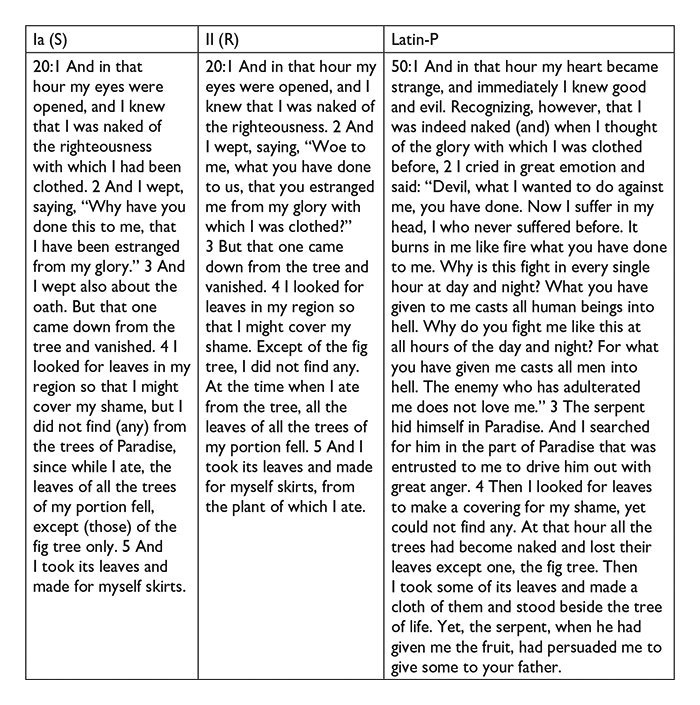
This chapter as well as the next chapter expands on Genesis 3:6b–7 LXX: and she ate and gave also to her husband with her, and they ate. And the eyes of the two where opened, and they knew that they were naked, and they sewed fig leaves together and made a loincloth for themselves.
Yet, in a gender-segregated Paradise, the scene has to be told twice. First, Eve realizes her nakedness. The two Greek versions harmonize the Genesis account in which the tree of knowledge of good and bad only leads to perception of nudity by adding the expression γυμνὴ τῆς δικαιοσύνης (“naked of righteousness”). However, it must remain open whether those who narrated and heard the story thought of a kind of divine-glory-covering dress or whether they understood this expression more ethically as a state of righteousness. 72 The Latin explicitly states that Eve before transgression indeed wore some glorious dress. All three versions further explain why the first parents choose the fig tree, because all of nature in Paradise reacts to the transgression. 73
Eve, however, remains not passive but blames the snake. Both Greek versions concur here, except that version II has no reference to her oath, not mentioned in this version before. The Latin-P version is again most interested in Eve’s inner struggles. While she immediately laments her transgression and blames Satan for making her the cause of all humans’ desire and sin, she nevertheless becomes the seduced seducer and passes the fruit on to Adam. 74 Some sentences in Eve’s speech, like Quia illud quod mihi dedisti totos homines in infernum mergit (“What you have given to me casts all humans into hell”; LLAE 50:2), recall later Christian ideas of hell.
The dialog between Eve and Adam
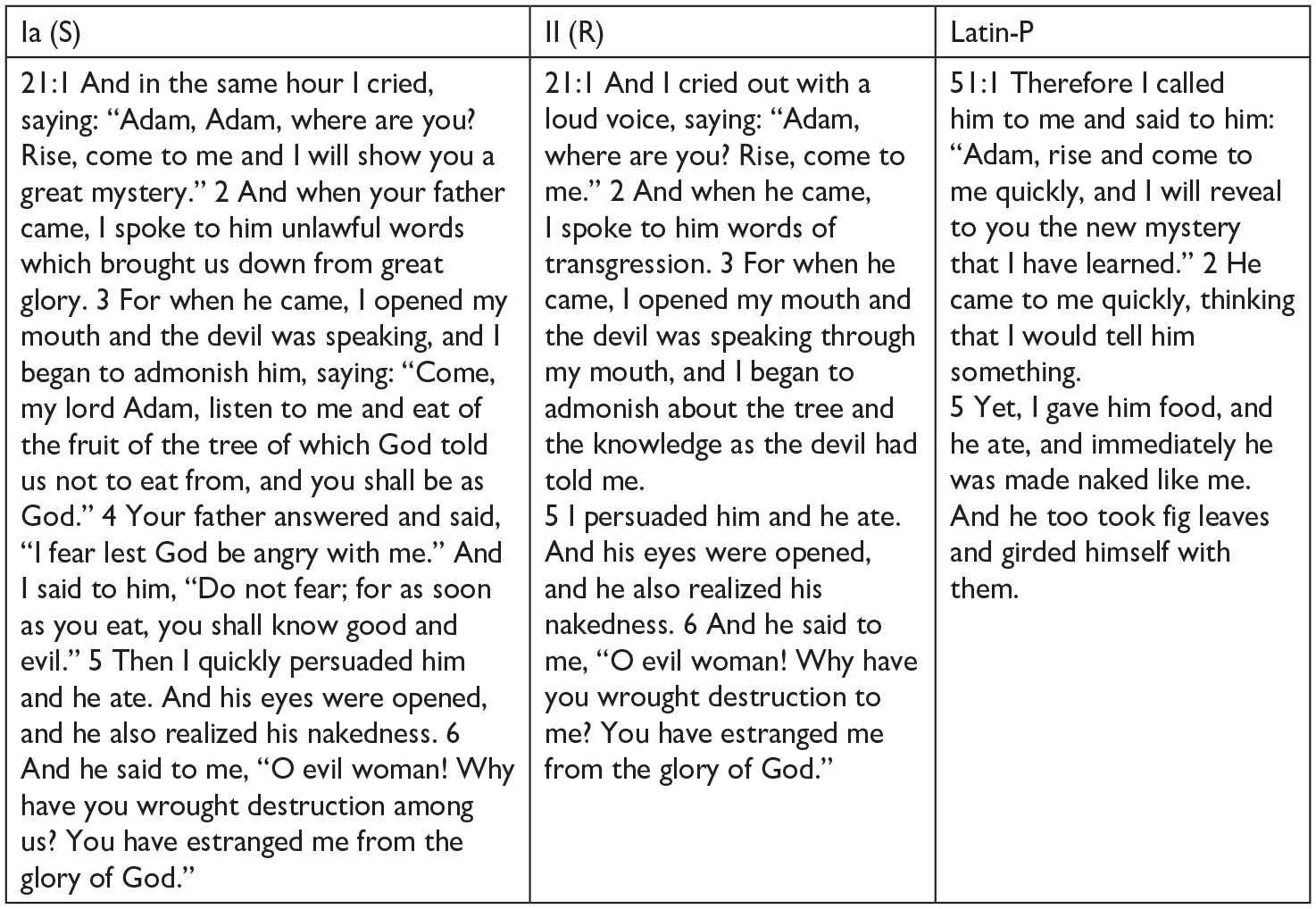
In contrast to Latin Eve, Adam’s inner struggles and reflections seem not so much of interest for the writers of the Latin-P tradition. Adam’s movements seem to be motivated by eagerness to learn something about the mystery Eve is announcing to him. The scene can be read as a criticism to Adam’s curiosity or to Eve’s disguising promise. Adam’s actions are recapitulated briefly: He ate, became naked, and girded himself. In the Latin-P text, the first human beings dwelled already clothed in some form in Paradise, a textile of glory. 75
In congruence with the Latin-P text, Eve promises also in GLAE Ia to tell Adam a mystery (μυστήριον/mysterium; GLAE Ia 21:1/LLAE 51:1). The shorter Greek II version leaves this out. In chapter 33, however, both Greek texts depict Eve as a visionary of the heavenly realm: GLAE Ia 33:2 A chariot of light, borne by four bright eagles, that were impossible for any man born of woman to tell the glory of them or behold their face and angels going before the chariot. 3 When they came to the place where your father Adam was, the chariot halted and the Seraphim. 4 And I saw a golden censer and three bowls, and behold, all the angels with censers and frankincense came to the incense-offering and the smoke of the incense veiled the firmaments. 5 And the angels fell down and worshipped God, crying aloud and saying: “Holy Jael, have pardon, for he is your image, and the work of your holy hands.”
76
Eve is privileged to envision God’s shining Merkabah chariot carrying the dead Adam back into heaven while the angels perform a heavenly penitential service. 77 Especially this later scene has raised interest in feminist interpretation. It seems to be paralleled to the Eve-as-revealer motif in the Christian exegesis of Genesis 3, documented by some texts from the Nag Hammadi library. 78 Like Job’s three daughters, she witnesses the heavenly liturgy in the moment a famous righteous one ascends into heaven (T. Job 48–52). As Arbel argues, in light of the close connection between women and the care of the dead in antiquity, Eve’s knowledge of heavenly mysteries counters female stereotypes. 79 For her, GLAE 33 proves that some layers of the writing are familiar with female visionary experience. Yet, while there is definitely a strong tradition of female figures envisioning the Merkabah in funeral contexts, it is not obvious, in my view, whether the “mystery” Eve is promising to Adam in GLAE Ia 21:1 and LLAE-P 51:1 indeed refers to her later visionary experience. At least, GLAE II, LLAE (Latin-P) and many other Greek manuscripts do not read Eve’s vision in chapter 33. In chapter 21/51, Eve’s promise to tell a mystery is at best a pretext, at worse a lie.
Compared to what is told in the previous chapters about Eve, the Greek Adam is easily convinced. 80 Like the snake before her, Eve had become Satan’s mouth. Only the two Greek text versions include this Eve-as-mouth-of-devil detail, and mostly Greek Ia expands much on this. As the mouth of Satan, Eve repeats exactly the snake’s alias Satan’s words (GLAE Ia 21:3 = 18:3). 81 Her whole conversation with Adam duplicates exactly her previous dialogue with the snake. Adam, like the snake and Eve, responds with the caveat: “I fear lest God be angry with me” (GLAE Ia 16:3; 18:2; 21:4). And all three answer: “Do not fear;” and the latter two add, “for as soon as you eat, you shall know good and evil” (GLAE Ia 16:3; 18:5; 21:4). And finally, both Eve and Adam lament with the same words to have been estranged from glory. Yet, Eve speaks of “her glory” while Adam speaks about the “glory of God.” 82
Again, feminist scholarship discusses how to evaluate this Eve-as-mouth-of-devil feature. Levison argues, “Just when Eve is most culpable—intentionally giving the fruit she knows is hurtful to Adam—she is at least partially exculpated in Apoc. Mos. 21. She was the unwilling vessel of the voice of Satan.” 83 To the contrary, Arbel finds her “implicitly conflated with the evil instigator of the primeval transgression” and as the one who deprived Adam from the glory of God identified with a representation of heresy. 84 While I personally tend to agree with the former position, there is another feature that can likewise denounce or excuse the first female being: Her oath. Whoever wrote or narrated the GLAE Ia was likely very critical of any oath or vows, at least between humans. Bound by a naively given oath, Eve is committed to convince Adam to eat. At the same time, the feature has some potential to exculpate Eve. The two motifs—oath and Satan’s mouthpiece—seem to me not totally concurring theological features that document some theological discussion behind the manuscripts and versions.
The theophany
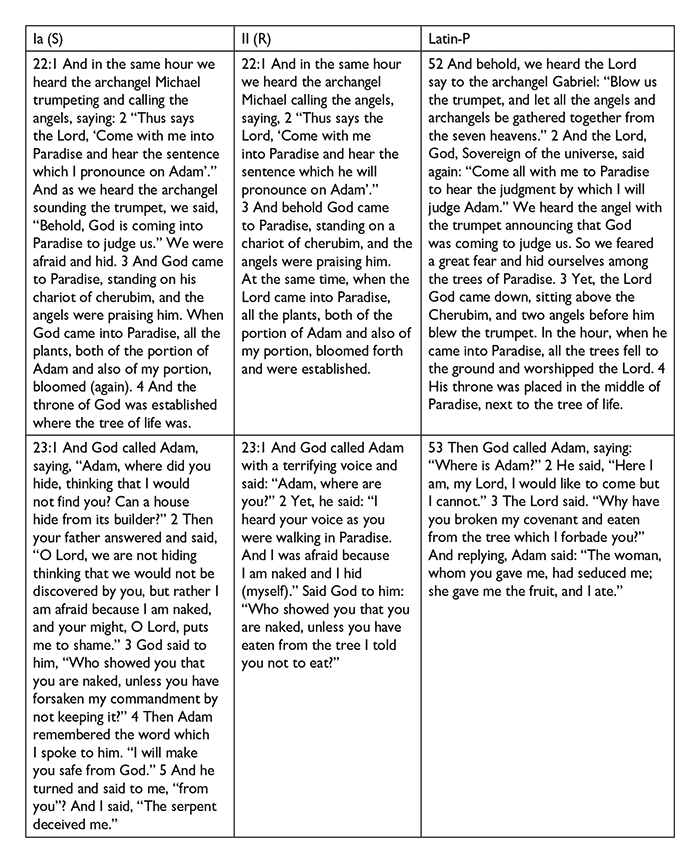
While the biblical story insinuates that God is just about to take an evening walk when he calls Adam (Gen 3:10), the Life of Adam and Eve expands this feature into a full judgment scene with a trumpeting archangel calling the heavenly court to witness the theophany in Paradise. In the Latin text, God comes sitting on a Seraphim throne, and his arrival is answered by worshipping trees in Paradise. The Greek has God coming down on a chariot drawn by cherubim, that is, on the Merkabah chariot, surrounded by hymn-singing angels. 85 The Greek texts identify the trumpeting archangel as Michael, while the Latin gives him the name Gabriel. 86 As in many Jewish texts, the angels intercede on behalf of human beings. Likewise, Philo, who calls the Logos an “archangel with many names,” sees in the Logos a “suppliant for afflicted mortality” and “ambassador of the ruler to the subject.” 87
Like Genesis, the Life of Adam and Eve depicts Paradise as a walled garden on earth. 88 Its nature is immediately restored when God and his heavenly court appear (GLAE 22:3/LLAE 52:3). There is a slight difference between the texts in whether Michael alias Gabriel acts in his own name or on God’s command and whether they paralleled a heavenly scene and an earthly reaction. 89
The source of God’s questioning of Adam is Genesis 3:9–13. The GLAE II version follows almost exactly the Septuagint, yet without 3:12–13. That is, Adam does not blame Eve in saying: “The woman, whom you gave me, she gave me from the tree and I ate” (Gen 3:12). There is also no excuse of Eve by saying, “The snake tricked me, and I ate” (Gen 3:13). Instead, this version moves directly from God’s statement that Adam must have eaten the forbidden fruit to the protoplasts’ expulsion from the garden (GLAE II 27:1).
The GLAE Ia provides its retelling of Genesis 3:9–13 in its own words. And while it still follows the biblical story line, it provides the most expanded version of a human reaction to God’s painful questioning. Possible critique of the limited knowledge of the biblical Creator might be countered when the GLAE Ia God does not ask Adam “where are you” but “where did you hide, thinking that I would not find you?” God’s might is furthermore emphasized by “can a house hide from its builder?” (GLAE Ia 23:1). Moreover, the GLAE Ia version expands on the reason why Adam hides himself when becoming aware of being naked (Gen 3:10), explaining this as human shame before God’s might and power. Adam’s eating from the forbidden tree (Gen 3:11) is unambiguously phrased as “transgression of God’s commandment” (GLAE 23:3). The GLAE Ia version has Adam remember a word of Eve, that she has not (at least not in this text) spoken: “I will make you safe from God” (GLAE 23:4). 90 And finally, Adam addresses Eve directly, and Eve defends herself with the Genesis text: “The snake tricked me” (GLAE 23:5 = Gen 3:13).
LLAE 53:1 quotes almost exactly the old Latin version Genesis 3:9, and 53:4 uses Genesis 3:12 as a templet. It focuses attention on Adam alone. Adam is not obviously naked when God asks the first man why he has broken the covenant, and he shifts the responsibility: “This woman, you gave me, seduced me by giving me the fruit” (53:3). The seduxit me (“seduced me”) is added to the Genesis text. 91 More directly than in the Bible, Adam shifts the blame to the women.
God’s judgment
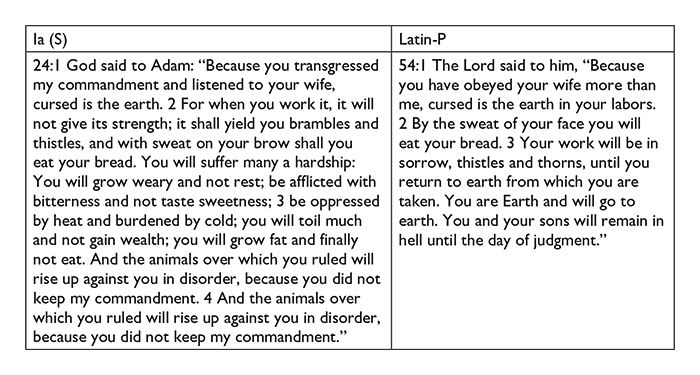
In Genesis 3:14–19, God curses the snake, Eve, and Adam. While the GLAE II version passes over the whole section and continues immediately with the expulsion of the protoplasts from Paradise, the other two versions of the Life of Adam and Eve read this as the announcement of God’s verdict. The Latin-P text continues its focus on Adam. The curses of the snake and Eve are just left out (Gen 3:14–16). God’s curse of Adam is cited from the old Latin text of Genesis 3:17–19 with a few additions. LLAE reads “because you (Adam) obeyed (obedisti)” instead of the Old Latin Bible “you listen” (audisti) to your wife. In this text’s gender ideology, a male should not obey his wife instead of God. Wives should obey their husbands, not vice versa. 92 The Latin version places Adam in hell until judgment day. This idea is likely a Christian gloss. It contradicts at least LLAE 37, 67, and 79 (cf. GLAE 37 and 40).
The Greek GLAE Ia tradition includes all three cures, yet in a reverse sequence. First, God sentences Adam. Genesis 3:19, “until you will return to earth,” is left out. GLAE 33–37 tells another story about Adam’s death and installment. GLAE Ia expands, however, on Adam’s future as a farmer on infertile land. 93
Then God turns to Eve: GLAE Ia (S) 25:1 Turning to me, the Lord said to me, “Since you have listened to the serpent and ignored my commandment, you shall be in idle (states) and you will suffer unbearable pain. 2 You shall bear children with much trembling, and in the hour when you give birth you will lose your life from out of great anguish and birth pains. 3 And you will confess and say, ‘Lord, Lord, save me and I will never again turn to the sin of the flesh.’ 4 Therefore, by your words, I will judge you, because of the enmity which the enemy has placed in you. And yet you shall turn again to your husband, and he shall rule over you.”
God attributes to Eve the same responsibility as to Adam for having ignored God’s commandment. As in Genesis 3:16, she is cursed by birth pains and being ruled by her husband. While GLAE Ia 24 expands on Adam’s hopeless work of a farmer on barren land, it also expands on the hour of childbirth, including all the pain and fear that giving birth involves for many women. It also quotes a prayer on a birthing chair: “I will never again turn to the sin of the flesh.” Because this phrase reappears only in post-fourth-century Christian literature, Michael D. Eldridge identifies it as part of a Christianized redaction. 94 Others attribute it to some ascetic tendencies. 95 Diaz Araujo explains it as exegesis of Genesis 3:16, similar to what can be assumed behind 4QInstruction and Genesis Rabbah. 96 In sum, the prayer sounds like a comment from a Jewish or Christian ascetic group with a general critique of human procreation. At least, the next verse links better to 25:2. It is not only taken out of the curse of the snake in Genesis 3:15 but is cited again in GLAE Ia 26:4. The last part of God’s sentence of Eve comes back to the biblical text of Genesis 3:16.
Finally, God sentences the snake for being a vessel to Satan by quoting Genesis 3:14–15. 97 The snake is held accountable not only for becoming the devil’s vessel but also for having been ungrateful and a seducer. Therefore, the snake will go “on its breast and belly,” because it will be deprived of all limbs and food and has to eat dust from the earth.
The expulsion from paradise
As the reader of the Bible knows, Adam and Eve have to leave Paradise. In this last scene, all the three versions provide an individual set of episodes.
The shortest narrative provides LLAE Latin P: LLAE 59:1 When God had said this, he commanded the angels to expel us (out of Paradise). 2 Your father Adam wept before the angels, who were casting us out, saying: “We give glory to God!” And they said: “What can we do for you?” 3 Adam said to them, “Behold, I am cast out, but please let me take some perfume with me, with which I shall anoint my face in the presence of the Lord. Perhaps then God will hear me.” 6 They allowed him to take some, and he took with him four perfumes: spikenard, saffron, calamint, and cinnamon. And when he had taken them, we were driven out of Paradise. And so we were driven out to the earth.
Since the advent of God’s throne in Paradise in LLAE 52, Eve still continues to focus on her husband. The angels intercede on behalf of weeping Adam, and he is allowed to take from Paradise some aromatic fragrances that are used in ancient cults. Here, however, spikenard, saffron, calamint, and cinnamon are used not in worship or healing but to anoint the praying supplicant. In my view, this again is a late antique perspective on worship. The Latin narrative is no longer interested on Eve’s own perspective on the scene.
GLAE Ia has the most elaborate discourse between Adam, the angels, and God: GLAE Ia 27:1 Having said these things, he ordered his angels to cast us out of Paradise. 2 While we were being expelled and lamenting, your father Adam begged the angels: “Let me be a little while so that I may beseech God that he might have compassion and pity me, for I alone have sinned.” 3 And they ceased driving him out. And Adam cried out with weeping and said: “Forgive me, Lord, what I have done.” 4 Then the Lord said to his angels: “Why have you stopped driving Adam out of Paradise? Is the guilt mine, or did I judge badly?” 5 Then the angels fell on the ground and worshipped the Lord, saying: “You are righteous, Lord, and you judge uprightly.” GLAE Ia 28:1 Turning to Adam, God said: “From now on I will not allow you to be in Paradise.” 2 And Adam answered and said, “Lord, give me from the tree of life that I might eat before I am cast out.” 3 Then the Lord spoke to Adam, “You shall not now take from it; for it was appointed to the cherubim and the flaming sword which turns to guard it because of you, that you might not taste of it and be immortal forever. 4 You have the strife which the enemy has placed in you, but when you come out of Paradise, if you guard yourself from all evil, preferring death to it, at the time of the resurrection I will raise you again, and then there shall be given to you from the tree of life, and you shall be immortal forever.” GLAE Ia 29:1 When the Lord had said these things, he ordered us cast out of Paradise. 2 And your father wept before the angels outside of Paradise, and the angels said to him: “What do you want us to do for you, Adam?” 3 Your father answered and said to the angels. “See, you are casting me out; I beg you, let me take fragrances from Paradise, so that after I have gone out, I might bring an offering to God so that God will hear me.” 4 And they came to God and said: “Jael, eternal king, command that fragrant incenses from Paradise be given to Adam, 5 that he might take aromatic fragrances out of Paradise for his sustenance.” 6 When the angels allowed him: he gathered four kinds of crocus, nard, reed, cinnamon, and other seeds for his food. And he took these and went out of Paradise. And (so) we came to be on the earth.
In the GLAE Ia tradition, the expulsion of Adam and Eve has two acts. Twice the angels react to Adam crying, first to his prayer of repentance and then to his weeping outside of Paradise. Twice the angels intercede on behalf of Adam (27:2; 29:2–3). However, God declines their first intervention on behalf of Adam. God is not ready to change his just sentence, at least not yet. Strikingly, and contrary to what has been told in this version before, it is now Adam who takes over the full responsibility for transgressing God’s command all by himself (GLAE 27:3). 98 Therefore, he is promised resurrection and eternal immortal life when he henceforth will guard himself from evil (GLAE Ia 28).
However, Adam is not comforted by God’s promise, and the compassionate angel intercedes a second time on behalf of the still desperately weeping Adam, and this time successfully. If “Jael, eternal king” is the correct code word in addressing God—this name of God appears in Eve’s vision in GLAE 33:5—then this request is feasible to me. Adam is allowed to collect four kinds of fragrant incense to use in his worship of God. 99 The difference in the concept of worship between the Greek Ia version and the Latin-P version is obvious. In the GLAE Ia version, incenses burned as offerings will open God’s ears and make prayer more successful. Moreover, Adam is allowed to collect seeds to grow food. So equipped, the first couple leaves Paradise.
While in the LLAE version and in the GLAE Ia version, discussed so far, the account of the expulsion centers on Adam, the GLAE II decenters the first male, at least slightly. 100 Without any human reaction to God’s question of Genesis 3:11 (GLAE II 27:3) and without all three curses from Genesis 3:13–19, this version centers on God’s reaction to the two protoplasts’ transgression. GLAE II 27 reads exactly the same as the GLAE Ia version. GLAE II 29:1–6 skips some dialogical parts, yet in terms of content follows again the story line of GLAE Ia 29, except that Adam takes only three incenses and no seed for food. Without GLAE Ia 28, that is, without God’s direct answer to Adam’s request, the narrative moves more straightforwardly and logically. God denies any hasty pardon but grants some perspective for religious life outside Paradise.
However, living on one’s own outside Paradise remains in this text a challenge for the protoplast. GLAE II provides this feature at this point of the narrative with an episode known also from the beginning of the whole story in LLAE (ArmLAE; GeoLAE) 1:1–10:2: GLAE II (R) 29:7 And it happened that we mourned for seven days. After seven days we were hungry, and I said to Adam: “Arise and bring us food that we might eat and not die. Let us get up and walk around the earth so that God might hear us.” And we rose and went through the whole land and did not find (food). 8 And Eve said again: “Rise, my lord, and do away with me that I might depart from you and from the presence of God and from the angels so that they will cease to be angry with you.” 9 Then Adam answered and said to me: “Why have you been thinking of this evil, that I should commit murder and bring death to my own side, so that I should stretch out my hand against the image which God made. But rather let us repent for forty days so that God have mercy on us and provides us food made for the beasts. 10 I will do this forty-four days and you forty, and take this stone and set (it) under your feet, and go in and stand in the water up to the neck, and do not let a word come out of your mouth, for we are unworthy and our lips are not clean. But cry silently to God (saying): ‘O God, be gracious to me’” 11 Adam went into the Jordan River, and the hair of his head was spread out as he prayed in the water. And he cried with a loud voice, saying: “I say to you, water of the Jordan, stand still; and all animals and all birds both on land and sea gather together.” And all the angels and all the creatures of God surrounded Adam as a wall around him and wept and prayed to God on behalf of Adam, so that God gave ear to them. 12 But the devil, not having found an opportunity with Adam, came to the Tigris River to Eve. Taking the form of an angel, he stood before her weeping, and his many tears fell on the earth, and he sounded like an angel and said to Eve: “Come on land out of the water and stop weeping, for the Lord has heard your request, and the angels and all his creatures have beseeched God about your prayer.” 13 Thus the enemy deceived us a second time.
Only GLAE II, that is, the Greek manuscripts R and M, and SlavLAE 35–39 add this episode to Eve’s account of the fall. 101 For good reasons, most recent editors exclude the passage as a later addition to the text. 102 From GLAE II 29:8 to GLAE II 29:12, the perspective changes and an anonymous third-person narrator reports about Eve’s and Adam’s deeds. Yet, read in the context of Eve’s account of the fall in GLAE II, this episode adds some surprising perspectives to her story. As stated earlier, the GLAE II God does not curse or pass a sentence on Adam, Eve, and the snake. God just states that the first couple must have eaten from the forbidden tree (GLAE II 23:3). Immediately thereafter, God commands his angels to expulse the first couple (GLAE II 27:1). Yet Adam is not ready and starts to plead for mercy, taking over all responsibility with his confession: “I alone have sinned” (GLAE II 27:2). God, however, does not change his judgment but has it confirmed by adoring angels (GLAE 27:4–5). Afterward, Adam and Eve travel around the earth in search of food, crying. And again, God overhears their crying (GLAE II 29:7). Therefore, now Eve assumes full responsibility for the first humans’ transgression and asks Adam to be killed, “so that God might cease his anger” (GLAE II 29:8). Adam denies this, yet suggests a more elaborate penitence with some gender-specific differences: For himself he chose the river Jordan in the holy land, sending Eve to the river Tigris in Mesopotamia. His span of time should be 44 days, while he assigns to the “weaker gender” only 40 days. 103 And, without any discussion, he cries out loud but assigns to his wife absolute silence (GLAE II 29:10–11). Therefore, some interpreters argue that Eve here mostly disrespects male authority. Arbel reads this scene as an example of rejected femininity that links women’s “autonomous agency to heresy.” 104 Yet Anne Marie Sweet observes a unique portrayal of Eve as a repentant and later forgiven sinner, exactly in this part of the story. 105 And Levison argues,
Eve’s request for release is intended to ameliorate Adam’s position before God. Her fall to the deceiver is not entirely blameworthy. Who could resist this angel with tear-stained clothes? There exists, therefore, in the testament of Eve according to the second form several elements which present Eve as a tragic figure characterized by generosity, the imageo dei, and a pardonable naïveté.
106
Again, the assessment of this scene in feminist scholarship remains ambiguous. And indeed, one can read the scene in many ways. One reading observes some irony in its representation of gender roles. Adam is not only helped by all the angels and creatures in praying, he is also protected by them. 107 As Sweet argues, it might be that GLAE (II) expands here on the Wisdom of Solomon: “She (Lady Wisdom) carefully guarded the first-formed father of the world, when he alone was created, and delivered him from his own transgression; she gave him strength to rule over all things” (Wis 10:1). 108 Eve, however, not only has to fight alone, but silenced by her male partner and deceived by an angel, who turns out to be no one other than the disguised devil, there is a chance left to finish her task. What is narrated as an uncontradicted reality about Adam—namely, all creatures and angels beseech God on his behalf—remains in her case Satan’s lie. Read from a gender-critical perspective, the overly protected Adam is not to be the only hero in this part of the story.
Conclusion
I hope to have shown that the three manuscripts representing each text family differ in their representation of gender roles in Eve’s account of the fall. LLAE Latin-P has her perform from the beginning as a weeping repentant sinner (LLAE 45:1; 60:1). The prehistory explains why and how Satan became Adam’s enemy. Eve is only the target through whom the devil through the snake hopes to occupy Paradise for himself (LLAE 46:2–3). The Latin-P version is most interested in Eve’s inner struggles and pain before and after her transgression of God’s commandment. After she ate, she rapidly convinces Adam to eat from the tree by promising to tell him a mystery. From this point in the story, she disappears out of the narrator’s focus. God talks to Adam alone (LLAE 51–54), the angels intercede for him, and he gets fragrance and seed to sustain his life and prayers (LLAE 59). Adam’s inner struggles are not part of the story in the Latin version.
The GLAE Ia tradition has a dying matriarch who explains her life to her descendants and draws out from her life experiences the ethical conclusion: “watch yourselves so that you do not forsake the good” (GLAEIa 30:1). In the gender-divided Paradise, the devil gets access through the male snake and therefore through Adam’s part (GLAE Ia 16). However, Eve seems to be chosen as the gate opener because she is again the easier target (see GLAE Ia 16:3). Throughout, the text features parallel speeches and reactions of the three main figures, the snake, Eve, and Adam. While Satan needs some time to convince the snake, the snake needs even more time, some lies, and an intoxicating fruit to speak an oath to convince Eve to eat (GLAE Ia 18–19). Although she immediately knew, Eve is not able to restrain from convincing Adam, not only because of her naive oath (GLAE Ia 19:2) but also because, by losing all self-determination, she becomes the mouth of Satan, just as the snake had become before her Satan’s vessel (GLAE Ia 21:3–5). Despite this intensive consideration on Eve’s role in the fall, after she convinced Adam to eat, her narrative focus turns to God’s theophany and his three curses, which are reversed in their sequence. Interestingly, God’s sentence of Eve expands on women’s pain in childbirth and the difficulties to restrain oneself from the male (GLAE Ia 25). Adam is cursed with a fruitless farmer’s work on barren land. Hereafter, her focus turns almost exclusively to Adam’s unsuccessful attempts to change or at least ease God’s sentence with the help of sympathetic angels (GLAE Ia 27–29). However, at some point, Eve includes a we in the account of Adam’s further destiny (27:1–2; 29:1, 6).
In the GLAE II tradition, Eve drew no concrete ethical advice out of her story (GLAE II 30:1). Yet, in this version, she is explicitly chosen by Satan as the target through whom Adam can be cast out of Paradise (GLAE II 16:3). Satan betrays her, appearing in the guise of a hymn-singing angel (GLAE II 17:1–2). The talk between the snake and Eve is much shorter here and cites in parts directly from Genesis 3:5 (GLAE II 18–19). Her words to Adam are likewise more abbreviated, yet Eve appears likewise as the mouth of Satan (GLAE II 21:3). While there is a theophany of the Merkabah chariot in Paradise, God does not curse any of the three but just asks, “Who showed you that you are naked?” (GLAE II 23:2), and expels all human beings out of the garden. Compared to the other two texts, there is not much interest in the details of Adam’s expulsion. However, both Adam and Eve assume the responsibility for sin, pain, and death for their own (GLAE II 27:2; 29:2). And Satan betrays Eve in the guise of an angel a second time (GLAE II 17:1–2; 29:13). Satan’s attacks and God’s reaction seem to be the main focus of this version in which Eve is a brave, yet unsuccessful fighter against the devil, a fight from which Adam remains protected by the angel’s persistent intercession (GLAE II 29:11).
The comparison of three text families of the Life of Adam and Eve follows in the footsteps of Levison’s and Díaz Araujo’s synoptic reading, yet it adds throughout a comparison of the recently published Latin version of the story to the discussion. 109 The advantage of this method is not only to base research on existing texts and not (only) on modern hypothetical reconstructions of an allegedly original version. The comparison of the manifold representation and constructions of gender in the respective manuscripts and text families provides a window to the ancient discussion on Eve’s and Adam’s role in Paradise. The fluidity between manuscripts suggests an ongoing discussion, a continuous updating of the story in the very social contexts in which the story was written down throughout the centuries. There is not one text family that throughout exonerates Eve while others denigrate the first woman. Nor is there only one female and/or male role model of the story promoted in its respective versions. To the contrary, as we have seen, several features can lead and have led to various evaluations.
In view of the whole story in Tromp’s reconstructed hypothetical original version, Arbel argued, “Eve emerges both as a transgressor of God’s way, as Satan’s vessel, . . . and, in sharp contrast, the GLAE’s Eve is a moral figure committed to God’s path, an ethical and wise teacher.” 110 Yet not only individual scenes—like her involvement in Adam’s funeral in her Merkabah vision, both included only rarely in preserved texts—can be read as an “attempt to depart from the dominant theological trope of a liable and culpable Eve and to introduce an alternative, even subversive, depiction of Eve.” 111 Instead, I agree with Levison’s observations that the GLAE Ia and the GLAE II versions both provide in each case, in different ways, a complex presentation of Eve. In both texts, Eve acts with integrity, straightforward, and clever, even though the devil fights as a trickster with an angelic disguise to reach his goal. Moreover, she is strong enough to take God’s judgment upon herself and to endure it.
None of the three versions examined in this paper only exonerates or denigrates Eve; nor is the one with the most emancipatory potential easily identified. Some contradicting features and narrative lacunae in each version make it probable that they are already in themselves an intermediate result of polyphonic discussions. Yet the LLAE Latin-P text adds some features that, in my view, can be identified as later Christian additions—for instance, the statement that all humans, including Adam, are cast into hell (LLAE 50:2; 54:2) and the use of the perfumes from Paradise as ointment for prayer rather than a fragrance for offerings (LLAE 59:4). I am also inclined to assume that the constant interest in Eve’s internal struggles with Satan in LLAE Latin-P 45–50 reflect anthropological thinking in late antique (Christian?) ascetic circles. However, these fights explicitly focus on the female point of view. So again, the question whether the later LLAE Latin-P text originated as a male’s phantasy or as psycho-mythological thinking among female ascetics must remain an open question.
All manuscripts and text families give evidence that there was a discussion on the male and female responsibility for the beginning of sin and death. Who did not guard his or her part of the garden from the devil? Why and how could she be convinced to transgress God’s commandment? Could Eve have kept at least Adam from transgression? The three text families and their respective manuscripts and the polyphonic oral narrative behind the three versions have raised these and similar questions since antiquity, throughout all the centuries that have so far formed the manuscripts discussed.
Footnotes
Declaration of conflicting interests
The author(s) declared no potential conflicts of interest with respect to the research, authorship, and/or publication of this article.
Funding
The author(s) received no financial support for the research, authorship, and/or publication of this article.

Notes
Author biography
Angela Standhartinger is Professor of New Testament Studies at the University of Marburg. More recently she published “Performing Salvation: The Therapeutrides and Job’s Daughters in Context.” Pages 173-196 in Re-Making the World: Christianity and Categories, Essays in Honor of Karen L. King. Edited by Taylor G. Petrey. WUNT 434. Tübingen: Mohr Siebeck, 2019; “Member of Abraham’s Family? Hagar’s Gender, Status, Ethnos, and Religion in Early Jewish and Christian Texts,” Pages 235-259 in Abraham’s Family. A Network of Meaning in Judaism, Christianity, and Islam. Edited by Lukas Bormann. WUNT 415. Tübingen: Mohr Siebeck, 2018 and Intersections of Gender, Status, Ethnos and Religion in Joseph and Aseneth.” Pages 69-87 in Early Jewish Writings. Edited by Eileen Schuller and Marie-Theres Wacker (The Bible and Women 3.1; Atlanta: SBL Press, 2017.