




Abstract
How do distributive politics affect participation under incomplete information? We theorize a novel mechanism that we call asymmetric participation, which explains participation as a self-selection process induced by a broadly targeted welfare benefit. Incomplete information about the de facto allocation of benefits causes asymmetric participation. When citizens expect particularistic distribution and access to the benefit depends on voter registration, supporters of the incumbent, who supplies the benefit, self-select into the electorate. This creates an incumbency advantage. We illustrate this argument using the case of the Renda Básica de Cidadania (RBC) in Maricá, Brazil, the largest unconditional cash transfer program in Latin America. Based on qualitative evidence, we develop a formal model, which we test against novel survey data. We find that under the de facto procedure of implementation, supporters of the incumbent supplying the RBC, self-select into the electorate, and engage more in activities that signal party loyalty.
Keywords
Introduction
Implementation of distributive policy is a black box for most citizens. Even completely rules-based policy could be perceived as clientelistic if citizens do not know how much discretionary power is exercised during implementation. Scholarship on distributive politics generally focuses either on clientelistic or programmatic policy. Our research contributes to closing the gap between the clientelistic and the programmatic perspective on distributive politics. We highlight that seemingly programmatic policy can still prompt sophisticated behavior by voters due to the incumbent’s discretion over the implementation of policy.
We relate to recent research on strategic complementarities between programmatic and particularistic policy (Frey, 2021; Imai et al., 2020). In the literature on clientelism, there is a growing interest in the gray area between programmatic and clientelistic policy (cf. Calvo and Murillo, 2019; Hicken and Nathan, 2020; Mares and Young, 2016). Bardhan (2022: 5) puts it nicely: ‘The distinction between clientelist and programmatic politics is not always sharp; there may be a whole range of institutional arrangements in between that need to be more carefully studied.’
We offer a new angle to understand broadly targeted welfare benefits as an electoral strategy. While the final implications of our asymmetric participation theory point toward an incumbency advantage, similar to economic voting or particularistic targeting, how the electoral gains are achieved differs from both. However, we do not claim that asymmetric participation happens instead of clientelistic or programmatic strategies. Rather, concurring with Calvo and Murillo (2019), we think of a portfolio of strategies. This can entail clientelistic and programmatic strategies, and strategies in between. Asymmetric participation can happen incidentally or strategically. Politicians can have programmatic policy intentions or purposely manipulate conditions on the ground to induce asymmetric participation. The electoral effect always favors the incumbent, who supplies the benefit. We, therefore, hope to add to the recent debate about the effects and strategic motives of public policy in contexts of clientelism (Bobonis et al., 2022; Calvo and Murillo, 2019; Diaz-Cayeros et al., 2016; Frey, 2021, 2022; Gottlieb, 2021; Larreguy et al., 2015).
Bardhan (2022) describes a transition from clientelist to programmatic policymaking as a transition from relational to rule-based institutions. Within this framework, the logic of asymmetric participation sheds light on the transition process. Relative to Frey (2021), we document a mechanism, through which an incumbency advantage, beyond retrospective rewards, can still persist even without explicit manipulation.
Put simply, asymmetric participation describes a self-selection mechanism of incumbent supporters into the electorate. There are two conditions, one on the supply side and one on the demand side, of a welfare policy that induces the self-selection process. First, only registered voters gain access to the welfare policy. Second, there is incomplete information. Citizens do not know whether the benefit is allocated according to de jure rules or whether implementation is subject to discretion by corrupted bureaucrats. Relying on the information that clientelism is pervasive in local politics, citizens expect the distribution of benefits to be contingent (in the clientelistic exchange sense as defined in Hicken (2011)) on supporting the incumbent.
Under the expectation that benefits are contingent on political support, unregistered citizens face an incentive to register to obtain the benefit. However, citizens must fear being denied the benefit if they cannot commit to politically supporting the incumbent. Publicly declaring support and loyalty through campaigning, participating in party meetings or rallies, or displaying endorsement symbols are typical ways, in which citizens can signal their commitment to the incumbent (Nichter, 2018; Nichter and Nunnari, 2022). This is not without cost. Specifically, signaling support is more costly for citizens who are ideologically more distant from the incumbent. Hence, ex-ante supporters of the incumbent face stronger incentives (larger net expected benefits) from registering to vote and applying for the benefit program. Moreover, asymmetric participation has a self-enforcing dynamic: as citizens observe disproportionally many supporters of the incumbent being enrolled in the policy, the expectations of contingent allocation of benefits rise.
We illustrate the argument using the case of the Renda Básica de Cidadania (RBC) in Maricá, Rio de Janeiro state, Brazil, the largest unconditional cash transfer (UCT) program in Latin America. De jure, all individuals in households earning less than three times the national minimum wage and residing in Maricá for at least three years, are eligible for a monthly cash transfer, with no strings attached. However, from qualitative interviews with locals in Maricá, we learn that de facto (perceived) eligibility looks different. Citizens of Maricá believe it is helpful or even necessary to support and display loyalty to the local incumbent to access the RBC. Moreover, citizens agree that it is necessary to be a registered voter (holding a voting ID) in Maricá to access the RBC.
Based on the qualitative evidence and the seminal models of Stokes (2005) and Nichter (2008), we develop a formal model of political participation in the forms of electoral participation (registering and voting) and signaling (campaigning, joining party meetings, joining a party, visiting a rally, displaying paraphernalia, and asking politicians for favors or suggestions). We then provide suggestive evidence from a novel survey we fielded in Maricá, showing that the empirical reality plausibly aligns with the mechanics of the model.
First, we document a substantial share of violations of the three-year residence criterion for the RBC, hinting at electoral influx from neighboring municipalities. We then compare beneficiaries of the RBC to non-beneficiaries in Maricá. In line with the model, beneficiaries turn out more and vote more for the incumbent. Furthermore, beneficiaries engage more in activities that relate to signaling support to their favorite candidate. This entails campaigning, participating in party meetings, joining a party, participating in rallies, displaying endorsement symbols, asking politicians for favors, and making suggestions or reporting issues to politicians. We interpret these findings as evidence of the underlying mechanism of asymmetric signaling costs, which ultimately leads to an overproportional selection of incumbent supporters into the active electorate.
Besides the interaction of social policy and clientelism, our research connects well with several other strands of the literature. In the welfare state literature, our work relates to the material-particularistic argument in explaining the emergence of the welfare state (Häusermann et al., 2013; Kitschelt and Wilkinson, 2007; Lynch, 2006). The case of the RBC clearly shows how the self-interest of a party aligns with the objective of creating a broad welfare scheme.
Moreover, we relate to the literature on electoral consequences of cash transfers. It is theorized that the poor, for whom the cost of voting poses a binding restriction to turn out, are enabled to participate in voting (Bidadanure, 2019; Birnbaum, 2012; Goodhart, 2007; Morales, 2018; Pateman, 2004). While empirical evidence from both conditional and unconditional transfers backs up the theory (Araújo, 2021; De La O, 2013; Labonne, 2013; Manacorda et al., 2011; Zucco, 2013), our results caution against an unequivocally optimistic reading of this literature.
Finally, since the RBC is financed from oil revenues, our work also relates to the political economy of natural resources. Here, it is often argued that resource wealth positively influences regime duration, especially in non-democracies. Extracting maximum wealth requires staying in power in the long term, which in turn requires satisfying a large selectorate 1 using natural resource wealth (Mahdavy, 2023[1970]; Robinson et al., 2006). Our results suggest that even in a democratic system, oil can fuel the survival of a local regime. 2
The Case of Maricá
The Renda Básica de Cidadania (RBC)
Maricá is a coastal municipality in Rio de Janeiro State, Brazil. Since 2014, Maricá runs the largest UCT program in Latin America, the RBC. The program was implemented under former mayor Washington Quaquá (Workers Party, Partido dos Trabalhadores (PT)), and it has been running since then without discontinuation (Waltenberg and Katz, 2023).
The adoption of the RBC in Maricá is mainly explained by its increasing fiscal capacity, which results from a geographical contingency. Maricá’s adjoins the Santos Basin Pre-salt Zone (SBPZ), an off-shore oil and gas exploration discovered by the Brazilian federal government in 2006. According to Law no12.351/2010, the closer to the oil and gas fields, the more royalties a given municipality should receive, which makes Maricá the main net beneficiary of the royalties in the SBPZ.
The exploitation of natural resources in the SBPZ placed Brazil among the countries with the most significant oil potential in the world and made it a net oil exporter. In 2017, the SBPZ accounted for 50.7% of Brazil’s national oil and natural gas production. Despite fluctuations in oil prices, Maricá has experienced a substantive increase in its revenues in the last decade. As discussed by Araújo (2022), Maricá had a total revenue per capita of R$1,056 in 2003. Ten years later, it was R$4,573, more than four times larger. Since then, Maricá has been experiencing a linear growth in its revenue per capita due to the rise of the price of oil per barrel on the world market.
To be eligible for the RBC program, an individual must be registered in the Cadastro Único (known as ‘CadÚnico’), the federal government’s unified social benefit registry. CadÚnico is an online and large-scale server developed in the 2000s in the context of the creation of Bolsa Família, a conditional cash transfer program implemented under the Worker’s Party’s (PT) first administration (2003–2006). Since then, several municipalities in Brazil have been using CadÚnico to implement several other policies at the local level (Bichir, 2010). This consolidated online repository allows the local administration to process applicants’ information with lower targeting costs. Importantly, deciding who can or cannot receive the program remains entirely under the control of the municipal authorities.
De jure, all citizens of Maricá living in households earning less than three times the national minimum wage (
More than 42,000 of Maricá’s 165,000 inhabitants are currently enrolled in the RBC. Once officially in the program, each beneficiary receives an identity card issued by Maricá’s community bank, Banco Mumbuca. This bank has adopted a local digital currency called Mumbuca. Virtually all shops and services in Maricá have been integrated into the program. Notably, Mumbucas are restricted to Maricá and cannot be used in other localities.
From 2014 to 2016, it paid 85 Mumbucas (the exchange rate of the Mumbuca is pegged to the Brazilian Real 1 to 1) per month to roughly 14,000 households. In 2017, the RBC rose to 130 Mumbucas per household per month. In June 2019, the RBC shifted from a monthly payment of 130 Mumbucas per household to 130 Mumbucas per individual, bringing the total number of beneficiaries to 42,000. In response to the COVID-19 outbreak, the RBC was increased to 300 Mumbucas in March 2021. In May 2022, this value was re-adjusted, and since then, each beneficiary has received a monthly transfer of 200 Mumbucas (Waltenberg and Katz, 2023).
The perceived importance of signaling support
Most cash transfer programs are de jure distributed according to objective criteria, but de facto implementation is potentially subject to discretion. On the ground, citizens have incomplete information about politicians’ discretion levels over particular policies. In the Latin American context, clientelism is pervasive, and Brazil is no exception. Unsurprisingly, citizens, therefore, tend to assume politicians have high levels of discretion. When citizens believe that politicians can manipulate eligibility for a welfare policy, the threat of doing so is credible, even if this is beyond the politicians’ power.
Citizens in Maricá seem to concur that supporters of the local incumbent do not have to fear benefits being withheld. When asked about the modalities of receiving the RBC, a local answered: Do you want to receive the Mumbuca [local name of the RBC]? I can tell you how: Show them you are loyal by campaigning for them, support the mayor and his friends in elections, and attend every public event organized by the local administration.
The citizens’ perception of contingent benefit allocation becomes apparent in this and many similar statements. Since the incumbent cannot know who their true (ideological) partisans are, they have to identify their partisans based on observable support activities. Inferring and signaling support and loyalty through campaign involvement and displaying paraphernalia is a common theme in clientelistic politics in Brazil (Nichter and Nunnari, 2022). It is documented in various places that citizens who signal support are more likely to receive benefits (both in their own expectation and in real terms, Auyero, 2000; Cammett, 2014; Michelitch, 2015; Nichter, 2018; Nichter and Nunnari, 2022). This raises instrumental incentives for citizens to signal partisanship to secure benefits. Since signaling support increases the perceived likelihood of receiving the benefit, signaling can be considered a ‘soft’ eligibility criterion. However, this only works in an environment of incomplete information. Applying for the benefit and being turned down is costly, and retrieving the information about the true risk of being turned down due to not supporting the incumbent seems impossible. 3 Hence, at least some potential beneficiaries will apply and signal support to avoid the unknown risk of being turned down, while some others will not take any chances as signaling is too costly (Nichter and Nunnari, 2022). A self-enforcing dynamic is also plausible in this context. If known partisans of the incumbent are the first to apply and receive the benefit, non-partisans might infer partisanship causes receiving the benefit. Signaling can entail activities such as campaigning, showing up to rallies, turning up for party meetings, joining the party, visibly displaying endorsements through flags, t-shirts, or the like, or personally contacting local politicians. Signaling support for the incumbent is plausibly less costly for someone with an ideological position close to the incumbent and relatively more costly to someone with an ideological position further away from the incumbent. This difference in signaling costs leads to systematic differences in evaluating the cost–benefit calculation between citizens who are ideologically close and distant from the incumbent.
The Electoral Justice
Brazil has mandatory voting at electronic ballot machines with biometric identification. Citizens must, therefore, register to vote at their place of residence. However, the place of electoral residence may differ from the place of legal residence, and the Electoral Justice (the institution in charge of voter registration) is known to be lenient in assigning electoral residences (Hidalgo and Nichter, 2016; Limongi, 2016: 11).
For local elections, this opens up an additional pool of potential voters, which parties could tap into to secure electoral support. The practice of voter buying, that is, transferring voters from outside a district into a district, to increase the share of supportive voters is well documented in mayoral elections in Brazil (Hidalgo and Nichter, 2016). The other pool comprises citizens who are not registered to vote anywhere. Those are often the local poor, many of whom are employed in the informal sector. For the most recent general elections in Brazil, the share of registered voters was approximately 77% of the population aged 18 or older. 4
The crucial link between program participation and voting happens through voter registration in Maricá as a participation condition. Being included in the RBC is de facto contingent on an electoral residence, that is, having a voter ID from Maricá. This incentivizes non-voters, from both pools, local unregistered or from elsewhere, to register to vote in Maricá, to receive the RBC: Woman: Some people who used to live in Niterói, Rio de Janeiro, and other municipalities moved to Ponta Negra [district of Maricá] to access the benefits only available here. But some do not know that they must also transfer their voter ID to Maricá. Interviewer: Really? This is not part of the formal rule. Did I miss something? Woman: I know, but that is how it works, trust me!
In another instance, a man even reports from his own experience of changing electoral residence: I know some people who moved to Maricá to access the benefit, but it is not as simple as that. Besides showing them [local authorities] all the required documents, you need to be registered to vote in Maricá. That is why I am trying to transfer my voter ID from São Gonçalo to Maricá.
For some of the unregistered, the costs of registration were a prohibitive constraint, as they would have voted if they were registered. The additional incentive to register when the RBC is contingent on registration will allow those citizens to overcome the constraint and vote. For some others, registration is only instrumental to obtaining the benefit, thus they will register but still abstain.
The electoral residence requirement alone would expand the electorate in all directions of the political spectrum. However, when combined with the expectation of incumbent supporters receiving preferential treatment in benefit allocation an asymmetry in participation is created. Unregistered individuals ideologically more distant from the incumbent are less likely to register. For them signaling loyalty to the incumbent to avoid rejection is more costly than for unregistered individuals ideologically closer to the incumbent.
Theoretical model
General setup
We start with a simple spatial framework. Citizens
The material benefit in the form of a cash transfer is denoted by
The strategies available to a citizen can be represented in a decision tree with three stages (see Figure 1). The first stage is compliance. The choice variable
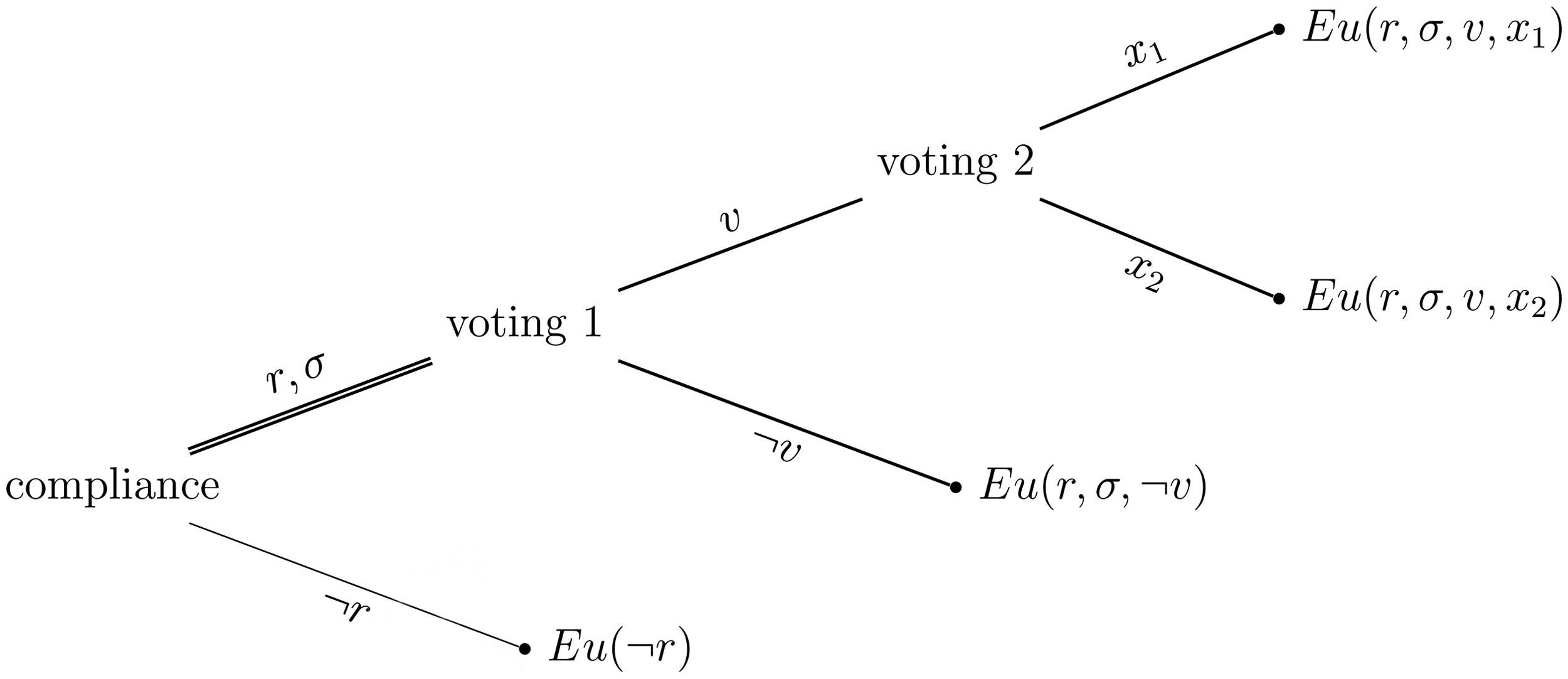
Static decision tree of citizen. Double lines indicate two variables being chosen simultaneously along a path.
The basis for the expected utility function is
The benefit introduces incomplete information. Therefore, the random variable




The transfer is conditional on income and registration. In expectation, the transfer also depends on signaling. By comparing the expected utilities of all possible strategy profiles, we can derive conditions contingent on individuals’ initial characteristics that describe optimal behavior. Note that we assume that policy preferences are uniformly distributed throughout the model’s analysis. Moreover, we assume that income is distributed independently from political preferences.
No transfer
We start by comparing not registering to registering and not voting, that is, equations (3) and (4). It immediately shows that registering and not voting is dominated by not registering. The benefits are the same, despite bearing the cost of registration when registering. There is no incentive to abstain upon registration.
Now we turn to voting. Consider the case of an incumbent supporter, that is,


Signaling is never strategic when
Let
To illustrate, we can turn to Figure 2. We can solve the threshold implicitly defined by the inequality in equation (5) and (6) for
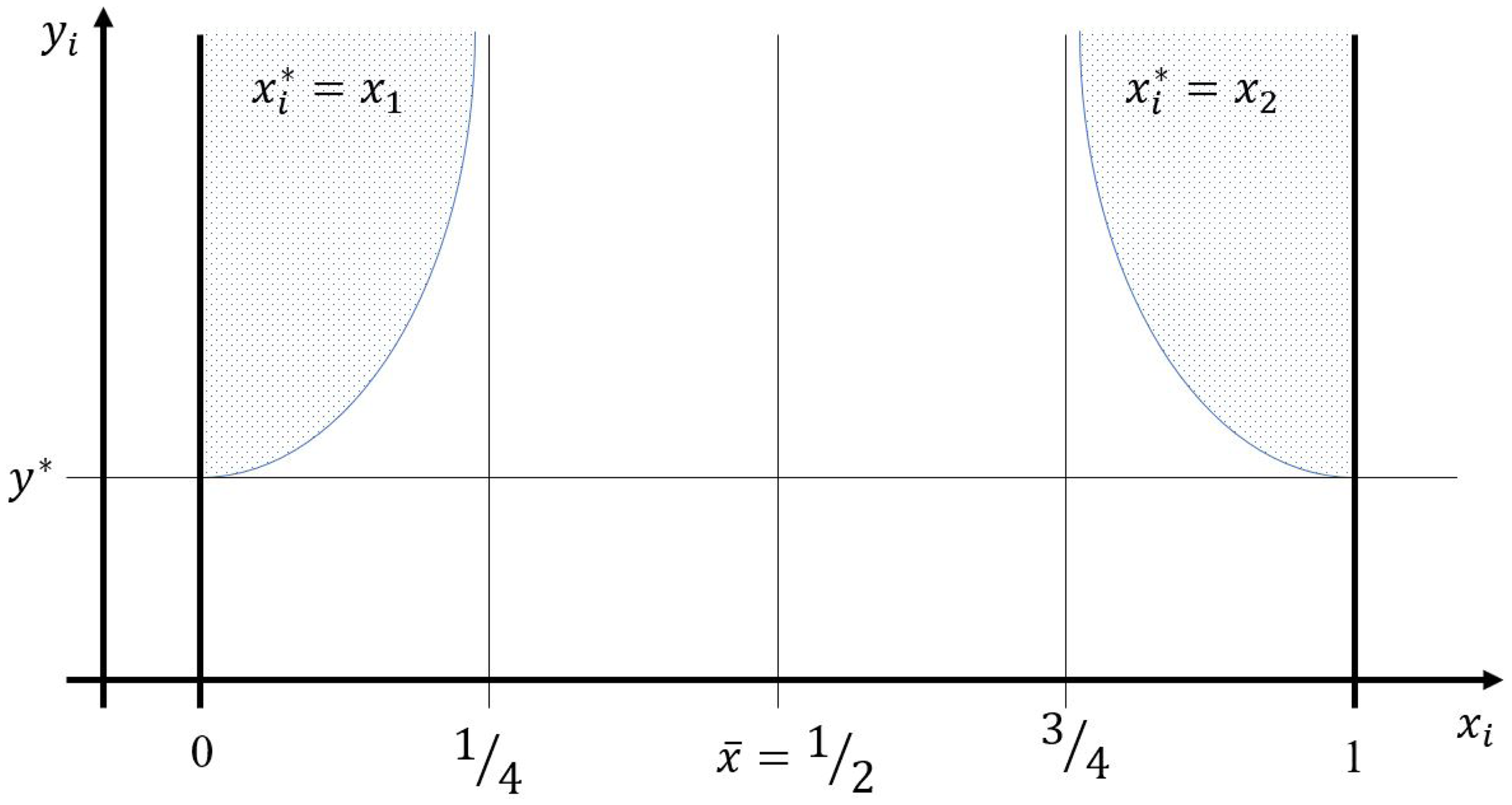
Baseline model.
Note that we consider the case
In the next step, voting 1, we compare the sincere vote with abstaining when being registered,
Signaling can be seen as a continuous choice that is taken before voting 1, only when
The registration decision requires comparing the expected utility of not registering to the preferred alternative among the three possible outcomes after registration, given the optimal signal.
Abstaining without registration is preferred over registering and abstaining, if the combined costs of registration and signaling, outweigh the expected utility of receiving the benefit: Not registering is preferred over voting for the incumbent if Analoguous to 2., not registering is preferred over voting for the opposition if
Inspecting the asymptotics of equations (10) and (12) toward infinite income gives a respective threshold value in the preference domain








Let
The RBC only affects poorer citizens with income Turnout increases for both parties:
Comparing For some weaker incumbent supporters, There is asymmetric participation. More incumbent supporters than opposition supporters are induced to vote. Intuitively, this follows from the fact that signaling is more costly to opposition supporters, which reduces the expectation of receiving the benefit. Analytically, this follows from comparing the surface area above Signaling support for one’s favorite party is less common among opposition supporters than incumbent supporters. Since the optimal signal
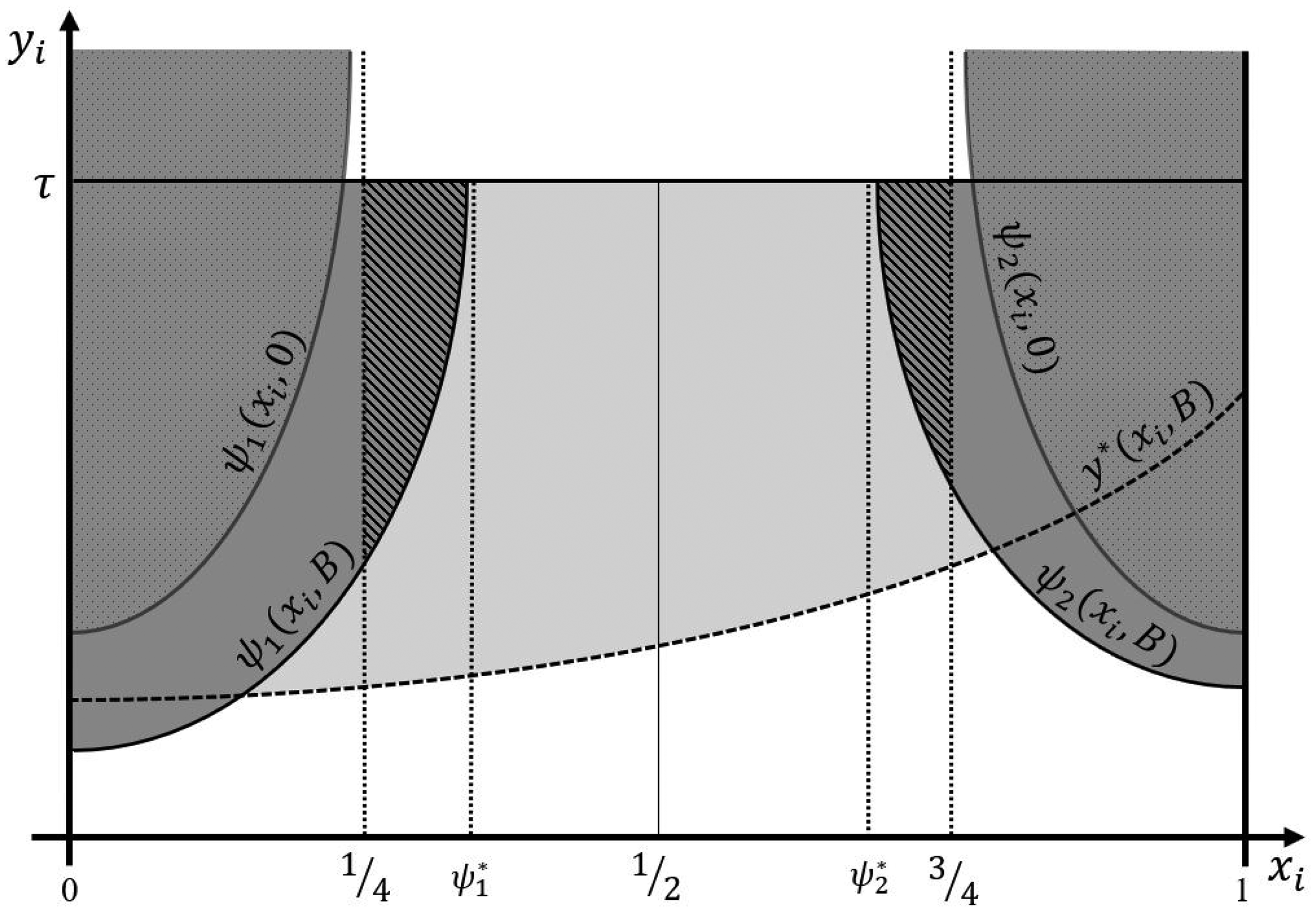
Model including the Renda Básica de Cidadania (RBC) transfer. Dark gray areas contain voters, except for cross-hedged areas. Dotted areas contain the citizens who would have voted without the RBC in place. All blank areas a populated by non-registered citizens. Non-voters are in the light gray area and cross-hedged areas, above
Implication 1 calls for higher turnout straightforwardly. From implication 2, it follows that in an environment of incomplete information, the incumbent can mobilize more voters than their competitors by supplying a broadly target welfare scheme that is contingent on voter registration. Note that we remain agnostic about whether this condition is strategically placed or not. In the same way, we remain agnostic about whether the expectation of contingent benefit allocation is a matter of citizens’ experience with how politics work or whether there was some intervention. There could be some well-placed rumors or selective denials. After all, it could be the case that citizens observed the strong supporters being the first to obtain any benefit because those were the first to select into their party’s program. This could then have spurred rumors of contingent allocation. To test implication 2, we need to empirically verify whether beneficiaries (those with income below
Reflecting on assumptions
At this point, it is in order to discuss more deeply some of the model assumptions. We build on the turnout buying model of Nichter (2008), which extends the vote buying model of Stokes (2005). Since we augment existing models by differentiating between registration and actual voting, we assume that the incumbent can only observe vote registration, which aligns with the anecdotal evidence of using the voting ID as a means of administering the benefit. Note that we remain agnostic about whether this condition is strategically placed or not. In the same way, we remain agnostic about whether the expectation of contingent benefit allocation is a matter of citizens’ experience with how politics work or whether there was actual denial. There could be some well-placed rumors or selective denials. However, it could also be that citizens observed the strong supporters being the first to obtain any benefit because those were the first to select into their party’s program. This could then have spurred rumors of contingent allocation.
The model assumes new voters come from previously unregistered citizens. In reality, there are two conceivable mechanisms. First, there are locals in Maricá, who are unregistered. Plausibly, those are poorer citizens with weaker formal connections. Second, there are citizens not local to Maricá, who are not registered in Maricá. Those could be unregistered or registered elsewhere. Either or both of the mechanisms can be at play. Data about voting behavior in poorer areas of Maricá and data on voter influx to Maricá allows us to address these mechanisms separately to some degree.
The incumbent’s decision whether to implement an RBC
The main purpose of this paper is to highlight the role of expectations in the electorate’s reaction to distributive policy. However, on the flip side, there is also a decision to be made by the incumbent; whether to implement a policy? It is only rational for the incumbent to implement (and invest scarce resources) if an electoral benefit is looming.
In the case of the RBC, this electoral benefit hinges partly on the distributional assumptions along the policy preference and income dimension. The initial assumptions of uniformly distributed policy preferences and income being independently distributed from policy preferences make a graphical comparison, as in Figure 3, easy and intuitive, because surface areas directly correspond to masses of citizens.
It is also intuitive that these assumptions are probably not true in reality. Especially, the assumption about policy preferences being independent of income. However, it is quite plausible that this violation works in our favor. Since the PT, a typical left-leaning party, with a strong support base among Brazil’s poor, is the incumbent, it is most likely that the poorer parts of the electorate hold preferences closer to the incumbent. This implies that the density of citizens increases toward the bottom left of the income-preference plane (respectively, the origin in Figure 3). Hence an expansion of active voters in this area comprises even more voters than a corresponding expansion on the opposite side of the policy preference dimension that is less densely populated. In other words, under the model assumptions we are more likely to understate than overstate the electoral advantage the incumbent derives from implementing the RBC.
Thinking from the incumbent’s perspective, the distribution of voters in the preference and income space is crucial. Hence, the question arises: Under what distribution of citizens in the income-policy-preference space would it make sense to implement the RBC? In principle, any distribution that generates an electoral advantage would be acceptable. In other words, any benefit is acceptable for which the mass of voters that falls in the area between
Quantitative empirical analysis
In this section, we present insights from a unique survey we fielded in Maricá. Besides demographics, respondents were asked about their political behavior and whether they received the RBC. Comparing beneficiaries of the RBC to non-beneficiaries allows us to test whether the implications of the model hold up against the real-world accounts of citizens of Maricá.
Data and empirical strategy
We fielded a survey in September 2021 in Maricá. Interviewers were sent to randomized sub-districts within Maricá and then followed a random path along which they interviewed pedestrians in the street. Due to the pandemic situation at the time, we explicitly refrained from in-house interviewing, to maximize safety for both interviewers and respondents. The survey yielded
Measurement
To assess the voting and support signaling behavior of citizens in Maricá, we want to compare the political engagement of beneficiaries and non-beneficiaries of the RBC. Therefore, we measure several outcome variables related to political engagement.
First, we are interested in citizens’ vote choices. We ask whether respondents voted or not in the last election and for whom. We then collapse the choices into binary variables for whether or not someone voted, whether they voted for Fabiano Horta (PT, Maricá’s mayor at the time when we ran our survey), and—in the spirit of the model—whether or not they voted for any party in the opposition. Note that Fabiano Horta was elected with slightly over
Second, signaling support requires citizens to get in contact, communicate, or otherwise connect with the local incumbent. 8 Therefore, we asked respondents whether or not they have engaged in seven activities that relate to signaling support, in the past two years. Those are the variables displayed in Table 1.
Measures of signaling support.
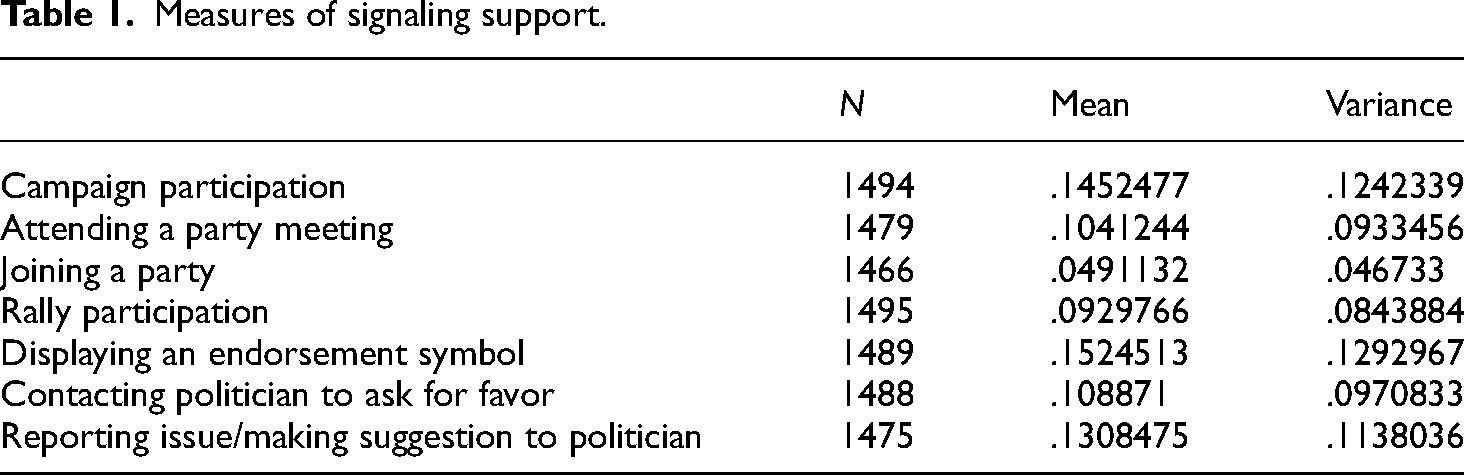
Measures of signaling support.
Campaigning is a central aspect of the work of political parties. In the literature, campaigning is often used to describe all efforts parties make—clientelistic or not—to sway voters before elections (e.g. Casey, 2015; Stokes, 2005; Stokes et al., 2013). When citizens participate in these activities, it seems plausible that local politicians recognize them and their efforts. Maricá is not a big metropolis after all. Local party events will be held and visited by a common crowd and people likely know each other. Hence, newcomers can be easily identified. Collaborating with party members in a campaign can create exactly the key social network connections that make citizens confident about entering the application process for a benefits program with a questionable evaluation of eligibility. In the event of being held up in the bureaucratic process, ‘I’m a friend of your colleague X!’ may be just the right answer to grease the wheels.
Similarly, we think of rally participation and visiting party meetings as activities to generate valuable network ties that ultimately influence the expectations to obtain the benefit. Joining a party is a strong commitment, and therefore an extremely strong signal toward supporting the incumbent. On the one hand, joining a party is the signal that makes it most likely to secure the benefit if the RBC was allocated based on political allegiance. On the other hand, joining a party is especially costly, when the ideological distance to the party is large. Displaying an endorsement symbol is a visual cue of support. Flags on facades or cars, posters, hats, or t-shirts make clear statements about party affiliation. Politicians can easily gather information about who pledges support to their party.
The last two variables ask for more direct contacts: Did respondents approach a politician to ask for a favor? Did they approach a politician to report an issue or make a suggestion? From the literature on request fulfillment (e.g. Nichter and Peress, 2017), we know that not only powerful patrons exploit helpless clients but also citizens can voice demands and have agency in clientelist systems. In the view of a more dynamic exchange relationship, network connections that are valuable in the process of gaining eligibility, can also be created and fostered through direct exchange initiated by the citizen. Nonetheless, we acknowledge that these latter two measures map less directly onto the concept of loyalty signaling compared to the other measures.
Besides the latter two, we phrased questions in terms of favorite candidates to avoid social desirability bias. This complicates the analysis to some degree because we do not know citizens’ underlying preferences. However, we can condition the analysis on vote choice. The model predicts that voters do not vote against their preferences, only that strong supporters vote for their preferred candidate. This then allows us to make a meaningful comparison of signaling activities between voters of PT and voters of the opposition. Here, the model prediction is clear: for opposition supporters the optimal signal (in terms of their favorite candidate not in terms of incumbent support) is biased away from their preferred candidate (toward the incumbent) by the size of the benefit. Hence, opposition voters are less likely to signal support for their preferred candidate than incumbent supporters.
De jure, there exist two criteria that citizens need to satisfy to be eligible for the RBC. One, citizens must reside in Maricá for at least three years. Two, citizens must live in a household earning less than
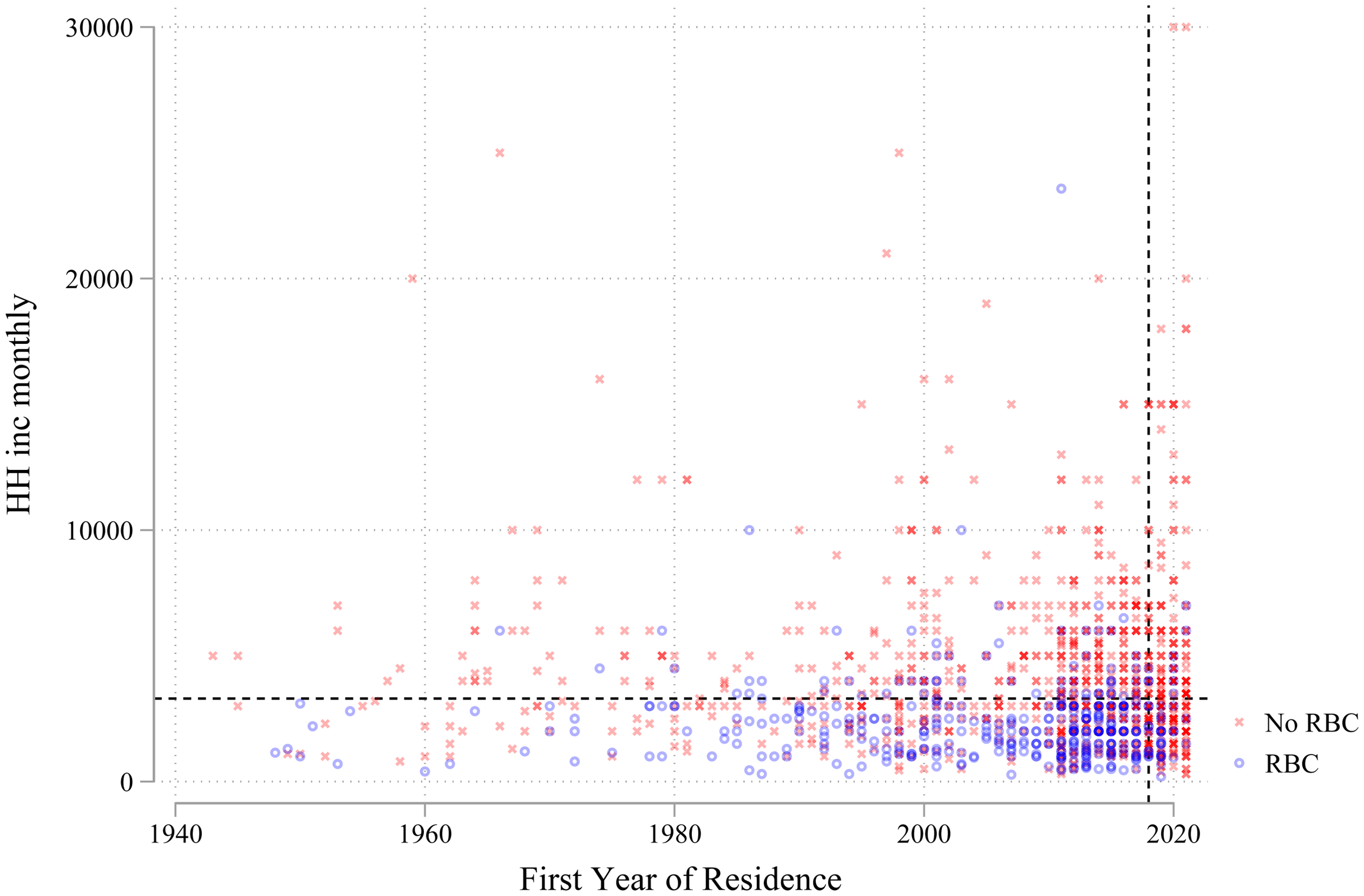
Eligibility and inclusion. The axis depicts the dimensions of eligibility. Dashed lines demarcate eligibility thresholds in the respective dimensions, partitioning the plane into quadrants. RBC beneficiaries are denoted with ‘o’ and non-beneficiaries with ‘x.’ Eligible individuals lie in the southwest quadrant. Individuals falling in any other quadrant are not eligible due to either not residing in Maricá sufficiently long, their household income exceeding the threshold, or both.
To validate the model, it is central that the predictions concerning voting behavior hold. The de facto–de jure gap outlined before complicates this endeavor to some extent. In the model, to keep things tractable, we abstract from false inclusion and false exclusion. We even abstract from the time of residence dimension for eligibility. Empirically those distinctions exist. However, we cannot exactly measure who was potentially eligible, and hence whose behavior was affected by the RBC. We observe de facto beneficiary status and de jure eligibility, both of which could serve as proxies. Rather than arguing for or against a particular proxy, we aim to triangulate the measurements and report comparisons in voting behavior for both, RBC beneficiaries versus non-beneficiaries, and eligible versus non-eligible citizens. Despite misassignment, eligibility, and inclusion still positively correlate (
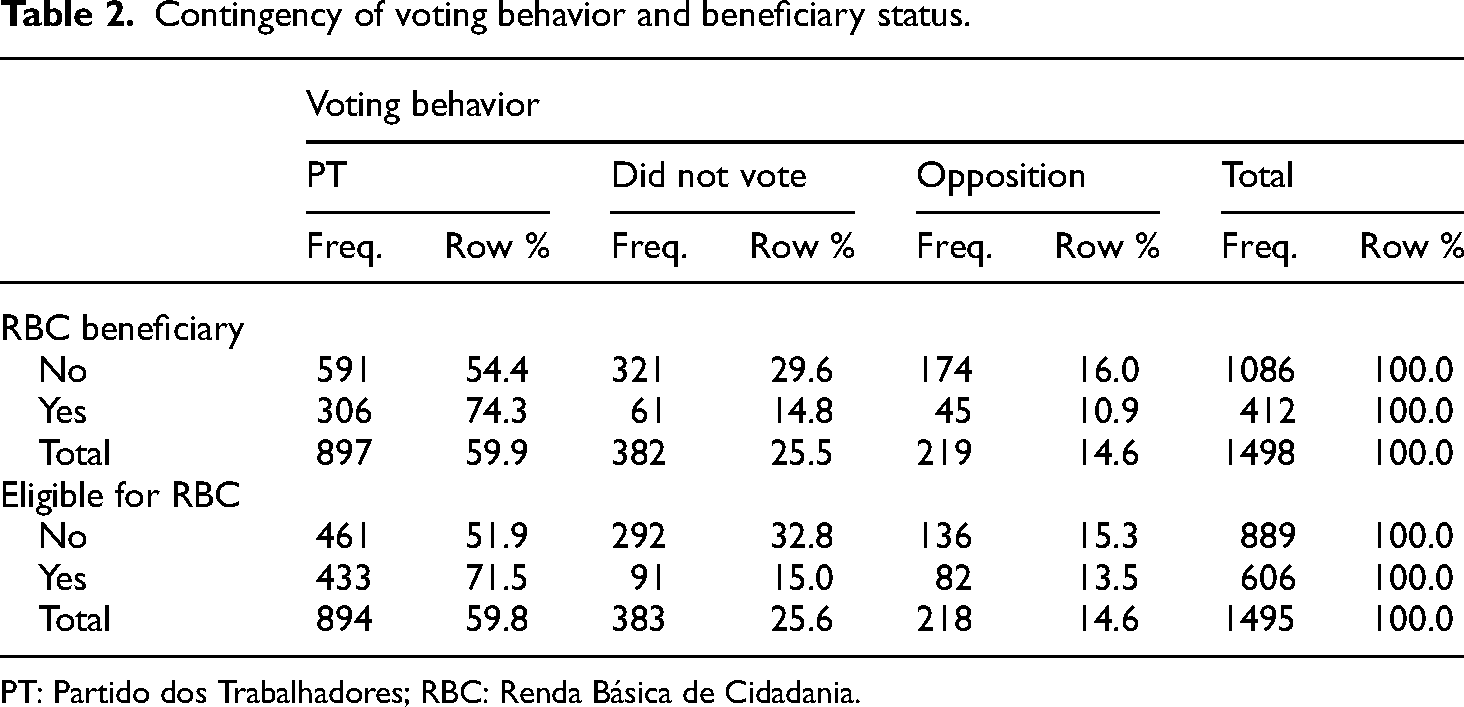
Following the logic displayed in Figure 3, citizens can be classified in
Contingency of voting behavior and beneficiary status.
Contingency of voting behavior and beneficiary status.
PT: Partido dos Trabalhadores; RBC: Renda Básica de Cidadania.
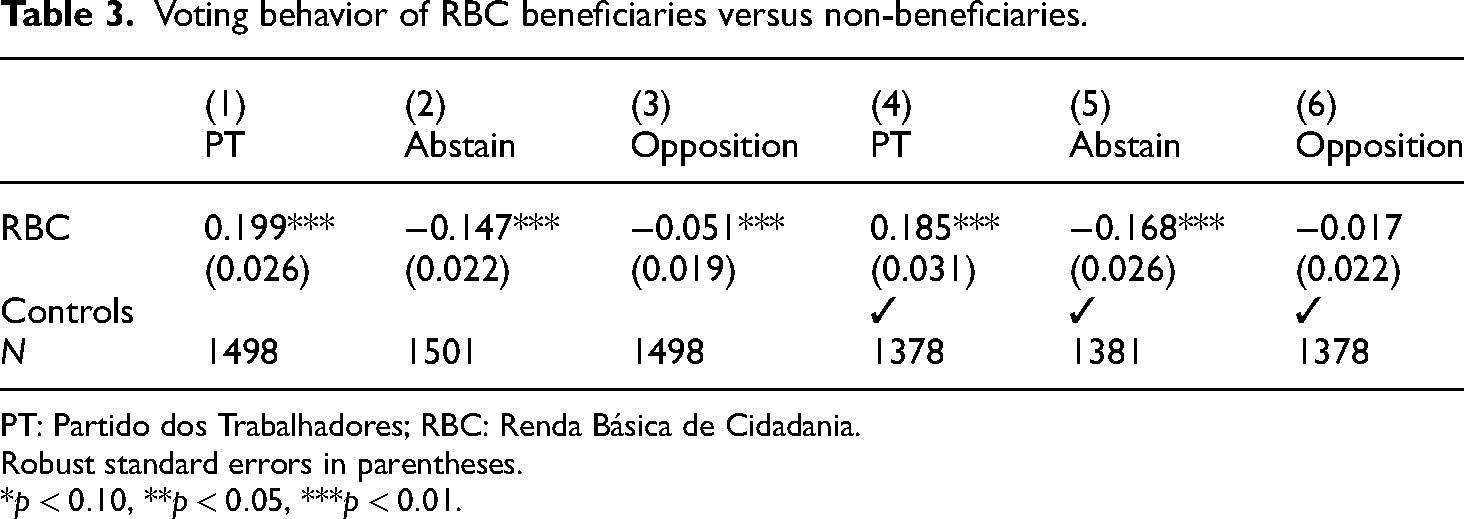
In a simple linear regression framework, we can test whether the differences in voting behavior between beneficiaries and non-beneficiaries are statistically significant. The results for an ordinary least square (OLS) estimation of a linear model with voting behavior as the dependent variable and beneficiary status as the independent variables are reported in Table 3. The models in columns (1)–(3) do not condition on control variables, that is, they show pure correlations, and the models (4)–(6) use demographic control variables. The regression analysis confirms what the contingency table suggests. Beneficiaries vote significantly more commonly for the incumbent (
Voting behavior of RBC beneficiaries versus non-beneficiaries.
PT: Partido dos Trabalhadores; RBC: Renda Básica de Cidadania.
Robust standard errors in parentheses.
*
After voting behavior, we want to examine whether the model’s implications align with reported signaling behavior. Since we measure outcome variables in terms of signaling support to a ‘favorite’ politician, we need to account for the unknown underlying preferences of voters. Vote choices give us a measure of revealed preferences, even if only a crude one, since weaker supporters, in any case, are likely to abstain, and hence do not reveal preferences. Remember that according to the model, voting should still be sincere and not be influenced by the RBC. The model suggests that the optimal direction of the signal is biased toward the incumbent (PT) by the amount of the benefit. Therefore, even for the strongest opposition supporters, there is an incentive to reduce their signaling to their favorite candidate (the opposition). Conversely, such an incentive does not exist for incumbent (PT) supporters. If anything, even the optimal signal of the supporters of the incumbent is biased toward signaling more support to their favorite candidate. Ideally, we want to compare the change in signaling prevalence before and after the RBC across eligibility status. Comparing only level differences in signaling across eligibility status is not very informative since it is plausible that more affluent voters are more politically engaged and interested anyway. We contend that it is more useful to compare level differences across PT and opposition voters. As vote choice should not change due to the RBC, level differences in signaling are more plausibly related to the RBC.
9
Thus, we want to test the hypotheses:
Signaling activities are more prevalent among PT supporters than opposition supporters. Signaling activities are more prevalent among beneficiaries, who vote for PT. Signaling activities are more prevalent among eligible citizens, who vote for PT.
For this purpose, we estimate the following model by OLS:

The results are reported in Table 4. Figure 5 reports the difference in predictive margins (based on the results in Table 4) between incumbent voters and opposition voters, for beneficiaries (eligibles, lower panels in Figure 5) without control variables and with control variables (right-hand side panels in Figure 5).
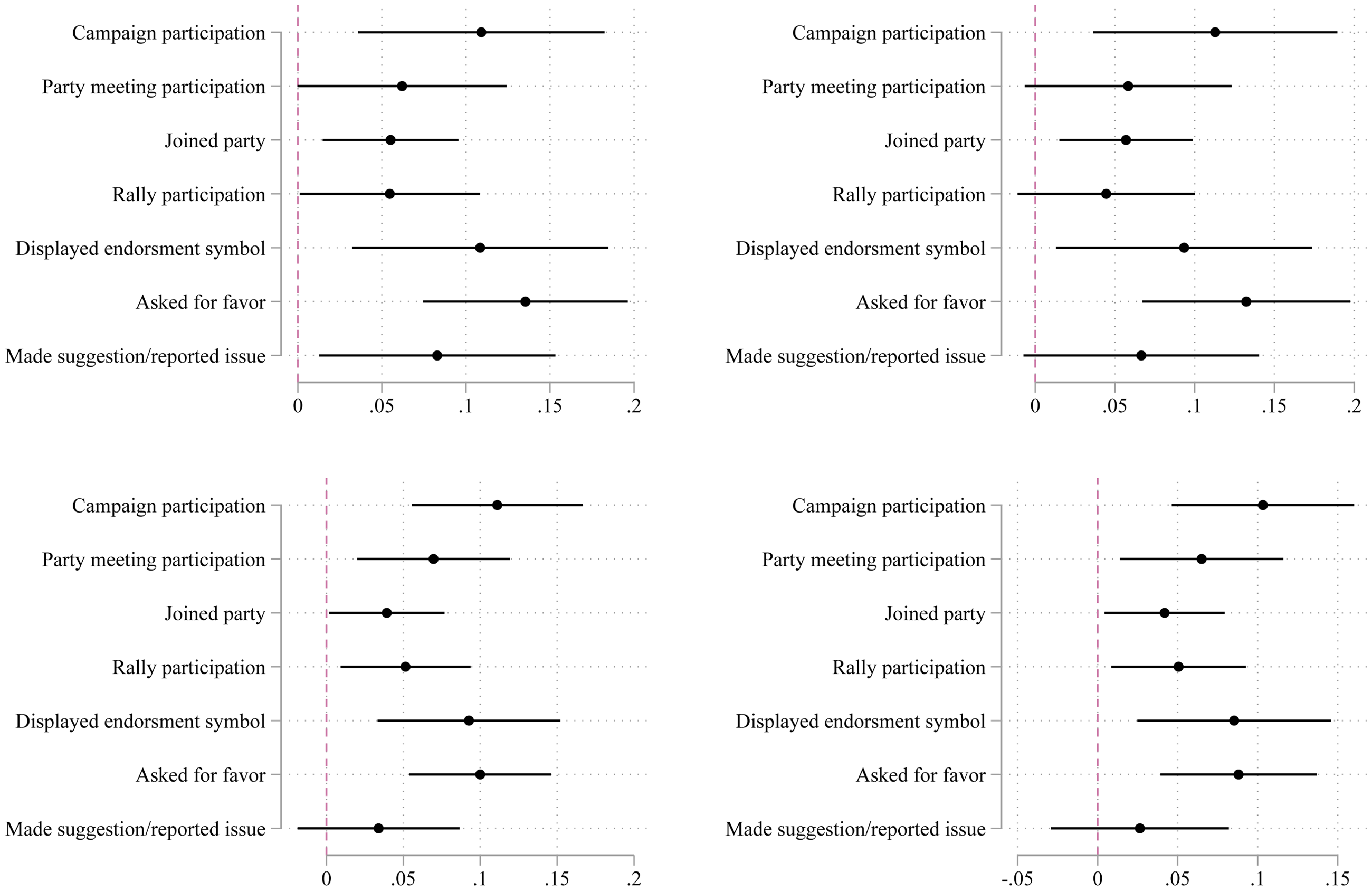
Partial correlation plots. The plotted coefficients represent the marginal effects of being a PT voter conditional on positive beneficiary status or eligibility status respectively. For the left panels, this corresponds to a linear combination of the coefficients of ‘PT voter’ and ‘RBC × PT voter’ reported in Table 7 (Appendix C). The panels to the right are based on specifications using demographic control variables, corresponding to Table 8 (Appendix C). We report 95% confidence intervals from Huber–White robust standard errors. PT: Partido dos Trabalhadores; RBC: Renda Básica de Cidadania.
Signaling behavior of PT voters.
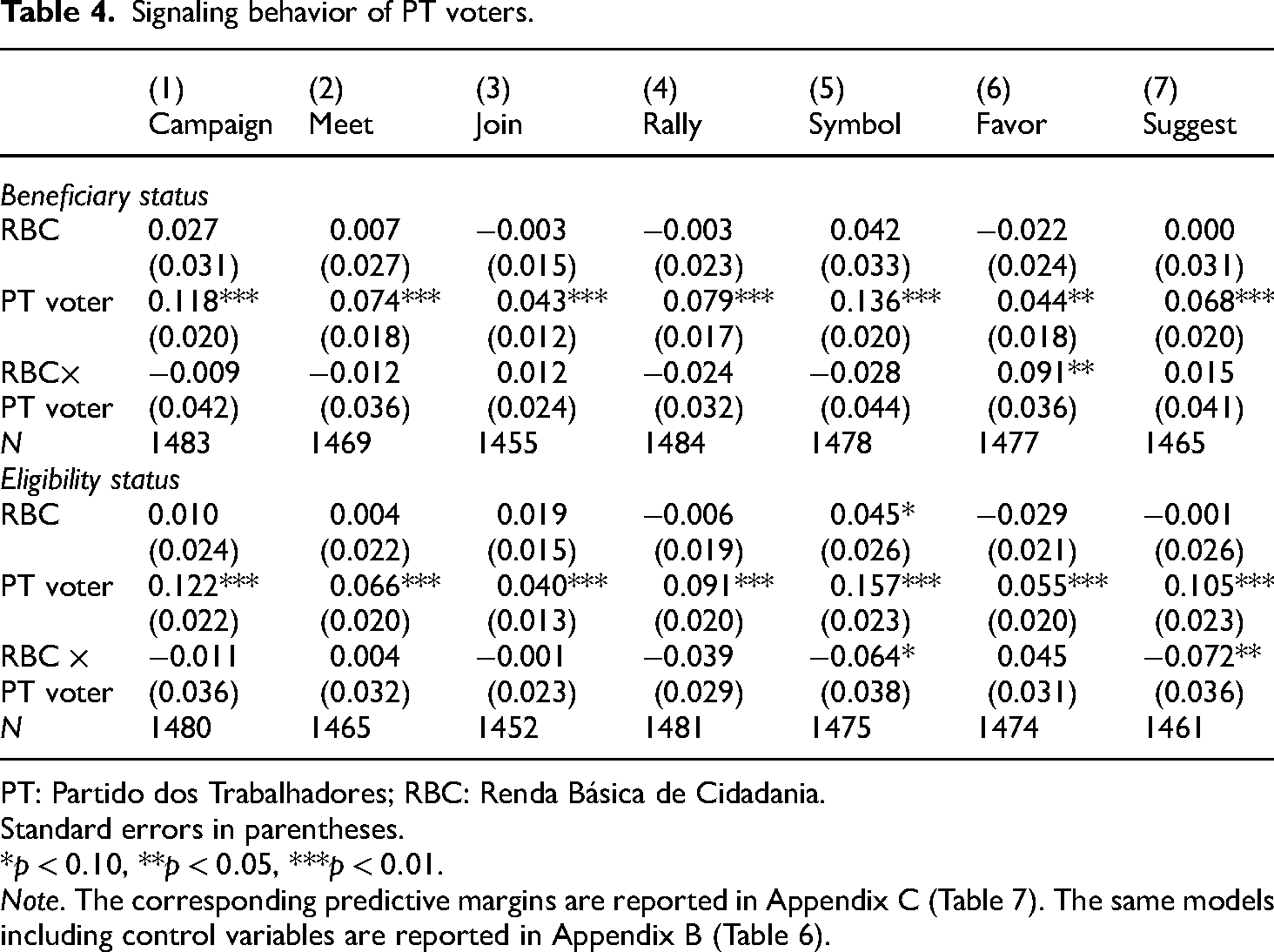
PT: Partido dos Trabalhadores; RBC: Renda Básica de Cidadania.
Standard errors in parentheses.
*
In general, the results confirm the hypotheses. Overall, PT voters are more likely to signal support for their favorite candidate. In the upper right panel in Figure 5, for the specification with beneficiary status as the independent variable, including demographic controls, for participation in party meetings, rally participation, making suggestions, or reporting issues to politicians, we cannot reject that the estimated coefficients differ from 0 at the 95% confidence level. Besides rally participation (
Taken together, the empirical evidence presented in Section 4.2 and this section supports the argument that a de jure universalist welfare program creates mobilization in favor of the incumbent party through asymmetric mobilization. Under incomplete information about the de facto allocation of welfare benefits, expectations to be included in the welfare program are contingent on signaling support for the incumbent party. Coupled with local voter registration, this leads to a self-selection of supporters of the incumbent into the electorate.
We theorize a novel mechanism for how voters are being mobilized by social policy. Our baseline predictions of higher turnout, especially for the implementing party, are similar to classic explanations such as clientelism or retrospective voting. Going beyond that, leveraging the power of expectations under incomplete information about de facto allocation rules on the side of the citizen, we charter new territory between particularistic and programmatic policy. Asymmetric mobilization happens because citizens expect particularistic allocation. Indeed, when benefit allocation depends on voter registration, citizens’ expectations of particularistic allocation are sufficient to alter behavior. There doesn’t need to be any actual particularism. Yet, the electoral dynamics play out similarly to turnout buying (Nichter, 2008) or voter buying (Hidalgo and Nichter, 2016). Unmobilized voters in Maricá can be mobilized (i.e. turnout buying) and voters from surrounding municipalities are mobilized (i.e. voter buying). Instead of voters being actively incentivized to participate, supporters of the party handing out the benefit self-select into the electorate under asymmetric mobilization.
In line with the recent literature, exploring the blurry lines between programmatic and particularistic policy (Bardhan, 2022; Calvo and Murillo, 2019; Frey, 2019, 2021; Hicken and Nathan, 2020; Holland and Freeman, 2021; Imai et al., 2020; Mares and Young, 2019), we highlight that even an UCT that undoubtedly improved the living situation of many poor citizens on the ground can have complex complementarities with party incentives and ultimately corroborate a local stronghold. Whether there is manipulation, for example, in the form of selective benefit allocation, is unknown to us and leaves scope for future work. Some follow-up questions might be particularly interesting for the clientelism literature. Would the strategic manipulation of expected clientelism already be classifiable as clientelism? What strategies can be used to manipulate expectations? Which actors participate in information brokerage? Moreover, what happens to ‘traditional’ brokers? Are ‘traditional’ clientelistic relationships maintained at all?
From a policy design and evaluation perspective, it is desirable to know which exact institutions allow for manipulations of seemingly programmatic policies. Recent literature has argued for irrevocable benefits as anti-clientelistic (Bobonis et al., 2022; Frey, 2022). Yet, we find scope for strategic interference—even if not exactly clientelistic—in an irrevocable benefit program. Similar to Frey (2022), our findings caution that the underlying incentives need to be considered to ultimately evaluate the strategic (mis-)use of irrevocable benefits.
The classic party patronage argument states that clientelistic systems prevent progressive policy (Häusermann et al., 2013; Shefter, 1977). However, we show that even universalist welfare policy can align with politicians’ interest in creating a local stronghold. In the larger process of democratic consolidation, this means that universalist social policy can replace particularistic policy. 10 Our research highlights that even when young democracies move toward less particularistic policies, the legacy of clientelism is carried on in citizens’ expectations about policymaking. This in turn has real effects on electoral outcomes. From this perspective, asymmetric mobilization can inform the discussion on how welfare states develop and democracies consolidate. In an optimistic outlook, it seems possible that policies, such as the RBC, could even outlive the incumbent who implemented them, leaving behind a universalist social policy without partisan connection.
Footnotes
Acknowledgements
For helpful comments, we thank Pablo Beramendi, Anderson Frey, Isabela Mares, Katharina Michaelowa, Christian Ochsner, Jonathan Slapin, Julia Wagner, and seminar and workshop participants at FPE:CSS Zürich, ZPESS Zürich, EPCS Hannover, and EPSA Glasgow. All errors are our own.
Declaration of conflicting interests
The authors declared no potential conflicts of interest with respect to the research, authorship, and/or publication of this article.
Funding
The authors disclosed receipt of the following financial support for the research, authorship, and/or publication of this article: This work was generously supported by the Inequality Research Fund grant by the URPP of the University of Zürich.

Appendix A Verifying asymmetric mobilization
Comparing the mass of voters. The plot evaluates inequality (17) over the domain of B (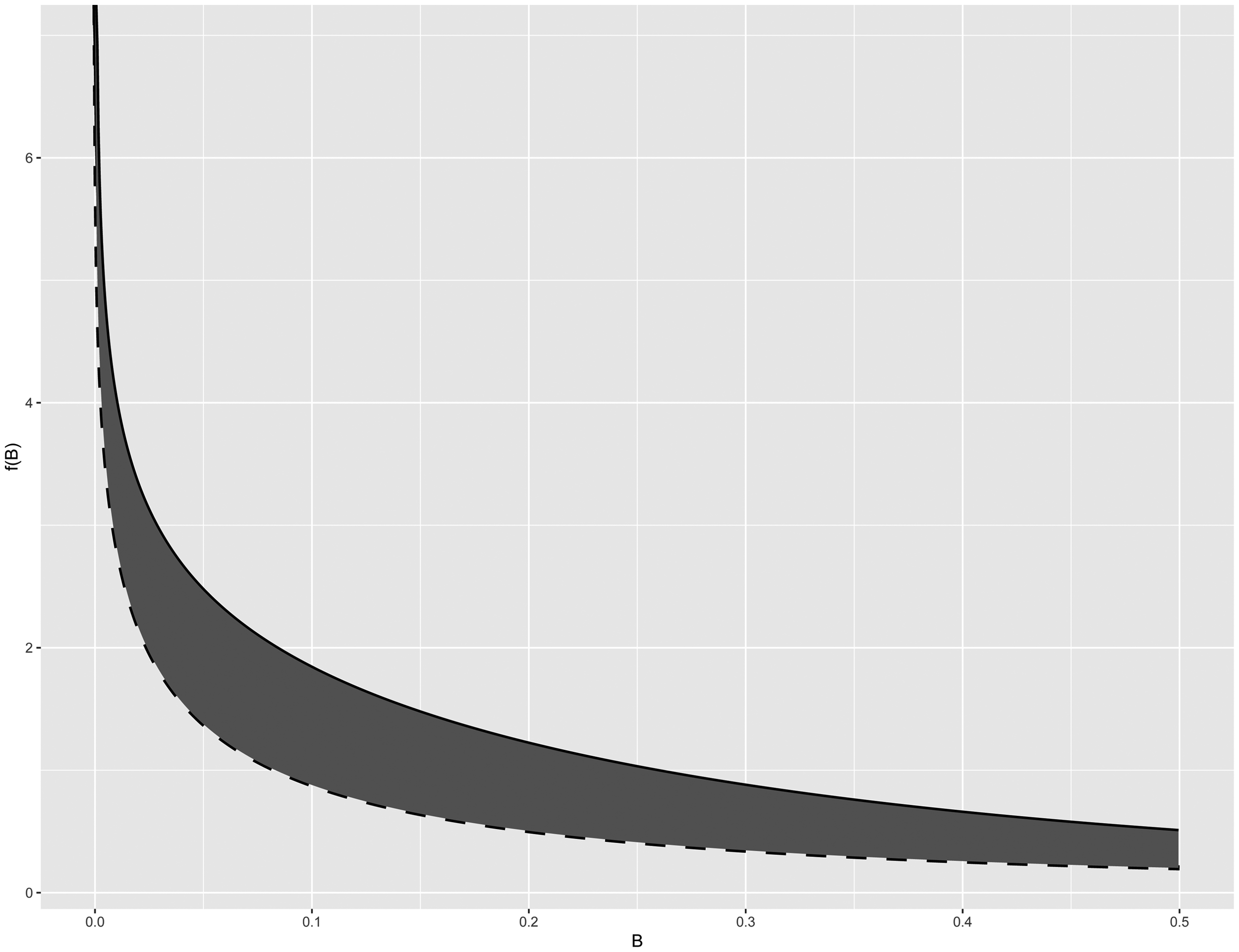
Appendix B Descriptive statistics
Descriptive statistics.
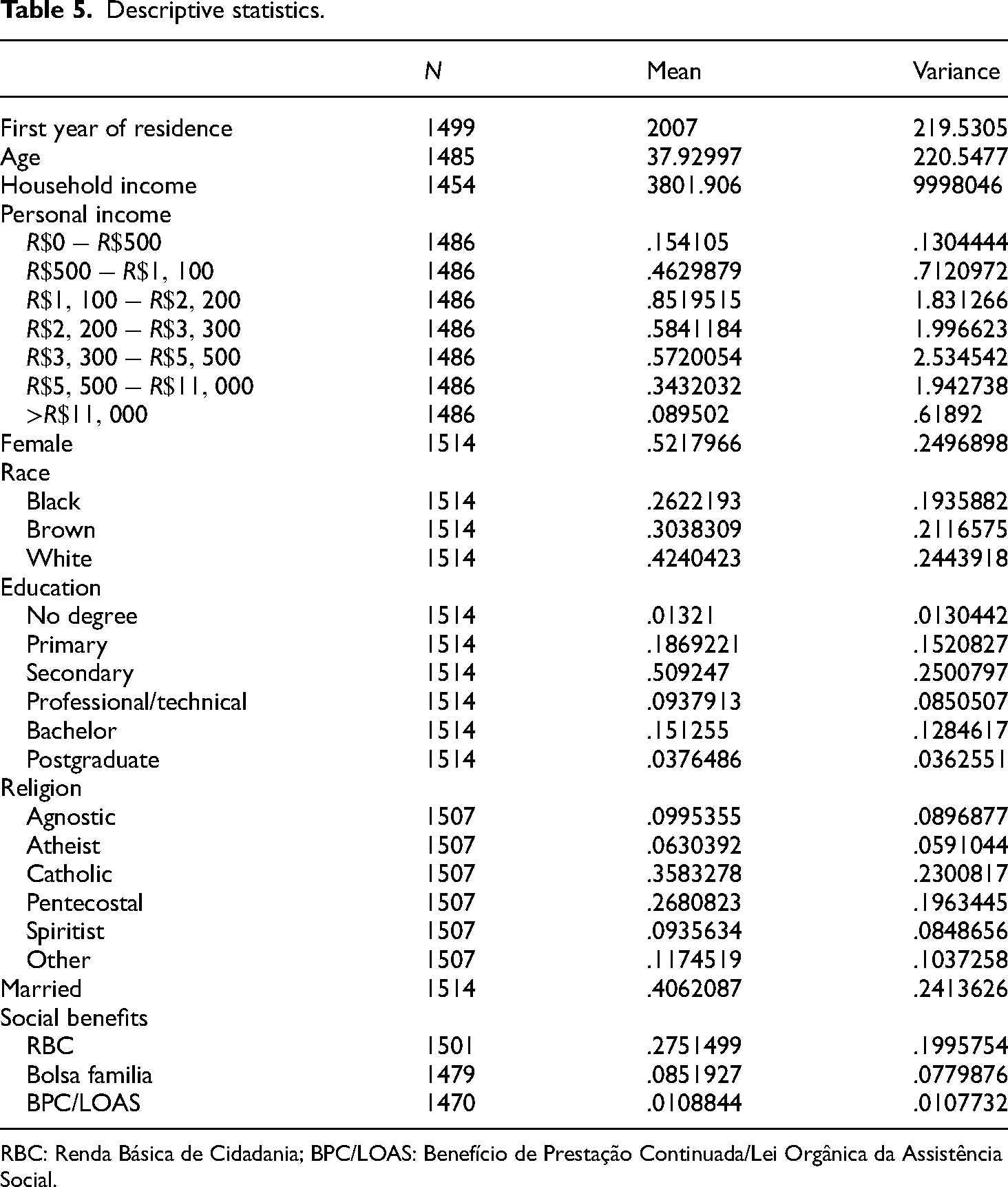
| N | Mean | Variance | |
|---|---|---|---|
| First year of residence | 1499 | 2007 | 219.5305 |
| Age | 1485 | 37.92997 | 220.5477 |
| Household income | 1454 | 3801.906 | 9998046 |
| Personal income | |||
| |
1486 | .154105 | .1304444 |
| |
1486 | .4629879 | .7120972 |
| |
1486 | .8519515 | 1.831266 |
| |
1486 | .5841184 | 1.996623 |
| |
1486 | .5720054 | 2.534542 |
| |
1486 | .3432032 | 1.942738 |
| |
1486 | .089502 | .61892 |
| Female | 1514 | .5217966 | .2496898 |
| Race | |||
| Black | 1514 | .2622193 | .1935882 |
| Brown | 1514 | .3038309 | .2116575 |
| White | 1514 | .4240423 | .2443918 |
| Education | |||
| No degree | 1514 | .01321 | .0130442 |
| Primary | 1514 | .1869221 | .1520827 |
| Secondary | 1514 | .509247 | .2500797 |
| Professional/technical | 1514 | .0937913 | .0850507 |
| Bachelor | 1514 | .151255 | .1284617 |
| Postgraduate | 1514 | .0376486 | .0362551 |
| Religion | |||
| Agnostic | 1507 | .0995355 | .0896877 |
| Atheist | 1507 | .0630392 | .0591044 |
| Catholic | 1507 | .3583278 | .2300817 |
| Pentecostal | 1507 | .2680823 | .1963445 |
| Spiritist | 1507 | .0935634 | .0848656 |
| Other | 1507 | .1174519 | .1037258 |
| Married | 1514 | .4062087 | .2413626 |
| Social benefits | |||
| RBC | 1501 | .2751499 | .1995754 |
| Bolsa familia | 1479 | .0851927 | .0779876 |
| BPC/LOAS | 1470 | .0108844 | .0107732 |
RBC: Renda Básica de Cidadania; BPC/LOAS: Benefício de Prestação Continuada/Lei Orgânica da Assistência Social.
Appendix C Auxiliary results
Voting behavior of RBC eligibles versus non-eligibles.
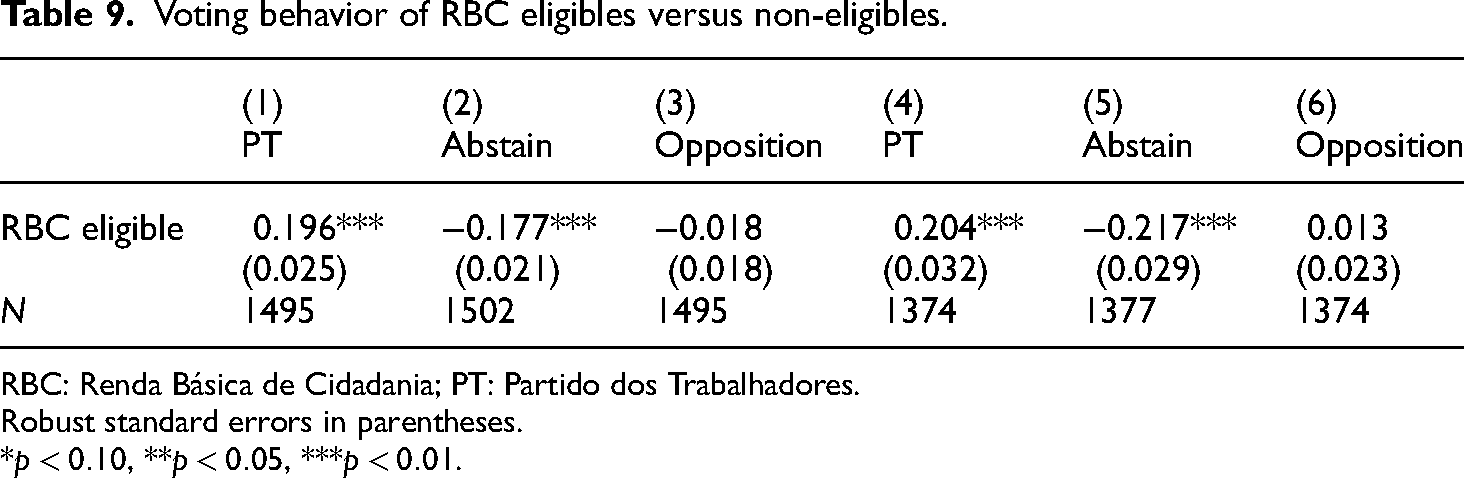
| (1) | (2) | (3) | (4) | (5) | (6) | |
|---|---|---|---|---|---|---|
| PT | Abstain | Opposition | PT | Abstain | Opposition | |
| RBC eligible | 0.196*** | −0.177*** | −0.018 | 0.204*** | −0.217*** | 0.013 |
| (0.025) | (0.021) | (0.018) | (0.032) | (0.029) | (0.023) | |
| N | 1495 | 1502 | 1495 | 1374 | 1377 | 1374 |
RBC: Renda Básica de Cidadania; PT: Partido dos Trabalhadores.
Robust standard errors in parentheses.
*