




Abstract
Congressional oversight is a potentially potent tool to affect policy making and implementation by executive agencies. However, oversight of any agency is dispersed among several committees across the House and Senate. How does this decentralization affect the strategic incentives for oversight by each committee? And how do the strategic incentives of oversight committees align with the collective interest of Congress as a whole? We develop a formal, spatial model of decentralized oversight to investigate these questions. The model shows that when committees have similar interests in affecting agency policy, committees attempt to free ride on each other, and oversight levels are inefficiently low. But if committees have competing interests in affecting agency policy, they engage in “dueling oversight” with little overall effect, and oversight levels are inefficiently high. Overall, we contend that committee oversight incentives do not generally align with the collective interests of Congress, and the problem cannot be easily solved by structural changes within a single chamber.
Introduction
From 2017 to 2018, during the 115th Congress, neither the House Committee on Financial Services, chaired by Rep. Jeb Hensarling (R - TX) nor the Senate Committee on Banking, Housing, and Urban Affairs, chaired by Sen. Michael Crapo (R - ID) held oversight hearings on financial regulators. Their lack of oversight on regulators was notable, given the regulators’ deregulatory activity during the time period. For example, the National Credit Union Administration (NCUA) amended a risk-based capital rule from 2015 to postpone the effective date and exempt 90% of all credit unions from the rule’s effects. 1 The chair of the NCUA Board, J. Mark McWatters, had voted against this risk-based capital rule as a board member in 2015 and lost. Three years later, he was a part of the effort to gut the rule. Neither the House nor Senate committee with oversight jurisdiction over the NCUA held a hearing about the deregulation of credit unions or with financial regulators in general. 2
Yet when Democrats took control of the House in the 116th Congress, these same two committees held what some have called “dueling hearings” 3 with the NCUA. The House Committee on Financial Services, now chaired by Rep. Maxine Waters (D - CA), and the Senate Committee on Banking, Housing, and Urban Affairs, still chaired by Sen. Michael Crapo (R - ID), held full-committee hearings overseeing the NCUA within one day of each other. 4
The phenomenon of “dueling hearings” by committees with differing policy goals is an area of congressional oversight that, to the best of our knowledge, has gone largely unexplored. Existing studies have characterized congressional oversight as makeshift and fragmented (Wood and Waterman 1991) and argued that too many committees’ involvement can undermine congressional oversight (Clinton et al. 2014). One NPR story revealed that 108 committees, subcommittees, and caucuses were overseeing the Department of Homeland Security. 5 But to the best of our knowledge, no study has systematically analyzed the burst in oversight by committees with overlapping jurisdictions that disagree about policy—this phenomenon of “dueling hearings”—alongside insufficient oversight by those same committees when they agree about policy.
Existing studies have dealt to some degree with the question of how much congressional oversight is optimal. While it was once considered alarming that Congress did so little oversight (e.g. Ogul 1976), Aberbach (1990, 2002) demonstrated empirically that on-the-record oversight has grown considerably and often is relatively high. Moreover, as McCubbins and Schwartz (1984) argued, on-the-record oversight need not be extensive to be effective. Nevertheless, noting the collective action problem between multiple committees with common interests, Gailmard (2009) argued that committees may do less oversight than is in their collective interest.
This article contributes a spatial model of oversight by multiple committees in order to systematically examine how the strategic incentives of oversight committees align with the collective interest of Congress as a whole. In our model, multiple committees can have common or competing interests. The model reveals an interesting dynamic: When oversight committees have competing interests, they use oversight in part to “undo” the influence of other oversight committees. In equilibrium, committees may engage in extensive oversight with little or no effect on the enacted policy—which matches the empirical finding in Clinton et al. (2014). Time spent on oversight presumably has other publicly valuable uses, so in this case, Congress as a whole provides more oversight than is in its collective (or the public) interest. On the other hand, when oversight committees have similar interests in shifting the enacted policy, a collective action problem similar to that noted by Gailmard (2009) holds, and committees provide too little oversight to promote their collective interest.
Background
Major pieces of legislation typically leave important details to be worked out by bureaucratic agencies. For example, the Patient Protection and Affordable Care Act delegates to the Secretary of Health and Human Services everything from the reimbursement structure for insurance companies, to the determination of reasonable rate increases, to the establishment of a high-risk health insurance pool. Because agency employees are subject-area experts, congressional delegation can result in more efficient and expert policies. Civil servants, however, have inherent opportunities to bend public policy in the direction of their preferred alternatives (Potter 2019; Nou 2019). The costs of congressional delegation to Congress are well theorized: When it delegates to agencies, Congress entrusts policy-making authority to actors with different goals and conceptions of good public policy, and a weaker connection to the electorate, than Congress itself. An agency problem results.
There are multiple channels by which Congress can mitigate this agency problem. Taken broadly, these include structural elements of agency design, statutory constraints on agency policy discretion, and ex post oversight of agencies after authority has been delegated (McCubbins and Schwartz 1984; McCubbins et al. 1987; Aberbach 1990, 2002; Bawn 1997; Epstein and O’Halloran 1999). Approaches for ex-post oversight, the focus of this article, include: submitting a public comment to an agency’s rulemaking docket (Hall and Miler 2008), requesting a report from the Government Accountability Office, holding a hearing (Aberbach 1990, 2002; Feinstein 2017; Kriner and Schickler 2016; Kriner and Schwartz 2008; McGrath 2013; Marvel and McGrath 2016; MacDonald and McGrath 2016), and using its veto power under the Congressional Review Act to overturn agencies’ final rules. All of these approaches can be thought of as efforts to bend public policy back in a committee’s preferred direction and away from the agency’s, or the President’s, or even other subsets of Congress not involved in the oversight hearing in question.
Does Congress use these channels effectively to promote its collective interests with respect to agencies? Agency design and ex ante constraints are embedded in statutes passed by Congress as a whole, so presumably reflect its collective interests reasonably well (cf. Shipan 1997; MacDonald 2010; Palus and Yackee 2016; Bolton and Thrower 2019; Potter and Shipan 2017). On the other hand, ex post oversight is decentralized to individual committees. Thus, strategically, we should expect oversight committees to use this tool to pursue their own members’ interests (Bawn 1997), which need not coincide with those of the whole Congress. 6
We model congressional oversight as an activity that multiple committees with overlapping oversight jurisdictions can carry out. Thus, our model has at its core an important feature of congressional oversight that other studies have noted but that has not been extensively theorized: Multiple committees with overlapping jurisdictions can carry out oversight. While certain committees are likely more active in their oversight (such as authorizing committees), technically, House and Senate committees lack a set of agencies that they are responsible for (or prevented from) overseeing (Clinton et al. 2014). 7 Moreover, multiple committees can be interested in the same agencies (Aberbach 1990; Jones et al. 1993; King 1997; Evans 1999; Baumgartner and Jones 2010). For our model to apply, we need to have more than one committee with standing oversight jurisdiction over an agency. This is clearly true for any federal policy area, where agencies must contend at least with committees from both the House and Senate, as well as appropriations and often multiple authorizing committees in the same chamber.
Moreover, we model oversight as having an effect on the final content of public policy. There are various channels by which this effect might operate, for example, a signal of Congress’s interest in changing budgets or enabling legislation in response to dissatisfaction with agency actions. These signals might induce an agency to change its policy or to change the intensity with which it enforces an existing policy. In the model the effect of oversight on policy is instantaneous, a simplification that allows us to abstract from the specific channel involved.
Our model investigates strategic incentives for oversight when it affects policy, though whether oversight in fact has these effects requires further empirical analysis. The possibility is worth investigating given (among other things) the lack of clarity in the literature about what exactly oversight does. Some scholars argue that oversight is a vehicle for grandstanding (Park 2021) or scoring political points against the opposing party (Weich 2019), e.g. the effects of Benghazi hearings on Hillary Clinton’s poll numbers (Weigel and Terris 2015), or Sen. Mitch McConnell publicly warning Democrats that aggressively investigating Trump could lower the poll numbers for Democrats as a whole (Foran 2018). Other literature points to oversight that is more programmatic in nature. For example, hearings communicating directly with agencies (McGrath, 2013; MacDonald and McGrath, 2016; Marvel and McGrath, 2016) and hearings investigating executive branch wrongdoing (Kriner and Schickler, 2016). To our knowledge, finding ways to directly connect oversight with policy effects remains a challenge for this literature. One point of this paper is to generate testable hypotheses that can motivate future empirical work.
It is also worth noting that oversight may be more likely to have policy effects in some agencies than others. For many regulatory actions, there may be nothing that Congress can do to change policy absent passing a new law. Thus, the incentives that this paper illuminates may be more relevant to some agencies than others.
By directly connecting congressional hearing activity with agency actions, this article dovetails with recent empirical studies of congressional oversight that either directly connect congressional hearing activity with agency actions and/or the ideological leanings of agencies (Feinstein 2017; MacDonald and McGrath 2016; McGrath 2013). 8
This article, along with Feinstein (2017); MacDonald and McGrath (2016); McGrath (2013), are in contrast to the analysis of Aberbach (1990, 2002) because they take agencies into account. Aberbach, on the other hand, places oversight in a framework centered on Congress and the broad contours of the national policy-making environment. Oversight’s costs and benefits are understood by Aberbach in terms of resources available to congressional committees, such as staff sizes; and the wider constraints Congress faces in fashioning new policy initiatives, such as budget deficits. Aberbach argues that both the resources available for legislative oversight of bureaucracy and the costs of building grand new policy initiatives contributed to the growth of oversight activity through the 1970s and 1980s. Thus his account emphasizes factors internal to Congress and the wider policy environment as determinants of oversight.
In sum, Congress faces an agency problem when it delegates to agencies. There are many ways that Congress can go about attempting to mitigate this agency problem, some prior to or at the time of delegation and some after delegation. For congressional oversight that occurs after delegation, one of the interesting and potentially problematic features is that oversight is carried out by multiple committees with overlapping oversight interests. We argue that individual committee oversight incentives do not generally align with their collective interests, a point that has been largely overlooked in existing studies of congressional oversight. We formalize this argument and its implications in the following section.
The model
We model oversight as an activity that multiple committees may undertake, that reveals information about the policy actions implemented by an executive agency, and that may affect that policy going forward. We first present the model formally, and then discuss the substantive motivation.
Formalities
The model is a game with three players: the agency
Each player has symmetric and single-peaked preferences over policies, with a commonly known ideal point denoted
Each player’s utility is composed of a spatial policy utility and a cost of oversight. Committee
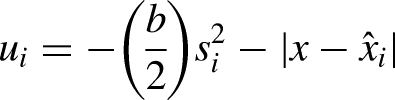

The sequence of policy making is as follows. First,
If
To facilitate analysis, we reflect the policy influence of oversight in a very simple way. If both
When the committees choose oversight levels, they choose in ignorance of the agency’s choice
Substantive motivation
We comment briefly on some of the key assumptions in the model. Foremost is that multiple committees may be involved in oversight. As noted above, this reflects the situation for any federal policy area in which agencies must contend at least with committees from both the House and Senate, as well as appropriations and often multiple authorizing committees in the same chamber. We are agnostic about the sources of committee spatial preferences, and particularly whether they are driven by the chamber median, majority party, etc. We take these preferences as given and analyze equilibrium behavior under any possible configuration.
Committee oversight “jurisdiction” in the model is endogenous. Each committee has the right, but not obligation, of oversight; each can opt out of oversight jurisdiction by setting
Oversight is costly for committees, represented by
Oversight is also costly for agencies, represented by
Our model considers two basic functions of oversight: First, to discover exactly what an agency has done (or proposed); second, to influence the committee to change its policy. The first point is equivalent to assuming that committees cannot condition their oversight levels on the agency’s policy choice; they use oversight in part to determine what that policy is. The second is equivalent to assuming that oversight has policy consequences (cf. Bawn 1997). Clearly, there are many ways to model this aspect. Essentially, we think of oversight as opening a bargaining process between the committee and the agency over policy implementation, and our model posits that all the bargaining power lies with the committees. This is a special case of any model in which oversight discontinuously shifts policy toward the oversight committee’s ideal, with the probability increasing in its oversight. The stark assumption of moving exactly to the committee’s ideal is less formally cumbersome than but yields the same comparative statics as, assuming that effective oversight moves policy some proportion of the difference between the committee ideal and the agency proposal. As we discussed previously, while we focus on oversight as a tool for members of Congress to influence policy after enactment, we are not so much claiming that oversight really does have policy effects. Our claim is that it is worth understanding the incentives for oversight in the case that it does have policy effects.
Analysis
When the agency enacts a policy (

In view of this distribution, first consider agency policy
If
In view of lemma 1,


The strategic problem for

Additional strategic insights are provided by the following comparative statics, which are derived in the appendix.
For flanking committees
For inside stacked committees
For outside stacked committees
Figure 1 illustrates these effects. It shows the oversight level of each committee as
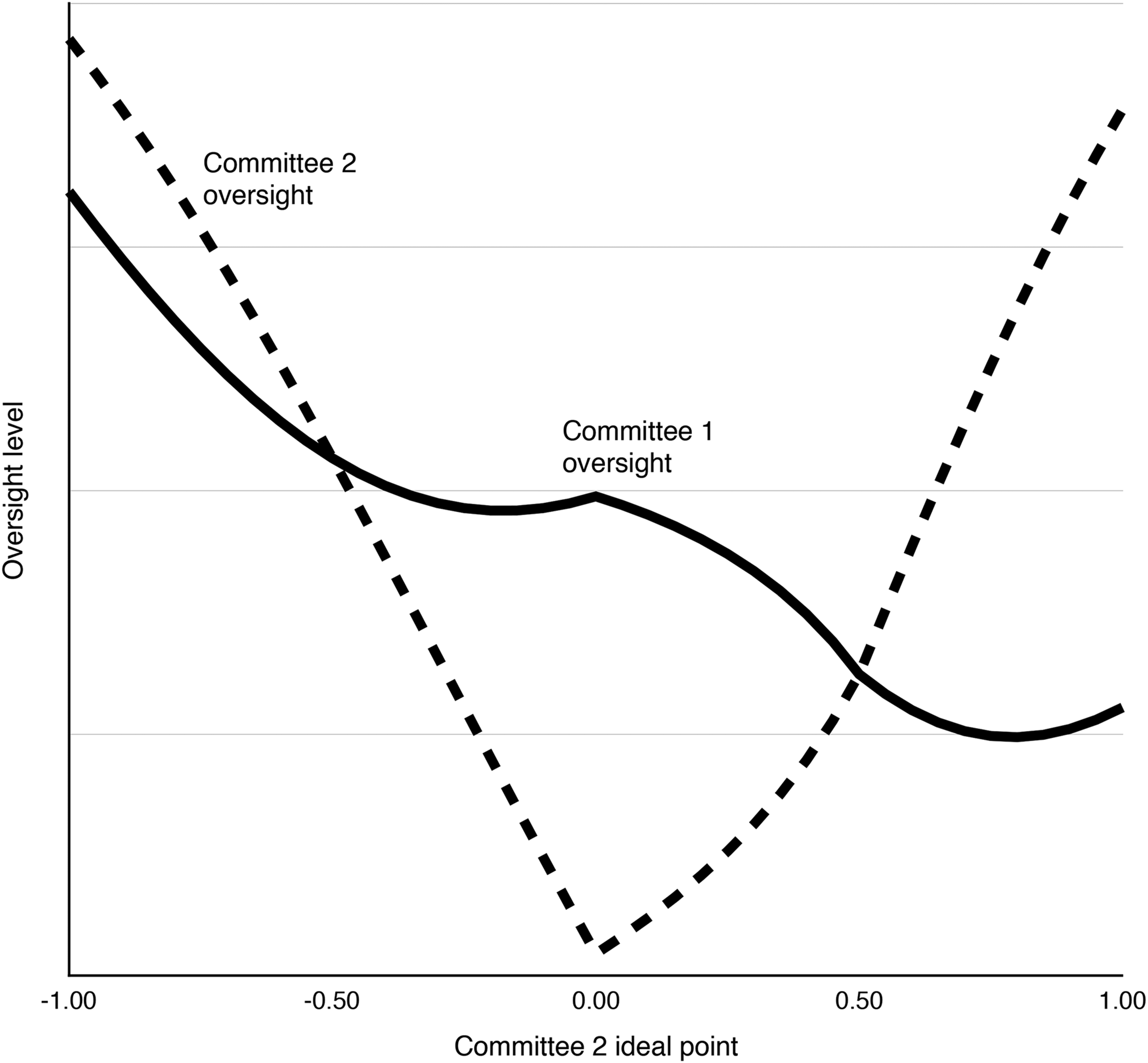
Oversight levels by committee. Assumes
In all cases, committee
The effect of the other committee’s ideal point
Strategic incentives vs. collective interest
How do the strategic incentives delineated above compare to the collective interest of Congress? We address this by identifying the optimal oversight levels assuming that a pan-congressional planner directs each committee’s oversight, with equal weight on each committee’s utility. This is a decidedly narrow take on Congress’s “collective interest,” but already broad enough to reveal problems. Incorporating the interests of additional members besides those on oversight committees would not alleviate these problems, as will become clear.
Suppose that the normative standard of Congress as a whole is captured by a single representative legislator with ideal point



On the other hand, when
The collectively optimal level of oversight for each committee (solving equation 7 for

Comparing equilibrium and collectively optimal oversight (equations 4 and 8) yields:
For flanking committees
In the flanking case,
In the stacked case,
The problem stems from the decentralized structure of Congress. Given that structure, any ideological configuration among committees and agencies leads to one collective action problem or another. Moreover, given decentralization across chambers, it is not the case that greater centralization within a single chamber will necessarily alleviate the problem. For instance, given autonomous Senate committees, the collective inefficiency of oversight may be either greater or smaller when all House oversight is coordinated by the leadership.
Conclusion
This article considers incentives for oversight of the executive branch by multiple, decentralized congressional committees. We develop a formal model to provide a strategic rationale for “dueling oversight,” in which ideologically opposed committees use oversight in an “arms race” to neutralize each others’ influence on executive branch policy making and implementation. The model shows how both dueling oversight, and the opposite case of sluggish committee oversight, emerge from the same underlying strategic forces.
In addition, the model shows that decentralized oversight among multiple committees across chambers essentially always creates a collective action problem of some sort for the oversight committees as a group. When committees have competing policy goals with regard to an agency, they use oversight to counteract each other’s influence. The benefits of oversight (relative to everything else a committee can be working on) increase for each committee as the other committee invests in oversight. This is because each committee seeks to “undo” the influence of the other committee’s oversight efforts. In equilibrium, the competing committees conduct a lot of oversight but with little or no effect on policy outcomes. As we have noted, this matches the empirical finding in Clinton et al. (2014).
On the other hand, when committees have shared policy goals with regard to an agency, neither considers the benefit of its oversight for the other committee and committee efforts at oversight are too low in equilibrium. This is because committees each prefer to free ride on the oversight efforts of the other committee, reserving their time and other resources for other non-oversight activities. This follows the logic of a collective action problem and is similar to the one noted by Gailmard (2009).
With some modifications, the model developed here can apply to oversight by multiple principals across branches of government, for example by Congress and the president. Similar issues to those examined here, but different from those in other models of congressional and presidential oversight of the bureaucracy, arise when oversight is conducted by different branches with competing or aligned policy goals. With this modification, a committee’s optimal level of oversight would depend on its ideological conflict with the president and on its ideological conflict with the agency, weighted by how much oversight the president is doing.
This extension could apply, for example, to congressional committee oversight and oversight by the president’s Office of Information and Regulatory Affairs (OIRA). Unlike the model of OIRA oversight in Wiseman (2009), our model always entails the agency proposing its ideal policy because oversight does not depend on the agency’s proposed policy but the policy outcome does. Moreover, in our model, a congressional committee would benefit from OIRA review when the committee and OIRA were aligned (and in fact could find themselves faced with a collective action problem) and would find itself needing to conduct more oversight to “undo” the effects of OIRA review when the two disagreed about agency policy.
The model could be extended to consider the interests of additional members besides those on the oversight committees in how the “collective interest” of Congress is determined. This would further illuminate the answer to the question of how the strategic incentives of oversight committees compare to the collective interest of Congress. Moreover, the model could be extended to consider the interests of the majority party in how the “collective interest” is determined.
Finally, the model could be tested empirically on oversight committees across chambers of bicameral legislatures with overlapping oversight jurisdiction. The model could also be tested empirically on oversight committees within the same chamber with overlapping jurisdiction. The key feature of any application is to have multiple committees with shared oversight jurisdiction that can have common or differing preferences over policy.
Footnotes
Acknowledgments
The authors thank participants at the University of California, Berkeley Research Workshop in American Politics, the 2014 Political Economy and Public Law Conference at the University of Rochester, and the 2013 American Political Science Association Annual Meeting for their helpful feedback. All errors and omissions are our own.
Declaration of conflicting interests
The authors declared no potential conflicts of interest with respect to the research, authorship, and/or publication of this article.
Funding
The authors received no financial support for the research, authorship and/or publication of this article.
