




Abstract
We consider a Gellnerian model to study the transformation of a two-region state into a nation state. Industrialization requires the elites to finance schooling. The implementation of statewide education generates a common national identity, which enables cross-regional production, while regional education does not. We show that statewide education is chosen when cross-regional production opportunities and productivity are high, especially when the same elite holds power at both geographical levels. By contrast, a dominant regional elite might prefer regional schooling, even at the loss of large cross-regional production opportunities if it is statewide dominated. The model is consistent with evidence for five European countries in 1860–1920.
1. Introduction
How does a state turn into a nation state? According to Gellner (1964, 2006), the transition results from the implementation of a mass education system to get workers ready for industrialization. Because workers, through schooling, acquire a common national identity that enables them to communicate with each other, they also become mobile, which enhances the production potential of the economy. Historically, however, not every state becomes a nation state, as nation building at the state level can fail and give rise to stateless or peripheral nations, such as Quebec, Scotland, Catalonia or Flanders (see, e.g., Keating, 1993, or Laitin, 1989).
To understand nation building success or failure, our paper presents a Gellnerian model in which the transformation of a state into a nation state, or instead the emergence of a peripheral nation, is modelled as an equilibrium outcome stemming from the interaction among elites in the decision to set up a schooling system.
To this purpose, we model a state composed of two regions characterized by an initial degree of heterogeneity 1 or imperfect market integration. The state is populated by masses and by two elite groups (landowners and bourgeoisie), with both masses and landowners evenly split across regions, but bourgeois over-represented in one region. Political power is in the hands of one of the elite groups, referred to as the ‘dominant group’, which is not necessarily the same at the regional and state levels. Value is created through bilateral production between the members of the elites and the members of the masses. Initially, the state is pre-industrial and production takes place only within each region.
The economy is hit by a productivity shock representing an industrialization opportunity, which can only be exploited if the elites decide to finance the set-up of a schooling system. If this is the case, the masses attending school become more productive, and particularly so in the matches with the bourgeois. 2
In addition to raising productivity, schools generate a national identity. 3 If the statewide dominant elite implements schooling in both regions (a ‘unified schooling’ system), this creates a common identity to both regions, which enables the bourgeois to produce with the masses of the other region, and this to an extent determined by the degree of market integration. Alternatively, if a regionally dominant elite implements schooling for a region alone without sharing the associated costs and benefits with the wider state-level elites, no common cross-regional identity is created, cross-regional production remains infeasible and a peripheral nation arises. In both cases, the dominant group decides on how the school set-up cost is shared with the dominated elite at the relevant geographical level – but the dominant group cannot force the dominated to make payments that leave them worse off than under no education.
We first characterize equilibrium education levels and show that education is implemented for sufficiently large industrialization shocks, with a larger share of the investment being paid by the dominated group as the industrialization opportunity becomes better. The identity of the dominant group does also matter, and equilibrium education is shown to be higher when bourgeois dominate, since they benefit more from industrialization than landowners. Specifically, for relatively low industrialization shocks, dominant bourgeois might choose to fully finance education even if this makes the dominated landowners worse off, while instead in a similar situation dominant landowners are not willing to implement education.
As for the choice of the schooling system, unified schooling is always (weakly) preferred at equilibrium whenever the dominant group is the same at the regional and state levels, and market integration and/or productivity are sufficiently high. This result stems from the technological advantage given to unified schooling. Specifically, a dominant bourgeoisie prefers this system because it can directly benefit from a large number of cross-regional matches, while dominant landowners also favour it because the bourgeois are willing to pay a larger share of the schooling cost under this system.
However, if both market integration and the industrialization shock are low, the gains from cross-regional production stemming from the unified system become much smaller, and then the dominant bourgeois from the bourgeois-abundant region prefer regional schooling because the greater number of bourgeois in that region reduces the per-capita set-up cost of education. Similarly, if dominant, the landowners from that region will choose regional schooling, this time because bourgeois are more willing to implement education in that region or more willing to pay than under unified schooling.
In addition, we show that regionally and statewide dominant elites never choose to implement regional schooling in the bourgeois-scarce region, as this would entail the double disadvantage of a loss of (however small) cross-regional production and a greater per-capita set-up cost of education.
When the regionally dominant elite does not control power at the state level, its incentives to choose regional schooling become greater, simply because more costs can be transferred to the other elite at that level. Specifically, regionally dominant but statewide dominated landowners always support regional schooling when feasible. For them, indeed, being dominated under a unified system is particularly dangerous as the large gains that bourgeois might enjoy under that system can result in the bourgeois fully financing schooling and making them worse off than under no schooling.
Regionally dominant but statewide dominated bourgeois will still choose unified schooling when the cross-regional production gains are large, i.e., when both the industrialization shock and market integration are large, as in that case it is still profitable to get a smaller share of a much bigger cake. At the same time, bourgeois-led regional schooling can still arise in situations in which cross-regional production gains are very large and market integration is perfect: indeed, if the productivity gain from the masses’ education is much smaller for landowners, statewide dominant landowners will choose not to implement unified schooling even if the bourgeois are willing to fully pay for it, leaving regional education as the best (and only) option for the bourgeois.
We also show that the regionally dominant but countrywide dominated bourgeois of the bourgeois-scarce region may have an incentive to implement regional education, as the greater per-capita costs can be compensated for by a larger part of the total cost being transferred to landowners. This equilibrium outcome can be related to Gellner’s famous example of the creation of a national identity in backward Ruritania (Gellner, 2006).
Finally, we relate our model to the educational choices for 1860–1920 of five European countries characterized by different power configurations within the elites and different nation building outcomes. To this purpose, we first draw on the history literature 4 to determine for each of these countries the identity of the dominant group or groups, the characteristics of their educational choices and their main nation building outcomes. Next, using historical data for these countries on the size of their railway networks (Martí-Henneberg, 2013) and their gross domestic product (GDP) per capita (Maddison, 2003) as proxies for, respectively, market integration and the industrialization shock, we show that the observed educational choices are compatible with the model along different dimensions. In particular, a lack of implementation of education occurs for a small railway network and a low GDP per capita, while, conversely, large networks and high GDP per capita are associated with the choice of unified schooling.
Our paper contributes to the existing literature in two ways. First, we propose (to the best of our knowledge) the first modelling of a nation building process à la Gellner, 5 and do so by explicitly incorporating the role of elites following Breuilly’s critique (Breuilly, 1993) of Gellner’s theory and other nation building theories underlining the importance of the interaction between central and peripheral elites (see, in particular, Kroneberg and Wimmer, 2012, and Roeder, 2007). Second, we provide a theoretical framework for understanding the endogenous emergence of peripheral vs. statewide nations and link it to the existing historical evidence for five European countries characterized by different power configurations.
The remainder of the paper is organized as follows. In Section 2, we develop the basic model and describe when unified schooling and regional schooling are implementable. In turn, in Section 3 we analyse the choice of education system by the elites; finally, in Section 4, we relate our model to the historical evidence for five European countries. Section 5 concludes the paper. Most proofs are relegated to an appendix.
2. The model
Consider a pre-industrial state with two regions
Value is created through bilateral production between members of the elites and members of the masses. Initially, production takes place only within each region and the surplus from each match is normalized to 1. The bargaining power of the masses is given by
There are two periods in our model, with production taking place in each of them. Let

2.1. Schooling
This rural society is now hit by a productivity shock representing an industrial revolution. If the new technology is implemented, the match productivity in the agrarian sector (landowner-masses) increases to
The set-up of the schooling system requires a total investment by the elites equal to the number of students attending school. In the first period, the productivity shock is observed and the schooling decision is made. If schooling is implemented, production takes place only in the second period. If schooling is not implemented, production takes place in both periods but the match productivity stays equal to one.
Two possible ways of organizing the schooling system can be chosen by the dominant elites. Specifically, the dominant elite at the state level may promote the implementation of schooling in both regions (‘unified education’, denoted by U), which generates a common national identity in the two regions and, for this reason, the possibility of inter-regional production matches for the bourgeoisie. The extent to which inter-regional production is possible depends on the existing level of integration of the regions. After the implementation of unified schooling, the state becomes a nation state. Alternatively, a dominant regional elite may promote the implementation of schooling in that region alone and organize its funding at the regional level (referred to as region-i schooling, and denoted by
We denote by
2.1.1. Unified schooling
Under the unified system, any bourgeois pays

The landowner’s payoff depends on his own investment

2.1.2. Region-i schooling
The region-i dominant elite might have incentives to finance schooling in its own region without the elites from the other region paying or benefitting from education. As no common identity is created across regions, cross-regional production cannot take place.
The region-i bourgeoisie’s payoff is, in that case

i.e., each region-i bourgeois invests

2.2. Education thresholds of the elites
A member of elite e will be willing to make a payment

As, from equations (2) to (5), the payoff
Assume that the politically dominant elite can impose an education payment on the dominated elite as long as the dominated elite does not become worse off than under no education after making such a payment. If productivity is very high, dominated elite members might be better off than under no education even if they fully pay for education, i.e., even if each of them pays
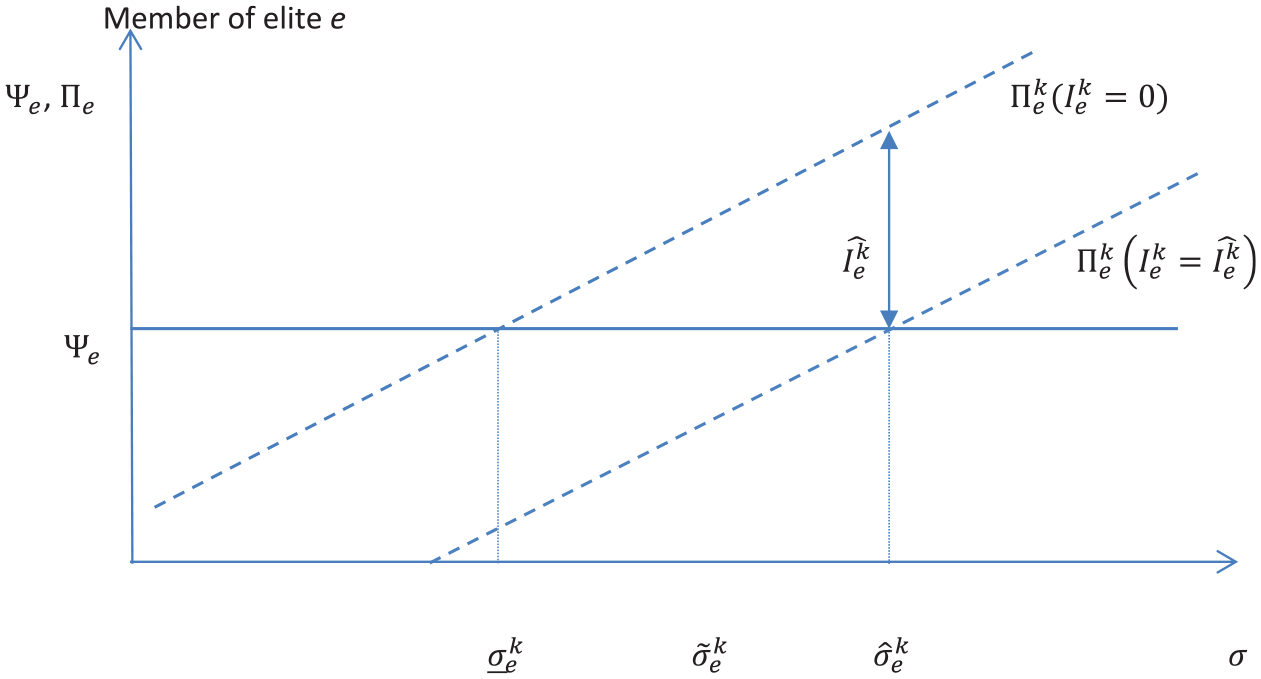
Threshold productivity levels for the elite.
Across elite groups, and for a given size of the cost, it is easy to show that the bourgeois choose to invest in education for lower productivity levels than the landowners, which simply comes from their greater interest in the masses’ education. Note, however, that the relevant cost for an individual is the per-capita cost; thus, the size of the elite groups is a relevant variable too. Lemma 1 characterizes the ranking of the thresholds, while the full expressions for the thresholds and the payments are available in Table 1.
Productivity thresholds.
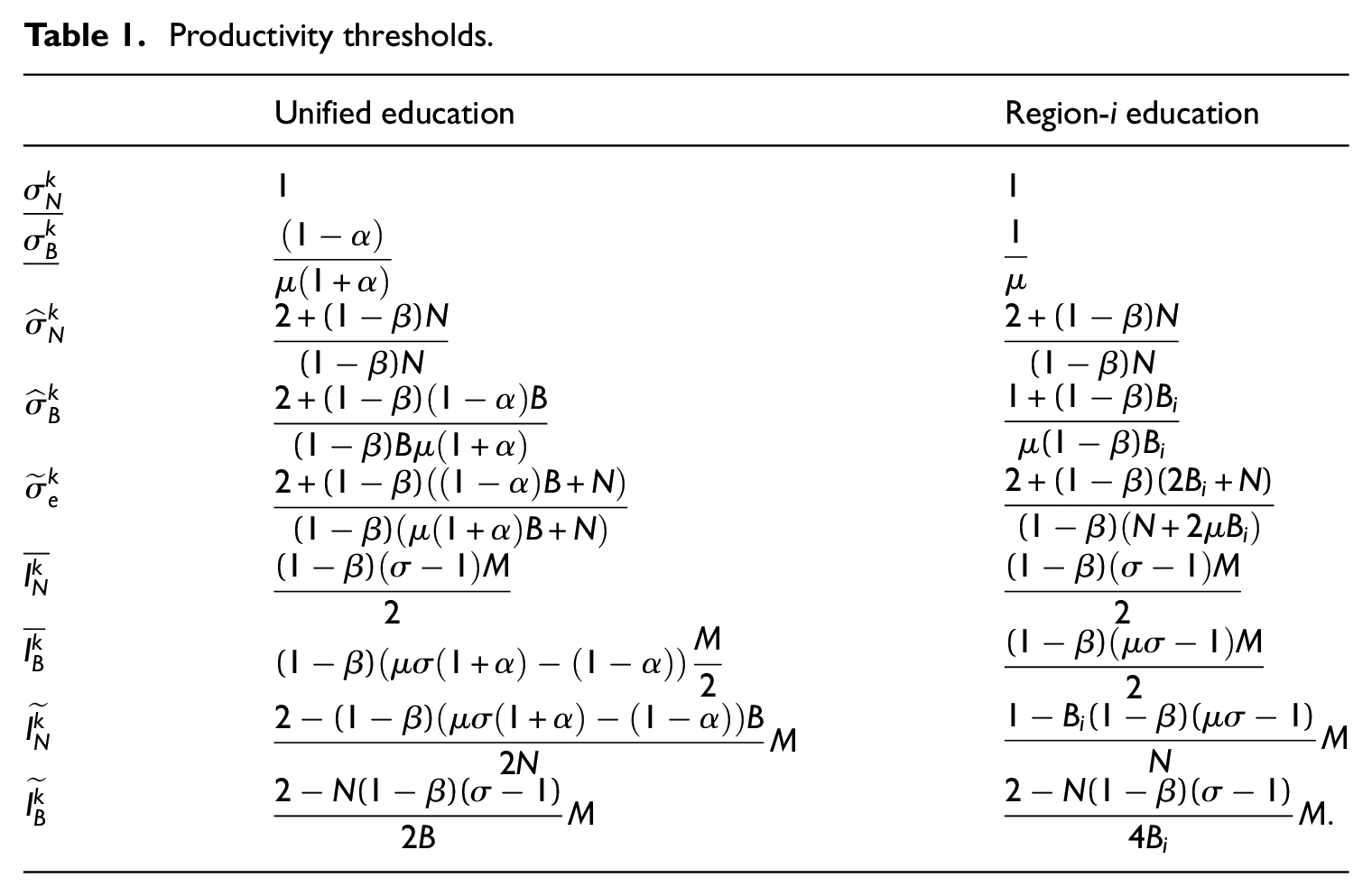
The attractiveness of schooling for the bourgeoisie relative to the landowners is particularly high when (i)
2.3. Equilibrium education
We are now in a position to study the decision on provision and financing of education by the elites for a given education system k.
2.3.1. Bourgeoisie dominant
Figure 2 represents, with a continuous line, the equilibrium outcome for the provision and financing of education when the bourgeoisie is dominant and
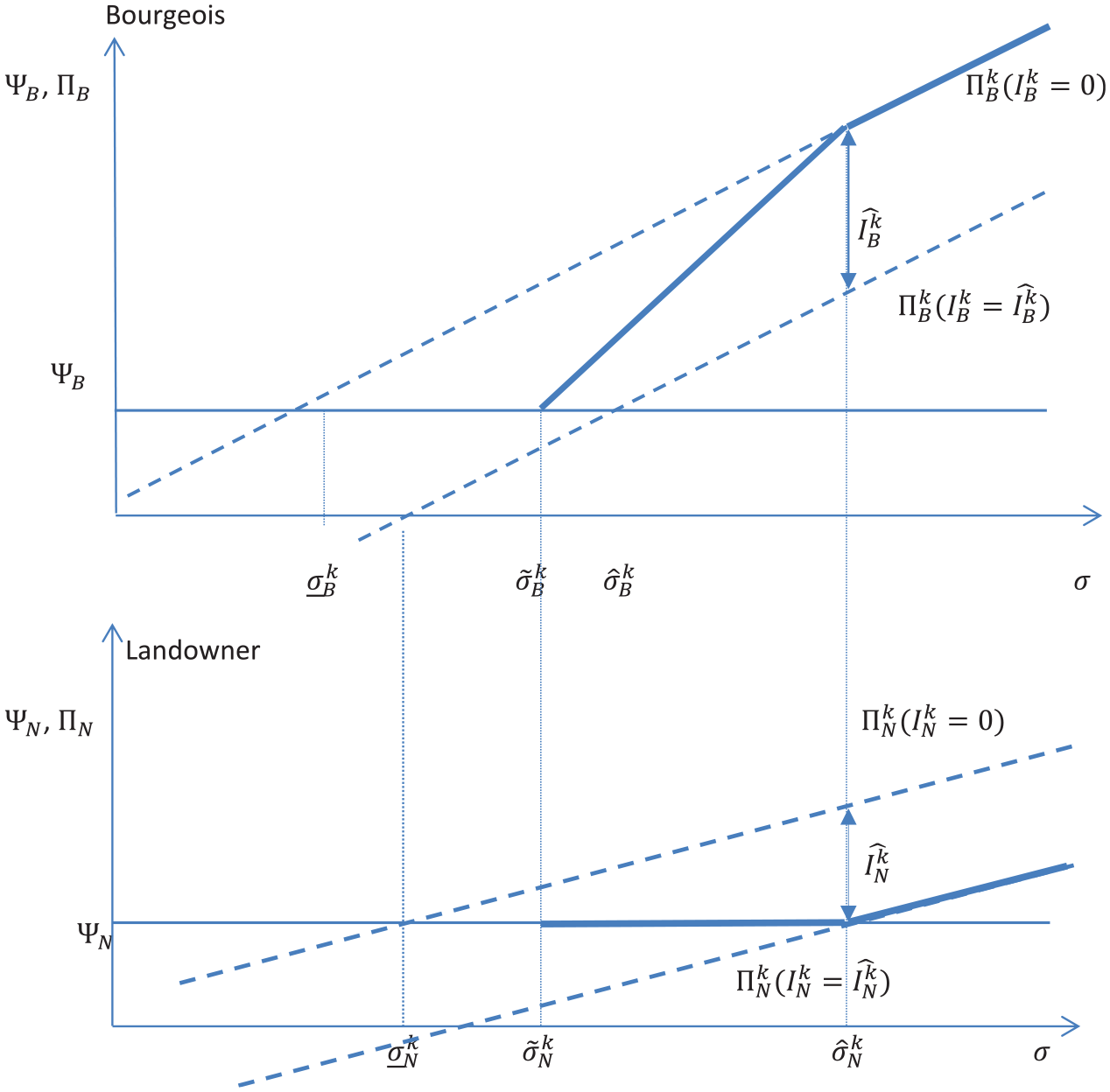
Bourgeoisie dominant and
In turn, Figure 3 represents the outcome for
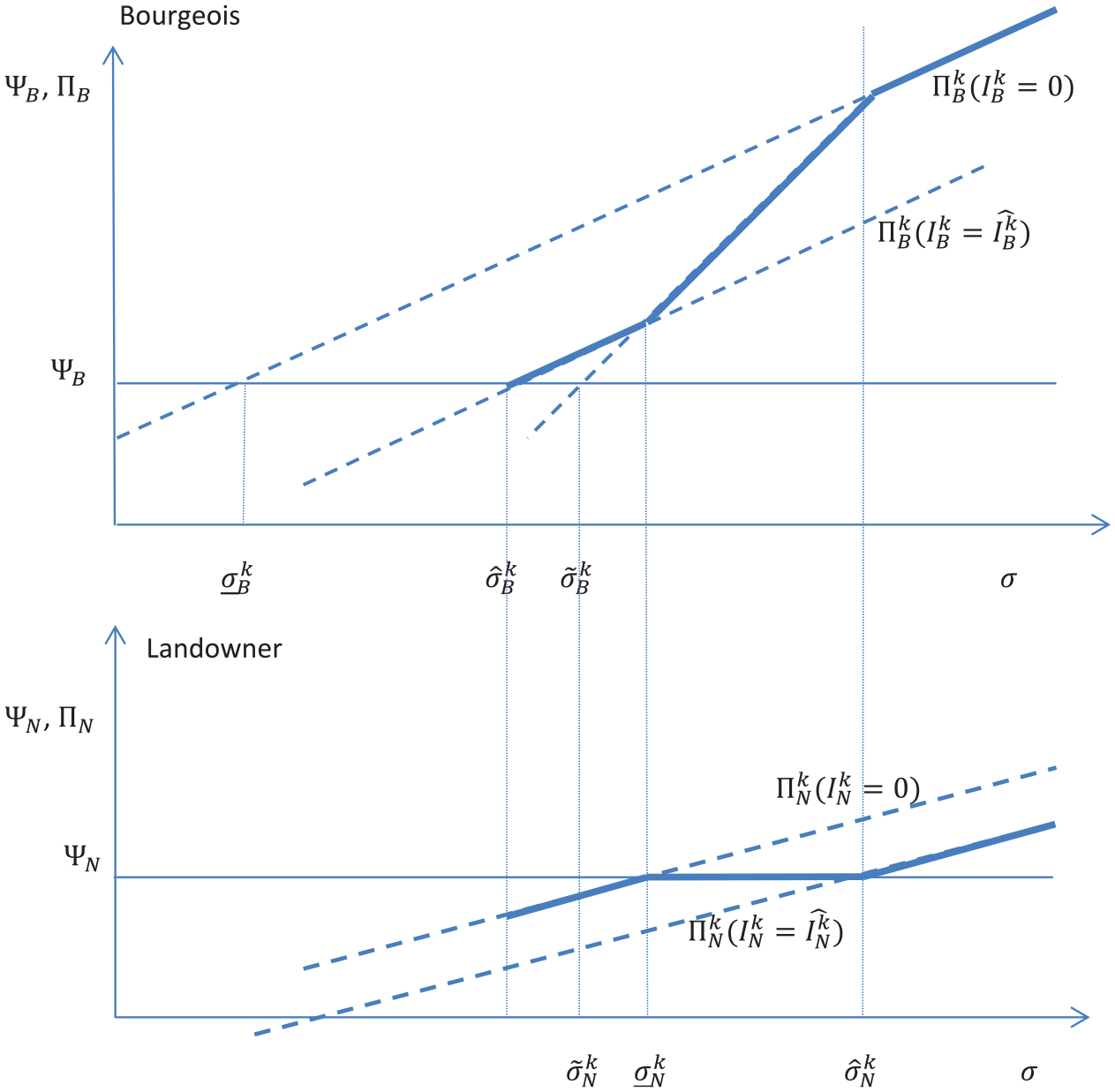
Bourgeoisie dominant and
2.3.2. Landowners dominant
Figure 4 represents the case where the landowners are dominant and
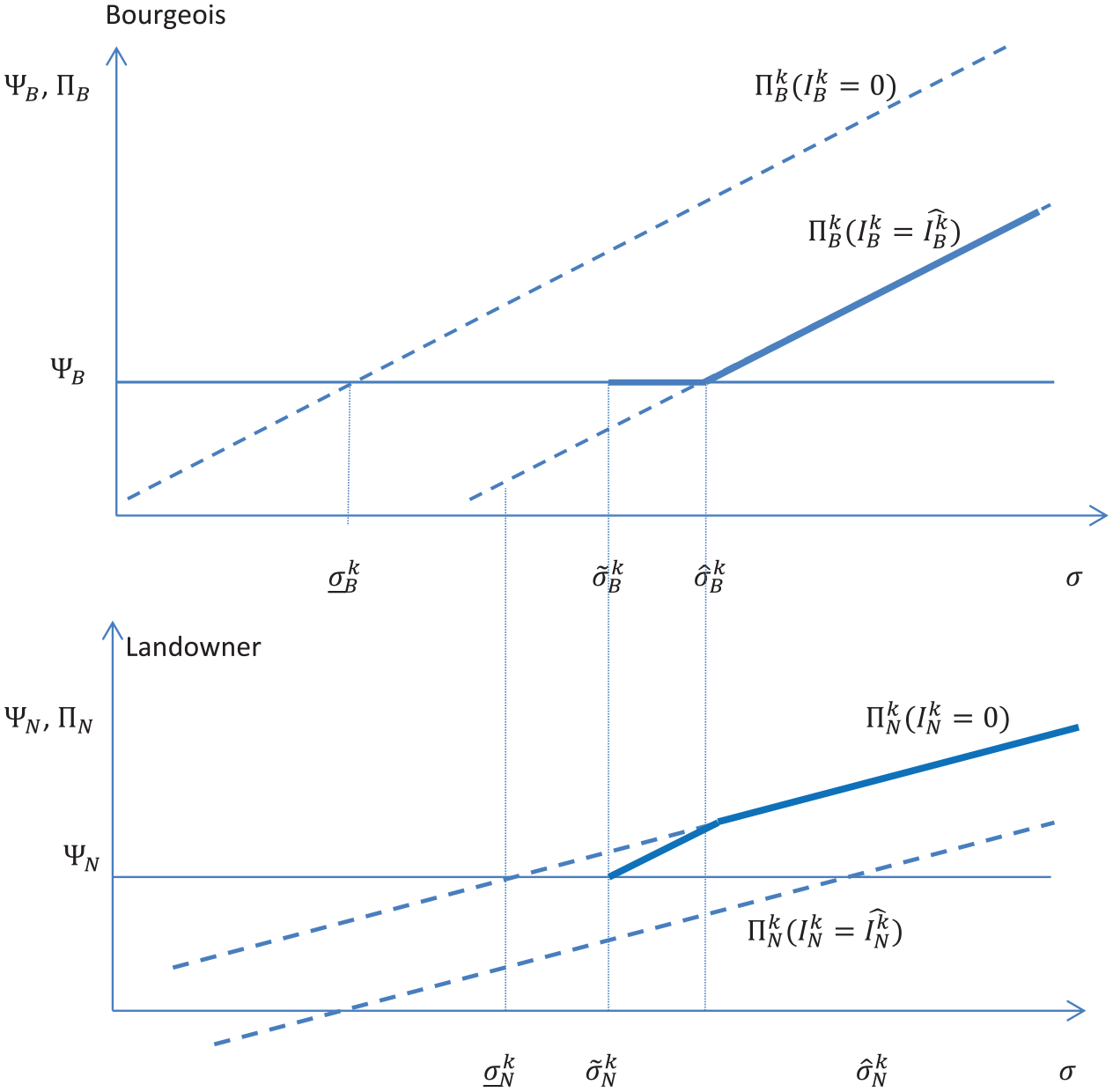
Landowners dominant and
2.4. Landowners’ vs. bourgeois’ dominance
Proposition 1 compares the provision of education, depending on the identity of the dominant group.
For
By contrast, for
The analysis so far has taken the potential educational system as given. However, the elites choose the education system depending on their political power and the resulting benefits.
3. The choice of education system
Each elite member prefers the education system that yields the highest benefits. Combining equations (3) and (5), we obtain that landowners prefer regional schooling to unified schooling whenever

i.e., landowners will simply go for the cheapest system in terms of their schooling set-up costs, because they do not benefit from the extra cross-regional matches generated under unified schooling. This implies in particular that if they are to finance education fully under both systems, they will be indifferent between the two schooling systems as region-i schooling halves the number of mass members to be educated but also the number of landowners financing education, i.e.,
Instead, compared with unified schooling, regional schooling restricts the number of matches for the bourgeois, and especially so if market integration

It is easy to see that for
Clearly, as the costs of education are crucial and these costs partly depend on the identity of the dominant group, the preferences of each elite group over these two systems may depend on the power they can exert at the regional or state level. 9 Section 3.1 characterizes the choice of system when the bourgeois are in full control in the sense that they are politically dominant at the state level and also in each region. Similarly, Section 3.2 considers a situation in which landowners are always dominant. Finally, Sections 3.3 and 3.4 consider two situations in which the statewide dominant elite fails to dominate in one region.
3.1. Bourgeoisie always dominant
Consider first a situation in which the bourgeoisie is dominant in both regions, and thus also statewide dominant. For that case, the following proposition can be stated (see Appendix B.2. for the specific thresholds).
The bourgeoisie is willing to choose a regional organization of education over the unified system only if regional schooling generates cost savings that are able to compensate the lack of cross-regional production. As the bourgeoisie is countrywide dominant and thus in a good position to make landowners pay as much as possible for unified schooling, the choice of regional schooling can only come from a larger size of the bourgeoisie that would alleviate the per-capita cost of regional schooling. Clearly, as the bourgeoisie is smaller in region 2, region-2 schooling is actually always more expensive in per-capita terms than unified schooling and, as a result, region-2 schooling is never chosen.
Instead, region-1 schooling is a potential candidate; Figure 5 illustrates the second part of the proposition for
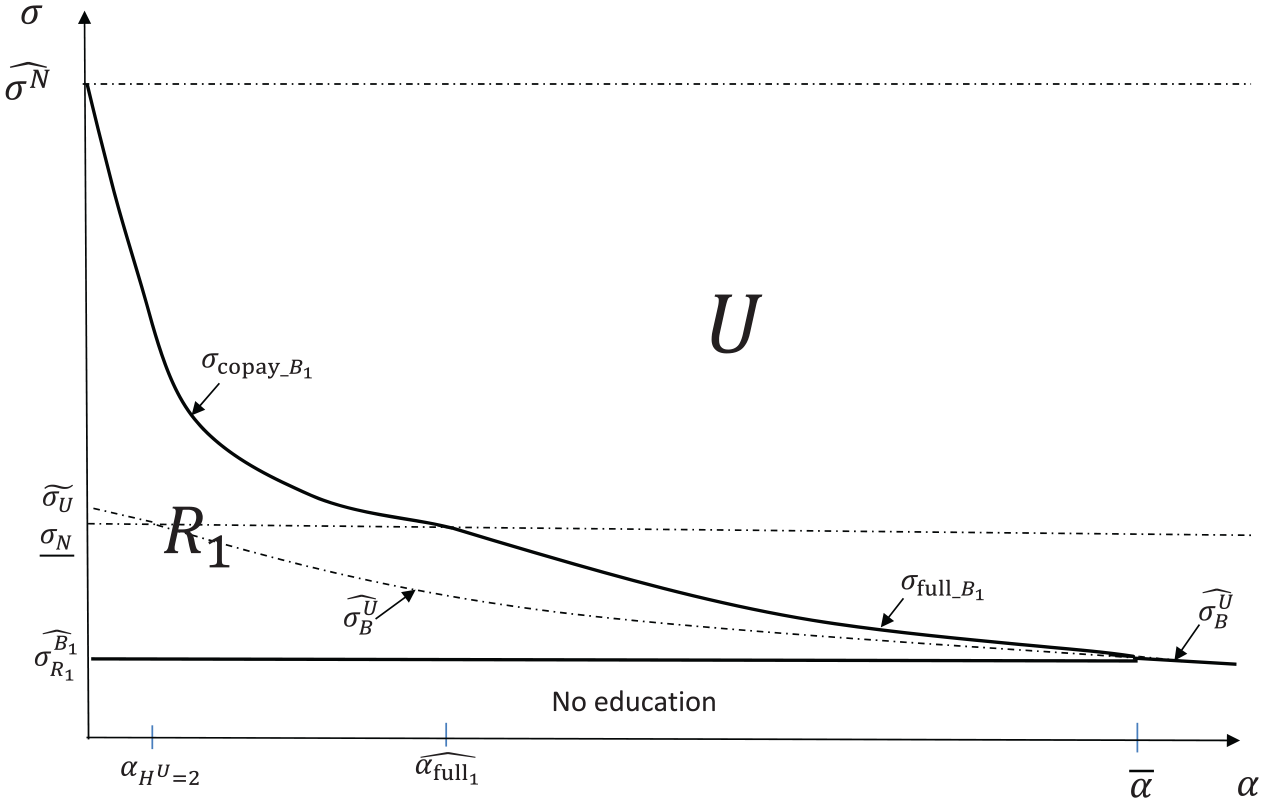
Bourgeoisie always dominant (
Clearly, the implementation of schooling only in region-1 results in the region-2 bourgeoisie retaining the no-education payoff. If region-1 schooling is the only feasible system, the region-2 bourgeoisie will be indifferent between implementing schooling in the other region or not. Instead, if unified schooling is implementable, an outcome better than no education is potentially attainable to them; thus, region-2 bourgeois will oppose region-1 schooling if this is the case. In turn, dominated landowners end up paying an identical amount for education under both systems whenever
3.2. Landowners always dominant
Consider next a situation in which the landowners are in full control. As the payoff from schooling to landowners is the same under both systems, dominant landowners simply choose the system that allows them to transfer a larger share of the cost of schooling to the bourgeois. The following proposition holds.
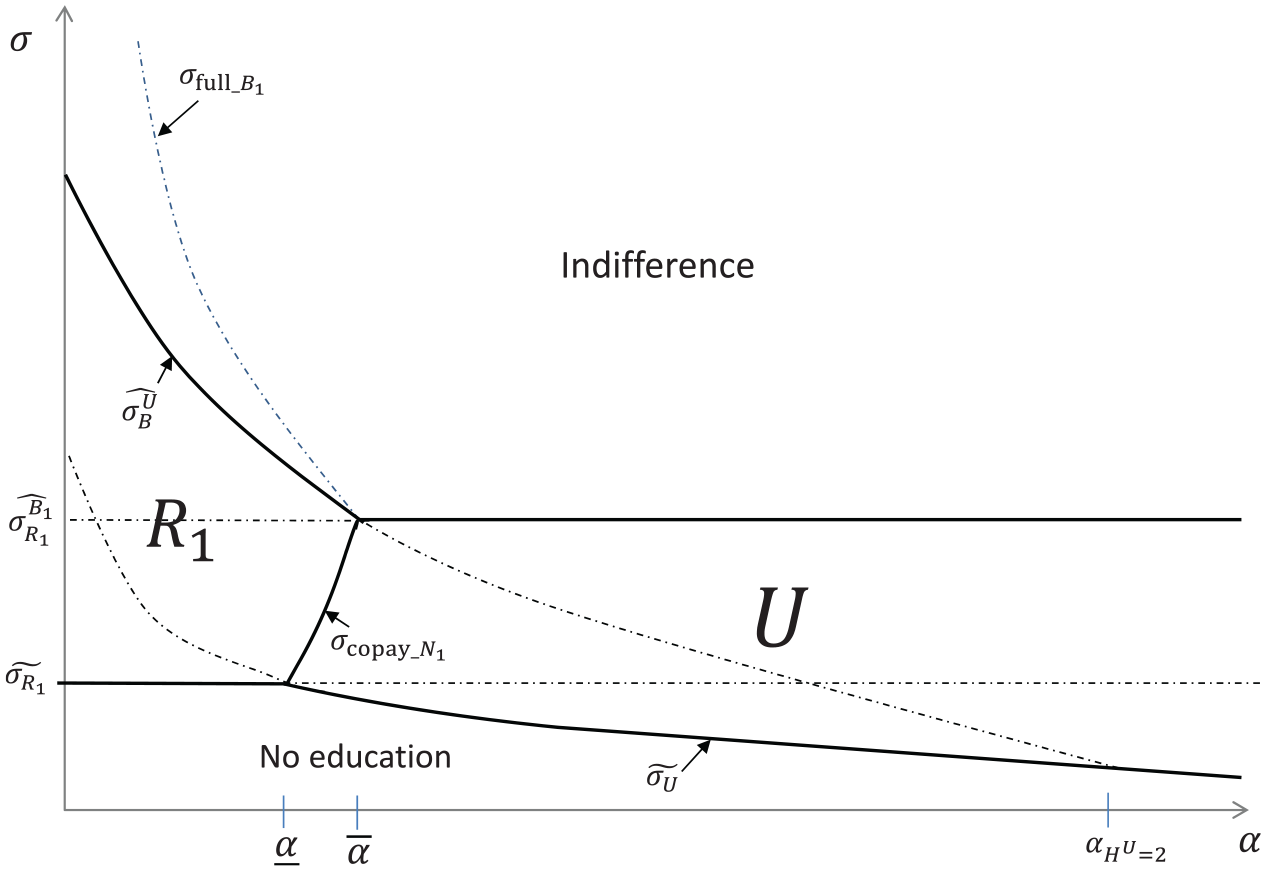
Landowners always dominant (
Landowners do not benefit directly from cross-regional matches under the unified system, but can benefit indirectly, as bourgeois are more willing to pay for education in that case. Regional schooling becomes attractive in turn when the lower per-capita cost for the bourgeois makes them willing to pay more for regional education, which translates in savings for the landowners. However, this is not possible for region-2 schooling, owing to the small size of its bourgeoisie, and as a result dominant landowners never choose region-2 schooling.
Instead, region-1 schooling might be chosen by landowners, as bourgeois may be willing to pay more for education under that system. Consider Figure 6, where
Proposition 8 in Appendix B.2.2 studies the preferences of bourgeois and region-2 landowners over the two systems. The dominated bourgeois are shown to share the same preferences as the landowners, except for
3.3. Region-i dominant but statewide dominated bourgeoisie
Consider next a situation in which the landowners are dominant at the state level but the bourgeoisie is dominant in region i, which implies in turn that the landowners are dominant in region
Consider first the tradeoff facing a region-i bourgeois: on the one hand, by implementing region i schooling, the region-i bourgeois can shift educational costs to the landowners while they bear most of the costs under unified schooling as they are dominated by the landowners under that system. On the other hand, if unified schooling can be implemented, region-i schooling leads to the loss of valuable match partners in region
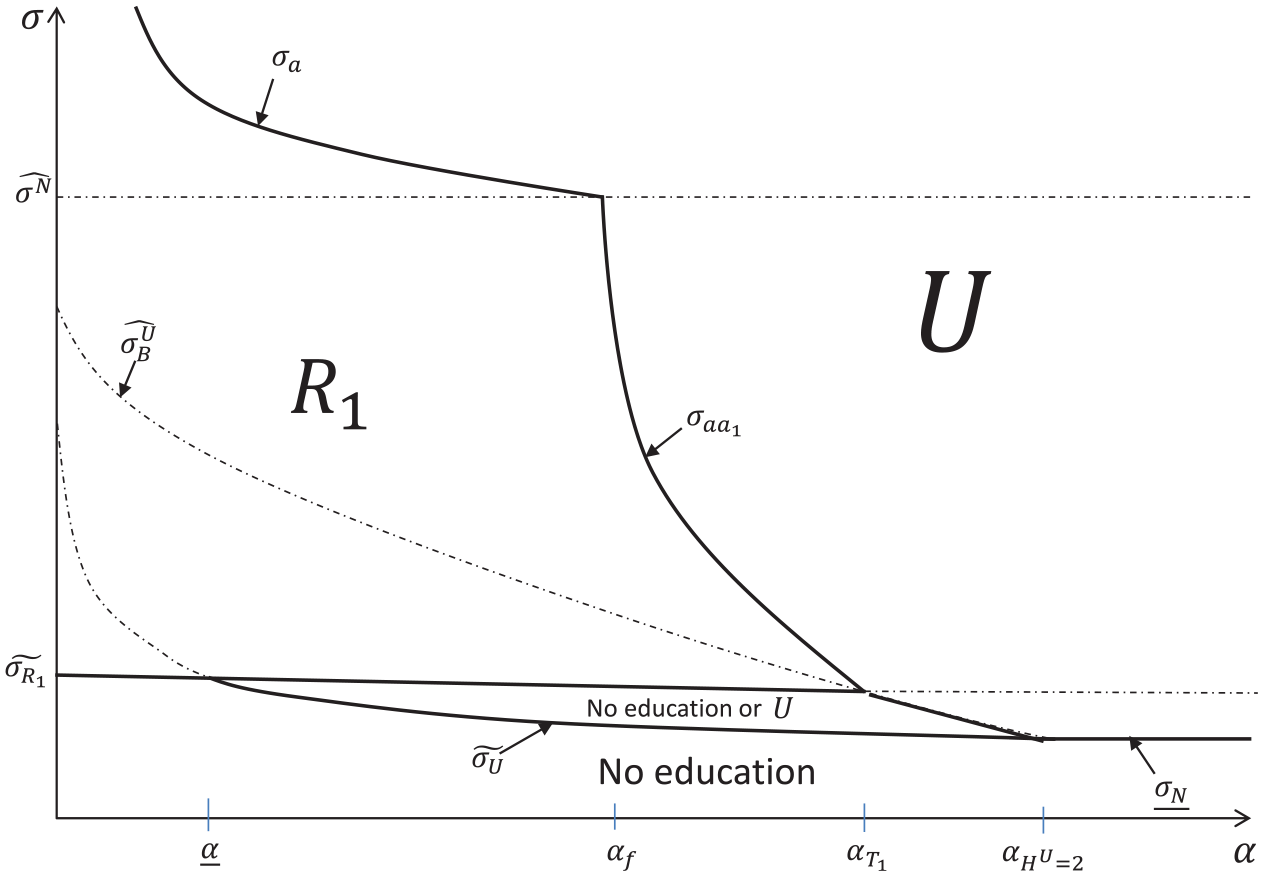
Region-1-dominant but statewide dominated bourgeois (
Consider the case where
Unlike in the two cases where the same elite exerts power regionally and countrywide, region-2 schooling is now an equilibrium outcome: indeed, while the two disadvantages from region-2 schooling – i.e., the loss of cross-regional production and the high per-capita cost of education – are still present, these can be now overcome by the shift in the balance of power in favour of the bourgeoisie at region-2 level (see Figures 11 and TA4). As region-2 is bourgeois-scarce, it can be considered relatively backward and related to Gellner’s (2006) Ruritania. Interestingly, as in Gellner’s discussion, Ruritanian nationalism is more likely in the presence of some prior ‘barrier to communication’ or heterogeneity between the two regions.
While region-i bourgeois prefer, in some cases, the implementation of region-i schooling, Proposition 9 in Appendix B.3 shows that statewide dominant landowners never prefer region-i schooling to unified schooling and, in most cases, actually oppose it.
3.4. Region-i dominant but statewide dominated landowners
Since landowners do not benefit from regional mobility, they prefer region-i education whenever their educational costs are lower under this system. Proposition 5 shows this to be the case for regionally dominant but statewide dominated landowners.
Landowners prefer regional schooling because they are the dominant group under that system, which implies that they can shift (part of) the educational costs to the bourgeoisie and hence implement schooling, paying less than they would under the unified system, where they are the main bearers of the educational cost. When unified schooling is the only implementable system, this system leaves them either indifferent or worse off than under no education, so they never strictly prefer it. Proposition 6 shows that attempts by region-i landowners to implement region-i education will be opposed by the bourgeois except when the region in question is region 1 and both market integration and productivity are low enough.
While the statewide dominant bourgeoisie generally prefers unified schooling, if both productivity and market integration are low enough, it might prefer to be dominated under region-1 schooling, given the lower per-capita costs of schooling. As for the landowners from the other region, who are both regionally and statewide dominated, we know from Proposition 7 that they will be indifferent unless one system can be implemented and fully financed by the bourgeoisie, in which case they will prefer the other one (if viable) or no education.
3.5. Choice of system and dominant group
When and how does the choice of the system depend on the identity of the dominant group? Figure 8 provides the answer for the choice between region-1 and unified schooling for
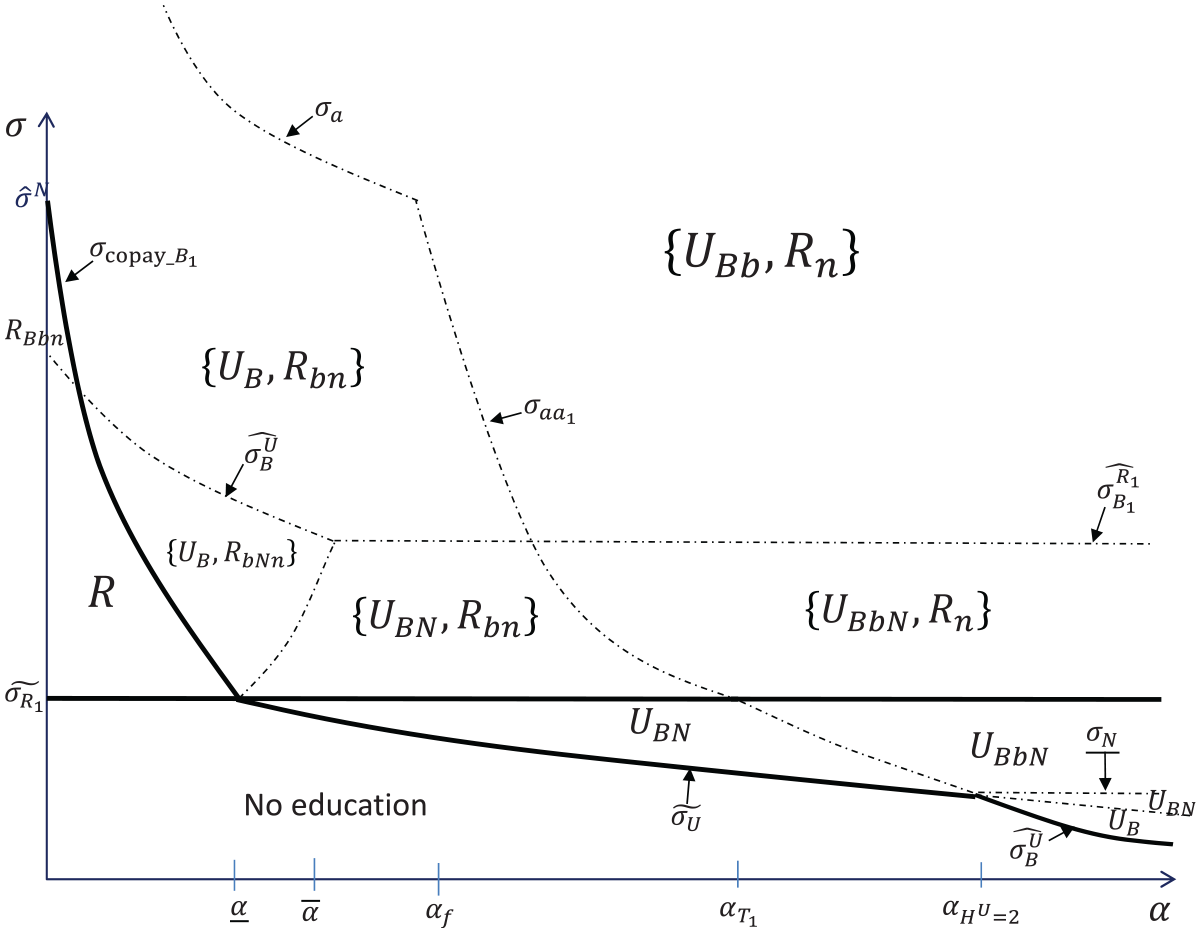
Choice of the system depending on the dominant group (
Independently of the politically dominant group, no education system is set up for sufficiently low productivity shocks. For higher productivity but small market integration (
4. Historical evidence
This section studies, for 1870–1920, the educational choices and nation building outcomes of five European countries with different power configurations among their elites. To this purpose, we first present each country separately and then discuss their outcomes in the light of our model using the development of railways as a proxy for market integration and GDP per capita as a proxy for the industrialization shock.
4.1. France
In mid-nineteenth century France, most of the industries were concentrated in the north-east, north of the ‘St-Malo-Geneva’ line (see, e.g., Weber, 1976). Price (2004) argues that the grande bourgeoisie was dominant in French politics since 1830, and this domination seems to apply both to the north-east, where the industrial bourgeoisie was mostly located, and to the rest of the country, with the increasing role in the implementation of the 1870–1914 reforms of the Radical Party, which represented petty bourgeois groups (Magraw, 1983).
The Ferry laws in the 1880s instituted free schooling throughout France, with French becoming the only language of instruction. After this reform, in 1910, individuals aged 15 or over had an average of 6.99 years of education (Morrisson and Murtin, 2009), the second highest level in Europe after Switzerland. As argued by Weber (1976), this reform also led to the spread of the French language and the French identity throughout the country.
Politically, France is often used as a benchmark of successful nation building (see, e.g., Kroneberg and Wimmer, 2012) and the success (or even the existence) of regionalist or nationalist parties in Alsace, Brittany, Corsica or the French parts of the Basque Country or Catalonia has been very limited. For instance, in the first round of the April 1928 French legislative elections, regionalist candidates were only present in Alsace and obtained 15.9% of the votes (see Lachapelle, 1928).
In terms of our model, this reform thus corresponds to the implementation of unified schooling by a state- and regionwide dominant bourgeoisie.
4.2. Spain
In Spain, the first industries (mainly textiles) were mostly concentrated in Catalonia and in the Basque Country (Tortella, 2000). According to Linz (1975), the Catalan bourgeoisie was unable to gain power at the Spanish state level and thus aimed instead at securing power at the regional level, building up support on the basis of cultural nationalism. Thus, while the bourgeoisie was dominant in Catalonia and the Basque Country (Linz, 1974), at the Spanish-wide level, it was ‘the agrarian and financial interests of central and southern Spain who made up the political oligarchy’ (Harrison, 1976, p. 902).
The development of the education system was limited, with an average of 4.63 years of education in 1910 (Morrisson and Furtin, 2009). At the same time, Vilanova and Moreno (1992) show that in the period 1887–1920, the illiteracy rate fell much more quickly in Catalonia (from 60% to 29%) than in Spain as a whole (from 65% to 44%). According to Balcells (2013, p. 478), this differential evolution in the development of schooling was partly the result of political choice at the Catalan level 15 and ‘[these schools] socialized a first generation of literate citizens with values of either suspicion against the Spanish state or love for the Catalan nation.’
When elections were held, peripheral nationalist parties were systematically represented in the Spanish Parliament since the end of the nineteenth century. For instance, in the June 1931 Spanish legislative elections, the Catalan nationalist parties obtained almost three-quarters of the Catalan constituencies (see Tusell, 1982).
Given the differential development of education and the strength of the Catalan identity, we could argue that – in terms of our model – the Spanish case corresponds to the implementation of regional education in Catalonia by a regionally dominant but statewide dominated bourgeoisie.
4.3. Hungary
According to Good (1994), industrialization in Hungary (mainly in the food-processing sector) was mostly concentrated in lower-western Hungary (including the Budapest region) and upper-western Hungary (including current day Slovakia), while eastern Hungary, Transylvania and Croatia-Slavonia were more backward. Politically, within the large autonomy of the Kingdom of Hungary following the 1867 Austro-Hungarian compromise, there was ‘aristocratic dominance of Hungarian politics from the 1860s revival of Magyar politics to the end of the monarchy’ (Freifeld, 2000, p. 57) and this dominance applied to both regions (see also Mason, 1997).
An important investment in education was conducted throughout the entire country, with primary school enrolment increasing from 324,000 to 2.5 million in 1849–1900 (Janos, 1981). By 1910, the average number of years of schooling was 3.82, which was still smaller than Spain but catching up some of the gap existing in 1870. While Magyars accounted for less than 40% of the population in 1846 (Freifeld, 2000), ‘in the case of Hungary, this process was further stimulated by the desire to create an ethnically homogeneous society, and by the conscious use of the school system as an instrument of national integration’ (Janos, 1981, p. 156). This was done through ‘an aggressive Magyarization of the elementary schools’ (Freifeld, 2000, p. 240), starting in 1879.
In terms of our model, the Hungarian case can thus be characterized as the implementation of a unified system in a situation where the nobility is state and region wide dominant.
4.4. Finland
In Finland, following the large autonomy associated with the status of Grand Duchy within the Russian Empire (received in 1809 and respected until 1899), ‘domination within the country – political, economic and cultural – was in the hands not of the Russians but of the Swedish-speaking upper class’ (Alapuro, 1988, p. 90), which ‘did not have a solid basis in landownership’ (p. 91). Alapuro (1988, p. 62) identifies south-western Finland and the southern area of the county of Viipuri as the ‘gravitational centre of industrialisation’ led by the Swedish-speaking upper classes and with sawmilling as the leading sector, while the rest of the country, mostly inhabited by Finnish-speaking landowners, constituted the periphery.
While reading levels were already high since at least the mid-eighteenth century for religious reasons (Myllyntaus, 1990), writing ability was very poor. To tackle this and to develop nationalist and religious values, a system of non-compulsory municipal primary schools (kansakoulu) was approved in 1866 by the Finnish Senate. However, the system developed well only in cities (Westberg et al. 2018) and by 1900 the average number of years of schooling was only 0.769 (Morrisson and Murtin, 2009). Following its independence from Russia in 1917, Finland was in 1921 one of the latest countries in Western Europe to introduce compulsory school attendance, with the average number of years of schooling growing quickly at that point to reach 3.12 in 1940.
In terms of our model, the Finnish case can thus be characterized as a situation of country- and regionwide dominant bourgeoisie leading to a no-education outcome in the 1860s and to the implementation of a unified system in the 1920s.
4.5. Italy
At unification (1861–1870), the south of Italy had a lower GDP per capita than the centre-north (Felice, 2013) and also experienced higher illiteracy rates (A’Hearn et al., 2011). Overall, modernization and capitalistic production were confined to agriculture (Romeo, 1959) and ‘the first Italian ruling class (…) [was] mostly composed of landowners and aristocrats, almost always from the centre-north’ (Macry, 2012, p. 103). By the Giolittian period (1901–1914) instead, the interests of the centre-northern bourgeoisie were guiding the industrialization process (Macry, 2012).
The initial system was based on the Piedmontese Casati law (1859) establishing 2 years of free primary school, but leaving the implementation to municipalities (Felice, 2013). Although successive laws extended schooling, by 1890 the average number of years was only 1.87 (Morrisson and Murtin, 2009), well below the Hungarian or Spanish levels. As argued by Cappelli (2015), the low levels of schooling were due to the financial constraints of municipalities and also to the perception that schooling was not a valuable investment, particularly in the south. In 1911, the Daneo–Credaro reform centralized the payment of teachers’ salaries, resulting in a surge (especially in the south) in educational enrolment (Cappelli, 2015), reaching 4.24 years of education in 1940 (Morrisson and Murtin, 2009).
In terms of our model, the Italian case in the 1860s can be represented as the choice of no education by the countrywide and regionally dominant landowners of the north, and instead the choices in the Giolittian period as the implementation of unified schooling by the countrywide and regionally dominant bourgeoisie from the north.
4.6. Discussion
Figure 9 represents the educational choices of these countries in the period 1860–1920 using data from Martí-Henneberg (2013) on kilometre of railway per square kilometre and from Maddison (2003) on GDP per capita. This graph is interpreted as the empirical counterpart of Figure 8, with the development of railways and GDP per capita as proxies for, respectively, market integration (
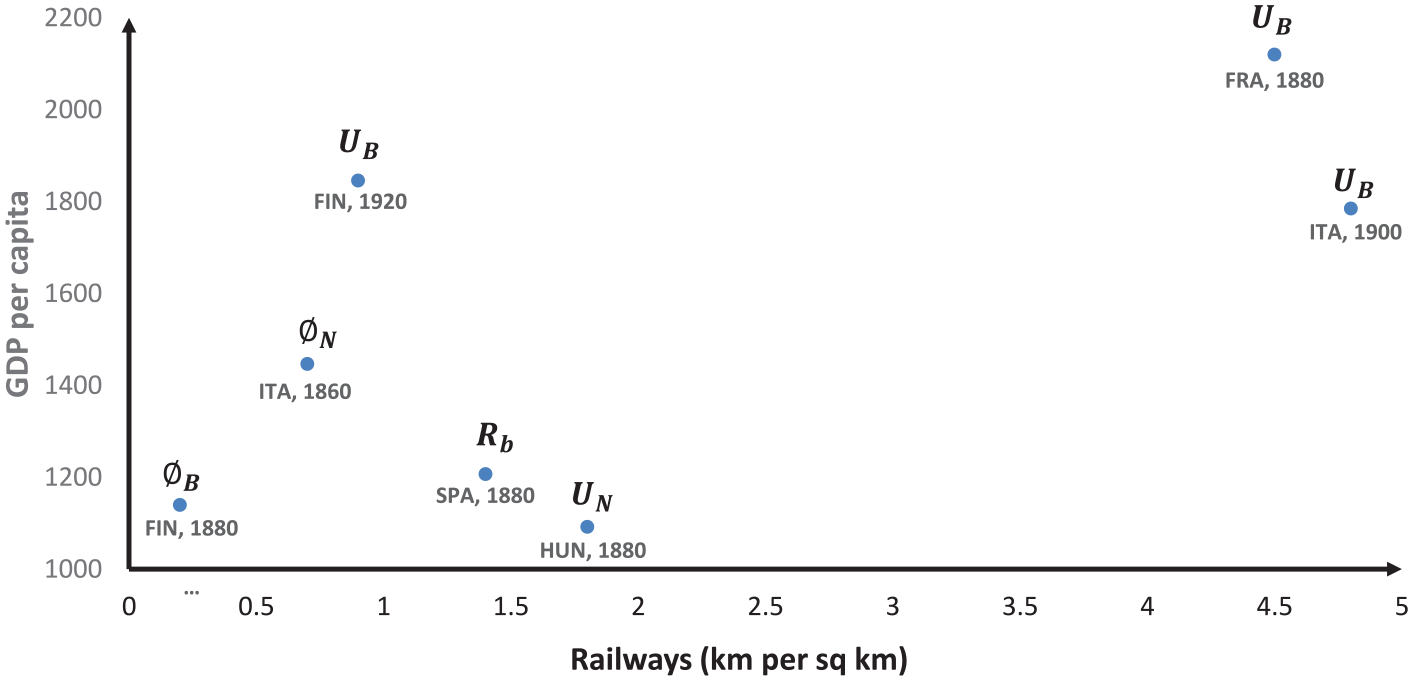
Choice of educational system in five European countries (1860–1920).
Empirically, no education arises for low levels of railway development and GDP per capita, which is compatible with Figure 8 from the model simply because investment in education is less profitable for low values of
In turn, at the other extreme of Figure 9, bourgeois-dominated countries with relatively well developed railway networks and high GDP per capita as France in 1880 and Italy in 1900 chose unified education, which is compatible with the prevalence of unified education in the model for high
Finally, while Spain and Hungary in 1880 shared quite similar levels of GDP per capita and railway development, these two countries differed in terms of the power structure, and only Hungary chose a unified system. This is compatible with the area in Figure 8 where
5. Conclusion
In this paper, a Gellnerian model of industrialization and nation building is presented, emphasizing the key role of elites in shaping that process. As in Gellner (1964, 2006), the central link between industrialization and nation building goes through the double role of schooling as productivity enhancer and generator of a common identity. In addition, as in more recent contributions to the nation building literature (see, in particular, Breuilly, 1993; Kroneberg and Wimmer, 2012; Roeder, 2007), the observed outcome in terms of industrialization and nation building crucially depends on the nature of the interaction between elite groups with different (and sometimes diverging) interests.
Starting from a non-unified state constituted of two regions, the implementation of a common education system that transforms the state into a nation state has the advantage of expanding output by enabling inter-regional production, although following Gellner’s (2006)‘barriers to communication’, this might only be achieved to a certain extent.
If these barriers are not too strong and productivity is large, a common education system will indeed be the outcome if the identity of the dominant group is the same at the regional and state levels: intuitively, an elite that is dominant at both geographical levels can appropriate a large share of the cake at both levels, and thus goes for the implementation of education at the level where the cake is the largest, i.e., at the state level. However, if the barriers are strong or productivity is not high, restraining schooling to the bourgeois-abundant region pays-off, as this reduces per-capita education costs.
Instead, a regionally dominant but statewide dominated elite might prefer a large share of the small (regional) cake rather than a small share of the large cake stemming from building a nation state, even if barriers to communication are not particularly large. When regional and statewide power are not in the same hands, it may even happen that the elite of a backward (bourgeois-scarce) region chooses to implement regional schooling, as for Gellner’s Ruritania.
While a full empirical test of our model is beyond the scope of this paper, our analysis of the school set-up decisions in five European countries in 1860–1920 shows that our model is able to generate some broad historical features, such as the importance of market integration or the geographical distribution of power.
Clearly, our model is highly stylized and cannot match some important features characterizing countries that include a peripheral nation. In particular, while in our model the emergence of a peripheral nation always comes (by construction) with the failure of nation building at the state level, such countries as Canada, Belgium, Spain or the UK, which include regional nations, have also developed a (stronger or weaker) national identity at the state level – which clearly makes institutional design difficult.
Supplemental Material
online_appendix_revision – Supplemental material for Schooling, nation building and industrialization
Supplemental material, online_appendix_revision for Schooling, nation building and industrialization by Esther Hauk and Javier Ortega in Journal of Theoretical Politics
Footnotes
Appendix A. Cutoffs and educational costs for the elite
The productivity shock that makes the elite indifferent between implementing U or not is such that
Under
Let e (resp.
Table 1 reports the productivity thresholds and payments under the two systems.
Observe that
Appendix B. Unified versus region- i education
Acknowledgements
We thank Alberto Bisin, Ramon Caminal, Jonathan Hopkin, Bill Kissane, Paolo Masella, Yona Rubinstein, Thierry Verdier, Stephane Wolton and seminar participants at the CEP (LSE), Royal Economic Society, ESSLE-CEPR, City University London, ENSAI (Rennes), Workshop on Culture and Institutions (Valencia), Birkbeck, Workshop on Cultural Transmission and Evolution (Paris), Workshop on Aging, Culture and Comparative Development (Luxembourg), Brunel, the Africa Meeting of the Econometric Society (Algiers), and LSE Government for useful comments and suggestions. J Ortega thanks the Department of Government at the LSE for their hospitality while revising this paper.
Declaration of conflicting interests
The author(s) declared no potential conflicts of interest with respect to the research, authorship, and/or publication of this article.
Funding
The author(s) disclosed receipt of the following financial support for the research, authorship, and/or publication of this article: This work was supported by the Spanish Ministry of Economy and Competitiveness, through the Severo Ochoa Programme for Centres of Excellence in R&D (grant number SEV-2015-0563), CICYT (grant number ECO2012-37065), and the government of Catalonia.
Supplemental material
Supplemental material for this article is available online.
Notes
References
Supplementary Material
Please find the following supplemental material available below.
For Open Access articles published under a Creative Commons License, all supplemental material carries the same license as the article it is associated with.
For non-Open Access articles published, all supplemental material carries a non-exclusive license, and permission requests for re-use of supplemental material or any part of supplemental material shall be sent directly to the copyright owner as specified in the copyright notice associated with the article.
