



Abstract
Polyacrylonitrile-based carbon fibers (PANCFs) have revolutionized industries since the 1960s due to their superior properties and applications. However, a significant gap remains between their performance and theoretical potential, highlighting the urgent need to enhance our understanding of the process-structure-performance relationship. Computational simulations, with their ability to provide analysis from the atomic level to higher-scale, are essential for bridging this gap. This review provides a comprehensive overview of advancements in computational simulation techniques to produce high-performance PANCFs by optimizing the process parameters through simulations. Furthermore, advancements in reactive molecular dynamics, density functional theory, atomistic modelling, and finite element methods to enhance the PANCFs manufacturing process are systematically evaluated. Simulations play an important role in developing PANCFs by identifying novel comonomers for PAN precursors, evaluating different solvents during spinning, precise tracking of cyclization and dehydrogenation mechanisms during stabilization, and predicting mechanical property losses due to defects. Moreover, it is demonstrated that how kinetics-driven frameworks accelerate carbonization simulations by combining atomic-scale interactions such as carbon ring formation and graphitic growth with macroscale process parameters like temperature and pressure. However, certain limitations remain: unresolved heterogeneous microstructure representation, multiscale disconnects between atomic bond-breaking and macroscopic fiber evolution, and validation barriers due to oversimplified quasi-2D models. To overcome these problems, possible future directions including advanced force fields, multiscale integration, and AI-driven modeling could enhance the performance of PANCFs.
This is a visual representation of the abstract.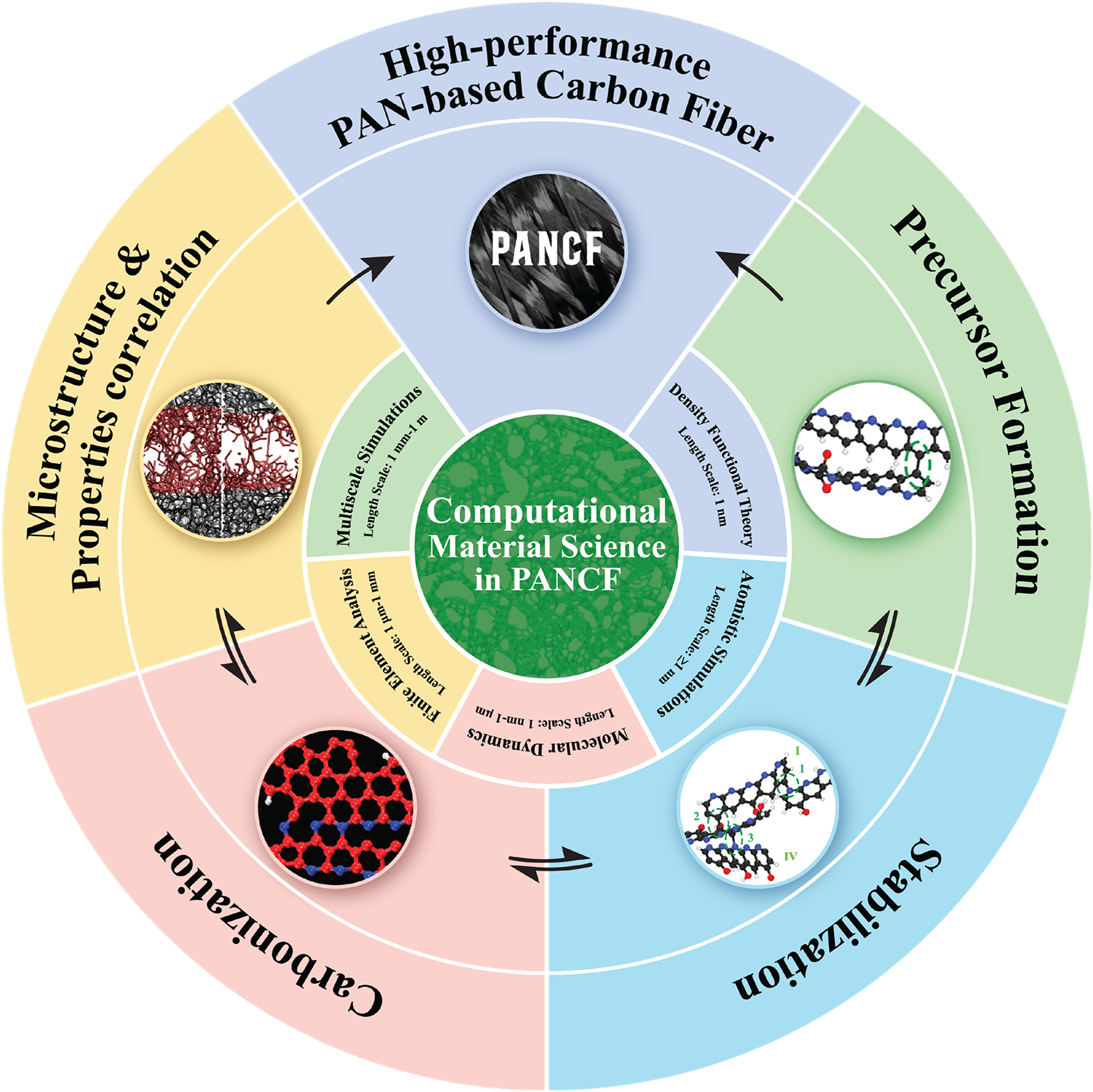
Keywords
Get full access to this article
View all access options for this article.