




Abstract
The purpose of this work is to explore whether high levels of emotional intelligence as a competence enhance students’ and graduates’ perceived fit with innovative organizations, thereby increasing the likelihood of employment. Our empirical analysis is conducted using original data from an online survey of 478 respondents, including both current students and employed alumni in business studies at an Italian university. Findings highlight EI as a significant predictor of employment in innovative organisations, regardless of their size (SMEs vs larger firms) and industry (manufacturing vs services). These results suggest that universities should design their courses and curricula to focus on both technical and soft skills that foster students’ employability in innovative organizations.
Introduction
Technological change and digital transformation are rapidly reshaping job requirements: skills that were once peripheral are now essential, and new competencies continue to emerge (Edmondson et al., 2020; Leopold et al., 2025). Recent mismatch research argues that under digitalisation, competency requirements evolve rapidly and labour markets increasingly value demonstrable competencies over formal credentials, making traditional curriculum-alignment strategies less effective (Alam et al., 2025; Rahman et al., 2024). This trend, on the one hand, challenges employers to align the right individuals with appropriate organizational roles, a topic extensively explored since the seminal studies on person-organization fit (Kristof, 1996; B. Schneider, 1987). On the other hand, it places increasing pressure on current and prospective employees to broaden their skills and competencies endowment and on higher education institutions to offer learning opportunities that prepare students for these evolving demands (Edmondson et al., 2020; Matsouka and Mihail, 2016). In this context, we focus on emotional intelligence (EI) as a human-centric competence that may matter for employability in innovation-intensive, interaction-rich organizational settings (Edmondson et al., 2020; Kotze and Miller, 2023).
In a technology-driven labour market, it is perhaps unsurprising that EI is among the most sought-after and impactful competencies. EI is increasingly recognised as critical for career development (Edmondson et al., 2020; Kotze and Miller, 2023). This emphasis on EI reflects a broader shift towards recognizing the complementarities between human-centric competencies, such as empathy, collaboration, and adaptability, and technical expertise. Defined by Salovey and Mayer (1990) as the ability to identify, comprehend, and manage one’s emotions and those of others, EI has been robustly linked to job performance in several studies. In this regard, EI is consequential not only as an internal capability but because it is typically enacted in team-based workplace behaviours, such as regulating emotions during interdependent work, communicating constructively, and managing disagreements in ways that sustain collaboration and team effectiveness (Druskat and Wolff, 2001; Jordan and Troth, 2021). For example, scholars have studied the relationship between EI and different organizational outcomes, such as job satisfaction (Chiva and Alegre, 2008), work performance (Chen et al., 2015; Cuéllar Molina et al., 2020; Cuéllar-Molina et al., 2019; Van Rooy and Viswesvaran, 2004), and future career development and success (Parmentier et al., 2022; Pirsoul et al., 2023; Ran et al., 2022; Sultana et al., 2016). Although previous studies have shown that EI is generally important for job performance (Chiva and Alegre, 2008; Coetzee and Harry, 2014; Cuéllar Molina et al., 2020; Kerr et al., 2006; Wong and Law, 2003), evidence on how EI contributes to person-organization fit, particularly in innovation-oriented organizational cultures, remains under-researched. This link is likely to operate through the behavioural enactment of EI in interaction-rich work environments, such as those involving emotion regulation, constructive communication, and teamwork, which are particularly salient in innovative settings.
Developing an innovation-oriented organizational culture can be a source of competitive advantage for firms that operate in industries driven by rapid technological advancements and shifting market demands. Innovative organizations often operate in environments that require technical competencies alongside a high degree of adaptability, problem-solving capabilities, and emotional resilience (Jena and Goyal, 2022; Salminen et al., 2021; Schneider et al., 2013; Zwick et al., 2017), qualities closely linked to EI. Our study examines the relationship between EI at an individual level and employment in innovative organisations. Specifically, we investigate whether individuals investing in human capital (i.e. students and graduates in tertiary education) benefit from higher EI competence in terms of a higher likelihood of being employed in such organisations. We also examine whether the contribution of EI is contingent on the organizational size and industry.
Understanding the connection between EI and employment in innovative organizations provides useful insights for higher education institutions that develop initiatives aimed at building employability-relevant competencies. Identifying the environments in which students and graduates with higher EI are more likely to thrive can inform programs that cultivate EI competence and its behavioural enactment, thereby improving employability outcomes. Our analysis is based on an original sample of 478 students and graduates from an Italian university.
With supportive results, our paper makes two meaningful contributions. First, by exploring the role of EI in fostering employment within innovative organizations, we highlight how EI is not only beneficial for individual development but may also function as a relevant competence in workforce planning and recruitment in innovative contexts. For universities, this means that redesigning courses and curricula to strengthen employability-relevant competencies, including EI competence alongside technical competencies, can support graduates’ employability.
Second, our findings extend EI theories in career development and planning by suggesting that EI competence is associated with employees’ effectiveness and adaptability in innovative environments.
Conceptual background
Person-organization fit
There is a direct link between employability and fit between worker and their work (Flanagan, 2025). The Person-Organization (P-O) fit is a critical extension of the Person-Environment fit theory, positing that the alignment between an individual’s values, goals, and personality with those of their organization leads to increased job satisfaction, commitment, and overall work performance (Kristof, 1996; Muchinsky and Monahan, 1987). The importance of P-O fit is evident in its impact on organizational outcomes (Wojtczuk-Turek and Turek, 2016). For instance, when employees perceive a high degree of compatibility between their values and those of the organization, they are more likely to experience higher job satisfaction and organizational commitment (Cao et al., 2022; Saraç et al., 2014). So much that the fit between worker and their work is also regarded as a feature of employability. In other words, how people feel about the fit with an organization can, in the first place, affect their desire for potential employment. Further, this alignment also contributes to lower turnover rates (Abdalla et al., 2018), as individuals are less likely to leave an environment that supports their personal and professional aspirations (De Cooman et al., 2009). Such environments foster a sense of belonging and identification with the organization and enhance motivation, leading to greater personal investment in the organization’s success.
Moreover, research indicates that a strong P-O fit can significantly influence recruitment and retention strategies. Organizations that articulate their values clearly and authentically are better positioned to attract candidates whose personal values align with these stated values (Yu, 2014).
In light of these discussions, P-O fit both enhances individual satisfaction and performance and serves as a strategic lever for organizations aiming to cultivate a resilient and motivated workforce. This alignment is particularly relevant in contexts requiring high levels of innovation and adaptability, where the congruence between individual creativity and organizational innovation goals can significantly drive success. At the same time, fit is also reflected in everyday interaction patterns through collaboration, constructive conflict, and adaptability under uncertainty. These are enacted behaviourally, suggesting that individual competencies that support such interaction patterns should be especially relevant for explaining employment in innovative organizational cultures.
Emotional intelligence
While emotions are an integral part of everyday organizational life (Ashforth and Humphrey, 1995; Thory, 2013), the full recognition of their impact became widespread with the emergence of the notion of EI (Koubova and Buchko, 2013; Van Rooy and Viswesvaran, 2004). In this regard, organizations are increasingly seeking employees with a higher level of EI (Edmondson et al., 2020). Salovey and Mayer (1990) defined EI as the “ability to monitor one’s own and others’ feelings and emotions, to discriminate among them, and to use this information to guide one’s thinking and actions” (Salovey and Mayer, 1990). In this paper, we treat EI as an emotional and social competence enacted behaviourally in workplace interactions, especially in collaborative work that is central to innovative organisations.
Although Mayer and Salovey introduced the term and coined the concept, the idea of EI gained widespread popularity through Goleman’s (1995) best-selling book. Goleman (1995) adopts a broader perspective on the concept and categorizes EI into two primary dimensions: (i) the personal dimension, which focuses on self-awareness, self-management, and motivation, and (ii) the social dimension, which focuses on the importance of social skills and relationship management. The personal dimension includes (1) self-awareness, which entails knowing one’s strengths, weaknesses, drives, values, potential, and impact on others; (2) self-regulation, which involves controlling and redirecting disruptive emotions; (3) motivation, that is, the ability to pursue goals with energy and persistence, for reasons that go beyond money and status. While the personal dimension concerns how individuals understand and regulate themselves, the social dimension concerns relationship management, including empathy and social skills expressed through interaction. The former consists of understanding and sharing others’ emotions. Social skills, on the other hand, encompass a range of abilities that facilitate the building of relationships and networks, enabling individuals to influence and guide others in desired directions. In general terms, these skills are essential for effectively navigating social situations and fostering positive interactions and connections (Goleman, 1995).
Research has demonstrated that EI is not merely an innate temperament. EI comprises developable competencies that can be strengthened through training, experiential learning, and coaching (Goleman, 1995). In this regard, universities may invest in EI development to leverage it as a strategic asset to cultivate emotionally competent alumni, equipped to meet interpersonal and ever-changing demands of dynamic organizations. Thus, EI training could be a valuable tool for strengthening university–industry collaboration and enhancing graduate employability.
Developing EI competences
As we highlighted in the previous section, what is crucial is a fit between people’s competencies and the organizations in which they are employed. Based on the integration of P–O fit and EI, we argue that innovative organizations better fit individuals with high levels of EI. Drawing on a tradition in the literature that frames innovative organizations as firms operating in dynamic, technology-driven environments that demand creativity, collaboration, and adaptability from their workforce, rather than defining them solely through R&D expenditure or patent activity, we conceptualize innovative organizations as those that foster a culture of continuous change and openness to new ideas (Edmondson et al., 2020; Flanagan, 2025; Matsouka and Mihail, 2016). Specifically, we define innovative organizations as firms that systematically introduce new or significantly improved products, services, processes, or organizational practices as part of their competitive strategy (Büschgens et al., 2013; Damanpour, 1991; OECD and Eurostat, 2018). Such organizations are characterized by a culture that prioritizes adaptability, creativity, risk-taking, and continuous learning, and that fosters collaboration and open communication among employees (Tsakalerou, 2016; Wojtczuk-Turek and Turek, 2016). These cultural features make the behavioural side of EI especially relevant. EI competence is expressed through collaboration-relevant behaviours, such as emotion regulation under pressure, constructive communication, trust-building, and constructive conflict, that support coordinated problem-solving in innovative settings (Druskat and Wolff, 2001; Jordan and Troth, 2021).
Innovative environments that emphasize collaboration, adaptability, and open communication naturally align with the emotional and interpersonal competencies typical of emotionally intelligent individuals (Tsakalerou, 2016). Such individuals excel in managing relationships, navigating uncertainty, and fostering trust, qualities essential for innovation (Jena and Goyal, 2022; Quandt and Castilho, 2017). In dynamic, innovation-driven settings, emotionally intelligent employees contribute to problem-solving, handle stress effectively, and adapt quickly to change (Duckworth et al., 2007; Schneider et al., 2013). They are also particularly effective in promoting constructive conflict and embracing diverse perspectives, which further reinforces their fit in innovative firms (Sharma and Singh, 2021; Zhang et al., 2015).
We also argue that the firm’s characteristics affect the relationship between EI and employment. The first relevant feature, is the firm size, as small and medium-sized enterprises (SMEs), embedded within dense local production systems tend to operate with informal organizational structures, flat hierarchies, and high levels of interpersonal interaction, making them a fertile ground for developing innovation projects that, albeit often being user-driven rather than science-driven, are able to strengthen the competitive position of the firms. In such small firms, success is often contingent upon relational trust, informal coordination mechanisms, and collective innovation, all of which are enhanced by employees’ emotional and social competencies (Coleman, 1988; Marlow and Patton, 2002).
A second relevant dimension is the industry, as firms operating in service sectors rely heavily on customer interaction and employee adaptability. In such contexts, EI is especially critical for interpreting customer needs, adapting behaviour accordingly, and delivering innovation through personalized and relationally intensive services (Edvardsson et al., 2010; Eriksson and Englander, 2017; Wieseke et al., 2012).
This setting may shed light on the needs for higher education and training at the regional level. It is increasingly recognized that one of the contributions of higher education institutions to socio-economic development is to equip students with competencies that may enhance their employability (Fakunle and Higson, 2021; Matsouka and Mihail, 2016). The actual effectiveness of such efforts is debated, especially when it comes to the development of the skills needed in the medium-to long term: often, it is possible to identify gaps between the skills employers require and those that graduates actually possess (Edmondson et al., 2020). This implies that programs should be designed in a way to prepare students for the future job market and increase their employability (Matsouka and Mihail, 2016; Pais-Montes et al., 2019). While there are general global competencies that are particularly required for engineering and technical students (Richter, 2026), it is also important to prepare students for specific local markets (Okolie et al., 2020). Universities and educational institutions operating in socio-economic ecosystems characterized by the prevalence of tightly connected SMEs may benefit from emphasizing the development of emotional and relational competencies alongside technical and managerial competencies. Preparing students for employment in firms embedded in innovation-intensive and socially complex environments requires a curriculum that aligns with the needs of the industrial system. While this is usually discussed within the context of Western and non-Western economies (Fakunle and Higson, 2021), more attention has recently been paid to improving local labour-market skills at the regional level through localized analysis (Corradini et al., 2023). Thus, our study contributes to theoretical advances in P–O fit and EI, as well as to context-sensitive strategies for human capital development.
Methods
Sample
We tested our hypotheses on a sample of 478 undergraduate and graduate business students at a public university in the Northeast of Italy, including full-time workers, part-time workers, and full-time students. North-East Italy is characterized by a dense network of SMEs, which are the backbone of Italy’s economy and play a pivotal role in driving innovation and employment. Therefore, offers a good setting for investigating the relationship between EI and employment outcomes in innovative organizations.
The data were collected via a survey created in Microsoft Forms and distributed through the university’s administrative offices within the student community. We obtained responses from 537 students. Subsequently, we cleaned the dataset of observations with missing values. As a result, 89% of the initial respondents were retained for further analysis. Given its status as the official language of Italian higher education institutions, the questionnaire was administered in Italian.
Summary of the personal details of the respondents.
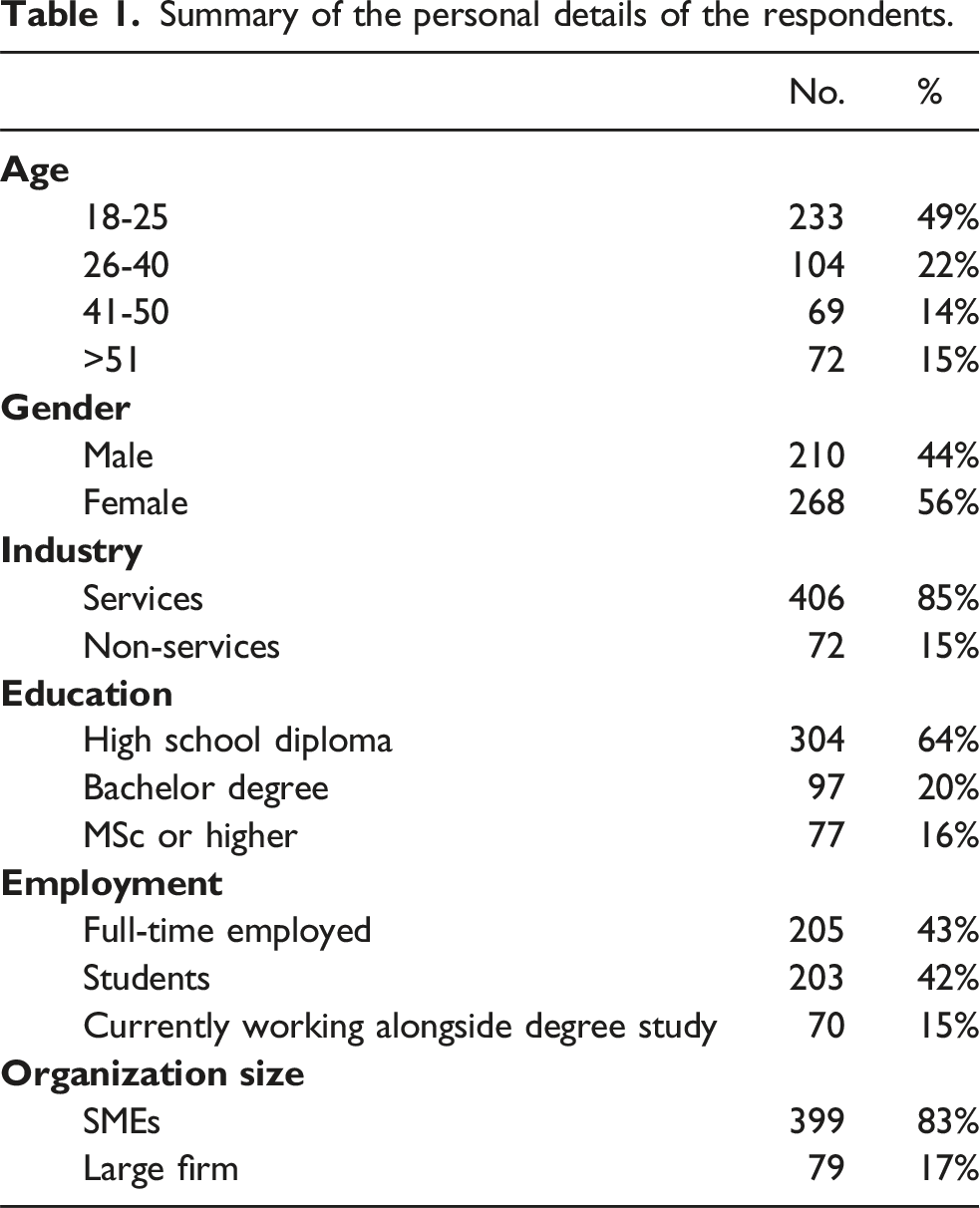
To investigate the relationship between individual EI and the likelihood of being employed in innovative firms, a series of binary logistic regression models was estimated. A total of five logistic regression models were specified. The first model was estimated on the full sample, while the remaining four were run on subsamples derived from the original dataset, according to the specific topics under investigation.
Measures
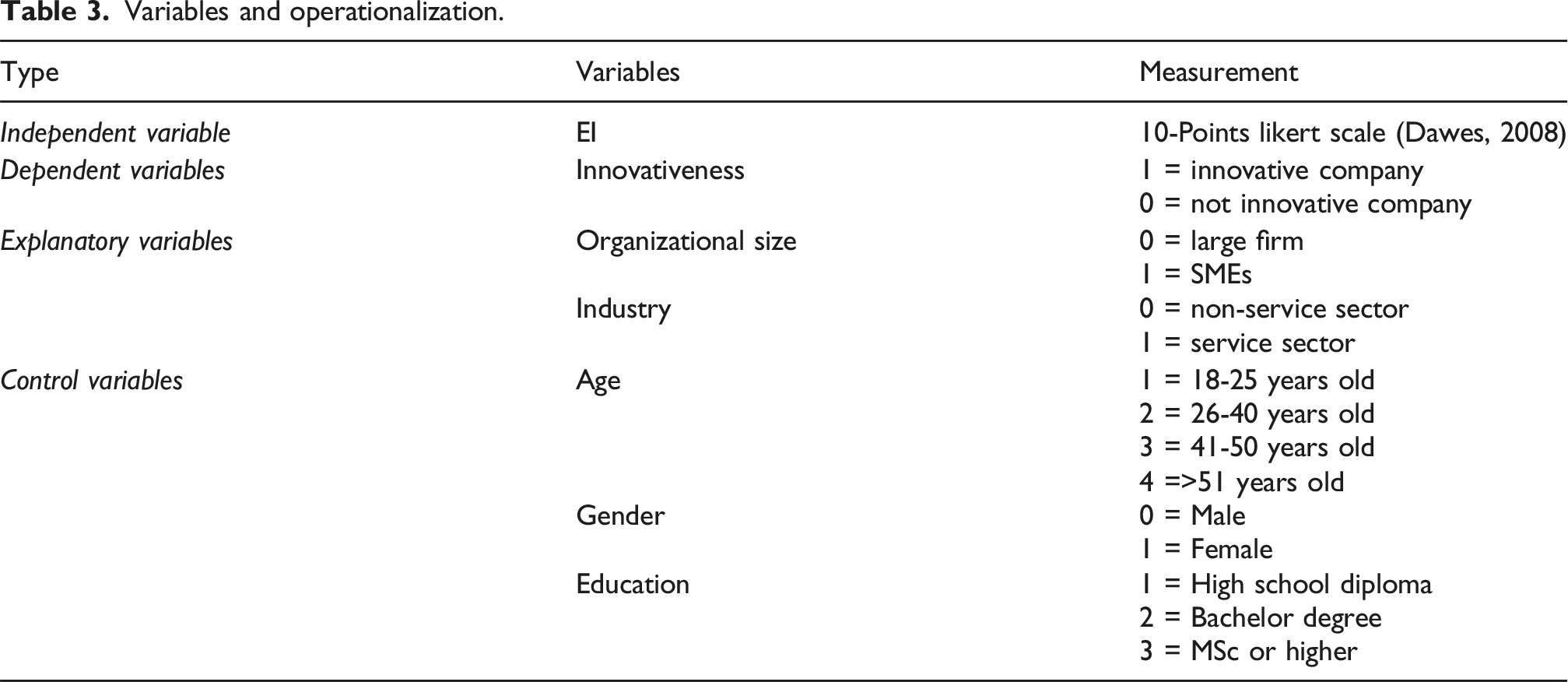
Dependent variable: Innovativeness. We measured innovativeness by explicitly asking the respondents what the level of innovativeness of the organization in which they work was, according to them, on a scale from 1 to 10. Then, for the study’s aims, the variable was dichotomized as a dummy, assuming the value 1 (innovative organization) if the level of innovativeness was above the sample’s median value (7) and value 0 otherwise.
Operationalization of the concept of EI.
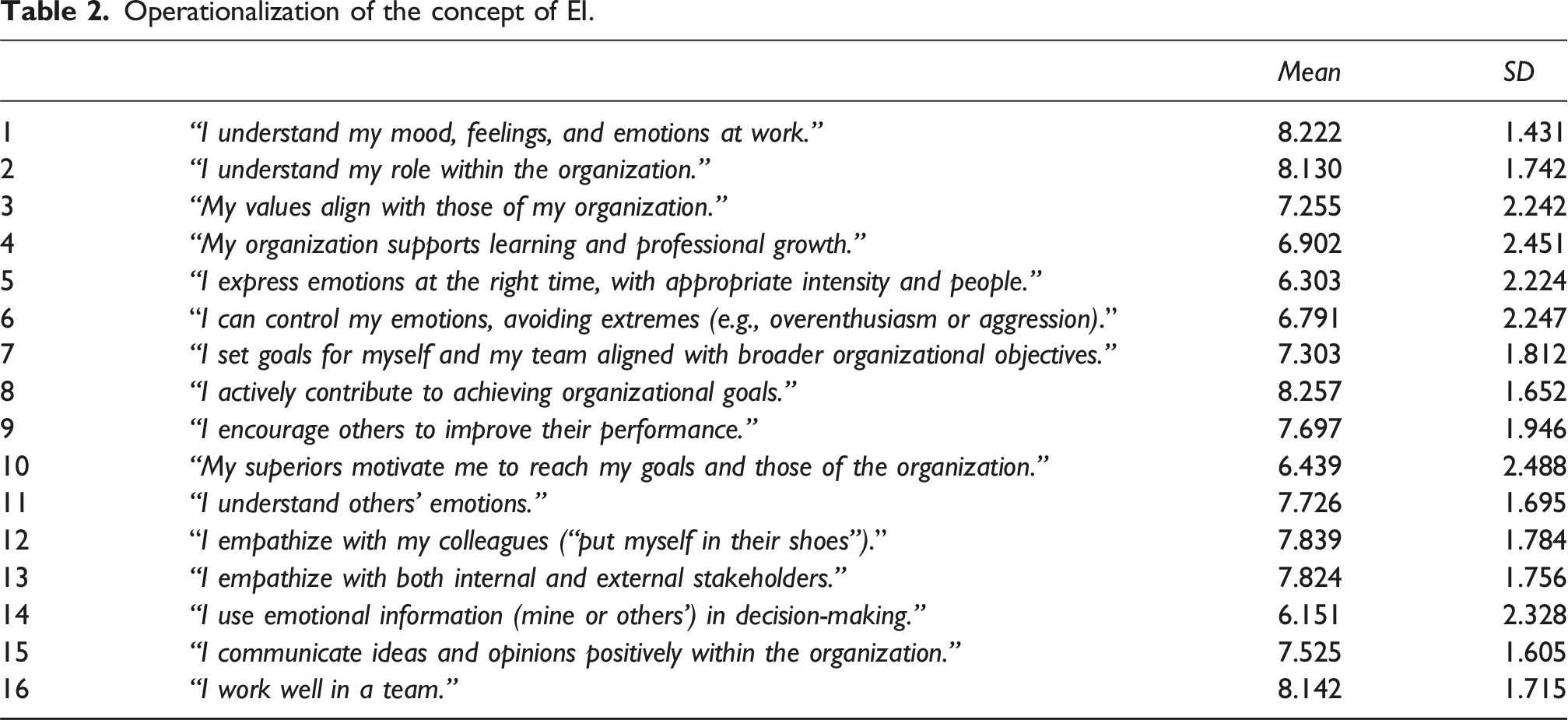
Organizational size. In addition to examining innovativeness, we introduced organizational size as a secondary variable in the second test. This was done to explore whether organizational size, in conjunction with innovativeness, influences the relationship between EI and P-O fit. The organizational size was assessed directly by asking participants about the number of employees in their workplaces. Then, for the study’s aims, the variable was dichotomized as a dummy, assuming the value 1 (SMEs) if the number of employees was below 250 and the value 0 otherwise.
Industry. Mirroring our approach with the previous variable, we examined industry alongside innovativeness to assess its potential impact on the relationship between EI and person-organization fit. Similarly, the industry was assessed directly through survey questions, where participants indicated the industry of their employing organization. For the study’s aims, the variable was then dichotomized as a dummy, assuming value 1 (Service sector) if the firm was indicated as belonging to service industries (see Table 1) and value 0 otherwise. The service industry includes knowledge-based services, traditional services, public administration services, and non-profit services.
Control Variables. Even though we collected numerous control variables through the survey, we selected three as the main control variables for our model. The three control variables chosen are age, gender, and study title (e.g., Cao et al., 2022; Carette et al., 2013). Controlling for age helps reduce the potential impact of age-related characteristics (e.g., life stage, professional experience) on the observed relationships, thereby improving the internal validity and robustness of the findings. Gender is an additional control variable, allowing us to determine whether the effect of EI may differ across genders. Lastly, education allows us to isolate the effects of the main independent variables while controlling for any variance attributable to differences in the education level (e.g., Scandura, 1992).
Variables and operationalization.
Descriptive statistics and correlations.
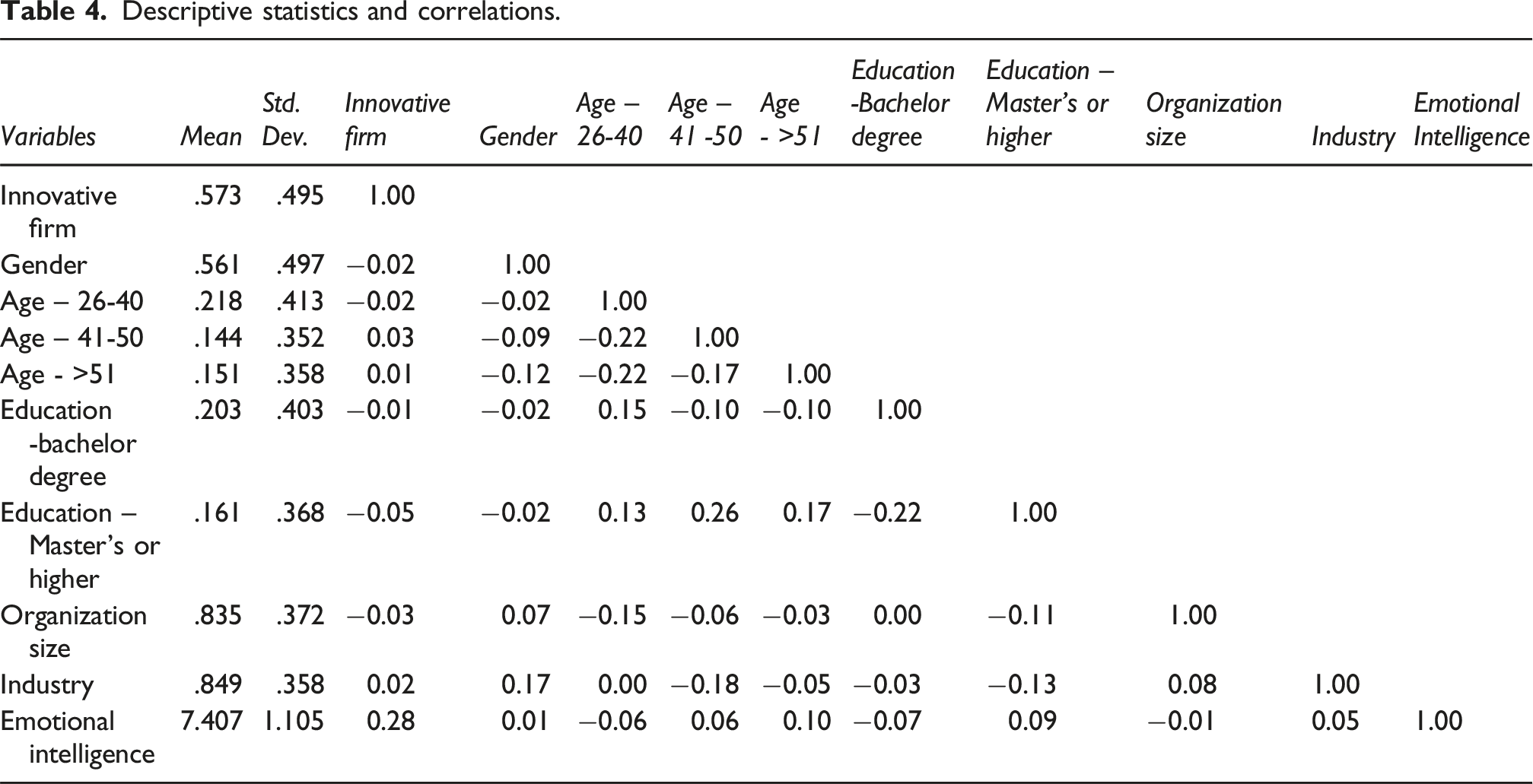
The variables described were used to estimate regression models examining whether EI is associated with the likelihood of employment in organizations characterized by higher levels of innovativeness. In this framework, EI is treated as the primary explanatory variable, and the innovativeness of the employing organization represents the outcome of interest. This specification is motivated by the core argument in our chosen research path, that EI may influence individuals’ ability to navigate organizational environments, build relationships, and adapt to dynamic work contexts, which in turn can affect their access to and integration within organizations that exhibit stronger innovative orientations. The main analysis therefore relies on a logistic model using a binary indicator of innovative organizational employment. Additional analyses reported later in the paper explore alternative specifications and group-based comparisons across EI levels to assess the robustness of the results in comparison to our chosen empirical path. While the innovativeness of the employing organization may reflect multiple underlying mechanisms, including alignment between individual capabilities and organizational environments, this study’s empirical focus is on the direct association between EI and employment in innovative organizational contexts. Accordingly, the analysis is designed to test this relationship directly rather than to estimate a full mediation structure.
Results
Logistic regressions estimating the effect of individual emotional intelligence on the likelihood of being employed in innovative firms.
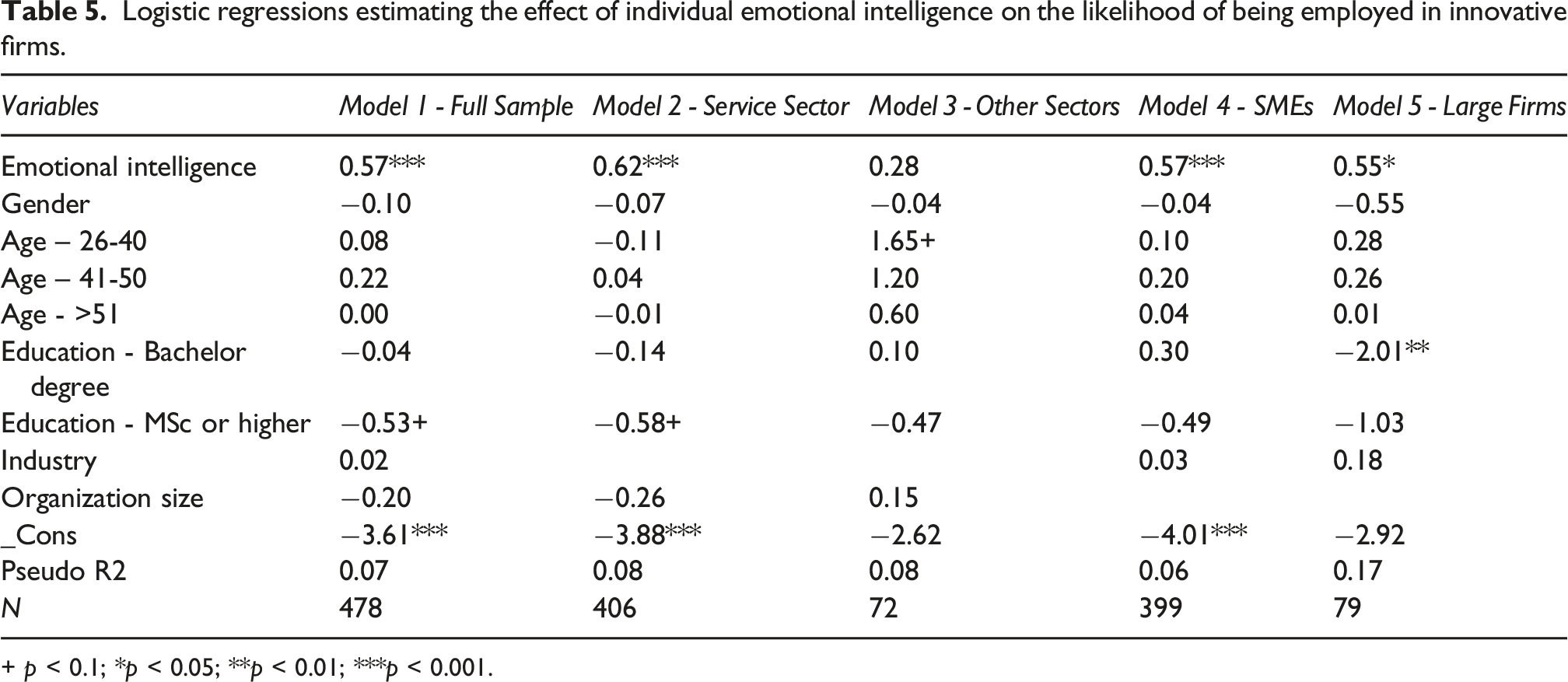
+ p < 0.1; *p < 0.05; **p < 0.01; ***p < 0.001.
Further data exploration reveals findings that partially align with our expectations. Specifically, regarding firm size, the regressions suggest that the effect of EI is more pronounced in smaller firms than in larger ones. This is evident in the coefficients, where EI has a coefficient of 0.57 in small firms and 0.55 in large firms, both significant, indicating a slightly stronger effect in smaller organizational settings. On the other hand, another relevant dimension to further explore is the firm’s industry. Here, the impact of EI is greater in the service industry than in other sectors. The regression outputs support this, revealing a coefficient of 0.62 in the service sector, which is significantly higher than the 0.28 found in other sectors, where the result was also non-significant. Although both findings point to the critical role of EI in innovative organizational environments where adaptability and interpersonal interactions are more directly tied to organizational success, it is worth noting that a subsequent post hoc test of the coefficient differences revealed that these differences were not statistically significant. Therefore, despite the observed trends where EI exhibited higher coefficients in small firms and the service sector, the differences are not substantial enough to fully support the assumptions we previously made.
Regarding control variables, gender exhibits a negative effect, particularly strong in the service sector and large firms. On the other hand, age showed a generally small positive effect on the likelihood of employment in innovative firms, except for the service sector, where the effect is negative. Although its impact is not statistically significant across all the subsamples. These controls suggest that demographic factors may influence employment outcomes in innovative firms, although their impact is less pronounced and consistent than that of EI.
Robustness tests
To assess the stability of the finding and address potential concerns regarding model specification and measurement choices, we conducted several additional robustness tests. In particular, we estimated complementary models that categorize individuals by EI level and compare outcomes across groups. These additional analyses are intended to verify whether the relationship observed in the main model remains stable across alternative specifications.
First, we examined whether the results depend on the binary operationalization of the outcome variable. In the main analysis, innovative employment is captured through a dichotomous indicator derived from respondents’ assessment of the innovativeness of their employing organization. As a robustness check, we re-estimated the model using the continuous measure of organizational innovativeness reported by respondents (measured on a 1–10 scale) as the dependent variable. The results confirm that EI remains a strong and statistically significant predictor (β = 0.66, p < 0.001). Substantively, individuals with higher EI tend to be employed in organizations that are rated as more innovative organizations. This finding indicates that the main results are not driven by the dichotomization of the innovativeness measure.
Second, following a group-comparison logic, we examined whether the results hold when individuals are categorized according to their EI levels. Specifically, the distribution of EI was divided into quartiles, and logistic regression models were estimated using the lowest EI group as the reference category. The results reveal a clear monotonic pattern: compared with individuals in the lowest EI group, those in the third quartile have approximately 2.7 times higher odds of being employed in an innovative organization (p < 0.001), while individuals in the highest EI quartile exhibit over five times higher odds (p < 0.001). Predicted probabilities also display a strong gradient, increasing from roughly 0.40 in the lowest EI group to approximately 0.77 in the highest group. This pattern reinforces the interpretation that higher levels of EI are associated with a substantially greater likelihood of employment in innovative organizational contexts.
Third, we examined whether the relationship between EI and innovative employment varies across organizational environments not simply through sub-sample analysis but by estimating interaction models including EI and indicators capturing service-sector organizations and large companies, as well as their interaction terms on the full sample. The interaction between EI and employment in service-sector organizations is positive but does not reach conventional levels of statistical significance (interaction coefficient = 0.32, p = 0.17), suggesting that while the association may be somewhat stronger in service contexts, the difference is not statistically decisive. In contrast, the interaction between EI and employment in large companies is essentially zero and statistically insignificant (coefficient = −0.01, p = 0.98), indicating that the relationship between EI and innovative employment does not vary systematically with firm size. Importantly, across both specifications, the main EI coefficient remains positive and statistically significant, confirming the stability of the core finding.
Taken together, these additional analyses provide consistent evidence that the main findings are robust to alternative operationalizations of organizational innovativeness, different model specifications, and subgroup comparisons based on EI levels and organizational context. Across all specifications, EI remains positively associated with the likelihood of being employed in more innovative organizations.
Discussion
The findings of our study enrich the understanding of the EI-employability nexus by highlighting the association between EI and employment in innovative firms, while conceptually linking EI to collaboration-relevant workplace behaviours without directly observing those behaviours.
The results align with prior research that identifies EI as essential for managing interpersonal dynamics and creating a work environment conducive to innovation (Goleman, 1995; Salminen et al., 2021; Salovey and Mayer, 1990). The ability to perceive, use, understand, and manage emotions is likely to support effectiveness and adaptability in roles that require high levels of creativity and interaction, traits common in innovative firms (Edmondson et al., 2020; Tsakalerou, 2016; Zulfadil et al., 2020). While we do not observe workplace behaviour directly, we argue that EI is consequential in innovative settings because it is enacted through collaboration-relevant behaviours. Contrary to the assumption that certain environments, such as smaller firms or service-oriented industries, would place a higher premium on emotional competencies, our analysis shows that EI remains a significant factor regardless of firm size or industry type. The distinctive contribution of this study lies in demonstrating that EI’s relevance is not confined to specific industries or organizational sizes, suggesting its widespread applicability in innovative organizational settings.
Theoretical implications
This research highlights EI as relevant competence associated with students’ employability within innovative organizations. Specifically, while EI is regarded as a personal development strength, it is also a strategic asset in workforce planning and recruitment, particularly in innovative contexts. This contributes to a deeper comprehension of EI as a critical component within the broader framework of P-O fit, suggesting that EI significantly aligns with the dynamic capabilities required by organizations that prioritize innovation and adaptability (Tsakalerou, 2016; Zulfadil et al., 2020).
Second, the study extends EI theories in career development and planning by demonstrating that EI is positively associated with employment in innovative environments, where effectiveness depends heavily on interaction quality and behavioural adaptation. This finding aligns with previous research that identifies EI as pivotal in managing interpersonal dynamics and enhancing workplace environments conducive to innovation (Goleman, 1995; Salovey and Mayer, 1990). The consistent positive influence of EI across various organizational types supports the notion that EI’s relevance transcends specific industry and size contexts, indicating its universal applicability in fostering successful employment outcomes in innovative firms (Prati et al., 2003; Quandt and Castilho, 2017).
Implications for practice
Consistent with mismatch research in the digitalisation era, curricula may need to emphasise demonstrable competencies alongside formal credentials, reinforcing the value of developing human-centric competencies such as EI (Alam et al., 2025). Our findings have important implications for educational institutions and curriculum designers. Specifically, high EI individuals are more likely to be employed in firms and in positions where creativity and collaboration are essential, namely innovative organizations. This means that developing EI competences among students, who will be future employees (Clarke, 2006; Owusu-Manu et al., 2019; Thory, 2013), could significantly benefit their employability in innovative organizational settings. Given the general relevance of EI, curricula should both foster domain-specific knowledge and proactively integrate EI training as a core component of future workforce preparation. As trainability is one of the distinctive features of EI (Goleman, 1995), two strategic approaches emerge. Firstly, structured interventions aimed at strengthening EI should be embedded across disciplines, reaffirming its cross-cutting importance irrespective of the field of study. Secondly, EI assessment could be embedded in educational pathways to help orient students toward curricula that align better with their emotional and cognitive profiles. For instance, students with high EI might be encouraged to deepen their technical competencies to complement their interpersonal strengths, while those with lower EI might benefit from focused development in soft skills to enhance their overall employability.
Despite including contextual variables such as industry and firm size in our analysis, the lack of variation in these factors suggests that employers consistently value EI-related competencies regardless of sector or organizational size. This strengthens the argument for embedding EI-oriented strategies in curriculum design broadly. At the same time, it is important to recognize that specific characteristics of the local labour market may still influence employer expectations. In particular, universities that maintain strong ties with the local entrepreneurial ecosystem should consider these dynamics when redesigning curricula, as the relevance and applicability of EI-related training may be especially pronounced in such contexts.
Limitations and future research directions
Several limitations should be acknowledged. A first limitation concerns the operationalization of key constructs. Defining and measuring organizational innovativeness through respondents’ perceptions rather than objective external indicators was a pragmatic yet imperfect solution. Similarly, collapsing EI into a single composite score from 16 items, while theoretically justified, inevitably simplifies a multidimensional construct.
A second limitation relates to the measurement of EI itself: because EI was assessed through self-report items, responses may be subject to social desirability bias, as participants may consciously or unconsciously present themselves in a more favorable light.
The empirical setting, based on graduates from a single university, limits the generalizability of the findings, as institutional contexts differ in their educational approaches, labour market connections, and student composition. Future research could replicate the analysis across multiple universities or different national settings to examine whether the relationship between EI and employment in innovative organizations varies across educational systems or cultural environments.
Our dataset also does not include detailed information on graduates’ field-job match, skill mismatch, or other multidimensional classifications of employment outcomes proposed in prior research (e.g. Lei et al., 2024, 2025). Future studies could incorporate richer labour market indicators to examine how EI relates to different forms of employment alignment or mismatch.
A further limitation concerns the isolated measurement of EI. Our study treats EI as a standalone construct, which may not fully capture how emotional competencies interact with deeper dispositional factors such as personality, values, and motivational orientations (e.g., Mayer et al., 2008; McCrae and Costa, 1987). Future research could adopt a more integrative approach to better understand the conditions under which EI most strongly predicts employment outcomes in innovative settings.
Finally, the cross-sectional nature of the data limits our ability to examine career dynamics over time. Longitudinal designs could provide insights into how EI influences career trajectories and whether its impact evolves as individuals move across organizations, roles, or sectors, findings that would strengthen both the theoretical and practical significance of this research.
Footnotes

Ethical considerations
All participants in the study provided their approval and informed consent for the treatment of their personal information.
Author Contributions
All authors listed have made substantial contributions to the research ideation, data acquisition, data analysis, and interpretation of the results. Moreover, we declare that all the authors have contributed to the drafting, writing, and editing of the manuscript. Finally, they all gave their approval for the submitted version.
Funding
The authors received no financial support for the research, authorship, and/or publication of this article.
Declaration of conflicting interests
The authors declared no potential conflicts of interest with respect to the research, authorship, and/or publication of this article.
Data Availability Statement
The data that support the findings of this study are available on request from the corresponding author. The data are not publicly available due to privacy restrictions.
Permission to Reproduce Material
All figures and tables in this manuscript are original.