




Abstract
While Higher Education Institutions (HEIs) are expected to transform their scientific innovation towards developing human capital (HC) and diffuse technologies to businesses, this is not the case in many developing countries’ small business sector. The aim of this study was to test the influence of academia-industry linkage (AIL) on technology transfer (TT) through HC as well as the related institutional barriers (IB). Data were collected using a questionnaire from 245 small manufacturing enterprises in Addis Ababa, Ethiopia. A quantitative approach with descriptive and explanatory research designs were employed. The study findings show that AIL can affect TT both directly and indirectly through HC. IBs were found to not significantly moderate the effect of AIL on TT, while it conditionally moderates the relationship. Given these findings, future researchers are expected to test the role of other variables such as environmental barriers and institutional factors on TT.
Keywords
Introduction
Background
Scientific endeavours have changed significantly because of the growth of university technology transfer offices and increased efforts by institutions to secure formal intellectual property (Bruneel et al., 2010). Technology transfer (TT) refers to methods for determining and choosing advanced stages of technological development and new innovations (Forouhar et al., 2016). Higher Education Institutions (HEI) in developing nations should be generating relevant technologies to support the growth of their domestic industries. Particularly, collaboration between academia and industry is essential for an economy’s growth and development (Singh and Kaundal, 2022). This knowledge transfer is necessary for developing countries to implement their industrial development policies.
According to Shubert et al., (2014), the term “academic-industry linkage” (AIL) refers to an industry participant’s active participation in a research collaboration with academics. As stated by Sierra et al., (2017), academic institutions are expected to consistently translate their scientific findings into meaningful innovations that are both feasible and desirable. HEIs and enterprises engage in a variety of direct and indirect, personal and non-personal, relationships for mutual gain (Hoc and Trong, 2019). Research and community service in almost all universities of Ethiopia have UIL offices to integrate universities with industry (Chebo and Gebrekidan, 2022). The dissemination and retention of technologies to stakeholders are the goals of TT (Silva et al., 2019). Besides, according to Sierra et al., (2017), TT is viewed as a linking process that connects the drive of an idea with the distribution channel to the intermediate or end user.
A wide range of agents, including university technology transfer officers, scientists, engineers, corporate executives, and independent entrepreneurs, frequently interact during the process of creating new technology-based companies. Linkages between academia and industry are not a new topic to debate as they have been considered numerous times for the expansion of the fundamental idea they support, which is the growth and development of society through the means of technology transfer (Singh and Kaundal, 2022). Technology transfer is the prevailing strategy between these experts and the production and commercialization entities (Sierra et al., 2017). Unfortunately, little is known about how these academia - industry teams affect how successfully technology-based enterprises are founded and then expanded (DeTienne and Chandler, 2007) through the generated technology.
The implementation of field-based learning by the AIL was not always done correctly in terms of human capital (Teressa, 2022). According to Becker (1993) and Galama and Van Kippersluis (2019) HC is a stock of knowledge, skills and abilities in an organization, likely to lead to greater productivity. This theory is different from absorptive capacity (Cohen and Levinthal, 1990) and organizational learning (Argyris and Schön, 1997). An important component of any policy or goal for economic improvement in general, or technology transfer, would be a strong emphasis on human capital development (Haque, 1992), because human capital is an essential conduit in academia-industry linkage (Fiaz, 2013). The impact of AIL on technological advancements may be felt through several different avenues, including university and government research, industry and business R&D (Kahsay, 2017). In addition, foreign knowledge could be acquired through purchasing patents, licences, or know-how from foreign firms, observing competition, hiring foreign scientists and engineers, foreign direct investment, and reviewing the scientific and technological literature (Kahsay, 2017).
Given the above facts, this study contributes to both practitioners and future researchers. First, to the authors’ knowledge, the study is among the first to test the indirect influence of AIL on TT through HC which provides a hint for future researchers to replicate the study in different environments and contexts, mainly focusing on the specific knowledge, skills and abilities possessed by individuals and managers. Second, it’s unique in revealing the moderating and conditional effect of institutional barriers (IB) in the relationship between Academia-industry linkage (AIL) and technology transfer (TT) in small manufacturing enterprises of one of the low-income countries. Finally, the findings of this study advise policy makers and firm managers to consider the relevance of academia industry collaboration and human capital development in terms of the benefits to be derived from the TT.
Problem statement
The impact of AIL on technological advancements may be felt through a few different avenues, including university and government research, industry and business R&D (Kahsay, 2017). Also, the implementation of field-based learning through AIL was not always done correctly in terms of human capital (Teressa, 2022). Although the literature on AIL acknowledges both elements, relatively few research have investigated the types of barriers and the potentially mitigating factors (Bruneel et al., 2010).
AIL is faced with many difficulties. Private companies are focused on acquiring valuable knowledge that may be exploited to gain a competitive advantage, whereas HIEs are primarily driven to develop new knowledge and to educate (Dasgupta and David, 1994). Additionally, there are many barriers to the transfer of innovations, which are defined as any restrictions or characteristics that hinder the efficient operation of a system for technology transfer and research commercialization. As a result, these barriers obstruct interactions between the R&D sector and businesses and the growth of innovative entrepreneurship (Mazurkiewicz and Poteralska, 2017). The lack of an entrepreneurial culture in HEIs, the limited availability of researchers and research with commercialization potential, the lack of knowledge and technology demanded by businesses, the disconnect between potential supply and demand, the decreased interaction between actors, and some regulatory frameworks are among the main barriers to technology transfer (Sierra et al., 2017). Beside these, other barriers to technology transfer include a lack of knowledge and communication with business owners, a lack of suitable authority for specialists, a lack of continued investment, and a lack of senior management support (Forouhar et al., 2016).
Practically, small and medium enterprises (SMEs) suffer from a lack of new technologies. Alternative technologies in these companies have a lower ability to enlist external assistance, collaboration, and involvement; as a result, they are unable to secure the necessary funding for the new technology (Forouhar et al., 2016). R&D institutions that are not fully open or prepared to cooperate with firms, ineffective systems supporting corporate innovation and R&D activities, a lack of financial resources, and a lack of innovative culture and mentality among employees are the most concerning barriers facing enterprises (Jasinski, 2009). These issues are at the root of all difficulties in the technology transfer processes. Additionally, very limited targeted policies around funding for R&D activities; insufficient budgetary support for applied research; an excessive focus on the support of science for innovation; and a lack of innovation and TT policy (Forouhar et al., 2016), are among the barriers to successful technology transfer. In Ethiopia, unlike the number of HEIs, SMEs are poorly staffed, notably in relation to R&D personnel (Abebaw et al., 2018). Thus, this study aimed at examining the influence of AIL on TT emphasizing on the role of HC and IBs.
Objectives of the study
The aim of this study is to examine the direct and indirect influence of AIL on TT. It also focused on testing the mediating role of human capital and the conditional moderating role of institutional barriers on the influence of AIL on TT. In line with this objective, the study answers the following research questions; 1. To what extent do university and industry collaborate and engage in human capital development and technology transfer? 2. Does AIL influence TT both directly and indirectly? 3. Do institutional barriers conditionally moderate the influence of academia-industry linkage on technology transfer?
The remaining sections presents the literature review, follwed by the methodology, then the results and findings, managerial implications, and lastly the conclusion, limitations and future research implications.
Literature review and hypotheses
Numerous researchers from different countries have studied the academia-industry technology transfer to identify the variables that affect its performance as well as those that function as roadblocks or impediments (Sierra et al., 2017). According to Singh and Kaundal (2022), Academia-Industry Linkage (AIL) are interactions between businesses and academia (universities/R&D institutes) with the aim of resolving technical issues, working on R&D, introducing new products, and gaining scientific and technological information. Okoronkwo et al., (2022) adds that there is a significant relationship between knowledge transfer and industrial linkages. Successful AIL aid regional businesses in the import, modification, and transfer of technology (Teressa, 2022). Because HEIs are trying to produce valuable Intellectual Property (IP) to promote TT, they are managing their industry partnerships in increasingly aggressive ways (Bruneel et al., 2010).
AIL can be considered as a sustainable technology transfer mode (Terán-Bustamante et al., 2021). Universities in developing countries are tasked with developing new knowledge and collaborating with local industry to effectively absorb and adapt technology that have been imported (Okoronkwo et al., 2022). The finding of Gebrekidan and Chebo (2024) shows that AIL enhances entrepreneurial ecosystem and firm’s capability via different mechanisms including technology transfer. Universities have a positive impact on society through educating the next generation, producing and disseminating information and technology (Carl and Menter, 2021). In response to technological advancements, a Technology Transfer (TT) process is under way that heavily relies on collaboration between academia, business, and government (Silva et al., 2019). Furthermore, the process of TT emerged because of AIL (Arenas and González, 2018). Therefore, it is hypothesized that;
As the support for academic-industry linkage (AIL) is improved, technology transfer is enhanced. Human capital (HC) is defined in this study as the unique skills, knowledge, and ability for innovation and development that individuals within an organisation possess (Klimkiewicz, 2023). This is different from organisational learning, which indicates group routines and processes of adaptation over time (Argote and Miron-Spektor, 2011), and absorptive capacity, which represents the firm-level dynamic capability to recognize, absorb, and apply external knowledge (Kretschmer and Symeou, 2024). Therefore, we concentrate on the micro-foundations of HC, which are especially important in small manufacturing businesses where the success of technology transfer greatly depends on the competence and adaptability of individual employees. These micro-foundations include workers’ technical expertise, problem-solving skills, and experiential learning. Human capital will play a vital role in the job experience and learning redirection in favour of TT (Silva et al., 2019). Between individuals, human capital can be produced through time and be transferred (DeTienne and Chandler, 2007). Other components, such as information, expertise, and technical assistance, should go along with the processes when a tangible technology is transferred (Silva et al., 2019). According to Puerta and Jasso (2018), the role of HEIs in the knowledge society as knowledge producers and communicators is becoming increasingly crucial. The importance of knowing how well higher education providers is preparing students for the workforce is growing across all program levels, according to Fraser et al., (2019), and nowhere is this more apparent than with vocational education (Teressa, 2022). Access to human resources is one of many factors cited as motivating businesses to develop AIL (Hoc and Trong, 2019). AIL’s main contribution to TT is the improvement of human capital, which serves as the conduit for the assimilation and application of knowledge. Human capital theory states that investments in education, training, and skill development boost employees’ productivity and ability to use new technology (Becker, 1993). Through technical training, applied learning opportunities, and exposure to scientific knowledge, AIL helps personnel develop their competencies. Consequently, the possibility that transferred technology are successfully embraced and modified within businesses is increased by these improved capabilities. Therefore, HC acts as the intermediary that transforms the opportunities generated by AIL into concrete TT outcomes. Thus, it’s hypothesized that;
As the support for academic-industry linkage is improved, human capital is enhanced
Academic-industry linkage indirectly and significantly influences technology transfer through human capital There are several impediments and obstacles, which is why technology transfer is in such a bad shape (Jasinski, 2009). For instance, the legislative and regulatory frameworks that governments use to direct how organisations behave and function, particularly universities and the business sector, have an impact on AIL (Kahsay, 2017). According to Sierra et al., (2017), HEI lack the ideal institutional structure to commercialize their technology and services. These obstacles include a lack of formal regulations, which results in little practical application (Mazurkiewicz et al., 2019), lack of norms and procedures or structural obstacles, and parameters for research evaluation and incentives (Sierra et al., 2017). In addition, Sierra et al., (2017) identified several other factors that affect the AIL and TT, including the limited availability of researchers and research with commercial potential, the limited management of intellectual property rights, the lack of knowledge about the TT Office, the insufficient business and marketing experience, as well as its performance. Furthermore, Forouhar et al.,’s (2016) research demonstrates that organizational, technical, and human information barriers ultimately pose the greatest obstacles to technology transfer. Technical barriers are found in the infrastructure, while managerial skills, cost information, and information about obstacles are found in human information barriers. Kirkland (1999) categorized barriers into five broad groups: Financial hurdles, particularly a lack of resources, lack of human resources (skills), and challenges in the link between industry and academics (Forouhar et al., 2016). Additionally, Johnson and Lybecker (2009) outlined challenges to TT to include the high cost of TT, legal restrictions and bureaucracy, ineffective information systems, and a lack of systems that are suitable to support R&D and innovation activities. Other obstacles include personnel incompetency in working with businesses and end users (Mazurkiewicz et al., 2019). The nature of relationships between universities and industry is influenced and shaped by certain personality traits and circumstances (Shubert et al., 2014). In line with these studies, institutional hurdles (IB) are constraints that prevent AIL and TT from operating effectively. These impediments consist of information asymmetries, organizational or managerial barriers, and formal regulatory systems (Bruneel et al., 2010; Hailu, 2024; Rossoni et al., 2024). This multidimensional approach guarantees increased conceptual accuracy while examining the conditional effects of IB on AIL and TT. Therefore, it’s hypothesised that;
Institutional barriers significantly and positively moderate the effect of academic-industry linkage on TT. Besides the standard moderation, we have developed a hypothesis to test the conditional moderating effect of IB in the relationship between AIL and TT. To distinguish conditional moderation from the standard moderation, significant moderation (H4) implies that IB alter the AIL–TT relationship uniformly across the entire sample. However, conditional moderation (H5) builds on Hayes’ (2017) conditional process theory by testing whether the moderating effect of IB varies at specific levels (e.g., high, medium, or low) of the moderator. Thus, conditional moderation recognizes that the impact of AIL on TT may remain significant at some levels of IB while being reduced or nullified at others. Therefore, it’s proposed that;
At lower levels of IB, AIL significantly enhances TT, whereas at higher levels of IB, this effect diminishes.
Methodology
This study was carried out in Addis Ababa, by testing the effect of AIL on TT under different level of human capital and institutional barriers. Small manufacturing firms in the city was the unit of study and data source. The research design was descriptive and casual, and a quantitative research approach was employed to analyse the data collected in a cross-sectional survey.
The total target population under the study is 8697 small enterprises engaged in the manufacturing sector. Using Yamane’s sample size determination, a representative sample of 382 owner/managers was determined. The sampling technique employed for this study is simple random sampling method.

Out of the 382 sample respondents received, 308 were returned. That is an 80.62% response rate. In accordance with prior methodological standards, out of the 308 initial responses, 39 questionnaires were removed due to significant missing data (Hair et al., 2019). Additionally, 24 multivariate outliers were identified using standardized residuals higher than ±3.0, Mahalanobis distance at p < 0.001 in compliance with established guidelines (Kline, 2016). Following these procedures, 245 valid responses were retained for final analysis.
Based on earlier empirical sources, questionnaires were created and produced for this study. A thorough review of the literature was conducted to construct items that were used to measure these factors because there isn’t a standardized questionnaire on the topics of AIL, TT, and institutional barriers. After a detailed analysis and comparison of literature, items used for measuring the constructs of AIL, TT, and IB were developed from literature and rated on the seven-point Likert scale. In summary, TT measures were developed mainly from the work of Bruneel et al., (2010); Forouhar et al., (2016) and Singh & Kaundal (2022) focusing on methods for determining and choosing advanced stages of technological development. HC measured “the stock of knowledge, skills and abilities in an organization likely to lead to greater productivity” (Becker 1993; Galama and Van Kippersluis, 2019; Haque, 1992; Kahsay, 2017; Sierra et al., 2017). Academia-Industry Linkage (AIL) is constructed mainly from the work of Terán-Bustamante et al., (2021); Singh and Kaundal (2022), Teressa (2022), and Okoronkwo et al., (2022). Lastly, IB measures constraints that prevent AIL and TT from operating effectively, derived from studies by Bruneel et al., (2010), Hailu (2024), Rossoni et al., (2024), Kirkland (1999), Forouhar et al., (2016), and Mazurkiewicz et al., (2019).
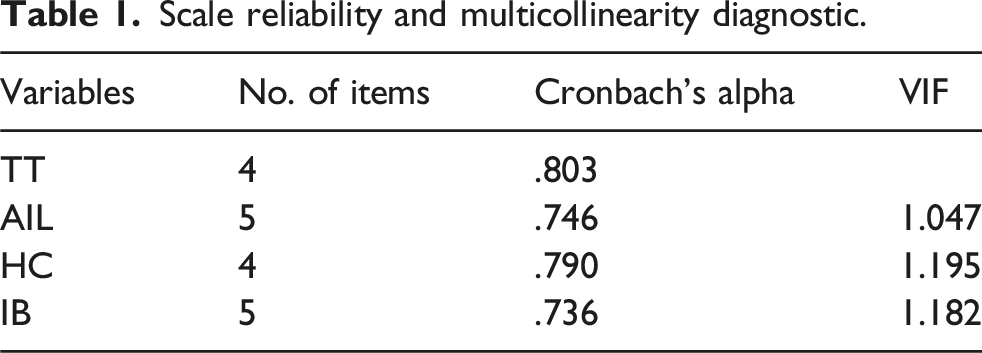
Data processing including editing, coding, and classification was undertaken after data collection. The data were then fed into SPSS version 24 for analysis. Then descriptive (mean, standard deviation) and inferential (conditional process analysis) analyses were carried out. Next, the data’s reliability and validity were assessed. Pilot study with ten participants was carried out. Reliability was assessed using Cronbach’s alpha coefficient, and data that has an alpha coefficient of more than 0.7 is considered reliable; in our instance, all of them are over 0.7. Furthermore, the presence of multicollinearity was assessed using correlation and the variance inflation factor (VIF). Due to the highest correlation is 0.382 between the independent variables, no collinearity was found. Furthermore, all the VIFs are less than 5, indicating that multicollinearity is not a concern.
The study employed Ordinary Least Squares (OLS) regression with composite (summed) scores, which treats scale scores as manifest factors rather than as latent constructs. This approach is consistent with other important studies in management and organizational studies (Podsakoff et al., 2003).
Results and findings
This section presents the analysis and discussion of major findings obtained from both descriptive and inferential statistical analysis.
Analysis of the extent of AIL, HC, IB, and TT
Scale reliability and multicollinearity diagnostic.
Descriptive statistics results.
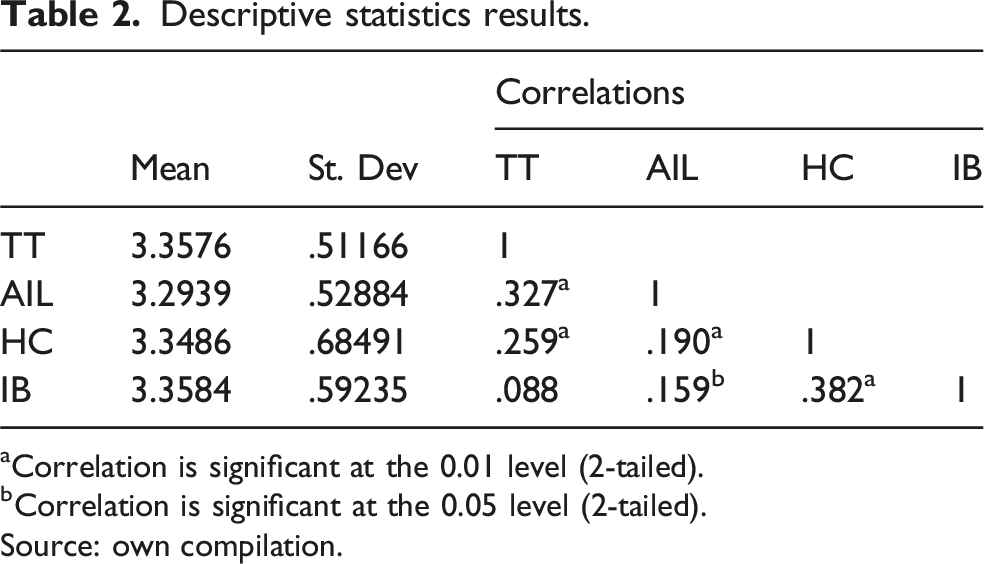
aCorrelation is significant at the 0.01 level (2-tailed).
bCorrelation is significant at the 0.05 level (2-tailed).
Source: own compilation.
The role of AIL on human capital (HC)
The effect of AIL on HC.
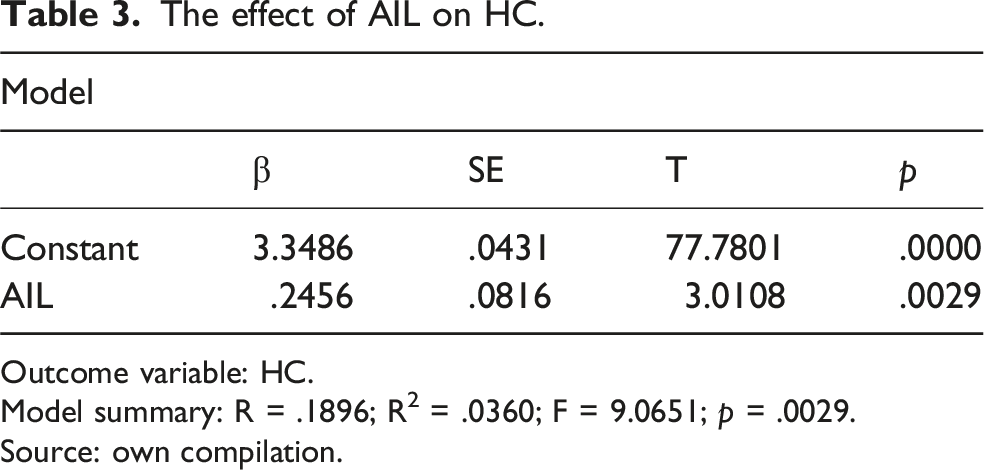
Outcome variable: HC.
Model summary: R = .1896; R2 = .0360; F = 9.0651; p = .0029.
Source: own compilation.
The result revealed that hypothesis 2 which stated that “As the support for AIL is improved, human capital will be enhanced” is supported. According to earlier research (Puerta Sierra and Jasso Villazul, 2018), HEIs transmit knowledge to enhance human abilities and knowledge. While Polt et al., (2001) regarded encouraging AIL to increase access to human capital, Teressa (2022) and Fraser et al., (2019) emphasized that HEIs are training students for practical work. Therefore, the integration of academic institutions with the university is very helpful in developing human capital. That is, the activities by HEIs such as research and education is contributing to develop the industries workforce.
Determinants of technology transfer
The direct and interaction effects of AIL on TT.
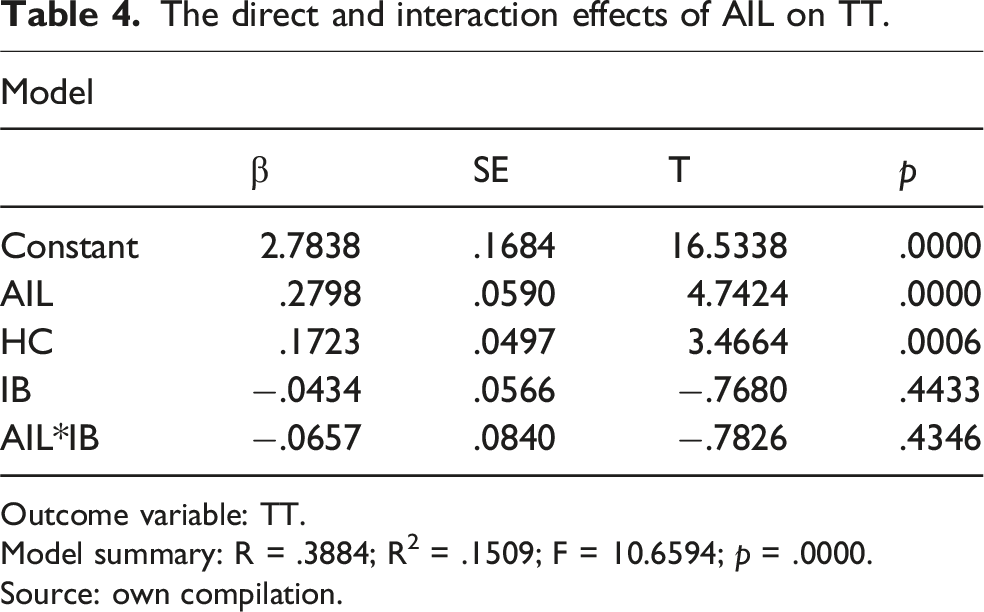
Outcome variable: TT.
Model summary: R = .3884; R2 = .1509; F = 10.6594; p = .0000.
Source: own compilation.
The direct effect of AIL on TT is positive and significant (b = .2798, s.e. = .0590, p < .001). That is hypothesis 1 is supported, which indicates that advances in the collaboration between academic institution and industries will directly contribute to the improvement of technology transfer. Besides, the result indicates that the firms receiving support from HEIs (especially TVET institutes), are benefiting from technology transferred by these academic institutions. This finding is consistent with the finding by Teressa (2022), which argued that successful AIL help firms to transfer technology. That is, universities have a positive impact on society through producing and disseminating information and technology (Carl and Menter, 2021). Okoronkwo et al., (2022) also stated that there is a significant relationship between knowledge transfer and industry linkages. According to Arenas and González (2018), encouraging collaboration between academia and industry can aid TT. Terán-Bustamante et al., (2021) adds that the knowledge and technology transfer the university forges, further connects it with industry. According to Marotta et al. (2007), for industry, working with academic institutions increases the likelihood of them introducing new products specifically and TT generally. A process of TT is heavily dependent on the integration of academia, industry, and government, according to Silva et al., (2019).
Similarly, human capital directly, positively and significantly affects TT (b = .1723, s.e. = .0497, p < .001). This indicates that firms which have better human capital, tend to engage more on TT than the firms with poor human capital. That means, firms whose employees have a higher level of education, or whose managers/supervisors have a higher (perceived) level of knowledge, are more likely to innovate (Marotta et al., 2007) and engage in technology transfer (Figure 1). Path diagram. Source: own compilation.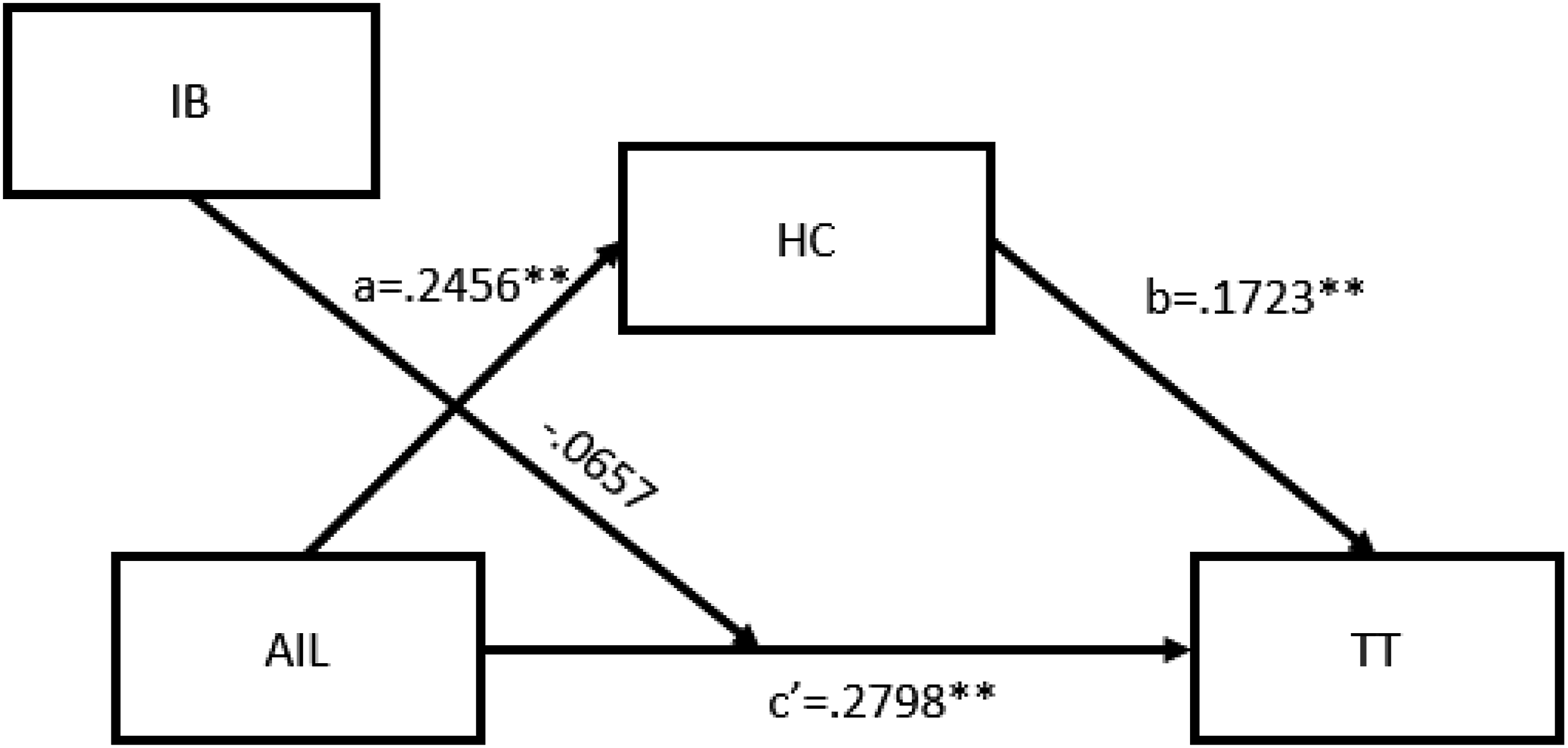
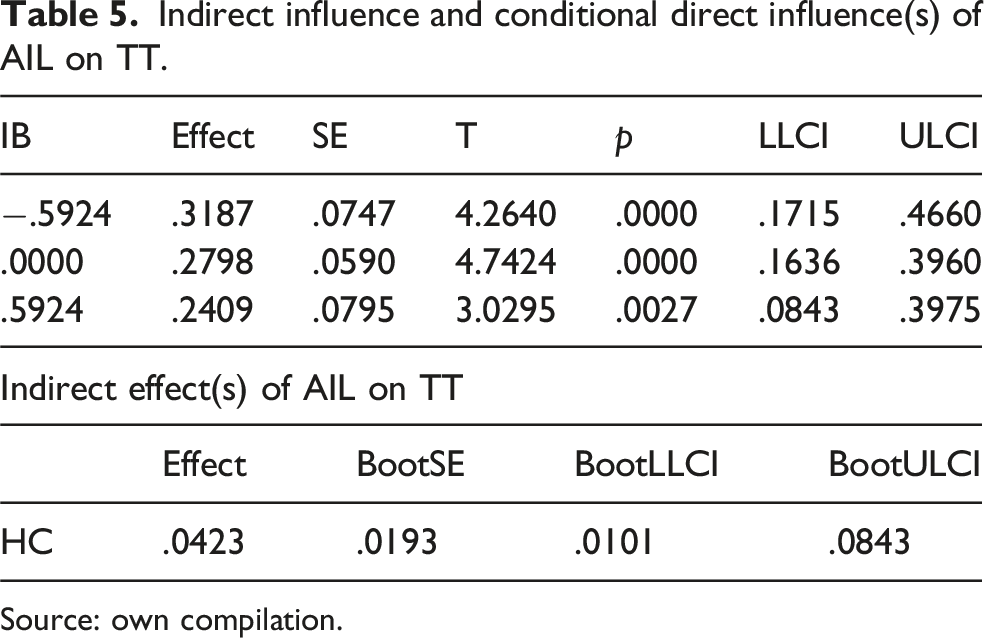
Indirect influence and conditional direct influence(s) of AIL on TT.
Source: own compilation.
The conditional and indirect influence of AIL on TT
The slope associated with AIL in the regress table (Table 5) represent the slope for cases falling at the mean of the moderator variable, IB. This is reflected in the table of conditional effects. Thus, the slope for AIL for cases falling at the mean on IB is b = .2798 and is significant (p < .001), which shows that IB conditionally moderates the influence of AIL on TT. Thus, hypothesis 5 is supported. In line with this finding, previous studies shows that prior experience of AIL lowers orientation-related barriers. It also indicates that breadth of interaction diminishes the orientation-related, but increases transaction-related barriers (Bruneel et al., 2010).
Regarding the mediating role, the bootstrap confidence interval from this result [.0101, .0843] does not contain 0, it can be concluded that the indirect influence is statistically significant. That is AIL affects TT indirectly through HC. This indicates that hypothesis 3 is supported. Thus, the higher the AIL engagement by small firms, the better the human capital which in turn influences the adoption of transferred technology.
Managerial implications
Implication for both practitioners and managers are presented. First, this study shows that the extent of collaboration between academia and small firms are not sufficient. Thus, HEIs need to give more consideration to strengthening collaborations with small manufacturing firms in technology transfers. Since the study found that AIL indirectly influences TT through human capital, policy makers, and government offices must improve the skill and knowledge base of small enterprises to enable them to benefit from the technology transferred from HEIs. Technology generated by HEIs must find its way to SMEs to make them more competitive. AIL must be encouraged and supported to enhance technology transfer’s contribution to economic development, especially in developing economies. Therefore, the management of academic institutions must consider transferring scientific outputs and technologies to small manufacturing enterprises.
The limited scope of structured activities currently in place is reflected in the conclusion that AIL and HC are at modest levels in small manufacturing enterprises. For instance, organized internship programs and collaborative R&D projects are still uncommon, even though some TVET colleges are currently offering field-based training. Policies should place greater emphasis on targeted skill-upgrading workshops, curriculum co-design between academia and industry, and the establishment of innovation hubs where businesses and students engage together on applied projects to close these gaps. By coordinating academic outputs with firm-level requirements, such techniques not only improve the development of HC but also directly increase the efficacy of technology transfer. Moreover, the study shows that AIL is contributing to the advancement of TT. Therefore, policy makers should consider the significance of AIL and incorporate it in their technology transfers policies. There should be a robust policy to support TT transfers via AIL. According to Teressa (2022), stakeholders must coordinate curriculum design and provide a feasible internship. Furthermore, for extensive technology transfer, joint research and development is essential (Bruneel et al., 2010).
Conclusions, limitations, and future research
The main objective of this study was to test both the direct and indirect influence of AIL on TT. It also tested the moderating role of IB in the relationship between AIL and TT. The study shows that the extent of AIL and TT practices are at a moderate level while the development of HC and IB is also rated as moderate. TT is correlated significantly and positively with AIL and HC. Regarding the cause-and-effect relationship, AIL contributes to the development of HC (directly) as well as TT (indirectly through HC). This shows that enterprises who are collaborating with academia benefit from technology transfer offered by the academic institutions. Similarly, AIL contributes to the enhancement of HC skills and knowledge which in turn contributes to the use of technology transfer by the HEIs. Moreover, IB is not moderating the influence of AIL on TT.
This study revealed the influence of AIL on TT considering various factors including HC and IB. However, there are other variables that need to be considered by future researchers. For example, future researchers must test external environmental barriers in the relationship between AIL and TT. There is also a need to examine the triple helix (university, industry and government) concepts in industrial parks. The data for this study was collected using cross sectional design. In future, researchers may have to conduct a longitudinal study to test the influence of AIL on TT and intervention on AIL extent for better extrapolation.
The availability of financial resources, the presence of supportive legislation, and the accessibility of pertinent infrastructure are still crucial but sometimes disregarded institutional barriers in developing countries’ technology transfer ecosystems (Bruneel et al., 2010). Future studies should investigate how financial mechanisms, policy environments, and digital infrastructure support effective TT, particularly in countries with low incomes where these systemic aspects are frequently lacking. Researchers can differentiate between firm-level determinants (like human capital and absorptive capacity) and system-level factors (like policy frameworks or infrastructure availability) that jointly shape TT outcomes by using multilevel modelling approaches, which are also highly encouraged.
Footnotes

Funding
The author(s) received no financial support for the research, authorship, and/or publication of this article.
Declaration of conflicting interests
The author(s) declared no potential conflicts of interest with respect to the research, authorship, and/or publication of this article.