




Abstract
We discuss how neglecting empirical methods courses and studies has reduced the capacity of higher education institutions (HEIs) in low- and middle-income (LMI) countries to develop fruitful collaboration with partners in society and to solve socioeconomic problems. With the situation in Iran serving as background, we first elaborate on the characteristics of higher education in LMI countries and the challenges that impede conducting empirical research. Second, while acknowledging the resource limitations of HEIs in LMI countries, we suggest multiple actions to provide enabling contextual mechanisms and enhance the motivation and capabilities of academic staff to learn and use empirical methods in research projects.
Keywords
Introduction
Although faculty at higher education institutions (HEIs) in resource-constrained developing countries publish significant numbers of papers in peer-reviewed journals, they still struggle to have an impact on society (Sabagh and Moshtari, 2025). This is partly related to resource constraints rooted in external factors like public budget cuts, but we agree with scholars who argue that this is due to a failure to apply sound, rigorous methodologies when addressing issues in which firms and society intersect (Halme et al., 2022). For example, by analyzing operations and supply chain management journals, we found that modelling is the most preferred methodology among researchers from low- and middle-income (LMI) countries like Iran and Turkey, whereas empirical methods—case studies, experimentation, action research, ethnography and design research—are rarely employed.
This viewpoint paper contributes to the literature on university-industry collaboration in developing countries (e.g., Tegegne et al., 2024; Thanh Bui and Takuro, 2024). We propose that not acknowledging or even neglecting training in empirical research methods has reduced the possibility of building mutually fruitful relationships between relevant stakeholders such as HEIs and firms and organizations operating in society. This deficiency may not support identifying and understanding the complexity of problems, offering meaningful recommendations, collecting feedback, improving on suggested actions and subsequently developing theories, providing practical solutions and generalizable recommendations for organizations.
Our discussion is based on the relevant literature and analyses of empirical observations from industrial engineering, management and economics departments in Iran. The focus on these fields is more aligned with management-related research and reflects a pattern common in other LMI contexts: a methodological reliance on modeling, highly centralized governance of education, limited research funding and emphasizing publication volume over societal engagement. These shared features make the Iranian suitable for depicting the challenges faced across many LMI countries across many developing countries, thereby supporting the transferability of our arguments beyond the Iranian context.
The paper first elaborates on the characteristics of higher education in Iran as an example of an LMI country and the associated challenges that reduce the instances of conducting empirical studies. Then, building on the motivation–opportunity–ability (MOA) framework (Siemsen et al., 2008), it suggests a number of actions to provide enabling contextual mechanisms and to enhance the motivation and capabilities of academic staff to learn and use empirical research methods. Building those capacities through the proposed strategies can impact the ability of HEIs to advance the field of management theory, teaching, and practice both locally and across national borders.
Challenges in training and adopting empirical research methods in LMI countries
The first observation is that academic staff have not been trained in and do not teach empirical research methods courses to doctoral students. Most method courses are at a basic level, but advanced aspects like experiments, case studies, longitudinal studies and even action research are rarely if ever offered. Many professors are teaching-oriented and do not have expertise in empirical methods; more importantly, they are not active in conducting research, serving as reviewers for leading journals, or participating in international conferences, each of which limits their ability to mentor doctoral students. What they do teach is based on what they read in research method textbooks rather than their real-world implementation of methods and in-depth interactions with colleagues. In addition, faculty members do not have the skills needed to liaise with companies or the broader society to inspire them to join or support research projects and disseminate study results.
The next observation is associated with the commitment of academic staff to adopt empirical methods in their own projects and the theses they supervise. Compared with modeling studies that mostly generate or use numerical data to illustrate model results, empirical methods require sustained engagement with real-world settings, more time, energy and commitment from researchers and wider stakeholder engagement. Further, more funds and resources are needed for such projects. While modeling can be a valuable approach, especially when it comes to scenario testing and optimization problem and theory development, it often does not consider the specific institutional and cultural realities in which industry operates. By contrast, empirical research usually engages directly with organizations and their communities, which can unravel the contextual factors and tacit knowledge that is generally not captured in purely analytical work. However, in management departments in Iranian HEIs, researchers are faced with limited research budgets and other environmental factors that steer them toward smaller short-term projects that promise quick results and straightforward paths to publication.
Identifying interviewees from a diverse group of stakeholders and collecting data at different times requires devoting substantial time, while theoretical data analysis requires collaboration with researchers within a department or at other domestic and foreign universities. However, Iranian academics at both the doctoral student and faculty level simultaneously work and study; thus, they cannot spend the time required to carry out ambitious and impactful empirical projects. Professors do not earn enough salary, so they must teach extra courses or engage in short-term consulting projects, both of which reduce their commitments to the core research mission. Of course, carefully targeted short-term consulting can provide exposure to practical challenges and pave the way for longer-term empirical research collaboration. However, given the transactional nature of most consulting assignments and the absence of institutional incentives, long-term projects and consequent collaborations remain the exception rather than the rule. The funding agencies want researchers to deliver quick results, mostly in the form of publications, which discourages researchers from conducting empirical studies and cultivating partnerships with industry and the broader society.
In terms of the promotion criteria in management departments, we observed that time and effort spent in creating and developing collaboration with partners in society—identifying relevant research phenomena, jointly developing solutions, observing their impact in practice and eventually disseminating the results—all go unrecognized. Professors are pressured by high teaching loads and poor working conditions; they are pushed to publish papers with a greater emphasis on quantity than on quality. Moreover, it can be difficult to have papers accepted by empirical journals, so doctoral students prefer methods that are easier to complete or more likely to be published. Iranian doctoral students in management have 2 years to finish their thesis in Farsi and then publish one or two papers in international journals. Publishing pure modeling and analytical papers offers a much clearer and more predictable road than tackling difficult empirical research. When faculty members see considerable uncertainty for publishing empirical studies, they discourage researchers from going in this direction. Another issue is that a large group of doctoral students do not consider the quality of a doctoral program to be as important as receiving a PhD as quickly as possible; therefore, they have more interest in taking the fast track.
The next observation is the institutional environment in which academic staff work. Empirical studies about the wicked problems of society require interdisciplinary research and intense, long-term collaboration among scholars. However, the learning environment in Iranian HEIs is poor; professors and their students do not collaborate and exchange information and feedback. Instead, people are worried about plagiarism or others unethically using their work for their own benefit, so they do not share working papers with one another. Similarly, organizing research seminars and publishing workshops is not common, and international scholars are not welcome to take part in the department’s activities; they are viewed instead as rivals. Internationalization efforts in countries like Iram are also limited, so it is not common to use research visits to participate in international events. In addition, the limited research resources are not allocated strategically; funds are distributed among faculty members without considering the quality of their research and their commitment to the full range of academic activities.
Suggestions to enhance training and the adoption of empirical methods
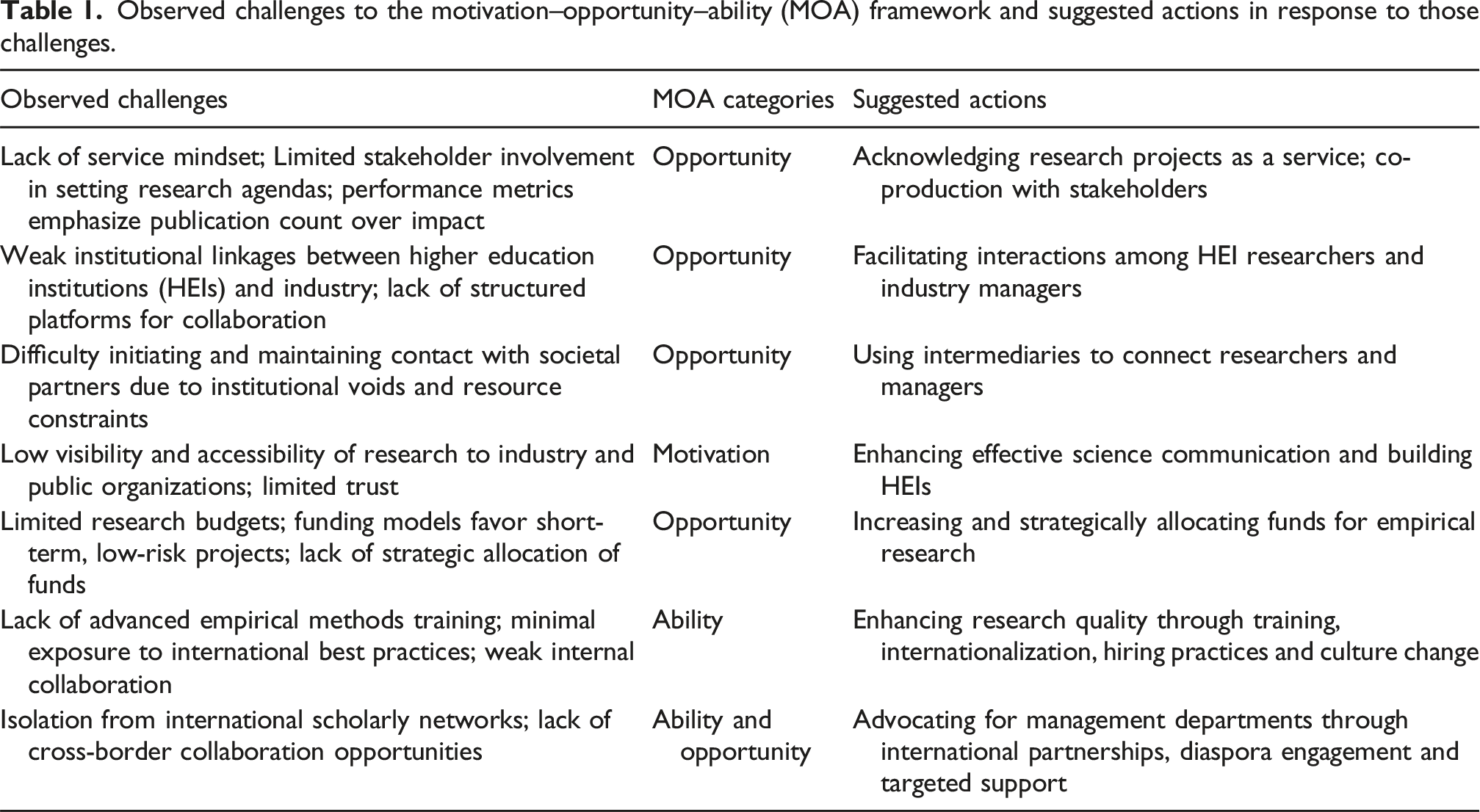
Observed challenges to the motivation–opportunity–ability (MOA) framework and suggested actions in response to those challenges.
Acknowledging research projects as a service by policymakers and HEI managers
Many of the challenges identified above fall under the opportunity dimension of the MOA framework. Addressing these challenges requires rethinking how HEIs conceptualize their role in knowledge production.
HEIs’ services have been driven largely by supply, based on their faculty members’ potential; thus, real demand is not properly captured. Policymakers and HEI administrators should acknowledge that higher education services are not driven by supply and move toward co-production with stakeholders. Knowledge and innovation are not simply transferred from one side to the other but are produced jointly. Ideally, they are about collaboration, dialogue and interaction. Therefore, in line with a service perspective, knowledge cannot be easily transferred from academia to surrounding society (or vice versa); it should instead be co-produced (Suomi et al., 2019).
From a service perspective, academics should discover what kind of knowledge and expertise stakeholders outside academia expect and then aim to co-produce it with them. Stakeholders from outside academia should be actively involved in preparing research agendas and supporting the implementation of research through collaborative and inclusive methods. There could be more research and development projects, particularly those co-designed with partners outside academia.
We argue that when academics adopt a product mindset and presume to live in ivory towers, are overconfident about their competencies and expect managers and policymakers to approach them for advice and to learn about best practices, they do not interact with industry and—as McKinnon (2013) notes—are more interested in impressing one another with their intellectual brilliance than in doing research that is of real value to the wider world. In addition, the lack of a service mindset can be related to the ‘counting productivity’ approach and the pressure to chase indices that are manifested in performance measurement mechanisms of researcher and department performance, which impacts academic behaviors and undermines the practical relevance of research (Hawkins et al., 2022).
Facilitating interactions among HEIs researchers and industry managers
Among the challenges reported above were weak institutional linkages and the absence of structured interaction platforms, both of which hinder collaborative empirical research. These issues align with the opportunity dimension of the MOA framework and call for mechanisms that create enabling conditions for sustained engagement between academia and industry.
We suggest that productive interactions emerge in environments that offer conditions for those interactions to occur. In this context, the notion of enabling conditions opens discussions about the role and influence of organizations on research projects that are designed to solve socioeconomic problems. Enabling conditions help to restore the accountability balance by making impact a responsibility shared among universities, industries, policymakers, academic staff and managers. For instance, if responsibility were shared, governments, research funders and universities could not simply demand impact from researchers without also providing the appropriate enabling conditions (De Jong et al., 2022).
Moreover, universities should support faculty by establishing the infrastructure and incentive mechanisms appropriate for encouraging cross-sectoral partnerships. Macro-level regulations and policies established by legislators and the civil service can help nurture effective and productive industry–university relationships.
Intermediary role of actors in facilitating relationships between researchers and managers
One suggestion is to consider the potential role of intermediaries in collaborations among universities and societal partners; they can provide links between two or more entities that need to connect but cannot do so sufficiently do so without a linking device or support (Howells, 2006). Because LMI countries are inevitably faced with the issues of inadequate resources, short-term views among policymakers and institutional voids, non-governmental organizations (NGOs), civil society actors and independent think tanks can play crucial roles in formulating demands and opportunities for collaboration between universities and partners in society. These actors can co-produce developmental research and innovation agendas with universities by making demand-side information less confusing and clarifying ill-formulated social system problems (Atta-Owusu et al., 2021). NGOs are uniquely positioned to play this role, due to the knowledge of unmet social needs they acquire through activism (Spar and La Mure, 2003) and as service providers to the socially disadvantaged and underserved (Banks and Hulme, 2012). As another intermediary, national and international funding agencies can use criteria that mandate researchers from universities and practitioners from industry to apply jointly for support. In addition, funders should more deeply consider the practical uses of research results when awarding grants.
Effective communication of science for building HEI brands and improving trust
The reluctance of industry and public organizations to collaborate with HEIs is partly due to the low visibility of research relevance, which reflects a motivational barrier from the stakeholder side. Therefore, we suggest having clear science communication strategies between industry and HEIs that can strengthen trust and create mutual incentives for engagement. To enhance industry’s trust of HEIs, universities should systematically communicate and make accessible the theoretical insights or practical relevance of their studies for stakeholders like public funding agencies and partners in industry or the wider society. Such communication should be phrased in language that is understandable for practitioners and managers of business and public organizations: Twitter, Bluesky and LinkedIn posts, policy briefs, articles in professional magazines and so on. As more and more key societal actors discover the usefulness of such activities, they may increase their support of HEIs and approach them more often and more readily for advice in policy matters. To this end, HEI leadership has a crucial role to play by investing in science communication mechanisms and being active in science marketing. Training academic staff to engage in science communication activities, incorporating those activities into promotion criteria and encouraging faculty by giving credit, recognition and visibility to those who are active in these ways would help. In addition, networking events like science or research days and public seminars in the middle or at the end of projects can all increase the scale and quality of science communication (Suomi et al., 2019).
Science communication enhances the transparency and thus the accountability of HEIs to address the training and research needs of society. However, science communication should not adopt a one-way, top-down approach. Hosting professors of practice or visiting lecturers from public organizations, industry, consulting firms and development agencies and other NGOs can help students and researchers learn about best practices and technological and other innovations. In addition, they will become more aware of the challenges that organizations face when formulating their theses and research projects and may choose to address such challenges. Developing long-term projects will be easier for HEIs and partners that already know and trust one another and have jointly developed social capital. These science communication initiatives will also make it easier for researchers to access data.
Support empirical research projects with increased funding
Limited research budgets, combined with funding models that favor short-term, low-risk projects emerged as an opportunity constraint in our observations; we thus suggest that allocating funds strategically to help overcome this barrier. HEIs in LMI countries can increase their funding resources and thus provide funds for empirical research projects that are demanding in terms of time and resources. For example, international funds provided by the World Bank, UN agencies, the European Union or China could all help bolster empirical research. Funding agencies at the national level and charitable foundations can also strategically allocate their funding resources to support projects with genuine practical relevance rather than simply aiming to publish papers. Alumni and academics in the diaspora can facilitate access to such opportunities.
Equally important as increasing the amount of funds is using them in a way to improve the quality and relevance of projects. In many developed countries, core funding models are based on the performance of HEIs: quality of publications, studies’ impacts, employment of graduates and so on. Public research funds are allocated based on intensive competition among academics who make high-quality proposals. These research projects are carried out over the long term to allow researchers to develop deep and fruitful interactions with partners in society, whether that means collecting data, obtaining feedback from international colleagues or disseminating results. In addition, given the interdisciplinary approach needed in research projects if they are to address complex societal problems, large grants are awarded to consortia of academic staff and managers from multiple HEIs and organizations. In these competitive grant processes, successful proposals usually demonstrate a greater commitment to academic activities, are interested in collaborating with industry and international academic collaborators and have a clear plan for disseminating results. In contrast to what is practiced today in Iran, research funds should not equally be distributed to all academic staff, including those who are not active in research. Departments can also support successful staff by giving them bonuses for publications in quality journals and reducing their teaching loads while offering scholarships or decent salaries to junior researchers.
Enhancing the empirical research skills of researchers
Several observations, such as the lack of advanced empirical methods training, minimal exposure to international research environments and poor internal collaboration, point to ability gaps among academic staff. We suggest that targeted capacity-building initiatives can strengthen these capabilities.
The next set of suggestions may help HEIs in LMI countries enhance the empirical research skills of their current academic staff. Empirical research requires social skills, presentation skills, writing and communication with stakeholders, a commitment to contributing to society and an interest in conducting responsible research with real impacts. The first proposal is to increase the scale and quality of universities’ internationalization activities to enhance the skills and experience of staff regarding empirical methods. Research visits to high-performing universities and participating in international research workshops and conferences can help them exchange experience and learn from others, which will eventually increase the multicultural awareness of researchers, enhance their empirical research skills and attractiveness to international research teams and lead to more impactful research (Moshtari et al., 2023).
Developing doctoral programs in which high-quality research courses are offered to students by domestic or international professors is another key initiative. In addition, interactions with stakeholders in writing theses should be encouraged. Improving the academic culture by giving constructive feedback to colleagues, organizing research seminars and inviting international researchers to visit and share insights would also be very helpful. Hiring and promoting professors with expertise in empirical research methods and success in publishing in quality journals should be prioritized, and the promotion protocols of departments should consider the comparative difficulty of publishing empirical studies rather than simply counting publications. Another suggestion is to develop data management and ethical research code protocols to guide researchers and develop trust-based collaborations with partners in society.
Advocating by international partners for management departments in LMI countries’ HEIs
The limited interaction of HEIs in LMI countries with international scholarly networks, as described above, also limits both ability (through missed skill-building opportunities) and opportunity (through a lack of collaborative channels). Engagement with international partners can help overcome these intertwined constraints.
We complete our suggestions by noting several actions that international actors—academic societies, journals, faculty at leading universities and especially the academic diaspora—can carry out to advocate for management departments at HEIs in LMI countries and improve the quality of the supply of and access to international financial resources.
International academic societies can facilitate the participation of researchers from the Global South in conferences by providing them with travel grants or organizing conference sections, or even entire conferences, in a hybrid format to make them inclusive for researchers with limited budgets. In addition, they can encourage their members to initiate (online) training sessions about different empirical research methods and share other online teaching resources. At the university level, developing academic partnerships with HEIs in the Global South, which the University of Arizona among others has already done, can be very helpful in improving the quality of PhD programs: examples include taking part in supervision teams, offering research methods courses and providing funds for research visits.
International researchers, including those in the diaspora, can be pioneers in such efforts. They know local languages and contexts and may have access to data collection and dialogue with managers and policymakers. However, there is a certain preconception that leading international journals and audiences are not interested in LMI settings. Given the importance of the UN’s Sustainable Development Goals and the many calls for relevance and impact by academic societies, journals and funding agencies, it is clear that there is interest in supporting such initiatives. Admittedly, collaboration with academics or institutions in LMI countries is not straightforward. International journals can support empirical research studies in LMI countries by arranging special issues and online and in-person publishing workshops to improve researcher capability in LMI countries (see Akmal et al., 2022, for examples). Indeed, there have been many recent efforts to encourage researchers to move beyond Western contexts and conduct research in an LMI milieu (e.g., Morris et al., 2023; Wickert et al., 2024). Still, limitations in respect to data collection should be considered by journal editors, who need to balance theory building and producing impactful research.
Footnotes

Funding
The authors disclosed receipt of the following financial support for the research, authorship, and/or publication of this article: This work was supported by the Research Council of Finland (332921).
Declaration of conflicting interests
The authors declared no potential conflicts of interest with respect to the research, authorship, and/or publication of this article.