




Abstract
There are many ways in which scientists can engage in entrepreneurial activities. The context of this article is a Swedish research group in marine ecology, which became increasingly involved in entrepreneurial activities. This article focuses on the what, why and how of entrepreneurship as part of an academic role. The study was conducted as an interactive research process, involving activities as well as interviewing participants in the project. Theories of identity work, role identity and passion were used to analyse this context. Two distinct but simultaneous processes were identified: first, when scientists engage in commercial entrepreneurial activities and react by reaffirming their roles as academics and, second, when scientists engage in entrepreneurial activities in a broad sense, fulfilling environmental and social goals (this is compatible with their scientific passion connected to their academic role identity). This article shows that scientists can be entrepreneurial while working with social and environmental responsibility with no conflict between their entrepreneurial activity and their role as an academic.
Keywords
Universities are increasingly faced with the responsibility of solving societal challenges and educating people who will do so (Nowotny, 2003). The literature has shown an increased emphasis on the interaction between sectors in the context of large-scale social and environmental challenges (Carayannis and Campbell, 2009; Carayannis et al., 2012). This also creates pressure for scientists to do more than research and to engage in entrepreneurial activities. An example in the Swedish context is the government research proposal entitled ‘Knowledge in Collaboration – For Society’s Challenges and Strengthened Competitiveness’. Academic entrepreneurship is seen as one way for universities to provide social and economic benefits (Siegel and Wright, 2015). However, there are many other ways for scientists to fulfil their responsibility towards society and different pathways for knowledge transfer (Hayter et al., 2018), which are neither formal nor measured.
Entrepreneurship itself has undergone a transition in which social and environmental solutions have become an important factor: During the industrial era entrepreneurship as progress was associated with growth and material wealth-making. In present times enterprising people who are able to recreate societal structures that enforce sustainable development, environmentally, socially, ethically as well as financially, are much sought after. (Berglund et al., 2012: 1)
At the same time, scientists can be considered to be acting entrepreneurially if we consider the different ways in which academics engage with society apart from commercialisation and start-ups (Perkmann et al., 2013). According to Perkmann et al. (2013: 424), this academic engagement can be defined as ‘knowledge-related collaboration by academic researchers with non-academic organisations’. In this article, we address the question of what, why and how entrepreneurial activities are compatible with an academic role. In doing so, we aim to identify which types of entrepreneurial activities are compatible for these scientists with their academic role.
The case used in this article is a research project called ‘Algoland’ at Linnaeus University in Sweden. The aim of the project is to use biological solutions to clean air and water using waste from industrial, urban or agricultural activities as feedstock. The Algoland research vision is to counteract the negative impacts and risks linked to human activities such as climate change, eutrophication and resource scarcity. Algoland research has been funded by governmental, semi-private and private-sector grants during 2007–2019.
At the intersection of science and global impact, Algoland develops new recycling opportunities using microalgae, whose biomass is a valuable resource for animal feed, fertilizer, biofuels and bioplastics, with an added value for the industrial sector (Rathi, 2017). In collaboration with the cement industry (Cementa, HeidelbergCement Group and SMA Mineral AB), one of the main industrial sources of carbon dioxide (CO2) emissions worldwide (Benhelal et al., 2013), Algoland demonstrated the potential of reducing cement flue gas CO2 by 40% using microalgae (Olofsson et al., 2015) while producing a biomass suitable for animal feed.
Over a decade, the research group has gained a substantial amount of evidence concerning the potential of microalgae solutions to reduce CO2 and recover nutrients from waste streams in the northern climate. While the regional collaboration with industrial and other partners led to successful proof-of-concept, new projects were developed to expand the Algoland concept to other industries elsewhere. The aim was to create an industrial platform which would provide the foundation for a full-scale system that would be sustainable from ecological, economic and social standpoints. In the context of this industrial platform, the scientists engaged in a variety of entrepreneurial activities relating to algae – these scientists are the ‘algaepreneurs’.
Background
The literature on academic entrepreneurship goes back to dilemmas elaborated by Stankiewicz concerning the tension between academic and commercial values (Stankiewicz, 1986) and the scientific ethos proposed by Robert K. Merton (Merton, 1973). Both these lines of thinking focus on differences between the academic system and the social and commercial systems. Later evidence has shown that most scientists can be entrepreneurial hybrids with strong industry engagement while keeping true to scientific norms (Lam, 2010) – suggesting a blurring of the lines between academic and non-academic norms.
One widely discussed topic in academic entrepreneurship is the ‘entrepreneurial university’ (Clark, 1998), the literature on which encompasses studies of increased interactions with industry and intermediaries that encourage innovation and firm creation (Rothaermel et al., 2007). An entrepreneurial university expands the role of the university to include entrepreneurial activities in addition to teaching and research (Etzkowitz, 2003; Schmitz et al., 2017). Further, the entrepreneurial university provides incentives for scientists to become entrepreneurs (Welter, 2011), and universities that support entrepreneurial behaviour do seem to foster entrepreneurial intention among research scientists (Huyghe and Knockaert, 2015). At the same time, it has also been suggested that the entrepreneurial university should adopt a broader conceptual model of entrepreneurship as a way to build skills and knowledge, complementing the dominant model of entrepreneurship with its focus on business creation and economic growth (Gibb, 2007).
Research into the influence of entrepreneurial activity on scientific publishing found that it did not have a negative effect on the amount or content of publications (Van Looy et al., 2004). It has also been shown that the pursuit of additional scientific knowledge is the main motivation for entrepreneurial activities in universities (Morales-Gualdrón et al., 2009). However, there is also evidence of trade-offs for academics engaging in commercialisation activities which can decrease research output (Toole and Czarnitzki, 2010): this suggests that entrepreneurial activities may have a backlash and create tensions between the academic role and the role of an entrepreneur. This effect has been found to vary among university types, with mid-range universities struggling to produce excellent research and contribute to the local economy at the same time (Wright et al., 2008).
Academic entrepreneurship also intersects with the literature on research collaboration, which blurs institutional lines between university and other sectors (Bozeman et al., 2013). It has been shown that the strength of university–industry links is more important for academic entrepreneurship than the number of such links (Fischer et al., 2017). Another way to view academic entrepreneurship is to look at the different ways academics engage with society and the economy. One definition of such engagement is ‘activity that goes beyond the traditional academic roles of teaching and/or research, is innovative, carries an element of risk, and leads to financial rewards for the individual academic or his/her institution’ (Abreu and Grinevich, 2013: 419).
In this article, we support a broad definition of both entrepreneurship and academic entrepreneurship to recognise the variety of activities in which academic entrepreneurs engage and which are not limited to financial reward. Such activities have been referred to as academic entrepreneurial behaviour (Holley and Watson, 2017), a term that recognises the many ways in which science is made useful, including educating, networking and communication with the public (Jacobsson et al., 2014). For scientists, a narrow definition of usefulness can come into conflict with the research process: there are many different ways in which scientists relate to their involvement with external sectors.
The ‘why’ of academic entrepreneurship aims to answer the call for the social responsibility of universities through new forms of entrepreneurial activity (Siegel and Wright, 2015). This engagement with society encompasses a high degree of experimenting and innovative thinking from participants. In this respect, we follow the conception of being entrepreneurial as being a curious and experimenting human being (Johannisson, 2018). Similar to the process in the lab, this entails a form of experimentation with uncertain outcomes. The difference is that scientists are experienced in lab work but are less so with regard to the entrepreneurial process.
Theory
In this article, we use roles as a theoretical lens to understand what happens when scientists in their academic role engage in entrepreneurial activities. A role is linked to a certain social position. Identity is internal but linked to a role, helping individuals to cope with situations. As such, role identity itself is a link between a person and society (Callero, 1985). Role identity includes the different expectations of a role and the corresponding actions for different roles which influence how one behaves (Mathias and Williams, 2017). Multiple role identities may, for an individual, compete with each other and be in conflict (Stryker and Burke, 2000). There is also quantitative evidence that strong academic identification increases conflict between the academic and entrepreneurial roles (Zou et al., 2018): each role carries its own expectations, and the expectations associated with different roles can cause conflict between them. However, multiple roles can also bring advantages in terms of status, gratification and possibilities (Sieber, 1974).
The issue of multiple roles, with the entrepreneur having to handle the transition from one role to another, has also been recognised in the entrepreneurship literature (Hoang and Gimeno, 2010). Entrepreneurs need to manage several role identities and entrepreneurial activities are undertaken based on these different roles (Mathias and Williams, 2017). Similarly, academics may have an academic social identity and many other role identities, including those of teacher, researcher or citizen, depending on the situation. The roles may also change with time or context, depending on the point which the individual has reached in his or her academic career or the entrepreneurial process in which he or she is engaged.
A form of identity work emerges when academics engage in entrepreneurial activity. Identity work is a process whereby individuals customise and validate their professional identity and in which stories are important in the construction of identity (Pratt et al., 2006). This process may cause conflicts in individuals as they change or reaffirm their role identities. Previous theory has identified two strategies that an individual can use to manage changes to their role identity: delegating and buffering (Jain et al., 2009). These strategies can function as ‘brakes’ for academics before their role travels too far to the commercial side. Delegating means that the academics establish contacts to gather resources and skills that complement their own skills. For example, knowledge about commercialisation can be provided by a science park, so academics can concentrate their efforts on research while fulfilling entrepreneurial activities. Buffering enables academics to protect their academic identity through prioritising research and academic norms. Scientists actively take steps to retain their scientific identity when engaging in entrepreneurial activities. Three ways to retain scientific identity have previously been identified regarding role identity salience (Jain et al., 2009): prioritising scientific activities, so that academic work comes first and entrepreneurial activities second; reaffirming the scientific focus by conducting basic research as opposed to more applied research; and resolving conflicts between academic and commercial norms by favouring making knowledge public.
To further explain what influences identity work, the concept of passion can be used, defined as positive feelings and a commitment to certain activities. Specific passions can be connected to specific role identities. Entrepreneurial passion emerges from engagement with, for example, entrepreneurial activities that are meaningful for the identity and result in positive feelings (Cardon et al., 2009). This passion may be directed to specific activities, which may be growth or new products, to people, to inventing or to a social mission (Cardon et al., 2017). Previous research has also shown that such passion varies from content to context. For example, social entrepreneurs are passionate in terms of being enthusiastic and energetic about involvement in the creation of social values (Kropp, 2016), while ecopreneurs are passionate about matters relating to the natural environment (Isaak, 2016). Thus, passion creates meaning and motivation interrelated with the self-identity of an entrepreneur.
Different roles may entail competing passions, such as the entrepreneurial passion and the scientific passion that influence entrepreneurial intention. Such passions can coexist and compete with each other in a form of ‘passion orchestra’ (Huyghe et al., 2016). A strong scientific passion can influence the type of entrepreneurial activities scientists engage in and how strongly they engage. Entrepreneurial activities, on the other hand, can challenge the role identity of an academic entrenched in science. Previous research suggests the importance of this role perspective as a way to understand academic entrepreneurship. Here hybrid roles rather than dichotomies are active (Jain et al., 2009; Lam, 2010) – the academic maintains a core role based in science while layering entrepreneurial activities on top of it.
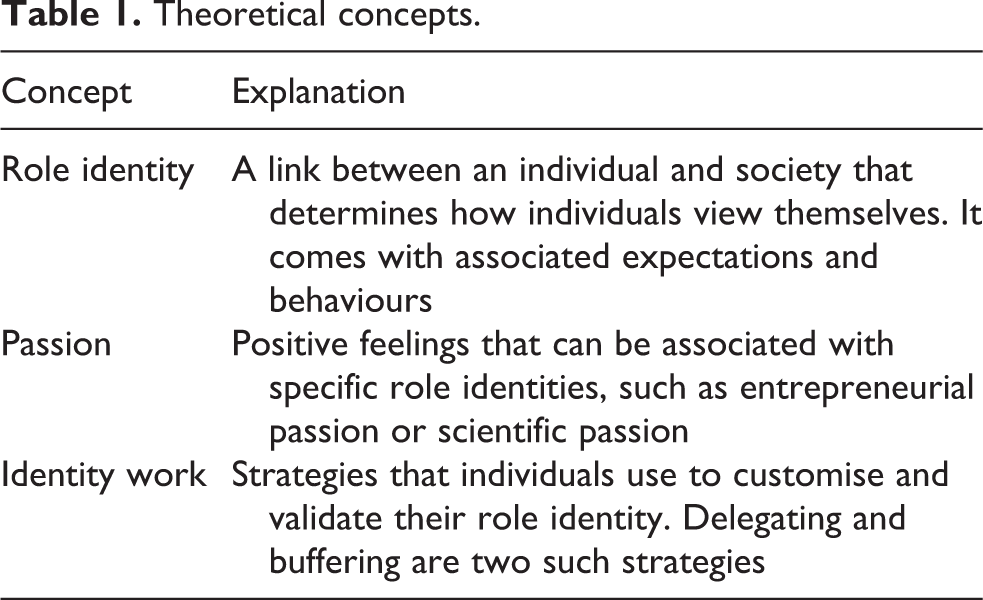
Identity work can be used to ascertain how and when scientists customise and validate their academic role identity. Further, the strategies of delegating and buffering make it possible to analyse how scientists reaffirm their academic role when they come too close to commercialisation. Finally, the concept of passion can help us to determine what type of academic engagement is compatible with a scientific passion. The main theoretical concepts are summarised in Table 1.
Theoretical concepts.
Method
Algoland is rooted in a transdisciplinary collaboration between scientists (microbiologists and ecologists) and non-academic communities and has developed cross-disciplinary research with social scientists to address the more complex issues of sustainable development. Following the development of an industrial platform to extend the positive impact of innovative science-based solutions in Algoland, the main author, with a background in social science, became involved in Algoland during the autumn of 2017. The aim was to study the potential for an industrial platform which would pave the way for the project to reach economic, social and environmental sustainability (as specified in the notes from the initial meeting). Part of the process was to develop a concept that could be used in other industries: one early idea was to examine potential business models based on Algoland.
To study entrepreneurial activities, the study was conducted as an interactive research process (Svensson et al., 2007) and a cross-disciplinary effort between entrepreneurship and marine ecology. The main author became part of the research group Marine Phytoplankton Ecology & Applications (15 members in 2017), participating in meetings, discussions and other activities related to entrepreneurial activity. The co-author is the leader of the research group and the founder of Algoland.
Research group members contributed to the research goals and questions regarding the industrial platform. Bengt Johannisson suggests the merging of researcher and entrepreneur – an ‘entresearcher’ that ‘takes on the responsibility to effectuate a venture and capture its emergence through authentic personal involvement in the venturing process’ (Johannisson, 2018: 70). The concept of an industrial platform organised Algoland activities as a form of entrepreneurial venture.
To assess the potential of an industrial platform with the Algoland vision, a full-day conference was devoted to the construction of business models based on both the advancement of knowledge and the provision of innovate solutions and services of added value. A workshop was conducted based on the Business Model Canvas (Osterwalder and Pigneur, 2010), with participants from research in mixed groups with other external partners. The 20 participants were from municipalities, consultancy firms, the Regional Council in Kalmar County, a waste management association, an energy agency, an energy company, industry, a science park and a mussel farm. The Business Model Canvas templates were filled in and documented and pitches from the four groups were filmed and transcribed.
Six months after the conference, the core Algoland team met with representatives from Kalmar Science Park and an Innovation Advisor from the Grants Office at Linnaeus University. During meetings and through email, discussions ranged from the technology readiness level, ownership of a possible start-up and how possible contracts could be written. Notes from these interactions were used to support the analysis.
Further, six interviews were conducted with participants from the research group and three interviews with external stakeholders involved in the Algoland project. This qualitative material was used to create a case file in qualitative data analysis software, which includes the nine interviews, documentation from the workshop and the meetings and documents and research material produced in the Algoland project.
This material was analysed using initial codes generated after reading through it. The initial codes were based on the theoretical framework and research aim but were also data driven. The material was then coded using thematic coding (Braun and Clarke, 2006; Brinkmann and Kvale, 2015), and preliminary themes were suggested and reviewed, until 14 themes were selected. Three core categories were selected with the research question in mind: collaboration, reflection on the role and academic–commercial tension.
When science meets entrepreneurship
In this section, we show that being collaborative also meant being entrepreneurial – and vice versa – and that this led to a form of identity work. We shall also look at how the scientists managed their encounter with a more commercial view of entrepreneurship using strategies of delegating and buffering.
Being collaborative, being entrepreneurial
The project was built on a collaborative approach from which the entrepreneurial activities emerged. Such interaction was in itself challenging and here the differences between academia and industry were in evidence. During the collaboration, the scientists left their comfort zone and engaged in a process of identity work:1
I6: The industry say they want a business plan while we want to study our data further. They want quick results, that’s the thing! But it’s good that they push us. We try to make them understand that it’s not something that happens overnight. You need to work on it for a long time. I3: It’s challenging to keep up with your academic merits. […] It’s extra work to collaborate with the industry, a lot of phone calls. It’s not the same as lab work as we are dependent on more people. It was frustrating at first but I have accepted the fact that it takes time. I7: I didn’t use to think about it that much but now I constantly think about it. […] Probably because being in this environment and group taught me to think about sustainability. That’s when I realised that I have started to think about for example mass production and mass consumption. I do think about it and try to do it. Try to talk with someone outside that don’t think about it. As I grew up, I actually felt pressure. I9: The soul of the scientist might not be compatible with the soul of the entrepreneur. Algoland have been successful in involving entrepreneurs and could do that to a larger extent. It is in the nature of things that those that do research might not be those that do business from it and make this accessible to society. […] It’s the responsibility of someone else to do this. Algoland would tip over if it stretched too far, it would lose foothold in the academic world.
Dealing with the dominant model of entrepreneurship
Identity work emerged from the collaboration, and from theory, we know of previously identified strategies adopted to deal with it. One strategy the scientists used to reaffirm their role was to delegate (Jain et al., 2009) tasks and resources to industry to complement their own skills: I6: It can be frustrating as you don’t really know how to do this or that. Try to read about it but feel that you don’t have the required background. You can get help from the network you have with industry. Often you don’t know how to go forward and feel you lack the structure and the routine for these things. Then you know that you can go to that person and get help or get access to a broader network. I6: A lot of pressure. When will the business plan come? It’s not something we can do. So we really need to involve other disciplines. Hope that will come and your [main author] work is part of that. The social and economic aspects. We need more of that. I4: The idea is to make this bigger, something reasonable. It’s not a goal that we biologists can fulfil. I5: My interest is research. Application is interesting and we work a lot with that but we are not industry workers. We want to publish research reports. I1: The best thing I have done is not to go all the way to collaborative research. I have always kept one foot remaining in basic research. Balancing between the two. I5: Not necessary. You can do research to find out how things work. You could contribute but there is probably not any responsibility for that. Research should be able to be done without profit. I4: I think the economy controls a lot of other things in society. It’s not good if all aspects of society are run by the economy. You have to think a bit bigger and everything cannot be measured by money.
A broader sense of academic entrepreneurship
In this section, we shall see that the scientists were engaged in an entrepreneurial process simultaneous to but different from the one above. This process was based on a broader conceptual model of entrepreneurship, shown as an engagement with society and the environment – or the so-called academic entrepreneurial behaviour (Holley and Watson, 2017). Here the scientists, as ‘algaepreneurs’, engaged in identity work but did not use the strategies to reaffirm the roles in the same way as that described in the previous section.
Algoland as an entrepreneurial venture
During the collaboration with industry, there was also a constant interaction with the local society in which the scientists engaged in entrepreneurial activities. Algoland was a hub for entrepreneurial activities in a broader sense: I3: Algoland are engaged in outreach events where we meet the public and this in turn contributes to basic science. […] We have worked with a sustainability safari where Algoland is an obvious part. It has grown and attracts 300–600 high school students every year. I9: I am impressed by the fact that Algoland are not traditional researchers that stay in the lab. They stretch as far as they can into the private sectors and the private sector lends a helping hand. Here is the bridge builder that you need to go from research to practice and new ideas for companies. I think that is really cool. I1: We got external funding from a company which was really good. Working on two patents at the same time. At that time it was no problem being a researcher and doing that. It was never my idea to have a start-up and work with my own companies. I’m too scientific for that, although I have the mindset of an entrepreneur. Soon I realised I needed a project name which became Algoland. There are Legoland and other lands that were good so why not think about an empire straight away! That was something to build upon, a vision of something big that could solve societal challenges such as cleaning air and water. I6: When I started working with algae it was a lot of talk about biofuel which is quite dead now. Now it’s more about animal feed and human consumption. […] We need to change things in our society to make it more sustainable. We need to find new sources of protein to raise animals and for humans. The population is growing.
Social and environmental engagement
In the previous section, we saw that this engagement with society was less problematic than the engagement with industry and the commercial view of entrepreneurship. Why was societal engagement more compatible with the academic role? One scientist felt a responsibility towards society to do something about pressing societal challenges: I1: I’m a researcher grounded in science but I’m also a concerned citizen. With all these societal challenges I think that scientific results need to be used in society. I4: When you talk to people it stirs emotions. After they understand what we are doing and how it works they become happier. A lot of stories about how they have seen the sea change. Before you could fish but now there is nothing left. So I hope that people feel that we do something they can relate to […] The response from society is the best part. All the [positive] attention the project receives. I7: Generally people think it’s a nice project. Probably in the future when we approach other people, it won’t be hard to convince them. It has been a project that attracts people and which people find important. Solve a problem and find a valuable product. I think the future is bright. I6: The project has gained attention locally and it sparks interest. People think it’s exciting and fun that we do this kind of project. I don’t know, but there is still some faith, people see potential in this and that contributes to positivity in the project.
Discussion and conclusion
Throughout the empirical analysis, it can be seen that scientists reflect on their academic role. This reflection is particularly present when they encounter activities that sit in contrast to their scientific passion – that which creates meaning and motivation. From the reflection, we can see that when the scientists encounter the dominant model of entrepreneurship, they find safety in their academic role identity. Scientific passion succeeds when competing, rather than coexisting, with an entrepreneurial passion (Huyghe et al., 2016). At the same time, it was less problematic for the scientists to engage with society and to be entrepreneurial in a broader sense. Thus, there are two distinct but simultaneous processes.
First, we can distinguish a process in Algoland, where the collaboration with industry meant that the scientists engaged in identity work in which they needed to reflect on their own roles as academics. The interactions between scientists and industry contribute to the addressing societal challenges (i.e. research matters) but motivate scientists to ‘test the water’ of a dominant model of entrepreneurship. This identity work was intensified when they were confronted directly with ideas about commercialisation. The scientists reacted using strategies of delegating and buffering to reaffirm their role as academics, which function as brakes before they slide over to the commercial side of entrepreneurship. As for entrepreneurial passion (Cardon and Kirk, 2015), scientific passion seems to be important in social interactions in both academic and non-academic organisations. Recognition of Algoland research by non-academic communities and organisations (awards, prizes) also helped to reinforce interactions and engagement with students, industry, authorities and the public.
Second, there is another, simultaneous process which is more compatible with the academic role. Algoland itself can be seen as an entrepreneurial venture, as the scientists venture outside academe with outreach activities and other initiatives. The motivation for these activities was the vision of a better world socially and environmentally. The scientists engaged with society in their dialogue with citizens, authorities and through outreach activities. While this engagement led to a process of identity work, the scientists found it interesting, valuable and even a motivation for doing something more than was expected of them. When testing the water of a broader model of entrepreneurship, they found these outreach activities to be compatible with their scientific passion and therefore the engagement did not warrant the use of strategies to deal with their role identities, but rather enhanced them.
These two processes are shown in Figure 1 as a dual feedback loop.
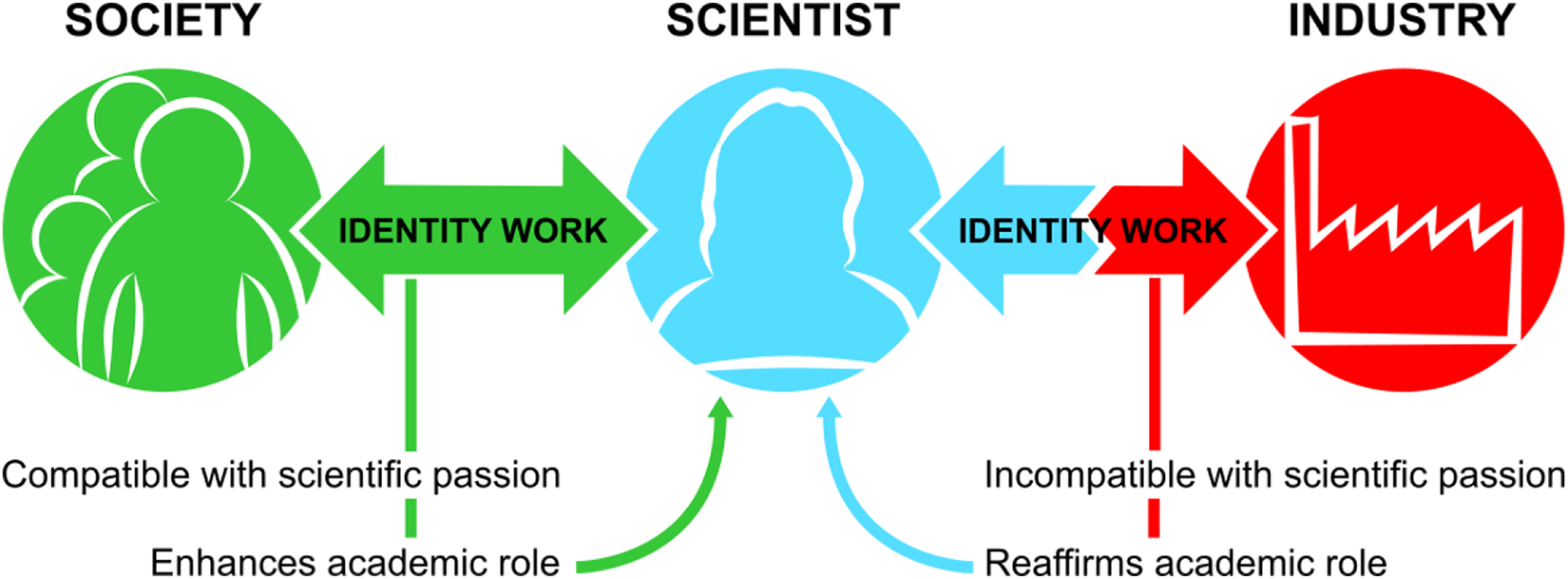
Dual feedback loop of identity work.
This study contributes to our understanding of how scientists engage in and react to entrepreneurial activities. When these activities were formulated in a commercial context, within a dominant model of entrepreneurship, they engaged in strategies as previously shown in the literature (Jain et al., 2009). However, when engaging in entrepreneurial activities in a broader sense, they found them compatible with their scientific passion which in turn related to their academic role identity. Here they were entrepreneurial through their academic engagement (Jacobsson et al., 2014) with wider society. In this respect, we also show that scientists can be passionate about the call for social responsibility and increasing interaction with society (Siegel and Wright, 2015; Wright, 2014) and can successfully integrate related activities into their everyday working life.
The implications for theory include the identification of specific scientific passions. The scientific passion in this case was tied to social and environmental improvement, which motivated the scientists to engage in entrepreneurial activities that would promote such improvement. This finding helps fill a knowledge gap, showing that the interrelationship of passion and identity varies from context to context (Kropp, 2016). In the framework of Algoland, the marine ecologists wished to carry on excellent science while contributing to society and health in a long-term perspective. Hence, the interrelationship between society and the environment became part of their mission. Scientists from other disciplines might have other interests, as this depends on the context. The scientific passion has its roots in particular disciplines that influence the type of entrepreneurial activities and the entrepreneurial intentions of scientists.
While it has not been the focus of this article, the results also have an implicit bearing on studies in sustainable entrepreneurship, eco-innovation and ecopreneurship (Galkina and Hultman, 2016; Rodríguez-García et al., 2019). A key theme in the literature on ecopreneurship is the balance between environmental concerns and business goals. Ecopreneurs are often motivated by their passion for the environment, which gives meaning to their entrepreneurial ventures. Such passion might be part of an endless endeavour to save the world or achieve a sustainable society (Isaak, 2016). We recommend further research on how interactions with partners outside universities affect the academic role.
With regard to implications for practice, the study shows that scientists can be very entrepreneurial in a broad sense, even if they do not want to engage in commercialisation. Other alternatives should therefore be considered when measuring academic entrepreneurship and creating incentives for promoting entrepreneurship. This would involve recognising entrepreneurial activities that are not directly commercial but that have commercial potential or contribute to other forms of social value. It would be detrimental to force scientists directly into commercialisation; it is a step-by-step process, and the scientific passion can, as shown in this study, be deeply rooted.
Algaepreneurs belong to a new breed of entrepreneurial scientists who assume responsibility for a sustainable society based on science-based solutions with a positive impact, such as Algoland. Adopting such social responsibility can later evolve into commercialisation; however, this may not be the passion of scientists.
Footnotes
Declaration of conflicting interests
The author(s) declared no potential conflicts of interest with respect to the research, authorship, and/or publication of this article.
Funding
The author(s) disclosed receipt of the following financial support for the research, authorship, and/or publication of this article: This study has been funded by research grants (to CL) from the Swedish Research Council Formas through the Strategic Research Environment (Ecochange), the Kamprad Family Foundation (BlueWetlands), and the Swedish Energy Agency (grant no. 44677-1).
