




Abstract
Employability is significant to higher education. Given employability’s importance, higher education practice has been affected. However, employability is a complex concept with several stakeholders. Even though students are interested parties, their understanding of employability is not well-known. This paper is interested in employability from the student perspective. Its aim is to explore the student experience of employability within higher education. The research approach of a collective case study involving 11 students was taken. Data collection methods included semi-structured interviews; students supplied employability related stories. Additionally, work placement reflections plus mentor feedback forms were examined. Findings confirmed employability is a multifactorial concept, however, a fit between worker and their work was considered most valuable
Introduction
Graduate employment is a significant issue for universities in England. Following the publication of the Dearing report in 1997, student fees were introduced for higher education in this country. Graduate employment outcomes were one rationale for the introduction of student fees (Augar, 2019; Browne, 2010; Dearing, 1997). Graduate employment outcomes were considered one justification for the introduction of student fees because students were identified as the people most likely to obtain highly skilled, highly paid work following their studies. As a result, they were identified as the most appropriate funders of their education (Browne, 2010; Dearing, 1997). Because graduate employment has influenced higher education funding, graduate employment outcomes for individual higher education institutions are monitored by England’s higher education regulator, the Office for Students. In fact, a university’s graduate employment outcomes contribute to an institution’s position in the United Kingdom’s university league tables (The Guardian, 2024).
Reflection on employability interpretations demonstrates a connection between graduate employment outcomes and employability. Employability is a multifactorial concept with some difference in opinion regarding its nature (Romgens et al., 2020). Despite some variation in employability conceptualisations, certain dominant characteristics of employability exist. Employability is often perceived as an individual’s ability to obtain and retain employment (Trought, 2012). Additionally, employment possessing some match for the individual is linked to employability and considered beneficial (Yorke and Knight, 2006). The association between employability and a fit between an individual and their work demonstrates the labour market is relevant to employability. Indeed, employability has been defined as incorporating a relationship between the individual and the labour market (McQuaid and Lindsay, 2005). Given individual acquisition of employment is an employability characteristic, a link between employability and graduate employment outcomes is recognisable. Furthermore, the notion that highly skilled people obtain highly skilled jobs connects graduate employment outcomes with employability. An association is evident because a fit between worker and their work is a feature of employability.
A relationship between graduate employment outcomes and employability explains the effort directed at employability facilitation within higher education (Healy, 2023). Connections between graduate employment outcomes and employability also highlight employability conceptualisations matter. Employability interpretations are important because they affect higher education practice, for example, alterations in the higher education curricula have taken place to encourage employability (Riebe et al., 2010). Higher education endeavours pertaining to employability illustrate universities are employability stakeholders (Trought, 2012). Nevertheless, employers and students are also interested parties (Tymon, 2013). Since employability concerns employment and the labour market, employers are of relevance to employability. Given students are the recipients of action taken by universities to foster employability and, because graduates are likely to be in search of work (Augar, 2019), students are also employability stakeholders.
Despite being employability stakeholders, student views on employability are not dominant in employability literature (Donald et al., 2017; Tymon, 2013). Some previous studies have focussed on employability from the student perspective usually in relation to specific issues, for example, student fees (Donald et al., 2017), skills development (Tymon, 2013) and work placement (Jackson, 2015). Notwithstanding the existence of some prior insights regarding the student perspective of employability, an enhanced general understanding of employability from the student viewpoint remains advantageous. An enhanced appreciation regarding students’ general understanding of employability is beneficial because this development encourages the illumination of students’ priorities concerning employability. Consequently, this paper aims to explore student experiences of employability within higher education. The main research question for the study underpinning this paper is What are the student experiences of employability within higher education?
Different approaches have been taken during previous attempts at employability interpretation. Stakeholders have been consulted using surveys (Zhao and Cox, 2022) and interviews (Donald et al., 2017). Additionally, numerous employability conceptualisations have resulted from theoretical studies (Flanagan, 2022). Given this paper is interested in students’ general understanding of employability and the aim of this research is to explore students’ experience of employability within higher education, the research approach of a collective case study was considered most valuable in meeting this paper’s aim. Data collection methods included the conduction of semi-structured interviews plus the acquisition of employability related stories from students. Work placement reflections and work placement mentor feedback documents were also examined.
Literature
Employability interpretations
As stated, previous employability conceptualisations have been undertaken and definitions vary. In fact, Small et al. (2018) state ‘Based on evidence to date, it is clear there is no single agreed definition of employability’ (p.162). Forrier and Sels (2003) recognise that employability definitions have altered over time. They describe how early understandings of employability connected the concept with a desire for full employment and subsequent employability interpretations linked employability with support for unemployed people.
Having accepted employability definitions change, recent employability interpretations demonstrate an onus on the individual. Trought (2012) links employability with a person’s capacity to obtain and retain their employment in a dynamic labour market. Forrier and Sels (2003) agree but, they highlight that employability encompasses individual employment retention over a long period of time, for example, while a person is of working age. Yorke and Knight (2006) also connect employability with a person’s ability. Having acknowledged employability incorporates an individual’s ability to obtain employment, Yorke and Knight add that employability also involves the acquisition of employment which possesses some match for a person. Importantly, Yorke and Knight advocate that some fit between the individual and their work is rewarding because there is opportunity for self-fulfilment. Harvey (2001) also associates employability with some fit between the individual and their work. Harvey’s research was informed by employer opinions. Employers appreciated the presence of some fit between worker and their work because they valued a match between the abilities of potential employees and the work available to them.
The labour market and other contributory factors
Despite some variation in understandings of employability, recent literature does confirm individual ability is significant to the concept. Indeed, Peeters et al. (2019) assert it is the strong association between employability and individual ability which has fostered connections between employability and personal resource accumulation. Nevertheless, despite a notable link between employability and individual ability, the perception that employability includes some match between a person and their work suggests the labour market is of relevance to employability. Several authors emphasise the labour market’s importance. Forrier and Sels (2003) stress employability involves a person’s ‘chance’ of gaining employment (p.106). They add that ‘chance’ is affected by a person’s ability plus labour market characteristics. McQuaid and Lindsay (2005) maintain employability possesses 2 aspects. They name the 2 aspects as supply and demand focussed. The Supply focussed aspect of employability concerns the individual. The demand focussed element pertains to the labour market. Furthermore, McQuaid et al. (2005) accept employer preferences impact upon employability.
The presence of a different emphasis regarding employability confirms employability is multifactorial. Further perusal of employability literature highlights additional contributory factors. Bateman and Crant (1993) researched the effects of personality on peoples’ ability to work well with others. Given employability involves the labour market which encompasses the workplace and the workplace is a social environment, a person’s ability to work well with others appears significant to employability. Bateman and Crant found that the possession of a proactive personality (a disposition to proactively influence an environment) had a positive impact on social interactions within the workplace. Other authors have found personality traits affect employability, for example, Van Dyk (2015) argues hardiness affects a person’s work readiness. Di Fabio and Saklofske (2014) maintain emotional intelligence influences career decision making. Trait emotional intelligence is also thought to stimulate self-regulatory processes within a person which enhances resilience and creates a positive outlook during work searches (Udayar et al., 2018). Goleman (1996) agrees with Di Fabio and Saklofske (2014) plus Udayar et al. (2018). He argues that emotionally intelligent individuals can control their emotions and cultivate the positive outlook necessitated for employability. Bolkan and Goodboy (2011) associate positive self-perception with self-efficacy. Self-efficacy involves self-belief (Bandura, 1997) and, it has been connected to employability (Turner, 2014). Mao and Shen (2020) argue identity is important to employability. They talk in terms of ‘identity capitalization’ (p. 188). Identity capitalization incorporates pursuits which will influence how a person is perceived in the workplace.
Having acknowledged that additional factors have links to employability, most examples provided in this paper support the significance of personal resource accumulation to employability (Peeters et al., 2019). For example, emotional intelligence can be learnt (Goleman, 1996). Involvement in activities which promote mastery of experience encourages self-efficacy (Bandura, 1997). Furthermore, Mao and Shen (2020) advocate that individuals establish useful contacts in order to enhance their identity capitalization.
The impact of employability conceptualisations
The introduction to this paper recognised understandings of employability are impactful, for example, universities have been made accountable for graduate employment outcomes (Office for Students, 2020) and, graduate employment outcomes relate to employability. Additional effects on higher education practice concern the connection between individual ability and employability. The link between individual capacity and employability has fostered the advocacy of personal resource accumulation (Peeters et al., 2019). Applicable resources include knowledge (Dearing, 1997) and skills (Fallows and Steven, 2000). Because knowledge and skills are considered valuable resources for employability and, universities are considered repositories of knowledge (Williams, 2013) plus skills (Fallows and Steven, 2000), potential students are encouraged to attend university in order to acquire those resources (Augar, 2019). As a result, the onus on employability within higher education is strengthened (Augar, 2019). Universities have also developed strategies considered appropriate to employability advancement (Coopers and Lybrand, 1998; Healy, 2023). Examples include the facilitation of skills development within a module such as the teaching of team work (Riebe et al., 2010). Careers departments have also evolved (Bradley et al., 2021).
Theoretical developments have resulted from employability interpretations, for example, numerous employability models have emerged. The models vary depending upon the author’s emphasis, however, several possess advice on employability facilitation for higher education students. Yorke and Knight’s employability model (2006) focuses mainly on the curriculum. Yorke and Knight advocate the value of subject specific knowledge. They also encourage the embedding of employability skills within higher education programmes. The production of progress files by students which chart employability skills development is recommended. Dacre-Pool and Sewell’s employability model (2007) highlights personal characteristics as being vital for employability. Dacre-Pool and Sewell acknowledge the significance of emotional intelligence to employability and they argue that a student’s self-esteem is impactful. As a result, Dacre-Pool and Sewell support strategies which develop self-knowledge such as teaching students how to reflect effectively. Tomlinson (2017) defines employability as ‘Largely constitutive of the accumulation and deployment of a variety of interactive forms of capital’ (p.339). The different forms of capital include human, cultural identity and psycho-social. Consequently, activities such as social networking are advocated in Tomlinson’s model.
Perusal of some employability models reaffirms the contribution of personal resource accumulation to the concept (Peeters et al., 2019). Nevertheless, the relevance of the labour market is also apparent. The models of Yorke and Knight (2006) plus Tomlinson (2017) support student interactions with the labour market via work placements. Additionally, Hillage and Pollard’s employability model (1998) champions effective work searches.
Employability stakeholders
Tymon (2013) recognises the existence of several employability stakeholders. She identifies employers, higher education staff and students as interested parties. Tymon (2013) argues that different viewpoints concerning employability vary according to the stakeholder. Her assertions are supported via a study by Konig and Ribaric (2019). Konig and Ribaric researched the employability interpretations of higher education staff plus employers. Both higher education staff and employers connected employability with a person’s ability to be employable and both stakeholders linked an individual’s capacity to be employable with the possession of personal resources. Nevertheless, despite similarities in the employability interpretations, opinions did vary. Higher education staff and employers’ views differed regarding the importance to employability of various personal resources. Tymon stressed that despite the existence of several employability stakeholders, students’ understanding of employability is not prevalent in employability literature. Tymon’s response to her identification of a gap regarding the student perspective was her study which explored students’ understanding of employability in relation to skills development (2013). Tymon found students appreciated the relevance of skills development in relation to employability. Later studies concerning the student viewpoint of employability were completed by Jackson (2015) and Donald et al. (2017) Jackson (2015) surveyed students regarding the contribution of workplace experiences to their employability. She concluded that work placements supported skills development. Donald and colleagues (2017) were interested in student opinion regarding the balance between the financial burden of a university education versus the possible employability related advantages. They found that students evaluated their financial investment in higher education positively, nevertheless, students possessed concerns regarding diminishing employability related returns. Decreased employability related rewards were connected to higher tuition fees, debt, and interest payments. Prior studies confirm students are important employability stakeholders. Prior research provides valuable insights from students on aspects of employability. However, a general insight regarding the student perspective of employability remains beneficial.
In summary
A summary of employability characteristics from previous interpretations.
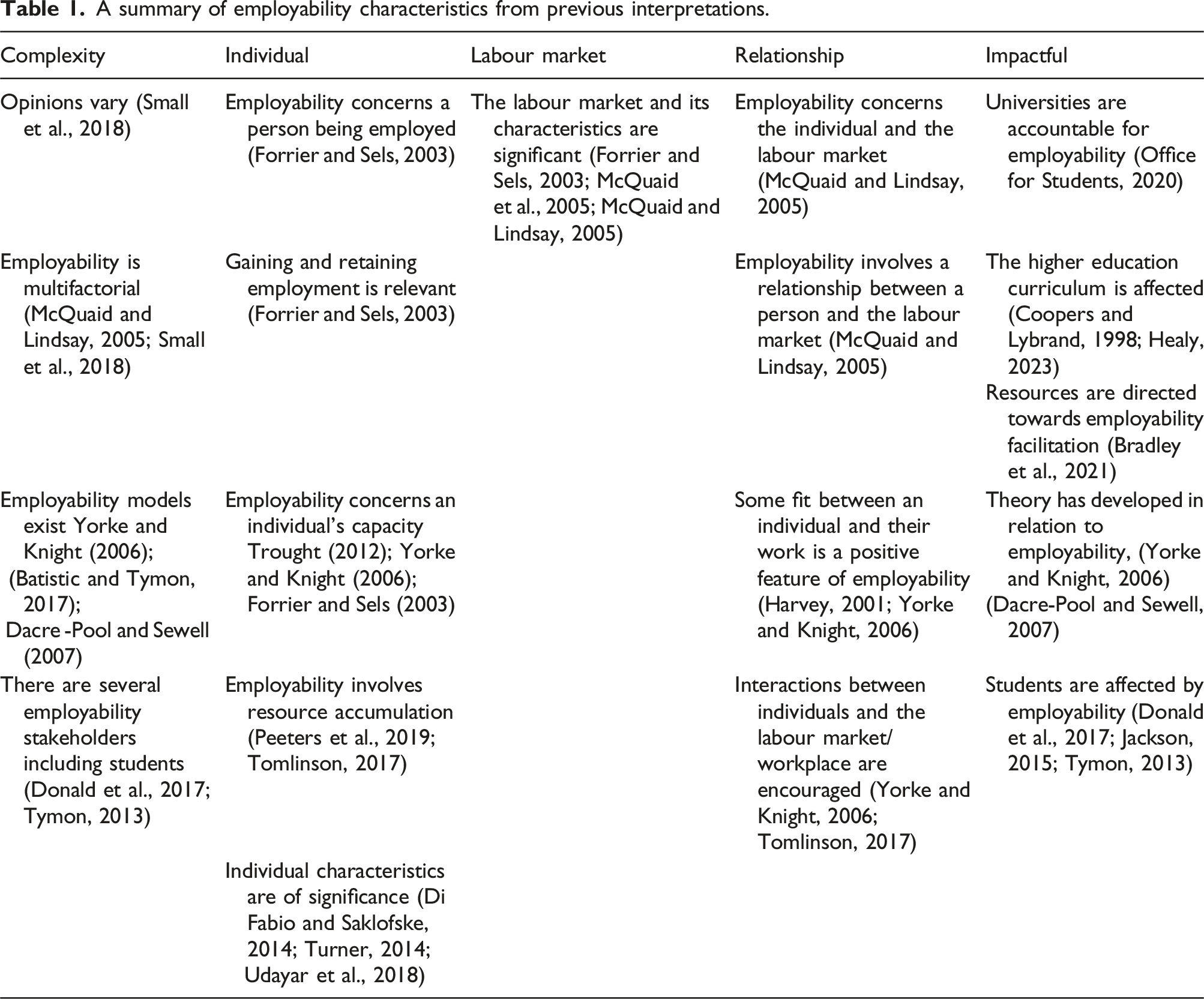
This paper’s literature review and synopsis support further study of the student perspective on employability. Further study is advantageous because the intricacy of employability has been illuminated. Some effects of employability on higher education have been recognised. This paper appreciates higher education practice impacts upon students, consequently, students are important employability stakeholders with valuable views on this subject. Also, students are also likely to seek work at some point. This paper acknowledges prior studies exist which have focussed on certain aspects of employability from the student perspective. Nevertheless, a general interpretation of employability from students remains beneficial. A general insight from students regarding their understanding of employability will illuminate students’ priorities in this area.
Methodology
As previously expressed, the aim of this paper is to explore student experiences of employability within higher education. As stated, the main research question for this paper is -What are the student experiences of employability within higher education? The main research question plus the literature review for the study underpinning this paper influenced the creation of the contributory research questions. They are- 1, What is employability and how do students define employability? 2, What teaching and learning strategies have universities used that are thought to facilitate employability? 3, What other contributing factors are present? 4, How do students perceive the link between higher education and employability? And finally, 5, How do students connect their assessments of learning with their appraisals of employability related success?
Given the study informing this paper is interested in students’ experiences, it is qualitative and interpretive in its nature. As a result, the creation of a theoretical framework was necessary (Collins and Stockton, 2018). This paper’s research questions as well as its literature review inspired the construction of the theoretical framework. The main research question plus contributory research question 1 signal the desire to understand employability from the student viewpoint. Contributory research questions 2, 4 and 5 demonstrate an understanding that employability encompasses learning. Notions that employability incorporates individual capacity, personal resource accumulation as well as the identification of higher education as an employability stakeholder support the belief that employability involves learning. In recognition of a connection between employability and learning, Dewey’s theories of learning were used in the construction of the theoretical framework. Contributory research question 3 reflects employability’s multifactorial nature. Employability’s multifactorial nature is recognisable in research question 3 because this question enquires about other contributory factors. In addition to individual capacity, the labour market is pertinent to employability. The significance of the labour market to employability encourages an acknowledgement that the workplace is of relevance. Given the workplace is a societal feature and a social environment, Bourdieu’s sociological theories appeared appropriate to this research. Additional contemplation of Bourdieu’s’ theories alongside further reflection on the nature of employability encouraged the use of Bourdieu’s’ views on capital in this paper’s theoretical framework. Bourdieu’s theories of capital were considered particularly valuable considering the association between personal resource accumulation and employability.
The research questions plus its literature review also motivated this paper’s research approach and case study was favoured. Case study has been utilised in qualitative research (Yin, 2014). It is considered advantageous in understanding individual experience (Yin, 2014). Significantly, exploration of employability literature had encouraged some initial research ideas and, even though initial research ideas are often discouraged in qualitative research (Riessman, 2008), the possession of pre-conceived ideas is acceptable in case study (Eisenhardt, 1989). The case study featured in this paper is exploratory, instrumental, and collective. This case study is exploratory because it is interested in students’ experience (Stake, 1995). It is instrumental because developments in the understanding of student experience are contributing to an understanding of employability. This case study is also collective because several cases are studied in order to achieve the research aim. The decision to complete a collective case study was motivated by belief that experience occurs overtime (Ricoeur, 1984). In anticipation that student experiences may vary according to their year of study, the collective case study incorporated 3 cases. Case 1 included 4 students in year 1 of their degree (2 of these students subsequently left the university). Case 2 included 3 students in their second year and Case 3 incorporated 4 students in their third year. Additionally, the research informing this paper took place over an academic year. All participants in the study are described as vocational learners. They are described as vocational learners because all participants were involved in degrees which contributed to a Children, Young People and Families cluster of programmes. Informed consent was obtained and the research was subject to ethical approval.
Themes reflecting students’ interpretation of employability.

As recommended in Eisenhardt’s account of building theory from case study research (1989), employability literature was used in interpreting all the themes which emerged from the data. The theoretical framework was also utilised when considering student responses.
Findings and discussion
As mentioned in the previous methodology section, themes were similar across all cases, consequently they are presented and discussed as a collective case study, nevertheless, the original cases are identifiable.
Employability involves a fit between worker and their work
Student insights regarding their interpretation of employability reflected the perception that employability is a multifactorial concept. Despite confirmation of employability’s multifactorial nature, this paper stresses that a fit between worker and their work is fundamental to employability according to students. See the following data extracts: ‘I would say it’s about how well-fitting you are for the job’ (case study 2 student). ‘It means to employ somebody with the skills and knowledge they have for that job, not just any job’ (case study 3 student) ‘I think it’s about having the tools to find a job that you would like rather than just what you can get’ (case study 3 student)
The multifactorial nature of employability is well-recognised in employability literature (Romgens et al., 2020). Additionally, the idea that employability incorporates some match between the individual and their employment has been articulated by other authors (Harvey, 2001; Yorke and Knight, 2006
Factors impactful on fit
Knowledge, skills, practicalities, the social, change, happiness and challenge were all identified as influential on a fit between worker and their work by students.
Knowledge
The following quote concerns a student’s reflection on the value of her degree in relation to her employability: ‘So, I think in terms of study… having relevant ideas and knowledge to fit properly’ (case study 3 student).
One explanation for the relevance of knowledge to a fit between worker and their work was that students believed pertinent knowledge helped a person do their job. ‘I work in a call centre; I do have knowledge about what I am doing’ (case study 2 student). ‘Somebody who knows what they are doing’ (case study 3 student).
Significantly, workplace mentor feedback documents also demonstrated an appreciation that knowledge facilitated a fit between worker and their work. 5 participants within the collective case study completed a work placement and 4 work placement mentor feedback forms were available for examination. The mentor feedback forms ask - ‘What top 5 skills or knowledge do you think a graduate should have to be successful when entering your sector?’ In response to this question, 3 mentors identified ‘relevant knowledge’ and 2 mentors picked out ‘sector and industry knowledge.’
Given mentors and students interact and mentor feedback forms are shared with students, mentor opinion regarding the contribution of knowledge to a fit between worker and their work is known to students. Consequently, it is possible, mentor views regarding the contribution of knowledge to employability may have affected student opinion. Additionally, social policy proclaiming knowledge is influential on matches between individuals and their work (Augar, 2019; Dearing 1997) has influenced higher education practice, for example, graduate employment outcomes are monitored (Office for Students, 2020). Given that participants in the research underpinning this paper were students, it is probable dominant attitudes within higher education have influenced their views. Nevertheless, this paper also found students’ workplace experiences affected their opinion concerning the contribution of knowledge to a fit between worker and their work. The following extracts from students’ workplace reflections show that students discovered university acquired knowledge helped them understand their working environment. ‘The child protection module helped me understand the roles of the staff members, for example, I know the role of the child protection officer and how they would ensure the safety of the students’ (case study 2 student). ‘Supported staff in class with carrying out observations on the children. This links to the pedagogy modules which looked at the EYFS curriculum and the planning of activities to comply with this and meet children’s needs’ (case study 2 student).
The data above not only supports the value of knowledge in facilitating a fit between worker and their work, it confirms employability involves learning. The students’ insights also corroborate Dewey’s social constructivist views on learning. For Dewey, learning which occurs in different aspects of a person’s life combines and builds over time (1938).
Skills
Participants in the research informing this paper also appreciated that skills affect a fit between worker and their work. ‘Well for me, it is like everything I learned and like build on in all my skills that make me suitable to be employed in certain situations. I tend to build on skills based on what employment I am going into’ (case study 1 student). ‘I would say employability means for me, to employ somebody with the skills and knowledge they have for that job, not just any job’ (case study 3 student).
Significantly, students did not talk about specific skills when they reflected upon the contribution of skills to a fit between worker and their work. They mentioned skills in the pleural and the term skills set was used by one student when discussing employability. ‘When I think of employability, I think about the skills set that we have’ (case study 1 student).
This finding appears surprising given many skills are valued by employers (Tymon, 2013). However, like knowledge, skills are highlighted in social policy and higher education texts as being significant to the facilitation of a match between workers and their work (Dearing, 1997; Fallows and Steven, 2000). Indeed, universities have adopted teaching approaches considered pertinent to skills facilitation (Coopers and Lybrand, 1998). As a result, it is possible that, once more, higher education practice has influenced students’ views.
Importantly, students also mentioned the contribution of personal characteristics to a fit between worker and their work. However, when discussing personal characteristics, students were more specific. ‘I think personalities make a difference in different jobs’ (case study 1 student). ‘It is the suitability of both the workplace to the person and the employee to the workplace and the visions and values of the workplace. You know, are you all singing from the same hymn sheet?’ (case study 1 student). ‘Being adaptable and resilient…they want somebody who is ging to be able to adapt …roles are changing’ (case study 3 student).
Students’ propensity to identify particular personal characteristics as being significant to a fit between worker and their work suggests personal characteristics are meaningful to them. The contribution of personal characteristics to employability has been acknowledged in employability literature (Turner, 2014; Udayar et al., 2018). Given higher education curricula has been adapted to facilitate employability (Healy, 2023), it is possible students may have read texts acknowledging the relevance of personal characteristics to employability. Nevertheless, students’ identification of certain personal characteristics as being pertinent to a fit between worker and their work indicates this understanding may have been learnt beyond higher education.
Reflection on students’ responses regarding the contribution of both knowledge and skills to a fit between a worker and their work alongside an acceptance universities are associated with both knowledge and skills development (Trought, 2012), encourages an appreciation that students participate in higher education to advance their employability.
Practicalities
An appreciation individuals enrol on degree programmes to advance employability motivates an understanding that practicalities affect employability. Previous authors have recognised practicalities are significant to employability (Forrier and Sels, 2003). However, this paper demonstrates just how important practicalities are to employability. According to this paper, students balance different practicalities in order to advance a fit between them and a form of employment. The following data extract demonstrates a student balancing the practical need to earn money to fund her student life style with the practical need for time to enhance her knowledge. ‘The plan now is to stay waitressing at the restaurant because they are quite flexible with hours like, if I say I’ve got some assignments, can I have less shifts – they will do it for me’ (case study 1 student)
The next example also demonstrates a student balancing activities. In this example, she balances the completion of a work placement with two other jobs. One of the jobs provides the student with the practicality of money, the remaining job offers her knowledge which she considers pertinent to the acquisition of work which is a match for her. ‘So, since our last meeting, I have started a new job. I have reduced my hours so I can focus on my placement. I’ve recently got a teaching assistant job that is paid so, I have reduced my hours at the supermarket’ (case study 2 student).
Students also offered insights into the difficulties of balancing practicalities. One student commenced work in a department store to fund her student lifestyle. As time progressed, the paid employment eclipsed her degree progression. She said: ‘I think I have just had enough. I think I put too much pressure on myself. You know with working as many hours as I did as well as going to uni and, because me and my partner are renting, so it is a lot. I do it all myself, so, I think alongside uni., it was a bit too much and I sort of realised that I just wanted to work all the time’ (case study 3 student).
Further data reinforces the challenge of balancing the practicality of money with time to study and obtain knowledge. ‘I am working now and it is quite difficult to balance because I have been promoted to bar manager which consequently means iam therefore responsible should a staff member phone in sick, so if you think, last week, I did 54 hours on top of doing my degree’ (case study 1 student)
Bourdieu’s insights regarding economic capital are pertinent to findings which show students balance the practicality of money. Bourdieu used the term capital to illustrate individual possession of resources and the distribution of power within a society. According to Bourdieu, the more capital an individual possesses, the greater their power. Bourdieu also links capital with class (Moore, 2012) and argued capital is not distributed equally. Accepting that access to economic capital is not equal encourages recognition that balancing the practicality of money with time to study and obtain knowledge is easier for some students than others. Indeed, it is possible some students do not need to work during their participation in higher education because they have alternative to access economic capital such as family money.
The social
The study informing this article describes the social as being significant to a fit between worker and their work. The social is described as significant to a fit between worker and their work because several social factors are influential. Influential social factors include social learning, social connections, and social interactions.
Social learning
Evidence that social learning is significant to a fit between worker and their work is apparent in students’ perceptions of personal characteristics. As mentioned previously, participant insights regarding the contribution of skills and personal characteristics to employability differed. Skills were mentioned in general terms but specific personal characteristics were linked to a fit between worker and their work by students. The identification of certain personal characteristics indicates their value may have been learnt beyond higher education.
For example, as already stated, mentor opinion is shared with students, consequently, it is possible mentor opinion influences them. For instance, 2 mentors of case study 1 students rated team working as their most valued graduate skill on their mentor feedback forms. Despite team working being defined as a skill on the mentor forms, it is nuanced. Indeed, the personal characteristic of a proactive personality is thought to affect peoples’ ability to work well with others (Bateman and Grant, 1993). As a result, it is feasible students’ views mentioned earlier concerning personality were learnt socially.
Social connections
The well-recognised link between social connections and employability (Batistic and Tymon, 2017) is supported by this paper. Students gained work placements via social connections: ‘I emailed my primary school and I said iam a previous student and I needed a placement. I need a placement and I’d like to come in and do it here’ (case study 1 student).
There was also an understanding apparent among students that social connections may facilitate their ability to obtain a job which was a match for them. ‘I started going on to a bit of thinking into pastoral care jobs. So, I thought that if I could get my foot in the door in a school and get talking to people then I could move into that eventually’ (case study 3 student).
Social connections are defined as social capital by Bourdieu (Moore, 2012). Indeed, Tomlinson (2017) links social connections, social capital, and employability. However, it important to reiterate that access to capital is not equal. Confirmation that social capital influences students’ ability to obtain work which is a fit for them highlights deficits in social capital limit employability.
Social interactions
Participants involved in the study underpinning this paper articulated that their ability to acquire work which is a fit for them was affected by their social interactions. Social interactions were impactful because work presenting the possibility of a match for someone is discovered via their social interactions. The following quote reflects a student’s conversation with her peers: ‘We were all talking about our placements and what we had arranged and there were people like, that have got placements in somewhere I’ve never even considered, like, for example, one of my friends is going to a museum to help out with like schools that come on day visits… so, it’s just more ideas that I could look into next year’ (case study 1 student).
The contribution of social connections and interactions to a fit between worker and work suggests employability expands socially.
Change
Employability literature illustrates employability is a fluid concept. For example, Small et al. (2018) concluded there was no agreed definition of employability and Forrier and Sels (2003) recognised employability understandings altered over time. Factors affecting a person’s ability to obtain work which is a fit for them also change. For example, opinions regarding work perceived as a fit for an individual can change. The following quote reflects a student’s decision to embark on a degree which she believed provided alternative work options: ‘The children were grown and there was nothing to do in the house now, so, I would do something better for myself and for the family’ (case study 3 student).
The quote above shows lives change and, as a result, ideas regarding a fit between worker and their work alter.
Happiness
Happiness was perceived as an important consequence of a fit between a person and their employment according to participants in the study underpinning this paper. Employability has been previously linked to self-fulfilment (Yorke and Knight, 2006). However, this paper illustrates that an effective match between worker and their work can result in happiness according to students. ‘I think at the end of the day, you should have a job you are genuinely happy with. You don’t want to work hard and not be happy with what you are working as’ (case study 2 student). ‘You don’t want to live to work, you work to live. If you are unhappy in your job… then happiness without a doubt’ (case study1 student).
Challenge
The ability to obtain work which is a fit for an individual is challenging. Employability is associated with personal resource accumulation (Peeters et al., 2019) and this paper demonstrates resource accumulation is hard. For example, as already recognised, access to economic and social capital is not equal. Students also illustrated that searching for work which is a match is difficult ‘I feel like employability this time, I feel it’s a lot harder to get a job than I thought before. More to process than what I thought before’ (case study 2 student).
The following quote is an extract from a student’s employability related story. It concerns the recruitment process. She states: ‘I was chatting to another applicant. She said she was just so grateful to get an interview. So, she had a degree and had been working in a primary school as a teaching assistant. She said she has been applying for things for such a long time and not getting a response back, so, that made me feel the market is very competitive’ (case study 3 student).
Given that a fit between worker and their work is fundamental to employability according to this paper, the challenge of work searches recognised both personally and vicariously by students is significant.
Conclusion
This aim of this paper was to obtain a general understanding of employability from the student perspective. Consequently, students’ experiences of employability were explored. Students viewed employability as a multifactorial concept. Despite its multifaceted nature, a fit between worker and their work was considered fundamental. Several factors were identified as influential on a fit between worker and their work. They included knowledge, skills, practicalities, the social, change, happiness, and challenge.
This paper stresses understandings of employability are influential and its findings have impact. The relevance of knowledge and skills to a fit between worker and their work supports higher education’s links to employability. The significance of resource accumulation to employability is also confirmed. Importantly, this paper demonstrates students have significant interactions with the workplace. Examples featured in this paper include work placement and students working in order to fund their student life styles. This finding challenges the notion that employability in the context of higher education solely concerns graduate employment outcomes. The significant involvement of students in the workplace during the progression of their degrees also demonstrates both workplace representatives and university staff affect students’ employability. Workplace representatives can facilitate the development of employability related learning. Employing students also offers valuable practical assistance in the form of financial support. Universities should help students during their varied interactions with the workplace, for example, via the teaching of relevant skills and via the consideration of work commitments in students’ time tables.
Having highlighted the relevance of the workplace and higher education to students’ employability, this paper stresses representatives from both groups should work collaboratively to support students.
Furthermore, this paper recognises students possess agency in relation to their employability. They construct plans and act in order to progress their employability related goals. Nevertheless, this paper’s interpretation of employability which derives from the student viewpoint recognises employability is challenging. Employability is defined as challenging because students face struggles during their attempts at the establishment of employability. Difficulties include economic and social barriers plus, searching for work is arduous. Consequently, the need for student support is reinforced. Examples of relevant help include the facilitation of social contacts by universities. The role of the workplace mentors is also emphasised. Adequate financial assistance for students is also advocated. Adequate financial assistance is advocated because although work can aid employability, over working students will not, indeed, it may put the acquisition of their degree in jeopardy. Overworking students also fosters social inequality given not all students have a practical need for employment. Appropriate sources of funding include governments and employers given both have an interest in student employability.
Finally, happiness has been identified by this paper as a consequence of a fit between worker and their work. Given students define employability as being fundamentally about fit, the presence of a connection between happiness and employability reinforces the worth of supporting students during their employability related endeavours.
Footnotes
Declaration of conflicting interests
The author(s) declared no potential conflicts of interest with respect to the research, authorship, and/or publication of this article.
Funding
The author(s) received no financial support for the research, authorship, and/or publication of this article.
