




Abstract
As an important player in China’s international relations, Chinese universities have been actively involved in China’s international development projects along China’s “Belt and Road Initiative (BRI)” routes. In this study, three Chinese universities are invited to share their collaborative education projects with three developing regions of the world: Central Asia, South East Asia and Africa. Using knowledge diplomacy as a theoretical lens to examine the three cases, this study aims to describe and evaluate the role of Chinese universities in the BRI programs in meeting the urgent talent needs of key infrastructure and energy industries in the global south. Through these three cases, the study also aims to shed light on China’s economic goals in international education that are currently absent in policy documents and academic literature.
Keywords
Introduction
Due to China’s growing role in world economy and higher education, it is important to observe the Eastern-led globalization initiatives that are beginning to reshape the structure of international higher education (Van der Wende et al., 2020). In this study, we will look closely into the role that Chinese higher education has played in China’s Belt and Road Initiative (BRI), an ambitious international economic plan with the aim to connect China with a large number of developing countries through infrastructure development and enhanced trade relations (Yu et al., 2020).
China’s belt and road initiative
As a centerpiece of China’s foreign policy in the new century, BRI was started in 2013 by the Chinese government as a global infrastructure development strategy to link China with other developing regions (Smith, 2021). As of 2023, BRI has worked with over 150 countries in Asia, Africa and Europe, representing almost 75% of world’s population and over 50% of the world’s GDP (Caridi, 2023). Figure 1 is a map showing the BRI routes (Martin and Lammertink, 2021). To finance a wide range of infrastructure projects, the Asian Infrastructure Investment Bank (AIIB) was established in 2015, providing loans to countries in need. The bank, headquartered in China, currently has 106 members, including 42 in Asia, 26 in Europe, 21 in Africa, 8 in Oceania, 8 in South America, and 1 in North America (AIIB, 2023). The pronounced goal of BRI is to fill an infrastructure gap, to enhance regional connectivity, to improve trade relations in these developing regions, and thus creating a new engine for world economic growth (Wang et al., 2021). According to the World Bank, the BRI is likely to boost world GDP by $7.1 trillion a year, raising the world GDP by 4.2% in 2040 (CEBR, 2019). Map of BRI (Martin and Lammertink, 2021).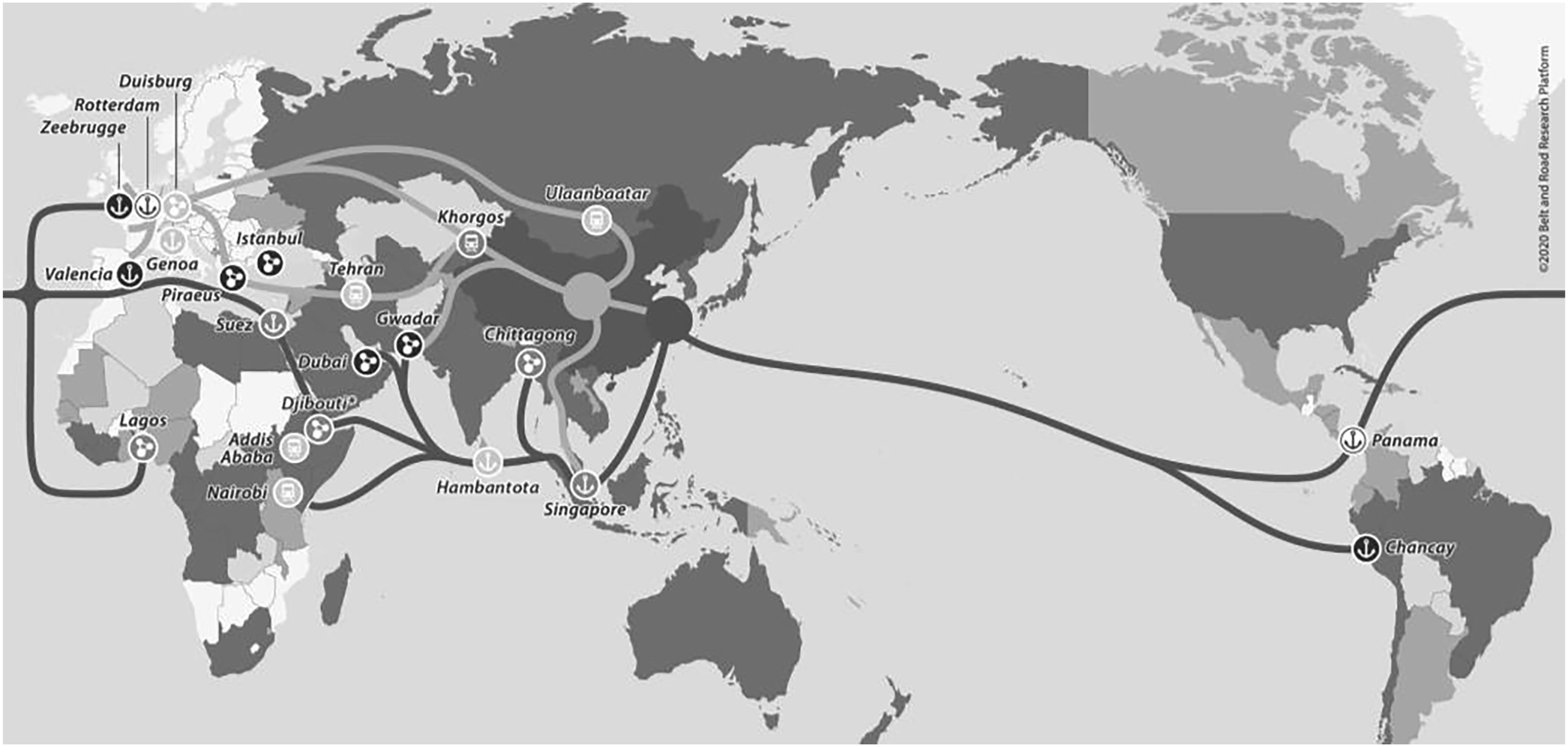
With fast economic growth, China aims to play a bigger leadership role in the world and engage in “Major Country Diplomacy” (Lin, 2019). BRI is said to reflect a Chinese vision of a new world order based on shared economic development (Jin, 2023). Building a “Community of Common Destiny” has been considered the motivating force behind China’s future foreign policy (Mardell, 2017). Due to a more centralized governance structure, the Chinese approach to higher education internationalization is a nationally coordinated approach. The Chinese government has a strong role in directing the international activities in different Chinese institutions and the institutional goals in internationalization reflect national goals and priorities (Liu, 2021a). China’s BRI includes specific action lines for higher education collaboration (Van der Wende et al., 2020). In the current literature, however, there is a lack of knowledge on the specific ways the Chinese universities have been mobilized to support China’s BRI strategy, and this study hopes to fill this gap.
International education in China
China has been a major source country of international students in the new century. With the fast economic growth and the fast increase of household income, there has been a corresponding fast increase of the number of Chinese students studying overseas in the new century. Currently about one third of all international students studying in key host countries, such as the US, UK, Australia and Canada, are students from China (Liu, 2021b). While continuing to encourage Chinese students to study overseas, the Chinese government in the new century also hoped to attract students from other countries to study in China. In 2010, China rolled out a “Study in China Plan”, aiming to attract half a million international students to China in 10 years (Liu and Liu, 2021). In order to achieve this goal, the Chinese government has been generous in offering Chinese government scholarships, with about 12% of international students in China on Chinese national government scholarships as of 2018 (Liu and Liu, 2021). Different from the economic goals pursued by higher education internationalization in Anglo countries, international student education in China is aiming to achieve more of a national diplomatic goal (Liu and Lin, 2016).
As a Socialist country, China faces many challenges in its international public relations. In order to counterbalance the perceived negative discourse about China from Western media, China has aimed to “Tell China’s Stories Well” in its public relations (Huang and Wang, 2019). It is believed in China that the adverse Western impression about China is a result of the lack of knowledge about China and the lack of experience in China (Liu and Lin, 2016). For this reason, China hopes to attract more international students to China’s top universities so that they will have an opportunity to witness Chinese society objectively through first-hand experiences. The economic rationale is absent in Chinese policy documents on international student education; instead international students in China are constructed as “para-diplomats” for China (Mulvey and Lo, 2021). The Chinese objective in international student education is to serve China’s international diplomacy by educating international friends who are knowledgeable about China, friendly to China, and even fond of China” (Liu and Lin, 2026). In this study, we connect China’s BRI initiative and China’s international student education, hoping to examine the ways in which China’s international higher education has been involved in China’s BRI projects.
Knowledge diplomacy
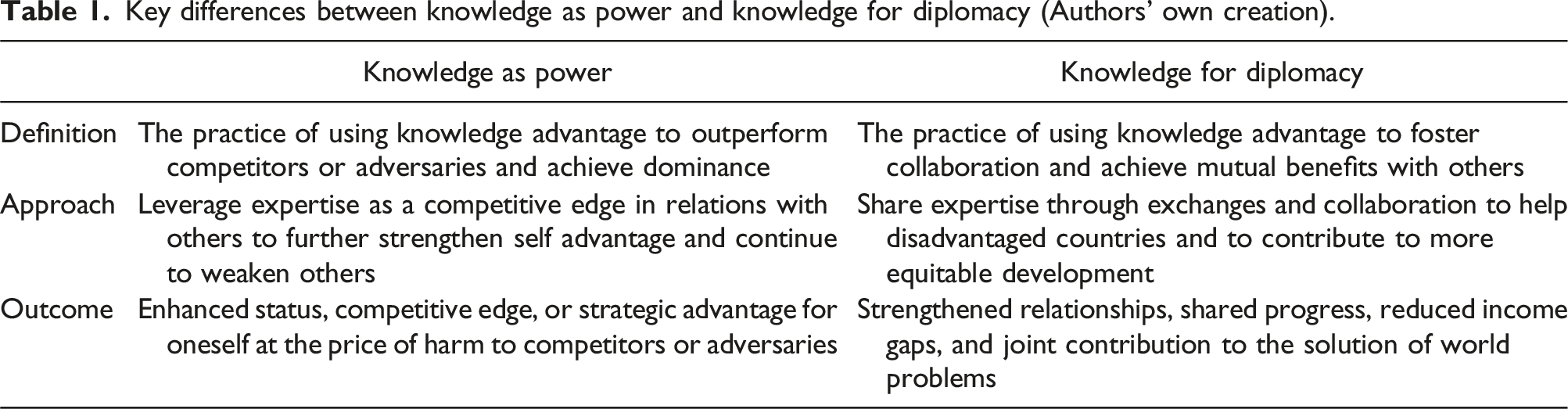
Chou and Demiryol (2023) distinguish two different concepts in understanding higher education’s role in international relations: knowledge power and knowledge diplomacy. Knowledge power refers to the goal of seeking global knowledge leadership and dominance, and knowledge diplomacy refers to the goal of seeking solutions to global challenges. Some Western countries are concerned over China’s increasing influence through BRI around the world, particularly in the global south countries, accusing China of creating a debt-trap for the developing countries (Brautigam, 2020). Through a more negative lens, China’s BRI has been perceived as a neo-colonial and economic imperialist endeavor, and China’s international student education has been understood as the Chinese effort to gain soft power. Soft power has been a concept used to refer to one country’s ability to secure national self-interest by influencing the behavior of other countries through attraction and persuasion, instead of military action or economic coercion (Nye, 2004). It is no secret that higher education internationalization has been used as a tool to enhance a country’s economic advantage and political influence (Lomer, 2017). The international activities of higher education have been criticized by scholars as they have been increasingly motivated by economic profits rather than by either government policy or goodwill (Yang, 2002). Such neoliberal developments in higher education have been at least partially responsible for many of the common world challenges we face today, such as global warming, developmental inequality, refugee crisis and the most recent world pandemic (Liu, 2023).
Key differences between knowledge as power and knowledge for diplomacy (Authors’ own creation).
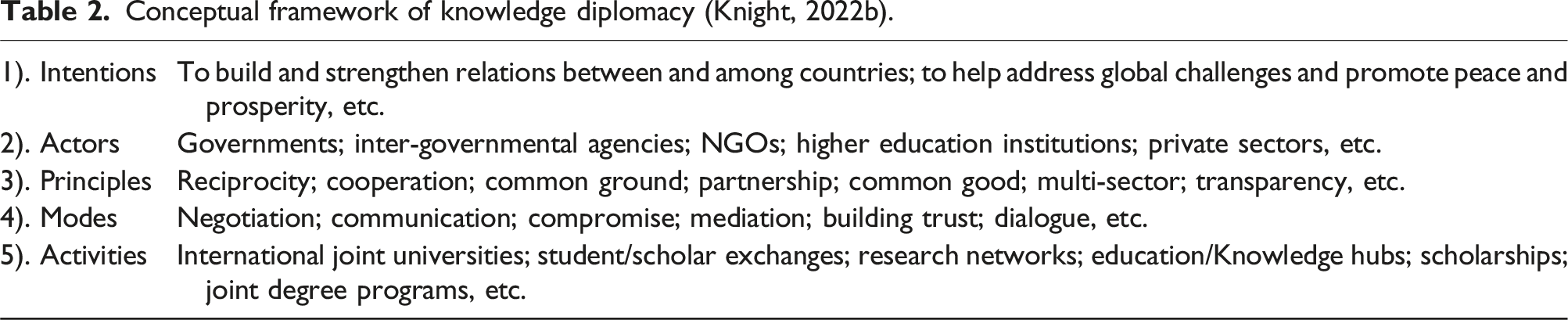
Conceptual framework of knowledge diplomacy (Knight, 2022b).
Methodology
Soon after the kick-off of the BRI in 2013, a University Alliance of the Silk Road (UASR) was established in 2015 with the goal of building educational collaboration and promoting economic growth in countries along the BRI routes (Sharma, 2015). A year later, the alliance included 132 universities as members across 32 countries and regions on five continents (Martin, 2016). Based on its wide geographical reach, large scale of student exchanges, diverse types of institutions and programs involved, and socially responsible agendas, UASR is considered to have embraced a knowledge diplomacy approach (Chou and Demiryol, 2023). The conclusion is based on the analysis of open documents, such as the consortium’s membership, governance and activities. In this study, we will provide three focused case studies that will serve to demonstrate at the micro level the role of Chinese universities in China’s BRI initiative. The three Chinese UASR member universities in this study, selected through purposeful sampling (Staller, 2021), all have worked on successful joint international education programs in partnership with the governments and industries in BRI countries.
The methodology used in this study can be called a narrative case study, combining the strengths of narrative studies and case studies. A case study design allows researchers to look into a social phenomenon in a detailed and in-depth way (Yin, 2013), and the narrative methodology allows researchers to capture the complexity of a social phenomenon in a holistic manner (Clandinin and Connelly, 2000). Each university (represented by an international program officer) was invited through a written interview to develop a comprehensive narrative to introduce their BRI programs, including the national context, the industry involved, the partnership, the funding model, the number of students involved, the training model, etc. Through a member checking process (Birt et al., 2016), additional information was requested from each university in the case of key contextual information missing or inconsistency in writing. All three narratives were edited and brought to similar length in consultation with the three universities as well for the presentation in this paper. The three universities are each given a pseudonym to secure anonymity. Intercoder reliability checks among four authors were conducted during the cross-case analysis to ensure systematicity, communicability, transparency and trustworthiness while making sense of the three case studies (O’Connor and Joffe, 2020).
Three case studies
In data presentation, the three narratives from three universities are presented here as three independent cases, leaving a cross-sectional analysis at the following Discussion section. In line with the narrative approach, the three case studies aim to be holistic, comprehensive, and highly contextualized.
The case of SY university
The Republic of Tajikistan is located in the Pamira foothills, a land-locked state. It borders Uzbekistan and Kyrgyzstan to the north and west, China and Afghanistan to the east and south. Tajikistan is rich in natural resources, with 183 millions of barrels of proven oil reserves as of 2020, ranking 92nd in the world, and 300 billion cubic meters of proven gas reserves, ranking 88th in the world. But as 93% of the Republic’s territory is covered by mountains, extracting these natural resources is extremely difficult and complicated. In September 2013, the Chinese government signed intergovernmental agreements with the governments of Uzbekistan, Tajikistan and Kyrgyzstan on the Central Asian Gas Pipeline Line D project. In March 2014, “TAPLINE”, a branch company of China National Petroleum Company (CNPC) and Tajikistan Gas Transmission Company (TGTC) signed an agreement on the establishment of Trans-Tajikistan Gas Pipeline Company Limited (TTGP), with each side contributing $300 million US dollars. After the completion of the TAPLINE lines A, B, C, D and domestic supporting projects, the annual natural gas exported from Central Asia to China will reach 80 billion cubic meters, accounting for more than 40% of the current natural gas imports of China.
In 2014, the construction of Central Asia Gas Pipeline Line D, an energy artery jointly built by China and Tajikistan, was started, and TTGP was responsible for the construction and operation. In 2016, SY University, one of the Chinese universities with strong petroleum engineering programs, successfully won the bid for TTGP foreign staff training project. In 2017, the China-Tajikistan university-industry cooperative talent training program was launched, and the first batch of 30 Tajik TTGP-sponsored students were selected from the top 1000 students in the country’s national college entrance examination. Adopting the model of university-industry cooperation and targeted training, these 30 outstanding high school graduates from Tajikistan were sent to study petroleum engineering, oil and gas storage and transportation and other undergraduate majors in SY University, China. The program was 5 years long, with the first year devoted to Chinese language instruction and the following 4 years for degree courses in Mandarin. After graduation, these students were expected to return to work on the construction of “China-Central Asia Natural Gas Pipeline Line D”.
As for funding, SY University applied to the Ministry of Education of China for Chinese government scholarships to support the program, and 15 students, half of the cohort, were entered in the Chinese government scholarship queue for full funding. The other 15 were fully sponsored by TTGP with the same level of funding as the Chinese government scholarship, including tuition and living expenses. By July 2022, the project students completed the 5-year training cycle of language plus major studies successfully. Except for 14 Tajik students who have been approved by TTGP to continue studying in the same university for their Master’s programs, all the other students have returned to work and serve the project company in their home country where the pipeline project Line D is constructed. The China-Tajikistan program has successfully trained a group of skilled professionals urgently needed in joint engineering projects between the two countries. The project also serves to build bridges for people-to-people exchanges between China and Tajikistan, with 30 professionals fully proficient in Mandarin Chinese. In 2021, the project was listed as “Classic Case of International Talent Training” by the China-Mongolia Bureau of the International Labor Organization, and nominated as a case of “University-Industry Cooperation Double Hundred Plan” by the Chinese Society of Higher Education in 2022. The project model was recognized by the International Labor Organization, the Ministry of Social Security and the Ministry of Education of China.
SY University has taken advantage of its strong oil and gas programs in actively working with international companies in the oil and gas industry among the “Belt and Road” countries since 2013 when China first launched the Belt and Road Initiative. In 2018, SY University signed a cooperation agreement with Trans-Kyrgyzstan Gas Pipeline Company Limited (TKGP) to train 30 high school graduates selected from villages along the Line D pipeline for Kyrgyzstan, using the same training model. Subsequently, XSYU also jointly carried out the Master’s programs in petroleum engineering with the Central African Republic PTIAL Petroleum Company and the Nigeria Petroleum Science and Technology Foundation.
The case of HH university
In recent years, the Laotian Government has recognized its electricity industry as a significant driver for national economic growth and a source of foreign currency income. Laos is endowed with over 20 rivers longer than 200 km, including the Mekong River, the longest in the country with a dramatic drop of up to 484 m. This abundance of water resources presents a natural advantage for hydropower electricity generation. Elecricite du Laos (EDL), a state-owned company, is responsible for the country’s electricity generation, transmission, distribution, and even exportation to neighboring nations. EDL has enjoyed a long-term partnership with China Power Kunming (CPK), a Chinese state-owned enterprise in Kunming province (bordering Laos), focusing on Hydraulic Engineering and Power Engineering. As a pioneer in overseas ventures, CPK has been heavily engaged in the Southeast Asian market for decades, particularly in Laos, taking advantage of its geographical proximity. Their engagement in the region includes direct investment, financing for power grid systems, infrastructure development for hydraulic power stations, and the establishment of electricity output sources. Due to CPK’s operations, the application of Chinese technology and industry standards has been widespread in the region.
However, the rapid expansion of power grids in Laos has led to a shortage of professionals with industry expertise. EDL turned to CPK, a trusted and long-standing partner, for collaboration in joint talent development. Both entities established a joint committee to select the most promising high school graduates from Laos. Sourcing from its internal training budget and with support from some Chinese companies that are local industry partners in Laos, EDL successfully sponsored 20 Laotian undergraduate students annually for 3 years (in total 60) from 2014 to 2017 to pursue degrees in Electrical Systems and Automation in China. The administration of the scholarship fund was entrusted to the China Scholarship Council (CSC), an affiliate of China’s Ministry of Education. The scholarship adheres to CSC’s reference standard, and the total investment of the project was 21 million RMB. HH University in Nanjing, China, renowned for its expertise in Hydraulic Engineering, was invited to be the host institution for these sponsored Laotian degree students.
A tailored “1 + 3+1″ curriculum for this program has 1 year of Chinese language learning, followed by 3 years of disciplinary area studies and a 5th year internship at different power stations. The 60 candidates in this program have all graduated between 2019 and 2021, with many now employed by EDL. This initiative, with support from Chinese industries and the endorsement of the Chinese government, served to help Laos meet its national energy needs and even export electricity to neighboring countries, notably Thailand. The program has also deepened collaboration between China and Laos within the power industry and beyond. The collaboration between EDL and CPK yields benefits beyond mere economic profitability. Contributions to local society and education development have been substantial. These young talents are serving as bridges between these two nations. This reservoir of human resources with technological know-how and excellent bilingual skills holds immense value for the future of collaboration between Laos and China. Some of the program graduates have already worked their way to intermediate management positions within EDL, as well as key roles in governmental bodies such as the Ministry of Energy and Mines, Ministry of Foreign Affairs, and Ministry of Natural Resources and Environment.
Alongside the hydraulic program, a cohort of 37 Laotian students in Management, sponsored by both EDL and the Industrial and Commercial Bank of China (ICBC) Vientiane Branch, pursued MBA degrees at HH University from 2016 to 2017. Encouraged by the positive outcomes of previous programs and HH University’s increased reputation in Laos, another 41 young professionals from various sectors, including industry, government, and research institution, engaged in advanced studies in fields such as Hydrology and Water Resources, Flood prevention and Disaster Reduction, as well as Hydropower Infrastructure in China. These individuals have successfully earned their Master’s degrees from HH University. These young talents, equipped with specialized skills and an international perspective, are bound to develop into key forces for Laos’ national economy and social development. With connections spanning governments, businesses and industries, collaborative educational programs in higher education, such as the program in this case study, can serve to propel industrial upgrading, economic growth, and mutual benefits between nations.
The case of CA university
China’s engagement with Africa has increased rapidly in the past few decades, particularly in the area of bilateral trade. China had been Africa’s largest trading partner for the new century. Trade volume between China and Africa increased from $12.3 billion in 2002 to $208.8 billion in 2019. Due to COVID-19, bilateral trade volume in 2020 was down by nearly 10% from 2019 to $187.7 billion. With the economic recovery in the aftermath of COVID-19, bilateral trade between China and Africa reached a record high of $254.2 billion in 2021, a 35% increase over the 2020 figure. Many African countries along China’s “Belt and Road” are at a critical stage of economic and social development. They all need to create more jobs to drive economic development. They also need a large number of skilled talents to provide support to their fast economic and social development. While building infrastructure projects for Africa, called “hard connectivity” in Chinese, China also pays more attention to the “soft connectivity” of cultural exchanges and people-to-people exchanges with African countries. Most importantly, China is committed to building local talent training bases to achieve long-term development goals of common interests. According to a Chinese Confucian saying, “it is more important to teach people how to fish than to simply give them fish to eat”. Training local talents is the Chinese way of teaching people how to fish.
In cooperation with a number of universities in Africa, China Road & Bridge Corporation (CRBC) strives to explore innovative university-industry cooperation training models for international students from Africa. It is often called the “three in one” model with three partners - students, universities and enterprises - working together to meet their common goal of providing important talent support for the transportation development projects of African countries along the “Belt and Road Initiative”. Since 2018, CRBC has signed training agreements with CA University in Xi’an, China, and these agreements have fully funded 135 international students from Africa, among whom 101 are from Republic of the Congo, 15 from Senegal, 15 from Madagascar, 4 from Gabon. CA University tailor-made a “2 + 2″ training model for these industry-sponsored international students from Africa. In the first 2 years, sponsored international students in the university-industry cooperation program take general education courses (including Chinese language courses), basic science courses in their subject areas, and professional basic courses as separate cohorts. In the last 2 years, they take their professional core courses and professional elective courses together with Chinese students according to the two major directions of Highway Engineering and Bridge Engineering chosen by students. This training model has helped improve the language ability and professional ability of international students from Africa in the first 2 years, and in the last 2 years, they can quickly catch up with or even surpass the domestic Chinese students when they take courses together in Mandarin.
Chinese companies in Africa have transformed from being mere builders to being more active participants in the economic and social development of their host countries. They have begun the process of genuinely localizing their workforce. Capitalizing on projects under construction, CRBC implements a two-step strategy of cultivating local technical talents and local managerial talents, with the aim of providing local employment opportunities and providing a local personnel foundation for sustained local development. For example, the Kenya Mombasa-Nairobi Railway project is the first railway system project that fully adopts Chinese funds, Chinese standards, Chinese technology, Chinese equipment and Chinese operation. It is the largest infrastructure project in the country in half a century. The launch and the operation of the project require a large number of professional railway talents from the country that are familiar with the technology from China. There are similar projects run by CRBC across the continent. In order to meet the local talent needs, CRBC also jointly launched programs with three other universities in China, providing full scholarships to fund 100 international students from Equatorial Guinea, Togo, Senegal, Madagascar and other countries to study in China and bring advanced technology back to their home country. Apart from longer degree programs, there are also shorter training programs. For example, CRBC cooperated with CA University to train 4 Gabonese engineers in a customized short-term program. The short-term training was customized according to the needs of industries and students, and the teaching model combining “theory course + practice course” was well received.
Discussion
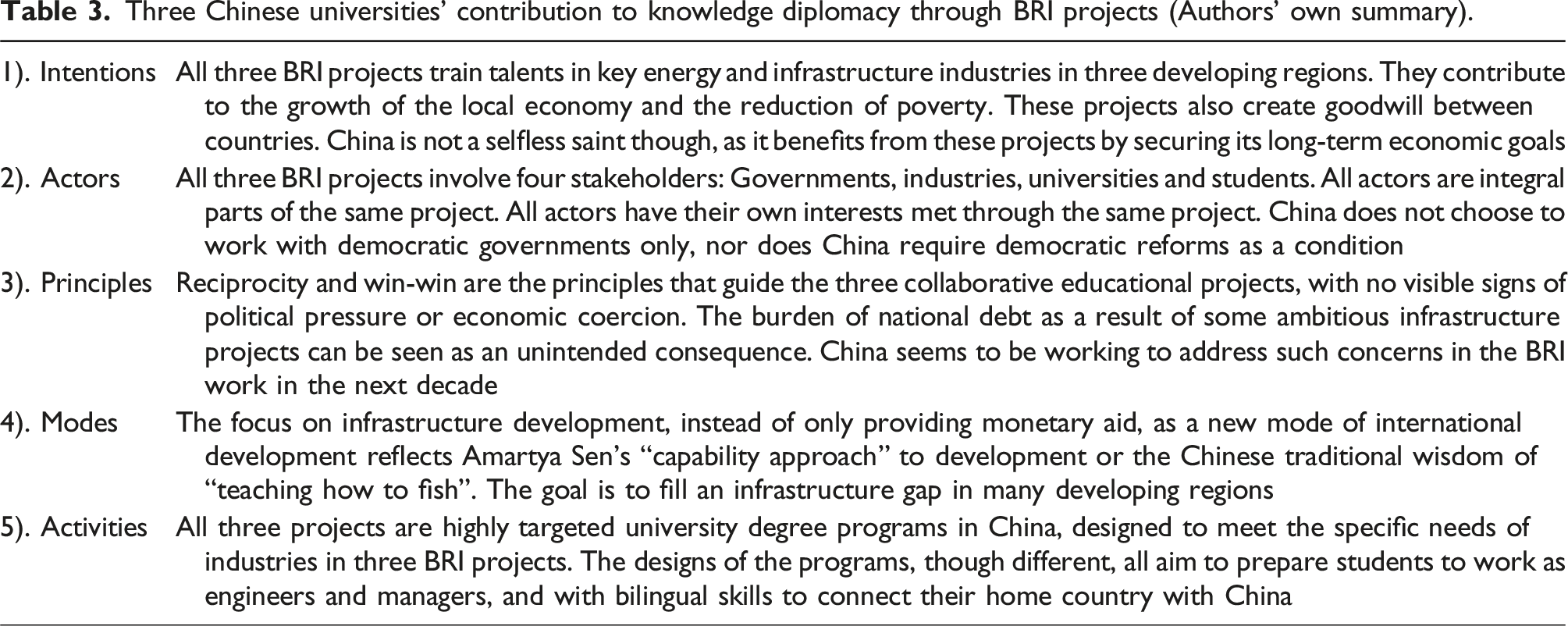
Due to concerns over widened gaps between the world’s haves and have nots as a result of the neoliberal operations of global higher education, universities have been called upon to engage in knowledge diplomacy in their internationalization efforts to address issues of unbalanced development, uplift the developing countries from poverty, and to promote social justice and peace through international development. The concept of knowledge diplomacy is developed and promoted to understand the role of international higher education in building peaceful relationships between and among countries (Knight, 2022b). To discuss the three narrative cases above, we will apply Knight’s (2022a) conceptual framework and its five fundamental elements to examine the extent to which the Chinese higher education’s involvement in BRI has contributed to the goal of knowledge diplomacy.
Intentions
International Higher education can serve multiple goals, but the current practices have tended to focus too much on enhancing national competitiveness in the world knowledge economy, and too little on addressing common global challenges. For this reason, the goals of higher education internationalization expected in the construct of knowledge diplomacy are to strengthen international relations, solve global problems, and promote world peace. All three BRI cases in this study aim to educate technical and managerial talents needed in key energy (natural gas and hydropower) and infrastructure (road and bridges) industries in three developing regions. All three programs serve to generate local economic growth opportunities and thus contribute to the reduction of world inequality in economic development. With students educated in China and in Chinese, and all returning to home countries to work, they serve as bridges and help strengthen the relations between their home countries and China. So all these goals of the three BRI programs are goals of knowledge diplomacy.
But are the Chinese truly selfless saints without any self interest to pursue? Though the current literature suggests that an economic rationale is absent in China’s provision of international student education, the three cases in this study seem to show that, in addition to the soft goal of making international friends, there is clearly a long-term economic goal pursued by China. Specifically, students are trained with funding from the Chinese government and industries to serve Chinese industries, either through direct investment or joint ventures. It is a long-term economic goal, as it is not direct tuition income, but investing in talent development to serve both the Chinese and local economic growth. “It is true that in international relations, countries present their self-interest first–it is naive to think otherwise. But because national self-interests are closely linked to global issues, finding a common ground and multilateral cooperation between state and non-state actors are growing in importance” (Knight, 2022a: 1). Knowledge diplomacy does not mean zero pursuit of self-interest, but requires wisdom to find a common ground of mutual interests and to achieve a win-win situation for all.
Actors
The achievement of knowledge diplomacy at a higher and more significant level would require multiple stakeholders working together on large-scale bilateral or multilateral projects. From the three cases in this study, we can tell that the BRI projects that the Chinese universities are involved in have three major actors: governments (both China and another BRI member country), industries (from both China and another BRI member country) and a Chinese university. The Chinese institutions in this study often call it a “university-industry partnership” in student training. Apart from government, industry and university, students are of course another major stakeholder. All stakeholders have their own interests that are met by the same program. Governments on both sides are interested in supporting their major industries. The industries hope to be successful and profitable, and thus are interested in having a good supply of professional talents with bilingual skills. Publicly funded universities need to work on teaching and research programs that meet the needs of society. Students want to gain career skills and to contribute to the wellbeing of their country and the world. All partners bring to the collaboration different resources - funding, expertise, or a willingness to work hard on the part of students.
One important criticism of China’s BRI projects with the global south is that China does not carefully choose government partners to work with. Thus such projects, with no requirement for democratic reform agenda or human rights protection from the local government, may serve to give support to undemocratic governments and autocratic leaders. The Chinese political non-interference policy indeed sets China apart from its Western counterparts in approaches to their international development work with developing countries. It can be said to be part of the new world order China aims to build where international development projects focus on the improvement of basic life conditions of all people, leaving political systems to be the choices of the people in each country. In addition, as China is considered a non-democratic country with many human rights violations, it would not make sense for China to set democratic processes and human rights protection as conditions for its partnerships. Future historians and political scientists will tell which approach works better in bringing more sustainable long-term change.
Principles
The current imbalance of world development is a result of colonial and neoliberal patterns of development in the past. The imbalance of development, with a well-developed West and an under-developed rest, is so severe that it begins to threaten the sustainability of the world, demonstrated by global warming, global environmental deterioration, global epidemics, and global refugee crisis. It has become an absolute imperative to amend past wrongs and engage in a new, more equitable, and more sustainable development. For this reason, cooperation, reciprocity and mutuality are considered important principles and values that higher education internationalization needs to embrace. The three BRI projects in the three case studies seem to all have endorsed and followed these ethical principles and values. There are no visible signs of political pressure or economic coercion. There is Western accusation that the BRI is China’s debt diplomacy, a new form of neo-colonialism to get BRI countries helplessly dependent on China (e.g. Zeiger, 2020). Is this the Chinese government’s malicious intention or rather an unintended consequence?
Either way, the Chinese government seems to have recognized this important issue, though publicly denying the Western accusations. In 2023, China announced its next 10 years’ vision for BRI, aiming to give priority to projects with small investments, quick impact, as well as sound economic, social and environmental benefits (Bloomberg News, 2023). This can be understood as the Chinese government’s effort in addressing the debt issue for BRI member countries. In addition, we must stress here that the Chinese universities, if we can separate them from the Chinese government, do not seem to be part of this “conspiracy”. The Chinese universities do not charge tuition. They receive government and industry funding for these students. They try to develop innovative models, either 1 year language study followed by 4 year disciplinary training or 1 year language study followed by 3 year program training and 1 year industry internship, to ensure the quality of training. And they send all students home to serve their home countries.
Modes
BRI represents a unique Chinese approach to international development. There is a household saying in China that says, “If you want to get a village rich, build them a road first” (要致富, 先修路). This explains to some extent the Chinese focus on infrastructure development. The historical “Silk Road” in Tang Dynasty took Chinese merchants from Xi’an, China’s capital then, through central Asian countries all the way to Europe on camel backs. In the first 30 years of the People’s Republic of China (1949-1976), Chairman Mao mobilized resources and people around the country to build roads and powerlines to all parts of China. The infrastructure development during this period, the roads, ports, power and water supplies, allowed a wide scope of manufacturing industries to be built quickly in the country when China adopted the “Reform and Open-up” policy from the 1980s, turning China into the world factory. In the new century, China aimed to connect all parts of the country with highways and speed trains, even over difficult terrains such as deserts and sea water. BRI, China’s modern-day idea for a new “Silk Road” (Van der Wende et al., 2020), has aimed to connect China with a large number of neighboring countries and beyond in the global south through infrastructure development (ports, railroads, bridges, airports, etc.), leveraging the Chinese experience and expertise in this area amassed from within China.
China’s pronounced intention through BRI is to uplift all regions of the global south and build an “International Community of Common Destiny”. The focus on infrastructure development as a new mode of international development reflects Amartya Sen’s “Capability Approach” to development (Sen, 2001) or the Chinese traditional wisdom of “teaching people how to fish, insteading giving people fish to eat (授人以鱼, 不如授人以渔)”. One might be able to predict that the future world factory could be these BRI countries after the basic infrastructures are in place. The debt pressure felt by BRI countries as a result of these large-scale projects needs to be solved in manners of negotiation, compromise and dialogue (Knight, 2022a).
Activities
Apart from network development through UASR, the most important activities the Chinese universities engaged in to support BRI projects have been to train talents urgently needed by the industries through innovative degree programs. Based on the three case studies in this study, these educational programs have multiple partners, a point we mentioned above. Students are all fully funded by governments and industries, which allows students from different social and economic backgrounds to participate. All students are from BRI member countries where major infrastructure projects are taking place, and they are all expected to return to their home countries to work in the industries they were trained in. The programs are highly targeted programs that are designed to meet the needs of specific industries. All programs are conducted in Chinese with bridging arrangements for students to learn Chinese either before or during their degree programs. With Chinese proficiency, all these graduates are expected to play positive roles in strengthening relationships between their home countries/regions and China in the future.
Another major criticism of China’s BRI projects in developing countries has been the excessive reliance on Chinese workers over local people in the region (e.g. Chandran, 2018). From the three cases in this study, we can say that China has begun to focus more on local talent development and at a higher level. Students are trained to become engineers and managers who can play leadership roles in specific industries. Based on the information provided by the third case study, the same targeted talent training activities have been taking place in many other Chinese universities in collaboration with industries.
Three Chinese universities’ contribution to knowledge diplomacy through BRI projects (Authors’ own summary).
Conclusion
BRI is a unique Chinese approach to international development with a focus on infrastructure development in the global south. Chinese universities have been involved in BRI through collaborative education programs in partnership with governments and industries to train technical and managerial talents for key infrastructure projects. Through a narrative case study with three Chinese universities known for their successful collaborative education programs, this paper has shown the detailed ways in which such programs are funded, structured and implemented. From the lens of knowledge diplomacy, this study has also provided initial evidence that Chinese universities are contributing to the goal of knowledge diplomacy through their BRI involvement. Though small in scope, these collaborative education programs are concrete steps toward the UN’s sustainable development goals. It is advisable to include these programs in future discussions on knowledge diplomacy as non-Western initiated examples.
Limitations
BRI has been a massive ongoing project taking place in multiple regions and in multiple industries over a decade. A case study design is better at describing in an in-depth way how the Chinese universities engage in university-industry collaborative talent training to support the needs of important infrastructure development projects in developing countries. A case study design is also able to demonstrate that these projects are creating impact in project-specific ways. With knowledge diplomacy as a theoretical lens in this paper, we can also say with much confidence that the three Chinese universities’ work constitutes contributions to knowledge diplomacy. But a case study with only three universities is not able to glean the total impact of Chinese higher education’s ongoing involvement in the BRI initiative. More research is needed in the next decade to further examine the role and impact of Chinese universities’ participation in BRI. An important question to ask in future research is whether the benefits of such projects can trickle down from individual students to other members of their home society and thus achieve more sustainable long-term change in the local society.
Footnotes
Declaration of conflicting interests
The author(s) declared no potential conflicts of interest with respect to the research, authorship, and/or publication of this article.
Funding
The author(s) received no financial support for the research, authorship, and/or publication of this article.
