




Abstract
The existing literature on the entrepreneurial transition of universities tends to focus on three main areas: management challenges, working conditions, and the professional identity of researchers. However, it is unclear how entrepreneurial practices actually exist in the new situation. This paper examines the influence of current policies and academic traditions on the emergence of academic entrepreneurship and the practices that emerge. The specific organizational context in Russia (post-Soviet planning traditions, bureaucratization, and extensive state funding of entrepreneurial activities) has created a contradictory situation for researchers, who have been forced to create local practices to address specific problems at particular moments. A theoretical framework that distinguishes between strategic and tactical entrepreneurship, based on de Certeau’s and Scott’s sociology of practice, is used to analyze these local practices in Russian universities. As a result, I have compiled a list of tactics, including academic entrepreneurship, buffering, bootlegging, window dressing, research portfolio management, commercial duty, duplicating organizations, and gray zone entrepreneurship. The study presents a novel methodology for examining the policy-application gap and offers insights into the discrepancy between statistical accounting and actual academic entrepreneurship.
Keywords
Introduction
In recent decades, universities have experienced tensions between management and researchers. Universities around the world are undergoing an entrepreneurial transformation, diversifying revenue streams, engaging researchers in applied science, and creating commercially viable innovations (Clark, 1998). Researchers, on the other hand, insist on a career path focused on the traditional ideals of independent research. The situation challenges organizations to find different solutions.
Entrepreneurial transformation involves different activities and changes. New university activities include “patenting, licensing, creating new firms, facilitating technology transfer through incubators and science parks, and facilitating regional economic development” (Rothaermel et al., 2007: 692). This transformation is not limited to a new relationship between universities and industry or a tripartite alliance between industry, universities and government. It is a transformation of the internal mechanisms of work (Cooper, 2009). These are the activities, along with organizational change, that I refer to in this paper as academic entrepreneurship.
Two main understandings of this transformation have emerged in recent studies. Scholars of academic entrepreneurship and entrepreneurial universities (Rothaermel et al., 2007; Siegel and Wright, 2015) understand technology transfer and commercialization of academic research as a new third mission of universities, in addition to teaching and research. Another approach is the critical theory of academic capitalism. Researchers (Münch, 2014; Slaughter and Rhoades, 2004) have focused on analyzing external pressures and the market behavior of institutions and researchers in response. The main difference between the approaches is the focus of attention and the moral evaluation of the outcomes of change.
Both of these approaches demonstrate that academic work has undergone a transformation in terms of its structure and value. New practices have emerged within the university setting, influenced by commercial logic. These include a focus on innovative research with applied and commercial potential, government and university funding for fundamental and applied science, direct funding from industrial organizations, industry-scientific cooperation, patenting, entrepreneurial education, patenting before public presentation of results, and non-student participation in commercial research (Oliver and Sapir, 2017). The manner in which daily practices and strategies are conducted is contingent upon the set of goals that is being pursued. There have been notable changes in the core activities and strategies of the academic profession (Oliver and Sapir, 2017; Novotny, 2017; Sá et al., 2019), academic habits (Matthies and Torka, 2019), mindset (Dzisah, 2010), and social stratification in higher education (Kwiek, 2018). These changes are related both to new requirements from universities in the form of new forms of contracts and KPIs for laboratories, as well as new intellectual property rights given in the US and several other countries to scientists.
However, not in all countries rights and obligations have emerged simultaneously as part of a coherent research policy. In Russia, at the same time as effective contracts for researchers, where the main part of the salary was linked to the fulfillment of indicators, and state financial incentives for academic entrepreneurship, researchers did not receive additional rights, and universities from the Soviet period retained elements of planned economy and a similar level of bureaucratization. This situation makes the possibility of realizing academic entrepreneurship more difficult and forces researchers to choose the way of action in a creative way. The objective of this paper is to examine the manner in which policy contradictions and traditions influence researchers’ tactics of becoming academic entrepreneurs under specific conditions in Russia.
The concepts of de Certeau (1986) and Scott (1998) provide insight into the creative practices of responding to governance and unified instructions. De Certeau posited a dichotomy between strategy, which is a position of power, and tactics, which are invisible and opportunistic. Strategy is defined by its place, time, and resources, whereas tactics are defined by their ability to seize moments and exploit places of opportunity. Scott subsequently provided an epistemic component to the distinction, differentiating between techne as a rational, universal form of knowledge and metis as a local, fluid, and intuitive mode of understanding. These authors facilitate the recognition of two distinct types of academic entrepreneurship: strategic or managerial entrepreneurship, and tactical entrepreneurship. Such an approach helps to clarify possibilities and ways of doing things in particular situations, and to classify them.
The present research is based on 32 problem-centered interviews with researchers and seven expert interviews with state funds and market representatives conducted during 2019–2020. The results of the study became even more relevant following the Russian invasion of Ukraine and the imposition of sanctions against Russia. This was due to an increase in state pressure to create innovation in universities, particularly in the absence of substantial university reforms and state science policy. The analysis examines the extent to which researchers engage in entrepreneurial activities, the factors influencing their decisions regarding the organization of current and future partnerships, and the institutional context that shapes particular situations. Consequently, I have identified eight tactics of academic entrepreneurship: entrepreneurial research, buffering, bootlegging, window dressing, managing research portfolios, commercial duty, duplicating organization, and gray zone entrepreneurship. The described tactics are closely related to three significant features of Russian higher education: the planning system, bureaucratization, and the participation of state money in projects. Consequently, the study contributes to the understanding of the contemporary university system in Russia and could potentially be useful for research of other authoritarian and highly bureaucratized higher education systems.
Academic entrepreneurship: Strategy and tactic
The new situation has the potential to redefine the academic ethos. The traditional academic values expressed in the four Mertonian institutional norms of science are communalism, universalism, disinterestedness, and organized skepticism. Two of these values become problematic in the context of academic entrepreneurship. The concept of communalism refers to the notion of equal access to scientific results and the understanding of the results of scientific research as a commonwealth. Nevertheless, the connection between business and commercial research has the potential to influence the sharing of knowledge. In their study, Slaughter et al. (2004) described how scientists distribute information to publications in order to circumvent patenting issues and comply with industrial censorship regulations. Blumenthal et al. (2006) demonstrated that scientists often withhold and conceal information until a partner company has patented it. A similar issue arises with regard to the concept of disinterestedness. Commercial contracts have the potential to create conflicts of interest (Radder 2010). Such practices may result in the misrepresentation of results and the concealment of unfavorable outcomes for industry partners (Lexchin et al., 2003).
The situation thus gives rise to a gradient of attitudes and practices among researchers, with those who have adapted to new values displaying a divergence from those who have not. Lam (2010) identifies four categories of scientists: entrepreneurial scientists, who have embraced the new work environment and perceive a flexible boundary between academia and industry; entrepreneurial hybrids, who have accepted the need for applied research but have more complex negotiations; traditional hybrids, who are concerned about the erosion of academic science and carefully consider new opportunities; and traditional scientists, who have attempted to distance themselves from change. The academic profession is becoming increasingly blurred, which can be understood as either unpofessionalisation or reprofessionalisation (Sá et al., 2019). Researchers are depicted as either (un)conditional surrenderers who are surviving by playing by the new rules (Alvesson and Spicer, 2016) or as individuals who are attempting to redefine their roles and responsibilities within the academic profession (Sá et al., 2019).
However, researchers might not be that easy to govern, as Gläser ironically calls it. He (Gläser, 2019) describes different researchers’reactions to governing science: • Buffering: creating of the reserve to deal with changes; • Bootlegging: using resources dedicated to one particular purpose for another; • Window dressing: symbolic compliance, meeting external interests by changing language without real content adaptation; • Managing research portfolio: constructing different research lines to meet expectations of the University and external interests.
Depending on discipline, position within the university, and individual circumstances, different combinations of these tactics are possible.
This study employs the theoretical lenses of de Certeau and Scott to examine the distinctions between strategic and tactical entrepreneurship. De Certeau’s approach has previously been successfully applied to organizational research. For example, the author demonstrates a discrepancy between strategy and its implementation (Whittington, 2006) and differentiates between managerial and artistic entrepreneurship (Hjorth, 2005). De Certeau posits that strategy is “the calculation (or manipulation) of power relationships that becomes possible as soon as a subject with will and power (a business, an army, a city, a scientific institution) can be isolated” (de Certeau, 1986: 36). In contrast, a tactic is defined as a calculated action determined by the absence of a proper locus. Strategy uses space as its advantage, tactic uses time. Strategic entrepreneurship is defined as the rational, planned actions of a university, whereas tactical entrepreneurship is understood to be the precise local decisions and practices that emerge from the strategic framework.
This analytical framework is designed to identify strategies and tactics at the university.
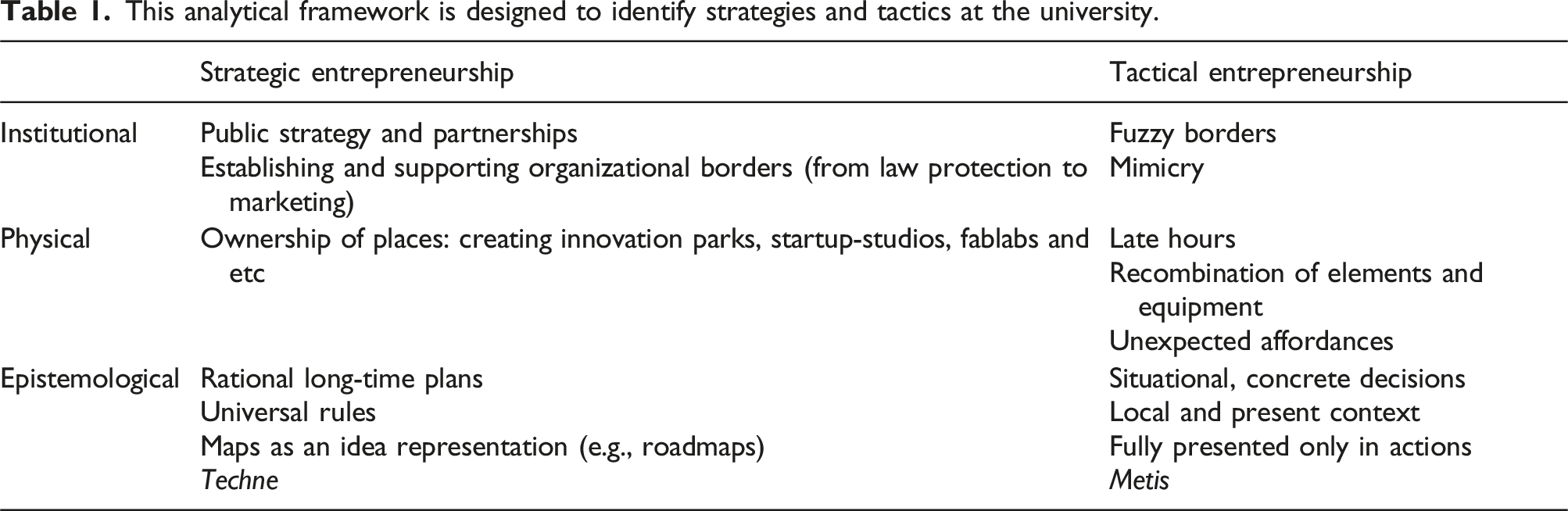
The theoretical approach described will enable me to analyze the tactics employed by academics engaged in academic entrepreneurship, including their motivation and correlation with the strategic actions of the university. The focus of this study will be on the reported everyday practices, typical creative ways of avoiding controversy and creating a window of opportunity. The contrasting strategies and tactics will demonstrate how solutions are developed within the context of institutionalized rules and the emergence of new opportunities and constraints. The resulting set of tactics will reflect the variety of recurring ways in which researchers achieve their goals in resource-poor settings and within the specific context of their university.
Institutional changes and regional traditions in Russia
The main difference in the Russian higher education system is the vertical management structure. Most rectors are appointed rather than elected, and in recent years more and more often these rectors come from other regions or even from outside the education sector (Gerashchenko, 2021). These rectors are not similar to effective managers appointed in the USA and Europe, they are embedded in the vertical of state power and their position depends on the decisions of the Minister of Science and Higher Education. At the same time, self-management practices in universities are weak and professors have little participation in decision-making (Sokolov, 2022). Thus, universities are highly dependent on the state and the newly introduced policies are quickly applied.
At the same time, Russia is undergoing a similar transition to a new form of university, comparable to those in the United States and Europe. The most significant steps to change universities and the work of researchers took place in the 2010s. During this period, “effective” contracts (based on KPIs) for university employees were introduced (2012), a decree of the Government of the Russian Federation on support for the development of innovative infrastructure at universities was issued (2010), the Agency for Strategic Initiatives was established (2011), the 5–100 University Excellence Initiative was launched (2012), the monitoring of the performance of higher education institutions was started (2012). Ideologically, the science policy is oriented towards the transformation of academic capitalism.
By 2020, all forms of commercial activity of universities mentioned by Rothermel and others (2007: 692) will have emerged in Russia. Similarly to other countries, the requirements for the percentage of co-financing and the number of patents for universities are increasing, and competition between universities is stimulated by various methods.
The most recent initiatives that include elements of academic entrepreneurship are Priority 2030 and the Advanced Engineering Schools project. The first program is aimed at the allocation of strategic projects and organizational greenfields (differently managed departments) in the university, which should combine scientific, educational and commercial components, with the indicators of project results chosen by the universities themselves. The Advanced Engineering Schools project involves a closer link to commercialization. The initial application for participation had to be prepared with industrial partners and had to include planned revenues from commercial projects as key indicators. Both programs were launched after the data collection for this paper, but as will be shown later, they are likely to have reinforced earlier patterns of response to the introduction of academic entrepreneurship.
However, innovations do not displace established rules and traditions. Russian higher education has many peculiarities that are related to the Soviet and early post-Soviet times and have not been critically reevaluated within the state academic policy and university administration. Three features of a modern Russian university have a significant impact on the work at the university and local decisions of researchers: consequences of the Soviet planning system, bureaucracy, and government funding of entrepreneurial activities.
For many years, the Soviet planning system (gosplan) shaped funding, recruitment, and performance indicators in universities. Higher education was practically subordinated to the labor needs of the national economy: most higher education institutions worked for concrete economic sectors. Researchers find that the current structure and functioning of the Russian higher education system is still largely determined by Soviet principles (Kuzminov et al., 2015). Scientific projects are carried out in accordance with pre-determined directions, based on negotiations between organizations and the Ministry of Science and Higher Education (“goszadanie”). The main funding is provided according to the number of students, without orientation to the quality of education - controlled number of enrolled students (Androushchak and Yudkevich, 2015). The planning system functions by establishing a set of metrics and a dependency on funding and maintaining educational programs contingent on the metrics being attained. Furthermore, the system cultivates a culture of working with the metrics; it is crucial to exceed them slightly, but not excessively, so that the following year’s metrics remain at a moderate level of improvement relative to the previous year.
Another noteworthy aspect of Russian universities is the prevalence of bureaucratic procedures. In a study by Lisyutkin and Frumin (2014), internal bureaucratization is identified as one of the primary internal factors contributing to the deterioration of universities. This is evidenced by the increasing formalization of activities and the prevalence of external, mechanical performance over the content. Moreover, the advent of digitalization has not resulted in a reduction in bureaucratization; rather, it has led to the duplication of paper reporting with the introduction of new digital systems. The factor is also significant in relatively stable and growing universities. Qualitative research indicates that bureaucratization for researchers is a significant contributing factor to the observed decline in work efficiency (Volchik et al., 2016). Researchers report that the possibility of external collaboration as greater than that of internal collaboration with the administrative structure of the university (Demin, 2017). Consequently, bureaucratic processes represent a significant limiting factor in the launch of any project within the university.
Finally, the key feature creating the present contradictory situation in innovation policy is significant financial support from the state. State funds, state corporations, and ministries allocate money to support initiatives for commercialization: opening and supporting technology parks, construction of innovation centers, support for joint science-intensive projects of university researchers and business, and so on. As Budyldina (2018) showed on the example of St. Petersburg universities, patents, and the applied application of research results are created to obtain more government funding, and not to further transfer of knowledge. On the one hand, groups aiming to create commercially successful startups tend to avoid public funding due to concerns about intellectual property rights. On the other hand, the majority of researchers are not motivated to engage in academic entrepreneurship; rather, they are primarily interested in developing projects with the potential for commercialization. These projects are typically completed at the early prototype or proof of concept stage.
Consequently, Russian researchers are trapped in a double bind situation. On the one hand, the new scientific policy and stimulating funding encourage the development of academic entrepreneurship. On the other hand, high bureaucratization, the need to meet but not exceed targets, and weak influence on decision-making demotivate them to change their usual ways of working. This contradiction gives rise to a set of interesting practices of resistance and creative acceptance of new rules of the game.
Method
Case
Virtual and Augmented reality market in Russia is a fast-developing market with a big number of small companies and research groups and few major clients. The market has some specific state support directly from the budget and through state corporations. It has close connection with free-market sphere of gaming and surprisingly less connected with highly regulated sphere of security: VR plays important role in the new ways of industrial safety practices but almost invisible for national cyber and information security policies. There is a VR/AR association and one active community, but most of the community and companies work separately. There are no national academic conferences on VR/AR research and scholars rarely meet each other on international conferences abroad (it was so before the pandemic).
All main forms of knowledge commercialization can be found in studied VR/AR laboratories: consulting for commercial companies, commercial R&D, creation of startups, patenting of developments, incubating student startups, and selling the developments of past students on marketplaces, licensing.
There are four primary reasons to select this case: active commercialization in the field, the existence of a state policy and support, the recent emergence of the field, and access to the field. Firstly, the area is a new and rapidly developing field, which is experiencing active commercialization. This facilitates the creation of a range of entrepreneurial activities, including those involving corporate consulting and student spin-offs. Secondly, a multitude of financial and institutional support programs have recently been initiated. The Neuronet market roadmap (2018), the Virtual and augmented reality roadmap (2019), the lead research centers in digital technology by Russian Venture Company (2019), and numerous smaller projects by the National Technology Initiative are among the key initiatives that have shaped the landscape of this field. Thirdly, the study of the new research area enables the grasping of new tactics created in the shadow of the Soviet planning system and new institutional changes, rather than a long-term local tradition. Finally, the author’s experience plays a specific role in the formation of their perspective. For a period of 3 years, I was employed as an instructional designer and researcher in a company specialising in virtual reality and augmented reality. This experience has enabled me to develop an informed interviewing process that includes defining key terms and establishing a mutually understandable language with the interviewee. This approach can be considered an “ad hoc pidgin,” as described by Laudel and Gläser (2007), which enhances the introductory phase of an interview and facilitates trust and communication. The findings of the study of VR/AR labs can be extrapolated to the understanding of new technological fields that lack traditional industrial partners and the Soviet tradition of interaction.
Sample and procedure
In order to address the research question regarding the tactics employed by researchers to become academic entrepreneurs, a total of 32 problem-centered interviews (Flick, 2014) were conducted with academic professionals, and seven expert interviews were held with state funds and market experts. The interviews centered on the central question of the relationship between local regulations and cultural norms within universities and the selected tactics employed.
The selection was based on the principle of theoretical sampling (Gläser and Strauss, 2017), with the most contrasting cases being identified through the use of university websites, publications, and conferences. The cases differ with regard to Russian regions, types of universities, positions, experience, gender, and original discipline.
The sample included representatives of 14 universities: special status (Lomonosov Moscow State University), national research universities (ITMO University, National Research Tomsk State University, Tomsk Polytechnic University, Moscow Aviation Institute, HSE University), federal universities (Far Eastern Federal University, Ural Federal University, Kasan Federal University, Southern Federal University), regional universities (Volga State University of Technology, Samara State Medical University, Petrozavodsk State University) and commercial university with state participation (Skoltech). The differing statuses of entities within a given jurisdiction entail disparate regulatory frameworks, differing elements of state funding, and the potential for the establishment of distinct organizational forms.
The study included the heads of laboratories and other departments (17 individuals) and other researchers, such as research laboratory assistants, junior researchers, senior lecturers, and specialists in educational and methodological work (15 individuals). The original disciplines of the informants, as indicated by their educational background and faculty affiliation, include mathematics, software engineering, psychology, history, and chemistry. The informants’ ages range from 23 to 66 years, with 26 men and six women participating in the study. The observed gender imbalance can be attributed to the existing imbalance in the technical sciences in Russia. Based on different indicators, the participation of women in the discipline is estimated to be between 7% and 20% (Krasnyak, 2017; Paul-Hus, 2015).
Seven expert interviews were conducted, including representatives of innovation support funds, two representatives of national technological initiatives who participated in roadmap creation and different VR/AR support projects, two university managers, the head of the VR/AR association, and a project manager in a VR/AR company who was connected with different universities.
The interviews were conducted during the years 2019 and 2020. The majority of the interviews took place in the interviewees’ universities, with the duration ranging between 50 min and one and a half hours, and were supplemented with observations of the working space. Due to the circumstances surrounding the global pandemic, six interviews were conducted via videoconference.
All informants provided informed consent. Offline informants signed informed consent in paper form. It included a brief description of the author and research topic, information about anonymization, academic reasons for using materials, and contact information in case an informant wanted to add or withdraw material. For the six video interviews, informed consent was read aloud and contact information provided via email.
The interviews were digitally recorded and anonymized during the transcription process. The written interviews were subjected to analysis using QDA Miner Lite. The codification was based on four types of activities in the university setting (teaching, science, administrative work, entrepreneurial activities) and three dimensions (physical, institutional, and epistemological). The similar patterns were then grouped into tactics.
Results
After initial interview coding based on theoretical frame presented in the first section, I identified 8 recurrent tactics for organizing the commercialization of scientific developments. Tactics combine three levels: institutional (institutional statuses, identifications), physical space (using of labs and equipment) and epistemological level (concrete forms of practices and deeply context-grounded decisions). They were used by researchers of different status and different institutions and according to self-reflection influenced most of the key activities: search and distribution of funding, choice of research topics and applied developments, opening of new study areas, and a change in status of the main division within the university.
Entrepreneurial research
Entrepreneurial research represents an almost ideal-typical combination of traditional research and academic entrepreneurship. In accordance with Lam’s (2010) conceptualization, the field of entrepreneurial research is distinguished by its capacity to integrate fundamental and applied research, collaborate with grant-funded and commercial entities, prioritize scientific inquiry, and generate revenue from additional contracts. Teaching duties play a role in the academic logic of this institution. Researchers promote new programs and work for “market diversity,” as was mentioned in one of the interviews. They utilize ordinary space and equipment, and even employ business frameworks to organize project management. The sole distinction between applied strategic entrepreneurship is the dominance of short-term planning.
The majority of researchers in a laboratory engage in a variety of activities, including academic and marketing events, and interact with representatives from both academic and business sectors. In addition, researchers engage in activities related to popular science, such as participating in events and festivals.
The strategy identified in universities with low or medium bureaucratization, high planning regulation, and high state financial stimulation involvement. A university or department with a relatively low level of bureaucratization allows scientists to initiate new projects, negotiate unconventional contracts, and optimize financial flows. This is particularly beneficial in a greenfield setting where other university management rules may apply. In this context, the combination of a planning system and government support makes academic entrepreneurship a regular, necessary, or even profitable pursuit for researchers. The flexibility of bureaucratic processes is a crucial factor for researchers employing this tactic.
Buffering
In accordance with the approach to governance proposed by Gläser (2019), researchers establish a reserve fund from various projects to ensure their continued operation during periods of limited funding. They also purchase specialized equipment that is challenging to procure through smaller projects and provide support for internal fundamental science projects. In the majority of cases, they employ financial resources derived from large-scale commercial projects or funds from 5 to 100. It is conceivable that this could be continued with the new strategic leadership program for universities Priority 2030. The utilization of these funds for the strategic objective is documented in official documents, yet it is uncertain whether they will ever be used for the declared tasks.
Those who employ this tactic operate from a strategic standpoint, but do so through tactical means. They expand the laboratory’s project portfolio by participating in strategic and well-funded projects, but must constantly balance spending on their primary research interest and strategic project, and carve out time for their favorite projects. The self-employment format described by de Certeau emerges during periods of unaccountability. Furthermore, researchers establish a network within the university to identify potential avenues for expedient collaborative projects, thereby enhancing the likelihood of securing additional funding for internal initiatives.
As entrepreneurial research, the tactic was observed to occur in universities with medium bureaucratization, high planning regulation, and high state financial stimulation involvement. Scientists exploit accounting irregularities to combine projects or redirect resources. In such instances, researchers typically resort to this practice when the required metrics are unfeasible for traditional or desired projects. This allows them to take on additional projects to provide themselves and their subordinates with income and to ensure the unproblematic fulfillment of the metrics. The current existence of their research groups is contingent upon government funding for entrepreneurial projects or one industrial, rendering it inherently unsustainable.
Bootlegging
The practice of bootlegging allows informants to utilise resources and entrepreneurial space for scientific purposes. As defined by Gläser (2019), bootlegging refers to the use of resources from one project for the benefit of another. State funds allocated to entrepreneurial projects, space, and equipment are de jure dedicated to purely academic activities. Participation in market conferences or university public events serves to formally acknowledge the strategic goals of the organization, yet the day-to-day practices of the specialists indicate that their primary orientation is scientific reputation, which they attempt to maximize through data gathering and publishing.
A significant role is played by a considerable amount of rhetorical trickery. Researchers employ the reframing of academic research in business terms, utilizing minor business processes such as customer development to defer the conduct of genuine applied research and development. In one instance, the laboratory receives the majority of the funding for the development of a specific medical product. The concept is developed and presented publicly at various events. However, the majority of resources are allocated to a narrow focus on fundamental neurophysiology, with a significant number of papers published and research promoted in teaching. The product is presented in the university’s leaflets, but there are no plans to develop a working product within the laboratory. The principal distinction between the previous tactic and this one is that it does not entail the blending and melding of projects but, rather, a clear differentiation from the official one.
This tactic was found in universities with high bureaucratization, low planning regulation and high involvement of state financial stimulation. The high involvement of public finance creates a set of opportunities within the university to undertake projects that are remotely similar to the current line of work, as there is less competition for funds. Given the high degree of bureaucratization of processes, the creation of a “rhetorical veil” is required to allow resources from one project to be used for another. Nevertheless, the limited influence of the planning system allows the regular results to remain at the level of general descriptions of processes, thus avoiding the need to achieve specific scientific or commercial targets, which is left to the personal choice of researchers. Consequently, researchers are afforded numerous opportunities to formally initiate a commercial project, yet they are not compelled to pursue it to completion.
Window dressing
Window dressing can be defined as a symbolic compliance to strategic entrepreneurship, which encompasses a broad range of epistemic and rhetorical practices. In the context of academic entrepreneurship, this entails the introduction of novel descriptions of scientific projects as early-stage technologies, the formulation of future product principles, and the presentation of complex arguments regarding potential applications. In the context of academic entrepreneurship, window dressing involves the presentation of previous research results as a potential technology transfer opportunity to state funds or corporations. It is not only engineering projects that are tailored to align with customer interests. Psychological projects are also subject to this process, with examples including employee training, testing the risk level of candidates, and developing psychologically effective product presentations in VR.
In contrast to the practice of bootlegging, researchers do not initially receive funding specifically for product development. Instead, they attempt to secure such funding through formal changes. The typical outcome of such activities is the receipt of multiple grants for early-stage technology development that do not result in the transfer of technology to subsequent organizations, such as corporate research and development centers. In this strategy, researchers often encounter different affordances of space and equipment. They may simulate new processes, and at times, they begin to utilize new university infrastructure to pursue old, continued goals. Consequently, a long-standing project and its various iterations are subjected to external reworking for new purposes. However, it is possible to discern the preservation of a single research direction without the intention of actual knowledge transfer.
This tactic is not limited to the epistemic domain but also manifests at the institutional level. Laboratories that employ this tactic actively establish new units, but they typically duplicate staff and informal structures from different units, even when they transition from an academic department to an innovation cluster. In one of the interviews, the head of a laboratory read aloud the names of her various laboratories. This was because the laboratory was part of different units within the university, each of which was considered temporary and subsequently not retained in memory. One laboratory has multiple identities, each associated with a distinct project and utilizing similar methods.
The tactics was found in universities with high or middle bureaucratization, high or middle planning regulation and high involvement of state financial stimulation. State funds make it possible to create new projects, but the similarly high pressures of bureaucratized processes and planning regulations prevent researchers from starting and developing a new topic. In order to keep up with indicators and accurate reporting, they are forced to adapt previous developments to new conditions and regularly fine-tune or reformulate their presentation for other new projects. In doing so, much of the scientists’ efforts go into creating this visibility rather than developing the key project in a meaningful way.
Managing research portfolio
Researchers construct various research lines with the dual objective of combining their own personal interests with external funding expectations. This represents a prime example of academic metis, whereby participation in a variety of projects, grants, and collaborations is achieved through minor adjustments to the topic, the collection of intriguing data sets to fulfill disparate expectations, and so forth. It is of the utmost importance to be fully aware of the current situation at the university and the state program, as Scott elucidates in his explanation of metis: “The ability to discern when and how to apply the principles of metis in a specific context is the essence of this concept.” The nuances of application are crucial precisely because metis is most valuable in settings that are subject to change, uncertainty, and specificity (Scott, 1998: 316). Often, researchers are unable to provide a clear rationale for their involvement in the project. Instead, they cite vague explanations such as “Commercial footpath leaded us here.” The distinction between this tactic and entrepreneurial research is the imbalanced combination of disparate topics and activities. Commercial, educational, and scientific projects are intertwined in complex ways, and according to the researchers’ accounts, this creates a workload that is exceptionally high in terms of both quantity and complexity.
The role of teaching in this tactic is particularly noteworthy. To remain operational amidst a multitude of disparate projects, the laboratory employs a considerable number of students on tasks that are relatively simple and require minimal expertise (“what professor would model grass?” as one of laboratory head said). Consequently, the role of teaching within the laboratory environment became increasingly practical, not only as a consequence of the structure of the educational programme, but also as a vital aspect of the laboratory’s day-to-day operations. Researchers engage in a variety of activities within the laboratory, including conducting practical classes, assigning tasks to undergraduate and graduate students, and recruiting talented students for junior positions.
The tactic can be observed in universities of varying levels of bureaucratization and state financial stimulation, though it is most commonly found in institutions with a high level of planning regulations. Such institutes are typically established in contexts where there is a paucity of opportunities for higher education or a high level of competition. In order to maintain their position, researchers must achieve exceptionally high indicators, including those related to commercial activities. Consequently, they engage in projects that vary considerably in subject matter and type of work. The university does not discourage any type of activity, provided that it generates revenue and contributes to the university’s ranking. Consequently, this tactic is employed by scientists who are driven by the necessity to survive and perceive no alternative but to pursue state funding for their primary research project or to reduce their performance at the university.
Commercial duty
The commercial duty tactic establishes a local rule of justice: all researchers are required to engage in commercial activities. The type of order may vary. It may have an age-experience structure (i.e., researchers should begin in a laboratory with a commercial project), or it may be equal terms. Researchers describe it as a means of distributing the workload equitably among team members, while also meeting the external requirements and needs of the laboratory.
The number of commercial projects undertaken concurrently is contingent upon financial necessity and, on occasion, personal requests. Researchers recognize the necessity of distributed financial resources and experience as a team, yet they consider it a low-expert-level activity, which is why they prefer to participate in it rarely. When the laboratory has broad access to the organization of students’ practice, it employs them to complete routine tasks on commercial projects.
The tactic is not typically codified as an official rule, but it persists. In most cases, there are sarcastic remarks or elaborate justifications for such practices: everyone needs to toughen a will. In order to combine research and commercial activities, it is necessary for researchers to work extra hours and identify potential areas of infrastructure utilisation. Consequently, the majority of individuals tend to favour the rule of collective division of labour.
The tactic is the most prevalent, and thus can be observed in all combinations of university characteristics, with the exception of low levels of bureaucratization, low levels of planning regulations, and high levels of state financial stimulation. In the absence of high bureaucratic control and the pressures of a planning system, researchers tend to prefer simpler and more individualistic paths as opposed to commercial duty. It is plausible that the impact of these factors may differ in other research areas where the initial work is structured in larger teams or purely individually.
Duplicated organization
A duplicate organization is the establishment of a startup that is structurally and functionally analogous to the existing laboratory. This tactic enables the laboratory to optimize the probability of forming collaborative alliances in the marketplace, whether as a university or a small company. Additionally, it permits the flexible reallocation of existing partnerships and resources. External startup can be used to buffering many since VR/AR development and R&D prices are not regulated. Moreover, the strategy contributes to the stability of performance indicators. Each period, the laboratory should strive to attain the recommended level, while avoiding overreaching to remain outside the scope of close attention.
Duplicating organization is associated with the generation of substantial financial gains under comparatively less restrictive regulatory frameworks than those typically observed in academic settings. This strategy is particularly associated with the narrative of survival and the concept of “working on oneself,” as described by de Certeau (1986). The tactic blurs the boundaries between the roles of researchers, who may simultaneously serve as teaching assistants and business developers. It also creates a hybrid space where different equipment and practices coexist. The primary challenge is the field of public presence. Researchers attempt to promote their startup, but primarily utilize less conventional university channels to conceal external activities. Concurrently, they maintain regular contact with the organization’s marketing department, which facilitates the promotion of the main laboratory in a manner that is distinct from the official style but consistent in terms of the topics and focus areas.
This tactic is observed in universities with high bureaucratization, high planning regulation, and medium or high involvement of state financial stimulation. The conditions of emergence are analogous to the window dressing tactic. The necessity to seek non-linear solutions arises from the combination of high planning regulations and high bureaucratization. If window dressing represents a strategy for masking the lack of real academic entrepreneurship, duplicated organization represents a strategy for developing it as widely as possible. The availability of state funding for academic entrepreneurship serves to prevent the complete withdrawal of the laboratory from the university.
Grey zone entrepreneurship
Grey zone entrepreneurship is a strategy employed by entrepreneurs who seek to operate their businesses in a manner that is as inconspicuous as possible, both for the university administration and for the administration of the faculty or department. Such business activities may include the translation of scientific and technical literature, consulting, applied research, and IT development. There are several ways of realizing gray zone entrepreneurship. These include direct contracts with business partners (researchers as individuals), the sale of products through marketplaces (e.g., the App Store and Google Play), and various forms of barter trade.
The fundamental principle underlying its implementation is the maintenance of a relatively modest scale. While it is not explicitly prohibited by university regulations, researchers frequently engage in activities that are not clearly defined or regulated due to the involvement of new technologies. As de Certeau writes: “it is dangerous to deploy large forces for the sake of appearance; this sort of ‘demonstration’ is generally useless and the gravity of bitter necessity makes direct action so urgent that it leaves no room for this sort of game” (de Certeau, 1986: 37). Researchers operate in an uncodified zone, where the principles are not clearly defined. Consequently, they exercise caution to prevent the establishment of new official rules.
Researchers have developed novel methods for utilizing the physical and digital realms of a university, uncovering a multitude of previously unanticipated applications for equipment. Students play a pivotal role in the business sector, acting as trend watchers and identifying novel avenues for commercialization. They have previously pioneered the marketplace concept, which emerged 5 years ago, and are now at the forefront of the NFT movement. These innovative approaches are not adequately analyzed or incorporated into strategic entrepreneurship due to age-related limitations and a lack of clear state policy guidance, which leaves a significant opportunity for creative entrepreneurship.
It emerges in universities with a high degree of bureaucratization, minimal planning regulation, and a low involvement of state financial stimulation. In the absence of significant requirements and complex organizational processes, it is more straightforward for scientists to maintain academic entrepreneurship at the level of small projects with small income, without the necessity to report on them. The tradition of such small, part-time jobs (commonly known as “shabashka”) using university resources emerged in the late Soviet period, concurrent with the decline of the economy and the dissolution of the planned economy.
Conclusion
As in other countries, Russian researchers have not yet fully become academic entrepreneurs. On the one hand, they feel the pressure of state policy and university management, which is why they initiate new forms of activity. On the other hand, they are looking for ways to creatively rethink the tasks assigned to them and their fulfillment, while maintaining their own values and scientific interests. As a result, they add up to a set of local context-dependent researcher desires and tactics for resolving the contradictions of academic entrepreneurship implementation that are not long-term in terms of planning horizon.
The research is devoted to identifying, describing and linking these tactics with specific Russian characteristics. I used a theoretical framework based on the works of Scott (1998) and de Certeau (1988). It was used to analyze 32 problem-centered interviews and 7 expert interviews in the field of virtual and augmented reality. The derived tactics were compared with the previous classifications of Lam (2010) and Gläser (2019) to identify typical and novel forms.
As a result, eight tactics for implementing academic entrepreneurship were derived. They include entrepreneurial research, buffering, bootlegging, window dressing, research portfolio management, commercial duty, duplicating organization, and gray zone entrepreneurship. These tactics are repeated across universities of different size, status, and geography. A single researcher may use more than one tactic. In other subdisciplines, the set may differ, but I believe that these tactics are common to a large number of relatively new technological and digital trends.
Three characteristics of the Russian context - elements of a planned economy, a high level of bureaucratization, and state funding of academic entrepreneurship - have a significant impact on the emergence of practices. The collision of strategic decisions of the university management on planned financial results, patent registration and innovation production and the rules of regular adjustment of indicators from past results are confronted with the impossibility or high resource intensity of performing simple tasks with the legal department, patent office and accounting department. In a number of cases, the tactics started at a point where large industrial contracts were not awarded because of the personal position of the accountant. Government funding, on the other hand, served as motivation to try new workarounds to the tactics. Accordingly, the policies introduced to stimulate academic entrepreneurship only worked where administrative changes had been made beforehand or where units with special conditions (greenfields) had been organized.
Several tactics can be executed at the same time under the same circumstances. What might explain this situation? The simplest explanation lies in individual biographical differences. Such an explanation was given in the research on technological entrepreneurs in Russia in comparison with other countries by, Bychkova et al. (2019), the results of which are partly presented in a separate paper in English by Kharkhordin (2018). However, in my case it does not work: researchers of similar age and family background showed different tactics and different feelings about strategic entrepreneurship and the transition to the new mission in general.
Another possible way to look at this situation is through the lens of trust. The importance of this factor in higher education has been shown by different researchers: at the faculty level (Smith and Shoho, 2007), at the university level (Tierney, 2006), at the national higher education system (Vidovich and Currie, 2011), and at the international level (Heffrman et al., 2018). The interviews also provide a variety of examples where decisions, moral judgments, and interpretations of a new policy were made in categories of trust.
Trust plays an important role on four levels: trust in the bureaucratic processes of the particular university, trust in the rector personally, trust in the administration or the university as a whole, and trust in the new conditions or state policies in general. For example, in the most illustrative example of bootlegging, the main motive, and therefore the most significant factor, was mistrust in the new working conditions. The researcher did not see any reason to devote much time to the development of innovative products, believing that the fascination of the university and scientific policy in Russia with this topic would soon pass, and therefore it would be impossible to complete the product and make money from it. At the same time, publications are a more reliable investment of time and other resources to increase reputation and easier to find a new place after the next shift.
The main lesson that policy researchers and triple helix researchers can draw from the described tactics is that academic entrepreneurship has emerged in Russia in one form or another, but it is not and cannot be properly accounted for in the existing system. Some tactics allow to formally close indicators, but neither produce commercially usable knowledge, nor establish links with industry, nor develop their own prototypes. On the other hand, other practices are directly academic entrepreneurship, but for various reasons escape the consideration and attention of regulators. The results of this work can be applied to the design of new support programs for technology transfer, to the development of a system for the evaluation of researchers and current performance indicators, and to the preparation of support programs for young and mid-career researchers.
As a result, it is possible to outline the directions of interesting future research. The first direction concerns the role of trust in the choice of tactics, especially in the context of the decline of generalized trust in modern wartime Russia. The second direction concerns the study of differences in tactics in other disciplines with different forms of work organization and characteristics of knowledge transfer.
Footnotes
Acknowledgements
The author would like to thank Olga Zeveleva, Assistant Professor at Utrecht University, for valuable comments throughout the study.
Declaration of conflicting interests
The author(s) declared no potential conflicts of interest with respect to the research, authorship, and/or publication of this article.
Funding
The author(s) disclosed receipt of the following financial support for the research, authorship, and/or publication of this article: Research funded by Oxford Russia Fellowship.
