




Abstract
Purpose: This study examines the transformative effects of the COVID-19 pandemic on entrepreneurial education during and after the pandemic. Methodology: Using action research-based case study with a mixed data collection method, that spans pre-, during, and post-COVID-19. Data collection involved class discussions in a final mandatory class, surveys sent after the end of the class, and official course evaluations. Findings: The pandemic-induced changes highlighted that extended instructional timeframes do not necessarily yield better entrepreneurial outcomes. A condensed, immersive approach fostered innovation and improved entrepreneurial mindsets. The hybrid teaching model introduced by the pandemic enriched class demographics, offering a broader spectrum of perspectives and enhancing discussions. Implications: The shift to digital and hybrid teaching models brought diverse student profiles, which, when appropriately harnessed, can enrich classroom discussions and peer learning. Future research should delve deeper into the motivations of distinct student groups and the long-term effects of current teaching strategies on entrepreneurial endeavors.
Keywords
Introduction
In early 2020, the COVID-19 pandemic changed the world. As a result, individuals, companies, and institutions were forced to close with social distancing and quarantining. The pandemic also had a significant impact on higher education institutions worldwide. Due to social distancing and quarantining measures, universities were forced to close their campuses and shift to online-based classes within days (Nandy et al., 2020) This shift disrupted the traditional in-person and physical classes, prompting universities to explore new ways of delivering education to students. (Marironi et al., 2020) Despite the challenges, students and educators have adapted to the new normal, and online learning has become an essential part of higher education (Márquez-Ramos, 2021).
As an educator, the pandemic has presented new challenges in the classroom. The shift to remote learning has required the adaptation of teaching practices in ways that were previously unanticipated. While technology has helped facilitate online classes (Bao, 2020), the lack of face-to-face interaction has rendered it difficult to assess the needs of students and provide the necessary support (Márquez-Ramos, 2021). One of the biggest challenges for lecturers has been to maintain student engagement and interest without the benefit of in-person interactions (Bolliger and Halupa, 2018). The COVID-19 pandemic has in some cases resulted in negative effects for entrepreneurial teaching (Laachach et al., 2023). This has made it challenging to implement practical segments of the course, such as hands-on projects and experiments (Jones et al., 2021; Laachach et al., 2023). As a lecturer, it is imperative to recognize these challenges and find ways to support students during these unprecedented times (UNESCO, 2020). This study delves into the realm of entrepreneurial education, exploring its evolution in response to the unprecedented challenges posed by the COVID-19 pandemic. The interest in this subject stems from the dramatic shift towards online and hybrid learning models, fundamentally altering the educational landscape for entrepreneurship. Traditionally, entrepreneurial education has been characterized by a hands-on, interactive approach that fosters innovation, critical thinking, and problem-solving skills. However, the pandemic has necessitated a pivot to digital platforms, raising questions about the efficacy of such methods in a virtual setting. Prior research has illuminated various aspects of this transition, highlighting both the opportunities and obstacles presented by online learning environments. Notably, studies have underscored the importance of adaptability, the potential for increased accessibility, and the challenges of maintaining engagement and replicating experiential learning opportunities remotely. Building upon this foundation, our research aims to contribute new insights into how entrepreneurial education can continue to evolve and thrive in a post-pandemic world. By examining the outcomes of innovative teaching strategies implemented during this period, we seek to identify best practices that can enhance the effectiveness of entrepreneurship education, ensuring that it remains a powerful engine for economic growth and innovation in an increasingly digital world.
Entrepreneurial learning versus Entrepreneurship education
In recent decades, entrepreneurial learning has been highlighted as an essential element in training future entrepreneurs, where students should learn about entrepreneurship focusing without and within – a shift from “learning about entrepreneurship” to “learning for entrepreneurship” (Sörensson and Bogren, 2020). Furthermore, previous studies in entrepreneurial learning have highlighted the objective, content, and pedagogy as three pillars when teaching in an entrepreneurial university (Heinonen and Hytti, 2010). Thus, learning entrepreneurship is centered on course objectives, the content for students to learn, and how teachers should apply pedagogy to instruct.
Entrepreneurship education and entrepreneurial learning are crucial for individuals looking to embark on an entrepreneurial journey. The two concepts serve different yet complementary purposes in developing the skills and knowledge needed for success in entrepreneurship. Entrepreneurship Education refers to the formal instruction and training about entrepreneurship, often offered in institutional settings such as schools, colleges, or universities. Its curriculum is grounded in theoretical and practical facets of entrepreneurship, ranging from understanding market dynamics to crafting business plans (Kuratko, 2005). This type of education provides the foundational knowledge that aspiring entrepreneurs need to start and run successful ventures. In contrast, Entrepreneurial Learning is about the continuous, experiential learning entrepreneurs acquire when engaging in real-world entrepreneurial activities. This process is adaptive and emerges from experiences, failures, mentorship, and the actual nuances of initiating and managing ventures. The outcome is often a sharper entrepreneurial instinct, enhanced decision-making skills, and resilience (Cope, 2005; Idris et al., 2018). Entrepreneurs who engage in entrepreneurial learning continually refine their skills and knowledge, which is critical for success in a constantly evolving business environment. While entrepreneurship education provides foundational knowledge, entrepreneurial learning builds and refines that base through practical, hands-on experiences. While the former occurs in fixed durations in structured environments, the latter is a lifelong, ever-evolving journey molded by every entrepreneurial experience (Rae, 2005).
So, in other words, entrepreneurship education and entrepreneurial learning are both essential components of the entrepreneurial journey. Aspiring entrepreneurs need to have a strong foundation in entrepreneurship’s theoretical and practical aspects, which they can acquire through formalized instruction. However, it is equally necessary to engage in real-world entrepreneurial activities continually, which allows students in entrepreneurship/future entrepreneurs to refine their skills and knowledge and stay up-to-date with the latest trends and developments in the business world. In the context of discussing entrepreneurial learning and teaching entrepreneurship, it’s important to consider the pivotal question raised by Kirby (2004) regarding the feasibility of teaching entrepreneurship in academic settings, and whether business schools are adequately equipped for this challenge. Although numerous business schools assert their commitment to preparing students for the ‘real world’ (McDonald, 2017), there remains a debate among scholars about the fundamental teachability of entrepreneurship (Haase and Lautenschläger, 2011; Henry et al., 2005). Educators in the field have highlighted distinct approaches to enterprise education, including education ‘about’, ‘for’, and ‘through’ enterprise, with the latter approach being favored (Kyrö, 2005). Consequently, we advocate for providing students with practical experience in starting a business using seed capital as a means to offer experiential and real-life learning opportunities. This approach aims to break down the barriers of traditional academia and enable students to engage directly with the complexities of real-world business scenarios.
The famous entrepreneurial challenge, originally named “the $5 challenge,” is an attempt to bring entrepreneurial teaching and learning together. Professor Tina Seeling introduced This task at Stanford University (2009). In 2009, Seeling published a fantastic story about a classroom experiment where her students turned $5 seed money into $650 in 2 hours. This story fascinated many entrepreneurship educators worldwide, so they tried to adopt it in their classes.
We did adopt this experiment into our course “Strategic Entrepreneurship” as early as 2010. The idea was to offer the students a glimpse of entrepreneurial learning rather than teaching them about entrepreneurship. This course is at 4th year post-graduate (Master) level. The students must be engaged with in-group collaboration and peer-based learning while performing an “entrepreneurial challenge” where they identify, evaluate, and exploit an opportunity to make as much money as possible in one day. Instead of only talking about the entrepreneurial process of identifying or creating opportunities, evaluating and exploiting the opportunity, the students can, though the experiment, learn by trial and error to grasp a more extensive understanding of the concept.
After having adopted this experiment over one decade ago into our course, the outcome has been very positive, offering the students an “eye-opening experience” when they learn how others have exploited others or the same idea as themself with better results. This experiment has remained one of the most famous experiments for business students and is highly appreciated by them.
However, even this experiment abruptly stopped in 2020 as the world locked down. Therefore, the question that remained in 2020 was “how to offer students such an experience of entrepreneurial learning within the framework of the course during a pandemic.” This was further complicated as the lockdown also brought other rapid changes to the concept of teaching and, with that, many challenges for the instructors (Liguori et al., 2021). Some examples of questions and challenges that we faced was: how to teach online? Can we lecture as before, using the same slides and videos? How do we know if students are attending? What adaptations are needed for the examination as the students are not allowed to be on campus?
One central question was how to adopt the entrepreneurial challenge experience offered in the course. We wondered if transferring the assignment’s content and objective from offline to online without changing the pedagogical approach would be possible.
This paper aims to discuss the experiences and gained knowledge of adopting our course and our experience during and after the COVID-19 pandemic.
Methodology
This study is grounded in our experiences of teaching the master’s course “Strategic Entrepreneurship” before, during, and after the COVID-19 pandemic. Recognizing the unique context and challenges presented by these periods, we present this research as a case study employing an action-research, mixed-methods data collection approach. While conducting the research, we, as instructors, took on the dual role of educators and researchers focusing on capturing students’ perspectives. Our reflection centered on the pedagogical elements, the learning experiences, and potential areas for course enhancement.
Our research methodology involved collecting data from several sources: Official course feedback surveys from 2020 to 2022 (including the free text section where students write extensively), digital surveys from 2021 to 2022 participants, and additional qualitative materials such as notes from final class where the course is orally evaluated and discussed with the students.
Specifically, for the years 2021 and 2022, we disseminated a digital survey approximately 2 months after the course’s conclusion, targeting students who participated in the Strategic Entrepreneurship courses. The response rates from these cohorts were 18% (2021) and 31% (2022). To address potential concerns regarding the low number of digital survey participants, we have undertaken tests of reliability to ensure the integrity of our findings. For instance, the reliability of our survey instrument was assessed using Cronbach’s alpha, yielding scores of 0.82 for the 2021 survey and 0.85 for the 2022 survey, indicating a high level of internal consistency among the survey items. These reliability tests underscore our confidence in the data’s robustness, despite the challenges posed by smaller sample sizes.
The response rate in the official course evaluations has been higher, boasting higher response rates of 62% (2020), 56% (2021) and 58% (2022). Furthermore, Insights from discussions held during the final mandatory class sessions (with almost 100% participant rate) further enriched our data pool, ensuring a multifaceted perspective on the educational experiences during the studied periods.
This methodology allows for a comprehensive examination of the transformative effects the pandemic has had on entrepreneurial education, leveraging data exclusively from students enrolled in this specific course.
The case of entrepreneurial teaching in Sweden
The “$5 challenge” has been a critical element in our entrepreneurial class for over a decade, forcing students to undergo the entrepreneurial opportunity process of identifying (or creating) opportunity, evaluating it, and exploiting it (Shane and Venkataraman, 2000) in 7 hours. The limited seed money available also requires students to use effectual reasoning (Sarasvathy, 2009). Including this assignment in the course of entrepreneurship has also been an attempt to increase entrepreneurial opportunity recognition among students, which previous research has identified as less considered (Mehdizadeh et al., 2021). Furthermore, giving the students a more extended time also allows them to act and reflect on their leadership and achievement motivation, identified by prior research as an important motivational factor for MBA students in entrepreneurship (Mukesh et al., 2021).
Minor adjustments have been made to fit the Swedish context, regulations, and course objectives. First, the students gather at 8 a.m., randomly grouped into five students. They receive an envelope with 100 SEK (about $10) as seed money. This assignment is also an excellent team-building exercise as it is the first class in a 2-year master´s program where most students are new to the school and do not know each other. The instructions given to the students are as follows: During the remaining hours of the day, each group must try to identify or create opportunities to gain as much short-term financial profit as possible. Each group receives 100 SEK as seed money. The rules are a) you may not add additional seed money, b) no charity or donations, c) if you use tools, they must be common things (easily accessed) and not of significant value, d) no gambling (e.g. lottery and poker games), e) there has to be a real value exchanged as part of the business (no IOUs), f) the 100 SEK, all expenses, and profit must be accounted for, down to the last cent. Finally, return the envelope with the earned money by 4:00 p.m. Tomorrow, each group has 10 minutes to present their assignment. The presentation must answer the following questions: How did your group identify the opportunity? What different ideas did you consider, and why did you decide not to proceed with them? Which business idea did you decide to use and why? What difficulties did you encounter? How did you solve them? Did you change your strategy/idea during the day? What have you learned during this assignment? Finally, how much did you make? The challenge is also a contest where the winners receive 60% of the accumulated profit. The second group receives 25%, and the third Group 15%. The prize ceremony is held at the end of the second class.”
When presenting the next day, the students listen to the other groups and discuss questions concerning how one group identified an opportunity that another group rejected (connected to entrepreneurial cognition) and why two groups with the same identified opportunity performed differently (connected to exploitation strategy and prior knowledge). A mind-opening experience is when the students realize that the seed money limited their mindset in pursuing opportunities. In contrast, one or two groups often end up with much money without even touching the seed money. Before the year 2020, the educational framework was largely as outlined previously. Courses were predominantly delivered on campus, creating a physical learning environment where students could interact directly with one another and with faculty. The student body was relatively uniform, comprising primarily a significant number of male international students from Pakistan and India, with annual enrollments from these countries averaging around 18 to 20 students. Additionally, there was a smaller cohort of European exchange students who contributed to the diversity of the classroom. Despite this international presence, the majority of students were from Sweden, forming the bulk of the academic community. This setup fostered a unique blend of cultural perspectives within the campus, enriching the educational experience by blending local and international viewpoints.
While this exercise had been a success key for a long time, in 2020, the COVID-19 pandemic changed everything. As borders closed and quarantine regulations were imposed, we were forced to offer the course digitally. Entrepreneurial education in higher education consists of content, objectives, and pedagogy (Heinonen and Hytti, 2010). A change from offline to online impacted these three factors. Therefore, the immediate change in 2020 was unsuccessful. We attempted to keep the course objective, pedagogy, and content identical to the on-campus course, which resulted in multiple problems. First, most students were at the master’s level from outside the EU, so they were not granted visas because of closed borders. As a result, they were not interested in paying tuition to continue studying in their home countries online. Hence, we lost 60% of the student base that year. Second, the cultural problems and different learning styles among the Swedish, European, and non-European students became much more evident as they collaborated online with various time zones and internet connection capacities. Third, as the students were located in different parts of the world, conducting the entrepreneurial challenge in 7 h became almost impossible. For instance, a simple thing, how to provide the students with seed money, became a logistical issue.
Therefore, the Strategic Entrepreneurship course in 2020 is a course we would rather forget for multiple reasons. Instead, for the 2021 course, we had the time to plan and adjust the content, objective, and pedagogy to fit online teaching.
First, the course was announced as an online-based course for 2021, so the students who applied were aware and prepared. Second, we changed the course content and objectives. For example, for the entrepreneurial challenge assignment, the students were divided into groups. They received the assignment on the first day, so they had the entire course length to exploit the identified opportunity. Thus, instead of 7 h, the students had 7 weeks for the task. We also ensured that at least one Swede was in each group, who was digitally wired the seed money through the Swedish Mobile wallet system. Finally, we kept the final presentation at the end of the course. However, we changed the content and objective to include a separate lecture about the entrepreneurial opportunity process as it would be too late at the end of the course when the students were presenting.
For 2022, the course was reinstated early as an on-campus course. However, we maintained parts of the online course objective as a “hybrid” format based on our experience from the previous year. Nevertheless, we returned to having the entrepreneurial challenge in 1 day (7 h). Moreover, based on the interest in sustainability from the previous year, we also changed the content and focus to entrepreneurship connected to UN Sustainable Global Development goals.
Findings and discussion
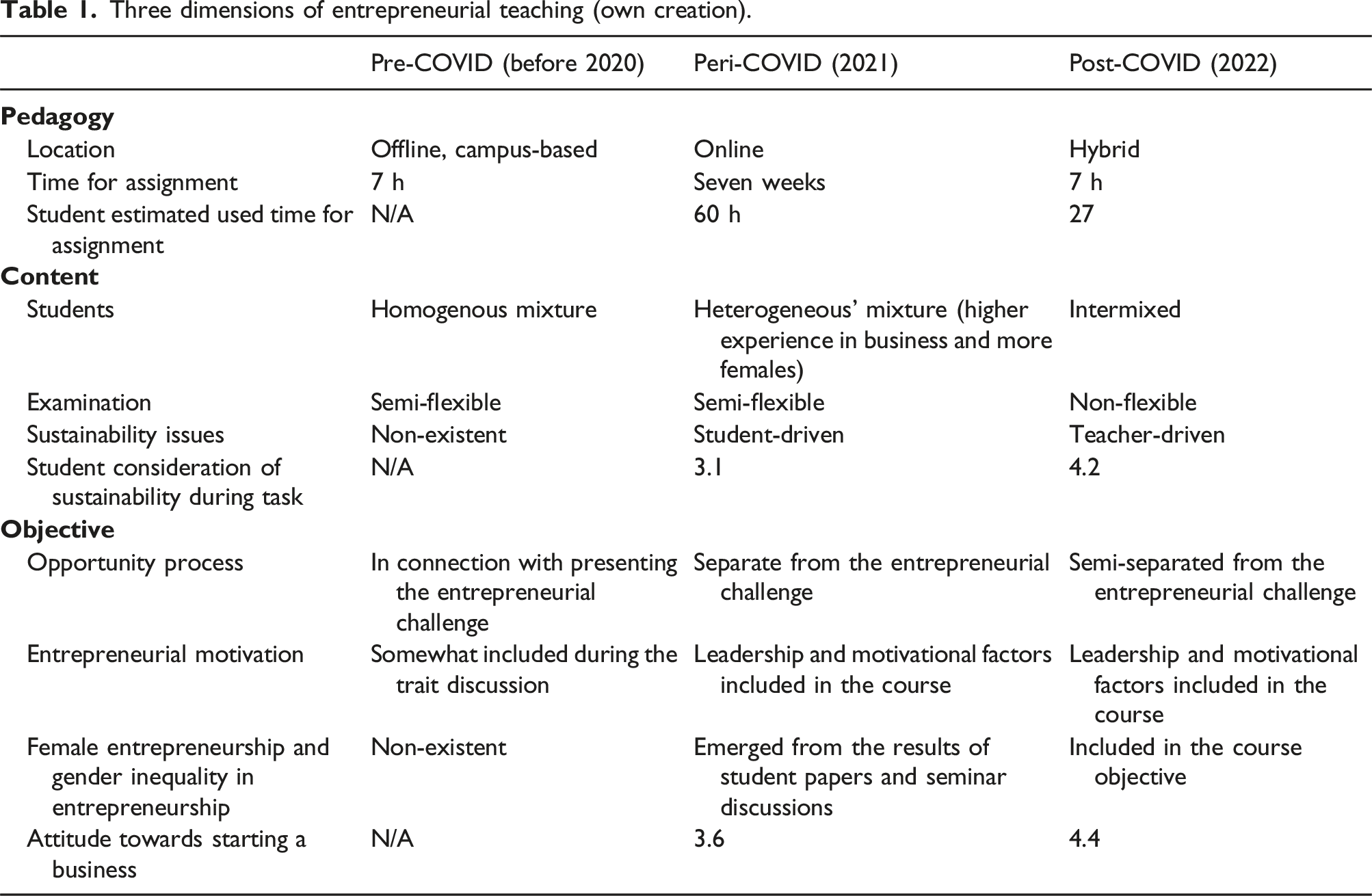
Three dimensions of entrepreneurial teaching (own creation).
Pedagogy - Evolving timeframes and their impact on entrepreneurial outcomes
The course usually had only 1 day for the entrepreneurial exercise. However, during the pandemic in 2021, there were restrictions, so the students read the course in hybrid form, which meant that the task went from covering only 1 day to 7 weeks. The result shows that the longer time contributed to the students creating more entrepreneurial solutions. The students also thought the more extended time was a significant gain: “I think this task would have been more effective as a long-term project than just 1 day. In a day, the focus was just on monetary gains, but for the long run, it could have been on innovation and other aspects of business, and the learning would also be more” (R14).
The students spent more time on the task when it took place over 7 weeks compared to 1 day of practice. The time was longer than 7 h due to compiling a presentation of their activities after the exercise ended. Interestingly, if the students had received less time for the assignment (note: the average estimated number of hours per group was 27 in 2022 compared with 60 in 2021) than the previous year, they still highlighted that they had learned much from the assignment and scored higher in their attitudes towards starting a business (4.4 of five in 2022 compared with 3.6 of five in 2021). In other words, the results of this study suggest that providing students with more time to complete the assignment did not necessarily lead to an increase in their learning. The students who were given less time to complete the task reported learning more and scored higher in their attitudes towards starting a business. Although the students who had more time could practice and refine their skills, their increased efforts did not necessarily translate into significantly higher earnings. Overall, the findings suggest that time constraints should not be the primary focus when it comes to student performance.
Based on the findings of the study, it seems that shorter time constraints may also be beneficial for student engagement and attention. It could be argued that when students are given a shorter amount of time to complete a task (i.e., 7 h), they are more likely to focus and pay attention to the material at hand. This is because they know they have a limited amount of time to complete the assignment, which can help increase their motivation and drive. On the other hand, when students are given an extended amount of time to complete a task (i.e., 7 weeks), they may be more likely to procrastinate or lose interest in the material. This could be because they do not feel the same sense of urgency or pressure to complete the task quickly. Overall, it is clear that time constraints can significantly impact student engagement and attention. While it is essential to allow students enough time to practice and refine their skills, it may be more beneficial to set shorter time limits for specific assignments in order to keep them motivated and focused. By doing so, students may be more likely to learn and retain the material, ultimately leading to greater academic and professional success.
In the survey study, most students highlighted this idea and the pedagogy that the task of being an entrepreneur is about seeing opportunity: “I have learned about how to explore the entrepreneurial skills in you and how to think innovative ideas about business” (R28). They also highlighted the importance that the money received initially did not control what they could do. Instead, as creative people, they did not let the start-up capital control which business idea they invested in: “We are capable of operating a firm even without a capital outlay, but regrettably, our limited perspectives have taught us to stick to the resources we have” (R26).
Upon further analysis of the survey, it is evident that the students from both years have grasped the fundamental idea of entrepreneurship, which is to recognize opportunities. They have also demonstrated a keen interest in learning innovative business approaches. The concept of opportunity-based entrepreneurship resonates with the students’ perspectives, as they are aware that start-up capital should not limit their creativity and innovation. As respondent R26 stated, “We are capable of operating a firm even without a capital outlay, but regrettably, our limited perspectives have taught us to stick to the resources we have.” This sentiment is also echoed by respondent R28, who mentions, “I have learned about how to explore the entrepreneurial skills in you and how to think innovative ideas about business.” As one student writes in their survey, “I learned from this task that no matter how much investment we have, even if we have a minimal amount of money, we should be focused on opportunity and have a plan to start our business” (R42). The students’ approach aligns with the Sarasvathy (2001) Effectuation theory, which emphasizes resourcefulness over resource control. The experiment’s most successful students do not let the lack of resources hold them back from exploring their entrepreneurial skills. Instead, they leverage their existing resources to create and operate a successful business. This observation echoes the insights of Stevenson and Jarillo (1990), where they discuss the importance of entrepreneurial management, emphasizing resourcefulness over resource control.
Content - from homogeneity to diversity and sustainability
Before the COVID-19 pandemic, the course predominantly attracted two distinct groups of students: one native to Sweden and the other comprising exchange students. Despite originating from various countries, these groups shared similar age brackets, offering a largely homogeneous classroom environment. In 2021, due to pandemic constraints, a shift to a hybrid teaching method introduced a notably diverse student demographic. Many of these students were entrepreneurs, concurrently managing businesses in their respective home countries. Additionally, there was a noticeable increase in female exchange students compared to previous years.
The hybrid teaching model enabled a broader spectrum of students to enroll in the course. Notably, two main demographics emerged during this transition. The first comprised entrepreneurs who, under traditional circumstances, would have found it challenging to relocate to Sweden and continue managing their businesses. The hybrid model facilitated their simultaneous involvement in both the course and their enterprises. The second group encompassed women, many of whom had family responsibilities, including childcare. These students, who might have otherwise faced barriers to university education, could now engage via platforms like Zoom.
One of the profound advantages of the hybrid model was its contribution to social sustainability. A majority of the participants hailed from economically disadvantaged countries, but through the hybrid format, they could study from their native regions. This not only allowed them to apply their learnings in local contexts but also indirectly propelled social development in their home countries. Furthermore, these students played roles in highlighting the significance of cultural context in entrepreneurship. As one participant expressed, “It is important to think outside the box. Cultural differences affect businesses, and the way entrepreneurs think is also affected by their cultural backgrounds. Also, another takeaway for me was that it is better to ask for forgiveness than to ask for permission” (R14).
In 2021, a recurring theme among student discussions was the emphasis on sustainability in their business propositions. This indicated that sustainability was organically integrated into their entrepreneurial vision. Consequently, post-COVID-19, the course was refined to prominently feature sustainability, aligning with objectives set out in Agenda (2030); United Nations (2015). Data indicated a marked increase in the significance of sustainability in coursework when it was institutionally emphasized.
The diverse student demographic in the COVID-19 period and the subsequent year necessitated alterations in course content. Given that a sizable faction of students comprised non-European women with familial responsibilities and entrepreneurs, there were inherent challenges in collaboration and meeting deadlines. Lessons from 2021 underscored the need for instructors to adopt a more stringent approach concerning course structure and timelines. Implementing unambiguous repercussions for missed deadlines proved pivotal. By 2022, this structured approach had effectively addressed many of the challenges that surfaced the previous year.
Objective- from theoretical understanding to Experiential transformation
The primary aim of the course experiment is to transition students from mere entrepreneurial teaching, which is to acquire knowledge about entrepreneurship, to entrepreneurial learning, which emphasizes experiential understanding and the cultivation of an entrepreneurial spirit. As Gibb (2002) posited, entrepreneurial learning goes beyond classroom theories; it delves into the realm of real-world experiences, fostering a proactive mindset. Having already been introduced to the essential concepts and research domains throughout the course, this task serves as a hands-on platform, aligning with Pittaway and Cope’s (2007) notion that learning about entrepreneurship and learning to be an entrepreneur are distinct yet interconnected processes.
In 2021, there was a noticeable emphasis on female entrepreneurship more than in prior years. Consequently, the course’s content was further tailored in 2022 to address post-pandemic entrepreneurial landscapes, resonating with Rae’s (2005) argument about the changing dynamics of entrepreneurial education in adapting to evolving societal contexts.
One significant outcome, as noted by students a year post-course completion, was their transformation shaped by both entrepreneurial learning and teaching. They developed the acumen to identify opportunities, with several launching their ventures. A student shared, “After completing my degree, now I am an owner of 50% shares in a grocery store and work in the store as well” (R4). This echoes Politis’s (2005) findings that experiential learning processes significantly influence venture creation. Although the study did not explicitly ask about business initiation, responses emerged organically, underscoring the transformative power of entrepreneurial learning.
Students opined that the entrepreneurship assignment epitomized the essence of entrepreneurial teaching. One remarked, “It was a funny experiment, out-of-the-box thinking. I think this task should also be included in the course in the coming years” (R21). Their feedback mirrors Neck and Greene's (2011) stance that effective entrepreneurial education should be action-oriented and opportunity-focused.
The pandemic and its aftermath necessitated a shift in our student demographics, compelling us to evolve our teaching methodologies. Embracing Kuratko's (2005) idea that entrepreneurial teaching requires adaptability, the course now emphasizes the multifaceted motivations of students, from honing their knack for spotting opportunities to exploring the nuances of entrepreneurial motivation and leadership. Recognizing this paradigm shift, adjustments began in 2021, culminating in a comprehensive overhaul of the course plan and syllabus by 2022, which aligned with the holistic approach to entrepreneurial teaching and learning recommended by Fayolle (2013).
Conclusions
The COVID-19 pandemic brought about unanticipated challenges which catalyzed a paradigm shift in the realm of entrepreneurial education. This study meticulously delves into the multifaceted aspects of this evolution, including the influence of timeframes on entrepreneurial outcomes, the amplifying effects of diverse class demographics, and the paramount importance of experiential learning in fortifying an entrepreneur’s journey.
Concerning the timeframes for entrepreneurial education, the traditional presumption was that a prolonged duration would naturally foster better entrepreneurial acumen. Our investigation challenges this notion. We found, intriguingly, that a succinct yet intensive duration fosters a heightened sense of engagement. This urgency can act as a crucible for innovation and refine the entrepreneurial mindset of the students. Such insights are invaluable for educators. A nuanced approach, which melds time for introspection with periods of intensive and immersive learning experiences, seems to be the golden mean.
The advent of the hybrid model, borne out of the pandemic's exigencies, wasn't merely a shift in the modality of education delivery. It transformed the student demographic landscape. The enriched diversity in classrooms wasn't just quantitative but deeply qualitative. Entrepreneurial students hailing from varied backgrounds contributed a melange of cultural nuances, experiential wisdom, and an emphasis on sustainability and cultural context in entrepreneurial pursuits. The value of such diversity is manifold and, as our study suggests, it makes a compelling case for the continuation of hybrid or diverse teaching modalities even in a post-pandemic era.
The intricate dance between imparting entrepreneurial knowledge (entrepreneurial teaching) and the tangible experience of entrepreneurship (entrepreneurial learning) stood out as a linchpin in this transformative educational journey. Merely relying on didactic methods of imparting entrepreneurial principles falls short. The synthesis of theoretical knowledge with the visceral experience of grappling with authentic challenges and formulating solutions is vital. The success stories of our students, manifested in their entrepreneurial ventures post-course, reinforce this perspective.
From a practitioner’s viewpoint, the emergence of the digital or hybrid classroom isn’t just a logistical adaptation but a conduit for embracing diversity. The rich tapestry of backgrounds, experiences, and thought processes that students from diverse demographics bring is not a mere addition but a multiplier in terms of learning outcomes. However, harnessing the potential of such a diverse classroom, especially in the digital realm, requires a sturdy structural backbone. This includes clear guidelines, effective communication channels, and adaptive teaching methodologies. Furthermore, it is paramount for educators to shed any lingering biases that associate longer assignment durations with better learning outcomes. Our study accentuates that an elongated timeframe might, paradoxically, be counterproductive.
To further enrich this research spectrum, it would be enlightening to delve into the motivations and experiences of specific student cohorts, especially women from developing nations juggling familial responsibilities or those balancing concurrent business engagements. Understanding their integration with budding entrepreneurs can yield fresh perspectives. A holistic longitudinal study mapping the students’ journey—before, during, and after the course—will further demystify the symbiotic relationship between entrepreneurial teaching and learning, offering insights into its long-term impact on their entrepreneurial trajectories.
Footnotes
Declaration of conflicting interests
The author(s) declared no potential conflicts of interest with respect to the research, authorship, and/or publication of this article.
Funding
The author(s) received no financial support for the research, authorship, and/or publication of this article.
