




Abstract
We propose and evaluate contractual- and Intellectual Property (IP) instruments in support of research collaboration partnerships between universities and the Small, Medium and Micro Enterprises (SMME)-industry, and more specifically in the South African context. Interviews were conducted with executives from 11 South African originated SMME’s in the high-technology industry. The findings of this study and potential solutions were then verified and validated with SMME’s, large multinational industry and universities (in South Africa and international) and can be considered as good practice principles to assist in industry-university collaboration (IUC). One aspect that was reported with high occurrence, is the matter of IP valuation, as it can often create further barriers in IUC. The question regarding how to value the IP and any rights relating thereto (IPR’s), is attended to in this study and shared experiences from industry and universities provide insights in the considerations and principles to be used when entering discussions regarding IP valuation.
Introduction
Industry-university collaboration and academic engagement
Industry-university collaboration (IUC) is important and beneficial to both industry and universities, but accompanied with challenges (Ramos-Vielba and Fernández-Esquinas, 2012) (Scandura, 2016) (Wright et al., 2008). Academic engagement and commercialisation are of particular interest to this study. Academic engagement is considered by many companies to be significantly more valuable than commercialisation. Universities’ income derived from academic engagement is significantly higher than through commercialisation (Perkmann et al., 2013).
Academic engagement is defined as “knowledge related collaboration by academic researchers with non-academic organisations [and] include formal activities such as collaborative research, contract research, and consulting, [as well as] informal activities like providing ad hoc advice and networking…” (Perkmann et al., 2013), whereas commercialisation refers to “the patenting and licensing of inventions as well as academic entrepreneurship” (Perkmann et al., 2013) and focuses on the “generation of patents and the creation of spin-off firms stemming from research projects” (Ramos-Vielba and Fernández-Esquinas, 2012). It is further acknowledged that academic engagement can lead to commercialisation (Perkmann et al., 2013).
Contextualising the Small, Medium and Micro Enterprises-industry
This study places emphasis on experiences from the Small, Medium and Micro Enterprises (SMME’s) in the high-technology industry in South Africa (SA), in terms of IUC, however the outcome of this study is widely applicable, as verified and validated with universities internationally and multinational large industry.
Definition of SMME (Bvuma and Marnewick, 2020).
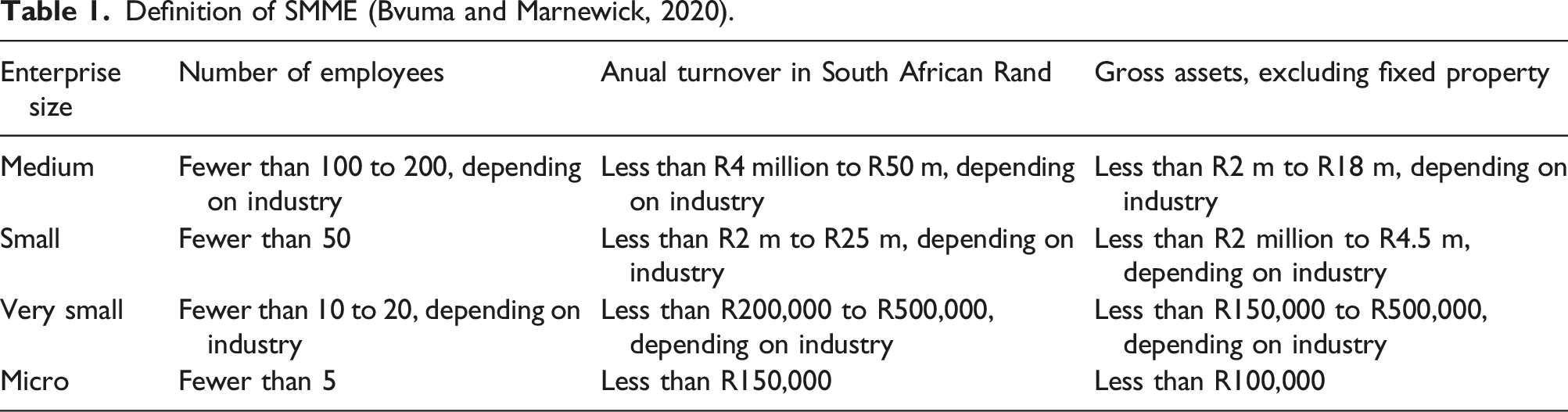
In the SA context, SMME’s are an important contributor to the economy, as shown by its 15,7% year-on-year turnover increase in the third Quarter of 2021, in comparison with the reported large enterprises turnover increase of 11,4%. It is also reported that the number of SMME’s rose by 41 000 (1.7% increase) compared to the third Quarter of 2020. Unfortuntunately, the decline in employment of 3% in comparison with the previous year, accounted for 75% of the overall job losses experienced in 2021 (Bureau for Economic Research (BER), 2022).
From an IUC perspective, the engagement between universities and SMME’s can be regarded as essential to contribute to the SA economy. Current literature on IUC provides an overview on general principles, properties and areas that are regarded stumbling blocks to effective IUC (such as negotiations around IP and IPR’s) (Ramos-Vielba and Fernández-Esquinas, 2012) (Perkmann et al., 2013) (Awasthy et al., 2020). However, limited insights in how to overcome these stumbling blocks, and understanding the contextual limitations, needs and expectations of SMME’s in the SA context, is available.
Contextualising the intellectual property valuation and intellectual property rights
Contractual- and IP (and IPR’s) negotiations are often considered as hurdles in IUC and it is acknowledged that the processes enabling transfer of knowledge through academic engagement and commercialisation are poorly understood (Ramos-Vielba and Fernández-Esquinas, 2012). When considering these IP negotiations, one of the core questions is: What is the potential value of the expected foreground (project) IP arising from a research project and the related IPR’s (if any)?
As noted from literature, the matter of IP valuation is a complex one, especially with regards to what is considered to be “hard-to-value intangibles 1 ” (Schmidtke and Sidher, 2015) (Bishop, 2003) (Matsuura, 2004) (The Organisation for Economic Co-operation and Development, 2015), and although this study won’t be able to provide clear-cut answers for all scenarios, the intent is to provide general principles for consideration of the valuation of IP (and IPR’s) in the context of IUC, as confirmed and validated by both industry and universities.
Contextualising the South African intellectual property-legislative landscape
The most relevant legislation to consider in the SA IUC context is the South African Intellectual Property Rights from Publicly Financed Research and Development Act 51 of 2008 (IPR Act) which came into effect with its Regulations in August 2010, read with the South African Patents Act 57 of1978. 2 Under the IPR Act, the National Intellectual Property Management Office (NIPMO) is mandated to ensure that “intellectual property from publicly financed research and development is identified, protected, utilised and commercialised for the benefit of the people of the Republic, whether it be for social, economic, military or any other benefit” (Department of Science and Technology (DST), 2008).
The IPR Act considerations are briefly described. If an industry partner funds a research project at a university in full (at ‘full cost’ meaning all its associated direct and indirect costs), the IPR Act does not apply, and the parties are free to negotiate the terms of the IP (and IPR’s) transaction. However, if the project is not funded at full cost, the project will be subject to the IPR Act as it is deemed that the project (including the IP outcomes) is subsidised by public funding. The IPR Act define what is deemed as full cost, based on generally accepted accounting practices. Where a research project is funded below full cost, NIPMO approval will be required for certain IP transactions, such as the transfer of IP to the industry partner, exclusive licences, or licences on a royalty free basis (Department of Science and Technology (DST), 2008).
Where IP is transferred to an industry partner offshore, South African Reserve Bank (SARB) approval is required. For this approval, it is important to indicate that the fair market value of the IP was considered and paid for (Werksmans Attorneys, 2017).
It is noteworthy to mention that other countries, such as the United Kingdom (UK) have similar financial regulatory requirements regarding costing of research (University of Cambridge, 2022), and therefore the principles discussed in this study, is also relevant to, and can be applied in the international context.
Research methodology
Figure 1 describes the research methodology for this study. Research methodology.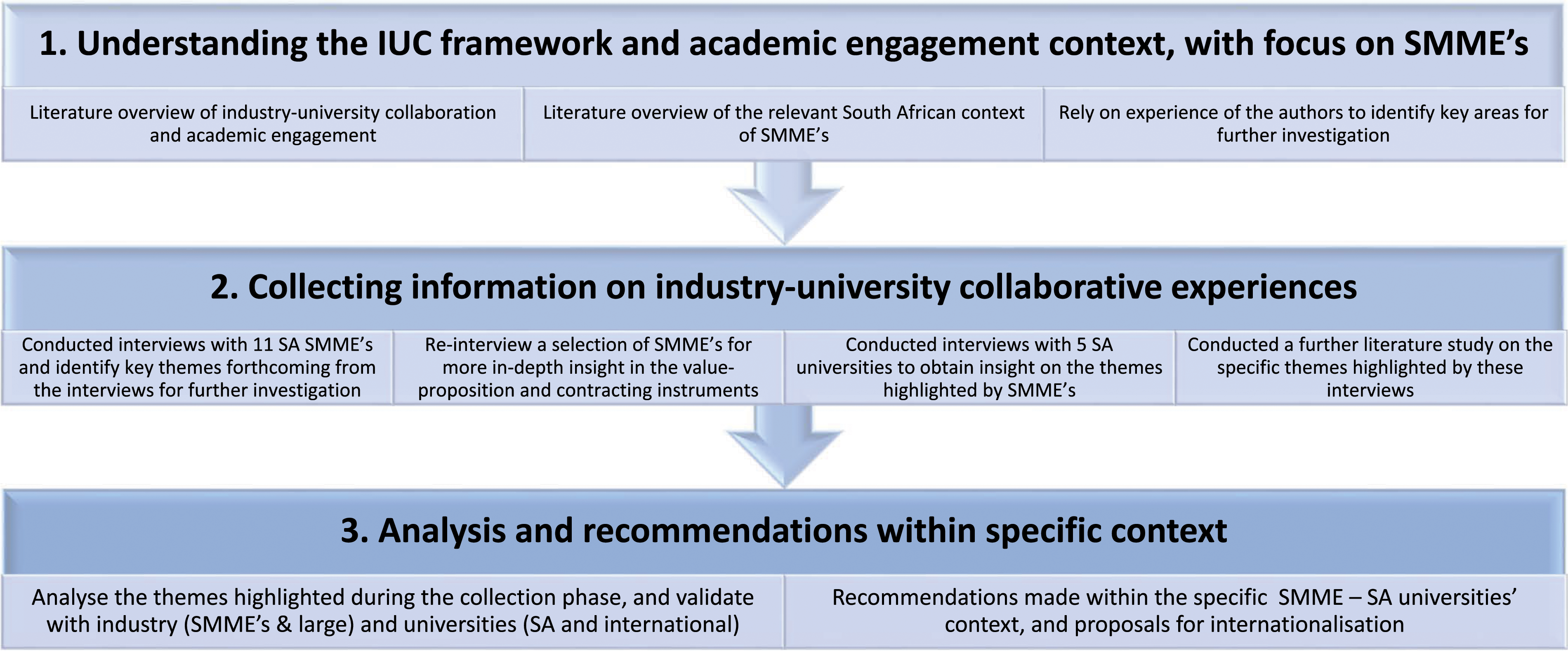
Understanding the IUC framework and academic engagement context, with focus on SMME’s
A literature study was conducted on IUC, academic engagement and the importance of IUC for the SMME’s in the high-technology sector in South Africa. With reliance on the literature and the experience of the authors, a comprehensive questionnaire was developed to conduct semi-structured interviews with SMME’s to obtain further insights.
Collecting information on industry-university collaborative experiences
Interviews with executives from 11 SA based SMME’s (high technology) industry partners, with an international footprint and IUC experience with SA and international universities, were conducted during April-June 2021.
During the interviews specific points were raised that prohibit effective IUC, similarly to that as found during the literature review. To understand these hurdles within context, the following questions were asked and further unpacked: • What is the intrinsic strategic value (for industry and universities respectively), linked to IUC and academic engagement, and how does this create tension in expectations? • Do the parties consider the value of the IP (and IPR’s) in a comparable manner? How is the valuation of IP (and IPR’s) done, or what are the considerations for each party? • How can the requirements with regards to contracting be more effective or supportive to IUC (i.e., standardised contracting instruments which create certainty upfront and support IP transfer- or access to IP)?
The available literature does not provide constructive solutions to overcome these hurdles. Therefore, the authors proposed solutions that would be in the best interests of both industry and universities. This led to a re-interviewing of a selection (four) of the SMME’s to obtain further understanding on their expectations and valuation methods and to validate the proposed contracting instruments.
After re-interviewing the SMME’s (coded as Companies 1–11), interviews were conducted with five SA universities (coded as Nat-Uni-01 – Nat-Uni-05) experienced in IUC, to obtain their insights in the feedback from the SMME’s, and to test and validate the proposed contracting instruments and IP valuation criteria.
A further literature review study was conducted with focus on the valuation of IP (and IPR’s).
Analysis and recommendations within specific context
After the collection phase, the information was analysed, potential solutions developed and tested against the selection of SMME’s (four SMME’s) and large industry (three large industry partners (with global footprint and IUC experience with SA and international universities), coded as Companies 12–14), as well as universities (five South African and ten internationals (coded as IntUni-01–10, from Ireland, England, and Scotland)). Recommendations are made to overcome the hurdles experienced by SMME’s. It further leads to a better understanding and confirms principles that could be applied to IUC in general, and not only limited to the SMME’s in the SA context.
Exploring the main concerns experienced by industry-university collaboration
The main findings of the themes forthcoming from the interviews which relate to aspects impacting the structuring and negotiation of research contracts, IP transactions, and IP valuation, are reported. For transactions where specific licenses to university background IP are critical to the success of the project IP creation, there might be other considerations that are not addressed within the scope of this study. This study focusses on the project IP (foreground IP) considered in general as at an early-stage (lower technology readiness levels (TRL1-4)). 3 Within a university context, it shares certain characteristics with so-called “Hard-to-value intangibles”, and it is therefore helpful to consider the characteristics and nature of hard-to-value intangibles to address the specific challenges regarding the valuation of early-stage university technology created under IUC.
“Hard-to-value intangibles” are typically characterised by one or more of the following (Schmidtke and Sidher, 2015): • Partially developed by the time of transfer • Expected commercial exploitation would only take place several years after development or transfer • It forms an integral part to the development of other “hard-to-value” intangibles • Expected commercial exploitation would be in a novel manner, thus expected projections are materially uncertain • Transfer typically takes place under a lump sum payment • Is to be used/developed under a cost contribution arrangement
An example of the early-stage university technology would be that a company has a series of technologies in its technology value chain and engages with a university to assist with improvement of an existing technology or development of a potential new technology that will form part of a larger technology. The overall contribution that this improved new technology would make to the whole technology process is hard to value, as there are several other dynamic aspects which could impact the whole technology process. In a negotiation between the company and university, this would be considered a “hard-to-value” IP (early-stage university technology).
The interviews with the SMME’s confirmed that there is definite strategic value for SMME’s in engaging with universities, however some reported that they rather steer away from interaction with universities where contracting and IP-negotiations are needed due to the considered barriers. The themes identified through the interviews relating to the perceived barriers that impact the research contract negotiations, are reported.
Creating certainty
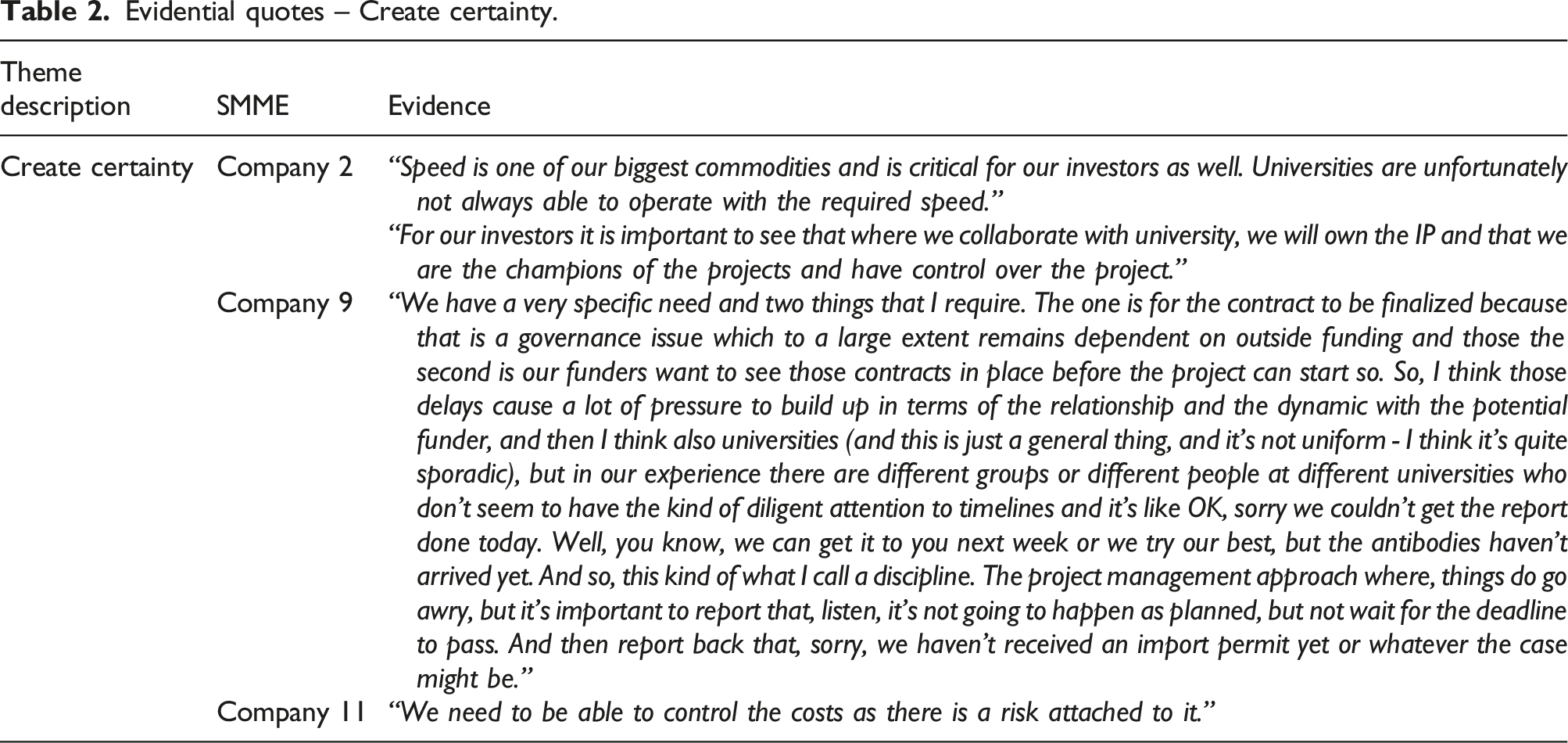
SMME’s shared frustrations regarding the timeframes in which universities negotiate research contracts and conduct the research. Due to the nature of the fast-moving industry, they typically need to find quick solutions to problems to keep their competitive edge. A mismatch in expectations is reported by some, where they sense that researchers tend to approach problems from an academic perspective, whereas SMME’s require a workable solution within a short timeframe. Additional complexity regarding long timeframes for contractual negotiations, deters SMME’s from engaging with universities.
Industry requires more upfront certainty on aspects such as: • Options on ownership or exclusive use of IP • Pricing implications • IP valuation considerations • Timeframe for concluding contractual arrangements • Timeframe for conducting research and the project management capabilities to deliver on time
Evidential quotes – Create certainty.
Establish a balanced contractual model/instrument with emphasis on IP
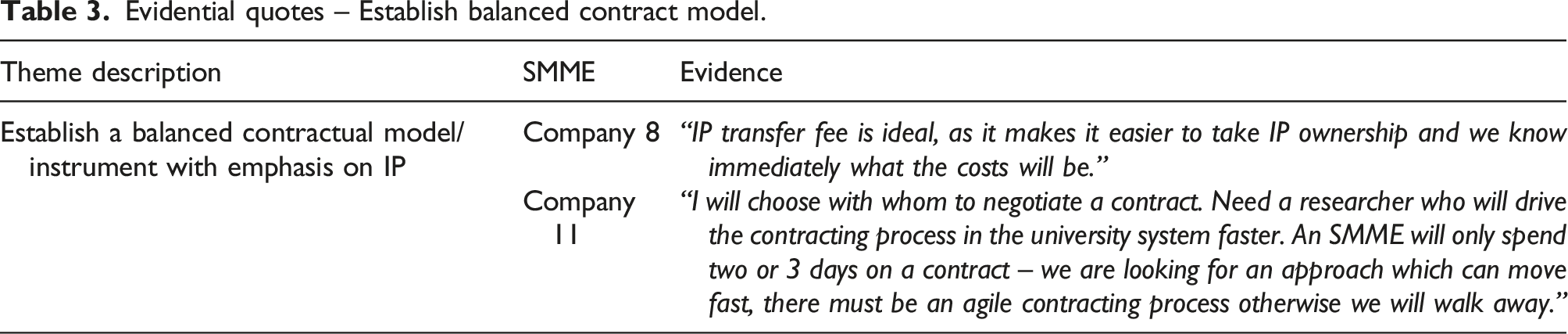
Emphasis was placed on a transparent process where fair principles are applied in the costing and pricing of the research, the contract negotiations, and the valuation of the resulting early-stage university technology. The participating SMME’s requested a contracting model/instrument with a suitable level of sophistication that balances the intended benefits of the transaction and the uncertainty on both the industry and university’s side. A hesitancy to assign IP to an industry partner is perceived to be linked to the difficulty in valuing of the IP by the universities.
A serious concern was raised by the SMME’s that universities tend to overvalue early-stage university technology and to over-estimate the TRL of such technology without cognisance of the further development costs and risks, when determining the value of the IP during a negotiation. This result in difficult negotiations which are at times perceived as unnecessarily complicated. It is due to this perception that some of these industry partners decided to limit IUC to other forms that do not involve any specific projects where IP-negotiations are required. Difficult negotiations regarding IP ownership and IP valuation are typically considered as a deal-breaker for SMME’s.
Evidential quotes – Establish balanced contract model.
Recommendations
Constructive recommendations are made to address the concerns raised. These recommendations were verified and validated with industry (SMME’s and large multinational industry) and universities (national and international) and can therefore be considered state of the art contracting instruments and IP valuation principles that are applicable beyond the SA context.
Research contracting instrument
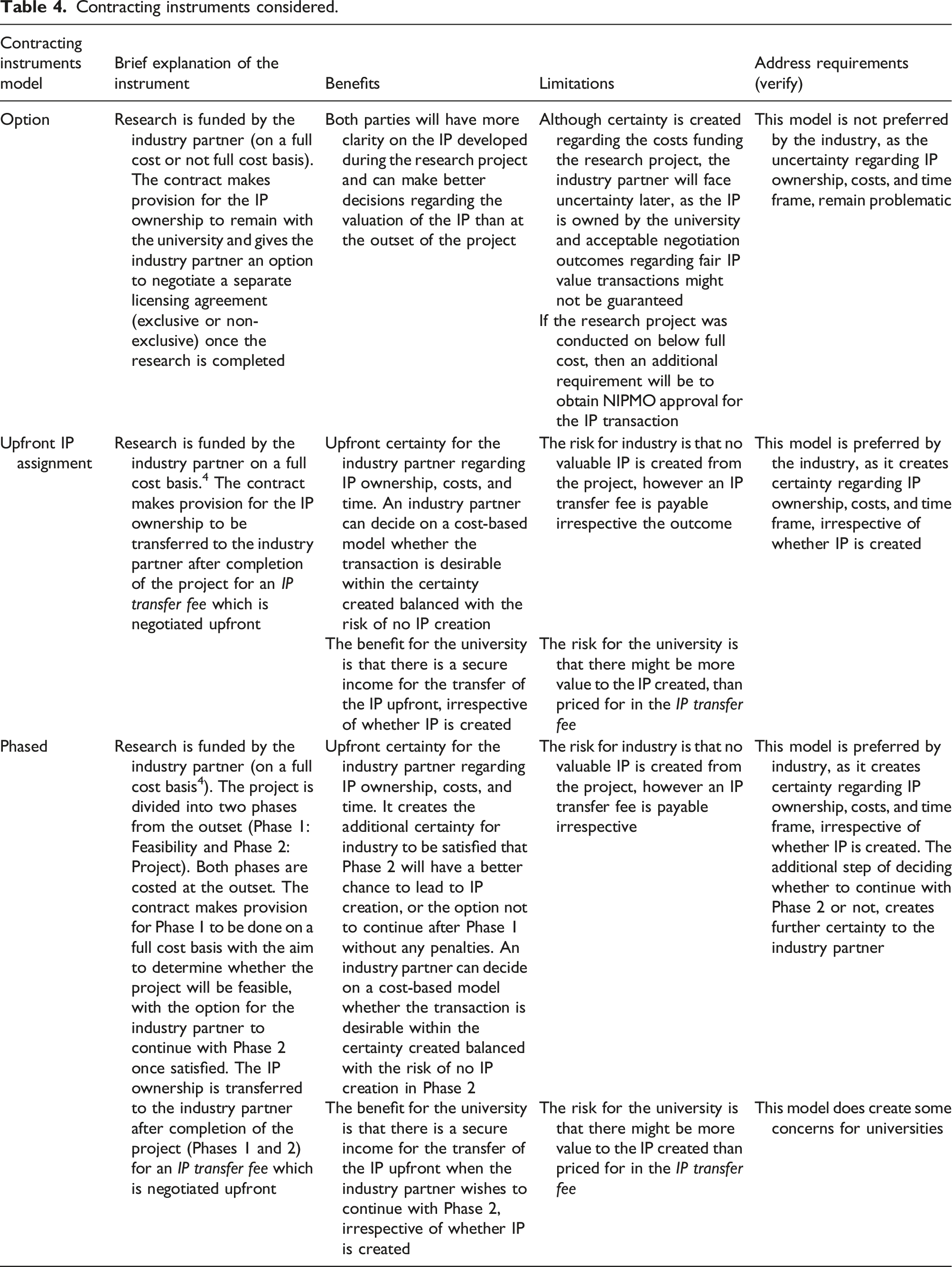
From the findings, the industry desires a contract instrument where they can choose different options in terms of access to IP or ownership thereof, and certainty must be established early in the discussions regarding the timeframe and the costs.
Contracting instruments considered.
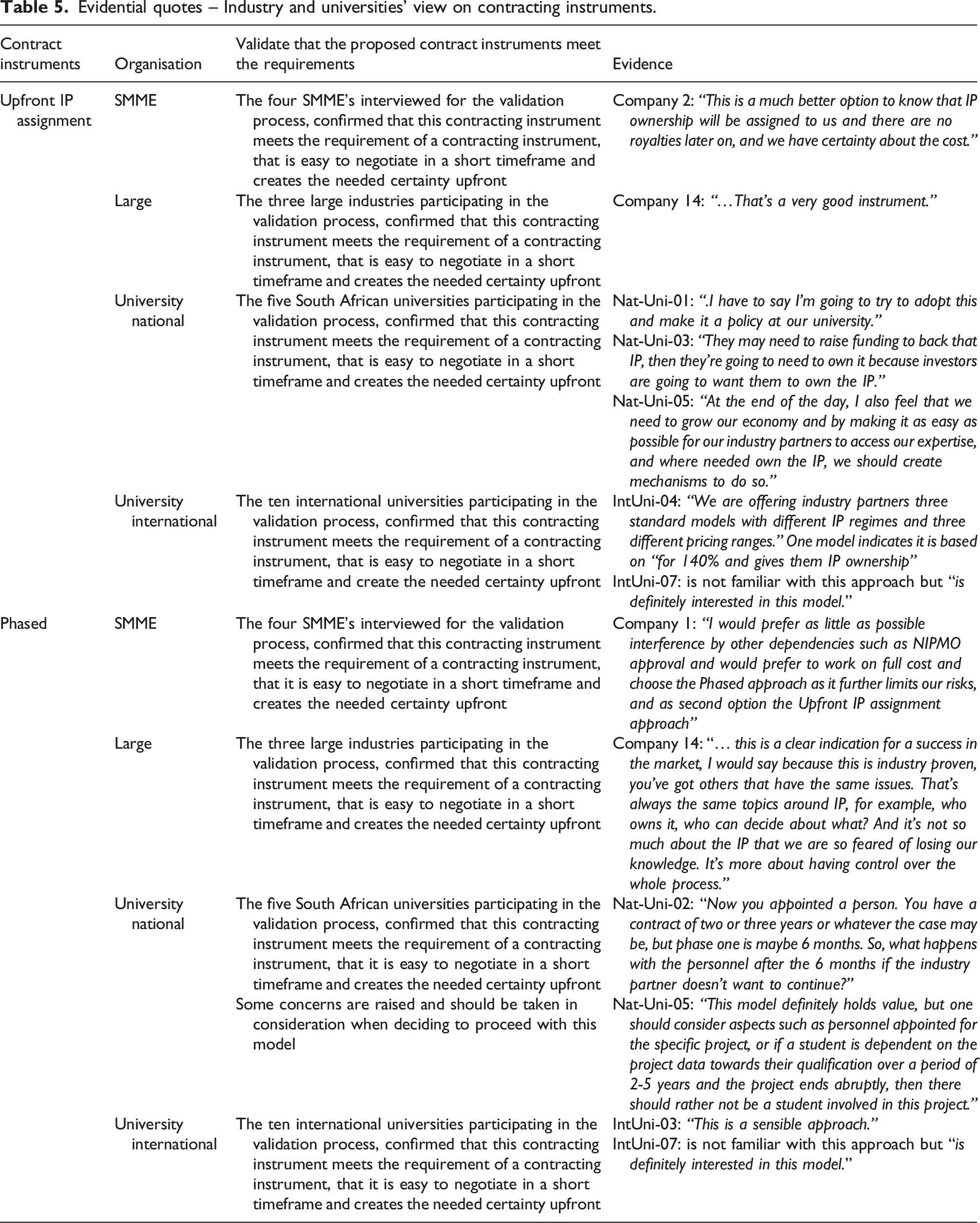
Evidential quotes – Industry and universities’ view on contracting instruments.
Intellectual property valuation approach
Several common IP valuation models were considered, such as cost-based, market-based and income-based (Matsuura, 2004) (The Organisation for Economic Co-operation and Development, 2015), however within the context of IUC the closest model to what the industry and universities require, is an adaption of the cost-based model, with cognisance of its limitations. Again, the level of sophistication of the IP valuation approach, should be balanced with the effort of the research contracts negotiations and the overall strategic benefits of research collaboration for both parties.
The cost-based valuation model uses the cost incurred for the IP development or for replacing the IP, as an estimation of the value of the IP. This model however does not consider the potential future benefits that can be derived from using the IP and is typically used as a basis for valuation of specific IP, for comparative valuation methodologies or where the regulatory requirements involved require an IP valuation (Matsuura, 2004).
As this study focus on an IP valuation approach for early-stage university technology, where the cost of the project and hence the IP outcomes can be determined with reasonable certainty while the potential future benefits are typically difficult to quantify, and where there are regulatory requirements involved in terms of the IPR Act (and SARB for offshore transactions) as explained earlier, the cost-based valuation model is considered to be a sensible approach as a basis for making pragmatic recommendations for industry and universities during their research contract negotiations. Using the cost-based model as the foundation, we propose that the full cost basis is considered as the first level of the cost-based model, and a price linked to the IP transfer (“IP transfer fee”) is considered as the second level of the cost-based model. For the first level, the full cost is determined by the application of generally acceptable accounting practices, and in terms of the requirements of the IPR Act in the SA context. However, an effort to determine the second level (IP transfer fee) again leads to the dilemma regarding the difficulty in valuing early-stage university technology.
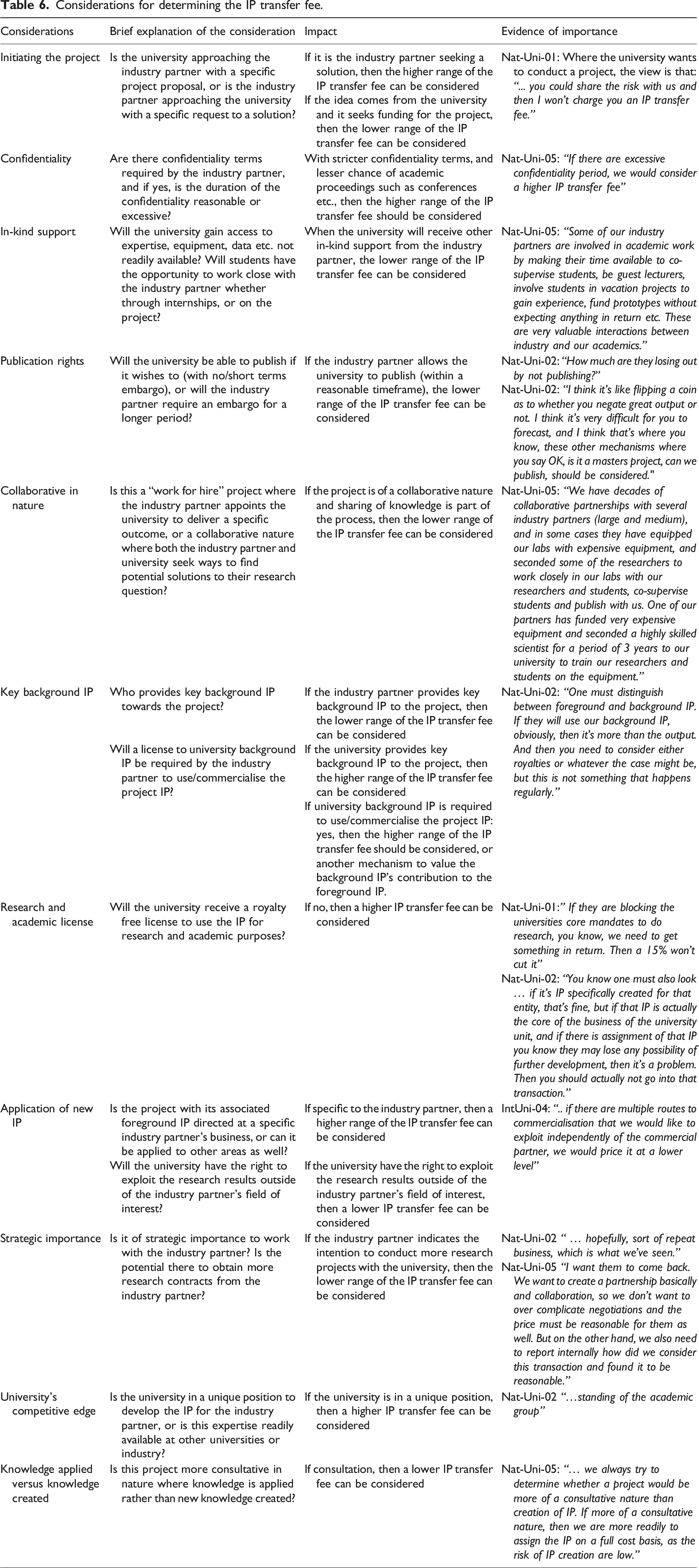
During the interviews with the industry and universities, principles were forthcoming to give due consideration to determine a reasonable IP transfer fee as a valuation approach for early-stage university technology.
From a university perspective
Three universities (one in South Africa (Nat-Uni-05), and two in England (IntUni-04 and IntUni-03)) use a similar contracting instrument as described in the “Upfront IP assignment” model (Table 4). For the IP transfer fee there are several considerations, but these can’t be translated to a monetary value, and therefore each university needs to view it as part of the negotiation process and to set a reasonable fee. However, between the three universities, an IP transfer fee range of 15–50% of the full cost of the project, is regarded as reasonable and accepted by industry. One approach could be to set a default position on a specific percentage and to charge it as a standard IP transfer fee on all these “Upfront IP assignment” contracts so as to create certainty for both industry and the universities, while another approach could be to prepare a list of principles for decision-making for the specific university and to decide whether the IP transfer fee should be to the lower or higher end of the range. IntUni-03 explained that they start the internal review of the IP valuation process at a 50% IP transfer fee, and as they apply their set of considerations, they would decrease the IP transfer fee. For instance, if the industry partner doesn’t allow the university to publish or involve students, doesn’t provide background IP but would use the university’s background IP, the IP transfer fee would be at the higher end of the 15–50% range. This university seldom charges the 50% range and rarely goes below 20%. IntUni-04 indicated that they have found that 40% is considered reasonable by their industry partners and it is seldom deviated from. Nat-Uni-05 experienced that industry finds the range of 15–25% reasonable and it is well accepted.
Considerations for determining the IP transfer fee.
Nat-Uni-04 mentions that “I think there are a handful of technologies that one might take a different view on, …. the highest potential ones, but for most I believe one is better off getting them out the door”.
Nat-Uni-02 indicates that for the last three years the research contract income from industry (specifically SMME’s) made up less than 6%, and therefore once again the effort in negotiations should be balanced with the income and other benefits.
All the participating universities (national and international) agree that there would be no clear answer to the valuation of IP, but that the considerations provided and discussed below would give a university the peace of mind that the decision-makers applied their minds and that decisions are made in a systematic and pragmatic manner and are based on acceptable standards and approaches.
From an industry perspective
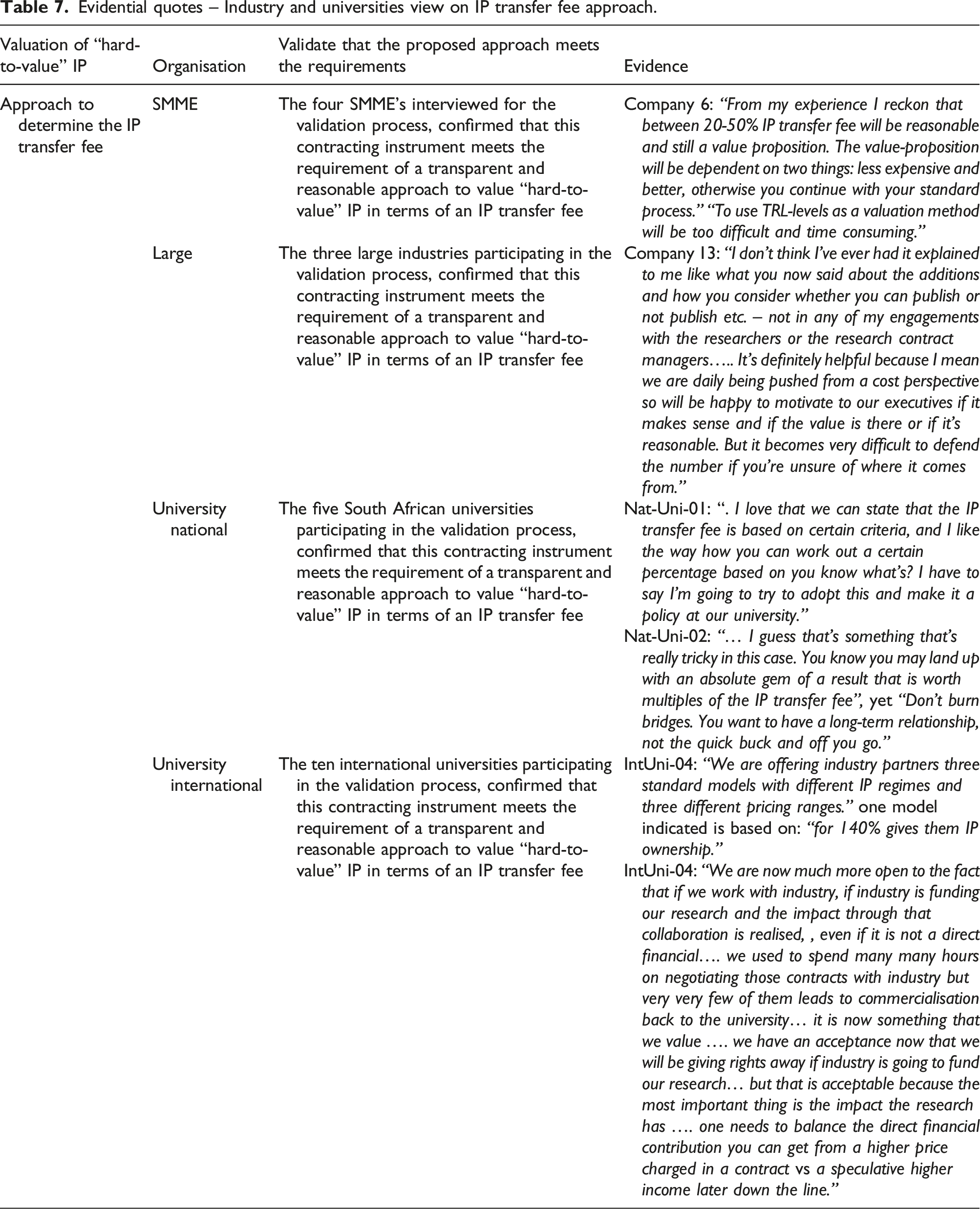
During the interviews with industry (SMME’s and large), some of these considerations for an IP transfer fee were presented to the industry to obtain their input and perspectives. These considerations were positively received, and industry indicated that it creates transparency which will assist them to motivate to their executive committees what the price considerations are based on. After explaining these considerations to Company 13, the response was: “I don’t think I’ve ever had it explained to me like what you now said about the additions and how you consider whether you can publish or not publish etc. …. not in any of my engagements with the researchers or the research contract managers….. It’s definitely helpful because I mean we are daily being pushed from a cost perspective so will be happy to motivate to our executives if it makes sense and if the value is there or if it’s reasonable. But it becomes very difficult to defend the number if you’re unsure of where it comes from.”
Asking the SMME’s how they would consider the IP transfer fee as a reasonable price, the value proposition remains the main consideration, which is cost base. Company 6 indicated that it will always be a “value proposition which will be different for different situations. If I can do it in my company, I have control over the costs, time, and IP. … I will work with a university when it is low TRL work and mostly on a consultative basis.” If an industry partner considers the total price (full cost plus IP transfer fee) to be too costly, it will seek other avenues either by appointing the skilled persons in-house or approach another university or company to assist. There is a difference in nuances between SMME’s and large industry, as large industry has other motivations for IUC such as skills development of students, etc. The SMME’s re-interviewed to determine their views on IP valuation, indicated that they are comfortable with a 15–50% range for an IP transfer fee above the full cost price. Although each project will still be evaluated by the industry on cost-benefit basis, they confirmed that this IP transfer fee with a range of 15–50% would streamline the negotiations.
Universities understand that the decision will be based on a cost-model, as per Nat-Uni-03’s comment: “I mean the other way to look at it, … it’s almost obvious. What can they get in the market. So, if they can get it more cheaply in the market where they have more control, of course they’re going to go that route. Now whether that is a consultant or another company that does the work, whatever it is they’re going to look for the best deal and that’s what a business should be doing, right. So, it’s really about how competitive universities are in the market.”
Evidential quotes – Industry and universities view on IP transfer fee approach.
Implications
The recommendations and principles proposed give guidance to any university and industry if applied as general principles and considered within their specific legislative context. The checklist in supplemental material can be used to guide the process to assist both universities and industry entering into negotiations regarding IP transfer and IP valuation. This checklist must be considered within the terminology, definitions and recommendations made in the article.
Conclusion
Early-stage university technology as described above in the context of IUC, has the potential to become a barrier in negotiations. The recommendations on contracting instruments and an approach to determine a value for the early-stage university technology forthcoming from a research contract, will create certainty for both parties, as the principles applied are reasonable, transparent, and defendable. Due to the difficulty of valuating IP, the level of sophistication of the valuation methodologies used must be balanced with the potential other benefits, and risks of the uncertainties.
As these approaches were discussed with both industry (with experience in IUC with SA and other international universities) and universities (SA and international) and the final proposals verified and validated with a selected group, it is proposed to be regarded as state of the art in research contract management in the IUC context.
Supplemental Material
Supplemental Material - Suitable contract instruments and intellectual property valuation methodologies for industry-university collaboration
Supplemental Material for Suitable contract instruments and intellectual property valuation methodologies for industry-university collaboration by Cornelia Malherbe, Cornelius SL Schutte, Gerardus Verhoef, Petrie Meyer, and Theodorus Doubell in Industry and Higher Education
Footnotes
Acknowledgements
Without the participation of the universities and industry, this study and publication would not be possible. We thank you for your time and willingness to share your knowledge and experience with us.
Declaration of conflicting interests
The author(s) declared no potential conflicts of interest with respect to the research, authorship, and/or publication of this article.
Funding
The author(s) received no financial support for the research, authorship, and/or publication of this article.

Supplemental Material
Supplemental material for this article is available online.
Notes
References
Supplementary Material
Please find the following supplemental material available below.
For Open Access articles published under a Creative Commons License, all supplemental material carries the same license as the article it is associated with.
For non-Open Access articles published, all supplemental material carries a non-exclusive license, and permission requests for re-use of supplemental material or any part of supplemental material shall be sent directly to the copyright owner as specified in the copyright notice associated with the article.
