




Abstract
This article focuses on the third mission of higher education institutions (HEIs) and their role in the ecosystem of creative and cultural industries (CCIs) consisting of the innovation framework (Quadruple Helix) stakeholders. The article provides a comprehensive literature review of the role of HEIs as the knowledge-creating and engaging actor in the CCI ecosystem and place brand co-creation. The research paves the way for empirical validations of our longitudinal and multi-method research to highlight the ability of a university to implement its third mission of supporting the CCI ecosystem engagement to strengthen place branding efforts in regional development. We utilized relational access to collect extensive qualitative data, which provides an understanding of the shift of knowledge transfer processes toward an intensive engagement in economic and social development in the CCIs’ ecosystem and place brand co-creation. In conclusion, we present the role of HEIs in CCI ecosystem stakeholder engagement as one living a sustainable and inclusive place brand.
Introduction
This article focuses on the active role of a higher education institution (HEI) as a regional development actor (Etzkowitz, 2008; Leydesdorff and Meyer, 2006). Nicotra et al. (2021) illustrate academic education strategies and their evolution in the direction of an ecosystemic approach. The often-preferred objective is to align HEI’s academic values, and the regional development aims for improved impacts and outcomes (Nicotra et al., 2021). Research reports a close connection between the HEI–industry collaborations and governance and development in the region (Lazzeroni and Piccaluga, 2015). The research context for that connection has been in the creative and cultural industries (CCIs) and the “creative campus” (Comunian and Gilmore, 2016). Nieminen and Lemmetyinen et al. (2022) conceptualized and outlined “the social infrastructure that nurtures and strengthens cooperation in business networks promoting” CCIs. The study found that social infrastructure facilitated university–industry–government (Triple Helix) interactions and collaboration. In some further studies, the combination of HEI, industry, and government is complemented with a fourth part, people, which extends the Triple Helix to become a Quadruple Helix (QH) (e.g., Carayannis and Campell, 2009; McAdam et al., 2012; Carayannis and Rakhmatullin, 2014).
However, in this research, we link the QH stakeholder engagement and innovation framework to their impact on the development of place branding. Dudek-Mańkowska and Grochowski (2019) hold that the creative economy and place branding can be combined with a specific location, thus allowing for a city or a region to be a brand. Here we perceive “the creative place brand” (Dudek-Mańkowska and Grochowski, 2019) as the ultimate level of manifestation of the creative economy and an evolution of the local creative ecosystem. Additionally, most organizations targeting economic and sustainability goals are now reacting to the growing influence of data and technology in the context of a place brand ecosystem. This influence is apparent in the utilization of smart technologies and digital transformation, consisting of big data usage, mobile technologies, and social media in place brand development (Braun, 2013; Mariani, 2018; Pohjola et al., 2020). Similarly, to Osorno-Hinojosa et al. (2022), we argue that service-dominant logic underpins understanding value creation in HEI–industry collaboration initiatives. The approach involves understanding value creation as acts of co-creation, where stakeholders jointly create value through interaction (Vargo and Lusch, 2017).
This article investigates a university’s role in a CCI value co-creation ecosystem as the central stakeholder in branding a place. The article follows the systemic stream of research focusing on the user-centric innovation environment (Carayannis and Rakhmatullin, 2014). The study relies on empirical case data and extends the understanding of the engagement of QH stakeholders in the ecosystem. It addresses the research question: What role does the HEI play in the CCI ecosystem engagement when branding a place? Following the abstract, an introduction to theoretical discussions on stakeholder engagement in place branding and the CCI ecosystem follows. A literature review prompted further discussion. The methods section introduces the data sources. The results section presents the findings of the longitudinal process of gathering and analyzing the data. Finally, the conclusions section unites the theoretical discussions and enriches them with empirical findings. Our references are provided at the end of the paper.
Literature review
Place branding researchers (e.g., Boccella and Salerno, 2016; Cooke and Lazzeretti, 2008) have investigated how the creative industries have influenced on the development of cities or focusing on the place branding process alongside the creative economy (Evans, 2015; Mengi et al., 2017). Some others focused on explaining how place branding has an important role for local development (e.g., Maheswari et al., 2011). Based on the literature on creative ecosystems and place brands, “the creative place brand” (Dudek-Mańkowska and Grochowski, 2019) is the ultimate level of manifestation of the creative economy and an evolution of “the local creative ecosystem” (Comunian, 2011).
The place brand is a co-created spatial experience involving people in a certain activity (Rahimi et al., 2018). Kavaratzis and Hatch (2012) further define that brands are co‐created by the many people who encounter and appropriate them. Førde (2016) and Wallpach et al. (2017) noted that stakeholders play a central role in building brand identity and thus branding places are seen as co-creative holistic processes with diverse stakeholders rather than a result of managerial objectives led by top-down processes (Gulisova, 2021). Vargo and Lusch (2004) stress that brand value is “co‐created through network relationships and social interactions among the ecosystem of all stakeholders,” as was well-articulated by Merz and Vargo (2009). Therefore, it seems logical to view branding and brand value creation as a process combining the views and objectives of place’s stakeholders (Braun et al., 2013).
The overall roles within Triple Helix stakeholder ecosystem development are realized through a set of functionalities concerning knowledge generation and sharing, innovation co-creation, and consensus-building spaces. From a Triple Helix systems perspective, stakeholder interactions in the ecosystem can generate novel knowledge combinations and advance regional level innovation practices (Ranga and Etzkowitz, 2013). The knowledge-sharing and experimentation in the social context of HEIs are particularly relevant from an innovation perspective (Kumari et al., 2020). Successful ecosystem co-creation relies on the interactive engagement of regional level QH stakeholders representing research and education, public organizations, businesses, and residents (Komninos et al., 2021).
The people dimension is central to this study, justifying a four-dimensional helix dimension (QH) (e.g., Carayannis and Campell, 2009; McAdam et al., 2012; Carayannis and Rakhmatullin, 2014). However, the extant literature offers no consensus or clarity regarding the fourth element of the QH model (e.g., Höglund and Linton, 2018). We propose that the fourth element in this study is people because of the interactive nature of place branding, realized, for example, as
Hauge et al. (2018) stated that collaboration between universities and CCIs boosts regional innovations and economic growth. Creative and cultural industries are part of a global knowledge economy, constantly exchanging knowledge, creativity, and skills to innovate and aim for local competitive advantage. Hauge et al. (2018) further emphasize that HEI and CCI actors may have markedly different understandings of and interests in cooperative initiatives. Enhancing the engagement between academia and industry to drive innovation thus demands common goals and suitable arenas for collaboration. Activities in organizational learning, such as those engaging participating universities and partnering companies, emerge as focal concerns when diffusing knowledge and transferring innovation practices across contexts (Osorno-Hinojosa et al., 2022).
Higher education institutions have a critical regional role in promoting technological innovation within industry ecosystems (Clarysse et al., 2014). Companies, their personnel, local universities, and research organizations can be characterized as knowledge hubs forming the heart of innovation ecosystems. The modern innovation is growingly interdisciplinary, and it demands cross-sectoral collaboration in the process of performing cross-industry projects (Tolstykh et al., 2021). The role of HEIs is being transformed and reinforced in a QH ecosystem context. The role of the HEI provider in enhancing the engagement of the stakeholders is seen through a value-creating framework consisting of the scene-setter, matchmaker, and co-creator roles (Nieminen and Lemmetyinen, 2015).
Dooley and Bowie (2005) followed a strategic approach to place brand management and stated that aligning an organizational brand with the dimensions of a place brand might offer benefits that strengthen the place brand and the organizational brand in people’s minds. One operationalization of such a strategic approach is efforts to enhance innovation in regions in line with the regional strategy (Pasquinelli, 2015), which is emphasized in our study and illustrated in Figure 1 below. CCI ecosystem stakeholders in place brand co-creation.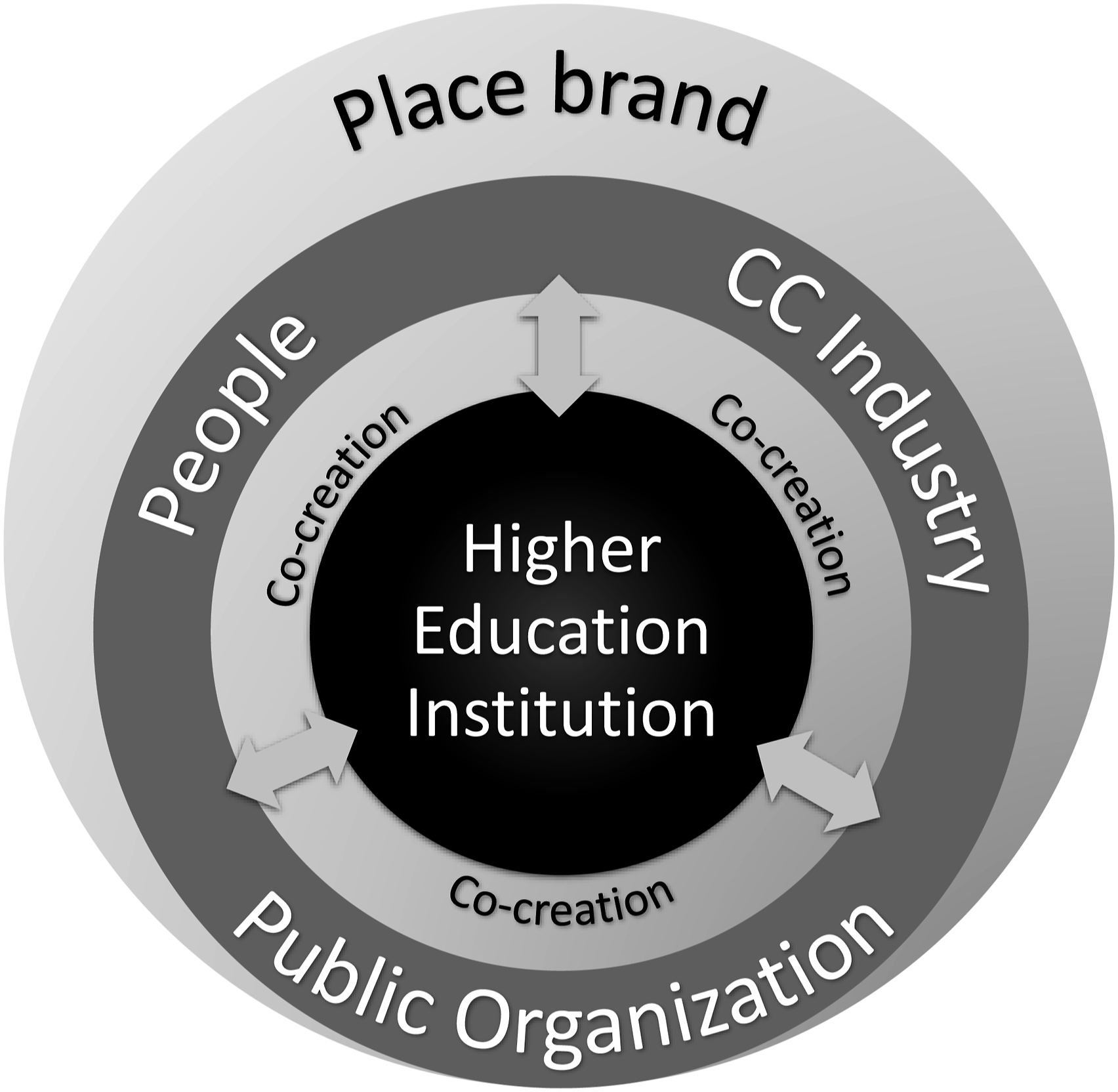
Figure 1 reflects the literature review above in illustrating the central role of HEIs in place brand co-creation. This theoretical setting justifies and heightens interest in conducting a focused data analysis of the relationship between the CCI innovation framework and the place brand.
Methodology
The current study is based on data harvested from the researchers’ long-term interaction with creative and cultural industry actors in a city. It offers an opportunity to extend our understanding of the engagement of QH stakeholders in the CCI ecosystem. It is guided by the research question: What role does the HEI play in the CCI ecosystem engagement when branding a place? There have been calls for more qualitative, longitudinal, and multi-method work studying community collaboration, how it operates, and how it can be maintained (e.g., Jack et al., 2010). The current research presents a selected case study (Eriksson and Kovalainen, 2016) ecology—the CCI ecosystem in the city of Pori, Finland and the wider region—to investigate the phenomenon of engagement and stakeholder roles in context.
The city of Pori, with a long industrial heritage, has identified a need to rebrand itself as a creative and attractive place. The regional university campus in Pori is closely integrated with projects supporting the city’s development and embracing residents of the city, business companies, and public and private cultural organizations and institutions. The Pori campus provides coordinators for local CCI projects. Pori also makes an interesting case due to its enabling multiple forms of participation and embracing the public’s opportunities to contribute to rebranding the city. The culture and history of the city were seen to form the core of the brand of the city (Hakala et al., 2020). The city administration initiated the rebranding process, which was therefore influenced by political decision-making. To move the focus of brand ownership from top-down management includes accessible discussion and decision-making at the local level—including the residents of the city—and now extends beyond a sectoral or industry perspective.
Data collection methods and themes.
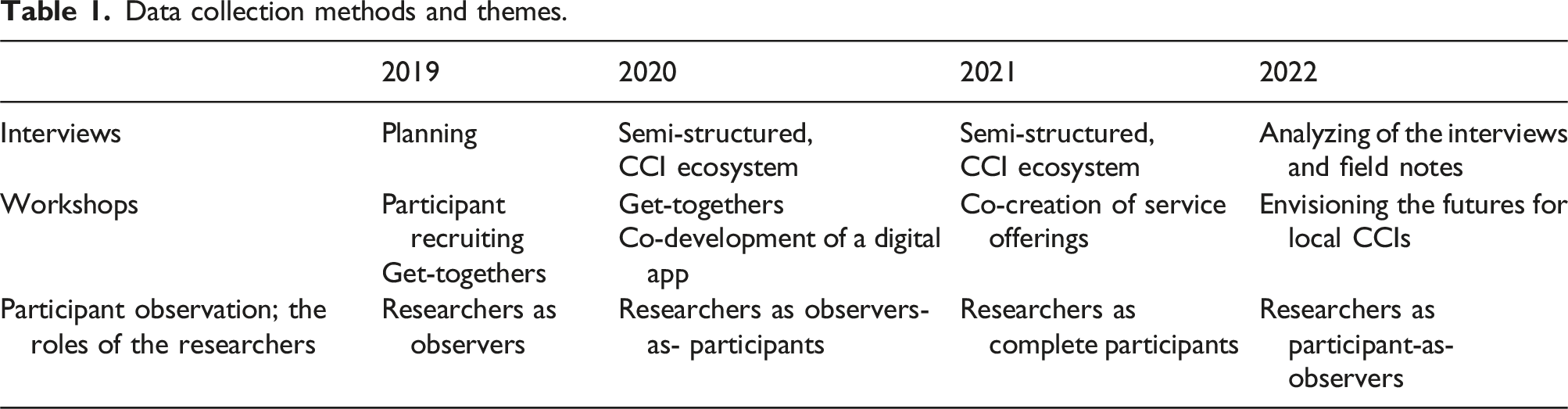
We believe that ethnography, participant observation, interviews, and intensive interaction in the field support “an intensive case study strategy” (Eriksson and Kovalainen 2016: 134). Referring to Bell et al. (2019: 413), our roles as ethnographers have changed from observer to observer-as-participant and participant-as-observer to complete participant. As faculty members of the local university, we had unparalleled access to collect data on-site and were also invited to do so in social settings. In business research, the extent of participant observation varies considerably: At its peak, researchers might share their everyday life and activities in the research setting. In the business research context, that could mean working in an organization that is a subject of the research. In our case, one of the researchers worked for one of the case organizations. The other three have several years of experience facilitating workshops like those informing this study, making it possible to form an insider’s view of the phenomenon. As Eriksson and Kovalainen (2016: 156) put it, “simultaneously there is always an observer side of the process,” and the challenge is “to combine participation and observation in a way that enables understanding of the site as an insider while describing it to the outsiders.” The authors of this study have been immersed in research on the CCI sector in Pori for a considerable time, which meant they applied their pre-understanding when analyzing the case data (Lemmetyinen et al., 2022). They could therefore apply a dynamic and context-related research method (Chalmers and Shaw, 2017).
The data were thematically analyzed (Bell et al., 2019: 520), which offered a flexible way of analyzing a broad selection of qualitative data. The data were clustered in themes, partly related to the research focus and research questions (stakeholder engagement and the university’s role) and partly to categories identified through the analysis (Bell et al., 2019: 519–520). The categories were the dimensions of stakeholder engagement in CCIs and the university’s role in enhancing stakeholder engagement. This qualitative method helped unveil how a university can support the engagement of the actors in the CCI ecosystem.
When analyzing the data, we utilized the dimensions of stakeholder engagement with a place brand (Helmi et al., 2020; Pohjola, 2022). This study complements the philosophical and concrete dimensions of engagement by Helmi et al. (2020) with the strategic engagement dimension (Pohjola, 2022). In the data, we identified the philosophical commitment of the stakeholders (Pohjola, 2022). Subsequently, we compared the parties that were philosophically committed and had stored data on the mobile experience platform mentioned above (Pohjola, 2022). The final stage of the analysis reviewed the university’s role using the typology of Nieminen and Lemmetyinen (2015); scene-setter, matchmaker, and co-creator as counterparts to the levels of stakeholder engagement: philosophical, strategic, and concrete.
Results and argumentation
University as the scene-setter—philosophical engagement
Many formerly industrial cities must redefine themselves as creative and attractive places to live and study, and the Finnish city of Pori is no exception. To increase our understanding of the CCI sector of the city, in 2020, we invited local people we considered stakeholders in the creative economies in the city to two workshops to discuss the themes of sustainable and inclusive creative and cultural industry. We did not want to presuppose who was involved in the CCIs of Pori but contacted a wide range of local cultural and creative workers, entrepreneurs, policymakers and influencers involved in private and public local cultural institutions and organizations and included volunteer associations.
The workshops worked as “get-togethers” and informed us about the local CCI ecosystem, how CCIs were understood, and where the ecosystem was based. While the first workshop’s primary purpose was to identify the people involved in the local creative ecosystem, the subsequent workshops aimed to understand the opportunities and challenges of cultural sustainability. The focal questions were how to extend the digital development of sites, support the transition toward smarter service environments, and meet the expectations associated with digital platforms and the digital customer experience. The workshop participant emphasizes the possibilities of accessibility and sustainability of the platform: “Digital platforms allow customers to explore tourist routes and attractions on their own in a cost-effective way” (Workshop Participant).
The engagement at the philosophical level can be revealed from participants’ interest in cooperating and leveraging digital opportunities, expectations, and the benefits of increasing accessibility and sustainability to explore the surrounding region (Pohjola, 2022). Digitalization facilitating a more sustainable and inclusive CCI ecosystem topped the list of motives.
We conducted 33 semi-structured face-to-face interviews in Pori and the surrounding area in 2020. The interviewees included a wide range of local creative workers, entrepreneurs and freelancers, policymakers, network/community managers, companies, HE providers and volunteer/community groups and influencers engaged in the creative economy. We used a snowball method, so the interviewees were selected based on recommendations from other interviewees.
The informants were asked who should be involved in the city’s creative economy and how they see their role in supporting inclusive and sustainable cooperation. We also asked them to show us on a map where the creative and cultural economy of the city was located. Unsurprisingly, the same key locales were identified by most of the informants. Moreover, it was evident that the interviewees believed strongly in the local creative ecosystem, which suggests Pori has the potential to be branded a creative place.
Philosophical engagement indicates “understanding, alignment, identification, and integration” with the place brand and is shown through “moral support, future engagement intention, and positive word-of-mouth behaviour” (Helmi et al., 2020: 628). The stakeholders in CCI showed a strong philosophical engagement. The informants also wished someone would coordinate the cooperation. We view the university’s role as that of a scene-setter
The university as a matchmaker—strategic engagement
The intensive data-gathering process heightened our understanding of the strategic decision-making of the CCIs of Pori and its environs. We invited the policymakers to discuss the data. The workshop opened with some provocative statements based on the data to stimulate the discussion. Examples of such statements were, CCIs are mentioned in several strategies of both the city and the area, but there is no explicit strategy for the CCIs/creative economy of the city; and Pori does not have an independent cultural strategy, it is covered by the cultural strategy of the whole region; On the city level, culture and creativity are associated with welfare, tourism, and events and The strategy of cultural upbringing encompasses pre-school and school children but there is no strategy for higher education/university education. The statements prompted a lively discussion. The workshop ended with a groupwork exercise in which the participants represented cooperation to trigger inclusive and sustainable CCIs using Lego bricks. At the end of the session, some participants advocated the university adopt a matchmaker role or even one of a co-creator to engage the participants in helping the CCI ecosystem evolve into a creative place brand, which is an evolution of the local creative ecosystem (Comunian, 2011) and the most developed manifestation of the creative economy. (Dudek-Mańkowska and Grochowski, 2019)
When the regional cultural strategy was conducted, it was coordinated by the regional council that engaged public, private and third-sector cultural professionals, entrepreneurs, and volunteers. However, in practice, since project funding is limited, only a fraction of voices will be heard in the development of CCIs. An example of a network coordinated voluntarily is the regional cultural producers with around 200 participants (Lemmetyinen et al., 2022).
Helmi et al. (2020) provide a typology featuring two levels of engagement with a place brand: the philosophical and the concrete. We adopted the same two levels, but as our research progressed, it revealed a third level between the two. We labeled that level strategic engagement (Pohjola, 2022).
The university as co-creator—concrete engagement
In 2022, we ran workshops to elicit the experiences of those who had participated in the CCI co-creative research, development, and innovation oriented (RDI) projects. At the workshops, for example, university personnel taught the attendees to use a digital platform to present their services, destinations, and activities. We gathered participant feedback, and subsequent analysis showed that 27 actors had commenced tangible activity. The resulting mapping digitally features 806 places or points of interest. “Each destination on the route has its own story, its own world where you can immerse yourself for as long as you want” (Workshop Participant).
The workshop participant describes an arts route and its locations as a unique destination hosted on a digital platform. The site-specific descriptions presented on the platform encourage tangible and dynamic engagement via digital activities. In addition, new participants committed to the destination joined the platform continuously. Our observations of the workshop data showed the workshop participants who were philosophically committed did not necessarily engage in action at the concrete level (Pohjola, 2022).
The Helmi et al. (2020) typology revealed “visible behavioural manifestations of engagement with both tangible and intangible…components.”
As one participant put it: “Digital and smart content will convince tourists to travel to Satakunta (a province).”
HEI roles in the CCI ecosystem and Place Brand Engagement ref. to Helmi et al., 2020; Pohjola, 2022.
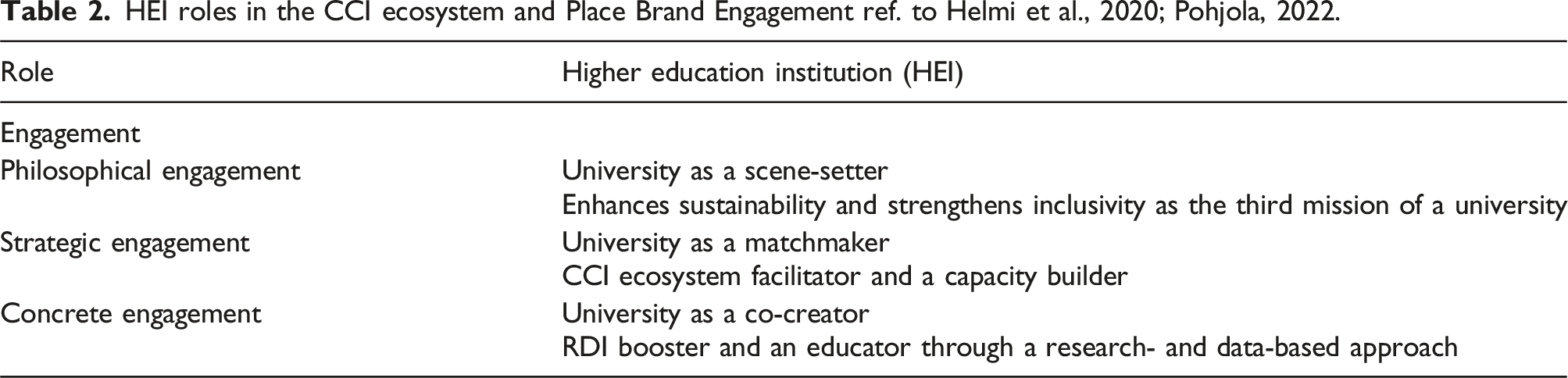
The HEI’s role as a scene-setter, matchmaker, or co-creator has connected regional actors of the ecosystem and strengthened the international cooperation of those involved in R&D activity of the area. In addition to the HEI, we identified the public sector, the CCI industry and people as stakeholders of the CCI innovation ecosystem who live the place brand.
Our informants considered Pori as a CCI hub but highlighted that the place brand of Pori must not be just advertised but lived with (Hakala et al., 2020): “we are making Pori a more enjoyable, more inclusive, and more cultural city and all those attributes you want to attach to it. A more fantastic place” (Informant).
The CCI ecosystem stakeholders considered the brand-building process of Pori encapsulated inclusiveness and openness and suggested everybody’s opinions were respected. The informants appreciated how the city planning took into consideration citizens’ opinions. They considered that the dynamic processes, supporting atmosphere and non-bureaucratic organizational practices are prerequisites for change and innovation (Lemmetyinen et al., 2022), which supports our findings that those principles should be widely applied in policymaking.
The informants valued the natural environment, local production, and, most of all, sustainability, and ethicality. Stakeholders considered sustainable development would be an important characteristic of the future creative ecosystem of Pori.
Conclusions
This article focuses on the relationship between the CCI stakeholders and place branding. In doing so, it combines the phenomenon of the creative economy comprised of cross-industry actors within a specific location that makes it possible for a city or a region to be a brand (Dudek-Mańkowska and Grochowski, 2019). The research has investigated the systemic nature of multi-stakeholder ecosystems and place brand development, emphasizing the role of culture in strengthening sustainability outcomes along with socioeconomic and environmental aspects. The literature on place brands and creative ecosystems indicates the creative place brand (Dudek-Mańkowska and Grochowski, 2019) is the ultimate level of manifestation of the creative economy. It represents an evolution of the local creative ecosystem (Comunian, 2011), emphasizing the experiential nature of brands as co‐creations of the multitude of people who face and connect with them (Kavaratzis and Hatch, 2012).
Collaboration and CCI stakeholder co-creation practices facilitated by the HEIs contribute to innovation in industrialized countries and orchestrate the initiation of cross-industry ecosystems. This study sheds light on the nature of stakeholder engagement and interactions in the ecosystem and especially on the role of the HEIs in generating new ways of combining knowledge and resources that may contribute to innovation practices and co-creation of brands (Kavaratzis and Hatch, 2012) at the regional level as emphasized by Ranga and Etzkowitz (2013). Rapid digital transformation and novel platform solutions illustrate the future-oriented development in enhancing and renewing place-based services and experiences that strengthen inclusive and sustainable place brand co-creation in regions. The findings support the perspectives presented by Pohjola et al. (2020) and Mariani et al. (2018) that digitally enhanced engagement can improve place brand co-creation and vitalization, for example, by boosting social shareability, and deepening interactivity. At the strategic level, the HEI’s role in the QH context is to enhance the CCI ecosystem collaboration. These findings align with those of Hauge et al. (2018), which prompted a call for policies stimulating cultural, social and economic changes to promote a new praxis for strategic partnerships, such as those involving the engagement of QH stakeholders.
This study shows the university’s role as a facilitator and a capacity builder of an ecosystem that enhances the coordination of activities to support innovation and strengthens place branding. Current research reveals the scene-setter role at the stage of philosophical engagement with the CCI ecosystem. At the strategic stage, the university’s role was that of a matchmaker; within the concrete dimension, the university acted as a co-creator of value that complemented regional innovation processes and place branding.
Moreover, reflecting on the smart specialization of the region, it is clear a coordinator can build unity in multi-industry ecosystems between the philosophical, strategic, and concrete dimensions. The findings offer practical guidance for organizations managing place brands on enhancing QH stakeholder engagement through cross-industry co-creation in branding a place. QH collaboration facilitated by HEIs and cross-industry initiatives advancing place branding through digital and sustainable development activities are increasingly dynamic and hence merit closer investigation in the future.
The interconnected QH ecosystem supporting the formation of an inclusive and sustainable place brand through the dimensions of engagement is illustrated in Figure 2. This study has revealed some major factors underpinning regional cooperation and strengthening engagement between HEIs, industry, government and the people in the concrete, philosophical and strategic dimensions. In so doing, the current research clarifies the existing theoretical understanding relating to the Triple Helix and QH interactions and how they can generate new combinations of socio-economic-cultural-technological-environmental knowledge and resources on the regional level (Ranga and Etzkowitz, 2013; Tolstykh et al., 2021). Role of the HEI in the CCIs ecosystem and Place Brand engagement.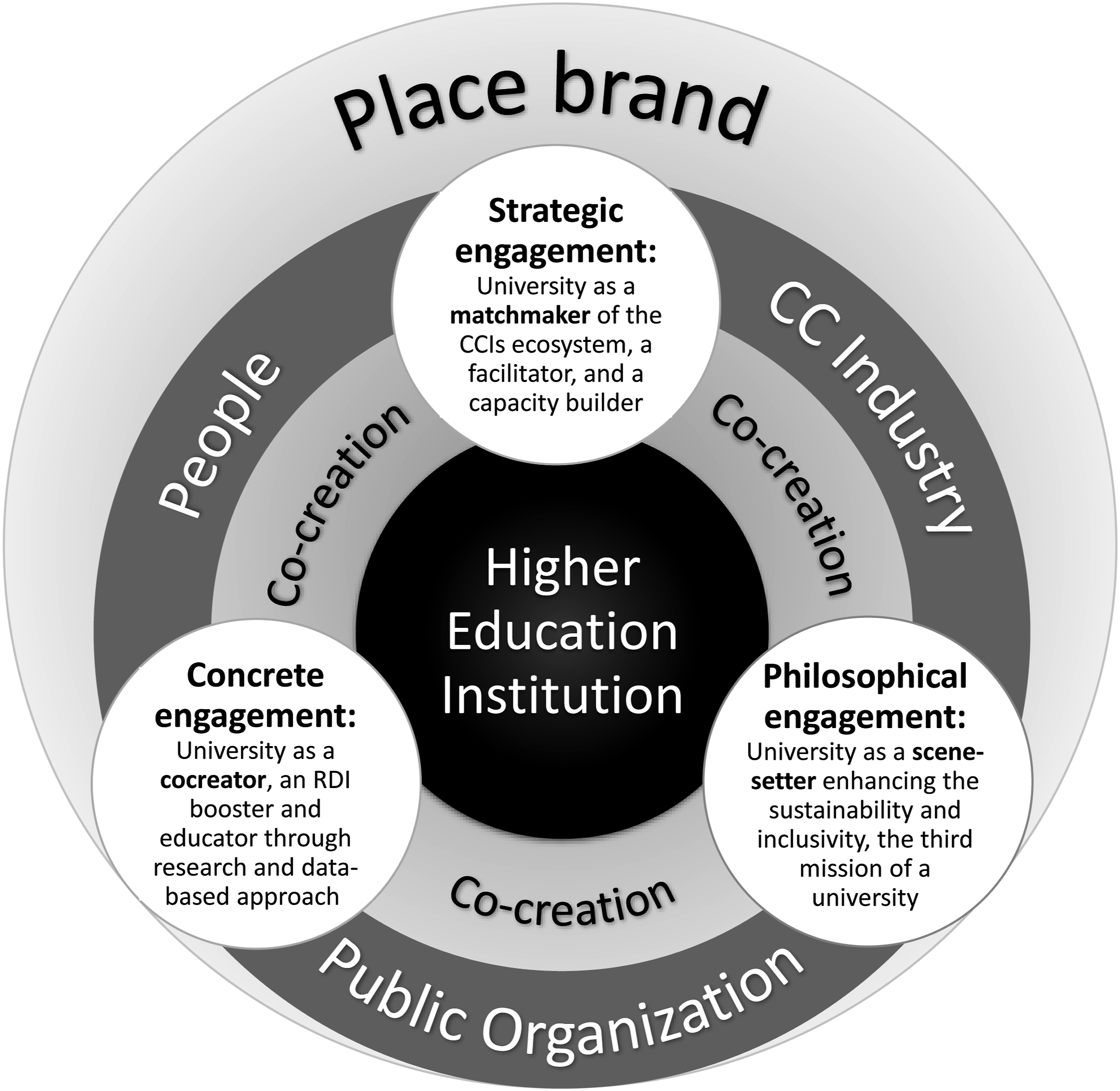
Our study coincides with the regional development policies of the EU and the sustainable and inclusive development of regional innovations. The EU’s Smart Specialisation strategy highlights the so-called entrepreneurial discovery process, which is closely connected with stakeholder engagement. The aim of stakeholder co-creation here is to identify regional strengths and leverage them for sustainable growth (Komninos et al., 2021). These policy connections provide linkages that strategically engage the ecosystem’s cross-industry stakeholders and build continuity into the place-brand co-creation processes regionally. The study emphasizes the role of HEIs in knowledge creation and capacity-building in multi-scientific collaboration in ecosystems.
Limitations and avenues for future research
The present study has provided vital information about the roles of an HEI in CCI ecosystems and place branding. Since the CCI stakeholders interact in a systemic manner as actors in an ecosystem, there is a need to maintain and extend multi-method research on ecosystem stakeholder engagement by investigating and involving other QH actors in further studies.
Sustainable development requires deep QH stakeholder engagement and cooperation (Carayannis and Rakhmatullin, 2014). This study investigated the CCI ecosystem context where activities and development are inherently culturally bound; however, the investigation could also be extended to other industry ecosystems, which might then unveil cross-ecosystem effects and their cultural input into regional place branding initiatives and efforts. Future research efforts should also tap into the effects of digitalization in place brand engagement and how the role of an HEI in an ecosystem varies when operating on platforms. A deeper understanding of stakeholder inclusivity might also provide new insights into sustainability and CCI ecosystem engagement dimensions.
Footnotes
Declaration of conflicting interests
The author(s) declared no potential conflicts of interest with respect to the research, authorship, and/or publication of this article.
Funding
The author(s) disclosed receipt of the following financial support for the research, authorship, and/or publication of this article: The authors received financial support from Finnish Cultural Foundation.
Correction (November 2024):
Article updated to correct the funding since its original publication.
