




Abstract
This multiple case study explores how researchers are motivated to perform their third mission activities in terms of collaborative projects with public and private actors. The study also investigates the involvement of universities’ third mission support personnel and technology transfer executives in the collaboration. The study contributes new insights into individual motivations for academic engagement and commercialisation. This is done by empirically demonstrating that commercialisation projects are based on ideas originated from novel and basic research, while academic engagement is based more on the general knowledge and capabilities of researchers and their research groups. The findings also revealed that motivations for taking on third mission activities were mainly about disseminating the results of research to wider society, rather than being driven by monetary rewards. This is demonstrated not only for the researchers, but also for the external partners, the support personnel, and technology transfer executives. The findings further imply that researchers are more satisfied with the support structure set up at their university for academic engagement projects than with the support structures for commercialisation of research, such as technology transfer offices. The findings can have implications for both policymakers and practitioners within knowledge and technology transfer.
Keywords
Introduction
Creating impact from research has become increasingly important in today’s society and universities are encouraged by policymakers to develop a third mission in addition to research and education (Etzkowitz and Leydersdorff 2000; Laredo, 2007). Traditionally, the third mission of universities has been coupled to support for economic growth in society and has been evaluated based mainly on the ability to commercialise research in terms of patent and license agreements or to create academic spin-offs (Breznitz and Feldman 2012; Gulbrandsen and Slipersæter 2007). However, third mission includes all activities in a university beyond teaching and research, and in the last decade there has been a stronger focus on the transition of universities’ third mission strategies towards global missions, sustainability, and green and social innovation (Benneworth et al., 2016; European University Association, 2017; McKelvey and Zaring, 2018; Reichert, 2019).
When researchers contribute to their university’s third mission it is usually through either academic engagement or commercialisation of research. Commercialisation activities are defined as the exploitation of technology and knowledge for a market (OECD, 2013), whereas academic engagement is considered to mean all other knowledge and technology-related interactions between researchers and non-academic institutions (Perkmann et al., 2013). The motivations for engaging in commercialisation activities is in the literature proclaimed to be mostly monetary driven, both in the case of research organisations (Bercovitz and Feldman, 2006) and in the case of individual researchers (D’Este and Perkmann, 2011; Muscio et al., 2017; Perkmann et al., 2013). This contrasts with the motivations for academic engagement, which are reported to be more in line with, and supportive of, the academics’ own research agendas (D’Este and Perkmann, 2011; Lam, 2007, Perkmann et al., 2013).
Most universities worldwide have established various structures to support their researchers in third mission activities, such as internal procedures, management, administrative support offices, and technology transfer offices (TTOs) (Clarysse et al., 2005; Link et al., 2015). However, many scholars seem to agree that universities have prioritised support for entrepreneurship and commercialisation activities over academic engagement (Lam, 2011; Muscio et al., 2014, 2017; Perkmann et al., 2013). Despite considerable efforts by governments, industry, and university leaders, the impacts of research have not been as high as expected (OECD, 2013, 2019; Reillon, 2017). One important theory for this lack of impact is that most researchers do not seem to be motivated by money-related and commercial motives nor by institutional obligations or incentives (D’Este and Perkmann, 2011; Iorio et al., 2017; Sormani et al., 2022). In the literature there are calls for more research on individual motivations, the importance of previous experience, career and life-cycle impacts, and contexts such as university-level and TTO support for academic engagement and commercialisation activities (Compagnucci and Spigarelli 2020; Muscio et al., 2017; Perkmann et al., 2021; Van de Burgwal et al., 2019).
The main goal of this paper is to investigate the individual motivations of various actors who engage in third mission activities by participating in academic and commercialisation projects. While researchers’ motivations for researchers are covered in the literature, the motivations of other collaborative actors in third mission projects seem to have been underinvestigated. The actors in the study on which this paper is based were researchers, external partners from private and public non-academic organisations, and university support personnel and TTO executives. A further aim of this paper is to shed more light on how university support structures and TTOs collaborates in the execution of third mission activities. The study is guided by two research questions:
RQ1: How are the various actors involved in academic engagement and commercialisation motivated to engage in such activities?
RQ2: In what way are university support personnel and TTO executives involved in academic engagement and the execution of commercialisation projects?
The empirical multiple-case study presented in this paper is based on data sampling within a specific field of research from three universities in three different European countries. Researchers, public and private partners, and the involvement of university third mission support personnel and technology transfer executives are in focus in the study. From studying projects within academic engagement and commercialisation, new empirical findings concerning the motivation for and execution of third mission activities, on both individual and organisational levels, are added to the literature.
The remaining part of this paper is structured as follows: The following section starts with a brief overview of the theoretical background framing the study. Thereafter, the context and the methods for sampling and analysis of the data are presented, followed by the results. In the final section of the paper, the results and contributions are discussed in relation to theory, and the implications for practitioners and suggestions for further research are presented.
Theoretical background
Academic engagement and commercialisation
Academic engagement is increasingly considered an important part of universities’ third mission and is generally defined as: ‘knowledge-related collaboration by academic researches with stakeholders from non-academic organizations’ (Perkmann et al., 2013: 424). Some links or channels for academic engagement are formal, such as collaborative research projects, contract research, and consulting. Other channels are more informal in character, such as providing ad hoc services and training for professionals or participation in external advisory or standardisation committees and networking with practitioners (Grimpe and Hussinger, 2013; Link et al., 2007). Commercialisation of research on the other hand can be understood as the process through which research ideas are transferred (or transformed) into products in the market, in addition to capital gains, income from licenses, and revenue from the sale of new products (Gammon, 2017; OECD, 2013). Commercialisation activities have traditionally been closely associated with the university third mission to foster economic growth and are mostly described as aimed at generating, protecting, and exploiting intellectual property (IP) (Clarysse et al., 2005; Link, et al., 2015). Academic engagement is practised more widely across disciplines and has been demonstrated as being of greater economic significance for universities and companies than commercialisation (D’Este and Perkmann, 2011; Perkmann et al., 2021). For the researchers, academic engagement is reported to be related more to the support of ongoing research (D’Este and Perkmann, 2011). Academic engagement is further linked to increases in the benefits of science to society (OECD, 2013), and is regarded as a pathway to societal progress (Muhonen et al., 2020). By contrast, commercialisation activities are usually linked to the purpose of economic reward, both for research organisations and for individual researchers (D’Este and Perkmann, 2011; Muscio, et al., 2017; Perkmann et al., 2013; 2021). Furthermore, academic engagement has been shown to be positively affected by researchers’ characteristics, such as their previous experience of commercialisation and work outside academia, the specific scientific fields in which they work, such as life sciences and technology, their academic seniority, and their gender (Perkmann et al., 2013, 2021). Academic productivity in terms of scientific publications is further shown to go ‘hand in hand’ with both academic engagement and commercialisation, and the most productive scientific researchers are those who engage in institutional and commercialisation activities (Clarysse et al., 2011; Gulbrandsen and Thune, 2017).
Motivations for third mission activities and self-determinant theory
In the economic literature, self-determinant theory (STD) is often used when studying motivations, and two types of motivation are classified: intrinsic and extrinsic (Deci and Ryan, 1985; Gagné and Deci, 2005; Ryan and Deci, 2000). The term intrinsic motivation refers the self-determinant behaviour steered by a personal wish or an urge. By contrast, the term extrinsic motivation refers to a less self-determinant behaviour when external factors affect an individual’s choices. Compared with intrinsic motivations, extrinsic motivations can be stimulated more easily by different types of incentives.
In general, it is anticipated that most researchers have intrinsic motivations and therefore their choices of third mission channels for collaboration are determined more by their own interests and less by extrinsic motivations such as monetary or university incentives (Lam, 2011; Orazbayeva et al., 2020; Van de Burgwal et al., 2019). D’Este and Perkmann (2011) identified four main motivations for researchers to engage in industry: commercialisation, learning, access to funding, and access to in-kind resources (from industry). They point out that three of these factors are research related. The main motivations for underpinning academic engagement among academics have been found to be research funding and, to a lesser extent, academic curiosity, career development, and the need for recognition (D’Este and Perkmann, 2011; Lam, 2011; Hughes et al., 2016; Iorio et al., 2017). More recently Van De Burgwal et al. (2019) have argued that there is a fourth distinguishable category, namely motivations with a moral nature, and Orazbayeva et al. (2020) has identified social orientation as an important motivation for education-driven academic engagement.
Strong governmental or university constraints may seem to have an inverse effect on researchers’ motivations to engage in third mission activities. For example, universities with strong entrepreneurship missions or obligations to disclose inventions and use TTO services seem to cause researchers either to choose academic engagement over commercialisation or to sidestep their TTOs (Abreu and Grinevich, 2013; Clarysse et al., 2011; Van Burg et al., 2021; Zhao et al., 2020). Halilem et al. (2017) found that the level of control exerted by universities, together with high expectations and incentives for commercialisation, was resulting in decreasing academic engagement in Canada. Conversely, too high royalty rates for licensee agreements were causing researchers to choose academic engagement rather than commercialisation (Halilem et al., 2017). Industry actors on their part seem to be reluctant to collaborate when universities want to claim ownership of a patent (Taxt et al., 2022; Thursby and Thursby, 2003). However, in general, collaboration with industry seems to have led to increases in patenting by researchers, but the researchers are more often registered as co-owners of the patents with industrial companies, and also have tended to bypass their TTO in the process (Goel and Goktepe-Hultén; 2018; Lawson, 2013; Van Burg et al., 2021).
It has been shown that the effectiveness of incentives and how they are perceived does not always align in universities (Sormani et al., 2022). More, several authors have called for incentives that better reflect researchers’ intrinsic motivations to take part in third mission activities (Galan-Muros et al., 2015; Lam, 2011; Sjoo and Hellstrom, 2019). However, it should also be considered that universities’ third mission activities often conflict with traditional academic values, and it has been shown that the activities cause confusion among researchers or even an identity crisis (De la Torre et al., 2017). It is therefore important to also take academic culture into consideration when considering incentives that stimulate third mission activities (Hossinger et al., 2020; Perkmann et al., 2021).
Third mission activities and university support
Encouragement to stimulate third mission activities has come from governments and industrial actors, as well as from university managers themselves (Gulbrandsen and Slipersæter, 2007; Hayden et al., 2018; Jiao et al., 2016; Perkmann et al., 2013). A substantial increase in internal university support for entrepreneurship, innovation, and commercialisation activities and the transformation towards entrepreneurial universities has been reported (Etzkowitz, 2004; Etzkowitz et al., 2000; Sánchez-Barrioluengo and Benneworth, 2019). With regard to policy and organisational factors, Perkmann et al. (2021) claim that commercialisation has historically been preferred over academic engagement at university level, although the volume of activity and revenue from commercialisation projects is modest compared with university income from academic engagement (D’Este and Perkmann, 2011; Muscio et al., 2014; Perkmann et al., 2013). The establishment of separate technology transfer offices (TTOs) to help researchers with commercialisation activities is considered an important example of such a priority by universities (Perkmann et al., 2013). TTOs are defined as either entities or separate intermediate organisations responsible for technology transfer and other activities in relation to the commercialisation of research (Link et al., 2015), and the literature highlights the importance of TTOs for commercialisation of research (Cunningham et al., 2020; Hayter, 2016; Hossinger et al., 2020). However, another stream of literature reports a general negative attitude towards the function and role of TTOs and describes them as transaction-oriented and bureaucratic structures that sometimes slow down innovation and commercialisation processes. Furthermore, TTOs are often described as not suitably equipped, to help and support academic engagement activities of a more general nature, thus leaving a gap in for such support in universities (Link et al., 2015; Hayter, 2016; Perkmann et al., 2021; Weckowska, 2015).
To cope with the emerging entrepreneurial universities, O’Kane (2018) shows that some TTOs are developing a more diverse role by probing deeper into the universities and adopting an intermediary role between them and various funding organisations. In addition, O’Kane (2018) demonstrates that TTOs increasingly engage as actors in the innovation ecosystem to attract collaborative partners and investors to commercialisation projects. However, some academics, mostly male researchers with previous commercial or industrial experience, seem to sidestep their TTO deliberately when making commercial agreements (Clarysse et al., 2011; Wu et al., 2015). Furthermore, university departments’ capabilities, knowledge, and resources, in addition to support and recognition by peers and departmental leaders, have in some cases been shown to have a more positive effect on commercialisation activities than has TTO support (Hossinger et al., 2020; Leitner et al., 2021; Muscio et al., 2014; Rasmussen et al., 2014). By contrast, knowledge about what role departments and university-level support structures play in facilitating researchers’ participation in academic engagement is reported as relatively scarce (Perkmann et al., 2021; Compagnucci and Spigarelli, 2020). Moreover, lack of time and resources, and lack of incentives and rewards, in addition to university inflexibility and bureaucracy, are considered important barriers to researchers’ engagement in both commercialisation and academic activities (Hughes et al., 2016; Muscio et al., 2014; Sjoo and Hellstrom, 2019).
There are still gaps in the understanding of motivations for and effect of university-level support, policy and incentive mechanisms established to help and facilitate both academic engagement and commercialisation activities, and therefore more research is needed (Holley and Watson, 2017; Hossinger et al., 2020; Muscio et al., 2017; Perkmann et al., 2021).
Methods
Study context
The sampling of data for the study was done in connection with the Horizon 2020 project ‘European Marine Biological Research Infrastructure Cluster to promote the Blue Bioeconomy’ (EMBRIC). 1 The project, which aimed to accelerate scientific discoveries and innovation from marine biology, had 27 partners from nine countries, among them universities, marine research stations, and private companies from areas along the European coastline. As part of the EMBRIC project analyses of the blue biotechnology area was performed, including a territorial embedding assessment (TEA) (Robinson et al., 2016).
The 11 cases and showing the type of innovative links (academic engagement or commercialisation) and the type of collaboration (public/private) on which, they were based.
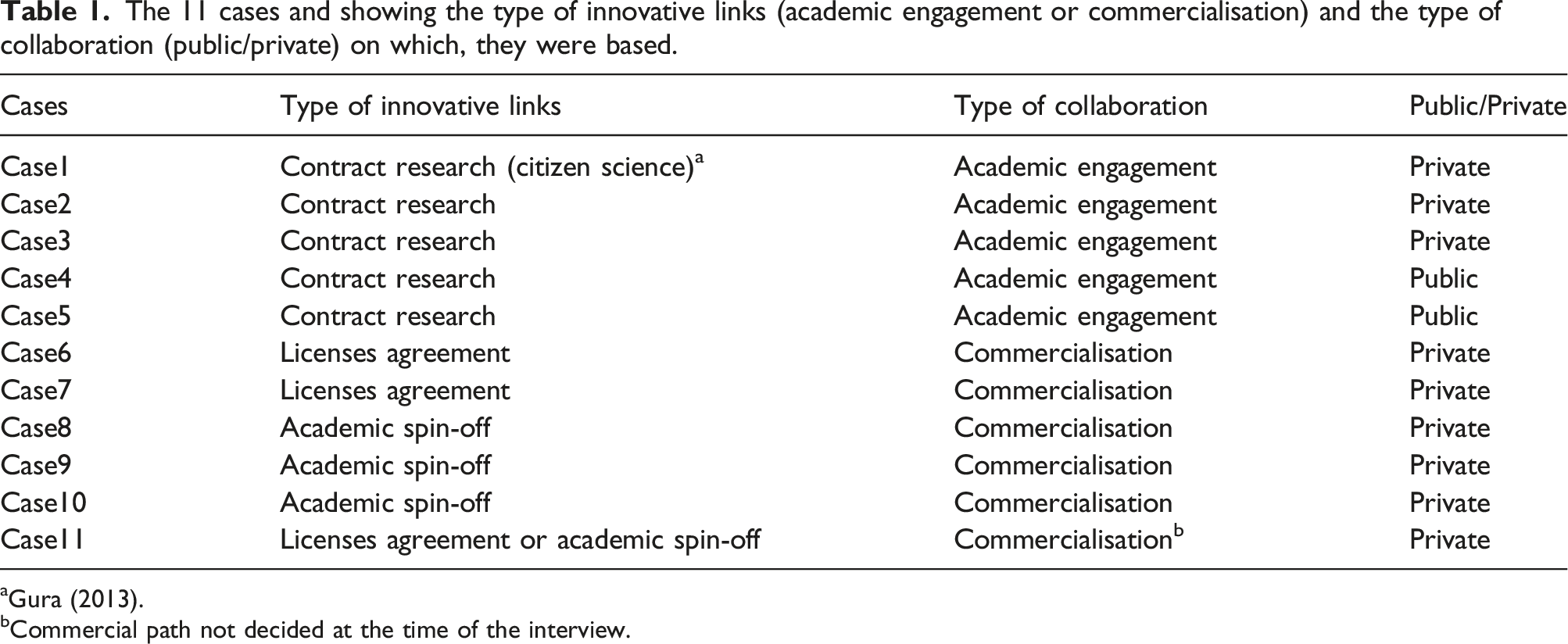
bCommercial path not decided at the time of the interview.
Data collection
The EMBRIC project data were systematically collected during 2017 and 2018, based on the TEA method developed by Robinson et al. (2016). The method is built on activity profiling, as described by Laredo and Mustar (2000), and has been developed as a tool to understand the role, contributions, and interrelations between universities and other ecosystem actors through the types of connections with ecosystem actors and the intensity of those connections (Robinson et al., 2016; Taxt et al., 2022). The TEA data related to five different ways (dimensions) in which universities interact with society through their third mission activities (termed links in the TEA method): (1) certified knowledge instruments (scientific publications and competition-funded projects), (2) training as embodied knowledge (courses and events for professionals), (3) competitive advantages – the innovative aspects (contract research, consulting, and commercialisation projects), (4) research and public debate (societal links), and (5) policy and society links (policy links). All data were collected for the years 2010–2016 exclusively and within the field of marine research, understood as research, innovation, and training within marine biology, including aquaculture, and marine biotechnology in addition to stock-assessment/management and fisheries. Representatives from the partnering academic institutions in the EMBRIC project met regularly during the project period to ensure that data from the research organisations were compiled and interpreted uniformly. 4
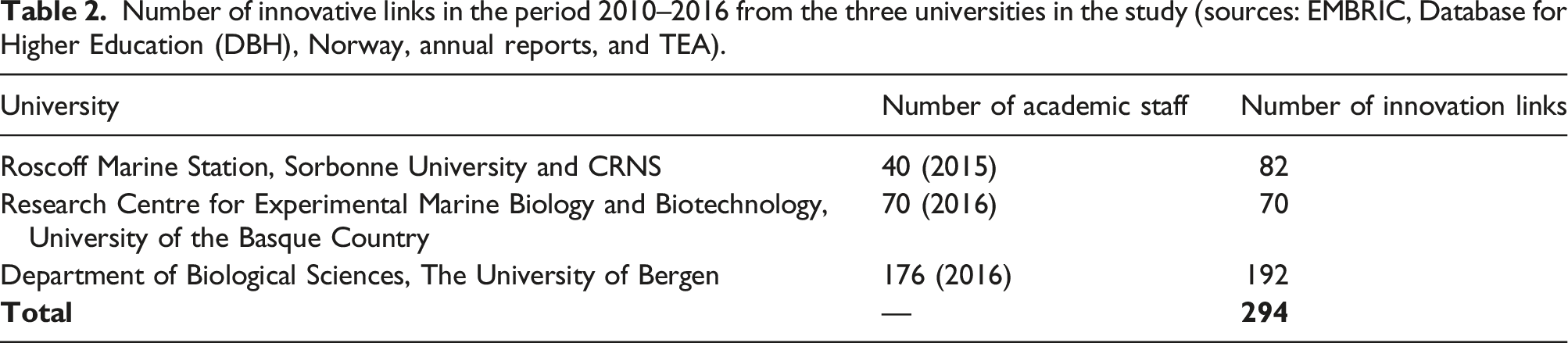
Data from the third dimension, the innovative aspects in the TEA method were used to frame the selection of cases for this study. In total, 294 innovative projects or links were collected from the three universities and all the cases were selected among these links. A link was defined in this study as a transaction that is traceable between the parties in terms of a collaborative project, a spin-off project, a licencing agreement, a contract, or other kinds of visible economic transactions.
Case studies
To gain a more detailed understanding of the motivations for third mission activities and the collaborative patterns in those activities, a qualitative research methodology with in-depth, semi-structured interviews was used for selected cases in terms of third mission projects from the 294 innovative links collected through the EMBRIC project. The unit of analysis for the multiple-case study was therefore identified as ‘an innovative link represented by a collaborative project, spin-off or contract at the university’ (See Table 2 for more details about the type of link for each case). The in-depth, embedded, multiple-case study was designed as described by Yin (2018) and thus represent a rich theoretical framework. It was considered robust with regard to comparing findings across cases with differing empirical evidence. Additionally, a purposeful sampling approach was used (Harsh, 2011), in which the logic of the sampling lay in the selection of information-rich cases for in-depth studies. The collaboration in the cases selected was usually based on long-term personal contacts and trust among the partners. In addition, on request for information from the external partners, the universities reported that some of the cases were categorised as confidential. Therefore, the cases selected for this paper are highly anonymised and no connection to the various institutions are identifiable. Consequently, this has limited the potential for comparisons between the three universities. The data material collected in the EMBRIC project did not include the identity of the individual principal investigators (PIs). Cases were therefore selected using a snowball sampling approach (Biernacki and Waldorf, 1981), whereby the collaborating partners in the EMBRIC project were actively engaged in the process of identifying possible cases. In most of the cases, the EMBRIC partners assisted in making the initial contact with the PI responsible for the project. A total of 31 cases were preselected and contact was initiated; all of those cases were identified as separate projects or contracts within their university. The final selection of cases was based on relevance and/or whether the responsible PI or collaborative partners were willing/able to meet for an interview. In total 11 cases were finally selected. A total of 22 semi-structured interviews with 27 respondents were conducted in 2019. The PI responsible for the selected case project, the industrial/public sector partner and, if relevant, the university support personnel and TTO executives associated with the project, were interviewed. The PI was interviewed first and then assisted in contacting external collaborative partners, support staff at the university, and/or TTO executives involved in the project. A snow-ball sampling (Biernacki and Waldorf, 1981) was therefore also used in the selection of respondents. The respondents were divided in three different groups, based on their role in the project: (1) principal investigators (PIs), (2) support personnel from universities and TTOs (SPs) and (3) external collaborative partners from companies and public sector organisations (ECs). In total, 12 PIs, nine SPs, and six ECs were interviewed. The interviews were based on the following four themes defined in the interview guide: 1. What type of knowledge is the project/contract collaboration building on? 2. What is your motivation for doing this type of project and for contract collaboration? 3. What kind of support have you received from your institution/TTO, and are there any internal incentives to stimulate these kinds of activities? 4. What types of impact, knowledge, and results have resulted from the project/contract collaboration? In addition, the respondents were asked about their background, including their previous experience of academic engagement and commercialisation, the background for the project, and about general collaboration and relations among the actors in the project. Finally, all respondents were asked about the importance of geographical proximity for their project. A separate interview guide was developed for both the collaborative external partners in the projects and for the TTOs, but which covered the same topics. The interviews lasted 40–90 min and were conducted either at the individual respondent’s workplace or, in some cases, at a place selected by the respondent. The interviews were tape-recorded and transcribed. In addition, the interviewer took notes during the interview. To better understand both the projects, and the individual respondents, information was also acquired by reading media articles and by studying websites and other types of documentation, such as contracts and projects descriptions that often were provided by the respondents. This information was however not included in the analysis of the data. As the research evolved, new perspectives and new research themes emerged. When analysing the data, the author continually went back and forth between the empirical data and existing research and theories. Thus, an abductive process was adopted, whereby the research process shifts back and forth between the background theory and the empirical investigation (Dubois and Gadde, 2002; Tavory and Timmermans, 2014). The recorded interviews were then coded, based on the themes and questions from the interview guide, and a first round of analysis was performed, which resulted in a rich data corpus that was then produced in a spreadsheet. The corpus consisted of quotes based on the coding for each of the three groups of respondents (PIs, ECs, and SPs). The data corpus was analysed several times and the findings organised according to five themes: (1) motivation for academic engagement and in commercialisation activities, (2) collaboration in the project, (3) attitudes peers and managers towards academic engagement and commercialisation activities, (4) mechanisms, incentives, and support structures for third mission activities, and (5) results and impact of the project. In addition, the data corpus reflected patterns of similarities and differences in academic engagement and commercialisation, respectively. The empirical findings are presented in the next section.
Results
Number of innovative links in the period 2010–2016 from the three universities in the study (sources: EMBRIC, Database for Higher Education (DBH), Norway, annual reports, and TEA).
Of the 11 cases, five were categorised as academic engagement, while six were categorised as commercialisation. Three of the cases were spin-off companies. Two of them were created before 2010, but they had ongoing research contracts or licensing agreements with their parenting university
With regard to the characteristics of the collaboration in the projects, some general findings were made for all three groups of respondents: 1. The importance of geographical proximity was expressed as crucial for both the establishment of the project and the general collaboration 2. The level of competence of the collaborating partners was regarded as very important for both collaboration within the projects and the projects’ success 3. All formal contracts and collaboration in the projects were the result of long-term personal contacts and often informal collaboration 4. Industrial partners were reluctant to collaborate if the university held a patent on the technology in question 5. None of the respondents reported any incentives for cross-team collaboration or third mission activities, either from the universities or from the TTOs or partnering companies.
In the following subsections, some of the most important results relating to the three groups of respondents are presented.
Principal investigators
PIs were defined as the academic project leader for the case project. Most of the PIs interviewed had a background in contract research and other forms of collaboration with industry, and only one had a background in industry. The motivation for academic engagement and commercialisation varied among the PI respondents. For the tenured researchers, funding for their research activities was highlighted as an important motivation for their academic engagement. For the non-tenure researchers, funding for their own salary was reported as the most important motivation. None of the PIs reported that personal economic gain was their most important motivation, either for academic engagement or for commercialisation, as exemplified by one of the PIs responsible for an academic spin-off: I’m doing what I like. Not just being rich, you know, [rather] it’s richness in your ideas and your aims and what you want to achieve. (PI4)
For the cases within academic engagement factors such as personal contacts, the general knowledge of the PIs/research group and their personal network with industry and public actors was reported as important for the establishment of a collaborative project. Specific research ideas were not reported as important for academic engagement. The possibility to have results published in academic journals was highlighted as an important prerequisite for the academic engagement projects. However, the outcome was not always as hoped: In this specific case, we cannot publish. However, for most of the rest of the contracts we have be able to have the results published. (PI2)
Most of the commercialisation cases had their origin in pure basic research, in which the PIs gradually, often over decades, turned their ideas into a commercial product, either in the form of a spin-off company or a licensing contract. All of the academic spin-off companies had created jobs in the region, in addition to initiating new academic engagement projects with their parent university. In the commercialisation cases, too, the urge to disseminate research ideas and inventions to wider society seemed to be a very important motivation for the PIs. In addition, the freedom from reporting and university bureaucracy was highlighted as an important driver for spin-off creation: I’m not working to enrich people that are richer than me, that’s not my aim. However, if we want to create jobs, [...] jobs won’t be created in the public institutions, [but rather] less and less, I think. So, the future for young students lies in SMEs. (PI4)
None of the PIs reported any specific institutional incentives for taking on third mission activities, but they all considered such activities important in terms of general dissemination and knowledge transfer in order to their research to reach local and wider society: For me it’s a cultural thing, and I think it’s my duty to do outreach science, to do outreach in my own language. (PI6)
A significant difference was detected among the PI respondents concerning how they experienced the support structures. In the cases categorised as academic engagement, the PIs were in general satisfied with the support they received from their institution. Moreover, they realised that setting up contracts and budgets was an area in which they needed help and they acknowledged the complementary skills of the university support staff in dealing with those matters: They are coordinating all the contracts. There is an online application system in which you introduce all the data, all the calculations for the budget, the person months, amount per hours, and so on. Sometimes you make mistakes, so they help you. (PI2)
However, some causes of tension were reported, such as slow bureaucracy and even arrogance, yet still the expertise of the university support staff was recognised by the PIs: Sometimes this help is quite hard, because they are good at doing their thing, but sometimes they speak like they are blaming you. (PI2)
In the cases categorised as commercialisation, the level of tension was much higher between the actors engaged in the projects. The PIs reported that universities were reluctant to take on any commercial activities in their organisation, such as allowing private companies access to laboratories or incubation for academic spin-off companies. Furthermore, it was claimed that both the universities and their TTOs had too high expectations about the income from the commercialisation projects, such as from licensing agreements with academic spin-offs. In most cases, the latter strategies were considered very counterproductive to the commercialisation process and left the responsible PIs and academic entrepreneurs frustrated and disappointed: The university wanted so much money, and it was slow at responding. They [university management] were treating us like a big pharmaceutical company, so I was telling them ‘All the money I have will go to the project, and spending money to pay for the license is not very fair. I agree to pay you when we get money, but it’s kind of difficult in the beginning’. (PI4) So, I waited three to 6 months just to have an appointment, with the university. They do this because they know we need the patent to create the company. However, when I refused to agree to their terms, they did not care. They just said ‘In 3 months, you will come back and agree, because we know that you need the patent’. (PI8)
University support personnel and TTO executives
The extent to which research and innovation support personnel from the universities and the TTO executives were closely involved in the cases varied. In some of the cases, they were responsible for making contracts and maintaining licensing agreements, but for the most part they were remotely connected, with limited knowledge of the daily activities. The TTOs in general and the external TTOs only with responsibilities for commercialisation activities in particular were very often considered unnecessary and, in some cases, expensive intermediaries that did not add any value to the project: The TTOs is an additional layer that is not useful or, at least, if they want to be part of it [the project], they should not take so much money. (PI3)
The PIs representing university support towards third mission activities highlighted the difficulties with gaining the trust of the researchers: I really try to communicate with them to explain how it works, but you know, when you are not a researcher, when you don’t even have a PhD, it’s complicated to be listened to. (SP2)
The support personnel saw themselves as important mediators between the PIs and the TTOs in the cases when collaboration between the two parties was faltering.
In the cases involving commercially more mature spin-off companies or older spin-offs created before 2010, the TTOs were no longer involved or had only minor roles in the commercialisation process. In some of the cases, the TTO executives considered themselves important actors for moving the commercialisation activities in the right direction: I have confidence in saying that without the TTO, nothing would have been done. (SP1)
In other cases, the TTOs seemed more reluctant and were waiting for the researchers to respond or take a more active part in the commercialisation process. Most of the TTO executives pointed out that the researchers were very often late or even non-responsive in the deliveries agreed upon. The TTO executives also seemed very aware that many of the researchers did not have much trust in them.
Some of the cases were considered high in social impact, but with limited potential for economic return on investment. Consequently, many TTO executives found it difficult to justify working on their project, or even to get permission to from their managers to do so: Everyone knows that it’s not viable, economically speaking. So, every year, people must sit down and decide if they want to keep losing money or not. (SP1)
In some of the potential licensing cases, the fact that the university had already patented the technology was explained as a barrier to the industry becoming interested in the technology. This often resulted in a situation in which both the PIs and the TTOs ran out of funding possibilities to develop the technology further, even when it was considered both novel and commercially promising. When asked about their motivation for working on the commercialisation of research, all SPs highlighted that they found it very meaningful to help research results become realised in society. Many of the SPs also pointed out how they enjoyed working with researchers, and how they highly appreciated having their knowledge and assistance recognised by them.
External partners
In many of the contracts within academic engagement, the universities were subcontractors with specific assignments from a company. Many of those projects were initiated based on orders from government, often based on environmental regulations. All of the academic engagement contracts with external partners, independent of sector, were based on long-term personal relationships between the ECs and the PIs, and they all expressed respect and had knowledge of the working situation for academics. They also knew very well how the researchers were incentivised in the direction of research and education, and not towards third mission activities from their institutions: They [the PIs] have told us that they have seen some difficulties, and some of the difficulties are that they are not measured on how much they transfer to society or how much they work with society. The measures and their salaries are based on how much they publish in science journals or how many hours is spent on research projects. So, they don’t foster or incentivise research to focus on society and societal needs. (EC3)
In licenced commercialisation projects, most the interviewed external partners were clear that their motivation for participating was for other reasons than to earn money directly from the project. They considered these kinds of collaborative projects important for their business because they were based on novel ideas or were vehicles for social engagement. The research ideas or projects represented something new to the external partner’s company, but without great potential for revenues. Their goal was to use the projects as important means to gain visibility and attention for their companies and they were not willing to compromise too much on the economic terms in the agreements with the universities.
In the cases within academic engagement, none of the respondents from the companies or collaborating organisations were directly exposed to either the university support personnel or the TTO executives. Instead, all contact went through the PIs. By contrast, in commercialisation projects, the external partners needed to negotiate directly with university managers, and in most cases with TTOs. Most of the external partners expressed some concern about the bureaucratic process and unrealistic expectations of future income from the university: For our company, it was very complex to make contracts with the university. We needed six months to build the contract and it was difficult for them to understand that we do not earn money on this project. (EC2)
The partnering companies also questioned the role of the TTO: The TTO doesn’t bring us a lot of [...] It’s not very useful for us. It’s the same with all the universities we have contracts with. We always deal and talk with the researcher directly to develop, to create, to invent, to find new solutions. The TTO is in the background and comes in at the end, when we need to make the final agreements. (EC1)
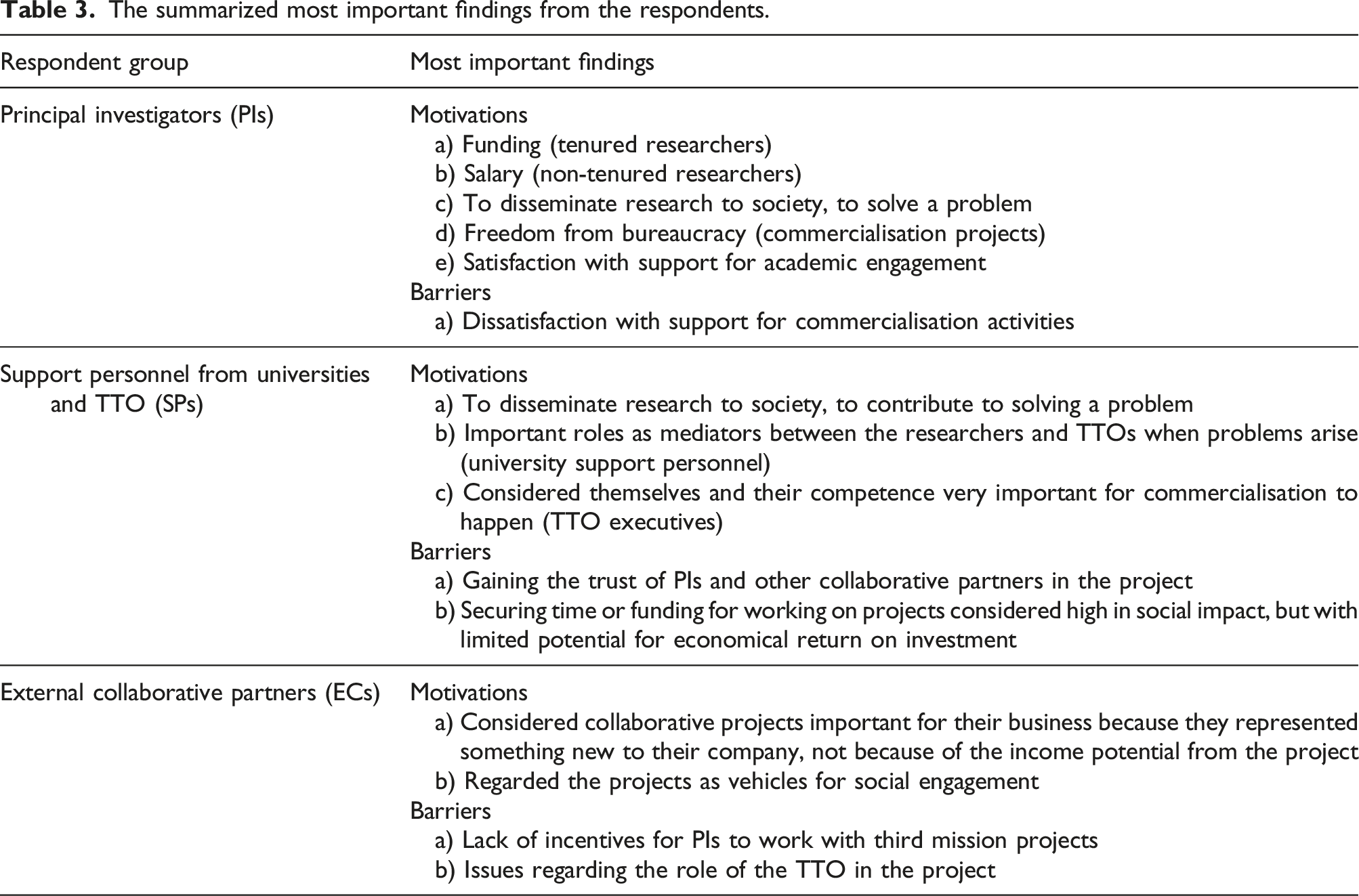
The summarized most important findings from the respondents.
Discussion and practical implications
Motivations for academic engagement and commercialisation
The findings from this study add new perspectives on researchers’ motivations to engage in third mission activities and especially their motivations for academic engagement and commercialisation. Empirically, the findings from the multiple case study demonstrate that commercialisation projects within marine sciences are based on long-term, novel, and basic research. The academic engagement projects, however, seemed to be based more on the general knowledge and the experimental capabilities of the research group to meet the needs of the private and public partners. These findings to some extent contrast with those of D’Este and Perkmann (2011) and other researchers (Muscio et al., 2017; Perkmann et al., 2013, 2021), who makes the point that academic engagement is closer to the researchers’ own research than to commercialisation projects. There is considerable consensus in the literature that commercialisation activities are driven by monetary rewards, both at the university level and among individual researchers (Bercovitz and Feldman, 2006; D’Este and Perkmann, 2011). However, none of the PI respondents in the study reported economic rewards as important for starting a commercialisation project. Rather, they stated a wish, or even an urge, to realise their research ideas, often as a solution for existing problems in society, and that this was their most important motivation for becoming involved in the commercialisation process. This finding is in line with the work of Lam (2011), who found that the great majority of the scientists are motivated more by research and an academic career also in their commercialisation activities, rather than by monetary rewards.
Non-commercial motivations for entering into commercial agreements with universities were also expressed by many of the collaborative partners, who reported they were motivated by social engagement and a wish to ‘give something back to society’. These findings are in line with those from more recent research showing how a moral or social orientation can motivate researchers (Orazbayeva, et al., 2020; Van de Burgwal et al., 2019), but this has not been documented in the literature for other groups of actors involved in third mission activities. Therefore, these findings must be considered a novel contribution from this study.
By contrast, many of the academic engagement projects were driven by economic motivations in terms of funding for the research group, including academics’ salaries. This was especially highlighted by the non-tenured researchers, who were dependent on the projects in order to continue in their university position. But they did not necessarily express a wish to continue the activity if they managed to obtain a tenured position. Although funding is an important motivation for academic engagement (D’Este and Perkmann, 2011), the aforementioned finding in many ways stands in contrasts to existing literature highlighting academic engagement as being much closer to researchers’ own research agenda than to commercialisation (D’Este and Perkmann, 2011; Muscio et al., 2017).
As academic engagement projects are dominant in both volume and income, they are considered in the literature as being of greater economic significance than commercialisation projects, both for universities and the collaborating companies (Bercovitz and Feldman, 2006; Hughes et al., 2016; Perkmann et al., 2021). Furthermore, Perkmann et al. (2021) argue that commercialisation support has traditionally been favoured over support structures for academic engagement, such as the establishment of TTOs. All three universities in this study have set up professional internal support structures for projects categorised as academic engagement. The universities have also established or have access to a TTO. While the researchers seemed quite content with their internal support for academic engagement activities, they were less satisfied with the help and support they received from the TTO. Moreover, the study findings demonstrated that in several of the commercial cases the university managers counteracted the commercialisation process. Furthermore, the counteraction seemed to be related to a lack of capabilities, experience, and sometimes to disproportionately high-income expectations, both in the case of the universities and in the case of the TTOs. In addition, the economic burden of having to pay a TTO as a partner in the project caused dissatisfaction among the PIs, as well as the partnering companies, and the university leaders, especially in the cases that involved an external TTO. For their part, the TTOs seemed reluctant to invest too many resources in projects for which the return on investment was considered low.
The third mission of universities has been shown in transition from a money-driven policy structure towards a more socially engaged and sustainability-driven university mission (Compagnucci and Spigarelli, 2020; McKelvey and Zaring, 2018; Perkmann et al., 2021). In the early phases of the commercialisation process, when the commercial risk is very high, few actors are willing to help or capable of helping researchers in their innovation and commercialisation activities. Moreover, the competence, willingness, and capabilities for university support structures, including TTOs, have been found crucial for early-stage commercialisation projects (Galán-Muros et al., 2015; Rasmussen et al., 2014). However, in the studied cases reported in this paper, TTO funding and rewards caused a lot of tension, especially in cases where the social impact was considered high, but the economic rewards were low. In addition, the study revealed that the initial motivations for both academic engagement and commercialisation activities seemed to be more coincidental and tended to reflect social engagement among researchers, rather than motivated by monetary rewards (Orazbayeva et al., 2020; Van de Burgwal et al., 2019). This observation may also mirror the described transition of the third mission of universities. TTOs are considered both as important components and as necessary intermediaries for realising the impacts of research from universities (Cunningham et al., 2020; Hayter, 2016). Therefore, the role, missions, competence, and funding structures for TTOs should ideally be aligned with the evolving third mission of universities. However, the findings presented in this study imply that both universities and TTOs need to put in considerable effort and make changes to achieve such alignment.
Practical implications and advice
The findings have some practical implications. Universities may consider giving researchers more freedom to choose between the academic engagement and commercialisation paths, as also supported by Lam (2011). Policymakers, university managers, or support structures such as TTOs should consider academic engagement and commercialisation activities equally important parts of the third mission. It follows that more universities should consider broadening the role and tasks of their TTOs. To achieve this, a more seamless inclusion of the TTO activities in the university third mission projects could be mediated. This in turn might result in a beneficiary effect of drawing on important competence from the TTOs, as well as facilitating a culture for both academic engagement and commercialisation within the universities. In addition, different funding mechanisms for the TTOs could be considered, preventing the quest for financing for their activities prior to collaboration in the projects. Furthermore, universities should reconsider their incentive for third mission activities, including avoiding too high expectations of income from the commercialisation projects. Finally, in line with several other scholars (Halilem et al., 2017; Lam, 2011; Sormani et al., 2022), it is argued universities should in general balance their obligations and incentives and align them better with researchers’ intrinsic motivations.
Limitations and suggestions for further research
The research presented in this paper had some limitations, but these limitations may also give directions for further studies. Based on the context and nature of the cases, a snowball sampling approach was used in the data collection, leaving the sample non-representative and biased toward certain group of cases (innovative links) and respondents. Furthermore, a significant comparison either between the three universities or between the specific national or regional characteristics they operate in relation to was possible. Moreover, the third mission activities were compared in terms of contract research, citizen science projects, and commercialisation projects, but did not include academic engagement activities, such as competition-funded research projects with private or public partners. Therefore, further studies should aim for a broader representative comparison of incentives and support structures for academic engagement and commercialisation. In addition, the role of department levels and university support for both academic engagement and commercialisation activities needs to be further explored. A good place to start could be to conduct a parametric study based on the main findings from this study, in addition to other results from the EMBRIC project. Finally, the role and funding structure for TTO support in relation to the transition of the third mission of universities should be included in future research agendas.
Footnotes
Acknowledgements
I want to acknowledge VIS, UiB, EHU and Sorbonne University for the collaboration and willingness to share relevant cases for this study. A special thanks to Pierre Colas at the Roscoff Marine Station and Ibon Cancio at the Research Centre for Experimental Marine Biology and Biotechnology, University of the Basque Country for their help and assistance during my data collection at their institutions. I will further express my deepest gratitude to all the respondents for their time and contributions. In addition, I want to thank my supervisor professor Knut Hidle at UiB and professor Øivind Strand at NTNU for their valuable input to this paper.
Declaration of conflicting interests
The author(s) declared no potential conflicts of interest with respect to the research, authorship, and/or publication of this article.
Funding
The author(s) disclosed receipt of the following financial support for the research, authorship, and/or publication of this article: This work was supported by The Research Council of Norway (272380) and the Horizon 2020 funding programme (654008).
