




Abstract
The pressure on higher education institutions (HEIs) to realize third mission activities continues to grow, intensifying the search for incentives to motivate academics to engage with stakeholders outside their HEI. Previous studies have found limitations in intrinsically motivating academic engagement; therefore, this study investigates the extrinsic regulation of motivations via incentives. The authors identified a broad range of incentives for third mission activities, belonging to four motivation categories: pecuniary incentives, career advancement, appreciation and research support. Drawing on self-determination theory, incentives (nudges and rewards) are empirically compared in a between-subject design with a sample of 324 academics from the business and economics disciplines. The analysis showed that nudges affect business and economics academics’ intention to engage with society in a joint research project. Furthermore, these academics responded well to incentives concerned with the research support motivation category. The findings contribute to the literature by highlighting the relevance of marginal incentives—nudges—in implementing appropriate incentives in HEIs.
Higher education institutions (HEIs) worldwide have adopted a facilitating role in bringing the benefits from newly generated knowledge to society at large (e.g., Carayannis et al., 2012). A paradigm shift with regard to the role of HEIs has been advocated in a second academic revolution, with a third mission added to the previous two longstanding missions of education and research (Backs et al., 2019; Etzkowitz, 2001; Perkmann et al., 2013). The third mission is understood as the HEI’s external orientation; at the beginning it referred to the commercialization of research, but more recently the focus has been increasingly on society (European University Association, 2017).
Concretely, third mission activities are all activities beyond research and education, which include but are not limited to licensing, spin-outs, research consultancy, joint research, publicly funded research, informal advice and public lectures (Abreu and Grinevich, 2013; Iorio et al., 2017). Research dedicated to the third mission has increased, although the majority of studies have been restricted to activities in research commercialization (e.g., licensing), which represents only a fraction of the third mission domain and therefore provides an incomplete picture, especially regarding academic engagement with society (McKelvey and Zaring, 2018; Olmos-Peñuela et al., 2014). This creates a research opportunity to develop and broaden our understanding of the third mission by acquiring insights into HEIs’ engagement with society.
The engagement of academics—including lecturers—is a prerequisite for the accomplishment of the third mission (Tartari and Breschi, 2012). Hence, the mounting pressure on HEIs to realize third mission activities has extended to pressure on academics. Academics’ contribution to the third mission is referred to as academic engagement. The concept of academic engagement has been generally defined by Perkmann et al. (2013: 424) as “knowledge-related collaboration by academic researchers with stakeholders from non-academic organizations.” The relevance of such engagement has been acknowledged, as researchers agree that ties between academics and actors from society can effectively address societal problems and increase the societal impact of HEIs (Benneworth and Jongbloed 2010; Cinar and Benneworth 2020; De Jong et al., 2015; Muhonen et al., 2020).
Third mission promoters—for example, HEI managers—are taking responsibility to spur third mission activities such as research commercialization and joint research. The third mission runs counter to the perspective of HEIs operating as ivory towers (Etzkowitz, 2014), but there has also been criticism on the effectiveness of promoting third mission activities. Accordingly, promoters are advised to be selective with regard to the third mission activities they promote, as not all forms of academic engagement contribute to the larger goal of bringing innovation (Giuliani and Arza, 2009).
However, there is untapped potential, as shown in a recent report on academic engagement, primarily covering university–business cooperation but also other activities (Davey et al., 2018). To increase academic engagement, HEI managers have introduced incentives (Pinheiro et al., 2015): interestingly, current practice has predominantly considered incentives and individual motives in isolation, and so the focus has been on either individual motives or institutional incentives. Consequently, there are discrepancies between how incentives are designed and how they are perceived by academics (De Jong et al., 2015).
The aim of this paper is to identify which incentives have been implemented by promoters of the third mission of HEIs and to understand the alignment of those incentives with motivations previously identified for academic engagement. The contribution of the paper is twofold. The first study provides an overview of the incentives that are employed to promote the third mission with reference to various third mission activities. In the second study, the focus is on the effectiveness of such incentives in motivating business and economics academics to engage in joint research projects with society. Two research questions were thus developed: What incentives have been implemented by HEIs to engage academics in third mission activities? What incentives are effective in engaging business and economics academics in joint research projects with society?
The structure of the paper is as follows. We first provide an overview of the literature on motives for academic engagement. This is followed by a review of the incentives appealing to these motives. We report on two connected studies. In the first, we identify incentives for every category of motive, and differentiate between the more subtle type of incentive—the nudge—and the stronger type of incentive—the reward. Secondly, in an empirical analysis we develop a survey that displays a stimulus in the form of an invitation message for an international joint research project between academics and stakeholders from society. The concluding paragraph of the stimulus describes an incentive offered to the academic (reward, nudge or control, following a between-subject design). In the survey, academics are asked to indicate the likelihood that they would accept the invitation in the invitation message. The effect of intention to take part is analyzed with a one-way ANOVA. In an open-answer question, the academics are asked to explain the underlying reasons for their acceptance decision. These data are analyzed qualitatively following the Gioia methodology. The paper concludes by stating how the two analyses together contribute to literature and practice, and by setting out limitations and suggesting future research avenues.
Theoretical background
HEIs’ third mission and academic engagement
Vannevar Bush addressed the facilitating role of science in his 1945 report to President Roosevelt (Bush, 1945), stating that societal progress (e.g., health, security and welfare) would happen when fundamental research was sufficiently funded. However, in recent decades a gap between research and societal progress has been identified. Aiming to bridge this gap, the focus has shifted to the development of HEIs’ external orientation, aiming to increase the benefits of science to society (OECD, 2013)—for example, via third mission activities and academic engagement. In third mission research, empirical studies on academic engagement with society are in short supply (McKelvey and Zaring, 2018). Nevertheless, researchers generally agree that academic engagement—the knowledge-related collaboration of academic researchers with non-academic actors—constitutes a pathway to societal progress (Muhonen et al., 2020; Perkmann et al., 2013; Spaapen and van Drooge, 2011). An advantage of the engagement perspective for the third mission is its applicability to various domains, including business, economics, the social sciences and the humanities, which have received insufficient attention in the context of third mission activities (Palsson et al., 2013)—although this implies neither a non-contribution nor a lack of potential (Siegel and Phan, 2005).
Figure 1 shows a framework of interactions between HEIs and society, differentiating between the institutional level of the HEI and the individual level of the academic. While HEIs have the third mission in which they take responsibility for societal progress, academics can engage with society. Academics can decide to engage autonomously or be steered by regulations. This framework shows HEIs aiming to develop the third mission by incentivizing academic engagement. Incentives may lead academics to change their behavioral intentions and, subsequently, their behavior and so to contribute to their HEI’s mission toward society. Cumulatively, these individual engagement practices then contribute to the third mission at the institutional level.
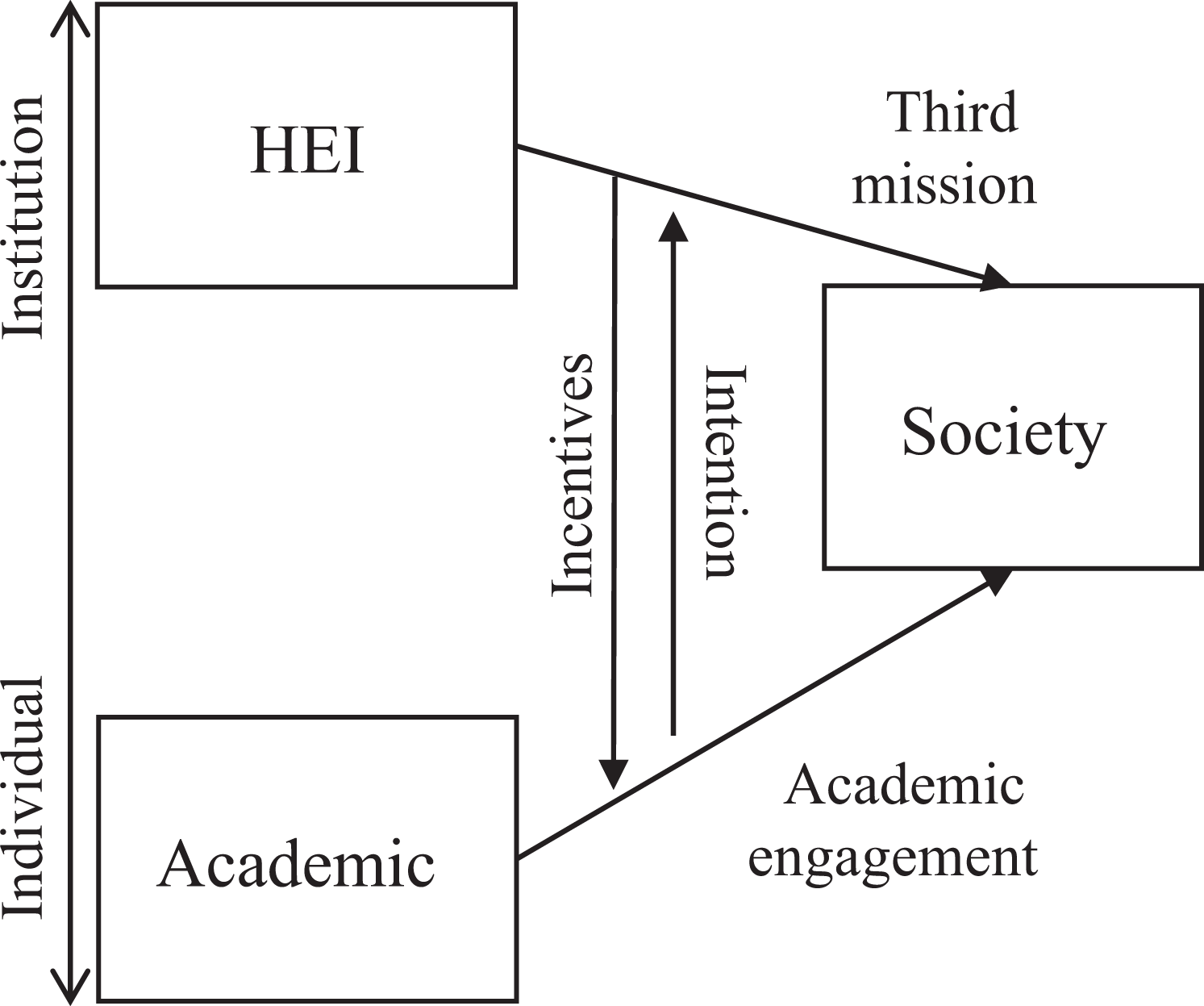
A two-level framework of science for society, illustrating the interaction between incentives and behavior.
Self-determination theory
Because motivation has long been recognized as an antecedent of behavior and a driver of outcomes (Deci and Ryan, 2000; Gagné and Deci, 2005; Ryan and Deci, 2000), it has been a major theme in the third mission discourse (Ankrah and Omar, 2015). In our context, motives can be found on two levels: the institutional level of the HEI and the individual level of the academic. An HEI’s motives for successfully implementing the third mission and becoming a main driver of innovation are mainly to increase its status, legitimation, and to gain access to public resources (Etzkowitz, 2001). Yet, to carry their third mission activities, HEIs are dependent on individual academics and their motivation for academic engagement (Lam, 2011; Orazbayeva et al. 2019a).
In general, an individual’s motivation comprises several aspects on a continuum from a motivation (unwillingness to act, lacking intention) to extrinsic motivation (contextual factors can promote or inhibit intention), to intrinsic motivation (intention driven by joy and satisfaction) (Deci and Ryan, 2000). An individual’s motivation can change over time: with an increase of self-determination, motivations are internalized (Ryan and Deci, 2000). Three determinants of self-determination have been distinguished: autonomy (the feeling of voluntariness), competence (feeling able) and relatedness (feeling connected) (Ryan and Deci, 2000).
These three determinants have been studied in the academic engagement literature. Autonomy is understood as the academic freedom and autonomy in an academic’s decision to engage (Lee, 2000; Tartari and Breschi, 2012). Competence is understood as the belief that one has the appropriate capabilities for academic engagement (Clarysse et al., 2011) Relatedness is understood as peer behavior impacting an academic’s decision making (Tartari et al., 2014; van de Burgwal et al., 2019). One study shows, within the framework of self-determination theory, that academics increasingly engage in third mission activities when they have the appropriate freedom, competence and support (Orazbayeva et al., 2019b).
Motives
Given that this study draws on self-determination theory, we have selected those papers that apply the same theoretical lens to academic engagement in our overview of the literature. Additionally, other papers have been identified in which similar ideas about motives have been developed (Arzenšek et al., 2018; D’Este and Perkmann, 2011; Franco and Haase, 2015; Lee, 2000; Ramos-Vielba et al., 2014; Roman et al., 2018; Tartari and Breschi, 2012; van de Burgwal et al., 2019). The extension of the self-determination continuum to the field of third mission research was initiated by Lam (2011), followed by Iorio et al. (2017) and Orazbayeva et al. (2019a), who provided a comparable set of motives.
To understand the different motives that have been discussed regarding academic engagement, we build on previous categorizations to cluster motives into four broader categories. The categories identified from the overview of the literature are pecuniary incentives (D’Este and Perkmann 2011; Lam, 2011; Ramos-Vielba et al., 2014), career advancement (D’Este and Perkmann 2011; Lee, 2000), appreciation (Arzenšek et al., 2018; Iorio et al. 2017; Lee, 2000) and research support (D’Este and Perkmann, 2011; Franco and Haase, 2015; Iorio et al. 2017; Lam 2011; Lee, 2000; Orazbayeva et al., 2019a; Ramos-Vielba et al., 2014; Roman et al., 2018; van de Burgwal et al., 2019). For example, since “financial compensation for the activity” (Iorio et al. 2017) is motivationally similar to “increase in funding and other resources” (Lam, 2011) and “obtaining funding/financial resources” (Orazbayeva et al., 2019a), we clustered them in one category. We assigned all the funding motives that support research into the category “research support” to allocate individualized rewards that result in a direct increase in personal income to the pecuniary incentive category. “Improving my teaching” (Orazbayeva et al., 2019a; van de Burgwal et al., 2019) and “improving graduate employability teaching” (Orazbayeva et al., 2019a; van de Burgwal et al., 2019) are specifically education-driven and are not considered in our four categories.
Incentives
To investigate incentives, we rely on two dimensions. The first is the alignment of incentives to motives, as called for by De Jong et al. (2015). Hereby, we rely on the clusters derived from the literature cited in the previous subsection. An incentive may actively encourage academic engagement; for instance, if the motive is to receive research funding, the complementary incentive would be offering this support to researchers who engage in such activities.
The second dimension is the intensity of regulation. As self-determination theory describes, people may be oriented toward a behavior because of stronger external regulation such as rewards; yet a strong reward can also move people backward, away from the behavior (Ryan and Deci, 2000). For instance, on the one hand, studies have supported the idea that promotions and pay raises could motivate academics to engage (van de Burgwal et al., 2019). On the other hand, studies also support intrinsic motivations for academic engagement (Orazbayeva et al., 2019a; van de Burgwal et al., 2019). In a case study on academic engagement, Lahikainen et al. (2019) found that academics might decouple their academic engagement activities from the incentive system implemented by HEI managers because they consider the incentive system counterproductive. To provide insights with regard to the levels of regulation, we distinguished between incentive types that strongly target the external regulation of behavior (rewards) and awareness-oriented incentive types that target motivation that is, at least partially, internally integrated (nudges—Thaler and Sunstein, 2008). The latter are relatively inexpensive in terms of effort and implementation costs (Sunstein, 2014). We based intensity on a simplified ranking of the incentives per category, where the most resource-intensive incentive represents a reward and the least resource-intensive a nudge.
Research question and hypotheses
Although studies have shown evidence concerning academics’ motives for academic engagement, they have yet to show which incentives are especially efficacious when appealing to these motives. In our first study, the central research question asks what incentives HEIs use to stimulate academics to engage with third mission activities. We will analyze these incentives according to the underlying motives and present the theoretical framework. In the second study, the main research question concerns the effectiveness of the incentives. Following the self-determination framework (Ryan and Deci, 2000), it could be expected that the regulation of motivations with incentives (nudge and reward) affects intention, as does the type of incentive. As such, we developed the following hypotheses:
Study I: Identification of incentives to promote third mission activities
Methodology
The motivational categories derived from the scientific literature formed the basis for the further identification of incentives. Seventy-two peer-reviewed cases from the “Good Practices Database” and the “Conference Libraries” from university–industry interaction conference proceedings between 2013 and 2018 were used. The conference proceedings were from 38 countries worldwide, with the majority in Europe (n = 54). They show how the landscape of incentives manifests for all third mission activities, irrespective of local context and strategies. The cases were written by people who were positive about third mission initiatives, and the incentives described represent self-proclaimed “good practices.” Nonetheless, the case studies relate to practice and help to contextualize the findings from the literature.
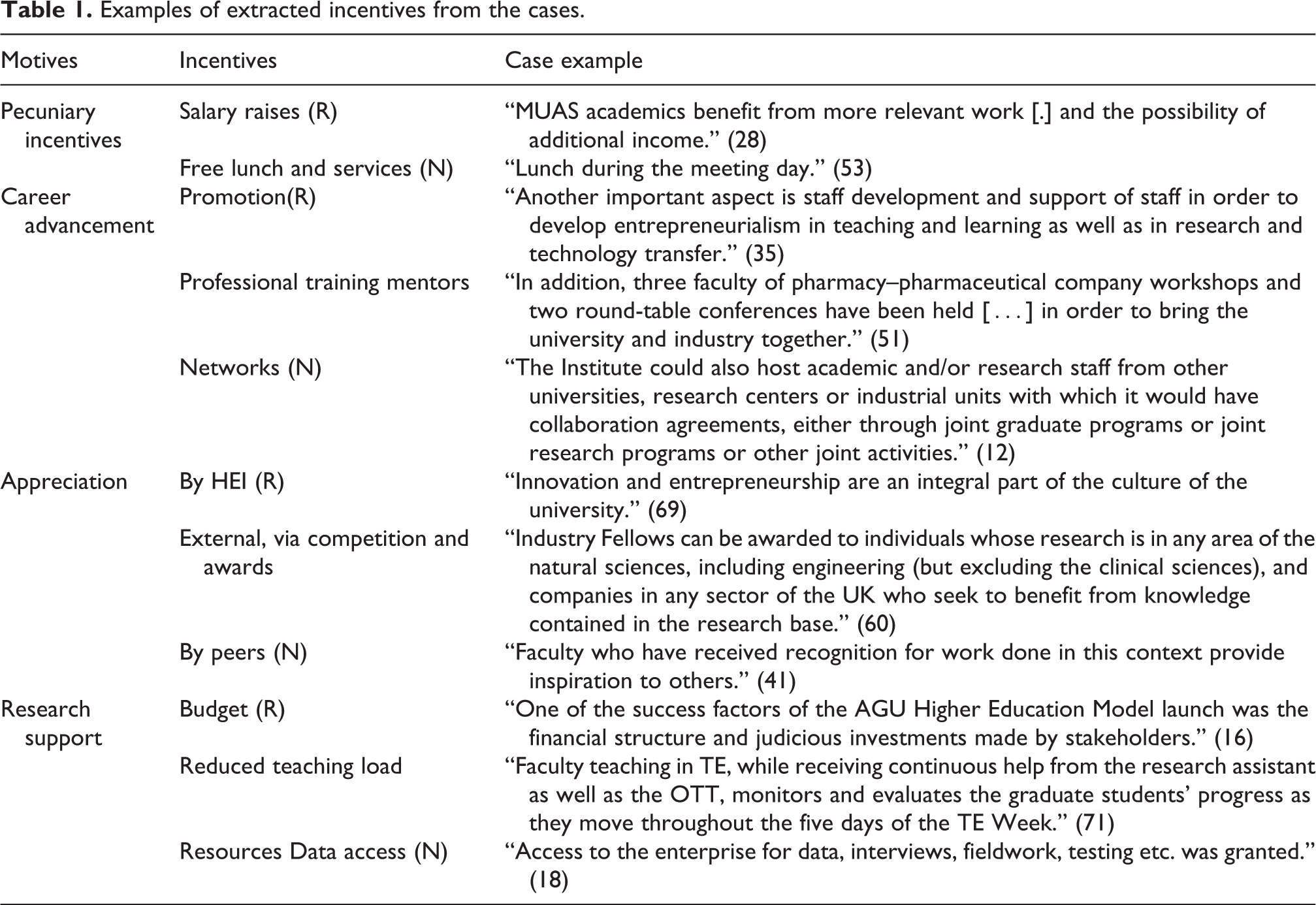
The identified incentives were first marked in each case, resulting in 801 marked text passages: the right-hand column in Table 1 reproduces sample passages. These marked segments were then aggregated into groups based on the similarity of the incentives and then grouped again according to the categories from the literature: pecuniary incentives, career advancement, appreciation and research support. For all these motive categories, there were regulation strategies from marginal (N, nudge) to strong (R, reward) in each case. The incentives that fell between the two extremes were not further categorized and were simply referred to as incentives.
Examples of extracted incentives from the cases.
Results
The incentives identified were: pecuniary incentives (2%), career advancement (55%), appreciation (16%) and research support (27%). Regulation strategies within the categories were distinguished from strong (R, reward) to marginal (N, nudge), with the others falling between these two extremes. Incentives identified as rewards included salary raises, promotions and appreciation by the HEI in the form of, for example, a third mission and research budget. Meanwhile, the nudges identified were free lunch and services, organized networking events, appreciation by peers and access to data from a third mission activity.
Pecuniary incentives
Two types of incentives were found in this category that led to direct or indirect financial benefits for academics. The first was a direct increase in personal income via a salary raise; this represents a significant investment for the HEI and was ranked as a reward. The second incentive, which included free lunch and other catering services, was classified as a nudge since such catering services at events are relatively easily provided.
Career advancement
Within career advancement, we distinguished between the following incentives: promotion, professional training, mentors and networking. First, the promotion of academics leads to an increase in salary and status but requires resources from the HEI, and thus was categorized as a reward. The second incentive, professional training, helps create awareness and can take various forms to benefit academics’ careers. Mentors can also support scholars with their own personal experiences. As professional training normally necessitates a fee, mentors usually volunteer by investing their own time. The fourth incentive included networking opportunities, one of the top-mentioned incentives. During these events, HEIs enable participants to build connections by facilitating interaction between academics and actors from industry and society on regional and international levels. This incentive was ranked as a nudge, specifically, a disclosure nudge (Sunstein, 2014).
Appreciation
A third motive was appreciation, in which we differentiated between three incentives that targeted subjective norms: appreciation by the HEI (for example, via a third mission statement); external appreciation through competition and awards; and appreciation by colleagues. The HEI’s third mission is a management tool to give direction for the institution as a whole, including the faculty. As management is generally in a position to make decisions that significantly impact academics’ careers, complying with the mission can be rewarding. Another form of appreciation is external (from the HEI’s perspective): common forms include competitions around regional or entrepreneurial objectives—some of these events award participants with monetary prizes, others in the form of recognition. The third form of appreciation was a social norm nudge, where behavior is adapted in line with that of one’s peers (i.e., peer pressure).
Research support
The fourth motive was research support, in which, for example, funds and resources are acquired, including four types of incentive: research budgets, reductions in teaching load, more resources (e.g., workplace facilities) and access to research data. All these resources are either directly relevant to research or indirectly relevant because they free up time or can be used to acquire further resources. However, since research budgets always require additional finance and are most flexible for academics to advance their research, they were considered a reward. Gaining access to data collected while working on third mission activities does not require additional resources, and data are only relevant in a specific context; hence this was regarded as a nudge.
Implementation
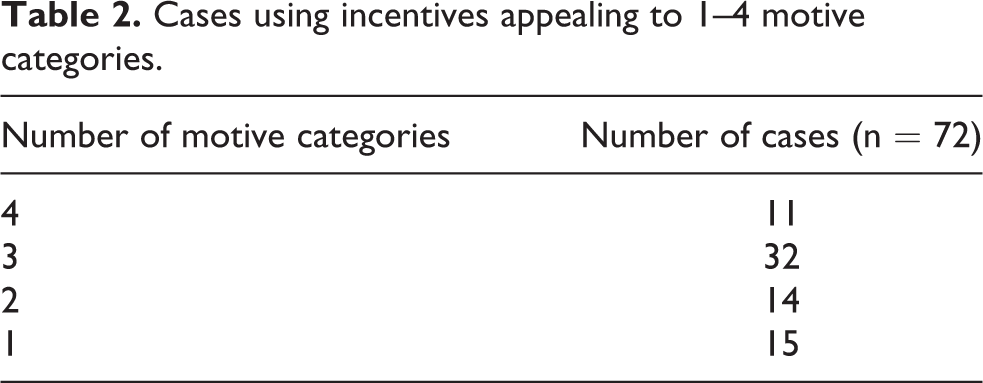
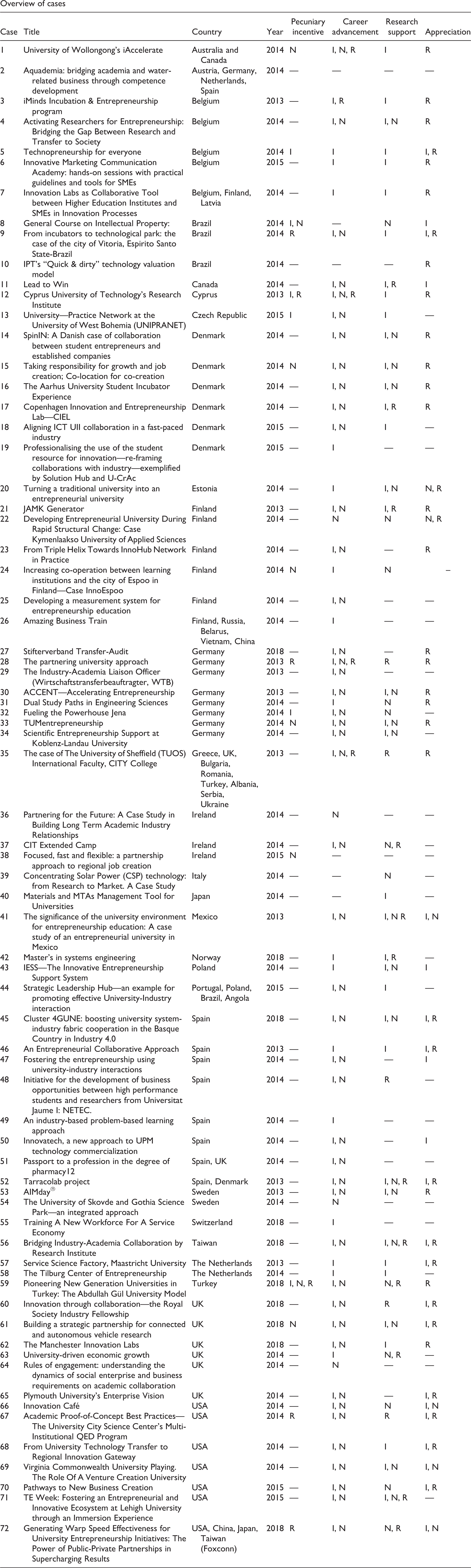
Interestingly, a broad mix of incentives appealing to various motives is implemented in practice. Table 2 shows the number of cases in which incentives that can be allocated to our motive categories are used. Most of the cases (n = 32) had implemented incentives appealing to at least three motives. A fair majority of the studies also appealed to research support and career advancement motives. Rather frequently appreciation was added to the mix; however, pecuniary incentives were less common. Nonetheless, a broad mix of combinations was identified in the 72 cases. The numbers mentioned are likely higher in practice than reported in the cases; therefore, we must interpret the data with caution and cannot assume that all implemented incentives were disclosed in all cases (see Appendix 1 for the motive categories appealed to per case).
Cases using incentives appealing to 1–4 motive categories.
Study II: A comparison of the effectiveness of incentives
The identified incentives were compared to gauge their effectiveness in changing intention and how they were perceived by academics. Though academics pursue various motives, and HEI managers appeal to various motives through incentives, the study was designed to evaluate one incentive at a time, since we argue that a between-subject design is the most appropriate to answer our research questions.
Methodology
This empirical study was set in the context of an international joint research project for business and economics academics. A survey with an experimental element was designed to compare the effectiveness of several incentives. The incentives compared include both rewards and nudges appealing to the four motive categories (Figure 2).
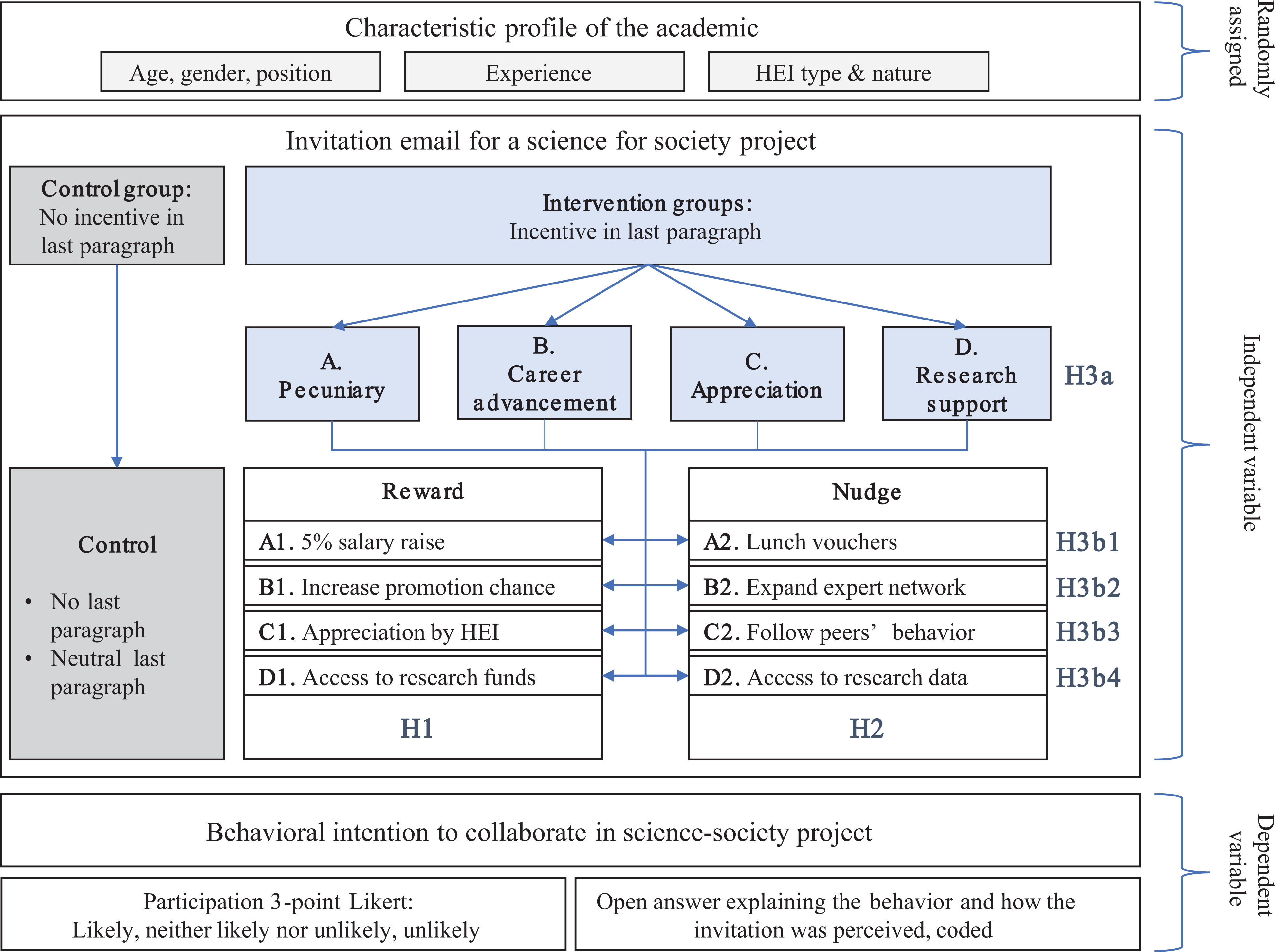
Study design.
The primary reason for an experimental survey design using rigorous controls is that rewards and nudges are rooted in behavioral science. In this field, experiments are proposed as appropriate methodology (Grégoire et al., 2019; Kirk, 2012; Sunstein, 2014). Furthermore, the survey questions allowed us to describe our population and to find underlying explanations of the participants’ behavior by coding responses to open-ended questions. Therefore, this study can be explained as a convergent mixed-methods design (Clark, 2019).
Population and sample
Data were collected in 2019 in business and economics faculties, a population that has received comparatively little attention for its third mission activities (Palsson et al., 2013). Academics in the field of business and economics can contribute to collaborative third mission projects with society by employing their expertise in, for example, marketing or financial planning (Wright et al., 2009). The data were collected in the framework of a student project led by the authors. Participants were recruited via the authors’ and project teams’ network, including those HEIs where the project members had studied in the past, and academic participants were asked to forward the survey to other academics in the fields of business and economics. Project members distributed the URLs to the survey in the name of the authors of this paper, so exploiting their networks in certain countries, including their home countries, resulting in samples from Latin America, Europe and Australia. Participants were included in the final sample only if they were active in at least one of the sub-fields of business and economics. We excluded those without the autonomy to make authoritative decisions, such as research assistants.
Under the assumption that participation intention and the effectiveness of incentives could be affected by various factors (Backs et al., 2019; Hauser et al., 2018), the following variables were recorded in our study: position, age, gender (Orazbayeva et al., 2019a), experience (Bruneel et al., 2010), HEI type, HEI nature (Agrawal and Henderson, 2002; D’Este and Patel, 2007) and region (Azoulay et al., 2007; D’Este and Patel, 2007). However, the interpretation of the effects of these variables is beyond the scope of the present study.
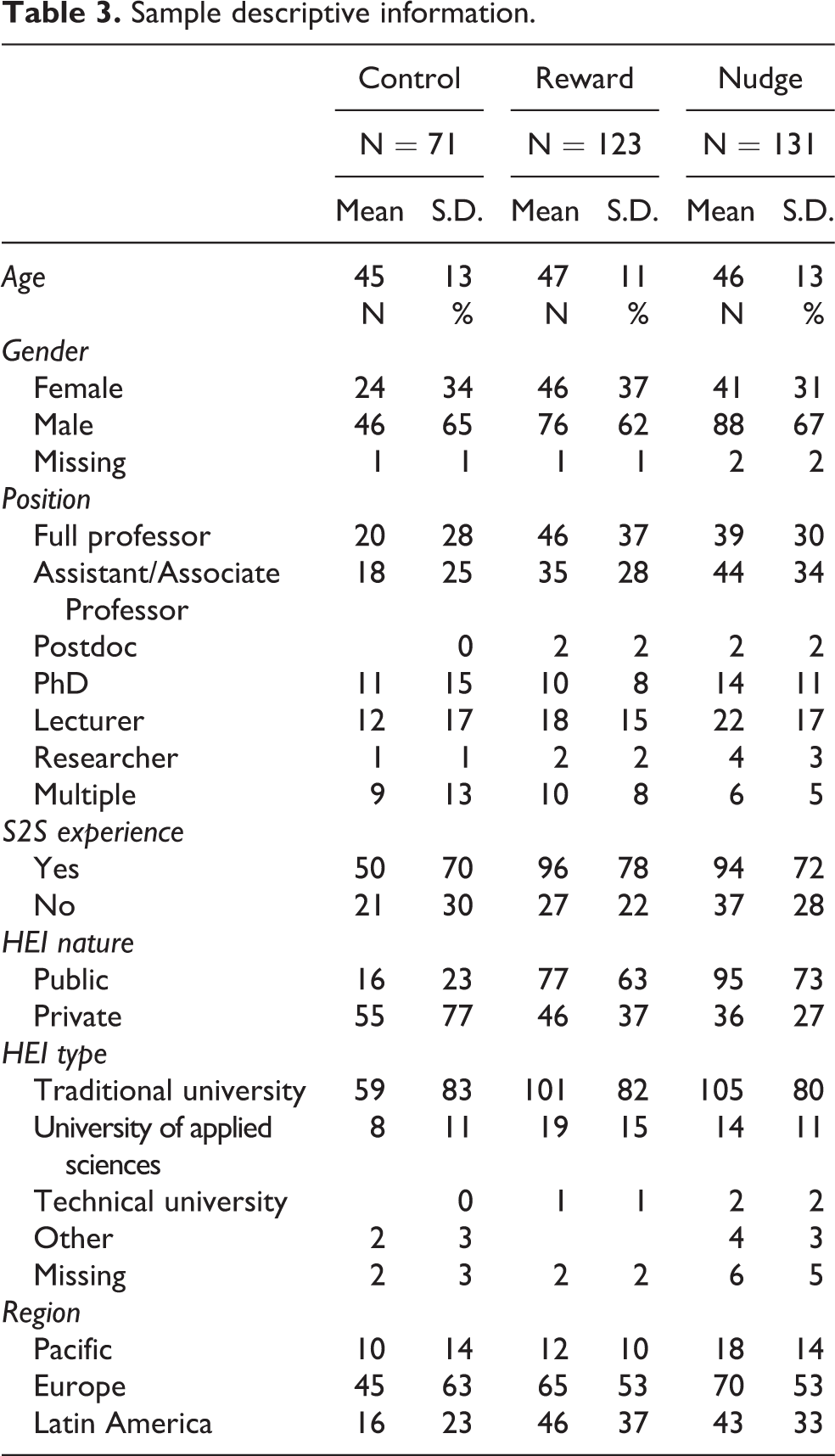
The sample comprised 324 academics and lecturers, who were randomly assigned to one of three groups (Figure 3). Their average age was 46, with a standard deviation of 12.3 years. Approximately 32% of the sample held a full professorship, while 29% were either assistant or associate professors. Most of the academics (73.33%) had experience of academic engagement with society. Regarding the type of HEI, 53% of the participants belonged to a public institution, and 81.66% worked in a traditional university. In Table 3, the descriptive statistics are shown for all 3 conditions: control, reward and nudge.
Sample descriptive information.
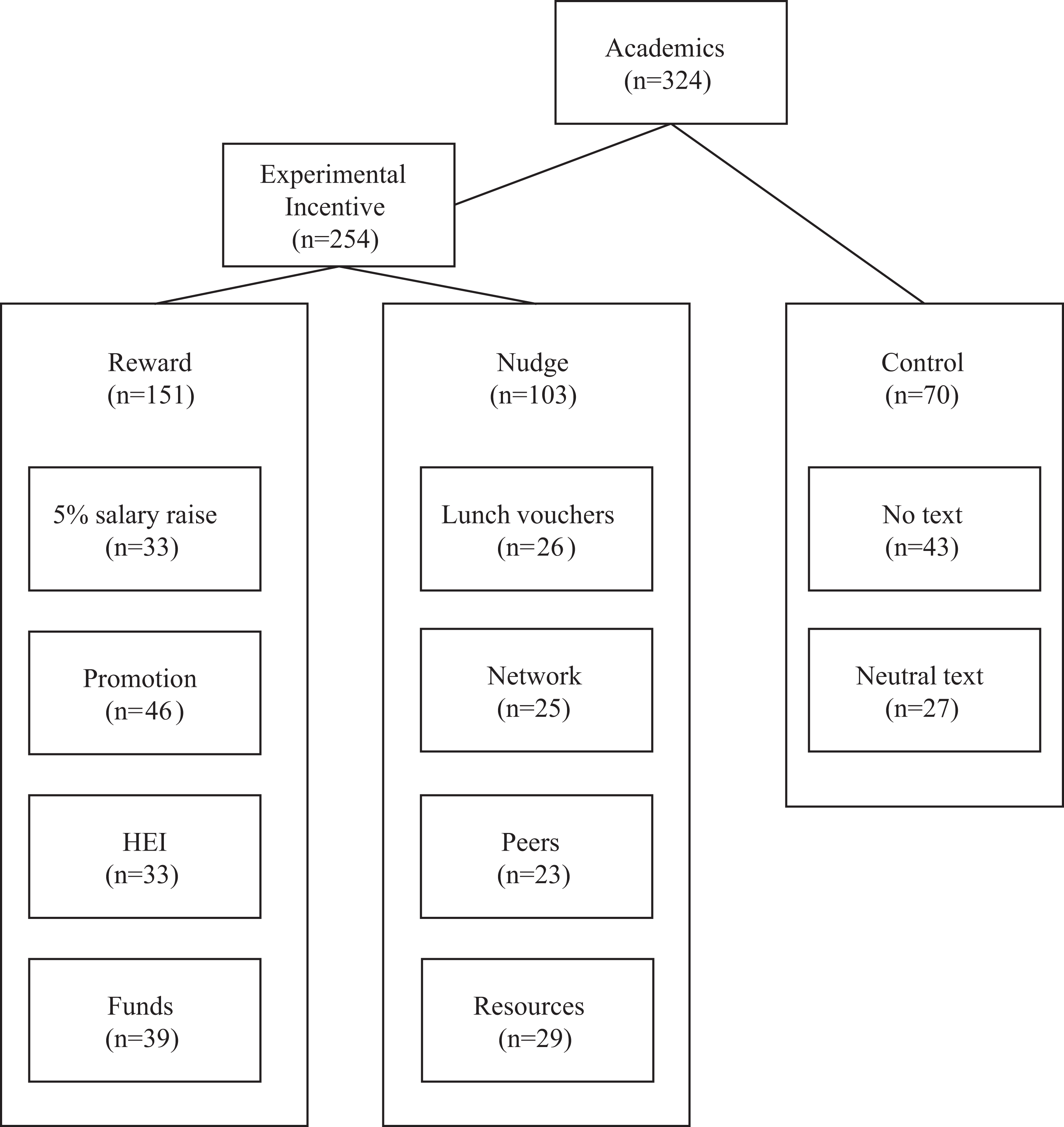
Sample and randomization.
Research instrument
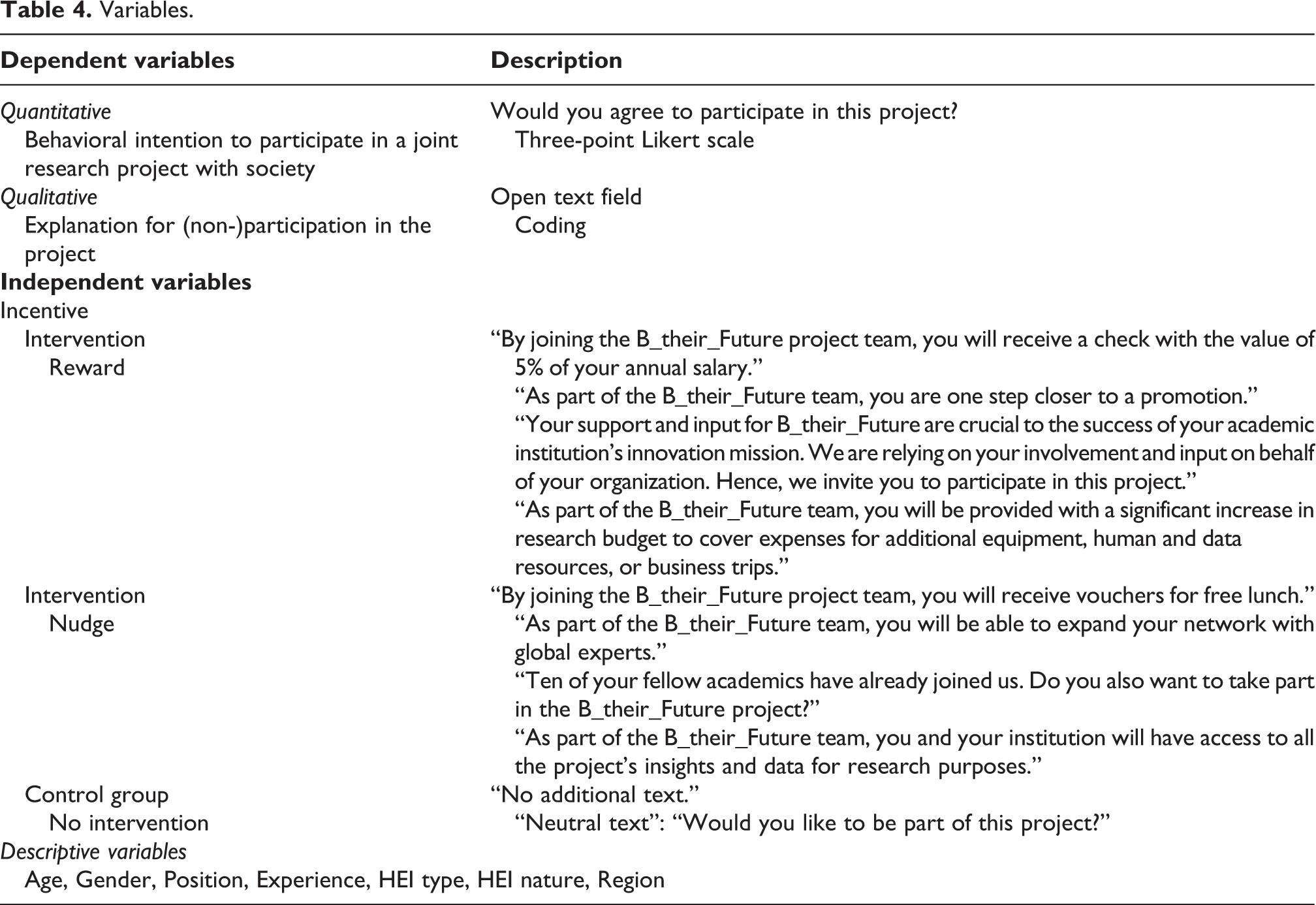
An experimental survey design with a stimulus and open-ended and closed-ended questions was developed to answer our research question. The survey was administered online using a web-based form in Qualtrics via an anonymous URL to secure valid standardized and anonymous data collection (Gosling et al., 2004). The stimulus was a fictitious invitation for a joint research project with society (Figure 4). The participants were clearly instructed to treat the fictitious situation as if the email had been sent to their inbox. The stimulus was designed with 10 different concluding paragraphs, each corresponding to different experimental and control conditions. In a between-subject design, the participants were randomly assigned to 1 of 10 conditions in the survey. These conditions presented different incentives (experimental group) or no incentive (control group) (Table 4). Academics were asked to evaluate the invitation, considering it in a real-world setting, and to respond with their likelihood of accepting it to measure their degree of intention to participate in the joint research project. They were also asked to explain their choice in a text field.
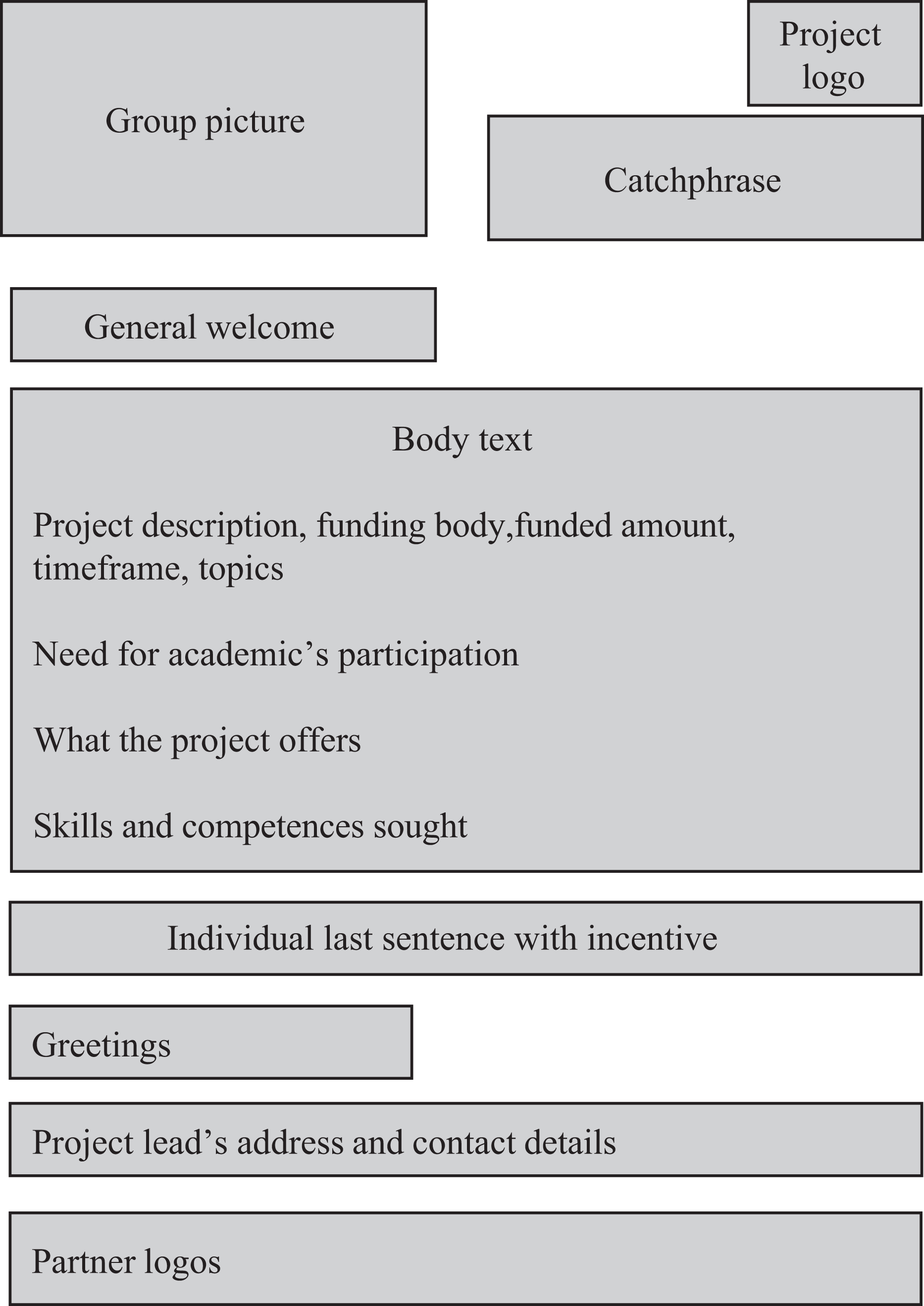
Stimulus design.
Variables
The variables used to measure the concepts are listed in Table 4. The dependent variable was the intention to participate in a joint research project with society, evaluated on a three-point Likert scale (1 = unlikely, 2 = neither likely nor unlikely, 3 = likely). According to the theory of planned behavior, intention is a precursor to behavior (Ajzen, 1991), including in the context of third mission activities (Arzenšek et al., 2018; Grünhagen and Volkmann, 2014). An open-ended question about behavioral intention was asked, so that the academics could clarify their decision.
The only independent variable was the incentive. In the experimental group, we distinguished between two categories of interventions: rewards (reward) and nudges (nudge). Both nudges and rewards were further subdivided into pecuniary incentives, career advancement, appreciation and research support. We referred to the control group as “control.”
Variables.
Quantitative analysis
The quantitative data were analyzed using IBM SPSS Statistics 24. To test the first two hypotheses, a one-way ANOVA was conducted to assess differences in the mean scores of academics’ participation between control, rewards and nudges. A Bonferroni posthoc test was applied thereafter to identify pairwise differences. The assumption of homogeneity of variances was tested using Levene’s test of equality of variances (p = 0.12).
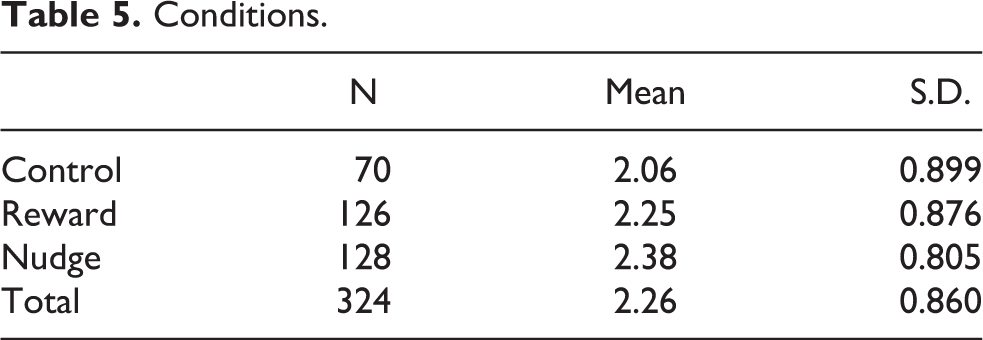
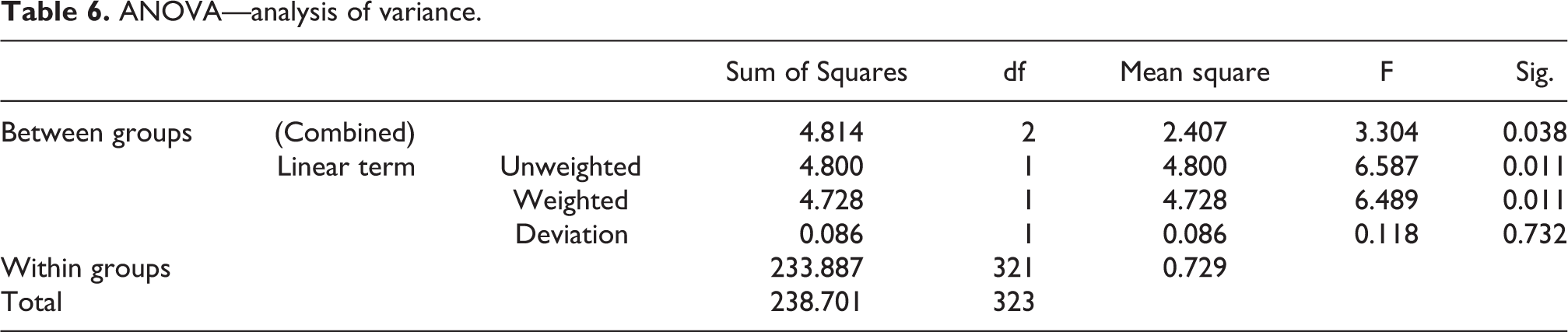
Table 5 displays the mean of the academics’ behavioral intention to participate in the project. The significant results of a one-way analysis of variance—F(2,321) = 3.30 (p = 0.04)—demonstrated the importance of considering different incentive types to encourage academics’ third mission activities (Table 6).
Conditions.
ANOVA—analysis of variance.
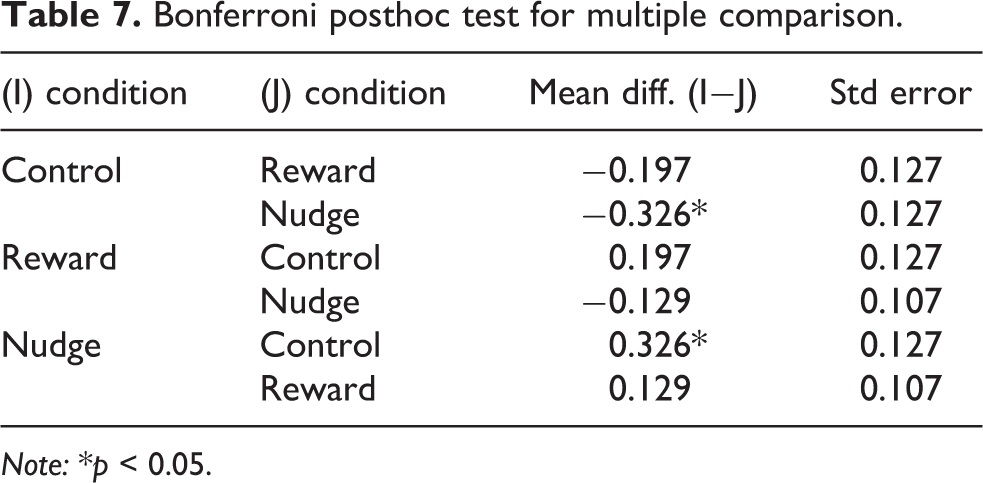
The Bonferroni posthoc analysis showed that academics who were nudged were more likely to participate in the fictitious project (M = 2.38, SD = 0.81) than academics who did not receive any incentive (M = 2.06, SD = 0.90) on a significance level of p < 0.05 (Table 7). Notably, incentives targeting an academic’s awareness via nudges positively affected behavioral intention, supporting the second hypothesis that nudges affect an academic’s intention to contribute to the third mission via collaboration in a joint research project with society. No such effects of rewards were supported by our data; therefore, the first hypothesis that rewards affect an academic’s intention to contribute to a joint research project as a third mission activity was rejected.
Bonferroni posthoc test for multiple comparison.
Note: *p < 0.05.
Various tests were conducted to test the third hypothesis (H3a, b1–4—see Figure 2). Due to the heterogeneity of variances (0.043), a Welch test was performed to test hypothesis H3a by comparing the four different motive categories for incentives (reward and nudge combined): pecuniary, career advancement, appreciation and research support. Subsequently, a sequence of four Chi-square tests was conducted to compare the effects of nudges versus rewards within the motive category. Welch’s F (3.131.16) = 1.68, which was insignificant (0.17).
The chi-square test allowed comparison of the effect of rewards versus nudges within each category: pecuniary incentive
Qualitative analysis
The qualitative data were analyzed using MAXQDA. Aiming to answer how the stimulus was perceived by the academics, we first distinguished between stimuli that were unmentioned and stimuli that were mentioned by them. Whether or not a stimulus was mentioned depended on whether there were direct comments related to the stimulus in the last paragraph of the invitation. A division of the “mentioned” category into three sub-groups was also made: negatively perceived, positively perceived and diversely perceived.
As the nudges were subtle but not necessarily non-transparent, academics commented on three of them: the nudge related to research support via data access, the career advancement nudge related to networking, and the appreciation nudge related to peer participation. Comments were also made relating to three rewards: the career advancement reward related to promotion, the pecuniary reward of 5% of the annual salary, and the research support reward offering a significant increase in research budget. Apparent differences between the rewards and nudges that were mentioned were, therefore, not found; however, it could be claimed that both types of incentive were indeed transparent and visible, while others might be taken for granted and therefore remain unmentioned.
Positively perceived incentives
Stimuli that were positively perceived were the nudges related to research support in the form of data access and a significant increase in research budget, and the career advancement nudge related to networking. Positive attitudes were found toward both rewards and nudges. For example, an associate professor from Brazil said, In order to participate actively, it would be necessary to know […] what resources would be allocated and how. I am interested in engaging with the industry and collaborations with impact in society. […] I would probably be interested. Mainly because it maintains a network with colleagues from other institutions and establishes research relationships with professionals from other countries.
Negatively perceived incentives
Only one of the eight incentives was judged as counterproductive: the promotion reward in the career advancement category. For example, a professor from Switzerland claimed that it was unfavorable to their motivation to participate: The connection to the promotion is rather counterproductive […] I personally don’t get anything for my promotion from it. It’s not addressed to me […] and it reads like a spam email.
Diversely perceived incentives
Not all the analyzed stimuli were either positively or negatively perceived. The 5% salary raise (the pecuniary reward) resulted in both positive and negative comments. As the goal of qualitative analysis is to acquire many different perspectives, rather than counting responses (Gioia et al., 2013), we shed light on both types of comments. For example, one participant commented on the pecuniary reward as follows: I would be in doubt about the validity of this project. In Brazil, it is not common to offer financial resources without prior contact and a relationship of trust between the participants. Interesting tasks with social relevance/benefit appeal to me and monetary incentives.
Unmentioned incentives
No direct comments were found regarding the appreciation reward related to the HEIs’ missions or the pecuniary nudge of lunch vouchers. The analysis showed that many academics believed that there should be an allocation of money (“contribute to society with financial support”), that the exact benefits to the academic should be communicated (“It is not clear the benefits for the person who is going to be engaged”), and the importance of collaboration with others and the expansion of one’s network through participation should be stressed (“I like the idea of working with people from other institutions […]”).
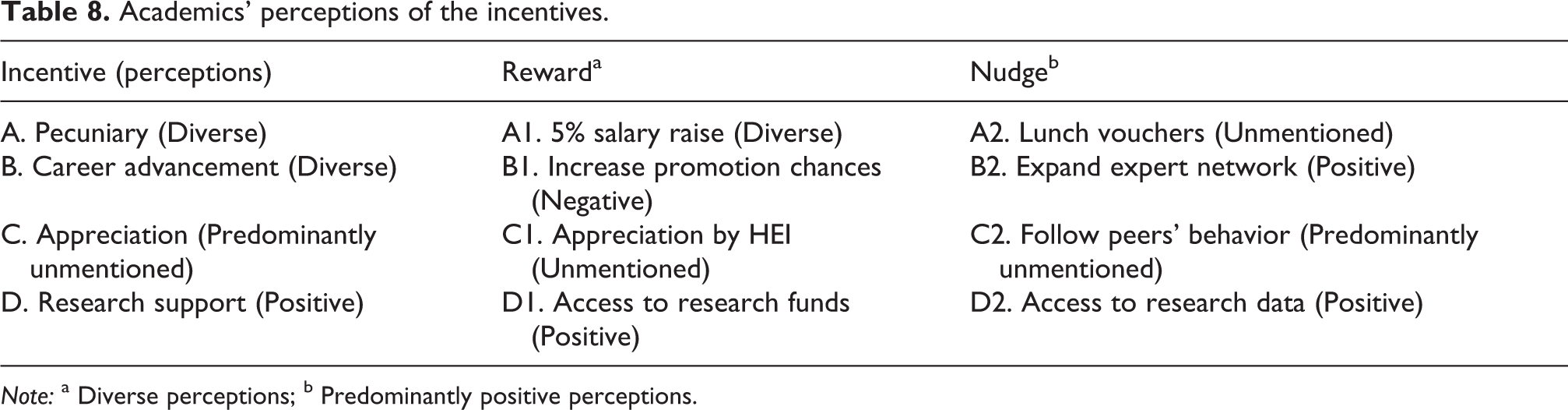
Nudges were predominantly positively perceived, while rewards were perceived diversely from negative to positive. Incentives appealing to the motives of appreciation and research support were perceived as positive, while those appealing to pecuniary and career advancement motives were perceived as both positive and negative (see Table 8 for a summary of the qualitative results).
Academics’ perceptions of the incentives.
Note: a Diverse perceptions; b Predominantly positive perceptions.
Discussion
This study identified a broad range of incentives for promoting academic engagement in the third mission. The incentives that have been implemented by HEIs to engage academics in third mission activities, in general, contribute to four categories of motives: pecuniary incentives (e.g., salary raises and lunch vouchers), career advancement (e.g., higher chances to get a promotion and expansion of personal networks), appreciation (e.g., by the HEI and by peers), and research support (e.g., in funds and data). Incentives identified as rewards and nudges were compared in the setting of a hypothetical experiment with business and economics academics. Our data showed that nudges were more effective than no incentive at all in increasing business and economics academics’ intention to engage in a joint research project with society; thus, subtle and inexpensive types of incentives seem to be effective. One thought-provoking result was the lack of support for a difference between either reward versus control or reward versus nudge. The results on the effectiveness of incentives did not show a difference between motive categories nor was there a difference within categories regarding the effect of nudges and incentives. Nonetheless, the research support category seemed to be well perceived by the business and economics academics, as did the reference to networking opportunities. Increased chances of promotion or an increase in salary were not perceived as believable and thus were judged as counterproductive by at least some of the academics. The academics did not mention other incentives, such as the support of the HEI mission and lunch vouchers.
Contributions to the literature
This study contributes to the literature by defining incentives that appeal to motivations, aiming to diminish the discrepancy of how third mission incentives are designed and perceived (De Jong et al., 2015). Our data show that the effectiveness of incentives and how they are perceived do not always align; for example, we did not find support for the hypothesis that there is a difference in effectiveness between motive categories. However, the motive category “research support” was clearly perceived as the most productive by the academics, which resonates with results from Lam (2011), who showed that research enablers such as budgets are much needed and especially welcomed by academics. Moreover, research support has been frequently identified as a motive for academic engagement (D’Este and Perkmann, 2011; Franco and Haase, 2015; Iorio et al. 2017; Lam 2011; Lee, 2000; Orazbayeva et al., 2019a; Ramos-Vielba et al., 2014; Roman et al., 2018; van de Burgwal et al., 2019). Another compelling result showed that the absence of research support, particularly funding, is a reason for academics not to engage in joint research projects with society.
How the incentives for engagement were perceived by the business and economics academics is supported by the self-determination (Ryan and Deci, 2000) of the academic and the determinants autonomy, competence and relatedness. Strong rewards that steer toward the third mission are perceived as conflicting with academic freedom. Academic freedom and autonomy play an important role in academic engagement (Lee, 2000; Orazbayeva et al., 2019b; Tartari and Breschi, 2012). Hence, nudges that do not interfere with freedom of choice (Thaler and Sunstein, 2008) are effective in promoting the third mission
Two rewards led to fierce reactions from the business and economics academics: the increased chance of promotion and the salary raise. This could be due to the perceived unreliability of the promise. Seemingly, some rewards do not resonate with the higher education environment and the reality that business and economics academics face in joint research with society, notwithstanding that such rewards are not uncommon for academic engagement in general, including research commercialization (D’Este and Perkmann 2011; Lam, 2011; Ramos-Vielba et al., 2014). Interestingly, a case study has shown that such rewards are solely granted for research advances and are not linked to excellence in third mission activities (Lahikainen et al., 2019). This is also supported by the analysis of practitioner cases, which do mention such rewards, but relatively seldomly; for instance, pecuniary rewards represent only 2% of the total of incentives identified.
Furthermore, previous research has supported the idea that promotions and pay raises could motivate academics (van de Burgwal et al., 2019). The sample in our study explains the reason for this—individualized financial rewards violate the social goal of bringing benefits to society. Our results support Lam’s suggestion that “financial rewards might be inadequate or even misplaced” (Lam, 2011: 1366). Thus, our results indicate a differentiation between the approach required for the original research commercialization oriented third mission and that required for the current mission, which has taken a societal turn.
Incentives appealing to the appreciation of the academic and soothing the relatedness of the individual were predominantly received without resistance. Interestingly, the academics did not comment on the appreciation reward related to their HEI’s mission, despite the strong role of the mission mentioned in the literature. The appreciation nudge of participating peers was not positively perceived by all the responding business academics, principally due to its operationalization, which resembled a spam email. As the literature on nudges has shown, peer nudges are most effective when the peers or “peer environment” are close to the individual and when the nudges are realistic (Thaler and Sunstein, 2008). We recommend acquiring a good understanding of the context of the third mission activities and of academic staff’s behavior before designing incentives (Hauser et al., 2018).
The lunch vouchers pecuniary nudge remained unmentioned by the business and economics academics, but contributed to the overall effect of nudges being more effective than no incentive at all. It might be that the provision of food at meetings is taken for granted since this is a common procedure. However, the expansion of academics’ professional networks can be argued to be important, either as a nudge or by emphasizing that the international and cooperative character of the project will result in positive responses, as this can boost academics’ careers.
Contributions to practice
Our study supports a third mission promotion strategy appealing to various motives of academics. As this broad targeting of motives has been common practice, as shown in our analysis of practitioner cases, and seems to be effective in promoting the engagement of business and economics academics in joint research with society, we advise its continuation and exploration of its effectiveness for other academic disciplines and third mission activities. Additionally, efforts appealing to the research support motive should be expanded as this was positively perceived by academics. Especially in the short term, research support in the form of resources is considered an enabling factor for third mission efforts (D’Este and Perkmann, 2011; Franco and Haase, 2015; Iorio et al. 2017; Lam 2011; Lee, 2000; Orazbayeva et al., 2019a; Ramos-Vielba et al., 2014; Roman et al., 2018; van de Burgwal et al., 2019).
Considering academics’ autonomy, we recommend the exploitation of nudges since they are subtle and maintain freedom of choice (Sunstein, 2014; Thaler and Sunstein, 2008). Moreover, nudges have been shown to be more effective in raising the intention of business and economics academics to engage in a joint research project with society. In short, we recommend implementing inexpensive awareness-oriented nudges before considering expensive rewards. It should be noted that rewards may even have unintended side-effects as they can contradict the autonomous practice of academics (Lam, 2011; Lee, 2000; Tartari and Breschi, 2012), and intrinsically motivated individuals might abstain when strong extrinsic rewards are offered (Ryan and Deci, 2000). Moreover, to the broad audience of academics, regardless of their intrinsic motivation, rewards in the form of a pay raise or an increase of salary were not much believed in the present study, and, in this sense, can be counterproductive. With some caution, we also suggest sympathizing with the relatedness that the academics experience. Peer nudges should follow a realistic design and preferably need to consider the specific environment for each individual academic. From a more general perspective, a mission statement may help (Iorio et al., 2017). However, in this study, the effect was too weak to show this general sense of belonging when a third mission statement is in place.
To summarize the managerial and policy implications of this research, we recommend focusing on: 1) nudges to boost (partly) internalized motivation; 2) a mix of appeals to pecuniary incentives, career advancement, appreciation and research support; and 3) respecting relatedness, autonomy and competence.
Limitations
This research has some limitations. To begin with, the incentives identified in the first study are from practitioner cases and have an affirmative bias toward the third mission. However, not all forms of third mission activities contribute to the larger goal of bringing innovation to society (Giuliani and Arza, 2009). Moreover, two major assumptions underlie the second study. The first is that business and economics academics’ intention to collaborate in such a joint research project is a fair predictor of participation in comparable forms of joint research projects in a real-world setting (Arzenšek et al., 2018; Ajzen, 1991; Grünhagen and Volkmann, 2014). The second is the far-reaching effect that productive interactions not only lead to science for society interaction (Muhonen et al., 2020) but also bring benefits to society, justifying these types of strategies, contrary to the automatic effect described by Bush (1945).
Another limitation is that the convenience sample of business and economics academics recruited via the authors’ and project teams’ network, which included a high rate of academics with experience in collaboration with society (73%), which is substantially higher than in monitoring reports such as that by Davey et al. (2018) (about 50%). This may have been caused by a sampling bias, despite the study’s invitation clearly asking all participants, irrespective of their experience, to take part. While the randomization allowed this experience to be equal across all groups, it might be that nudges were especially effective in a population of academics with previous experience of academic engagement with society, suggesting an even stronger intrinsic drive among academics than in previous related studies (Iorio et al., 2017; Orazbayeva et al., 2019b). Therefore, caution is required when generalizing to a population without previous experience, as well as generalizing to other academic disciplines, because the results might be solely applicable to the specific context (Backs et al., 2019).
Another limitation is the lack of evidence to explain why some motive categories were not effective when appealed to via an incentive. This could have been due to the hypothetical conditions of the experiment. Credibility could have been improved by doing the experiment in a real-life setting, employing HEI promoters themselves to sign and send the invitations.
Directions for future research
Despite these limitations, our study indicates that motive-based incentives in the form of nudges increase the likelihood that business and economic academics will take part in a joint research project with society and, thereby, contribute to HEIs’ third mission. Nonetheless, finding a single most effective incentive for promoting academic engagement is beyond the scope of this study, as it is most likely not a one-size-fits-all solution. An interesting research avenue would be a highly contextualized and in-depth study with a sample from different academic disciplines. Another methodological approach could be a (meta-)study across academic fields that, if on a global scale, takes cultural effects into account. Future work might also elaborate on the current study by comparing all incentives identified in Study I, not solely focusing on rewards and nudges but also on the incentives that fall in between strong and marginal. Such a study would contribute insights into the motives of academics, organized along the self-determination continuum, and underpin the importance of revisiting this alignment. A final recommendation for future research is to focus on the role of networks in academic engagement and third mission promotion, since the current study indicates a role for networks that could be further explored.
Footnotes
Acknowledgments
We would like to thank the scientific community and the practitioners present at the University-Industry Interaction Conference (UIIN) 2018 and the Institute for Small Business and Entrepreneurship Conference 2019 for their valuable reviews and feedback. We also thank Ana Beatriz Imperatori, Linn Korte, Carolina Ossa and Iulia Stroila for their excellent assistance during this study. We would also like to express our gratitude to all the students from the Münster School of Business who took part in the nudging project, and whose hard work allowed us to gather all the data. Moreover, we thank Dr Sanae Okamoto for her contribution in the early stages of the analysis of the UIIN case studies. Last but not least, we thank the two anonymous reviewers for their motivating yet critical comments.
Declaration of conflicting interests
The author(s) declared no potential conflicts of interest with respect to the research, authorship, and/or publication of this article.
Funding
The author(s) received no financial support for the research, authorship, and/or publication of this article.

Appendix 1
Overview of cases
| Case | Title | Country | Year | Pecuniary incentive | Career advancement | Research support | Appreciation |
|---|---|---|---|---|---|---|---|
| 1 | University of Wollongong’s iAccelerate | Australia and Canada | 2014 | N | I, N, R | I | R |
| 2 | Aquademia: bridging academia and water-related business through competence development | Austria, Germany, Netherlands, Spain | 2014 | — | — | — | — |
| 3 | iMinds Incubation & Entrepreneurship program | Belgium | 2013 | — | I, R | I | R |
| 4 | Activating Researchers for Entrepreneurship: Bridging the Gap Between Research and Transfer to Society | Belgium | 2014 | — | I, N | I, N | R |
| 5 | Technopreneurship for everyone | Belgium | 2014 | I | I | I | I, R |
| 6 | Innovative Marketing Communication Academy: hands-on sessions with practical guidelines and tools for SMEs | Belgium | 2015 | — | I | I | R |
| 7 | Innovation Labs as Collaborative Tool between Higher Education Institutes and SMEs in Innovation Processes | Belgium, Finland, Latvia | 2014 | — | I | I | R |
| 8 | General Course on Intellectual Property: | Brazil | 2014 | I, N | — | N | I |
| 9 | From incubators to technological park: the case of the city of Vitoria, Espirito Santo State-Brazil | Brazil | 2014 | R | I, N | I | I, R |
| 10 | IPT’s “Quick & dirty” technology valuation model | Brazil | 2014 | — | — | — | R |
| 11 | Lead to Win | Canada | 2014 | — | I, N | I, R | I |
| 12 | Cyprus University of Technology’s Research Institute | Cyprus | 2013 | I, R | I, N, R | I | R |
| 13 | University—Practice Network at the University of West Bohemia (UNIPRANET) | Czech Republic | 2015 | I | I, N | I | — |
| 14 | SpinIN: A Danish case of collaboration between student entrepreneurs and established companies | Denmark | 2014 | — | I, N | I, N | R |
| 15 | Taking responsibility for growth and job creation; Co-location for co-creation | Denmark | 2014 | N | I, N | I, N | R |
| 16 | The Aarhus University Student Incubator Experience | Denmark | 2014 | — | I, N | I, N | R |
| 17 | Copenhagen Innovation and Entrepreneurship Lab—CIEL | Denmark | 2014 | — | I, N | I, R | R |
| 18 | Aligning ICT UII collaboration in a fast-paced industry | Denmark | 2015 | — | I, N | I | — |
| 19 | Professionalising the use of the student resource for innovation—re-framing collaborations with industry—exemplified by Solution Hub and U-CrAc | Denmark | 2015 | — | I | — | — |
| 20 | Turning a traditional university into an entrepreneurial university | Estonia | 2014 | — | I | I, N | N, R |
| 21 | JAMK Generator | Finland | 2013 | — | I, N | I, R | R |
| 22 | Developing Entrepreneurial University During Rapid Structural Change: Case Kymenlaakso University of Applied Sciences | Finland | 2014 | — | N | N | N, R |
| 23 | From Triple Helix Towards InnoHub Network in Practice | Finland | 2014 | — | I, N | — | R |
| 24 | Increasing co-operation between learning institutions and the city of Espoo in Finland—Case InnoEspoo | Finland | 2014 | N | I | N | – |
| 25 | Developing a measurement system for entrepreneurship education | Finland | 2014 | — | I, N | — | — |
| 26 | Amazing Business Train | Finland, Russia, Belarus, Vietnam, China | 2014 | — | I | — | — |
| 27 | Stifterverband Transfer-Audit | Germany | 2018 | — | I, N | — | R |
| 28 | The partnering university approach | Germany | 2013 | R | I, N, R | R | R |
| 29 | The Industry-Academia Liaison Officer (Wirtschaftstransferbeauftragter, WTB) | Germany | 2013 | — | I, N | — | — |
| 30 | ACCENT—Accelerating Entrepreneurship | Germany | 2013 | — | I, N | I, N | R |
| 31 | Dual Study Paths in Engineering Sciences | Germany | 2014 | — | I | N | R |
| 32 | Fueling the Powerhouse Jena | Germany | 2014 | I | I, N | N | — |
| 33 | TUMentrepreneurship | Germany | 2014 | N | I, N | I, N | R |
| 34 | Scientific Entrepreneurship Support at Koblenz-Landau University | Germany | 2014 | — | I, N | I, N | — |
| 35 | The case of The University of Sheffield (TUOS) International Faculty, CITY College | Greece, UK, Bulgaria, Romania, Turkey, Albania, Serbia, Ukraine |
2013 | — | I, N, R | R | R |
| 36 | Partnering for the Future: A Case Study in Building Long Term Academic Industry Relationships | Ireland | 2014 | — | N | — | — |
| 37 | CIT Extended Camp | Ireland | 2014 | — | I, N | N, R | — |
| 38 | Focused, fast and flexible: a partnership approach to regional job creation | Ireland | 2015 | N | — | — | — |
| 39 | Concentrating Solar Power (CSP) technology: from Research to Market. A Case Study | Italy | 2014 | — | — | N | — |
| 40 | Materials and MTAs Management Tool for Universities | Japan | 2014 | — | — | I | — |
| 41 | The significance of the university environment for entrepreneurship education: A case study of an entrepreneurial university in Mexico | Mexico | 2013 | I, N | I, N R | I, N | |
| 42 | Master’s in systems engineering | Norway | 2018 | — | I | I, R | — |
| 43 | IESS—The Innovative Entrepreneurship Support System | Poland | 2014 | — | I | I, N | I |
| 44 | Strategic Leadership Hub—an example for promoting effective University-Industry interaction | Portugal, Poland, Brazil, Angola | 2015 | — | I, N | I | — |
| 45 | Cluster 4GUNE: boosting university system-industry fabric cooperation in the Basque Country in Industry 4.0 | Spain | 2018 | — | I, N | I, N | I, R |
| 46 | An Entrepreneurial Collaborative Approach | Spain | 2013 | — | I | I | I, R |
| 47 | Fostering the entrepreneurship using university-industry interactions | Spain | 2014 | — | I, N | — | I |
| 48 | Initiative for the development of business opportunities between high performance students and researchers from Universitat Jaume I: NETEC. | Spain | 2014 | — | I, N | R | — |
| 49 | An industry-based problem-based learning approach | Spain | 2014 | — | I | — | — |
| 50 | Innovatech, a new approach to UPM technology commercialization | Spain | 2014 | — | I, N | — | I |
| 51 | Passport to a profession in the degree of pharmacy12 | Spain, UK | 2014 | — | I, N | — | — |
| 52 | Tarracolab project | Spain, Denmark | 2013 | — | I, N | I, N, R | I, R |
| 53 | AIMday® | Sweden | 2013 | — | I, N | I, N | R |
| 54 | The University of Skovde and Gothia Science Park—an integrated approach | Sweden | 2014 | — | N | — | — |
| 55 | Training A New Workforce For A Service Economy | Switzerland | 2018 | — | I | — | — |
| 56 | Bridging Industry-Academia Collaboration by Research Institute | Taiwan | 2018 | — | I, N | I, N, R | I, R |
| 57 | Service Science Factory, Maastricht University | The Netherlands | 2013 | — | I | I | I, R |
| 58 | The Tilburg Center of Entrepreneurship | The Netherlands | 2014 | — | I | I | — |
| 59 | Pioneering New Generation Universities in Turkey: The Abdullah Gül University Model | Turkey | 2018 | I, N, R | I, N | N, R | R |
| 60 | Innovation through collaboration—the Royal Society Industry Fellowship | UK | 2018 | — | I, N | R | I, R |
| 61 | Building a strategic partnership for connected and autonomous vehicle research | UK | 2018 | N | I, N | I, N | I, R |
| 62 | The Manchester Innovation Labs | UK | 2018 | — | I, N | I | R |
| 63 | University-driven economic growth | UK | 2014 | — | I | N, R | — |
| 64 | Rules of engagement: understanding the dynamics of social enterprise and business requirements on academic collaboration | UK | 2014 | — | N | — | — |
| 65 | Plymouth University’s Enterprise Vision | UK | 2014 | — | I, N | — | I, R |
| 66 | Innovation Café | USA | 2014 | — | I, N | N | I, N |
| 67 | Academic Proof-of-Concept Best Practices—The University City Science Center’s Multi-Institutional QED Program | USA | 2014 | R | I, N | R | I, R |
| 68 | From University Technology Transfer to Regional Innovation Gateway | USA | 2014 | — | I, N | I | I, R |
| 69 | Virginia Commonwealth University Playing. The Role Of A Venture Creation University | USA | 2014 | — | I, N | I, N | I, N |
| 70 | Pathways to New Business Creation | USA | 2015 | — | I, N | N | I, R |
| 71 | TE Week: Fostering an Entrepreneurial and Innovative Ecosystem at Lehigh University through an Immersion Experience | USA | 2015 | — | I, N | I, N, R | — |
| 72 | Generating Warp Speed Effectiveness for University Entrepreneurship Initiatives: The Power of Public-Private Partnerships in Supercharging Results | USA, China, Japan, Taiwan (Foxconn) | 2018 | R | I, N | N, R | I, N |