




Abstract
Research of the main university stakeholders has only been of a cross-sectional or short-term nature thereby limiting our understanding of how universities have evolved as a result of stakeholder influence. Indeed, neglect of stakeholders in strategic planning may result in both companies and universities becoming less successful and less competitive. For this reason, a temporal perspective was adopted to enable a consideration of events, their antecedents and subsequent effects thereby identifying emerging evolutionary trends and responding to them so that there can be appropriate decision making and accountability. This paper uses historical organisational studies to provide a longitudinal overview of internal and external stakeholder influence on university evolution and change from their foundations in the early Medieval period. Five university generations are described: Medieval, Humboldtian, Civic/Land Grant, Mass, and Stakeholder. This investigation reveals a number of strategic shifts in stakeholders as their voices have become increasingly prominent or have declined. Over time, the number of stakeholders have grown as their salience has been acknowledged through concepts such as the third mission; corporate social responsibility and helix structure; and, although some of the main stakeholders have remained constant such as learners and faculty, their influence has fluctuated.
Keywords
Introduction
Universities have evolved and flourished over a period of 900+ years e.g., Università di Bologna (1088), University of Oxford (1096), and Université de Paris (1200); however, it is only in recent times that the role of stakeholders has been explicitly investigated and these studies have been of a cross-sectional or short-term nature (eg. Chapleo and Simms, 2010; Gibb and Haskins, 2014; Benneworth and Jongbloed, 2010; Tetřevová and Sabolova, 2010; McAdam et al., 2021). Indeed, if stakeholders are neglected in strategic planning, universities may be less successful, less competitive and have weaker quality assurance systems (Kettunen, 2015; Mainardes et al., 2010). Moreover, in spite of the importance of the main stakeholder relationships they have never been studied from a longitudinal perspective which may provide us with insights into the evolution of universities and where their future trajectory might lie (Bucheli and Wadhwani, 2014; Rowlinson et al., 2014). Without an historical consideration of university stakeholders, it will be challenging to identify the evolutionary trends which are emerging and respond to them so that there can be appropriate and successful decision making and accountability (Salancik and Pfeffer, 1974).
The contemporary university, Jongbloed et al. (2008: 304) argued: ‘suffers from an acute case of mission confusion’; and this confusion is not new with Webster (1998: 69) pointing out that: ‘The university has never been an agreed institution, fixed in form. On the contrary, its history is one of continuous change and mutation.’ This ambiguity of purpose has meant that universities have tacitly used internal and external stakeholder management in attempts to resolve stakeholder differences (Benneworth and Jongbloed, 2010).
Evolution of university stakeholders (adapted by authors).
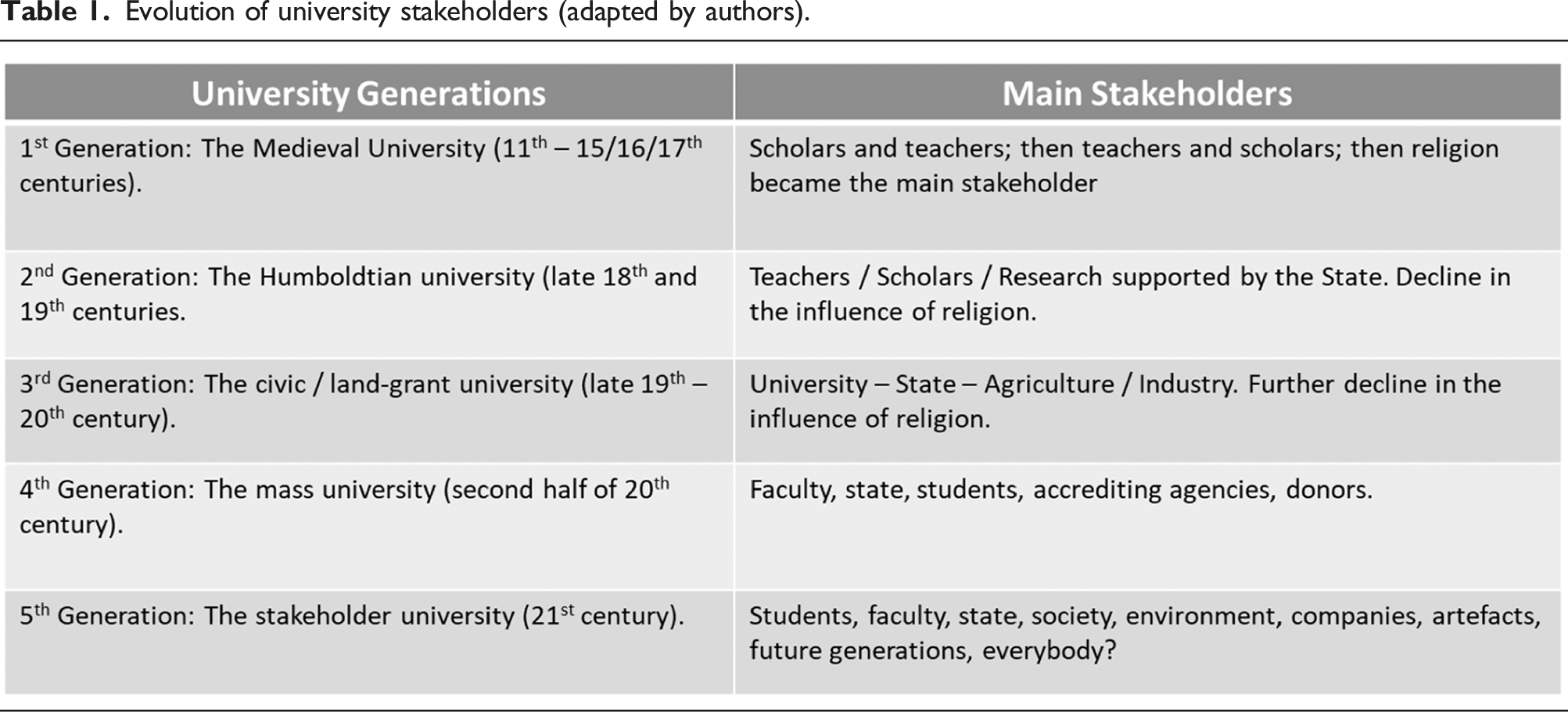
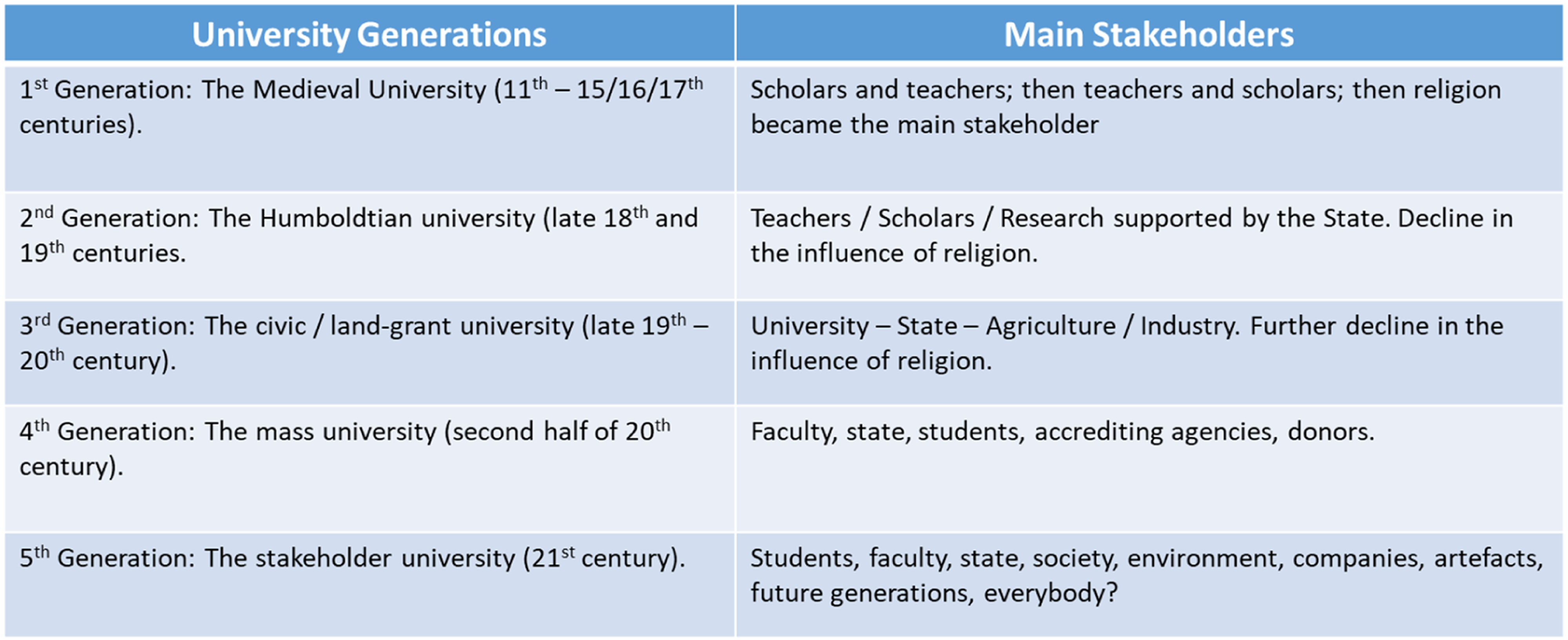
The aim of this study is to explore the evolution of stakeholders within universities and their impact on strategic direction. Below, we will explore the nature of stakeholder theory; consider university stakeholders; examine the principal stakeholders across five university generations; and finally draw some conclusions. By doing so, this might provide a less static perspective, compared to cross-sectional studies, and identify principles which assist universities to accommodate stakeholders within a more coherent philosophy and strategies for the future.
Stakeholder theory
In contrast to the longevity of universities, S&P500 companies are relatively short-lived surviving, on average, less than two decades (Anthony et al., 2018) and this is due, in part, to a narrow focus on shareholder primacy (Friedman, 1970). An investigation of 400 company strategic decisions discovered that approximately half ‘failed’, with one of the main reasons being that they did not take into account the interests of, and information held by, key stakeholders (Nutt, 2002). This failure to consult, think and act: ‘too predictably leads to poor performance, outright failure or even disaster’ (Bryson, 2004: 22).
The term stakeholder was popularised by Freeman (1984: 46) who defined stakeholder as: ‘any group or individual who can affect or is affected by the achievement of the organisation’s objectives.’ Freeman argued that traditional approaches to strategic management were becoming less relevant and less successful and, therefore, managers needed to focus their energies taking into account stakeholders who included: banks, customers, employees, environmentalists, government, media, stockholders (shareholders), suppliers and other special interest groups.
Stakeholder analysis begins firstly with identification and, secondly, classification according to their possession of three attributes: their power to influence the organisation; the legitimacy of their relationship; and, the urgency of their claim (Mitchell et al., 1997). Next, the organisation’s managers decide the salience of the stakeholders to determine the degree of priority given. Mitchell et al. (1997) also noted that stakeholder attributes might change; were socially constructed; and those stakeholders may or may not consciously exert influence with some being dormant.
It was not only for reasons of survival that organisations began to pay greater attention to stakeholders but also because of democracy and social justice objectives that a wider range of stakeholders were gradually included. Furthermore, the world is becoming increasingly complex and interconnected and any public problem inevitably involves a variety of individuals, groups and organisations (Bryson, 2007). If the interests of key stakeholders are not satisfied then the organisation will lose legitimacy, relevance, the resources needed to sustain it and ultimately become obsolete (Nybom, 2003).
This growing awareness of stakeholders is also paralleled by an increased interest in corporate social responsibility: ‘policies and practices that business people employ to be sure that society, or stakeholders, other than business owners, are considered and protected in their strategies and operations’ (Carroll, 2016: 2). The consideration of what constitutes stakeholders was also widening and Starik (1993, 1994) suggested that this should include: potential stakeholders; past or future generations; non-physical mental-emotional constructs; non-living objects; and the natural environment.
Methodology
Studying the historical evolution of organisations is an important and growing area because it can provide insights into events, their antecedents, and subsequent impacts (Leblibici, 2014; Rowlinson et al., 2014). An historical perspective can also offer explanations of how actions have influenced development, and these may be better understood, or only be visible from a retrospective standpoint (Bucheli and Wadhwani, 2014). However, to investigate the use of ‘stakeholder’ over centuries presents a challenge because it is a relatively recent construct which originated in 1963 when the Stanford Research Institute combined the terms ‘shareholder’ and ‘stockholder’; thus, searches for the term in earlier historiographies of universities is problematic. To address this, the authors adopted two methodological approaches: a systematic literature review (SLR) of the past 25 years, and historical organisational studies for the preceding period beginning with the establishment of universities.
An SLR process (Xiao and Watson, 2019) is considered an appropriate methodology to understand both the recent historical and present context of the university and its approach to stakeholders. It supports validation of this conceptual article as it relates to validity, reliability and repeatability supporting the overall quality of approach and findings. Using Scopus, the keywords ‘universit*’ AND ‘stakeholder’ in ‘article title’ produced an initial 702 publications covering the period Jan 1998- March 2022. Further analysis specific to Social Science related journals revealed 411 articles (1998-2022), with peer reviewed articles dominating, 331. This augured well for topicality of stakeholders given conversations around widening engagement, sustainability and strategic partnerships. To ensure maximum validity the authors further dissected the trajectory of publications over a c19-year period resulting in a total of 115 publications captured from period (2003-2022) with the title ‘university(s) & stakeholder(s)’ and representing a significant upswing in publications during the period 2020-2021. Finally, the authors filtered these to 18 peer reviewed publications: (Alarcón-del-Amo et al., 2016; Amaral and Magalhães, 2002; Antonaras et al., 2018; Benneworth and Jongbloed, 2010; Carey, 2013; Chapleo and Simms, 2010; Cavallone et al., 2022; Gibb and Haskiins, 2014; Kettunen, 2015; Langrafe et al., 2020; Mampaey and Huisman, 2016; Matkovic et al., 2014; Margherita and Secundo, 2011; McAdam et al., 2021; Miller et al., 2014; Ricardo, 2011; Schüller et al., 2014; Turan et al., 2016).
The second part of this study utilised historical organisational studies which is an approach to ‘enrich and transform our understanding of contemporary organisations’ (Maclean et al., 2016: 609). In spite of numerous advantages there is only limited application as a result of the ontological differences between the social sciences which utilise replicable procedures and data; and the humanities which incorporate historical narratives derived from a variety of temporal and sometimes incomplete sources (Rowlinson et al., 2014). This ontological divide between the social sciences and the humanities has been partially bridged by what has been called the ‘historical turn’ (Macdonald, 1996) and the ‘creative synthesis’ of historical organisational studies (Maclean et al., 2016). A temporal perspective enables an historical narrative consideration of events, their antecedents and subsequent effects; and through the use of ‘temporal lenses’, in this case stakeholder theory, the causes, consequences and meanings of actions may be interpreted (Bucheli and Wadhwani, 2014: 14) across five generations discussed below.
Evolutionary path of Universities
1st generation: medieval universities and stakeholders
The early Medieval universities largely emerged from cathedral schools e.g., Paris, or town schools e.g., Oxford, and the term ‘university’ was derived from ‘universitas magistrorum et scholarium’ meaning a guild or corporation of teachers and scholars, and this was abbreviated to ‘universitas’ meaning the totality or whole (Leff, 1975). The Università di Bologna was originally a student-centred institution with students electing rectors, formulating regulations, determining pay scales and lecture times, and the teachers also took oaths to the student Nations (geographically-based associations of students). On graduation, students were expected to teach as regents for two years and then to leave on completion of this period. This lack of job security impacted on the continuity of teaching and, by the mid-1300s, municipal authorities, the church and state began to address these limitations and provide some funds to establish a stable cohort of teachers. This strengthened the faculty and the balance of power gradually transferred from the students to the faculty (Georgedes, 2006).
The early Medieval universities were mainly masters’ guilds relatively autonomous of external paymasters other than fees; however, the influence of the church increased particularly with the establishment of monastic colleges and both students and teachers acquired clerical status (Cobban, 2002). Local religious authorities were the main stakeholder influence but, as universities pursued autonomy, they often aligned themselves with the papacy and royalty which granted them charters providing independence (Georgedes, 2006) thereby enabling universities to decouple from the influence of the local bishop and town with little third mission activity.
Teaching in Latin communicated the principles of core texts such as the bible and classical works such as those by Aristotle. The Church was a powerful stakeholder, and the Bible was considered a higher sacred truth so any contrary views were obliged to defer to the Bible. For example, in the early 13th century the bishop of Paris censored 217 Aristotelian propositions and similar measures were applied in Oxford (Georgedes, 2006). It was generally considered that there was a fixed body of knowledge which did not change and therefore, was delivered with little alteration for centuries.
Change did not always arise from stakeholder influence, technology in the form of printing resulted in gradual changes including: the replacement of Latin with vernacular languages; the growth and opening of libraries; changes of curriculum; changes to pedagogy; and written examinations replacing oral disputations (Moodie, 2014). Cheaper books allowed greater access to a wider variety of texts and this enabled the Jesuits to pioneer the study of multiple authorities upon one subject rather than explore the perspectives of one author on a variety of subjects (Grendler, 2002).
The primary purpose of Medieval universities was occupational with some early universities being famous for the subjects they taught e.g., Bologna – law; Paris – theology, arts; Salerno – medicine; Orleans – ancient authors (Paetow, 1909). Medieval universities ‘were not intended to be “ivory towers” full of scholars unconcerned with the world around them, but rather, they served a valuable purpose for society at large’ (Georgedes, 2006: 96). The male-only students often began their studies around 14 years old and were financially dependent on stakeholder patrons such as church, royalty, parents and guardians who would often expect the graduates to take up church, state or other responsibilities on completion of their studies (Georgedes, 2006).
Renaissance rulers and local authorities became increasingly aware of the societal benefits of universities and between 1400-1625 the numbers increased: Denmark (1); France (9); Germany (4); Italy (7); Netherlands and Belgium (3); Scotland (4); Spain (8); Sweden (1); and Switzerland (2) (Grendler, 2004). However, no universities were founded in England during this period with Oxbridge carefully guarding their exclusive duopoly. In 1333, a group of masters left Oxford and attempted to set up a new seat of learning in Stamford but were prevented and from 1334 – 1827 Oxford graduates were obliged to swear the Stamford Oath that they would not lecture outside the two universities. As a consequence, further attempts to establish higher learning in Carlisle, Durham, London, Ripon and Shrewsbury were defeated and it took half a millennium before cessation of the restriction resulted in new universities being established: i.e. University College London (1826) and Durham (1833) (Whyte, 2015).
This restrictive practice was partly due to the historical origins of universities as guilds which naturally wished to protect their rights and privileges from competitors. Equally important were the state and English Church which wanted to control the universities that were often sources of heretical thought. Indeed, during the Reformation and Civil War the universities had been at the heart of the rebellion, and, therefore, it suited all the main stakeholders: the universities, Church and state to maintain control and restrict expansion. (Whyte, 2015).
2nd generation: Humboldtian universities
During the 1700s, the consequences of the Renaissance and Humanism paved the way for the Enlightenment and a decline in the influence of the church. The scientific method which had developed from dialectical debate encouraged the move away from the teaching of traditional texts, and the concept of a fixed body of knowledge shifted to the philosophy of constant exploration and discovery of new knowledge (Delanty, 2002). All these influences created a fertile environment for a revolution in the direction and purpose of the university which were embodied in the Humboldt university model, and which might equally have been described as the Enlightenment university (Wissema, 2009).
Founded in 1810, Berlin’s Humboldt University was named after the Prussian diplomat and minister of education Wilhelm von Humboldt (and later his brother Alexander) who encouraged the Prussian king to establish a university. Influenced by the ideas of the philosopher Friedrich Schleiermacher, Humboldt said that universities: ‘treated science as a problem which is never completely solved and therefore engaged in constant research’ (UNESCO, 1993: 7). Rather than relying upon the authority of religious and classical texts, knowledge was to be verified and confirmed through research.
The independence of the university was emphasised by Humboldt (1810/1970: 244) who wrote: ‘The state must understand that intellectual work will go on infinitely better if it does not intrude.’ However, he insisted on the right of the state to appoint university teachers to prevent personal academic disputes from affecting appointments, teaching and research. Academics were given autonomy and freedom to conduct research into new areas of knowledge without distraction from the outside world – essentially, universities became ivory towers where professors would conduct ‘pure’ research on advancing understanding of the world. However, one significant consequence of this relatively isolated focus on science for its own sake was that many of the major innovations of the 18th and 19th centuries: electricity, electric light, photography, radio, railways, steam engines, telegraphy, telephone were achieved by inventor-entrepreneurs and not within the domain of universities (Wissema, 2009).
The Humboldt model of universities was supported by the state because it provided professional cadres which enabled the state to grow and be more successful. Tuition fees as a percentage of universities’ budgets declined as the state contributed increasing funds (Wissema, 2009). In addition, rapid industrialisation increased the demand for knowledgeable and skilled people (Nybom, 2003). This nation building and the expansion of printed texts also encouraged teaching in the vernacular replacing Latin. Within fifty years, Humboldt’s ideas for a university ‘became the undisputed model institution for practically all university systems of the world’ (Nybom, 2003: 145). This research, combined with teaching centred around mono-disciplinary faculties, was so influential that Wissema (2007: 16) argued it was still ‘largely intact’ when he began his studies in the 1960s.
3rd generation: civic/land-grant universities
The USA’s colonial era colleges generally represented a continuation of the Medieval university and were strongly influenced by the statutes of Elizabethan Oxford and Cambridge as well as Scottish universities which were governed by a board of lay representatives rather than controlled by the faculty. Organised Christianity was influential in the foundation of eight of the first nine colleges and these encouraged the training of clergy together with the education of people for various professional areas. Despite this there were no religion-based admission tests as there were in Oxford and Cambridge possibly because of the need to attract tuition-paying students from other denominations (Brubacher and Rudy, 1997).
Teaching in the early colleges was for the elite and was based predominantly on the classical liberal arts and the concept of a fixed body of knowledge (Brubacher and Rudy, 1997). These policies lasted for almost 200 years until it became clear that reforms were necessary and three main drivers were identified (Key, 1996). The first was demographic pressure for increased access to higher levels of education. Secondly, a debate about changing from a classical curriculum to a more science-based curriculum which had practical applications. And, thirdly, the role of federal government in higher education for the first time with its desire to increase production from the land and thereby lead to increased national prosperity and revenues.
These tensions resulted in the first federal aid to higher education which was legislated in the Morrill Act of 1862 using the sale of land to establish at least one college in each state which provided learning in agriculture, mechanical arts, military tactics, professional areas as well as science and classical studies. Unlike the Humboldt university model of research being conducted in ivory tower isolation, the knowledge and understanding developed within these land-grant universities was designed to be of benefit to farming, industry and society (Delanty, 2002). The intention was to benefit civic society and Key (1996) argued that rather than being mainly educational legislation, the Morrill Act was, in fact, economic policy legislation.
Across the Atlantic Ocean, English universities had not markedly changed for 600 years and access was dependent on both the ability to pay tuition fees and adherence to the doctrines of the Church of England. However, barriers to entry gradually decreased with the removal of the Stamford Oath in 1827; Catholic emancipation in 1829 and the University Tests Act 1871, which abolished the requirement to make a declaration of religious belief thus signalling a further decline in the influence of the church. Indeed, John Owens insisted in his bequest to establish Owens College, a predecessor of the University of Manchester, that any inclusion of religion should not offend students.
The emergence of a professional society also increased demand for the provision of higher education, and this was supported by the university extension movement in the latter half of the nineteenth century (Delanty, 2002). The focus of land-grant universities on society was paralleled in Britain with the establishment of civic universities e,g. Birmingham, Bristol, Manchester, Nottingham, and Sheffield. These came to be known as redbrick universities after the term was popularised by Truscot (1943) and their founding was not due to state initiative but the result of private enterprise and public subscriptions (Whyte, 2015). However, the redbrick universities were largely dependent on state funding for ongoing costs and the curriculum was often influenced by the state, contrary to the general view that the state was largely absent and only became more engaged in the second half of the 20th century (Whyte, 2015).
4th generation: Mass universities
During the second half of the 20th century there was a rapid expansion of higher education in many countries; e.g. in the UK, in 1960, only 5% of 17-30 year-olds went to university; this increased to 13% in 1980 and, 35% by 2000 (Chowdry et al., 2013) and 50.2% in 2017-18 (Department for Education, 2019). This increase in HE access resulted in crowded lecture theatres and less interaction with teachers, many of whom were more interested in conducting research (Stappenbelt, 2013). Although nearly all universities’ prospectuses contained the words research, teaching and service as priorities of the professoriate (Boyer, 1996), emphasis was often placed on a successful and ‘prodigious research machine’ (Kellogg Commission, 1999: 9). Tenure and academic progression were closely tied to research output, and service rarely counted towards promotion and was sometimes detrimental to advancement (Boyer, 1996). It was evident that the ivory tower of the Humboldt-style universities had not been fully reformed.
The divergence away from the original mission of the land-grant and civic universities became increasingly apparent in the latter half of the 20th century. Boyer (1996: 23) bemoaned that universities had become ‘a private benefit, not a public good,’ with students becoming credentialed and faculty tenured. The main purpose of land-grant universities was rural development and few universities had given attention to urban areas where they were situated. In the US, former President of Michigan University, James Duderstadt, maintained that during his tenure with the university (1969 – 1996) Michigan had changed from a state university, to a state-assisted university, to state-related university, to a state located university (Kellogg Commission, 1999).
By the 1990s, there was a growing awareness that US universities were unresponsive and failing to fulfil the expectations of numerous stakeholders. The rapid growth in enrolments had created their own pressures and, during the previous 20 years, state support had contracted from 80% of budget to 30%. Consequently, these pressures of affordability and containment of costs had increased financial challenges. In addition, demands for accountability from students, parents, communities, taxpayers, donors, trustees and legislators were being presented to universities. Furthermore, there was a failure to address local problems and, more widely, policymakers were pressing for answers to national and international challenges (Kellogg Commission, 1999; Byrne, 2006).
5th generation: the Stakeholder University
In the final decade of the 20th century in both the USA and Britain, it was evident that land-grant and civic universities had lost touch with some of their main stakeholders causing a crisis of relevance and dissatisfaction. In the USA, discontent evoked a joint response from the National Association of State Universities and Land-Grant Colleges (NASULGC) and the Kellogg Foundation. The Kellogg Commission (2001: 13) noted that universities were perceived to be ‘out of touch and out of date’; and ‘that although society has problems, our institutions have “disciplines.”’ It sought solutions to these problems and resolved to restore the ‘people’s universities’ as key societal institutions.
In the UK, universities had concentrated their attention on a narrow range of stakeholders i.e., accrediting agencies, administrators, faculty, donors, students and trustees; however, this focus was too restricted and failed to consider other significant groups (Burrows, 1999). To rebalance university relationships, the National Committee of Inquiry into Higher Education (Dearing et al., 1997: 263) identified a number of principal stakeholders: students and their families, graduates, employers, HE institutions, and taxpayers and stated that: ‘the long-term wellbeing of higher education rests on establishing a new compact between society, as represented by the Government, students and their families, employers and providing institutions.’ Despite this and subsequent government guidance, there is still need for further engagement as the UPP Foundations’ Civic University Commission. (2019: 5) stated: ‘we found few examples of a systematic and strategic approach to the civic role, based on an analysis of the needs of the place.’
The unsatisfactory status quo encouraged universities to systematically identify, classify/categorise, and prioritise stakeholders according to their importance or salience (Matkovic et al., 2014; Mitchell et al., 1997) and, thereby, effectively manage them through ‘smarter practice’ (Chapleo and Simms, 2010: 20). 30 types of stakeholders were identified at the University of Portsmouth of which 12 groups were considered particularly important and, notably, one interviewee commented that: ‘“everybody” was effectively a stakeholder’ (Chapleo and Simms, 2010: 14), thus reflecting societal interconnectivity which has the potential to produce an almost unlimited number of stakeholders (Doh and Quigley 2014) (see Table 1).
Following identification, stakeholders need to be categorised and these dimensions include: internal and external; active and passive; potential for cooperation and threat; and stake and influence (Burrows, 1999). The final stage is to prioritise, and this can be undertaken by considering three main dimensions: formal, economic and political influences (Freeman, 1984).
Having completed these three stages of identification, classification and prioritization, the next task was for university management to determine its strategy which Clarkson (1995) summarised as reaction, defence (Mampaey and Huisman, 2016), accommodation and proaction. Stakeholders may have conflicting objectives thus there is a need to ensure that their interests are balanced (Reynolds et al., 2006) and this requires universities to develop a system of reciprocal multiple stakeholder relationships which: ‘aims to achieve value creation for all stakeholders involved’ (Miller et al., 2014: 266). Universities could respond to the loudest and most influential stakeholders and be pulled in multiple directions, or they could take responsibility for their future. In the USA, they chose the latter, and Byrne (2006: 1) reminded people of the inaugural words of the Kellogg Commission ‘We must take charge of change.’ Similarly, a study of Spanish public universities found that universities which were more responsive and/or proactive to stakeholders performed better with regard to resource acquisition; beneficiary satisfaction; and reputation. In particular, responsiveness was insufficient, ‘a proactive stakeholder orientation is also needed’ (Alarcón-del-Amo et al., 2016: 131).
It should also be noted that although universities are sometimes considered to be coherent centrally directed entities they are also a confederation of subsidiary levels because of professional considerations, distributed power and devolved decision making (Jongbloed et al., 2008). Describing universities from a holistic perspective may restrict insights because of their plurality of internal communities and, consequently, each department should also map out their own stakeholders (Gibb and Haskins, 2014).
Increasing stakeholder representation
At the same time as state/land grant/civic universities were recognising the need to reinvigorate their founding missions of teaching, research and service, there was also an acknowledgement that the separate and predominantly silo-based approaches of universities’ focus on fundamental/basic research, and industry’s attention to applied research was hindering the creation of knowledge and national wealth (HMSO, 1993). Arising from these limited perspectives governments, which had previously been predominantly laissez-faire, began to intervene and encourage the development of closer university – industry relationships in order to stimulate the development of national innovation systems (Lundvall, 1992; Nelson, 1993). Criticising the Humboldt ivory tower approach to research, Etzkowitz and Leydesdorff (1995; 2000) argued that it would be more effective and productive if research were applied through the development of a triadic relationship between university, industry and government thereby proposing a triple helix metaphor.
Within universities, third mission valorisation initially focussed on economic contributions such as technology transfer, licensing, spin-outs etc.; however, this tended to disregard some stakeholder groups and the potential for broader societal contributions by humanities, arts and social sciences (HASS). The perceived lack of importance of these disciplines meant that: ‘HASS stakeholders are not sufficiently salient as stakeholders to universities’ (Benneworth and Jongbloed, 2010: 567).
In a grounded study of Western Cape universities in South Africa, Cooper (2009: 154) criticized the dominant triple helix which had resulted in the marginalisation of university - civil society relations causing them to have ‘orphan status.’ To address this problem, Cooper proposed a fourth helix representing a ‘scholarship of engagement’ (ibid) with multiple civil society stakeholder groups including: local and regional government, non-governmental organisations, labour, social organisations and groups including gender, housing, health, human rights, and the environment. Likewise, the Kellogg Commission (2001: 13) recommended that universities went beyond service and outreach which were one-way, and committed themselves to reciprocity and two-way interaction, thus creating an ‘engaged institution.’
This trend for broader representation resulted in the addition of a fourth helix which was ‘human centred’ and involved civil society, media and cultural publics, arts, and artistic research, and innovation (Leydesdorff and Etzkowitz, 2003; Carayannis and Campbell, 2010). However, even the quadruple helix proved to be insufficiently comprehensive to accommodate the growing number of stakeholders and it was extended to a quintuple helix which represented the environment and social ecology (Carayannis and Campbell, 2010) which had been previously identified by Freeman (1984) and Starik (1993, 1994). Retreating from his original reluctance to have more than three helices, Leydesdorff (2012) subsequently proposed an N-tuple of twenty plus helices to represent the complexity of stakeholder interactions. This growth in stakeholder involvement is illustrated in Figure 1 which also might also be represented by a multi-helix model. Internal and external university stakeholders (compiled by authors).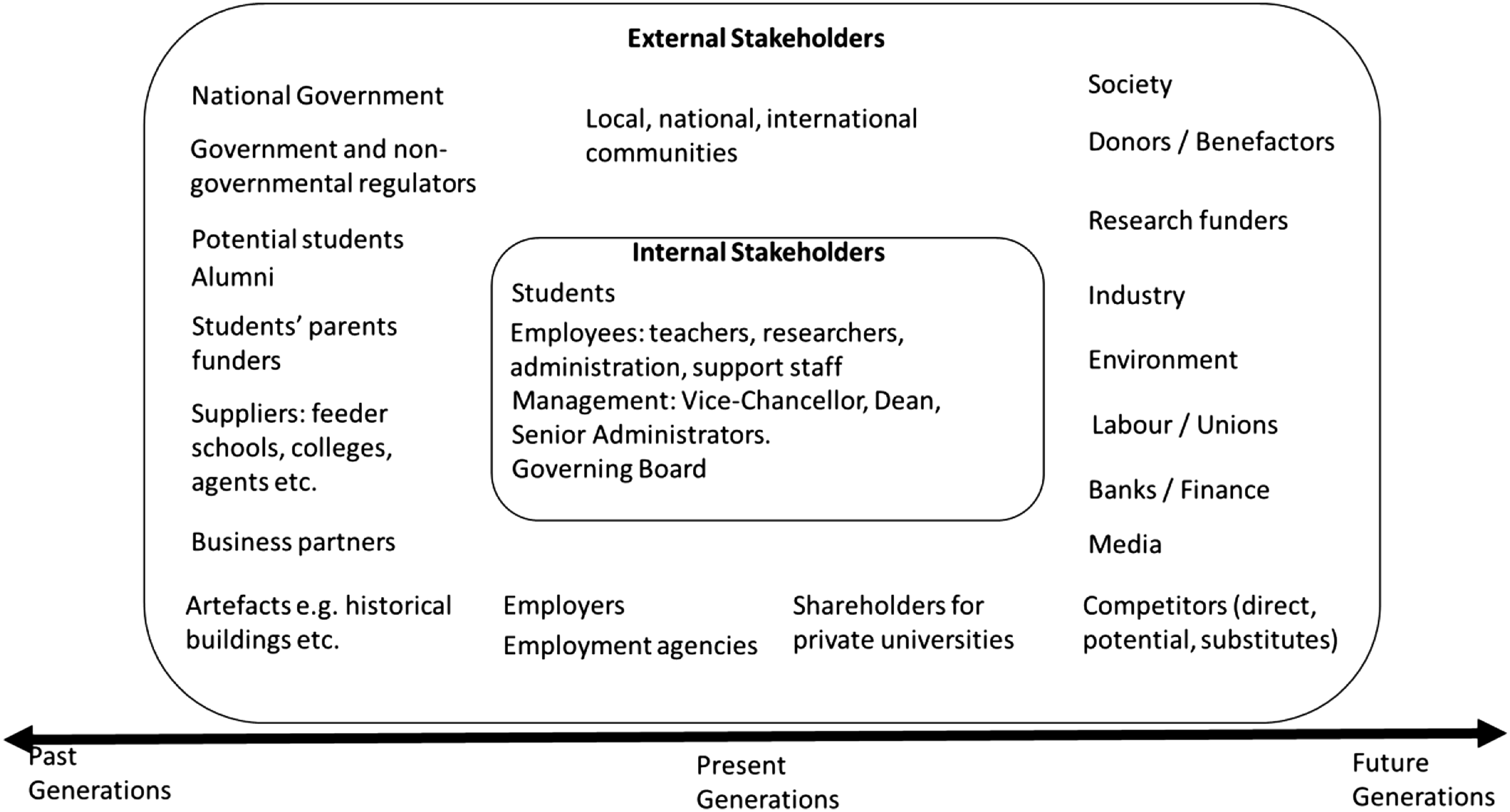
It is evident there is a powerful movement towards a stakeholder university (Bleiklie and Kogan, 2007; Margherita and Secundo, 2011: 175) and this trend is also reflected in wider society with the growth of corporate social responsibility (CSR) in organisations (Carroll, 2016) and the use of stakeholder analysis to identify pertinent university CSR communities (Antonaras et al., 2018).
Learners – the main stakeholders?
Resource dependency theory maintains that organisations will prioritise those stakeholder groups which control resources (Agle et al., 1999; Tetřevová and Sabolova, 2010). For example, in 2018-19, total income for UK universities was £40.5billion and this can be subdivided into: fees and education contracts - £19.9bn; funding body grants - £5.3bn; research grants and contracts – £6.6bn; other income - £7.6bn; investment income - £0.388bn; and donations and endowments - £0.701bn (HESA, 2020). Indeed, universities have been encouraged to be increasingly entrepreneurial and seek resources from multiple sources (e.g. Clark, 1998).
It is evident from these figures that fees and education contracts are, by far, the highest contributor of finance which give learning and teaching salience. This priority is generally confirmed with the mission statements of universities emphasising, in order, teaching, research and community service responsibilities (Jongbloed et al., 2008). On the whole, the highest priority is teaching (Turan et al., 2016) and key individuals at the University of Portsmouth ranked students number 1 among stakeholder groups, followed by staff, funders/Higher Education Funding Council for England, commercial and knowledge transfer, government, community and town (Chapleo and Simms, 2010: 20). Three main factors affect the influence of university stakeholders: student recruitment and satisfaction, financial implications, and potential impact on the strategic direction (Chapleo and Simms, 2010).
In the USA, the Kellogg Commission (2001: 1) stated that land grant universities were originally designed to ‘put students first,’ and this would be revived by creating ‘genuine learning communities’, being ‘student centred’ and providing a ‘healthy learning environment.’ In addition, the Commission (2001: 17) recommended that: ‘institutions encourage interdisciplinary scholarship and research, including interdisciplinary teaching and learning opportunities.’
A similar perspective was presented by Gibb and Haskins (2014: 20) who maintained that: ‘The emerging dominant stakeholders are students, accompanied by those who influence their choice.’ And, likewise, in the Spanish universities of Castilla and León the main stakeholders were students, employees and government with a particular emphasis on internal groups (Ricardo, 2011).
There isn’t always agreement regarding the pre-eminence of learners and teaching according to Schüller et al. (2014) who divided university stakeholders into fields and then prioritised their salience. In the educational field, students were considered most important; in research and development it was academic staff; and for enterprise it was premises and equipment.
In Portugal, researchers identified conflicting views with university presidents ranking teaching first ahead of research and societal relations whereas directors gave primacy to relations with the external environment (Mainardes et al., 2010). More pertinently, a survey of Brazilian HEI heads revealed that although students received the most value from their relationship with the institution, students were also ranked lowest among all stakeholder groups with regard to their contribution to decision making and should be better prepared for this role (Langrafe et al., 2020). Furthermore, Amaral and Magalhães (2002) noted that although medieval universities consisted of a community of teachers and students, the role of students now plays a less important role in modern universities.
Limitations and further research
This paper has used historical organisational studies to condense 900+ years of the universities’ evolution and it is not possible to represent all the dimensions as fully as the authors would like. However, the heuristic shape which has emerged from the study is one consisting of five broad evolutionary stages; changing sources of power among stakeholders; and, a clear observation that the originally small number of stakeholders has progressively grown to encompass most if not all dimensions of society which interact with universities.
This raises the question of to what extent should the views of individual stakeholder groups be considered paramount and what might be the negative effects of using this power to the detriment of other stakeholders? For example, the concept of academic freedom (Finkin and Post, 2009), for example, may be challenged by overly influential funders and governments. Similarly, what about the freedom for a learner to study a subject of their choice when governments may be reducing funding to arts and humanities subjects which, they argue, do not provide full economic returns, reduce employment prospects, and are part of a culture war (Moran, 2022)?
Using the lens of ‘stakeholders’ to attempt to understand the evolution of universities is but one approach; alternative considerations might be the entrepreneurial university (Guerrero and Urbano, 2012); knowledge management (Mahdi et al., 2019); and power (Moodie and Eustace, 2011); each of which provides insights together with attendant limitations.
A number of other avenues which are deserving of further research include: stakeholder domination of university agendas; the advantages and disadvantages of individual stakeholders; and approaches to holding stakeholders to account.
Conclusions
Five university generations have been identified together with an increasing number of stakeholders and wider representation which have implications for accountability, decision making and governance (Carey, 2013). This increasing representation mirrors Leydesdorff’s (2012) N-tuple helix which we describe here as a multi-helix interaction. This interaction mirrors the perspective that everyone might be considered a stakeholder i.e. a multi-helix (Chapleo and Simms, 2010; Doh and Quigley 2014) and this greater inclusiveness might also be beneficial to minority groups and allow diverse voices to be represented (Arday, 2021). Furthermore, it has been possible to discern a number of additional themes regarding the role of stakeholders: • Stakeholder numbers have grown particularly in more recent decades to incorporate societal and environmental concerns. • The salience of stakeholders has changed e.g., the decline of the church. • Students are among the main stakeholders in large universities. • Failure to attend to stakeholder groups may cause crises in universities e.g., civic universities ‘returning to their roots’. • There is a growing interdependency between universities and their stakeholders. • Conflicting tensions are natural developments and these differences, if managed appropriately, can be a source of strength and longevity. • Universities need to respond, defend, accommodate and proactively manage their stakeholder constituencies. • Universities may need to seek out dormant or invisible stakeholders i.e. until recently there has been little formal consideration of the environment. • Universities need to maintain a degree of independence and autonomy managing their responses and balancing the demands of stakeholders?
The tensions created by the growing and changing stakeholder nexus have created strength and longevity in universities as they have developed the ability to respond, adapt and evolve (Freeman, 1984; Bryson, 2004; Mainardes et al., 2010; Kettunen, 2015). Unlike the early Medieval Oxbridge colleges which built high walls for protection against the ‘town’ (Georgedes, 2006), modern universities are becoming boundaryless with greater integration among local, national and international constituencies and stakeholders (Gibb and Haskins, 2014). These developments are encapsulated within what the Kellogg Commission (2001: 2) described as the creation of: ‘A university without walls, it will retain the best of our heritage. But it will also be open, accessible, and flexible in ways that can barely be imagined today.’
Footnotes
Declaration of conflicting interests
The author(s) declared no potential conflicts of interest with respect to the research, authorship, and/or publication of this article.
Funding
The author(s) received no financial support for the research, authorship, and/or publication of this article.
