




Abstract
Autistic adults are underemployed. This means that workplaces are not meeting expectations of support for autistic employees and are not benefitting from a diverse workforce. This brief study investigated the current understanding in UK workplaces of adjustments and confidence with regard to supporting autistic employees. An online questionnaire was completed by 98 employees, mostly within the education sector. 15% of the respondents had a diagnosis of autism themselves. Understanding and confidence across all employees were moderate. Attending autism training in the workplace was associated with a better understanding of adjustments that could be made, but having autistic family or friends and having autistic colleagues were both associated with higher confidence in supporting autistic employees and understanding of positive workplace contributions. The findings corroborate the benefits of autism training in increasing understanding of adjustments that can be made in the workplace; however, a minority of employees had completed such training. The research provides a positive focus on personal understandings of autism which aid understanding and confidence when supporting autistic colleagues. The recommendations are to update and increase the accessibility of autism training, and notably to include the perspective of autistic employees and acknowledge workplace strengths in order to improve employment prospects within the autistic community.
Only 22% of adults with Autism Spectrum Disorder in the UK are in paid employment, compared to 81% of the general population and 52% of the disabled population (Office for National Statistics, 2020). When employed, autistic adults have greater likelihood of working in unskilled positions with lower pay rates, irrespective of their education or working abilities and despite the fact that the majority of autistic adults want to work (Dreaver et al., 2019; National Autistic Society, 2016; Scott et al., 2015). Core characteristics associated with autism are often regarded as reasons for working challenges, including difficulty in adjusting to new environments and routines (Hendricks, 2010). Additionally, some autistic employees experience workplace bullying (National Autistic Society, 2016). Workplace struggles, unsurprisingly, share similarity with the difficulties expressed by autistic students in higher education, including bullying and feeling isolated, and difficulty managing expectations to socialise with peers (Davis et al., 2021). At the same time, strengths that autistic employees contribute are recognised in both higher education and in the workplace (Drake, 2014), alongside the struggles described and lower rates of graduation (McFarland et al., 2017).
The implications of underemployment include negatively affected quality of life, financial independence and physical and mental wellbeing (British Psychological Society, 2021; Hendricks, 2010; Solomon, 2020) and negative impacts on the economy (National Autistic Society, 2016; Solomon, 2020).
Despite guidance being available for employers (Harmuth et al., 2018; Black et al., 2020), there is variable understanding internationally of how support can be provided in workplaces as a matter of routine (Lindsay et al., 2021; Scott et al., 2017). It is not yet known how the recommended delivery of support is influencing day-to-day workplace practices in the UK. When studied in the performing arts sector, support for autistic employees was said to be inadequate (Buckley et al., 2020).
With an increasing number of autistic individuals entering the workforce (Morath, 2019), successfully employing autistic individuals requires improved understanding and investment. It is likely that there can be learning from higher education, and an update to research in bridging the gap to employment.
This Research Note adds an overview of how well the UK workforce, mostly within the education sector, understands and implements support for autistic employees in an attempt to raise awareness of what might be done to improve employment prospects to benefit both employees and employers.
Workplace survey
An online questionnaire designed for this study was distributed to 58 organisations in the north of the UK. The questionnaire was written with an occupational therapist and an autistic expert-by-experience. Given the limited research, the invitation to participate did not exclude any industry sector and sought representation from organisations with membership of workplace disability schemes committed to improving employee wellbeing. There was no compensation for participating.
Questionnaire items sought data on six independent variables for employees: age, gender, autism diagnosis, completion of workplace autism training, having autistic family or friends or having autistic colleagues. Four dependent variables provided the outcomes of interest to inform this study. These were: understanding of difficulties faced by autistic colleagues, understanding of positive contributions made by autistic colleagues, understanding of adjustments that can be made for autistic colleagues, and confidence when supporting autistic colleagues. Responses were on 5-point Likert scales (1= not well to 5 = extremely well). The study variables were identified from a literature review: understanding of autism in the workplace and confidence in providing appropriate workplace support have been identified by autistic adults (López and Keenan, 2014), by representation from some employment sectors in the UK (Buckley et al., 2020) and by some workplaces internationally (Lindsay et al., 2021) as barriers to the employment of autistic adults. These quantitative questionnaire data formed part of a larger qualitative dataset that explored definitions of reasonable adjustments (Petty et al., 2022).
For the data analysis, non-parametric tests were used because the questionnaire returned nominal and ordinal data and there was variable distribution of responses across categories. Kruskal-Wallis tests and Mann-Whitney tests compared differences between independent groups. Bonferroni corrections for multiple comparisons between the six independent variables were applied when interpreting all p-values to reduce type-1 errors.
The study complied with ethical standards, with approval granted by the University of York ethics committee. All participants gave written informed consent.
Survey findings
Participant demographics (N = 98).
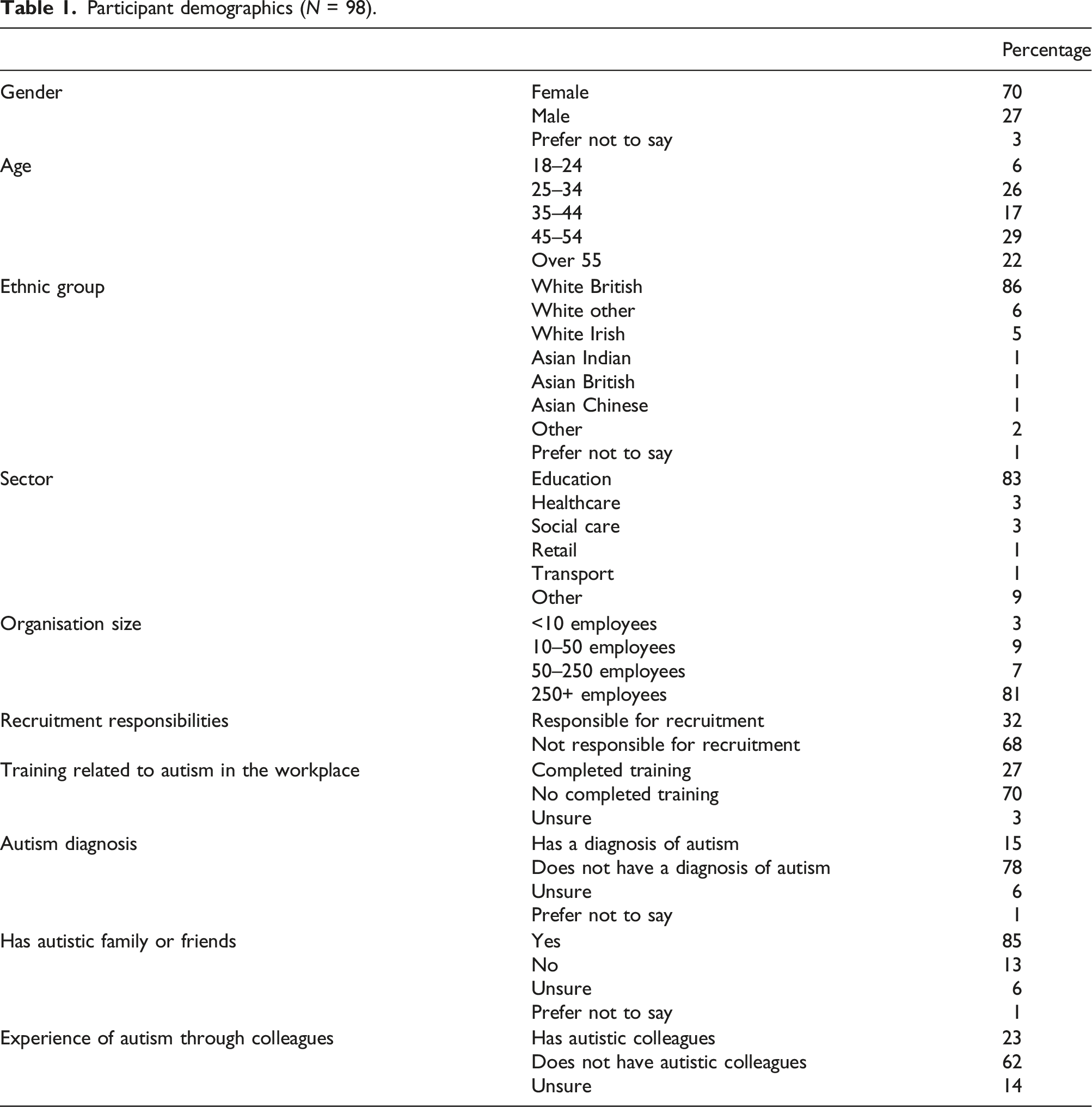
Most respondents were female (70%) and White British (83%) across a range of ages, mostly over 45 years (51%). 15% of participants reported a diagnosis of autism; 85% had experience of autism through family or friends; 23% had an autistic colleague or autistic colleagues. Most (81%) worked in organisations with 250+ employees in the education sector (83%).
Comparisons of understanding and confidence ratings in supporting autistic colleagues between different employee groups: employees with and without a diagnosis of autism.
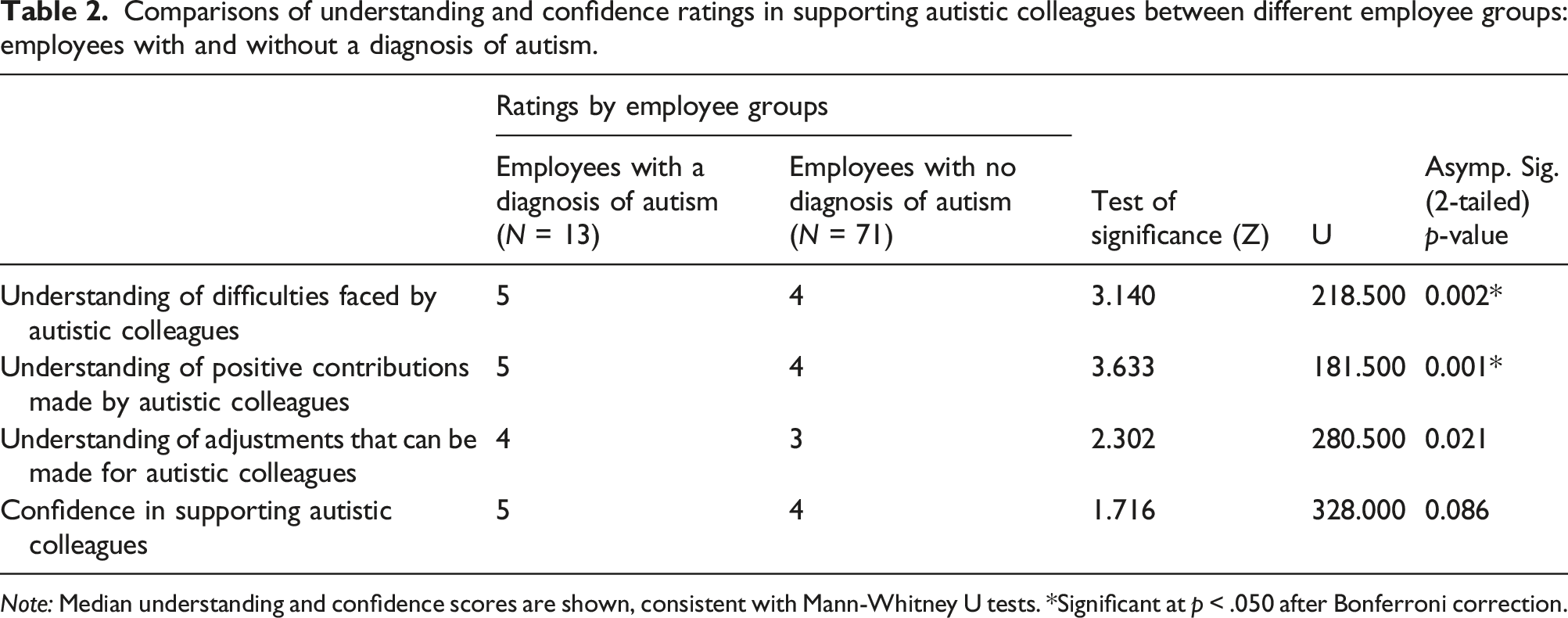
Note: Median understanding and confidence scores are shown, consistent with Mann-Whitney U tests. *Significant at p < .050 after Bonferroni correction.
Comparisons of understanding and confidence ratings in supporting autistic colleagues between different employee groups: employees who had and had not completed autism training.
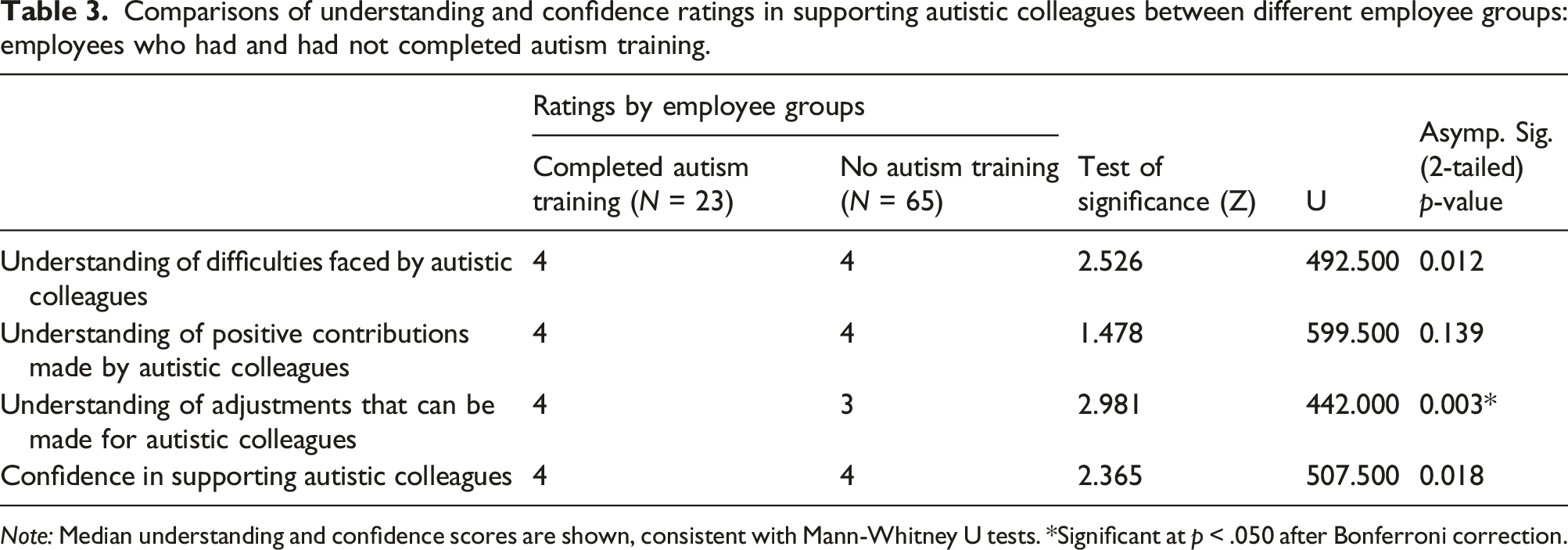
Note: Median understanding and confidence scores are shown, consistent with Mann-Whitney U tests. *Significant at p < .050 after Bonferroni correction.
Comparisons of understanding and confidence ratings in supporting autistic colleagues between different employee groups: employees with and without personal experience of autism.
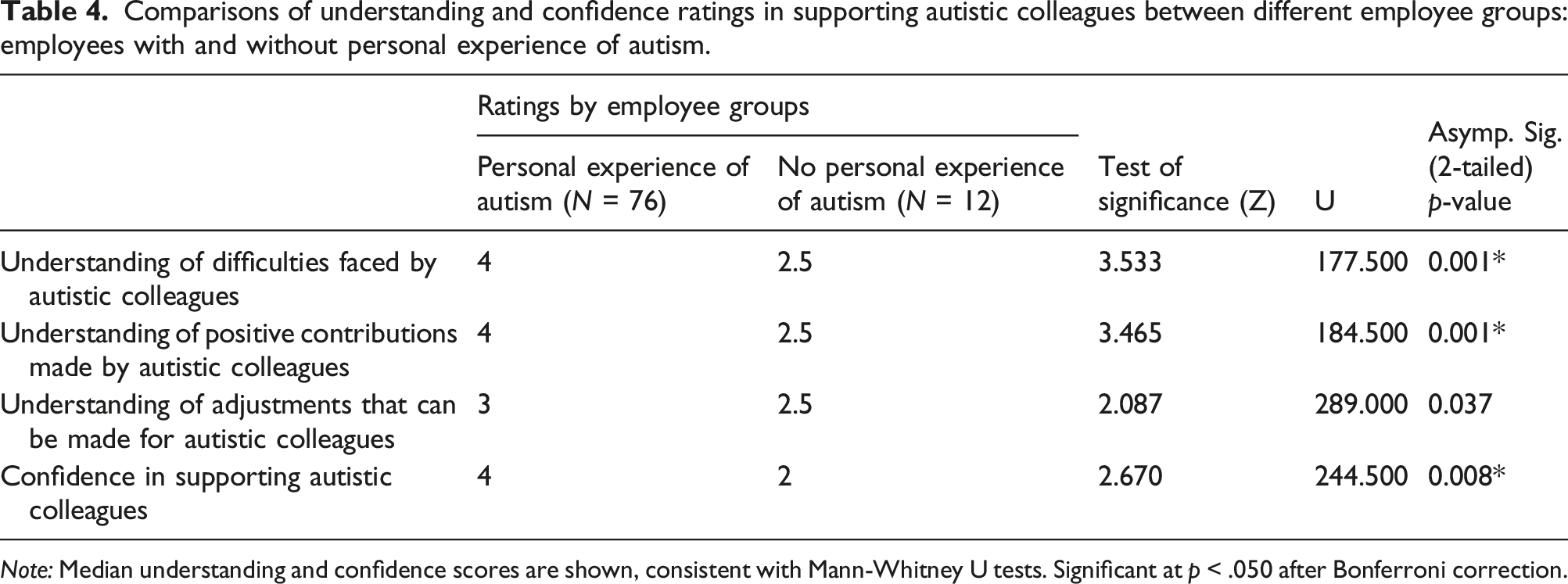
Note: Median understanding and confidence scores are shown, consistent with Mann-Whitney U tests. Significant at p < .050 after Bonferroni correction.
Comparisons of understanding and confidence ratings in supporting autistic colleagues between different employee groups: employees with and without autistic colleagues.
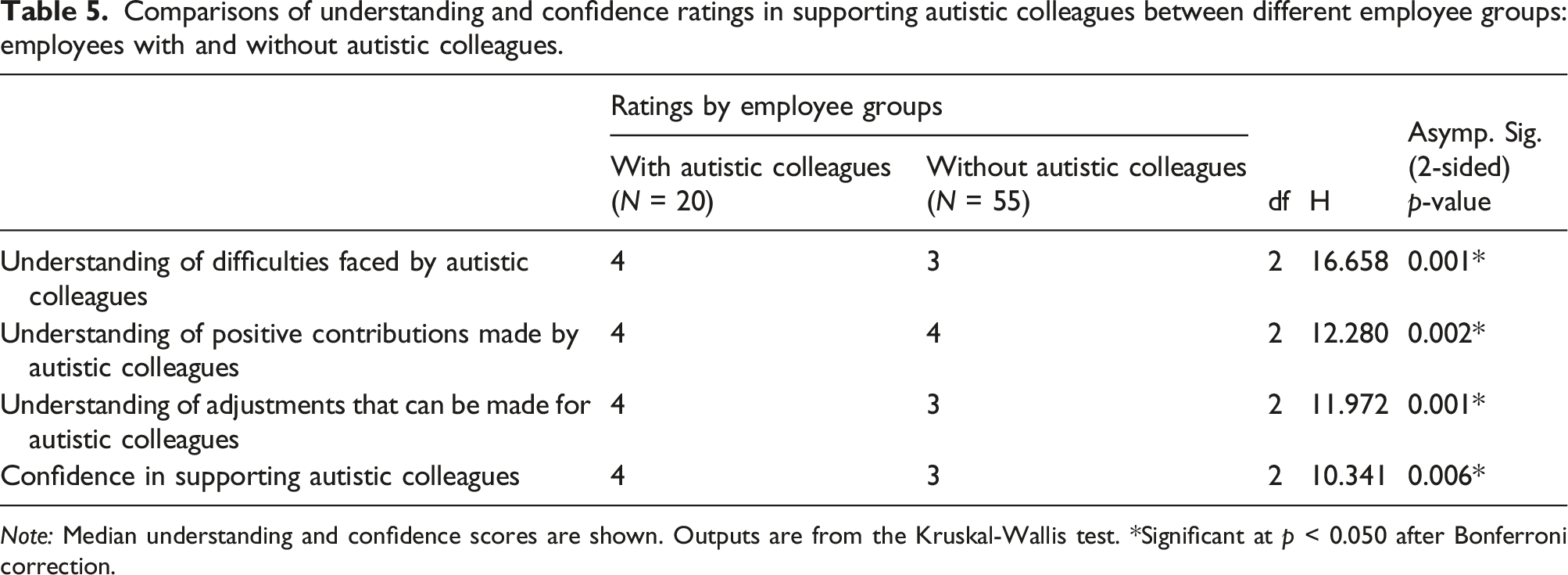
Note: Median understanding and confidence scores are shown. Outputs are from the Kruskal-Wallis test. *Significant at p < 0.050 after Bonferroni correction.
Understanding difficulties faced by autistic employees
Employees said they ‘somewhat’ understood workplace difficulties faced by autistic employees. Improved understanding was associated with employees having an autism diagnosis (p = .002), experience of autism through family or friends (p = .001) and autistic colleagues (p = .001). Workplace autism training was not associated with increased understanding. Understanding did not vary with the respondent’s gender or age.
Understanding positive contributions of autistic employees
Collectively, employees understood positive workplace contributions made by autistic employees ‘somewhat well’. Understanding was associated with autism diagnosis (p = .001), having experience of autism through family or friends (p = .001) and autistic colleagues (p = .002). Understanding of positive workplace contributions did not vary with attendance at training, with gender or with age.
Understanding workplace adjustments
Employees understood workplace adjustments that could be made to support autistic employees ‘neither well nor not well’. Better understanding was associated with attending autism training (p = .003) and having autistic colleagues (p = .001). Understanding was not higher for participants who had an autism diagnosis or those with experience of autism through family or friends. Understanding did not vary with the respondent’s gender or age.
Confidence in supporting autistic colleagues
Employees reported ‘moderate’ confidence in supporting autistic colleagues. Confidence was higher for those who had experience of autism through family or friends (p = .008) and autistic colleagues (p = .006). Confidence was not higher for participants who had attended training, had an autism diagnosis or with employee gender or age.
Summary of survey findings
The current understanding of the needs of autistic employees and confidence in supporting autistic employees described in this study were moderate, although the understanding of what reasonable adjustments could be made in the workplace was lower than the understanding of the difficulties faced by autistic employees or the positive contributions they could make. Understanding of both the workplace difficulties and the positive workplace contributions of autistic colleagues were associated with employees having an autism diagnosis, employees having experience of autism through family or friends and employees having autistic colleagues. In comparison, understanding of workplace adjustments to support autistic employees was higher for employees who had attended autism training and for employees with autistic colleagues. Employees with experience of autism through family or friends or colleagues reported the highest confidence in supporting autistic colleagues.
Conclusion and areas for further research
This study provides an overview of how employees working predominantly in the education sector in the UK understand the needs and support options for autistic employees. The important context for this overview is the positive contributions that autistic employees can bring to their work, which include creativity, attention to detail and high productivity (Scott et al., 2017). Previous research has suggested that employing autistic individuals can also positively impact understanding of autism in the workplace, inclusion and awareness of a breadth of additive skills, which can inform future employment decisions (Scott et al., 2017). Research is made difficult by the low number of autistic colleagues being truly represented in industry. A second important contextual consideration is the legal obligation that employers are under in the UK to ensure that employees are not disadvantaged at work by their autism diagnosis (the Autism Act, 2009; the Equality Act, 2010) by making appropriate working adjustments (Petty et al., 2022).
Despite this context, the understanding of support that can be provided in the workplace was shown to be lower than the understanding of the difficulties faced or the positive contributions of autistic employees. These findings suggest that training the workforce in autism understanding is associated with knowledge of how actually to provide the right support, which is consistent with previous research (Dreaver et al., 2019; Harmuth et al., 2018; Hendricks, 2010; Scott et al., 2017), though this understanding is only moderate. Further, we recommend that training should be developed to include personal perspectives of autism (Gillespie-Lynch et al., 2017; Harmuth et al., 2018), positive contributions to the workplace from autistic colleagues (Scott et al., 2017) and examples of achievable support local to each workplace (Petty et al., 2022). Additionally, the co-facilitation of training sessions with autistic employees, employing advocates or workplace representatives of neurodiversity would be worthy of further exploration to achieve the same aims.
To borrow from research into the health sector, improved understanding and confidence were reported by health professionals who had personal autism experience when they were working with autistic patients (Crane et al., 2019). As a possible explanation, personal experiences of autism are more variable and qualitatively different from autism as represented in academic literature, offering explanations for behaviours (Gillespie-Lynch et al., 2017; Harmuth et al., 2018). Currently there is low understanding of strength- or possibility-focused approaches to supporting autistic colleagues (Black et al., 2020; Bölte, 2021; Scott et al., 2017). This context would support a shift in training focus from ‘awareness’ of autism to understanding of autism (Harmuth et al., 2018) to promote an inclusive and better-supported neurodiverse workplace.
The value of these inclusive practices and the benefits of hiring an autistic workforce need further research (Bölte, 2021). There is an important need for learning to bridge the gap between higher education, and the workplace for autistic adults. The higher education setting has the benefit of a greater degree of research (Davis et al., 2021). The supports available span modifications to work tasks, the environment and social demands (Davis et al., 2021). The workplace, however, is less well understood. Our view is that the wealth of understanding and support provided in the higher education setting needs to be carried forward and updated for workplaces through person-led workplace training. This article is intended to raise awareness and to prompt further research.
Footnotes
Author contribution
Stephanie Petty: Conceptualization; Project administration; Supervision; Writing – review and editing. Hannah Richardson: Data curation; Formal analysis; Writing – original draft. Niamh Eccles: Data curation; Writing – original draft. Lydia Tunstall: Data curation; Writing – original draft.
Declaration of conflicting interests
The author(s) declared no potential conflicts of interest with respect to the research, authorship, and/or publication of this article.
Funding
The author(s) received no financial support for the research, authorship, and/or publication of this article.
Availability of data
The dataset is available from the corresponding author on reasonable request.
