




Abstract
Research on entrepreneurship education (EE) emphasizes the role of learning environments, contexts and pedagogical choices in developing students’ entrepreneurial competences. EE has assumed that it solely carries the task of improving entrepreneurial competences. Yet, the objectives, content and methods of teaching vary, and hence non-entrepreneurship teachers’ classrooms can also provide a learning environment for entrepreneurial competences. However, whether or not this kind of unintentional teaching of entrepreneurial competences takes place has not been widely addressed. In this study, the authors investigate how business school non-entrepreneurship teachers’ teaching methods unintentionally match the known framework of entrepreneurial competences. The findings indicate that non-entrepreneurship teachers do unintentionally expose their students to entrepreneurial competences such as creativity, learning from experience and financial literacy. However, competences such as opportunity recognition, perseverance and mobilizing resources do not receive similar attention. The findings indicate that some entrepreneurial competences are not solely owned by EE, but can be embedded in non-entrepreneurship education. Accordingly, the study extends the current understanding of EE and which “niche” competences should be emphasized in it, but also demonstrates how non-entrepreneurship teachers can expose students to entrepreneurial competences while teaching in their own subject areas.
Keywords
Recent research on entrepreneurship education (EE) has focused on learning environments and contexts that are designed specifically to develop students’ entrepreneurial competences and behavior (Bureau and Komporozos-Athanasiou, 2017). Still, previous research also suggests that EE does not necessarily provide enough resources or have enough space in a higher education institution (HEI) to support its desired outcomes, ranging from increased understanding of entrepreneurship, improved self-efficacy and opportunity formation skills to new business creation (Blenker et al., 2011; Higgins et al., 2013; Nabi et al., 2017; Pittaway and Cope, 2007). Hence, the importance of the EE context has been widely acknowledged and accompanied by discussions about the pedagogical choices and methods used to support the development of entrepreneurial competences and how these choices depend on the objectives, content and constraints of the institutional context of teaching (Fayolle and Gailly, 2008; Jones, 2019). Accordingly, there are several types of EE, and entrepreneurship can be considered more as an everyday practice than merely as a subject (Blenker et al., 2012; Jones, 2019).
Nevertheless, as noted above, recent EE research has focused on what happens within EE and what it produces (Nabi et al., 2017). EE scholars challenge the idea of entrepreneurship as a subject and ask us to view it more as a pedagogical choice (Blenker et al., 2012; Jones, 2019; Neck and Greene, 2011; Yamakawa et al., 2016). Hence, if EE is a pedagogical choice, can teaching entrepreneurial competences take shape outside of EE? For instance, teachers in different business subjects, such as marketing and accounting, already use methods like business planning, case work or experience-based learning that may support entrepreneurial competences (Pardede and Lyons, 2012; Turner and Gianiodis, 2018). Moreover, many of the generic skills that HEIs emphasize in their curricula (see Voogt and Roblin, 2012) are similar to entrepreneurial competences—for example, creativity and problem-solving (Bacigalupo et al., 2016; Kozlinska, 2016). Together, the use of novel teaching methods and the emphasis on generic skills imply that non-entrepreneurship teachers can unintentionally employ pedagogical choices and methods that support the development of students’ entrepreneurial competences. Hence, the teaching of entrepreneurial competences can be embedded in non-entrepreneurship subjects, but thus far research has neglected to study how this takes place in those subjects.
In this exploratory study, we investigate whether and how non-entrepreneurship business teachers unintentionally provide opportunities for students to develop entrepreneurial competences, which we define as the unintentional teaching of entrepreneurial competences. For instance, this can happen when a non-entrepreneurship teacher uses opportune teaching methods to show students how to develop their entrepreneurial competences (Joensuu-Salo et al., 2020). Based on interviews with non-entrepreneurship teachers in a business school, we attempt to identify what kinds of teaching methods non-entrepreneurship teachers use and how these methods match with previous research on key entrepreneurial competences, namely within the EntreComp framework (Bacigalupo et al., 2016). Rather than focus specifically on entrepreneurship courses, we investigate teachers of business subjects other than entrepreneurship, which enables us to identify whether and how the unintentional teaching of entrepreneurial competences unfolds in non-entrepreneurship teaching. However, despite their potential, we do not focus on students’ perceptions of the development of their entrepreneurial competences in non-entrepreneurship teaching.
Our study answers the call to add diversity to the understanding and contextualization of EE (Fayolle and Gailly, 2008). Although non-entrepreneurship teachers’ course content and learning objectives align with the business school’s objectives, our findings clearly indicate that the respondents unintentionally expose their students to various entrepreneurial competences. To a varying degree, non-entrepreneurship teachers use teaching methods and formulate learning outcomes that may enhance students’ entrepreneurial competences when learning about non-entrepreneurship subjects. This implies that the embeddedness of EE in non-entrepreneurship education is not only possible but is already taking place. However, we identify that non-entrepreneurship teachers do not cover all the entrepreneurial competences defined by the EntreComp framework (Bacigalupo et al., 2016). For instance, there were no clear examples of the competences of opportunity recognition or mobilizing others and resources embedded in non-entrepreneurship teaching. Accordingly, it seems that, at least in the business school context of this study, (intentional) EE is needed to support the development of these competences.
In addition, our research contributes to the EE literature by showing that entrepreneurial competences are not solely the domain of EE. Our findings indicate that these competences can be embedded in non-entrepreneurship teaching at HEIs through different teaching methods. The findings further illustrate that teaching entrepreneurial competences are and can be embedded in any business discipline in higher education, which can also embrace using new methods over the known and comfortable teaching methods (Joensuu-Salo et al., 2020; Neergaard and Christensen, 2017). Even if the studied teachers were not aware that their teaching had anything to do with entrepreneurial competences, our findings reveal that supporting entrepreneurial competences is more a question of pedagogical choice (Blenker et al., 2012; Neck and Greene, 2011; Yamakawa et al., 2016) than of subject alignment. The studied teachers unintentionally use teaching methods that are conducive to developing students’ entrepreneurial competences. Hence, our study supports the idea that EE can actually take place in multiple contexts.
While our findings show that some entrepreneurial competences are embedded in non-entrepreneurship teaching, we could not find evidence of teaching methods supporting such competences as opportunity recognition, perseverance, and mobilizing resources. Those competences, in turn, support students’ entrepreneurial intentions (Armuña et al., 2020). If some competences are not embedded in non-entrepreneurship education, it is important that entrepreneurship teachers focus enough on exposing their students to the otherwise less emphasized competences. Finally, our study illustrates that using Bacigalupo et al.’s (2016) EntreComp as an analytical framework enables the development of new evidence of how entrepreneurial competences can be supported in higher education.
Entrepreneurial competences in higher education
In this study, we follow Jackson and Chapman’s (2012) findings and define an entrepreneurial competence as the ability to function successfully or perform appropriately in entrepreneurial scenarios. This allows us to consider a competence as a set of cognitive, socio-cognitive, self-management and technical/administrative dispositions of an individual for a specific purpose (Jackson and Chapman, 2012; Reis et al., 2020; Stevens, 2013). In general, teaching competences in higher education is emphasized because changes in working life, in work structure and in the necessary competences (Bhardwaj et al., 2018; Jääskelä et al., 2018; Suleman, 2018) have pressured HEIs to upgrade and rethink their educational programs. Since EE provides an opportunity to equip students with important competences (Crayford et al., 2012; Nabi et al., 2017), it has also been addressed as one of the key means of bridging the theory–practice gap (Rae, 2010) and to help HEIs renew themselves to meet the changes in the economy (Binks et al., 2006; Stolze, 2020; Turner and Mulholland, 2017; Welsh et al., 2016).
Previous research has discussed the position of EE among other subjects in HEIs (Jones, 2019) and has addressed its impact and outcomes (Eesley and Lee, 2020; Mets et al., 2017; Nabi et al., 2017), but with varying results. For instance, compulsory entrepreneurship courses appear to lower students’ interest in entrepreneurship (Oosterbeek et al., 2010), but they still seem to improve students’ perceptions of their entrepreneurial competences (Von Graevenitz et al., 2010). Logically, it has been debated whether it is possible to learn entrepreneurial competences (Heinonen and Poikkijoki, 2006) and, if it is, what kinds of teaching methods are suitable (Fayolle and Gailly, 2008; Joensuu-Salo et al., 2020; Pittaway and Cope, 2007). When examined in closer detail, a broad range of behavioral, attitudinal and mindset abilities and skills are needed to initiate and organize an entrepreneurial process (Clinkard, 2018; Moroz and Hindle, 2012). Accordingly, entrepreneurial competences range from the ability to recognize new business opportunities to abilities needed to cope with uncertainty and to learn from experience (Bacigalupo et al., 2016; Reis et al., 2020). Charrón Vías and Rivera-Cruz (2020) propose that self-awareness and emotional intelligence are also key entrepreneurial competences. In addition, various competences, such as collaboration, creativity, critical thinking, problem-solving and acting independently, have been emphasized in discussions of both entrepreneurial and working life competences (McComas, 2014; Rychen and Salganik, 2001; Tynjälä et al., 2006; Voogt and Roblin, 2012). These elaborations suggest that entrepreneurial competences overlap with general working life competences (Clinkard, 2018; Jääskelä et al., 2018), which highlights the relevance of entrepreneurial competences in the context of higher education and its role in supporting students’ employability.
However, despite its key role in supporting personal growth, creativity and innovation among students (Gedeon, 2014; Turner and Mulholland, 2017), the role of EE has been seen as problematic since it clashes conceptually with humanistic values and possibly boosts social inequality (Lackeus, 2017; Rae, 2010). The general attitudes about entrepreneurship at any HEI characterize how EE is perceived among the teaching faculty (Bergmann et al., 2018). For instance, even if using diverse and new innovative teaching methods seems to support the development of entrepreneurial competences needed in contemporary careers (Joensuu-Salo et al., 2020; Robinson et al., 2016; Verduijn and Berglund, 2019), finding and maintaining a balance between traditional and novel teaching methods, the practical, experiential nature of EE and the rigors of academic practice is challenging (Robinson et al., 2016; Smith et al., 2006; Verduijn and Berglund, 2019). Scholars have also shared concerns that EE seems to have taken-for-granted assumptions about its positive outcomes (Scott et al., 2016). Therefore, higher education teachers might not consider entrepreneurship as appropriate curriculum content (Fejes et al., 2019).
However, the understanding of EE has shifted toward considering it as a pedagogical method rather than an outcome or a subject (Blenker et al., 2012; Jones, 2019; Yamakawa et al., 2016). For instance, Bureau and Komporozos-Athanasiou (2017) illustrate how applying arts-based methods in their business school course made students face time pressures, uncertainty and the freedom of deciding their own actions, all of which improved students’ working life and entrepreneurial competences. The plurality of entrepreneurial competences implies that teaching entrepreneurship is not limited to EE but extends to other learning contexts and subjects. Previous research implies that teaching entrepreneurial competences does not need to take place only in the context of EE (Penaluna and Penaluna, 2020), but that it can be embedded into other subjects too. To exemplify, Robinson et al. (2016), Verduijn and Berglund (2019), Pittaway and Cope (2007) and Harms (2015), among others, have noted that learning situations which embrace uncertainty and guide students to employ scarce resources increase their entrepreneurial competences. While embedding EE in existing courses could be a planned approach, we suspect that in reality embeddedness is most likely an unintentional result of the teaching activities and methods that teachers use in their own domain-specific subject. In other words, supporting entrepreneurial competences is an unintentional outcome when teaching a non-entrepreneurship subject.
Consequently, we are interested in exploring whether there are indications of the unintentional embeddedness of EE in non-entrepreneurship teaching. The embeddedness enables us to understand how EE is shaped and influenced by context and the educational institution in which it exists (Charrón Vías and Rivera-Cruz, 2020; Mitra, 2016) and which guides the overall curriculum and courses (Holmström et al., 2016; Smith, 2008; Teerijoki and Murdock, 2014). Being aware of the importance of the context, we assume that it influences the teaching methods utilized by teachers, but the investigation of the context is outside the scope of our empirical assessment. How EE takes shape when embedded in an existing course is influenced not only by the chosen pedagogical methods but also by the goals, intended learning outcomes and objectives set for that particular course (Charrón Vías and Rivera-Cruz, 2020). Hence, we focus on non-entrepreneurship teaching, which follows learning outcomes and objectives other than EE.
Methodology
In this exploratory study, we assume that the development of entrepreneurial competencies can be supported through teaching methods that support students to, for instance, take initiative in the learning situation (Jones, 2019). With a focus on teaching non-entrepreneurship subjects and exploring teaching methods with the potential to support the development of entrepreneurial competences, we investigate how HEI teachers in non-entrepreneurship subjects may unintentionally provide opportunities for students to develop their entrepreneurial competences.
Data collection
We draw on interview data from thematic interviews with 19 non-entrepreneurship teachers who work at a business school’s regional campus of a Finnish university. This population of teachers was the focus group of a larger research project under which the data collection was conducted. Research material was collected between November 2018 and spring 2019 through face-to-face interviews. The interviews were jointly conducted by two researchers, which contributes to the internal consistency of the data collection (Powell et al., 2010). Both interviewers were familiar with the respondents from previous work, which supported the development of trust and understanding between interviewers and interviewees. All interviews were digitally recorded and transcribed verbatim. The interviewed teachers represent different business subjects, have at least 5 years of teaching experience and all but one have undertaken some pedagogical studies (Table 1).
Background information on the respondents.
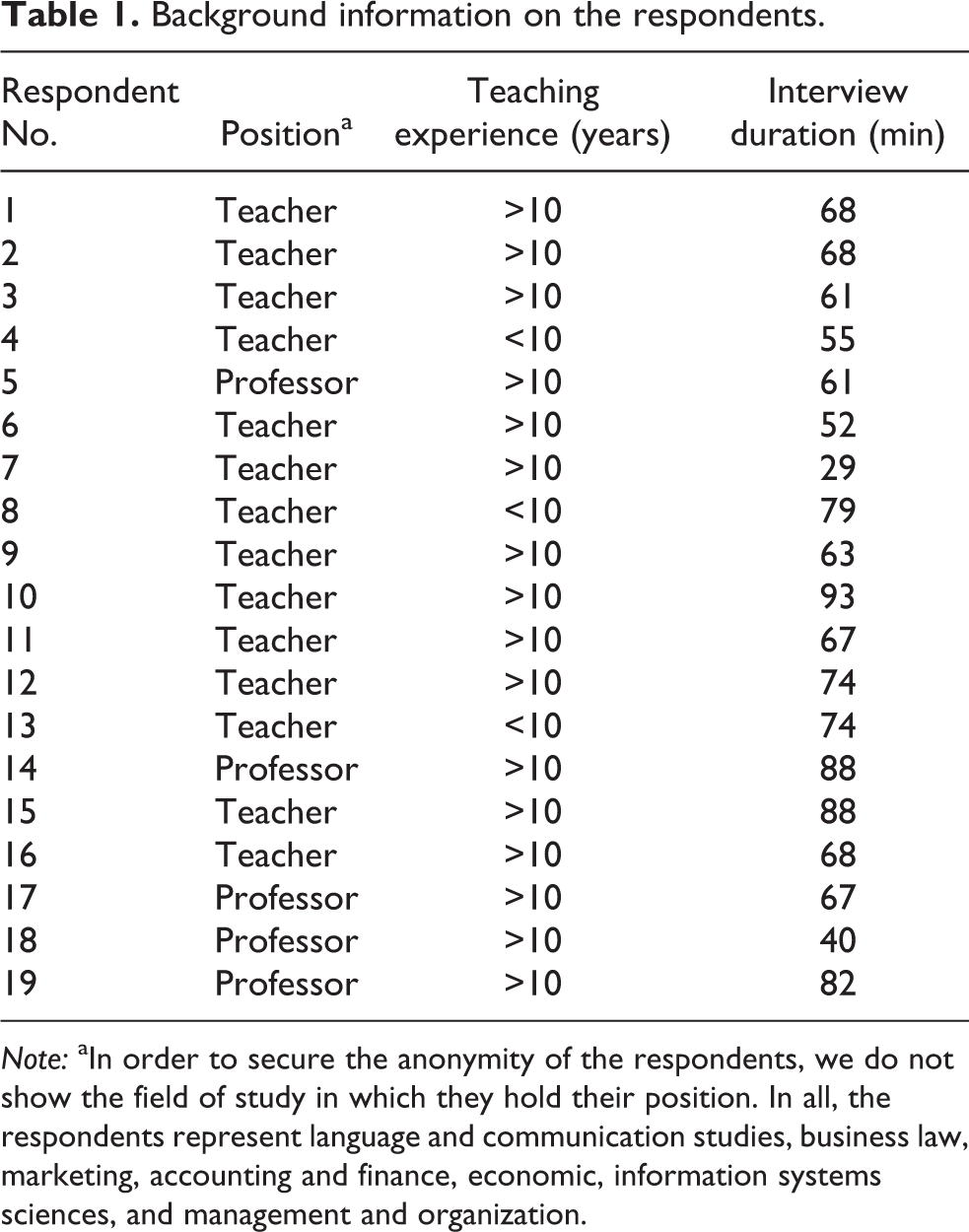
Note: aIn order to secure the anonymity of the respondents, we do not show the field of study in which they hold their position. In all, the respondents represent language and communication studies, business law, marketing, accounting and finance, economic, information systems sciences, and management and organization.
The interview guide covered four themes, and we focus on the first two in this study (Appendix 1). The first theme focused on teachers’ perceptions of learning goals and what the students should learn at a business school. The second addressed the teachers’ teaching methods. The interview questions for each theme were deliberately broad enough to allow the interviewees to discuss their feelings, experiences and interpretations (Cope, 2005). Consequently, pre-set questions were followed but were not always posed chronologically.
Coding and analysis
The analysis process was initiated with data coding following the guidelines of interpretive thematic analysis (Braun and Clarke, 2006). The coding was conducted with NVivo 11 software. We searched for expressions, statements and extracts related to entrepreneurial competences in the teachers’ discussion.
In the subsequent interpretative phase, by applying Jones’s (2019) approach of a signature EE pedagogy, we analyzed the data by interpreting and matching them with the EntreComp framework (Bacigalupo et al., 2016). Hence, our analysis was abductive when we moved backward and forward between data and the framework (Dubois and Gadde, 2002; Gummesson, 2000). EntreComp (Bacigalupo et al., 2016; Appendix 2) has already been used as an analytical framework in analyzing the curricular documentation (Dinning, 2019) and entrepreneurial intentions among science, technology, engineering and mathematics students (Armuña et al., 2020). The framework consists of three competence areas through which individuals can develop and evaluate their entrepreneurial mindset and behavior: (1) ideas and opportunities; (2) resources; and (3) into action. Ideas and opportunities covers competences that occur at the beginning of the entrepreneurial process (Bacigalupo et al., 2016). Resources defines how strongly an individual believes in and motivates themselves and others, how capable they are of leveraging the resources they or the team have already obtained, and how well financial know-how is developed (Bacigalupo et al., 2016). The third area, into action, consists of competences that are often achieved through active teaching methods or learned through experience (Fox et al., 2018). Each of these competence areas is divided into five main competences, which are detailed in Appendix 2.
In our analysis, we looked for indications of whether teachers employ teaching methods (activities and assignments) that support students’ agency and active position. For example, we searched for descriptions of activities that we interpreted as requiring teamwork (supporting entrepreneurial competences such as working with others and ethical thinking as defined in the EntreComp framework), working with external stakeholders (supporting, e.g. mobilizing resources and learning through experience), conducting real-life projects outside the classroom (supporting, e.g. taking initiative), analyzing customer needs (supporting, e.g. visioning), and conducting business/marketing planning (supporting, e.g. learning through experience and financial and economic literacy).
The validity of the coding was checked by comparing and discussing it with two researchers separately. After the coding procedure, the coded activities were categorized in result tables, which enabled us to identify the teaching methods that supported the development of entrepreneurial competences in non-entrepreneurship teaching.
Results
We organized our results based on the three main competence areas of the EntreComp framework detailed above—ideas and opportunities, resources and into action. The framework assumes that the entrepreneurial competences are linked, and one should not focus on or extract only one competence (Bacigalupo et al., 2016). Hence, it is logical that some of the teaching methods we identified could induce the development of different entrepreneurial competences. Intriguingly, during most of the interviews the teachers were not aware that their teaching had anything to do with entrepreneurial competences. For example, interviewees could agree that financial and economic literacy was a core competence for all business school students, but they were not aware that economic literacy is also a core entrepreneurial competence (Bacigalupo et al., 2016).
Ideas and opportunities
This ideas and opportunities competence area comprises five competences: spotting opportunities, creativity, vision, valuing ideas and ethical and sustainable thinking (Table 2). Our analysis indicates that the teachers interviewed have created learning outcomes that require the use of competences belonging to this area—for instance, asking students to craft business and marketing plans as well as competitor analyses for new, imaginary ventures requires the use of creativity: In one of my courses, I ask students to launch a new business, a totally new one or imagine buying an existing one. Then they have to plan for hiring three new employees and write a business plan…and they have to make the financial and profitability calculation. (Respondent 11)
Examples of teaching activities concerning the competence area of ideas and opportunities.
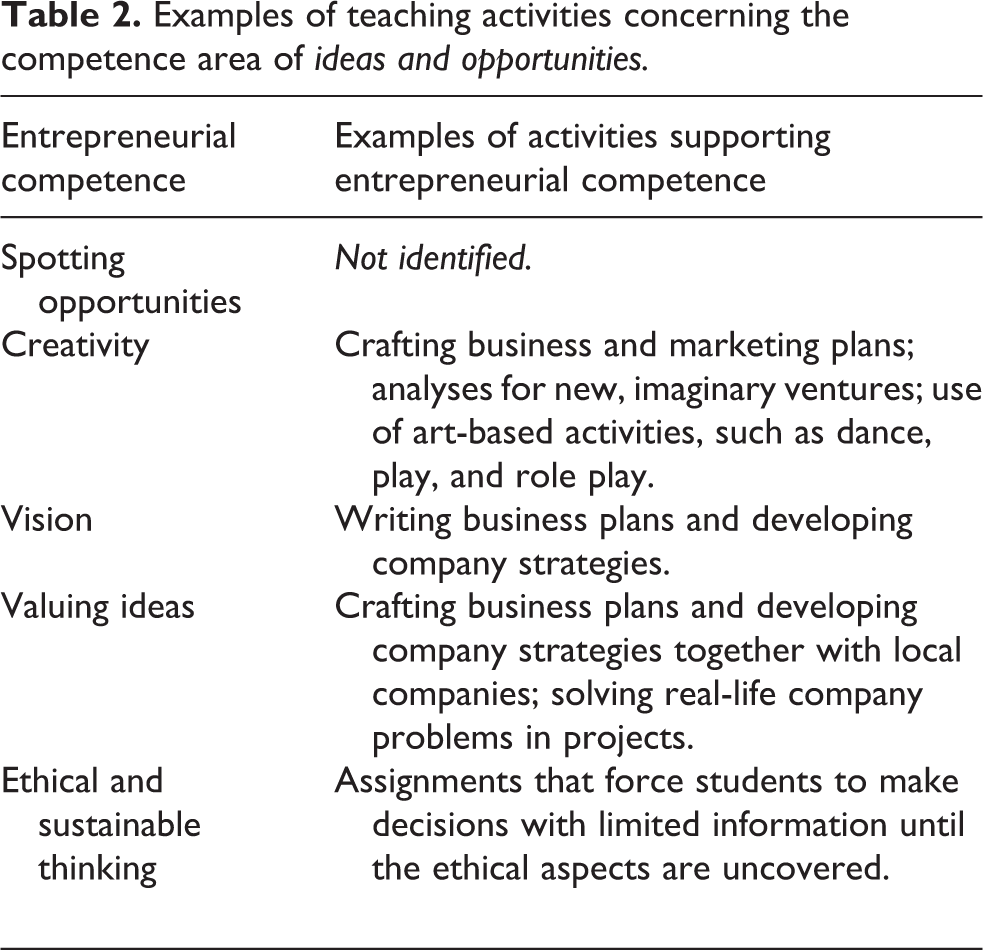
Finally, the competence concerning ethical and sustainable thinking was present in only one of the respondents’ courses, in the form of evoking the students’ responsibility through emotions: Based on photos of potential job applicants [with some background information missing], students have to pick who they would employ. Then, more information is given to students, something that can be a reason for discrimination, like this person has a certain political view, this person is gay, this person is disabled, has been in prison. Who would you employ now? Then we discuss how actions can be discriminating if you don’t hire someone because of the person’s age, gender, or ethnic background. (Respondent 6)
Resources
The competence area of resources covers competences of financial and economic literacy, self-awareness and self-efficacy, mobilizing resources, mobilizing others and motivation and perseverance (Table 3). Considering that a business school educates business professionals whose key competence is financial and economic literacy, it is no surprise that many of the teachers use business planning, financial calculations and strategy formulation in their teaching, thus developing financial and economic literacy in the students. Intriguingly, some of the teachers seemed to address this competence only implicitly, while others required students to give proof of this competence during their courses, for example with written business plans.
Examples of teaching activities concerning the competence area of resources.
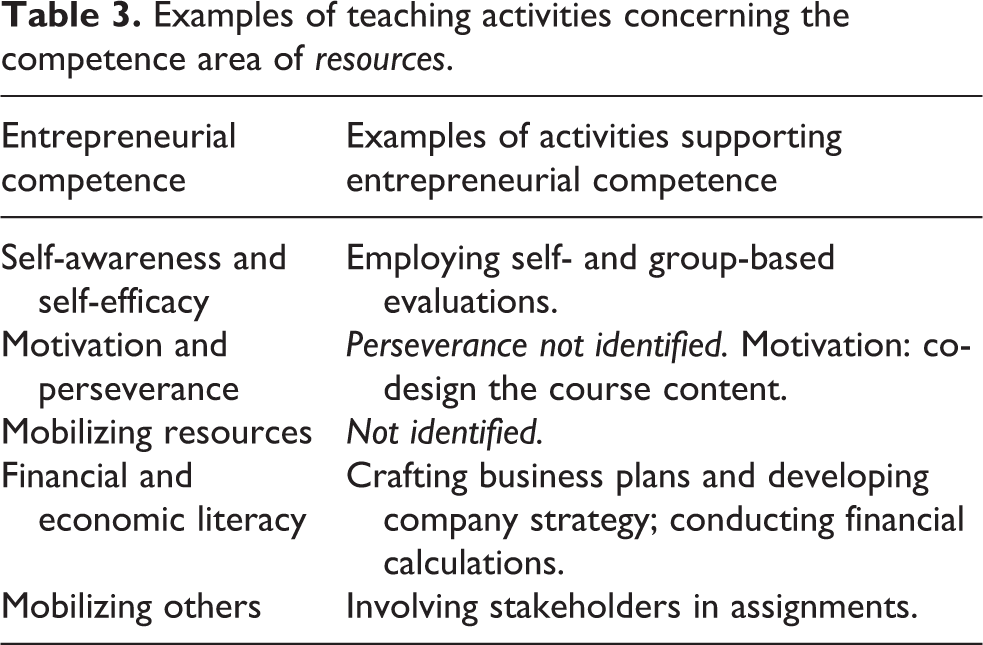
Our analysis indicates that the competence of self-awareness and self-efficacy is also frequently embedded in the studied teachers’ teaching. Even if the identified teaching methods do not directly require students to evaluate their individual strengths and weaknesses (Bacigalupo et al., 2016), some identified teaching methods, such as the flipped classroom and co-designing the course content, indirectly activate self-awareness and self-efficacy. These methods require students, for instance, to position themselves in relation to existing knowledge, reflect on their own learning strategies and proactively seek external help if needed (Sun et al., 2017; Zheng et al., 2020). Similar exposure to this entrepreneurial competence can be obtained through self-assessments and group-based assessments of learning (Panadero et al., 2017): Depending on how they assess the activeness of their fellow members…they also evaluate their own activeness. (Respondent 17) …and each student will share the method they would use in order to search for more information. Only after everyone has shared their choice, I will open up how I would do it. I try to make them think about the problem themselves. (Respondent 19) If I’m not in control of all the content, it means that the students are learning because they are choosing the content, and not me. And that is much more motivating and interesting for them, and then they are more likely to learn. (Respondent 8)
Into action
The into action competence area consists of five competences: taking initiative; coping with uncertainty, ambiguity and risk; working with others; planning and management; and learning through experience (Table 4). We were able to pinpoint examples of teaching methods such as the flipped classroom and students co-designing the course (i.e. thinking of theories and other content to be used in the course), which expose students to taking initiative and working toward set goals (Bacigalupo et al., 2016). We noticed that there were high expectations of and possibilities for the students with regard to taking responsibility for their own learning processes. Teaching methods that require interaction and taking initiative can augment entrepreneurial agency (McMullen et al., 2020), hence supporting the development of entrepreneurial competences: I get my students to come in every week and present to the group on a subject that they have researched and that they think will be new and interesting to their group, within the domain that they are studying. It meant that I couldn’t actually assess them directly on the content because I didn’t know what the content was going to be. They invented the rules by themselves. I didn’t tell them to do this, but it happened organically. (Respondent 2)
Examples of teaching activities concerning the competence area of into action.
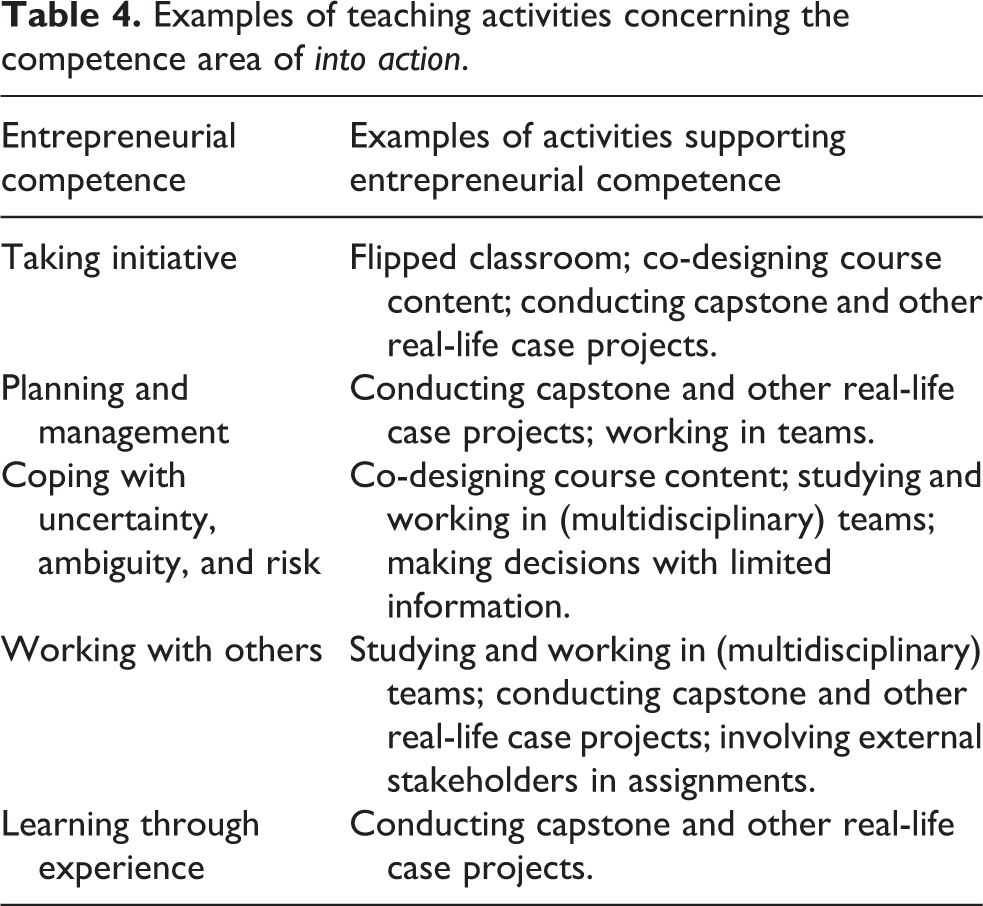
We were able to identify many teaching methods, such as co-designing the course content with external stakeholders and conducting project-based courses, which expose students to the competence of uncertainty and ambiguity. In these examples, both the outcomes of the assignments and the path to reaching their outcomes are unknown beforehand (Packard et al., 2017), and they require students to make decisions about the next steps and possibly adjust the process along the way (Bacigalupo et al., 2016): They have to develop a mindset where they have to learn stuff that is not in the curriculum. That mindset is important if you are in working life. You have to be proactive. (Respondent 8) The course is conducted directly together with large companies; they have to be able to get the project done from the beginning to the finish…students themselves are responsible for it, we [teachers] are not directing them. (Respondent 13)
Discussion and conclusion
Our exploratory study draws on the concept of embeddedness in investigating whether entrepreneurial competences are supported in non-entrepreneurship teaching in higher education. Our findings suggest that various pedagogical choices can support different entrepreneurial competences, even if the teaching itself is not about entrepreneurship. Hence, to varying degrees, non-entrepreneurship teachers unintentionally use teaching methods and formulate learning outcomes that, in addition to addressing their own subject, may also enhance students’ entrepreneurial competences. Accordingly, we conclude that the embeddedness of EE in non-entrepreneurship education is not only possible but there are, in fact, many examples of its occurrence. Our results reflect Dinning’s (2019) findings that the development of entrepreneurial competences can also be a by-product of non-entrepreneurship teaching.
By investigating teachers’ teaching methods, we introduce the concept of unintentional teaching of entrepreneurship. Despite the fact that the non-entrepreneurship teachers’ course content and learning objectives are directly aligned with the business school’s objectives (Holmström et al., 2016; Smith et al., 2008; Teerijoki and Murdock, 2014), there is ample indication that the respondents are actually unintentionally exposing their students to entrepreneurial competences. When analyzing the narratives of the respondents, it becomes evident that they are unaware that some or many of their learning outcomes and teaching methods require and expose the students to develop entrepreneurial competences. One explanation for this unawareness is that the teachers do not have a clear understanding of or are not familiar with different entrepreneurial competences.
Recent research suggests that the use of innovative teaching methods in any subject supports the development of students’ entrepreneurial competences (Joensuu-Salo et al., 2020). Hence, the potential provided by embedding teaching methods that support entrepreneurial competences should be discussed not only inside but also outside the EE box since developing these competences can also support the personal growth, self-awareness, emotional intelligence and employability of HEI students (Charrón Vías and Rivera-Cruz, 2020; Gedeon, 2014; Turner and Mulholland, 2017).
Even if non-entrepreneurship teachers use methods that may support entrepreneurial competences, we conclude that they do not cover the entire spectrum of entrepreneurial competences defined by the EntreComp framework (Bacigalupo et al., 2016). Our findings show that there were no clear examples of the competences of opportunity recognition, perseverance and mobilizing resources being embedded in non-entrepreneurship teaching. It seems that, at least in the business school context of this study, EE is needed to support the development of these competences. Furthermore, to help higher education students develop their competence in exploring the multiple aspects of value creation (Lackeus et al., 2020) and to help teachers create learning environments that encourage students to create value for others (Lackeus, 2020), subjects other than entrepreneurship also need to be involved (Dinning, 2019; Eesley and Lee, 2020). For instance, this calls for discussions of entrepreneurial competences as part of the program-level planning and designing of learning outcomes (De Jorge-Moreno et al., 2012) outside of EE.
Our findings suggest that, even though students in the context of this study are not exposed to every competence in the EntreComp framework (Bacigalupo et al., 2016), many of the identified teaching methods provide students with opportunities to develop their entrepreneurial competences. Intriguingly, our findings imply that entrepreneurial competences are not developed in isolation, but teaching methods can support the development of different competences at the same time. This supports the idea of interdependencies between competences (Rezaei-Zadeh et al., 2014), and how one can support the development of others. Unfortunately, our data do not provide insights for the possible direction of these interdependencies.
It is important to raise the question of whether the unintentional teaching of entrepreneurial competences actually generates long-term outcomes similar to those of EE. Nabi et al. (2017) highlight that the expected outcomes of EE seem to focus on short-term impacts such as transforming students’ entrepreneurial attitudes and intentions, and not on long-term outcomes such as new venture creation. And Armuña et al. (2020) suggest that competences such as spotting opportunities, valuing ideas and commitment are vital to developing the entrepreneurial intentions of students. If such competences are needed to generate long-term outcomes but were not clearly evident in the unintentional teaching of entrepreneurial competences, it is unlikely that long-term entrepreneurship outcomes can be achieved through the unintentional teaching of entrepreneurship.
On the other hand, since entrepreneurial competences, skills, experiences and knowledge (Duval-Couetil, 2013) seem to overlap with the human capital and personal qualities required in working life (Oinonen, 2018), a positive outcome of the unintentional teaching of entrepreneurial competences stems from the possible enhancement of students’ employability. Similar findings were presented by Birdthistle et al. (2016), who suggest that the more practical teaching of entrepreneurship increases students’ self-confidence and presentation skills, which serve them when they face uncertain career paths.
Finally, our findings contribute to the EE literature by illustrating how entrepreneurial competences are not solely owned by EE. Instead, teaching entrepreneurial competences can be embedded in any business discipline in higher education, and this can also inspire teachers to embrace new methods over the known and comfortable ones (Neergaard and Christensen, 2017). On the other hand, although we found support for the possibility of embedding EE in non-entrepreneurship teaching, we are still far from clarifying its role in higher education (Laalo et al., 2019; Rae, 2010).
Limitations and future research
Despite our promising findings, our research design has some limitations that offer fruitful opportunities for future research. Our findings imply that the outcome of the unintentional teaching of entrepreneurial competences may not be a number of new start-ups or increased entrepreneurial intentions, but it may encourage students to take initiatives and help them become more entrepreneurial (Jones, 2019; Lackeus et al., 2020). Unfortunately, we could not investigate students’ perspectives of exposure to unintentional teaching of entrepreneurial competences, and hence this opens up an avenue for future research. Future research could also investigate whether this kind of unintentional teaching could increase entrepreneurial self-efficacy (Shinnar et al., 2014). As EE can be considered a pedagogical method rather than a subject (Blenker et al., 2012; Yamakawa et al., 2016), future research should investigate how the teaching of entrepreneurial competences could be embedded in non-entrepreneurship or non-business subjects (Penaluna and Penaluna, 2020). In the same vein, future studies could investigate how non-entrepreneurship or non-business students perceive the development of their entrepreneurial competences when EE is embedded in their own domain-specific teaching. This approach requires data collection from students, comparative control group settings and longitudinal data covering before and after perceptions of entrepreneurial competences. A longitudinal research design might also provide a way to study the direction of interdependencies and temporal occurrences of entrepreneurial competences (see Rezaei-Zadeh et al., 2014). Moreover, it would be valuable to investigate entrepreneurship teachers’ perceptions of their teaching and how it supports different entrepreneurial competences as detailed by EntreComp or similar frameworks. This approach could enable researchers to unfold neglected areas which should be better considered in EE, as well as to identify which of the different outcomes are relevant for EE (Nabi et al., 2017).
In conclusion, by exploring the idea of the unintentional teaching of entrepreneurial competences, we contribute to the recent literature on EE. Teaching entrepreneurial competences, unintentionally or not, may produce important learning outcomes beyond increasing understanding about entrepreneurship or seeking to create new ventures (Yamakawa et al., 2016). Our findings offer new insights into how different pedagogical practices might enhance students’ entrepreneurial competences even when entrepreneurship is not part of the intended learning outcomes. Although this kind of unintentional entrepreneurship teaching is not a traditional form of teaching “for entrepreneurship,” it reflects its qualities (see Fayolle and Gailly, 2015). This implies that non-entrepreneurship business school teachers may unintentionally increase their students’ entrepreneurial competences, thus indirectly influencing students’ entrepreneurial competence development while maintaining a focus strictly on their own discipline.
Footnotes
Acknowledgements
The authors thank the expert reviewers for insightful comments on our study.
Declaration of conflicting interests
The author(s) declared no potential conflicts of interest with respect to the research, authorship, and/or publication of this article.
Funding
The author(s) disclosed receipt of the following financial support for the research, authorship, and/or publication of this article: This work was financially supported by the Finnish Ministry of Education and Culture (Grant #OKM/304/523/2017).

Appendix 1 Interview guide concerning teaching and teaching methods
Warm-up question: Could you please tell us about your career as a teacher? THEME 1: What should the students learn at [business school at the University of X], and specifically in the [yyyy] Unit?
[slogan of the business school]: How is this slogan realized in your teaching, or how should it be realized? What should the students learn? What kind of attitudes, skills and behaviors do they need when they enter working life? How would you like students to behave/what would an ideal student be like? What do you think will support the development of the students’ working life skills?
THEME 2: How do you teach so that the students will reach the learning goals?
What kind of different teaching situations have you planned and realized that help the students to take responsibility for their learning and develop their expertise? Examples? If the student is to learn creativity, decision-making, problem solving and tolerance for ambiguity, how do you plan a teaching situation for this?
THEME 3: Development of teaching (and learning?)
If you had enough resources (time and money), how would you realize your teaching? What kind of innovative teaching methods have you used? Are there some methods you would like to try but have not? Why not? What has encouraged or hindered your experimenting? What kind of support do you need/would you like to have to develop your teaching?
THEME 4: The University of X is an entrepreneurial university
How is this slogan realized in your teaching, or how should it be implemented in the curriculum/in your lessons? How do you see/understand ‘entrepreneurship’? The [University of X] has developed a strategy for entrepreneurship, which incorporates goals for enhancing entrepreneurial attitudes, skills, behavior and culture across the entire university and various activities: How do you feel about this? How should this strategy be implemented in the curriculum? And in your lessons/teaching? What kind of activities does it require? What kind of learning environment does this entrepreneurial (university) require? Is it realistic in the [yyyy] Unit?
Appendix 2 Entrepreneurial competences according to the EntreComp framework
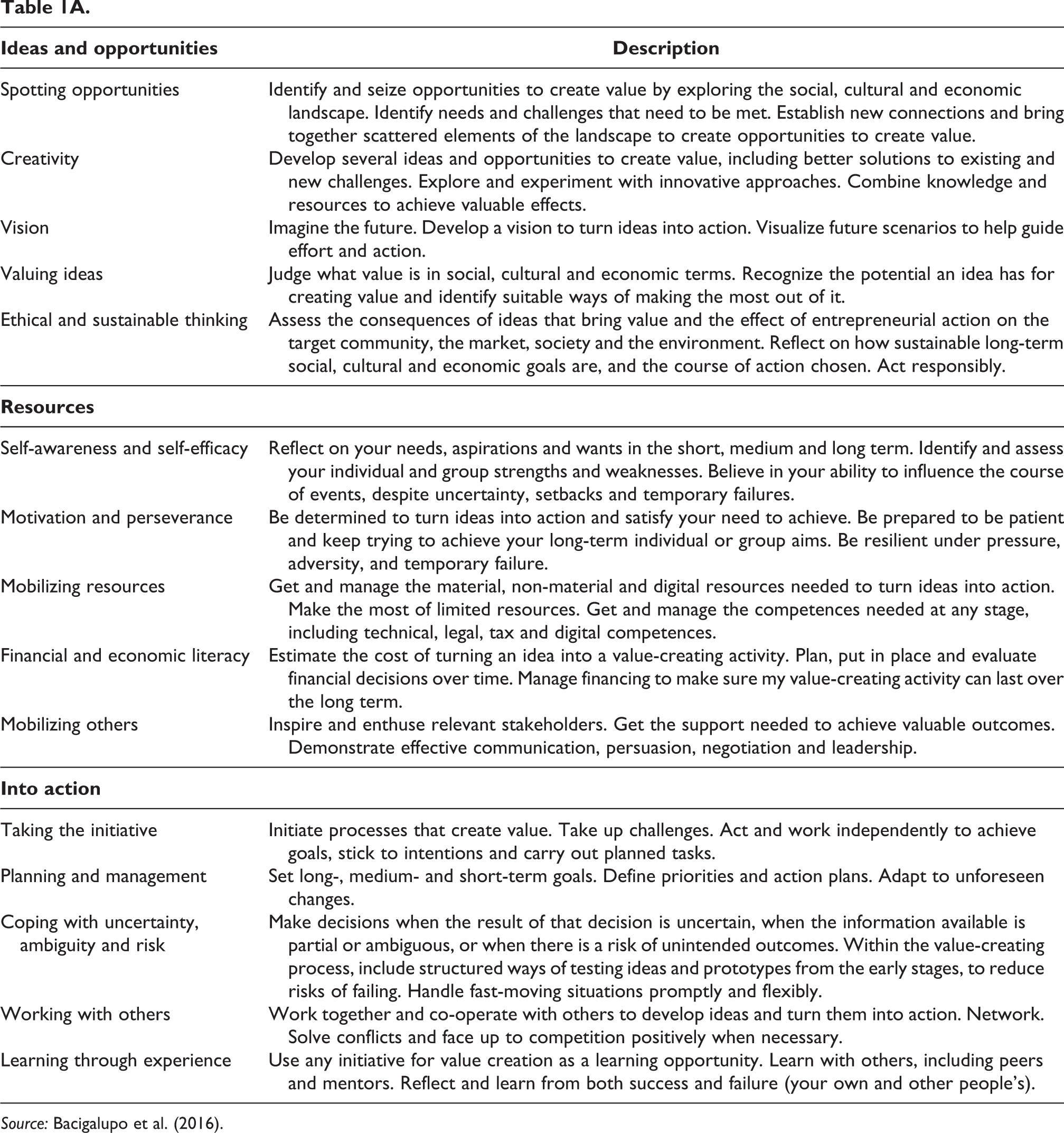
| Ideas and opportunities | Description | |
|---|---|---|
| Spotting opportunities | Identify and seize opportunities to create value by exploring the social, cultural and economic landscape. Identify needs and challenges that need to be met. Establish new connections and bring together scattered elements of the landscape to create opportunities to create value. | |
| Creativity | Develop several ideas and opportunities to create value, including better solutions to existing and new challenges. Explore and experiment with innovative approaches. Combine knowledge and resources to achieve valuable effects. | |
| Vision | Imagine the future. Develop a vision to turn ideas into action. Visualize future scenarios to help guide effort and action. | |
| Valuing ideas | Judge what value is in social, cultural and economic terms. Recognize the potential an idea has for creating value and identify suitable ways of making the most out of it. | |
| Ethical and sustainable thinking | Assess the consequences of ideas that bring value and the effect of entrepreneurial action on the target community, the market, society and the environment. Reflect on how sustainable long-term social, cultural and economic goals are, and the course of action chosen. Act responsibly. | |
|
|
||
| Self-awareness and self-efficacy | Reflect on your needs, aspirations and wants in the short, medium and long term. Identify and assess your individual and group strengths and weaknesses. Believe in your ability to influence the course of events, despite uncertainty, setbacks and temporary failures. | |
| Motivation and perseverance | Be determined to turn ideas into action and satisfy your need to achieve. Be prepared to be patient and keep trying to achieve your long-term individual or group aims. Be resilient under pressure, adversity, and temporary failure. | |
| Mobilizing resources | Get and manage the material, non-material and digital resources needed to turn ideas into action. Make the most of limited resources. Get and manage the competences needed at any stage, including technical, legal, tax and digital competences. | |
| Financial and economic literacy | Estimate the cost of turning an idea into a value-creating activity. Plan, put in place and evaluate financial decisions over time. Manage financing to make sure my value-creating activity can last over the long term. | |
| Mobilizing others | Inspire and enthuse relevant stakeholders. Get the support needed to achieve valuable outcomes. Demonstrate effective communication, persuasion, negotiation and leadership. | |
|
|
||
| Taking the initiative | Initiate processes that create value. Take up challenges. Act and work independently to achieve goals, stick to intentions and carry out planned tasks. | |
| Planning and management | Set long-, medium- and short-term goals. Define priorities and action plans. Adapt to unforeseen changes. | |
| Coping with uncertainty, ambiguity and risk | Make decisions when the result of that decision is uncertain, when the information available is partial or ambiguous, or when there is a risk of unintended outcomes. Within the value-creating process, include structured ways of testing ideas and prototypes from the early stages, to reduce risks of failing. Handle fast-moving situations promptly and flexibly. | |
| Working with others | Work together and co-operate with others to develop ideas and turn them into action. Network. Solve conflicts and face up to competition positively when necessary. | |
| Learning through experience | Use any initiative for value creation as a learning opportunity. Learn with others, including peers and mentors. Reflect and learn from both success and failure (your own and other people’s). | |
Source: Bacigalupo et al. (2016).