




Abstract
The role of higher education institutions (HEIs) in developing the innovative capacity of societies is well recognised. That role is accomplished through the creation and dissemination of knowledge, the success of which is dependent on the types and extent of interactions that can exist between HEIs and industry. Yet this topic remains insufficiently explored in African countries. This paper investigates the extent of the role of Algerian HEIs in cooperating with industry. The main enablers and inhibitors of such activity are also examined.
Keywords
Higher education institutions (HEIs) are increasingly recognised as institutional actors that play a central role in developing the innovative capacity of the societies in which they are embedded (Fischer et al., 2018; Saad et al., 2015). In advanced economies, HEIs are likely to be actively involved in the creation and dissemination of knowledge (Gulbrandsen et al., 2011), leading to the development of innovation capability and growth (Brown, 2016). This development is dependent on the types and extent of interactions that can exist between academia and industry (Brown, 2016).
HEIs are being encouraged to move away from their traditional position and to play a more proactive role in the production of knowledge (Fischer et al., 2018). However, the factors driving the formation of links between HEIs and industry remain insufficiently explored (Abereijo, 2015; Fischer et al., 2018), with fewer studies in particular on developing countries (El Hadidi and Kirb, 2017; Fischer et al., 2018). Despite considerable diversity many African countries, including Algeria, are still marked by a strongly centralised system of education and by weak links between HEIs and industry.
This paper investigates the extent of interactions that Algerian HEIs are establishing with industry and the factors that promote and/or impede the development of these links.
The rest of the paper is structured as follows. The next section reviews and analyses existing theoretical constructs and develops the main hypotheses. The subsequent section explains our quantitative research methodology. We then summarise the results from our survey, and provide an analysis of the practices of the HEI–industry relationship in Algeria. Finally, we offer our conclusions and discuss the policy implications of our findings.
Literature review and hypotheses development
The recent literature has stressed the importance of universities in the development of innovation (Brown, 2016), as well as their new entrepreneurial role in creating, disseminating and exploiting knowledge (Hayter, 2016). This role relies on strong interactions with stakeholders, such as businesses, involved in innovation systems (Hayter, 2016). Through such collaboration, HEIs can improve their financial position (O’Shea et al., 2005), gain first-hand technological experience and play an active role in the economic and social development of their societies (Perkmann et al., 2013). More importantly, in developing countries, such links can play a critical role in technological catch-up (Schiller and Brimble 2009).
However, there is a substantial lack of knowledge about what makes the interactions between HEIs and industry more effective, especially in Africa and other parts of the developing world (Bingab et al., 2018). HEIs in Africa are not always well-established, and often lack the resources and capabilities required for such collaboration (Abereijo, 2015). The following subsections develop the main hypotheses that will help us address the above concerns.
Geographical proximity
Setting up links between HEIs and industry requires trust, commitment, motivation and the creation of bilateral value through a common purpose (Morgan and Zeffane, 2003). These factors can be facilitated by geographical proximity (Hewitt-Dundas, 2013), which can ease the transfer of both codified and tacit knowledge and foster a climate of innovation (Arundel and Geuna, 2004). Similarly, David and Forey (2003) claim that the ability to share knowledge and innovate is more dependent on local than on distant linkages.
The empirical research strongly supports the above views (Acs et al., 2002; Anselin et al., 2000; Rosenkopf and Almeida, 2003). However, van Oort et al. (2008) suggest that geographical proximity is particularly applicable to interactions involving highly advanced technical and scientific knowledge. Nevertheless, many authors (e.g. Massard and Mehier, 2009) believe that there is some confusion and disagreement on the role played by geographical proximity in driving this type of collaboration. D’Este et al. (2012) argue that the role of geographical proximity is overestimated and should be considered as one element of a much larger set of proximities, including organisational and cognitive proximities.
Furthermore, it is worth raising two cautionary notes. First, these forms of collaboration have been developed largely in relation to private-sector enterprises (Plewa et al., 2005). The application of such concepts to HEIs may not be straightforward. Second, most of the concepts were initially conceived for developed countries and may not always be relevant to developing countries (Ranga and Etzkowitz, 2010).
From the above discussion, we propose the following hypothesis.
Absorptive capacity
The ability of universities to effectively contribute to the production and diffusion of knowledge is contingent on the context, the availability of resources and their level of absorptive capacity (Philpott et al., 2011). The availability of technical, managerial and human resources are crucial for the development of successful links with industry. Prior experience and competencies in collaboration management (Fischer et al., 2018), project management and negotiation skills (Pertuzé et al. 2010) have been found to be critical for collaboration. The reputation of academics and the quality of their activities and procedures are, for instance, used by industry to identify potential collaborators (Fontana et al., 2006). Institutions with higher numbers of well-known researchers are more likely to attract research collaboration (Perkmann et al., 2013). With regard to HEIs in African countries, the ability to establish collaboration with industry can therefore be affected significantly by their resource constraints and limited level of absorptive capacity, especially in terms of prior experience, expertise and reputation.
Based on the above discussion, we propose our second hypothesis:
Alignment of motives
The goals and motives of HEIs and businesses are not necessarily similar. This is bound to affect their collaboration (Bruneel et al., 2010; El Hadidi and Kirby, 2017). HEIs are driven by internal dynamics that are separate from market transactions (Bruneel et al., 2010). They focus on academic objectives, while businesses concentrate on market objectives and profit (D’Este and Perkmann, 2011). The priority of academics is to establish a reputation through publications (Perkmann et al., 2013) and to disseminate their knowledge (Bruneel et al., 2010). Thus they are more amenable to collaboration with the industry if this collaboration is related to their own academic activities (Lee, 2000) and can help them enhance their competencies, reputation and access to strategic resources (Ankrah and Al-Tabbaa, 2015; D’Este and Perkman, 2011). Overall, the dominant view in the literature suggests that links with the industry are not necessarily financially-driven (Göktepe-Hulten and Mahagaonkar, 2010), but are simply seen as a means of supporting academic activities (D’Este and Perkman, 2011). However, there are also HEIs that are striving to become more entrepreneurial in order to better commercialise their knowledge (Perkmann et al., 2013) and gain greater access to industrial expertise and funding (Fischer et al., 2018). Hence, our third hypothesis:
Regulatory and financial motivators
Unlike teaching, academics do not see engagement with industry as an obligation. This has led HEIs and policy makers to incentivise engagement with business (Perkmann and Walsh, 2008). For instance, financial and reputational rewards, such as royalties or a share of licence revenue, have increased academics’ disclosure of inventions to universities and are considered as critical for HEI–industry collaboration (Jensen and Thursby, 2001; Lach and Schankerman, 2008). This view is echoed by D’Este and Perkmann, (2011), who argue that financial support for HEIs helps to establish successful relationships with industry. In the USA, academics actively engage with industry by identifying licensees and working with them in further development (Agrawal and Henderson, 2002) which can lead to additional income generation for the institution. Political and regulatory motivators are also important. Governmental initiatives, regulation and social pressure can potentially motivate HEIs and industry to join forces in their quest for recognition and eminence (Ankrah and Al-Tabbaa, 2015).
From the above discussion, we propose the following hypothesis:
Procedural and cultural obstacles
While there are clear benefits to be drawn from collaboration, there are also significant challenges. Collaboration can be affected seriously by major frictions that lead to a lack of trust and of understanding concerning expectations and working practices between HEIs and industry (Bruneel et al., 2010). The two sectors operate on different timescales and have different cultures, procedures and objectives (Bruneel et al., 2010; El Hadidi and Kirby, 2017).
For example, academics often fail to appreciate the time and market constraints of business and consequently businesses tend to be apprehensive of the way work is carried out in academia (El Hadidi and Kirby, 2017).
Traditional forms of governance with a heavy dependence on government bureaucracy (Bruneel et al., 2010), which exist in HEIs in most African countries, can engender additional institutional barriers. Such concentration of authority and decision making constitutes a major obstacle to effective governance and collaboration (Bingab et al., 2018; Maassen, 2017). Centralisation is also found to be inhibiting the initiative and creativity needed for the establishment of effective relationships with industry (Chen et al., 2011). However, for other scholars (Manna, 2013) centralisation, based on strict compliance with rules and procedures, can help in directing and influencing individuals’ behaviour when implementing change.
Hence, organisational, procedural and cultural differences can create barriers which affect the sharing of knowledge and other resources. This can be especially complicated for Algerian universities, which are characterised by a strong bureaucratic culture and rigid boundaries within and between organisations. We therefore advance the following hypothesis:
Data, method and results
Sample
As expected for most African and developing countries, institution-level surveys are difficult to administer in Algeria. We therefore relied primarily on a web-based questionnaire using Qualtrics and a convenient snowballing approach. We started with an initial respondents’ email list and then continued expanding the list using information obtained from various institutions and respondents during the survey. The identified individuals were sent emails giving links to Qualtrics as well as full instructions on how to respond to the questionnaire. Some respondents requested direct contact and were given hard copies of the questionnaire: these were administered directly by the authors. We distributed a total of 1,080 questionnaires/emails, of which 627 were returned, giving a response rate of 58%. However, there were 27 incomplete questionnaires, which reduced the number of valid questionnaires to 600. Our sample consisted of managers of HEIs and academic staff.
The Algerian higher education system consists of 63 universities (of which three specialise in engineering and technology) and 43 specialised ‘Ecoles’. Most of the ‘Ecoles’ have been recently created and are specifically designed to be more specialised and elitist.
The questionnaire was initially prepared in English and was then translated into French, the most common language in Algerian higher education. We took into account conceptual equivalence between the English and French versions of the instrument (Chen and Bates, 2005). Certain questions were reworded at the piloting stage to mitigate potential misunderstanding by respondents, hence validating the instrument for use in the Algerian context.
Independent variables
We use a probability model to explain the impact of selected institutional characteristics on the probability of the presence and intensity of collaboration. The independent variables include three regional dummies (west, east and centre), which are contrasted with the south region. These dummies represent the first hypothesis.
Lazzeri and Pisano (2014: 3) recognise that ‘a key barrier to empirical progress on this front has been a lack of direct measures of absorption’. These authors measure the absorptive capacity of laboratories by tracking the impact of external sources on the R&D activities of the laboratories. Unfortunately, this is not possible in our context because of the large number of HEIs and departments involved. However, we contend that technical capabilities are positively correlated with absorptive capacity and, hence, are good proxies for it. Thus, for technical capabilities (our second hypothesis) we use four variables. The first is the number of disciplines (NDisciplines) offered by the institution. This reflects the (lack of) depth or focus of the HEI’s teaching. The maximum number of disciplines offered is seven. 1 The second variable is the number of programmes offered by each institution (UnivProg). This represents the breadth or span of the HEI’s coverage. The maximum number of programmes is five. 2 The third variable is a dummy reflecting pure science institutions (Science). The fourth variable is the percentage of research active staff in each institution. This variable reflects the research focus of the institution.
Finally, we use three controls. First, the ‘Ecoles’ dummy is used to control for potential difference in collaboration since these newly created institutions have a different status and are more specialised than standard universities. Second, we use the log number of students and the log number of staff as proxies for institutional size. 3
The intensity of cooperation uses three additional explanatory variables, which are principal components extracted from the questionnaire as described below.
Motivators and inhibitors of collaborating institutions
We asked respondents from collaborating institutions seven questions on factors that could act as potential motivators in their collaboration. The questions are shown in Appendix A. The respondents were asked to rank each item from unimportant to extremely important on a scale of 1 to 5. As these motivators may be highly correlated, we conducted a factor analysis to reduce the dimension of the seven items. The factor analysis shows that there are two significant factors. For the motivators, Panel A of Table 1 shows that only the first two eigenvalues are greater than unity, suggesting two significant factors (explaining slightly more than 69% of the variability of the seven motivators). There are two distinct loadings on the two factors: the first factor (Regulation&Finance) loads mostly on Regulation and Financials (items 1 and 2), whereas the second factor (Reputation&Access) loads on Academic Reputation and Access (to managers, infrastructure, and intellectual property), which includes items 3 to 7. These two factors were extracted using the Varimax method, and were used as independent variables.
Principal component analysis for collaboration motivators and inhibitors.
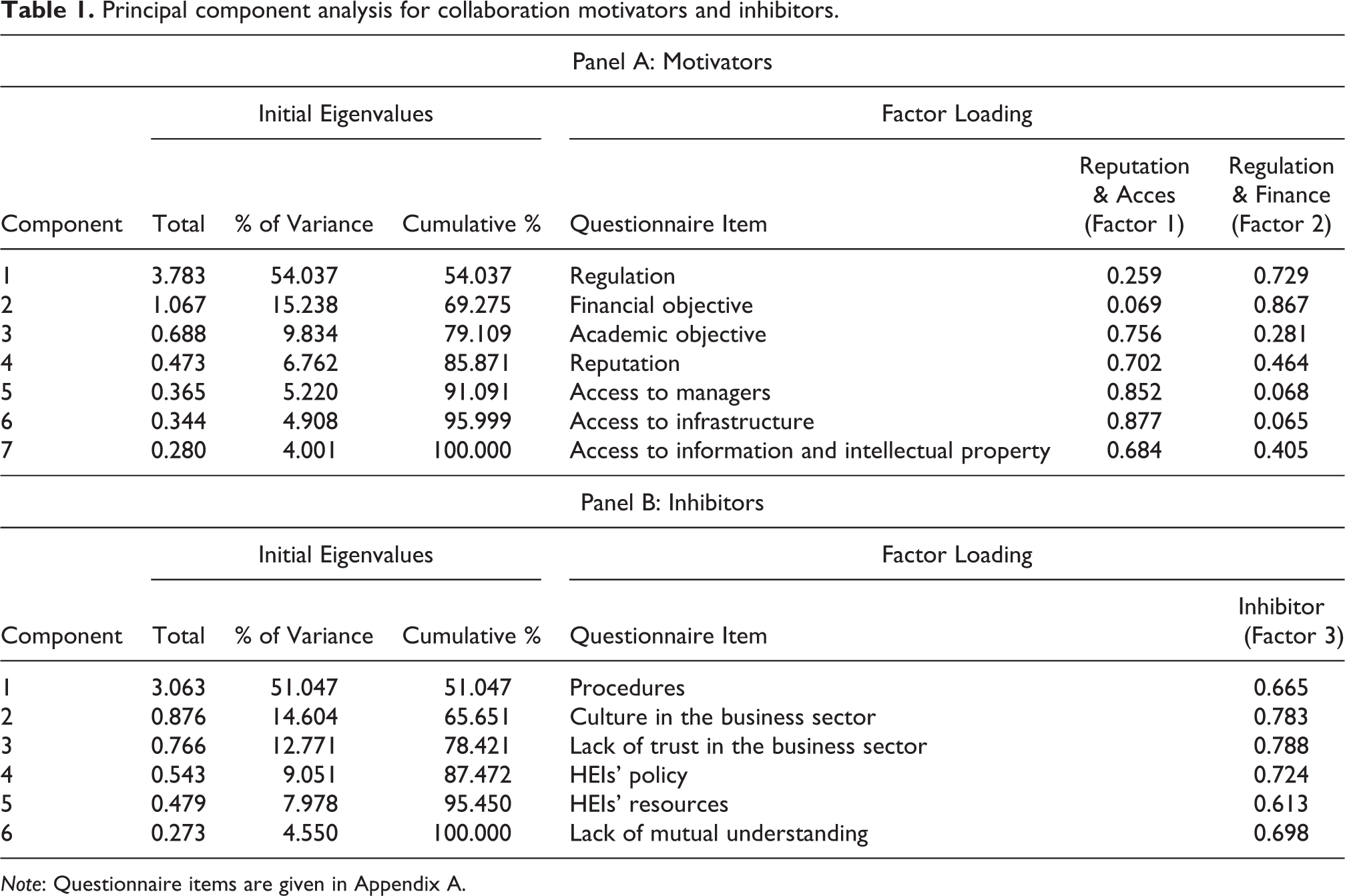
Note: Questionnaire items are given in Appendix A.
We also asked the same respondents about their perceptions of six factors that could impede collaboration. The scale ranged from unimportant to extremely important. Panel B of Table 1 suggests a single factor (inhibitor) explaining about 51% of the six inhibitors. The factor was extracted using Varimax and used as an independent variable.
Dependent variables
Our first dependent variable is a binomial variable measuring whether or not the respondent’s institution has had any collaboration project with industry during the past five years. A simple Probit model is used to estimate the probability of collaboration.
The second dependent variable measures the intensity of collaboration. We measure this variable on a Likert scale of five levels of importance, from ‘not important’ (Intensity = 0) to ‘extremely important’ (Intensity = 4). We use an Ordered Probit with five levels and four threshold parameters.
Results
Table 2 shows the distribution of respondents. Of the 600 who replied to the question of whether their institution had had formal collaboration with industry during the last 5 years, more than two-thirds (68%) replied in the affirmative. About a third of respondents were from general universities (34.17%) and about half were from the ‘Ecoles’. The sample is dominated by the western (42.84%) and central (33.17%) regions. The southern and eastern regions account for around 12% each, which is representative of the south given its low population density, but not of the eastern region which is as heavily populated as the other northern regions.
Frequency statistics of respondents.
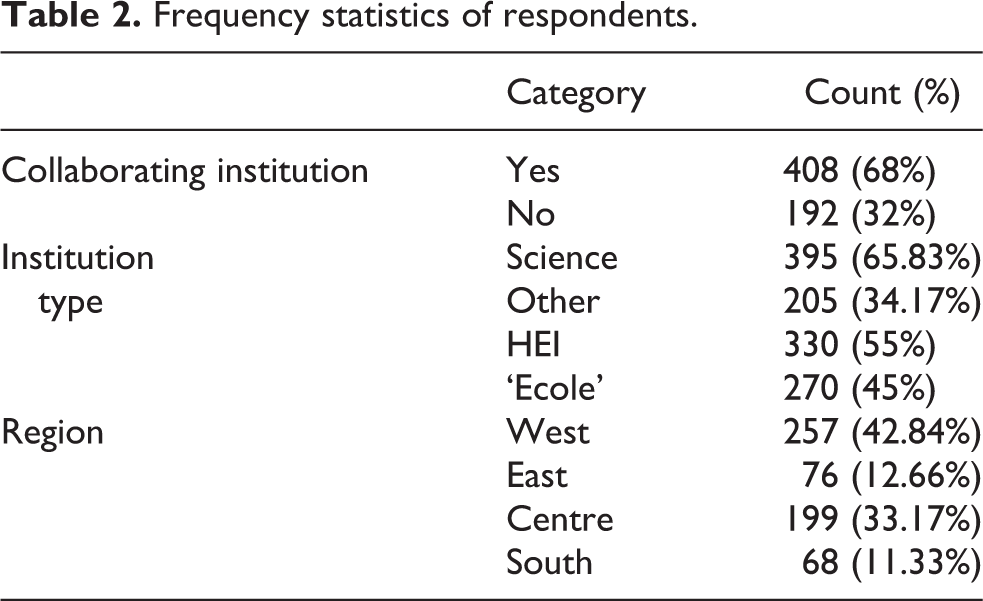
The number of students averages 16,590 but a standard deviation of 18,299 shows substantial variability across the sample. The number of staff is also highly variable, with an average of 789 and a standard deviation of 827. The average proportion of researchers is 51.96% with a standard deviation of 19.25%. The number of disciplines (1 to 7) has an average of 2.99, and the number of programmes (1 to 5) has an average of 3.53.
Table 3 shows some descriptive statistics of the five types of collaboration. These variables were measured on a Likert scale (1 = unimportant, 5 = extremely important). The means indicate that the two most intense/important types of collaboration are training (mean = 3.51) and network development (mean = 3.56). The least intense/important is secondment, with a mean of 1.83.
Descriptive statistics for five types of collaboration.
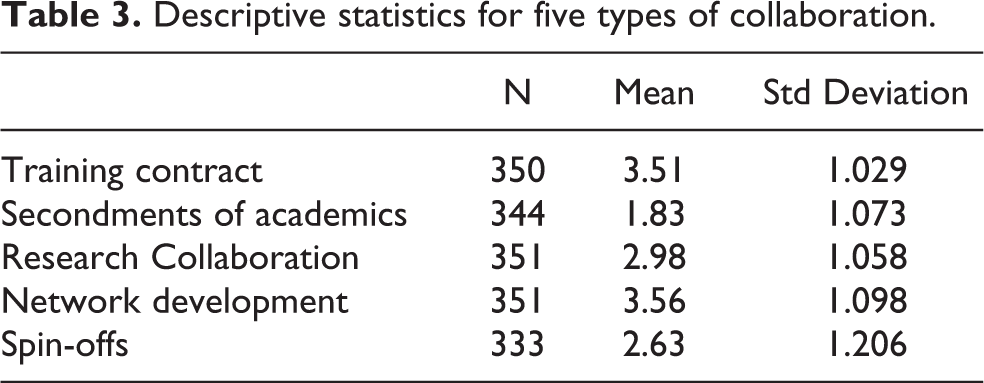
Table 4 presents the probability model results explaining the probability of collaboration and the intensity of the five types of collaboration. The basic model (M0) shows how certain institutional features influence the probability of collaboration. The remaining five models (M1–M5) show the impact of various characteristics on the probability of the level of engagement in the five types of collaboration.
Probability model results.
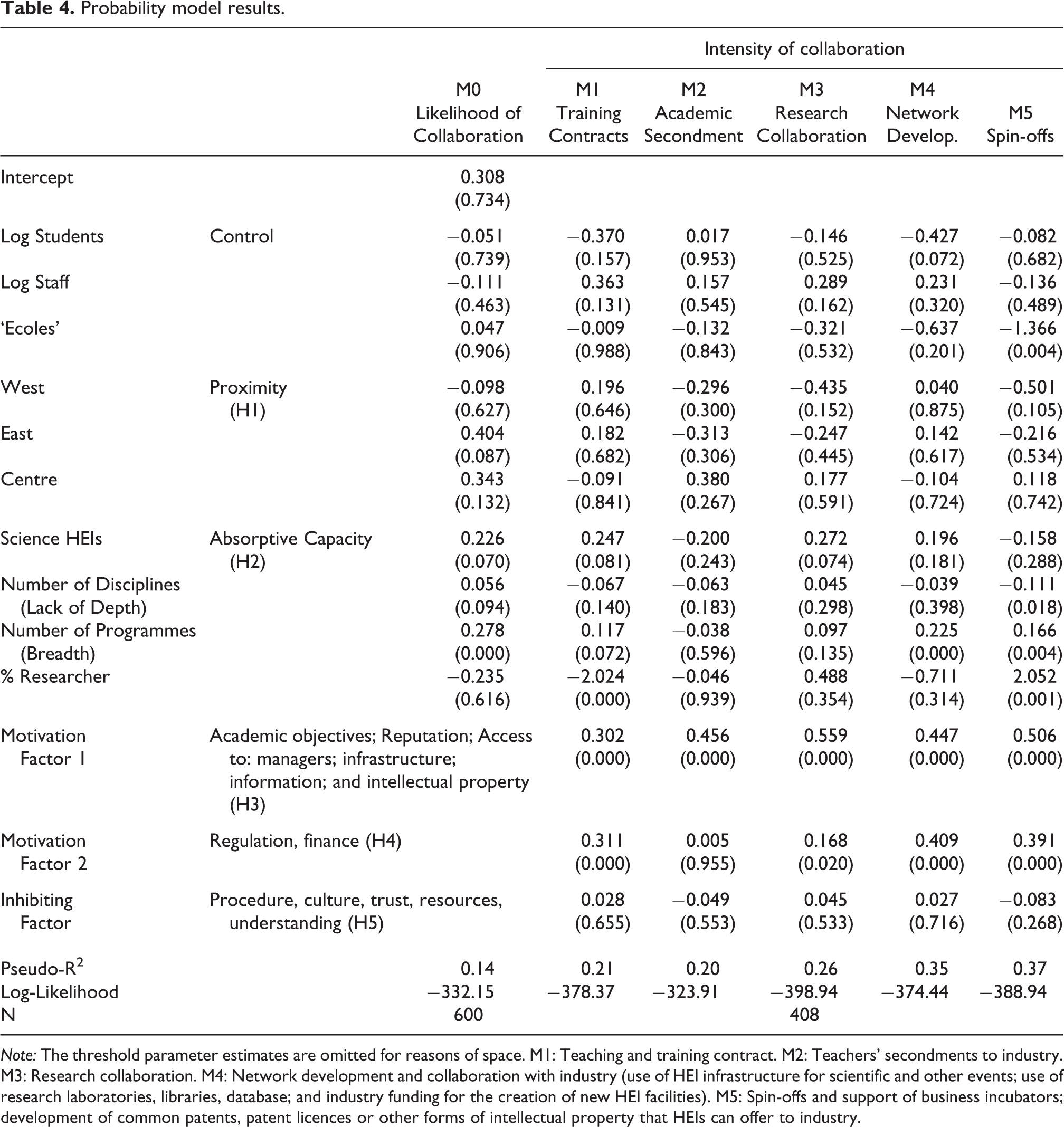
Note: The threshold parameter estimates are omitted for reasons of space. M1: Teaching and training contract. M2: Teachers’ secondments to industry. M3: Research collaboration. M4: Network development and collaboration with industry (use of HEI infrastructure for scientific and other events; use of research laboratories, libraries, database; and industry funding for the creation of new HEI facilities). M5: Spin-offs and support of business incubators; development of common patents, patent licences or other forms of intellectual property that HEIs can offer to industry.
First, we note that none of the control variables is significant in the basic model (M0) and in three of the five intensity models (M1–M3). The number of students in Network Development (M4) is only significant at the 10% level. The coefficient for the ‘Ecole’ dummy is highly significant and negative in M5, suggesting that this type of institution has significantly fewer spin-offs than other institutions.
For the first hypothesis of proximity, we note that the coefficients for the West and Centre dummies are insignificant, implying that there is no difference between these two regions and the southern region in terms of likelihood of collaboration. Moreover, the East dummy is only significant at the 10% level, which suggests weak evidence that the eastern institutions are more likely to collaborate than the remaining regions. However, none of the regional dummies is significant in explaining the intensity of collaboration. We can therefore conclude that there is little evidence in favour of our first hypothesis that the geographical proximity of HEIs to industrial areas increases the likelihood as well as the intensity of collaboration.
The absorptive capacity hypothesis has greater support from the data. For the probability of collaboration (M0), the ‘Science’ dummy has a positive coefficient that is significant at the 10% level, implying that science institutions are more likely to cooperate than general institutions. The number of the disciplines ((lack of) depth) offered by an institution is also marginally significant. However, the strongest contribution is the number of programmes offered (breadth). The coefficient is the highest at 0.278 and highly significant. The research focus (%Research) has no impact on the likelihood of collaboration. Overall, there is some evidence that the absorptive capacity promotes the likelihood of collaboration.
Turning to intensity, absorptive capacity seems to have a generally positive impact, but this impact depends on the type of collaboration. Absorptive capacity has no impact on Secondment (M2), but the remaining four types are affected by some of the dimensions of absorptive capacity.
The number of programmes (Breadth) is the most important determinant of the intensity of M1 (0.117, p-val < 0.001), M4 (coeff = 0.225, p-val < 0.001), and M5 (coeff = 0.166, p-val < 0.001). The number of disciplines ((lack of) depth) is insignificant in four out of the five types. However, while it is significant in M5 the coefficient is negative, which suggests that a greater number of disciplines (i.e. less depth or focus) reduces the intensity of spin-offs. The Science dummy is the second most important determinant with positive influence over M1 and M3, although the significance is only at the 10% level.
The percentage of researchers strongly influences M1 and M5. The coefficient on M1 is negative, suggesting that more research-active institutions tend to have less intense ‘training contracts’. In contrast, research intensity strongly influences spin-offs.
Thus, overall, there is mixed support for the absorptive capacity hypothesis (H2). For training contracts (M1), Science and Depth have positive coefficients but are only significant at the 10% level. Research intensity is highly significant but is negatively related to the intensity of training contracts. For the level of secondment of academic staff (M2), none of the variables is significant. Both models thus provide evidence against H2.
On the other hand, for research collaboration (M3), network (M4) and spin-offs (M5), the evidence supports the absorptive capacity hypothesis. For research collaboration (M3), only the Science dummy is marginally significant at the 10% level, suggesting a higher intensity of research collaboration in Science institutions relative to other general institutions. For M4 only Breadth matters (positively and highly significantly). The final model (spin-offs, patents and other forms of intellectual property) provides the strongest support for the absorptive capacity hypothesis, with three absorptive capacity dimensions showing highly significant positive influence. Note that the negative coefficient of Depth is expected because a greater number of disciplines reduces institutional focus. Institutions that are less focused have lower levels of spin-offs. In contrast, higher Breadth and higher research focus lead to increased levels of spin-off.
Overall, in terms of the likelihood of a collaboration decision, we have little evidence that geographical proximity influences formal collaboration (H1), strong evidence that institutions with more programmes (Breadth) are more likely to have formal collaboration in general (H2), and weak evidence that Science and Breadth are positively related to formal collaboration (H2).
Within collaborating institutions, Models M1 to M5 show that the intensity of collaboration depends on a number of institutional characteristics and these are different across the five types of collaboration. The most consistent characteristic is the Breadth of the institution (the number of programmes). Greater Breadth improves the probability of collaboration as well as the intensity of collaboration in three out of five types (personnel training, network development, and spin-offs).
The last part of Table 4 shows the results for the impact of the two motivation factors and the inhibiting factors on the five types of collaboration. The Reputation and Access factor (F1) is positively and strongly associated with the intensity of all five types of collaboration. This strongly supports our third hypothesis (H3). The Regulation and Finance factor (F2) is significant in four out of five types of collaboration (it is insignificant in secondment). However, although the coefficients are highly significant they are of slightly lower scale than those associated with F1. Thus, although the results lend support for our fourth hypothesis (H4), this support is slightly less important. Finally, the inhibiting factor (F3) is unrelated to any of the five types of collaboration. All coefficients are near zero and highly insignificant. We therefore do not find evidence in support of our last hypothesis (H5).
Discussion
Contrary to a large body of the literature (Arundel and Geuna, 2004; David and Forey, 2003; Hewitt-Dundas, 2013), our results do not support the geographical proximity hypothesis. There are several possible explanations for this conflicting result. The first explanation is the strong dependence on centralised decision-making. In Algeria, both HEIs and key companies are essentially state-owned. Thus, the initiative of local actors to collaborate with industry is still limited and under strict control from their respective ministries. The lack of significant differences between the various regions of the country in their attempts to forge links with local partners can also be explained by the reliance on a bureaucratic and centralised system of governance. There is, however, some shred of evidence showing the existence of institutional geographical collaboration in the east of the country. This could be explained by the emergence of successful private enterprises such as the CONDOR and CEVITAL groups, which are working with their local universities. Second, the technological and capability level of both HEIs and industry in Algeria are low compared to industrialised economies. This view is supported by the suggestion that geographical proximity is mostly applicable in contexts involving highly advanced technical and scientific knowledge (van Oort et al., 2008). As argued by Ankrah and Al-Tabbaa (2015), institutions that do not possess an appropriate system of governance and a satisfactory level of capabilities and resources are unlikely to successfully establish and manage collaboration. Prior results that have been found in the developed economies may not necessarily apply to the context of African nations (Bingab et al., 2018). Third, and in line with the suggestion of Plewa et al. (2005), previous studies have mostly focused on private-sector enterprises which have different goals, motives and cultures. HEIs may therefore behave differently in reaching out to the business sector. Fourth, given the advances in transport and communication, geographical distance is becoming a lesser hurdle in interactions between research partners. Finally, geographical proximity may not be a reliable or sufficient measure of institutional proximity. As suggested by D’Este et al. (2012) and Drejer and Vinding (2007), collaboration between HEIs and industry may well be driven by organisational and/or cognitive proximities and other factors.
Our results confirm that absorptive capacity and a series of motivating factors do influence the probability and intensity of collaboration. However, contrary to expectations, although respondents identified several inhibitors, their impact is insignificant.
The literature has highlighted the criticality of the availability of resources and of an appropriate level of absorptive capacity as conditions for collaboration, exchange of knowledge and the development of national innovative capacity (Cohen and Levinthal, 1990; Philpott et al., 2011). On the whole we confirm the absorptive capacity hypothesis, finding that most of the proxies used for absorptive capacity have a positive impact on the probability and intensity of collaboration. This is consistent with prior research which suggests a positive impact of the availability of technical, managerial and human resources on successful collaboration (Fischer et al., 2018). However, our results are only partially aligned with existing research in relation to the positive effect of research expertise and the quality of research activities on collaboration (Fontana et al., 2006; Plewa et al., 2005, 2013). Indeed, our proxy for research intensity has the expected impact on only one of the five types of collaboration (spin-offs). We do not know the reason behind this unexpected result, but speculate that it may lie in the low quality of research in Algeria. Indeed, for a long time, research has not been one of the key priorities of Algerian universities, whose mission has mainly been to provide human capital to support the economic and social development programmes of the country.
Turning to the system of incentives, we find that motivating objectives, such as reputation and access to facilities within the business sector, are the most important determinants of intensity of collaboration. Indeed, all five types of collaboration are positively impacted by this motivation factor. This result is consistent with the plethora of prior studies indicating that scholars are driven by their own academic objectives (Perkmann et al., 2013), access to resources and information (Ankrah and Al-Tabbaa, 2015; D’Este and Perkman, 2011).
Engagement with industry is not seen as a natural task by academics. This is why the literature suggests the necessity of encouraging academics to engage with their social and economic environment through the provision of financial incentives such as scholarships and grants (D’Este and Perkmann, 2011; Jensen and Thursby, 2001). Regulation can also hinder or promote collaboration (Ankrah and Al-Tabbaa, 2015). Consistent with these studies, our research shows that regulation and finance are particularly important in promoting collaboration with industry. This confirms our fourth hypothesis that collaboration is more effective in the presence of a favourable financial and regulatory environment.
The most surprising result in this study is the lack of significance of the procedural and cultural obstacles. This is in contrast to the abundant literature on the obstructing nature of cultural differences (Bruneel et al., 2010; El Hadidi and Kirby, 2017), procedural complexities (Bruneel et al., 2010) and bureaucracy (Bingab et al., 2018; Maassen, 2017). Given that Algerian HEIs are still heavily tied to the central government and suffer from bureaucratic rigidities, we expected to find a significant and negative impact of these inhibitors. Unexpectedly, the data reject our last hypothesis, and we are unable to explain satisfactorily this negative result. One potential explanation could be the quality of data, in the sense that respondents did not have consistent views regarding their perceptions of the six questionnaire items that cover the obstacle factor. We leave this puzzle as a topic for further investigation.
Conclusion
The purpose of this paper is to use Algeria as a representative case for many African countries that suffer from an apparent split between HEIs and their external environment. Although we find some evidence of collaboration, it is merely limited to training and network development. This could be explained by the HEIs’ strong teaching orientation and low level of research capabilities. Our results also underline two noteworthy issues for policy makers and HEI managers in African countries. The more postgraduate programmes (Masters and Doctorates) HEIs offer, the more able they are likely to be to reach out to industry. Furthermore, spin-off collaboration seems to be associated with specialised HEIs or HEIs that are highly focused in their academic activities.
Our results have implications for the question of whether key concepts designed for developed countries are relevant to African countries. Existing policy tools may not all be appropriate to African economies. For example, our results suggest that proximity is not important, which means that policies which focus on concentrating HEIs around industrial areas may not yet be as effective as in the developed world.
On the other hand, we do find policy tools that are relevant to the developing world. Specifically, policy makers should work towards improving the infrastructure and resources than can help HEIs to increase their level of absorptive capacity. They should also focus on improving the governance of HEIs and creating a climate that can foster collaboration with industry as a means of strengthening their national innovative capacity.
Our study has a few limitations. First, we use perception data to measure collaboration and the intensity of collaboration. Future studies should use more objective and measurable data, such as R&D figures, number of trainees, joint patents and joint publications as measures of collaboration. Such data are, unfortunately, not available in Algeria. Second, the exclusive use of Algerian institutions may limit the generalisability of our findings. A better, but more challenging way would be to include institutions from several countries to improve external validity. Third, our geographical distance measure is restrictive and should be extended to better reflect the various concepts of proximity. Similarly, a richer definition of absorptive capacity would help extract more precise and consistent conclusions than ours.
Despite the above limitations, we believe that our study is one further step towards comprehending an important element of still poorly understood factors that affect the establishment of links between HEIs and industry as one of the key foundations for national innovative capacity in the African world.
Footnotes
Declaration of conflicting interests
The author(s) declared no potential conflicts of interest with respect to the research, authorship, and/or publication of this article.
Funding
The author(s) received no financial support for the research, authorship, and/or publication of this article.

Notes
Appendix A
Questions related to Motivators
Questions related to Inhibitors