




Abstract
This article contributes to the debate on employability skills in UK higher education. It starts by discussing the concept of employability and places the debate in the context of mega-trends affecting UK higher education and the broader UK labour market. It distinguishes between different types of employability skills, as identified by employers’ surveys, and matches them with specific small-group teaching activities, drawing on pedagogic theory and practice. The article concludes that, beyond work-integrated learning, traditional small-group teaching activities can go a long way towards bridging the gap between graduates’ skills and labour market needs.
The objective of developing employability skills as part of the learning process has become vital in the UK higher education system (Miller et al., 2013). The trend can be attributed to the growing marketization of the education sector, but also to labour market trends and shifts in public policy. These include, for example, the persistent graduate unemployment in the context of a more competitive labour market, and the so-called ‘war for talent’ with associated skill gaps and shortages identified in employers’ surveys (Confederation of British Industry (CBI), 2017). Apart from the recent CBI survey, several works in the literature have identified skill gaps as a problem across advanced industrialized countries (Cappelli, 2015; Jackson, 2010; Jackson and Chapman, 2012). The digital revolution has been central to this problem in that it has generated a demand for new skills while outdating others across a wide range of sectors (Berger and Frey, 2016). These trends have put additional pressures on higher education institutions to undertake a more systematic reflection on how employability skills may be embedded in the curriculum. The debate has also been steered by policymakers, and so employability has become a priority of higher education institutions and agencies (Boden and Nedeva, 2010; Knight and Yorke, 2003; Pool and Sewell, 2007; Small et al., 2018).
Employability skills may be developed through a variety of student learning opportunities and activities which are part of the higher education experience – for example, self-study, participation in lectures, attending specialized career-advising workshops or participating in work-integrated learning (WIL) programmes (Jackson, 2015; Jackson and Wilton, 2016). Admittedly, WIL can greatly assist the closing of the gap between the traditional objectives of higher education degrees and the nurturing of employability skills. Further, digitalization trends (Berger and Frey, 2016) demand new ways of reskilling learners through, for example, online and modularized education and training. Nevertheless, the focus of this article is on how employability can be developed even in the more traditional pedagogic context of small-group teaching.
The rest of the article is structured as follows. In the next section, we draw from relevant academic and policy literature to analyse the definition of employability and we critically discuss the mega-trends affecting the broader labour market context, as well as specific challenges in the UK higher education sector. The discussion suggests various tensions between the specific skills that the employers need and the marketization that pushes universities away from challenging and abstract thinking towards dumbing down to increase student satisfaction.
Next, the article unpacks the different types of skills that employers need, drawing on industry surveys and following recent approaches in the employability literature (Chhinzer and Russo, 2018; Iyer and Dave, 2015; Matsouka and Mihail, 2016; Small et al., 2018; Wilton, 2014). The article maps these skills against small-group teaching activities that reflect traditional pedagogic practice and argues that those activities may bridge the gap between industry needs and the traditional formats of higher education curricula. The subsequent section analyses in more detail a selection of examples of small-group teaching activities and how they can be geared towards improving employability skills. The final section concludes by arguing that the marketization of higher education has intensified the need to develop employability skills, but that traditional pedagogic practice may bridge the gap between what employers need and what universities can realistically offer.
Employability: Definition and dimensions
In early 2012, the Higher Education Academy released an updated version of Pedagogy for Employability guidance (Pegg et al., 2012). Although employability lacks a universally accepted definition, for the purposes of this article, we adopt the definition used by the Higher Education Academy. In this context, employability is defined as: a set of achievements – skills, understandings and personal attributes – that makes graduates more likely to gain employment and be successful in their chosen occupations, which benefits themselves, the workforce, the community and the economy. (Pegg et al., 2012: 4)
A report from the (now defunct) UK Commission for Employment and Skills (UKCES) observed that employability skills entail, on the one hand, ‘experiential action-learning’ which denotes ‘using skills rather than simply acquiring knowledge, placing emphasis on trial and error, and with a clear focus on the pay-offs for the learner in employment and progression’ and, on the other hand, ‘work experience’, which may either be realized through ‘a work placement in an actual business, or an authentic classroom simulation based on a real workplace’. (UKCES, 2009: 5)
Although the definition offered by UKCES links the development of employability skills with the learning process, it remains unsatisfactory with regard to the specific skills that are important for the development of employability as an attribute. An increasing number of higher education institutions offer ‘work experience’ as part of work placement programmes or internships and generally in WIL programmes (Helyer and Lee, 2012; Jackson, 2015; Jackson and Wilton, 2016). However, this should not necessarily be taken as suggesting that it is impossible to develop employability skills unless a work placement is part of the degree. Instead, the aim of experiential learning can be achieved in more traditional pedagogic contexts, such as small-group teaching activities that promote this learning and simulate the ‘work experience’.
In fact, the Qualifications and Curriculum Authority (QCA) framework had clearly specified the key skills that constitute employability, and these included information technology (IT), numeracy, communication, problem-solving, team working and an ability to improve one’s own learning and performance (Exley and Dennick, 2004). Indeed, these six skills are those that the UK government ‘sought to embed in education and training for the young’ (Grugulis et al., 2004: 8–9). One needs to acknowledge, however, that other scholars and commentators have been critical about the notion of employability, suggesting that the skills should be captured by other concepts such as ‘complexability’ (Higdon, 2018). More generally, a critical discussion of employability as a concept requires an understanding of the changing labour market and higher education context in which the debate is taking place. The next section discusses these broader trends.
Mega-trends affecting employability in UK higher education: Digitalization, marketization and lifelong learning
In order to understand how the concept of employability has evolved over the last two decades, one needs to sketch the changing context of UK higher education and, more broadly, the mega-trends that affect the labour market context. 1 In this section, we focus on two key trends that affect the political–economic context of employability: changes in the labour market that have shifted the focus towards digital skills and lifelong learning, and the marketization of higher education that has steered the need for greater value for money in higher education degrees.
Lifelong learning and digitalization
The increasing shift in the public discourse on government policy towards emphasizing ‘employability’ reflects fundamental shifts in the labour market. Government policies, not only in the United Kingdom but also across Europe, have moved from a focus on promoting full employment and job security to a focus on employability over the life course with policies such as Flexicurity (Kornelakis, 2014). The emphasis on employability in public policy discourse is based on the premise that the notion of jobs for life is a relic of the past. The monumental transformation in the nature of employment across and within organizations is at the heart of these macro-level changes.
The pattern of lifetime careers in large bureaucratic organizations has been rendered obsolete. Instead, career patterns have become erratic and resemble what have been dubbed ‘boundaryless’ or ‘portfolio’ careers (Arthur and Rousseau, 1996), with mobile employees moving across rather than within organizations. The old employment models that provided security through loyalty and lifelong employment are deemed inappropriate for this ‘brave new world’ of work and instead ‘employability’ is put forward as the recipe for success (Baruch, 2001). However, there is a limit to how much employability may help low-skill occupations that do not fit the stereotype of ‘boundaryless’ careers.
Technological advances and the trends in digitalization exacerbate these changes in the labour market. Digitalization is not only affecting the availability of work by automating tasks and making jobs extinct, but also changes the content of jobs constantly (Petrakaki and Kornelakis, 2016). Therefore, a mindset oriented towards lifelong learning is required to keep up with rapidly changing technologies and new digital skills. Recent reports suggest that the demand for new skills is not restricted to the information and communications technology sector, but expands across other sectors such as manufacturing (Berger and Frey, 2016).
Second, digitalization renders certain job tasks obsolete but at the same time opens up employment opportunities and facilitates the development of new forms of flexible work, such as mobile work, project work, crowd employment and platform work (see Eurofound, 2015; Howcroft and Bergvall-Kåreborn, 2019). Employees can either turn to these new forms of employment fully – this is especially the case for those who would typically be excluded from the labour market because of family responsibilities or some form of disability – or partly, supplementing their traditional employment status (Berger and Frey, 2016). The new flexible forms of work increase the requirement to become (or remain) employable in the digital economy and cultivate a strong culture of lifelong learning.
Marketization and neoliberalism in UK higher education
At the same time as the above labour market trends that manifest a breakdown of traditional models of employment, a more critical perspective on employability suggests that the shift in the pedagogic discourse also reflects a deep-seated shift towards what has been called the ‘neoliberal university’ (Matthews et al., 2018; Parker, 2014). In this context, the unprecedented increases in university tuition fees about 10 years ago fundamentally changed the relationship between the university and the student body. The university can no longer be considered as an institution offering education as a public good; universities are increasingly corporatized and adopt the manners of managerialism (Ball, 2012; Parker, 2014). The marketization of the sector is further reflected on the competition between higher education providers, while students assume largely the role of customers buying a particular service (Lorenz, 2012). This overall trend of marketization has several knock-on effects on the nature and content of higher education degrees, with greater importance attached to employability, and less to learning for the sake of learning.
Students have more bargaining power because of the increased competition between universities, and they also perceive their education as a form of investment through the payment of hefty fees. Graduate jobs are then perceived as the pay-off from this investment and therefore their participation in higher education is strategic. As a corollary, the universities have also changed the focus of the pedagogic discourse from learning to satisfaction of the student-as-customer. This creates a host of other tensions and conflicting goals in the university system.
On the one hand, university degrees have been criticized for grade inflation and a dumbing down of the requirements for high-award classifications. On the other hand, employers are not satisfied with the skills students possess when they graduate. Another tension, related to the last point, arises from the fact that, since students pay hefty fees, the importance of the notion of ‘customer satisfaction’ is increased. As a result students, in their new role as customers, may not welcome a challenging learning experience that will likely develop the skills employers require. There is no easy way to ease this tension in the context of teaching and learning practice, since the root causes are the commercialization of education as a product or service and the perverse incentives and dynamics that this commercialization creates.
There is, then, a fundamental discrepancy between what academics believe good pedagogic practice means for employability and what employers actually want or need from their graduates. The following section will seek partly to address these tensions by bridging the employer and pedagogic perspectives on employability with concrete examples of small-group teaching activities.
Employability skills: What do employers’ need?
Although much of the debate on employability has taken the form of top-down government and policymakers’ discourse, there is little in terms of an explicit link with an employer’s or industry perspective. Interestingly, the CBI collaborated with the National Union of Students and identified ‘key capabilities’ that graduates should have and the list is taken from the work of CBI (CBI, 2011: 13–14):
The ‘key capabilities’ the employers emphasized match quite well with the ‘key skills’ that we mentioned above, from the UK government agency QCA (Exley and Dennick, 2004); that is, team working, problem-solving, communication, IT, numeracy and self-management. All the employability skills are linked with a generic requirement for a ‘positive attitude’. The positive attitude echoes the so-called ‘Good Bloke Syndrome’ (Grugulis et al., 2004: 7). This is a clear-cut personality trait that reflects a shift in employers’ discourse towards describing behavioural characteristics.
The main difference from the skills that the QCA had identified earlier is the generic skill of business and customer awareness. Some ‘basic’ skills (numeracy, communication, IT) are prerequisites for the more ‘advanced’ or ‘complex’ skills (self-management, problem-solving, teamwork, business awareness). Admittedly, those advanced skills should be interpreted in a broad and encompassing manner. They likely include several subsets of skills, such as ‘creativity’ or ‘decision-making’ or ‘personal effectiveness’ (Kneale, 2009: 104–105) – which may be construed as a subset of self-management or problem-solving skills. Similarly, presentation skills, negotiation skills and persuasion skills can be understood as a subset of ‘communication’ skills.
Having established the ‘skills that matter’ the question then becomes: where are the shortages and gaps? Based on information from the CBI, and specifically its Education and Skills Survey (CBI, 2017), employers seem to be less satisfied – in ranked order – with the following: foreign language skills, business and customer awareness, international cultural awareness, self-management (resilience, career knowledge), communication skills, positive attitude, problem-solving, team working, analysis, basic literacy, technical skills, numeracy, IT skills. In other words, it seems that the more ‘advanced’ skills are the ones that are usually missing. By contrast, employers seem more satisfied with the ‘basic’ skills of literacy, numeracy, technical and IT skills (CBI, 2017: 93).
Given the deficiency in business awareness and self-management skills, educational activities that are likely to nurture those skills should be given some priority in the curriculum. Arguably, small-group teaching is by nature a great facilitator of ‘key skills’ for employability (Exley and Dennick, 2004: 111; Griffiths, 2009: 74). Thus, the next section will explore and analyse how employability skills can be embedded in small-group teaching activities.
Employability skills in the context of small-group teaching
Table 1 summarizes how some of the key skills shortages identified by the CBI can be mapped against small-group teaching techniques. The table is not intended to be exhaustive, but rather to suggest schematically that several small-group teaching techniques can be geared towards the development of different employability skills. Additionally, the table highlights that some activities are more suited to developing particular skills than others. The next section discusses some of these examples in more detail to illustrate the points of the article.
Key employability skills and small-group teaching techniques.
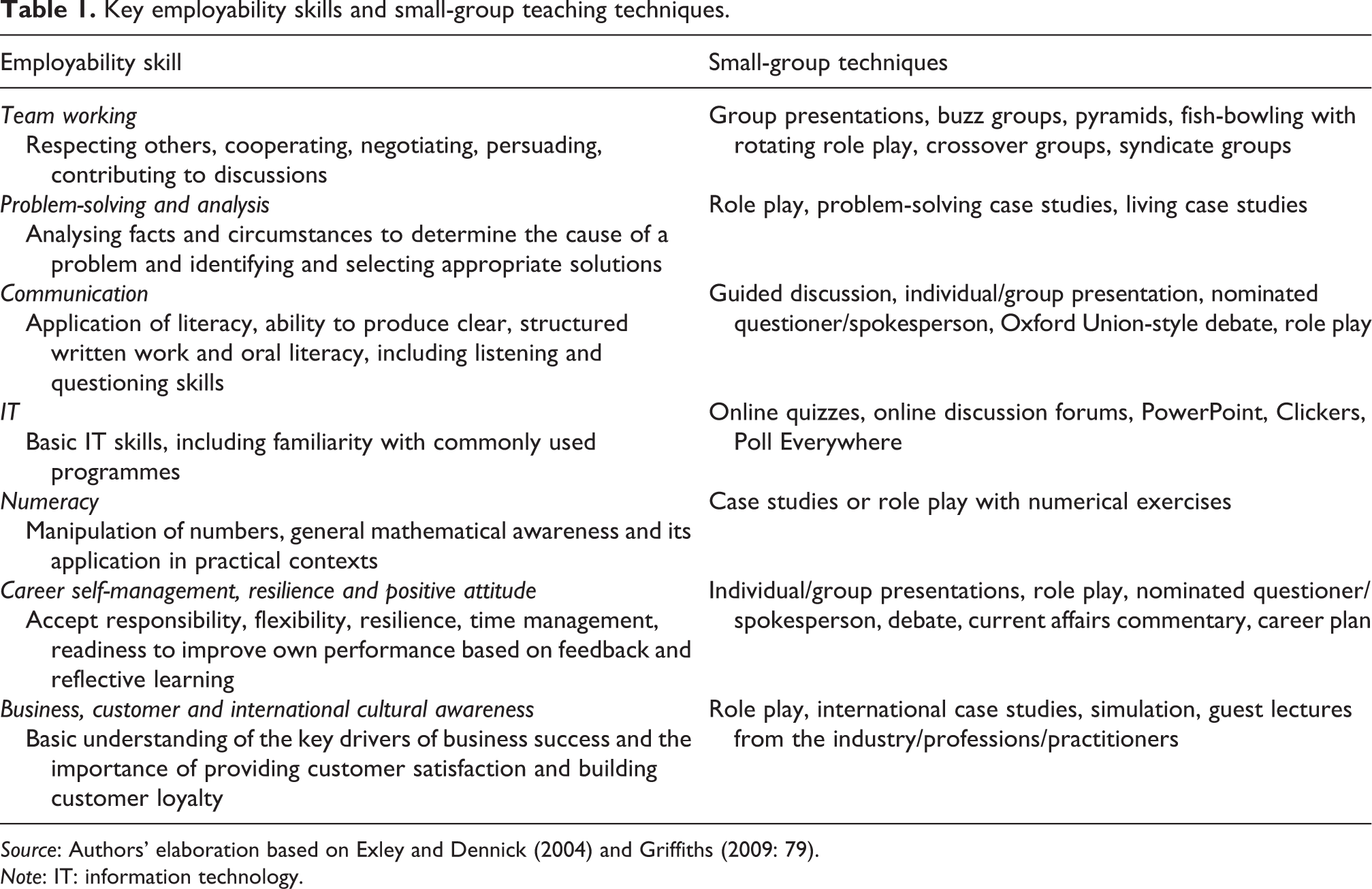
Source: Authors’ elaboration based on Exley and Dennick (2004) and Griffiths (2009: 79).
Note: IT: information technology.
Examples of small-group teaching activities
Student presentations
Student presentation is a method many academics use in their tutorials. The standard format is to ask a student (individual presentation) or a group of students (group presentation) to prepare a short report (5–15 min) and present it in front of an audience, usually their classmates. The topics may come from a predetermined list and be allocated at the beginning of the term. The student presentation is a learning method that has clear benefits with regard to developing a wide range of employability skills. It is a powerful way to develop aspects of oral communication skills such as presenting in front of an audience. It also sharpens IT skills, since the presentations are usually prepared using PowerPoint (or equivalent) and the Internet is increasingly used for background research. A presentation may have a quantitative component (e.g. analysing statistics), thus contributing to the development of analytical and numerical skills. If the presentation is by a group, this provides an excellent opportunity for collaborative work and the output requires the development of team working skills. But even if the presentation is by a group rather than an individual, this requires a certain degree of self-management (assuming responsibility and taking initiative). Finally, the topic of the presentation may steer the business and customer awareness of students, especially if the question relates to a real-life business situation.
The problem-solving case study
Case studies (or scenarios) belong to the general category of problem-based learning (PBL) and are used extensively and in many different ways in small groups (Griffiths, 2009: 74). Case studies are very useful for developing employability skills. As Exley and Dennick (2004: 77) note, medicine was one of the first disciplines to develop PBL at Case Western Reserve University in the United States in the 1950s. However, since then case studies have been used in several disciplines, and especially in business and management education (Lucas and Milford, 2009: 394). Another variant of the problem-solving case study is what has been termed the ‘living case study’ (Dickenson et al., 1996). This variant may take two forms. First, it might be an imaginative case, but it is ‘live’ in the sense that students develop the scenario over time, perhaps during seminar time, working on different phases and responding to stimuli given by the tutor. Second, the living case might pertain to a real-life organizational problem, linked with a placement or project report. Hence, the students present the results of their analysis to practitioners who are interested in solving the particular problem.
The examination of a case study in class has the potential to nurture problem-solving and analytical skills. Additionally, it is a powerful form of experiential learning because it takes into account the Kolb learning cycle stages of active experimentation, concrete experience, reflective observation and abstract conceptualization (Fry et al., 2009: 15). The case study is an effective way to develop business and customer awareness, since it does reflect a real-life business situation. Finally, if case studies are situated in a diverse range of cultural and national contexts, they have the potential to promote the international cultural awareness that is so lacking in graduates, according to employers’ surveys. A case study may also sharpen communication and team working skills if dealt with in a syndicate group, and it can develop numerical skills if it entails a numerical reasoning component. Self-management, such as assuming responsibility and taking initiative, is also required in groups, and IT skills are likely to be developed if the case study requires them (for instance, a case study that is part of an online quiz).
The Oxford Union-style debate
The use of a formal debate may be feasible when ‘there are two polar points of view, two theories, solutions or ideologies […] or two historical interpretations’ that can be compared and contrasted (Exley and Dennick, 2004: 99). Debate can be a powerful tool for developing aspects of communication skills, including the abilities of argumentation, persuasion, questioning, analysis and presenting in front of an audience. The debate is also a good method for developing self-management and teamwork skills, especially if the preparation of the speakers takes place in a group. The main benefit of debate teams is to facilitate critical thinking among students who essentially disagreed with the proposition they were asked to defend. They are asked to think differently and, while discussing their argumentative strategy with their peers, to take into account rebuttal of counterarguments. Hence, the debate may well enhance respect for others’ views, which is essential for cultural awareness and resilience. Finally, the topic of the debate may steer the business and customer awareness of students, especially if the proposition relates to a real-life business question, rather than a more theoretical one. At the end of the debate, the tutor may cast the vote deciding which side has won the argument that day or, even better, the students may decide that for themselves. The decision could happen at the end of the tutorial or – if time does not allow – as a follow-up exchange in an online discussion forum.
Role play
Role play basically requires ‘asking someone to be someone else, to pretend to be another person in an imagined situation’ (Exley and Dennick, 2004: 66). It is a particularly valuable method for the development of skills that reflect real-life situations. The careful debriefing of the roles to the role players is of the utmost importance. According to Elwyn et al. (2001), some of the benefits of role play as a learning activity include the observation of how people react in complex situations, receiving immediate feedback, closing the gap between theory and practice, changing attitudes and consolidating skills development. Some variations of role play are ‘role reversal’, in which participants swap roles so that they reflect on how it feels on the other side; ‘role rotation’, in which the main role is rotated so that everyone experiences it; ‘alter ego’, in which a participant stands behind the main role player and acts as their alter ego, voicing the role player’s imagined thoughts or feelings in the first person; and ‘replay’, which can be used by the facilitator to allow the players to rewind and act out a specific sequence again (van Ments, 1989).
Role play has several advantages in terms of developing employability skills. First, it can serve to develop problem-solving and analytical skills. For instance, if the role play is an interview it might take the form of a ‘case interview’ – typically used by management consulting firms such as McKinsey (Cosentino, 2011). In this case, the script might include problems the interviewee should analyse and discuss on the spot, such as numerical exercises that may be required (e.g. ‘guesstimates’). Role play can be a medium for the practice of communication skills, including listening, questioning and negotiating, and more generally interpersonal social skills while interacting with another role player. If the preparation of role play scripts is done within a group (e.g. fish-bowling or ‘rotating role play’), then teamwork skills may also be developed. Some degree of self-management is always required to perform in the role individually or while improvising in the ‘alter-ego’ variation. It is perhaps better if there is no set script, so that students practise taking initiative and assuming responsibility (self-management). Time permitting, scripts may be developed in groups, and then role players may perform the roles in the fish bowl. Finally, role play is an excellent tool for developing business and customer awareness because students become engaged in a situation in which they have to address a simulation of real-life scenarios.
Conclusion
Employability has been at the heart of policy discourse in the UK higher education sector. Various trends have contributed to this, including digitalization and marketization. Digitalization demands a new skills set to meet the requirements of emerging types of work (such as platform and project work), whereas marketization engenders a commodification of higher education. Both trends place employability at the core of education. The purpose of this article is to reinvigorate the relevance of traditional teaching activities as a way of meeting the requirements of employability within a highly digitalized and neoliberal society. Although there are other opportunities to develop employability skills, such as WIL, this article focused on how educators can respond to industry’s perspective on employability skills in higher education by looking at the example of small-group teaching.
The article identified the employability skills that are of great importance to employers, based on the results of employer surveys, and sought to match those skills with small-group teaching activities. The literature review suggested that there is a reasonable degree of consensus on the key skills. Based on survey evidence, it is suggested that employers are generally satisfied with some basic skills (basic literacy, numeracy and IT), but are rather dissatisfied with regard to more complex skills that are associated with personality traits (business awareness, career self-management and problem-solving).
The article outlined the benefits for the development of employability skills of specific pedagogic techniques (presentation, problem-solving case studies, Oxford Union debate, role play). As the challenges of digitalization in the labour market and marketization in higher education create new tensions in relation to the development of employability skills, one way to resolve these tensions is to rethink the relevance of traditional small-group teaching and learning practices and techniques for employability.
Footnotes
Declaration of conflicting interests
The author(s) declared no potential conflicts of interest with respect to the research, authorship and/or publication of this article.
Funding
The author(s) received no financial support for the research, authorship and/or publication of this article.
