




Abstract
This study seeks to examine the relationship between the outcomes of undergraduate Public Relations programs, and the knowledge and skills outlined in the current body of literature. Furthermore, it compares academic and professional perspectives on the importance of these skills and their acquisition in undergraduate programs. Using a survey, two experts evaluated 1188 learning outcomes from all 83 public relations programs and departments. Other 82 experts’ opinions were obtained during research data analysis. Consequently, it has been revealed that the outcomes of higher education institutions have considerable gaps in knowledge and skills that are highly valued by the labour market. It is apparent that the competencies prevalent in the modern workforce are either deficient or inadequately integrated into the program outcomes of higher education institutions. Moreover, it is recognized that practitioners emphasize technical skills, whilst educators focus only on expertise.
Introduction
The abilities required for successful employment in the creative economy are evolving swiftly. The higher education system, which formerly focused on creating intellectual knowledge, considered professional skills and competencies as a secondary outcome of the educational process. Besides, university tutors often express scepticism about the idea that university education should focus on providing skills for employment, as they believe it is not their responsibility (Bennett et al., 1999). Recently, however, professional skills have become the key component of the graduate degree (Coll et al., 2002) since many (i.e., Abbasi et al., 2018) agree that “education and industry are interrelated as output of the education system is the input of the industry”. The level of readiness of higher education graduates for the business world is a collaborative effort involving multiple entities such as higher education institutions, sector representatives, professional organizations, faculty members, and students, rather than the sole responsibility of one institution (Ayoubi et al., 2017; Lim et al., 2016).
Employability-related skills are also on the agenda for public relations (PR) graduates, who often find employment in the private sector. In line with the necessity of maintaining communication for multiple purposes and on multiple platforms (CPRE, 2015) some technical skills like writing, which is considered one of the most important skills for PR specialists, are thought to be much more difficult today. Thus, dealing with digital transformation and social networks is among the most important challenges facing the field of PR (Moreno et al., 2009). According to the results of a large-scale research (Moeran and Alačovska, 2011), in a way that reminds us of the aforementioned digital transformation that the industry is exposed to, the professional competencies that PR workers need most are the ability to use information and communication technologies and new media.
The role assigned to higher education in the creative economy shifts specialization towards individuals with different abilities who function in teams in a distributed system rather than practitioners of a particular profession. On the other hand, it is not possible to make such a de-contextualized definition in PR, which is mainly a corporate administrative function. The change briefly summarized above requires questioning the relationship between the current state of PR education and the requirements of work in the sector. The employability-oriented trend in media and creative industries education (Ashton, 2011), emphasizes the importance of skills in PR education. In terms of preparing for a PR career, we are faced with a wide spectrum of skills that define creative work such as curiosity, self-learning, flexibility and problem solving, as well as skills for producing content and managing the process in relation to actors in the network (Huws, 2014). Recent research highlights that the digitalization of communication has accelerated the evolution of public relations field, necessitating new digital, analytical, and ethical skills from graduates (Jelen-Sanchez, 2023). As the field of communication and especially PR is considered to be in the “twilight zone” due to the faltering conditions brought by digitalization (Toledano, 2010: 235), the ongoing debate about the lack of skills that new graduates need to transition into business life is becoming much more important in the field of PR. The authors of this study aim to contribute to the discussion on this subject with concrete data.
The deficiencies in the skill set required by the public relations profession are addressed in various studies (Canadian Public Relations Society [CPRS], 2011; CPRE, 2015; CPRE, 2017). DiStaso (2019) summarizes that there are several gaps stated by observations of practitioners and educators on the desired and found knowledge, skills, and abilities (KSAs) of graduates. There were significant differences in KSAs delivered by educators and found by practitioners. The 2016 CPRE Omnibus Survey reveals skills gaps in undergraduate PR education in several subjects. The above-mentioned studies aim to evaluate and develop PR education in order to fill the skills gap that arises in the light of sectoral needs and technological change. The study reported here is seeking to gain an enhanced understanding of the acquisition and development of skills and knowledge of PR in higher education institutions in Türkiye. By doing this according to the taxonomy of a previous study by CPRE (2019) that has been applied globally, we hope to open up the possibility of cross-border comparisons as well.
This research has sought to accomplish multiple objectives. In the first stage of our study, we aim to evaluate how comprehensive the learning outcomes of PR education in Türkiye are based on the taxonomy of the previous study by CPRE (2019). Phase two seeks to assess and contrast the viewpoints of academics and practitioners regarding the necessity and competency level of skills in undergraduate programs. Consequently, the research questions are explicitly stated as follows: • How can the relationship between the outcomes of PR programs and the sector competency taxonomy be described? • Are there any differences between academic and practitioner evaluations of PR graduates’ desired and delivered levels of knowledge and skills? • How can the gap between desired and acquired levels of knowledge and skills for PR graduates be described, if any?
Materials and methods
Research design
Following Creswell’s (2003) research design framework, this study utilized a sequential mixed-method approach that combines qualitative and quantitative elements to achieve an in-depth understanding of the link between public relations (PR) education and the competencies demanded by the industry. The qualitative phase (Study 1) employed content analysis to evaluate the learning outcomes of all undergraduate public relations programs in Türkiye, identifying the presence and distribution of knowledge and skills categories according to the Commission on Public Relations Education (CPRE) taxonomy.
Study group
The purposeful sampling strategy (Marshall, 1996), which involves choosing the information that would best answer the researcher’s research questions, was used to choose the study group for the study. Opinions of 82 experts were consulted when analysing the research’s data. We assigned 43 of these experts based on their research on relevant topics. The remaining 39 were public relations professionals. While determining the experts, the inclusion criteria were decided to have been conducting research or studies in the field of public relations for at least 5 years, to have studies on the subject of research for academics, and to have carried out recruitment processes in the relevant field for sector employees. The initial phase of the research involved data collected from two experts who conducted a comprehensive assessment of the learning outcomes across all selected programs and departments related to public relations. Data collection commenced upon the completion of ethical approvals and the requisite legal authorizations.
Procedure
After 3 years of research in the U.S. and abroad, the Commission on Public Relations Education released reports (CPRE, 2006, 2019) of findings and recommendations with clear, consistent and compelling direction for PR students, those who teach them and those who hire them. Then the KSAs (knowledge, skills, and abilities) from the 2006 survey were updated to better align with current public relations education and practice by DiStaso (2019).
Programs included in the research.

Using the content analysis method (Krippendorff, 2013), the contents of the program outcomes are coded by two experts (one from the university and one from the PR sector) according to each title in this taxonomy. According to Krippendorff (1980), content analysis is a research method for drawing reliable conclusions about the context of data from that information. As shown by Weber (1985) and Krippendorff (2013), it is a research approach that employs a series of steps to draw reliable conclusions from text. Additionally, by revealing the degree to which objectives are delivered in a particular text, content analysis can be helpful for curriculum developers (Pegues, 2007, December).
Written text is by far the most widely utilized data source for content analysis (Krippendorff, 2013). Similarly, in our study, manifested PR program outcomes on the websites of the sampled university programs are the main text in question. We applied content analysis to create a list of knowledge and skills that will be used to develop a scale for the second part of our study. As stated above, the data that was collected by the expert opinions on the relationship between these outcomes and the taxonomy of KSs. Average agreement rates between experts were 86.4% and average kappa was .78.
As a measurement tool for Study-2, 50-item survey, consisting of KSs for PR, was developed. The list of KSs, which are the product of content analysis mentioned above, were used by the researchers to develop survey items. The survey consisted of two parts, (1) in the first part how important each knowledge or skill is in the field of PR; and (2) while in the second part, it was questioned to what extent undergraduate PR education meets these knowledge or skills. For example, a subject matter expert was asked to rate the significance of the statement “Media relations skills are required in business life” on a scale of 1 to 5 (1: I strongly disagree, 5: I totally agree). In the second part of the survey, the same expert was given the item “PR undergraduates gain media relations skills throughout higher education,” and the expert was asked to rate his or her opinion on a scale of 1 to 5 (1: I strongly disagree, 5: I completely agree).
Results and discussion
Study 1: Presence of knowledge and skills in PR program outcomes
Presence of KSs in PR program outcomes.
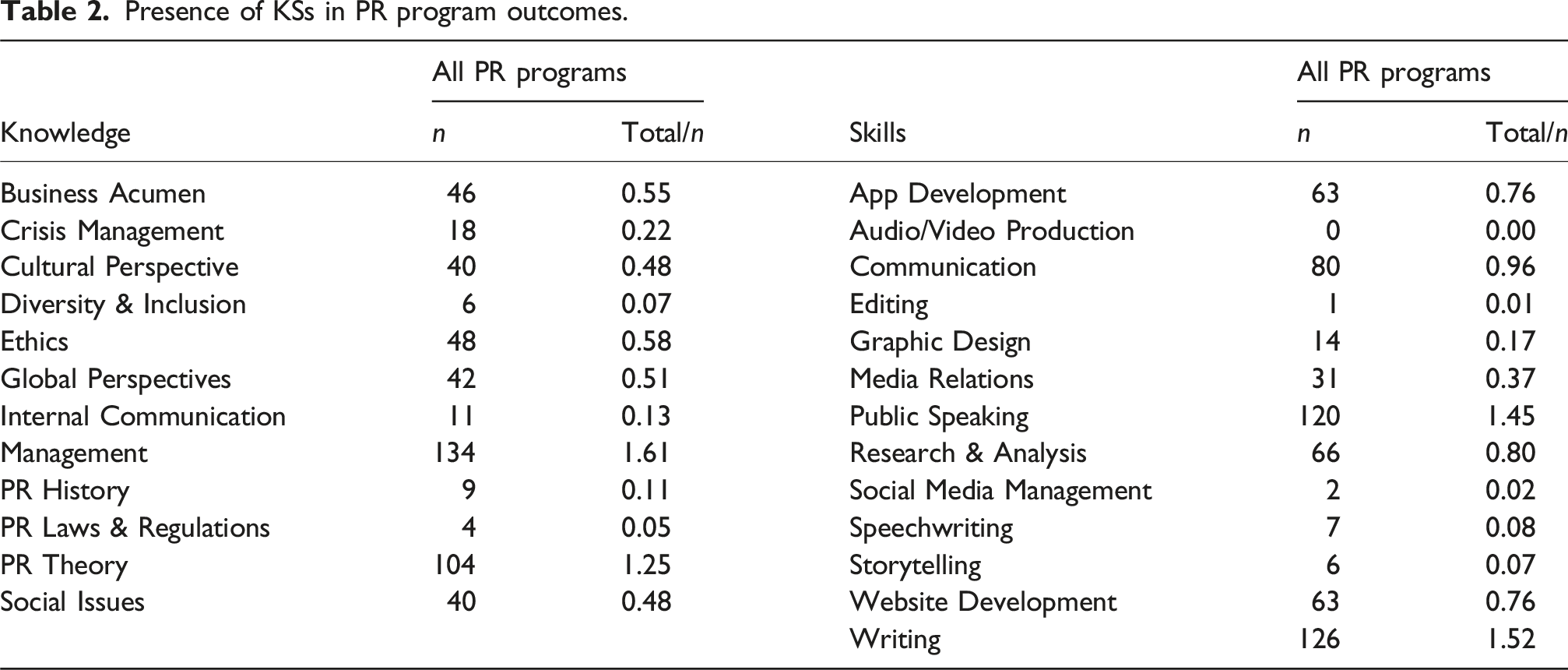
In all university types, Management was the most common type of knowledge, followed by PR Theory. PR Laws & Regulations and Diversity & Inclusion knowledge stood out as the least common types in the program outcomes of all universities. The most prominent skills are Writing and Public Speaking while on the lower end, Audio/Video Production, Editing, and Social Media Management skills have little or no presence. While linking university curricula with labor market requirements remains controversial (Jackson and Chapman, 2012), in any case, there is an evident need for graduates to gain employability skills to be provided by HEIs (Ayoubi et al., 2017).
Similar to this research, the program outcomes of HEIs have major shortcomings in the sorts of knowledge and skills that the labor market values. It is seen that the skills that are frequently included in the current workforce, especially Audio/Video Production, Editing and Social Media Management, are either absent or very little included in the HEI program outcomes. It is precisely this deficiency that the industry often criticizes that existing university curricula fall short, which is prominent in various other studies (i.e., Killingsworth and Grosskopf, 2013; Thurlow et al., 2018) and it corresponds to the criticism to tackle the practical issues in the industry that may be important to employability (Osmani et al., 2015).
The fact that PR Laws & Regulations, Diversity & Inclusion knowledge are rarely found in HEI curricula in the research findings can be considered as another indicator of the lack of up-to-date information. It is obvious that in a globalized workplace, intercultural competence is an important employee feature for effective communication and interaction across cultures and contexts. While some researchers (Walker and Black, 2000) have cited poor faculty skills and a lack of institutional resources as a rationale for similar problems, one of the more fundamental problems is that many practitioners are inherently opposed to aligning undergraduate curricula with industry requirements and therefore challenge strategies for curriculum. It can be thought of as a resistance to change like renewal (Jackson and Chapman, 2012). As Auger and Cho (2016) point out, PR programs in particular are still lacking in requirements for business courses in the curriculum. This proposition, which seems to be justified from an academic point of view, actually constitutes the idea of higher education in a larger context that involves more than the acquisition of the knowledge and skills necessary to obtain a career in a particular field (Fallows and Steven, 2000). However, the gap that exists between what is taught at school and the skills required to perform on a job is so wide that a high percentage of young graduates are said to be unemployable for lack of needed skills that would make them profitable for any employer (Ayofe and Ajetola, 2009). Considering the rapidly changing workforce needs, graduates need to foster skills in managing ambiguity (Burke and Macdermid, 1999). As can be understood, there is a need to strike a balance between the nature and basic structure of HEIs and workforce practices.
Study 2: Survey results
Does theory meet practice? Perspectives of educators and practitioners
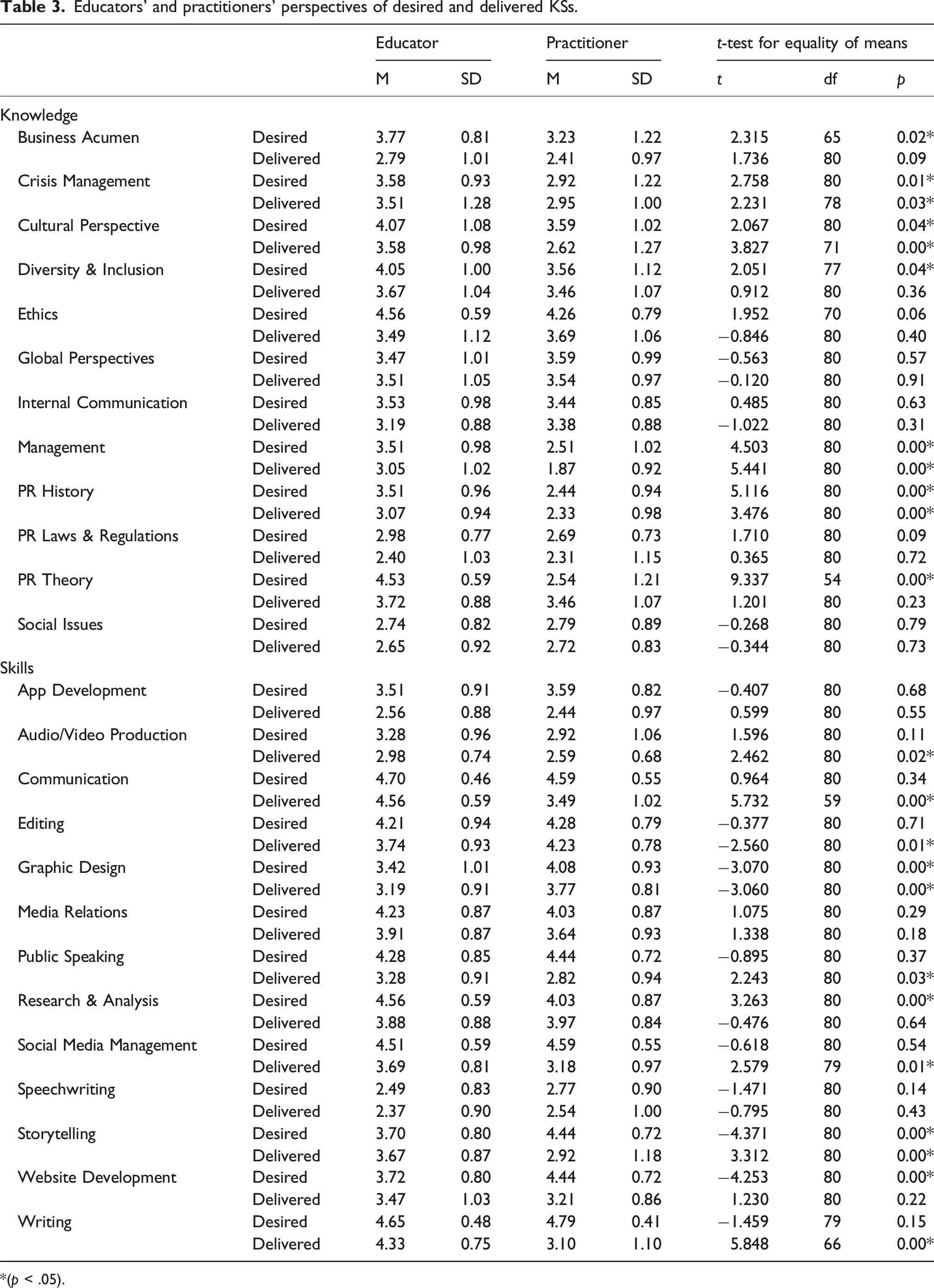
Educators’ and practitioners’ perspectives of desired and delivered KSs.
*(p < .05).
Regarding the extent to which the necessary knowledge is delivered in PR programs, educators claim that the minimum delivered knowledge areas are PR Laws & Regulations, Social Issues, and Business Acumen, meanwhile practitioners listed Management, PR Laws & Regulations and PR History among the less delivered knowledge areas. In terms of skills, according to educators Speechwriting, App Development and Audio/Video Production are not adequately acquired, and practitioners likewise believe that App Development, Speechwriting and Audio/Video Production skills were insufficiently provided to undergraduates.
It was also found that educators place a higher value on the study of Business Acumen, Crisis Management, Cultural Perspective, Diversity & Inclusion, Management, and PR History than practitioners when comparing the two groups’ key knowledge preferences for PR graduates. Regarding skills, it has been discovered that educators place a higher value on Research & Analysis, whereas practitioners place more emphasis on Graphic Design, Storytelling, and Website Development.
When comparing how educators and practitioners differ statistically in terms of the knowledge gained, it has been found that educators rate the knowledge gained by PR graduates as high in all areas of Crisis Management, Cultural Perspective, Management, and PR History, but practitioners do not indicate a higher level of gain than educators on any subject. Regarding the acquired skills, educators feel they equip PR graduates with Audio/Video Production, Communication, Research & Analytics, Social Media Management, Storytelling skills, while practitioners express the presence of Editing and Graphic Design skills in PR graduates.
As per the research’s findings, educators and practitioners both emphasize the key knowledge reported in the literature (e.g., DiStaso et al., 2009; Thurlow et al., 2018) in terms of desired KSs. In addition to this anticipated result, it is understood that practitioners place a greater emphasis on technical skills such as Graphic Design, Storytelling, and Website Development, which are thought to be more crucial in the workplace, while educators focus exclusively on expertise such as PR History and Research & Analysis, which are also significant in curricula.
When the desired and delivered information is taken into account, this viewpoint is equally evident. While educators believe that graduates acquire a broad range of knowledge and skills, practitioners contradict this. In fact, these participants brought up the fact that graduates lack access to knowledge in areas like Management, App Development, and Audio/video Production, all of which have the potential to be extremely important and should be kept prevailing (Jeffery and Brunton, 2010; Robles, 2012; Woodward et al., 2010). Given that ICT literacy and associated disciplines must be integrated into the curriculum at all levels of school, this circumstance highlights a critically important gap (Ayofe and Ajetola, 2009; Rosenberg et al., 2012).
One of the most striking findings in this part of the study is that although educators think that graduates gain a lot of KSs, practitioners do not indicate a higher knowledge gain in any knowledge than educators, but they stated that this gain is achieved in very few skills. It is evident from this difference between educators and practitioners that the education world does not provide adequate feedback on graduates from practitioners and the needs of the business world does. However, it is known that skill delivery and graduate competencies are poor (Trung and Swierczek, 2009). Also, skills and competencies required for most occupations today differ from those required in the twentieth century due largely to the emergence of complex information and communication technologies (Dede, 2010) and educators are sometimes criticized (Lee et al., 1995) for providing outdated information to the graduates. As Abbasi et al. (2018) stated, education and industry are inter-related and the output of the education system is input of the industry. Besides PR has been featured as an applied science and a management discipline in communication theory (Pieczka & L'Etang, 2006) which makes this field require a close relationship between theory and practice.
How much is desired and how much is delivered? Educators’ and practitioners’ evaluations of KSs of PR graduates
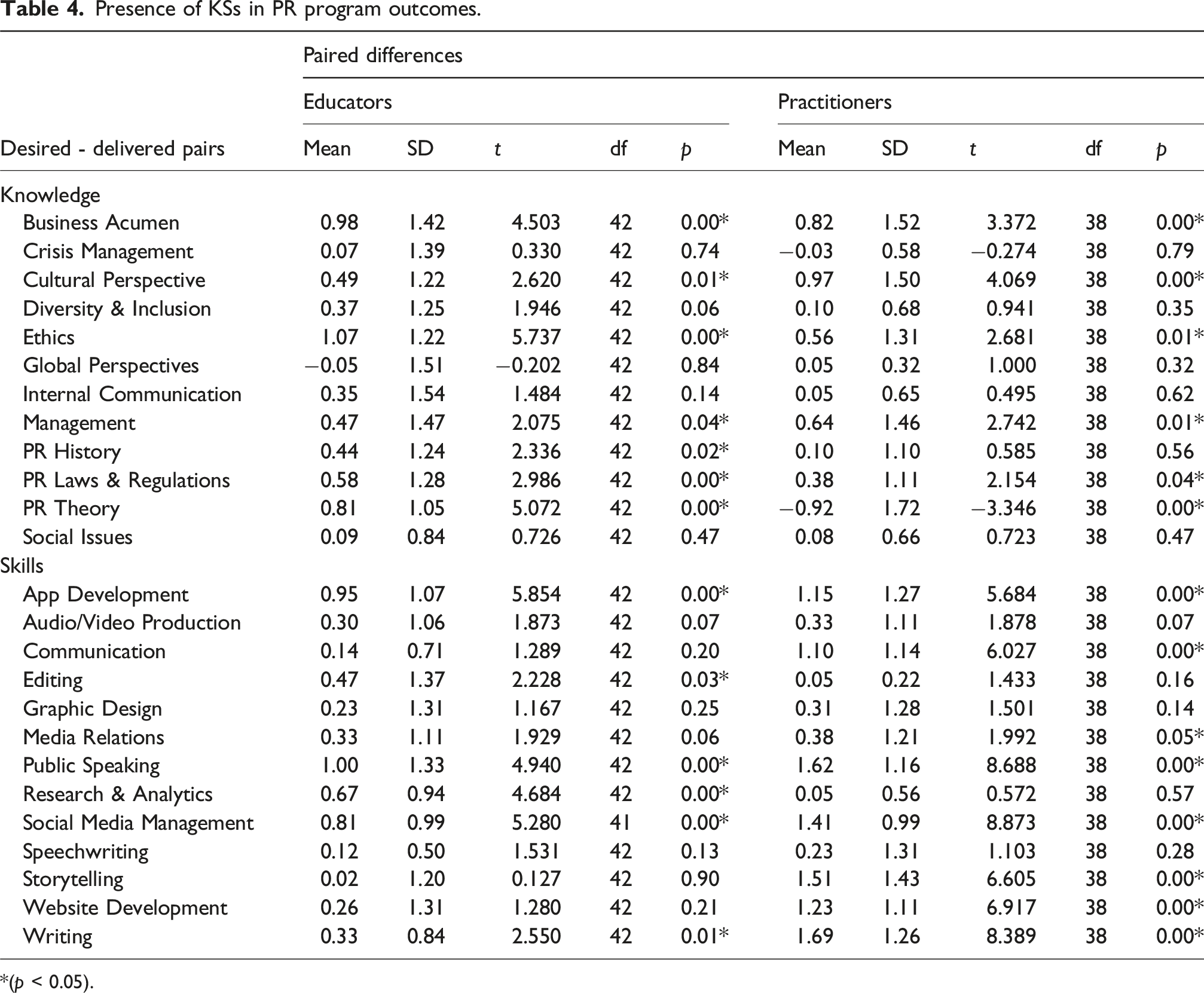
Presence of KSs in PR program outcomes.
*(p < 0.05).
When comparing the levels of desired and delivered skills, educators found that in the areas of Writing, Editing, Public Speaking, Research & Analytics, Social Media Management, and App Development, the delivered levels of skills were lower than the intended levels. While practitioners predicted a difference between the level of being desired and delivered in the same skills as educators other than Research & Analysis, and it was observed that the Communication, Media Relations, Storytelling and Website Development skills were delivered at a lower level than desired.
This study supports the notion that graduates lack the necessary level of skills to function in the workplace (Abas-Mastura et al., 2013). The difference between what is needed or desired and what is actually provided is known as a skill gap (Ayofe and Ajetola, 2009). The fact that practitioners and educators in this study both indicate a lack of ability in several fields is quite significant. The knowledge gap that this study found has also been discovered in a number of other publications. Entrepreneurial needs and aspirations, which are known as an auxiliary factor in the transition to business life after higher education and can be seen primarily as an indicator of Business Acumen and Management, indicate an important need that HEIs cannot use or sufficiently provide (Collins et al., 2004; DiStaso et al., 2009). The government policy and the requirement to provide students with entrepreneurial KSs are both driven by the absence of graduate employment, which is also extremely obvious and frequently documented (Collins et al., 2004). Again, the lack of Cultural Perspective of PR graduates, as recent public relations scholarship has acknowledged, the impact of globalization, and highlighted diversity in practices in different socio-cultural contexts (Bardhan and Weaver 2011; Fitch and Desai, 2012) is an important deficiency in this regard. Finally, a number of researchers have also noted the obvious knowledge gaps in PR History, PR Laws & Regulations, and PR Theory (e.g., Flynn, 2014; Robles, 2012; Woodward et al., 2010).
The distinct problems that emerge, particularly among educators and practitioners, when the skill gap is addressed in terms of skills stand out. One of them, Communication, such as presentations, in organizations is highly valued by employers (Baugh et al., 2009; Payne, 2005) can be considered one of the remarkable skills. In the literature, there is great emphasis on communication skills which suggests that employers are looking for (Simon and Jackson, 2013). Because graduates can utilize communication skills to build relationships and communicate with others to maximize future performance (Lievens and Sackett, 2012), and because interpersonal skills assist workers in transitioning to supporting roles when they first enter the workforce (Saeed, 2015).
Conclusions
As a pervasive problem in other disciplines, this study attempted to investigate the skill gap among recent graduates in the PR industry. Trung and Swierczek (2009) claim that because academic institutions’ curriculum objectives largely disregard employers’ needs, the skills development they provide does not meet the needs of their clients. In addition to looking at HIEs’ curricula from a competency-based perspective, efforts were made to resolve the tricky subject of evaluating practitioners’ and educators’ subjective perceptions. However, in accordance with prior research findings (Neff et al., 1999), our present study indicates that there exists a degree of consensus between academic institutions and industry professionals regarding the relevance of the KSAs encompassed within HE programs. The findings of a recent study conducted in Turkiye, in which PR professionals assessed the content of HE programs, indicate that the skills acquired in higher education are deemed essential but insufficient in current sectoral conditions (Oksuz and Gorpe, 2023). One possible reason for this may stem from the breadth of industries in which PR professionals are engaged. Meganck et al. (2020) state in their study of 1000 job postings that the talent and skill need of different PR job titles vary. As evident in our study, the emergence of new skills necessitates not so much rendering previous skills obsolete but rather complementing these foundational skills (such as writing and public speaking, etc.) by fostering their application and enhancement within the digital context through the acquisition of additional skills. In prior studies, it has been asserted that traditional professional skills serve as a foundational framework for the application of emerging digital competencies within the field of PR (Paskin, 2013). One could draw the conclusion that contemporary PR practitioners need a wider skill set than their predecessors who practiced in the twentieth century given the recent rapid and fundamental changes in the business, media, and communication sectors (Flynn, 2014).
It is occasionally advised that university programs be tailored to improve graduates’ employability in order to address such ongoing gaps between graduate qualifications and the demands of the labor market (e.g., Ayofe and Ajetola, 2009). Thurlow et al. (2018) hypothesized that this deficiency might be a result of the amorphous nature of PR and its functions. A feasible first step may be to assess the programs on a regular basis to check for internal and external accountability or to see if the curriculum has lost coherence (Bajada et al., 2019). Once more, as Bajada et al. (2019) also highlighted, it is essential to have a systems-wide framework that addresses both sectors of work and education growth.
Post-pandemic research underscores that hybrid work models and AI-facilitated communication necessitate universities to reformulate curriculum concerning adaptive digital literacies and ethical decision-making (Jackson and Bridgstock, 2021; O’Brien, 2022). These developments underscore the ongoing necessity of revisiting the knowledge-skills alignment identified in the current study.
Additionally, this study has some significant limitations. First of all, different scholars and practitioners employ diverse definitions of what skills are, which makes it difficult to contextualize. In addition to the semantic ambiguity, skills are frequently referred to as competencies, capabilities, qualities, elements, or learning outcomes in a variety of publications, including government reports, scholarly studies, and practitioner manuals (Bennett et al., 1999). Similarly, the classification of skills in this study was primarily based on technical skills, however it is commonly accepted that undergraduates must also develop non-technical skills (Hancock et al., 2009). As a result, attempting to gauge the discrepancy between what is desired and what is provided is restricted to only conceptualizing the skills contained within the taxonomy employed in this research.
The philosophy and objectives of higher education are connected to another limitation of this study. Industry and accreditation organizations increasingly demand that HEIs include non-technical skill development in undergraduate programs. As a result, responsibilities are gradually being transferred from the workplace to the classroom (Cassidy, 2006). This propensity and emphasis on employability drive higher education and the undergraduate degree it delivers is loaded with professional competencies rather than knowledge-based understanding (Kirp, 2003; Starkey et al., 2004). Whatever position we take in the above discussions, employment-oriented traits are a huge reality that new graduates face. As we have seen in the PR example, this ambiguity on learning needs and the degree of delivery of KSs is an area that is subject to differing approaches. This discrepancy in approach arises from the incongruity of the formal objectives we introduce to the youth we rely on for the future.
In line with the research questions that guided this study, the findings suggested that (1) the relationship between PR program outcomes and the CPRE taxonomy is ambiguous, with numerous current competencies inadequately represented; (2) educators and practitioners exhibit significant discrepancies in their assessments of graduates’ required and obtained knowledge and skills, particularly with regard to technical and digital competencies; and (3) a distinct gap exists between what is needed and realized levels of these competencies. These results collectively emphasize the ongoing need to realign higher education curricula with sector expectations, confirming that bridging this gap needs regular interaction between academia and industry counterparts.
Footnotes

Ethical considerations
This study was conducted in accordance with the principles of the Declaration of Helsinki and was approved by the TED University Human Research Ethics Committee (Approval Decision No. 26.05.2022-16502). Data collection commenced upon the completion of ethical approvals and the requisite legal authorizations.
Consent to participate
At the onset of the study, participants were provided with comprehensive information regarding the nature of the study, privacy policy, and conditions of participation using a written informed consent to participate which was obtained from all the participants.
Consent for publication
Written informed consent for publication was obtained from all participants confirming their agreement to the publication of relevant details in this article. All non-essential identifying information has been omitted to protect the participants’ confidentiality. In accordance with the journal’s policy, the authors confirm that the original written informed consent forms are securely stored and will not be submitted with the manuscript to preserve confidentiality. These documents are available upon request by the journal’s editorial office.
Author contributions
Author 1: Methodology, Visualization, Roles/Writing - original draft, and Writing - review editing. Author 2: Conceptualization, Data curation, Formal analysis, Validation.
Funding
The authors received no financial support for the research, authorship, and/or publication of this article.
Declaration of conflicting interests
The authors declared no potential conflicts of interest with respect to the research, authorship, and/or publication of this article.
Data Availability Statement
The data that support the findings of this study are available on request from the corresponding author, [OY]. The data are not publicly available due to the sensitive nature of the questions asked in this study, survey respondents were assured raw data would remain confidential and would not be shared.
Declaration of generative AI in scientific writing
During the preparation of this work the authors did not use any generative AI tool/service and takes full responsibility for the content of the publication.