




Abstract
This study explores how debt relations entrap workers through complex power dynamics involving employers, intermediaries, and local lenders. Using a Foucauldian framework, we introduce the concept of the dispositif of debt bondage to analyse how debt produces bonded subjects while maintaining control via everyday life practices. Central to our study is a 14-minute documentary – Of Labour and Love, which depicts lived experiences of debt-bonded kiln workers. Our analysis demonstrates that debt bondage is not merely an isolated exploitative labour arrangement but a structural feature of labour relations, particularly in Indian brick kilns, deeply embedded in relations of exchange, power and meaning. The paper contributes by extending the understanding of debt bondage as a set of relations that shape and control behaviours, making work on self essential for the reproduction of indebtedness and subsequently producing debt-bonded labour.
Introduction
Indebtedness is a normalised condition in contemporary societies (Charbonneau and Hansen, 2014; Evans and Gregson, 2023; Langley et al., 2021; Lazzarato, 2012; Montgomerie and Tepe-Belfrage, 2019). Mortgages, consumer loans, credit cards, student loans, or payday lending have become routine, making it difficult, if not impossible, to evade. This normalisation and prevalence of debt have produced what Lazzarato (2012) theorises as the indebted subject. Lazzarato addresses a core concern: the subjective dimensions of indebtedness. Indebtedness, in this account, is not merely economic but “immediately subjective”, producing subjects who follow specific imperatives that are functional for the reproduction of debt as a key paradigm of social relations (Di Feliciantonio, 2016: 1209). For Lazzarato (2012: 30), the indebted subject embodies a particular form of homo economicus, 1 for whom the creditor–debtor relation supersedes other relations, such as capital–labour or consumer–corporation.
While this theorisation has been influential, particularly within critical political economy, it remains largely grounded in the institutional logics of advanced capitalist economies in the Global North. Much less attention has been paid to contexts in which financial infrastructures are informal, coercive and embedded within everyday relational practices. In countries such as India, credit is not extended (or administered/regulated) only by formal financial institutions but also by informal entities like employers, labour intermediaries, landlords, and local shopkeepers (Carswell et al., 2021; Guérin et al., 2015). In these settings, debt operates not simply as a financial mechanism but as a modality of control, dependency, and discipline. It produces conditions of bondage that are woven into the social fabric of everyday life and labour.
The most widely cited definition of debt bondage is articulated in the United Nations (1956) Supplementary Convention on the Abolition of Slavery, which describes it as a condition in which an individual pledges their labour (or that of someone under their control) as collateral for a loan, without clear limits on the duration or value of work to be performed. While this legal framing highlights the centrality of unrepayable debt, it tends to obscure the phenomenon from the broader social, affective, and institutional conditions that produce and sustain it.
Research has traced how debt relations are embedded within global value chains, household economies, and community-level social hierarchies, thereby reinforcing the structures of inequality and precarity (Phillips, 2013; Roberts, 2013; Shahadat and Uddin, 2022). Within the sociology of work and employment, scholars have increasingly argued for a shift beyond juridical definitions to explore how labour coercion operates through informal, often invisible mechanisms (Burawoy, 1979; Edwards, 1980; Wilson, 2020). In this tradition, debt emerges not merely as a financial obligation but as a disciplinary and relational device – an instrument of immobilisation that binds workers through moral obligation, kinship, and the routines of daily survival (Bear, 2015; Guérin and Venkatasubramanian, 2022; James, 2021).
Despite this growing body of literature, there remains limited attention to how debt itself operates as a structuring logic within labour regimes, how it actively shapes subjectivities, legitimates coercive practices, and configures the terrain of everyday life and work. This study responds to such calls by developing a sociological account of debt bondage not as an aberration, but as an enduring form of labour regulation, particularly in India’s brick kiln sector. Rather than focusing solely on contracts or individual choices, we unpack the socio-political dispositif (apparatus) (Foucault et al., 1988) that renders debt bondage not only possible but productive – economically, institutionally, and culturally. In doing so, we treat debt as both a mode of subjectification and a constitutive element of labour governance in informal economies. To guide this inquiry, we pose the following research question: How does the dispositif of debt bondage produce subjectivities and normalise exploitative labour within the everyday social fabric of India’s brick kiln sector?
To theorise this dispositif, we draw on Foucault’s (1977) concept of subjectification to extend the notion of the indebted subject into the realm of debt-bonded subjectivity. Subjectification allows us to analyse how debt operates not only through financial transactions but through techniques of power that produce willing and enduring forms of labour subjugation. We further develop the notion of the dispositif (Foucault, 1977), a Foucauldian analytic for tracing the heterogeneous elements (discourses, institutions, practices, affects) that coalesce around a regime of power, as a way to conceptualise the ensemble of mechanisms that produce and perpetuate debt bondage.
Methodologically, the study draws on original ethnographic fieldwork and a 14-minute documentary film, Of Labour and Love, which serves as both empirical archive and analytic object. The film recounts the lives and conditions of two workers bonded through debt to their employer (kiln owner), local lenders and grocers. Rather than simply reporting worker experiences, the filmic medium allows us to trace the spatial, temporal, and affective dimensions of debt bondage, offering a textured entry point into the dispositif we seek to theorise. We encourage readers to view the film at this point.
The study contributes to the sociology of work and employment by offering a novel conceptualisation of debt bondage as a deeply embedded and socially legitimised form of labour coercion. By foregrounding the disciplinary and relational dimensions of indebtedness, we reframe bonded labour as a systemic and socially reproduced condition, rather than an individualised or contractual aberration.
The structure of our analysis unfolds in three parts. We begin by developing the theoretical lens through which we examine the entanglements of exchange, power, and meaning that underpin the coercive recruitment of labour into debt bondage. We then turn to a methodological reflection on the use of film as a form of empirical material. The final section presents our analysis of the empirical case, drawing on visual ethnographic methods to trace the embodied and spatial dimensions of labour exploitation.
Debt, subjectification and bondage: Theoretical underpinning
Debt, as a transactional relation, has existed for thousands of years, although its meaning has evolved from moral obligation to economic instrument (Graeber, 2011). The social dynamics of debt are shaped by individuals’ relationships to the state (e.g. citizenship status), racial hierarchies and gender norms. In other words, debt shapes how people live and work, often in ways that reinforce existing inequalities. However, for purposes of this paper, we limit our discussion of debt to the labour relations involving indebtedness and, in some cases debt bondage.
Mainstream economic thought typically frames debt as a voluntary exchange, which is temporal and involves securing present consumption by pledging future labour (Featherstone, 2020; Peebles, 2010). This framework centres on individualised decision-making within a market for debt, where rational agents are assumed to weigh costs and benefits autonomously. In contrast, critical scholars, particularly from Marxian traditions, see debt as a structural mechanism that deepens worker exploitation. Here, debt is not merely a contract but a tool of capital that intensifies surplus extraction by binding labour more tightly to production (Banaji, 2003; Brass, 1999, 2008; Rao, 1999a, 1999b). Harvey (1989) calls this “accumulation by dispossession”, where everyday needs become opportunities for capital expansion.
This critique extends to labour contracts. Rather than signalling parity, labour contracts are seen to mask the underlying asymmetries of dependence and exploitation that define the wage relation (Morishima and Catephores, 1978; Wolff, 1999). For indebted workers, these asymmetries are further compounded. Debt acts as a double burden: not only are workers exploited through wage labour, but the value they produce also funds interest repayments, further entrenching them in cycles of obligation. This creates a self-reinforcing cycle in which precarious labour is sustained by financial obligation.
Brass (1999, 2008, 2014; Brass and Van der Linden, 1997), writing from a class-relational perspective, argues against the notion that debt-bonded labour is a remnant of pre-capitalist relations. Instead, he contends that such subordinated labour forms are entirely compatible with contemporary capitalism and indeed function as disciplinary mechanisms that cheapen labour. For Brass, debt operates as a form of labour control, curtailing mobility and bargaining capacity, thereby embedding workers within exploitative circuits of production and reinforcing class domination.
Alongside this structural analysis, another strand of scholarship focuses on how debt shapes the self. Drawing on the work of Graeber (2011), Hardt and Negri (2017), and Marazzi (2011), such scholarship argues that indebtedness is not only economic but personal and political. These perspectives frame debt as a moralised form of coercion. Indebtedness produces compliant subjects who internalise the obligation to repay, thereby engaging in self-exploitation in the service of creditors. Debt, in this reading, is not simply an economic relation, but a political and ethical project of subjugation. Rather than being externally enforced, debt operates through an internalised obligation. The indebted subject comes to feel personally accountable for repayment and thus becomes complicit in their own exploitation (Hardt and Negri, 2017).
This view is articulated in Lazzarato’s (2012) concept of the indebted subject. He argues that debt produces a specific kind of subject who is responsible, compliant, and committed to repayment. Crucially, this subjectivity is produced not through force, but through consent. Individuals come to see themselves as morally bound to repay what they owe, and they shape their lives accordingly. However, Lazzarato’s account is largely abstract and focused on advanced capitalist societies. It offers little insight into how debt operates in informal economies or within precarious labour regimes. This paper aims to fill that gap.
To do so, we turn to the Foucauldian (1977, 1980, 1982) concept of subjectification, which helps explain how individuals come to understand themselves as subjects through practices of self-regulation. In The History of Sexuality, Foucault (1978) explained that individuals recognise themselves as subjects (of sexuality) by learning and practising ideal behaviour. Subjectification, therefore, points to the practices through which the subjects are led to observe, analyse, interpret and recognise themselves. In other words, it is via subjectification that people turn into subjects who internalise a generalised understanding about their self and identity.
In his later work, Foucault (1982) offers two meanings for the term subject: subject to other through control or dependence, and subject tied to one’s own identity (self) by knowledge of self or conscience. While the meanings are interrelated and point to a form of power that produces subjects or subjugates, it is the practices and procedures of the latter that subjectification refers to – the production of a subject as an object for self. Foucault’s empirical focus, however, remained largely on medical and penal institutions, with relatively less attention paid to the institutions of work, family, religion, and community life. Nevertheless, many of the disciplinary practices and technologies of power he identified remain highly relevant to understanding the dynamics of debt-bonded labour (e.g. Raffnsøe et al., 2019).
So, a Foucauldian analysis, as it bears on debt-bonded labour, would necessarily begin with tracing the techniques through which debt disciplines and shapes the worker. Subjectification, in this context, refers to how indebted individuals come to see themselves as responsible, self-monitoring, and morally obligated to fulfil their debt through labour. This aligns with Foucault’s notion of working on the self as a form of biopolitical governmentality (Di Feliciantonio, 2016: 1210)– a technique of governance aimed at managing behavioural uncertainty. Indebted workers often internalise their obligations not just as economic necessity, but as moral duty tied to their roles as caregivers, parents, or providers (Dardot and Laval, 2014). In this way, debt acts as an invisible manager, enforcing productivity and self-discipline.
However, the process of subjectification, given the multitude of practices and contexts within which it may take place, offers very little use as an analytical concept. To address this, we turn to the concept of dispositif. Dispositif, or apparatus, allows us to examine how various social, institutional, and ideological elements interact to shape subjects and structure conditions of possibility. Foucault describes dispositif as a thoroughly heterogeneous ensemble produced by the dynamic interplay of forces – institutional, legal, rational, and so on – that interact, sometimes reinforcing and sometimes negating one another (Foucault and Ewald, 2003: 45).
Originally used in film theory to explore how cinema shapes perception (Baudry and Williams, 1974), the concept of apparatus was later developed by Deleuze and Guattari into a broader sociological tool (Deleuze et al., 1986). This version of dispositif highlights how ordinary practices, spatial arrangements, and institutional logics work together to produce governable subjects (Collett, 2020; Eriksson, 2005; Legg, 2011). Their framing, particularly in relation to analysis of cinema (or film), offers a framework for including specific practices and techniques embedded in social conditions (Deleuze, 2019). In other words, such analysis suggests an alternative framework for turning mundane problems into objects of regulation (Villadsen, 2021). In our study, it provides a framework for analysing how indebtedness is constituted through the intersection of social, economic, and emotional forces.
We use the idea of a dispositif of indebtedness to explore how subjectification produces both the indebted subject and the productive self, expected under debt relations. Building on Lazzarato (2012), we examine how certain spatial and temporal elements work together to embed and sustain debt bondage. Temporal elements include loan advances, repayments, and the rhythms of employment. Spatial elements refer not only to material deprivation (such as poor housing or lack of food) but also to the intimate, everyday relationships, like love and family, that are mobilised to enforce obligation. Although not spatial in the conventional geographic sense, these relationships anchor indebtedness in lived social spaces.
Building on the analytical framework developed above as a starting point and the film as the centrepiece for our analysis, we aim to unpack the process of subjectification in debt bondage. By engaging both visuals and text, we demonstrate how structural forces (such as employer control), and subjective experiences (such as moral responsibility) converge in the lived realities of debt. Such a framework emphasises the tensions between the structural workings (violence) of debt and subjective character of indebtedness as quintessential power relations structuring debt bondage. It reveals the complexities in the making of the debt-bonded labour and unpacks the connections and disconnections in the dispositif of debt-bondage, which we argue, oscillates between different elements and thus emerges for the observer as something that depends on the specific set of relations that renders it visible and thinkable.
In sum, our conceptual framework brings together Marxist critiques of labour exploitation, Foucauldian analyses of subject formation, and visual research methods to show how debt produces both material dependency and moral subjectivity. The dispositif of debt bondage is thus both a structure of power and a lived experience. To that end, we ask: How does the dispositif of debt bondage produce subjectivities and normalise exploitative labour within the everyday social fabric of the brick kiln sector?
Methodological apparatus
This study adopts a mixed-methods design that integrates ethnographic fieldwork with visual research, centred on the production of a short documentary film, Of Labour and Love. The film provides both the empirical grounding and a critical analytic lens for the inquiry. Rather than simply reporting worker experiences, the film functions as an entry point into the dispositif of debt bondage, traced through spatial, temporal and affective dimensions of everyday life. The visuals and narrations are treated not as illustrative supplements but as analytic artefacts through which everyday governing practices and techniques of power become visible (Foucault et al., 1988). The narrative centres on two speakers, Raju and Satender, who work in Indian brick kilns. Informed by Beutin’s (2023) critique of anti-slavery media, the film avoids sensationalist and colonial framings by prioritising participants’ own perspectives and everyday lives.
Visual methodologies, particularly video-based approaches, have gained traction in the study of complex social phenomena (Hietanen and Rokka, 2018; Wood and Brown, 2011; Wood et al., 2018). When combined with dialogic methods, they generate layered forms of insight that unsettle hierarchies of knowledge and deepen analytical engagement (Gloor and Meier, 2000; Harper, 2002; Pink, 2013). This is especially relevant in “boundary-crossing” research contexts (Giroux, 1992), where significant asymmetries of power shape knowledge production.
Our approach is epistemologically aligned with emancipatory traditions and methodologically informed by participatory research (Oliffe et al., 2008). The use of film enabled the incorporation of workers’ perspectives while remaining attentive to the structural privileges typically held by university-based researchers (Denzin and Lincoln, 2008). Reflexivity was treated as a central methodological commitment, with sustained attention to how knowledge claims related to participants’ lived experiences. The documentary format functioned not only as a mode of representation but also as a form of knowledge production and dissemination (Bell and Davison, 2013). In this sense, the film operated as a contextual signifier, communicating the values, expectations and social worlds of those represented (Kellehear, 1993). In such settings, visual methods function as reflexive devices, enabling alternative modes of seeing, knowing and representing.
Research context
The research is situated in the Indian brick kiln sector, a context widely recognised for exploitative labour practices and structural inequalities 2 (Andersson et al., 2019; Bales et al., 2009; Breman, 2010; Breman et al., 2009; ILO, 2017; Kara, 2017). The kiln featured in the film reflects stark asymmetries of caste, class and access to land. Workers are internal migrants from marginalised communities who routinely encounter caste-based discrimination (Acharya and Naranjo, 2018; Carswell and Chrispal, 2020; Oosterhoff et al., 2018; Samonova, 2019).
The kiln employed approximately 42 permanent workers and 200–250 seasonal workers, including clay moulders (Bharaye waale), bakers (Jalaye waale), and loaders (Dholaye waale), most of whom worked under conditions shaped by wage advances and recruitment through Sardars (intermediaries). Workers typically took advances ranging from two months’ wages to a full production season, deepening cycles of debt-based entrapment.
Field immersion, consent and ethical practice
This study was conducted under formal ethical approval granted by a New Zealand university in 2019 as part of the lead author’s doctoral research. 3 Ethical clearance was obtained prior to the commencement of fieldwork and filming.
Before filming commenced, the first author joined a Sardar on a recruitment trip and spent extended time in workers’ home villages to build rapport and deepen contextual understanding. While access to the kiln was facilitated by a regional contractor and the kiln owner, participation in the research and the film was not derived from site permission alone. Informed consent was sought directly from all participants, particularly the two central narrators.
Consent was secured through ongoing engagement in participants’ native languages. Participants were informed that visual recording would take place and that their identities might be visible to audiences beyond their immediate community. Consent was treated as an ongoing and revisable process, with participants given repeated opportunities to withdraw, refuse recording, or limit the use of specific footage.
Filming took place over eight weeks across two kiln sites in northern India. Following production, the completed film was screened to both the kiln owner and the participants, including the two central narrators. This enabled participants to view and reflect on their representation and to suggest omissions or revisions. No objections were raised, and participants affirmed their willingness for the film to be publicly disseminated.
Given the visual nature of the methodology, complete anonymity was neither claimed nor promised. Instead, ethical practice centred on minimising harm, avoiding sensationalism and preserving participants’ dignity through careful framing, editing and circulation decisions.
From video to the film
In producing the film, we used Adobe Premiere Pro, a professional video editing platform, and employed cinematic techniques such as match cuts, ambient sound layering, and voiceovers to evoke narrative continuity and affective depth. Match cuts, transitions that link two distinct shots through visual, spatial, or thematic continuity, were used to signal symbolic or material connections across scenes (Bordwell and Thompson, 2013). The process involved distilling over 11.5 hours of footage into a 14-minute narrative. This editing was guided by both methodological intent – using images as analytic artefacts – and aesthetic judgement, aimed at producing a “force of sensation”. In doing so, the film functioned not only as a medium of representation but also as a site of inquiry, opening up new modalities for engaging with and communicating the embodied dimensions of labour exploitation.
Following Guba and Lincoln’s (1994) interpretivist stance, we approached visual representation as inherently plural and situated. The notion of unmediated representation is challenged by apparatus (dispositif) film theory (Baudry and Williams, 1974) and further contested by video editing technologies. These tools allowed us to foreground the subjective and relational dimensions of bonded labour – emotions, silences, and gestures not always visible through conventional ethnographic methods (Henley, 1998). In this study, these subtleties were meticulously documented and journaled by the lead author during ethnographic fieldwork.
The film emphasised the subjectified debt-bonded labourer, who takes on a dramaturgical quality through its interaction with the camera (Miko-Schefzig et al., 2022). The camera thus amplifies and reinforces the concept of the produced self. This process occurs within a specific context (e.g. Indian brick kilns) unveiling practical insights, often inaccessible through conventional ethnographic methods, but emerging naturally from the structured filming environment. This environment enabled emotional expression and narrative depth, transforming the film into more than a record. Thus, film becomes a tool for academic inquiry when it moves beyond being a simple visual record to convey meaning through gestures, body language, and other sensory elements, as highlighted by Wood et al. (2018).
Finally, to preserve the authenticity of the narrative, the storyline was edited in alignment with well-established conventions in documentary cinema (De Bromhead, 1996; Vernet, 1988). The narrations and visuals were presented to the participants in the film, and their suggestions sought for any omissions or additions. This approach ensured that the material was not distorted, maintaining the integrity of the visual artefacts while enhancing their communicative power. So, the film served as a medium to foster a deeper understanding of the situations depicted. In making this claim, we position the film as akin to academic writing, where mastery of language and adherence to scholarly conventions are employed to communicate complex ideas effectively. In this sense, the film leveraged cinematic conventions to depict the lived experiences of debt-bonded labourers with sensitivity and precision, not as a supplement to analysis but as a methodological site in its own right – one that foregrounds the spatial, affective, and temporal contours of debt-bonded labour.
In the next section, we analyse the film in relation to the dispositif of debt bondage, focusing on its spatial and temporal articulation in the lives of kiln workers.
Discussion of the film – the dispositif of bonded labour
This section presents our analytic discussion of the film, drawing on visual ethnographic methods and Foucauldian concepts to trace how the dispositif of debt bondage produces specific subjectivities and structures everyday labour. To that end, we used the dispositif of indebtedness (Figure 1) as our ideologically informed analytical framework for interpreting the film. This discussion, therefore, seeks to unpack the process of subjectification in debt-bonded labour and construct the dispositif of bondage. Our objective is to reveal the complex connections and disconnections, both visible and hidden, between the heterogeneous elements of the dispositif as situated in workers’ everyday lives. This interpretive engagement foregrounds the disciplinary power of debt, as manifested in the calculative practices and constrained life worlds of debt-bonded labourers narrated in the film – a dynamic otherwise difficult to render visible.
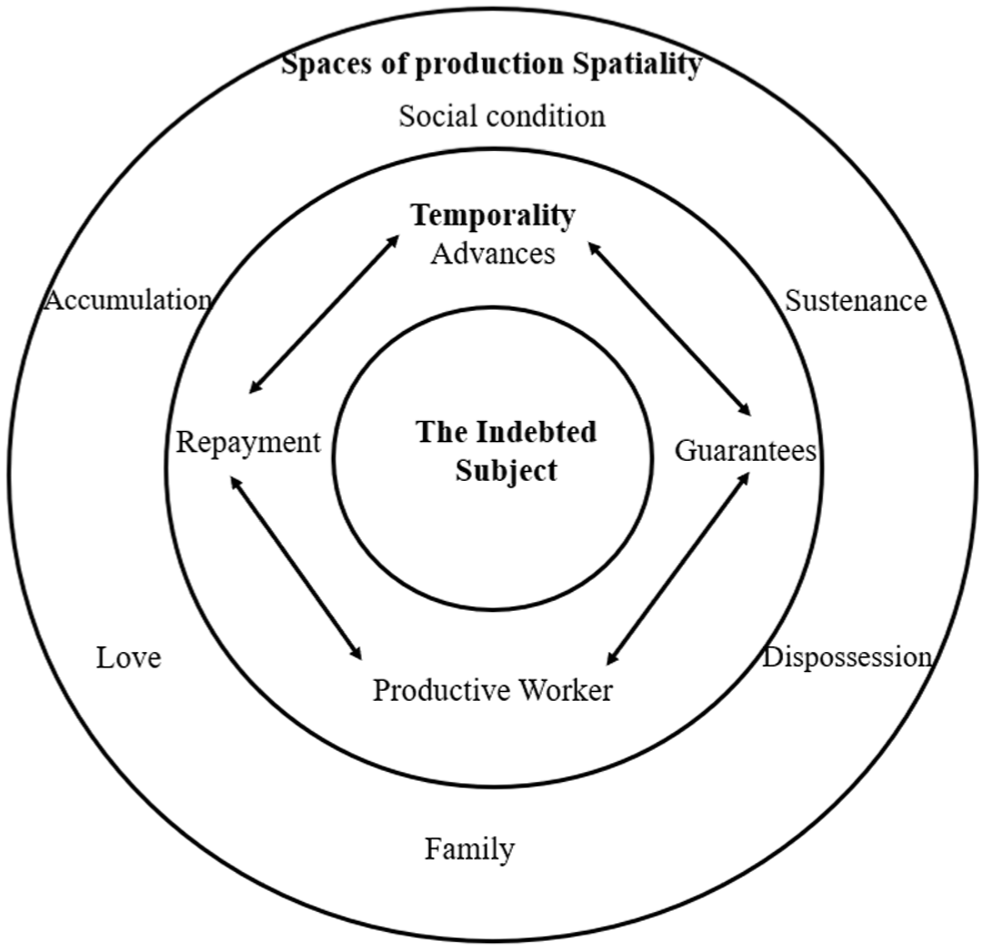
The dispositif of indebtedness.
The discussion is structured into two interrelated domains: spatial and temporal. While these domains are treated separately for analytical clarity, we recognise that they often overlap in practice. For example, decisions about food (a spatial issue) may be shaped by wage cycles or repayment timelines (temporal issues). Instead of separating these dimensions rigidly, we highlight how they interact dynamically within the dispositif of debt bondage.
Each subsection focuses on a key element of this dispositif. First, we examine how debt binds labourers through spatial practices involving food, housing, and romantic relationships. Then, we explore the temporal logics of advances, repayments, and seasonal labour cycles that entrench workers in bonded conditions. Overall, we show how these elements converge to produce the indebted, productive subject – a worker who not only labours under obligation but internalises debt as a moral responsibility.
Spatial production of debt-bonded labour
The spaces of production include the physical spaces as well as the social spaces characterised by the social relations and practices. Here we analyse how the spatial dimensions of debt bondage in India’s brick kiln sector operate through three interconnected domains: sustenance, housing, and intimate social ties. These elements are not merely background conditions but active components in the reproduction of dependency. In other words, we show how spatial needs (what people eat, where they live, and whom they care for) are shaped by debt and, in turn, reinforce workers’ subjectification.
Sustenance: Sustenance generally refers to the act of maintaining something or someone in life or existence. Food is fundamental to this, and because creation of surplus value depends on the “living character” of the labour (Martin, 2011), food occupies a significant prominence in production processes and, in this case, the (re)production of the debt. Narrations in the film frequently referenced food. Raju discussed his family’s struggles and spoke of food in relation to his father’s work while growing up in his hometown and his own work at the brick kiln in relation to his own sustenance and that of his family. In his narrative account, food is intimately connected to the conditions in which the labour (bonded or otherwise) operates. It creates a space that transcends the boundaries of time and place. This is particularly evident when a lack of means to buy food helps create predatory debt relations. For example, Satender (at about 6:40) talked about the debt he owes to the grocer in his village for food purchased during the non-production months. He immediately stated the resolve to pay the debt, calculably conscious of sustaining continued sustenance in both the production and non-production seasons i.e. at work and at home, which, in this case of migrant kiln workers, is 700 miles away.
Food, therefore, occupies a vital position in the conceptual spaces within which bonded labour exists. In the dispositif of bonded labour, it forms what Foucault termed as the “connections” that exist within the heterogeneous elements of the dispositif. These connections form the apparatus “which has as its major function at a given historical moment that of responding to an urgent need” (Foucault, 1980: 194). Food emerges as a site where subjectification unfolds, converting individuals into debt-bonded labourers through a logic of subsistence and scarcity.
The film underscores the intimate connection between food and the disciplinary function of debt. For instance, both Raju and Satender discuss the calculated spending on food, underscoring the anxieties and austerities imposed by their indebtedness (Raju at 3:33 and Satender at 8:07). While both speakers recognise the fundamental role of food in sustaining life and enabling labour, they also articulate a heightened awareness of the imperative to forgo even minimal indulgences in order to prioritise debt repayment. In this context, the act of sustenance becomes implicated in a broader process of subjectification, wherein workers are constituted as instrumentalised subjects – valued primarily for their productive capacity.
This dynamic fosters what we describe as liveable anxieties – a concept we introduce to capture the state in which kiln workers’ most basic needs are narrowly met, yet any aspirations beyond subsistence are systematically curtailed. These anxieties are not overwhelming to the point of rebellion, nor comfortable enough to allow for mobility or exit. Instead, they function as a calibrated condition of constraint: one that sustains the worker within the debt economy while simultaneously internalising its logic.
Liveable anxieties serve a dual purpose. On one hand, they ensure continued compliance with debt repayment, disciplining consumption and desire. On the other, they shape a particular subjectivity – that of the responsible, calculable debtor who learns to suppress excess in favour of obligation. In the film, Raju forgoes fizzy drinks and Satender avoids buying fruit – not because they are unavailable, but because indulging in such items would violate the moral economy of debt austerity. Their choices reflect more than material deprivation; they express an internalised ethic of sacrifice (see Figure 2).
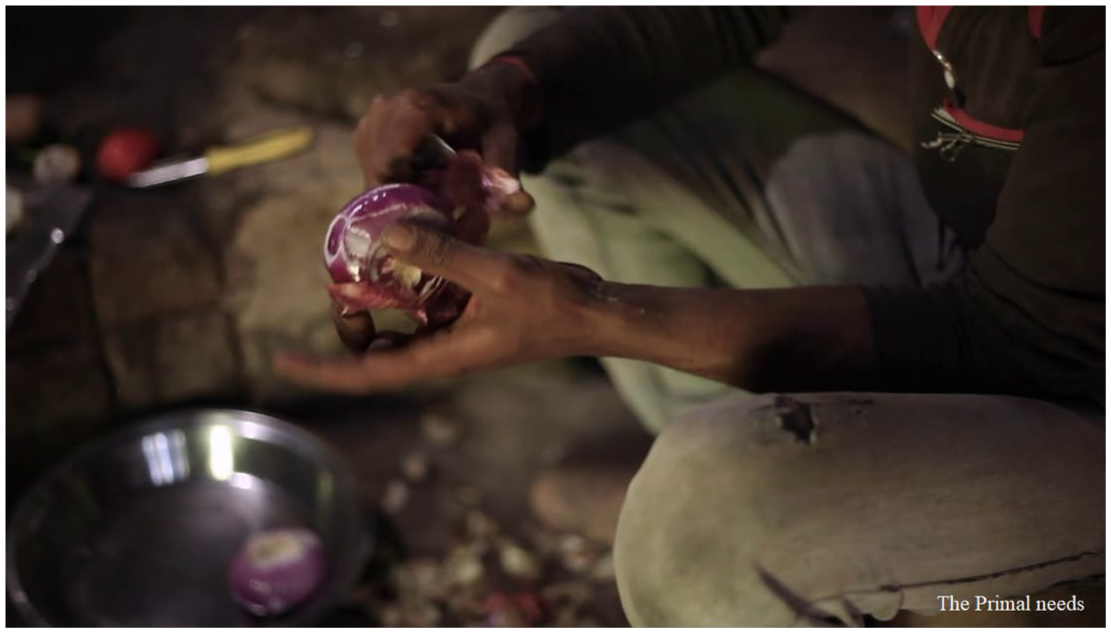
Primal needs.
In this context, sustenance itself becomes a site of objectification. The everyday acts of eating, feeding, and provisioning are organised by the imperative to repay. This renders the body and its needs not simply biological but political – regulated in service of debt. Through this process, the worker is not only exploited materially but is also shaped as a subject: one whose life is governed by a narrow calculus of survival, duty, and delayed gratification.
Dispossession and accumulation: A common characteristic of people working as debt-bonded labourers in India, possibly an offshoot of the caste system, 4 is their dispossession and landlessness (Acharya and Naranjo, 2018; Oosterhoff et al., 2018; Samonova, 2019). Raju’s reflections reveal this starkly. For him, a house is an unsettling hybrid structure with different meanings: it is a thing (property/possession), a domain (home and shelter), and an aspiration (future security) (see Raju at 9:21). He discusses it in connection to his failed romantic relationship, as well as his most significant desire – to achieve a fulfilled life. He also relates it to his decisions to work at the kiln in order to save money for building a house. It is, in fact, impossible to overstate the significance of owning a house in Raju’s account. A house serves as both a material and symbolic anchor for his sense of stability, dignity, and purpose.
The narrative arc of Raju’s dispossession, or, more precisely, his enduring aspiration for possession articulated in the film, reveals complex and affectively charged linkages within the broader dispositif of debt-bonded labour. His longing to acquire land and construct a home emerges not merely as a material aspiration but as a structuring desire that organises his relations of exchange, power, and subjectivity. This yearning, while ostensibly unrelated to the conditions of his labour, is in fact intimately enmeshed with the socio-economic and affective logics that sustain his bondage. Raju’s reflections disclose how experiences of love, familial attachment, and emotional deprivation are folded into the calculus of indebtedness: his entry into debt relations with the kiln owner, and his continued entrapment therein, are not only economic decisions but also deeply entangled with his affective investments and relational commitments. In this sense, the dispositif does not merely regulate labour but choreographs the intimate terrains of desire, obligation, and hope.
However, when Raju’s account is situated within the dominant logics of modern thought on accumulation, a disjuncture becomes apparent. As Chakravartty and da Silva (2012) argue, the figure of the accumulating subject in modernity is variously configured through liberal rationality (as a self-interested actor), historical materialism (as a bearer of productive and creative labour), and neoliberal governmentality (as a morally obligated debtor embedded in circuits of credit and responsibility). Raju’s subjectivity, by contrast, appears misaligned with these normative configurations. His aspiration to possess a house – a hybrid object of material security and affective anchoring, is rendered structurally untenable within accumulation regimes that predicate creditworthiness on calculative rationality, stable income flows, and asset-based collateral. From the vantage point of mainstream financial institutions, which conduct rigorous credit assessments to safeguard return on investment, Raju is categorically illegible as a viable subject of credit. This financial exclusion, however, does not signify the absence of debt relations; rather, it enables the proliferation of informal and coercive lending regimes. In such contexts, predatory actors, so-called high-risk, high-interest lenders, or more insidiously, employers themselves, step in to operationalise debt not merely as a financial instrument but as a mode of labour control. The result is not simply the production of indebted subjects but the fabrication of debt-bonded lives, where economic dispossession is sutured to regimes of extraction, coercion, and affective capture.
Love and family: The film shows how love and family operate as affective intensifiers within the dispositif of debt bondage. Raju’s dispossession is emotionally tethered to his failed romantic relationship. He attributes the loss of his childhood love to his inability to provide materially (see Raju at 9:30). As discussed above, Raju’s ultimate aspiration is to own land and build a house. He narrates his heartbreak over losing the girl he loved since he was ten years old to another suitor, expressing his emotions with a stumbling voice and moist eyes (see film at 10:05). These expressions vividly capture the unease he feels when reflecting on these events.
Despite his visible emotional turmoil, Raju demonstrates a conscious awareness of the rational behaviour of his produced self. He views ownership of land and a house as the remedy for his dispossession, and as a means of closure for failed love. Raju reaffirms his belief in the productive self, aligning his aspirations with the idea that material ownership is a precondition for romantic love. The film thus illustrates the intimate connections between love and other elements in the dispositif of debt bondage. In other words, he rationalises romantic loss through alignment with his productive self – a self that aspires to land ownership as both remedy and redemption. Love becomes subordinated to accumulation.
Similarly, Satender places his faith in his produced self to validate his love and responsibilities toward his family. For Satender, family creates the space for debt-bonded labour, shaping his identity as a productive worker. His love is expressed through his sense of duty to his parents and children, reinforcing his belief in the value of being a productive kiln worker (see Figure 3). For both men, familial love is filtered through the subjectivity of the productive self. The dispositif does not merely discipline bodies, but co-opts affect to produce subjects whose attachments validate their bondage.
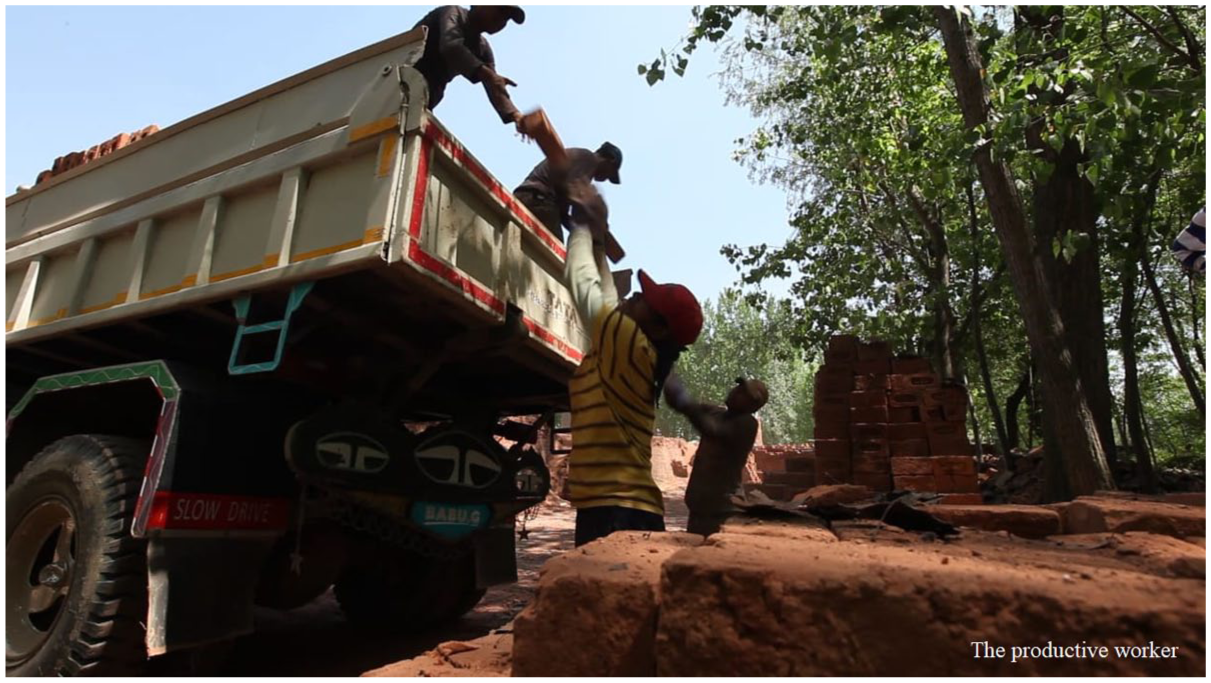
The productive worker.
Temporal production of debt-bonded labour
The dispositif within which the debt-bonded labourers are produced operates not only in the spaces of production but also across time, bridging the actions of past, present and future. This temporality, on the face of it, is a function of debt where present consumption is bought with a promise of future labour (Peebles, 2010). When this temporality intersects with the spatialities discussed above, a set of complex, often obscured, temporal practices emerge. In the following text we discuss the main temporal practices in debt relations in the dispositif of bonded labour.
Advances: The use of advances is endemic to labour relations in brick kilns, functioning as a form of anticipatory debt designed to secure future labour obligations (Ercelawn and Nauman, 2004). These advances are extended to workers involved across different stages of production – those who mould, bake, or transport bricks (see film, 6:20–6:36). Because repayment is made through labour rather than monetary instalments, advances are typically issued well before the production cycle begins. They are often used to meet household needs, cover medical costs, or finance social and ceremonial obligations in workers’ hometowns (see film, 6:40). In this way, the advance not only binds the worker to the kiln but also extends the temporal and spatial reach of labour control into the everyday life of the indebted. In addition to receiving initial advances, workers receive further loans when working at the kiln, and these subsequent advances are usually communicated as friendly loans that the employer gives out when asked by the labourer. In the film, Raju frames these as acts of support, even as he acknowledges that they extend his bondage (Raju at 4:15). These debts, though presented as informal help, entrench the worker’s temporal commitment to the kiln.
Guarantees and repayment: In the labour regime of the brick kilns, monetary advances are extended by kiln owners to workers through the intermediation of Sardars (also referred to as Maistry). Functioning as pivotal brokers, Sardars are held accountable by kiln owners for the recovery of these advances, thus constituting a layered and hierarchical debt structure. While the financial transaction is formally mediated by the Sardar, workers invariably describe their indebtedness as owed directly to the owner. Both Raju and Satender, for instance, consistently referred to their debt as an obligation to the kiln owner, despite the disbursement occurring via the intermediary. This perceptual collapse of the intermediary’s role reveals how power and accountability are discursively and materially anchored in the figure of the owner.
The recruitment process itself further entrenches this relational architecture. Kiln owners enlist Sardars, who in turn mobilise labour – typically from within their own kinship networks, prior work relationships, or shared village ties – through the promise of substantial advances and transportation to the kiln site. Where such prior familiarity is absent, Sardars often require additional forms of social collateral. In these instances, a third-party guarantor – commonly a respected figure within the recruit’s village – is enlisted to underwrite the loan. In Satender’s case, for example, this function was performed by the local grocer. Such mechanisms illustrate how recruitment and debt are entangled within dense networks of obligation, surveillance, and embedded trust, extending the dispositif of control beyond the kiln into the social fabric of rural life.
Both Raju and Satender carried pre-existing debts to local grocers in their home villages – obligations that were effectively underwritten by the promise of advance payments from the Sardars, who maintained established relationships with these grocers. Upon receiving the advance from the kiln owner, the Sardar would first settle the outstanding amount owed to the grocer on the worker’s behalf, subsequently allocating the remainder of the funds to cover the costs of transporting the worker to the kiln site. This circulation of debt across multiple actors and locations reveals a tightly woven network of financial obligation in which the Sardar operates as a central node. The apparent cordiality and trust between Sardars and village grocers not only facilitated these arrangements but also introduced an additional layer of informal credit assurance. In effect, this intermediation reinforced the securitisation of debt while deepening the worker’s entrenchment within overlapping circuits of dependence and mobility control. These relational dynamics illustrate how informal trust-based networks serve not merely as social infrastructure but as mechanisms for extending and intensifying the dispositif of debt bondage across rural and industrial geographies.
The prevalence of advance payments channelled through local grocers in the recruitment of kiln workers remains indeterminate. Attempts to investigate this practice in the field elicited visible discomfort from intermediaries, including both the Sardars and the grocers, thus limiting the researcher’s ability to pursue the matter further through direct inquiry. Nonetheless, conversations with workers revealed a discernible pattern: the sustenance of labourers, both during and beyond periods of active production, was inextricably linked to the financial guarantees extended by local grocers. These arrangements traversed the spatial and temporal boundaries of the labour process, connecting sites of production with places of origin, and structuring forms of dependence that extended well beyond the kiln itself. What emerges, then, is not simply a financial transaction but a broader apparatus of provisioning that binds workers to a regime of obligation across multiple social terrains. This dispositif operates through both formal and informal infrastructures, revealing how debt circulates as a mediating force between survival, mobility, and labour extraction (Satender in the film at 6:54).
Dispositif of debt bondage
Building on the conceptual diagram introduced in Figure 1, the dispositif of debt bondage can be understood not as a static structure but as a recursive configuration of relations through which debt, labour and subjectivity are continuously co-produced and reproduced. What emerges is not linear causality but a patterned assemblage through which obligation, endurance and dependency are systematically organised and normalised in everyday life.
This dispositif operates through three analytically distinct yet empirically intertwined circuits. The circuit of credit and obligation links advances, loans and guarantees to workers’ future labour. Advances convert potential labour into present debt, while kinship-based guarantees extend surveillance and accountability beyond the worksite. Debt thus actively produces durable relations of dependency by securitising workers’ futures and redistributing risk away from employers and onto labouring bodies embedded in their respective social and community networks.
The circuit of social reproduction connects debt to the infrastructures of everyday life such as food, shelter, care and romantic love. Debt reorganises the conditions of living. Food insecurity, precarious housing and affective ties are embedded into labour relations as mechanisms through which dependency is normalised. Subsistence becomes a disciplinary terrain governed not just by force, but by need of food, housing, care, love and obligation.
The circuit of subject formation consolidates these processes within the self. Through repeated exposure to debt and moral narratives of responsibility, workers come to understand themselves as indebted, responsible and calculably productive subjects. Debt is internalised as duty, repayment as moral conduct, and endurance as worth, producing self-governing subjects aligned with the imperatives of productivity.
These circuits recursively reinforce one another, producing a dynamic assemblage of power. Debt bondage thus appears not as exceptional unfreedom, but as a socially productive regime that organises survival, aspiration and labour through ordinary practices, sustained as much by affect and morality as by coercion and deprivation.
Subjectification: Production of the productive subject
This study sets out to examine how debt operates not simply as an economic relation, but as a structuring logic that organises labour, subjectivity, and everyday life. Our analysis, in response to the research–question posed above, demonstrates that debt functions less as a neutral mechanism of exchange than as a technology of governance that binds workers through spatial, temporal and affective architectures of control (Foucault, 1977; Foucault and Ewald, 2003).
Our engagement with the empirical material from the film shows that debt bondage is not sustained primarily through coercion or force alone, but through a dispersed and routinised regime of discipline that renders exploitation ordinary, normalised and morally intelligible (Bear, 2015; Guérin and Venkatasubramanian, 2022). Rather than appearing as a deviation from everyday life, debt becomes embedded within the conditions of survival such as food provisioning, housing aspirations, kinship obligations, and intimate relationships. In this sense, debt is not an external imposition but a lived and negotiated condition that organises everyday conduct. Or conversely, the violence of debt is obscured by its incorporation into the ordinary rhythms of social reproduction.
Spatially, our analysis showed how sustenance, shelter, and emotional ties function not merely as background conditions or neutral backdrop to exploitation but as active infrastructure of labour governance. The recurring references to food scarcity and calculated consumption reveal that sustenance (or simply, hunger) operates as a disciplinary technology (Martin, 2011). Workers do not simply endure deprivation; they learn to inhabit and manage it. What we term liveable anxieties captures this calibrated condition of precarity wherein workers are held at the threshold of survival – neither abandoned to outright destitution nor enabled to achieve meaningful security. This carefully regulated insecurity produces bodies that are simultaneously resilient, self-governing, and economically useful. Food, housing insecurity and emotional attachment are thus not collateral effects of exploitation; they are constitutive of its production and reproduction.
Temporally, the system of advances, guarantees, and repayments extends labour discipline beyond the spatial and institutional boundaries of the kiln (Ercelawn and Nauman, 2004; Peebles, 2010). Debt holds together past obligations, present endurance and future promises into a continuous chain of dependency. Advances appropriate workers’ future labour before it is performed; guarantees enrol kinship networks and village actors into circuits of surveillance and enforcement; and repayment schedules (working seasons) structure the rhythms of movement, rest, and bodily expenditure. Time is governed by debt and becomes a terrain of governance, producing what may be understood as a mortgaged and foreclosed future (Lazzarato, 2012), reified by obligation. Through such mechanisms, debt shapes life trajectories wherein aspiration is not eliminated but endlessly deferred.
The spatial and temporal arrangements produce a particular kind of subject – the productive, debt-bonded worker. This subject does not experience debt just as an externality, but as moral responsibility (Hardt and Negri, 2017). Workers repeatedly narrate repayment in the language of duty, sacrifice and honour, aligning their sense of self with endurance and calculability. Here, debt operates as a technology of the self (Foucault, 1982), compelling individuals to govern themselves in accordance with the imperatives of capital even in the absence of direct supervision. Debt-bonded workers actively participate in their own governance, not because they are duped or irrational, but because their relational attachments are structurally tethered to compliance (Dardot and Laval, 2014; Di Feliciantonio, 2016). These spatial and temporal arrangements are concretised through what can be understood as recursive circuits of obligation, social reproduction and subject formation, which together constitute the dispositif of debt bondage.
The dispositif analytic allows us to show these practices do not operate in isolation. Food, romantic love (or its loss), migration, advances, intermediaries and moral obligation coalesce into a coherent, though inherently unstable, regime of power (Foucault, 1977; Legg, 2011). This framework moves beyond legalistic framings of bonded labour and economistic interpretations of debt by showing how domination is reproduced through the intimate and mundane textures of everyday life (James, 2021; LeBaron, 2014). Debt, in this account, is not an exceptional anomaly within otherwise “free” labour markets, but a productive and generative force that stabilises exploitation by embedding it within desire, hope, obligation and the slow violence of plain survival.
Conclusion and contributions
To conclude, our analysis of the film Of Labour and Love offers a sociological rethinking of debt bondage by demonstrating how debt functions not merely as a mechanism of financial obligation but as a governing logic that organises labour, subjectivity and everyday life. Instead of treating debt-bonded labour as an anomaly or moral aberration, we have shown how it is actively produced, reproduced and maintained through an apparatus of spatial, temporal and affective relations – the dispositif of debt bondage.
The central contribution of this study lies in theorising debt as an apparatus of subject formation. We advance the argument that debt in informal labour regimes operates as a technology of governance that works through food, housing, kinship, aspiration and morality. In doing so, the study contributes to debates in the sociology of work and employment by shifting attention away from contracts and coercion, toward the everyday practices through which unfreedom is rendered normal, liveable and legitimate.
Empirically, the paper demonstrates the value of film as a mode of sociological inquiry. Rather than treating visual material as illustrative, the study positions the film Of Labour and Love as an analytic site through which the embodied and affective dimensions of labour control become visible. This approach contributes to methodological debates by showing how visual ethnography can capture dimensions of exploitation – silence, gesture, hesitation, endurance – that are often inaccessible through text alone.
Finally, the study contributes to contemporary understandings of unfree labour by offering a conceptual language for grasping forms of domination that are neither fully coercive nor fully voluntary. The concept of liveable anxieties extends existing scholarship on precarious work by showing how survival itself becomes a calibrated condition of governance, sustaining labour compliance while foreclosing meaningful exit. In doing so, the paper advances debates on modern slavery, debt-bonded labour and financialised subjectivities by demonstrating how debt operates not simply as constraint, but as a productive social force that organises hope, obligation and endurance.
Taken together, these contributions reposition debt bondage not at the margins of capitalist labour regimes, but at their centre, as a crucial mechanism through which work, life and subjectivity are governed in contexts of extreme precarity. Further research could extend this framework to other sectors and geographies, exploring how similar dispositifs operate across global chains of production, migration and care.
Footnotes
Funding
The authors received no financial support for the research, authorship, and/or publication of this article.
Supplemental material
Supplemental material for this article is available online.

Notes
Omer Nazir, Lecturer at Massey University’s School of Management and Marketing, investigates modern slavery, debt bondage, and technology’s role in shaping work. Drawing on political economy and critical management studies, he exposes structural drivers of exploitation and works with policymakers to advance ethical labour practices and challenge inequities in global employment systems.
Majid Khan is a Lecturer in Management and Sustainable Business in the School of Management and Marketing at Massey University. His research examines the intersections of business and society, seeking to generate theoretical insights and empirical evidence that contribute to scholarly debate and guide practical action.