



Abstract
Worker hostels or dormitories are common in labour-intensive industries staffed largely by migrant labour, and have long been associated with exploitative practices. More recently, hostels have come under scrutiny because of accusations that they are used to restrict workers’ freedom in ways that are tantamount to modern slavery. Drawing on a qualitative study of a garment hub in South India where such claims have frequently arisen, we explore the conditions of freedom and unfreedom in worker hostels and how suppliers who run such hostels respond to competing expectations about worker freedom. Our findings show that hostels perform three interrelated functions: restriction, protection, and liberation, which together constitute a complex mix of freedom and unfreedom for migrant women workers that we term hybrid (un)freedom. As a result, we problematize the binary understandings of freedom and unfreedom that predominate in the modern slavery literature. We also develop a new way forward for examining freedom in the context of hostels that considers the system of relationships, traditions, and socio-economic arrangements that workers and employers are locked into and that prevent meaningful improvements in the freedom of women workers.
Introduction
Worker hostels or dormitories 1 are common in labour-intensive industries staffed primarily by migrants, such as the garments and electronics industries. They provide communal housing to workers, typically located adjacent to or near the workplace. Although hostels have been subject to limited attention in the literature on work and organization beyond the pioneering work of Smith and Pun (Pun, 2005; Pun and Smith, 2007; Smith, 2003; Smith and Pun, 2006; see also Cowan, 2018; Mezzadri, 2020; Mezzadri, 2021), poor living conditions in hostels have long been associated with sweatshop practices in global supply chains (Pun, 2007; Pun and Yu, 2008). Yet still, most research on working conditions in global supply chains has settled on practices inside worksites rather than in living quarters.
More recently, hostels have come under greater scrutiny because of the restrictions they impose on worker freedom. For example, a stream of activist reports and media articles has highlighted the plight of women migrant workers in the Indian garment industry, where workers have reportedly been ‘held captive’ and subject to severe ‘mobility restrictions’ in hostels associated with textile mills and garment factories supplying global brands (Bengtsen, 2018; ICN, 2016; Ray and Peepercamp, 2018; Sen, 2018). Likewise, the early 2020s COVID-19 pandemic reportedly accentuated some of these problems, with migrant workers in Singapore hostels, for instance, facing forced detainment as part of the government’s efforts to contain outbreaks of the virus (Ratcliffe, 2020). Such practices have led to accusations that restrictions on freedom of movement in hostels represent a form of unfree or ‘slave’ labour for migrant workers (Delaney and Tate, 2015; ICN, 2016).
To date, the academic literature on hostels has provided relatively little direct insight on the issue of freedom, beyond brief criticisms of the restrictions faced by workers (e.g. Pun, 2007; Pun and Smith, 2007). Nonetheless, the claim that worker freedom is curtailed in hostels is an important extension of the critique of hostels as part of global supply chains (Azmeh, 2014; Pun and Smith, 2007; Pun and Yu, 2008) and reinvigorates debates about the management of modern slavery and freedom in the workplace (Crane, 2013). However, the idea that worker freedom and its opposite (slavery or ‘unfreedom’) can be understood in purely binary terms – and that workers are either free or unfree – has been the subject of increasing debate (Chuang, 2014; Fudge and Strauss, 2014; Mezzadri, 2017; O’Connell Davidson, 2015). For instance, O’Connell Davidson (2015) argues that freedom and the line between freedom and slavery are social constructs rather than absolute categories, where particular interpretations of freedom are mobilized to support specific political goals. Brace and O’Connell Davidson (2018: 24–25) underscore the need to move beyond: . . . a liberal vision of a world in which people are either abject, passive objects, and slaves or freely contracting subjects, thereby missing the unseen, structural factors that force fates on men as well as women and children under the social relations of capitalism.
Likewise, political economy scholars have argued that slavery and free labour are not binaries but rather extreme ends on a continuum of freedom and unfreedom experienced by workers within the global economy (Barrientos et al., 2013; Lerche, 2007; Phillips, 2013). Along this continuum, workers always exhibit some agency, even in highly constrained and exploitative circumstances (Kotiswaran, 2017; LeBaron, 2020). The tendency to posit a rigid distinction between severe forms of labour exploitation (such as forced labour, modern slavery, and unfree labour) and ‘free’ labour has been recognized to ‘obstruct the task of understanding the nature and dynamics of unfree labour relations that exist across the contemporary global economy’ (Barrientos et al., 2013: 1038). Feminist political economists, in particular, have stressed the need to see worker freedom holistically, paying attention not only to conditions at work but also in the home (Cowan, 2021; Dunaway, 2014; LeBaron and Gore, 2020; Shah and Lerche, 2020).
A key problem with simplistic, if politically useful, binaries of freedom/unfreedom in the context of hostels is that they can lead to an erroneous diagnosis of the problems facing workers and flawed potential solutions. Therefore, to illuminate how the conceptual space between these extremes matters both theoretically and practically, we seek to develop a more complex understanding of worker freedom in hostels within global supply chains. Addressing the objective of this special issue, ‘to invite critical interrogations of the meaning of freedom and its current and potential relationship with social relations in and around work,’ we adopt an approach that goes beyond the workplace to include the home and embedded familial, community, and gender relations. As such, we ask: How is worker freedom experienced in hostels and under what conditions is it restricted or enabled? And how do owners of hostels (i.e. suppliers) navigate demands for freedom from multiple actors in supply chains?
To answer these questions, we draw on an in-depth empirical study of a garment cluster in Tamil Nadu in India. Our analysis enables us to make three main contributions. First, we contribute to the literature on worker exploitation in hostels by showing that hostels perform three, at times interrelated, functions: protection, liberation, and restriction. In investigating these sometimes-paradoxical functions, we re-embed understandings of the nature and conditions of freedom in the local context and incorporate the perspectives of those who enforce and those who experience it. Second, we contribute to the literature on modern slavery in business by problematizing common conceptions of freedom and unfreedom and addressing the impacts of these functions on workers. In a society with deeply embedded patriarchal norms permeating the households of young women joining the workforce, we introduce the concept of hybrid (un)freedom and explain how experiences of freedom and unfreedom are shaped by the system of relationships, traditions, and social and economic arrangements that workers are embedded within. Third, we contribute to the supply chains literature through a focus on the responses of suppliers to global brands as they seek to develop solutions that navigate a space between the freedom-related demands of brands and the expectations of actors in the local context within which they too are embedded.
The article proceeds as follows: we first review the literature on the role of worker hostels in global supply chains and explore relevant conceptions of freedom and unfreedom. We then explain our methodology before presenting our findings, exploring their implications, and presenting our conclusions.
Worker hostels in global supply chains
The provision of housing for workers by employers has a long history, stretching from the pre-industrial era to the emergence of cotton villages, company towns, and other forms of industrial hostels and worker housing from the 18th century onwards (for reviews, see Pun and Smith, 2007; Smith, 2003). Modern incarnations include mining work camps in South Africa (Crush and James, 1991), bunkhouses for migrant agriculture workers in North America (Horgan and Liinamaa, 2017), mega-dormitories for migrant construction workers in Singapore (Yea, 2017; Yeoh et al., 2017), and hostels for migrant factory workers in the Middle East (Azmeh, 2014), Europe (Andrijasevic and Sacchetto, 2016), and China (Pun, 2012; Smith, 2003; Smith and Pun, 2006).
Given these different contexts, the nature of worker hostels understandably varies. It ranges from relatively small operations to huge multi-storey complexes or even ‘mega-dormitories’ that might include cinemas, sporting facilities, shops, and bars (Yeoh et al., 2017). Hostels can be owned by employers, local governments, or intermediaries such as recruitment agencies (Andrijasevic and Sacchetto, 2016). Some are reserved for men, others for women, but are rarely mixed (Pun and Smith, 2007).
Notwithstanding these differences, there are commonalities in how contemporary hostels impact working conditions. This is commonly articulated in terms of a ‘dormitory labour regime’ that conceptualizes worker exploitation in the confluence of state migration policy, employer control over housing, and transnational capital in the form of foreign direct investment and global supply chains (Pun, 2007; Pun and Smith, 2007; Smith, 2003; Smith and Pun, 2006). Researchers have consistently demonstrated that this dormitory labour regime facilitates and accentuates worker exploitation by providing for the ‘temporary attachment or capture of labour by the firm’ (Pun and Smith, 2007: 31). The collapse of the work–home boundary reinforces employer control over workers and enables the imposition of longer and more flexible working hours, making workers ‘on tap labour’ (Smith, 2003: 333) that suits the demands of global supply chains (Pun, 2007; Smith, 2003).
Research also points to many hostels having substandard living conditions, overcrowding, lack of private space, and strict rules and punishments governing worker behaviour (Pun, 2007; Smith and Pun, 2006). At times, passports and identity documents are confiscated for ‘safekeeping’, preventing workers from leaving their jobs, the hostel, or even the country they live in. Residents are potentially under constant surveillance, with guards, closed-circuit television, and even fingerprint scanners used to enforce expected behaviours and track movements (Pun and Smith, 2007; Yeoh et al., 2017). The concentration of the dormitory labour regime on temporary migrant workers on short-term contracts who are typically unable to migrate permanently (owing to state migration policy) also reduces the likelihood that they will be able to organize to press for better pay and conditions and resist employer demands (Pun, 2007; Pun and Smith, 2007).
More broadly, migrant workers in hostels typically experience ‘social quarantining’ where they are dislocated from their families and excluded or marginalized from local communities (Azmeh, 2014; Goh, 2019; Horgan and Liinamaa, 2017). Thus, ‘relationships in both their work and home environments are heavily circumscribed: they have no control over who they interact with in work situations or with whom they live’ (Horgan and Liinamaa, 2017: 724). The incorporation into global supply chains of these disembedded migrant workers with limited social and family networks enables suppliers to offer the flexibility needed to meet the scheduling demanded by buyers (Azmeh, 2014).
Although the benefits of hostels to firms in global supply chains have been well documented, there has been scant attention paid to potential benefits to workers. For example, Smith (2003) briefly outlines how hostels facilitate mobility and may be better than available alternatives for workers, but suggests it ‘is compliance rather than active consent to a system that is fundamentally low wage and exploitative’ (Smith, 2003: 350). Pun (2007: 243) also acknowledges that, even though the dormitory labour regime is fundamentally exploitative, the lack of educational and employment opportunities in rural areas, plus a desire to ‘escape arranged marriages, familial conflicts, and patriarchal oppression’ prompt women to enter the regime. More positively, Ceccagno and Sacchetto (2020: 310) elaborate on the ‘unexpected spaces of self-tailored mobility’ that migrant workers in Europe are able to fashion as they move between different hostels. Indeed, the system has inherent contradictions, as it both facilitates and impedes certain aspects of migrants’ mobility and makes possible some forms of resistance while also systematically undermining worker organization (Pun, 2007; Schling, 2017; Smith and Pun, 2006).
This literature provides a rich picture of the role of hostels in global supply chains and their effects on living and working conditions. To date, though, it has offered relatively little insight on freedom specifically, despite mentioning limits to ‘freedom of movement’ (Pun and Smith, 2007) and ‘freedom of mobility’ (Pun, 2007) as elements of the dormitory labour regime. To address this and make progress in developing a more nuanced and clearer understanding of freedom and unfreedom in hostels, we now turn to the literature on forced labour and modern slavery where such issues have been examined extensively.
Conceptualizations of worker freedom and unfreedom
Freedom and its expression in the workplace are fundamental human rights, enshrined in the UN Declaration of Human Rights (UNDHR) and International Labour Organization (ILO) labour standards. Freedom has been presented by the UNDHR, as the ‘highest aspiration of the common people’, and articulated mainly with respect to specific rights and freedoms such as freedom of speech. Those such as freedom of expression and freedom of association have been widely examined across the literature dealing with business and human rights (e.g. Barry, 2007; Dawkins, 2012), but issues of freedom of movement and broader conceptions of the nature of freedom and unfreedom in the workplace have been most extensively elaborated in the literature on forced labour and modern slavery (Barrientos et al., 2013; Crane, 2013; McGrath, 2013; O’Connell Davidson, 2015).
Scholars focused on understanding the nature and role of modern slavery in the contemporary global economy frequently represent unfree and free labour in binary terms, using concepts like ‘modern slavery’ and ‘forced labour’ to describe the worst forms of labour exploitation (Bales, 2004; Bowe, 2007; Kara, 2017) and present these in opposition to ‘free labour’ and ‘wage labour’. Although definitions vary, accounts of modern slavery within this tradition generally coalesce around the convictions that: (1) modern slavery is analytically and ontologically distinct from ‘free’ labour; (2) it is feasible to isolate modern slavery from other forms of exploitation; and (3) modern slavery is an aberration within an otherwise free labour market. This approach to freedom and unfreedom within modern slavery studies gives rise to a series of binaries, as shown in Table 1.
Slavery and free labour as binaries.
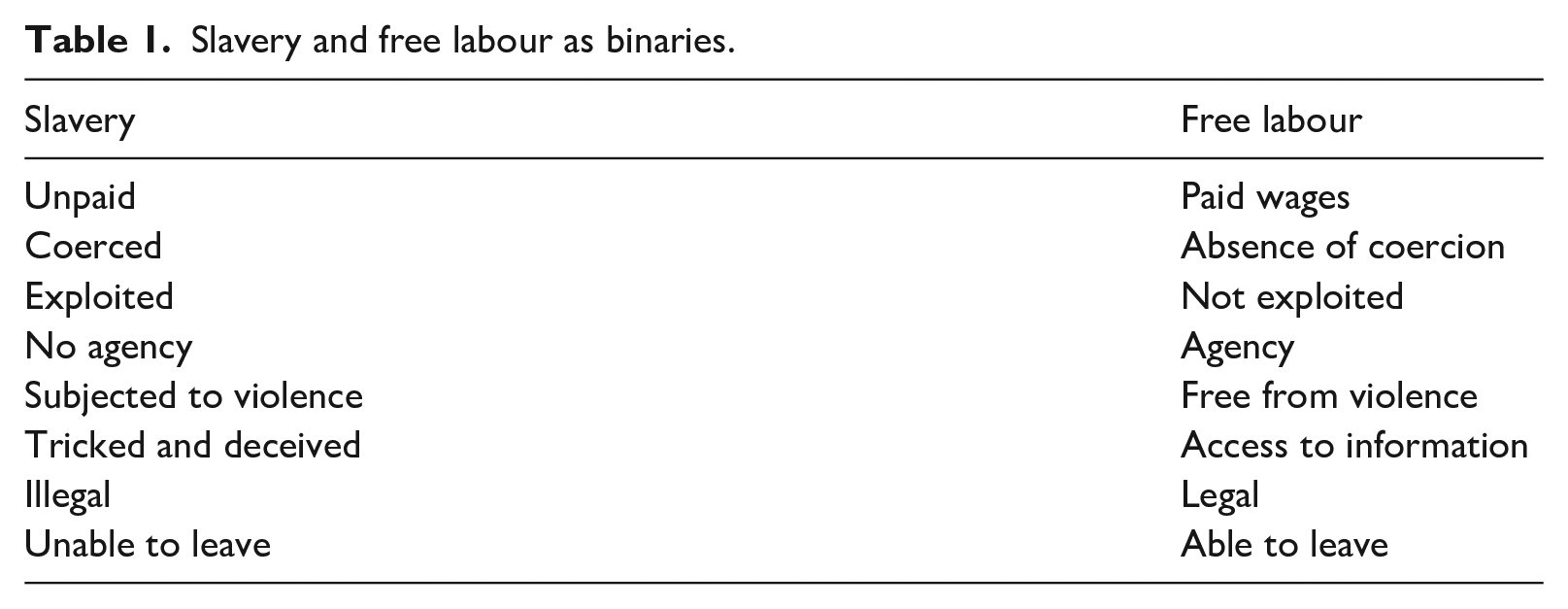
These binaries have been increasingly challenged (Kotiswaran, 2017; LeBaron, 2018a, 2018b; Phillips, 2013). Such studies have stressed that not only is modern slavery impossible to isolate from more minor forms of exploitation but also that there is considerable overlap and porousness between these categories. Workers may move at different times between situations that meet the threshold of modern slavery and more minor forms of labour exploitation, often within relatively short periods. Moreover, researchers note there is considerable continuity between the forms of unfreedom that workers face within forced labour and in so-called free labour (Barrientos et al., 2013; LeBaron, 2020), and often labour conditions ‘cannot in any useful sense be positioned on one side or other of a clear dividing line between ‘free’ and ‘unfree’ labour’ (Barrientos et al., 2013: 1038).
Recognizing the limitations of binary thinking, scholars have urged that labour freedom and unfreedoms are better conceptualized along a continuum or spectrum, wherein workers confront different forms and degrees of exploitation. Skrivankova (2010: 18), for instance, proposes a ‘continuum of exploitation’ that stretches from the ‘positive extremity (desirable situation) of decent work to the negative extremity of forced labour (most serious form of labour exploitation).’ Scholars including Lerche (2007) and Guérin (2013) conceptualize unfreedom along a continuum characterized by degrees of unfreedom, with Lerche, for instance, noting that ‘there is a need to move away from unhelpful dichotomies, and acknowledge the fluidity of the actually occurring levels of unfreedom’ (Lerche, 2007: 447).
Notably, given the empirical focus of our study, important literature conceptualizing worker unfreedom focuses on India, exploring forms and degrees of unfreedom in relation to a wide range of issues and types of work, including the informal economy (Breman, 2016; De Neve, 2005), labour and debt bondage (Carswell and De Neve, 2013; Lerche, 2007), the care economy (Shah and Lerche, 2020), garment sweatshops, including home-based work (Mezzadri, 2017), and migration (Cowan, 2021). Although this literature is theoretically diverse, a key thread is the need to capture the variegated forms and degrees of unfreedom that workers confront in their daily lives.
Scholars have considered the individual-level and structural factors that make workers more likely to experience work that sits along the unfree end of the continuum. For example, gender, migration status, caste and class, race and ethnicity, and contract type are key individual-level traits that shape vulnerability to unfreedom (Fudge and Strauss, 2014; LeBaron and Gore, 2020; Mezzadri, 2017). Also, historical factors like processes of dispossession or forced migration (Bhagat, 2020), and structural, political, and economic relations such as the extent to which policy paradigms privilege businesses and profitability over the protection of workers and labour rights (LeBaron and Phillips, 2019), also shape worker unfreedom. In addition, particularly relevant to our research is the extent to which social power relations based on gender difference and men’s power over women’s bodies and labour pervade the workplace as well as the home (Ferguson, 2020; Smith, 2020).
Conceptualizing labour freedom and unfreedom beyond binaries challenges several assumptions typically made about hostel workers, such as that they are necessarily forced to work and are held against their will. However, the complexities of these dynamics have yet to be explored. For example, although Siu (2017) and Yea (2017) examine ‘forced labour’ and ‘unfree labour’, respectively, in the dormitory labour regime and provide insight on how migrant workers are controlled, there is little attempt to question these fundamental assumptions and interrogate such practices beyond binary conceptualizations. To achieve this, researchers must focus more explicitly on workers’ experiences of freedom and unfreedom in hostels, and locate this in a deep understanding of their work, home, and community lives. We now turn to explain how we sought to achieve this in our empirical study.
Methods
Empirical context
We focused our empirical study on a garment production cluster located around Tirupur in Tamil Nadu, India. The region is a major manufacturing hub accounting for around 45–50% of all knitwear exports from India. Major global brands including Adidas, C&A, H&M, Nike, Primark, and Walmart import from the region. The cluster comprises over 8000 manufacturing units and 2000 spinning mills, and involves a wide range of activities, including garment production, spinning, dyeing, printing, and embroidery. 2
The cluster has been the subject of extensive previous empirical research on working practices and conditions (e.g. Carswell and De Neve, 2013; De Neve, 2005; Soundararajan et al., 2018b), but little has explicitly focused on hostels. There are hundreds of worker hostels in the Tirupur cluster housing intra- and inter-state migrant workers from rural areas. Although there is accommodation for both men and women workers, and some limited space for families, most hostel residents are women, and usually young, single women. Hostels offer dormitory-style accommodation for workers who share rooms with between four and 24 others. Many have beds or ‘cots’, but it is not unusual for residents to have just a mat on the ground or sometimes to bring their own beds. Residents typically have some space for a limited number of possessions, such as clothes and basic toiletries. The hostels all have shared bathrooms, water, and a canteen that serves three meals a day. Most also have communal spaces.
We selected Tirupur because it had been the focus of reports claiming that women in hostels were subject to forced and bonded labour and restricted freedom of movement (Anti-Slavery International, 2012; Bengtsen, 2018; ICN, 2016). Although some reports had focused on the Sumangali system – where a single payment (often used as a dowry) is made to a young woman worker’s family after several years’ work (Fair Labor Association, 2012) – this had been largely eradicated by the time of our fieldwork and was not prominent in our data (although other indicators of exploitation and restrictions on freedom of movement were).
Data collection
We collected primary data during two one-month fieldwork trips as part of a broader research project on decent work in garment supply chains. Data were collected primarily through semi-structured interviews using an interview guide that was refined and adapted during the data collection process. This enabled us to guide the discussion toward the topics we were interested in exploring (experiences of hostels and freedom) while also allowing space for interviewees to offer detailed, open-ended responses on what can be a sensitive issue. Ultimately, a semi-structured approach to interviews allowed us to capture the detailed perspectives of our interviewees and the nuances that existing accounts of hostels might miss.
We adopted a purposive sampling approach where we were driven to identify informants according to the needs of our emerging theoretical and empirical frameworks. We conducted 57 interviews that specifically addressed the issue of hostel accommodation and worker freedom. Given the complexity of the phenomenon under study, and in line with in-depth studies on labour rights in global supply chains (e.g., Munir et al., 2018; Reinecke and Donaghey, 2021; Soundararajan et al., 2018a), we attempted to capture a diversity of voices and perspectives, adopting a snowballing technique to identify suitable respondents, and using gatekeepers like parents and village leaders where necessary to access relevant workers. We stopped the interview process upon reaching theoretical saturation when answers became repetitive and no new insights emerged (Corbin and Strauss, 2015).
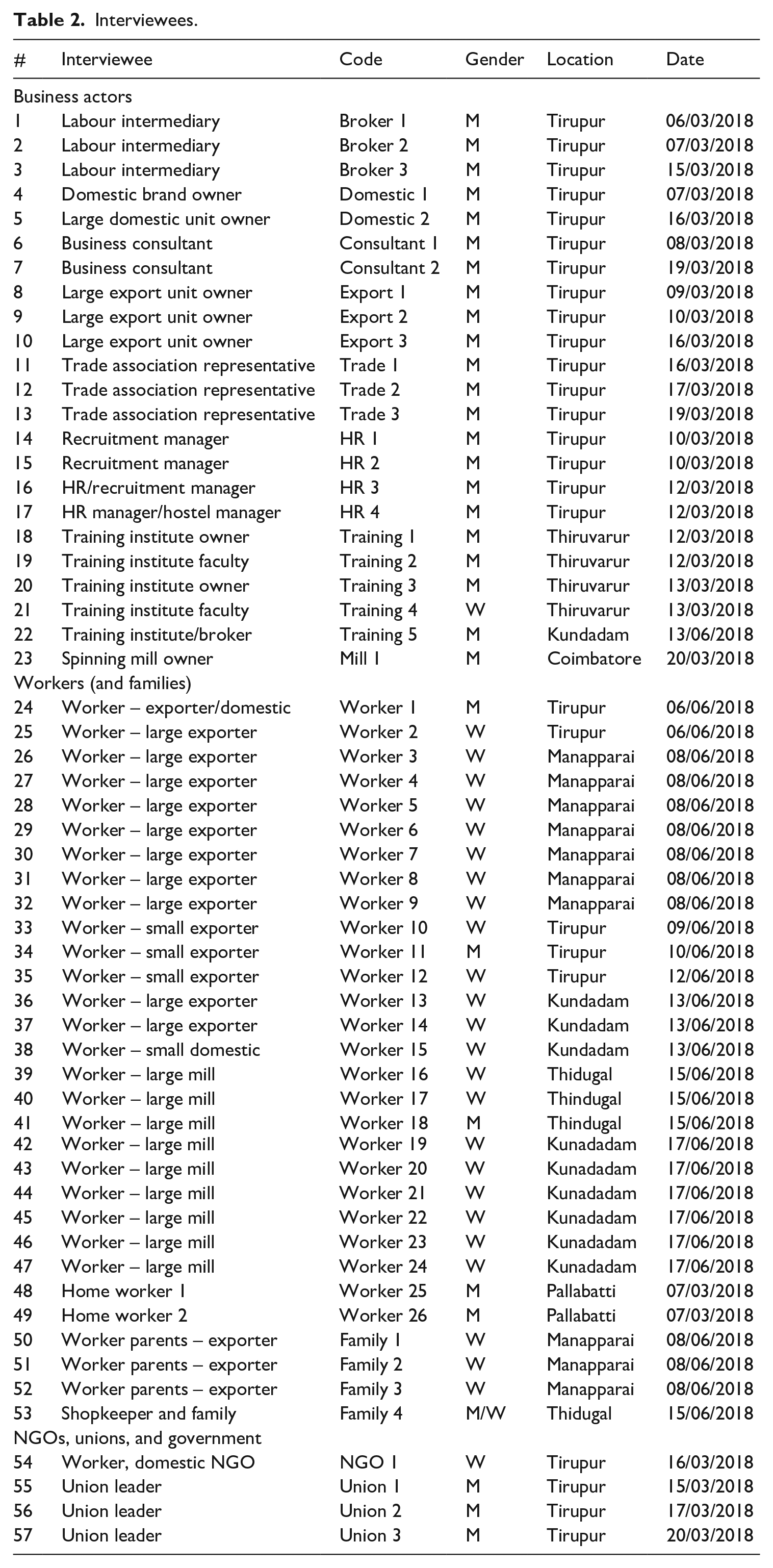
Our interviews were conducted with factory and mill owners and managers, hostel wardens, trade associations, brokers, training institutes, NGOs, unions, workers, and their families (see Table 2). The interviews were conducted in locations where the interviewees felt comfortable: managers in the workplace; and workers and their families in their homes, temples, and community centres. We let respondents decide on these locations. Given that most of our interviews regarding hostels concerned women workers, the location of interviews in homes and communities better enabled us to understand the specifically gendered experience of workers both in the workplace and the household, as is common in gendered commodity chains research (Dunaway, 2014). We audio-recorded most of the interviews. When not given consent to record, detailed notes were taken, and reflections of the field research team were audio-recorded at the end of each day of interviews or as soon as feasible thereafter. Some interviews were recorded directly in English, but the primary language used during interviews was the local language of Tamil.
Interviewees.
Two of the five authors conducted the fieldwork, the remainder of the team being consulted regularly before, during, and after the trips. One of the authors who collected data is from Tamil Nadu and has been researching in this context and on labour rights in supply chains for nearly eight years. This helped the researchers gain access to interviewees and sites during the data collection process. The research team ranged from contextually embedded to relatively detached from the context, enabling us to address any biases that might emerge one way or the other. Although the two field researchers are seasoned ethnographers, we were sensitive to the gender and cultural circumstances of the women workers and families we interviewed, which necessitated complementing our research team with women research assistants who were culturally attuned and proficient in Tamil. These local research assistants carried out all our interviews with women workers. All audio recordings were fully transcribed, and those in Tamil were translated into English. To check for accuracy, the author proficient in Tamil back-translated the transcribed interviews.
In addition to interviews, we observed recruitment campaigns, factory operations, hostels, villages, families, workers’ dwellings, and nearby areas. These observations were recorded in verbal or written form. Additional data were collected in the form of documents (e.g., media and civil society reports and governmental and intergovernmental materials) and photos taken by field researchers. Following the fieldwork trips, again as part of our broader project, we also conducted roundtables in India, the UK, and Switzerland, with over 100 additional industry stakeholders. This generated further insight on our preliminary findings, including on (un)freedom in hostels. We took extensive notes and added these to our field diaries. Data collected from these observations and roundtables added flesh and context to the interview data, as well as helping with data triangulation. All data relevant to freedom in hostels were collated in one database and subjected to analysis to address our two research questions without prioritizing any particular data source for either question.
Data analysis
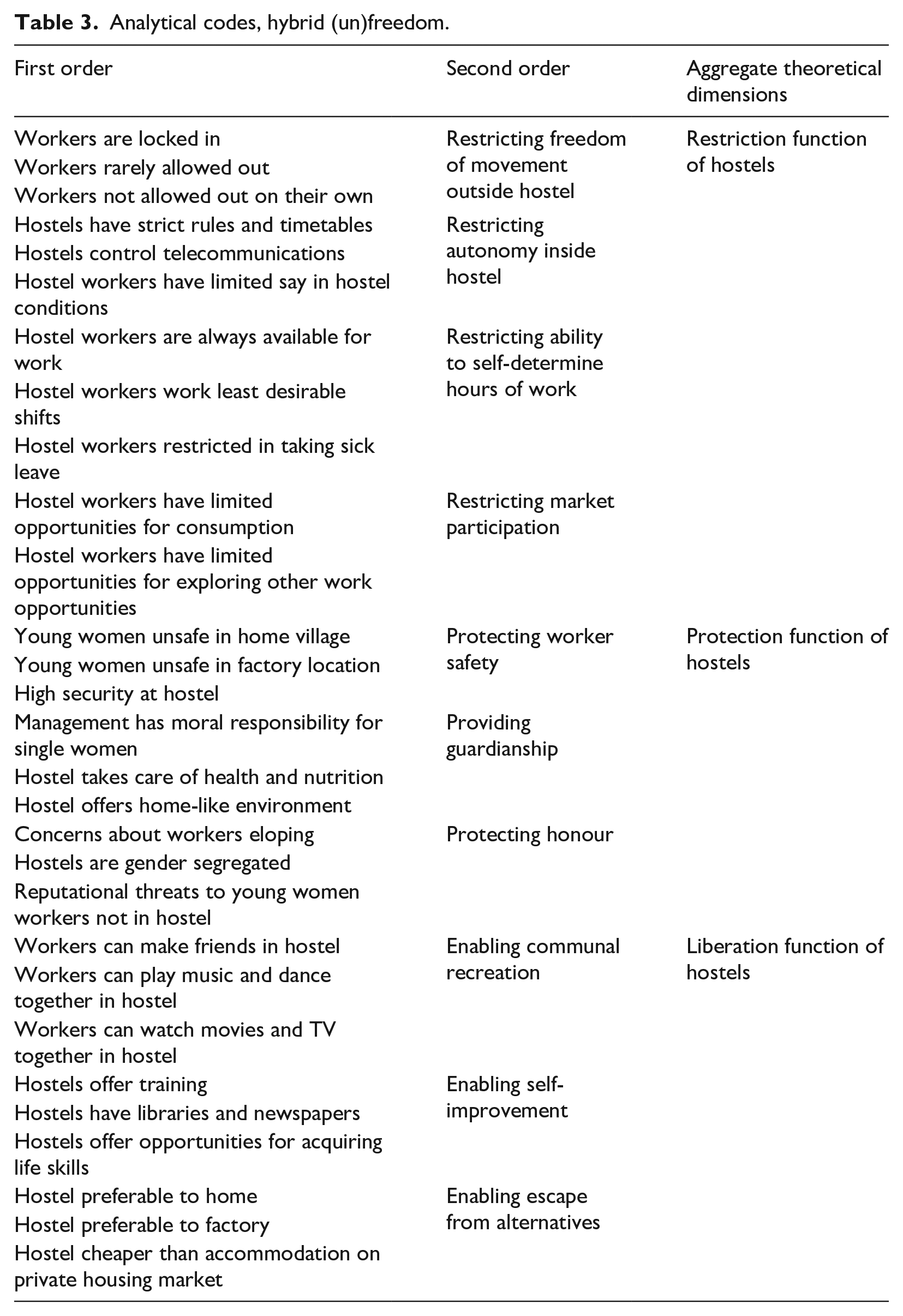
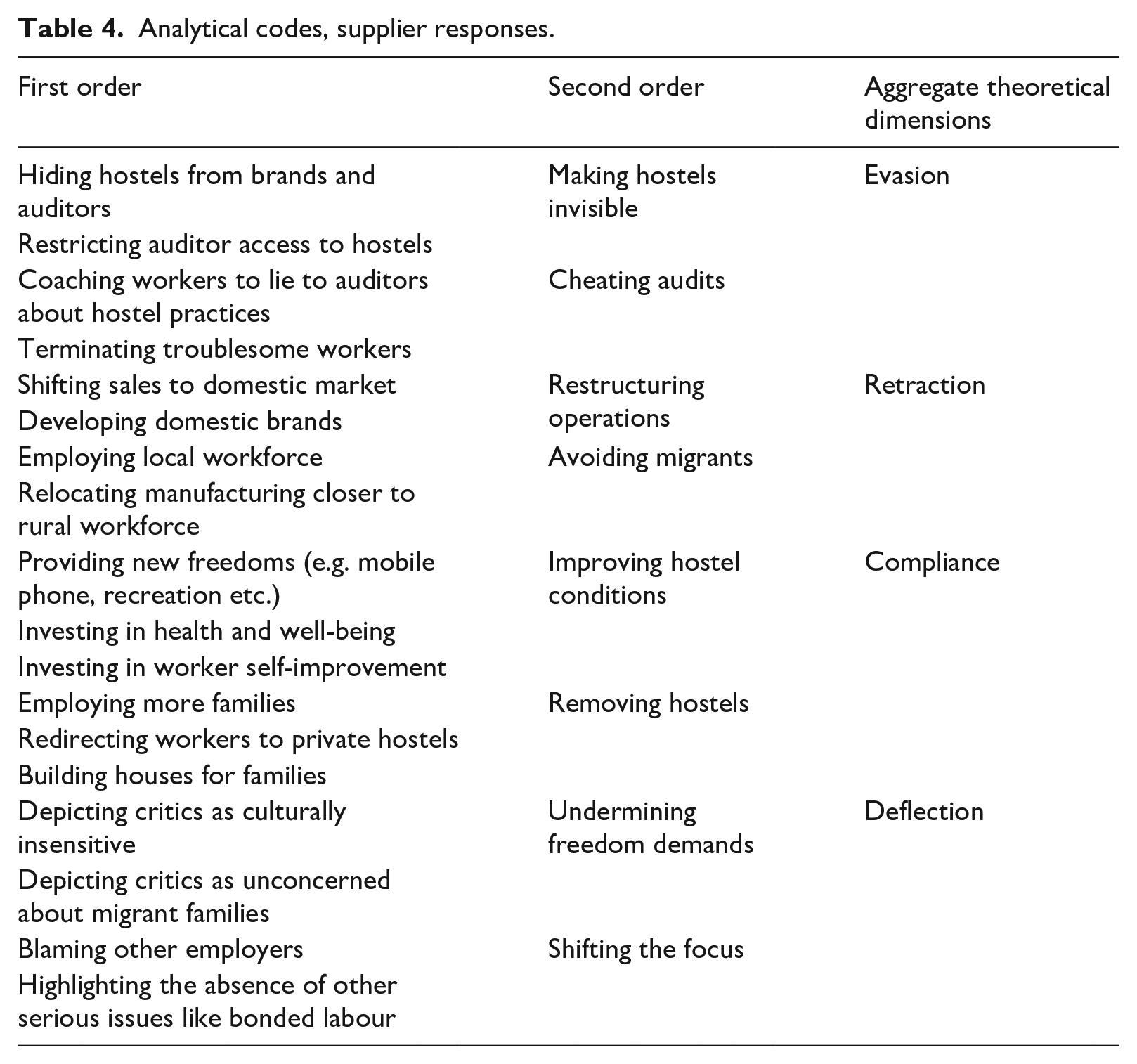
The data were analysed using Braun and Clarke’s (2006) approach to thematic analysis. We approached the data inductively, looking for different ways in which freedom and unfreedom in hostels might be manifested, without regard to a specific theoretical conceptualization or model of freedom. Our goal was to explore freedom from the perspective of our informants and theorize in a grounded manner (Corbin and Strauss, 2015). One author carried out coding to ensure consistency, but the transcripts were read by the entire author team, who were consulted regularly to help refine and sense-check the codes as the analysis progressed. We proceeded through three stages of coding that are summarized in Tables 3 and 4 and expanded upon below.
Analytical codes, hybrid (un)freedom.
Analytical codes, supplier responses.
The data were initially open-coded using consensually agreed upon exploratory questions: Why do workers stay at hostels? How do workers and families experience hostels? And what shapes their perceptions? This process enabled us to develop first-order codes that captured the various ways that hostels were seen to impact upon the freedom of workers, both negatively and positively, ranging from ‘workers are locked in’ and ‘hostel workers restricted in taking sick leave’ to ‘hostel offers home-like environment’ and ‘hostels offer training’. We then grouped these disparate codes into second-order themes and ultimately aggregate theoretical dimensions through an iterative process. For example, codes like ‘workers are locked in’, ‘workers not allowed out on their own’ and ‘workers rarely allowed out’ indicated that hostels restrict workers’ freedom of movement outside the hostel. Thus, we grouped them under a second-order theme labelled as ‘restricting freedom of movement outside hostel’. We developed three other second-order themes denoting the different ways hostels perform the restriction function, namely ‘restricting autonomy inside hostel’, ‘restricting ability to self-determine hours of work’, and ‘restricting market participation’. These second-order themes were then merged to form an aggregate theoretical dimension, ‘restriction function of hostels’. As is normal in thematic analysis, these codes were revised and refined as our theorizing developed, with some overlapping or irrelevant codes deleted and some redefined and relabelled to better fit the arrangement of higher- or lower-order categories (King, 2004). Through this iterative analytical process, we identified three functions performed by hostels based on the accounts of our informants: ‘protection’, ‘restriction’, and ‘liberation’, which we then conceptualized as ‘hybrid (un)freedom’, referring to the intersection of freedom and unfreedom that results.
Our initial analysis also indicated that suppliers were facing competing demands from various stakeholders with respect to the three functions and had responded accordingly. Like the process described above, we analysed these responses by initially open-coding the data guided by questions: What kind of demands for freedom do suppliers receive? Who demands them? And how do suppliers respond? This process resulted in first-order codes about the different methods suppliers use to respond to competing freedom demands from diverse actors, ranging from ‘hiding hostels from brands and auditors’ to ‘building houses for families’. Again, through an iterative process of grouping and regrouping codes, we developed second-order themes and eventually aggregate theoretical dimensions. Through this process, we identified four supplier responses to competing freedom demands from civil society, workers, families and brands: ‘evasion’, ‘retraction’, ‘compliance’, and ‘deflection’.
We ensured internal homogeneity by checking for coherence in the codes and external heterogeneity by checking for the distinction between categories and adjusting accordingly (Patton, 2015). We followed Lincoln and Guba’s (1985) four ‘trustworthiness’ criteria (credibility, dependability, confirmability, and transferability) to ensure the quality of our analysis. Credibility was improved through triangulation, reflection, reflexivity, and phronesis (Cassell, 2005; Cassell et al., 2009), as well as prolonged engagement with the context, consultation with relevant actors, and iterative discussion of codes among the research team. Dependability was improved by discussing findings with other scholars during conferences and seminars, and with stakeholders during our roundtables in India, Switzerland, and the UK. Confirmability was improved by presenting detailed data collection and analysis processes, whereas transferability was improved by offering ‘thick’ descriptions.
Hybrid (un)freedom and the restriction, protection, and liberation functions of hostels
Our findings show that, over time, the conditions in Tirupur hostels have gradually improved. According to respondents, this has been mainly owing to competition among employers to attract and retain workers, as an HR manager (HR 4) suggests: ‘Many workers have left other factories and joined this company because of the facilities provided here in terms of hostel and other things because they were not given good hostel facilities in their old factories.’ All told, most current hostel residents we interviewed were reasonably content with the conditions they experienced, with most comments being targeted at the quality of food on offer or problems with specific lights, fans, or individual wardens. Non-hostel workers and ex-hostel residents were, however, in general, far less sanguine.
As spaces at the intersection of work and home, the role and function of hostels are quite complex, especially concerning worker freedom and unfreedom. Our analysis suggests that, from the point of view of workers, their families, employers, and other stakeholders, hostels have three main functions in this regard. These are summarized as restriction, protection, and liberation. Together they give rise to what we term ‘hybrid (un)freedom’ – that is, the experience among workers of simultaneously being free and unfree. In the following sections (and summarized in Figure 1), we discuss in detail each of these three functions before explaining how they interact to form hybrid (un)freedom and how suppliers navigate different expectations around such freedom.
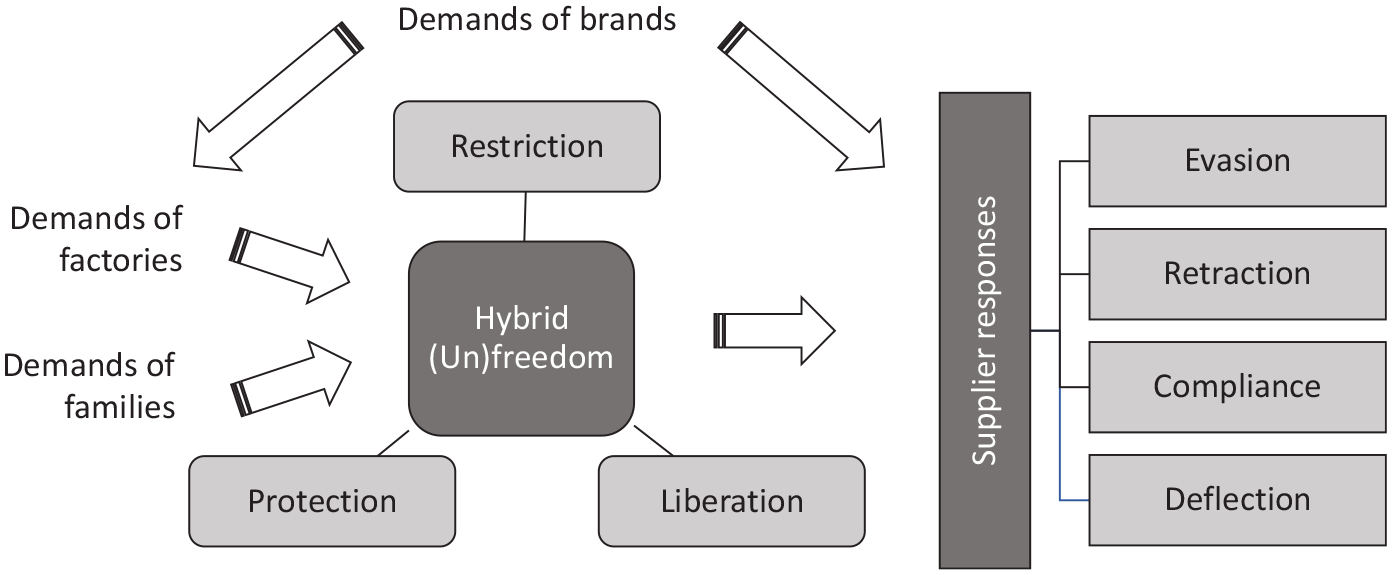
Hybrid (un)freedom in hostels.
Restriction function of hostels
We found considerable support for claims within the literature that hostels restrict freedom for workers. However, we extend and enrich our understanding of such restrictions within a broader analysis of hostels as sites of control. We refer to this as the restriction function of hostels. By this, we mean that hostels can be seen as places that impose restrictions on workers such that human rights violations are enabled and where other forms of exploitation are routinely made possible both in the hostel itself and in the workplace. This restriction function of hostels comprises four elements: (1) restricting freedom of movement outside the hostel; (2) restricting autonomy inside the hostel; (3) restricting ability to self-determine hours of work; and (4) restricting market participation.
Restricting freedom of movement outside the hostel
Restricting young women – but not men – from voluntarily leaving the hostel premises unaccompanied is a defining characteristic of Tirupur hostels. All hostels in the region appear to operate such restrictions. Hostels are usually in remote locations in walled, gated compounds that are always securely locked. Wardens and security personnel are in place to ensure compliance. Some interviewees (but rarely hostel residents) referred to hostels as ‘like a prison’ or ‘jail’.
In most cases, young women are only allowed out at most once a week (usually on a Sunday), or sometimes only once a month. These ‘outings’ may last as little as two or three hours and are generally only possible if accompanied by a staff member. As an HR manager explained to us about his company’s policy: Female workers are restricted, they cannot move freely outside the hostel . . . we don’t let them go outside regularly . . . There is an outing time. We take them to the city. We give them 3 hours’ time. That is the free time allowed by the company. (HR 1)
In contrast, male workers living in hostels do not face the same restrictions and freely move outside. According to industry informants, this is because men are considered unlikely to accept such restrictions whereas women, and young women especially, are regarded as more willing to conform, as the HR manager above continues: ‘We also provide men’s hostel facilities; they are not ready to adapt to the restrictions. We cannot control them. If we restrict, even the others would also move outside.’
We encountered little or no attempt among our informants to hide the restrictions on women’s freedom of movement in hostels, despite it constituting a major part of the critique emanating from the media and NGOs. Indeed, as we will explain below, it is a source of some pride among local industry actors and even a source of competitive advantage in relation to other employers.
Restricting autonomy inside the hostel
Restrictions on movement outside of hostels are probably the most widespread and vivid example of human rights abuse we documented, but there are also significant restrictions imposed on workers inside hostels. Hostels have strict rules and timetables, which means that residents are only allowed to conduct certain activities at given times of the day (for example, television is usually available only for one or two hours an evening, e.g. between 7 and 8 p.m.), there are prescribed meal and bedtimes, and guests are at most limited to family members, and often proscribed entirely. Some hostels also restrict communications of various sorts, for example, using signal blockers to prevent phone and internet access (especially among women residents), which is framed as being motivated by a paternalistic concern for the best interests of the residents to prevent them spending ‘too much’ time on their phones. In most cases, workers have little say in influencing these hostel conditions. Although some complaints may be acted upon, there are few formal feedback mechanisms or functioning complaints procedures, so this is mostly at the discretion of wardens. Even minor complaints can go unheeded, as a worker (Worker 8) explains: ‘We asked to put two more lights in the room, they told they can’t do it . . . Light from one end does not reach the entire room. They told they can provide only one light per room.’
Restricting ability to self-determine hours of work
Hostels also play a role in facilitating exploitation within the workplace. Lack of autonomy in the hostel is mirrored by restrictions in self-determining hours of work in the factory or mill. Because they live on-site (or very close by) and cannot leave the hostel, residents are essentially always available to work. Some report expectations that they will work overtime whenever requested – or as one worker (Worker 12) put it, ‘they make them work day and night’ – and others suggest that hostel workers are often required to engage in unpaid labour to cover for absent colleagues despite having completed their shifts. In production units that operate around the clock, hostel workers usually work during the unpopular night shifts.
Hostel workers can also experience restrictions in taking sick leave, whereby the hostel is expected to be empty during the day, and checks are made to ensure residents are all in the workplace. As one worker (Worker 1) remarked: If you don’t go to work in the morning, then they will come for rounds in the hostel to check whether everybody has gone to work or not. If people are seriously ill, then they will take you to hospital for check-up or else they won’t allow you to stay in hostel in the working hours and they’ll make sure everyone is at work. Even they don’t allow you to take rest in the hostel and if you are suffering from headaches and all then they won’t even listen to those kinds of excuses at all.
Several respondents suggested that these kinds of explicit pressures to work during bouts of sickness had eased in some factories in recent years, yet the expectation that hostel workers should refrain from taking sick leave except in unavoidable circumstances appeared to have been largely internalized by workers. As one worker (Worker 5) commented, ‘Once I was suffering from headache and instead of taking rest, I compensated by working extra.’
In more extreme cases, some spinning mills effectively lock in workers for a fixed term of employment (usually three years), during which they cannot end their tenure without significant financial penalties. These remnants of the Sumangali system mentioned earlier impose severe restrictions on the agency of workers and enforce significant limits on workers’ contact with their families, as this mother (Family 3) explains:
Have you seen your daughter?
I go to meet her once in 3 months or 6 months . . . We go at night, we are there in their room by 5 a.m., we stay with them till 3 p.m. and come back home.
Can you take them out when you go?
No, they take them out. We can’t take them out.
How long are you going to ask her to continue work there?
One more year. They told us she has to work for 3 years. We can bring her back after that 3 years.
Restricting market participation
Finally, the restriction function of hostels also involves limits imposed on workers’ ability to participate in markets. On the one hand, restrictions on freedom of movement coupled with restricted internet access and few (if any) goods to buy in the hostel mean that workers have limited opportunities for consumption. Occasions for shopping, and the range of goods and services available, are largely at the discretion of the warden. On the other hand, hostel residents also have limited opportunities for exploring other work opportunities, as their access to information about alternatives is strictly curtailed. For example, this extract from our field diary (Notes, 10/3/18) offers a contemporaneous reflection on a site visit: ‘I thought reading between the lines as well that as women are in the hostels, they really don’t have the opportunity to seek or to talk to other workers and see what other factories are paying and to network and/or to collect any of that.’
In sum, women workers (and young single women workers in particular) are, as anticipated, susceptible to various restrictions on their freedom because of being accommodated in hostels. By exploring the intersection of their work and living experiences, we can see the particular forms of exploitation that can arise specifically from the intersection of the two realms rather than in either one in isolation. However, it is also evident that although some stakeholders condemn the restrictive practices of hostels, they are rarely challenged by current hostel residents and their families or, of course, by the companies that operate them. In fact, despite being a relatively clear violation of human rights, issues such as restrictions to freedom of movement are regarded by many to be the hallmark of a ‘good’ hostel rather than a ‘bad’ one. The rigour of various restrictions constitutes a key competitive differentiator attracting workers to particular employers. To explain this, we need to see hostels in a broader cultural context and explore their other functions in relation to freedom. To do so, we now turn to the protection function of hostels.
Protection function of hostels
Hostels in Tirupur are widely regarded as essential for recruiting migrant workers, and a defining feature of such hostels is that they offer a high degree of supposed ‘protection’ of young women workers. This protection function of hostels comprises three main elements, namely that the hostel: (1) protects worker safety, (2) provides guardianship, and (3) protects honour (locally referred to as கற்� or karpu). Such protection goes hand-in-hand with the restriction function of hostels because the rationale for imposing restrictions is that they serve to protect workers from various dangers rather than exploiting them. It is, in that sense, a very paternalistic form of protection that offers freedom from certain keenly felt risks but at the cost of ceding significant control to employers.
Protecting worker safety
The safety of women (especially of young, single women), both in their home villages and in their place of work, is a major concern expressed by migrants, their families, and other stakeholders. Many parents present their home villages as places where young women are at risk of various dangers, chief among them kidnapping and forced marriage, as a mother attests: We cannot keep the girls here at home, there is no safety, anybody can take them away from us . . . I don’t go out when she is there at home. I cannot go, she is not safe here. If they like a girl, they carry her off and get married to her. They don’t ask. They say she is our village girl, we can get married to her. (Family 3)
Likewise, the areas around factory and mill sites in and around Tirupur are frequently presented as dangerous, especially for young women, with risks apparently including violence and sexual assault, and more unspecified forms of ‘cheating’ and ‘going missing’. As a result, the ‘prison’-like qualities of hostels are presented both by employers and workers as a means of keeping residents safe, with locked doors, a secure environment and ‘wardens and security people to take care of them’ (Worker 15). Therefore, restrictions are prudently valued by young women and their families, as they perceive themselves to have few, if any, other ways to remain effectively shielded from danger.
Providing guardianship
In addition to physical security, hostels are also seen as replicating familial roles and protections. This is the most literal interpretation of paternalism in the hostel context. Factory owners present themselves as having a responsibility to look after the welfare of young women workers in the absence of their parents, with families entrusting owners to provide guardianship for their children in addition to employment and accommodation. As this mill owner (Mill 1) recounts: ‘Morally, we should take care of them, we are answerable to their parents. Their parents trust us and leave their kids here.’
Such paternalistic claims for guardianship also include the assumption of responsibilities for providing for workers’ health and nutrition, where regular meals and on-site medical facilities are often seen as an offering at least as good, or more predictable, care than is on offer at home. For workers, this gives rise to an apparently ‘home-like’ environment in many respects, both in terms of the types of restrictions they face and the various protections they are afforded. One worker (Worker 7) commented: ‘It is like a home, and we have a homely atmosphere over there.’
Protecting honour
The third element in the protection function of hostels is their protection of karpu or ‘honour’ of single women workers, usually narrowly linked to their virginity in a patriarchal sense. Fears of kidnappings, rape, and abduction form one part of the narrative around the need for high security, but fears about the sexual and romantic independence of young women form another, probably even more pervasive, rationale. ‘Elopement’ of young couples without the permission or knowledge of their parents is a persistent fear among families that is routinely reiterated by employers and indeed other workers and stakeholders. As one NGO worker (NGO 1) reported, ‘Young co-workers fall in love and get eloped, and their family will complain to police about their missing and all.’ Such fears are used to justify restrictions on the freedom of movement of young women (but not men) and also underlie the social organization of hostels into gender-segregated spaces where women and men are housed in separate hostels (or at least separate parts of hostels that cannot be easily breached) and prevented from interacting outside of the workplace.
Accommodation in prison-like hostels is not just perceived as protection of young women’s honour but, equally importantly, it is perceived as sending a signal of virginity to potential husbands and their families back in the home village. It is widely believed that single women living outside hostels in Tirupur run the risk of having a ‘bad name’, with their virginity brought into question by living in private sector housing without the same protections as worker hostels. Respondents commented that before the widespread introduction of hostels in Tirupur, the region had garnered a reputation as a place with many risks for the honour of single women: They don’t prefer girls who have worked at Tirupur when they come for an alliance for marriage, that has been the bad name for girls coming to Tirupur. They come here, see a boy, they get married and go off, that is what people back home think. (Worker 2).
The adoption of the high security, single-gender hostel model, however, is seen by many as an essential step in having shifted that reputation, both for the cluster and its young women migrant workers.
In sum, the protection function of hostels sheds light on the drivers for the practices that restrict freedom for women workers in hostels. Restrictions on movement, autonomy, self-determination, and market participation largely reflect (and are enabled by) the experience of such women at home. Their relocation to the hostel represents both a desire among their families to maintain a degree of paternalistic control over young women and an opportunity for employers to establish order, availability, and vulnerability among their workforce.
Liberation function of hostels
Hostels are not only a place of restriction, confinement, and paternalistic protection for young women workers. Perhaps surprisingly, we also found that some workers saw them as offering space for freedoms not experienced elsewhere in their lives. We term this the liberation function of hostels, which comprises three elements: enabling communal recreation, enabling self-improvement, and enabling escape from alternatives. Again, these are not absolute freedoms, but are relative, and limited in important ways to certain areas of the hostel workers’ lives and not others. They are largely experienced as freedoms because of the even greater restrictions experienced by young women workers in other contexts, such as the factory floor and their home villages.
Enabling communal recreation
In contrast to the view of hostels as sites of modern slavery, many hostel residents themselves describe them as ‘fun’ places where they can enjoy friendship, entertainment, and pleasure. Sharing rooms and communal lounges in hostels with other young people from the same region or village gives rise to kinship and social bonding opportunities. Many workers describe their cohabitants as ‘friends’, and the time spent with such friends is the highlight of hostel life for most.
Hostels for women usually offer an entertainment programme most nights involving television or movie screenings. At weekends, there are typically music shows or programmes where workers can sing, dance, and freely interact with one another. Workers have little discretion about the content, frequency, or duration of such opportunities for communal recreation, which have a strictly enforced schedule. They are also purely women-only. Therefore, the freedom to engage in communal recreation is a bounded one. However, the typical response from workers about what is best about hostel life, as captured by this resident (Worker 4), gives a sense of its importance, and highlights what distinguishes it from many other areas of their lives: ‘We can have fun with our friends and can be happy.’
Enabling self-improvement
Beyond recreation, hostels also increasingly offer opportunities for ‘self-improvement’. This is most evident in the provision of training courses for residents, including professional skills courses such as nursing, computing, typewriting, and personal skills like yoga and swimming. Many hostels also have library facilities to encourage reading and studying, as well as newspapers to help residents keep abreast of current affairs. Some employers aver the need to inculcate ‘soft skills’ in residents about nutrition and hygiene, as well as financial literacy and women’s empowerment. As one owner recounted to us during a roundtable in India, they provide young women with life skills training ‘so that they don’t send so much money home’, where, he claimed, ‘their fathers and brothers just spend the money on alcohol’ (Notes, 1/3/19).
Enabling escape from alternatives
In many respects, then, although hostels offer a bounded and highly paternalistic form of freedom, they represent a liberation of sorts to women workers, especially compared with other spaces seen as even more restrictive. First, the hostel environment is often preferred to being at home where single women in particular face similar (and sometimes even greater) restrictions on their movement and behaviour and fewer opportunities for social time with friends. Second, the hostel is preferred to the workplace, where workers experience more coercive forms of control, as this worker (Worker 3) explains: It is fun and can enjoy a lot in the hostel, but once you go to the factory there is no fun and happiness because of work, and sometimes they’ll keep scolding you due to work-related matters, but gradually you will get used to it.
Of course, this expressed preference for the hostel over the workplace does not account for the fact that, as we have already explained, controls in the workplace under a dormitory labour regime are at least partially enabled by controls in the hostel. Finally, hostels enable workers and their families to escape the financial burdens imposed by the private housing market. Hostels are usually offered free of charge to migrant workers (though food is typically not) and provide guaranteed accommodation free from the machinations of unscrupulous landlords, the need for upfront deposits, fear of rent increases, and regular rental payments that would threaten the economics of migration for low-income families.
In sum, hostels offer a degree of liberation for workers alongside their restrictions. Although this experience of freedom reflects the norms around liberty that young women experience in other contexts, hostels typically are presented as their best available opportunity for personal expression and development among their limited options.
Bringing these three elements of restriction, protection, and liberation together, the experience of freedom and unfreedom among women hostel workers in the Tirupur garment industry is complicated. The intersection of the three functions defies easy categorization along binary lines of freedom and unfreedom. While constituting different aspects of the experience of hostel life, restriction, protection, and liberation operate in concert such that any more positive aspect of freedom only makes sense in the context of a more negative aspect of unfreedom, and vice versa. Freedom and unfreedom are experienced simultaneously by hostel workers. We label this ‘hybrid (un)freedom’, as hybridity refers to a combination of two (or sometimes more) different elements in one (whether agricultural, genetic, cultural, linguistic, or organizational), and essentially problematizes boundaries (Pieterse, 2001). The word hybrid comes from the Latin hybrida, which, among other things, denotes the child of a freeman and a slave (Lewis and Short, 1879) and as such captures well the mixing of freedom and unfreedom that is experienced in hostels.
We will return to elaborate on hybrid (un)freedom in the Discussion section. But, before this, the last part of our findings focuses on how supplier companies in the value chains of global brands respond to hybrid (un)freedom.
Supplier responses to freedom demands
For supplier companies, hybrid (un)freedom in hostels presents a degree of complexity. Although brands are content to enjoy the flexibility and low costs that hostels enable, they are also reluctant to accept practices of unfreedom that trigger a critical response from the media and NGOs. Hence, many pressure suppliers to eliminate the restrictive practices of hostels. Conversely, the supposed freedoms that hostels offer workers and their families are seen by suppliers as essential for recruiting a steady stream of migrant workers that enables them to remain competitive. As a result, suppliers have had to fashion an approach that navigates between these competing demands. In the main, they choose to enact either evasion, retraction, compliance, or deflection tactics.
Evasion
The restrictions imposed on hostel workers described above are unlikely to meet the labour standards that sourcing firms have committed to and seek to enforce. Therefore, some suppliers engage in evasion tactics to conceal their nonconformity to brands’ demands. As hostels are outside the workplace, suppliers may be able to avoid them being included in the social audits that brands use to evaluate supplier compliance with standards. Even when hostels are included, audit cheating by suppliers is commonplace. For example, this hostel worker described how managers coach her and her colleagues to give the ‘right’ answers to auditors: Actually we go at 7:30 in the morning and come back at 5:30, but they will coach and ask us to lie to auditors that we go to factory at 8 in the morning and come back by 5 p.m. So, we do it accordingly whatever is told by our management, if we say something else to the auditors then they will remove us from the job . . . They’ll ask to lie about work timings and also about the food quality and other things. (Worker 3)
In this way, many suppliers can keep hostel practices beyond the official surveillance of brands, even if unofficially brand representatives often acknowledge the presence of hostels and their potential for exploitation. This entry from our field diary, recorded during a roundtable with UK brands, illustrates this with respect to ‘difficult to access’ hostels hidden by suppliers: ‘[Manager from brand] also talks about the big problem of offsite hostels – she says they [the brand] talk to units and they [the production units] say they don’t have hostels, but then they’ll have offsite hostels, which are then even more difficult to access and audit’ (Notes, 13/3/19).
Retraction
Some suppliers have also taken steps to escape the brands’ demands altogether. This involves a more fundamental restructuring such as shifting sales to the domestic market or relocating manufacturing closer to the source of the migrant workforce to obviate the need for hostels altogether. This entails a variety of logistical and other challenges but has the advantage of reducing labour costs owing to the lower wage rates prevalent in rural areas as well as removing the costs and problems involved in running hostels. As one factory owner explained: Some of the big exporters are experimenting with this, setting the factories in rural areas . . . They can easily make use of the workforce in rural areas. They don’t have hostel facilities, so no exploitation of workers. They are exploited by paying less money, but it cuts down certain hotspots for exploitation. (Domestic 1)
The point here is that, although exploitation is still possible – and indeed likely – in firms that do not need to offer hostel accommodation (because workers’ homes are located near the factory), it will be different in certain key respects to exploitation made possible by a dormitory labour regime. Workers would likely not experience the same severe restrictions on their freedom of movement as imposed by their employers, but similar types of restrictions might still be imposed on many young women in their family homes. Crucially, though, these would be largely uncoupled from the employment relationship and the ability of employers to leverage restrictions on movement to extend control over employees’ behaviours, social lives, and working hours.
Compliance
Where suppliers are unable to avoid competing freedom demands, another approach is accepting buyer demands. One way they comply is by improving hostel conditions and enhancing in a limited way some of the freedoms (short of freedom of movement) experienced by workers. Another way is by withdrawing from offering hostels to young women workers altogether. However, although this helps to maintain business with buyers and significantly reduces the risk of human rights violations around freedom of movement, it creates problems for suppliers in maintaining the recruitment of women workers. As one mill owner who had adopted this strategy explained in one of our roundtables in India, ‘I had to stop all this [restrictions on women in hostels]’, but as a result, ‘my female workforce is going down’ (Notes 1/3/19). The message was that without restrictions on freedom of movement, the supplier faced a loss of legitimacy among migrant families, and as a result the supply of young women workers had dwindled.
Deflection
Finally, suppliers may also resist demands that give rise to the hybrid (un)freedom experienced by hostel workers. Certainly, in private, many are dismissive of the concerns of western brands, NGOs, and the media when it comes to the issue of freedom in hostels. This typically involves depicting critics as lacking in cultural sensitivity and unattuned to the demands of migrant families. As this mill owner explains: Earlier [managing women workers] was easy, now after media penetration in a large way, we are finding it difficult. All have mobiles, labour laws insist on allowing free movement of women. When an NGO or government official comes into the unit, they ask the workers if they are allowed to move freely whenever also. Even at midnight if you want to go out, whether the factory is allowing you to go out of the premises. We are supposed to allow them to go outside as per rule. What will happen if they go out? Is our country so safe? (Mill 1)
Thus, a set of proscriptions based on abstract legal rules rather than their own sense of ‘moral responsibility’ towards protecting young women workers is presented as symptomatic of institutionalized ‘cultural values’ being under threat.
Many employers also seek to shift the blame onto other employers in other parts of the cluster; as one exporter (Export 1) puts it, ‘one or two who make mistakes cause problems for the reputation of the industry as a whole’. In so doing, these suppliers seek to deflect attention from the systematic issue of freedom of movement towards what might be seen as more egregious or less controversial problems such as bonded labour, which has been significantly reduced in the cluster over the past decade. This denial that freedom of movement is a problem because a few operators still engage in an ostensibly worse practice is a typical tactic for rationalizing away an ethically questionable practice (Anand et al., 2004).
Discussion: Hybrid (un)freedom in context
Our findings show that the experience of women workers in hostels (especially those who are young and single) does not easily fit a binary conceptualization of freedom and slavery or even a specific point on a continuum. Instead, they experience a form of hybrid (un)freedom that simultaneously comprises elements of both unfreedom and freedom, each of which needs to be seen in the context of the gendered nature of prevailing social and economic relations.
Young women workers experience heavily circumscribed freedom of movement in hostels, but they protest little about this because it bears minimal difference to their home life experiences before migrating and deviates little if at all from their expectations of life in Tirupur. This does not diminish such human rights violations, but it does help to explain why they persist without any meaningful challenge from below. Male workers, although subject to many of the same exploitative practices as women in the workplace, face far fewer restrictions in hostels in line with their own experiences and expectations. The experience of unfreedom, therefore, is deeply gendered, reflecting prior learning from work on gendered commodity chains (Dunaway, 2014) and illustrating in detail how gendered practices and processes in the workplace and the familial home can be combined and replicated – in some cases concentrated – in the hostel. Although the experience for individual women is dependent on their background, demographics, and circumstances, the incursion of the power and control of the production context into the home-like environment of the hostel conflates paternalism with employment (Pearson, 2014: 22) and brings with it ready justifications for the curtailment of freedoms we capture under the constraint function of hostels. Against this paternalistic backdrop, the home, the workplace, and the hostel all perpetuate the same patterns of reinforcement of gender inequality based on expectations of and for women.
The protection function of hostels thus needs to be considered in the context of the patriarchal norms that govern how young women’s bodies should be policed and controlled – and how paternalistic control over women’s private time and space is unquestionably extended to factory owners and their managers (Dedeoglu, 2014; Pun, 2007), thereby reinforcing the hegemony of men in global supply chains (McCarthy et al., 2021). As Pun (2007: 252) states, ‘“protection” [is] often used to rationalize control and punishment of women’ in hostels. As with other forms of ‘households’ extensively studied by Owens (2015) and others, control in hostels is justified as benevolent – a necessary protection against worse alternatives. A solution to this is complex, however, as it would require changing cultural norms and policy intervention into the home environment where, as Chant and Brickell (2014: 91) put it, ‘policy makers fear to tread’. However, at the same time, in the local context, the absence (or perceived absence) of protection can arguably have significant and long-term economic and social consequences for women. Thus, Dedeoglu (2014: 118) observes that (in Turkish garment factories) ‘the promise of strict behaviour surveillance and protection of the virginity of girls . . . is the means through which employers secure agreement from families to permit young girls to work in their facilities’.
Likewise, women’s experience of liberation in hostels needs to be seen in the context of the even more constrictive practices that they experience elsewhere – at home, in the village, in Tirupur, and in the workplace. Hostels are better than the alternatives, but this is because the alternatives are strikingly limited for young women from rural areas. Much like Chinese women factory workers, they are ‘not just fighting against the patriarchal family but also against an undesirable village life’ (Pun, 2005: 71). Hostel residents then have essentially traded one variety of patriarchal oppression for patriarchal oppression of a different kind. ‘Liberation’, thus, should not be overstated but rather seen as relative and bounded.
Nonetheless, these differences are consequential. Hostel life does constitute a degree of freedom from potentially worse forms of oppression for young women workers. The shift from family home to hostel represents a shift away from restrictive family patriarchy, a context that feminist scholars have long noted centres on the sexual and reproductive role of women (Peterson, 2014). Despite being created in response to the demands of global supply chains and state migration policy, hostels offer space for women to develop as individuals beyond this role. However, the embedded nature of these hostels means they are not immune from the surrounding social norms and, indeed, many of the women have been sent by their families to earn money to continue their sexual/reproductive roles through the institution of marriage. Thus, while managers articulate the possibility of women workers’ ‘self-improvement’ through hostel life, their attention is focused on empowering women in their gendered familial role supporting the household rather than empowering them as workers in their economic role (Ruwanpura and Hughes, 2016).
The intersection of these freedoms/unfreedoms in the experience of hybrid (un)freedom suggests a degree of ambivalence and complexity that is rarely evident in media and NGO claims of modern slavery in hostels – nor indeed in much of the associated academic literature. Our contribution to the literature on modern slavery and freedom is to go beyond binaries and demonstrate the conditions under which workers face restrictions on their freedom of movement while still exhibiting some form of agency, albeit an agency that is largely personal and does little to challenge the status quo that restricts their life choices. This is only apparent if we examine freedom and unfreedom in nuanced ways that embrace hybridity and paradox instead of stable categories and straightforward binaries. Our research also underscores the importance of seeing freedom in context and how it is experienced across different locations – home, work, and their intersections. We show how gendered forms of (un)freedom experienced in these locations is conditioned by broader patriarchal social relations that shape and curtail opportunities for women workers.
In addition, we contribute to the work and organization literature on hostels and the dormitory labour regime. Specifically, we advance this literature with a more detailed and nuanced examination of the specific role and experience of freedom within hostels than has been provided to date. This is important because the extant literature has tended to focus on the exploitative aspects of hostels (e.g. Andrijasevic and Sacchetto, 2016; Azmeh, 2014; Pun and Smith, 2007) without giving much consideration for how such exploitation may also be accompanied by more positive experiences of freedom by workers (Ceccagno and Sacchetto, 2020). It is the coincidence of these different experiences of freedom and unfreedom that help explain why restrictions on freedom of movement have proven so resistant to change despite widespread criticism – and why there is so little demand for change from those affected. Our findings also suggest that claims in the literature that hostels are sites of ‘forced labour’ and ‘slave-like’ conditions (e.g. Siu, 2017; Smith, 2003; Yea, 2017) need more careful examination. It is not that such practices do not exist, but that the experience of women workers often evades easy categorization.
We also contribute to the global supply chains literature by showing how suppliers respond when subject to multiple demands of freedom emanating from stakeholders embedded in distinct contexts and with divergent interests. Connecting with the gendered commodity chains literature (Dunaway, 2014), which emphasizes the sometimes-contradictory ways through which the production process both reinforces and subverts gendered norms (Ramamurthy, 2004), the findings of this study hint at some of the drivers of these contradictions. For example, the literature on institutional pluralism emphasizes how actors are ‘subject to multiple regulatory regimes, embedded within multiple normative orders, and/or constituted by more than one cultural logic’ (Kraatz and Block, 2008: 243). This is an especially apt observation for actors working within global supply chains who need to navigate these conflicting logics – especially those concerning gender – that are brought by the many stakeholders operating up and down these chains. In our research, this is particularly evident concerning suppliers, as they attempt to balance the human rights discourse of brands and NGOs, on the one hand, and the cultural norms of women workers and their families, on the other.
We show that suppliers have a repertoire of strategies to navigate such conflicting freedom demands (Kraatz and Block, 2008; Pache and Santos, 2010). However, as rule-takers in global supply chains, they are constrained in what they can realistically achieve, which generates the ambiguities and contradictions experienced by workers. Notwithstanding all the initiatives to promote good working conditions in the global economy, Bartley (2018: 4) urges us to ‘dispense with the seductive idea that rules for corporate responsibility and sustainability can somehow bypass or transcend existing forms of domestic governance.’ Any successful attempts to improve working conditions will at the very least need to acknowledge the perspective at the bottom of the supply chain.
Limitations and future research
We do not suggest that we can generalize our findings beyond our specific context without further, detailed empirical work on other situations. First, our data relate culturally to the South Indian context where there are important elements of commonality but also significant differences with other contexts where hostels are common. Future research can explore how our findings converge and diverge with respect to how hostels in other contexts impact worker experiences of freedom/unfreedom. Second, our work has focused on young women migrant workers in particular, which leaves us with a partial perspective on freedom and unfreedom in hostels. Intersectional issues of gender, class, caste, ethnicity, and age are important and should be integrated more closely into future research methods (Lutz, 2015). Third, our data relate primarily to non-unionized workers. Further research could incorporate contexts where hostel workers can exercise collective action and effective representation and explore the effect of this on experiences of freedom.
Implications for policy and practice
Finally, there are also important policy and practice implications of our findings. Our study shows that solving the hostel problem is complicated and that demands to simply stop restrictions on freedom of movement, although well-meaning, are unlikely to be met with widespread success. If suppliers can continue to navigate the competing demands of different institutional orders, there is little impetus to challenge the status quo among local actors. Therefore, those looking to enhance freedom of movement among women workers will need to develop a longer-term vision for shifting to more freedom-enhancing living arrangements. This might involve, in the short to medium term, exploring possibilities for the redesign of hostel spaces to recalibrate the experience of freedom and unfreedom (see, for example, Cairns, 2002) as well as establishing worker, government, or NGO-run hostels employing more humane practices than in factory-run hostels. It might also include efforts to increase the supply and reduce the cost of private rental accommodation around worksites and increase family accommodation to reduce the reliance on single women migrant workers. Also, there is a need for greater attention to the inclusion of hostels in labour standards and their various forms of enforcement.
Longer term, we suggest that there is a need to focus on broader political, economic, social, and cultural change that tackles deep-seated gender discrimination and patriarchal relations at home, in the workplace, and in the hostel. A combination of changes in the structural conditions that perpetuate inequalities is needed alongside endeavours to improve at a national and local level. Thus, a wide range of stakeholders are implicated, including governments that set strong regulations but fail to ensure implementation; consumers and corporations that feed the demand for cheap, fast fashion; employers that take up business opportunities by employing vulnerable workers and exploiting ingrained opportunities for discrimination; and families and local communities that replicate and perpetuate the paternalistic values and traditions they have inherited. And then there are the women themselves. It is easy to position young women apparently with little agency or control over their own lives as the victim at the centre of the issues discussed in this article. That is not our intention, but their power is indeed inhibited. Education may eventually change the expectations of hostel residents and enhance their ability to improve their own living conditions, and greater opportunities for collective representation and action could enable greater resistance to restrictions on their freedom. As Jiang and Korczynski (2016) demonstrate, even supposedly ‘unorganizable’ migrant workers can, under certain conditions, find the means for collective mobilization.
Conclusion
The role of hostels in shaping worker freedom has been underexplored to date. In this study, we demonstrated that in the South Indian garment industry, freedom in hostels is manifested in complex ways that defy easy categorization or binary labels. Instead, women workers are enmeshed in a form of hybrid (un)freedom that simultaneously constrains, protects, and liberates them in quite specific ways – and that, in turn, gives rise to a range of responses by suppliers that do little to enhance worker freedom.
This suggests that – notwithstanding the evident personal deprivations and embedded exploitative practices disproportionately affecting women migrant workers – there are no easy solutions to the problem of freedom in worker hostels. Despite the political expediency of denouncing ‘modern slavery’ practices and urging for the removal of ‘prison-like’ hostels from the supply chains of brands, the messy reality of (un)freedom in hostels demands that we take a more systemic view. Better understanding why the problem occurs and what prevents it from changing – as we have done in this article – represents a critical next step in developing a way forward and avoiding ‘solutions’ that do little or nothing to address the underlying problems that hostels have emerged to solve.
More broadly, our research shows the value and necessity of going beyond binaries in understanding the interrelationships between freedom, work, and organization. Just as the hostel combines work and home, so it also combines freedom and unfreedom. Moreover, it is only possible to make sense of these hybridities with a deep understanding not only of how the hostel is organized but also how the organization of the hostel is interconnected with the organization of the workplace, the organization of the family home, and the organization of the supply chain. Going forward, it is crucial that debates on freedom, work, and organization take better account of these intersections. Research on decent work and working conditions, as well as that on freedom in organizations, only rarely extends its scope of analysis beyond the workplace. However, freedom is complex, multifaceted, and made meaningful in the intersection of workplace experiences and elsewhere. Although, hostels represent a distinctive collapsing of the work/home boundary and are therefore worthy of specific attention, research on freedom in organizations, in general, would benefit from greater attention to the intersections of work, the workplace, and other spheres of worker experience.
Likewise, the picture of hybrid (un)freedom that we advance here suggests the necessity to better account for the multidimensional nature of freedom. Although the formulation of freedom/unfreedom as a continuum represented an advance on binary conceptualizations, there is a need to go further. Freedom/unfreedom or free labour/slave labour are not necessarily best understood along a single axis, but rather along multiple axes relevant to the experience of workers. In the case of hostels in South India, we characterize these as restriction, protection, and liberation, but in other contexts the relevant axes may vary. Freedom should always be regarded as a complex hybrid, but the nature and form of that hybridity demand contextual specificity.
Footnotes
Acknowledgements
We would like to thank Remi Edwards, Babi Christina John, Amy Lunt, Saranya Vadhani Mathivanan, Rishi Sher Singh, and Sundaresan Velliangiri and for their valuable assistance with this project.
Funding
The authors disclosed receipt of the following financial support for the research, authorship, and/or publication of this article. This work was supported by the British Academy (grant number TS170075) in partnership with the UK Department for International Development, under the ‘Tackling Slavery, Human Trafficking and Child Labour in Modern Business’ Programme.
