




Abstract
The article examines the income trajectories of women and men in STEM (science, technology, engineering and mathematics) in Finland, a country within the Nordic labour market context that strives for gender equality. The study uses total population register data from Finnish STEM degree holders with at least a bachelor’s degree, aged 30–40 years, selecting cohorts born in 1960, 1965, 1970, 1975 and 1980 (N = 31,865). This study estimates how cohort, becoming a parent, and co-residing with a spouse affect income trajectories for women and men. The findings reveal persistent gender income disparities across cohorts, with economic turbulence potentially widening the differences. The results support the motherhood penalty and, unexpectedly, address a ‘living-alone penalty’ for men. Even with a design examining STEM graduates at the same career stage, gender differences remain significant and are not alleviated by the Nordic welfare state context.
Introduction
Why do women, on average, earn lower wages than men? The extant research offers many intertwined explanations (Blau and Kahn, 2017; Destefanis et al., 2024; Woodhams et al., 2022). Traditionally, the pay gap is attributed to gender differences in human capital (i.e. education and work experience) or labour market structure (Blau and Kahn, 2017). However, as women have become more educated and the gender gap in work experience has decreased, differences in human capital account for a diminishing part of the overall gender wage gap (Blau and Kahn, 2017; Cortés and Pan, 2020). Instead, labour market characteristics, such as gender differences in employment by industry, occupation and firm, remain highly relevant (Blau and Kahn, 2017; England et al., 2020). Owing to gender segregation, women are more likely to be employed in lower-paid occupations such as in education and health care, while men occupy better-paid, higher-ranking jobs in private industrial companies (Blau and Kahn, 2017). Another important explanation is the differing impacts of having children: childbearing causes breaks in women’s careers, with inevitable consequences for pay and career development (England et al., 2020; Goldin et al., 2017; Kleven et al., 2019a).
Attracting more women to well-paid, traditionally male-dominated occupations in STEM (science, technology, engineering and mathematics) has been proposed as a solution to the gender pay gap (Broyles, 2009; Michelmore and Sassler, 2016; Sterling et al., 2020). However, for this to become a solution, there should be no significant gender pay gap within STEM fields, yet the reality is different: women earn less than men, even within STEM occupations (Okahana and Hao, 2019; Sterling et al., 2020). While the size of the gender pay gap in STEM varies among different studies and contexts, it remains both significant and stubbornly persistent (Broyles, 2009; Dressel et al., 2025). Meanwhile, findings on the effects of family factors on the wages of men and women in STEM have been mixed, finding either a ‘motherhood premium’ among married women working in STEM (Beutel and Schleifer, 2022), or multiple earnings penalties as women’s family obligations increase (Xu, 2015).
Previous literature has, thus, established that women in STEM earn less than men, but many studies use cross-sectional data, limiting the evaluation of changes over time and in differing economic cycles. Studies hitherto have not examined whether women’s earnings in STEM fields have shown favourable developments in response to increased equality measures and awareness in recent decades. Another limitation is that most STEM studies are based on the United States (US), and little is known about the gender pay/income disparities elsewhere, although the differences and the impacts of parenting vary among countries with different institutional structures for social benefits and welfare services (Kleven et al., 2019a). Further, the literature lacks clarity on whether the gaps are due to gender, childcare breaks or other household factors.
This study aims to address these gaps by examining income development of women and men in STEM occupations in one Nordic country, Finland, and how childbearing and living with a partner affect the income trajectories. We focus on employees with at least a bachelor’s degree in a STEM field, comparing the total incomes of cohorts born in 1960, 1965, 1970, 1975 and 1980. These cohorts are compared at ages 30–40 years, using an indicator that sums up all earned income and taxable income transfers annually, based on the national taxation register. Gender income disparities are, therefore, disaggregated in the study’s total population follow-up design, considering cohort and family factors.
The article makes several contributions to the literature on the gender pay/income disparities in STEM. First, its focus on STEM alone reduces the impact of major factors contributing to the gender differentials in income, such as differences in human capital and occupational choice (Michelmore and Sassler, 2016). Second, by analysing the total population register since 1990, unique insights are provided into how income levels for men and women in STEM have evolved over time, under varying economic conditions. Third, the study examines the gendered effects of having a child and living with a partner on the income development of STEM degree holders. Fourth, Finland provides a unique context. By focusing on a Nordic welfare state aiming for income equality, it is possible to investigate whether the gender differences in earnings have decreased with strengthened gender equality policies and whether the social security system can or has supported equal career opportunities during family formation.
Despite expectations, our findings reveal persistent income differentials between men and women across cohorts. Even among STEM professionals in a Nordic country with egalitarian policies, women earn less than men, being disadvantaged by both having children and their gender. Moreover, two unexpected, gendered findings have emerged. During economic crises, income differences may further deepen, adding a ‘recession penalty’ for the affected cohorts. Conversely, in a strong economic climate, a ‘male boost’ is observable, which can increase income disparities between the genders. We also note that single men in STEM face a ‘living-alone penalty’.
Theoretical background
The theoretical approaches and earlier empirical contributions are outlined next, regarding the development of the income gap in STEM fields and the relationship between family dynamics and income disparities. Let it be noted that research on family factors in STEM is not comprehensive; therefore, regarding family factors, we also refer to research on other fields, highlighting STEM studies when referencing them.
The gender wage gap in STEM careers
Studies consistently demonstrate that women in STEM earn less than men (Michelmore and Sassler, 2016; Xu, 2015), even when they hold the same degrees (Broyles, 2009; Cech, 2013) and are engaged in the same work activities (Dressel et al., 2025), regardless of the workers’ degree levels (Okahana and Hao, 2019). Many scholars explain these pay disparities in STEM using the tenets of the human capital theory (HCT) (Broyles, 2009; Okahana and Hao, 2019; Xu, 2015). Studies applying HCT have identified full-time employment status, years of work experience and workplace seniority as predominant human capital factors that are positively related to earnings (Xu, 2015). In line with HCT, women’s lower wages could thus be considered the inevitable consequence of career breaks due to family responsibilities (Kauhanen and Napari, 2015).
While HCT explains some of the wage differences, it does not sufficiently address others. For example, recent female bachelor’s degree graduates employed in full-time STEM occupations in the US earned 23% less annually than their male counterparts, despite similar academic performance (Xu, 2017). The gender wage gap thus emerges already at career entry, prior to parenthood (Kauhanen and Napari, 2015; Sterling et al., 2020; VanHeuvelen and Quadlin, 2021; Xu, 2017). Hence, equal investments in human capital, such as obtaining a STEM degree, produce unequal results for men and women. As Okahana and Hao (2019: 182) emphasise, women are disadvantaged in nearly every circumstance, even after controlling for various factors such as ‘field of study, primary work activities, occupational field, employer sector, and race and ethnicity’. For these reasons, many scholars have deployed critical feminist approaches when studying this phenomenon.
Women in STEM fields not only earn less than men but also face poorer career development prospects (Cech and Blair-Loy, 2019). Studies drawing on critical feminist theories highlight that the culture in technology companies, which is often imbued with masculine ideals of career progression and merit (Bairoh, 2023; VanHeuvelen and Quadlin, 2021), creates obstacles for women, especially those with family responsibilities (Blair-Loy and Cech, 2022; Holth et al., 2013; Niemistö et al., 2021). Both formal and informal mechanisms, such as organisational processes for recruitment and advancement, favour men (e.g. Blair-Loy and Cech, 2022; Holth et al., 2017; VanHeuvelen and Quadlin, 2021; Xu, 2015). Across countries, technological prowess is highly valued, and women are less likely to be perceived as possessing it (Cardador, 2017; Faulkner, 2014; Holth et al., 2017; Sterling et al., 2020). Consequently, men are more likely to be recruited into higher-paid ‘core’ technical roles, further contributing to the gender pay gap in STEM (Cech, 2013; Dressel et al., 2025).
Although government and workplace policies promote gender equality in the Nordic countries, unequal outcomes pertaining to pay and careers in STEM persist. In the Swedish IT sector, men achieve higher positions more often than women, and parenthood boosts men’s upward mobility more than women’s (Holth et al., 2013). A study of a global ICT company in Sweden has found that women choose roles with lower availability demands to balance family responsibilities, impacting both their career development and technological expertise (Holth et al., 2017). Concerning the Finnish manufacturing sector, it has been demonstrated that women are recruited into lower occupational positions than men, which is only partially explained by differences in educational qualifications (Kauhanen and Napari, 2015). Men also earn higher initial wages and have better promotion prospects, compared with women (Kauhanen and Napari, 2015; Laine and Kauhanen, 2023).
Child/motherhood penalties, fatherhood premiums
Parenthood is an important explanation for the gender wage gap. Kleven et al. (2019b) argue that most of the gender inequality in earnings can be attributed to the impacts of having children. While women experience a ‘motherhood/child penalty’, men may benefit from a ‘fatherhood premium’. The motherhood/child penalty refers to the often large and immediate drop in earnings for women after the birth of a child. Since the father’s absence from work (if any) is usually of shorter duration, similar child penalties have not been observed (Kleven et al., 2019b; Yu and Hara, 2021). Cortés and Pan (2020) have found that these gendered impacts of having children account for nearly two-thirds of the overall gender earnings gap in the US.
Even in the Nordic countries, where policies generally support family formation, motherhood penalties can be significant. Kleven et al. (2019b) employ Danish data to show that the arrival of children creates a long-term child penalty for women – around 20% in earnings – driven by fewer hours worked and lower participation and wage rates. This impact is large and persistent across various labour market outcomes, while men are mostly unaffected. Even 10 years after childbirth, women’s earnings have not recovered, although the size of the penalty varies by country (Kleven et al., 2019a). Some studies suggest that child penalties particularly affect highly skilled women (Bütikofer et al., 2018; England et al., 2016), which in this case could pertain to the highly educated women in the STEM fields we are examining.
While the impact of motherhood on earnings has been widely studied, research on fatherhood is also growing. In Canada, highly skilled fathers earn 5–6% more than their childless colleagues (Cooke and Fuller, 2018). In the US, fatherhood is associated with a 3–10% pay premium, especially when transitioning from no children to one child with the same employer (Yu and Hara, 2021). Yu and Hara (2021) suggest that employers favour fathers but discriminate against mothers, with favouritism or discrimination corresponding to how well employers know and trust their workers. By contrast, Beutel and Schleifer’s (2022) comparison of STEM and non-STEM sectors observes that women in the US receive a motherhood premium only if they are married, while men receive a fatherhood premium regardless of marital status.
Despite the above, the positive effect of fatherhood on wages is contested. In Finland, Germany and the UK, little evidence of substantial fatherhood effects can be found; higher wages are associated with selection into fatherhood across institutional contexts (Icardi et al., 2022). In the US, Killewald (2013) has found a 4% fatherhood premium and a 7% marriage premium for men but argues that wage premiums are dependent on changes in fathers’ job traits and human capital (i.e. increased productivity).
Marital and cohabitation premiums
Apart from having children, the impact of relationships on the gender pay gap is of interest to scholars. Prior studies have discussed men’s ‘marital premium’, in particular. As a mechanism for such a premium, the theory of ‘specialisation’ in households has been proposed: while women have been responsible for childcare and domestic work, men have been able to invest in their work (Killewald and Lundberg, 2017). For example, Lichard et al. (2021) argue there is a ‘glass ceiling at home’ formed by unpaid household work, which inevitably limits the number of hours women can offer in the labour market, irrespective of country context.
Pertaining to STEM and non-STEM occupations in the US, Beutel and Schleifer (2022) have found that both highly educated men and women earn a premium once married, regardless of sector. Also for the US, Killewald (2013) posits that employer favouritism may explain better wages for married men, rather than specialisation. There may also be unobserved factors, such as employers’ assumptions about the effects of marriage on male competency (Killewald, 2013; Yu and Hara, 2021). However, the US family policy context is distinct; Killewald (2013) also observes that the wage premium for married men vanishes if their wives work full-time. Finally, Killewald and Lundberg (2017) question the existence of the premium at all. Based on their panel design, work experience, which increases with age, is the strongest predictor of men’s wages.
When examining the 29 countries participating in the Luxembourg Income Study (LIS) (de Hoon et al., 2015), we can observe that, after controlling for age, education level, occupation and industry, there is an average 7% marriage premium for men. The Nordic countries, in this comparison, are represented by Sweden, Finland and Iceland, all of which have rates around this average. Selection into marriage is not considered a sufficient explanatory factor: importantly, in countries where women and men participate in economic and political life and decision-making, married men gain a lower marital premium. Further, the higher the divorce rate of a country, the lower the marital premium. In these countries, household specialisation is considered smaller, and men face correspondingly less ‘breadwinner pressure’. Generous social provisions by the country do not correspond to a male marriage premium.
Finally, Barg and Beblo (2009) argue that the ‘marital’ premium is linked to being in a relationship, whether it is one of marriage or cohabitation, rather than marriage itself. They show that the wage premium is associated with living with someone. This selection may apply specifically to men, as suggested by the ‘marriageable men’ hypothesis, which posits that a man’s ability to provide for a family enhances his chances of finding a spouse (Lundberg et al., 2016), especially in breadwinner cultures. This, in turn, could be connected to the observed marital premiums.
Overall, confirming the mechanisms producing relationship-related premiums is complex. Killewald (2013) highlights the interaction between marriage and co-residence with a nuclear family in determining higher wages. Similarly, family-related expectations and behaviours vary by marital and parental status (Beutel and Schleifer, 2022), and by country (de Hoon et al., 2015). In the following analysis, we apply a design that assesses both childbirth and co-residence in relation to income.
Context of the study and hypotheses
Next, we introduce Finland as the context of the study and present our hypotheses.
In a country aiming for equality, are there diminishing gender income disparities in younger cohorts?
In the 20th century, Finland succeeded in making the ‘Nordic leap’ and rapidly developed from a small agrarian country into a strong Nordic democracy with swift economic growth driven by technological development (Meinander, 2021). In recent decades, this Nordic welfare state has aimed to bring about gender equity (Kantola, 2021). Like its Scandinavian counterparts, Finland provides tuition-free education; extensive public services, such as child and health care; and relatively high-level social protections, such as parental and unemployment benefits. Finland is ranked among the most gender-equal countries in the world (EIGE, 2022).
Despite this progress, gender equality has not been ‘achieved’ (Kantola, 2021; Niemistö et al., 2021). Recent OECD (2023) data show that Finland’s gender wage gap is the tenth highest among OECD countries and higher than the OECD and European averages. In 2021, women’s earnings were 84% of men’s (Statistics Finland, 2023b). Gender differences in earnings are mainly due to horizontal gender segregation, rather than pay gaps within sectors (Grönlund et al., 2017; Laine and Kauhanen, 2023). Educational fields and occupations are highly gender-segregated: more than 80% of the workforce in the care sector and more than 70% in education are women, while men dominate in construction, transportation, manufacturing and ICT (Statistics Finland, 2023b).
Although women often obtain higher education levels than men, they continue to work in lower-paying professions (Teräsaho et al., 2023). Further, vertical segregation affects earnings: women often work in sectors where promotions do not lead to significant pay increases. In male-dominated sectors, women are recruited into lower-ranking positions and are less likely to be promoted, despite having the same skills (Kauhanen and Napari, 2015; Laine and Kauhanen, 2023).
The considerable gender pay gap within STEM professions also applies to Finland (Laine and Kauhanen, 2023; Naukkarinen and Bairoh, 2022). Therefore, we expect marked income differences between men and women with STEM degrees. At the same time, the Finnish government and labour market organisations have implemented equal pay programmes since the mid-1990s (Nousiainen et al., 2023; Suomaa, 2018). Owing to these extensive equality policies, in this study, we anticipate finding less pronounced gender income disparities for the younger cohorts of workers:
H1: We expect to find significant, but diminishing, income disparities in STEM, with women earning less than men across cohorts.
It should be noted that, during the period under study, Finland has experienced both economic growth and decline. As a small, export-driven, open market economy, these fluctuations have been strongly reflected in GDP development (Figure 1) and, consequently, may impact the incomes of the studied cohorts (born in 1960, 1965, 1970, 1975 and 1980) in their 30s.
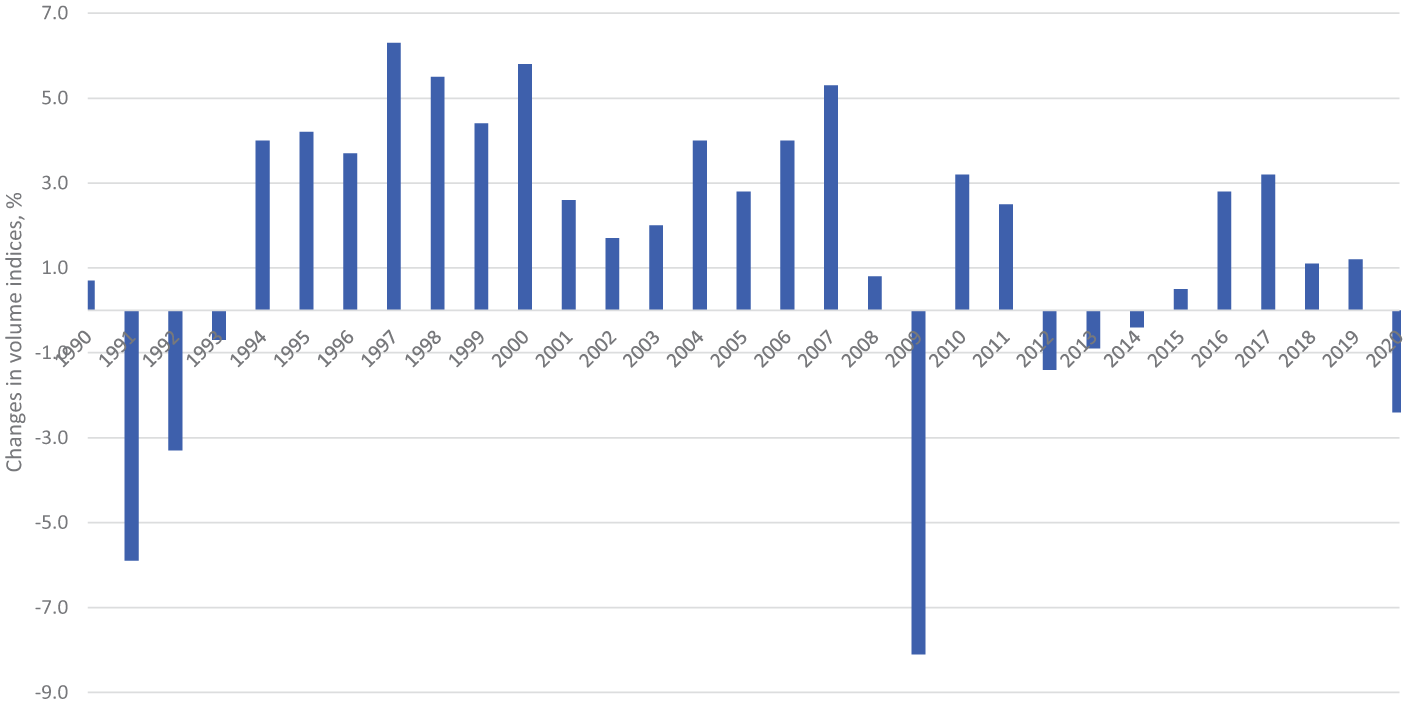
Annual change in the volume of gross domestic product, Finland 1990–2020.
In the early 1990s, Finland suffered a severe recession with high unemployment (over 16% in 1993–1994), due to fiscal policy mistakes and the collapse of trade following the Soviet Union’s fall (Meinander, 2021). From the mid-1990s, the success of the telecom company Nokia boosted the economy, but its decline and the sell-off of its mobile phone division in 2008–2013, exacerbated by the global financial crisis of 2008–2009, resulted in slow or negative growth until 2015 (Meinander, 2021). How these cycles affect the differences in income levels and development among the cohorts will be discussed.
Welfare state policies support families
In Finland, as in all the Nordic welfare states, parental allowances are part of the universal social insurance scheme (Lammi-Taskula, 2022). Finland has a dual-earning regime with accessible, low-cost, high-quality public day care. However, despite high female workforce participation and available childcare services, Finnish families tend to be traditional in caring for small children. Although family leave is available to both parents, mothers take 95% of the long family leave periods (Kinnunen et al., 2024).
The Finnish ‘home care allowance’ for children under the age of three, implemented in 1988, has countered Nordic egalitarian policies by keeping many mothers of infants at home (Kantola, 2021). This flat-rate allowance, an alternative to public day care, likely results in a ‘motherhood penalty’ for the mothers of infants. In 2022, the employment rate for mothers with children under three years of age was 63%, compared with children under three years of age was 63%, compared 92% for fathers. As children grow, the situation improves: 83% of mothers with children aged three to six are working, compared with 93% of fathers (Statistics Finland, 2023a). Public day care supports mothers’ return to work without the continued loss of earnings due to having a child:
H2A: We expect the birth of a child to reduce mothers’ incomes (a ‘motherhood penalty’), but only temporarily.
In the Nordic countries, fathers are subject to egalitarian expectations of childcare participation. A comparative study observed time use illustrating this egalitarian ‘new fatherhood’ in Norway (Hook and Wolfe, 2012). A cultural context emphasising fathers’ care responsibilities could lead to more equal career development for both parents, reducing the fatherhood premium. Despite Finland’s benefit system allowing fathers to care for their children after the three-month maternity allowance provided to the birthing mother, it is mainly mothers who take longer parental leaves. Aligning with international literature (Icardi et al., 2022):
H2B: We expect that the birth of a child does not decrease fathers’ incomes.
Finally, in line with Barg and Beblo (2009), we examine if co-residence affects income differences between women and men in STEM. As in many other countries (e.g. Lundberg et al., 2016), marriages in Finland are increasingly giving way to cohabitation. Except for families with the youngest children, Finland strongly represents a ‘dual-earner’ regime, even by Nordic standards. In STEM sectors requiring higher education, employment is typically full-time and continuous for both women and men. In such a context, household specialisation between couples would remain modest. However, since a male marriage premium comparable to the average of different countries has been observed in the Nordic countries (de Hoon et al., 2015):
H3: We expect to find a co-residence male premium.
Research design
To address the identified gaps in the extant literature, we selected a Nordic welfare state aiming for income equality as the focus of this study. We analysed the income of STEM degree holders aged 30–40 years in Finland, with a focus on total income by gender and cohort, the impact of parenthood and living with a partner. Five cohorts’ incomes were compared from ages 30 to 40.
Total register data
For this study, we relied on FOLK data, a whole population register-based dataset from Statistics Finland that covers all 15–70-year-olds in Finland since 1988 (about 3.5 million people annually). It combines indicators on population, employment, education, taxation and business, with encrypted identifiers for individuals and employers. As a total population register, it provides complete baseline and follow-up data with no attrition, except for instances when individuals die or move abroad.
This study’s population included cohorts born in 1960, 1965, 1970, 1975 and 1980. Individuals with a bachelor’s, master’s or doctoral degree in the natural sciences, ICT, or technology (International Standard Classification of Education [ISCED] classes 05–07), completed by age 30, were selected for inclusion in this study. Those employed at age 30 were followed up from the year they turned 30 until they turned 40, for the years 1990–2000, 1995–2005, 2000–2010, 2005–2015 and 2010–2020, respectively. Based on the data, we constructed a balanced panel, with observations for all individuals available at each time point.
Employees were studied at this age because they had likely finished full-time studies and started their careers and families. In Finland, women and men obtain their STEM master’s degrees around the same age (27–28 years) and have similar employment situations at graduation. After graduation, women experience more career interruptions for family leave, while men move into permanent full-time jobs (Naukkarinen and Bairoh, 2021, 2022). In the register, those with active employment contracts during their parental leave were listed as employed and included in the data selection.
The selection included 6,587 women and 25,278 men, totalling 31,865 individuals across five cohorts. The 1965 cohort was smaller, due to Finland’s economic recession during the early 1990s, which caused significant private sector reductions and high unemployment (Figure 1) and led to lower numbers of employed persons in 1995. By contrast, the 1975 and 1980 cohorts were the largest, likely due to increased participation in higher education (referred to as ‘educational expansion’; see Westerman et al., 2023), including STEM fields.
Measures
The dependent variable
Instead of conducting a typical wage analysis, our aim in this study was to capture ‘the true extent of compensation disparities between men and women’ (Torres-Olave, 2019: 53). The sum of annual total earned income in state taxation was selected based on Torres-Olave’s argument for ‘more comprehensive measures of compensation’, highlighting that without these, dimensions of the gender disparities in STEM may be missed. Our measure, originating from the national tax authority and social insurance institutions, included both earned income from one’s job and all taxable social transfers. The inclusion criteria were individuals aged 30, employed and holding STEM degrees. Among these individuals of reproductive age, the primary social transfers consist of parental allowances and unemployment benefits. The parental allowances covered by the dependent variable are the earnings-related maternity allowance, which can only be received by the birthing parent and extends from the late stages of pregnancy up to three months after the child’s birth, and the parental benefit, which can be applied for by either parent to care for the child. Unemployment benefits include earnings-related and partial allowances, and for individuals not yet eligible for the earnings-related scheme, basic unemployment allowance and labour market subsidy.
We applied a dependent variable by adjusting annual monetary values to the 2020 level using the cost-of-living index (Statistics Finland, 2024b). In the measure provided by Statistics Finland, highest annual percentile values were already top-coded to the median to adjust the upper tail. This measure allowed an intuitive estimation of earned euros.
The dataset lacked information on working hours, which significantly affects earnings (e.g. Destefanis et al., 2024); therefore, these data were not used to draw conclusions about wage gaps. However, we were still able to assess the total income of entire cohorts without missing data. This analysis contributed to our understanding of potential changes in the observed income disparities among different cohorts, based on total earnings.
Key independent variables
All analyses were separated by gender, with a focus on cohorts and family factors: the birth of children and living with a spouse over several years. In our data, the proportion of women in STEM increased from 14% to 24% between the 1960 and 1980 cohorts, although men still comprised the predominant majority. Gender, in this administrative register, was recorded as binary (male/female), in accordance with (and limited by) Finnish legislation.
Cohorts born in 1960, 1965, 1970, 1975 and 1980 were compared. The population register shows that the size of these cohorts has decreased by one-fifth over time, from 82,000 in 1960 to 63,000 in 1980 (Statistics Finland, 2023c). Nonetheless, our selection included a higher proportion of individuals from the most recent cohorts (supplemental material Table A1), reflecting higher levels of education, more positive economic cycles and increased employment in STEM.
To estimate the effect of a child’s birth on parental earnings, the timing of the first child born during the follow-up period was recorded (at ages 30–31, 32–33, 34–35, over 35 or no child born during the follow-up period). Furthermore, drawing on Barg and Beblo (2009), we estimated co-residing using annual household composition measures. We adopted a three-category variable to compare individuals based on their living arrangements during the follow-up period: those residing in a single-adult household throughout the study period (11 years), those living with a partner for one to 10 years and those living with a partner for the entire follow-up period. This measure reflected the polarisation within the population. Over half of people in their 30s lived with a partner throughout the follow-up period, either in a cohabiting relationship or married, while only around one-tenth lived alone the entire time. A ‘partner’ can be of any gender; same-sex couples were considered equally.
Control variables
Employees’ skills and labour market position were adjusted using ISCED, a time-invariant classification of educational fields.This approach was justified as individuals pursuing degrees beyond the bachelor’s level typically remained in the same field. The level of education was constructed as a time-varying variable to account for higher degrees obtained during the follow-up period. Typical for Finland, women in the study population were more educated than men, often holding a master’s degree in one of the natural sciences, like biology, while men mostly hold a bachelor’s degree in some branch of engineering.
We also accounted for the total number of children a parent had at age 29, one year before the follow-up period began. In addition to estimating the impact of the first child’s birth at specific ages on parental earnings, children born each year throughout the follow-up period were adjusted for.
Considering labour market position, we created a combined indicator for labour market status, employer sector and establishment size. Public and private sector employment was considered due to the differentiated nature of the work in these sectors. Additionally, because most private companies in Finland are small, establishments with 20 employees or fewer were distinguished. The result was an annual five-category, time-variant indicator: ‘employed in the public sector’, ‘employed in the private sector at an establishment with fewer than 20 employees’, ‘employed in the private sector at an establishment with at least 20 employees’, ‘employed, other’ and ‘not employed’. Characteristic of the Nordic labour market, women clearly worked more often in the public sector. Table A1 presents descriptive information for the model variables.
Analytical strategy
Linear mixed-effects models were used to analyse panel data with repeated observations nested within individuals (Singer and Willett, 2003). A model with random intercepts and a random slope for time (age) was specified, allowing variations among individuals in income levels and growth rates (Table A2). To compare income trajectories, two-way interaction terms between relationship and age, as well as cohort and age, were included. Age was treated as a continuous variable. To examine more complex patterns in income changes following childbirth, a linear mixed-effects model (without random slope) was estimated, with an interaction between age and timing of childbirth (Table A3). Here, age was treated as a categorical variable without assuming any particular function over time. All models were run separately for women and men.
We applied robustness checks to assess the consistency of the empirical findings. First, we took the natural logarithm of the income outcome variable to account for skewness in the income distribution and to eliminate potential heteroscedasticity. However, in this specific dataset, which consisted solely of tertiary-educated STEM workers within a specific age range, log-transformation of the income variable did not improve the fit of the models or alter the main results. To further ensure the results were robust against misspecifications, the analysis was reproduced by estimating Poisson random-effects models. Using a Poisson quasi-maximum likelihood specification with robust standard errors ensures consistent estimates under rather weak assumptions and regardless of the true data distribution (Wooldridge, 2010). The results from the Poisson models remained qualitatively similar to the main analysis.
Results
The full output of the linear mixed-effects models is reported in the supplemental material (Tables 2A and 3A). In the following, to facilitate the interpretation of the interaction terms used to test hypotheses, Figures 2–4 illustrate the predictive margins of total annual income.
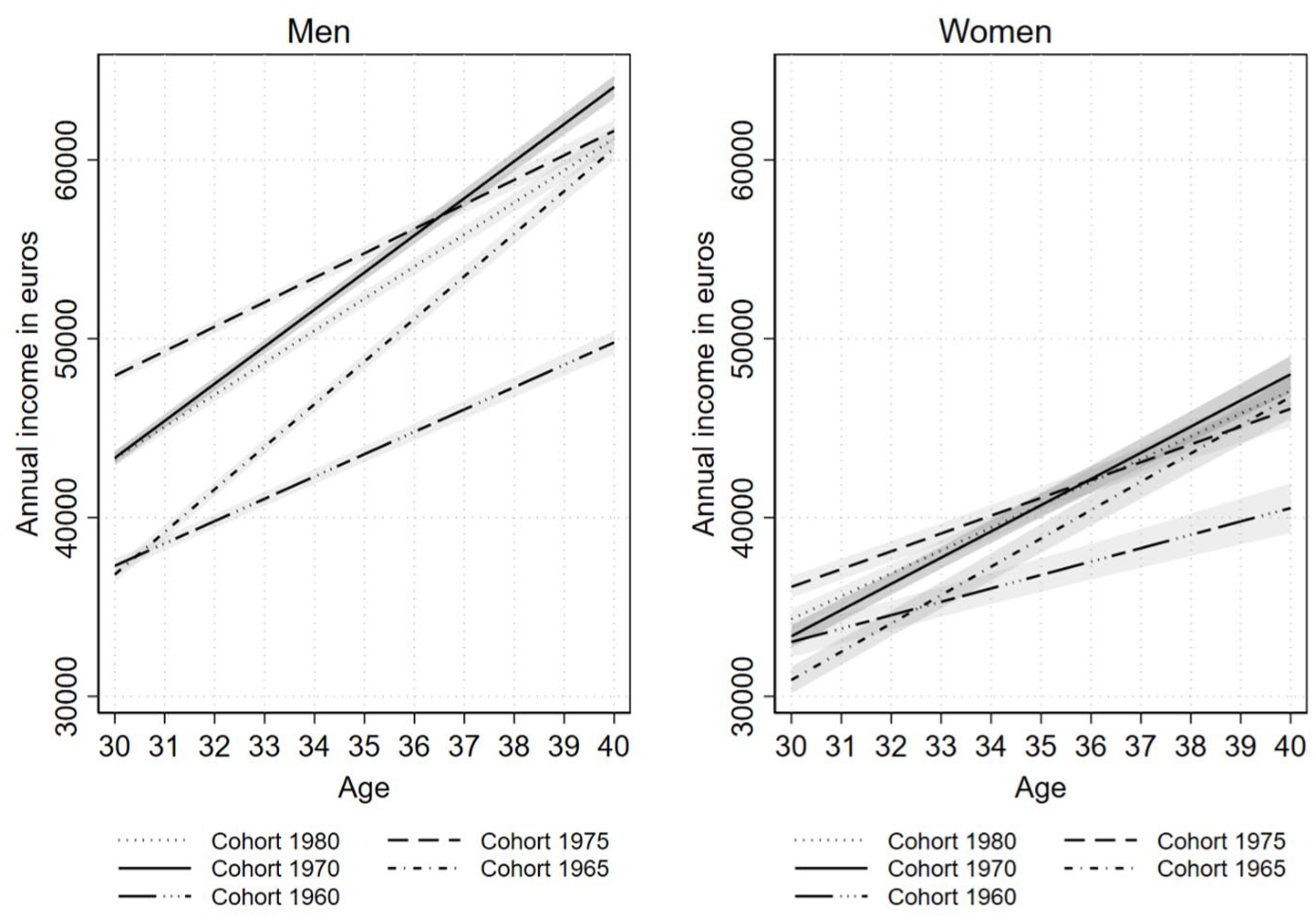
Predicted total income by cohort and age (with 95% CIs).
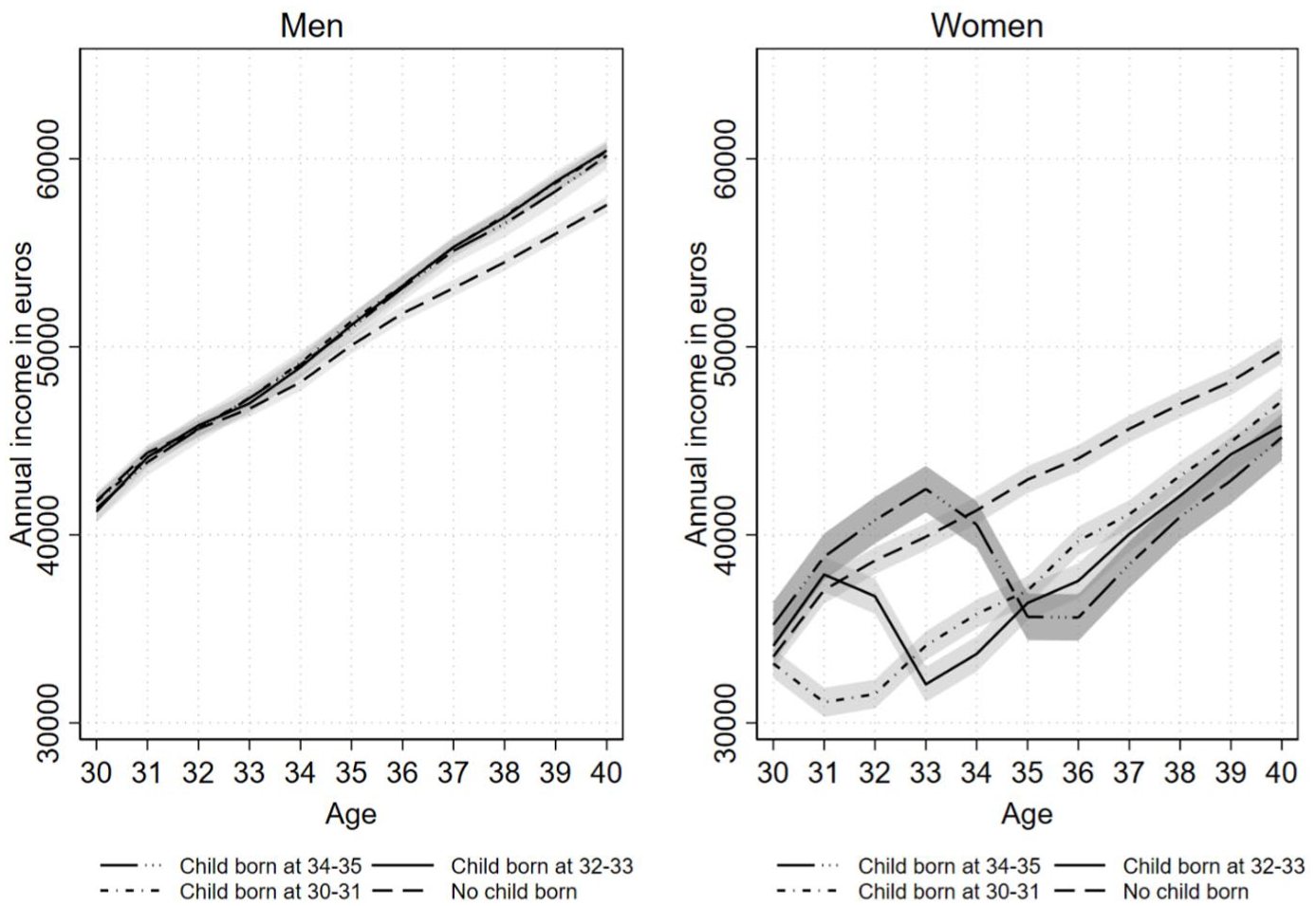
Predicted total income by childbirth and age (with 95% CIs).
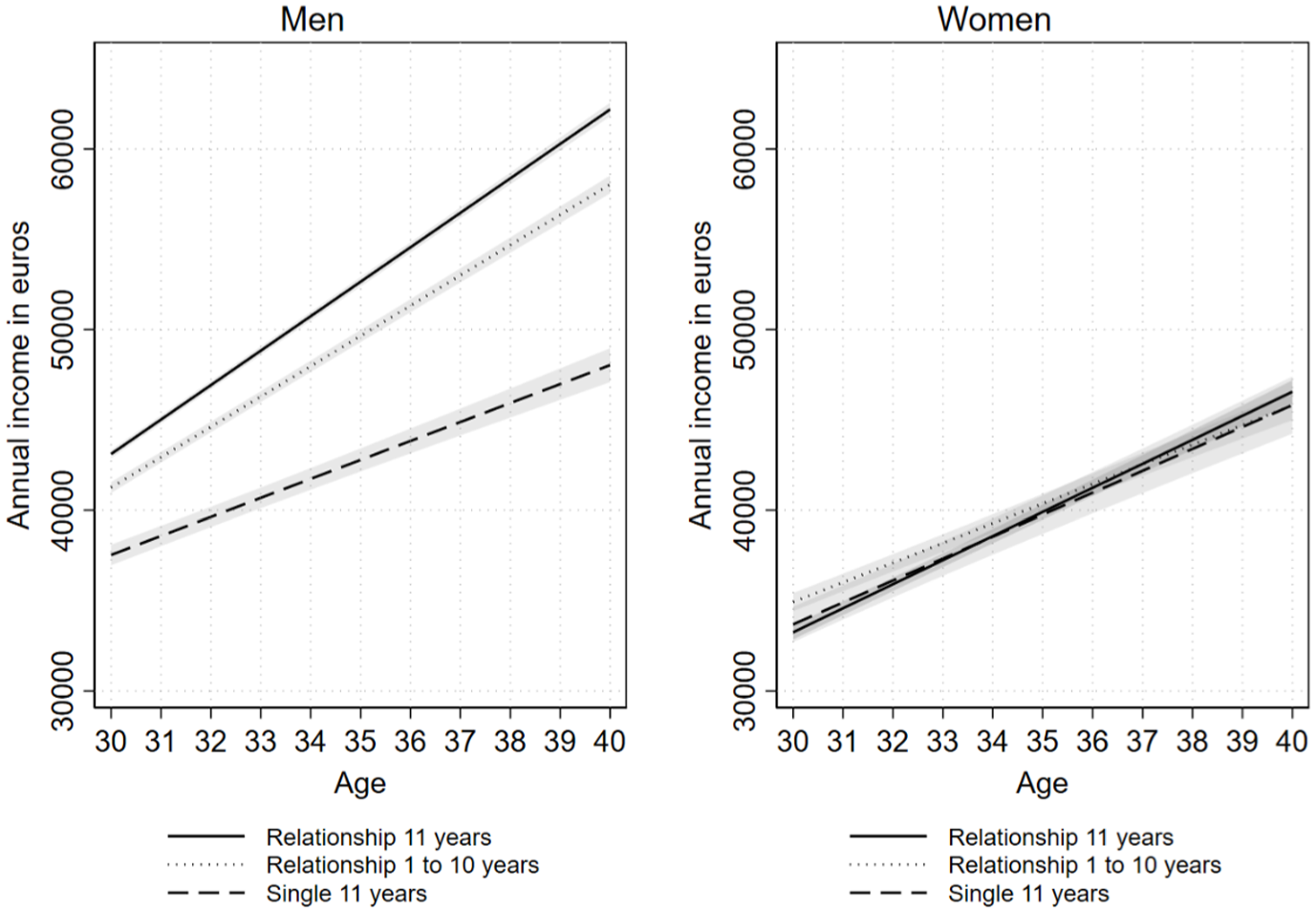
Predicted total income by relationship and age (with 95% CIs).
Comparison of cohorts
Our first hypothesis (H1) assumed marked yet diminishing gender income disparities across cohorts. As expected, there were significant differences across both cohorts and between genders (Figure 2). Women’s lower income levels, compared with men, were evident in all cohorts, and income growth was not as substantive as in male cohorts. We found that the deep economic crisis of the early 1990s had a severe impact on workers’ earnings. As a kind of ‘recession penalty’, income growth among the 1960 cohort remained relatively modest for both men and women throughout the follow-up period.
In contrast to the above, for the 1965 and 1970 cohorts, which we followed in their 30s during the economically favourable period of the 2000s before the global financial crisis, we observed a ‘male boost’. Among these cohorts, men’s income growth was the steepest, and by the end of the follow-up period, the 1970 cohort had the highest income level (Figure 2). Among women, cohort differences were far less pronounced, with the exception of the 1960 cohort.
It appeared that, during times of economic recession, initial income levels were lower, but income development soon after the recession was more positive, compared with cohorts experiencing a recession in the middle of the follow-up period. The result was that incomes levelled out among the cohorts born between 1965 and 1980, but not between women and men (Figure 2). Thus, while we expected Nordic labour market institutions and equalitarian-aiming policies to reduce income differences between men and women, our findings show no signs of any reduction. In particular, women’s income progression across cohorts has remained modest, contrary to our hypothesis. This finding suggests that the gender pay gap may also have persisted–or even widened–over time.
Family factors
As explained above, in hypotheses 2A and 2B (H2A and H2B), we expected that motherhood would temporarily affect income, but that fatherhood would not. Figure 3 shows how children born during the follow-up period (ages 30–31, 32–33, or 34–35) affected mothers’ and fathers’ incomes during this time. The first part of the hypothesis, H2A, was supported: the birth of a child reduced mothers’ incomes, even though the outcome measure included earnings-related family benefits at the time of the child’s birth. Figure 3 suggests that the penalty was substantial and accumulated over the years, with those who had children at the beginning of the follow-up period suffering significant income losses by the end of the follow-up period. Thus, the temporary nature of the motherhood penalty was not supported.
In addition, H2B was supported: the birth of a child did not negatively affect fathers’ incomes. In fact, those who had no children showed slightly lower income levels at the end of the follow-up period, indicating a mild fatherhood premium. Then again, while previous research suggested that Nordic fathers are participating in childcare due to increased egalitarian values (Hook and Wolfe, 2012), no such trend could be observed based on the present analysis. If fathers had participated significantly in childcare, it might have caused a dip in their incomes similar to that experienced by mothers, especially in more recent cohorts; however, we did not observe even a temporary drop in fathers’ incomes (Figure 3).
Finally, we examined years of cohabitation with a partner. We expected to find a premium for men who live with a partner (H3). Corroborating H3, more years of cohabitation were linked to both higher income levels and positive income development (Figure 4). In a way, this finding aligned with Killewald’s (2013) results: the more stereotypical and ‘norm-conforming’ the family, the higher the income. Conversely and somewhat unexpectedly, there was also a less discussed downside: the income growth of single men lagged over time, which we term the ‘living-alone penalty’. Meanwhile, support was given to the notion that the phenomenon is gendered, as it was not observed in women. Women with STEM degrees neither benefitted from stable relationships nor were penalised for being single.
The findings of our study have limitations. The relationship between the number of hours worked by men and women and their actual earnings could not be assessed using the administrative data, as employers were not required to record employees’ working hours. Therefore, we could not estimate the magnitude of hourly gender pay gaps within STEM professions. Further, the division of household labour, which could indicate the family’s internal social norms, could not be evaluated (Lichard et al., 2021). However, most male and female STEM workers in Finland work full-time hours, with no significant gender gaps in working hours. Furthermore, the data did not allow for a consideration of the gender segregation within STEM: men more often work in the private sector; in higher positions, such as in management; and in more technical ‘core’ work activities (cf. Cech, 2013; Dressel et al., 2025), all of which are concurrent with higher pay in the field of technology in Finland and hence contribute to the gender pay gap (Keränen, 2024). Such job content data on high-tech skills requirements (Cardador, 2017; Faulkner, 2014; Holth et al., 2017; Sterling et al., 2020) was, however, unavailable in the population and income registry records.
Discussion and conclusion
Increasing the number of women working in well-paid STEM jobs has been suggested as a solution to the persistent gender pay gap (e.g. Michelmore and Sassler, 2016), yet recent studies illustrate that considerable inequalities in employment and earnings remain between men and women working in STEM occupations (Dressel et al., 2025; VanHeuvelen and Quadlin, 2021). This article contributes to the literature by investigating whether the income disparities between highly educated men and women in STEM fields have decreased in a Nordic country, Finland, in recent decades. The study is based on comprehensive registry data, comparing five cohorts of employees aged 30–40. It also shows how having children and living with a partner are linked to income development for Finnish women and men in STEM.
The labour market context of the Nordic welfare state, characterised by high levels of education among women, generous family benefits and public day-care systems that support women’s employment, should ideally facilitate the reduction of income disparities, particularly for more recent cohorts of workers. Labour and welfare state researchers (Kantola, 2021; Koskinen Sandberg, 2018) have, however, critically questioned and examined how bright the Northern lights truly are (Mustosmäki, 2017). Our hypothesis was that income differences between women and men in STEM cohorts are diminishing. Contrary to expectations, the findings show that the gender income disparity in STEM in Finland remains significant, and it persists across cohorts. This is the case even though we deliberately examined a clearly defined dataset of individuals with the same field and level of education, and at the same career stage, and despite the chosen income indicator accounting for family and unemployment benefits (Torres-Olave, 2019).
The overall cohort comparison allows controlling for periodic changes, such as educational expansion, and cyclical changes, such as macro-economic factors (Westerman et al., 2023). Unexpectedly, the findings illustrate how economically challenging situations can exacerbate income disparities. The results indicate a ‘recession penalty’, where an economic crisis at the start of a career may deepen the income disparities among cohorts. Except for the 1960 cohort, male workers were somewhat less subject to such recession penalties. Instead, we can cautiously say that men’s incomes improve more rapidly, if the economic situation is favourable. This results in a kind of ‘male boost’ for cohorts coinciding with positive economic conditions and implies that, concurrently, women’s earnings lag further behind. Thus, economic recessions may exacerbate gender income disparities, casting shadows on gender income equality. This may be because, in economically favourable conditions, employers are compelled to compete for labour, and they particularly increase the earnings of male employees, who are perceived as more competent than women (Bairoh, 2023; Blair-Loy and Cech, 2022). Further research is needed to determine if ‘recession penalties’ and ‘male boosts’ are specific to STEM fields or apply across sectors and countries. Overall, the scarring effects of economic recessions should be studied across different fields (Xu et al., 2022).
Consistent with research from different institutional contexts (Dressel et al., 2025; Holth et al., 2013; Okahana and Hao, 2019; Xu, 2015), STEM degree investments in at least one Nordic country, Finland, are not equitably rewarded and disadvantage women. Scholars critical of HCT point out that it offers a limited explanation for gender differences in pay, since investments in one’s skills may not be fairly rewarded in the job market (e.g. Koskinen Sandberg, 2018; Woodhams et al., 2022). Furthermore, attributing the gender pay gap to individual choices shifts responsibility away from gendered social structures (Koskinen Sandberg, 2018). Nonetheless, the Nordic, equality-oriented institutional context supporting women’s employment does not reduce income disparities. Instead, our findings align with previous studies that argue how a strong welfare state structure may even hinder the economic rewards for highly educated women (Mandel, 2012; Mustosmäki, 2017), thereby maintaining income disparities.
As traditional human capital explanations for the gender wage gap have been losing salience, social and gender norms have gained prominence (Blau and Kahn, 2017; Cortés and Pan, 2020; Kleven et al., 2019b; Laine and Kauhanen, 2023). Although it is difficult to confirm directly the mechanism by which highly educated women in Nordic STEM fields suffer from income penalties, our findings imply that social and gender norms do, indeed, impact the incomes of men and women with STEM degrees in Finland. They also influence the attitudes of actors within the centralised wage bargaining system, thereby preventing wage negotiations from effectively supporting the levelling of women’s earnings (Koskinen Sandberg, 2018). At the workplace level, the roles of employers, organisational practices and discrimination have been underestimated (Broyles, 2009; Dressel et al., 2025; Woodhams et al., 2022).
We have also asked how family factors – having children, living in a relationship – are connected to income development among STEM workers. We hypothesised that motherhood would temporarily see reduced incomes and that fathers would face no negative connection to income development in the Nordic context. While having a child does not negatively affect fathers’ earnings, in line with Icardi et al.’s (2022) findings, it significantly impacts mothers’ earnings. It is likely that gender norms, which influence income disparities through the gendered division of labour within households (i.e. household specialisation) (Killewald and Lundberg, 2017) and ‘glass ceilings at home’ (Lichard et al., 2021), remain the explanatory factors. Despite the dual-career model and fairly equal opportunities for sharing parental leave, mothers overwhelmingly continue to be the primary caregivers for small children in Finland, despite their high levels of education. Although Finland provides earnings-related benefits to parents, having children is a strong and negative determinant of their income levels. Unlike in the US, where many parents leave STEM jobs after having children (Cech and Blair-Loy, 2019), the Nordic model still succeeds in supporting educated mothers’ return to work after parental leave. With the provision of public day care, although mothers’ incomes drop with childbearing, their income levels slowly recover in the follow-up years, compared with other women. Thus, the motherhood penalty consists of the caregiving years and the concurrent accumulation of the gender income disparity.
Finally, we have asked how living with a partner is linked to income disparities, regardless of marital status. Somewhat unexpectedly, men’s income trajectories are negatively affected by the lack of a stable relationship. This finding suggests a relationship premium, in line with de Hoon et al.’s (2015) work, alongside a stronger ‘living-alone penalty’ for men. It indicates that men, in particular, may be rewarded for stable relationships or penalised for the lack thereof (cf. Killewald, 2013; Yu and Hara, 2021). An explanation for the ‘living-alone penalty’ may be the lack of social support within the household, which can contribute to an individual’s productivity and earnings growth at work (Barg and Beblo, 2009). However, this explanation is not satisfactory for explaining the income disparities observed in workplaces, as they again refer to the assumptions of HCT about individual differences, rather than social norms, as the determinants of income inequality. The observation requires further research in the context of wage studies.
Like most studies on the gender income differences, this research cannot directly address the social norms that ultimately act as mechanisms in income inequality. There are significant differences in income development between men and women, which are most likely and predominantly due to the gender norms and gendered division of labour in the workplaces and households of the employees. As Xu (2015) argues, the core problem of income inequality in STEM is the differing treatment of men and women in the workplace and, we would add, at home. The mechanisms that produce discrimination or rewards based on gender, parenthood or relationship status are difficult to demonstrate because couples’, fathers’ and mothers’ choices between work and family, workers’ productivity differences, employers’ actions (Killewald, 2013) and the institutional context (Mandel, 2012; Mustosmäki, 2017) all play a role. We suggest that these diverse gender norms should be studied further in wage gap analyses across countries and sectors.
We conclude that the income disparities in STEM are largely attributed to gendered living conditions and social norms in households, workplaces and societies. Consequently, even an equality-oriented country such as Finland appears somewhat powerless to reduce persistent gender income disparities. Egalitarian attitudes and workplace equality programmes have not translated into equal incomes. Systematic actions at the international, national and workplace levels are needed to address income disparities. For example, encouraging fathers to take family leave through benefit systems and workplace actions are needed to dismantle gendered norms in family labour division. To maintain their ‘gender-equal’ reputation (Kantola, 2021; Mustosmäki, 2017), the Nordic countries must take decisive actions to support the career advancement of highly educated women in male-dominated sectors and beyond.
Supplemental Material
sj-docx-1-wes-10.1177_09500170251366157 – Supplemental material for Disaggregating Gender Income Disparities in STEM: Cohort and Family Factors in a Nordic Welfare State
Supplemental material, sj-docx-1-wes-10.1177_09500170251366157 for Disaggregating Gender Income Disparities in STEM: Cohort and Family Factors in a Nordic Welfare State by Susanna Bairoh, Satu Pyöriä and Niklas Mäkinen in Work, Employment and Society
Footnotes
Acknowledgements
The article’s register-based research data analysis has been enabled by a permit from Statistics Finland (permit number TK/476/07.03.00/2024).
Funding
The authors disclosed receipt of the following financial support for the research, authorship, and/or publication of this article: The Finnish Work Environment Fund has supported this research (project number 117355).

Supplemental material
Supplemental material for this article is available online.
References
Supplementary Material
Please find the following supplemental material available below.
For Open Access articles published under a Creative Commons License, all supplemental material carries the same license as the article it is associated with.
For non-Open Access articles published, all supplemental material carries a non-exclusive license, and permission requests for re-use of supplemental material or any part of supplemental material shall be sent directly to the copyright owner as specified in the copyright notice associated with the article.
