




Abstract
Institutional arrangements and social background characteristics significantly influence school-to-work transitions (STWT). This study examines cross-national differences in the risk of being not in education, employment, or training among young people with and without disabilities and investigates how institutional contexts influence the duration of ‘not in employment, education or training’ (NEET) status among individuals with disabilities across 31 European countries. Using longitudinal data from the EU Statistics on Income and Living Conditions (EU-SILC), multilevel random slope regressions were employed with interactions between self-assessed ‘limitations in activities because of health problems’ and institutional indicators. The findings reveal that higher rates of vocational enrolment, tracking in special schools and increased incapacity spending effectively reduce NEET-length among individuals with disabilities. These results underscore the importance of institutional contexts in shaping STWT and highlight the need for more in-depth comparative research on the transitions of young people with disabilities.
Keywords
Introduction
School-to-work transitions (STWT) are crucial events in life courses with long-lasting consequences for employment outcomes and related life chances (Bynner and Parsons, 2002). Comparative research repeatedly demonstrates how institutional arrangements shape STWT (Buchmann and Kriesi, 2011). Theoretical explanations for how institutions influence STWT are based strongly on the ideal-typical distinction of internal labour markets (ILM), focusing on internal career progression within a single organization, or occupational labour markets (OLM), that emphasize external mobility across employers within OLM (Gangl, 2003; Marczuk, 2024; Marsden, 1990; Maurice et al., 1986). Institutionally, these two system types differ in linkages of education and labour market, levels of school stratification, and the extent and organization of vocational training, thereby providing varying opportunity structures for STWT (Allmendinger, 1989; DiPrete et al., 2017; Gangl, 2001; Müller and Shavit, 1998).
However, how institutions influence STWT also depends on individual-level characteristics. Thus, while social background characteristics influence education, occupational and employment outcomes of STWT, in all countries (Hannan et al., 1996), the influence of institutional characteristics on STWT differs considerably between socio-demographic groups as depicted by the varying importance of formal education across institutional settings (Gangl, 2003; Wolbers, 2007). Also, case studies of Germany – considered an OLM with a strong vocational training system and highly stratified pathways between general and vocational education that provides smooth STWT (Buchmann and Kriesi, 2011) – show that low-attainers face increased risks of long-lasting labour market exclusion (Brzinsky-Fay and Solga, 2016; Jacob and Solga, 2015). This raises the question to what extent established institutional explanations and related indicators are suitable to explain cross-country variance in STWT of disadvantaged groups.
About 18% of the population of Organisation for Economic Co-operation and Development (OECD) countries are considered to have disabilities (OECD, 2022). Rates of students identified as having disabilities in schooling – so-called special educational needs (SEN) – have been on the rise worldwide for decades (Richardson and Powell, 2011). Persons with disabilities are a particularly disadvantaged group (Brown et al., 2022). For the study of social inequality and stratification, this diverse group’s members are of great interest due to their marginal positionality and the effects of disablement on lived experiences and life chances (Jenkins, 1991; Jenkins and Rigg, 2004; Powell and Blanck, 2023). Highly consequential employment rate gaps between persons with and without disabilities have been well documented (Burkhauser and Daly, 2009; O’Brien, 2013; OECD, 2022). Considerable evidence uncovered multiple simultaneous disadvantages that young adults with disabilities face during their STWT: students with SEN face significant additional hurdles to successfully transition to work and adulthood (Janus, 2009; Newman et al., 2011; Wells et al., 2003). Indeed, these young adults are at high(er) risk of being ‘not in employment, education or training’ (NEET) (Gutman and Schoon, 2018; Menze et al., 2023). This particularly strong kind of labour market exclusion stands for complete (temporary or long-term) withdrawal from the labour market, leading to lower income and occupational status in later careers (Bynner and Parsons, 2002; Levels et al., 2022). However, NEET-incidence among those with disabilities varies considerably between countries (OECD, 2022), with comparative studies needed to explore these disparities.
Yet, due to theoretical and methodological challenges, as well as data scarcity, the educational and employment processes of persons with disabilities remain understudied (Chatzitheochari and Platt, 2019). Especially, comparative studies on STWT of persons with disabilities remain very rare, leaving crucial questions open as to how institutions influence labour market entry of this strongly disadvantaged group.
Building upon existing research on the influence of institutional context on STWT, the research gaps are addressed by analysing how the gap in the duration of NEET (NEET-risk) between persons with and without disabilities varies by country. This reaches beyond descriptive insights based on cross-sectional aggregate data (OECD, 2022). Second, how does NEET-risk of persons with disabilities vary under different institutional conditions? Several institutional indicators related to ILMs and OLMs are included as ‘classical’ explanations. These indicators are then complemented with those relevant to explain challenging STWT of youth with disabilities. Longitudinal data for 31 countries of the European Union Statistics on Income and Living Conditions (EU-SILC) survey covers the first four years of STWT of persons aged 16–18 years. Multilevel random slope regression models of the cumulative duration of NEET with interactions of institutional indicators for 31 European countries with self-assessed limitations in activities due to health problems are estimated. This operationalization refers to a social model of disability and reflects internationally comparative studies on the labour market situations of persons with disabilities (Hadjar and Kotitschke, 2021; Kangas and Karonen, 2022; OECD, 2022).
This study advances our understanding of how institutional characteristics influence the STWT of persons with disabilities, while shedding light on potential NEET risk factors. It underscores the importance of developing additional and complementary institutional explanations and indicators to more comprehensively capture the factors driving variation in the STWT of persons with disabilities.
Research on STWT of youth with disabilities in comparative perspective
Despite not having drawn much attention from scholars of social inequality, disablement is a crucial factor in educational and social stratification processes (Brown et al., 2022; Jenkins, 1991; Powell, 2016). Social background characteristics, from low socio-economic background to ethnic minority status, increase the risk of disability classification (Morgan et al., 2015; Sullivan and Artiles, 2011). Disablement is related to numerous negative outcomes across the life course (Brucker et al., 2015; Hadjar and Kotitschke, 2021; Jenkins, 1991; OECD, 2022; Priestley, 2000).
Persons with disabilities are also disadvantaged in labour market access and STWT: Recent field experiments in several countries show their lower probabilities of being called back when applying for work, being invited for job interviews or being hired for a job. Unsurprisingly, important differences relate to impairment types (Ameri et al., 2018; Bellemare et al., 2018; Berre, 2024; Bjørnshagen and Ugreninov, 2021). Research in various countries shows that students with disabilities enter postsecondary education and employment (far) less frequently than their counterparts without disabilities and are more often in NEET (Gutman and Schoon, 2018; Janus, 2009; Newman et al., 2011; Wells et al., 2003). Menze et al. (2023) show that students from special schools for students with ‘learning disabilities’ in Germany exhibit a higher NEET-risk than comparable disadvantaged youth from regular lower secondary school tracks.
Research shows that STWT and NEET-rates generally differ between countries (Eurofound, 2014; Levels et al., 2022) and that (mental) health-related factors are important to explain NEET-risk (Lindblad et al., 2024; Rahmani et al., 2024). Descriptive comparative studies on disabilities and the labour market consistently show that the labour market chances of persons with disabilities also vary considerably across countries (Halvorsen et al., 2016; OECD, 2022; Pinilla-Roncancio and Gallardo, 2023). However, comparative studies on the STWT of youth with disabilities remain very rare. Existing studies map gaps in NEET-rates between youth with and without disabilities based on aggregate cross-sectional data (OECD, 2022), describe country-specific transition systems (EADSNE, 2002), compare transition systems in two countries (e.g. Tschanz and Powell, 2020) or show the impact of health for becoming NEET across regions (Rocca et al., 2022). Yet, crucial questions as to how and why the STWT – and particularly the NEET-risk – of youth with disabilities differ across European countries still demand attention. Particularly, investigating STWT based on longitudinal data seems crucial, because cross-sectional information on NEET-incidence can be misleading when estimating the NEET-risk during extended STWT (Brzinsky-Fay, 2014).
Institutional influences on STWT: Explaining cross-country variation with respect to disabilities
Signalling, stigmatization and discrimination as obstacles to successful STWT of persons with disabilities
Thus far, explaining the lower labour market chances of disadvantaged persons and those with disabilities concentrates on demand-side explanations, relying on mechanisms of signalling, stigmatization and discrimination. These concepts facilitate understanding how individuals or groups are classified and treated based upon certain characteristics, ascribed or achieved.
Employers are the central gatekeepers in labour markets: their attitudes and perspectives are key in hiring processes (Burke et al., 2013). Building upon human capital theory (Becker, 1975), the signalling approach assumes that employers use screening devices, like educational certificates, to select the most productive workers (Stiglitz, 1975). Because employers seek to limit costs, they sort applicants in labour queues, placing individuals with the highest perceived training costs at the end. Yet, since many skills are learned on the job, employers do not rely solely on educational qualifications as proxies for productivity, but also use a person’s background characteristics to assess their assumed trainability, which determines training costs (Thurow, 1975). Certain characteristics are associated with social stigma: stigmatization can be understood as the negative social reaction to discrediting characteristics 1 (Goffman, 1963), based on culturally shared and institutionalized beliefs about ab/normality and (mal-)functioning (Link and Phelan, 2001). Because of stigma, individuals may be considered as generally undesirable or inferior.
Both signalling and stigmatization explain reduced access to the labour market of persons with disabilities: disabilities are unjustifiably but widely understood as a particularly strong signal for low productivity, low trainability and therefore high training costs. Stigmatization often leads to discrimination. Statistical discrimination theory (Phelps, 1972) suggests that employers develop stereotypes based on experiences about who would be best to employ. They often discriminate against persons with certain characteristics, consistently placing them at the end of the labour queue or exclude them completely (Thurow, 1975). Persons with disabilities may suffer from such statistical discrimination because disability status marks membership in a group considered in many societies as generally undesirable. As Østerud (2023) recently showed for Norway, employers discriminate against persons with disabilities not only based on beliefs about reduced productivity but also based on apprehensions about their not fitting in socially, rendering disability a ‘master status’ in hiring decisions (Berre, 2024; see also Ballo, 2020).
Yet, in relation to persons with disabilities, the assumption of individual stereotypes based on prior experiences seems insufficient. Indeed, stigma is not a quality of a characteristic or an impairment per se, but is determined in social relations (Goffman, 1963), with the relevance and strength of a stigma as well as signals depending on (historical) context (Solga, 2002). Over time, negative labels and stereotypes are embedded in practices, programmes and policies that justify biased treatment resulting in ‘institutional discrimination’ (Gomolla and Radtke, 2002). Therefore, it is theoretically sound to assume that the strength of disability as a signal and the associated stigma vary between institutional contexts. Moreover, the roles and attitudes of employers in the STWT vary between countries, resulting in differences in levels of and possibilities for discrimination (on nationally varying strength of racial and ethnic discrimination, see Quillian et al., 2019). Taken together, such differences help explain variation in the impact disablement has on STWT.
Institutional variation and the NEET-risk of young adults with disabilities
A key issue in research on STWT is how the structure and linkages between education systems and labour markets shape pathways into employment. Two ideal-typical institutional configurations are often distinguished (Gangl, 2003; Marczuk, 2024; Marsden, 1990; Maurice et al., 1986): In OLMs, education systems are strongly stratified, often through tracks and vocational or apprenticeship programmes that emphasize investment in specific skills. These skills are clearly signalled through educational certificates, which convey industry- and occupation-specific competencies. Owing to the strong education/labour market linkages, STWT tend to be smooth, and employment trajectories are relatively stable (Buchmann and Kriesi, 2011; Scherer, 2001). However, the rigid and stratified nature of these pathways can disproportionately disadvantage certain, especially vulnerable, groups, leaving them at higher risk of long-term labour market exclusion (Brzinsky-Fay and Solga, 2016; Jacob and Solga, 2015; Menze et al., 2023).
In ILMs, in contrast, education systems are designed to support fluid labour markets by prioritizing general skills that are more easily transferable across jobs and firms. Here, education system and labour market are loosely connected, resulting in a larger share of the workforce experiencing mobility between jobs and firms (Hall and Soskice, 2001; Maurice et al., 1986). Labour market positions are more reliant on work experience gained within ILMs, which leads to greater turbulence and longer entry trajectories into stable employment (Gangl, 2003).
Accordingly, institutional characteristics expected to be relevant for the STWT of persons with disabilities are educational stratification via tracking and the organization(s) of vocational training. Within labour markets, employment protection legislation (EPL) – varying between ILM and OLM in terms of dismissal protections, flexibility and training focus – affects risks of being excluded from the labour market. However, comparative research on STWT has thus far hardly considered persons with disabilities. Building on these established institutional explanations, additional assumptions about institutional characteristics specifically related to stigmatization and discrimination of persons with disabilities are expected to impact labour market opportunities for this group: the proportion attending (segregated) special schools, the share of students classified as having SEN and governmental support for persons with disabilities.
Educational stratification is a central dimension for the linkage between education system and labour market (Allmendinger, 1989; Müller and Shavit, 1998), varying across European countries (Gogescu, 2024). It describes how educational institutions are organized into higher and lower educational tracks or types of (secondary) schools that certify certain skills, creating different educational groups (Kerckhoff, 2001). A general assumption with respect to STWT is that an education system’s higher degree of stratification smooths STWT because it sends stronger signals to employers about job applicants’ qualifications (Spence, 1973). Research emphasizes tracking as one dimension of educational stratification, a strong predictor of future employment outcomes, that functions as a mediator between social origin and labour market outcomes even after ability is accounted for (Bol and Van de Werfhorst, 2013; Schindler, 2021; Traini, 2022). Thus, tracking might be expected to also be beneficial for STWT of persons with disabilities. Therefore, the stronger the tracking, the lower the NEET-risk of persons with disabilities (H1).
While analyses of the influence of educational stratification usually address tracking in the general school system, tracking is also an important aspect of how students with disabilities are accommodated in school systems: while some countries include students with disabilities in general classrooms for the majority of the school day, other countries provide education for students with SEN mostly in separate classrooms or segregated special schools (Powell, 2016; Richardson and Powell, 2011). Theoretically, this limited access to general education has consequences for stigmatization, signalling, and, consequently, discrimination. First, it can be assumed that in societies in which students with SEN are more frequently educated in special schools, the stigma associated with disabilities is stronger, because special schools’ legitimacy is based on the normative assumption that students with disabilities may hinder learning of students without disabilities and should be placed in a (segregated) ‘safe space’ of protection and care (Pfahl and Powell, 2011). Thus, the signal for low trainability associated with disabilities is also stronger in countries with a larger share of special school students, which leads to persons with disabilities being placed more often towards the end of the labour queue – or being excluded. This assumption is further supported by studies on the effects of inclusive education – as compared with special education in segregated classrooms or special schools – that show positive relationships between attending general education and educational attainment as well as labour market integration (e.g. Blanck, 2020; Joshi and Bouck, 2017; Mazzotti et al., 2021). It is expected that the higher the share of students in special schools, the higher the NEET-risk of persons with disabilities (H2).
The proportion of students classified as having SEN in schooling (SEN rate) varies strongly between countries (Appendix A1) and is assumed to influence STWT and NEET-risk: focusing on the employment opportunities of less-educated people, Solga (2002) has shown that labour market discrimination of low-attainers is associated with group size and social selectivity. Smaller group size and more ‘negative selection’ leads to educational attainment becoming a stronger signal for low ‘trainability’ (Thurow, 1975) and increased stigma. In countries with lower SEN rates, the group of those with SEN comprises a higher proportion of persons with stronger impairments (EASNIE, 2020; OECD, 2000). Therefore, it can be expected that the signal of disabilities for low trainability is stronger the lower the SEN rate and therefore that the lower the SEN rate, the higher the NEET-risk of persons with disabilities (H3).
Institutional systems also differ with respect to the importance of specific vocational skills, transferred in the education system (vocational specificity), as well as regarding the organization of vocational training. Wolbers (2007) shows that the risk of being inactive after entering a first ‘significant job’ is lower in countries with strong vocational specificity. However, positive influences of vocational skills on labour market allocation seem to depend very much on the country (Iannelli and Raffe, 2007) and are assumed to be more likely in systems in which vocational qualifications are not only acquired in the school system, but also within firms. This is the case in dual systems of apprenticeship found in Germany, Austria, Switzerland and Denmark (Levels et al., 2022). Bol and Van de Werfhorst (2013) show that a higher percentage of upper secondary education taking place in a dual system reduces youth unemployment. Because acquired vocational qualifications may signal trainability and productivity for youth with disabilities as well (Ballo and Alecu, 2023), it can generally be expected that the stronger the emphasis on vocational skills in a country, the lower the NEET-risk of persons with disabilities (H4). However, in line with research showing disadvantages of persons with low formal qualifications in dual systems (Brzinsky-Fay and Solga, 2016; Jacob and Solga, 2015) and contrary to the general positive influence of dual systems on STWT (Buchmann and Kriesi, 2011), it is expected that the stronger the dual system in a country, the higher the NEET-risk of persons with disabilities (H5), because in dual systems employers are already the central gatekeepers when it comes to acquiring vocational qualifications and they are likely to discriminate against persons with disabilities (Ameri et al., 2018; Bellemare et al., 2018; Berre, 2024; Bjørnshagen and Ugreninov, 2021).
Based on insider-outsider theory (Lindbeck and Snower, 1989), another well-established impact of labour market institutions concerns EPL. In this line of thinking, employed workers (insiders) are interested in continued employment, and therefore strategically bargain their wages. School leavers – the not-yet-employed outsiders – do not participate in the bargaining process. However, their chances of entering the labour market are substantially influenced by EPL (Breen, 2005; Gangl, 2003; Wolbers, 2007). In labour markets with strong EPL, employers are more cautious in the hiring process, since barriers for firing unproductive workers are high (Estevez-Abe et al., 2001). It seems plausible that higher EPL also leads to more discrimination and higher NEET-risk of persons with disabilities because employers are risk-averse and will be particularly careful to place persons with perceived insecurities regarding productivity and trainability towards the end of the labour queue. Research on anti-discrimination legislation for persons with disabilities like the Americans with Disabilities Act (ADA) in the United States or the Disability Discrimination Act in the United Kingdom points to a possible reduction in labour market opportunities of persons with disabilities in the aftermath of their introduction, which further supports this assumption (Acemoglu and Angrist, 2001; Bell and Heitmueller, 2009). Therefore, it is expected that the higher the levels of EPL, the higher the NEET-risk of persons with disabilities (H6).
Finally, research demonstrates that policy measures can improve labour market chances and the STWT of disadvantaged groups and persons with disabilities (Berre, 2024; Dahmen, 2021; van der Zwan and de Beer, 2021). Countries differ with respect to the implementation of government support for the STWT of persons with disadvantages or disabilities (Pohl and Walther, 2007; Tschanz and Powell, 2020) and it can be expected that the stronger governmental supports are for persons with disabilities, the lower the NEET-risk of persons with disabilities (H7).
Data
Microdata for 31 European countries from EU-SILC was used to analyse the association of disabilities and NEET-risk in varying institutional contexts. EU-SILC longitudinal data involves rotating panels for individuals starting at the ages 16 to 18 and following them over four years. This dataset uniquely allows comparative and longitudinal analyses of STWT of youth with disabilities. Young people with non-missing information for the whole four-year period were selected, resulting in a sample of 27,001 persons. The four-year periods are distributed across the years 2003 to 2017.
NEET
To identify those experiencing NEET, the activity status for each month was used, surveyed using monthly calendar information with all statuses of unemployment and inactivity coded as NEET. NEET-risk can be operationalized in different ways (Levels et al., 2022): as a dummy variable indicating any NEET-experience within the four-year period, or experience of a six-month period of NEET, or a 12-month period of NEET (NEET-incidence). One can also take the cumulative number of NEET-months within a certain period (NEET-length) and therefore generate a continuous variable. NEET-length has been shown to be the most valid indicator of employment risks and was chosen accordingly (Levels et al., 2022). Appendix A2 shows the share of persons who experience NEET within the four-year period by country.
Disabilities
The main independent variable is disabilities. Contrary to many public and clinical perceptions of disabilities being visible individual conditions rooted in bodily, sensory or cognitive impairments or chronic illness, disability studies emphasize the social and cultural construction processes of ab/normality driving disability classification (Waldschmidt, 2018). The resulting diverging paradigms of ab/normality are reflected in historical, cultural and national variation in formal (administrative) disability classification (Powell, 2016). Therefore, comparative studies of persons with disabilities are challenging because formal classification and resulting disability status depend on context-specific norms as well as policies and regulations related to the provision of disability benefits, which lead to differing group compositions. Considerable variation is found even in categories, such as vision, that seem relatively objective and easy to measure – they are not (Saerberg, 2010). Moreover, school-to-work pathways imply shifs in institutional and organizational memberships and therefore transitions from school-based to employment-related definitions of disabilities and categorical membership imply dynamic status (Tschanz and Powell, 2020). Consequently, comparable (longitudinal) data that would enable the investigation of STWT of persons classified as having disabilities in different countries is largely missing. In accordance with other internationally comparative studies on disabilities (Hadjar and Kotitschke, 2021; Kangas and Karonen, 2022; OECD, 2022), in this study a measure of self-assessed disabilities is employed. Respondents were asked whether they experienced limitations in their activities because of health problems, 2 with possible answers: ‘Yes, strongly limited’, ‘Yes, limited’ and ‘No, not limited at all’. An individual was assigned ‘1’ for disabilities, if limitations were reported during the four surveyed years. This operationalization relates directly to a social model of disability but also the WHO’s (2001) International Classification of Functioning and Disability (ICF) that measures disabilities as limitations in activities arising from a complex relationship between ‘health conditions and contextual factors’, where the latter include barriers in the environment. Appendix A3 shows the distribution of disabilities across countries. Albeit subjective and at an individual level, this measure does reflect national differences in disability classification because individual reports of disabilities are not independent of disability policies and programmes, where countries with more generous disability benefits exhibit higher levels of self-reported disabilities (Yin and Heiland, 2022). 3 However, in a study comparing different operationalizations of disabilities in the Norwegian context, Molden and Tøssebro (2012, see also Grönvik, 2009) found that definitions of disabilities based on self-assessment include more people with chronic pain and mobility difficulties, fewer people with mental and learning/cognitive difficulties and more persons who participate in the labour market compared with administrative classifications.
Institutional context
Several indicators for institutional context were included:
– Educational stratification was measured twofold: First, a tracking indicator based on Bol and Van de Werfhorst’s (2013: 294, Table 1) tracking index helped measure general tracking in schooling (tracking). Second, information provided by the European Agency for Special Needs and Inclusive Education (EASNIE, 2017, 2018, 2020) captured national shares of primary and secondary students educated in special schools (SEN tracking) for the years 2012, 2014 and 2016.
– Based on EASNIE-datasets (2017, 2018, 2020), the share of students classified as having SEN (SEN rate) was also included.
– To capture the emphasis different education systems put on vocational skills, Bol and Van de Werfhorst’s (2013) measure on general vocational enrolment was used.
– To distinguish the emphasis countries put on a dual apprenticeship system, the OECD measure of ‘share of students in apprenticeships’ was included (https://stats.OECD.org, download: 11/2022).
– The indicator for EPL is based on country-specific yearly OECD information that classifies regulations regarding the strictness of EPL on a scale from 1 to 6. Higher values refer to higher EPL (https://stats.OECD.org, download: 11/2022).
– Since comparable indicators on government support for persons with disabilities during STWTs is scarce, ‘incapacity spending’ was the proxy indicator, referring to government spending on a country’s programmes relating to sickness, disabilities, or occupational injury (OECD, 2022).
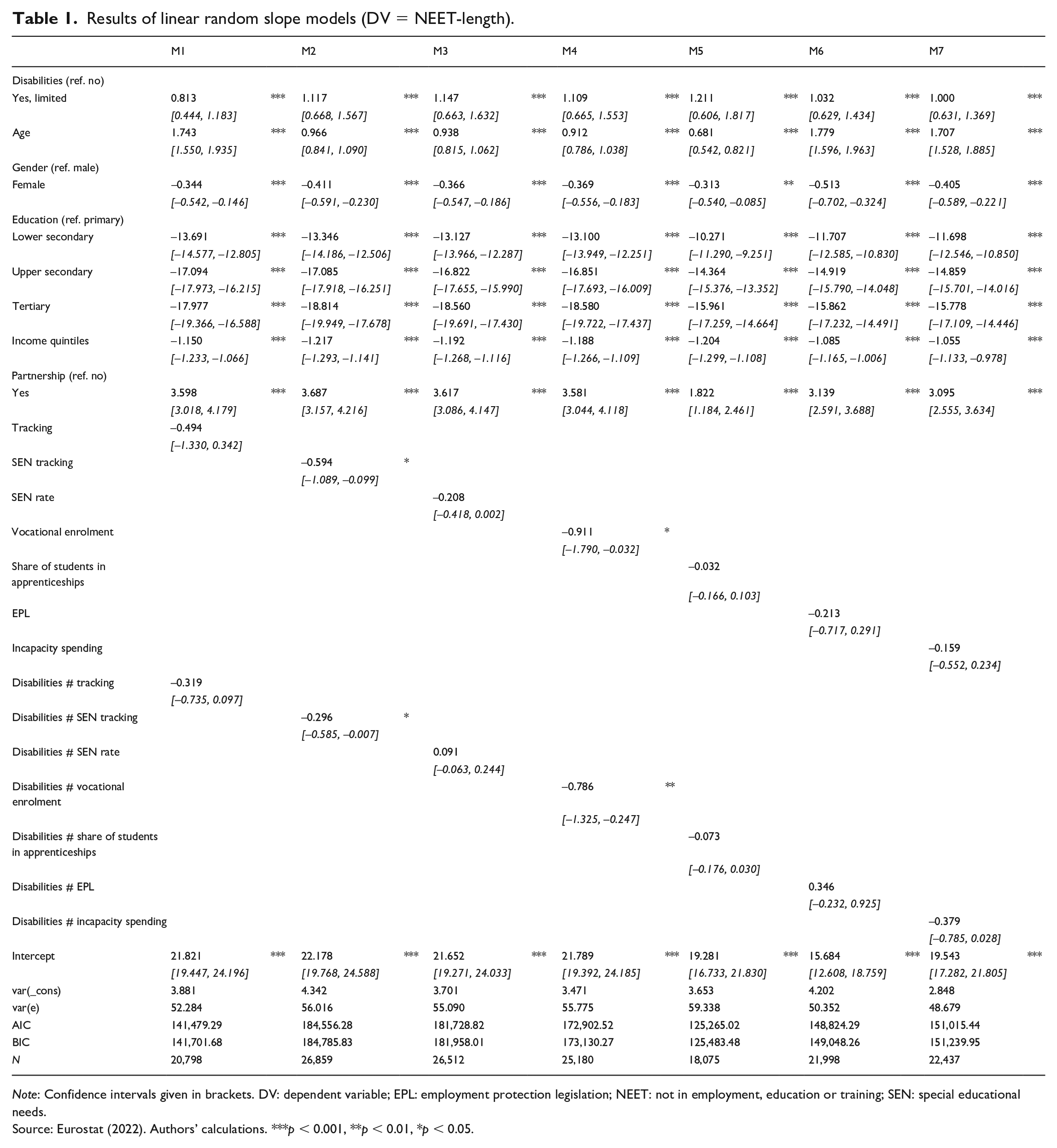
Results of linear random slope models (DV = NEET-length).
Note: Confidence intervals given in brackets. DV: dependent variable; EPL: employment protection legislation; NEET: not in employment, education or training; SEN: special educational needs.
Source: Eurostat (2022). Authors’ calculations. ***p < 0.001, **p < 0.01, *p < 0.05.
Control variables
Directed acyclic graphs (DAGs) were constructed to select relevant control variables and avoid model overdetermination (Appendix A4; Kohler et al., 2024): as the 31 countries start participating in the EU-SILC at different years and labour market opportunities and NEET-risk also vary by year, year was controlled for in all models. As gender matters for labour market participation of people with disabilities as well as for STWT (Ballo, 2020), it must be included as a control variable. Education was controlled, 4 as this has been shown to influence STWT (Wolbers, 2007), but may also account for part of the effect of disabilities on employment (Asuman et al., 2024). There may be interrelations between partnership and labour market trajectories (Vogel, 2002). Because the sample is composed of young people, a variable that indicates partnership (‘consensual union’) instead of marriage was used. Age at the time of the first interview was included because education systems differ considerably with respect to age and NEET rates differ strongly by age (Levels et al., 2022). The only measure for social background (Deluca and Rosenbaum, 2001) is the respondents’ household income quintile. The quintiles are related to the income distribution in each country separately. Unfortunately, migration background – despite minority status being relevant for disability classification (Sullivan and Artiles, 2011), as well as STWT of youth with disabilities (Cooc and Kiru, 2018) – cannot be controlled for in EU-SILC longitudinal data (for descriptive statistics of all variables, see Appendices A5 to A8).
Methods
Linear models of the number of months in NEET status were estimated. Given that individuals are nested within 31 countries, one of the core assumptions of regression models – the independence of observations – is violated. Additionally, the analysis aimed to explore the influence of country-level variables and their interaction with disabilities on the individual-level outcome (NEET-length). To account for between-country variability, the benefit of using a more complex multilevel modelling approach over standard regression techniques with correction methods (e.g. clustered standard errors) was assessed. This was achieved by estimating an empty random intercept model and calculating the intraclass correlation coefficient (ICC), which quantifies the proportion of variance at the country level. The ICC value of 0.27 indicates a substantial nested data structure, justifying the use of multilevel modelling for this analysis. 5 Because the dependent variable is NEET-length, ordinary least squares multilevel models were estimated. 6
The 31 European countries manifested strong differences in the distribution of both the dependent variable (NEET-length) and the independent variables (disabilities and controls). The variation of level-2 variables representing institutional differences was also very large. It was decided to let the coefficient (slope) of disabilities on NEET vary for each country and estimate multilevel random-slope models (Heisig et al., 2017). To avoid multicollinearity between variables on the country level, one random slope model for each institutional indicator, including interaction terms, was estimated. The individual variables were always included completely. 7 As not all institutional indicators are available for all 31 countries in the OECD data, the respective models were estimated only with those countries for which information was available. 8
To test how the NEET-risk of persons with disabilities varies under different institutional conditions, interaction terms of disabilities and the respective institutional variable were included. Seven random slope models were estimated, including all level-1 variables, one level-2 variable and the respective interaction with disabilities. 9
Results
Our first research question asks how the gap in NEET-risk between individuals with and without disabilities varies across countries. NEET-risk, operationalized as NEET-length, and the gap in NEET-length between young adults with and without disabilities, vary significantly across countries (Figure 1). The bivariate analysis revealed that, in nearly all countries, individuals with disabilities have a longer average NEET-length than those without disabilities. The exceptions are Norway, Austria and Switzerland.
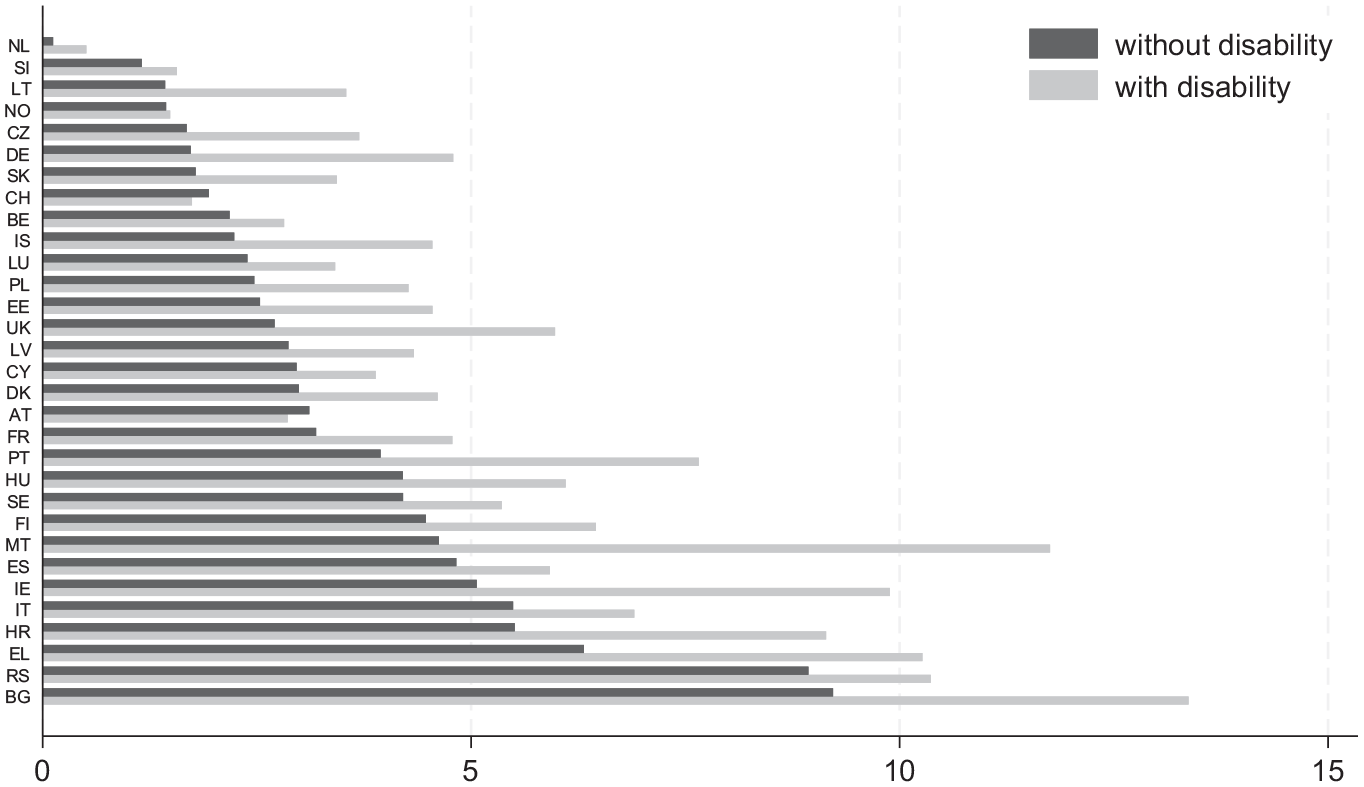
Average cumulative NEET-length during the STWT in months of persons with and without disabilities in 31 European countries.
Bivariate analyses showed that the point estimators of disabilities on NEET-length are positive in most countries (Appendix A10), except – again – Austria and Switzerland.
This leads to the question how does the NEET-risk of persons with disabilities vary under different institutional conditions. The results of the linear multilevel models are shown in Table 1.
The level-1 predictors describe the influences of individual variables across all countries: the coefficient of disabilities was positive (increasing) for NEET-length throughout all model specifications. For age, significant and positive coefficients for all seven models were found; for women, the NEET-length was shorter on average than for men across all countries. The higher the educational level, the shorter the NEET-length. Education seemed to have the strongest influence on reducing NEET-length. This is stable across all model specifications. Coming from a higher income household also reduced the average NEET-length, whereas being in a partnership increased NEET-length.
The level-2 predictors describe the influence of institutional variables on NEET-length, in general, whereas the interaction terms reflect the influence of institutional characteristics on the NEET-length of persons with disabilities. Regarding stratification (tracking), no significant coefficients were found for the pure coefficient or for the interaction. However, the point estimator of the indicator for general tracking is negative for both terms, which means that in tracked school systems, the average NEET-length is a little shorter for persons with and without disabilities. This reflects theoretical expectations and prior research. The positive and significant influence of disabilities on NEET-length is not significantly moderated by general educational stratification; therefore, hypothesis 1 must be rejected.
However, the stratification related to SEN schools (SEN tracking) showed significant coefficients. For persons with and without disabilities, SEN tracking reduced NEET-length, where the influence on persons without disabilities can be interpreted as a strong correlation of SEN tracking with general tracking. Nevertheless, hypothesis 2 must also be rejected because the positive interaction term reflected a negative impact of SEN tracking on NEET-length for persons with disabilities. A possible interpretation of this counterintuitive finding points to the existence, in countries with more persistent segregation of students with SEN in special schools, of specific labour market segments for persons with disabilities, such as sheltered workshops, that prevent NEET (Czedik et al., 2021). In Germany, for example, students leaving special schools are channelled directly into segregated (pre-)vocational rehabilitation programmes, where they are not in NEET, yet still do not participate in the labour market (Powell and Blanck, 2023). Testing this assumption remains a key research gap that will benefit from comparative sectoral and occupational studies.
The expectation that a higher share of persons classified as SEN (SEN tracking) may reduce the NEET-length (hypothesis 3) must also be rejected, because no significant association was found. Vocational enrolment (hypothesis 4) had a NEET-length reducing influence for all school leavers including a significant negative association specifically for persons with disabilities. Fewer NEET-months are experienced when more vocational qualifications are provided by the education system. There was no significant association with the share of students in apprenticeships (hypothesis 5). This may be interpreted as low-threshold provision of vocational skills (maybe within schools) helping people with disabilities, but selective dual apprenticeship structures do not necessarily do so. Hypothesis 4 is therefore confirmed, hypothesis 5 must be rejected as well as hypothesis 6, namely the increasing impact of high EPL on NEET-length of persons with disabilities, which is not confirmed by the data. Higher incapacity spending did not significantly influence the NEET-length of persons with disabilities. Therefore, hypothesis 7 is also rejected.
Robustness check
Research has shown that the type of impairment may influence the employment opportunities of persons with disabilities, but ‘type of impairment’ is not available in EU-SILC longitudinal data. However, all models were additionally estimated with a distinction between those persons who feel ‘limited’ and ‘strongly limited’ (Appendix A11). The results showed that interactions of the institutional indicators for vocational enrolment were statistically significant for those reporting strong limitations in their activities. SEN tracking was not statistically significant anymore, most probably because of reduced case numbers in the diverse disability categories. Interestingly, there was also an additional significant association of EPL with NEET-length for those being limited in their activities and a NEET-length reducing effect of incapacity spending for those reporting strong limitations in their activities, alluding to differential influences of institutional conditions for these two groups.
Discussion
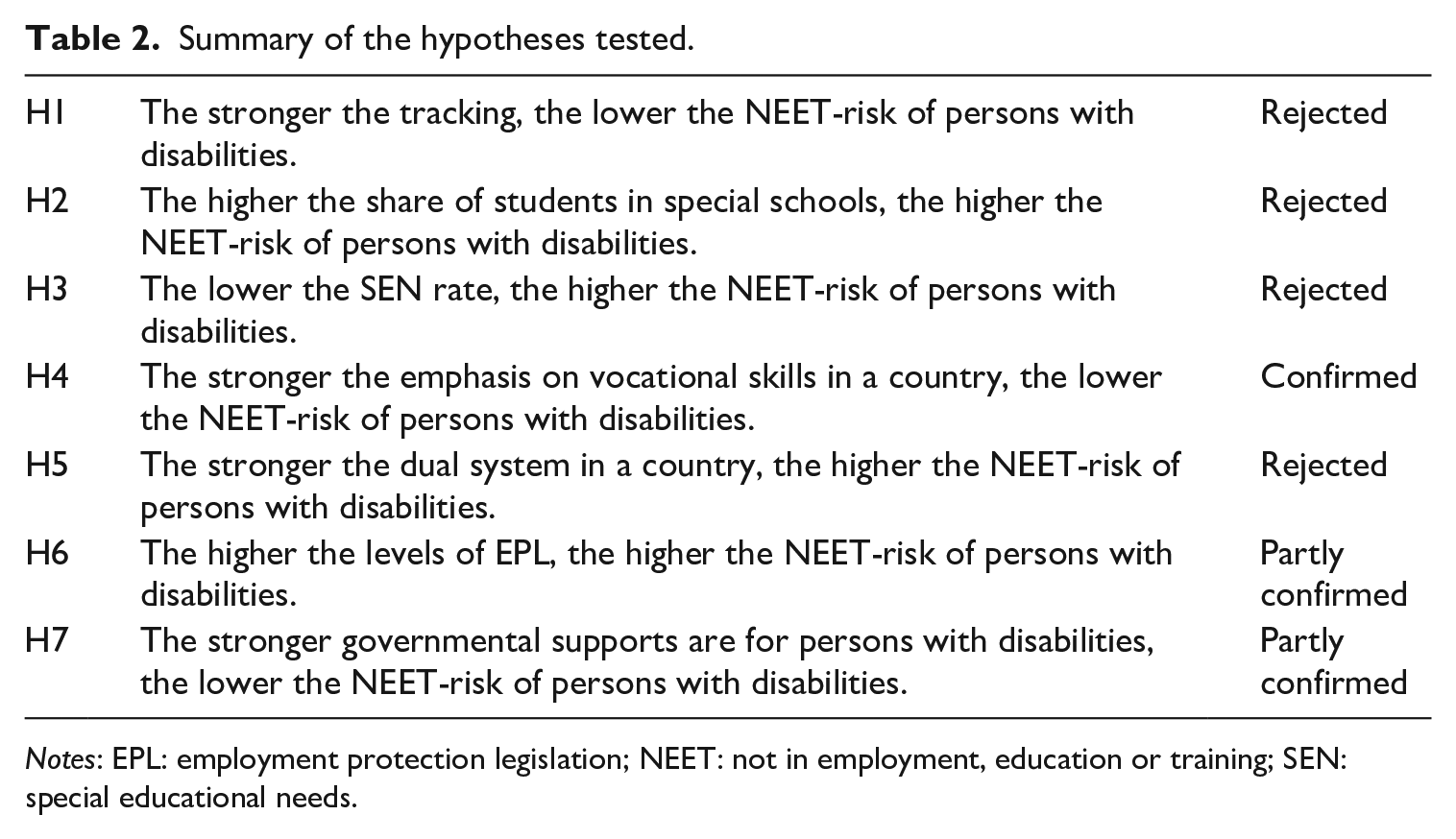
Gaps in NEET-risk between persons with and without disabilities across Europe were analysed to assess the extent to which the association of disabilities and NEET varies under different institutional conditions. By conducting a large-scale study of 31 countries and connecting research on social stratification, (special) education and disabilities, a persistent and pressing research gap was addressed. Based on established institutional explanations for cross-country variation in STWT related to ILMs and OLMs, ‘classical’ and new indicators were combined to explore how these institutional conditions influence the STWT of persons with disabilities (see Table 2). NEET was investigated instead of unemployment because the latter only partly covers the prevalent exclusion of people during their STWT. NEET-risk was operationalized as the cumulative NEET-length in months after leaving school.
Summary of the hypotheses tested.
Notes: EPL: employment protection legislation; NEET: not in employment, education or training; SEN: special educational needs.
The results show that the gap in NEET-length between persons with and without disabilities varies strongly across countries. Simultaneously NEET-length was shown to be significantly higher for persons with disabilities in almost all European countries. Among the institutional indicators included, the share of persons with SEN attending special schools (segregated) and vocational enrolment significantly reduce the NEET-length, albeit the robustness check clarifies that the latter is only valid for persons who feel strongly limited in their activities. EPL increases NEET-length for persons who are limited in their activities, and government support, measured by incapacity spending, reduces NEET-length for persons with strong limitations in their activities. However, apart from those few significant associations of institutional indicators with the NEET-length of persons with disabilities, many of the included institutional indicators did not show the expected associations. As hypotheses were mostly formulated based on institutional explanations for STWT related to ILMs and OLMs, the study raises doubts as to whether these established theoretical explanations can sufficiently explain the STWT of persons with disabilities. It will be necessary to further develop additional, complementary institutional explanations and related indicators in order to better understand the mechanisms underlying considerable cross-national variation in STWT of this highly disadvantaged group.
This study has limitations that also highlight considerations for future research. First, since classification systems of disabilities are culturally determined and nationally highly diverse, fully harmonized comparative data on the STWT of persons formally classified as having SEN or disabilities is missing and challenging to obtain. Here, disabilities were operationalized on the basis of self-assessed limitations in daily activities because of health problems. While important, this definition also has limits. Definitions of disabilities based on self-assessment include more people with chronic pain and mobility difficulties and fewer people with mental and learning/cognitive difficulties, who are particularly disadvantaged in their access to the labour market compared with other measures of disabilities, and include more persons who participate in the labour market than those covered by administrative classifications (Grönvik, 2009; Molden and Tøssebro, 2012). The influence of disabilities on NEET-risk is likely to be stronger if administrative definitions are applied or the STWT of persons with mental and learning/cognitive difficulties are compared across countries. Institutional influences may differ for this group. Owing to a lack of suitable data, however, these analyses are currently not possible across dozens of countries. Indeed, there is a need to further develop adequate and harmonized measurements of disabilities in international datasets that enable more reliable analysis of the effects of institutionalized categories and labelling. Second, with the theoretical assumptions about the varying strength of signalling, stigma and discrimination, demand-side explanations for inequality in STWT were emphasized. Still, it is reasonable to additionally consider supply-side approaches, particularly since the concept of stigma also involves effects on identity formation (Link and Phelan, 2001). Third, migration background could not be controlled for due to data restrictions, yet research has consistently shown that persons from certain ethnic minority groups are overrepresented among those with disabilities. Fourth, a general concern when investigating the influence of disabilities on employment processes relates to questions of reversed causality, because disabilities can lead to lower employment chances, but low employment chances can also result in disabilities (Parsons and Platt, 2022). This may be particularly important when definitions of disabilities based on self-assessment are applied, because longer periods of NEET may lead to poor health and feeling limited in activities. Unfortunately, it is not possible to make use of EU-SILC longitudinal data to check possible reversed causality because the longest observational period is four years (48 months), which leads to a hard right censoring, and limitations are only measured on a yearly basis, while there is monthly information on the activity status. Measuring NEET only after incidence of self-perceived limitation not only reduces the case number dramatically but also introduces bias in the dependent variable NEET-length (right censoring reduces the possible measurement of a cumulative number of months in NEET). Finally, the indicators used here may be subject to critical debate. This is particularly the case for the widely employed tracking index by Bol and Van de Werfhorst (2013), which may not capture country differences as well as previously thought (Traini, 2022). Also, regarding governmental supports, a very general measure for incapacity spending was used since direct information on programme participation or support structures (e.g. transition planning) for youth with disabilities during the STWT was not available. However, this measure turned out to be a significant institutional factor for the STWT of persons reporting strong limitations in activities, which reduces NEET-length and points to the importance of acquiring more comparable data on support structures for youth with disabilities during their STWT (Blanck et al., 2025; Powell et al., 2024; Tschanz and Powell, 2020).
Nevertheless, the results emphasize the importance of health-related factors and their interaction with disabling barriers as risk factors of NEET and stress how contexts differ in the extent to which they can equalize opportunities to ensure equity and inclusion, to which all these national governments have committed themselves via human rights charters. The NEET-length reducing influence of incapacity spending points to the necessity of support for persons with disabilities during their STWT. The NEET-length reducing influence of vocational enrolment underscores the importance of investing in occupational skills to prevent NEET.
However, the underlying mechanisms still need to be assessed more comprehensively (see, e.g. (Ballo, 2020; Berre, 2024). Further investigation is needed to confirm whether the NEET-length reducing influence of SEN tracking is indeed the result of confounding effects of welfare orientations reflected in the institutionalization of special schooling and vocational rehabilitation, where the latter diverts young adults with disabilities away from the regular labour market. The combinations and linkages of institutional characteristics relating to national diversity deserve further attention (Blanck et al., 2025). Comparative approaches and the resulting findings emphasize that there is not one best pathway for all youth to transition successfully. Studies should also investigate if and how the influence of institutional context on the association of disabilities with STWT may differ for outcomes related to inclusion (labour market participation). Finally, examining individual-level associations, the importance of education for STWT shown in prior research is thoroughly confirmed. This raises crucial questions regarding the differing opportunity structures for persons with disabilities to access inclusive education, be supported in achieving their learning goals, and attain certificates, as well as the varying potential of formal educational provisions to compensate disadvantages and counteract disablement during STWT.
Supplemental Material
sj-docx-1-wes-10.1177_09500170251361814 – Supplemental material for Special NEETs: Institutional Influences on School-to-Work Transitions of Young People with Disabilities in Europe
Supplemental material, sj-docx-1-wes-10.1177_09500170251361814 for Special NEETs: Institutional Influences on School-to-Work Transitions of Young People with Disabilities in Europe by Jonna M Blanck, Christian Brzinsky-Fay and Justin JW Powell in Work, Employment and Society
Footnotes
Acknowledgements
This study was presented at the 2022 conference of the European Research Network of Transitions in Youth (TIY) in Naples, Italy, and the 2023 Spring Conference of the Section ‘Social Inequality and Social Stratification’ of the German Sociological Association in Mannheim, Germany. We thank participants for their useful comments. We also thank the anonymous reviewers and the editor of Work, Employment and Society, Danat Valizade, for their detailed suggestions on how to improve this article.
Data availability

Funding
The authors disclosed receipt of the following financial support for the research, authorship, and/or publication of this article: We gratefully acknowledge the financial support provided by our respective universities, including funds for open access publication.
Supplemental material
Supplemental material for this article is available online.
Notes
References
Supplementary Material
Please find the following supplemental material available below.
For Open Access articles published under a Creative Commons License, all supplemental material carries the same license as the article it is associated with.
For non-Open Access articles published, all supplemental material carries a non-exclusive license, and permission requests for re-use of supplemental material or any part of supplemental material shall be sent directly to the copyright owner as specified in the copyright notice associated with the article.
