




Abstract
This study theoretically and empirically assesses the gendered relationship between family caregiving (excluding regular childcare) and wage development in the Netherlands applying conflict theory, which predicts a wage penalty due to difficulties in combining paid work and care, and enrichment theory, which expects a wage premium because of acquired skills and recognition. Growth curve modelling was used to analyse hourly wages from 19 years of register data combined with information on caregiving episodes, retrospectively collected among a Dutch sample (N = 2659 respondents and 324,940 months). Caregiving was distinguished by have-never cared, current caregivers and past caregivers, as well as by duration and intensity. The results showed that men’s wage growth slightly improved after caregiving stopped and when they provided intensive care. Women’s wage development was slightly weaker after caregiving stopped and when they provided intensive care. Thus, only men benefit from caregiving in terms of their wage growth, not women.
Introduction
As a result of population ageing, family care – also known as informal or unpaid care – is expected to increase, with many caregivers having to combine both care and work (Broese van Groenou and de Boer, 2016). This study examines how family caregiving – here defined as providing health-related care to sick, disabled, or older people in the personal network and excluding regular childcare – influences wage development compared to non-caregiving, applying a gender lens. It studies whether caregiving episodes, defined as months spent on caregiving for a person, are beneficial or a disadvantage for wage growth and if caregiving episodes are especially beneficial for men and not for women, as is often found for childcare (also called the daddy-bonus) (Glauber, 2018; Hodges and Budig, 2010). The focus on wages and their development as an indicator of accumulated disadvantages and inequality further sheds light on the bigger question of care-related tasks being associated with benefits for men and often disadvantages for women. Overall, the following research question is answered: How do family caregiving episodes influence wage development (differently) for women and men?
Most research on the consequences of family care for paid work focused on labour supply and found that caregivers often need to reduce their working hours (e.g. Gomez-Leon et al., 2019; Moussa, 2019), stop working (e.g. Gomez-Leon et al., 2019; Lee and Tang, 2013), or switch to a more flexible job (Fast et al., 2013; Raiber et al., 2024). Studies on wage effects paint a rather negative picture, with wages being lower for those having cared (Carmichael and Ercolani, 2016; Earle and Heymann, 2012; Ehrlich et al., 2020; Raiber et al., 2022; Van Houtven et al., 2013). All this is in line with the most-used theory in the field – conflict theory – which argues that family care and paid work compete both time- and role-wise, leading to negative spillover effects of the role of caregiver on paid work (Greenhaus and Beutell, 1985; Lee and Tang, 2013). In contrast to conflict theory, enrichment theory states that wages could increase through caregiving (Greenhaus and Powell, 2006). Valuable experiences and skills learned from caregiving might be used to improve one’s labour market position during or after a period of providing care, potentially resulting in a stronger growth in wages compared to non-caregivers. This positive spillover relationship between care and paid work could potentially be stronger for men compared to women. Thus, applying both conflict and enrichment theory can provide a better theoretical foundation to understand the gendered nature of how caregiving influences wage growth.
The current study adds to the existing literature in three main ways. First, instead of focusing on (cross-sectional) wage differences, a dynamic perspective is added, with a focus on wage development as a consequence of family care usually being applied in the childcare literature but not yet in the family care literature. This analytical approach helps to account for group differences in the starting wages (e.g. of women), as lower wages early in a career potentially incentivize providing care (i.e. selection into caregiving). Second, both conflict and enrichment ideas are applied theoretically. Third, a gender perspective on family care and wage development is provided, as conflict and enrichment potentially play a different role for women and men (Earle and Heymann, 2012; Ehrlich et al., 2020; Van Houtven et al., 2013), comparable to the case of childcare for which a daddy bonus is commonly found (Glauber, 2018; Hodges and Budig, 2010).
The research question is addressed by estimating growth curve models, analysing 19 years of hourly wage data in the Netherlands taken from tax administrations combined with retrospective family caregiving episodes collected in the Longitudinal Internet studies for the Social Sciences (LISS) in January and March 2020. Using an objective measure of wages from tax data results in fewer measurement errors and fewer (or even no) missing values compared to income information from survey data in previous studies. Furthermore, using complete caregiving histories based on monthly information enables us to examine caregiving careers instead of only snapshots (Fast et al., 2020). A dataset with information on 2664 respondents covering 329,561 months of their lives was obtained, including information on caregiving and wages for each of those months. To account for heterogeneity in caregiving, caregiving is conceptualized in three ways: (1) the overall effect of caregiving, including a category for those who gave care but stopped; (2) the duration of caregiving; and (3) caregiving intensity (hours spent on caregiving per week).
Background and theory
The Netherlands as the context of study
To understand how wages develop differently for caregivers compared to those who have not cared (yet), it is essential to describe the circumstances in which caregiving is combined with paid work for both women and men (Folbre, 2014). The Netherlands can be characterized as a welfare state that has taken a significant role in providing care to older and sick inhabitants (Verbakel, 2018). Since 2007, with the initiation of the new Social Support Act, but especially since 2015, with a restructuring of the Dutch health care system, the Dutch government decided to decrease the funding and eligibility of formal care and put more responsibility on families (Da Roit and Moreno-Fuentes, 2019). This new long-term care scheme limits access to paid care services and only those with severe care needs are covered (Da Roit and Moreno-Fuentes, 2019). There is a clear shift from formal care to more unpaid care (Broese van Groenou et al., 2016). One would expect that caregiving is valued in such a context where the family has gained importance again (Folbre, 2014). The impact of caregiving on wages should thus be comparably small, making the Netherlands a least likely case to find wage penalties. Any caregiving effects found here are likely stronger in other contexts. There is another argument why the Netherlands can be seen as a least likely case of finding caregiving effects on wages: compared to other countries, reducing working hours, a strategy to combine family care and paid work, is facilitated and common in the Netherlands, even in high-status occupations (Hartog and Salverda, 2018; Pennings, 2018). In the Dutch context, hourly wages are arguably less affected by reduced working hours as it does not necessarily signal poor work commitment and, thus, should influence wages comparably little.
In comparative and feminist welfare state research, the Netherlands relates to two categories of welfare states. While having some social policy elements that fall into the category of Social Democratic welfare states focused on guaranteeing equality (e.g. the basic pension system and more recent implementation of social investment policies), it is more similar to Conservative countries in terms of persisting traditional gender roles (Goijaerts, 2022; Goodin and Smitsman, 2000). Women are generally seen as the primary caregivers and, on average, work fewer hours, whereas men are stereotypically the breadwinners who value paid work over care (Kaufman and Uhlenberg, 2000; Smith et al., 2020; Vink, 2020). In such normative circumstances, women are usually the ones to take up family caregiving (Raiber and Verbakel, 2021) and work part-time more often (Hartog and Salverda, 2018) and, therefore, they likely disproportionately bear the costs of care (Folbre, 2014). This study theoretically and empirically disentangles these potential gender differences. Therefore, in the following, work–care conflict and enrichment theory, as the most-used theoretical foundation in family sociology to understand the employment consequences of family caregiving, are first described. Then a gendered interpretation of these theories is provided to derive hypotheses on gender inequality in the relationship between family care and wage development.
Work–care conflict theory
Work–care conflict theory assumes that work and care compete both time- and role-wise (Greenhaus and Beutell, 1985). When taking on a new social role, the role of family caregiver, time that before was devoted to paid work or leisure, must now be spent on family care, making the combination of work and family care difficult (Greenhaus and Beutell, 1985; Patterson et al., 2023). Additionally, as discussed in the theory of role strain (Lee and Tang, 2013), worries and issues in one role can spill over to the other role, making both roles more difficult. When work and care are competing, there are two main ways through which a work–care conflict can result in lower wage growth.
First, in case the work–care conflict is too strenuous, family caregivers might choose to adapt work to better facilitate the combination of work and care (Lilly et al., 2007). One way to adapt paid work is by reducing labour supply; that is, by reducing working hours or by dropping out of employment completely. This has been shown to be a widely used strategy to adapt work among family caregivers (see the review by Moussa, 2019). If a person starts to work fewer hours, the salary will decrease, and in the case of employment exit, there will be no salary at all anymore. Arguing from the position of human capital theory, working less will also affect hourly wages since work hours relate to building up work experience. Work careers tend to be cumulative, meaning that early interruptions and loss of capital can intensify over time, which implies less wage growth (Crystal et al., 2016; Möhring, 2018).
Furthermore, related to the theory of compensating differentials, family caregivers – similar to childcare – might choose to change to a job that is more flexible and, therefore, combinable with caregiving (Abendroth et al., 2014; Arai, 2000). Such desired features in the new job may come at the cost of lower hourly wages. Jobs that can be more easily combined with care are likely less demanding. These less-demanding jobs are often associated with lower status and fewer career development options, which can result in lower wage growth (Abendroth et al., 2014; Arai, 2000).
Second, research has found that family caregivers are perceived by employers as performing more poorly at work, being less productive and potentially experiencing more work disruptions (Martsolf et al., 2019). Being less productive – or regarded as such – because of family care can hinder promotions, resulting in lower wage growth compared to non-caregivers.
Family caregiving cannot be seen as a single event whose impact stops after caregiving has ended. Rather, it has to be looked at dynamically. Family caregiving situations are highly heterogeneous and can be described in terms of episodes that can be long or short (Fast et al., 2020) and with high or low intensity (Möhring et al., 2023). Both longer periods of caregiving and higher intensity make a work–care conflict more likely as both imply that caregivers spend more hours and energy on caregiving, which are then not available for employment. As a result, caregivers will feel a stronger urge to adapt work and employers’ perceptions of the caregiver’s productivity level are likely to be more negative.
Enrichment theory
Building on the concept of enhancement, the basic idea of enrichment theory is that having multiple social roles can be beneficial (Gonzales et al., 2015; Greenhaus and Powell, 2006; Rozario et al., 2004; Sieber, 1974). In case of multiple roles, stress in one role can be buffered by positive experiences in the other role (Gonzales et al., 2015; Greenhaus and Powell, 2006; Patterson et al., 2023). Multiple roles also enrich a person’s personality (Sieber, 1974). People can feel like they are realizing their potential more, boosting their self-esteem (Kulik et al., 2015). These resources are, in general, helpful for one’s employment career but are especially needed for better-paid management positions. Furthermore, resources, values and skills acquired in the care domain can be used to improve reputation and productivity at work (Greenhaus and Powell, 2006) and, hence, foster successful work careers. Examples can be communication skills related to social relationships, time management, taking responsibility, handling difficult situations and emotional security (Bovenberg, 2008). Family caregivers can use their acquired skills and strengthened personalities to increase their chances of promotions and thus increase their wages.
Care duration and intensity are also relevant in terms of enrichment as spending more time on caregiving, either in terms of longer duration or higher intensity, implies more possibilities to acquire new and additional skills that can have positive effects on wages. For example, in two weeks of caregiving, few skills can be acquired, and the same holds for low intensity. Yet, with longer duration and higher intensity, the care tasks provided are likely to get more complex which gives more opportunities to learn and adapt.
Gender inequality in the wage consequences
Both caregiving and paid work are strongly related to gender norms, which (re-)produce societal structures of power inequality (Folbre, 2006). These structures not only direct women and men differently into paid work and unpaid care work, but also value women and men differently for the same task. As described before, these relationships are especially pronounced in contexts with persisting traditional gender role norms, such as in the Netherlands (Kaufman and Uhlenberg, 2000; Smith et al., 2020). These gender norms also play a role in the influence of family caregiving episodes on wage development. Although arguments related to gender norm deviation predict that men who provide care experience less wage growth than female caregivers, it is argued that women are more likely to suffer from family caregiving in terms of earnings. This expectation is comparable to findings from the childcare literature that show that childcare reduces women’s wages more than men’s wages, which for the latter even appear to increase when they become fathers (Glauber, 2018). The following explains how conflict and enrichment theory can play out differently for women and men who provide family care by developing a gendered version of these theories.
Work–care conflict is arguably stronger for female than male family caregivers. Women, on average, tend to do a larger share of the household tasks in addition to their paid work and care tasks, resulting in stronger time conflicts (Treas and Hilgeman, 2007). Also, caregiving is stereotypically seen as a feminine task that women (should) provide more, might value (or feel expected to value) more and/or women are penalized more as employers might view women who care as less productive (Kaufman and Uhlenberg, 2000; Wattis et al., 2013). This could have the consequence that women are more likely than men to adapt their work when combining it with caregiving (e.g. by reducing working hours) or find it acceptable to miss work for care, resulting in more work interruptions and, consequently, less human capital accumulation (Robison et al., 2009). Overall, it has been found that men try to organize caregiving around work so that the spillover between work and care is as small as possible (Auth et al., 2015). However, what may be central to the relationship between care provision and wage development is not only gender differences in the organization of family care but rather the gendered perceptions and evaluations of care in society. Related to enrichment, women are already (expected) to have skills related to caregiving because those are stereotypically female skills (e.g. empathy or time management skills). On the contrary, men can widen – or employers may believe that their male employees have widened – their skill set, including skills that were not expected of them. Similar to the literature on the daddy bonus, men who take care of someone with health issues might signal dependability and loyalty (Hodges and Budig, 2010). Yet, the childcare literature also highlights that it might not be a logical or rational decision to value men for deviating from the ideal worker norm, but that it relates to existing biases in employers to favour men (England and Folbre, 1999).
Based on this gendered interpretation of the work conflict and enrichment theory, it is assumed that men generally will benefit more (or have fewer negative consequences) from caregiving regarding their wage development than women. Consequently, conflict mechanisms predict a negative influence of family care on wage development – adapting work and (perceived) lower productivity – and are more common among female family caregivers. This assumption leads to the first set of hypotheses: Women providing or having provided family care will experience smaller wage growth than those who have never cared (H1a). Also, for women, more time spent on caregiving is associated with a larger wage growth penalty compared to not having cared (H1b) and higher caregiving intensity is associated with a larger wage growth penalty compared to not having cared or lower intensity (H1c).
In contrast, those mechanisms predicting a positive impact of family care provision on wage development – realizing new skills and positive spillover leading to higher reputation – will more likely apply to male family caregivers. This leads us to the second set of hypotheses: Men providing or having provided family care will experience greater wage growth than those who have never cared (H2a). Also, for men, more time spent on caregiving is associated with a larger wage growth premium compared to not having cared (H2b) and a higher caregiving intensity is associated with a larger wage growth premium compared to not having cared or lower intensity (H2c).
Methods
Data
Data from a study on family caregiving collected among participants of LISS were used and linked to register data (based on tax information; Statistics Netherlands) of the same individuals. The LISS panel is an online household panel based on a representative sample of the Dutch population (see www.lissdata.nl and Scherpenzeel and Das, 2010). Alongside LISS’ core modules, an additional questionnaire was collected on retrospective family caregiving careers. In January 2020, the complete LISS panel (6409 respondents, 82.9% response rate) was asked if they ever provided family care (see supplemental material Appendix A for the survey question; Verbakel and CentERdata, 2021). This question was used to classify caregivers (provided care at least at one point in their lives) and non-caregivers (never provided care during their lives, at least until the moment of the interview). Those who provided care at least once received an extended questionnaire in March 2020 that gathered more specific information on their caregiving experiences. In this extended questionnaire, the respondents were asked to provide information on up to seven caregiving episodes, including the start and end date, so that nearly complete caregiving histories could be reconstructed. A caregiving episode consists of the time spent on caregiving for one person. More detailed information (such as caregiving intensity) was asked for up to three randomly selected episodes.
The register data provide monthly information on salaries and hours worked and information on children, partners and job characteristics (like sector). Hours worked were available from January 2001, determining the observation window’s beginning. The end of the observation window was January 2020, when the question to classify caregivers was asked. Each observed month of the respondent was accounted for in the dataset as a single observation, implying that monthly information between January 2001 and January 2020 is covered. The analytical sample included N = 324,940 months of 2659 respondents (290,651 months of 2386 respondents for the sample with information on caregiving intensity). For details on sample restrictions, see Appendix B.
Measurements
Dependent variable
The outcome variable was monthly hourly wages reversed lagged by three months, implying that caregiving information in January 2014 was related to wages of April 2014. Reversed lagging of the outcome variable is necessary because changes in wages will not be directly visible as wages are based on employment contracts, which makes them rather stable over time. As wage development is examined, all wage changes thereafter (that is, within the observation window) are picked up. Hourly wages are analysed rather than labour income as the interest here lies in wage effects independent from hours worked. To calculate the hourly wages based on wages per month, a variable in the register data was available that indicates the amount worked from 0 to 1 FTE (full-time equivalent): 1 FTE was defined as 40 hours worked per week. Note that there were no missing values on the dependent variable.
Main predictors
Caregiving was operationalized in three ways. First, a categorical variable was created, with (0) for months in which the respondent did not provide care and had never done so (have-never cared), (1) if the respondent was providing care for one or multiple people in that month (current caregiver) and (2) for respondents who cared in the past but were not providing care anymore in that particular month (past caregiver). It is important to distinguish the latter category (2) as past caregiving might have impacted the employment situation (due to conflict and/or enrichment in the past), meaning that these respondents are likely dissimilar from the have-never cared (0), whereas there is no current conflict or enrichment possibilities, which makes them dissimilar from current caregivers (1).
Second, caregiving duration was based on the sum of months in which the respondent provided care in the past for one or multiple people. This means that caregiving duration increases with one month compared to the previous month even if the respondent cared for multiple people that month. To take into account the overall enrichment and conflict the caregiver experienced, this measure is cumulative, meaning that the time spent in previous caregiving episodes was included in the sum of months when the caregiver entered a new care episode. For this measure, there was no restriction to the observation window (January 2001 to January 2020), yet all information before that period was used, so duration is based on all previous caregiving experiences. The sum of months of caregiving was categorized to integrate the information with the have-never cared and past caregivers categories (to avoid zero inflation as all months with no previous caregiving have zero duration and to avoid duration having its own systematic growth process; see Curran et al., 2010). The following categories were used in each specific month: (1) have-never cared, (2) cared less than one year, (3) cared one to five years, (4) cared more than five years and (5) past caregivers. With the threshold of one and five years, it is acknowledged that it will likely take at least a year until the effects on employment crystalize (short-term) and that employment adjustments will be particularly likely with long-term care commitments; as most caregiving episodes are shorter than five years (see Figure A1), care episodes of five years or more were considered to be long.
Third, for the intensity of caregiving, the hours cared for per week in the beginning and at the end of the episode were used. The highest value defined the intensity of the caregiving episode (at least intensive at one moment) and eight or more hours per week was defined as intensive. A threshold of at least eight hours was chosen as this resembles a full working day in the Dutch context. When caregiving for more than a working day, caregivers plausibly have to adjust their private and work schedule (Raiber et al., 2022) or signal their caregiving involvement at work. In case there were overlapping episodes, the sum of hours cared for per week was taken. This resulted in the categories (1) have-never cared, (2) non-intensive caregivers (less than eight hours per week), (3) intensive caregivers (eight or more hours per week) and (4) past caregivers. Intensity was available for up to three caregiving episodes per respondent. This means that for the analysis differentiated by intensity, time points with missing information on one or multiple caregiving episodes were excluded, except if it was known that the caregiving episode(s) with available information for that particular month already exceeded the threshold of eight hours.
Time was modelled by (potential) work experience to only compare respondents to those with similar work experience and therefore also similar age. This indicator increased every month by one and the value at the start of the observation window was defined by the number of months that had passed since ending education. As the exact date of ending education was unknown, it was assumed to be the normal age at which one’s highest educational level could be achieved. This is why it is called ‘potential’ work experience as the exact moment of labour market entry is not known. Cut points, based on Kraaykamp and Notten (2016), were age 16 years for primary education and intermediate secondary (also compulsory school age), 18 years for higher secondary, 19 years for intermediate vocational (adjusted to Kraaykamp and Notten (2016) as only very few are finishing earlier), 21 years for higher vocational and 22 years for university. More precisely, work experience refers to the current age in a particular month minus the number of months assumably spent on education. Negative work experiences were possible when the respondent was starting to work before the expected end of their education, yet only negative work experiences for up to two years were included (see restriction sample).
For the variables sex, the predefined variable from the LISS panel with the categories (1) men and (2) women was used.
Control variables
Children in the household was included because being responsible for children additionally to caregiving for family and friends with health issues can create more conflict and thus affect wages. Categories were: (1) child under four living in the household, (2) child between four and 14 living in the household, (3) no child under 15 living in the household. Information on a partner living in the household was included as the partner can be a resource by helping with family care, children and household duties or by being economically supportive. The following categories were created: (1) no partner in household, (2) partner without employment, (3) partner with part-time employment, (4) partner with full-time employment and (5) self-employed partner, including helping in a family business.
Additionally, models were controlled for months being unemployed as a count variable, increasing with each additional month of receiving unemployment benefits. Information on the employer, as a way to control for work environments in which it is easier to combine work and care, was incorporated by two control variables. First, for sector, the predefined sectors included in the register data were used: (1) private company, (2) subsidized sector (private companies with government funding) and (3) public sector. Second, the size of the firm was based on own calculations (sum of all taxpayers in the Netherlands registered at the same firm in the same month using the complete data available in the register data), creating the following categories based on the categorization of Statistics Netherlands: (1) up to nine people working at the firm, (2) 10 to 99 people working at the firm, (3) 100 to 499 people working at the firm and (4) more than 500 people working at the firm. Sector and firm size were recorded in the same month as hourly wage. The highest level of education was measured in categories (primary school, intermediate secondary, higher secondary, intermediate vocational, higher vocational and university) and taken from the LISS panel. In addition, birth year was used to create cohorts, distinguishing (1) 1941 to 1951, (2) 1952 to 1961, (3) 1962 to 1971, (4) 1972 to 1981, (5) 1982 to 1991 and (6) 1992 to 2004 as certain cohorts are differently socialized related to (gender) norms regarding both caregiving and employment (Glauber, 2019). An alternative would have been to control for periods (e.g. to account for financial crises influencing wages). In a robustness check, period instead of cohort effects were looked into, as cohort and period cannot be included simultaneously due to multicollinearity.
Analytical strategy
Growth curve models using Stata 16 software (xtmixed) were estimated. This type of regression analysis is particularly useful and conventional to model how wages ‘grow’ over time. Here time is operationalized as (potential) work experience in months to compare those with a similar length of stay in the labour market (see also the Measurements section). In line with common practice (Curran et al., 2010), linear, quadratic, or cubic wage development was included in the calculations. Ignoring this may result in biased estimates. Time was modelled as a cubic function based on the best model fit assessed with likelihood ratio tests. Importantly, it was established that there is no systematic growth process for all the caregiving variables (for a discussion of this issue, see Curran et al., 2010: 129), except for, potentially, duration. Yet, categories for duration instead of a linear measure were included. Additionally, the categories do not directly align with time in months (uneven categories covering below one year, one to five years, more than five years and past caregivers). Thus, there should no longer be a systematic growth in duration after categorization.
In the first step, a model was estimated in which the caregiving categories are interacted with time to derive the wage development per caregiving group compared to the reference category of have-never cared. Note that all caregiving variables are (potentially) time-varying as a person may change categories during the observation window, meaning that the caregiving effects consist of both within-person changes and between-group comparisons, yet with the between-group comparisons being dominant because of few transitions between caregiving groups over a person’s life course. This also means that one respondent can contribute to the estimates of different caregiving groups, yet only to one estimate per month. In the second step, the wage developments are compared for women and men to test the hypotheses on gender differences. To this end, the wage developments (time * caregiving) were interacted with sex (results not shown in the tables because of the high complexity of three-way interaction models, but they are presented as figures and discussed in the text). To control for the clustered nature of the data (i.e. months in respondents), random intercepts were included to account for the different starting points of the respondents in the wage distribution as well as random slopes (both for time and quadratic time) to account for individual variation in wage developments. For a more straightforward interpretation, the decision was made to neither include a random slope for cubic time nor to interact caregiving with cubic time.
Results
Descriptives
Table 1 shows the descriptive statistics for all variables. Women provided care in about one-third of all months observed and provided care in the past (but not at the point the survey was administered) in 17.85% of the months. In the remaining half of the months, they have never cared. Men were providing care in about a quarter of the months, were past caregivers in 12.67% of the months, and in 63.29% of the months, they belonged to the have-never cared group. In terms of how long people took care of someone, most months were characterized as long duration; that is, for more than five years: 21.91% for women and 16.21% for men. Women provided non-intensive care in 10.72% of the months and intensive care in 13.18% of the months. For men, the respective numbers were 8.11% and 7.74%. Men, on average, earned more than women (22.98 compared to 16.83 euro per hour). Figure 1 displays the predicted wage growth difference between women and men based on a model without any controls to show how wage development looks in the data. It highlights the wage difference between women and men over the complete time span, yet the wage growth for women and men was not statistically different on a 5% significance level.
Descriptive statistics.
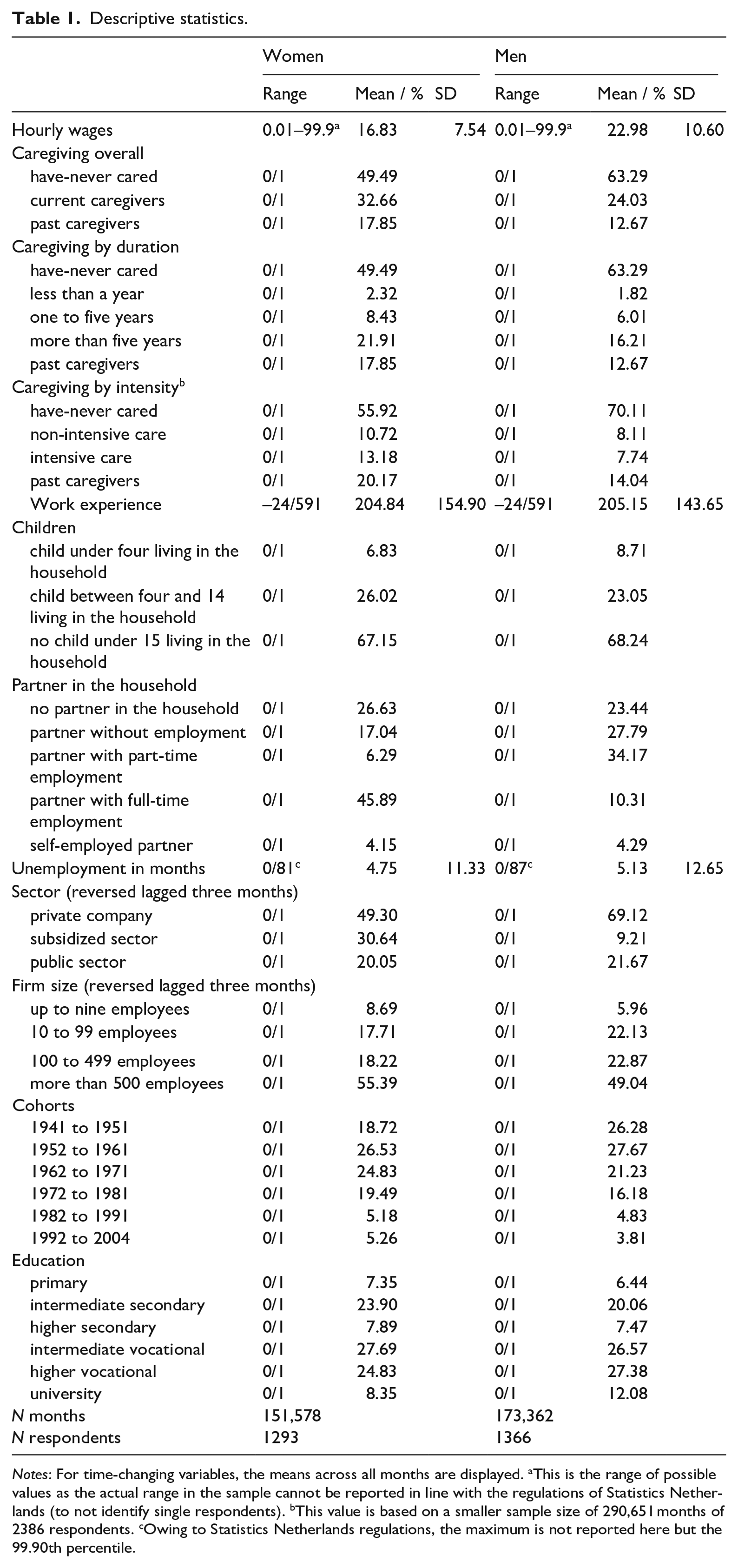
Notes: For time-changing variables, the means across all months are displayed. aThis is the range of possible values as the actual range in the sample cannot be reported in line with the regulations of Statistics Netherlands (to not identify single respondents). bThis value is based on a smaller sample size of 290,651 months of 2386 respondents. cOwing to Statistics Netherlands regulations, the maximum is not reported here but the 99.90th percentile.
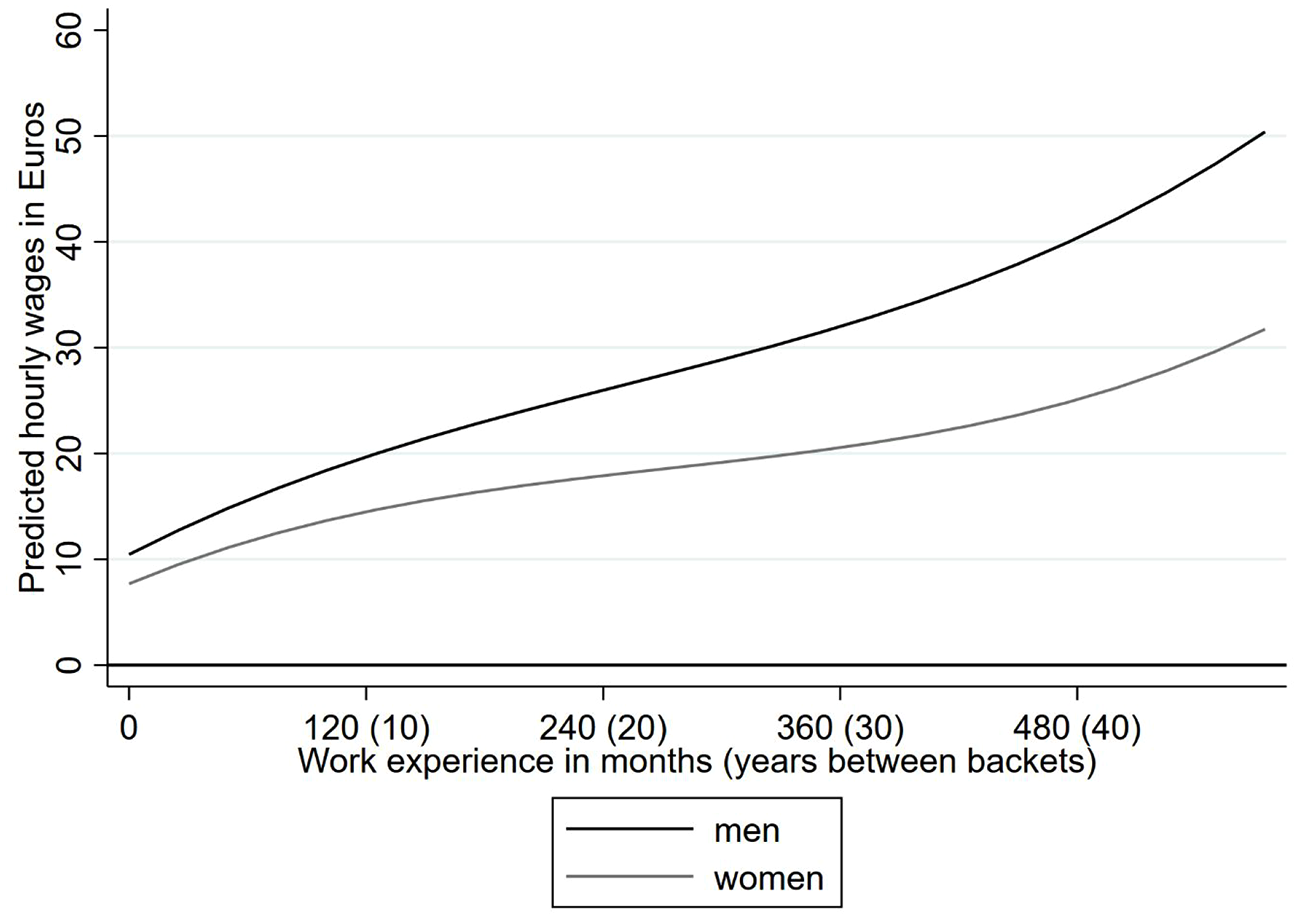
Predicted hourly wages by work experience for the empty growth curve models including time, squared and cubic time and their interactions with sex. N = 324,940 months of 2659 respondents.
Selection into caregiving
To examine how wages were different between caregivers and non-caregivers before the former group started to provide care (selection into caregiving), the wages of caregivers six months before they started caregiving were compared to the wages of non-caregivers with the same average work experience (172 months or about 14 years of work experience). T-tests revealed that men who would become caregivers earned significantly less than men who would never start being caregivers (22.90 euro compared to 25.31 euro per hour). No difference was found among women (17.34 euro for non-caregivers and 17.43 euro for caregivers). Accordingly, there was a selection into caregiving of those earning less among men, but not among women. This supports the chosen focus on wage growth rather than wage levels.
Growth curves
A linear general wage growth of about 9 to 13 euro per month was found for the have-never cared in all models (see wage growth in supplemental material Tables A1 to A3). Comparing how this general wage growth is different for caregiving groups, current caregivers and past caregivers was examined first (see Table A1, estimate of time * caregiving). The results showed that the wage growth of female current caregivers was similar to that of have-never cared women. When changing the reference category to past caregivers, it was found that female past caregivers had significantly lower wage growth than the have-never cared and current caregivers (coefficient: 0.004*). In other words, women’s wage development slowed down after giving care. This supports H1a, which argues for a care penalty for women. For men, the opposite was found; thus, a positive effect of past caregiving on wage development, yet only compared to current caregivers (again, tested by changing the reference category, coefficient: –0.003*). This means that, for men, having caregiving experience from the past went together with a wage (growth) bonus compared to currently being in a caring role, but not compared to never having been a caregiver. This is in line with H2a, which is related to enrichment for men. Note that the difference in wage growth for female and male past caregivers was below one cent (0.003 euro for female past caregivers and 0.004 euro for male past caregivers). When calculating this on a yearly basis, a person having cared in the past but not anymore would have 0.036 euro (0.003 euro * 12 months) more hourly wage growth compared to current caregivers, which would mean 74.88 euro per year more wage growth when working full-time (full-time work with 2080 hours per week * 0.036 euro).
The above-described patterns for female and male past caregivers were also statistically different. To visualize the complex wage growth models and how they differ by sex, Figure 2 depicts the predicted hourly wages for men and women for the significantly different categories. Although it also illustrates that the predicted wage growth differences between the caregiving groups were small, the pattern that emerged from the models implies interesting sex differences. Male past caregivers had lower wages at the beginning of their careers, but eventually their wages went above the line of the have-never cared – thus, higher wage growth for past caregiving – while for women the opposite was the case. It can be concluded that there is some support for the argument that men can benefit more from caregiving compared to women.
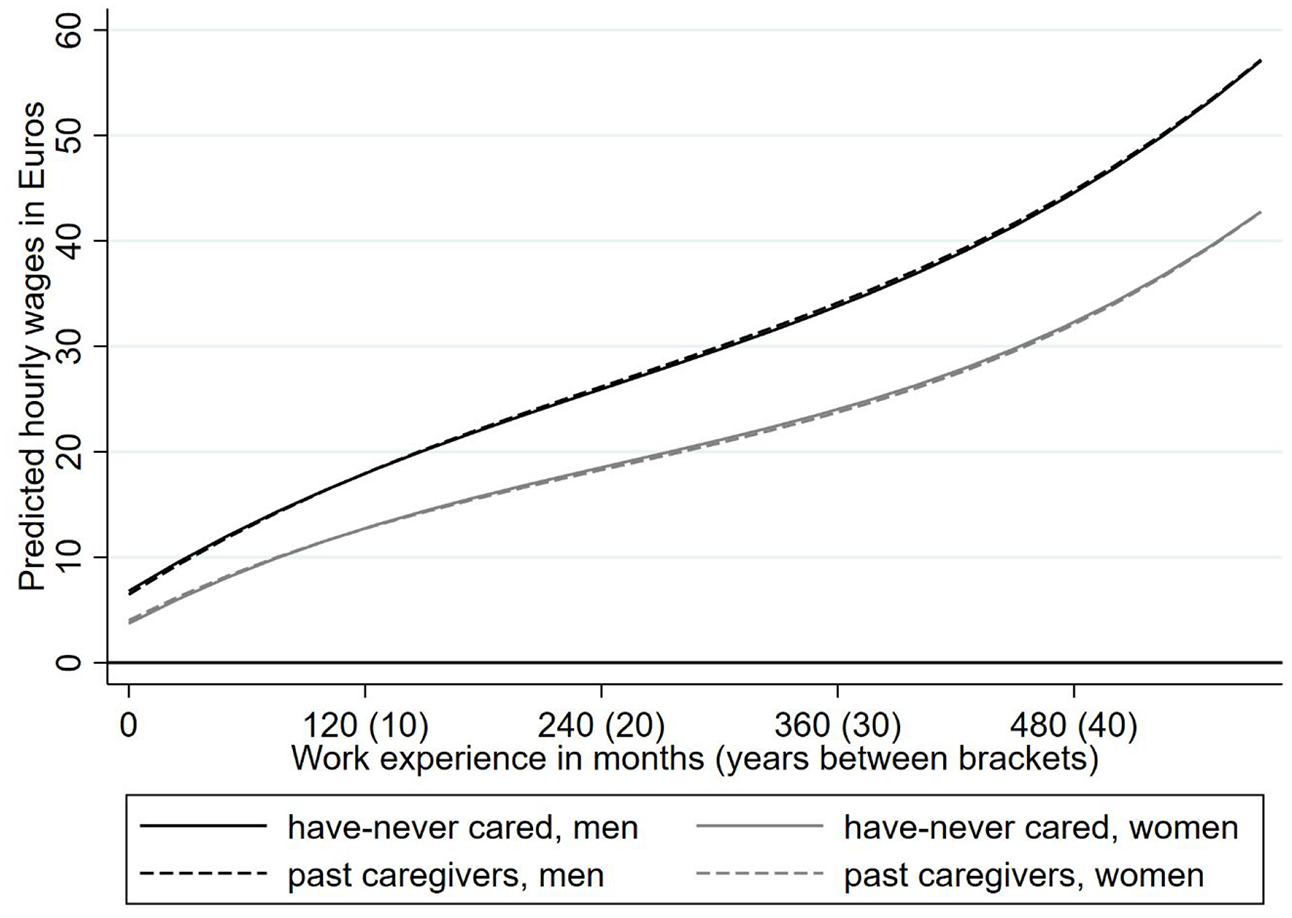
Predicted hourly wages by work experience, comparing have-never cared to past caregivers differentiated by gender (based on the interacted model with sex; not shown in tables due to otherwise high complexity). N = 324,940 months of 2659 respondents.
Table A2 shows the results for duration of caregiving (effect of time * duration). Among both women and men, there were no differences in wage growth by caregiving duration compared to the have-never cared category. This implies that, compared to those who have never cared, it does not matter how long one fulfils a caregiving role. Women who provided care for one to five years experienced a slightly, but significantly, higher wage growth than women who cared for less than a year (effect size below half a cent). This result implies some indication for enhancing wage growth effects with expanding caregiving periods for women, but this pattern did not extend to even longer duration categories. No differences in the interaction models were found, meaning no differences between women and men in the difference in wage growth by duration. Overall, there is little evidence for the duration hypotheses (1b and 2b).
When differentiating caregiving by intensity (see Table A3, effect of time * intensity), there was a negative effect on wage growth of intensive caregiving compared to have-never cared for women (0.004 euro). Hence, having cared intensively created a wage growth penalty for women, which is in line with H1c. The small quadratic effect means that the wage growth penalty slowed down over time. For men, there was no clear indication that caregiving intensity mattered for their wage growth. Yet, in the interaction models, it can be observed that female and male intensive caregivers differed. Men had stronger wage growth – a wage growth bonus – for intensive caregiving compared to women, who had a wage growth penalty when they cared intensively, compared to both men and women who have never cared, with a difference of 0.009 euro. This is illustrated in Figure 3, which shows the predicted averages per sex. Male intensive caregivers initially started with lower wages. They gained an advantage over time, namely a steeper wage growth, whereas female intensive caregivers lost their advantage in wages as they had slower wage growth. Again, this supports the idea that men can benefit more from (intensive) caregiving than women. For the comparison in wage growth between non-intensive caregiving and have-never cared, no clear differences between women and men were found. Table 2 gives a summary of the results regarding the hypotheses.
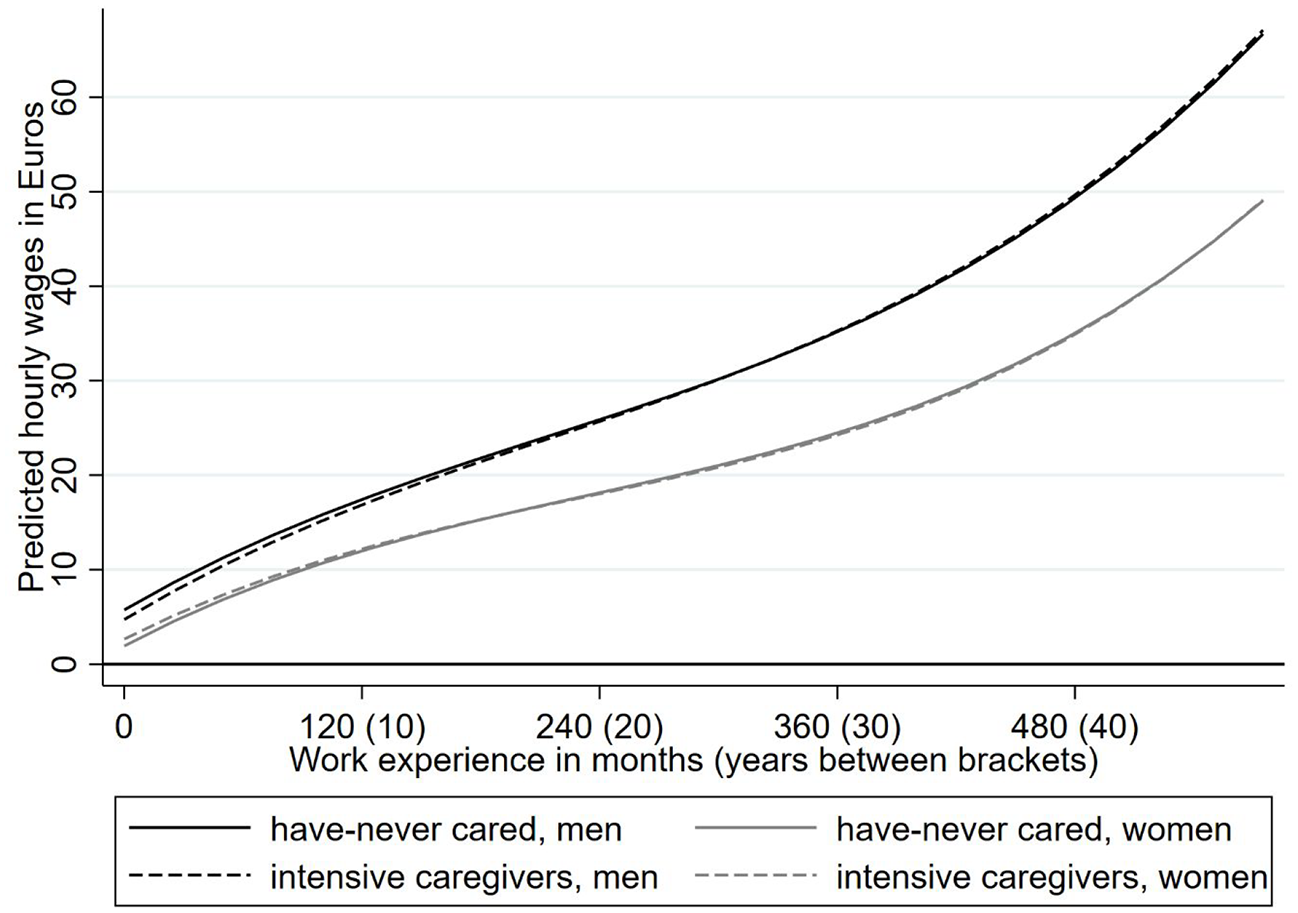
Predicted hourly wages by work experience, comparing have-never cared to intensive caregivers differentiated by gender (based on interaction model with sex; not shown in tables). N = 290,651 months of 2551 respondents.
Main findings hypotheses.
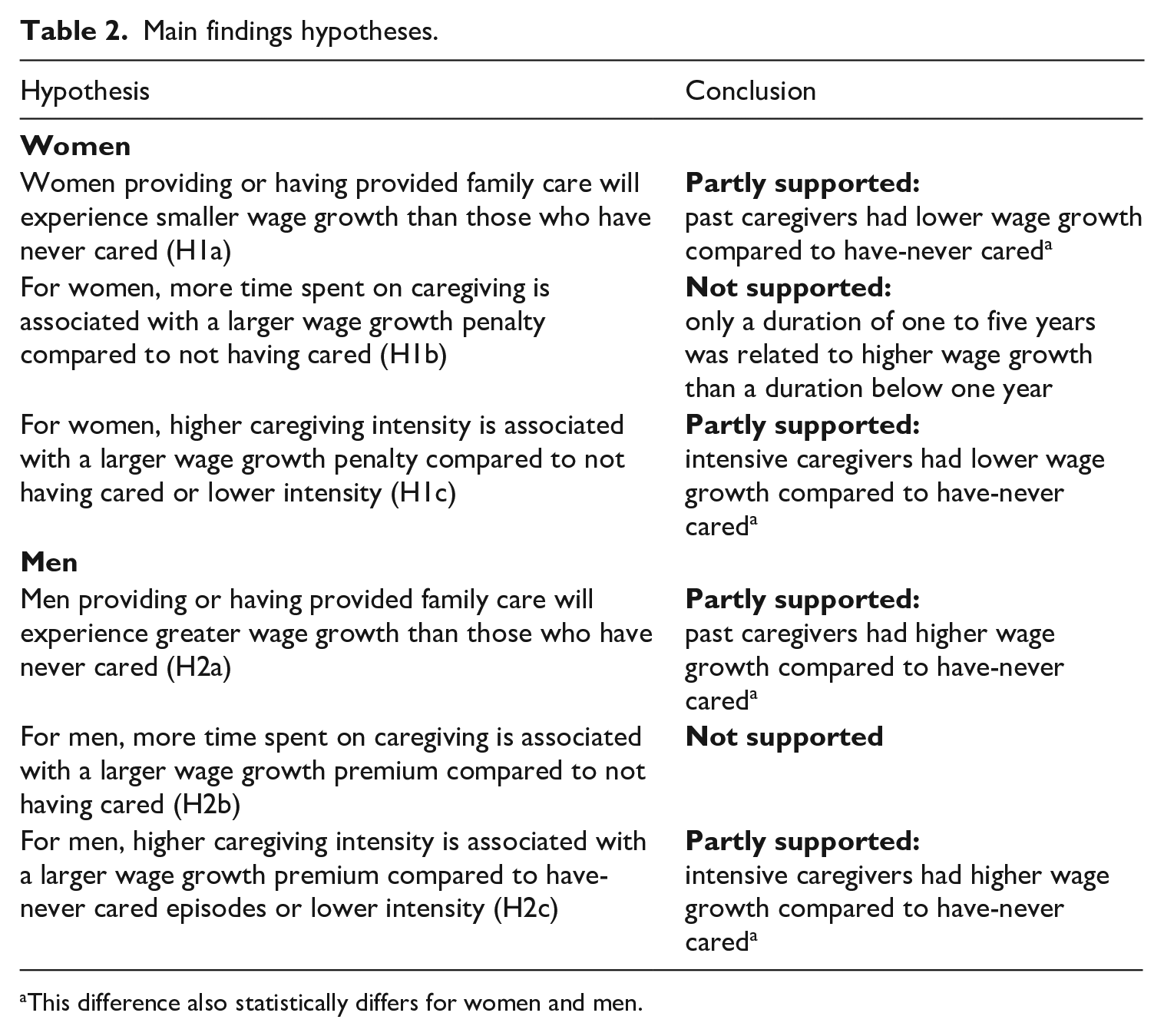
This difference also statistically differs for women and men.
Robustness checks
To test whether some of the made decisions influenced the results, six robustness checks were performed. First, hourly wages were corrected for yearly inflation; that is, for the rise in consumer prices (retrieved from https://opendata.cbs.nl/statline/#/CBS/nl/dataset/83131NED). The results above were reproduced. Second, respondents who, at some point, earned more than 100 euro per hour (before, only the months after the first time earning 100 euro were excluded) were excluded. This did not affect the results. Next, period was analysed instead of cohort, which again did not change the results. Changing the cut-off points for intensive caregiving to 11 hours instead of eight hours showed that intensive caregiving was not differently influencing wage growth for women and men anymore. Yet, this gave interesting results for non-intensive caregiving similar to those for intensive caregiving in the main models. Among men, non-intensive caregiving was related to a wage growth bonus whereas among women non-intensive caregiving was related to a wage growth penalty (compared to have-never cared). As observed in the data, both women and men answer 10 hours more often than nine and 11. This means that these cases are likely influential, so the threshold does matter. Changing the categories of duration to (1) up to five years, (2) five to 10 years and (3) more than 10 years, to have more differentiation among long-term caregivers, showed that, for women, having cared for more than 10 years was related to higher wage growth compared to have-never cared (coefficient = 0.005, p = 0.032); this implies that the enhancing wage growth effect of duration in the main models was extended in even longer durations. Finally, it was checked if the results on caregiving overall and caregiving duration were also reproduced on the smaller sample needed for the caregiving intensity models, which was the case. Altogether, the robustness checks showed similar patterns to the main analysis.
Discussion and conclusion
In this study, the impact of family caregiving on wage development for women and men based on work–care conflict and enrichment theory was described. These theories propose contrasting mechanisms and therefore opposite effects of family care among women and men. Would female and male caregivers face a wage growth penalty or bonus throughout their careers? Caregiving was conceptualized in three ways: (1) the overall effect of caregiving, including a category for those who gave care but stopped, (2) the duration of caregiving and (3) caregiving intensity. The relationship between family caregiving and wage development turned out to be gendered and the specific characteristics of caregiving (duration, intensity) indeed mattered. Past caregiving and intensive caregiving were, in fact, beneficial for the wage development of men, while for women, both past and intensive caregiving hampered their hourly wage development. This means that for men – under some conditions – there are signs that the enrichment mechanism outweighs the conflict mechanism. In contrast, for women, the conflict mechanism overshadows the potential positive impact of enrichment. Taken together, it has been argued and shown that the mechanisms of conflict and enrichment theory are indeed gendered.
Once having stopped caregiving – meaning having acquired relevant resources while not being in an actual role conflict anymore – men experienced more wage growth than those who had never cared. For women, however, even after caregiving, the impact of having experienced role conflict did not seem to end, presumably because they adjusted their work during caregiving to such an extent that they experienced the wage growth penalties of those adjustments even after caregiving stopped. As a consequence, this gendered caregiving effect could widen the already existing gender pay gap. This is in line with the literature on the fatherhood premium, where men gain an advantage from raising children compared to women, who, on average, experience a decrease in wage growth (Glauber, 2018). This highlights that to fully understand the gendered consequences of family care, it is necessary to consider both conflict and enrichment theory.
Interestingly, besides some indications that a longer caregiving duration enhanced female wage growth, there was generally little evidence for duration effects, neither for women nor for men. More insights (e.g. from qualitative work) are needed to understand the caregiving process better. The following question can guide future research: how long can caregivers keep up with their paid work and combine it with family care without adapting paid work or displaying lower productivity? Or, how long is it acceptable not to be as productive as usual? It would also be interesting to know whether it was anticipated that caregiving would go on for a long time. This would also be helpful in understanding where relevant thresholds lie and when caregiving is considered short- or long-term.
High-intensity caregiving – especially when measured as caring for more than a usual work day (eight hours or more) – was associated with a bonus for men, but a penalty for women. One explanation for this finding could be that men who provide care intensively signal reliability and loyalty to their employer (an argument related to enrichment theory and the literature on the daddy bonus). At the same time, non-intensive caregiving might go unrecognized by the employer. On the contrary, women seem to be more penalized when caring intensively as, for women, care work might be seen more as not committing to employment; for instance, by working fewer hours. Again, the resemblance to the results for childcare is evident: caregiving seems to be an advantage for men’s wages, whereas it is a penalty for women. The focus was on the overall effect of caregiving, being unable to look at the exact mechanism(s) underlying wage growth or decline. For instance, do women and men signal caregiving differently and how does the employer evaluate it? Or are the explanations more about working hours or learning new skills that men can better use to improve their labour market position? Future research would need to look more specifically into those potentially gendered mechanisms, including skills development and working hour reductions.
Although relevant results for enrichment theory and gender differences were found, it has to be noted that the effect sizes were generally small. Differences of less than one cent in hourly wage growth might not make the financial situation clearly better or worse for the specific caregiver or those not having cared. Other similar studies using yearly data only have also found small effect sizes when focusing on wage changes (Ehrlich et al., 2020). It can also be a positive conclusion that even if caregivers reduce their working hours, their hourly wages are not substantially affected. However, it must be noted that small differences in hourly wage growth accumulate over time. Given that populations are ageing, caregiving is likely to increase further in the future and even small differences can scale up when aggregating to full employment careers and whole societies. Future research should look into how much income is gained or lost for complete economies.
Combining retrospective survey data with administrative tax data makes for a unique dataset with many benefits compared to other data sources. Still, there are additional avenues for future research. First, this study was only about respondents who earned a wage, meaning they had to be employed to be included in the models. Months of unemployment were not taken into account, but those who do not return to work after caregiving ends are no longer observed. This means that caregivers who managed to stay in (regular) employment were analysed, yet quitting one’s job is the most detrimental consequence for a person’s wage. This is not captured in the analysis or theoretical model and should be looked at separately in future research. Second, although many relevant control variables were measured monthly and the exact timing of (non-)caregiving was known, potentially some information was missed to completely rule out selection effects (also related to gender). One clear piece of information that was lacking is the occupation of respondents. In the register data, the industry is available, but not the occupation within industries. Knowing the occupation of caregivers and non-caregivers could have said more about potential selection effects; for instance, respondents in certain occupations (e.g. care-related occupations or typical ‘male’ occupations) with (high or) low wage growth selecting themselves more into caregiving. Last, the results are situated in the Dutch labour market where part-time work – a typical strategy when experiencing work–care conflicts (Raiber et al., 2024) – is widespread and arguably less penalized for hourly wages. The effects found here are likely more substantial in other countries. Future research would have to confirm this and it is recommended that similar high-quality data are gathered in different contexts to better understand the global effects of family care on wage growth.
Overall, this study showed that considering both the negative (because of role conflict) and the positive (because of enhancement) caregiving effects on wage development is a useful framework to conceptualize, in particular, the gendered consequences of family care. Using high-quality data over 19 years, the findings highlight the gendered effects on wages for family care, comparable to the daddy bonus found in the childcare literature. This shows that in both types of care – family care and child care – women are disadvantaged, while men may benefit from caregiving.
Supplemental Material
sj-docx-1-wes-10.1177_09500170251348856 – Supplemental material for Wage Premium or Wage Penalty? Gendered Long-term Wage Development of Family Caregivers
Supplemental material, sj-docx-1-wes-10.1177_09500170251348856 for Wage Premium or Wage Penalty? Gendered Long-term Wage Development of Family Caregivers by Klara Raiber, Katja Möhring, Mark Visser and Ellen Verbakel in Work, Employment and Society
Footnotes
Funding
The authors disclosed receipt of the following financial support for the research, authorship, and/or publication of this article: This work was supported by the Dutch Research Council [grant number 015.013.049 and grant number 024.003.025] and partly funded by the Open Data Infrastructure for Social Science and Economic Innovations (ODISSEI) in the Netherlands ( ).
).
Supplemental material
Supplemental material for this article is available online.
References
Supplementary Material
Please find the following supplemental material available below.
For Open Access articles published under a Creative Commons License, all supplemental material carries the same license as the article it is associated with.
For non-Open Access articles published, all supplemental material carries a non-exclusive license, and permission requests for re-use of supplemental material or any part of supplemental material shall be sent directly to the copyright owner as specified in the copyright notice associated with the article.
