




Abstract
Drawing on ethnographic research, this article explores the daily implementation and lived experiences of workfare-inspired programmes designed for migrants seeking protection, who are living in Swiss reception centres. It examines how they are compelled to perform a wide range of unpaid work in exchange for their support and how they negotiate that work. Using a situated intersectional approach, the article shows how workfare-inspired programmes become a tool for channelling the behaviours of racialised migrant men and underlines the everyday resistance practices and survival strategies migrant claimants use to face exploitation. This case study takes a critical stance towards mainstream accounts of migrant workfare that frame it as a pathway to integration and empowerment. It brings new empirical insights to critical welfare studies and contributes to research on contemporary social security reform by showing how migrant claimants routinely resist the implementation of workfare.
Introduction
In Switzerland, work activation measures were introduced in various areas of social protection in the 1990s. Although Switzerland has never had a strong and generous welfare state compared with its European neighbours (Soulet, 2010), neoliberal reforms have been implemented to further reduce it. Since the 2000s, these reforms have extended to the asylum sector, affecting migrants whose pending asylum procedures gave them limited access to social protection. Without having the same rights as nationals in terms of access to social security and employment, they now tend to have the same obligations through their assignment to workfare-inspired programmes. The recent implementation of these programmes reflects a broader way of managing migration, now imbued with the ‘gaze of autonomy’ (Mezzadra, 2011), in which free labour plays a crucial role. Although workfare programmes have become an important part of migrants’ lives in European host countries (Alberti, 2017), their day-to-day organisation and concrete implications remain under-researched. The article aims to fill this gap by answering two research questions: how are these programmes implemented on a daily basis and how do migrants seeking protection experience and face unpaid work?
The existing literature on workfare programmes designed for migrants often focuses on integration, employability and empowerment outcomes (Dudley, 2007; Handy and Greenspan, 2009; Slootjes and Kampen, 2017), assessing the effectiveness of active labour market policies without critically questioning their underlying rationale. Other studies have shown that workfare can serve quite different purposes than bridging welfare and employment (Krinsky, 2007, 2009; Peck and Theodore, 2000; Wacquant, 2010). The history of workfare and its development in western countries underlines how it aims to limit the number of welfare recipients (Krinsky, 2009) while at the same time increasing ‘market discipline within the workforce’ (Greer, 2016), in a context of degradation of work conditions. According to Wacquant, workfare is accompanied by a ‘stern rhetoric of the “obligations of citizenship”’ (Wacquant, 2010: 198–201) and contains disciplinary mechanisms. By creating ‘a forced labour supply for contingent jobs’ (Peck and Theodore, 2000: 119), it reinforces the vulnerability of precarious workers (Greer, 2016; Patrick, 2014) and makes them particularly prone to exploitation. Alberti (2017: 3) argues the experience of this is exemplified by migrants ‘stigmatised as fraudulent benefit claimants, and in fact compelled to provide their labour under increasingly precarious conditions’.
Despite significant research on workfare policies, there remains a gap in understanding their day-to-day implementation and concrete implications for benefit claimants, particularly in specific institutional contexts and towards migrants. Existing literature on welfare destabilisation often focuses on the broader development of workfare policies (Peck and Theodore, 2000) or their structural impacts on labour markets and the workforce (Greer, 2016; Wacquant, 2010) but tends to overlook the practical realities of how these programmes are enacted and confronted. Furthermore, the lived experiences of migrants enrolled in these programmes and the forms of resistance they may adopt in response to the disciplinary mechanisms they encounter are not sufficiently explored. The mainstream literature on migrant workfare, by focusing on integration outcomes, fails to identify these disciplinary mechanisms, while research on contemporary social security reform tends to ignore how migrant claimants can routinely resist workfare policies.
This research aims to address these shortcomings by exploring migrant workfare programmes through an ethnographic lens that allows for the capture of their everyday implementation and experiences, while challenging the official rationale that frames these programmes in terms of integration or empowerment. It contributes to critical welfare studies by highlighting the ways in which mechanisms of control and exploitation permeate workfare programmes in practice – offering new empirical insights – while demonstrating that migrant claimants are not ‘passive’ in the face of exploitation.
A situated intersectional approach is used to highlight the multiple power relations that influence the implementation of workfare-inspired programmes and shape the coping strategies of migrant claimants. After setting out the conceptual framework, the article presents the methodology and context of the study, describing the fieldwork undertaken and the process of data analysis. The article then provides empirical accounts that show how the everyday implementation of workfare enables the control and exploitation of racialised migrant men and reveals how they discreetly resist unpaid work. Finally, the discussion highlights the key contributions of the article and the conclusion reflects on the limitations of this research and its implications for future studies.
Managing migration through workfare
In the 2000s, the implementation of workfare-based programmes designed for migrants reflects the application of restrictive and controlling measures in Swiss asylum policy. A specific feature of the Swiss case is the controversy surrounding the ‘abuse’ of the reception system (Leyvraz and Rey, 2020) and the numerous legislative revisions that have taken place as a result (Miaz, 2020). Put on the agenda by the far-right Swiss People’s Party, migration policy is one of the most debated issues (Parini and Gianni, 2005) in the political arena, constructing an ‘abuse policy narrative’ that portrays asylum seekers as ‘bogus refugees’ who would come to take advantage of one of the richest countries in Europe (Kaufmann and Bernhard, 2023). This ‘abuse policy narrative’ has led to restrictions on access to the labour market and social benefits, as well as to the obligation to reimburse the costs of social assistance, appeals and deportation (Miaz, 2020).
Migrants seeking protection are now incentivised to become ‘self-sufficient’. With the diffusion of welfare-to-work schemes in the asylum sector, social assistance represents both ‘a stick and a carrot’ (Rosenberger and Koppes, 2018) aiming to control the behaviour of migrant claimants. They must prove their ‘deservingness’ (Chauvin and Garcés-Mascareñas, 2014) by engaging in community work, training programmes, or voluntary work in return for their ‘forced welfare dependency’ (Mayblin, 2014). Their assignment to workfare-inspired programmes is constructed as a way for them to demonstrate that they are ‘deserving migrants’ (Di Cecco, 2021) who are worthy of the (limited) support they receive. The implementation of workfare-inspired programmes is therefore used as a tool to turn them into disciplined and productive subjects (Kohl, 2020).
As Mezzadra and Neilson (2013) highlight, actual migration management promotes exploitation. As a social process that ‘criss-crosses the whole fabric of production and reproduction’, exploitation can be traced ‘through the entirety of the migratory process and migratory experience’, including in the country of reception (Mezzadra, 2011: 124). According to Nakano Glenn (2010: 11), exploitation is ‘made possible by multifarious forms of coercion, ranging from personal moral persuasion to the force of impersonal legal doctrine, from internalised feelings of obligations to external constraints of the labour market’. Migrant claimants who have to work for free in order to prove they are worthy of protection, without the right to access to the labour market, are therefore exposed to exploitation. However, exploitation ‘is always confronted with migrants’ agency as its condition of possibility and as the material basis of its potential contestation’ (Mezzadra, 2011: 124). To fully understand how migration management through workfare supports control and exploitation, migrants’ voices and experiences must be taken into account.
Migrant everyday experiences and resistance
Migrants targeted by workfare-inspired programmes are facing ‘particular structural vulnerabilities’, derived from ‘financial insecurity, racialization, and social stigmatization’ (Gomberg-Muñoz, 2010: 297). Different scholars have shown how people facing multiple systems of oppression may opt for different kinds of coping or ‘survival strategies’ (MacDonald, 1994); that is, ‘forms of individualized adaptation to [. . .] widening socio-economic inequalities and more intensive forms of structural violence’ (Redman, 2023: 589). These survival strategies are particularly mobilised by migrant workers who cope with degrading working conditions in order to strengthen their dignity and self-esteem (Gomberg-Muñoz, 2010). In other words, to mediate the discriminations and stigmatisation they face in reception countries, migrant claimants might try to rebuild their ‘respectability’ (Skeggs, 1997). The aim of these strategies is not to ‘overthrow or transform a system’ (Scott, 1985: 301), but rather to survive within it (Redman, 2023).
Similar to other recipients of workfare programmes, migrant claimants may deploy a range of ‘methods to struggle against and subvert policies and practices’ (Redman, 2023: 589) designed to control them and use their labour for free. They might in that sense try to obtain the ‘least possible disadvantage’ from their conditions, by adopting ‘everyday resistance practices’ (Maculan, 2022: 437). In his seminal work, Scott (1985) helps to understand how ‘everyday weapons’, such as mockery or expressions of non-compliance, are tools of resistance for marginalised workers. Following Hirshman’s conceptualisation of resistance strategies in the workplace (Hirschman, 1970), migrant claimants might either opt for loyalty or for silencing their disagreement (Behtoui et al., 2017), or choose to voice it backstage, a safer setting in which to express it (Scott, 1990). The ‘exit’ strategy, which here means quitting workfare-inspired programmes, might be less likely used as it can depreciate the already harsh living and working conditions migrant claimants face in reception facilities. The use of these resistance strategies is therefore shaped by the multiple inequalities that structure migrants’ experiences. A situated intersectional analysis (Yuval-Davis, 2015) helps to understand how mutually constituted power relations influence both migrants’ exploitation and agency within specific contexts.
A situated intersectional approach
An intersectional approach allows for an empirical understanding of the ‘interconnected and constitutive nature of multiple forms of oppression’ in migration processes (Bastia, 2014: 238) and sheds new light on the policies and practices that underpin migration governance (Cleton and Meier, 2023). It provides an understanding of how migrants are subjected to specific processes of racialisation that draw on representations of class, gender and sexuality (Yuval-Davis, 1997) in receiving countries. These representations have situated effects on the way migration management is implemented and experienced on a daily basis.
In western hosting countries, precarious and racialised men are specifically exposed to mistrust and control, as they are ‘assumed to coincide not only with welfare dependence but also with poor work ethics and oppressive gender and family norms’ (Bonjour and Duyvendak, 2018: 897). Stereotypical public discourses contribute to ‘the social construction of certain migrant masculinities – particularly those with a Muslim and/or African background’ (Wyss, 2022: 52). Thus, in the specific configuration of migration, the intersecting of migrant masculinity with other categories ‘challenge or even subvert male privilege’ (Christensen and Jensen, 2014). For racialised migrant men seen as ‘bogus refugees’ and as a threat to social order, the ‘vulnerability frame’ (Chauvin and Garcés-Mascareñas, 2014) that dominates humanitarian representations of migrants (Ticktin, 2011) hardly applies. They must therefore prove, more than others, that they deserve to be helped and to remain in Switzerland.
Methodology and context of the study
This article is based on ethnographic research of the Swiss reception system (2016–2019). The Swiss federal system implies a management migration policy in which power is shared between the central state (federal level) and subnational regions (cantonal level). At the beginning of the asylum procedure, the central state is responsible for providing reception and assistance in federal centres. It then delegates this responsibility to cantonal authorities, as asylum seekers are transferred to their facilities for the continuation of their procedure. 1 While the State Secretariat for Migration is the sole authority deemed competent to make asylum decisions, cantonal authorities must implement reception and assistance for migrants with a different legal status: asylum seekers, (provisionally admitted) refugees, or rejected asylum seekers. Cantonal authorities are also responsible for implementing integration policy as well as deportation decisions. Additionally, they must verify the legal conformity of regularisation requests made by rejected asylum seekers, before sending it to the State Secretariat for Migration who decides as a last resort.
A complex web of actors and institutions are today involved in Swiss migration management. Since the 2000s, federal and cantonal authorities can outsource the daily functioning of reception to either for- or non-profit organisations. In federal centres, a private company is now responsible for providing shelter, food, health care and clothing, as well as for implementing workfare-inspired programmes. In cantons, reception centres can be outsourced or run by public agents (social workers), the latter being the case with the cantonal reception centre studied in this research. Nearby federal and cantonal facilities, migrant support organisations have established drop-in centres with the original aim of ‘compensating for the social violence embodied in the regime of migration control’ (Walters, 2010: 139). Over the years, these organisations have been pushed to cooperate with both federal and cantonal governments. This push has led to the externalisation of certain aspects of reception and assistance to these humanitarian ‘street-level organisations’ (Brodkin, 2013, 2015) that now formally participate in the making of migration management. Thus, they now work hand-in-hand with private companies and public agents to implement workfare-inspired programmes for migrants.
As a descriptive case study, the research was designed to describe the features of the Swiss reception system in detail and ‘in its real-life context’ (Yin, 2009: 18). One of its central features appeared to be workfare-inspired programmes. These were explored in depth in order to provide a rich and contextualised account of their day-to-day implementation and lived experiences. Between 2016 and 2019, the research process unfolded in five distinct phases, some of which were intertwined.
The initial phase involved 2.5 years of volunteering at two drop-in centres run by migrant support organisations: one connected to a federal centre and the other to cantonal facilities. This immersion, which took place two to three days a week, created opportunities for sustained observations and conversations with support organisations’ members and migrant claimants. Participant observation as a volunteer was open. The observations first focused on the daily work of migrant support organisations’ agents and their interactions with migrants according to gender, race or class categorisations. Gradually, the focus shifted to how certain categories of migrants were incentivised to volunteer at these drop-in centres or to engage in community work in exchange for support.
Owing to the close working relationship between members of migrant support organisations and cantonal and federal reception agents, a second phase involved repeated, informal conversations with the latter. It also included periodic visits to the reception centres they manage, offering deeper insights into the day-to-day operations and interactions at these facilities. A third phase (2017–2019) involved attending quarterly meetings between various actors of the reception system alongside members of migrant support organisations. This provided a broader perspective on how different actors coordinate daily in the operation of the reception system and the implementation of workfare-inspired programmes. At the end of the fieldwork (2018–2019), I circulated between the drop-in centres and the federal and cantonal reception facilities. This circulation allowed me to observe how migrants navigate the different sites of the reception system and how they were assigned to unpaid work in the public space.
Finally, semi-structured interviews were conducted with migrant claimants, reception agents from migrant support organisations and from federal and cantonal facilities, as well as with policymakers and state agents (2018–2019) (Table 1). Interviews with migrant claimants mainly focused on their migratory trajectory, their perceptions and daily experiences of the Swiss reception system (housing, legal procedures, relationships with different reception agents) and of different workfare-inspired programmes (description of the nature of the work and their working conditions, attitudes towards free labour, coping strategies). The interviews with reception agents from migrant support organisations and from cantonal and federal centres focused on their interaction with each other in the day-to-day management of migration, their perception of their role and of the obligations and rights of migrants seeking protection. The interviews with policymakers and state officers focused mostly on the development of migration policies and the creation of workfare-inspired programmes for migrants. Interviews lasted from 1.5 to 4 hours and were recorded, transcribed and anonymised.
Interviewees by role, status, gender and ethnicity.
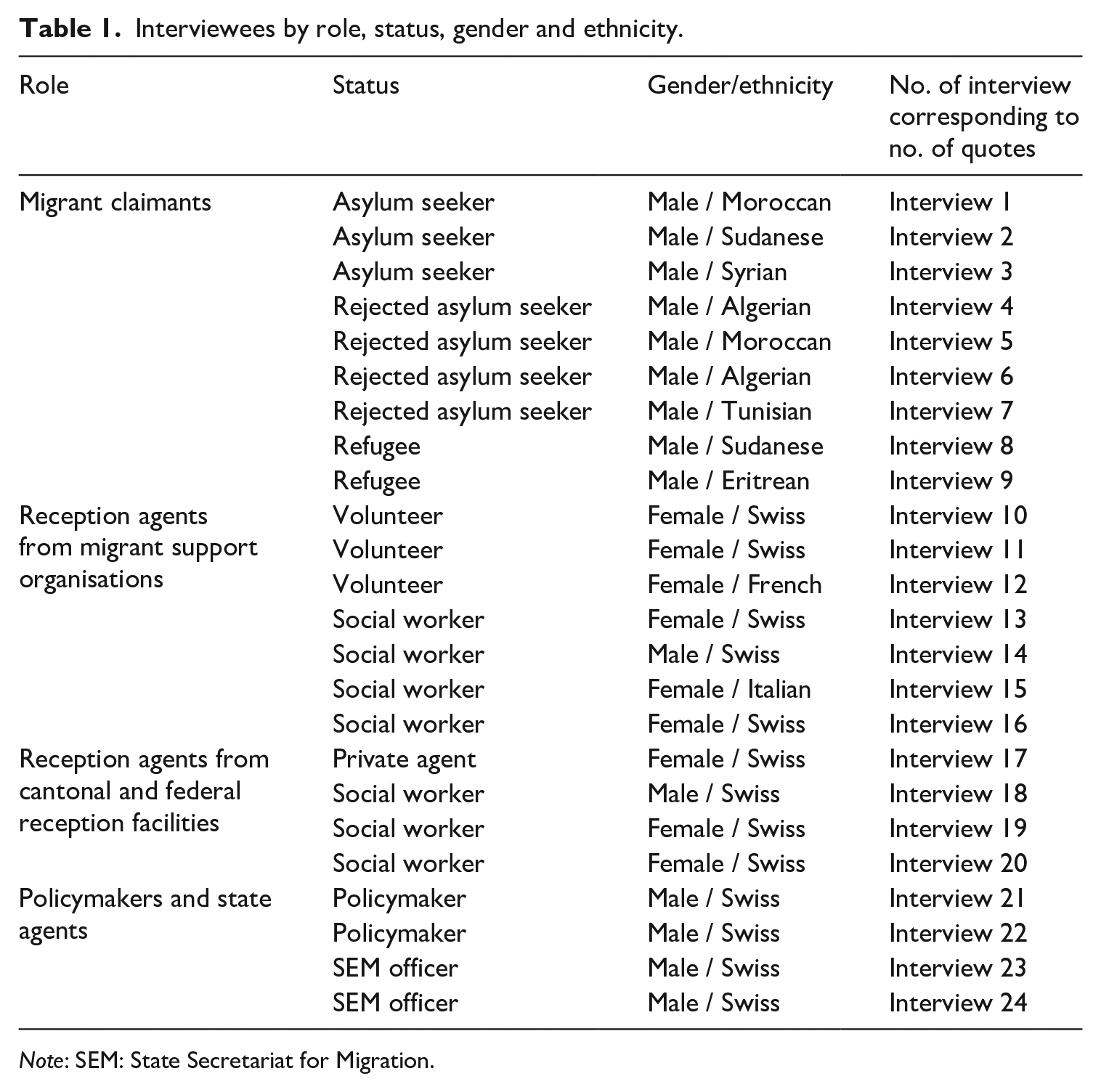
Note: SEM: State Secretariat for Migration.
In line with ethical research practices, the role of the researcher was constantly reiterated in an informal and fluid manner to ensure informed consent from the participants (Bhattacharya, 2007). Anonymity was assured and certain identifying biographical details have been deliberately altered to ensure confidentiality.
Most of the migrant claimants who participated in this research were Arab and Black men from North- and Sub-Saharan Africa aged between 25 and 40 years old, whose vulnerability is denied and whose ‘idleness’ is seen as problematic according to gendered and racialised stereotypes. I struggled to reach migrant women, who were encouraged to stay in federal and cantonal reception facilities by reception agents who assigned them to domestic space. As a White female researcher, I was not affected by the gendered and racialised forms of control and exploitation that take place in the Swiss reception system and did not share the same experiences as migrant claimants. However, working as a volunteer in the drop-in centres for an extended period, while not being seen as a reception agent (as participants were aware of my role as a researcher), enabled me to build bonds of trust with migrant claimants.
Data analysis followed an inductive approach and iterative process in line with grounded theory (Charmaz, 2014) to ensure robust findings specific to the research context and participants’ lived experiences. It also allows for a critical stance on the prevailing literature on migrant workfare programmes. Regular reflection on the fieldwork notes enabled the identification of emerging themes on which the interview guides were built. The interviews were then coded thematically, which provided additional insights and allowed for the refinement and development of the emerging theory. The comparison of data from fieldnotes and interviews allowed for theoretical saturation and the identification of relevant conceptual framework. The relevance of the concept of ‘exploitation’ as a tool of migration management came out from the repeated descriptions of racialised migrant men working for free within the reception system and from the narratives of reception agents and migration officers. The significance of the concept of ‘everyday resistance’ to understanding migrants’ attitudes to unpaid work first emerged from interpreting descriptions of repeated gestures of non-compliance (rolling eyes, sighs, mocking). Interviews with migrant claimants then provided a deeper understanding of the meanings they attach to unpaid work as a ‘survival strategy’.
From arrival to (ir)regularisation: A chain of exploitation
In Switzerland, newcomers who are received in federal reception centres are first categorised as ‘asylum seekers’. While they transit from federal to cantonal reception facilities, they can either become ‘(provisionally admitted) refugees’ or ‘rejected asylum seekers’, that is, unauthorised migrants waiting to be deported, appealing for their asylum claim to be re-examined, or trying to remain in Switzerland by obtaining another type of residency permit. These statuses give access to differentiated rights and services but also to different workfare-inspired programmes. Throughout their trajectory in the Swiss reception system, migrant claimants are therefore assigned to different forms of unpaid work.
Exploiting newcomers ‘for the benefit of the community’
On their official website, the federal government underlines that now ‘municipalities where federal reception centres are established can take advantage of community work programmes organised by private operators’ who run the centres. Residents of reception centres are portrayed and transformed as useful bodies. Community work programmes for asylum seekers have indeed become one of the central aspects of support in federal reception centres. As underlined in a booklet produced by the State Secretariat for Migration, asylum seekers are prompted to ‘take part in public work for the benefit of the community’. Asylum seekers clean up public space, sort waste for recycling, or clear snow from roads. According to the State Secretariat for Migration: these activities give them the opportunity to interact with the local population and gain experience. Participants receive an incentive payment of up to CHF 30 per day worked. This nest egg is given to them when they leave the centre.
2
Upon their arrival in Switzerland, asylum seekers are therefore put to work in public services in exchange for a very limited amount of money they cannot make use of immediately, as it is only given to them once they quit the federal centre. Yet, this ‘nest egg’ – which is five times less than the Swiss minimum hourly wage – functions as an incentive for migrants facing harsh economic conditions and who are not allowed to take paid jobs. During 2017, 1379 days and 81 half-days of work were performed by asylum seekers. Under the rhetoric of integration (as they may ‘interact with the local population’ and ‘gain experience’ through their work), asylum seekers’ work is not legally and financially recognised as such and is partially denied (Krinsky and Simonet, 2012).
While it fosters the exploitation of asylum seekers, this community work programme is also meant to control their behaviour and that of ‘young men’ in particular. According to a member of a migrant support organisation providing assistance in a non-profit drop-in centre near federal reception facilities: At first [in the beginning of the 2000s] there were a lot of young men and that’s it. So, the authorities wanted for them not to be unoccupied in the streets of the village [where the reception centre is established]. As we invited them into our drop-in centre, they were in the streets less and that was important for the government. [. . .] But, clearly, they couldn’t be doing nothing all day long. They must do something, for their integrity and for the local population [hostile to their presence]. (Interview no. 10)
Community work was for and foremost targeted racialised ‘young men’, whose forced unemployment was seen as a threat. Private security agents were also deployed to follow their habitual paths through the village, ‘especially on the girls’ way to school’ as one member of the migrant support organisation told me. Community work was therefore another tool to control migrant men’s behaviour.
The implementation of community work was outsourced by the government to both private operators and migrant support organisations helping asylum seekers. Besides more obvious and traditional methods of surveillance exercised by security agents, the involvement of migrant support organisations in the implementation of workfare-inspired activities helps deny its controlling and exploitive dimensions. Rather, community work programmes are presented as a way to help asylum seekers by giving them the chance to display their good morality, against xenophobic prejudices: As I volunteer with two members of the migrant support organisation at the drop-in centre connected to the federal centre, a reception agent from the private company that runs the latter enters, accompanied by a dozen of the male asylum seekers in work clothes and orange vests. After getting them to clear some forest paths, the private reception agent takes them back to the drop-in centre to warm them up with a cup of coffee. One of the members of the migrant support organisation begins to chat with the private reception agent. First about the harsh weather conditions and then about the ‘positive effects’ of the community work programme, which, according to the member of the migrant support organisation, makes it possible to ‘cleverly keep the asylum seekers busy’ while they ‘don’t have much to do’. The private agent replies that these programmes are indeed better for them than ‘waiting and drinking all day’. Both then talk about the complaints of local residents who have little patience with the [forced] idleness and visibility of male asylum seekers in the public space. (Fieldwork notes, November 2016)
In an interview, another member of the migrant support organisation similarly described community work programmes: We love when asylum seekers are working in the village and are not only working hidden in the forest. When they are along roads, picking up garbage, etc. People from the village make them responsible for lots of problems [. . .] So, when they see them working, it reduces their critiques. (Interview no. 11)
After the implementation of these community work programmes, agents from the private companies running the federal centre decided to apply certain conditions under which asylum seekers could participate. The aim was to constrain them to adopt ‘appropriate’ conducts, as I discovered while visiting the federal centre: M, an agent from the private company in charge of the federal reception centre, took me to visit the federal centre today. We first arrived in a big refectory, where no-one was seated. As we went upstairs to see the dormitories, we met with a dozen asylum seekers supervised by a few other reception agents. Asylum seekers were cleaning communal bathrooms, some with sponges or mops in hand, others scraping the floor. Michelle explained that cleaning collective areas such as the toilets, the refectory, or the courtyard, as well as serving meals, are part of the chores asylum seekers have to perform. When I asked her if this is part of the community work programme, she answered negatively and explained: ‘We put in place a stamp system. That is, everyone who volunteers for a chore in the centre, such as cleaning toilets and floors, or washing dishes, gets a stamp on the back of their identity card. When they’ve accomplished five tasks within the centre, they are eligible to a community work programme, so they can go and work outside for 30 CHF [per day]. We put this system in place so that asylum seekers are more eager to do cleaning duties daily in the centre. Because some of them were doing nothing in the centre but were always participating in the community work programme outside. For us, it was not fair, so we came up with this idea.’ (Fieldwork notes, December 2017)
Asylum seekers are thus required to accomplish domestic work in the centre for free to be allowed to participate in community work and gain a very limited amount of money. This arrangement allows the for-profit company running the federal centre to benefit from the free labour of asylum seekers, while reducing operational costs associated with its maintenance. At the same time, it empowers the agents of this company to shape the behaviours of asylum seekers, by introducing a system of sanctions and retribution. Thus, without being compulsory, domestic work in the centre is induced by a combination of internal rules and social coercion.
This establishes a chain of exploitation that begins within the federal centre and extends to public space. It allows both private companies and the federal government to reduce the costs of reception and assistance by producing commitments to unpaid work. This chain of exploitation continues as migrant claimants leave federal reception centres to pursue their legal procedures in cantonal (subnational) reception facilities.
The fashioning of a cheap workforce
Once they have been attributed to a specific canton, migrant claimants are assigned to different kinds of free labour, according to their legal status. First, those whose asylum application has been successful and have obtained a refugee status are oriented towards training programmes in sectors of the labour market facing staff shortages and characterised by low wages.
Social workers from cantonal reception centres try to transmit a set of instructions and advice whose purpose is to mould refugees into an exploitable labour force. During face-to-face counselling, they try to reorient them towards training programmes in sectors with labour needs, such as catering or the construction industry: Often, refugees are making career plans that are . . . I wouldn’t say unrealistic, but . . . too ambitious. For example, some of them want to study at the university . . . so we need to demystify the university, by saying that the university doesn’t necessarily lead to a job. We tell them our training programme would be more appropriate for them. I’m here to tell them that there are other paths [than the university], like in the catering sector, the building industry, these kinds of sectors in need of people [. . .] This is part of the political directives we receive. (Interview no. 18)
By using moral persuasion, social workers in cantonal reception centres who implement migration and welfare policies guide refugees towards the poorly paid and demeaning jobs many Swiss citizens will not consider in order to accelerate their exit from welfare. During our interview, another social worker from the cantonal reception centre explained:
Would you say the refugees who’ve been following your training programmes find jobs afterwards?
Well, yes, but it’s mostly jobs as cook assistants, dishwashers, that kind of job [. . .]. And in health care, too. There are quite a few people who found contracts afterwards as care auxiliaries, care assistants. Also, because there’s a need for people in those sectors! It’s not a surprise if these training programmes for refugees have been set up in these areas. (Interview no. 20)
In the same vein, rejected asylum seekers – who do not fit the refugee category – are assigned to ‘occupancy programmes’ inside cantonal reception facilities. While they cannot be redirected towards the labour market due to their status, the cantonal government has designed internal workfare-inspired programmes to make their presence cost-effective. The work they are pushed to carry out serves to provide useful services to the operation of the cantonal reception centre itself, as underlined by the cantonal centre’s annual activity report in 2012: With the help of occupancy programmes, [the reception centre] continued to meet a number of internal needs. The Kitchen programme provides around 3060 meals per week, representing 160,800 meals in one year. [. . .] For 2012, this represented some 2208 hours, which is the equivalent to one full-time job. (Cantonal Reception Centre, Annual Activity Report, 2012)
These occupancy programmes are using rejected asylum seekers’ workforce to engage in daily reproductive labour, such as maintaining accommodation buildings and feeding other migrant claimants, nurturing the self-reproduction of the cantonal reception system (Martorano, 2023). Furthermore, through occupancy programmes, the local government puts to work rejected asylum seekers who are not allowed to stay in Switzerland as refugees and take on paid employment. By creating a category of people who are uncertain of remaining in Switzerland, the state produces vulnerable migrants, whose desire for regularisation makes them particularly prone to exploitation. Rejected asylum seekers must indeed provide different types of free labour, as a social worker from the cantonal reception centre explained: In the centre, we present voluntary work in non-profit organisations as something that has greater value for a project of regularisation than our ‘occupancy programme’, which remains within our institution. Showing that an effort has been made to work [for free] outside the centre and outside the programmes we can offer, influences in a positive way requests for regularisation. (Interview no. 19)
Hence, rejected asylum seekers are also pushed towards another sort of unpaid work, that is, voluntary work (Taylor, 2004) in non-profit drop-in centres run by migrant support organisations. Indeed, social workers from the cantonal reception facilities often advise them to get involved voluntarily in the making of services at the drop-in centres welcoming them. They present voluntary work as an opportunity to perform civic duties and demonstrate one’s deservingness to access legal status: [. . .] there are several things to show when applying for a permit and to be regularised: the professional and financial situation, the integration path, letters of support. And for all these reasons, clearly, being involved in the non-profit sector as a volunteer is a plus. This is what we’re telling migrants in the centre. That it’s a way to show that you’re committed as a citizen. [. . .] So, we explain it will work in their favour, or against them if they don’t do any of that [. . .]. (Interview no. 20)
However, the incorporation of these narratives by rejected asylum seekers is not automatic and social workers from the cantonal reception centre also use moral persuasion: It’s not always easy to get people to accept the idea of working for free [. . .] Some would say, ‘I want a salary’. I sometimes feel that people are rather reticent about the idea of working for free in the non-profit sector. So, we need to underline the advantage in terms of practising French, networking, integration, etc. (Interview no. 19)
While it is difficult to assess whether volunteering has any effect on the chances of getting a residency permit, cantonal reception agents are perpetuating the exploitation migrants have been exposed to since their arrival in Switzerland. How do migrant claimants experience this on a daily basis? The following part of the article examines the ‘survival strategies’ (MacDonald, 1994) they develop to face exploitation.
Resisting exploitation on a daily basis
Even if they are constrained by a restrictive framework of limited rights and extended obligations, migrant claimants are not ‘passive victims’ (Redman, 2023). Nevertheless, they might mostly use covert everyday resistance to survive harsh living conditions and express their non-compliance.
Rebuilding self-care and self-respect as survival strategies
In Switzerland, as in many other countries in Europe, the experience of applying for asylum and waiting for a legal status exposes migrants to long-lasting and discouraging procedures. While waiting for his asylum claim to be re-examined after he made an appeal, B expressed his feeling of loss and dispossession for being restricted in almost every aspect of his life: Really the situation here is . . . For three years, it’s been like this. For me, it’s too much, it’s too much . . . All the time, you’re thinking about your family, your country . . . and your life here in Switzerland. And you’re wondering: ‘what am I going to do?’. You have nothing, you don’t have a permit, you’re not allowed to work, you’re not allowed to travel, you’re not allowed to do . . . anything. It’s really . . . really difficult. So at least when I work [as a volunteer], it keeps my mind busy, I stop thinking. (Interview no. 2)
The disciplinary mechanisms that permeate migration policies and rulings have a direct effect on the well-being of migrant claimants. They nonetheless use different kinds of strategies in order to survive in this system, such as the one B elaborated to ‘stop thinking’ about his condition. Hence, working – even for free – does take a central place in these strategies. The way migrants redefine the reason they engage in unpaid work underlines how they create and choose a definition of themselves and their activities that differs from the one proposed by migration governance’s policies and agents.
In order to (re)build a positive image of themselves, migrant claimants reclaim unpaid work as a ‘job’ (interview nos 1, 2, 4, 5, 6, 7, 9), allowing them to avoid some of the social and psychological consequences of unemployment (MacDonald, 1994: 507). Many migrant men told me they were taking on unpaid work to subjectively replace paid employment, as a rejected asylum seeker underlined while waiting for his asylum appeal to be considered: ‘There’s no way I can find a paid job in Switzerland, so I come and work here [in a non-profit drop-in centre as a volunteer]’. By responding to a social norm – that is, having an occupation – migrant claimants diminish the feelings of shame and inferiority they are subjected to on a daily basis and, consequently, improve their well-being (Stam et al., 2016):
And when did you start voluntary work?
Well . . . after all of this [the rejection of his asylum claim], my head was spinning. [. . .] I saw people in the same situation who went mad, you know? [. . .] But me, thank God, due to my education, to my religion, to my culture, to all of that, I knew how to handle the situation, by working a lot [in a non-profit drop-in centre as a volunteer]. I knew how not to go mad. (Interview no. 6)
While migrant claimants are responding to constraints and incentives that urge them to prove their utility and sense of civic duty by working for free, their involvement in unpaid work is also done to preserve self-respect. Another rejected asylum seeker trying to regularise his situation underlined this aspect in an interview:
How do you feel about doing unpaid work?
I have nothing else to do! What can I do? What am I going to do? It’s playing on my mind . . . As I told you, it hurts my pride [not being able to take paid employment]. I don’t want to beg. I’m not a beggar. I’m not someone like that. Me, I want to give to people, so how could I ever imagine not doing anything all day, having to beg to people? Doing nothing, it’s impossible for me. I’m not disabled! (Interview no. 7)
Migrant claimants may adopt a line of action that enables them to forge a positive image of themselves and that contributes to rebuilding their respectability (Skeggs, 1997), in regard to judgements of gender and race. In a system that devalues racialised people and labels migrant men as both ‘dangerous’ and ‘inferior’, working for free is an attempt to rebuild a respectable masculinity, as one asylum seeker waiting for his claim to be re-examined underlined:
So, you agree to work for free?
I just want to work because I don’t like to stay at [the cantonal centre’s accommodation]. I was not allowed to do anything and it was bothering me a lot. I’m still young, I can do anything! Why can’t I take paid job? Everyone is working here, I mean, even women are working in Switzerland (he laughs)! (Interview no. 3)
By being forced to depend on welfare and unable to take paid employment, migrant claimants’ manliness can be called into question. At the same time, migrant men are assigned to tasks traditionally considered as feminine, such as cleaning or cooking. Nevertheless, they frequently emphasised the physically demanding aspects of their work to reaffirm their masculinity. Evidence from fieldwork showed that migrant men concentrated on tasks such as unloading boxes of food, lifting furniture to clean underneath and setting up benches and tables. They would frequently emphasise the virile qualities believed as necessary to achieve these tasks, stating things such as: ‘Wait, give me that, it’s too heavy for a girl’ or ‘Look, I’m strong, I’ll do it’ (fieldwork notes, June 2016 and April 2017).
Through their unpaid work, migrant men try to build another image of themselves than the one to which they are reduced. This strategy enhances self-respect as well as subjective well-being and can therefore be seen as a tool for resistance. For oppressed groups, self-care implies self-preservation and can be considered as a strategy to survive in a coercive environment (Lorde, 1988).
With these survival strategies, migrant claimants are nonetheless working for free. However, this does not mean they are consenting to their exploitation. The following section reveals several exhibitions of non-compliance (Redman, 2023), yet avoiding ‘any direct symbolic confrontation with authority’ (Scott, 1985: 29) or symbols of authority, such as social workers from reception facilities or from non-profit drop-in centres.
Exhibitions of non-compliance to exploitation
Migrant claimants, especially those whose asylum claim is still under examination or has been rejected, have little choice but to adhere to the incentives of showing they deserve to access assistance and remain in Switzerland. However, they can contest, criticise or distance themselves from these incentives.
Subordinate groups hardly ‘believe actively in the values that explain and justify their own subordination’ (Scott, 1990: 72). Dominant narratives that allow for the exploitation of rejected asylum seekers are often caricatured, as shown in the following fieldwork notes: This evening K, a rejected asylum seeker, volunteered in the cantonal non-profit drop-in centre. Assigned to the task of managing the garbage cans that night, he looked at me with an ironic smile. He said, ‘You know, it’s quite something to be emptying these garbage cans. Soon, the city will hire me as a street cleaner. I’ll be working with an official uniform, earning a fortune! You’ll see!’ He laughed as he completed his task. (Fieldwork notes, September 2016)
K exaggerated his compliance with the figure of the deserving migrant to the point of mockery. This ‘art of political disguise’ (Scott, 1990: 139) here serves to criticise, in a hidden way, the promises that are made in reception centres, where free labour is presented as a chance to enhance professional integration. His performance also mocked the way migrants are predominantly assigned to essential yet poorly paid jobs in the Swiss labour market.
Other ‘hidden transcripts’ (Scott, 1990) or discreet expressions of non-compliance with work assignments can appear when members of migrant support organisations direct migrant claimants towards ‘voluntary tasks’ in the drop-in centres: As L, a rejected asylum seeker, walks into the cantonal drop-in centre, a social worker came to say ‘hi’ while asking him with a big smile if he ‘can do the dishes, please, please, please?’, a cloth in her hand. Taking the cloth she hands him, L looks at me with a raised eyebrow and rolls his eyes, saying, ‘Looks like I don’t have the choice anyway!’. (Fieldwork notes, October 2017)
Non-compliance to exploitation is also expressed in interviews, which allow for ‘backstage discourse consisting of what cannot be spoken in the face of power’ (Scott, 1990: xii). The following excerpt is an example of how disagreements with the exploitative nature of workfare-inspired programmes can be voiced in interviews: In 2017, I started working in the kitchen [of the cantonal reception centre]. It was from 8 a.m. to 4 p.m. In the kitchen, you can never sit down, you’re always on your feet! You’re always on your feet, coming and going, all day long. Washing dishes, chopping, preparing meals . . . Honestly, cooking is hard, it’s hard. I was tired all the time [. . .]. And I did get paid, yes, but not much. The [cantonal reception centre] they don’t pay much, actually they are thieves! (Interview no. 3 with asylum seeker)
Thus, migrant claimants who have experienced these programmes underlined their exploitative dimension. A rejected asylum seeker expressed similar opinions about the ‘occupancy programme’ he had been following in the kitchen of the cantonal reception centre: At that time, I was working in the kitchen of the [cantonal] centre. [. . .] And, sometimes, my referee there – my boss – he’d say, ‘Yeah, my wife, she’s calling me’, blah blah. And I’d say, ‘Yeah, okay, I’ll stay’. But I was doing his job! These kinds of things, I swear . . . (he nods in sign of disagreement). So, for instance, he’d sign up earlier and leave, leaving all the work to us alone [migrants from the occupancy programmes]. And for that work, they would give me a hundred Swiss francs a month! You work like crazy, like the boss, I swear, and him, he gets 8000, 7000 Swiss francs and you . . . nothing! (Interview no. 5)
Even if they are dissatisfied with the unfavourable treatment they receive, voice behaviour may be difficult to use in the workplace (Hirschman, 1970), where migrants are not in a favourable position. Being at the bottom of racial and organisational hierarchies may indeed reduce their belief in voice (Burke and Cooper, 2013). The conviction that their suggestions and ideas ‘will not be taken seriously and that they may be punished for speaking up’ (Behtoui et al., 2017: 962) can indeed discourage racialised and precarious workers to use voice strategies.
Owing to this difficulty of speaking up for themselves, or a failure to be heard if they do, exit appears to be ‘a reaction of last resort’ (Hirschman, 1970: 137) in some situations. Tired of playing the role of ‘deserving migrant’ without receiving any kind of legal status that would allow them to remain in Switzerland, some of them decide to quit unpaid work and to unregister from the cantonal reception centre’s assistance: When I went [to announce it], I was told (he lowers the tone of his voice): ‘You risk being arrested by the police’ [if he removed himself from the cantonal centre’s control and assistance but stayed in Switzerland]. But I’m not a criminal! So I told them, ‘For the moment I’m staying in Switzerland’. [. . .] So, right now, I’m no longer working [for free] [. . .]. It’s the society that bothers me. You can’t find a solution, you can’t find a way out . . . it’s too difficult, I swear. [. . .] I tried to follow the system to the end, but I swear, you can’t find anything. In Switzerland, you can’t find a . . . solution. You can’t find a legal solution with the state. (Interview no. 4 with a rejected asylum seeker)
Thus, some migrants choose to stop following the injunctions imposed on them, as a legal solution appears out of reach. Their exit from free labour – and from the assistance associated with it – is nevertheless a costly strategy, as they are depriving themselves of material aid and any kind of legality.
These exhibitions of non-compliance with exploitation represent different kinds of resistance and survival strategies. They are indeed located ‘within and against’ a system of migration governance ‘perceived as exploitative, unfair and/or exacerbating material/psychological impoverishment’ (Redman, 2023: 602). A rejected asylum seeker, who was urged to leave Switzerland after his appeal was denied and his deportation entered into by force, sums it up this way: ‘Switzerland treated me badly’. In the Swiss reception system, everyday resistance practices and survival strategies are therefore provisional means of coping with deterrent procedures. They are deployed according to specific positions in power relations and reveal the constrained agency of migrant claimants.
Discussion
The empirical section examines the daily implementation of workfare-inspired programmes and the ways migrants seeking protection within the Swiss reception system experienced them. It provides deep insights into how these programmes routinely foster control and exploitation, while also giving rise to everyday forms of resistance, two aspects often overlooked in various strands of the literature.
The findings demonstrate how migrant claimants have to work for free or for very little in exchange for a limited support and, as expected for refugees, without having the right to access the labour market. Activation measures for migrant claimants create work responsibilities without offering ‘the rights, benefits and programmatic supports it offers to citizens’ (Breidahl and Brodkin, 2023: 7). Refugees and (rejected) asylum seekers are directed towards varied workfare-inspired programmes by different reception agents in order to make their presence cost effective. (Rejected) asylum seekers’ free labour inside reception facilities and in the public space benefits the private company who runs the federal centre and reduces public spending. Refugees, for their part, are encouraged to participate in training programmes in sectors that need workers and that are characterised by harsh working conditions. These findings are in line with Ruhs’ (2013) work that underlines how high-income countries seek to maximise their net benefits from migration. This leads to restrictive rights for a large number of unwanted migrants, who are mostly represented among those seeking protection and are seen both as a ‘threat for the welfare state’ and as a ‘necessary workforce’ (Chimienti et al., 2021).
The first contribution of this article is therefore to challenge mainstream literature on migrant workfare by empirically showing that it serves a different purpose than empowerment and integration. The article adds to this strand of literature by showing how workfare in the asylum sector fosters the exploitation of vulnerable migrants and creates structural pathways into precarious, low-wage work. A second contribution of the article is that it outlines how reception agents who daily implement workfare-inspired programmes make use of moral persuasion to control the behaviour of migrant claimants and make them inclined to work for free. While the connection between the legal doctrine of asylum and that of workfare plays a crucial role in constraining migrant claimants (Alberti, 2017), the article shows how their daily interactions with public and private agents within the reception system also participate in shaping their behaviour. Thus, by offering insights into the subtle mechanisms of control and coercion that occur in the implementation of workfare policies, the article contributes to critical welfare studies that often lack empirical accounts of how disciplinary mechanisms unfold in practice.
Lastly, by focusing on the lived experiences of workfare programmes, the article shows how migrant claimants navigate them and cope with unpaid work. While the disciplinary mechanisms involved in workfare can make migrants feel disempowered and subjugated, they can also generate specific forms of resistance (Maculan, 2022). The findings underline how migrant claimants reclaim self-worth through their (unpaid) work so as to challenge the gendered and racialised stereotypes they are subjected to. While they reframe symbolically and subjectively their (unpaid) work, they also make use of different ‘everyday weapons’ (Scott, 1985) to resist exploitation. Rather than portraying migrant claimants as passive victims of control and exploitation, as is often the case in research on contemporary welfare reform (Redman, 2023), the article describes the different survival strategies and everyday practices of resistance that migrant claimants can employ. It therefore adds to this literature by showing that the control and coercion derived from workfare can coexist with discrete forms of everyday resistance.
Conclusion
This research is based on a descriptive case study of the Swiss reception system that shows how, far from helping migrant claimants to feel integrated and empowered, workfare-inspired programmes reinforce exploitation and feelings of injustice. While the results of this case study cannot attempt formal generalisation (Flyvbjerg, 2011), they provide deep insights into the contextual implementation of workfare-inspired programmes for migrants and the situated mechanisms of coping strategies. The article can therefore contribute to the process of knowledge accumulation in the field of active labour market policies for migrants. Specifically, this case study provides a valuable understanding of the different dynamics of migrant claimants’ everyday experiences and practices of resistance. However, a limitation of the study is that some of the hidden transcripts of resistance identified in this research emerged within the interview setting itself. While the interviews allowed migrant claimants to reflect on their experiences, they may also have encouraged them to construct or perform resistance differently than they do in ordinary interactions. Further research should therefore focus on open (free) labour disputes, where hidden transcripts are more genuinely brought to the surface. This can be done by exploring other national contexts of migrant workfare implementation, where strikes or lockouts are more part of the collective imagination. Switzerland is indeed characterised by a poor tradition of labour conflict in general (Degen and Martin, 2010) and migrant worker protests in particular. Further research should also pursue the adoption of an intersectional approach in order to refine the understanding of the mechanisms of control and exploitation involved in workfare policies and their differential impact on precarious workers.
Footnotes
Acknowledgements
The author would like to thank the research participants for generously sharing their time and experiences, as well as the anonymous reviewers for their constructive feedback and insightful comments.
Funding
The authors disclosed receipt of the following financial support for the research, authorship, and/ or publication of this article: This work was supported by the University of Lausanne and the University of Applied Sciences and Arts of Western Switzerland (HES-SO Valais-Wallis).
