



Abstract
This article marks the 50th anniversary of the passing of the UK’s Sex Discrimination Act (1975). The UK offers an important historical case study of how such laws are, or are not, translated into practice. The success of the Act is mixed: there has been progress but much more needs to be done. In this study, we seek understanding of the mechanisms through which changes, albeit limited, have been made, with the aim of identifying strategies for continuing progress towards equalities. Using a feminist methodology of researching differently within an archive of memories, and the underutilized work of feminist psychoanalytical theorist Jessica Benjamin, we identify that women engaged in micro-revolutions involving everyday strategies of resistance. Over time, these accumulate and bring about changes on which we can continue to build. The article, first, contributes a theory of women’s agency as quiet revolutionaries; second, it pushes forward feminist theories of recognition; and, finally, it advances methods of researching differently.
Keywords
Prologue
The Monaghan Report (Monaghan, 2020) found sexual harassment in the GMB, a major UK trade union, to be persistent, entrenched and unchallenged. Author One read the Report’s first page and ‘Having read it I shut down the laptop and pushed it away from me. I sat in stunned/not stunned but disbelieving/knowing silence. And incandescent rage.’ She had previously worked for another major trade union and saw, in the Monaghan Report’s pages, the continuation of what she had witnessed 25 years earlier. Her response motivated this article, written as the 50th anniversary of the UK Sex Discrimination Act (1975) looms. We offer qualified celebration to that Act’s passage: women’s position in organizations has improved but much remains the same. That is why we are furious: it has taken 50 years to achieve limited change: sexism, chauvinism, misogyny, inequalities, unequal pay, lack of diversity, harassment, verbal and physical violence, and so on, are still the lot of many female employees. Fury can be productive, as we will show.
Introduction
We will shortly celebrate the passing in the UK of the Sex Discrimination Act (SDA, 1975). That was not the first Act to protect against sex discrimination: the USA’s Civil Rights Act (1964) included sex in a broad range of areas in which protection was provided. Other countries have been slower to provide specific protection; Australia in 1984, for example. The UK therefore offers an important historical case study of the 50-year-long translation (or not) of equalities law into practice; it illuminates what may assist and what may militate against women’s struggle for equality.
In the UK, women’s working lives have much changed since passage of the 1975 Act and a subsequent range of additive legislation from both the EU and UK’s legislatures. Occupations that excluded females in 1975 now look much different (Buchanan et al., 2023) not only because of law but also because of changing gender norms, such as expectations that women give up paid work on marriage or birth of their first child (Connolly and Gregory, 2007). Companies seek to attract and retain female employees and have developed a range of human resource management policies and practices, often going beyond the statutory minima. Overt and implicit discrimination and expectations that were the norm in 1975 often appear unconscionable today (Kersley et al., 2007; van Wanrooy et al., 2013).
But gender pay gaps persist, as do harassment and discrimination, and the glass ceiling remains stubbornly in place (Sealy et al., 2017). Chauvinism and misogyny, Hydra-like, rear their ugly heads: success in cutting off one only makes space for another: a Harvey Weinstein, say, is vilified and ruined for sexually exploiting women (Kantor and Twohey, 2017), but an Andrew Tate appears who uses the internet to nurture a new generation of misogynists (Tiffany, 2023).
So, even though we celebrate the passage of that ground-breaking Act and many organizations’ intentions to fulfil its terms, we join with feminist scholars who argue its success is mixed and that much remains to be done (Guerin et al., 2023; Kabeer, 2021). Indeed, it should also be noted that in many countries the conditions that applied for women in the UK at the time of the introduction of the Act still prevail, with data generated and held by the World Bank documenting the persistence of large gaps between the legal treatment of men and women in the workplace despite the progress that has been made (Hyland et al., 2020). The obduracy of the inequalities the Act was designed to challenge is a ‘wicked issue’, that is, one that appears to be insoluble (Rittell and Webber, 1973). However, the word ‘appears’ is important: there has been progress, so the problem may not be as wicked as feared. The histories of women’s entry into organizations may contain valuable insights. How did they overcome often-fierce resistance? What tactics did they use, how did they change minds and win allies, and how did they resist exclusionary practices and remain stubbornly ‘inside’? Answers may be found in an archive that feminist memory studies are making available: the unrecorded histories of female ‘travellers in the [previously all-] male world’ of organizations (Marshall, 1984). That archive consists of conscious and unconscious memories (Pollock, 2016), and can be accessed by drawing on underutilized feminist thought (in our example, the work of Jessica Benjamin) and new developments in feminist methodologies of researching differently. Bringing the unthought-known (Bollas, 1987) of women with long organizational memories into conscious articulation may produce invaluable insights for solving the seemingly unsolvable past experiences that offer future strategies for speedier progress. The aim of this study is therefore to draw on feminist methodologies of researching differently to access an archive contained in one woman’s experience of entering a profession, gaining a toe-hold, and then a foot-hold, and finally a secure organizational place. Achieving this aim requires a feminist act of time travel, going back 25 years and flashing forward to today.
Our methodology is itself a celebration of the SDA (1975): we utilize feminist approaches made possible by the influx of women into the previously male stronghold of academia (Haraway, 1988, Harding, 1991), that is, feminist research methods (Bell et al., 2020; Fotaki and Pullen, 2024). In the 1970s, ‘women’s issues’ were deemed unworthy of scientific study (Greer, 1970) so research using feminist research methods, which study the personal, local and biographical, testify to ‘progress’ in women’s entry not only into organizations but also into the generation of knowledge. Specifically, we ‘research differently’; that is, we repudiate scientism and offer an alternative epistemological mechanism through which to develop knowledge in the field of Management and Organisation Studies. To do this, we use feminist retrospective ethnography and memory work to explore one subject’s lived experiences. She was employed to implement an equal opportunities strategy in a major UK trade union in the early 1990s, roughly mid-way between the Act’s passing and publication of recent reports into the continuation of harassment, bullying and institutional sexism in three UK unions (Carr, 2022; Kennedy, 2023; Monaghan, 2020). Her experiences elucidate how espoused strategies fail but, nevertheless, how progress occurs. We emphasize that our intention is not to impugn trade unions generally – we argue the need for workers’ representative organizations at every opportunity. Rather, interrogating organizations that specifically advocate egalitarianism while failing to practise it reveals the subterranean influences that intervene between talk and action.
Our study’s theoretical location is from the work of feminist psychoanalytical theorist, Jessica Benjamin. In joining feminist colleagues’ use of psychoanalytical theory to generate insights into complex organizational issues (e.g. Fotaki et al., 2014; Kenny, 2010; Vachhani, 2020), we turn to this ‘underutilized’ feminist theorist (Pullen and Fotaki, 2024) who offers a framework for thinking how subjecthood ‘resonates to the beat of social divides’ (Frosh, 2010: 29) and powerful insights for pushing beyond them. We draw specifically on Benjamin’s contribution to recognition theory, for without recognition the organizational subject cannot exist, except perhaps in abjection. This exercise in researching differently shows that improvements in women’s organizational positioning were achieved by women’s recognition of other women and their/our refusal to collude in a dominant masculine desire for female recognition. Women-recognizing-women were acts of everyday resistance within quiet but powerful feminist micro-revolutions.
In marking the 50th anniversary of the passage of the SDA (1975), we make three contributions: (1) a new theory of women’s agency as quiet revolutionaries who engage in micro-revolutions via acts of everyday resistance; (2) a feminist theory of resistant recognition based on the feminist, psychoanalytical work of Jessica Benjamin that expands organizational recognition theory; (3) we advance and contribute to a growing feminist movement in researching differently. We next introduce the SDA (1975) and establish our study’s context.
Half a century ago: The Sex Discrimination Act (1975)
It is difficult today to conceive of women’s 1 position in the UK, USA and many other countries in the 1970s: not allowed to sign credit contracts without explicit approval of a male relative, half the female working-age population earned no wages and the other half earned less than 50% of their male counterparts. Nevertheless, they provided nearly 40% of the UK labour force, motivating the government to bring forward anti-discrimination legislation. The 1975 Act’s main purposes were to ensure women experienced equal opportunities in employment and to prevent harmful workplace disputes. It protected men and women from discrimination (direct or indirect) on the grounds of sex or marital status, and covered employment, training, education, harassment, the provision of goods and services and the disposal of premises. It helped women overcome the long-standing bar on their entry into higher education and many professions (Richards, 1976). The Act established the Equal Opportunities Commission (now subsumed into the Equality and Human Rights Commission) whose key duties were to work towards the elimination of discrimination, to promote equality of opportunity between the sexes and to keep under review the workings of the SDA as well as the Equal Pay Act (1970). It pointed towards further ‘administrative and voluntary’ measures, anticipating the Race Relations Act (1976) and the Disability Discrimination Act (1995). 2
One commentator on the Act, Richards (1976: 35), noted that ‘the difficulty here is that such measures will have to be sufficiently radical to alter fundamentally the status quo in society. This will not easily be achieved, nor will the results be entirely predictable.’ As a piece of forecasting and comment, this statement is hard to fault. Fifty years of anti-discrimination legislation ought to have eradicated gendered job segregation and inequalities in pay. 3 It hasn’t. Although women are increasingly present in all aspects of public life and are more likely than men to attend and do well at university (Bolton and Lewis, 2023); and although 72.3% of women are now in paid employment (ONS, 2023), still they are more likely to work part-time (38% of women compared with 13% of men in 2021) (Frances-Devine, 2024), suffering a part-time wage penalty with less access to training and fewer routes to promotion than full-time work (OECD, 2015; Rubery, 1994). New forms of precarious work, including unsocial hours and temporary and zero-hour contracts (Kersley et al., 2007; van Wanrooy et al., 2013), are constructed as poorly paid ‘women’s work’, situations exacerbated by the COVID-19 pandemic (Alon et al., 2022).
Widespread gender segregation persists. For example, 78% of jobs in health and social care and 70% of jobs in education are held by women but in engineering and sciences, in skilled trades and as managers, directors and senior officials, women’s representation – while improving – still lags behind men’s (Frances-Devine, 2024). Women are well represented in the legal professions in general, but under-represented in senior positions (Ministry of Justice, 2022). 4 Their under-representation on the boards of large and important companies remains problematic (Sealy et al., 2017). Women carry more of the burdens of ‘the double job’ of family/household care plus paid work, they experience sexual and other forms of harassment, and often are second-class organizational citizens.
Therefore, progress has been made but low pay, insecure job tenure and lack of career opportunities, alongside the continuation of the ‘glass ceiling’ for women in the professions and managerial jobs, shows much remains to be done. To understand why progress is so slow and also to learn lessons about what facilitates (limited) change, we undertake a feminist case study within an organization whose avowed strategy was the removal of inequalities but whose officers engaged in behaviours that undermined that strategy. We employ feminist methods of researching differently to explore the experiences of a woman involved in implementing that equality strategy in the 1990s, who was appalled to discover, 25 years later, how little change had been made. In her recollections, we find the roots of recalcitrance against equalities but also the seeds that bring transformation.
Theoretical location
Recognition, our Benjaminian location argues, is fundamental to sustaining rightful occupancy of organizational space; it defines participants as ‘intruders’ or ‘members’. Our fundamental question when diving into the archive of memories is therefore: what processes of recognition led to women’s acceptance in organizations? Jessica Benjamin, an underutilized (Pullen and Fotaki, 2024) feminist theorist, is advancing recognition theory through her psychoanalytical theorizing and practice. We first briefly discuss recognition theory to provide the context necessary for understanding Benjamin’s feminist re-reading of recognition theory.
Many theories of recognition in management and organization studies are influenced directly or indirectly by Hegel’s thesis on the emergence of the modern western subject (Craib, 1998; Hegel, 1976; Kenny, 2010). It has informed the work of such thinkers as Foucault (see the discussion in Butler, 1987), Lacan (see Žižek, 2005) and Butler (see especially Butler, 1997) and through them theories of identity and recognition in MOS (Brewis, 2004; Cutcher et al., 2019; Czarniawska, 1998; Ford et al., 2008; Kenny et al., 2011; Knights and Willmott, 1989; Mangham, 1986; Thomas and Linstead, 2002; Tomkins and Eatough, 2014; Tyler, 2019; Tyler and Vachhani, 2021).
Briefly, in his articulation of the master–slave dialectic, Hegel (1976) concludes that our desire for absolute independence conflicts with our need for recognition. He outlines a mythical encounter that involves a master and a servant, each of whom exists only by existing for the other, through recognition. But he argues that the seeking of recognition is dangerous: to become a subject requires recognition from an other, but reaching out to that other carries a risk of annihilation. This is because parties turning to each other for recognition must go through negation, that is, the individual consciousness must get out of itself to meet the other consciousness. Benjamin finds inspiration through Hegel’s capturing of the self that is trapped in omnipotence and unable to experience that feeling of intersubjective relationship, which is so important to psychoanalytic contributions to recognition theory. Her theorizing critiques Hegel’s aggressive stance, offering a means through which mutual recognition can exist without the destruction of the other. Her work thus offers a theory of recognition appropriate for contemporary organizations.
Most theories of recognition deriving from Hegel assume that individuals fundamentally depend on feedback from other subjects and perhaps of society as a whole to develop a practical identity. In arguments that have resonance for the entry of women into organizations, this body of theory understands that individuals who fail to experience adequate recognition (for example if they are depicted by the surrounding others or societal norms and values in a one-sided or negative way), will find it much harder to embrace themselves and their contributions as valuable. A failure to recognize ‘can be a form of oppression, imprisoning someone in a false, distorted, reduced mode of being [. . .] it can inflict a grievous wound, saddling people with crippling self-hatred’ (Taylor, 1992: 25). Mutuality of recognition is not simply a matter of politeness but is ‘a vital human need’ (Taylor, 1992: 26), a need that continuously occurs and is often only noticed when it evades us, and thereby leaves us with feelings of being misunderstood or passed over (Benjamin, 2017: 471). Such misrecognition hinders or destroys an individual’s successful relationship to themselves (e.g. victims of racism, sexism, colonialism and so on have suffered severe psychological harm by being positioned as inferior humans). Experiences of misrecognition violate identities and motivate resistance against these violations through struggles to achieve the denied recognition.
A crucial feature of psychoanalytic recognition theory is its acknowledgement of the fundamentally relational, mutual and intersubjective process through which social identities are established (Yeatman, 2015). Benjamin (1998) argues that the need for recognition from others originates in early infancy and continues throughout life. It can become debased and contribute to struggles for domination, control and submission (Benjamin, 1988, 1995), and the misuse of power, even when unintended, can result in the deterioration of agency and erosion of recognition and acknowledgement (Benjamin, 2018). That is, recognition is not mutual if the other is present only as an object in the subject’s environment. This proves crucial to our analysis below, in which we see how female subjects can be reduced to an object in a failed dance of recognition, but also the somewhat unexpected forms of resistance they offer.
Organizations that prove to continue to harass and subordinate female employees, such as those in which our study is located, fail to reap the benefits of what Benjamin (1988) foresees if ‘women . . . claim their subjectivity’ and if they do so, they may ‘offer men a new possibility of colliding with the outside and becoming alive in the presence of an equal other’: The conception of equal subjects has begun to seem intellectually plausible only because women’s demand for equality has achieved real social force. This material change makes the intersubjective vision appear as more than a utopian abstraction; it makes it seem a legitimate opponent of the traditional logic, of subject and object. (Benjamin, 1988: 221)
Benjamin rejects the Hegelian ideal of resolution of conflictual acts of recognition through domination, instead insisting on the necessity of a tension between self-assertion and mutual recognition. She cites approvingly Honneth’s (1995, 2007) arguments regarding ‘the notion of a self constituted through reciprocal recognition postulates that the affirmation of independence depends on the expectation of mutual care or shared concerns’ (Benjamin, 1995: 2). This is emphasized in her theorizing of intersubjectivity as involving appreciation of the significance and qualities of the other as both separate from us and an independent subject not defined by us. Two similar minds are nevertheless continually challenged and frequently destabilized by each other’s difference and disjunction.
Benjamin’s (2018: 22) theory of intersubjectivity includes a reciprocal recognition of the other ‘as growing naturally out of the experience of being recognised by the other (in a) pleasurable way that is not a chore’. It is the ongoing product of collaboration and recognition – a shared experience where parties to it are attuned to a mutual reciprocity of expectations (Benjamin, 2018: 30). This introduces Benjamin’s (2018, 2021) theory of the moral Third, a psychoanalytical theory of mutual recognition she has recently expanded.
Benjamin (2018, 2021) develops her theory of the moral (and shared) Third in which each party acknowledges that they are flawed human beings who each has a duty of care for the other. The Third is thus a relational, transitional space between one subject and an other such that one is not completely determined by the other. We move from a position of One-ness (the great individualist that has been nurtured by western neo-liberal cultures) to the position, first, of Twoness. Twoness, referred to by Benjamin as ‘doer and done to’ relations, is about doing to others what we would not want them to do to us. In this position, the other subject is not recognized as fully and fundamentally equivalent in the ethical sense. So, we carry on misjudging, manipulating, neglecting and excluding. Domination and submission is a breakdown in equal and mutual human relationships and it is through the moral Third that we can move beyond this destructive dyad. Here, there is authorship and agency: each subject can express themself with a kind of freedom because there is a space between the parties in which they do not feel completely determined by the other.
The relational space of the Third halts the cycle of domination and ongoing subordination and gives rise to the logic of paradox that requires our simultaneous need for recognition, acknowledgement and independence: that the other subject is outside of our control and yet we need them. But it goes further than that in allowing an open space that moves away from one living at the expense of the other and into a position of shared, responsible living together – through acknowledgement and mutual recognition. This is the opening up of a co-created space in a shared relationship that recognizes conflict and dissent and seeks to generate reciprocal contribution, understanding and generativity. In this way, it also demands acknowledging wrongdoing and opening space for reparations. So, if each subject can be more courageous and consider how their actions make the other party react, then they can re-engage empathy for one another.
Later, we explore the tensions in the notion of the Third and return to Benjamin’s further theorizing of the shared, social and moral Third and the importance of both subjects in claiming their freedom. Benjamin’s thesis will prove fundamental to our analysis of what happens when recognition fails, how that contributes to the perpetuation of harassment and inequalities in organizations, but also how a refusal of recognition can seed resistance and a turning elsewhere for recognition. If intersubjectivity describes the existence of a relationship between self and other, if we are both separate and interrelated beings then, this study shows, a refusal of recognition does not necessarily mean the failure of subjecthood, but rather the constitution of a different space in which recognition is sought and offered. If ‘the Master’, to borrow Hegel’s terminology, refuses to participate in the dance of recognition with ‘the (female) servant’ then the servant finds recognition in other relationships, in which she experiences that reflexive recognition (Benjamin, 1988: 21) from the confirming response of others. All of this is unconscious: it is work that takes place in the psyche. It will help us understand both organizational failures to develop equalities anticipated in the SDA (1975), but also how change has nevertheless occurred.
Methodology
This study’s methodology involves researching differently, that is, (a) resisting the scientism that dominates much research in management and organization studies and (b) pushing beyond the limitations imposed on qualitative research methods by that scientism. This study’s methods are influenced by the dynamic and fast-developing field of feminist memory studies (FMS), which argues powerfully that memory is an alternative to history: memory passes down lineages, narratives and ideas that are otherwise unrecorded. This does not imply that memory is the lesser of history, because history too is ‘inevitably fabulation’ (Pollock, 2016: 31). Where mainstream memory studies tend to focus on war and conflict, FMS address nonviolent struggles (Reading, 2014) that appear lost, distorted or erased but can be discerned in the cultural memory of women and girls (Reading, 2019). Memories, or ‘revenants of the past’ (Kosmina, 2020: 901), contain the half-thought, almost unknown knowledge of women’s lived experiences, those ephemeral practices otherwise lost in the interstices of history (Deem, 2003). This is a feminist temporality that ‘remembers the past in the present for the future’ (Kosmina, 2020: 901), in which feminist futures cannot be asked without reference to our pasts and presents (Ahmed, 2003, in Kosmina, 2020). That is, FMS locate ‘cracks and ambivalences in the already known’ (Jansson et al., 2008: 230) with the aim of producing new contexts for political practice (Deem, 2003), in feminism’s as yet unrealized achievement of new forms of democracy and justice (Pollock, 2016).
Epistemologically, FMS understand that memory is unstable and chameleon-like, changing and moving (Magarey, 2004), forgetful even as it re-members and dis-members (Deem, 2003). As Gannon (2008: 46) describes it, memory writing is not a veridical act, it does not produce ‘truths’ about original experiences, but it utilizes ‘double spaces . . . the memories of then and there, and the present of here and now and us together’. FMS should therefore examine the multiple temporalities of an event in which ‘there is a traffic between different moments in time, a mingling of fantasies, projective and retrospective . . . of colliding temporalities and coinhabited fantasies [that] . . . are alive at the same time, although starting from different places and experiences’ (Pollock, 2016: 41). In what follows, ‘the event’ we explore is the reading of a report into sexual harassment in a trade union, into which multiple temporalities crowd that required disinterring through collective interrogation.
Methodologically, researching differently is inspired by feminist post-qualitative research methods that combine fruitfully with FMS because both approaches are inspired by the influential work of Frigga Haug (Haug, 1992, 2008). Haug identified that knowledge can be found in lived experiences that women hardly know they remember. It is knowledge residing almost at the edge of remembering, that can be recovered through collective works of interpretation, that is, through group work. As Gannon (2008: 46) describes it, in these collective contexts it becomes possible to:
. . . trace the formation of our own subjectivities, so that we might see the movement, the flow, the working of “organisms, forces, energies, materials, desires, thoughts, etc.” (Foucault, 1980: 97) on us and in us, and how they might be otherwise.
This group work returns participants to past experiences, the moments of which become available for deep interrogation, generating situated, local and reflexive knowledge as research materials. Distinctions between past and present collapse (previous experiences are relived in the present), as do distinctions between researchers and participants; all participants are both observers (Brannan, 2011) and ‘workers’ attempting to make sense of places in which they form part of the social fabric (Wolffram, 2013). These embodied, experiential materials provide situated knowledge (Smith, 1987) of being-in-the-moment, at the confluence of circulating discourses and material emplacements.
Thus, when Author One began to read the recently published Monaghan Report into discriminatory practices in one of the UK’s largest trade unions, her immediate response was intense anger. Kuhn’s (2010) methodology for memory studies uses photographs from family albums; family photographs plunge us back into a past from where we can gather insights for analysis in the present. The Report, like the photographs in Kuhn’s family album, plunged her back into her former identity as a trade union official. Her direct experience of the everyday world of trade unions, shown by the Monaghan Report (and later the Carr and Kennedy Reports), seemed to have changed little in 25 years. That moment of surprise became the motivation and primary source of empirical data for this study. Her immediate response of profound shock and anger proved to be a centre at which an extensive array of experiential, discursive, behavioural and material practices collided.
Methods and data analysis
The myriad of events experienced in the everyday quotidian largely fade from conscious memory. Those that remain available, feminist memory work understands, are marked for recall by their emotional, psychic and visceral intensity. It follows that emotions and the psyche are invested in such memories, as is the body that reacts to evoked memories. Such memories, located at a confluence of discourses, materialities, affects and emotions, offer a central point from which lines for analysis spin out (Harding et al., 2022). Author One’s immediate visceral response to the opening pages of the Monaghan Report led, first, to her writing a series of vignettes recalling her experiences of working within a major trade union in the early 1990s; second, she emailed Authors Two and Three to express her anger and vent her frustration that nothing had changed in 25 years since she had left. This offered first an enigma (why such a strong response and why the writing) and then a research opportunity (a not-easily-available account of the embodied, subjective experience of working as a female in a then male-dominated trade union). Researching differently legitimizes using just one person’s experiences to inform a study (Haug, 2008) and how those experiences can be captured by the participant using free-form writing to recall her historic experiences (Gilmore and Harding, 2022). As noted above, the writing occurred as a spontaneous, uncensored response to the Report.
Inspired by Haug’s (2008) work, we undertook a group analysis of that one member’s memories (Haug, 1992). There is no pretence that memories accurately recall ‘real’ or ‘true’ events: that is impossible. Rather, meaning does not lie in the experience but experiences become meaningful because of being grasped reflectively (Arnold, 1985, cited in Bain, 1995). Through this process, further memories emerge that participants did not know they had forgotten, and the unconscious peeks through that uninterrupted stream-of-consciousness, giving insights into the unknown influences on conscious behaviours.
This process of reflexive analysis requires facilitators who are skilled and trusted (Haug, 2008). All three authors had known each other and worked together for over 25 years. Members of this small research cooperative offered a sympathetic reception to the first layer of memories recalled, then asked probing questions that helped more details to emerge, eventually building such detailed accounts as are promised by FMS. The account thus generated becomes available for analysis, a procedure that may evoke further details. This inter-subjective approach facilitates the experience and operation of Benjamin’s the Third, in which there is mutual, inter-subjective recognition that facilitates the constitution of selves. The experience of the Third was central to the data analysis process.
The context for this memory work is a large trade union in the UK. As stated, the prompt for the study was the Monaghan Report (Monaghan, 2020) into instances of bullying and sexual harassment in one of the UK’s largest trade unions, the GMB, that resurrected Author One’s memories of working for another large trade union almost 30 years earlier. Reports into bullying and harassment in two other UK trade unions had since been published and are drawn on below. The context for this study is therefore organizations that should or could have been expected to have been at the forefront of ensuring the SDA (1975) and similar Acts were implemented because, as institutions bound up with collective, democratic action, they are inherently involved in achieving progressive change in the workplace (Dean and Perrett, 2020). As with other UK trade unions, the GMB and the trade union that employed Author One aimed to implement equal opportunities and anti-discrimination policies from the 1990s onwards, a need for adaptation driven by major changes to the composition of the UK workforce, notably a ‘feminization’ of the workplace (Rubery, 2015), and the need to recognize and represent these new younger, female and diverse members on their own terms (Ledwith, 2012). Although beset by internal politics and traditions that meant trade unions could be antipathetic to women’s involvement, unions have put in place a variety of initiatives involving the establishment of women’s committees, conferences, programmes of mentoring and education and training, and in some, the hiring of women’s officers nationally and/or regionally. It is therefore evident that much work has and continues to be done to enhance women’s involvement in and leadership of UK trade unions and there are many positive gains within the movement, but gender and diversity deficits remain (Ledwith, 2012; McBride and Waddington, 2008).
We thus move in this article between two time periods: the early 1990s when Author One was employed by a major trade union to help implement its equality policies, and the early 2020s and the publication of the Monaghan Report. Karen Monaghan QC, at the invitation of the GMB, explored the failure of the Union to implement Equality, Diversity and Inclusion policies – especially those concerning sexual harassment and bullying. Her report concluded: ‘The GMB is institutionally sexist’ (Monaghan, 2020: 4). It criticizes the male dominance of senior positions of the Union and the under-representation of women throughout its ranks. Branches – the key mover of any UK trade union – are dominated by men and often organized in ways that deter the participation of women members. Even worse, bullying, misogyny, cronyism and sexual harassment are endemic and accompanied by an organizational culture of heavy drinking, late night socializing, salacious gossip and a lack of professionalism.
The behaviours described in the Monaghan Report echoed those experienced and observed by Author One a quarter of a century earlier. The Report plunged her back in time to that period, evoking memories of her younger self in a misogynistic workplace. Her memories take us deeply inside an organization that mouthed anti-discrimination policies even while perpetuating them. We plunge back in time with her and then forward to the present day, compressing 25 years of history to gain understanding of the forces propelling equalities, those resisting them and, crucially, of the ways in which recognition was granted (‘you are a welcomed member of this organization’) or withheld (‘you do not belong here: get out’).
Data analysis
Data analysis was an iterative and recursive activity using a feminist extension of abduction techniques. To a ‘repeated process of alternating between (empirically-laden) theory and (theory-laden) empirical “facts”’ (Alvesson and Skoldberg, 2009: 5), we added intensive discussions about the ‘empirical materials’ (Author One’s recollections) in which we used Benjamin’s arguments to evolve theories for Author One to assess (and often reject – ‘no, it didn’t feel like that’). Through an iterative process of acceptance/rejection/development interpretive insights developed. The three authors have, between them, 100 years of working life since the SDA (1975). All are witnesses to some of the changes wrought by the Act, the torturously slow nature of some of those changes and the perpetuation of remnants of misogynistic cultures. Authors Two and Three sometimes offered their own memories of women’s work in the 1990s, not as additional ‘data’ but to provoke further rounds of acceptance/rejection/development of possible interpretations.
Following Benjamin (1988), we understand that unconscious factors influence conscious explanations of actions, thoughts or institutional arrangements. Our shared experience of gender discrimination added depth and insight to our analysis as our abductive process alternated between sympathetic and interrogative talk, theory, literature and empirical data. Successive steps in the analysis were thus informed both by consciously invoked questions and by the psyche’s role in ‘intuitive leaps’ (Gioia et al., 2013) that allow us to know without knowing how it is that we know.
That is, as we told our stories, we lapsed into silences and entered that meditative space of mutual recognition of ‘the Third’ and the enlargement of this moment of recognition. Benjamin (2018: 162) refers to it as a ‘dance’ in which, moving in time with our partners in acts of recognition, we enter a reverie in which there is much unconscious communication and ‘incremental moments of marking and meta-communication in action’. In those reveries, we returned voiceless to our earlier experiences and emerged angry because we had not yet learned, as today’s generations of feminists have learned, of our right to protest. All these experiences eventually coalesced into narratives, that is, three dominant stories of Author One’s experiences of working in a trade union in the 1990s. We next explore the narratives that emerged from this feminist experiment in history and memory-work. We present them in the form of three vignettes, accompanied by an excerpt from one of the three reports. There are two levels of analysis. The first involves an in-depth interpretation of Author One’s memories of her time working for a trade union in the early 1990s. The second flashes forward 30 years to 2023 when we three mature academics interrogated and deconstructed the first interpretation.
A cup of tea?
This first vignette explores memory as an act of time travel. We investigate how past and present collapse into the ‘now’, allowing a re-experiencing of the 1990s workplaces whose doors had been opened to women by the SDA (1975), and how the women who entered found, behind those doors, masculinized cultures that were not yet changing.
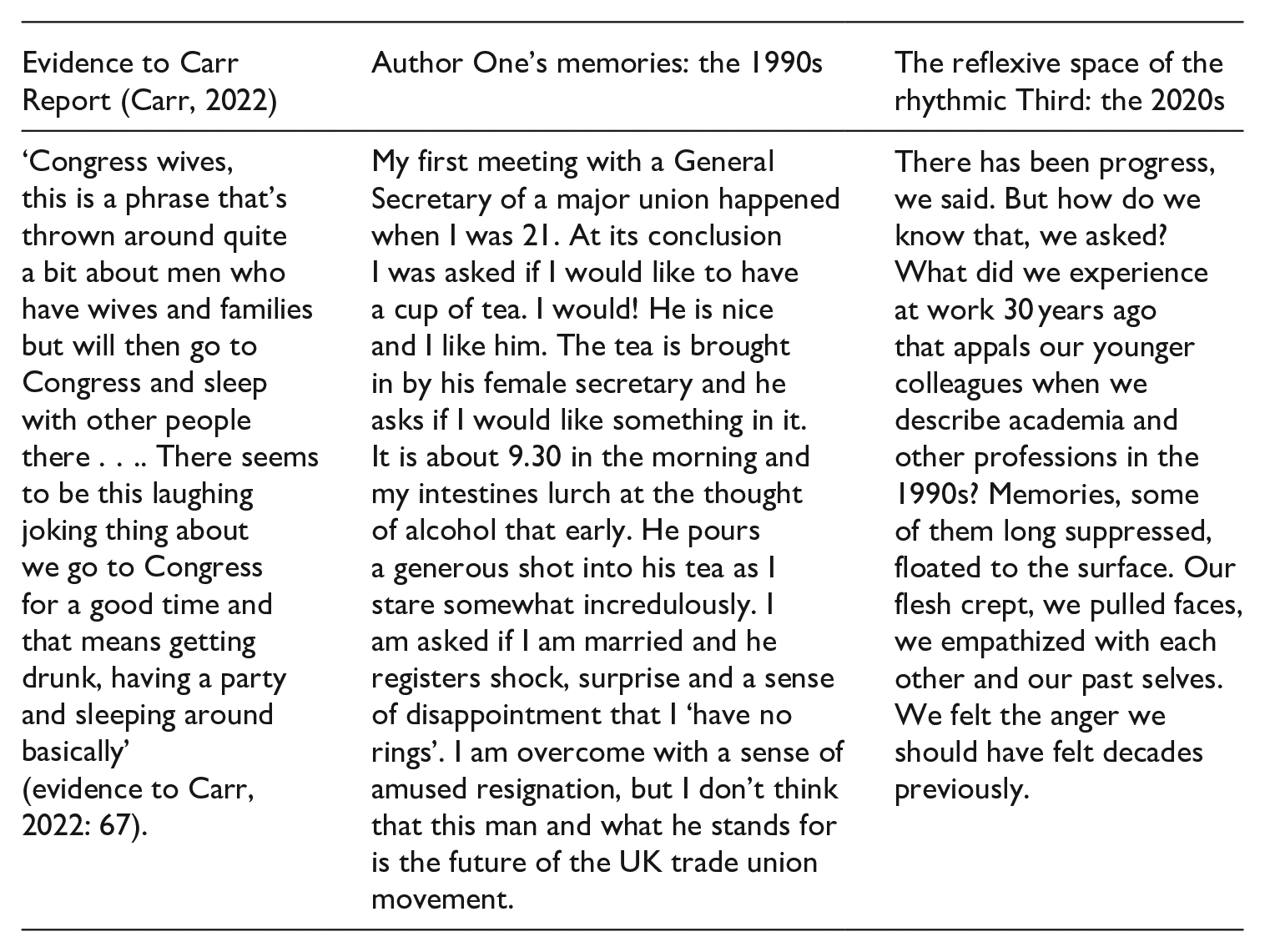
This illustration captures how time travel happens, through quantum leaps between pasts and present that collapse distinctions between then and now. Time does not exist, there is no past and present only ‘now’ in the unconscious (Freud, 1915). In the unconscious ‘the past’ is experienced as ‘the present’. The flesh, on the other hand, would appear to register the years that have been lived, particularly on the skin. But flesh also stores feeling states that can be evoked and re-experienced years later (Harding et al., 2022). Thus, distinctions between material flesh and immaterial psyche collapse when stimuli encourage stored feeling states to give up their contents and bring them to conscious attention and visceral experience. The anger evoked when she read the Monaghan Report plummeted Author One back into her younger self. Two selves and two epochs merged; memory became the present moment of experience. And now new feeling states (present-day anger) are laid down in the flesh and made available for analysis; this is what is meant by ‘visceral memories’.
In analysing this relived experience, we observe, first, the machismo of the 1990s workplace into which women were then only slowly entering and their (our) struggle for recognition. Author One recalls that the meeting appears to go well: ‘He is nice and I like him.’ The offer of a cup of tea, symbolizing a certain amount of care and consideration, seems the natural end to a satisfactory first meeting. However, the question about adding ‘something’ (alcohol) to the tea changes the dynamic. Alcohol transforms an innocent cup of tea into something else: it is an intruder into the normal day-time routines. Matter out of place, it possesses agency through its phallic symbolism (the entry of the ‘masculine’ alcohol into the ‘feminine’ tea). The meeting shifts from a professional interaction to an encounter in which an older, more powerful male seeks to flirt with a younger, female professional. His offer rebuffed, he places her in the supposedly inferior position of ‘the woman’ who has ‘failed’ to get married. He refuses to recognize, to bestow on her, the identity of the professional employee with legitimate rights to occupy organizational space.
Recognition, in Benjamin’s (2018: 2) definition, is ‘the basic element of building blocks of relationships’. It has two aspects: ‘a psychic position in which we know the other’s mind as an equal source of intention and agency, affecting and being affected’ (Benjamin, 2018: 3) and a process of ‘responsiveness in action’ (Benjamin, 2018: 3). What is essential is that each knows the other not as an object to be controlled or resisted but as another mind with which connection can be made. That is, recognition involves ‘experiencing the other as a responsive agent who can reciprocate that desire for recognition versus an object of need or drive to be managed within our own mental web’ (Benjamin, 2018: 3). Recognition ultimately fails in this encounter because one party recognizes the other only as an object lacking subjectivity. This destructive position negates the self of the person reduced to the status of object.
This vignette’s play of recognition has two Acts. The first dramatizes the possibility of mutual recognition (‘he is nice’) that is necessary for self-hood. Benjamin warns that all encounters bring with them the potential for relationships of domination and subordination, and the offer of alcohol in the tea shifts the dynamics and takes us to the second Act. Alcohol brings with it a gendered charge that changes the encounter’s dynamics from mutuality to domination/subordination, from Twoness (doer and done to), perhaps even the Third, to One-ness: the egotistical western subject for whom the other is an object existing to satisfy its (his) desire. Benjamin’s (1988) study of domination and control in Bonds of Love facilitates understanding of how the senior official’s conscious wish, that may or may not have been sexual, is informed by an unconscious desire to control and subordinate the other and so secure assurance of his own self. This domination is evident in the freedom he gives himself to ask Author One intrusive, personal questions: is she the property of another man? He refuses her that recognition through which she would know herself as an autonomous, independent subject rightfully occupying organizational space. As Benjamin (1988: 75) explains, this encounter of a powerful senior male and seemingly helpless subordinate female replicates the position of the young child who relates to the caregiver as an object of its drives, thus negating the caregiver’s independent subjectivity: caregivers exist only to fulfil the needs of the self. The senior official here replays that familiar childhood scene.
But the younger Author One refuses to concede recognition to this man who would treat her as object. This takes us to the third Act in this theatre of recognition. Here, if the childhood drama were to be relived, she would accept her lack of subjectivity, would offer recognition without expecting it in return and would thus be denied self-hood. She, however, refuses to recognize the other as either man or professional (she separates him from his senior role). She resists his flirting and viscerally records her rejection of the position in which he tried to place her (her intestines lurch). In the absence of that mutuality of recognition, an unequal complementarity should be perpetuated in which one plays the dominator and the other the dominated (Benjamin, 1988). This does not happen here. Author One does not reverse the gender roles (Benjamin, 1988: 81), and there is no sense that each is ‘playing the other’ (Benjamin, 1988: 81- emphasis added). Rather, ‘overcome with a sense of amused resignation’, she engages in a silent refusal to perpetuate this drama. She communicates her refusal viscerally: an incredulous look and lurching intestines. Although silenced she is not subordinated. Her agency lies in leaving this meeting and in refusing to allocate recognition to the other as a leader. It is not only that the relational space of the Third – of shared, responsible living through mutual recognition, acknowledgement and independence – is unachievable here; the parties are also stuck in the negative space of Twoness, of doer and being done to, until she departs, leaving the other in the deluded space of One-ness. Resistance lay in leaving the scene of diminution.
In summary, if personal histories are like the grains of sand in which are encompassed entire histories, and indeed studies suggest the value of individual histories in encapsulating larger wholes (Kuhn, 1995), then this first vignette suggests one reason for the Act’s slow implementation. It may have instigated a change in culture but, by definition, preceded that change in culture. Women entered male space, were treated badly, suppressed their anger and left the building. They did, however, resist – thus setting in train an accumulating series of changes, as our next vignette illustrates: women refused to submit to the status of object and survived in public spaces through what we call ‘strategies of everyday resistance’.
Undermining the phallus
This second vignette starts to map everyday strategies of resistance.
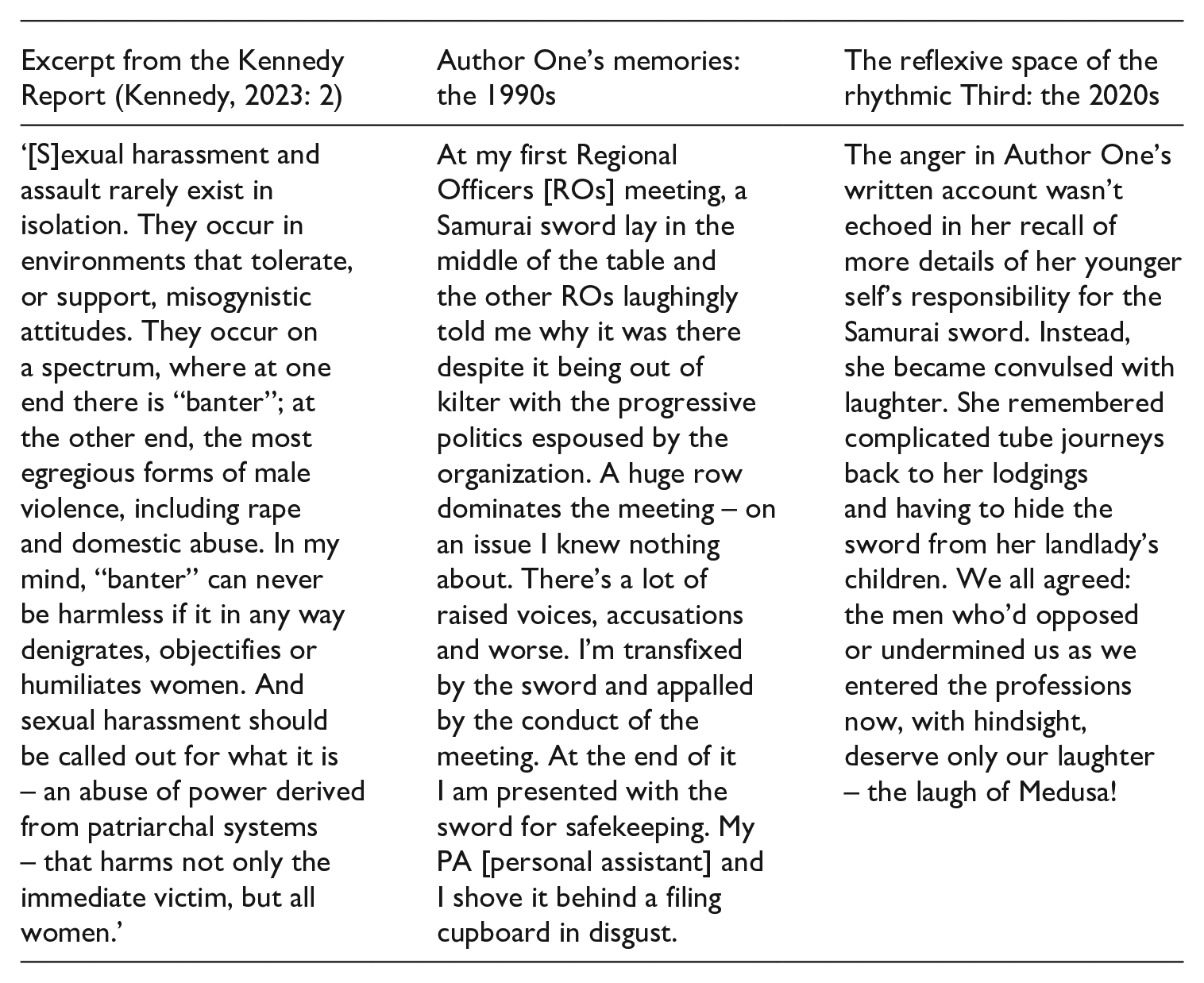
We return to the 1990s. Author One is a new employee in the Union. Psychoanalytical theory first directs attention to the phallic symbolism of the sword and its implied threat of violence in a meeting that teeters on hostility. While noise rages around her, she is transfixed by its presence. Conscious, rational reasons were given to her for its positioning, but it is the unconscious reasons that are pertinent to our analysis. Sitting there as an object that symbolizes masculinity, its phallic power appears to liberate those within its immediate ambit from the normal rules of polite organizational discourse. Second, it contradicts the Union’s espoused ‘progressive politics’, with the ‘huge row’ rendering those politics meaningless: in this room progressive politics are not allowed. The ‘object’ that symbolizes those politics is indeed the younger Author One, one of two women present. Note how she is banished to the meeting’s periphery, excluded from the battle, unable to take part in it. The sword communicates the message that her role is not to become an agentive participant in union business but instead a witness to a masculine battle for its dominance. Only when others have left can she regain agency through the symbolic act of working together with another woman to hide the sword.
Several acts of recognition circulate in that room. The first concerns Author One’s introduction to the Samurai sword and the reasons for its placement on the table. Fellow union officials appear to engage her in an act of mutual recognition: through being inducted into the history of the Union’s ownership of the sword, she is accorded the status of a member of that society of men. Except, of course, that this induction is done ‘laughingly’, with a humour in which the young Author One cannot share, so the apparent mutuality of this scene of recognition is undermined. Thereafter, ‘transfixed’ by the sword, the scene of recognition shifts to that encounter between her younger self and the sword. It holds her in its gaze, according her the status of an unwelcome intruder into that masculine culture that it symbolizes. Her identity is thus negated in this space.
Another scene of recognition in this space is that between the men engaged in fierce argumentation. Here, Benjamin (1988) leads us to suggest, the female’s role involves according recognition of their masculinity to the gathered men, that is, of their capacity for dominance, control, a battle for superiority and the perpetuation of the position of Twoness. Her function is to witness that masculine other’s struggle for male-to-male recognition. She herself is denied recognition as anything other than a subordinate. That is, when allowed into masculine space, the woman is allocated the role of bearing witness to and recognition of men’s masculinity. She is excluded from the circle of recognition of fellow professional officers: her presence is tolerated only insofar as she conforms with a traditional female role.
Thirty years later, something quite different emerged as Author One explored her account with her two co-researchers. She recalled further details of her younger self’s responsibility for the Samurai sword. Her account was funny; we all three laughed. In this space of the Third, of mutual recognition, what had been discomfiting 30 years earlier was transmogrified into shared enjoyment. Humour is reminiscent of that play that is fundamental to Benjamin’s psychoanalytical theory. Play, she writes, drawing upon Winnicott’s work, uses fantasy and metaphor to assist the emergence of articulated emotions (Benjamin, 2018). She directs us to explore objects as ‘characters’. In the ‘music of the rhythmic Third’ that we created through our close attention to each other’s thoughts, the sword becomes another character on our reflexive stage, taking its place in ‘the dance of thirdness’ (Benjamin, 2018: 164). The woman who had been transfixed by the sword becomes a ‘not-me’; in her place is one who laughs at the phallus, showing it has no agency. The anger we expressed when remembering the treatment we received when we first infiltrated into male space was replaced by a laughter that suggests oppression is overcome. Author One and her PA had refused to recognize the power of the phallus when they pushed the sword behind a cupboard. It remained there, she recalled, until rediscovered during an office move, after which it was disposed of. That is, her act of negating the power of the phallus (hiding it behind a cupboard) was a feminist micro-revolution (Parsons and Priola, 2012); our laughter, 30 years later, expressed our delight in its nullification. What this small act of assertion of agency comes to represent is the knowledge we have, with hindsight, of how women enlarged their space in the public realm; in the spaces women came to share with each other, we enacted numerous accumulative micro-resistances.
That is, in noting how different Author One’s memories are across time, how the sword was defanged, as it were, in our encounter in the Third, we replicated in that space of the Third activities that, only with hindsight, we recognized as feminist micro-revolutions through acts of everyday resistance. Those acts are written on our bodies and inscribed in our psyches, where is recorded a rejection of phallic power. Over 50 years many tiny acts accumulate, becoming feminist micro-revolutions that bring about change, albeit slowly, slowly. The next vignette illuminates these ‘strategies of everyday resistance’, a phrase Author One used when reflecting back on her former work to develop an equal opportunities strategy.
Strategies of everyday resistance
This vignette encapsulates the means by which women secured places in organizations through micro-revolutions that accumulate over time, although painfully slowly.
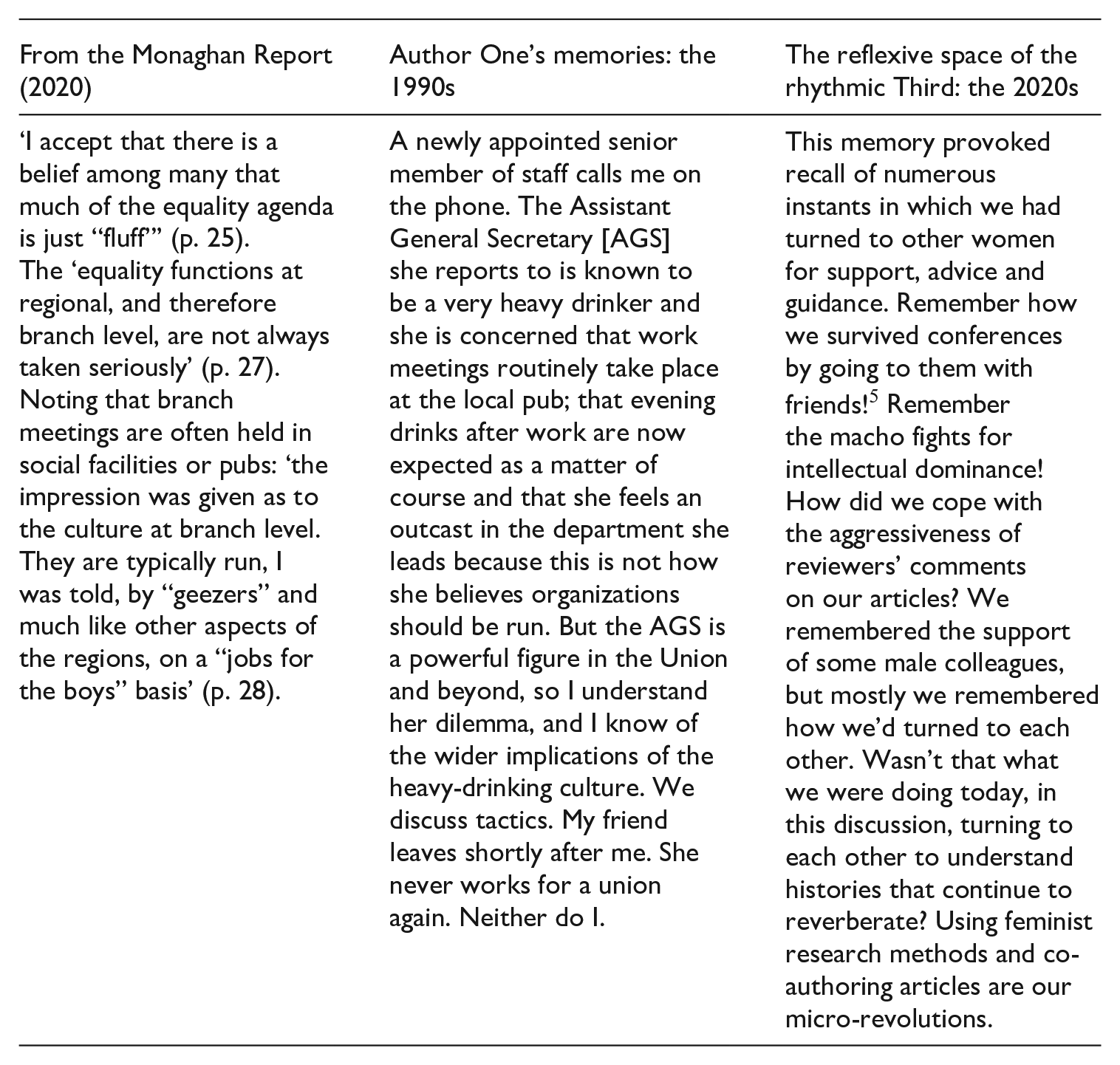
At first sight the younger Author One and her friend’s departure to work for other organizations suggests defeat: in a masculine drinking culture they are not recognized, have no self-hood. Negated, the two women must leave if they are to survive as human beings. Male colleagues, like the master in Hegel’s master/servant dialectic, did not appear to need recognition from female colleagues, only from each other, so had no need to strive to retain them as colleagues.
However, that vignette encapsulates an act of recognition: that between two female friends who can reach out to each other for support and advice. They are ‘like subjects’ who, although necessarily different from each other, can achieve a ‘tension of difference’, and thereby combine this difference with empathy, support and mutual recognition. The process in which they engage is ‘the essence of responsiveness in interaction’ (Benjamin, 2018: 3); that is, they confirm that they know each other as individuals and that: . . . my intentions have been understood, I have had an impact on you, that I see and know you, I understand your intentions, your actions affect and matter to me. Further we share feelings, reflect each other’s knowing so we have shared awareness. (Benjamin, 2018: 4)
They thus offer each other ‘an invitation to face reality together’ (Benjamin, 2011: 29).
Here, that ‘facing reality together’ involves, in the short term, a strategy to help one actor in this scene of recognition find a way of surviving in a culture she cannot change. In that culture, the behaviours she complained of were not acknowledged to be problematic and thus could not be pursued via the organization’s grievance procedures. Where formal procedures failed, an informal micro-revolution within a strategy of everyday resistance succeeded. It involved circumvention of organizational norms through small acts of a type with which many women of that generation and since will be familiar. That is, women work together to ensure their survival, in ways that are hidden from the dominant other. These acts of everyday resistance may not be framed as a political act (Lilja and Vinthagen, 2018) but they accumulate over time with powerful effect.
In other words, this vignette points towards how women, denigrated on their entry to masculine public space (the position of Twoness), turned to other women with whom they shared the pain of being denied recognition and developed a shared space of mutual recognition and self-assertion (the Third). They/we found recognition in the product of the Third: a friendship that was nurtured and worked on. The two women leave the organization to work elsewhere, having, our analysis suggests, found ways of circumventing aggressions and thus surviving in environments in which they were refused recognition, denied rights to occupy organizational offices and their existence and potential for subjecthood nullified and negated. ‘Ha ha’, they might have said, ‘we refuse your nullification and your denial of our existence: we will survive and thrive’.
Thirty years later, we recognized and honoured three decades of micro-revolutions involving everyday strategies of resistance. Reflecting in that reflexive stage of the Third, we realized we enacted in our work on this article the very things we tracked through one person’s life history: rather than the agonistic struggle for recognition described in Benjamin’s thesis of One-ness and Twoness, there was a mutual seeking of shared, responsible living together, through acknowledgement and mutual recognition in the Third.
We now have answers to the questions of what has impeded the full achievement of the SDA (1975) and what has facilitated such changes as have been achieved.
Discussion
The 50 years since the UK passed the SDA (1975) have seen radical changes in many workplaces as women have gained entry to management, the professions and other organizational spaces that, in 1975, were the sole domain of men. In the meantime, the very notions of ‘sex’ and ‘gender’ have been destabilized, with their division into two distinct categories under persistent challenge. However, progress has been slow, and women still lag behind men in many aspects of work and employment. There has been a stream of research lamenting the continuation of gross gendered inequalities (e.g. Cera and Klinenberg, 2024; Hing et al., 2023; Ridgeway, 2011), and three recent reports (Carr, 2022; Kennedy, 2023; Monaghan, 2020) revealed the continuation of misogynistic practices in organizations whose very raison d’etre is the achievement of workers’ rights. Achieving parity in employment appears to be not only problematic but insoluble. If it has not been achieved after half a century of striving, can it ever be achieved? To answer this question our study turned the question of ‘why is progress so slow?’ on its head and asked: ‘what has facilitated the limited but nevertheless invaluable changes in women’s working lives in that half-century?’
Women’s entry in large numbers into previously male-dominated organizational space required achieving recognition as rightful, legitimate co-occupants of that space. Without such recognition they/we could not exist in organizational space except as abject subjects. Our study employed feminist approaches, both in its theoretical location in Jessica Benjamin’s recognition theory, and its methodology in the emergent feminist movement of researching differently and in FMS. We show that advances in women’s place in organizations have been achieved, at least in part, through women’s engagement in micro-revolutionary acts in which they circumvented masculine hostility and resistance to their presence. They/we evolved practices of resistant recognition, that is, the enactment of strategies of everyday resistance against (masculine) mis-recognition through turning towards each other for (feminine) recognition. We next expand upon these findings to develop (1) a theory of women’s agency as quiet revolutionaries, and (2) a contribution to feminist theories of resistance through the concept of resistant recognition. Finally, we contribute to scholarly debates within MOS to researching differently.
In Benjamin’s terms, women entering male-dominated domains entered the space of Twoness, of doer and done to, where their role was limited to conferring recognition upon male occupants. Women needed to escape from that destructive dance of recognition and did this through finding agency as quiet revolutionaries. They evolved tactical acts of everyday resistance to both survive and to undermine repressive domination in contexts where rebellion or more open forms of voice were too risky (Scott, 1985). Women developed a repertoire of tactics through contextual and situationally bound combinations of everyday resistance (Tilly, 1995). Although lacking formal organization, these tactics are political and are a direct response to the configurations of workplace sexism and misogyny witnessed in the vignettes. That is, they grow out of the particular circumstances of the social place and life experiences of those that do the resisting (Johansson and Vinthagen, 2016). The methods used were familiar, ‘to hand’ and could be deployed with ease, and were also ‘quiet’, covert and only enacted or shared with trusted others. As noted by Rosales and Langhout (2020), it is not always easy to rebel or speak openly when one’s existence within the workplace is viewed as ‘other’, but strategies of everyday resistance facilitated forms of pushing back where direct action is not an option. It also provided a breathing space for those who felt suffocated by the toxicity of oppression facing them (Vinthagen and Johansson, 2013).
That is, where overwhelming power seemed to make it impossible to take action, where those with overt power denied recognition, small acts involving circumventions of those with power, acts undertaken outside their ambit, where women-recognized-women, bring small successes that accumulate over time into bigger changes.
Critics might argue that although everyday acts of resistance are tactical, may ensure survival and make it possible for women to remain in organizational space, they do not facilitate their being there as of right, and thus are antipathetic to flourishing. That is, they are not transformational and are little more than ‘decaf’ resistance (Contu, 2008); something compromised and redolent of stalemate (Mumby, 2005). They do not result in mutual recognition between dominant male occupants and women regarded as intruders into ‘their’ space. That critique, in Benjamin’s (2018: 215) terms, would understand that everyday acts of resistance conform with the notion of ‘only one can live’, that is, the extreme form of the western liberal individualist. Its final consequence is the splitting of Twoness; that is, people are driven apart until everyone is left to their own devices, at which point recognition becomes tentative: it stumbles and there is no self.
But strategies of everyday resistance are not solo endeavours: women work with other women and latterly more forward-looking male colleagues. They/we undermined a seemingly unshiftable masculine dominance and carved out organizational spaces for sharing as equals with all other colleagues. In Benjamin’s terms, they/we unwittingly and without planning (these strategies were emergent, in the necessity of the moment) enacted a physical critique of masculine, patriarchal traditions and undertook a radical turn away from a conceptual, logocentric orientation towards an embodied, material one.
What is important to emphasize is that small acts of everyday resistance can accumulate over time into revolutionary change (Lilja et al., 2017). The full force of the revolutionary changes anticipated in the SDA (1975) and its successors, that is equality between male and female in the workplace, may not yet be visible or experienced by all, but the changes in women’s working lives and their occupation of organizational space cannot be gainsaid: those small acts of resistance have, over time, expanded the organizational spaces for legitimate occupation by women.
But if we draw further on Benjamin to peer into the spaces carved out through everyday strategies of resistance, where women-recognized-women, we see in them the space of the Third, of mutual recognition. Here, participants are not silenced and do not have to circumvent everyday working arrangements in order to survive. Here, there is an ability to speak out about violation of acceptable patterns of interaction; what was tolerated 50 and even 25 years ago is no longer accepted. Latterly, male colleagues who are at ease with the dance of recognition with female colleagues have entered this space.
Thus, everyday acts of resistance, although slow to bring about change, prove somewhat revolutionary in the long term, although there is much more still to do. Benjamin, indeed, encourages an addition to the list of ‘things to be achieved’. The revolution we are charting should not aim solely at equality and diversity, but at a cultural change in which organizational space is co-created through relationships that recognize conflict and dissent and whose occupants seek to generate reciprocal contributions, understanding and generativity, in which wrongdoing is acknowledged and space for reparations made available. Palpably those spaces are as yet few and far between, and even those of us who strive to position ourselves in the moral Third may fall back at many points, and perhaps only succeed occasionally; we are only part-way through a revolution in which shifting from Twoness to the moral Third is itself a form of resistance, against the ego, against doer and done to, against the selfishness of western liberalism. But where Author One and her contemporaries had to circumvent masculine power-play, perhaps their/our daughters and grand-daughters can be more courageous and empathetic, and thus move more permanently into the space of the moral Third. That is, the revolution undertaken by quiet revolutionaries is ongoing.
We turn now to resistant recognition, by which we mean a demand for recognition made by those who occupy a seemingly subordinate or inferior position but who refuse to be recognized as inferior or subordinate. That women refuse (and continue to refuse) to be recognized as illegitimate intruders in masculine organizational space is the core of resistant recognition: I refuse to be(come) that identity you wish to impose upon me; I will not be negated by you, no matter how powerful you seem to be. To expand upon resistant recognition, we peer into one final act of resistance that forms the epilogue to what has gone before. In so doing, we break a rule of article-writing: we add new ‘data’ in the Discussion. This, too, is a tiny act of resistance.
Here is Author One’s final memory of her work in the Union: I worked with a range of women’s groups over a 10-year period delivering training and development sessions at local, regional and national levels. When I left, I distributed all my teaching/learning resources to every region, the national offices and to appropriate colleagues in the service conditions departments I had worked with to promote women’s inclusion and leadership. That I had to do this discreetly said something as to how unpopular this action would’ve been had it been known. But why if we were genuine about our mission to change? As my leaving day loomed, I gradually removed all the work I’d done and replaced my work with blank sheets of paper in the hanging folders where we stored our resources. On my final day, only blank, white sheets of paper remained.
When we met in 2023 to discuss what this meant, Author One said that in giving the materials to colleagues with whom she felt connected and by whom she was recognized, she was not only making a gift that in some ways repaired the damage of her leaving, she was also ensuring the continuation of the hard work that she and others had put into trying to bring the Union’s strategy on equalities into practice. Those blank sheets of paper therefore contain a message to those in the organization who would wish to continue to frustrate women’s entry as equals: they say ‘do not look here for evidence of strategies you have no intention of implementing: those strategies are underway, elsewhere, out of your sight and away from your power to frustrate or destroy them’. The white blankness of the sheets therefore is not a surrender (there is no strategy left to pursue) but a radical statement of resistance. She took her knowledge and expertise to other organizations, and over time developed a repertoire of combinations of everyday resistance, which she shared with others (Tilly, 1995) so the slow process of revolution from within, or micro-changes that undermine the habits of centuries and bring about a new order, spread. This is what we mean by resistant recognition: it is a refusal to be recognized by a dominant other and a determination to seek recognition elsewhere, through little acts of cunning, small feats of endurance. The SDA (1975) opened the door that allowed women to enter management and the professions, and once through that door they/we used subterfuge – micro-practices or micro-emancipation projects (Thomas and Davies, 2005) – and each other’s support not only to ensure they/we were not forced out again but also, as Benjamin advises, for engagement in the creation of less oppressive, destructive workplaces.
That is, resistant recognition, in Benjamin’s terms, marks a move into the moral Third where, stirred by an empathy that challenges the rationality of traditional workplaces (Benjamin, 2018: 227), participants recognize the moral dimension of work. They develop relationships governed by ‘human dignity’ and the value of human life overall (Benjamin, 2018: 51). This is a moral world, a relational matrix in which there is a shared commitment to [attempt to] put right what is wrong; of adjustment and accommodation to ensure violations are corrected. Injury is acknowledged; its sorrows shared. This is a moral stance in which witnesses to injury are called, and those who have been silenced or marginalized enabled to speak up. Benjamin (2021: 410) argues that through such collective togetherness the fear of being annihilated that spurs a need for self-protection is replaced by a transformation of fear into compassion, and grief into care (Benjamin, 2021: 410).
Thus, resistant recognition is concerned not only with demanding to be recognized on one’s own terms, but also with a demand of recognition of different ways of being and acting in organizations. Although demands for equality in careers, for pay distributed fairly, for child and elder care, are important, these demands should be accompanied by resistance to being reduced to simulacra of the men who have dominated organizations since the Industrial Revolution. Fairness, equality and so on are not concerned solely with ‘levelling the playing field’, or with instrumental demands, but with something more valuable: for a complete rethinking of what ‘work’ means and how its benefits should be shared. The accumulation of small acts over time that are bringing about a form of revolution (the welcome presence of women in organizational worlds) also presage something more profound. Those acts of everyday resistance may have had only an inarticulate line of vision, and intent and victory was not assumed or guaranteed (Fine et al., 2014: 59). It may have been a pragmatic feminist politics in which there was little possibility of direct and overt revolution against a gargantuan Hydra whose many misogynistic desires have been nourished through millennia of misogyny. But it proudly encompasses a demand for dignity and action, a revolution that incorporates demands for new cultures of work.
Finally, we return to the practice of researching differently enacted in this study. Management scholars work in the shadow of US hegemony over how MOS research should be practised: it preaches the need for scientistic methods that emphasize objectivity, statistical measurement and conformity (McLaren, 2019). Researching differently invokes strategies of everyday resistance against such scientism, seeking, just as writing differently has attempted, to throw off the straitjacket of rules that inhibit knowledge and understanding (Phillips et al., 2014). Where journals require ever-increasing numbers of participants if qualitative studies are to be regarded as valid, researching differently emphasizes the depth of insight to be gathered using small numbers, sometimes, as in this study, just one person. The approach is deliberately political: earlier feminists’ mantra, that the personal is political, governs researching differently. It seeks to learn from subjective experience – the subjective is political. Researching differently involves recognition: critical academics recognizing each other’s striving for different ways of generating knowledge (and thus we thank the reviewers of this article for their insights, tolerance and encouragement). Each study that researches differently is a micro-revolution that challenges scientism’s hegemony.
Conclusion
This article is a study carried out by three women who lived through and thus experienced the workplaces that were slowly opening up to women towards the end of the 20th century. We use anecdotes from those years when much of our experience of overt and casual sexism seems hardly believable now not only to students but also to our younger colleagues. That, in some ways, is testament to a cultural shift anticipated in the SDA (1975). It helped our entrance into organizations, but it was women themselves who found ways of ensuring they could stay and survive. We hope that the pace of that accumulation of micro-revolutions will now speed up and that the changes anticipated in the Act can finally reach fruition.
In conclusion, this article’s main contribution is a cautious celebration of the 50th anniversary of the passing of the Sex Discrimination Act (1975). It contributes to feminist debates in this journal as the article is, in itself, a case study of the success of that Act. That is, it celebrates feminist theory, here the work of a little-utilized feminist theorist, Jessica Benjamin, and feminist methodologies of researching differently that resist scientism. This would not have been possible if women were still excluded from academia and their/our voices silenced or negated. That exclusion and silencing were challenged by the Act that facilitated women’s entry into the professions, in our example the academic profession. The article’s substantive contribution is a theory of how the Act has been translated into practice, through small, tactical acts of everyday resistance that cumulate over time into revolutionary changes that are still ongoing.
However, there are other Acts whose progress is halting: is there useful material here and can the lessons we have garnered in this study be generalized and applied? We can only wonder if the micro-revolutions we have described, of strategic acts of everyday resistance, would be available to those who do not share the privileges of whiteness, or heterosexuality, or the benefits that come from being born in the Global North. We, inevitably, need more research. This study drops one small pebble into vast ponds of inequalities. Today, as we personally fight against the invisibilization that comes with being ‘older women’, we hope to have shown the value of unearthing the hidden agency that comes from below, and how its micro-revolutions can, if harnessed, bring about bigger and faster and more beneficial changes to defeat the barbarism of inequalities.
Footnotes
Acknowledgements
The authors would like to thank the Associate Editor and reviewers for their invaluable critiques and comments.
Funding
The authors received no financial support for the research, authorship and/or publication of this article.
