



Abstract
Working from home has been discussed in terms of reconciling work and family life and reducing gender gaps in the labour market. However, its implications for wages remain the subject of debate, with some researchers arguing that flexibility stigma disproportionately disadvantages certain groups, particularly mothers. This article uses data from Understanding Society, the UK Household Longitudinal Study, to investigate whether working from home has different consequences for individual wages according to gender and parental status. Inverse probability weighted fixed-effects regression models are used with a sample of up to 8552 employees. The results suggest that working from home is associated with higher earnings for mothers, suggesting that the benefits of flexible working arrangements may outweigh potential disadvantages.
Introduction
During the COVID-19 pandemic, working from home (WFH) received considerable attention as many transitioned from office environments to home setups. However, WFH had already been a topic of debate among scholars and politicians before the global pandemic, particularly regarding its impact on gender inequalities in the labour market and the reconciliation between work and family life (Chung and van der Lippe, 2020; Felstead, 2022). Despite this, the question of how WFH relates to careers and earnings in a gendered way remains uncertain due to conflicting theories and inconclusive evidence.
Some scholars are concerned that WFH may hinder career advancement and earnings growth, especially for mothers, due to flexibility stigma. They argue that remote workers might be perceived as less productive or committed (Chung, 2020; Williams et al., 2013). Empirical research supports this view, showing that workers who WFH, particularly mothers, often face the negative perceptions of their employer and colleagues in terms of respectability, likeability and commitment, which they believe will damage their career prospects (Chung, 2020; Munsch, 2016). Furthermore, cross-sectional evidence looking at mothers in the US suggests that WFH is associated with wage penalties, particularly for those in high-level positions, which may be due to stigma in the workplace (Glass, 2004).
Other researchers argue that WFH could be positively related to employees’ earnings by increasing their productivity and commitment to work, thus improving their career opportunities (Golden and Eddleston, 2020). Cross-sectional studies, controlling for occupational and job characteristics, found that employees WFH earned more than other employees (Heywood et al., 2007; Weeden, 2005). The association between WFH and wages may be larger for mothers because they could benefit most from WFH productivity-wise due to childcare responsibilities (Weeden, 2005). According to longitudinal evidence from Germany, taking up WFH is correlated with increases in hours worked, monthly earnings and hourly wages for both mothers and fathers, with a stronger impact on mothers’ hours worked and monthly earnings, suggesting that WFH helps women to combine their care responsibilities with paid work (Arntz et al., 2022). However, longitudinal evidence on salaried workers from the US shows that WFH during regular working hours is not associated with weekly earnings while working overtime from home is related to a lesser increase in earnings than working overtime on site (Glass and Noonan, 2016). This suggests that if WFH is positively associated with higher productivity, this increase in performance may not be paid accordingly.
This article further explores the complex relationship between WFH and wages by examining the theoretical mechanisms behind possible wage penalties and premiums associated with WFH. It also seeks to contribute to the inconclusive empirical evidence on how this relationship varies by gender and parental status, using the UK Household Longitudinal Study (UKHLS). Notably, it is the first longitudinal study to examine the relationship between WFH and wages in the UK. By focusing on the UK context, where policy efforts have aimed to increase female labour market participation through flexible working arrangements, this study can provide some insight into how such policies may either mitigate or exacerbate gender inequalities in the labour market.
The main contribution of this article is that it attempts to model selection into WFH. Several factors, such as the feasibility of WFH in the current job and the willingness of employers, influence who can WFH. WFH is more common in office jobs than jobs in manufacturing or the service sector (Arntz et al., 2020). Research also indicates that those granted the opportunity to WFH are often highly educated, better paid and work in higher-level roles (Felstead et al., 2002; Golden, 2008). This study controls for these factors by modelling who is most likely to WFH using inverse probability weighting (IPW, for further details, see the section ‘Analytic strategy’). Using fixed-effects (FE) models also accounts for time-invariant unobserved factors (e.g. personality traits), improving cross-sectional research that can only control for observable variables. The study also advances previous longitudinal research by addressing selection on wage growth with fixed-effects individual slope (FEIS) models. This analytical approach contributes to the mixed findings in prior research revealing that WFH is associated with higher earnings for mothers, indicating that the benefits of the flexible working arrangement might outweigh the potential downsides.
Theoretical background
Two competing theoretical explanations appear in the literature that make sense of the possible consequences of WFH for employees’ wages. As described earlier, some scholars have discussed that employers could stigmatise WFH, potentially leading to career harm and diminished wage growth in the long run (Chung, 2020; Williams et al., 2013). In this article, a competing theoretical framework is considered – consisting of the work–life facilitation perspective and the gift-exchange model – emphasising that WFH can enhance productivity and job commitment, improving career prospects, and therefore might be associated with higher wages.
The flexibility stigma
WFH may have negative career consequences and relate negatively to wages due to employers’ and supervisors’ perceptions (Munsch, 2016; Williams et al., 2013). According to the theory of the flexibility stigma, workers who utilise flexible working arrangements may experience discrimination from managers and co-workers because they are seen as less productive or committed to their work (Chung, 2020; Williams et al., 2013). This perception arises because flexible workers deviate from ideal worker norms, which dictate that employees should demonstrate an unwavering commitment to their employers, be physically present in the workplace and have no other obligations that could interfere with their work. According to this theoretical framework, employees who adhere to these demands are more likely to advance in the organisational hierarchies of their workplace (Acker, 1990; Williams et al., 2013).
By making use of flexible work arrangements, such as the option to WFH, employees signal that they have other responsibilities that they need to attend to besides work. Employers may then judge the worker’s commitment to the organisation, potentially leading to them not being considered for raises or promotions (Munsch, 2016). Furthermore, employers and co-workers may perceive flexible workers as less productive and less beneficial to the company – believing that they create more work for others – which might also be penalised with regard to career opportunities and pay raises (Chung, 2020). These arguments lead to the following hypothesis:
H1: Adopting the practice of WFH is negatively associated with employees’ hourly wages.
In institutional contexts where traditional gender norms are still prevalent, such as in the UK, it is to be expected that women in general and mothers in particular are more likely to suffer career harm because of the flexibility stigma. Mothers are expected to do most of the domestic and care work and are therefore perceived as less willing or able to adhere to ideal worker norms in the first place. Employers may assume that mothers make use of flexible working arrangements such as WFH to prioritise family demands over work (Chung, 2020). Even when women choose to WFH to enhance their productivity, employers may still hold negative and discriminatory perceptions about their use of flexible working arrangements (Brescoll et al., 2013; Lott and Chung, 2016). All in all, there is reason to believe that a penalty in terms of career advancements and pay – due to the flexibility stigma – should be noticeable when looking at the wages of mothers, leading to the following hypothesis:
H1a: Adopting the practice of WFH has a stronger negative association with women’s hourly wages in general and with mothers’ wages in particular compared with those of male employees.
Work–life facilitation and the gift-exchange model
WFH could also be positively related to employees’ wages by positively influencing their productivity and commitment, consequently leading to job and career opportunities (Golden and Eddleston, 2020). From a work–life facilitation perspective, the productivity gains associated with WFH can be attributed to a reduction in absenteeism, stress, fatigue and distraction, as WFH eliminates time spent commuting and allows individuals to coordinate work and other life commitments more sustainably (Fuller and Hirsh, 2019; Gariety and Shaffer, 2007; Weeden, 2005).
While these productivity enhancements could benefit all workers, theory suggests that WFH should be especially favourable for mothers (Weeden, 2005). According to the time-availability perspective (Carlson et al., 2021; Stafford et al., 1977), specific role obligations limit an individual’s time for different tasks. WFH can provide the flexibility to allocate time for unpaid caregiving and housework. Parents who WFH should be able to adjust their work schedules to accommodate their family obligations as needed (Chung and van der Horst, 2018), which allows them to dedicate more time and effort to their paid work, ultimately increasing their productivity (Brown Johnson and Provan, 1995). While fathers are often seen as the primary breadwinners, with lesser caregiving responsibilities, mothers are expected to prioritise family over work. Therefore, mothers stand to benefit more from the productivity advantages of WFH (Weeden, 2005).
From the perspective of social exchange theory (Blau, 1964), employers offer flexible working arrangements to signal that they recognise employees’ family needs and want to create better working conditions (Lott and Abendroth, 2022). Following this, the gift-exchange model (de Menezes, 2013) assumes that employees may feel obligated to reciprocate the ‘gift’ of WFH, leading to an increased commitment to their employers in return (Chen and Fulmer, 2018; Lott, 2021). This increased commitment may result in a greater work effort (Kelliher and Anderson, 2010). As WFH could be especially beneficial for mothers, they might place more value on the ‘gift’ of WFH (Brown Johnson and Provan, 1995; Weeden, 2005), which could also be the case for childless women anticipating motherhood in the future.
In summary, adopting the practice of WFH could be related to employees’ productivity and job commitment, potentially leading to rewards such as raises and promotions, resulting in higher wages. These benefits of WFH might be particularly pronounced for mothers, as they have more to gain in terms of productivity and might also value the flexibility the most. Based on the arguments above, the following hypotheses are proposed:
H2: Adopting the practice of WFH is positively associated with employees’ hourly wages.
H2a: Adopting the practice of WFH has a stronger positive association with women’s wages in general and with mothers’ wages in particular, compared with male employees.
Some scholars argue, however, that WFH could negatively affect the performance of some employees by introducing distractions at home such as the needs of family members or other private commitments that interfere with work (Arntz et al., 2022; Gariety and Shaffer, 2007). According to work/family border theories, WFH could lead to more time-, strain-, and behaviour-related conflicts between paid work and personal life because of a lack of spatial and temporal boundaries when WFH (Clark, 2000; Kossek et al., 2006). Employees who work from home tend to have difficulty drawing boundaries between their work and their personal lives (Lott and Abendroth, 2022) and are therefore more likely to experience conflict between the sphere of paid work and the sphere of family or personal life (Boswell and Olson-Buchanan, 2007). Men are seen – and often see themselves – as the primary breadwinners, making it more likely that they favour their work over their family responsibilities when working flexibly, and increasing their time spent working overtime when WFH, which could benefit their careers (Chung and van der Horst, 2020; Lott, 2015). Mothers are expected to shoulder the bulk of family responsibility, which is why they might carry out even more domestic tasks when they work from home and experience more interruptions from family members, negating the positive effects of WFH mentioned above (Pabilonia and Vernon, 2022; Powell and Craig, 2015). This argument leads to the following hypothesis:
H2b: Adopting the practice of WFH has a stronger positive association with fathers’ wages compared with other employees and a weaker positive association with mothers’ wages compared with other employees.
The UK context
The institutional setting plays a role in determining the impact of flexible working arrangements on labour market outcomes by who is entitled to such arrangements and how these arrangements are designed (Chung and van der Horst, 2018; Lott, 2015). Traditionally, the UK is a liberal welfare state, with the male breadwinner model still dominating (Esping-Andersen, 1990; Lewis, 1992). In line with this, until the late 1990s, the reconciliation of family and work life was viewed as a private matter, whereas public support for families was weak. Since then, a few developments have taken place concerning work/family policies.
In the early 2000s, maternity leave was extended to 52 weeks. Mothers are eligible if they had worked for their employer continuously for at least 26 weeks. This type of maternity leave pays up to 90% of the average weekly earnings in the first 6 weeks of leave and after that up to GBP 184.03 for 33 weeks as of 2024 (Chung and van der Horst, 2018; GOV.uk, n.d.b). Furthermore, a shared parental leave scheme was introduced in 2015, allowing parents to share a maximum of 50 weeks’ leave if the mother does not wish to use her full entitlement to maternity leave. However, data from the 2019 Parental Rights Survey shows that only 5% of eligible fathers took up shared parental leave (Department for Business and Trade, 2023). Since 2000, free access to childcare and early education has been available for four-year-old children. Since 2005, this has been extended to include three-year-old children. Since 2024, parents can receive 30 hours of free childcare per week for 38 weeks of the year for children aged 3 to 4 years old and 15 hours of free childcare for children aged 9 months to 2 years old, subject to income and working hours (GOV.uk, n.d.a; MiSoC, 2023). Nevertheless, the cost of childcare in Britain is among the highest in the world and local authorities frequently report a lack of childcare and after-school programmes (Coleman et al., 2022).
Most notably regarding this article, the right to request flexible working arrangements was introduced in 2003, which allows certain employees to request a change to the number of hours they work, when they start or finish work, the days they work or where they work. As the policy was launched to improve ‘parental choice’ (Lewis et al., 2008: 272) and aimed to enhance women’s employment rate, only parents of children under six or disabled children under 18 were eligible at first. Since 2014, however, it has been available to employees – regardless of parental status – who have been in continuous employment with their current employer for the past 26 weeks (Chung, 2020; Lewis et al., 2008). In October 2022, a bill was introduced into the House of Commons to expand these rights further. It became law in July 2023, meaning that as of 2024 all employees can make two flexible working requests in a year, regardless of how long they have been with their employer, and that employers must respond to such a request within two months of its initiation.
While female labour market participation has been increasing for several decades, the female employment rate is still lower than that of males in the UK. In 2023, the employment rate for men was around 78.4%, while for women it was around 71.9% (ONS, 2024b). Female working hours have also increased, but women still work part-time more often than their male peers. At the beginning of 2024, 37% of female employees worked part-time, while only around 14% of male employees did so. Therefore, 72% of all part-time employees were female (ONS, 2024a). In addition, mothers in the UK are more likely to work part-time than childless women, while fathers are less likely to work part-time than men without children (Eurostat, 2022). Views on the division of labour within couples are rather traditional in the UK. For example, according to the British Social Attitude Survey, in 2018, 52% of all those surveyed thought that women should take most or all of the parental leave and only 34% thought the parents should divide the leave equally, while less than 1% thought fathers should take most or all of the parental leave (Jones et al., 2019).
In sum, even though some reforms have been made, policies and social attitudes still favour a (modified) male breadwinner model, which does not adequately support women’s labour-market participation, as reflected in the high numbers of women working part-time. This consequently influences who can and wants to work from home and how the flexible work arrangement could impact their careers.
Methods
Data and sample
The present study used data from the UKHLS (University of Essex, Institute for Social and Economic Research, 2023). The UKHLS includes 40,000 households in wave 1 (for details regarding the sampling and interview procedures, see Lynn, 2009). Only waves 2, 4, 6, 8 and 10 (2010/2011; 2012/2013; 2014/2015; 2016/2017; 2018/2019) were included in the analysis because they included information about the respondents’ WFH status and their wages.
As the theoretical considerations above relate to employees, the analysis was limited to individuals in paid employment, dropping self-employed individuals and individuals in training or education. All person-years following an employment gap were also dropped – as individuals might choose a job that enables WFH but pays less when they return to the labour market – which resulted in a sample of 36,735 individuals.
For the multivariate analysis, around 11% of the derived sample was excluded due to missing data through listwise deletion, leaving a sample of 32,748. Listwise deletion was chosen for simplicity and consistency across analyses, given the relatively low proportion of missing data. Nonetheless, it should be acknowledged that listwise deletion may introduce some bias when data are not missing completely at random (Allison, 2010).
Only people who were able to experience the treatment (taking up WFH) during the observation period were included (Brüderl and Ludwig, 2015), meaning people who started using WFH during the panel (treatment group) or not (control group). Therefore, all individuals already WFH in the first wave observed had to be excluded. The person-years of individuals after they ceased WFH were also dropped, as it cannot be assumed that taking up WFH and dropping out of WFH is associated with wages in a symmetrical way (Allison, 2019; Arntz et al., 2022). In addition, cases where individuals changed employers while already WFH were also dropped, as WFH should mainly be associated with earnings at the individual’s current job (Glass and Noonan, 2016). These restrictions resulted in a sample of 18,015 individuals with 58,640 person-years.
The longitudinal weights provided with the dataset were utilised as advised by the Main Survey User Guide of UKHLS (Institute for Social and Economic Research, 2024). Owing to weighting, individuals who missed a wave between interviews or entered the panel after the first wave were dropped, leaving an estimation sample of 8552 individuals (3613 males, 4939 females) with 28,917 person-years. The statistical models used (see below) assume different numbers of person-years are required for the calculation, which led to different sample sizes for the multivariate models so that ultimately 8552 (FE models) and 5653 (FEIS models) individuals were included in the analyses.
Measures
Outcome
For the dependent variable, the gross hourly wages of the individuals were calculated by using their usual gross pay per month in their current primary job divided by their actual weekly working hours (contractual hours + overtime hours) in their current primary job multiplied by 4.35, the average number of weeks in a month. For the analysis, the natural logarithm of the gross hourly earnings was used to deal with outliers and positive skewness in the wage data. Cases with a monthly pay of less than GBP 1.00 or contractual working hours of less than one were dropped, as these were most likely data errors, which skewed the wage data. Hourly wages are the standard measure when productivity returns are of interest. However, employees’ monthly salaries were specified as an alternative outcome variable in the robustness checks because most of the participants who WFH are salaried workers.
Treatment
Participants answered whether they had access to and made use of several flexible working arrangements. The variable measuring WFH used the wording: ‘to work from home on a regular basis’. Consequently, employees stating that WFH was unavailable to them were set to zero. People who had WFH available to them but were not using the arrangement were also set to zero, as the focus of this article lies in the actual use of a WFH arrangement. Therefore, only people stating that they did WFH were set to one.
Variables predicting selection into treatment
In the analysis described below, selection into WFH is modelled using the conditional probability of choosing or being assigned the treatment condition (using WFH), given a set of observed covariates that affect both selection into treatment and the outcome of interest (wages) (Thoemmes and Ong, 2016). In the following analysis, the probabilities were estimated using participants’ job characteristics, human capital variables and information on their family situation.
Participants’ job characteristics are included to model selection into treatment, as only certain jobs and employers enable WFH. The size of the company individuals work for was included, as was whether they are employed in the private sector. A dummy was included that measures whether a participant works in a managerial or professional occupation, as these are the occupations most likely to use WFH. Whether an individual works part-time (⩽ 35 hours) was also included, as these individuals may not have access to WFH as their employer has already granted them some flexibility. The individual’s travel time to and from a regular workplace or office was also included, as a longer commute might motivate employees to take up WFH. Region dummies were included, as WFH may be more common in some regions than others.
The work experience of the individual and its squared term was included as it can increase human capital and seniority, which could influence whether a person can WFH or not. 1 Participants’ highest qualification was included for similar reasons. In addition, the participant’s age in years and its squared term were also included, as younger employees might be more open to using flexible work arrangements.
Gender and parental status were included in the propensity score and interacted to represent gendered care responsibilities that might lead individuals to decide whether or not to work from home. In addition, participants’ relationship status was included, as individuals living with a partner negotiate their care and domestic responsibilities differently than, for example, single parents.
Control variable used in FE regression
Confounders (i.e. variables that affect both wages and whether participants WFH) are controlled for in the FE regressions described below. Owing to the panel structure of the data and the models used, all time-constant confounders are automatically controlled. Accordingly, only time-varying confounders need to be taken into account. Events in people’s job histories could theoretically influence their wages and their access to and adoption of WFH. Therefore, changes of employer before and at the time of adoption were controlled for because, during the hiring process, wages and whether or how employees can WFH are negotiated. For individuals changing employers after treatment, the observations following the change were dropped (141 observations).
In addition, all time-varying confounders used for the propensity score were also included in the FE regressions. Therefore, whether individuals worked part-time, as part-time workers may earn less than their full-time counterparts due to the ideal worker norms described above, was controlled for. The individual’s travel time to and from a regular workplace or office was also controlled for, as a longer commute could affect productivity and willingness to work longer, and thus indirectly affect wages. The individual’s work experience, measured in years, and its squared term were also included in the FE regression, as well as age and age squared. Dummies for the interview year were included in the models to control for period effects. WFH has become more common and feasible over the years, while societal changes have also affected wages.
Analytic strategy
The present analysis aimed to estimate if the use of WFH is associated with changes in an employee’s wages. The decision to use WFH is determined by the availability and feasibility of WFH at the employee’s job, the employer’s willingness to allow the employee access to WFH and the employee’s personal preference for WFH. As the treatment is not randomly assigned, differences between people who use WFH and those who do not could bias the estimates. Several measures were taken to reduce this bias.
Inverse probability weighting was implemented to model selection into treatment on observable variables, which involves assigning weights to each observation at each point in time based on the inverse probability of WFH given a set of observed covariates that affect both selection into treatment and the outcome of interest. The likelihood of WFH was estimated using logistic regression models including the covariates described in the section ‘Measures’ (full models are shown in supplemental Table A1). To counter the problem of large weights emerging, the weights were stabilised. After that they were used in the regression analysis described further below multiplied with the longitudinal weights provided in the dataset (summary statistics for stabilised weights are shown in Table A2). Essentially, individuals who had a low probability of receiving (or choosing) WFH but did receive it get more weight, and those who had a high likelihood of receiving WFH and did receive it get less weight. The goal is to estimate the association between WFH and wages as if WFH was randomly assigned (for details on IPW, see Thoemmes and Ong, 2016). However, because there are potentially unobserved confounders that could not be accounted for, the estimation could have been biased if only IPW was used.
Therefore, FE models were applied together with IPW to model how taking up WFH might influence an employee’s wages. The advantage of the FE approach is that all time-invariant confounders, such as personality traits, are accounted for even when they are not observed, making them more robust to omitted variable bias than, for example, pooled OLS or random effects models (for further details see Brüderl and Ludwig, 2015). FE models, however, only use within-variation, meaning that people with no variation in the treatment do not contribute to the effect estimation (Brüderl and Ludwig, 2015). A variant of the FE model was adopted that allows the observations to be weighted to implement IPW. These models also excluded all so-called singletons (i.e. clusters or individuals who were only observed once), as they can have a biasing effect on the estimation of standard errors (Correia, 2015).
Conventional FE models are based on the assumption of parallel trends in the treatment and control groups, meaning they assume that selection into WFH is independent of wage growth over time (Ludwig and Brüderl, 2018). However, if wage growth affects selection into WFH, the estimates from a conventional FE model are biased. For example, individuals with strong career orientations could already be on steeper wage trajectories than more family-oriented individuals. If employers were more likely to allow individuals with a strong career orientation to WFH, there would be a positive correlation between wages and WFH, but this would be due to a selection of career-oriented individuals with steeper wage trajectories into WFH. Therefore, FEIS models were used in addition to the conventional FE models, which are suitable for different trends between the treatment and control groups. They provide unbiased estimates, even if the slopes of the treatment and control groups differ systematically (for details refer to Rüttenauer and Ludwig, 2020).
As theory suggests gender-specific associations, WFH was interacted with a gender dummy to test whether the association differs between men and women. As the relationship between WFH and wages might not only be dependent on the employee’s gender, but also their parental status, a three-way interaction between WFH, gender and a dummy variable was employed, set to one, if participants were living with their child(ren) under 16 in one household.
The analyses were performed using Stata 17.0. Results of the multivariate analyses are presented as figures using the coefplot.ado by Jann (2014). Full regression tables can be found in section 2 of the supplemental material. The code to replicate the analysis can be obtained under the following link: https://osf.io/zaxcr/?view_only=10866a59b40549bbbaecbd0a75710176.
Results
Descriptives
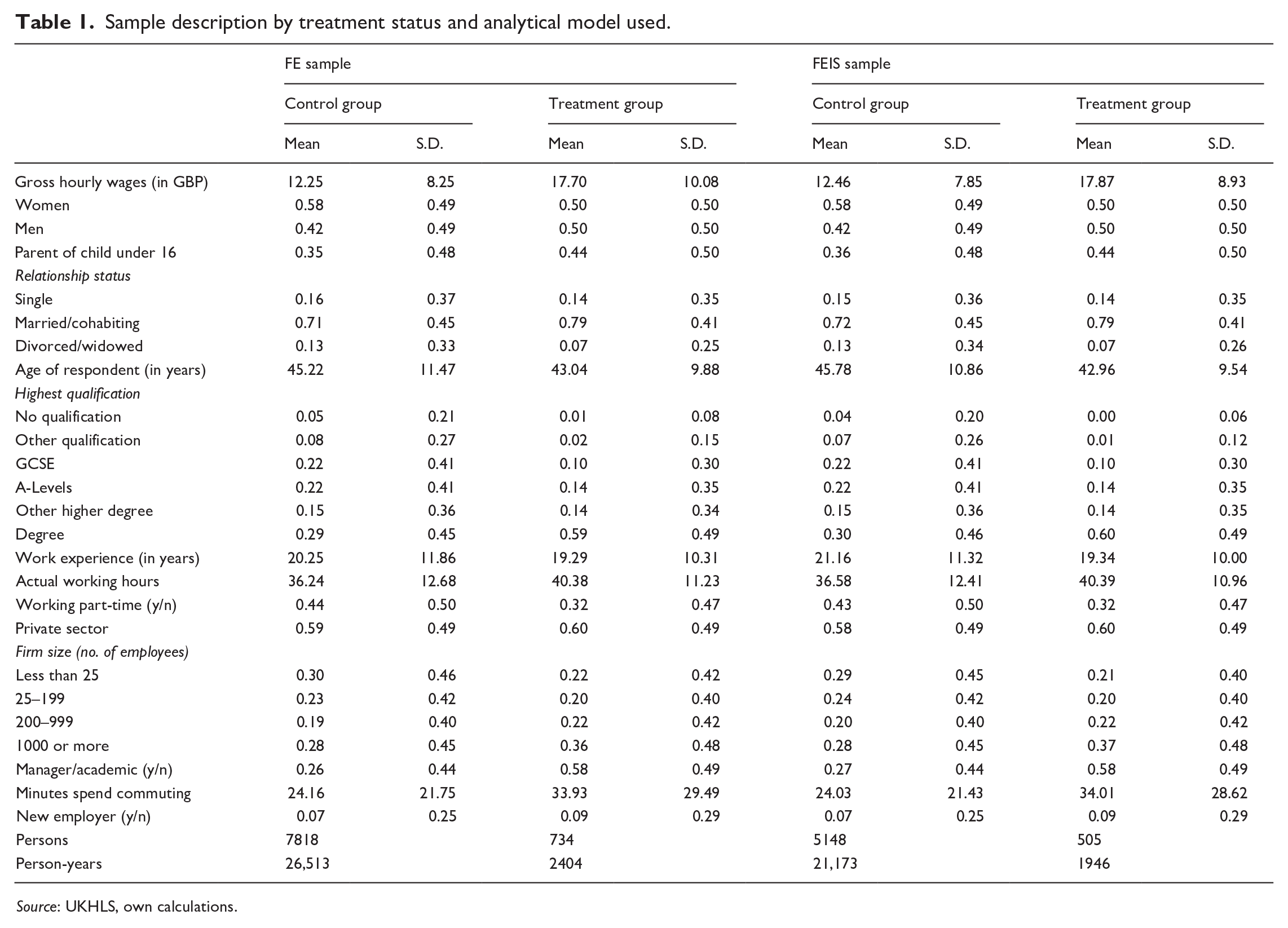
Table 1 presents the composition of the estimation samples by their treatment status. The treated group consists of every individual in the sample who starts to WFH during the observation period while the control group consists of individuals who never WFH during the observation period. In both the FE and the FEIS samples, only about 10% of the estimation sample starts to WFH during the observed period. This treatment group provides information about wages before and after starting to WFH, while the control group is included to accurately estimate the common influence of the age variable on the results (Brüderl and Ludwig, 2015).
Sample description by treatment status and analytical model used.
Source: UKHLS, own calculations.
There is a large overall wage difference between individuals in the treatment and the control groups. People who start WFH earn about GBP 5.4 more than people who never WFH. This observed wage differential may be partly due to differences in observed covariates. Individuals in the treatment group have a higher level of education, with around 60% having a university degree and 58% working in a managerial or academic profession. In addition, treated individuals work more often in larger companies, have longer commutes, are slightly younger and are more likely to be married. These mean differences in observables can be taken into account through IPW weighting and the use of control variables. However, there might still be unobserved confounders that explain the wage differences between the treated and untreated groups, which warrants the use of FE(IS) models.
Multivariate results
Overall effect
Figure 1 shows the FE and FEIS estimates of the overall association between taking up WFH and logged hourly wages (see Table A3 for the full regression models).
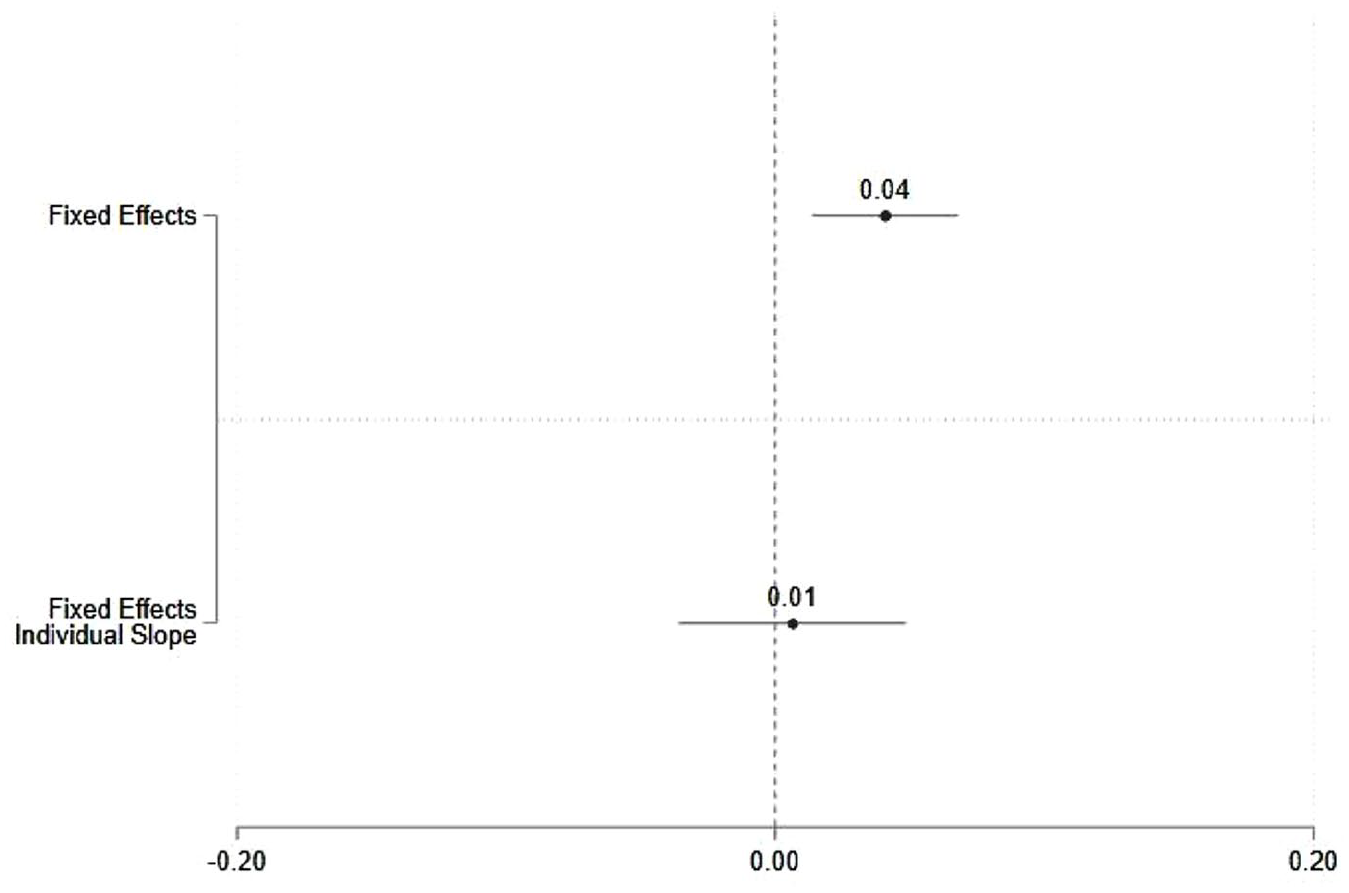
The overall association between WFH and logged gross hourly wages.
The FE model shows a positive and statistically significant association between taking up WFH and wages. According to this model, taking up WFH is associated with an increase in employees’ wages by around 4.2% (
The FEIS model, however, finds almost no association between WFH and wages (
In summary, the FE model suggests a positive relationship between WFH and gross hourly wages. However, this result appears to be biased by selection on wage growth, as the FEIS model shows that the association is minimal and not statistically significant. Consequently, these findings do not support H1 and provide only limited support for H2.
Gender differences
Figure 2 illustrates how the association between WFH and gross hourly wages differs by gender. Again, the estimates from the FE and the FEIS models are presented (see Table A4 for the full regression models).

The association between WFH and logged gross hourly wages by gender.
For women, there are positive associations between WFH and wages, regardless of the estimated model. According to the FE model, taking up WFH is associated with a statistically significant increase in women’s wages by around 6.3% (
For men, the FE model estimates a positive association (
In summary, there seem to be some gender differences in the effect of WFH over time, but they are small and not statistically significant. While selection on wage growth seems to be an issue when estimating the association between WFH and wages for men, it does not seem to play as big a role for women, as the results of the FE and FEIS models differ only slightly for women. The results suggest that WFH is associated with slightly higher wages for women, a result that offers some support for H2a.
Differences based on parental status
Figure 3 shows the association between opting to WFH and logged hourly wages by gender and parental status in both the FE and FEIS models (see Table A5 for the full regression models).

The association between WFH and logged gross hourly wages by gender and parental status.
The FE model suggests a positive association between WFH and wages that is statistically significant for childless women (
While the FE model essentially suggests no association between WFH and wages for fathers (
These results do not offer support either for H1a, which states that mothers would be expected to especially suffer in terms of their wages, or for H2b, which states that fathers would be expected to benefit the most from WFH in terms of their wages. They do lend additional support to the idea that mothers are the individuals that should benefit the most from WFH in terms of their wages, as proposed in H2a.
Robustness checks
Testing for simultaneity
To test whether simultaneous changes in employment status are driving the results, it was of interest to how the association between WFH and wages change over time. Therefore, FE dummy-impact functions were specified, which means that dummy variables representing the time in years since the commencement of WFH were included instead of a single treatment dummy (Ludwig and Brüderl, 2021). It was possible to include three dummies: one for the wave in which the commencement of WFH was observed, and two post-treatment dummies that represent the time of two years and four years post-commencement. During the observation period, 760 individuals in the weighted FE sample started WFH, 197 individuals continued for at least two years after beginning and 57 continued for at least four years. It was only possible to analyse the change over time for the overall sample because of the low number of observations.
Figure 4 shows the association between taking up WFH and logged hourly wages for the FE and FEIS models over three different points in time (see Table A6 for the full regression models). The FE model indicates that taking up WFH is associated with employees’ wages increasing by around 5.0% (
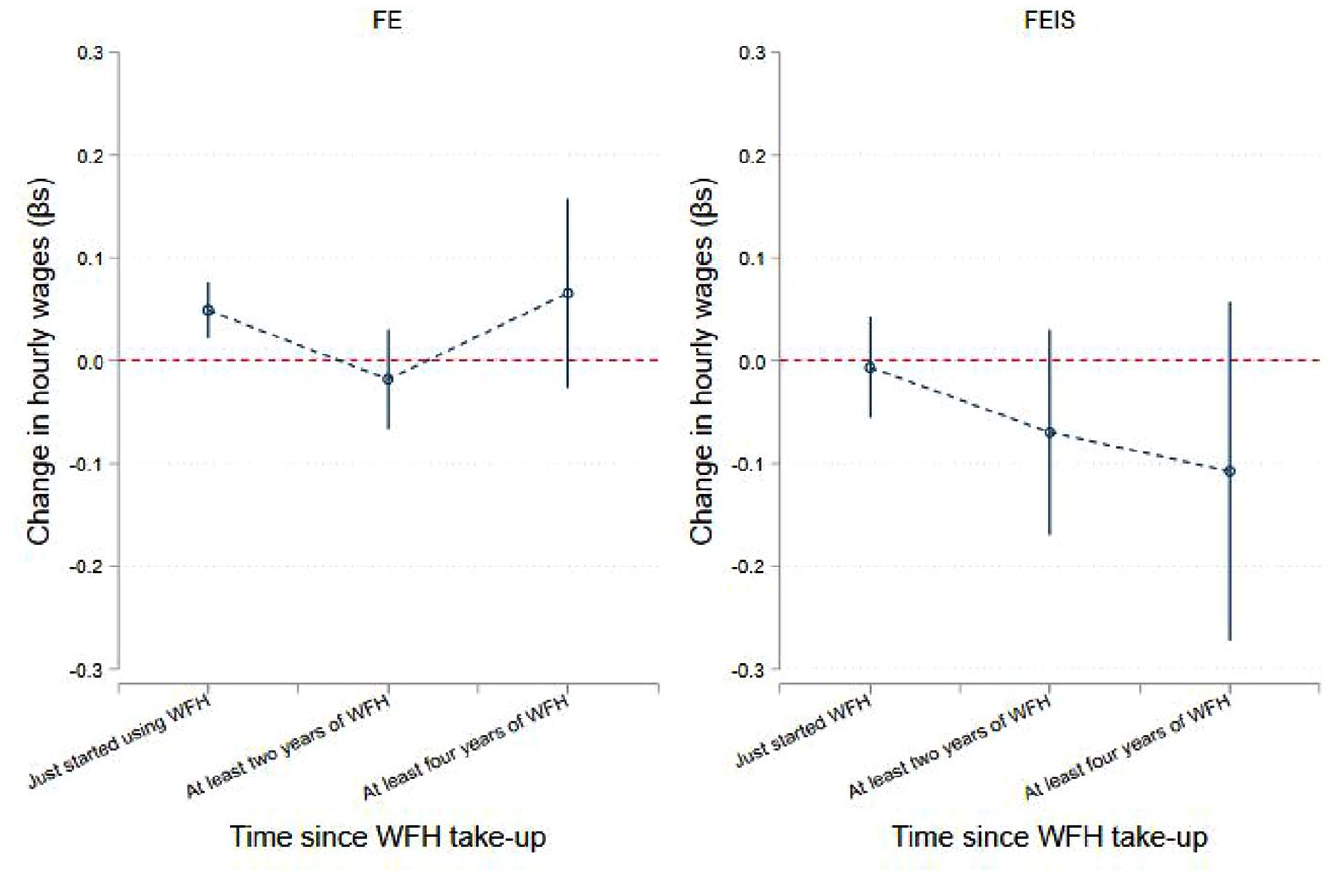
The overall association between WFH and logged gross hourly wages over time.
The FEIS model, however, tells a different story. Like before, it finds almost no association between taking up WFH and wages (
Alternative operationalisations
First, the natural logarithm of monthly salaries – instead of hourly wages – was used as the outcome variable because most individuals using flexible working arrangements are likely to be salaried workers. This made no meaningful difference compared with the shown estimates above. Figures A1–A3 and regression tables A7–A9 for this specification are in the supplemental material.
Second, a different operationalisation of the outcome variable was implemented, where instead of the actual working hours (contractual working hours + overtime hours) only the contractual working hours were used to calculate hourly wages. The associations between WFH and wages in this specification are qualitatively similar to the findings in the main analysis. Figures A4–A6 and regression tables A10–A12 for this specification are in the supplemental material.
Alternative sampling decisions
First, 225 observations from interviews conducted in 2020 were dropped to avoid the bias the COVID-19 pandemic might have had on the results. This made no difference regarding the estimates above, suggesting that the positive effect of WFH on wages was not a result of individuals taking up WFH because of the pandemic. Regression tables A13–A15 for this specification are in the supplemental material.
Second, a specification was estimated where all employees who exclusively work from home were excluded, as this might be a different kind of flexible working arrangement than only occasionally working from home. The results do not markedly differ from the results found in the main analysis. This suggests that individuals starting to work from home exclusively did not drive the results, but rather employees who WFH in addition to working in the office. Figures A7–A9 and regression tables A16–A18 for this specification are in the supplemental material.
Discussion and conclusion
In previous research, it has been inconclusive as to whether WFH has positive or negative career consequences and for whom. The present article weighs in on the matter by exploring how taking up WFH is associated with the earnings of men and women with and without children in the UK. The results suggest that overall, WFH is positively related to employees’ wages. The association, however, is small and statistically insignificant when taking into account selection on wage growth. The results of the present study differ from the results of Glass and Noonan (2016), who found that WFH is not associated with individual earnings for men or women. The present study finds that only women’s wages are positively related to WFH. Notably, the differences between men and women are not statistically significant in the presented models.
When looking at differences based on gender and parental status, results suggest that mothers are the ones who benefit the most from using WFH, as they are the only group for whom the association between WFH and earnings is positive and statistically significant, no matter the specification. These findings are similar to those of Arntz et al. (2022), who found that mothers WFH can raise their contractual working hours, resulting in higher monthly earnings. The findings are also compatible with other research that found that flexible work arrangements potentially diminish motherhood wage penalties (Fuller and Hirsh, 2019). The association between WFH and wages is, depending on the model, a negative one for fathers. This finding differs from those of Arntz et al. (2022), who found that fathers benefit from WFH in terms of their wages.
Theoretical implications
The present article investigated whether WFH is associated with career harm for employees because of stigma or if it is positively related to employees’ wages by enhancing their productivity and job commitment. The presented results are most compatible with a work–life facilitation perspective, which posits that WFH allows individuals to coordinate work and other life obligations more sustainably, enabling them to work more productively, which can then shape career and job opportunities, and could therefore be positively associated with earnings (Fuller and Hirsh, 2019; Gariety and Shaffer, 2007; Weeden, 2005). It is sometimes argued that men and women use flexible work arrangements differently, with men choosing WFH mostly to work more productively and women WFH to spend more time doing unpaid domestic work (Chung and van der Horst, 2020; Lott, 2015). However, the results suggest that mothers are the ones who benefit the most from WFH in terms of their earnings, which on the one hand points to the idea that mothers have the most to gain in terms of work–life reconciliation and therefore that the productivity advantages might be beneficial for them (Brown Johnson and Provan, 1995); on the other hand, coming from the gift-exchange model (de Menezes, 2013), mothers, in particular, might feel a sense of obligation to expend more effort at work for their employers in return for the opportunity to work from home because they value the benefits of working flexibly the most (Brown Johnson and Provan, 1995; Weeden, 2005).
Limitations
Although the present study provides some novel insights, it has several limitations. First, WFH is only measured every second wave in the UKHLS. In this article, it is assumed that if a participant uses WFH, for example, in waves 4 and 6, they also use WFH in wave 5. Therefore, it is not certain if the WFH status between the waves changes. Second, with the UKHLS it is only possible to identify who works from home via a binary indicator. However, research suggests that the number of hours worked from home, whether WFH is part of a formal or informal arrangement with the employer and whether WFH is used during regular work hours or as a supplement to work in the office, could change the outcomes of the work arrangement (Cortis and Powell, 2018; Golden, 2012). Lastly, while the IP-weighted FE models are a significant improvement to the cross-sectional studies investigating the association between WFH and wages, the results should not be interpreted as causal effects, as self-selection into WFH and other unobserved changes in employment status coinciding with starting WFH may still bias the findings.
Conclusion and outlook
The present study extends previous research, which often used cross-sectional data, by using comprehensive longitudinal analyses and controlling for observed and time-invariant unobserved factors to investigate whether WFH is associated with hourly wages. The article’s unique methodological approach reveals that the earning benefits of WFH are specific to mothers. This points to the idea that such a flexible working option might help them to balance work and family, which in turn means that WFH could at least slightly offset gender wage gaps and the motherhood pay penalty on a societal level.
The findings are interesting in the context of the UK’s institutional framework, as they highlight how policies like the right to request flexible working could help reduce gendered labour market inequalities. By influencing how flexible work arrangements are implemented and perceived within organisations, such policies could improve mothers’ earnings and other career outcomes. Exploring the relationship between institutional policies, flexible work arrangements and labour market outcomes may therefore provide valuable insights into the mixed findings in the previous literature.
One caveat is that WFH is not available to all employees, which means it can only benefit mothers working in an office job in a position that allows them to work from home regularly. Therefore, it would be interesting to examine whether and how the outcomes of WFH have changed post-pandemic, with more and different people than previously opting for WFH and with flexible working arrangements becoming more accepted in the workplace.
Supplemental Material
sj-docx-1-wes-10.1177_09500170251336943 – Supplemental material for Is Workplace Flexibility Penalised? The Gendered Consequences of Working from Home for the Wages of Parents and Childless Employees in the UK
Supplemental material, sj-docx-1-wes-10.1177_09500170251336943 for Is Workplace Flexibility Penalised? The Gendered Consequences of Working from Home for the Wages of Parents and Childless Employees in the UK by Johanna Elisabeth Pauliks in Work, Employment and Society
Footnotes
Acknowledgements
I would like to thank the anonymous reviewers and the editors for their constructive feedback on this article. I express my gratitude to Reinhard Schunck, Yvonne Lott, Isabell Habicht, Nora Huth-Stöckle and Emily Hellriegel for their comments and advice on earlier versions.
Funding
The author received no financial support for the research, authorship, and/or publication of this article.

Supplemental material
Supplemental material for this article is available online.
Notes
References
Supplementary Material
Please find the following supplemental material available below.
For Open Access articles published under a Creative Commons License, all supplemental material carries the same license as the article it is associated with.
For non-Open Access articles published, all supplemental material carries a non-exclusive license, and permission requests for re-use of supplemental material or any part of supplemental material shall be sent directly to the copyright owner as specified in the copyright notice associated with the article.
