




Abstract
When do women work? Which women work when? Much of our understanding of the temporal organisation of women’s paid work relies on oversimplified stylised estimates of duration and categorical indicators of work timing. Using United Kingdom Time Use Survey 2014–2015 workweek grid data and innovative sequence analysis, this research provides new empirical evidence by identifying a typology of women’s work schedules, including variants of and departures from the standard workweek. Furthermore, sociodemographic and job characteristics are found to be associated with different work schedules. A feminist evaluation of findings highlights the insufficiency of the standard/nonstandard dichotomy and presents new ways of describing worktime that better capture the complex and diverse experiences of women. It concludes that, while the standard workweek is not strictly identifiable as a type of schedule, it acts as an organising principle of worktime among contemporary working women.
Keywords
Introduction
Sociological literature on gender and worktime is extensive (Crompton, 2006; Fagan, 1996; Rubery, 2015; Rubery et al., 1999; Walthery, 2019; Warren and Walters, 1998), yet key questions about the scheduling of women’s paid work remain unanswered. For instance: How standard is ‘the standard workweek’ among women? When women work part-time, do they follow standard 9-to-5 workdays but on fewer days? Or do they adopt nonstandard workday schedules across a standard, Monday-to-Friday, 5-day workweek? How prevalent are different types of work schedules among women, and which women work when? These empirical questions give rise to a broader theoretical issue: Is the concept of ‘the standard workweek’ fitting for understanding and accounting for women’s worktime arrangements? This article critically interrogates the standard/nonstandard workweek dichotomy and develops an alternative typology of work schedules grounded in empirical data on women’s work schedules.
The extent to which contemporary work schedules depart from the standard – and for whom – remains a critical area of inquiry (Beers, 2000; Craig and Powell, 2011; Glorieux et al., 2008, 2009; Minnen et al., 2015; Walthery, 2019). This research departs from the conventional approach to gender and worktime, which compares men and women to highlight gender inequality. Instead, it centres on women, examining the temporal organisation of their worktime and exploring diversity and differences among them. By addressing these empirical gaps, this article not only broadens understanding but challenges and refines established concepts about worktime, ‘providing shocks to one’s own best loved or well worn ideas’ (Glucksmann, 2000: 168) about the standard workweek.
This article first introduces key debates surrounding the standard workweek and the diversification of work schedules. It then examines the methodological limitations of existing research on women’s worktime, outlines the feminist framework that underpins the study, describes the data and innovative analytical techniques employed, and presents empirical findings on when women work, how their schedules deviate from the standard and for whom. The conclusion evaluates the relevance of the standard workweek, arguing that while it does not strictly emerge as an observed type, it remains a strong organising principle of women’s worktime.
The standard workweek and the diversification of schedules
The standard/nonstandard dichotomy is a foundational framework for describing paid worktime arrangements. The standard workweek is conventionally defined as Monday to Friday, 9 am to 5 pm, totalling 37–40 hours per week, with an even distribution of daily hours. Nonstandard worktime, by contrast, refers to reduced workhours or work occurring outside these established timings, often during times typically reserved for family or leisure and thus considered unsocial (Craig and Powell, 2011: 274). Since the 1960s, the concept of standard worktime has prevailed in most industrialised societies (Fagan, 1996: 72), but this norm has been disrupted by employment deregulation, increased employer demands for flexibility, the shift to a service economy and technological advancements. The rise of the 24/7 economy has eroded standard daily and weekly rhythms, with work occurring at any time of day or night (‘24’) and diminishing the significance of the weekend (‘7’) (Anttila and Oinas, 2018). These changes have led to increasingly individualised and complex work schedules (Robinson et al., 2002).
The diversification of work schedules has also been driven by the feminisation of employment, as the formal wage economy has shifted from being predominantly male to include both men and women (Rubery, 2015). By 2023, employment rates among women and men in the UK were nearing parity (72.1% and 78.1%, respectively) (Francis-Devine and Hutton, 2025). However, gendered patterns persist: 38% of women, compared with 14% of men, work part-time (Francis-Devine and Hutton, 2025; Warren et al., 2010). These disparities largely reflect women’s disproportionate responsibility for unpaid domestic and caregiving work, which constrains their labour market participation (Fagan, 2001; Rubery, 2015; Sullivan, 2021; Warren et al., 2010). Nonstandard arrangements – such as part-time, flexitime, compressed hours and scattered hours – are often strategies for balancing paid and unpaid work, enabling women, particularly mothers, to remain in the workforce (Fagan, 2001; Rubery et al., 1999; Warren, 2004; Wheatley, 2017). However, variations in employment conditions and support for carers mean that these strategies are more challenging in some nations and are experienced differently by various groups of women (Bryson, 2007; Rubery et al., 1998; Warren et al., 2010). For instance, in the UK, limited public childcare provision and the high cost of private childcare further entrench part-time working among women, particularly among those in low-waged roles (Fagan, 1996; Sullivan, 2021; Warren et al., 2010).
Part-time work is not only influenced by caregiving needs but also by structural demands in feminised industries, where work schedules are shaped by the nature of the work itself (Ellingsæter and Jensen, 2019). In the UK, women are overrepresented in sectors such as health and social work, retail and education (Francis-Devine and Hutton, 2025). These industries, often nuanced by specific roles within them, frequently require schedules aligned with service delivery rather than the standard workweek pattern. This highlights the limitations of the standard workweek as a universal framework. While part-time work remains dominated by women, it is increasingly viewed as undesirable due to its negative impact on pay and career development (Chung and van der Lippe, 2020). Meanwhile, full-time employment among women in the UK has steadily increased since 2012, reflecting significant changes in women’s labour market participation and contributing to the diversity of their work schedules (Francis-Devine and Hutton, 2025).
However, gendered work patterns are not universal. The implications of nonstandard work arrangements for the division of labour, work–life balance and gender equality vary widely depending on national contexts (Chung and van der Lippe, 2020; Warren, 2004). In summary, women’s work schedules are shaped by domestic and caregiving responsibilities as well as the constraints of feminised industries, resulting in distinct and diverse patterns of temporal organisation. Together, these observations suggest that the standard workweek is descriptively limited in capturing the temporal organisation of women’s work.
Uncovering women’s work schedules
Research on invisible work has traditionally focused on women’s unpaid domestic labour (Hatton, 2017; Oakley, 1974), but aspects of their paid work, particularly schedules, remain underexplored due to limited data and analytical techniques (Lesnard and Kan, 2011).
The Labour Force Survey (LFS) is a comprehensive dataset on working hours, with ‘the standard workweek’ as a reference point for measuring work variations. Duration is assessed using styled estimates of ‘usual weekly hours worked’ and the binary ‘full-time or part-time’ indicator. While this dichotomy oversimplifies worktime (Warren and Walters, 1998), gradations like ‘mini-jobs’ under 15 hours (Beck et al., 2016) and ‘marginal’ versus ‘substantial’ part-time (Buchmann et al., 2010) have been proposed as more detailed alternatives. Yet, full- and part-time remain the dominant categories. Timing indicators (e.g. evening or weekend work) in the LFS reveal the prevalence of nonstandard work. However, the LFS offers limited insight into the scheduling of worktime (Lesnard, 2010). Consequently, questions about women’s work schedules persist.
Sequence data, detailing start and end times of work episodes over a 7-day period provide the necessary detail to examine the complexity of the workweek schedules (Robinson et al., 2002). Nationally representative Time Use Surveys (TUS) provide such data but are infrequently conducted and often lack the 7-day observation window required to analyse workweeks. Until recently, the granularity of sequence data was reduced to categorical indicators in the style of the LFS (e.g. evening or night work) or visualised as tempograms, which, while appealing, offered limited analytical value. Innovative analytical advancements, specifically dynamic Hamming matching (DHM) combined with cluster analysis, have advanced typology development using TUS data (Lesnard, 2010, 2014). This method has uncovered diverse work schedule patterns in the UK (Lesnard and Kan, 2011), Belgium (Glorieux et al., 2008, 2009; Minnen et al., 2015), France (Lesnard and de Saint Pol, 2009) and South Korea (Han and Koo, 2013), which is significant progress in understanding the diversity of contemporary work schedules.
Despite these advancements, our understanding of women’s work schedules remains limited. The lure of a nationally representative TUS sample is to analyse the entire dataset, propose parsimonious typologies and make powerful statements about the way a nation organises time. However, this strength comes with a critical weakness: a lack of sensitivity to the specific schedules of different population groups. Extant analytical procedures generate an ungendered national typology, with gender considered post hoc (Glorieux et al., 2008; Minnen et al., 2015), rather than being integral to the identification of patterns. This approach risks obscuring or overlooking the nuances of women’s work schedules, failing to adequately reflect their distinct temporal organisation of paid work.
A feminist approach to work schedules
This research draws on Glucksmann’s (2000) qualitative feminist work, Cottons and Casuals: The Gendered Organisation of Labour in Time and Space, which centres on women’s labour as a means for understanding the organisation of work, critiquing dominant concepts and developing theory through substantive analysis.
First, Glucksmann (2000) focuses on women’s experiences of work and explores diversity among women. This approach contrasts with the dominant approach to gender in time-use research, which often defaults to comparison of men and women given the ready inclusion of gender in quantitative analyses as a binary variable (Stacey and Thorne, 1985). Yet this approach has done little to advance the understanding of women’s work schedules. By focusing exclusively on women, this research disrupts this trend and provides a clearer understanding of the temporal organisation of their work.
Second, feminist scholars critique the standard workweek as a male-centric construct, shaped by historical male-dominated labour movements that assumed unencumbered male workers (Rubery et al., 1998). As Bryson (2007: 146) observes, ‘caring and domestic responsibilities do not disappear when women enter paid work’. The standard workweek reflects male interests and experiences, but is often treated as a neutral, ungendered norm (Glucksmann, 2000: 125). Glucksmann (2000) argues that defining women’s diverse work patterns as ‘nonstandard’ implies a standard based on the male norm, reinforcing implicit hierarchies that privilege these patterns as ideal while marginalising others (Code, 2018; Warren and Walters, 1998). This dualistic framework obscures the complexity of women’s work and overlooks caregiving responsibilities and structural inequalities, making the concept of the standard workweek descriptively and normatively limited for capturing women’s work experiences.
Third, a feminist approach extends beyond simply ‘adding on’ women’s experiences to existing frameworks (Skeggs, 2008). Rather than proving or disproving a theory or ‘counterpose concepts’, Glucksmann (2000) advocates developing theory in relation to substantive findings, using inventive methodologies to challenge established assumptions. As Skeggs (2008) argues, feminist research seeks to invite debate and re-inscribe existing concepts using new evidence. This principle informs the present study, which retains the concept of the standard workweek as a reference point while exposing its limitations through an analysis of how women’s work schedules engage with or deviate from it.
This feminist sensibility shapes the methodology of this research. First, the standard workweek is embedded in the question design in the LFS, serving as the pre-defined reference point for measuring variations in workhours’ duration and timing. However, the application of DHM to TUS data offers a descriptive, exploratory approach that makes no assumptions about the patterns in the sequence data (Lesnard, 2010: 391). This makes it ideal for capturing the diversity and complexity of women’s work schedules. Second, this research centres on women’s experiences by applying DHM and cluster analysis to a subsample of data from women, generating a typology of work schedules that faithfully reflects the temporal organisation of women’s work. Rather than counterposing concepts, it deconstructs the standard workweek into its components – duration and timing – to evaluate its adequacy as a descriptive or normative ideal for women’s work.
The aim of this research is threefold. Substantively, it develops understanding of women’s work schedules by uncovering their diversity and complexity through innovative methods, addressing gaps in existing literature. Methodologically, it demonstrates the value of sub-setting data prior to applying DHM and cluster analysis, providing a robust framework for exploring temporal patterns in worktime. Theoretically, it uses new empirical evidence to critically interrogate the dominant labour concept ‘the standard workweek’, and to propose more inclusive and nuanced ways of understanding the organisation of worktime. Collectively, these contributions challenge male-centric assumptions embedded in conventional frameworks and open avenues for rethinking how work schedules are conceptualised and analysed.
Method
Data
The analysis used workweek grid data from the United Kingdom Time Use Survey 2014–2015 (UKTUS15), conducted between April 2014 and December 2015, which provides information on the paid working time of a nationally representative sample. UKTUS15 is the most recent and suitable sequence data. Figure 1 illustrates the workweek grid that respondents completed for one week. They drew a line through each 15-minute interval worked each day or ticked ‘did not work’ if no work was conducted. Each week is thus represented by a sequence of 0s and 1s, indicating the absence or presence of paid work. Respondents aged 16 and older were eligible to complete the workweek grid, with 3523 grids returned. The analytic sample included employed women with a complete workweek grid (n = 1420) (Table 1).

United Kingdom Time Use Survey 2014–2015 workweek grid data collection instrument.
Sample characteristics (N = 1420).
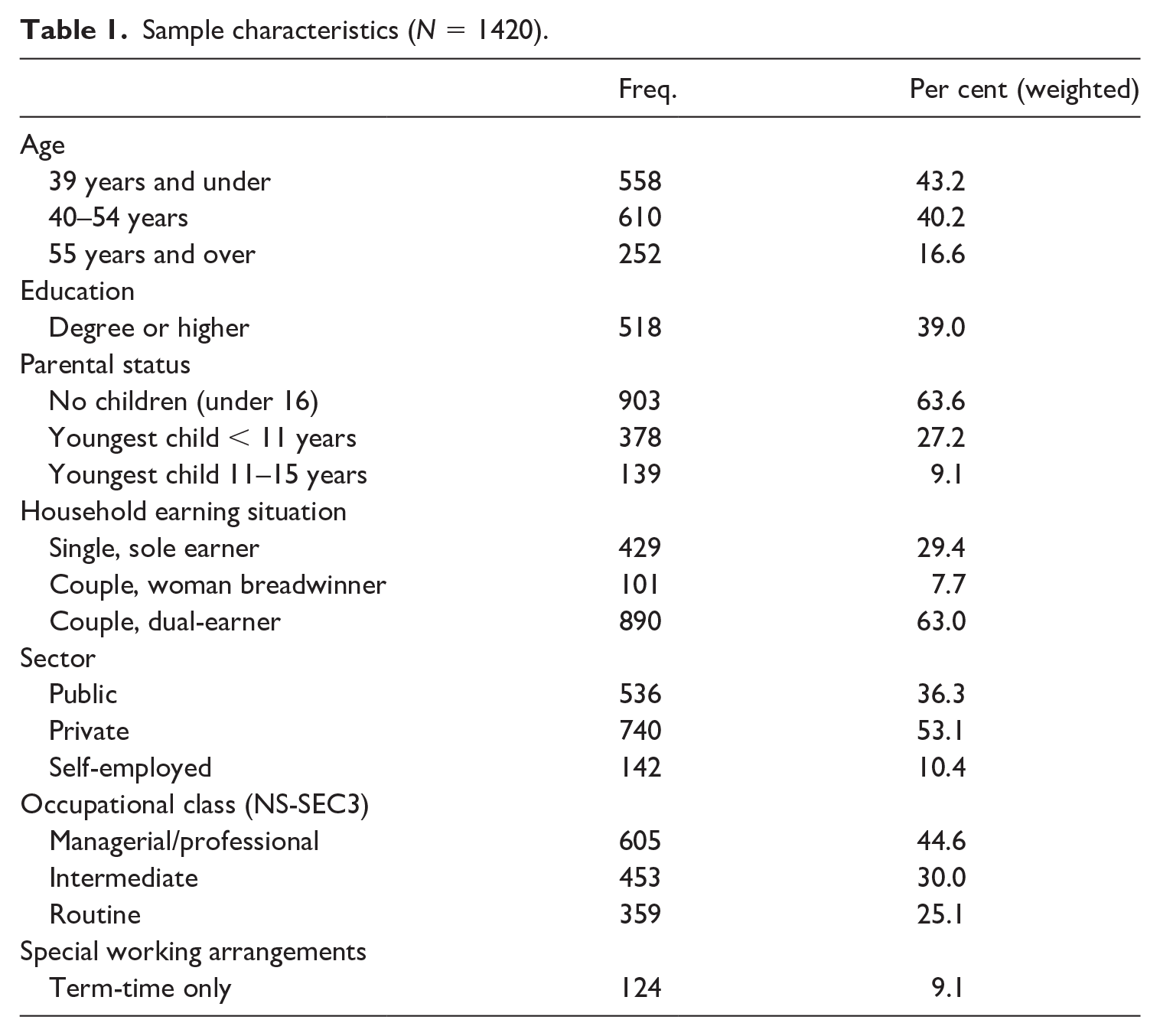
In addition to the workweek grid, household and individual questionnaires captured sociodemographic and employment characteristics, such as special work arrangements (e.g. term-time working) and occupational classification (NS-SEC and SOC 2010). As UKTUS15 is nationally representative, the dataset includes women in diverse occupations across public, private and self-employed sectors (Table 1) and reflects the composition of women in the UK workforce. The most common roles were teaching professionals (7.6%), sales/retail assistants (7.1%), childcare workers (5.7%), care workers, auxiliary nurses and dental assistants (5.5%) and nursing professionals (4.4%) (see Technical Appendix Table A1 for details).
Definitions
‘Work’ was defined as time spent working in a main job, family business, second job, or paid work from home, excluding commuting or unpaid breaks (e.g. tea, lunch, or rest breaks). A ‘workday’ was any day with at least one episode of work; a ‘day off’ had no work reported. Across 1420 workweek grids, 5956 workdays were recorded.
The ‘standard workweek’ is typically described as Monday to Friday, 9 am to 5 pm, but the operational definition differs across studies (Craig and Powell, 2011; Glorieux et al., 2008; Minnen et al., 2015). For this analysis, standard worktime was defined as 8 am to 6 pm, Monday to Friday, consistent with Walthery and Gershuny (2019) in their analysis of UK working time. Nonstandard hours were defined as before 8 am or after 6 pm on weekdays, and any time on weekends.
Analysis
The analysis replicated Lesnard and Kan’s (2011) two-stage DHM design – describing typical (1) daily and (2) weekly rhythms – to uncover a typology of women’s work schedules. Stage one applied DHM to the 96 quarter-hour intervals of each workday (n = 5956). DHM measures dissimilarity between sequences based on the cost of transforming one sequence into the other, using substitutions. Agglomerative hierarchical clustering was applied to the resulting distance matrix, to identify distinct types of workdays. There is no authoritative way to determine the right number of clusters for a typology (Lesnard, 2010: 405). The considerable subjectivity in determining the appropriate cluster solution is often considered a regrettable or problematic feature of the method; however, researcher degrees of freedom allow for seemingly subtle but sociologically important differences in the temporal organisation of work to be maintained rather than lost through the imposition of relatively arbitrary numeric rules or thresholds (Chan, 1995). A rigorous process was used to identify an appropriate cluster solution, which was then manually refined for substantive coherence in preparation for the next stage.
Stage two applied DHM and cluster analysis to the 7-day sequences (n = 1420) to create a typology of workweeks. An appropriate cluster solution was identified, manually refined and validated. Each workweek grid was classified a workweek schedule type, written to the dataset. Analyses used TraMineR, cluster, fpc and clustree packages in R (see Technical Appendix for full methodological details).
The two-stage design is arguably more complex than a one-stage design, where DHM is applied directly to the 672 quarter-hour segments (Lesnard and de Saint Pol, 2009; Minnen et al., 2015), but is justified by increased interpretability of results (Lesnard and Kan, 2011: 364). It captures nested periodicities in work scheduling – the organisation of hours within days, and workdays across weeks – reflecting the way work is scheduled in real life (Lesnard and Kan, 2011: 354). This distinction is critical for analysing women’s schedules given their higher likelihood of part-time work achieved through fewer hours per day, fewer days per week, or both.
Despite the advanced analytical techniques employed, DHM and cluster analysis uncover descriptive typologies. Weighted descriptive statistics show the prevalence of different types of workweek schedule among women in the UK. To infer who works when, a series of logistic regression models were fitted using workday types then workweek types as dependent variables. Independent variables included age, education (degree educated or higher = 1), household earning situation (single, sole earner = 0; couple, partner not in work = 1; couple, dual-earner = 2), parental status (no children under 16 = 0; youngest child < 11 years = 1; youngest child 11–15 years = 2), employment sector (private = 1; public = 2; self-employed = 3) and occupational class (NS-SEC3 managerial/professional = 1; intermediate = 2; routine = 3). Coefficients (β) are reported in log-odds units. To support interpretation, Standard Occupational Classification codes (SOC 2010) were used to identify common occupations for each workweek schedule type. Descriptive and regression analyses were conducted in Stata 17 software using tabulate, tsset and tsspell, and logit. UKTUS15 adopted a multi-stage stratified probability sampling design. Weights were applied in analysis to adjust for non-response at the different stages and make the sample balanced by month (wks_wt).
Typology of workdays
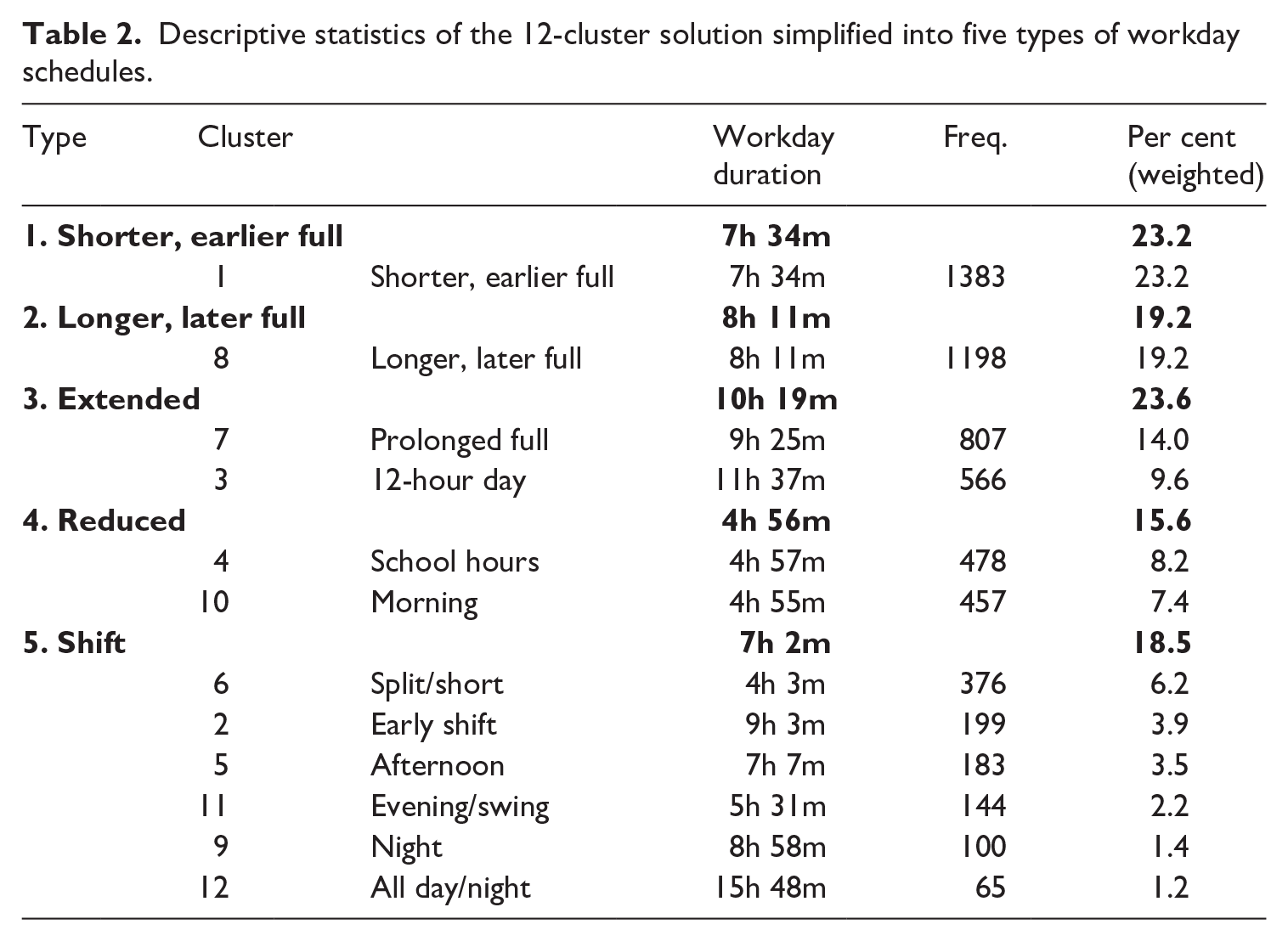
DHM was applied to 5956 workdays, followed by agglomerative hierarchical clustering. Temporal profiles of all cluster solutions between seven and 15 were considered before adopting a 12-cluster solution. The 12 clusters were manually sorted and combined to create five types of workday: (1) shorter, earlier full, (2) longer, later full, (3) extended, (4) reduced, and (5) shift workdays (Table 2, Figure 2). The five-class typology of workdays was entered as dependent variables in a series of binary logistic regression models (Table 3).
Descriptive statistics of the 12-cluster solution simplified into five types of workday schedules.
Binary logistic regression of five types of workday schedules.
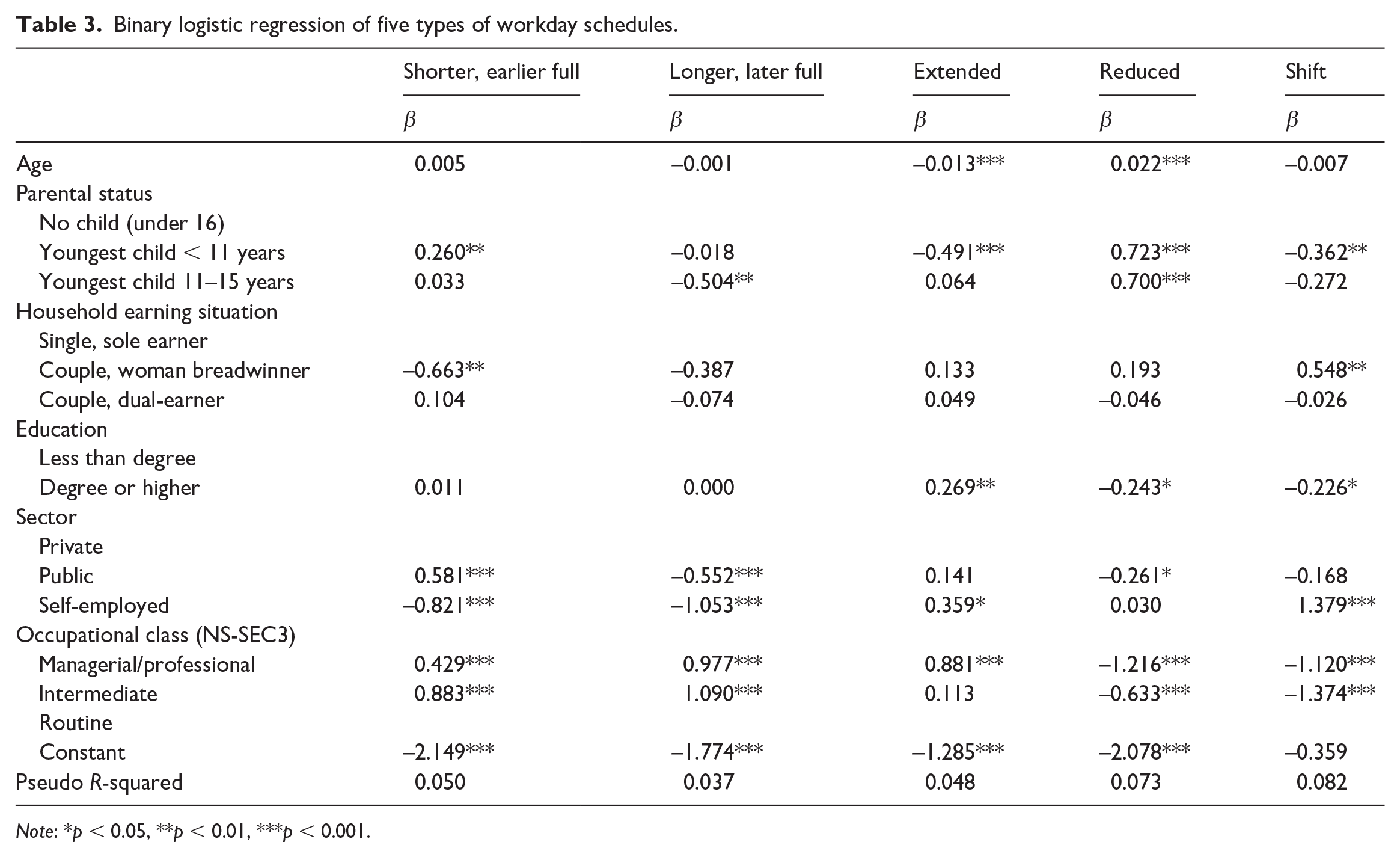
Note: *p < 0.05, **p < 0.01, ***p < 0.001.
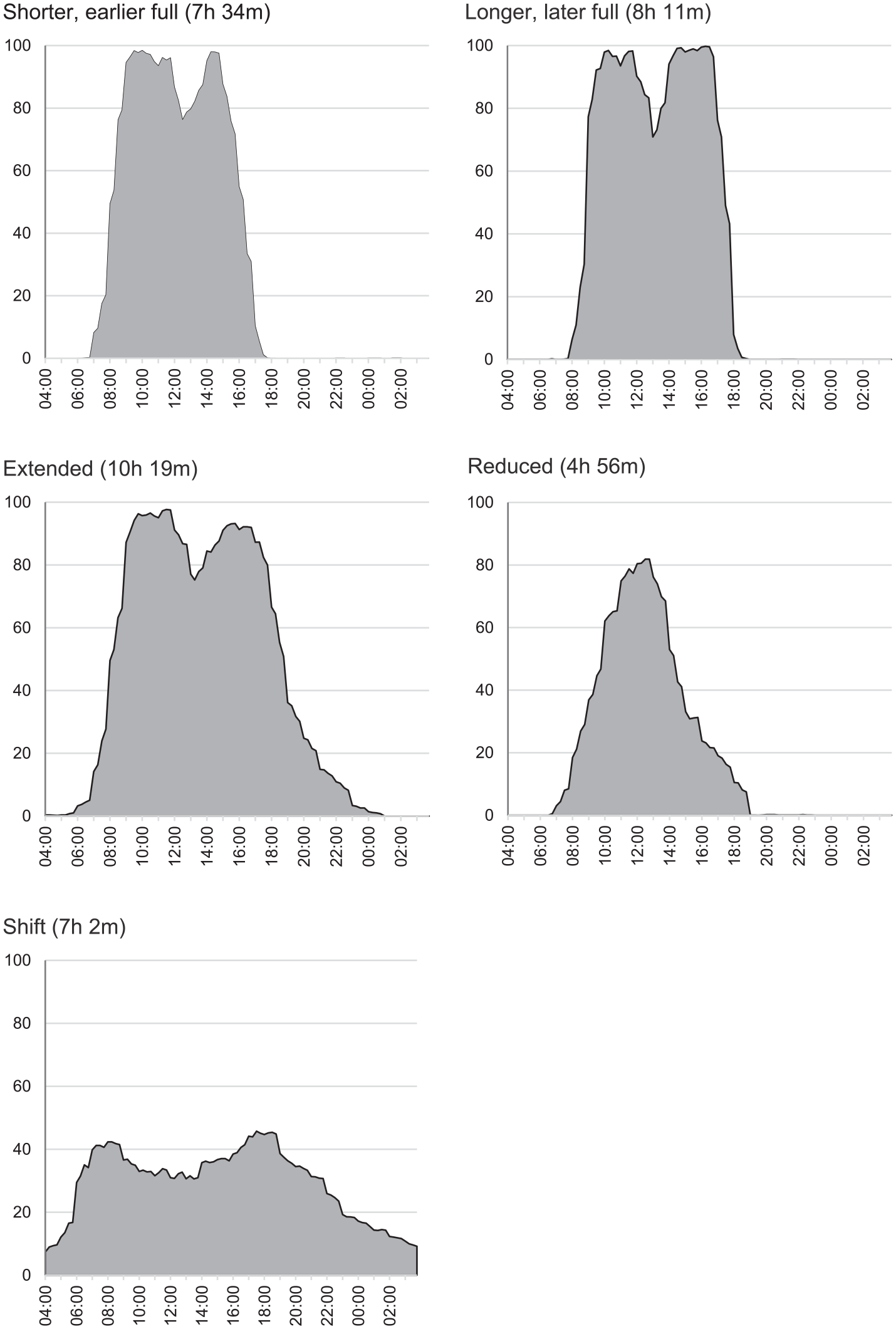
Tempograms of five types of workday schedule (per cent working over the day).
Strictly speaking, a standard 9-to-5 workday schedule did not emerge in the analysis. This challenges the assumption that the standard workday is a dominant pattern for contemporary women workers. Instead, two types of workdays approximated the standard workday in terms of duration (around 8 hours) but with critical variation in start and end times that reflect caregiving responsibilities and sectoral norms. First, shorter, earlier full workdays (Cluster 1: 23.2% of all workdays) had a modal start and end time of 8 am and 5 pm, respectively, and mean duration of 7 hours 34 minutes. There was a dip in participation at 12.30 pm, suggestive of a rest break or lunch break (Whillans, 2024). Second, longer, later full workdays (Cluster 8: 19.2%) had a modal start and end time of 9 am and 6 pm, respectively, and were on average 8 hours 11 minutes long, with a slightly later break time around 1 pm. At the manual sorting stage, it was considered whether the seemingly small differences between the schedules should be overlooked and merged into a single ‘full workday’ type that accounts for 42.4% of all workdays. Compounding their temporal similarities, both workday schedules were less common among self-employed women, and more likely worked by women in intermediate and professional rather than routine occupations (Table 3). However, shorter, earlier full workdays were more likely to be worked by women with young children and in the public sector; conversely, longer, later full workdays were more likely worked by women with no children and in the private sector (Table 3). Temporal demands of care activities for children, which must often be done routinely at certain times of the day (Craig, 2006), and sector-specific worktime norms and regulations shape the scheduling of workhours within the day. Despite seemingly minor temporal differences between the two types of workdays – that is, the hour timeslots at either end of the standard workday (8–9 am and 5–6 pm) – findings suggest that they are not equivalents but qualitatively distinct.
Third, the extended workday schedule had start and end times bearing resemblance to the standard workday, but with a longer duration. Two clusters were extended workdays. The prolonged full workday (Cluster 7) had a mean duration of 9 hours 25 minutes and modal start and end times of 8 am and 6.30 pm; so, while the end of the day was marginally later, it did not dramatically contravene standard timings. The 12-hour workday (Cluster 3) had an extremely long duration (11 hours 37 minutes) and often started at 8 am and ended at 8 pm; thus, workdays started at a similar time to a standard workday but extend into the early evening. Taken together, extended workdays account for just less than one in four of women’s workdays (23.6%). Table 3 shows extended workdays were more often worked by younger, degree-educated women, without young children, with professional occupations and who were self-employed.
Fourth, reduced workdays described schedules that fall within the hours of the standard workday (timing), but the length of the workday was notably shorter (duration). School hours workdays (Cluster 4) were approximately 5 hours long, starting at 10 am and ending at 3 pm, broadly corresponding with school hours in the UK. Morning shifts (Cluster 10) were a comparable duration (4 hours 55 minutes), but work started and ended earlier in the day, with 8 am and 2 pm the most common start and end times. Together, reduced workdays accounted for 15.6% of all workdays among women. Reduced workdays tended to be worked by older women, with young or teenage children, who did not have a degree and worked in routine occupations. Reduced and extended types of workday schedule were clearly distinct in terms of the timing and duration of workhours, but they were also worked by women with opposing sociodemographic and job characteristics (Table 3).
Finally, shift workdays workhours fell outside of standard worktimes (timing). The lengths of shift workdays varied considerably (duration). The most common schedule was the split/short shift workday (Cluster 6: 6.2%): within this cluster, three in five workdays contained a single spell of work, while two in five contained two or more episodes. The most common start and end times were 7 am and 9 am, suggesting a short shift before the standard workday and a second set of workhours performed later in the day starting at 3 pm or 4 pm until 7 pm. The two-peak pattern of workhours bookended the reduced workday and full workdays. The remaining shift schedules spanned four segments of the day: early morning (Cluster 2: 6 am until 3 pm), afternoon (Cluster 5: 2 pm until 7 pm or 10 pm), evening (Cluster 11: 5 pm until 10 pm or 11 pm), night (Cluster 9) and round-the-clock shifts (Cluster 12). While clusters within this type were very different in terms of timings, they shared the characteristic of workhours falling outside of standard worktimes. Furthermore, no cluster was so prevalent as to warrant being a distinct type of workday schedule. Taken together, shift workdays accounted for 18.5% of all workdays. Women working shift workday schedules were less likely to have young children, or a degree, and more likely to be the breadwinner in a couple household, work in a routine occupation and be self-employed (Table 3).
Typology of workweeks
Stage one of the analysis uncovered five simplified types of workday schedule. In preparation for stage two, a sixth type of day was added to the schema, a day off, to take account of the days that contained no episodes of paid work. Every workweek was seven episodes long (Monday to Sunday) and composed of the six-state classification. DHM was applied to 1420 workweeks, followed by agglomerative hierarchical clustering, to create a typology of workweek schedules. Temporal profiles of cluster solutions between 11 and 30 were examined and a 27-class classification was adopted. Again, manual sorting for the final stages of data reduction allowed for clusters that were similar in theoretically important ways to be combined (see Technical Appendix) to create nine types of workweeks (Table 4, Figure 3). Regression modelling revealed that job characteristics and, occasionally, sociodemographic characteristics contribute to explanations of the scheduling of workdays across the week (Table 5). Table 6 shows the most common occupations by workweek schedule type.
Descriptive statistics of nine types of workweek schedules, organised thematically (bold type).
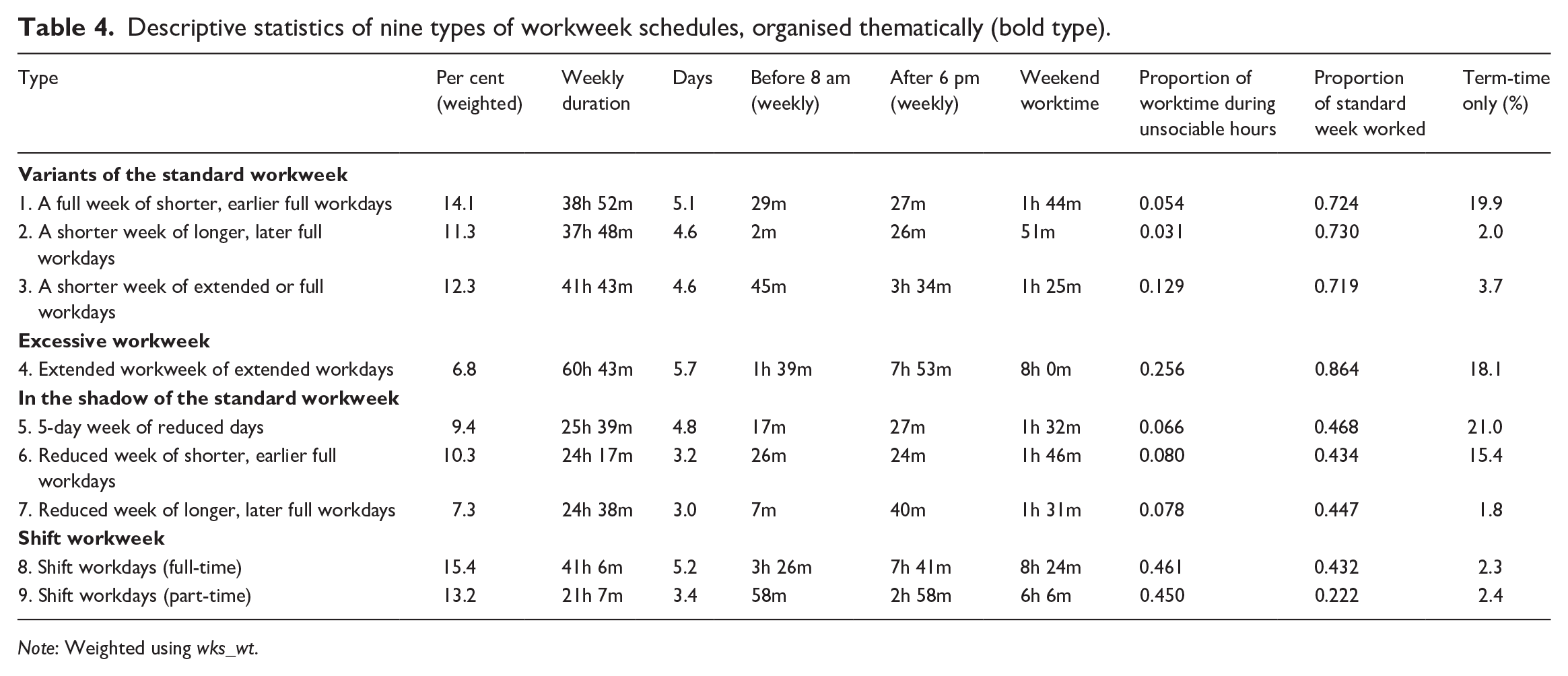
Note: Weighted using wks_wt.
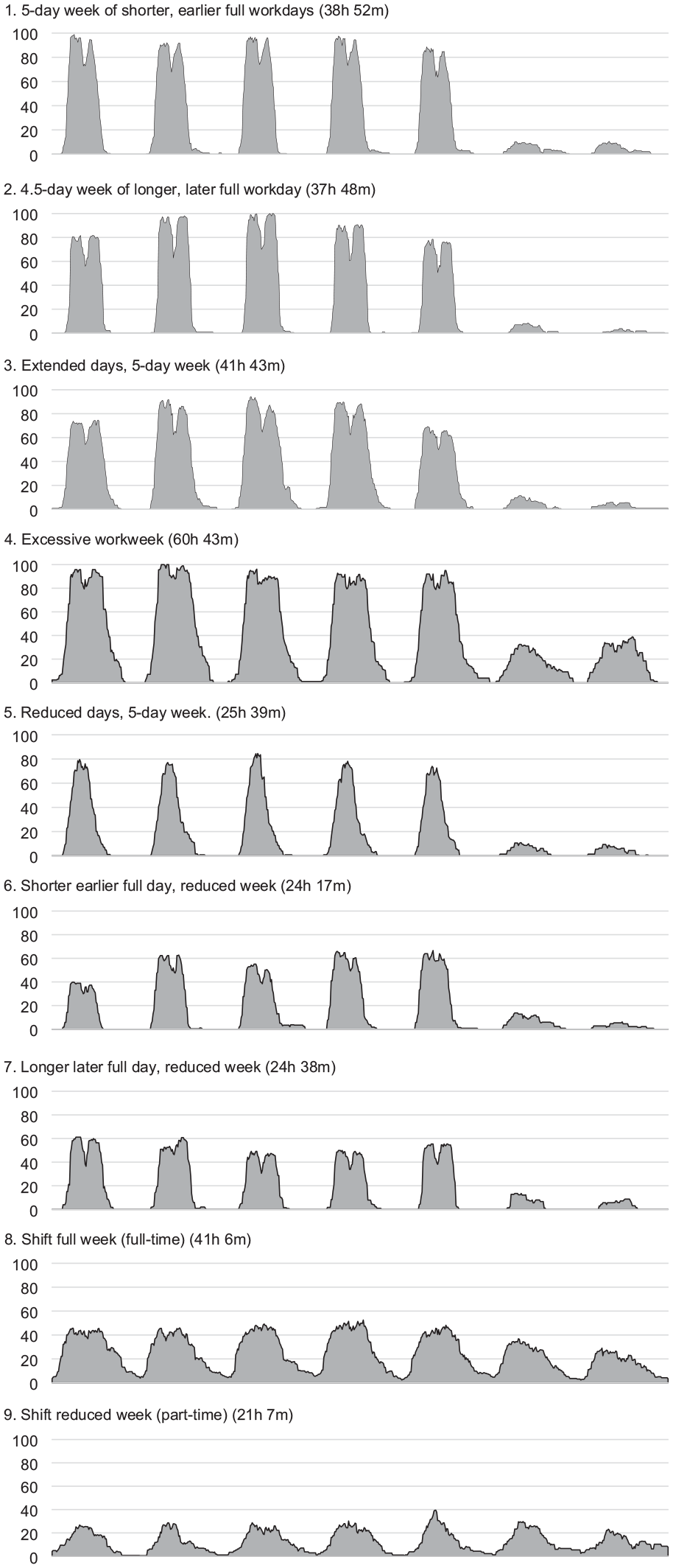
Tempograms of nine types of workweek schedules (per cent working over the week).
Binary logistic regression of nine types of workweek schedule.
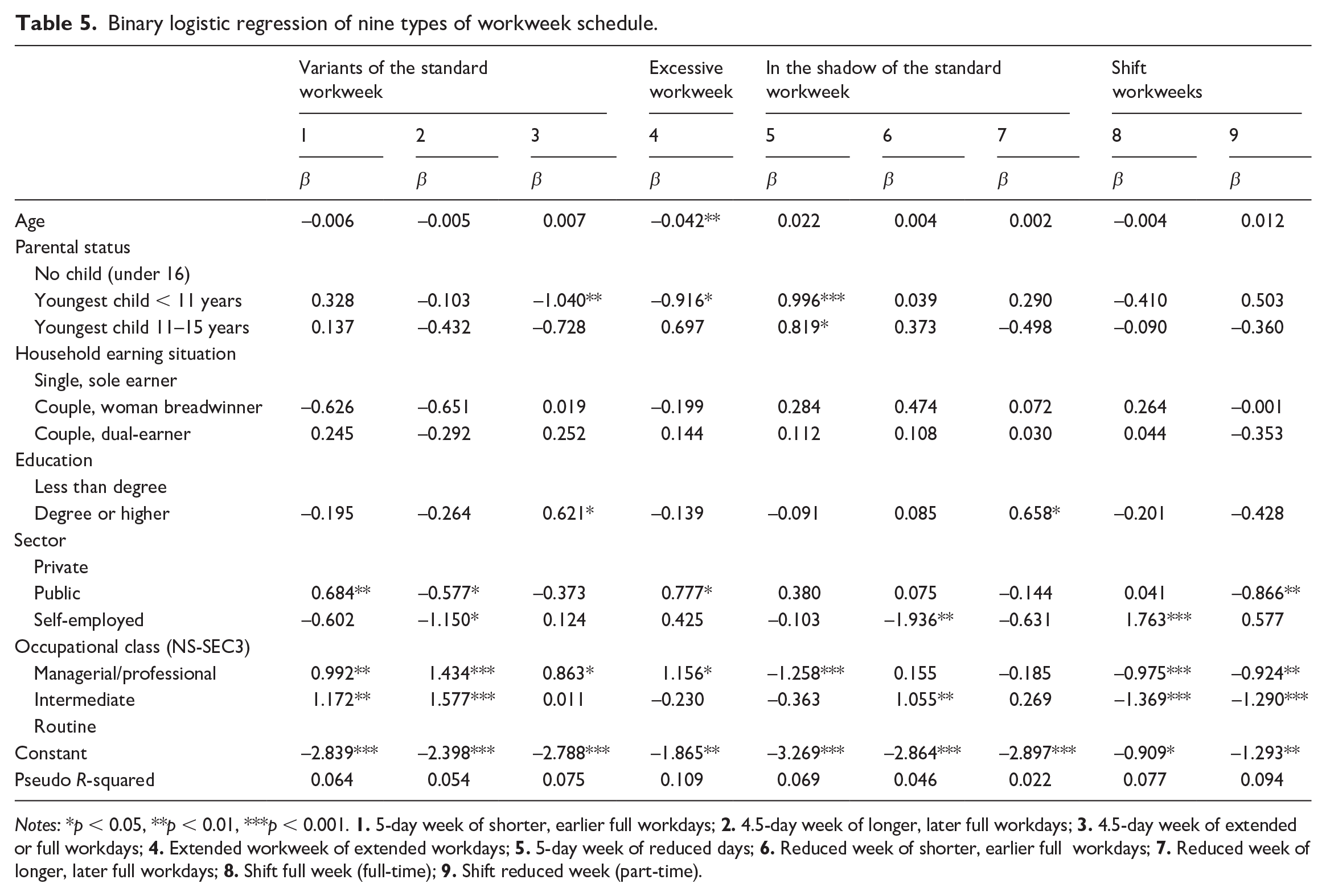
Notes: *p < 0.05, **p < 0.01, ***p < 0.001.
Most prevalent occupations (SOC 2010 4-digit) by type of workweek schedule.
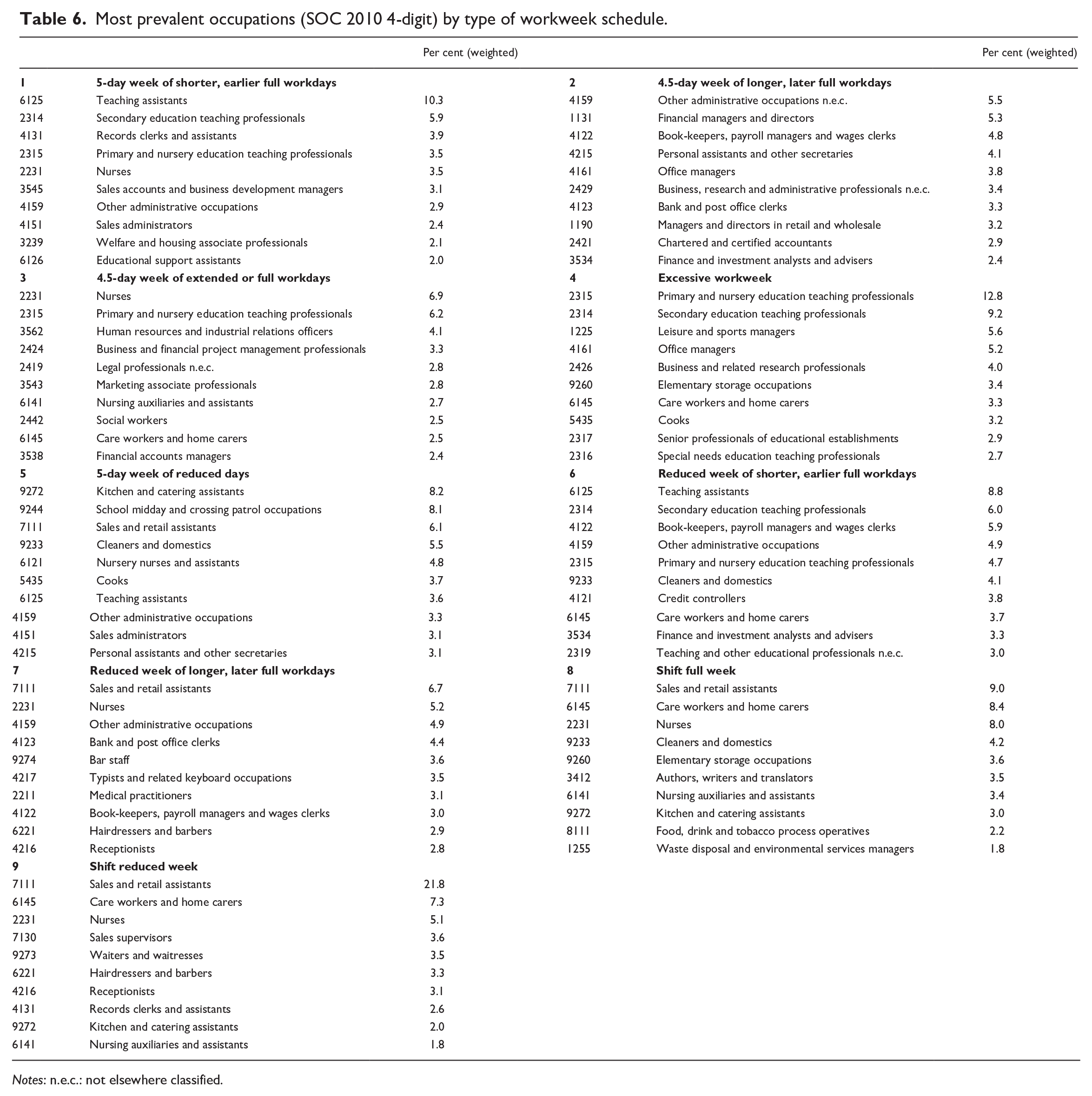
Notes: n.e.c.: not elsewhere classified.
Variants of the standard workweek
Given that a 9–5 workday was not revealed in stage one, a standard Monday to Friday 9–5 workweek did not emerge in stage two. Three types of workweek schedules were variants of the standard workweek (Types 1–3). These three workweek schedules involved full-time hours (c.40 hours) worked Monday to Friday, with minimal weekend work (Table 4). However, they differed in the structure of the workday schedule comprising the workweek and the mean number of days worked per week. Nevertheless, all three variants provided comparable coverage of the standard workweek (0.724, 0.730 and 0.719, respectively). Just under two in five women (37.7%) had a schedule that was a variant of the standard workweek, but there were notable differences in who works when, even among these closely related schedules.
The first variant of the standard workweek schedule was a full week (5.1 days) of shorter, earlier full workdays (Type 1), with a mean duration of 38 hours 52 minutes. While there was some spillover into the weekend (1 hour 44 minutes), only a small proportion of weekly worktime occurred during nonstandard hours (0.054). This schedule was significantly more likely to be worked by public sector employees (β = 0.684, p = 0.003), in managerial/professional (β = 0.992, p = 0.007) and intermediate occupations (β = 1.172, p = 0.001). This variant reflects women’s overrepresentation in feminised public sector roles, particularly in education, such as teaching assistants (10.3%), secondary education teaching professionals (5.9%) and primary and nursery education teaching professionals (3.5%) (Table 6). Correspondingly, 19.9% of women with this schedule worked term-time only.
The second variant, a shorter workweek (4.5 days) of longer and later workdays (Type 2) – often referred to as a compressed workweek – had a marginally shorter weekly duration of 37 hours 48 minutes. Working longer, later full workdays allowed women to reduce the number of workdays per week (4.6 days), with Monday or Friday often a day off (18% and 22%, respectively). Minimal work occurred during unsociable hours (0.031), with little spillover into weekends (51 minutes). In contrast to Type 1, this schedule was more common among private sector female employees, with very few working term-time only (2.0%). Women with this schedule occupied managerial/professional (β = 1.434, p < 0.001) and intermediate occupations (β = 1.577, p < 0.001) in administrative and financial management roles, such as financial managers and directors (5.3%), payroll managers (4.8%), personal assistants and secretaries (4.1%) and other administrative occupations (5.5%).
The third variant of the standard workweek – also fitting the definition of a compressed workweek – was a shorter week (4.5 days) of extended or full workdays (Type 3). The mean duration of 41 hours 43 minutes was greater than the 37–40 hours of a standard workweek but not long enough to be classified as an excessive workweek. Minimal work occurred on weekends (1 hour 25 minutes) but as the workweek was composed of extended workdays reaching into the early evening, a larger proportion of worktime fell into nonstandard hours compared with Types 1 and 2 (0.129). This schedule was significantly less likely to be worked by women with young children (β = –1.040, p = 0.001), suggesting that even modest encroachment into nonstandard hours may be irreconcilable with childcare responsibilities. Women working this schedule worked in managerial/professional occupations (β = 0.863, p = 0.012), with degree-level qualifications (β = 0.621, p = 0.016), and were employed across public and private sectors. Key occupations include nurses (6.9%), primary education professionals (6.2%), HR (4.1%), project management (3.3%) and legal professionals (2.8%).
The three variants of the standard workweek show significant sectoral and occupational inequalities, linking women’s work schedules to gendered labour market structures. In public sector Type 1 schedules, the prevalence of term-time only working reflects how women’s work aligns with the academic calendar, enabling caregiving responsibilities and making motherhood less of a barrier. However, this alignment also reinforces the gendered expectations that tether women to feminised roles in education and healthcare. In contrast, Type 2 schedules, more common in the private sector, are predominantly worked by women in higher-status managerial/professional and intermediate occupations, such as financial managers and administrative professionals. These roles offer access to compressed work schedules, demonstrating how flexibility is disproportionately available to women in high-status occupations. Finally, the underrepresentation of women with young children in Type 3 schedules underscores how even modest nonstandard hours remain incompatible with caregiving responsibilities. This variant, worked across public and private sectors, is dominated by women in high-skilled professional roles, often requiring degree-level qualifications, but caregiving constraints restrict these more demanding schedules. Together, these patterns reinforce the feminist critique of the standard workweek as a male-centric norm that insufficiently accommodates the diversity of women’s lives and responsibilities, even among these temporally related schedules.
Excessive workweek schedule
The excessive workweek schedule (Type 4) accounted for 6.8% of workweeks. It was the longest workweek by weekly duration (60 hours 43 minutes) and number of days worked (5.7 days). With extended workdays and frequent weekend work (39% Saturdays, 52% Sundays), it covered a high proportion of standard hours (0.864), exceeding the coverage of variants of the standard workweek but also considerable extension into unsociable hours: 17 hours 32 minutes occurred during nonstandard hours (0.256 of weekly worktime).
This schedule was significantly more likely to be worked by younger women (β = –1.042, p = 0.003), without young children (β = –0.916, p = 0.028), and in managerial/professional occupations (β = 1.156, p = 0.016). Long hours are most common in the private sector and non-unionised workplaces (Fagan et al., 2008) but the excessive workweek schedule was significantly associated with public sector employment (β = 0.777, p = 0.017), with women working as primary and nursery (12.8%) or secondary education teaching professionals (9.2%), leisure and sports managers (5.6%) and office managers (5.2%). 18.1% of women with this schedule worked term-time only, offsetting its demands with extended time off during school holidays. This highlights the importance of considering not just workhours within the day and workdays within the week, but workweeks across the year to account for women’s worktime. This schedule reveals how even excessive work patterns reflect gendered expectations, with teaching professionals and public sector workers facing heightened demands that mirror the contradictions of feminised labour: undervalued yet overburdened. By exceeding the boundaries of the standard workweek, Type 4 highlights the structural pressures that women face, even in ostensibly stable or privileged occupations.
In the shadow of the standard workweek
Three schedules, while appearing to conform to standard timings with minimal worktime in nonstandard hours (0.066–0.080), did not fully align with the standard workweek. These schedules had considerably shorter weekly durations and limited proportional coverage of standard hours (0.434–0.468). Together, these part-time schedules falling in the shadow of the standard workweek accounted for 27% of workweeks (Types 5–7).
The school hours schedule – the 5-day week of reduced days (Type 5, 9.4%) – was worked across 4.8 days, with minimal weekend work, totalling 25 hours 39 minutes. It aligned closely with the academic calendar, with 21% working term-time only. It was common among women with children, particularly young children (youngest < 11 years: β = 0.996, p = 0.001; youngest 11–15: β = 0.819, p = 0.041). However, women working this schedule were concentrated in routine rather than professional/managerial occupations (β = –1.258, p = 0.001), such as kitchen assistants (8.2%), midday school supervisors (8.1%), retail assistants (6.1%) and cleaners (5.5%), thus in feminised care and service roles.
Types 6 and 7 – reduced weeks of full workdays – shared similar weekly length and duration (24 hours 30 minutes over 3 days) but differed in occupational profiles. Women working a reduced week of shorter, earlier full workdays (Type 6, 10.3% of workweeks) were more often in intermediate than routine occupations (β = 1.055, p = 0.002), including teaching assistants (8.8%), primary and nursery (4.7%) and secondary education teaching professionals (6.0%), payroll managers (5.9%) and other administrative occupations (4.9%), with 15.4% working term-time only. In contrast, women working a reduced week of longer, later full workdays (Type 7, 7.3%) were more likely to be degree-educated (β = 0.658, p = 0.038), with occupations spanning nursing (5.2%), sales and retail assistants (6.7%) and bank clerks (4.4%). Term-time arrangements were rare (1.8%).
Looking across Types 1–7, motherhood and childcare constraints emerge as pivotal in shaping women’s work schedules. Working mothers of young children were significantly underrepresented in 4.5-day schedules (Type 3) and excessive workweeks (Type 4), which were more prevalent among managerial/professional occupations. Conversely, working mothers were overrepresented in part-time schedules like Type 5, associated with routine roles. This reflects longstanding feminist critiques of the labour market: mothers face barriers to higher-status occupations due to caregiving responsibilities, often downgrading to a lower occupational level to secure part-time work (Crompton, 2006; Fagan and Norman, 2012). These findings underscore how the lack of public childcare support in the UK shapes mothers’ labour market participation, leading them to limit hours and align work schedules with their children’s needs (Craig and Powell, 2011).
Together, the schedules that fall within the standard’s shadow and its variants, account for nearly two-thirds (64.8%) of women’s workweeks with regression analysis uncovering how, for women, freedom from caregiving responsibilities is associated with access to higher-status roles and more demanding schedules.
Shift workweek schedules
Two types of shift workweek schedules accounted for a notable share of women’s workweeks: 15.4% worked a full-time shift workweek (Type 8) and 13.2% worked a part-time shift workweek (Type 9), meaning more than one in four women (28.6%) worked a shift schedule. The full-time shift workweek averaged 41 hours 6 minutes across 5.2 days. There was substantial work performed before 8 am (3 hours 26 minutes) and after 6 pm (7 hours 41 minutes) each week, and Saturdays (61.4%) and Sundays (50.8%) were frequently worked, resulting in a high proportion of nonstandard hours (0.461). Despite this, over half of weekly worktime fell within standard hours, providing moderate coverage of the standard workweek (0.432). The part-time shift workweek averaged 21 hours 7 minutes over 3.4 days. It was composed of shift and reduced workdays and weekend work was common (47.9% Saturdays, 38.9% Sundays), but its reduced overall weekly duration resulted in low coverage of the standard workweek (0.222).
Both full-time and part-time shift workweek schedules were strongly associated with routine occupations, as managerial/professional and intermediate occupations were significantly less likely to involve shift schedules (Table 5). Common roles among women with shift workweeks were sales and retail assistants (9.0% full-time, 21.8% part-time), care workers and home carers (8.4% full-time, 7.3% part-time) and nurses (8.0% full-time and 5.1% part-time). Part-time shift work (Type 9) was associated with private sector employment (β = –0.866, p = 0.004) with notable roles in waitressing (3.5%) and hairdressing (3.3%). Full-time shift work (Type 8), unique among all schedules, was positively associated with self-employment (β = 1.763, p < 0.001), with notable roles in cleaning and domestic work (4.2%). Women’s age or parental status were not significantly associated with shift workweek schedules. The association between the full-time shift workweek schedule, self-employment and routine occupations likely reflects the flexibility demanded of low-status roles, often coming at the cost of predictability (Wood, 2018), rather than the high time autonomy assumed of self-employment.
The status of the standard workweek: An organising principle
This study provides new empirical evidence of women’s work schedules, incorporating both the duration of work and its timing into a single schema. This approach advances understanding of when women work, revealing significant patterns of temporal organisation shaped by caregiving responsibilities, occupational norms, and sectoral contexts. While focused on the UK, these findings likely have broader relevance given women’s disproportionate responsibility for unpaid work in most other societies. Inspired by feminist research on work, the findings not only address an empirical gap, but critically engage with the concept of the standard workweek, challenging its relevance as a universal framework for understanding women’s worktime (Fagan, 1996; Glucksmann, 2000; Rubery et al., 1998).
The findings underscore the insufficiency of the standard/nonstandard dichotomy for capturing women’s diverse work patterns: that is, the standard workweek did not straightforwardly ‘fit’ when applied to women. First, the standard workweek does not represent most women’s experiences. A strict representation of the standard (Monday to Friday, 9-to-5) did not emerge in the typology. Even broadly conceived approximations accounted for only 37.7% of workweeks (Types 1–3). Most women (62.3%) worked schedules that deviated from this norm, reflecting the intersection of sectoral demands and caregiving responsibilities.
Second, the findings reinforce the feminist critique that the standard/nonstandard dichotomy oversimplifies diverse experiences of work (Warren and Walters, 1998). By deconstructing the concept into its component parts, this analysis highlights schedules that fall within the shadow of the standard (Types 5–7, 27%). These schedules are nonstandard in duration but align with standard timings, with workhours largely contained within the bounds of 8 am to 6 pm on weekdays, avoiding evenings and weekends. Labelling these schedules as nonstandard overlooks their partial conformity to the standard in timing. Similarly, excessive workweeks (Type 4) and shift schedules (Types 8–9) further expose the limitations of this binary. Excessive schedules cover the highest proportion of standard workhours (exceeding variants of the standard workweek, Types 1–3) while also extending into nonstandard hours, nearly matching the unsociable hours of a full-time shift schedule. Effectively, the excessive workweek straddles both categories of the dichotomy. These findings challenge rigid distinctions between standard and nonstandard work schedules, revealing a range of temporal arrangements that resist simplistic categorisation.
Finally, the standard workweek framework overlooks the annual organisation of work and assumes consistency across the year. Term-time schedules, for example, demonstrate how weekly patterns are offset by extended breaks across the year. Among those working excessive schedules (Type 4), 18.1% also worked term-time only, balancing intensive weekly demands with long periods of no work. This interplay between weekly and annual rhythms further highlights the inadequacy of the standard/nonstandard framework in capturing broader temporal scales. Similarly, the LFS, which embeds the standard workweek in its question design, relies on the measure of ‘usual weekly workhours’. This approach assumes stability in hours worked, obscuring the significant variations that occur across the year, particularly in feminised industries where work schedules are shaped by caregiving responsibilities and the temporal flexibility required in many feminised sectors (Wood, 2018). By failing to account for this temporal variability, the LFS measures struggle to capture what is ‘usual’ in a way that is universally applicable, adding further weight to the argument that the LFS offers limited insight into the scheduling of worktime (Lesnard, 2010).
This typology advances debates on the standard workweek by showing it functions less as a typical pattern of work and more as an organising principle. While most women’s schedules deviate from the standard, the concept persists as a reference point that shapes individual work patterns and broader societal norms. Rather than rejecting the concept outright, this analysis adopts a feminist re-inscription (Skeggs, 2008), introducing terms such as variants of the standard, in the shadow of the standard and shifted from the standard to describe how work schedules engage and diverge from this foundational framework. These contingent terms retain the analytical resonance of the standard workweek while exposing its limitations. Retaining the language of the standard workweek is crucial to the typology’s effectiveness. Proposing entirely novel terms risks losing the conceptual and analytical connections to established debates. By prefixing ‘the standard’ with context-specific modifiers, this approach invites critical reflection on the enduring influence of the standard workweek as a cultural and organisational construct, even as it challenges its empirical relevance.
Conclusion
Following Glucksmann’s (2000) focus on women’s work as central to advancing theoretical frameworks, this research examined the diversity and complexity of women’s work schedules without treating men’s work as the necessary point of comparison. By doing so, this study critiques the dominant approach in time-use research that often obscures intra-gender differences by focusing on the comparison of men and women. The alternative analytical approach, inspired by the feminist approach of focusing on the experience of women, allowed for increased sensitivity in the application of DHM to the factors shaping women’s worktime. While different approaches are not inherently right or wrong, it is important to critically reflect on what is lost and gained, or whose account is amplified or obscured, by different formulations of the analytical procedure.
Reflecting on the present research inspires further development of the longstanding research agenda on gender, worktime and change over time. The reliance on 2015 data, while valuable, underscores a gap in the literature on post-pandemic work patterns. The COVID-19 pandemic and subsequent shifts in hybrid working, childcare provision and the gig economy have profoundly altered the organisation of work. Recent data suggest that there has been a steady rise in the proportion of women working full-time, with a sharper increase during the coronavirus pandemic (Francis-Devine and Hutton, 2025). However, current data sources, such as the United Kingdom Time Use Surveys 2020–2021 and 2023, lack the 7-day observation periods necessary for examining workweek schedules. Future research must prioritise collecting 7-day sequence data to capture the effects of these changes on productivity, work–life balance, gender equality and the organisation of non-work activities (Chung et al., 2021; Veal, 2023).
Further analysis of the 2015 data would also yield insights. Just as the male-defined standard workweek fails to account for women’s diverse schedules, existing research on part-time work – predominantly based on female labour – cannot be unproblematically applied to account for the emerging pattern of part-time work among men. As Warren and Lyonette (2020) note, part-time employment has increased among men but, as part-time work has been dominated by women, little is known about how their schedules differ from women’s or how sociodemographic and occupational factors influence these patterns. Replicating this study’s design using male-specific data would contribute to debates about the changing nature of part-time work and the persistence of gendered temporal inequalities.
While 2015 remains the most recently available data, suitable historical data are available to empirically evidence change in schedules over time in the UK. Historical analyses of worktime often question whether we are working more or less than we used to. A handful of studies examine the change in scheduling of work to examine the extent of de-standardisation of work schedules (Glorieux et al., 2008, 2009). In the UK, 7-day data are available from 1975 to 2015: United Kingdom Time Use Survey 1974–1975, Hours of Work Survey 1989 and United Kingdom Time Use Survey 2000–2001. Rather than examining the extent to which schedules have been de-standardised – which Glucksmann (2000) argues has only become a widespread concern because it is men’s prevailing pattern of work that changed – 1975 to 2015 data may be used to directly address Glucksmann’s (2000: 125) contention that women’s schedules have ‘always’ been more diverse than men’s. Analysing men’s and women’s data, separately, then comparing changes in the scheduling of work, may be analytically burdensome but would provide insight that an ungendered application of DHM would not. While a national typology is enticingly simple, this article maintains that there are considerable advancements to knowledge from conducting in-depth analyses of women’s (and men’s) work separately.
Supplemental Material
sj-docx-1-wes-10.1177_09500170251336933 – Supplemental material for Women and the Standard Workweek: Developing a Typology of Work Schedules in the UK
Supplemental material, sj-docx-1-wes-10.1177_09500170251336933 for Women and the Standard Workweek: Developing a Typology of Work Schedules in the UK by Jennifer Whillans in Work, Employment and Society
Footnotes
Acknowledgements
I am grateful to Prof. Oriel Sullivan and Prof. Vanessa Beck for their valuable comments on earlier drafts. I also extend my sincere thanks to the anonymous reviewers, whose thoughtful and engaged feedback strengthened this article.
Funding
The author disclosed receipt of the following financial support for the research, authorship, and/or publication of this article: This research was supported by the British Academy Postdoctoral Fellowship Scheme (pf160058).
Ethics statement
This study uses secondary data from Sullivan O and Gershuny J (2023) United Kingdom Time Use Survey, 2014–2015, accessed under the terms of the UK Data Service (SN:8128, DOI: http://doi.org/10.5255/UKDA-SN-8128-1). No primary data were collected, and ethical approval was not required. The research complies with all ethical guidelines regarding the responsible use of secondary data.

Supplemental material
Supplemental material for this article is available online.
References
Supplementary Material
Please find the following supplemental material available below.
For Open Access articles published under a Creative Commons License, all supplemental material carries the same license as the article it is associated with.
For non-Open Access articles published, all supplemental material carries a non-exclusive license, and permission requests for re-use of supplemental material or any part of supplemental material shall be sent directly to the copyright owner as specified in the copyright notice associated with the article.
