



Abstract
This article focuses on how unions mobilise collective action in the strategic action field of global labour governance. Few studies show how unions take advantage of global governance institutions. To address this, we analyse the 25-year-long campaign to elevate occupational safety and health to a Fundamental Principle and Right at Work at the International Labour Organization (ILO). Building on social movement theory (SMT), we argue that the elevation was made possible through the framing strategies deployed by the workers’ group that were able to mobilise support from governments, and actors external to the ILO, thus demobilising the employers. In drawing on rich qualitative data, our findings extend SMT by analysing how unions externally frame their demands at the supranational level and the context in which framing occurs.
Keywords
Introduction
In a world of soft rather than hard regulation, and a shift from the nation-state to global supply chains, unions have expanded their repertoires of action at the scale of transnational capital, albeit with varying success. In comparison, however, to the rich literature on mechanisms such as the Bangladesh Accord and international framework agreements (IFAs), we know very little of how unions take advantage of global governance institutions to create institutional power for workers at various levels. Stated differently: how do unions mobilise collective action in the strategic action field of global labour governance?
We explore this question by analysing the 25-year protracted campaign to elevate occupational safety and health (OSH) to a Fundamental Principle and Right at Work at the International Labour Organization (ILO). Hailed as the ‘biggest moment for workers’ rights for a quarter of a century’ (IOSH, 2022), in June 2022, the ILO adopted a ‘safe and healthy work environment’ as a core labour right to which states must commit to (ILO, 2022). OSH joins the rights covering freedom of association and collective bargaining, forced labour, child labour and discrimination, as the foundation of the global labour governance regime (Hassel, 2008). Representing a significant frame transformation at the ILO, the agreement has important spillover effects on other public and private labour governance mechanisms. In analysing this case, we draw on process data gathered from extensive fieldwork, including participant observation within the ILO’s headquarters, semi-structured interviews and analysis of ILO documents.
To understand collective action in global labour governance, we build upon social movement theory (SMT). With the exception of Kelly (1998), SMT has been given surprisingly short shrift in the sociology of work and industrial relations literature (Gahan and Pekarek, 2013; Tapia et al., 2015). SMT, particularly the concept of framing, focuses on how collective actors create frames to build coalitions and mobilise supporters (Benford and Snow, 2000). However, to date, the focus has primarily been on unions’ ‘internal’ framing (Heery and Conley, 2007; Royle and Rueckert, 2020), rather than framing strategies that are directed ‘outwards’ to other actors and fields (Però and Downey, 2024: 145). In global labour governance, unions must demobilise external detractors and develop coalitions through the political opportunity structures offered by strategic action fields (SAF) (Fligstein and McAdam, 2011, 2012).
Empirically, this study addresses the need for further research on how unions capture the gains of global governance institutions (Ford and Gillan, 2022: 574). Theoretically, we respond to calls for the development of SMT in the sociology of work; in particular, why different framing processes occur (Tapia et al., 2015: 173), how unions externally frame their demands at the supranational level (Ford et al., 2024: 13) and the context in which this takes place (Gahan and Pekarek, 2013: 768). As Scherrer (2022: 121) argues, we need to understand how power in labour governance is embedded in the ‘context of institutions in various fields and at different levels’. By analysing social movement dynamics through the theory of SAFs we can move beyond strategic framing for persuading people to act (e.g. fellow workers) to the interactional processes in a field through which frames are constructed, connected and contested. We focus on the framing strategies deployed by the workers’ group, in the context of the ILO’s SAF, which explains the recognition process of OSH as a fundamental labour right.
Literature review: Global labour governance and social movement theory
Over the past three decades, a global labour governance regime has emerged, characterised by private, voluntary, self-regulatory and market-oriented mechanisms rather than state regulation and collective bargaining (Hassel, 2008; Meardi and Marginson, 2014). The shift in governance from the horizontal nation-state to the vertical supply chain has adversely affected unions’ abilities to negotiate and represent their members (Donaghey and Reinecke, 2018; Marginson, 2016). While industrial relations systems remain primarily confined to the national level, unions have invented new (international) strategies, including campaigns and supranational institution-building, most notably IFAs (Ford and Gillan, 2022; Marginson, 2016). With the ‘explosion’ of a myriad of global labour governance mechanisms (Bartley, 2022) comes the opportunity for unions to exercise their power in different bodies and forums, including the ILO (Thomas and Turnbull, 2018), other UN agencies, the OECD (Ford et al., 2024), international finance institutions (Rueckert, 2021) as well as private governance mechanisms (Martens et al., 2018). However, labour diplomacy, as a repertoire of action (Ford and Gillan, 2022), has either been underplayed or otherwise dismissed as ineffective (Hyman, 2005; Lambert and Gillan, 2010). Though relatively little attention has been paid to how supranational governance institutions function as an ‘arena’ for contestation between various actors (Ford et al., 2024: 12), we contend that they provide (political) opportunities for unions with ‘input legitimacy’ (Reinecke and Donaghey, 2022) to frame their grievances. The outcomes of which have the potential to ‘spillover’ (Ashwin et al., 2020) to other mechanisms at various levels, thereby encouraging ‘domestic groups to adapt their norms, model their behaviors, and frame their own claims around issues that are domesticated from international politics’ (Tarrow, 2001: 14; emphasis added).
Previous research has drawn attention to SMT (Kelly, 1998), in particular the concept of ‘framing’ (Gahan and Pekarek, 2013), as both a promising avenue for the revitalisation of industrial relations theory (Tapia et al., 2015: 173) and in understanding union renewal (Behrens and Pekarek, 2021; Cake, 2023; Gooberman and Hauptmeier, 2023; Heery and Conley, 2007; Mendonça and Adăscăliței, 2020; Royle and Rueckert, 2020). In a seminal contribution, Kelly (1998) developed a theory of mobilisation that outlines how workers develop a sense of injustice, join together and consequently take (collective) action against employers. Kelly’s contribution is in addressing intra-union collective action problems and the focus on internal framing (e.g. mobilising fellow workers) has been the mainstay of SMT research in the sociology of work (Però and Downey, 2024: 144). In global labour governance, however, the process of mobilisation is often far removed from the workplace whereby framing is directed ‘outwards’ to external sources of influence (Blyton and Jenkins, 2013: 736). In other words, even if representativeness is a concern in global labour governance (Reinecke and Donaghey, 2022), the collective action problem unions face at the global level is not so much about mobilising people who are, in the main, union members but rather framing their grievances to other stakeholders such as civil society organisations (CSOs) and the incumbents of supranational institutions.
Framing is the process by which actors seek to mobilise support for their activities, ‘in such a way as to promote a particular problem definition, causal interpretation, moral evaluation, and/or treatment recommendation for the item described’ (Entman, 1993: 51). The first step is recognition of the nature of the problem (e.g. poor health and safety at work), often by classifying an adversary as the source of the blame (e.g. ineffective governments or powerful lead firms) (diagnostic framing), following which solutions to said problem can be proposed (prognostic framing) (Benford and Snow, 2000). Finally, there must be a ‘call to arms’ (Benford and Snow, 2000: 617) where the severity and urgency of the labour problem is elevated, potentially leading to a frame transformation (e.g. a new labour governance mechanism). Frames condense the ‘world out there’, provide a broad definition of an ongoing labour situation (Royle and Rueckert, 2020) and are socially constructed, negotiated and contested (Benford and Snow, 2000).
In mobilising collective action, actors deploy different framing strategies, in particular bridging, extension and amplification. Frame bridging denotes the ‘linking of two or more ideologically congruent but structurally unconnected frames regarding a particular issue or problem’ (Benford and Snow, 2000: 624), while frame extension captures how actors include issues of interest to potential adherents (Heery and Conley, 2007), drawing connections between frames in other fields by framing them as mutually compatible. Finally, frame amplification refers to the embellishment, idealisation and elaboration of pre-existing frames, enhancing the appeal of movement goals to mobilise latent supporters (Snow et al., 1986). Frame amplification may also involve the leveraging of ‘master frames’, namely the broad commitments shared between actors that function as principles that ‘constrain the orientations and activities of other movements’ (Benford and Snow, 2000: 618).
Actors can hold multiple frames concurrently, and different frames can become more or less salient over time. That is, framing strategies are often made possible by political opportunities, namely the ‘broad range of external social and political factors that affect the claims, tactics, mobilisation, and ultimate impact of social protest’ (Sawyers and Meyer, 1999: 189). Indeed, the establishment of new labour governance mechanisms is often precipitated by external ‘focusing’ events (Schuessler et al., 2019). When opportunities appear, movements can decide to mobilise or otherwise develop a strategy of abeyance to ‘maintain themselves and their organisations whilst waiting for better times’ (Sawyers and Meyer, 1999: 187). In this context, actors might favour frame plurality (Gray et al., 2015) (i.e. tolerating multiple and frequently conflicting frames) over mobilising for a frame transformation.
The process of framing does not function in isolation. However, previous research has been remiss in addressing the (institutional) context in which it takes place (Gahan and Pekarek, 2013: 768; Nulman and Schlembach, 2018: 382). Kelly’s framework, for example, ‘tells us little about the nature and functioning of the institutions and procedures of industrial relations’ (Connolly, 2023: 271). We therefore need to move from a ‘movement-centric’ approach that has characterised much of the SMT literature to one that is ‘field-centric’ (Fligstein and McAdam, 2011), particularly as power – the ability of one actor to affect the behaviour of another to the extent that they accept or adopt perspectives that may contradict their own (Lukes, 1974) – is relational and embedded in institutions. As the fundamental units of collective action in society, SAFs represent a particular social order where actors ‘interact with knowledge of one another under a set of common understandings about the purposes of the field, the relationships in the field (including who has power and why) and the field’s rules’ (Fligstein and McAdam, 2011: 3). Global labour governance is itself a SAF, a sub-level of the broader field of global governance and is made up of other SAFs. International organisations are both powerful actors and SAFs in their own right, with internal disputes and political processes. SAFs are dynamic and subject to change, whereby actors frame ‘lines of action’ and mobilise ‘people in the service of these action “frames”’ (Fligstein and McAdam, 2011: 7), which may create new (shared) understandings but also generate conflict, potentially triggering a ‘frame break’ (Grimm and Reinecke, 2024). The framing contests that take place in SAFs are context-specific, and actors must adapt their actions depending on the incumbents and challengers, their power and the ‘rules of the game’ (Fligstein and McAdam, 2011). In summary, to understand how unions mobilise support for their causes at the supranational level, it is necessary to focus more closely on the SAFs in which deliberation takes place, the political opportunities available and how framing strategies are deployed (or not) to mobilise collective action.
The ILO as a strategic action field
The ILO provides a fertile ground for studying the dynamics of collective action in global labour governance for three main reasons. First, it is the ‘focal interactant’ in the SAF of global labour governance (Thomas and Turnbull, 2021). Second, it has representative legitimacy through its tripartite structure. Finally, the ILO’s standards become binding once ratified by a member state. Combine this with the extensive case law developed through the ILO’s supervisory mechanisms, and this is about as close as the international community comes to a ‘hard law regime’ (Baccaro and Mele, 2012: 202).
Figure 1 illustrates the decision-making process at the ILO and represents the theoretical framework for this article. The ILO has three constituents: workers (W), represented by national labour unions and the International Trade Union Confederation (ITUC); employers (E), represented by national employer associations and the International Organisation of Employers (IOE); and 187 government representatives (G). The International Labour Office (O) (hereafter the ‘Office’) also plays a crucial role in mobilising collective action by providing ideational and material support to the tripartite constituents, most notably the workers (Thomas and Turnbull, 2021). While the workers’ and employers’ groups of the ILO respectively defend their class interests, governments represent their national interests and, although there is some regional grouping, typically operate on a state-by-state basis.
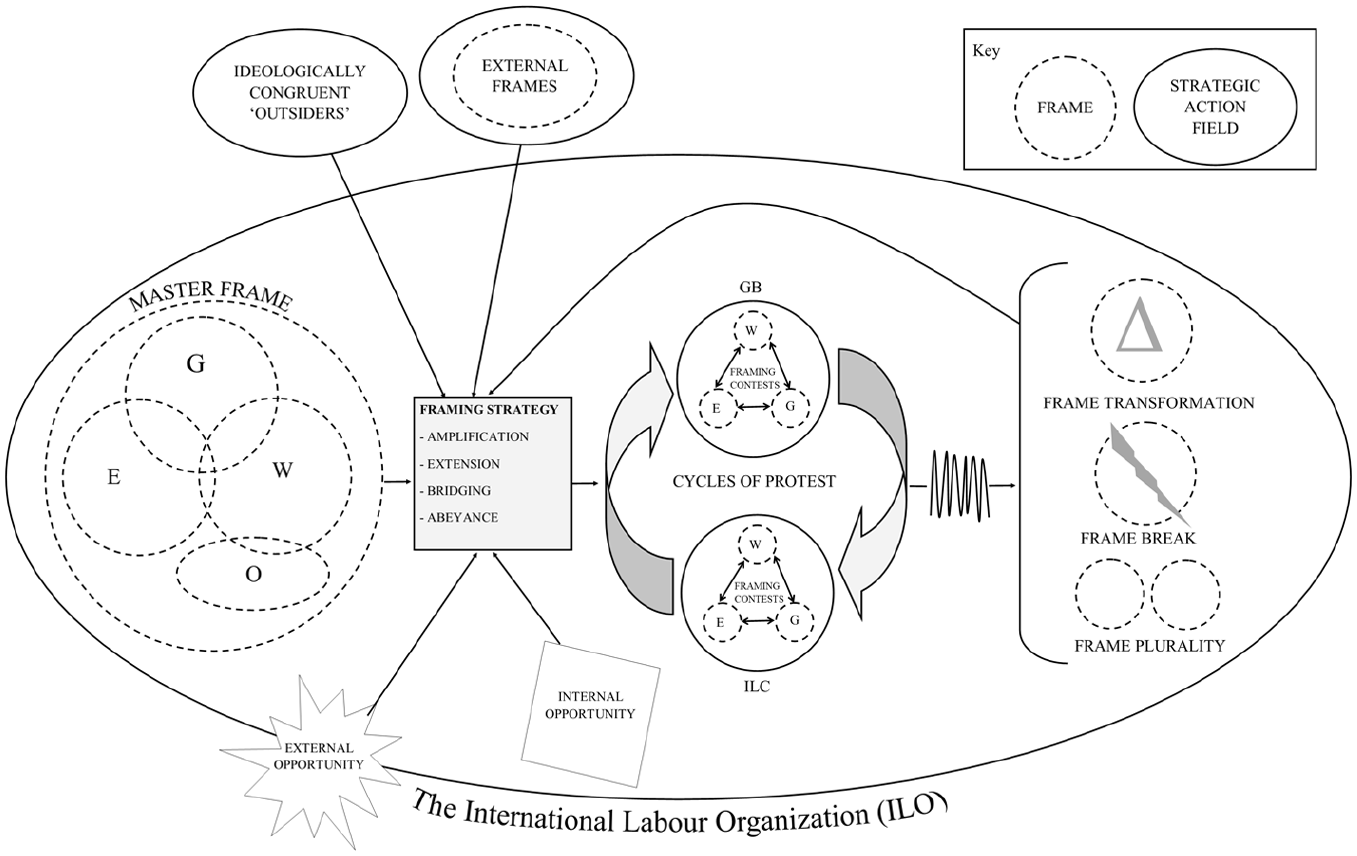
Collective action at the ILO.
The tripartite constituents have their own frames (how they see the world), but this is not to discount the possibility of frame alignment (the overlap between G, E and W in Figure 1). Decisions at the ILO are made through a process of strategic framing designed to, in the case of the workers, activate adherents (governments) and demobilise detractors (employers). During this process, constituents can draw on a powerful (shared) constitutionally defined master frame (Snow et al., 1986: 474) that ‘labour is not a commodity’ and that ‘the protection of the worker against sickness, disease and injury arising out of his [sic] employment’ is among the improvements that are ‘urgently required’ (ILO, 1919). Framing strategies are made possible by (internal) frames agreed upon in previous phases of deliberation, (external) frames from other SAFs, internal and external (political) opportunities and the presence of ideologically congruent ‘outsiders’. Deliberation at the ILO is best encapsulated as an ‘agonistic struggle’ (Thomas and Anner, 2023), whereby frames and framings are frequently, if not always, contested.
As Fligstein and McAdam (2011: 3) note: ‘SAFs look a lot like Russian dolls: open up an SAF and it contains a number of other SAFs’. The ILO has two key (internal) SAFs. The first is the Governing Body (GB). The GB meets three times a year and makes decisions on ILO policy, adopts the budget, elects the Director-General (D-G) and decides the International Labour Conference (ILC) agenda. The second SAF is the ILC, which meets every year. Each member state is represented by two government delegates: an employer delegate and a worker delegate. The Conference inter alia adopts international labour standards and is a forum where questions of importance to the world of work are debated. The ILC also has the power to instruct the GB to deal with unresolved questions, thus generating a ‘cycle of protest’ (McAdam et al., 1996) between these two key battlegrounds. The outcome of deliberation may lead to frame transformation (significant change), frame breaks (dissensus) or frame plurality (the toleration of multiple frames).
Methods
The question of how unions mobilise collective action in the SAF of global labour governance lends itself to process analysis. That is, if variance analysis ‘generates know-that type of knowledge’, process analysis ‘produces know-how knowledge’ (Langley et al., 2013: 4; emphases in original). To do so, researchers must ‘plunge deeply’ into the processes and collect qualitative data over time (Langley, 1999: 691). Our study draws on multiple sources of qualitative data, including participant observation, semi-structured interviews and document analysis (Table 1). Analysis of these sources enabled us to ‘capture the contestation and evolution of framing activities’ over time (Gahan and Pekarek, 2013: 768).
Data summary.
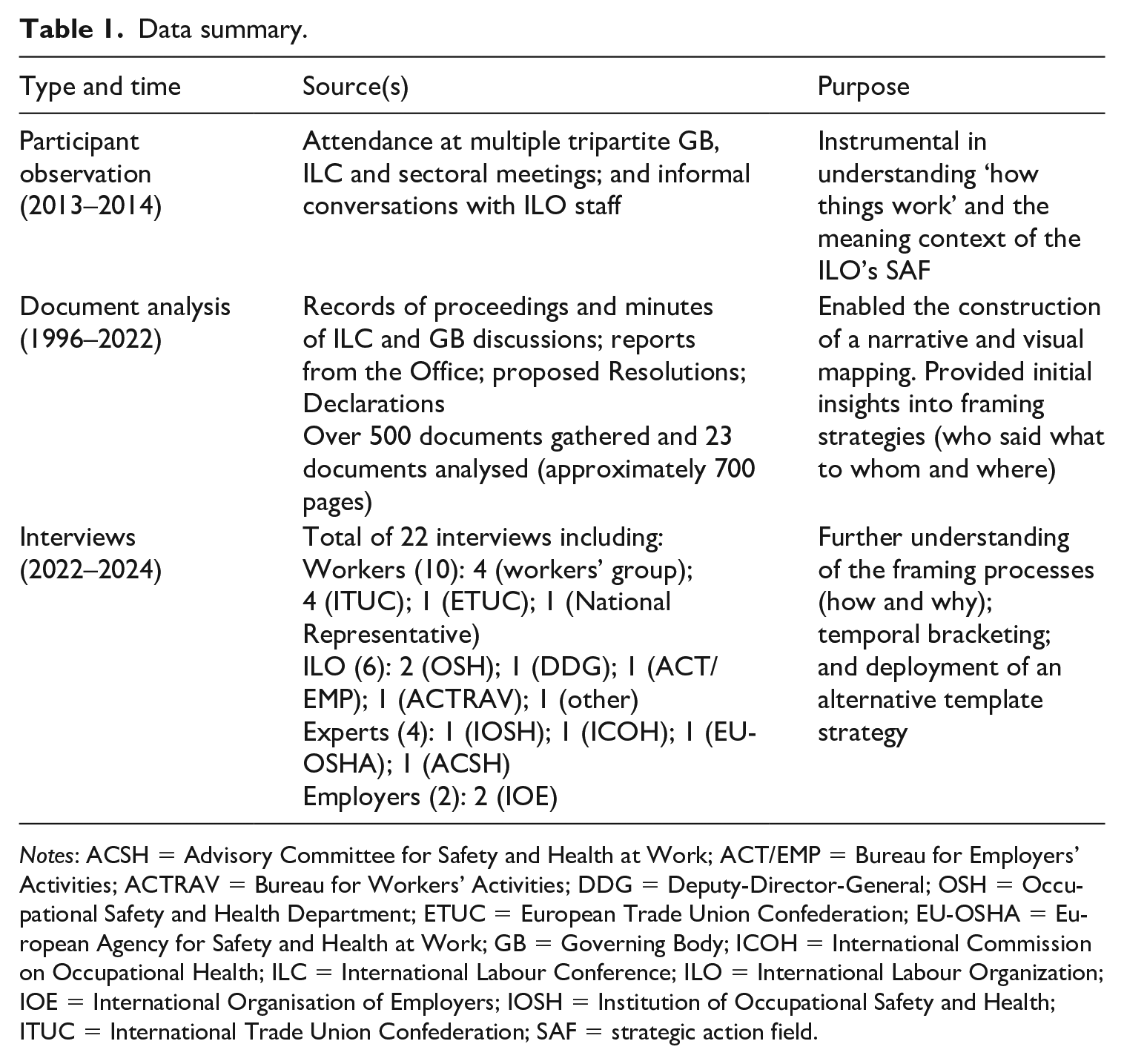
Notes: ACSH = Advisory Committee for Safety and Health at Work; ACT/EMP = Bureau for Employers’ Activities; ACTRAV = Bureau for Workers’ Activities; DDG = Deputy-Director-General; OSH = Occupational Safety and Health Department; ETUC = European Trade Union Confederation; EU-OSHA = European Agency for Safety and Health at Work; GB = Governing Body; ICOH = International Commission on Occupational Health; ILC = International Labour Conference; ILO = International Labour Organization; IOE = International Organisation of Employers; IOSH = Institution of Occupational Safety and Health; ITUC = International Trade Union Confederation; SAF = strategic action field.
Process analysis demands prolonged involvement in the processes being studied (Langley et al., 2013: 4–6). Both authors have had close connections with the ILO. Silva has worked for the ILO on multiple projects, and Thomas spent two years conducting ‘participant-as-observer’ (Gold, 1958) research at the ILO’s headquarters (January 2013 to December 2014). Although this period of observation did not coincide with the elevation of OSH in 2022, it was essential in understanding ‘how things work’ in the Organization (Watson, 2011: 204) and illuminated the interpretive process of framing and meaning construction (Cornelissen and Werner, 2014: 219). In particular, insider knowledge is invaluable when deciphering ‘ILO speak’ (the neutral and understated nature of framing) (Thomas and Turnbull, 2018), thus facilitating our understanding of how actors frame issues in the ILO and the interactions among them.
To understand what happened and to get ‘on top of the data’, we deployed a narrative strategy to produce a chronology of interconnected events (Langley, 1999: 695–697). Most meetings at the ILO have transcripts that present detailed content on the major debates, points of contention and concessions that occurred. 1 Both authors had worked separately on researching the ILO’s Centenary and were surprised by the elevation of OSH in 2022 after the fractious 2019 discussions. Therefore, the first step in our process analysis was identifying the major events that marked the debate since 2019. We collected the records of proceedings between June 2019 and June 2022 of each GB and ILC discussion. We then ‘traced backwards’ to locate the origins of the idea and its evolution over time. We conducted structured keyword searches of every GB and ILC (including the reports submitted for discussion) between 1989 (the end of the Cold War) and the 2019 Centenary. As part of our analysis, we looked at more than 500 documents and then focused on 23, where the most significant discussions took place. As every discussion at the ILO typically produces conclusions, which then signpost the next meeting (Figure 1), the establishment of the chronology was relatively straightforward.
The narrative strategy was deployed to not simply ask ‘what is going on here?’ but ‘what is this a case of?’ (Tsoukas, 2009: 298). We looked for evidence of framing strategies – extension, amplification, abeyance and bridging – and frame (dis)continuities – frame breaks, frame plurality and frame transformation. We also visually mapped the process, which is a particularly effective sensemaking strategy for understanding organisational processes (Langley, 1999: 700–703) both in terms of the general ILO process of decision-making (Figure 1) and the particular OSH timeline (Figure 2). This visual representation of process data represents an ‘intermediary step’ between raw data and abstract theorising (Langley, 1999: 700–703). The narrative strategy, facilitated by the visual mapping, was essential to understand who (e.g. workers or employers) said what (e.g. whether a change was framed as ‘fundamental’ or ‘premature’) to whom (i.e. their target) and where (e.g. the GB or ILC) but is a ‘surface representation’ that requires other strategies to delve below (Langley, 1999: 700–703). To establish why and how events happened we used ‘temporal bracketing’ (Langley, 1999: 703–704), analysing the evolution of events, punctuated by (internal and external) political opportunities and separated by identifiable (dis)continuities in the temporal flow (e.g. periods of upheaval as well as calm). We have identified five phases – Phase I: Establishment (1989–2006); Phase II: Inertia (2007–2012); Phase III: Inaction (2013–2017); Phase IV: Abeyance (2018–2019); and Phase V: Elevation and evolution (2020–2022). For each phase, we identified key events and the framing strategies adopted by the social partners at the ILO (Figure 2). These phases are cumulative, whereby each phase represents a shift in meanings and framing strategy (or absence of), but elements from the prior phase remain (Levy et al., 2016: 373).
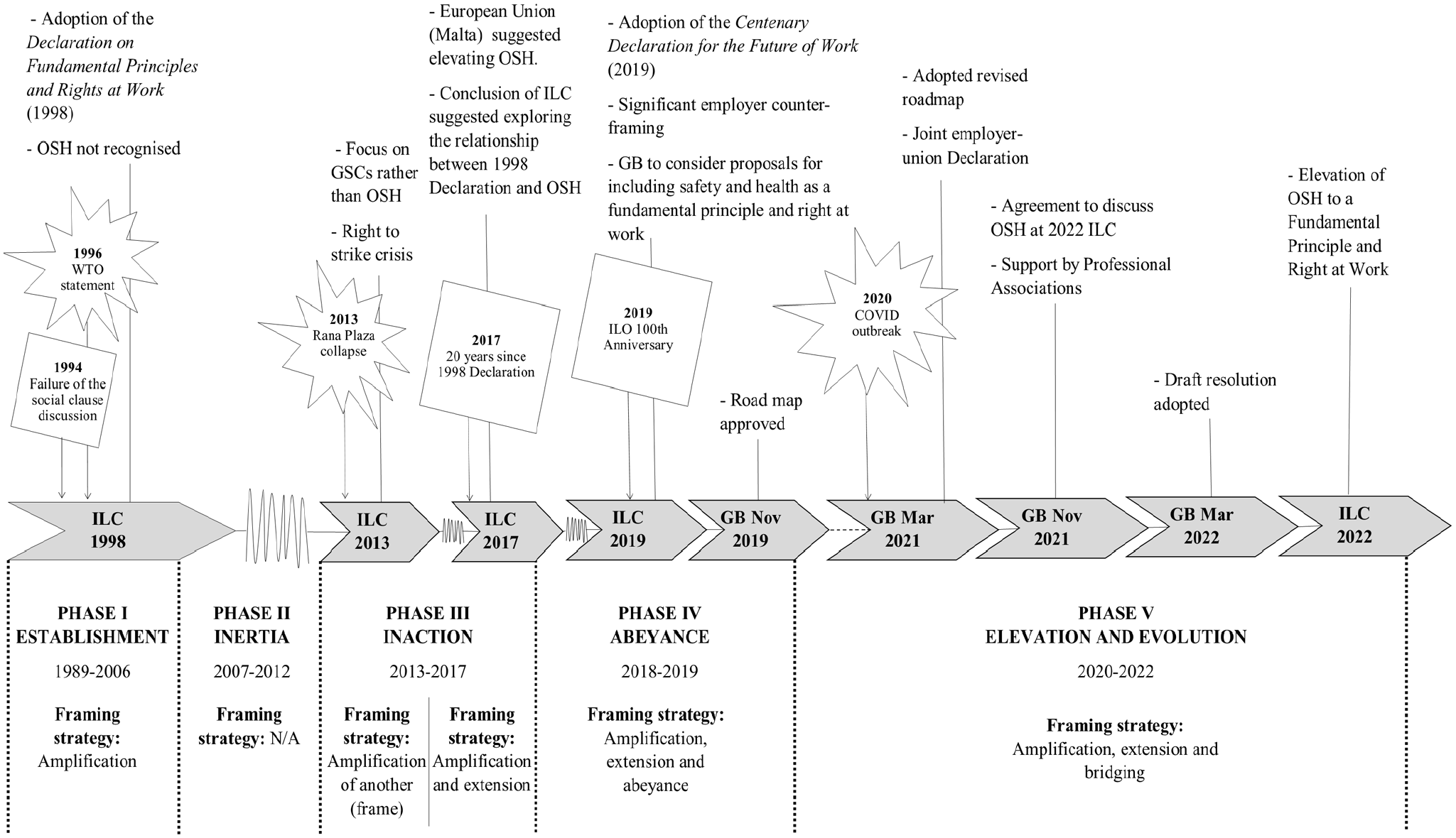
Mapping the elevation of OSH at the ILO.
The complete answer to why and how things happened ‘is unlikely to be found in ILO official documents’ (Maupain, 2020: 313). Consequently, we conducted semi-structured interviews with members of the workers’ group, ITUC, ILO officials (former and current), expert groups and the IOE to capture multiple perspectives on the process (Table 1). This was particularly important in understanding the implications of discussions that took place ‘backstage’ (i.e. outside of the halls of the GB and ILC), where concessions are often made. It was also essential in triangulating the document analysis (e.g. understanding why Rana Plaza did not act as a political opportunity in 2013 for OSH, or what the employers really meant when they said it was ‘premature’ to elevate OSH in 2021). To ensure anonymity we have labelled the interviews simply as ‘worker’, ‘employer’, ‘ILO’ or ‘expert’. To capture our interviewees’ ‘knowledge of events’ and ‘tap into [their] beliefs, perceptions, and experiences’ (Langley and Meziani, 2020: 372), interviewees were asked to chart the positions of the constituents in the process, why these were taken, and how and why they had changed (or not). During these interviews, we prioritised ‘how’ and ‘why’ questions and deployed an ‘alternative templates strategy’, asking what might have happened had certain framing strategies not been deployed or political opportunities exploited, comparing interpretations of the same events from different groups. This strategy is a ‘powerful means of deriving insight from a single rich case because the different theoretical interpretations provide the base for comparison’ (Langley, 1999: 699).
The number of interviews may seem limited to those unfamiliar with the ILO, especially considering the ILO invites over 4000 delegates to the annual ILC. In reality, only a few people are consistently engaged in (and motivated by) the discussion both inside the Office and within the constituencies. We followed a snowball sampling to identify participants and reached saturation once the same names were frequently repeated. Interviews were recorded, transcribed and then coded by hand by both authors. When combined with the document analysis, key events and junctures where framing/frames changed were identified. Both authors then engaged in an iterative process of discussion about our interpretations of the events, framing strategies and the phases of deliberation, until mutual agreement was reached. We also discussed our analysis with some participants to ensure our interpretations made sense to those involved. Thus, in summary, the analysis that follows combines a narrative strategy, visual mapping, temporal bracketing and an alternative templates strategy, drawing on rich qualitative data over time (Langley, 1999: 707).
Findings: The fifth fundamental
Phase I: Establishment (1989–2006)
The end of the Cold War, the spread of global supply chains and the establishment of the World Trade Organization (WTO) gave new impetus to debates over the link between labour standards and international trade. In 1993, the workers’ group in the ILO suggested a ‘world charter of workers’ rights’ to ensure that ‘free trade should equally be fair trade’ (Tapiola, 2018: 13–14). The failure of the social clause discussion at the ILO the year after (Figure 2) and recognition from the WTO that ‘the [ILO] is the competent body to set and deal with [labour standards]’ (World Trade Organization [WTO], 1996) thereby presented a political opportunity to reframe the ILO’s mandate and function. The result was the 1998 Declaration on Fundamental Principles and Rights at Work (hereafter the ‘1998 Declaration’). 2 Following the ‘torturous negotiations’ (worker interview), it was agreed that all ILO member states, by virtue of their membership, are ‘to respect, to promote and to realize [. . .] the principles concerning the fundamental rights’ of child labour, forced labour, discrimination and freedom of association and collective bargaining (ILO, 1998). The selection of the core rights was not based on ‘any coherent or compelling economic, philosophical or legal criteria’ (Alston, 2004: 485) but on the politics of tripartite deliberation.
As early as 1997, it was argued that OSH was a significant omission from the ‘core’ (Hepple, 1997; see also Alston, 2004: 486). During the 1998 deliberations, OSH was discussed as part of a ‘trade union wishlist’ (worker interview); however, as one ILO official put it, OSH was a ‘substantive right’ rather than an ‘enabling right’, and its inclusion did not resonate in the Palais des Nations. In fact, arriving at a position where the tripartite constituents had agreed on four core rights was viewed as a success in and of itself (ILO interview). As a worker representative argued: Including OSH into the mix would have led to a ‘no result’ on the whole Declaration and we could not have that [. . .] the employers were significantly against [the inclusion of OSH] and there was not enough will on the part of governments [. . .] it was not all [that] we wanted but a Declaration is better than no Declaration.
The 1998 Declaration signifies a significant frame transformation at the ILO and has become the ‘core’ of the global labour governance regime (Hassel, 2008). The Declaration is widely incorporated into both private (e.g. codes of conduct) and public governance mechanisms, including the European Union Generalised System of Preferences (GSP) programme and the United Nations Guiding Principles on Business and Human Rights (UNGPs) (Novitz, 2024). However, by identifying a ‘core’, other standards were ‘inevitably relegated to second-class status’ (Alston, 2004: 488).
Even as a ‘second-class’ standard, in the early 2000s, OSH became a ‘hot topic’ in the context of the ILO’s decent work agenda (ILO interview). The workers argued for extending the 1998 Declaration to cover OSH, especially as ‘globalization and free trade had adversely affected the safety, health and well-being of workers’ (ILC.2003/91/6/PR: 4). A Global Strategy on Occupational Safety and Health and the World Day for Safety and Health at Work were adopted in 2003, which provided the necessary conditions for the establishment of the Promotional Framework for Occupational Safety and Health Convention (C.187), one of just eight Conventions established in the past 20 years. The World Day for Safety and Health at Work, in particular, was critical in keeping OSH on the international agenda even during phases of dormancy (worker interview).
Phase II: Inertia (2007–2012)
Following the adoption of C.187 a period of inertia followed (Figure 2). OSH ‘went off the boil’ (worker interview) as the ILO shifted its focus to tangential issues such as HIV/AIDS, as a reflection of the priorities of international donors (ILO interview). As a former ILO official noted: ‘once you get money from governments, this gives you authority’, but unlike other international organisations, the ILO has a relatively small budget to support its activities and ‘tiny teams covering huge topics’ (Standing, 2008: 374). When it was discussed, OSH was often framed as a technical subject rather than a labour right and there was an assumption from both governments and employers that any legislation potentially increased costs (ILO interview). As the ILO had shifted to areas of ‘low-hanging fruit’, such as the eradication of child labour (Standing, 2010: 312), this made it a controversial topic for the constituents. As a member of the workers’ group summarised: You have an ILO which has shrunk down on a global level, you know, sort of eight to 10 people working in Geneva on occupational safety and health [. . .] African trade unions shifted their work from occupational health and safety to HIV [. . .] and Global Union Federations gradually pulled back on the work.
The ILO, like other SAFs, is a key battleground within which actors with ‘varying resource endowments vie for advantage’ (Fligstein and McAdam, 2011: 3). Collective action requires resources and, in this phase, both material (e.g. reports and studies) and ideational resources (e.g. suggestions by the Office to reinvigorate the ILO’s role on OSH) for the workers were limited and opportunities for framing in both the GB and ILC were rare.
Phase III: Inaction (2013–2017)
Crises in SAFs are more likely to originate ‘from without’ rather than ‘from within’ (Fligstein and McAdam, 2011: 8). However, while external political windows of opportunity create openings for the amplification of existing frames (e.g. from previous phases of deliberation) (Benford and Snow, 2000), they only open when events are (internally) framed as a possibility for change. The external opportunity of the collapse of the Rana Plaza building in 2013, where the ILO was the ‘object of pointed criticism for failing to take up its responsibilities’ (ILC.2013/102/DG: 24), ‘put workplace health and safety back onto the [ILO’s] agenda’ (ILO interview). However, this was overshadowed by the broader question of how to regulate global supply chains (Thomas and Turnbull, 2018). The workers’ group in the ILO purposively framed the discussion away from the building collapse and the OSH implications towards the plethora of other labour rights violations along supply chains, particularly in the garment sector (worker interview, see also Donaghey and Reinecke, 2018: 29). As a worker representative argued, ‘we know with the ILO that everything forms a queue. If you do one thing, then you are not doing something else [. . .] we had different priorities at the time and supply chains was our main focus’. Another suggested that ‘Rana Plaza gave us an opportunity to address [global supply chains . . .] an issue we had had long on the ILO’s agenda [since 2006]’.
The SAF of the ILO was also being shaken internally by the most significant constitutional crisis since the Organization’s foundation. In 2012, the employers questioned the existence of the right to strike and the ‘spectre’ of this discussion ‘haunted all our work’ (ILO interview). The right to strike crisis was indicative of the shifting power of the employers in the ILO. The end of the ‘Cold War consensus’ in 1989 – a period of détente between capital and labour – (La Hovary, 2015), the increasing power of international capital and declining global rates of unionisation (Visser, 2019) all helped in shifting power away from the workers in the ILO. This exacerbated existing power dynamics. The ILO’s first D-G, Albert Thomas (1919–1932), likened the ILO to a car in which the workers acted as the engine, governments as the steering wheel and employers as the brakes (quoted by Maupain, 2013: 123–124), which is clearly supported by the 25-year process of elevating OSH. As with all SAFs, interactants ‘know who their friends, their enemies, and their competitors are’ (Fligstein and McAdam, 2012: 11).
Following Figure 2, in 2017, the European Union group, represented by Malta, framed ‘20 years of the [1998] Declaration next year [as] an appropriate [internal] opportunity to initiate the process for reflection [. . . and therefore] the ILO should explore the feasibility to include occupational safety and health into [the 1998 Declaration]’ (ILC.2017/106/11-2/PV: 45). The suggestion by Malta was ‘paradoxical’ considering their lack of ratification of OSH standards (worker interview). Although the employers argued that ‘new rights’ should not be discussed (ILC.2017/106/11-2/PV: 19), the workers supported the EU’s proposal and the conclusions noted that the relationship between the 1998 Declaration and OSH should be ‘explored’ (ILO, 2017: 5). That is, in ‘ILO speak’, an agreement to suspend the intractable. In the following GB, the workers amplified the proposal that safety and health at work should be included among the fundamental rights: ‘for workers worldwide, the matter was becoming more and more urgent’ (GB.2017/331/PV: 126). Reminiscent of Phase I, employers counter-framed the suggestion, arguing that ‘expansion of the categories of those principles and rights to other labour issues would risk jeopardizing the consensus’ (i.e. a frame break) (GB.2017/331/PV: 28). With frame plurality comes inaction, because ‘interactants have different understandings about what is going on, what needs to be done, or how to do it’ (Gray et al., 2015: 130).
Phase IV: Abeyance (2018–2019)
How internal opportunities motivate collective action is best demonstrated by the 100th anniversary of the Organization. In preparation, a Global Commission on the Future of Work was established to set priorities for a ‘Centenary Declaration’ (ILO, 2019: 71–75). The Commission’s final report concluded that ‘it is time for safety and health at work to be recognized as a fundamental principle and right at work’ (ILO, 2019: 12). The workers’ group (unsurprisingly) supported the proposal and looked to extend the frame of the 1998 Declaration. The employers’ group (also unsurprisingly) counter-mobilised and argued that safety and health was ‘aspirational, not fundamental’ (ILC.2019/108/6/PV: 116) and ‘rights were unilateral, whereas OSH was about respecting rules and technical standards’ and therefore ‘it would not be appropriate to elevate OSH’ (ILC.2019/108/6/PV: 4).
Following what the employer spokesperson described as ‘one of the most challenging substantive discussions at the ILO in some time’ (ILC.2019/108/6/PV: 149), the workers retreated and conceded that ‘safe and healthy working conditions are fundamental to decent work’ (as opposed to a fundamental right) in the ILO Centenary Declaration with a suggestion for the GB to consider future proposals to elevate OSH (ILO, 2019: 6). OSH was not the only frame dispute at the Centenary discussions and the workers had to ‘fire-fight’ (worker interview) against counter-framing by employers on multiple issues including the fundamental recognition of collective bargaining as an ‘essential foundation of ILO action’ (ILC.2019/108/6/PV: 980). Pursuing the elevation of OSH in 2019 risked a frame break. As a worker representative stressed, ‘we knew we weren’t going to be successful [in 2019], but we were able to get a statement that was forward thinking’ (worker interview). While seen by a former ILO official as a ‘missed opportunity’, for the unions it was a strategy of abeyance, to fight the battle another day when a different mobilising structure would be available with additional opportunities for framing that may shift the power balance (Sawyers and Meyer, 1999). As the same worker representative highlighted: We absolutely wanted it [the elevation of OSH] in 2019, we’re trade unions after all [. . .] where you campaign and negotiate, and if you don’t get everything that you want at the first instance, then you retreat and fight another day. We’re like a rebounding bollard. You knock us over, we bounce back up, you knock us over, we bounce back up.
What creates and sustains SAFs is the ongoing use of social skill by actors (Fligstein and McAdam, 2012), and respondents noted the critical role of leadership in this respect in tempering expectations and framing what the group should be fighting for and against, within the context of the ILO. As one worker member stated: If you’re in the workers’ group, you’ll have some people who are arguing for something that is completely unrealistic and some people who are asking for something that is really easy and will not take you very much further.
Diagnostic frames in the ILO (e.g. safety and health is fundamental to decent work) are frequently shared; the challenge is agreeing on what to do about it (prognosis). Heated discussions continued in the following GB, where a roadmap was approved. Still, there was no consensus on whether there would be a future ILC discussion (GB.2019/337/PV: 25). The decision suggested another phase of inaction.
Phase V: Elevation and evolution (2020–2022)
The outbreak of COVID-19 resulted in the cancellation of the March 2020 GB, the June 2020 ILC and the subsequent GB in November 2020. Nevertheless, COVID-19 and the health and safety implications for workers worldwide acted as a political opportunity for labour to (re)mobilise and (re)frame their strategy at the ILO. In March 2021, the first GB since the outbreak of COVID-19, unions amplified the pandemic by constructing a frame that emphasised that safety and health at work needed to be addressed (diagnostic framing) but had yet to be translated into meaningful action (prognostic framing). The ITUC launched a campaign that stressed that OSH ‘must be recognised as a fundamental right for workers’, which would ‘place an obligation on ILO member states to adhere to the core occupational health and safety Conventions, regardless of ratification’ (International Trade Union Confederation [ITUC], 2021). In addition, during the 2021 World Day for Safety and Health at Work, the international union movement focused its framing on the adoption of OSH as a fundamental right. As a worker representative argued, the pandemic in the ILO assisted in ‘ramming home the importance of OSH with a specific example [. . .] loads of speeches started “as the COVID pandemic has shown us”, and this helped speed up the process’ (worker interview).
This framing of the pandemic as an ‘OSH crisis’ convinced governments about the importance of having healthy workplaces, making (economic) arguments against investing in OSH largely ineffective (ILO official). As the Deputy Director-General of the ILO noted, ‘the pandemic had reaffirmed the fundamental importance of OSH in protecting workers’ (GB.2021/341/PV: 48). COVID-19 also challenged the efficacy of existing mechanisms of labour governance: ‘to put it bluntly, it took a global pandemic to make clear that the world’s workplace health and safety systems weren’t fit for purpose’ (O’Neill, 2022). This was coupled with a motivational frame that stressed the number of workers who were dying to create a sense of urgency: ‘9 million people died [because of their work] between 2019 and 2022 [. . .] our argument is [that] no one should die at work’ (worker interview). However, the employers attempted to undermine the labour movement’s claims and counter-framed the pandemic as something that which had increased the ‘complexity’ and ‘implications’ of the workers’ prognosis and, therefore, recognising OSH as fundamental ‘was premature’ (GB.2021/341/PV: 44). In ILO speak, ‘premature’ means being adamantly opposed.
A crucial part of the union campaign was building bridges with relevant actors outside the ILO, who are ideologically congruent but lack access because of the tripartite structure. As one worker representative put it: ‘you buddy up with people who’ve got the same campaign aims as you and in that little intersection on the Venn diagram, you find an ILO instrument, and everyone is facing the same way’. A coalition of OSH professional organisations, including the International Association of Labour Inspectors (IALI), the Institution of Occupational Safety and Health (IOSH), the Society of Occupational Medicine and Collegium Ramazzini all submitted statements stressing the importance of elevating OSH at the ILO. This was useful, one worker representative argued, ‘to show to governments that it’s not just about trade unions banging on about stuff’ (worker interview) (as it had been for over 20 years). Another affirmed that ‘civil society alliances can be very, very important and can be very valuable [. . .] in putting pressure on the employers’ at the ILO (worker interview). The success of this coalition was in connecting the frames of the professional organisations, which stressed the technical aspects of OSH, with the broader human rights discourse being promoted by the unions (worker interview). Extending the technical focus to substantive human rights concerns was a particularly effective framing (ILO interview).
Frame bridging was also promoted through connections between the union movement and individual companies building on long-standing (national/sectoral) relationships and IFAs. In attempting to counter-frame the employers’ suggestion that the discussion was ‘premature’, the Building and Wood workers’ International (BWI) submitted to the ILO more than 300 joint trade union–employer declarations (primarily from the construction sector), including signatories such as the European Construction Industry Federation and European Confederation of Wood Working Industries, which supported the elevation of OSH (Building and Wood Workers’ International [BWI], 2021). As the workers’ spokesperson stressed at the time: ‘she trusted that the employers’ group saw the importance of such a message’ (GB.2021/341/PV: 45). Similarly, the Ethical Trading Initiative (ETI) orchestrated on behalf of some of the most prominent multinationals in the UK (e.g. Tesco and Primark) and CSOs (e.g. Oxfam and Anti-Slavery International) the advocation of the elevation of OSH ‘as a matter of urgency’ (McAllister, 2021). The ETI was a strong supporter of the elevation process, not least because one of the key worker representatives at the ILO was the Organization’s former Director but also because the ETI Base Code already included OSH. This ideational support, which was then magnified during the March 2021 GB, ‘helped in showing the employers that some of their biggest members were in support of OSH’, generated outside attention and discussion and put pressure on governments (worker interview).
The source of many opportunities (and challenges) a given SAF faces stems from its relations with other proximate fields (Fligstein and McAdam, 2012: 3). In this case, unions extended their frame to other labour governance SAFs. With support from the Office (GB.2021/341/PV: 49), they drew attention to the International Covenant on Economic, Social and Cultural Rights (1966), which recognises a right to ‘safe and healthy working conditions’ and Article 3 of the Universal Declaration of Human Rights (1948) that stresses that ‘everyone has the right to life, liberty and the security of person’. This framing stressed the mismatch between the ILO’s actions and those of other labour governance institutions (worker interview). As an ILO official argued: ‘there was a relative banality to the decision [. . .] it had already been agreed by other institutions that OSH was a human right [. . . and] this made it difficult for the employers to argue that the discussion was “premature”’.
In November 2021, there was a provisional agreement to include OSH in the ILO’s fundamental rights framework (GB.2021/343/PV: 57–8). However, there was still ‘the main challenge [of] the exact wording to be included’ (ILC.2022/110/3/PV: 4). Although the ILO had adopted 19 OSH Conventions, there were only three OSH standards, C.155 (1981), C.161 (1985) and C.187 (2006), that could be included due to their breadth and inclusivity (ILO interview).
With the end in sight, the strategy of the workers’ group at the ILC in 2022 was to extend their prognostic framing to the three key Conventions, aiming to maximise the commitment and responsibility of states and employers (worker interview). This was met with ideational support by the Office (ILO interview), IOSH, and the International Commission on Occupational Health (ICOH) (ILC.2022/110/1D/PV: 13). Employers only supported C.187 as ‘[it] provided ratifying member states with the necessary flexibility to implement its provisions regardless of their economic development’ (ILC.2022/110/1D/PV: 5). It was clear that the employers suggested C.187 on its own because it ‘did not impose any significant responsibilities on governments, and did not address the obligations and duties of employers’ (ILC.2022/110/1D/PV: 25). Without recognition of both C.187 and C.155 (C.161 was a ‘bargaining chip’ according to one worker representative) the discussions risked creating a ‘dead letter’ declaration.
Both interviews with workers and employers stressed the importance of (internal) frame bridging with government representatives, whose vote can ‘tip the balance’ (worker and employer interviews). A significant number of Asian countries exclusively supported C.187 (e.g. Bangladesh, China, India, Japan and Philippines), whereas others opted for both C.155 and C.187 (e.g. the Africa Group, the European Union and the United States) (ILC.2022/110/1D/PV: 21–6). Only Namibia supported the workers’ arguments for all three (ILC.2022/110/1D/PV: 11). The ensuing deadlock was finally broken ‘outside the room’ once ‘governments moved to support C.155 and C.187’ (worker interview). Twenty-five years after its first suggestion, OSH was finally recognised as a Fundamental Principle and Right at Work, signalling a significant frame transformation at the ILO and an evolution of the global labour governance regime.
Concluding discussion
The emerging global labour governance regime has simultaneously eroded unions’ power while creating new opportunities for unions to generate collective action. In contrast to other studies that have focused on particular international campaigns targeting multinationals or supranational institution-building, this research sheds light on how unions took advantage of a focal labour governance institution to create an agreement that has the potential to generate institutional power for workers at various levels. This study makes several empirical and theoretical contributions.
Through an analysis of the 25-year process leading to the elevation of OSH at the ILO in 2022 (Figure 2), this article demonstrates the effectiveness of what has been called a ‘labour diplomacy’ model of international unionism (Ford and Gillan, 2022). There is understandable concern for some that international unions and their leaders have moved away from an agitator model to a diplomatic one, losing touch with the grassroots (Hyman, 2005). However, in this case, unions were able to campaign and mobilise to reframe the labour governance regime in their favour. The (diplomatic) leadership of the union representatives was markedly crucial during this process, not just in terms of framing injustice as a collective grievance (Kelly, 1998) but also in coordinating the workers’ group, managing expectations and then identifying what should be framed, why, how and, importantly, when, in the context of the ILO.
Evidently, for trade unions, global labour governance mechanisms with their foundations in soft law will always be second best to collective bargaining and labour regulation and enforcement. However, in the context of declining union power, it can be meaningful for unions to mobilise support beyond the nation-state by building coalitions with other actors who share similar frames to establish or reframe existing mechanisms at the international level. Indeed, while the role of the ILO is subject to criticism, including the low ratification of its labour standards (including OSH) 3 (Baccaro and Mele, 2012) and lack of ‘teeth’ when it comes to enforcement (Standing, 2008), it is also evident that agreements made at the international level can strengthen institutional power for workers at the national and sectoral level (Thomas, 2021). How unions take advantage of other labour governance institutions offers a promising avenue for future research.
This article has provided a much-needed theoretically informed account of the evolution of labour governance above and beyond previous research that has focused primarily on the different forms, content and consequential effects of governance mechanisms (Meardi and Marginson, 2014: 658). It is evident from the case that framing is a useful analytical tool in looking at how unions foreground and background certain arguments while developing a coherent story of what is going on, what should be done and why people should pay attention (Gahan and Pekarek, 2013). We depart, however, from the previous literature in several ways. First, in contrast to studies that have focused on the role of societal and political pressures as critical drivers for labour governance (Schuessler et al., 2019), our study suggests that such external pressures alone are not sufficient. Political opportunities (e.g. disasters or pandemics) have the potential to shift power dynamics in institutions but must be framed in a way to generate collective action particularly as there is an ‘opportunity cost’ to prioritising one framing strategy over another (e.g. global supply chains rather than OSH in 2013). The concept of abeyance, in particular, helps us move beyond the ‘action–inaction’ dichotomy in most framing studies (Cornelissen and Werner, 2014) to instead view these processes over time as phases of retreat and advancement. While actors might choose full-scale mobilisation in response to political opportunities (as in 2021), in many other situations, particularly when facing other framing contests and a potential frame break, they may try to maintain their own framing (as in 2019). Unions, therefore, need to frame with clarity (logos), credibility (ethos) and empathy (pathos) but also at the ‘critical moment’ (kairos) if they are to be successful in mobilising collective action in global labour governance.
Second, previous research has overwhelmingly examined framing as an internal dynamic to mobilise fellow workers. However, externally oriented framing practices are also crucial in mobilising collection action, especially in contested SAFs such as the ILO. Unions now interact with many ‘external’ actors, networks and sources of influence and pressure, potentially requiring different strategies. Indeed, we must go beyond viewing framing strategies as discrete but instead as cumulative and complementary. In other words, while bridging (Gooberman and Hauptmeier, 2023) and extension (Heery and Conley, 2007) on their own are no doubt important in union revitalisation, in reality, workers use a variety of strategies depending on the target, their power vis-a-vis other actors, the ‘rules of the game’ of the field and what is likely to resonate among incumbents. Workers, in this case, combined the amplification of the pandemic as an OSH crisis, frame bridging with CSOs and companies outside the ILO, and extended their framings to external institutional frames in order to mobilise support. Amplification will always be needed to a greater or lesser extent and is a typical first step in generating collective action (e.g. creating a sense of urgency). In contrast, extension requires existing frames to be present (both internal and external to the SAF), and bridging necessitates having ideologically congruent coalitional partners available. Creating bridges with CSOs such as the ETI and IOSH to provide ideational support (e.g. writing letters of endorsement) is particularly important in the ILO’s SAF, given that the Organization’s tripartite structure does not (formally) allow much space for non-union CSOs in decision-making (Baccaro and Mele, 2012). Frame bridging was essential, albeit not at the expense of amplification: ‘I’m fairly certain that the 3 million deaths a year statistic has more impact [on employers and governments] than an occupational health specialist saying this is really an important issue’ (worker interview).
Our final contribution addresses the critique that SMT is relatively devoid of (institutional) context. By emphasising the SAFs in which framing occurs, this article shows how power manifests in different fields, how counter-framing and contestation take place, the impact of (external and internal) crises and the importance of resources (both ideational and material) for framing to be successful. The theory of SAFs also offers a way to consider spillover effects above and beyond union–employer interactions (cf. Ashwin et al., 2020) to the broader field. The immediate impact of the recognition of OSH is that member states that have not ratified the fundamental OSH Conventions must submit periodic reports on their progress towards ratification. Following the 1998 Declaration, a wave of ratifications of the eight core Conventions followed, to the extent that excluding the rights to freedom of association and collective bargaining, over 90% of member states have now ratified these fundamental Conventions. We are likely to see a similar reaction. Outside the ILO’s SAF, unions have pointed to the spillovers including the need to bring OSH into new trade agreements and its importance in domestic bargaining (worker interview). In the words of one worker representative (worker interview), now OSH is fundamental: It gets out of the building [. . .] out into the wider world and that’s the way I see its benefit. We are exporting it to other deals. Where in the past we would say should, we now say must.
Footnotes
Acknowledgements
We want to thank Jimmy Donaghey, as editor, the three anonymous reviewers who provided critical reviews, as well as participants at the 2022 International Labour Process Conference (ILPC).
Funding
The author(s) disclosed receipt of the following financial support for the research, authorship, and/or publication of this article: This article was made possible through funding from the UK Economic and Social Research Council (grant T81817C).
Ethics statement
This study has been approved by our institution’s ethics committee and has been performed in accordance with the ethical standards laid down in the 1964 Declaration of Helsinki. All participants gave their informed consent prior to their inclusion in the study.
