



Abstract
How the upward mobility chances of workers in unskilled or semi-skilled jobs are shaped by influences at the organisational and sectoral level remains an open question. This article aims to close this research gap by examining the role of internal labour market characteristics in the promotion prospects and wage increases of workers in semi-skilled and unskilled positions. The hypotheses are derived from dual and segmented labour market theory. Regression analyses based on linked-employer-employee-data (LIAB), covering 44,024 workers in semi-skilled and unskilled positions from 2005 to 2010, underline the importance of the internal labour market. A considerable share of workers moved to skilled positions through company change. For the workers who stayed with the company, career advancements were associated with regular training investments and formalised regulations at the company level. Collective agreements, in contrast, were associated with lower chances of upward mobility, but higher wages.
Introduction
In European political and scientific debates, in-company training is often seen as an instrument to achieve both productivity gains for the company and improvements in employment and promotion opportunities for employees, especially for disadvantaged labour market groups (Arulampalm et al., 2004; BMBF, 2015: 46; Bogai et al., 2017; Mohr et al., 2016; OECD, 2004; Wotschack, 2020a, 2020b).
However, a review of the existing research on continuing vocational training shows that the actual effects of in-company training on income, employability and upward mobility are far from clear (Asplund, 2005: 69). Although there have been several consistent research findings that prove positive effects from in-company training on wage increases and employability (Ramos and Harris, 2012), the overall number of empirical studies is rather small. Many studies have also been limited to specific countries, sectors or companies, and results have been inconsistent (Becker and Hecken, 2009: 378; Ehlert, 2017; Hansson, 2008: 22). Regarding theories in the field, the role of labour market institutions and collective actors is often neglected (Grimshaw et al., 2017; Krings, 2020). This article aims to fill this gap in the research. It is guided by the idea that labour market advancements of workers in semi-skilled or unskilled jobs are not only shaped by individual training behaviour, but also by the institutional structures of the internal labour market. The crucial question is in which way and to what extent are these workers’ upward mobility influenced by institutional characteristics at the company and sectoral level?
One prominent approach addressing the organisational and institutional context is the dual or segmented labour market theory (Dütsch and Struck, 2014; Emmenegger et al., 2012; Köhler et al., 2008; Sengenberger, 1982; Seo, 2021). It assumes that the labour market is structured into different sectors or segments: a primary sector characterised by jobs with good conditions regarding employment security, pay, training and promotion prospects, and a secondary sector with rather bad jobs, characterised by low skill demands, short-term employment, limited upward mobility chances and lower wages. The primary segment is typically present in larger companies with a more regulated internal labour market and hierarchical promotion and reward systems. In this typology, the question of the (im)permeability of the different segments remains unclear. According to the theoretical approach, workers’ abilities to move from the second to the first segment are strongly restricted by the segmented structure of the labour market.
A recent study in Germany has provided evidence of upward mobility of workers in the low-skilled segment, indicating at least some degree of permeability. According to this study, about half of the people without vocational qualifications were employed as skilled workers (Bürmann and Wiek, 2018). This raises the question of how they could get into skilled positions despite the dualised labour market structure and German vocational training system, which attaches great importance to formal qualifications. Two possible pathways – the subject of this article – are transitions in the external and internal labour market.
This article aims to explore these pathways further. First, the role of employer change is investigated. How does it relate to the upward mobility chances and earnings of workers in semi-skilled or unskilled jobs? Second, the impact of the institutional shape of the internal labour market is explored in terms of formalised HR policies, regular training investments, structures of employee representation and collective agreements.
Theoretically, this study builds on a critical reception of dual labour market theory that acknowledges the importance of legal regulations, collective actors, organisational policies and power relations (Emmenegger et al., 2012; Grimshaw et al., 2017; Krings, 2020) while also indicating more complex patterns of segmentation (Lukac et al., 2019; Seo, 2021).
Regarding the empirical base of this study, linked-employer-employee-data (LIAB) from the German Institute for Employment Research (IAB) was analysed (see Ellguth et al., 2014). The sample comprises of 44,024 full-time workers in semi-skilled and unskilled positions from 1272 companies; 26,853 of them did not change their employer during the five-year observation period (2005–2010).
One last remark on how the term ‘skills’ is understood in this study. Vocational skills are not a neutral concept; they are a socially constructed concept (Warhurst et al., 2017). In this article, we use the term in the (narrower) sense of nominal skills (Rigby and Sanchis, 2021: 23), defined as the skills employers are prepared to recognise and reward (in contrast to the entirety of workers’ knowledge, skills and experience). Semi-skilled and unskilled jobs indicate bundles of work tasks that are relatively easy to access, learn and perform without longer periods of vocational training.
Influences of upward mobility in low-skilled jobs: State of research
Formal training that leads to recognised vocational qualifications plays a crucial role in the highly institutionalised German vocational education system (Thelen, 2014). Though the idea of lifelong learning has been strongly emphasised by the public and scientific debate as the answer to an expanding range of practical and policy challenges, workers without adequate initial vocational qualifications get few ‘second chances’ in the German vocational education system to achieve formal professional qualifications during their employment careers (BMAS and BMBF, 2019; Rahner, 2014). However, with the Qualification Opportunity Act (since 2019) the German government has provided new financial support regarding formal training measures for this group.
Unlike formal training programmes – which are focused on general skills and lead to official professional qualifications – in-company training measures include informal training options such as courses, instruction or workplace-based forms of learning. These are initiated by the company and take place in the company context (Beicht et al., 2004). Making up around 65% of continuing vocational training programmes, they represent the largest segment of continuing training (BMBF, 2021). However, they focus on company-specific skill requirements and adaptation measures that are relatively short term and do not usually lead to recognised vocational qualifications. Long-term training programmes that offer employees opportunities to vocationally reorient or catch up on vocational qualifications are rarely represented (BMBF, 2015). Consequently, workers’ chances to achieve professional qualifications via continuing training are generally limited, particularly when they are working in jobs with low skill demands. Many of these workers report substantial concerns regarding whether continuing vocational training will actually pay off and lead to greater income, job security or promotion opportunities (Osiander and Stephan, 2018).
A review of the existing research on continuing vocational training confirms that the actual effects of in-company training on income, employability and upward mobility are far from clear (Asplund, 2005: 69). Although there are several consistent research findings that prove positive effects from in-company training on wage increases and employability (Ramos and Harris, 2012), the overall number of empirical studies is rather small. Many studies are limited to specific countries, sectors or companies, and their results are sometimes inconsistent (Becker and Hecken, 2009: 378; Hansson, 2008: 22). Moreover, many studies do not account for possible trade-offs between the different returns from training (Hansson, 2008: 22; OECD, 2004) such as income, upward occupational mobility or employment security.
Various studies have examined the role of continuing vocational training for career advancement opportunities in general, showing positive impacts on career advancements or employment security (Ebener and Ehlert, 2018; Green et al., 2000; Hansson, 2008; Pannenberg, 1995). The question of how on-the-job training affects the occupational mobility of workers in semi-skilled and unskilled jobs has only been addressed by a few studies. Evertsson’s (2004) findings show that employees with low qualifications are less likely to participate in training programmes that are relevant for promotions within the company. Sanders and de Grip (2004) examined the interplay between participation in training, job task profile and labour market mobility for low-skilled workers. They concluded that, for this group, continuing vocational training is only beneficial on the internal labour market.
A number of studies have demonstrated the positive effects of in-company training on income development (Becker and Schömann, 1996; Ehlert, 2017; OECD, 2004; Parent, 1999; Ramos and Harris, 2012; Zwick, 2003). Some reported varying returns from training depending on the size of the company (Ehlert, 2017; Pannenberg, 2008), occupational status of the workers (Evertsson, 2004), funding source (Booth and Bryan, 2002; Hansson, 2008), company change (Becker and Schömann, 1996; Booth and Bryan, 2002; OECD, 2004), type of training (mandatory or not) and the labour market segment (internal or not) (Ehlert, 2017).
Theory and hypotheses: Upward mobility in segmented labour markets
In the literature on continuing training, theoretical approaches that focus on human capital (Becker, 1975) dominate, emphasising the importance of individual characteristics and the labour supply side. The role of external and internal labour market characteristics in the career advancements of workers in semi-skilled or unskilled jobs has been widely neglected.
One important approach emphasising the organisational and institutional context is the dual or segmented labour market theory (Dütsch and Struck, 2014; Emmenegger et al., 2012; Köhler et al., 2008; Sengenberger, 1982). At the core of this theory is the assumption that jobs cluster in terms of (bad) pay, (lack of) employment stability and (limited) mobility opportunities, leading to a dualised labour market structure (Emmenegger et al., 2012).
Other scholars have questioned this assumption. The distinction between primary and secondary sectors might be too simplistic, as labour market segments have become more complex (Krings, 2020: 529). Moreover, the distinction of the different segments is usually reduced to employment contracts, overlooking how they combine with other aspects of precariousness like income, job prospects and perceived insecurity (Lukac et al., 2019; Seo, 2021). A recent study found evidence that a considerable share of workers is characterised by low income and lack of job prospects, despite having stable employment status (Seo, 2021: 494). Eventually, the role of institutions and actors in shaping different labour market segments is neglected (Krings, 2020: 530), underlining the need to explore the impact of (de-)regulation policies, collective agreements and unions’ bargaining power (Appelbaum et al., 2010; Prosser, 2016).
This study centres on Germany. Germany has been characterised as a prominent case of a coordinated market economy with a strong dual apprenticeship system, centralised collective bargaining and a strong organisation of continuing training activities at the company level (Allaart et al., 2009: 105; Estévez-Abe, 2005). However, coverage in collective bargaining has been shrinking since the 1990s due to increasing dropouts of companies and increasing numbers of precarious workers, particularly in the service sector (Swank et al., 2008). Consequently, there is evidence for a growing divide between the coverage of workers who do skilled work in the manufacturing sector and the large numbers of workers in semi-skilled and unskilled jobs who are not covered by the collective bargaining system (Doellgast et al., 2018; Thelen, 2009: 482; Thelen, 2014).
Likewise, the dual apprenticeship system has become more segmented. The growing service economy conforms less often to the standards of the traditional dual training system. There is evidence that the focus on standardised portable skills and exchangeable qualifications in occupational labour markets has been partly replaced by a system more geared towards company-specific skill needs (Thelen, 2009), less demanding (two-year) apprenticeships mainly in the service economy or school-based vocational tracks (as in the health and care sector) (Estévez-Abe, 2005; Thelen and Busemeyer, 2008). The traditional dual apprenticeship system is characterised by larger upfront investments in general and company-specific skills and strict, formalised skill requirements regarding promotion. For workers in semi-skilled and unskilled jobs, continuous non-formal training investments over the life course and more permeable employment trajectories gain greater importance (Thelen, 2014) and might also foster greater promotion chances.
Internal labour market characteristics and upward mobility chances
These developments show how the quality of work, employment and mobility chances in different labour market segments is shaped by organisational policies, legal and sectoral regulations and power relations (Grimshaw et al., 2017; Krings, 2020). When we apply this idea to the question of how workers can advance from semi-skilled or unskilled jobs to skilled positions, the focus shifts from individual training behaviour to the characteristics of the external and internal labour market. How does the presence or absence of inclusive regulations and collective interest representation at the company, sectoral and national level shape the upward mobility chances of this group of workers?
We expect that workers’ chances of moving from semi-skilled or unskilled positions to higher (skilled) functions will depend on the institutional structures of the company’s internal labour market. Staying with one employer does not necessarily help in moving up in the internal labour market; even less when workers are in a weak position – as is the case for workers in unskilled or semi-skilled jobs. We expect that the shape and structure of the internal labour market is an important determinant here. If it does not provide the resources and institutional structures to support upward mobility for those working in the low-skilled job segment, a change of employer might be the better alternative to improve their labour market chances. This basic expectation is broken down and tested in the following three hypotheses.
First, we expect that a considerable share of workers in semi-skilled or unskilled positions will not advance to skilled positions by staying in the company (hypothesis H1). We assume that this will typically be the case when it is more difficult to move up in the internal labour market due to a strong degree of internal segmentation.
Second, we expect that the upward mobility chances of workers in semi-skilled or unskilled positions will vary with the institutional characteristics of the internal labour market matter (hypothesis H2).
Institutional labour market influences at the company and sectoral level
Following the critical review of dual and segmented labour market theory (Dütsch and Struck, 2014; Köhler et al., 2008; Krings, 2020; Sengenberger, 1982; Seo, 2021), we expect that the promotion chances of workers in semi-skilled or unskilled jobs are influenced by companies’ training policies, the size of the internal labour market and its regulation via company agreements and interest representation structures. Large companies (H2.1), companies with regular or high training investments (H2.2), companies with formalised HR policies (H2.3) and companies with interest representation structures (H2.4) are associated with higher chances of career advancement for workers in low-skilled jobs.
The scope for professional or financial advancement is usually greater in larger companies than in small companies due to the more extensive resources and larger number of available positions. This should be beneficial for workers in semi-skilled and unskilled jobs in terms of their opportunities for career advancement.
As suggested by many policy makers and scholars who emphasise the importance of continuing training for upward mobility (often referring to human capital theory), regular and/or high in-company training investments for workers in semi-skilled or unskilled jobs should increase their chances of performing skilled tasks and being promoted accordingly.
Written regulations and procedures in HR work – in the form of target agreements, performance appraisals, job descriptions, procedures for filling positions and plans for staffing requirements – increase transparency and the amount of information on the actual performance of individual employees, future labour and skill demands and targeted personnel development. Workers in semi-skilled and unskilled jobs are likely to benefit from this in terms of targeted personal development and workplace learning to fill vacant, skilled positions.
Interest representation structures play an important role in rebalancing the power asymmetry between management and workforce in favour of employees and overcoming barriers to upskilling. Interest representation bodies are tasked with representing the interests of all groups of employees, including workers in semi-skilled and unskilled jobs. This includes their access to company rewards and promotions. Semi-skilled and unskilled workers in companies should therefore be more likely to realise occupational status improvements if interest representation structures are in place.
At the sectoral level, two important institutional context characteristics are of importance (hypothesis H3): collective bargaining coverage and the differences between ‘core’ versus ‘peripheral’ sectors of the German system of industrial relations – these go along with strong versus weak standardisation and formalisation of qualifications and careers.
Collective bargaining regulations set uniform standards for adequate salaries depending on tasks or qualifications. Wages are distributed according to collectively agreed standards depending on the required skills (pay group) and activity performed (pay grade). In this respect, an inclusive wage-setting effect of collective agreements would be expected (Eichhorst and Marx, 2015: 45), ensuring the participation of workers in semi-skilled or unskilled jobs (H3.1). On the other hand, due to stronger collectively bargained regulations, formal vocational qualifications are likely to play a greater role in internal promotion systems, which should make upward mobility within the framework of non-formal training activities more difficult (H3.2). In this context, tendencies towards closures on the part of trade unions may also play a role, insofar as these entail attempts to secure quality and income standards for certain functions via formalised qualification requirements and regulate access to these positions.
Regarding sectoral differences, we expect that in the ‘core’ sector of the German system of industrial relations with rather strong unions (manufacturing), there will be better wage development for workers in semi-skilled or unskilled positions due to a more inclusive wage-setting context (H3.3). In contrast, the transition from unskilled or semi-skilled jobs to skilled jobs will be more restricted due to stronger standardisation and formalisation of qualifications and career pathways in this highly regulated sector compared with other sectors (particularly the service economy) (H3.4).
Research design
Data
The hypotheses were tested using LIAB data from the IAB (Ellguth et al., 2014; Heining et al., 2012). Data were accessed via a guest visit to the Research Data Centre of the German Federal Employment Agency (BA) at the Institute for Employment Research (FDZ) as well as controlled remote data processing. The LIAB data (LIAB longitudinal model 9310) combines rich company information from the annual survey waves of the IAB company panel with register data from the BA.
Our sample of the LIAB data (2005–2010) includes all employees who were employed as ‘semi-skilled and unskilled workers’ at the beginning of the study period (2005). The decisive factor is therefore the occupational status in relation to the activity performed (and not the formal occupational qualification). Unfortunately, more recent waves of the LIAB could not be used for this study as the central occupational status characteristic of interest (‘semi-skilled and unskilled workers’) was no longer recorded.
The sample of workers in semi-skilled and unskilled jobs included in the study are all in full-time employment. The sample is therefore not representative of all employees in Germany. Although a fixed-effects model would have been possible (as confirmed by testing pooled ordinary least squares [OLS] regression against least squares dummy variables [LSDV]), we decided on the pooled OLS regression model for analytical reasons and data-related limitations. The focus of our study is on more time-constant explanatory variables – such as structural and institutional company characteristics – that do not vary much over the observed period of five years and would have been excluded in fixed-effects models. Institutional influences require time to unfold their effects; these could not be observed for a longer period due to data limitations.
A longer observation period was not possible as some of our key variables (most importantly occupational status to identify workers in skilled or semi-skilled jobs) were not used in later waves of the panel. To use the longitudinal structure of the data, we therefore decided to use pooled OLS and logistic regressions over a five-year observation period. Although we cannot make any statements about causal effects, our study aims to identify correlations between organisational characteristics (primarily the institutional context) and the upward mobility chances of workers in unskilled or semi-skilled jobs. After checking for intraclass correlations, which showed minor differences regarding our coefficients, we considered a simpler model with clustered standard errors as sufficient.
Method
By using regression analyses, possible promotions of semi-skilled and unskilled workers in the internal labour market were measured by occupational advancement from 2005 to 2010 from semi-skilled/unskilled worker to skilled worker, master craftsperson, foreman/woman or white-collar worker. The income development in the period under study (measured by the difference in ‘daily pay’ between 2005 and 2010) and the employment status (employment subject to social security contributions) at the end of the study period were also included as additional indicators.
Variables
We measured regular in-company training investments for the group of workers in semi-skilled and unskilled jobs, investigating whether the company provided support for continuing training for (at least one) semi-skilled and unskilled worker during the period under study, be it financial support or time off. Since the companies’ continuing training activities were measured at three points in time (2005, 2007, 2010), the variable can assume values between 0 (no investment in continuing training for semi-skilled and unskilled workers) and 3 (the company invested in continuing training for semi-skilled and unskilled workers three times during the observation period). Investments of two times or more over the observation period indicated regular training investments.
We also created a dummy variable that indicated whether the company had enrolled at least half (50% or more) of its semi-skilled and unskilled workers in continuing training at the beginning of the observation period (2005), indicating high investments for this group of workers. To reduce possible distortions due to compulsory training measures, we controlled for 15 sectors (and thus, possible differences in regulation). Nevertheless, an influence from in-company training investments as part of compulsory training cannot be ruled out.
As a control, we also included participation in formal continuing vocational training. We created a variable that indicated whether workers in semi-skilled and unskilled jobs had participated in continuing vocational training for at least two years during the study period. There were only 236 cases in which the occupational status in the company temporarily changed from ‘semi-skilled and unskilled work’ to ‘in training’ during the study period.
To measure collective agreement coverage, we created a dummy variable based on whether a sectoral or company collective agreement applied in the company. The variable only refers to the company of origin (even if an employee switched companies during the study period). The extent to which company HR work was formalised was measured using the degree of formalisation of HR policy (factor variable) in the following five dimensions (‘yes’ or ‘no’ questions): Does your company/department have (a) ‘written plans for staffing requirements?’; (b) ‘formally defined procedures for filling positions?’; (c) ‘job descriptions for the majority of jobs?’; (d) ‘written target agreements with employees?’; (e) ‘written assessments of work performance?’. A dummy variable was used to determine whether the company had an elected works council or staff council or another company-specific form of employee representation. To account for differences in company size, we created four dummy variables for companies with (a) less than 50 employees; (b) 50–249 employees; (c) 250–499 employees; and (d) 500 or more employees.
At the individual level, we controlled for age, gender and length of time at the company. At the company level, we included common control variables in the analysis: 15 industry dummies (based on Bechmann et al., 2012: 94); employee composition (metric variables for the share of women, part-time employees, older employees [50 years or older], high-skilled employees and semi-skilled and unskilled employees); location (whether the company is located in the western or eastern part of Germany); the company’s technological status (state of the art); (formal) employment security (exclusively permanent employment contracts); and skilled labour demand (problems finding suitable skilled workers when filling vacancies). All variables were recorded at the beginning of the observation period (2005). Since the period under review included the financial and economic crisis (2008), the analyses controlled for trends in employment (from 2005 to 2010) and earning situation (good to very good in 2010) in the company. To control for general increases in company wage levels and possible promotions in higher status groups, we also considered the average wage development (mean value) among other employee groups in the company.
Empirical findings
The sample for the following analyses comprises 44,024 full-time workers in semi-skilled and unskilled jobs from 1272 companies; 26,853 of them (from 585 companies) did not change their employer during the five-year observation period (2005–2010). Descriptive information on the sample can be found in Appendix Table 3.
The influence of internal labour market characteristics on occupational upward mobility
In line with hypothesis H1, staying in the company was negatively associated with occupational status improvements (see Appendix Table 4). The chance of moving up to a skilled position reduced by 36% (when keeping all other influences constant). In additional analyses, we also examined how the included company and individual characteristics were related to employment status at the end of the study period. These analyses revealed that the chance of employment security (measured as standard employment with social security contributions) increased significantly (by four times) when employees remained in the company, pointing at an important trade-off effect.
Variations in the chances of improving occupational status only occurred for a few of the included individual and company characteristics. The analysis showed the strongest positive effect for participation in formal vocational training, underlining the importance of formal training measures in the highly institutionalised German educational system. We also found evidence for gender and age-specific patterns of disadvantage; semi-skilled and unskilled women had significantly lower chances of occupational advancement. Regarding the included company characteristics, the analysis shows evidence of positive effects from formalised HR policies and regular training investments and a negative association with employee representatives. However, we only included the characteristics of the company of origin in the analysis; it is not possible to distinguish and control for internal labour market influences after company change. For that reason, we limited the sample to workers who did not change companies during the observation period (2005–2010).
Table 1 shows that the shape of the internal labour market is significantly associated with variations in upward mobility chances, confirming hypothesis H2. The promotion chances of workers in unskilled or semi-skilled positions who stayed with their company (from 2005 to 2010) varied with the institutional characteristics of the internal labour market. Among the included institutional company characteristics, large company size, regular training investments and formalised HR policies were positively associated with the career advancements of our focus group, confirming hypotheses H2.1, H2.2 and H2.3.
Logistic regression: Factors influencing career advancement (‘stayers’ only).
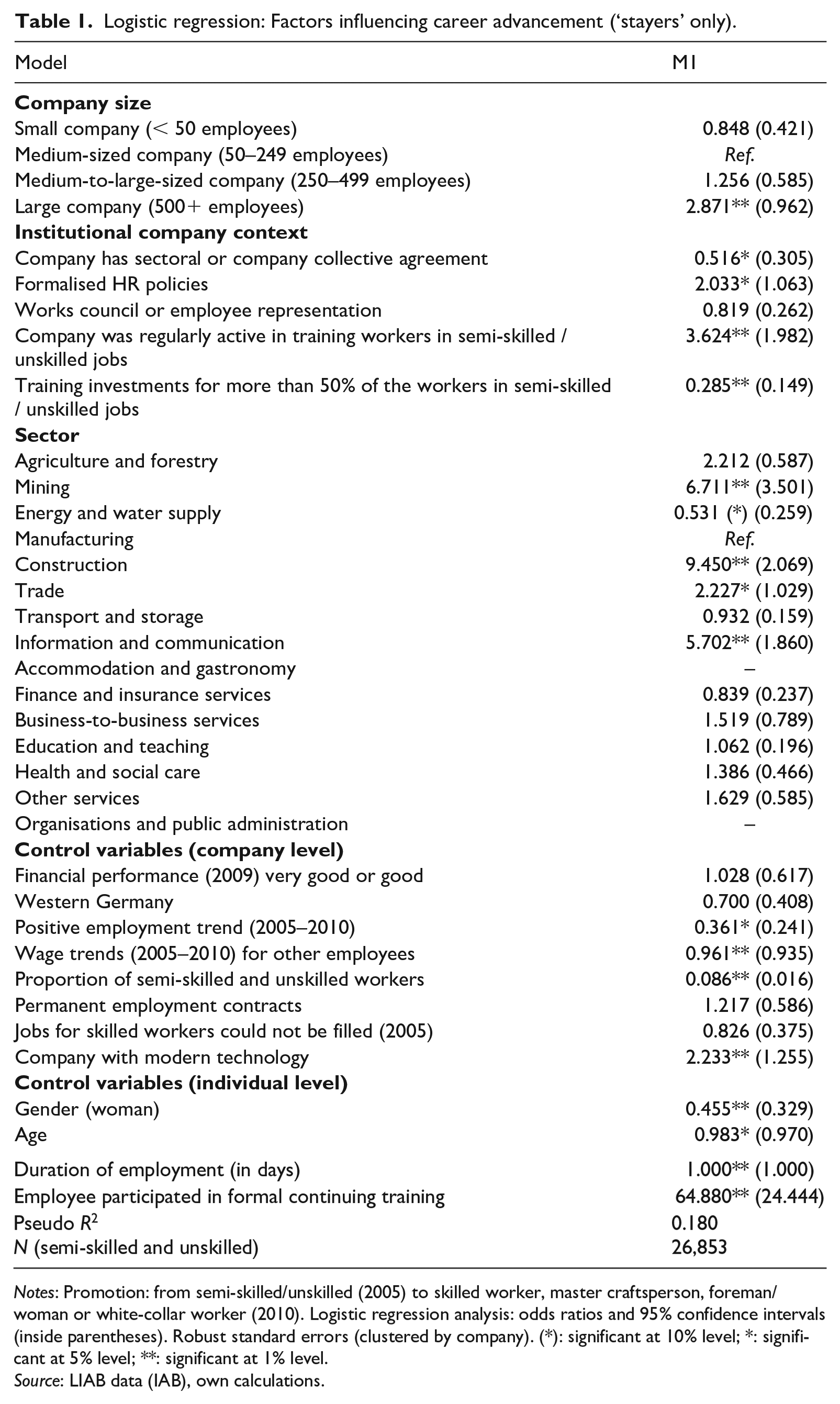
Notes: Promotion: from semi-skilled/unskilled (2005) to skilled worker, master craftsperson, foreman/woman or white-collar worker (2010). Logistic regression analysis: odds ratios and 95% confidence intervals (inside parentheses). Robust standard errors (clustered by company). (*): significant at 10% level; *: significant at 5% level; **: significant at 1% level.
Source: LIAB data (IAB), own calculations.
The chance of moving up to a skilled position was almost three times higher in large companies (with 500 or more employees), two times higher when the company had formalised HR policies and more than three times higher when the company invested in training for workers in low-skilled jobs on a regular basis. However, and in contrast to our expectations, larger training investments limited the promotion chances of workers in semi-skilled and unskilled jobs, probably due to higher levels of competition among workers who participated in training. Structures of employee representation (H2.4) did not have a significant effect.
The analyses also revealed significant influences regarding the institutional sectoral context, confirming hypothesis H3. The presence of collective agreements was negatively correlated with the upward mobility chances of workers in unskilled or semi-skilled jobs, confirming hypothesis H3.2 (and disproving H3.1). In companies with collective bargaining coverage, the chance of moving up to skilled positions was reduced by 50%. In line with hypothesis H3.4 (and in contrast to H3.3), there is evidence that transitions from unskilled and semi-skilled jobs to skilled positions were more likely in the construction, information and communication sectors than in the manufacturing sector. They were less likely in the energy and water supply sector, presumably due to an even higher degree of formalisation of positions and (required) skills.
Regarding the included control variables, the promotion prospects of workers in semi-skilled and unskilled jobs also varied with several of our control variables. Again, we found an even stronger positive effect for participation in (formal) vocational training (increasing the chances of career advancements by more than 20 times), underlining the importance of professional qualifications attained via the vocational training and education system.
Possible trade-offs: The influence of internal labour market characteristics on wages
Next to upward mobility chances, wage development is another important indicator for the labour market situation of workers in unskilled or semi-skilled jobs (Seo, 2021). The literature review shows that career advancements of this group of workers are often associated with lower wage levels compared with workers who possess (formal) professional qualifications (Bürmann and Wiek, 2018). Moreover, it has underlined the importance of possible trade-off effects regarding promotion, wages and employment conditions (OECD, 2004).
The analysis of wage development (with individual, company and sectoral characteristics as controls) provides evidence that remaining in the company is associated with growing wages (see Appendix Table 5). When workers in unskilled or semi-skilled positions did not change companies, they reported significantly higher wage increases on average. Given the negative correlation of staying with an employer with promotion chances and the positive correlation with (standard) employment security, there is evidence for an additional trade-off regarding wage development; for workers in unskilled and semi-skilled jobs, employer change was on average associated with losses of wage growth and higher risks of unemployment, semi-retirement, part-time work or marginal employment.
Analyses based on the subsample of workers who did not change companies between 2005 and 2010 (Table 2) provide evidence that larger company size and formalised HR policies are associated with wage increases. Regular or high training investments or structures of employee representation, in contrast, did not have a significant effect. Regarding sector-level influences, coverage by collective agreements was positively associated with positive wage development. Regarding differences between sectors, the analysis does not indicate better wage developments for workers in unskilled or semi-skilled jobs in the manufacturing sector.
OLS regression: Factors influencing wage changes (‘stayers’ only).
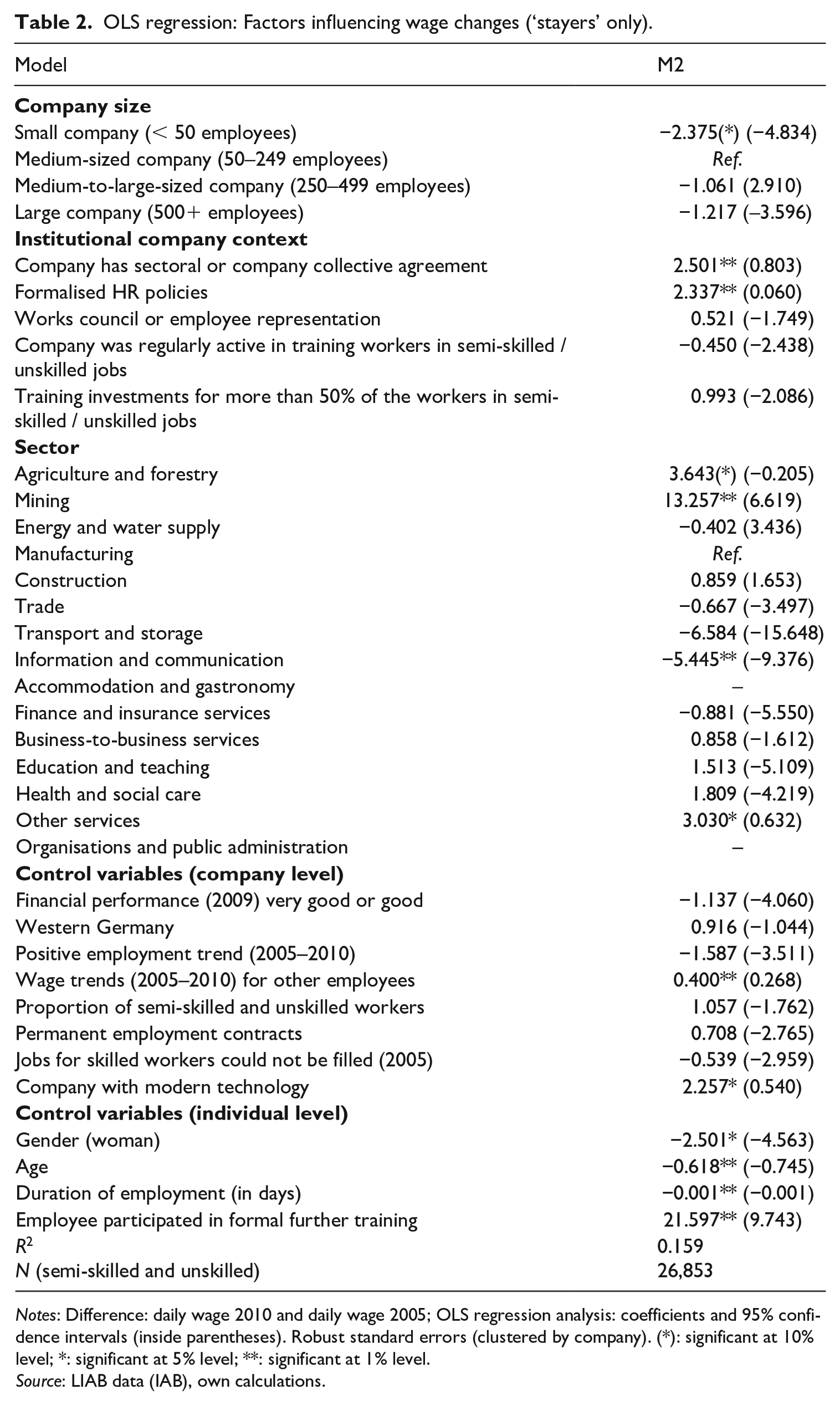
Notes: Difference: daily wage 2010 and daily wage 2005; OLS regression analysis: coefficients and 95% confidence intervals (inside parentheses). Robust standard errors (clustered by company). (*): significant at 10% level; *: significant at 5% level; **: significant at 1% level.
Source: LIAB data (IAB), own calculations.
Summary and discussion
In line with findings from previous research (Bürmann and Wiek, 2018), this study found evidence that a considerable share of workers in semi-skilled and unskilled jobs (11%) were able to move up (in the observed period from 2005 to 2010) to skilled jobs that require a formal vocational qualification. The question arises of how workers performing semi-skilled and unskilled tasks were able to get into these jobs, despite the great importance the German vocational training system attaches to formal qualifications.
The data used in this study (LIAB) provided company- and individual-level longitudinal information on full-time semi-skilled and unskilled workers for the period from 2005 to 2010. The detailed company information allows us to include differences in the regulation of the internal labour market concerning collective agreement standards, company regulations or interest representation structures for the first time. At the same time, the data have limitations that must be considered when interpreting the results.
The findings apply to a rather privileged sub-segment of semi-skilled and unskilled workers who are in full-time employment. Chances for upward mobility and wage increases should be significantly better for this segment of workers than for the overall group of semi-skilled and unskilled workers, who are often in more precarious employment.
Another problem with the data is that the information on occupational status is employer data for which the accuracy or timeliness of the information was not verified. Consequently, we can assume that the data did not account for all changes in occupational status and that occupational status improvements are therefore underestimated in the analyses. However, we assume that missing information is missing at random and that there is no systematic bias.
Another limitation refers to the training indicators used in this study. Regular training investments by companies and workers’ participation rates are a rather rough measure as they neglect differences in the length and importance of courses. As Green et al. (2000) have shown for the British case, the increase in training participation in recent decades has been accompanied by a decrease in the volume of training.
Finally, the data do not allow us to control for the influence of unobserved individual characteristics that may affect the relationship between our independent and dependent variables. We know from existing research that this can lead to statistical distortions (Becker and Schömann, 1996). The effects should therefore be interpreted with this limitation in mind. We attempted to control for unobserved factors at the company level and above, considering employee development, demand for skilled labour, wage development for other employee groups and the institutional company context.
Overall, the results of this study underline the importance of differences in the shape and regulation of the internal labour market. We made three central findings.
First, we found clear evidence supporting the main thesis of this article that workers’ chances of moving from semi-skilled or unskilled positions to higher (skilled) functions are shaped by the institutional structures of the company’s internal labour market. For a significant share of the workers in our sample, staying with their employer was associated with considerably lower promotion prospects, though with higher wages and job security.
Second, regarding the shape of the internal labour markets, we found that large company size, regular training investments and regulations at company level were associated with significantly better chances of upward mobility. The regulation of the internal labour market via formalised HR work procedures – such as written target agreements, performance appraisals, job descriptions, procedures for filling vacant positions or plans for staffing requirements – positively influenced the career advancement opportunities and wage development of workers in semi-skilled and unskilled jobs. When the company promoted in-company training for this group of workers on a regular basis, their chances of advancing to skilled occupational positions were three times higher. Structures of employee representation, in contrast, were neither associated with better promotion chances nor better wage development for this group. Though works councils are formally obliged to represent the interests of all workers, they might either not be willing to use their bargaining power for better promotion prospects of this group of workers or not able to prevail against management interests.
Third, regarding the role of the sectoral level, our study finds evidence for a contrary role of collective agreements. On the one hand, they fostered a positive wage development for workers in unskilled or low-skilled jobs, presumably by setting standards for pay in relation to defined work tasks; on the other hand, they restricted promotion trajectories beyond the formalised vocational training system by giving greater weight to formal vocational qualifications and training measures. In this respect, collective agreements run the risk of contributing to the limited upward mobility of workers in semi-skilled and unskilled jobs. Regarding sectoral differences, our study found evidence that transitions from unskilled or semi-skilled to skilled jobs are more difficult in the core sectors of the German system of industrial relations (like manufacturing), presumably due to the stronger standardisation and formalisation of qualifications and careers.
Surprisingly, in companies with large training investments (training provided to 50% or more of semi-skilled and unskilled workers), workers’ chances of career advancement were reduced and only increased if they changed companies. These results are consistent with the predictions of the labour queue model (Thurow, 1975) – long queues for promotion reduce individual chances for upward mobility and can be avoided by company change.
Conclusions and implications for labour market theory and policies
The results of this study underline the importance of institutional arrangements at the company and sectoral level for the upward mobility of workers in semi-skilled or unskilled jobs. This has been widely neglected in the literature. How workers in low-skilled jobs advance in the labour market is not only determined by different labour market segments (as stated by dual labour market theory) or individual characteristics (as emphasised by neoclassical theory), but also shaped by institutional regulations and policies at company and sectoral level (Appelbaum et al., 2010; Krings, 2020). Staying with one employer was not related to better promotion chances for this group of workers, while the presence or absence of inclusive regulations and collective interest representation made a significant difference.
A key finding of this study regards the role of company policies and regulations. In line with a critical review and extension of dual labour market theory (see Appelbaum et al., 2010; Krings, 2020; Lukac et al., 2019; Seo, 2021), our study shows evidence that upward mobility of workers in unskilled and semi-skilled positions is shaped by large company size and regular training investments focused on this group of workers as well as formalised HR policies covering the fields of performance appraisals, job descriptions, procedures for filling vacant positions and plans for staffing requirements. This finding underlines the need to consider and study institutional characteristics of the internal labour market more carefully. Moreover, possible trade-offs between promotion, wages or employment security need to be considered (Ebener and Ehlert, 2018; Seo, 2021) to evaluate their impact on labour market segmentation.
Regarding sectoral differences and collective interest representation, our study provides evidence for a reverse pattern, in line with predictions from the comparative political economy literature (Estévez-Abe, 2005; Thelen, 2009: 482). In the highly regulated manufacturing sector, transitions to skilled jobs are more difficult to realise, presumably due to the stronger standardisation and formalisation of qualifications and career pathways and their enforcement by collective agreements and strong unions. Regarding wage development, workers in unskilled or semi-skilled jobs benefit when they are employed in the manufacturing sector or have bargaining coverage. In this respect, strong unions and collectively agreed standards ensure the participation of this group in positive wage development but restrict their occupational upward mobility.
A last finding concerns the important role of participation in formal vocational training. In line with previous research (see, for example, Ehlert, 2017), the results indicate that opportunities for occupational status improvements and wage increases for workers in low-skilled jobs depended substantially on participation in more lengthy vocational training, underlining its crucial role in bridging different labour market segments in the highly institutionalised German vocational education system.
Supplemental Material
sj-pdf-1-wes-10.1177_09500170241275861 – Supplemental material for Crossers in a Segmented Labour Market: Occupational Advancement and Wage Changes from Semi-Skilled and Unskilled Jobs
Supplemental material, sj-pdf-1-wes-10.1177_09500170241275861 for Crossers in a Segmented Labour Market: Occupational Advancement and Wage Changes from Semi-Skilled and Unskilled Jobs by Philip Wotschack and Claire Samtleben in Work, Employment and Society
Footnotes
Funding
The authors disclosed receipt of the following financial support for the research, authorship, and/or publication of this article: This research was part of the empirical research project ‘The provision and effects of company provided further training for the labour market integration of low skilled workers’, funded by the German Research Foundation (DFG). The open access publication of this article was funded by the WZB Berlin Social Science Center via the Sage Journals Online Consortium.
Supplemental material
Supplemental material for this article is available online.
References
Supplementary Material
Please find the following supplemental material available below.
For Open Access articles published under a Creative Commons License, all supplemental material carries the same license as the article it is associated with.
For non-Open Access articles published, all supplemental material carries a non-exclusive license, and permission requests for re-use of supplemental material or any part of supplemental material shall be sent directly to the copyright owner as specified in the copyright notice associated with the article.
