




Abstract
In many countries, unions, with conflicting political identities, compete for works council positions. However, inter-union solidaristic forms of cooperation can occur within these same institutions. This article advances the concept of strategic group identity to explain the makeup, success, failure and longevity of inter-union cooperation in this context. Based on case studies of inter-union conflict and cooperation on works councils in the French automotive industry, the article highlights the importance of inter-union identity congruence in examining responses to shared threats. Several implications for understanding inter-union solidarity are developed.
Introduction
Works councils are a prominent vehicle for industrial democracy. In many countries, periodic competitive elections among trade unions determine works council composition. These elections force unions, often with long-standing political differences, to compete for workers’ votes (Pries, 2019). Despite this competition, unions can and do cooperate on works councils (Gumbrell-McCormick and Hyman, 2013). Yet the extent to which unions, competing against each other for works council positions, can develop inter-union cooperation within these institutions is little explored or understood. This article aims to conceptualise how such union cooperation comes about – cooperation being understood as a form of social interaction where two or more actors work together to a common end. The article further aims to conceptualise which unions are likely to be involved and how long cooperation might last.
Ideas from organisational strategy are extracted to advance understanding. Specifically, the article draws upon the concept of strategic groups, which proposes that competing organisations cooperate when exposed to shared threats (Peteraf and Shanley, 1997; Reger and Huff, 1993; Sonenshein et al., 2017). Crucially however, cooperation is likely to form and only persist when participating organisations possess complementary identities. Complimentary identities enable actors to coalesce around a ‘group’ to secure mutual interests. The group may even form its own identity, collaborating over the long-term to achieve interests. However, actors with incongruent identities struggle to sustain cooperation even when faced with shared threats.
The article applies such insights to the exemplary case of French works councils: exemplary as France is renowned for multiple unions with varying political identities competing for votes in works council elections. The article deploys two case studies conducted over several years examining inter-union conflict and cooperation on works councils across 12 automotive plants owned by Peugeot Société Anonyme (PSA) 1 and Renault. Applying insights from strategic groups, the article shows which forms of inter-union cooperation are likely to work, which are not, who is likely to be involved and how long cooperation is likely to last and why. The analysis offers a contribution to the literature via its synthesis of insights from organisational strategy literature to crucial employment relations concerns on inter-union solidarity. In doing so, the article moves beyond recent efforts dichotomising inter-union solidaristic behaviour into either interest-based or identity-orientated forms (Behrens and Pekarek, 2021; Benassi and Dorigatti, 2015). Rather, the article highlights – via the lens of strategic groups – not only how interests and identity interact, but how shared interests are insufficient for ensuring the durability of inter-union cooperation where complementary identities among participant unions are absent. Highlighting the significance of compatible inter-organisational identities for sustainable inter-union cooperation offers a novel way to think about workplace and union solidarity, which is of growing interest in the field (Beck and Brooks, 2020; Morgan and Pulignano, 2020).
Next, the article turns to conceptual issues around inter-union conflict, cooperation and solidarity before advancing how strategic group insights might contribute to understanding. The article then moves to a granular level of detail on French works councils as the institutional setting. After detailing the fieldwork methodology, the findings are presented. The article concludes with a discussion and the raising of implications for further testing and refinement of the ideas presented herein.
Conceptual issues
Works councils, as institutions for representative communication, are well-studied (Rogers and Streeck, 2009). Arrangements vary across countries. Statutory provision underpins some, others are voluntary and there are differences in rights and responsibilities, varying from co-determination to consultation. Works councils require employees to elect representatives in several European countries. In some, elections are monopolised by unions, encouraging inter-union competition. Nevertheless, cooperation can occur on such structures and this section considers inter-union conflict, cooperation and solidarity in more detail.
Conflict, cooperation and the role of solidarity
Conflict and cooperation in cross-country works councils is well-studied, with scholars frequently observing barriers to cooperation: unions prioritise local concerns that conflict with the interests of cross-border counterparts (see Whittal et al., 2017). Although work on inter-union works council elections is slight, Martinez-Lucio (2017) notes such systems are voters ‘rather than members’ trade unionism. Conflict quickly emerges in this context as one union may denigrate competitor unions to win votes. Beyond works councils, however, literature more generally identifies other sources of inter-union conflict: competition between unions of a ‘militant’ and ‘moderate’ persuasion based on political rivalries or different bargaining positions (Dundon and Dobbins, 2016; Fox-Hodess, 2020) or indeed battles over demarcation, membership and ‘poaching’.
Despite potential for inter-union conflict, unions can cooperate on single or multiple issues (Behrens and Pekarek, 2021). The duration and intensity of coordination might vary from one-off exchanges on individual issues to extended commitments over continuous periods. Regarding what motivates cooperation, Benassi and Dorigatti (2015) propose either ‘self-interested instrumental logic’ or solidarity-driven ‘ideological logic’. Similarly, Behrens and Pekarek (2021) note that union cooperation in the face of immediate threats tends to be driven by instrumental logic, prioritising narrower self-interested concerns. They argue that where unions’ social visions come under threat, inter-union cooperation is more likely to be animated by ‘ideological concerns’.
A growing area of interest concerning inter-union cooperation is the concept of solidarity to characterise unity of action and mutual support among groups identifying a common interest (Beck and Brooks, 2020). Solidarity can be ‘interest-based’, emanating from the structure of the labour process (Atzeni, 2010) or can be actively organised (Simms, 2012) via pragmatic political alliances to achieve shared goals (Morgan and Pulignano, 2020). Solidarity can derive from a more ideological-based ‘morality of justice’ (Bolton and Laaser, 2020), but can also be inclusive or exclusionary in orientation (Thomas and Tufts, 2019). Citing the American sociologist Robert Putnam, Morgan and Pulignano (2020) note that solidarity reflects ‘bonding’ and ‘bridging’ elements; the former provides similarity within the group and encourages the group to act together, the latter refers to the ability to network across different groups with some limited commonalities. Literature has also identified enablers and constraints to solidarity (Coderre-LaPalme et al., 2021) and highlighted where it can emerge (McBride and Martinez-Lucio, 2011). Institutional context is important: where employment institutions encourage fragmentation through, say, precarious contracts or contingent work, inter-worker solidarity weakens (Doellgast et al., 2018; López-Andreu, 2020; Tassinari and Maccarrone, 2020).
Common to solidarity studies is an appreciation of identity (Doellgast et al., 2018; López-Andreu, 2020; Morgan and Pulignano, 2020; Simms and Dean, 2015; Tassinari and Maccarrone, 2020). Identity is ‘the relatively stable characteristics and orientations of an organisation . . . which have both an internal dimension (assuring members, activists and officials what the union is and does) and an external one (proclaiming the nature of the union in the broader industrial relations and public sphere)’ (Gumbrell-McCormick and Hyman, 2013: 242). This latter external feature suggests identity incorporates ideology into its orbit insofar as the latter is an instrument of legitimisation (Fox, 1971: 124). Identity features, for example, in recent studies of union organising (Doellgast et al., 2021). Yet, there is a lack of understanding of how union identities assist inter-union cooperation and solidarity, despite the important role identity plays more broadly in shaping union behaviour (Hodder and Edwards, 2015).
While the literature provides insights into inter-union conflict and cooperation, scope remains for further development around the role of union identity in inter-union cooperation and solidarity in the context of institutional influences like works councils. There are specific gaps around why unions may cooperate in some instances but compete in others or indeed the basis on which unions who compete for works council positions come to subsequently cooperate. There is a lack of insight into factors influencing the longevity of union cooperation, as noted by Behrens and Pekarek (2021). To advance understanding, this article draws on a set of relatively novel conceptual ideas for the field that offer both explanation and prediction.
Strategic group identity
Specifically, the article extracts ideas from organisational strategy on ‘strategic groups’ (Peteraf and Shanley, 1997; Whetten, 2006). In understanding how cooperation can form among competitors, strategic group analysis explains why rivalrous organisations can cooperate, the actors likely involved and the factors influencing the longevity of cooperation. This literature analyses inter-organisational relations, such as agglomeration and coopetition, to illustrate how organisations competing with one another can cooperate under certain circumstances. The result is a strategic group: a collection of organisations with similar operational models and strategies (Bogner et al., 1988). Strategic group literature suggests cooperation between organisations is likely when their interests overlap. Organisations may form a strategic group to limit new entrants, share best practices or collude to control the market (Caves and Porter, 1977; Dranove et al., 1998; Hatten and Hatten, 1987). Thus, strategic groups of organisations who usually compete for work together in several ways where it is in their shared interests to do so.
In addition to interests, this literature considers the role played by identity in forming strategic groups (Peteraf and Shanley, 1997). Commonalities in group members’ identities, which interrelatedly comprise their ‘central’, ‘enduring’ and ‘distinctive’ characteristics, facilitate cooperation (cf Albert and Whetten, 1985). Central characteristics define the organisation in terms of their self-perception; enduring characteristics are traits deeply embedded in the organisation throughout its history; distinctive characteristics set the organisation apart from others (Whetten, 2006). Central characteristics evolving out of a long-standing idiosyncratic history can of course make an organisation highly distinctive. Peteraf and Shanley (1997: 166) argue that strategic groups can develop their own group identity derived from ‘a set of mutual understandings among members . . . regarding the central, enduring and distinctive characteristics of the group’. The literature emphasises the role of organisations’ central characteristics in helping build coordination and solidify group membership (Anand et al., 2013; Porac and Thomas, 1990; Porac et al., 1995).
Notably, strategic groups’ boundaries can be relatively ‘blurry’, comprising a core set of members, but with some organisations on the periphery (Reger and Huff, 1993). Peripheral organisations may identify less strongly with the group. The existence of peripherals can lead to discrepancies in the ‘strength’ of the group’s identity, impacting overall group performance. Peteraf and Shanley (1997) propose that members’ performance improves when all members identify strongly with the group. However, if group identity is weak, performance may not be enhanced, and the group’s existence may falter. Thus, strategic groups’ identities can vary in strength, determining how long the group persists and whether it can leverage positive outcomes for members.
Another critical factor affecting group identity strength is an ‘outgroup’ or common rival. Several studies support the idea that a common rival promotes cooperation among individuals (Brewer and Kramer, 1986; Kramer and Brewer, 1984), but this can also be true among organisations. Ingram and Inman’s (1996) study of Canadian and American hotels found that the presence of a common outgroup (i.e. firms across the border) increased the salience of local organisations’ central characteristics, fostering coordination among previously competing organisations. The increased salience of their identities (such as geographical origin in the Canadian hotels’ case) encourages strategic group members to identify more strongly with the ‘ingroup’ and work together to ostracise the common rival. Hence, competition with an organisation whose identity is sufficiently ‘other’ encourages cooperation among those with more complementary identities. In this way, even competing organisations can form strategic groups when faced with a common outgroup.
In sum, the strategic group literature highlights important interactions between identity and self-interest, which combine to create patterns of cooperation and competition. This approach offers potential to build upon prior conceptualisations in the field of employment studies hitherto dichotomising solidarity into interest-based or identity-orientated (Behrens and Pekarek, 2021; Benassi and Dorigatti, 2015). Strategic group literature suggests not only interactions between the two, but that self-interest is not sufficient for sustaining cooperation in the face of incongruent identities. To be sure, unions are more complex organisational forms than the firms that populate the strategic group literature, where the environment readily imposes one set of interests (profits or market share). Unions contend with various interests and actively construct collective interests under distinctive cultural legacies. Such caveats aside, the strategic group literature promises insight into union cooperation under conditions of competition. Overlapping interests from shared threats induce cooperation, but union cooperation is more likely among unions with similar central characteristics. The greater the identity congruence among cooperating unions, the more enduring the cooperation. The reverse also holds: the weaker the identity congruence, the less enduring the cooperation. When a union whose central characteristics fundamentally diverge from other unions emerges as a ‘market player’, the unions with complementary identities are likely to cooperate as a group to combat the former. Although these insights may well hold as a general case of explanation, the article turns to apply them to the case of inter-union behaviour on French works councils.
Context for the study
France epitomises inter-union rivalry structured around antagonistic political identities and competition in works council elections. Indeed, electoral strength rather than membership is the source of union legitimacy and influence. While such competition occurs across several European countries, France may be most severe due to its unusually high number of unions who compete in quadrennial proportionally representative elections for plant-level works councils. Works councils, holding information and consultation rights, have existed since 1945. Union activists occupy positions in works councils in many sectors. Electoral success determines each union’s proportion of seats on plant works councils; this is their plant-level representativeness which aggregates to company-level works council seats. Once elections have taken place, all representatives must elect a works council secretary, vice secretary, treasurer and vice treasurer. These positions of office offer unions more influence over local decision-making (e.g. allocation of budgets).
In 2008, local works council election scores became the determinant in whether unions have rights to collectively bargain. Unions need 10% of votes before they can negotiate agreements, while the validation of collective agreements depends on one or several union signatories holding at least 30% representativeness. Until 2016, unions holding 50% or more could block agreements signed between other unions and employers before government reforms removed such obstruction rights. The impact of tying unions’ institutional security to works council elections forces unions into ‘a kind of beauty contest’ between rival organisations (Gumbrell-McCormick and Hyman, 2006: 483), exacerbating inter-union divisions by creating a permanent electoral campaign as unions attempt to stand out in a crowded electoral marketplace (Béroud et al., 2013). However, unions are known to engage in alliances on local works councils (Andolfatto and Dressen, 2012; Gantois, 2014), although such dynamics are empirically noted rather than theoretically explained.
While French unions organise at national, sectoral, company and plant levels, the rise of company bargaining in recent decades increases the significance of company and plant union branches. The different unions exhibit several identities, and scholars distinguish between militant ‘radical’ unions (see Guillaume, 2018) and moderate ‘reformist’ unions (Parsons, 2019). While such dichotomies are fairly blunt labels, radical unions tend to adopt the principle of class struggle and socialist politics, while ‘reformists unions pursue a more pragmatic course of action [. . .] improv[ing] workers’ living conditions, without reference to social change [. . .] focusing on collective bargaining and try to obtain mutual gains for employees and employers’ (Doucouliagos and Laroche, 2003: 321).
The main union identities can be described in turn. The Confédération française démocratique du travail (CFDT) considers itself a union of accommodation, stressing compromises balancing business interests with those of employees (Ancelovi, 2014). Its shift from an overtly leftist orientation of past decades encouraged dissenters to leave for the radical-leftist Solidaires, Unitaires, Démocratiques (SUD) (Guillaume, 2014). The Confédération française de l’encadrement-Confédération générale des cadres (CFE-CGC), representing only supervisory and managerial staff, views itself as apolitical, hostile to strikes and championing ‘merit’ against what it perceives as other unions’ excessive ‘egalitarian’ positions (Béthoux et al., 2013). Whereas the Confédération française des travailleurs chrétiens (CFTC) traditionally adheres to Social Catholicism, the Confédération générale du travail (CGT) is characteristically a militant and adversarial union (Piotet, 2009). Historically close to the Communist Party, there have been contested efforts at moderation within the CGT in recent decades. Force ouvrière (FO) identity remains somewhat fragmented. The leadership espouses a ‘militant reformism’; a third way between the left and more rightist union positions. However, scholars report that workplace FO activists adhere to a ‘contractual unionism’ (Barthélemy and Groux, 2012: 102), approximating Hyman’s (2001) ‘market unionism’.
Thus, France’s context of union multiplicity and rivalry offers an ideal site for a study of inter-union cooperation under the institutionalised rivalry of electoral representation on works councils. Specifically, it offers a lens to assess the conceptual potency of strategic group concepts in explaining such dynamics.
The case studies and methods
The cases
In extracting insights from strategic groups to answer how unions competing for representational rights come to cooperate in works councils, the article draws upon two case studies of PSA and Renault undertaken between 2008 and 2015. The cases adhere to what Seawright and Gerring (2008) call a ‘typical case’ insofar as they have a confirmatory purpose in assessing the utility of a given set of theoretical insights. Both cases are union strongholds but exhibit considerable union multiplicity and competition. Union identities in PSA and Renault are described below in Table 1.
Union identities in the automobile industry.
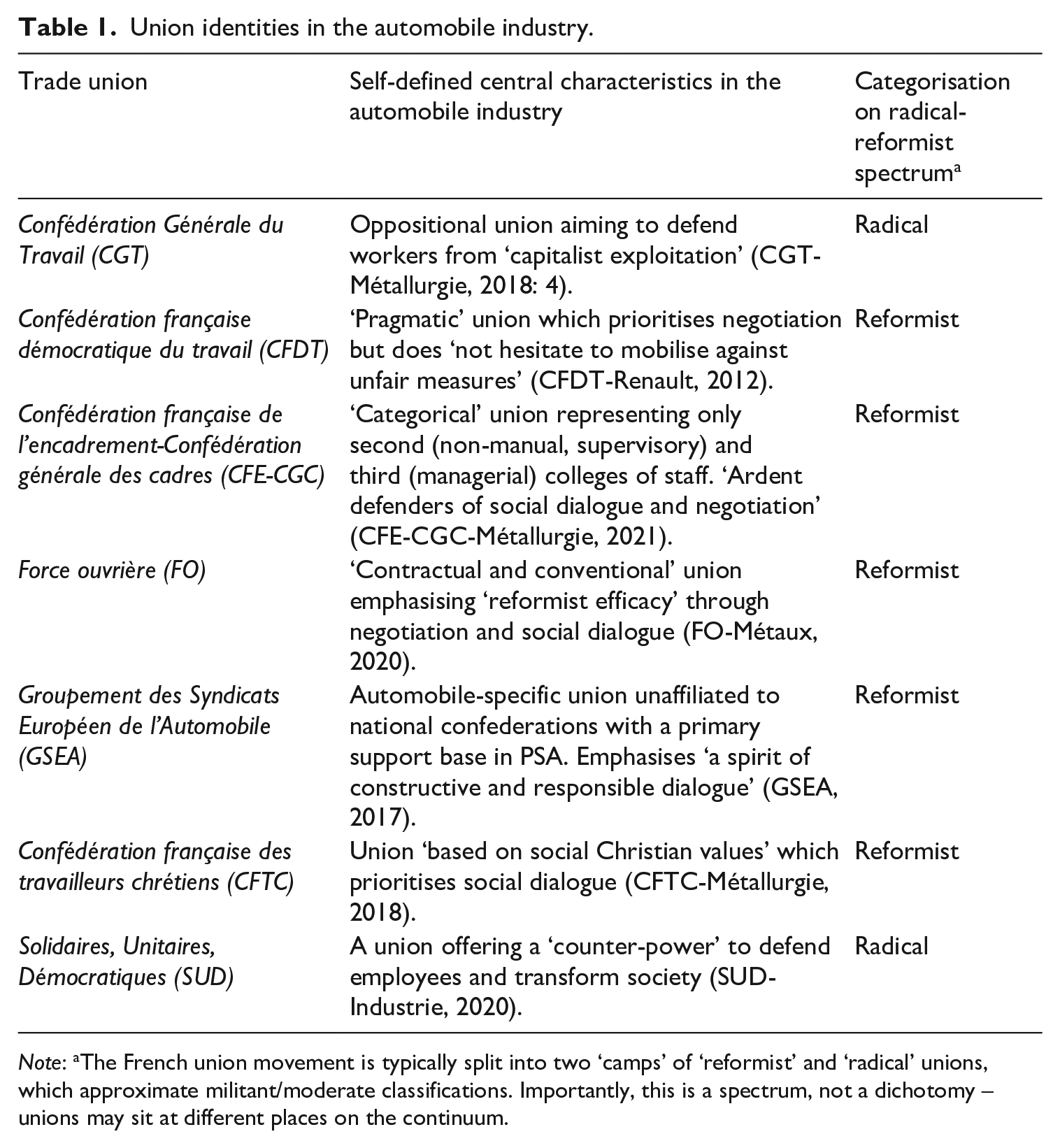
Note: aThe French union movement is typically split into two ‘camps’ of ‘reformist’ and ‘radical’ unions, which approximate militant/moderate classifications. Importantly, this is a spectrum, not a dichotomy – unions may sit at different places on the continuum.
Inter-union rivalry exists in a context of a weakening domestic industry. PSA and Renault have progressively offshored to low-cost assembly plants in Eastern Europe and Turkey to escape France’s high costs. French plants also produce less commercially successful models. The 2008 crisis intensified problems, resulting in the near-closure of Renault’s Sandouville plant and the closure of PSA-Aulnay, employing 4000. Employment numbers in the industry have fallen: over 300,000 people worked in the automotive sector at the beginning of the 21st century, whereas today that figure approximates to 225,000 (Statista, 2022). PSA and Renault’s workforces diminished by approximately 25% after 2008. Increased prominence of research and development and white-collar engineering roles and offshoring of low-skilled assembly work is shifting union representative patterns, with the rise of the CFE-CGC as the most representative union in both companies, and the decline of the once-dominant CGT.
At time of study, PSA had derived from mergers involving Peugeot, Citroën and Chrysler-Europe. The CFTC, CFDT, CGT, CFE-CGC, FO and SUD are electorally representative across various PSA plants. There is also a company-specific, employer-sponsored union, the Groupement des Syndicats Européens de l’Automobile (GSEA). Peugeot took a paternalistic approach to labour and sought to marginalise union influence. Chrysler-Europe’s subsidiaries Simca and Talbot, and Citroën, were dominated by an internal ‘yellow’ union, which sought to quash CGT militants. PSA historically favoured FO, the GSEA, CFTC and CFE-CGC at the expense of the more left-leaning CFDT and CGT, whose activists experienced victimisation and sometimes violent reprisal for their workplace activism (Hatzfeld, 2016).
Renault was state-owned between 1945 and 1996, when the state reduced its shareholding to less than a fifth, and the company entered an alliance with Nissan. Renault retained a reputation as a socially progressive employer throughout the post-war era, although its plants remained marred by conflict with the then-dominant CGT. Management reforms to boost competitiveness from the 1980s led to further confrontations with the CGT, before the latter was weakened through several industrial defeats. Such defeats weakened plant militancy and the CFDT and FO began to make electoral gains at the CGT’s expense. FO capitalised on declining morale among the CGT’s support base by fortifying its grassroots branches or ‘sections’ at Renault sites to push ‘membership services’ as a way of enticing workers to the union. The CFDT moderated its industrial politics in the company, with some of its more radical members moving to SUD. Reflecting PSA, the CFE-CGC is the firm’s strongest union in terms of election results.
Fieldwork and analysis
Fieldwork occurred at PSA and Renault company-level works councils and plant-level works councils in plants with the largest workforces and volume output. In PSA, fieldwork accessed the six largest sites (five assembly sites and one powertrain site). In Renault, fieldwork secured access to the six largest Renault plants in France (four assembly sites and two powertrain sites).
Interviewees were activists in union sections holding key institutional positions and able to provide information concerning inter-union relations on the company and plant works councils. Given that French union officials can hold several positions simultaneously, company-level interviewees also participated in plant works councils. The fieldwork comprises interviews with 46 interviewees across 44 different union sections across the 12 plants. Analysis incorporated the plant-level works council, where unions directly compete for seats and the company-level works council whose composition depends on electoral results at plant-level (see details below in Tables 2 and 3).
PSA plant electoral patterns.
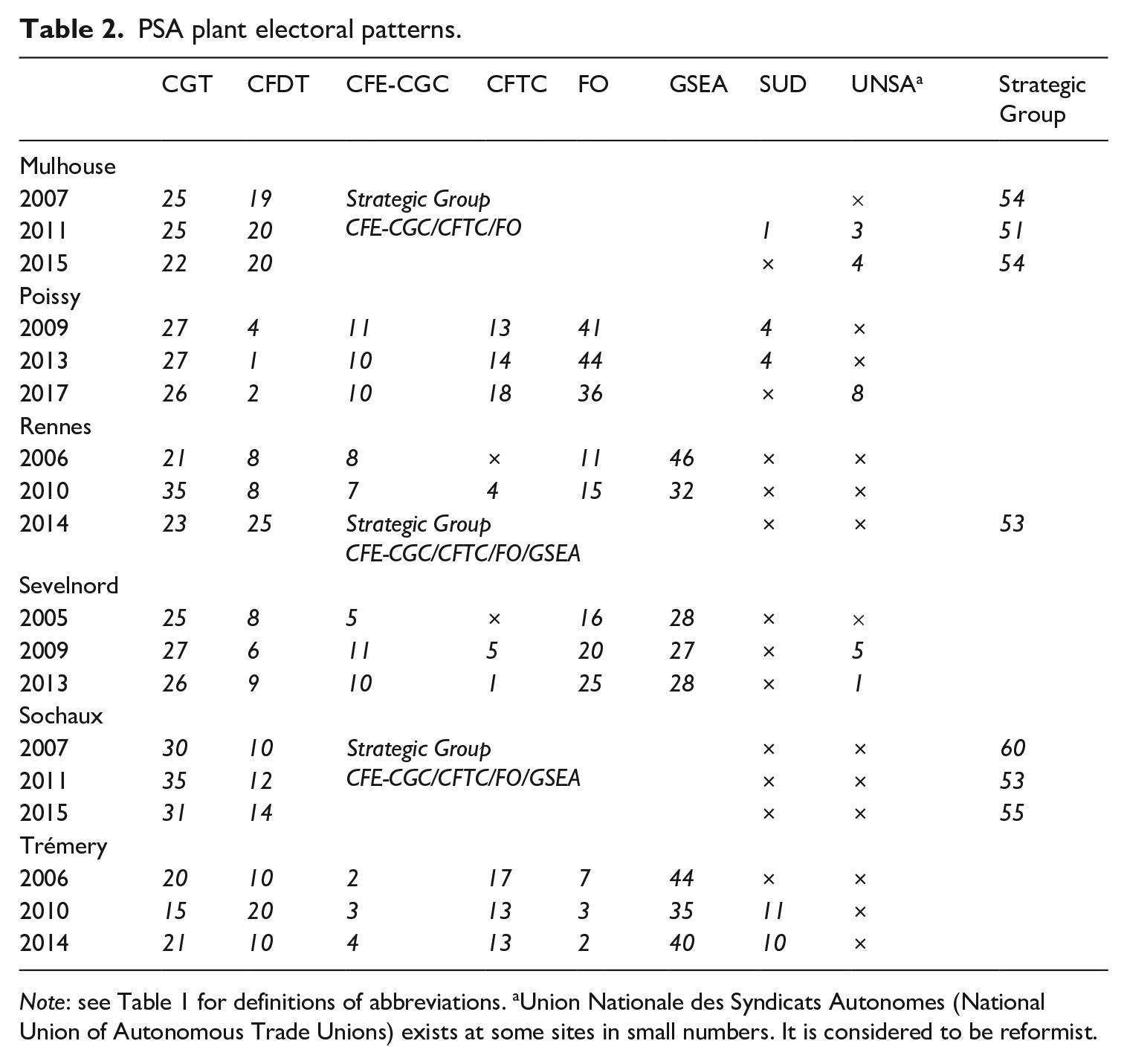
Note: see Table 1 for definitions of abbreviations. aUnion Nationale des Syndicats Autonomes (National Union of Autonomous Trade Unions) exists at some sites in small numbers. It is considered to be reformist.
Renault plant electoral patterns.
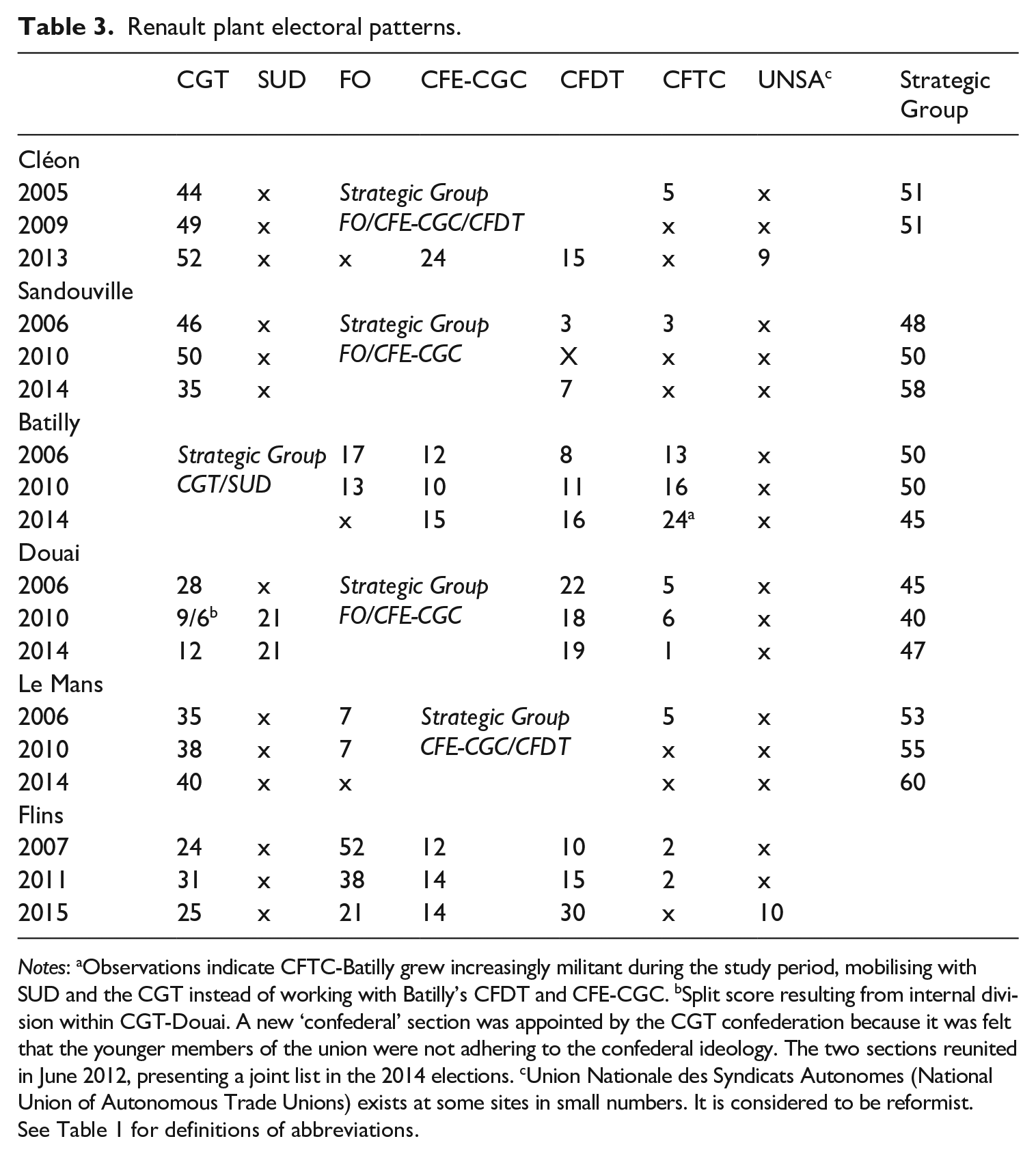
Notes: aObservations indicate CFTC-Batilly grew increasingly militant during the study period, mobilising with SUD and the CGT instead of working with Batilly’s CFDT and CFE-CGC. bSplit score resulting from internal division within CGT-Douai. A new ‘confederal’ section was appointed by the CGT confederation because it was felt that the younger members of the union were not adhering to the confederal ideology. The two sections reunited in June 2012, presenting a joint list in the 2014 elections. cUnion Nationale des Syndicats Autonomes (National Union of Autonomous Trade Unions) exists at some sites in small numbers. It is considered to be reformist.
See Table 1 for definitions of abbreviations.
Interview questions asked, inter alia: ‘Do trade unions coordinate with other unions?’, ‘Can you provide any examples of cooperation between unions at this company/plant?’, ‘What instigates this cooperation?’, ‘What are the typical issues on which unions cooperate?’, ‘How formal is cooperation (and how frequent)?’, ‘What are the outcomes of cooperation?’, ‘Are some unions cooperating more than others, if so, why?’, ‘Are unions selective with whom they cooperate, if so, why?’, ‘With which unions are you most likely to cooperate, and why?’, ‘Are there any unions in the company with whom you avoid cooperating?’.
Interviews were conducted by the first author as part of a larger project on inter-union relations and collective bargaining developments. As a foreign female researcher, participants tended to view her as an ‘outsider’ and competing unions’ members were found to be eager to explain their perspective on their own and other unions’ approaches to employee representation. Aware that the fieldwork was interviewing rival unions did seem to encourage union participation to ensure their perspective was not missed. Interviews were supplemented with 1700 documents provided by company and plant unions (100 inter-union communications and 1600 circulars). These documents span the period 2008–2015. Inter-union communications refer to letters and email exchanges between unions, providing insight into inter-union interactions. Union circulars (‘tracts’) are intended for readership by the workforce. Tracts were sourced from multiple unions to minimise bias and allow cross-referencing across different unions’ perspectives. Documents also corroborated interview content, enhancing fieldwork accuracy.
In terms of analysis, all evidence of known occurrences of inter-union cooperation on works councils was gathered. Cases of cooperation were arranged by company and plant-level examples, focusing on points of commonality and difference. Then, in each case, the reason for the cooperation was identified and observed via coding to come from two sources. First, unions cooperated in response to threats emanating from the employer and, second, some unions cooperated where they confronted a threat from another rival union. In these two specific cases, analysis then coded who was involved in cooperation, the nature of the cooperation (the issues and the outcomes) and how long the cooperation persisted. For this article, the findings are presented along (i) cooperation triggered by employer threats or (ii) by other unions who act as a common rival.
Findings
Cooperation triggered by employer threats
In both cases, threats from the employer regarding investment, pay austerity and job security stimulated inter-union cooperation over the timeline studied. This section examines inter-union cooperation in response to such threats at the company and plant-level works councils, before summarising patterns within the framework of strategic groups.
Company-level works council at PSA
In responding to competitiveness problems post-2008, PSA instigated negotiations on cost-cutting and workplace flexibility, including closures, pay cuts and shopfloor restructuring. Annual pay negotiations at the company works council in this period were marked by PSA seeking below-inflation pay increases or freezes. In 2011, inter-union cooperation on pay emerged for the first time in the company’s history, as the CFDT, CFE-CGC, CFTC, FO and GSEA developed a shared pay claim to counter wage austerity. The CGT remained outside this cooperation due to its more ambitious pay demands.
However, that inter-union cooperation splintered in the aftermath of PSA announcement to shut PSA-Aulnay and restructure PSA-Rennes in 2011 and 2012. The CFDT departed from the cooperative group due to internal pressures to develop a more independent militant position on restructuring. Those four unions remaining in the group operated under the ‘Come together to save PSA!’ Alliance, constituting themselves as the ‘responsible unions’ confronting ‘unions whose objective of a global socialist revolution is very far removed from defending employees’ interests’ (CFE-CGC, CFTC, FO, GSEA Joint Tract). However, this Alliance ended once company-level negotiations on disputed matters concluded with agreement. No further statements from the Alliance appeared.
Nonetheless, an informal pattern of cooperation emerged among former Alliance unions in 2013 when PSA sought a company-wide competitiveness agreement. Cooperation confined itself to information-sharing relevant to negotiations; however, unions autonomously developed their own individual bargaining positions. This autonomy did not prevent positions sufficiently converging to the degree that all four unions could support signing a competitiveness deal with PSA, including avoidance of plant closures for three years in exchange for concessions on pay and working time. Individual union signatories publicly commended each other for their coordinated efforts:
The CFTC made the choice to say ‘yes’ [to the agreement]. We were only able to do this because we worked, along with other trade unions, to improve management’s proposals to limit [its] effects. This is the type of participatory trade unionism with which we align ourselves. (CFTC-PSA tract)
Annual pay negotiations in the years after the competitiveness agreement saw these same four moderate unions adopt a somewhat similar pattern of interaction: some information-sharing prior to negotiations on annual pay talks, but a general preference for separate pay demands.
Both the CFDT and CGT remained isolated in the period studied. Both favoured opposition to concessions contained in the competitiveness negotiations. Shared opposition encouraged some peripheral cooperation in coordinating strike dates, amounting to four poorly supported company-wide strikes. Once the moderate unions ratified the competitiveness agreement, however, the CFDT refused to support further CGT company-wide strikes. Despite common opposition to the competitiveness deal, both unions highlighted differences in their respective views, with the CFDT claiming that ‘repeated conflict is never good for employment’, instead favouring a ‘third way’ between the CGT and the moderates (CFDT-PSA delegate). In contrast, CGT delegates claimed that the CFDT was not a reliable partner in opposition (CGT-PSA delegate).
Plant-level works councils at PSA
Inter-union cooperation at PSA plant-level works councils mirrored company-level dynamics. For example, PSA targeted the Sevelnord site for a plant-specific competitiveness agreement in 2012. Despite an initial ‘solidarity meeting’ with the CFE-CGC, FO and the GSEA, the CGT declared the union could not work with the others as they ‘accepted management assurances too easily’ (CGT-Sevelnord delegate). However, cooperation between the CFE-CGC, FO and the GSEA remained limited to informal information-sharing, although all three supported the plant-level competitiveness deal.
Employer threats instigated a formal electoral Alliance at PSA-Rennes in 2012 when the employer targeted the plant for headcount reductions of 1400. The Rennes Alliance included the four moderates: CFTC, CFE-CGC, FO and GSEA. At PSA-Rennes, the CGT and GSEA were sufficiently representative to sign collective agreements alone. Realising that a ‘rapport de force’ (FO-Rennes delegate) of moderate unions could impel new plant production, they created a ‘moderate bloc’ in the plant works council by presenting a joint list of candidates for the 2014 elections. Justifying the Alliance, these unions argued that:
our ideas on how to defend employees’ interests are close [. . .] negotiation is always the best way. It’s through [. . .] agreements that we find solutions [. . .] It is more effective than other [. . .] actions which play into management’s hands [. . .] History shows that resorting to violence does not always have the effect employees expect. (Rennes Works Council Alliance tract)
However, the Alliance dissolved post-election once it used its representative powers to obtain new vehicle production in exchange for pay and working time concessions. This body issued no subsequent statements.
Company-level works council at Renault
Like PSA, Renault pursued wage austerity and restructuring in the aftermath of the 2008 crisis. Post-crisis pay negotiations sponsored, in much the same way as at PSA, inter-union cooperation in 2010 to reverse wage austerity. This cooperation was unusual, bringing the CGT into explicit coordination with all the moderate unions on the company works council for the first time in Renault’s history. In the first instance, cooperation produced a jointly authored pay demand under the formal umbrella of the ‘Renault Alliance’ and strike mobilisation across all sites accompanied this common bargaining position. This joint mobilisation in turn forced Renault to end the dispute by offering an improved pay offer. However, the Alliance split over the offer with the CFE-CGC and FO favouring acceptance; the CGT and CFDT seeking continued opposition. Yet further mobilisation in opposition to the offer withered due to a lack of worker support. While the outcome of the pay dispute left the CGT sceptical of the Alliance, the CFDT nonetheless re-joined for the annual pay negotiations in 2011 and 2012. Indeed, the CFDT coaxed the CGT back to the Alliance in 2012, promising to support the CGT strategy of accompanying annual wage demands with strike action where necessary. A replication of the prior pattern of division occurred however: the CFE-CGC and FO favouring accepting a revised 2012 pay deal, the CFDT and CGT against, but with the CFDT suspending involvement in strike mobilisation due to dwindling levels of support.
Like PSA, Renault also sought a competitiveness pact around pay freezes and increased working time in 2013. The CFDT, CFE-CGC and FO proved open to concessions provided the employer offered commitments on jobs and investment. Yet there was no reconstitution of the Alliance; inter-union cooperation amounted to pre-negotiation meetings where the three unions shared their individual positions. Nevertheless, when Renault threatened plant closures if it could not secure agreement on its preferred terms, the CGT, FO and the CFDT jointly called for company-wide strike action. The strike had limited effect, bringing out less than 2000 workers nationally. Strike cooperation in turn collapsed, and prior patterns remerged: the CFDT, CFE-CGC and FO signed a concessionary agreement with Renault in exchange for production guarantees and no plant closures for three years. The CGT remained isolated in opposition to the deal.
After the competitiveness deal, subsequent annual pay rounds saw the partial revival of the Alliance on joint pay demands among the CFDT, CFE-CGC and FO. Again, this Alliance proved porous, with different unions reverting to autonomous rather than joint positions when suited in different years.
Plant-level works councils at Renault
Union cooperation within Renault’s plant-level works councils triggered by employer threats predominately replicated company-level dynamics. The most distinctive inter-union cooperation at plant-level not evident at the company-level emanated from leftist forces: the CGT and SUD 2 at Renault-Douai. Both radical unions cooperated to disrupt the employer’s roll-out of the 2013 competitiveness agreement, issuing several joint tracts and calls for strike action, accusing the other unions of ‘having accepted the dismantling of Renault France’ (SUD-CGT tract). However, this cooperation was short-lived due to electoral conflicts: SUD accused the CGT of having ‘one goal of diminishing SUD’s electorate’ at the site for the electoral advantage (SUD-Douai tract).
A summary of patterns
In deploying strategic group insights to explain the above patterns, one can see how, at PSA, cooperation asserts itself most easily among unions with similar central characteristics of moderation. Despite shared employer threats, engendering cooperation with other actors with dissimilar central characteristics either cannot get off the ground (as in the CGT-Sevelnord dismissal of solidarity meetings) or cannot hold (CFDT failure to remain in the Alliance at company-level). The strategic group of moderates (CFE-CGC, CFTC, FO, GSEA) is limited, short-lived and ad hoc, but repeatedly re-convened in response to employer threats to contain or curtail terms and conditions. These unions form a loose group identity around the lexicon of ‘responsibility’. The outgroups – the CFDT and CGT – share certain commonalities in terms of enduring identities across PSA’s history, but their central characteristics remain too dissimilar to foment any sustained form of viable cooperation. Renault unions make a better attempt at all-encompassing inter-union cooperation in response to employer threats, but it too fragments because incongruent identities pull such groupings apart. Moderate unions at Renault similarly coalesce around a ‘responsible’ posture. While this strategic group is also ad hoc in its pattern of formation, it repeatedly re-asserts itself across time as the dominant form of inter-union cooperation in response to employer threats. Notably, CFDT-Renault is more capable of acting as a strategic group member than at PSA because it has shed much of its radical identity to SUD, rendering the CFDT’s central characteristics more congruent with FO and the CFE-CGC by comparison.
Cooperation triggered by a common union rival
The second threat inducing inter-union cooperation on works councils was where two or more unions sought to counter challenges posed by the representative power of a commonly perceived union rival. This dynamic occurs at plant-level, the locus of works council elections where unions are in direct competition for votes.
Plant-level works councils at PSA
At Mulhouse and Sochaux, the CGT traditionally dominated and retained capacity to exert their influence on both plants’ works councils either alone or sometimes with the CFDT. To counter that possibility, cooperation occurred between the CFE-CGC, CFTC and FO for the past three decades at both sites, resulting in formal electoral alliances and voting pacts. These alliances involved presenting joint candidates in elections and combining votes on works councils to distribute positions of office among themselves. Such alliances endured over substantial time periods because the threat from the common rival persists due to sustained electoral support. Notably, such moderate pacts are likely supported by management insofar as they enabled the isolation of militants at the plants. For example, reports at the two sites indicate that these alliances received preferential access to plant management meetings without the CGT or CFDT present:
By joining forces, they manage to block us because they have more than 45%. So, we find ourselves in the minority . . . Today, the works council is run by the Alliance, and we’ve found ourselves a bit on the sidelines. (CGT-Sochaux delegate)
In contrast, either the CGT or the GSEA traditionally dominated at Rennes, Sevelnord and Trémery. At Trémery, the commonly shared rival was from the right: the GSEA commanded approximately 40% of the vote-share. The CFDT, CFTC, CGT and SUD allied in 2010, presenting a joint list of electoral candidates and combining their works council votes to distribute positions of office to marginalise the GSEA. However, the 2010 elections were deadlocked and the works council’s employer chair used the deciding vote to favour the GSEA. Over time, this Alliance has not endured, with the CFDT, the CFTC and the CGT disagreeing on wider political matters – among other things, support for the national government.
Furthermore, cooperation could unravel where an individual union’s self-interest asserted itself. Throughout the 2000s, the Sevelnord site GSEA and FO sections – ‘the responsible unions’ (GSEA-Sevelnord delegate) – cooperated on the works council to distribute positions, like secretary and treasurer, to marginalise the CGT’s influence. Over time, however, cooperation between the two grew uneasy and on occasion broke down because the GSEA was concerned about shedding representative share to FO, believing FO had ambitions to eclipse them. Thus, GSEA-FO coordination proved unsustainable due to electoral rivalry.
The Poissy plant was illuminating in suggesting that commanding representativeness disincentivises coordination. FO dominance here had not resulted in any evident coordination patterns, simply because the union had no need of it and the other unions were too representationally weak to make any significant impact.
Plant-level works councils at Renault
Where one union dominated representativeness sufficiently to act alone, inter-union coordination was not evident at Renault (as in PSA-Poissy). However, where no single union held a majority, unions engaged in informal voting ‘pacts’ to appoint positions of office and gain more influence on local decision-making. These pacts occurred in response to a common union rival, and the actors involved varied across sites, but the underlying dynamics observed in PSA hold in Renault too.
For example, at Renault, the CGT – and occasionally SUD – typically gained a large vote-share in the works council elections at Cléon, Douai, Le Mans and Sandouville. At these sites, some combination of the other unions formed informal voting pacts to distribute positions of office on the council among themselves (CFDT-CFE-CGC-FO Cléon; FO-CFE-CGC Douai; CFDT-CFE-CGC Le Mans; CFE-CGC-FO Sandouville). Such informal pacts can exist for several years or decades, as in the case of the pact at Douai; however, they risked being ruptured by increases in CGT voting power, as seen on occasion at Cléon and Sandouville. Such events tended to terminate the alliances as they no longer served a purpose to isolate the rival union:
It’s always been like that, an alliance to eject us from the works council so that we wouldn’t have any responsibilities. [But] now . . . we have 52%. There was a period where we found ourselves excluded . . . because of the other unions’ alliance. (CGT-Cléon delegate)
One long-standing informal voting pact to marginalise moderates existed at Batilly, where CGT representatives occupied secretary and treasurer positions and SUD vice-secretary and vice-treasurer. CGT-Batilly delegates indicated that they cooperated with SUD because the latter has the ‘same mindset as the CGT’, based on industrial militancy (CGT-Batilly delegate). CGT-SUD also cooperated in using the works council’s information and consultation rights to force management to justify decisions related to site production and work organisation. For instance, when Renault attempted to offshore production from Batilly in 2013, the CGT and SUD used their works council majority to instigate a review of the factory’s economic circumstances. The review found that ‘importation costs would have been much more expensive and would have bankrupted [Renault]’ (CGT-Batilly delegate). Thus, coordination in the works council enabled the CGT and SUD to prevent the offshoring, guaranteeing site survival for several years.
Consistent with patterns observed in PSA, cooperation was less likely to succeed when attempted between unions with very different identities. At Flins, FO dominated representativeness for over 20 years, although its absolute majority in the works council progressively declined during the 2010s. Other unions (CFDT, CFE-CGC and CGT) allege that FO mismanaged council funds. Consequently in 2011, the CFDT sought to coordinate with other unions to encourage ‘a pluralistic leadership of the works council’ (CFDT-Flins tract) and minimise FO’s influence on local decision-making. However, the CGT refused to participate, arguing that the local CFDT and CFE-CGC were too close to management. While the CFE-CGC welcomed the proposal, its numbers with the CFDT alone were insufficient to block FO dominance, prohibiting further cooperation from occurring.
Section summary
As in the case of employer threats, strategic group insights help explain the above patterns of electoral alliances to isolate the common rival. Where two or more unions perceive their combined votes in local works council elections would offset the majority of another union, they formed a strategic group combining vote-share to counter the common rival’s influence on local decision-making. This enables the cooperating parties to capture key institutional positions on the works council. Although such cooperation is often very durable (due to the persistency of the rival), cooperation stimulated by common rivals did vary in terms of longevity. The crucial factor in sustaining coordination over time is the similarity of coordinating unions’ central characteristics. Those with similar central characteristics appeared to develop sustained strategic groups over time (as in the pacts at PSA-Sochaux and PSA-Mulhouse, Renault-Batilly, Renault-Cléon, Renault-Douai, Renault-Sandouville). However, those groups with incongruent identities (as the attempted alliance at PSA-Trémery or Renault-Flins shows) were less successful. Yet even successful pacts could falter where their utility is made redundant by electoral results – that is, the common rival took an unassailable position post-election (e.g. Renault-Cléon) or where one cooperating partner started to assert its independent electoral ambitions (FO-Sevelnord).
Discussion and conclusions
In addressing how unions who compete against each other for works council positions develop inter-union cooperation within these institutions, the article extracted ideas from the literature on strategic groups (Albert and Whetten, 1985; Bogner et al., 1988; Peteraf and Shanley, 1997) to explain how cooperation comes about, how cooperative partners are selected and how long cooperation might last. The findings show unions cooperated under shared employer threats, but such cooperation primarily occurred across groups with complementary identities – in the cases, mostly moderate unions who constitute a ‘responsible’ grouping counterpoised to ‘irresponsible’ militants. Attempts at cooperation across polar identities was sparse and, where attempted, fell short because of identity incongruence. The article also found that unions could cooperate on works councils to isolate electoral threats from a union rival: faced with a threat of a single union commanding high levels of electoral representativeness, other unions cooperated to prevent the single union from monopolising local decision-making. While such cooperation only occurred where it was functionally necessary or possible for the unions, mutually compatible identities were necessary for it to work. On the sustainability of cooperation, the article finds differences depending on the nature of threats. Where confronting employer threats, cooperation among unions with complementary identities convened on an ad hoc, issue-specific basis. Once that immediate threat subsided, cooperation was no longer necessary and abated. However, participating unions repeatedly reignited such patterns of short-lived cooperation with the same complementary partners, indicating a strategic awareness of ‘responsible’ allies to align with when required. In contrast, faced with the threats of a single union commanding high levels of representativeness, the ongoing, more continuous nature of that threat encouraged longer-term cooperation, in some cases lasting decades.
The findings’ implications go some way to meeting scholarly calls for a greater empirical understanding of the constraints and enablers of solidarity in practice (Morgan and Pulignano, 2020). The cases suggest that complementary central characteristics in identity provided the necessary ‘bonding’ elements to enable solidarity. However, the very existence of such bonds precluded ‘bridging’ with those of highly dissimilar identities. Indeed, the ‘dark side’ of bonding is that it can function to ostracise and marginalise outsiders (Banting and Kymlicka, 2017; Thomas and Tufts, 2019); much of the inter-union solidarity observed in the cases was designed to isolate other unions. Indeed, the exclusionary inter-union aspects cemented more enduring forms of bonding than employer threats.
In addressing how unions competing against each other for works council positions come to develop cooperation within these institutions, the study highlights – at least in the French context – poor prospects for forms of ‘moral’ or ‘reflexive’ solidarity, which go beyond individual calculation of benefits and costs; that is, inter-union cooperation because it is the ‘right’ thing to do (Bolton and Laaser, 2020; Morgan and Pulignano, 2020; O’Toole and Calvard, 2020). Instead, the type of inter-union cooperation found in the cases often reflected a utilitarian political calculus as to how individual interests could be defended or improved by cooperation. Notably, the dichotomies proposed elsewhere (Behrens and Pekarek, 2021; Benassi and Dorigatti, 2015) are not much use in explaining dynamics in this regard. Such approaches compartmentalise solidarity, into whether they are driven by material self-interest or influenced by the union’s broader social or ideological visions. The contribution of strategic group insights is to bring interest and self-identities together, showing not only how they interact but also the limits of shared threats for generating solidarity when inter-union identities are incompatible.
Like other scholars identify elsewhere (see for example, López-Andreu, 2020), the dominance of utilitarian approaches to cooperation in the cases seemed to be partly reinforced by surrounding societal institutions. Representative works council elections inhibited expression of non-instrumental solidarities, encouraging calculative forms and prioritising individual union security. Can unions overcome such constraints? As Tassinari and Maccarrone (2020) note, the material effects of the labour process generate solidaristic strains. Such strains could hollow out identity differences as ‘the dull compulsion’ (Marx, 1977: 689) of market forces presses upon the unions to converge in outlook and realise united interests. However, like Tassinari and Maccaronne highlight, countervailing forces can act to dampen such trends to convergence: an electoral system that pits unions in a Hobbesian ‘war of all against all’ for institutional survival reinforces distinctive identities and provides fertile ground for wary instrumental calculation in inter-union relations.
One way to take this study forward is to further test the central thesis on complementary identities in other contexts. This could be, for example, in different national systems or different institutional sites, perhaps where elections are not a key structuring relation in inter-union dynamics. Alternatively, different types of identities could be considered: the political-ideological divide characterising French unions may be more difficult to circumvent relative to, say, divides characterising occupational-based unions for example, meaning different identities are less of a block to cooperation. Alternatively, in different contexts, one could assess whether solidaristic inter-union strategic groups are not only able to form but persist through time in response to different environmental threats where the relevant unions hold incongruent political identities as is common, say, in Spain or Italy. The central proposition of this article, informed by insights from strategic group literature, is that they cannot. However, cases that could falsify such a position would be of significant value in deepening understanding of the conditions for sustained solidarity across multiple unions.
Footnotes
Acknowledgements
The authors would like to express their gratitude to research participants and the journal review process for comments on earlier drafts of the article.
Funding
The authors disclosed receipt of the following financial support for the research, authorship, and/or publication of this article: The data presented in the article were generated as part of a project funded by the Department for Employment and Learning (now Department for Economy, Northern Ireland).
