




Abstract
The Trade Union Act (2016) stipulates that in order for a strike to be lawful it must now achieve a turnout of ‘at least 50 per cent’ in addition to a majority vote for strike action in the UK. We know remarkably little about the correlates of voting and even less about the decision to vote or abstain in union strike ballots. We address this gap, drawing from a large-scale survey of Public and Commercial Services Union (PCS) members administered shortly after their 2019 national pay strike ballot. Results show a disconnect between the focus of the dispute (pay) and the grievances that motivated participation in the ballot (working conditions). We find that those who do not vote in strike ballots are not neutral or undecided, but are, in many cases, opposed to strike action. Our findings also demonstrate the importance of internal union communication to participation in strike ballots.
Introduction
This article draws on a large-scale survey of trade union members to examine the correlates of membership participation in a strike ballot in the UK. Increasing union member participation has been a cornerstone of the organizing agenda (Carter, 2006; de Turberville, 2004; Simms and Holgate, 2010). While there is an extensive literature on the correlates of participation in trade unions more broadly (see for example Kirton, 2006; Kirton and Healy, 2013; Klandermans, 1984), there is limited discussion of voting in union elections or strike ballots in the UK or other countries. This literature has mainly focused on participation in relation to behaviours such as attending meetings, holding office and taking part in collective action. Where voting in either union elections or strike ballots has been included in this research, it has normally been conceptualized as one form of participation to be measured and incorporated into a multi-item participation scale (Gall and Fiorito, 2012). Consequently, and despite the widespread prevalence of strike ballots in countries such as Germany, Ireland, Poland, Portugal and the UK, we know remarkably little about the correlates of voting in such ballots and even less about the decision to vote or abstain.
The issue of participation in strike ballots has become salient in the UK, and other countries, following the introduction of legislation stipulating minimum turnout requirements for strike ballots in order for a strike to be deemed lawful. In the UK, the Trade Union Act (2016) requires that turnout in a strike ballot has to reach 50% of those balloted, a stipulation shared with legislation in the Czech Republic, Latvia, Poland and Slovakia as well as Australia. Moreover, in ‘important public services’ such as health, education and transport, a lawful strike also requires strike support from at least 40% of those eligible to vote (in addition to a 50% turnout). Legislation in seven other EU states, as well as in Canada, requires strike action to be endorsed by a simple majority of those voting. It is also worth noting that the constitutions of Germany’s two largest unions, IG Metall and Ver.di, require 75% membership support before a strike can be called (Labour Research, 2022).
Evidence suggests that UK trade unions have enjoyed mixed success in reaching the 50% threshold in recent strike ballots with turnouts usually ranging between 30% and 80% (see Lyddon, 2021; Richards and Ellis, 2022). That said, there has been an increase in strike activity in recent years (see Hodder and Mustchin, 2024), and strike ballots typically achieve a majority in favour of action with approximately 87% of the 10,814 UK strike ballots between 2002 and 2016 showing such a result (Clegg, 2017). The significance of strike ballots is clear from the disparity between the annual totals of such ballots and the number of strikes: between 2002 and 2006, for example, the annual number of strike ballots was approximately seven times the annual strike frequency, suggesting that ballot results play an important role in union–management negotiations (Lyddon, 2009: 336).
To reiterate, there is very little research on the factors that influence union members’ participation in strike ballots and the aim of this article is to begin redressing that gap in our knowledge. We report the results from a large-scale survey of members of the Public and Commercial Services Union (PCS) administered shortly after their civil service-wide pay strike ballot in spring 2019. With responses from many who did vote as well as a significant number of non-voters, we are able to shed light on some of the correlates of the decision on whether to vote, a neglected aspect of union participation. In doing so, we make important contributions to the literatures on mobilization theory, union instrumentality, participation and commitment. The remainder of the article is structured as follows: in the following section, we review the small body of research on union voting before broadening our focus to encompass other related literatures – on union participation, mobilization and the role of leadership in stimulating participation. Then we describe the research setting, sampling frame, the variables in our survey and our statistical procedures. Next, we present our results and following this our discussion. Finally, our conclusions are outlined.
Literature review
Despite membership participation being a mainstay of union organizing and strike ballots being central to the issues of collective action and trade union democracy, there is a surprising paucity of research on turnout in trade union strike ballots. The most systematic research comes from Australia where a mandatory 50% threshold was introduced in the Workplace Relations Amendment (Work Choices) Act (2005) and reinforced in the Fair Work Act (2009). Creighton et al. (2019) analysed 1204 ballots conducted between July 2015 and June 2016 and found that 78% achieved the 50% threshold but almost a quarter, 22%, fell short. Of the 111 ballots that just fell short of the legal threshold (turnouts of 40–50%), all but two of them backed strike action, a finding that demonstrates the baleful impact of abstention on union strike capacity. The level of strike support was very high in both sets of ballots: 98.6% of ballots that exceeded the 50% turnout were in favour of strike action compared with 91% of those failing to meet the legal threshold. The same study also found that the mode of balloting made a significant difference to turnout: 25% of postal ballots failed to achieve the turnout threshold compared with just 8% of workplace ballots. In the UK, Richards and Ellis (2022) describe a successful ‘Get the vote out’ campaign in one University and College Union branch and stress the importance of regular member communications from a small, dedicated leadership team. Ballot participation is strongly influenced by dispute framing and membership trust in local leaders, but with very few non-voters in their small sample – just nine from 95 – their article is unable to shed much light on why people do not vote.
The literature on organizing in American unions predominantly focuses on union certification elections (for an overview, see Godard, 2008). While there are some interesting and relevant points that can be gained from this literature, these elections are somewhat different from strike ballots, as only the latter require further action from the membership subsequent to the act of voting. Research on abstentions in US union certification elections finds that non-voters are less interested in the election, less knowledgeable about the campaign issues and are less likely to believe their vote would make a difference (Hepburn et al., 1997). A study by Gahan (2012) examines how union members handle problems with their union and finds that those who say nothing or disengage from the union display low levels of union loyalty and believe the union to be relatively unresponsive to members and their concerns. By analogy, it could be argued that members with those two attributes may be less likely to participate in union activities such as ballots.
Organizing literature in the UK has tended to focus on individual campaigns, rather than member participation in recognition or strike ballots (Simms and Holgate, 2010), so we therefore have to look to the four adjacent literatures on union joining, mobilization, communication and union commitment. Although they have rarely addressed the issues of ballot participation and election turnouts, their findings provide useful insights that helped shape our thinking about the determinants of strike ballot participation. First, with regards to union joining, perceived instrumentality is often shown to be a strong determinant of an individual’s propensity to unionize (Charlwood, 2002; Clark, 2009): the more effective a union is perceived to be in improving the terms and conditions of employment, the more likely people are to join. Evidence also suggests that collective reasons remain central to union joining when compared with individual services (Charlwood, 2002). Members who believe industrial action will be effective should therefore be more likely to vote in a union strike ballot compared with those with lower levels of instrumentality.
Second, mobilization theory argues that the willingness to participate in collective action depends on a set of conditions including specific employee beliefs and feelings: a deep sense of grievance or injustice widely shared with other employees; the attribution of blame for this injustice to an agency, normally the employer or the state; and a sense of efficacy, the belief that collective action can make a difference and that the benefits of action are likely to outweigh the costs (Kelly, 1998). Recent research demonstrates the explanatory power of mobilization theory in relation to collective action by a wide range of employees including technicians and contractors in Spain (López-Andreu, 2020); migrant workers in London (Jiang and Korczynski, 2016; Però, 2020); and Chinese factory workers (Lyddon et al., 2015). Empirical studies also emphasize the importance of social networks, both inside and outside the workplace, in facilitating or hindering participation in action (Blyton and Jenkins, 2013). As the starting point for mobilization is a feeling of grievance, we would expect that union members with a stronger sense of grievance would be more likely to participate in a union strike ballot, other things being equal.
Third, understanding ‘how communication contributes to the process of organizing workers’ (Botan and Frey, 1983: 237) is increasingly important, particularly given the demise of traditional print newsletters and the increased use of online technologies (e.g. emails and social media) for communications with members. Research by Wood (2015) shows that social media usage by workers can substantially overcome the problems caused by physical isolation, worries about trade unionism or fear of management reprisals. By extension, unions increase their social media activities to raise awareness of strike ballots in an attempt to improve turnout (Hodder and Houghton, 2015: 182–183). In addition to providing information about the strike ballot itself, union communications may also reinforce union bargaining demands and therefore the members’ sense of grievance, although the extent to which union members follow their union online is highly questionable (see Hodder and Houghton, 2015: 184–185).
Fourth, the literature on union commitment yields some useful insights in relation to participation in strike ballots. Grounded in industrial psychology, the majority of this research uses multi-dimensional measures where commitment normally includes items relating to union loyalty and identification as well as a general belief in trade unionism (Fullagar et al., 2004; Gall and Fiorito, 2012; Kelly and Kelly, 1994; Kirton and Healy, 2013). Research shows union commitment correlates strongly with various measures of union participation including attendance at meetings, voting in elections and engagement in strike action (Clark, 2009: 23).
In summary, if we conceptualize voting in a union strike ballot as a form of union participation, then the literature suggests the likelihood of voting will be influenced by each of the four factors identified in this brief review of the literature. We can therefore suggest that the probability of participating in a union strike ballot will be correlated with the following factors:
The perceived instrumentality of the union.
The strength of grievances about the issues in dispute between the union and the government, principally but not exclusively pay.
The degree to which members receive union communications about the dispute.
The level of union commitment.
Research setting, sampling, variables and statistical procedures
We draw on data collected from members of the Public and Commercial Services Union (PCS), with approximately 177,750 members (TUC, 2021). PCS predominantly represents lower and middle grade civil servants, as well as those working in the private sector on government contracts. Historically, civil service trade unionism has been moderate, largely due to the institutionalized Whitley system of industrial relations, based around centralized, national collective bargaining. However, civil service employment relations have been increasingly strained in recent years following decades of restructuring of government services, jobs and bargaining units (Fairbrother et al., 2012; Hodder, 2015). Over time, the process of pay determination fragmented from unified national bargaining to decentralized bargaining within individual departments and agencies. In response to these challenges, PCS policy has shifted, particularly since the change in the union’s national leadership in 2001 resulting in a change in tactics (Fairbrother et al., 2012). The union has adopted a militant approach to organizing since 2004, with annual objectives and targets about levels of membership, activism and channels of communication (Hodder, 2015; PCS, 2019a). There have been numerous strikes over pay and other issues at a departmental level (Lyddon, 2009), but following the introduction of the Trade Union Act (2016), the union initially failed to meet the 50% threshold required for civil service-wide industrial action, with unsuccessful ballots in both 2018 and 2019. However, since 2022 the union has won a number of ballots.
Data were collected through a membership survey that concentrated on the 2019 pay campaign, which culminated in a strike ballot conducted between March and April 2019. The main demands were a cost of living pay increase for all in the civil service, a living wage of £10 per hour nationally (and £11.55 in London), a return to national (unified) pay bargaining in the civil service, and equal pay and coherence of terms and conditions across the civil service. Following the pay campaign in 2019, a survey was conducted with PCS members in the civil service, where voting intentions, as well as views towards the failed 2019 civil service-wide pay campaign, were examined. The first call went out at the beginning of November 2019 to 85,152 members, followed by two reminders – at the beginning of December to 65,631 members and at the end of December to 62,272 members – excluding each time those members who had already responded.
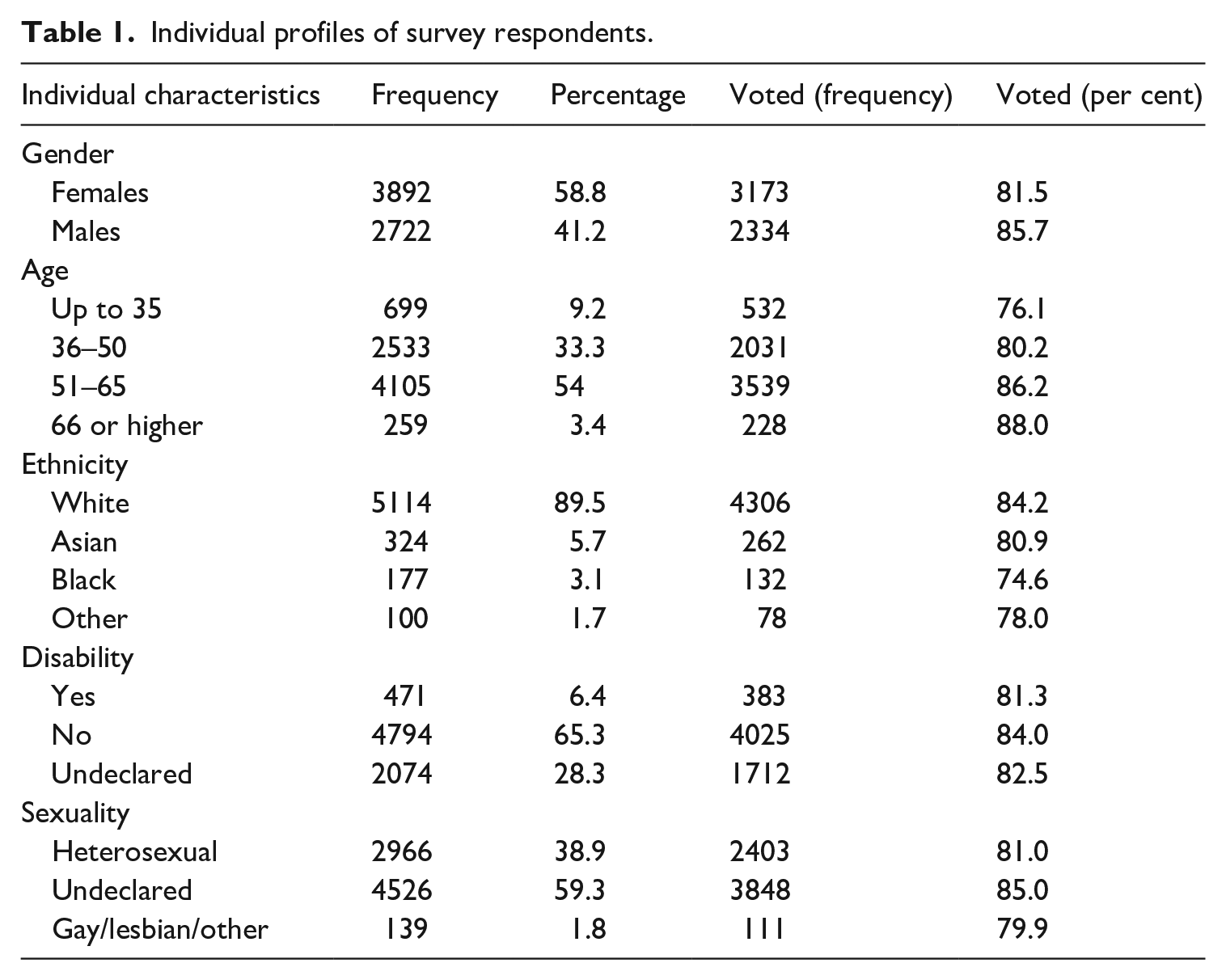
The first call generated 19,031 responses; however, an administrative error occurred, meaning no demographic details were available for these responses, so we were unable to use these responses for our analysis. The second and third survey reminders resulted in a total of 7821 additional responses, which included demographics such as gender, age, sexuality, disability and ethnicity, used for analysis in the article. When taking into consideration all the calls together, the response rate is 31.53% (26,853 responses from 85,152 questionnaires sent to members), whereas when considering only the second and third calls (and therefore the sample used here), the response rate is 11.91% (7821 responses from a total of 65,631 corrected questionnaires distributed via the second and third reminders). On demographic variables, our sample closely matched PCS population attributes with 58.8% women (59.1% in the population), 10.5% ethnic minority (10.0% PCS overall) and disability (6.4% in the sample and 4.7% in the population) (see Table 1 and PCS, 2019a). Age comparisons were not possible because of differing age bands in our survey compared with those used by PCS.
Individual profiles of survey respondents.
Measures
Dependent variable
The key dependent binary variable is addressed through the question ‘Did you vote in the March/April 2019 pay ballot?’ (with 1 = Yes and 0 = No).
Independent variables
The first independent variable (IV) is grievances, captured via issues that were deemed important to members. There were 11 items: ‘getting a pay rise’, ‘fighting a pay cut’, ‘improving one’s pension’, ‘preventing cuts from pension’, ‘improving terms and conditions at work’, ‘how performance is managed’, ‘the level of stress in one’s job’, ‘being overworked’, ‘lack of job security’, ‘poor/absent management processes’ and finally ‘experiencing discrimination’. Responses were measured on a five-point scale, with ‘5’ denoting extremely important and ‘1’ denoting extremely unimportant. Again, multiple responses were available, meaning dummy variables were created.
The second IV, instrumentality, was captured by seven items from the ‘reasons for joining PCS’ section of the questionnaire: ‘support if one has individual problems at work’, ‘protecting/improving pay and pensions’, ‘free legal advice’, ‘professional services’, ‘training and education’, ‘financial services’ and ‘most people at one’s workplace are in the union’. Responses were measured by a five-point scale with ‘5’ denoting that a reason is extremely important for the member and ‘1’ denoting extremely unimportant. Dummy variables were also created here.
Union communication was the third IV and was captured by three variables. First, members were asked if they had been ‘contacted by the union during the ballot period’, with responses being: ‘spoke to the local rep in person’, ‘received a telephone call’, ‘received a text message’, ‘was not contacted’ and ‘cannot remember’. A second variable asked members to indicate whether they engaged in any of the union’s social media during the campaign. Responses here were: ‘Facebook live events’, ‘Facebook page/discussions’, ‘Twitter’ (which is now X), ‘Instagram’ or ‘none of these’. Finally, a third variable asked members to indicate which of the following were visible in their workplace during the campaign, with responses being: ‘information on the union noticeboard’, ‘leaflets/pay bulletins distributed at work’, ‘a union meeting’, ‘union information distributed on desks’ and ‘none of these’. All three questions offered the option of selecting multiple responses, so dummy variables for each response were created.
Commitment to the union was measured via three variables: first, they were asked to state the extent to which they ‘identified strongly with the union’; second the extent to which they were ‘proud to belong to the union’, with ‘5’ denoting they strongly agreed with the statements and ‘1’ that they strongly disagreed (Kelly and Kelly, 1994). An additional item from reasons for joining the union section of the survey was also combined due to its fit, asking members the extent to which they ‘believe in trade unions’.
Several control variables captured individual, regional and workplace characteristics, namely age, gender, ethnicity and whether the individual identified with having a disability. The member’s region of employment was a categorical variable.
Analytical approach
Our core analysis was based on binary logistic regression models. Owing to the high number of variables, regression models were a result of a forward selection procedure in order to identify the most important variables. We did examine backward selection regression models; however, this procedure was not adopted because of lower AIC and BIC criteria. 1
Owing to the long list of variables, we identified meaningful groups (factors) that would enable us to reduce the number of variables included in the analysis. We selected a data-driven approach (rather than a theory-driven one) that would allow the data themselves to uncover the underlying connections from a relatively large set of variables and turn them into factors. For these purposes, we used exploratory factor analysis (EFA), a method that identifies underlying relationships between measured variables. EFA brought back meaningful groups of variables that were then interpreted based on the concepts addressed: grievances, instrumentality and commitment.
Starting with grievances, which included 11 items, EFA identified two factors. The first was a factor with grievances on pay and pensions, which included four items: ‘getting a pay rise’, ‘fighting pay cuts’, ‘improving one’s pension’ and ‘preventing cuts in one’s pension’. A second factor on grievances related to working conditions, and included seven items: ‘improving terms and conditions at work’, ‘how performance is managed’, ‘the level of stress in one’s job’, ‘being overworked’, ‘lack of job security’, ‘poor/absent management processes’ and finally ‘experiencing discrimination’.
Regarding instrumentality, EFA identified one factor on servicing and social custom, including five items: ‘free legal advice’, ‘professional services’, ‘training and education’, ‘financial services’ and ‘most people at one’s workplace are in the union’. Two independent items remained, as these did not fit in any factors: ‘support if one has individual problems at work’ and ‘protecting/improving pay and pensions’.
Finally, the commitment factor included three different items: ‘identify strongly with the union’, ‘proud to belong to the union’ and ‘believe in trade unions’.
These factors were then used in binary logistic models along with other covariates.
Results
Descriptive statistics
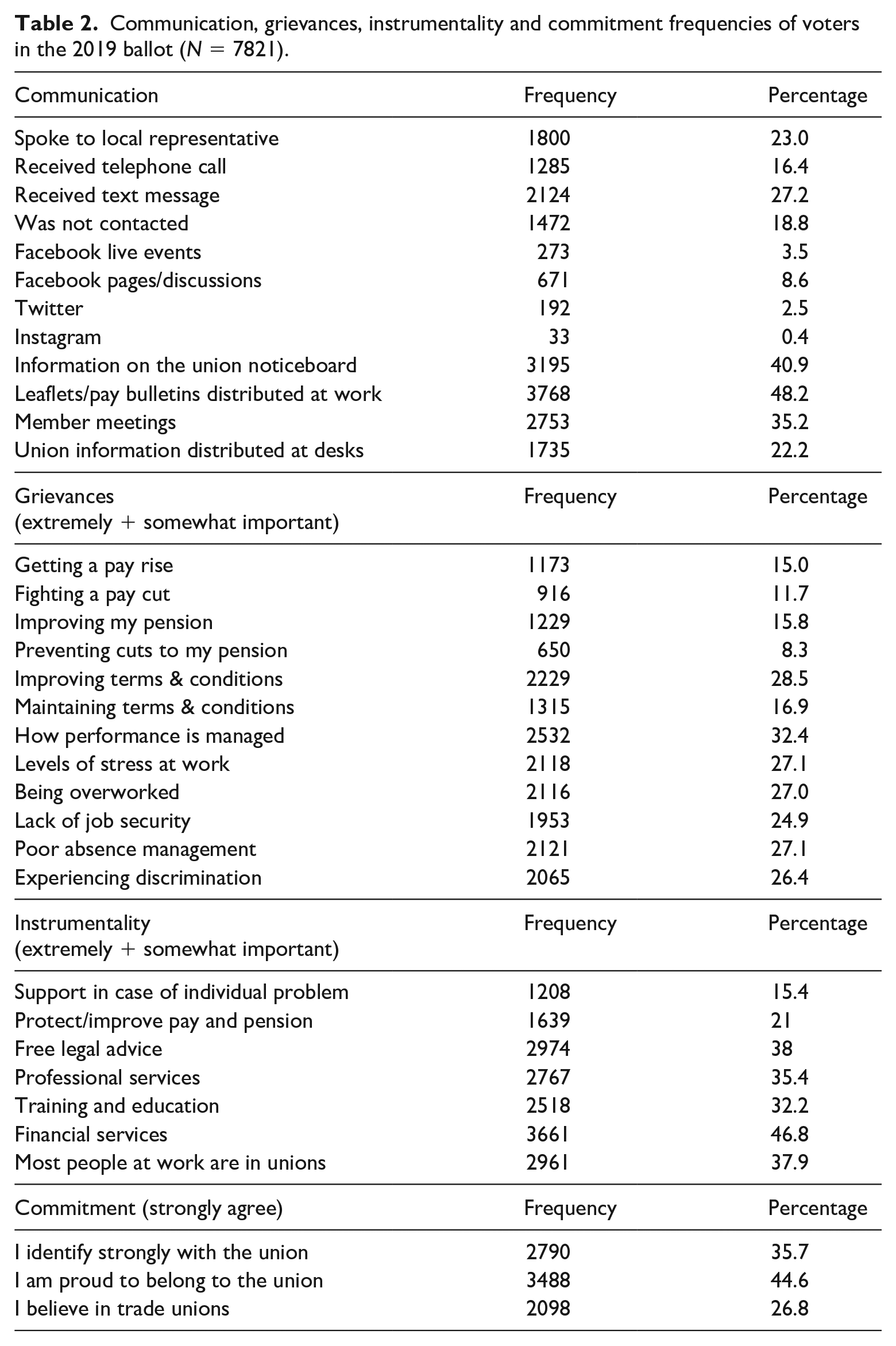
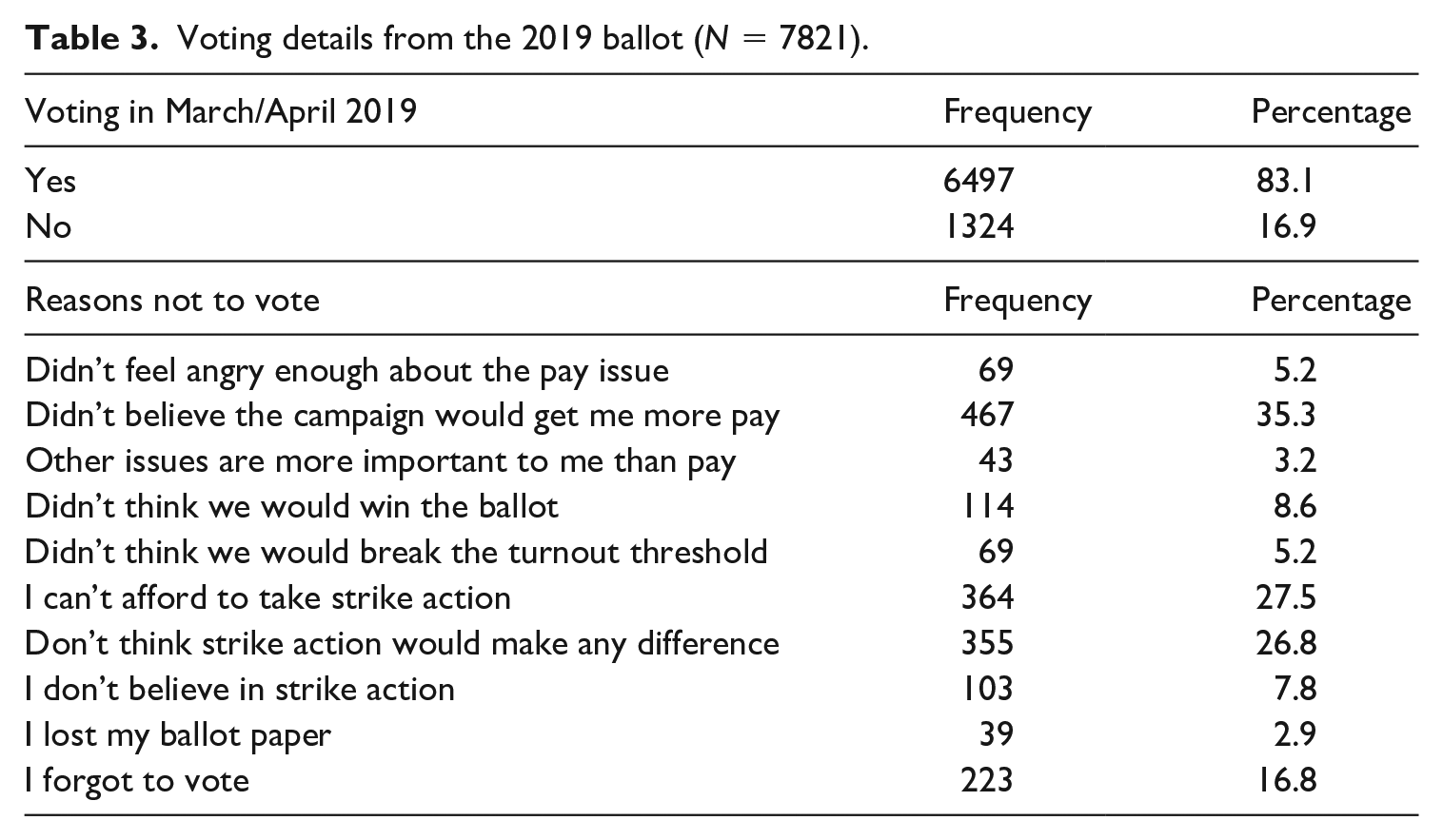
Our descriptive statistics enabled preliminary comments on the variables themselves and on our key empirical questions of who voted (or which particular groups were more likely to vote) and why members did not vote (see Tables 1–3).
Communication, grievances, instrumentality and commitment frequencies of voters in the 2019 ballot (N = 7821).
Voting details from the 2019 ballot (N = 7821).
Regarding member grievances (Table 2), pay and pay-related issues were the most important ones, followed by working conditions. Many items attracted high (> 80%) levels of endorsement, with the four most important issues being: preventing cuts to pensions, getting a pay rise, fighting pay cuts and improving pensions. Turning to instrumentality, support in case an individual has problems at work and improving pay and pensions were highest ranked, closely followed by belief in trade unions.
Communication also played an important role. Traditional methods such as leaflets and pay bulletins were deemed most important, followed by information on staff noticeboards and meetings. Text messages from, and communications with, local reps, as well as union material displayed within workplaces, were equally important. However, almost a fifth of the members reported that they had not been contacted at all. Considering commitment, the data revealed that the majority of members identified strongly with the union and were proud to belong to the union (more than 70% for both variables).
Who votes and who does not?
Although women were more responsive to the survey, Table 1 shows they were less likely to vote in the strike ballot (85.7% of males voted compared with 81.5% of females). The 50–65 age group appeared to be the most active, both regarding participation in the survey and voting. Respondents of a White background comprised the vast majority of the sample and were also more likely to have voted. The majority of the sample did not wish to declare their sexuality and identified as having no disability, in line with PCS membership data (PCS, 2019a).
Why do union members not vote?
Voting behaviours indicate similar results, with member voting being on average over 80% and non-voting around 17% (Table 3). Those who answered ‘No’ to whether they had voted were then asked to tick their reasons for not voting from a list of 10 options. The main reasons relate to efficacy (‘didn’t believe the campaign would get me more pay’ and ‘didn’t think the strike action would make any difference’: 35% and 27%, respectively) and to cost related to the industrial action (‘I can’t afford to take strike action’: 28%). ‘I forgot to vote’ was also significant, mentioned by 17% of respondents, posing questions around union commitment, discussed below. It is important to note here that due to the conditional nature of the variable, this could not be used in the regression analysis.
Regression analysis: Correlates of voting
Regression analysis was conducted to examine the variables associated with voting in the 2019 ballot.
All factors indicated a very satisfactory goodness-of-fit, high Cronbach’s alpha and factor loadings above a 0.670 cut-off. Specifically, for grievances – pay and pensions, Cronbach’s alpha was 0.757, and for grievances related to working conditions, this was 0.886. The instrumentality-union servicing and social custom factor indicated a Cronbach’s alpha of 0.895 was reached, and for commitment, Cronbach’s alpha was 0.876.
Table 4 shows that male and older PCS members were more likely to have voted, whereas PCS members of Black ethnicity were less likely to have voted.
Logistic regression. Dependent variable: ‘Did you vote in the March/April 2019 pay ballot (Question 1)?’.
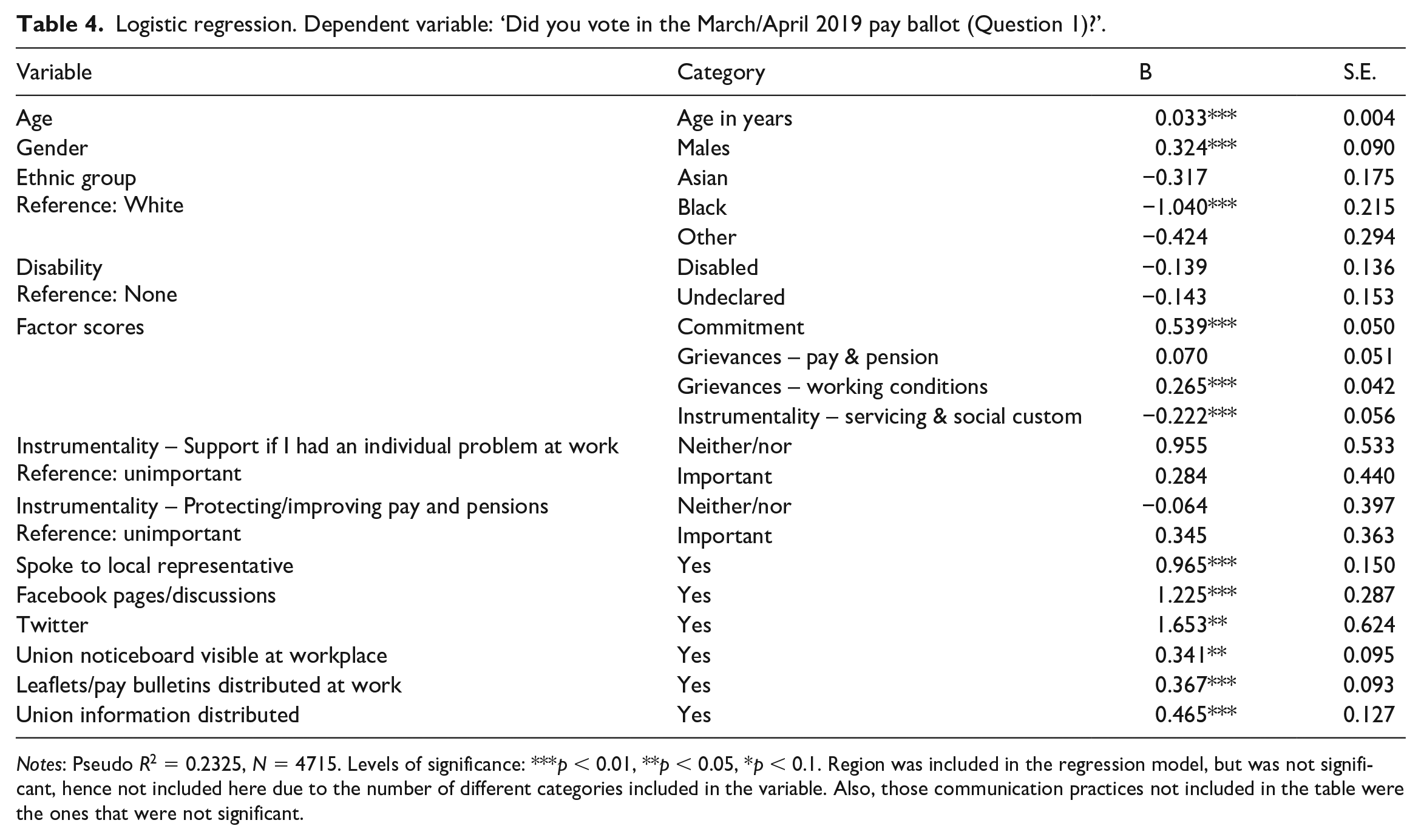
Notes: Pseudo R2 = 0.2325, N = 4715. Levels of significance: ***p < 0.01, **p < 0.05, *p < 0.1. Region was included in the regression model, but was not significant, hence not included here due to the number of different categories included in the variable. Also, those communication practices not included in the table were the ones that were not significant.
Looking at factors, commitment was significant and positively associated, indicating that more committed members were more likely to vote. When considering the commitment factor in combination with the factor grievances – pay and pensions, which was not significant, the model sheds light on which factors are important for members and which criteria members tend to vote with. The factor grievances – working conditions was also positive and significant, indicating a higher likelihood of having voted in 2019. By contrast, instrumentality – union servicing and social custom was negatively associated with the likelihood of having voted, yet significant, indicating that employees who joined the union for such reasons had lower chances of having voted in 2019. Individual items of instrumentality, namely support in case of a problem and once again protection of pay and pensions, were not significantly related to having voted in 2019.
Regarding communication, results suggest that traditional face-to-face methods were positively associated with voting. Members who spoke to local representatives were more likely to have voted. Members who engaged with the union through social media and in particular Facebook pages/discussions and Twitter were also more likely to have voted in the 2019 pay ballot. Similarly, the prevalence of union noticeboards and the distribution of leaflets or pay bulletins within workplaces were all positively associated with voting and, as expected, when any kind of union information was distributed, these were positive factors for voting.
To assess how the probability of voting was associated with the factors appearing in the regression model, their average marginal effects are displayed in Figure 1, along with the 95% confidence intervals. The probability of voting was higher by 4 percentage points for a unit increase when considering the factor reflecting commitment and by 2 percentage points per unit increase in the grievances – working conditions factor. By contrast, the grievances – pay and pension factor had no significant impact on the probability of voting. The instrumentality – servicing and social custom factor had a negative impact; a unit increase in this factor is associated on average with a 2% reduction in the probability of voting.
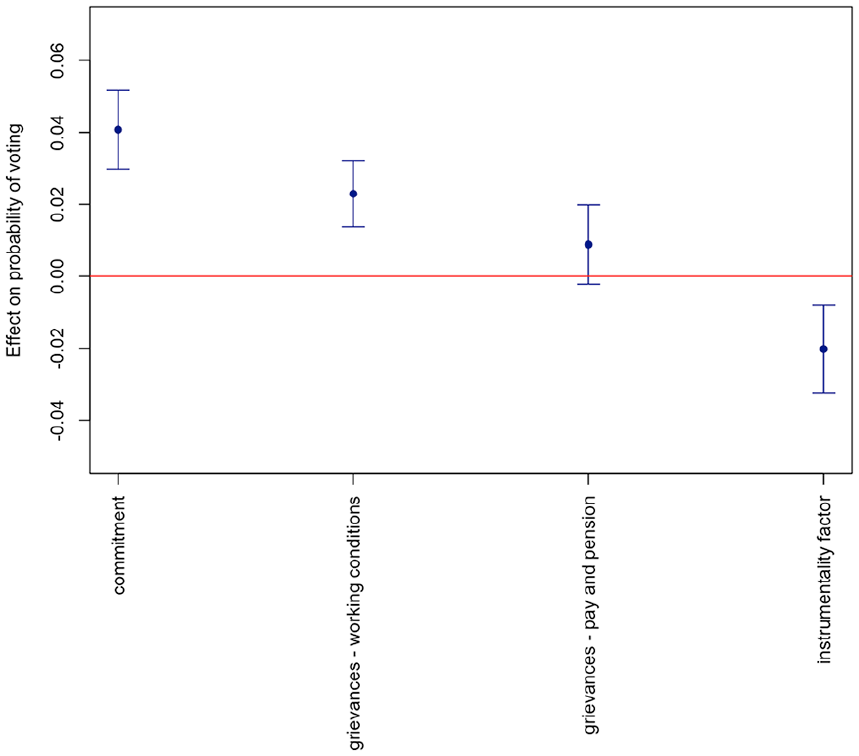
Average marginal effects of the factors associated with reasons that are important to members on voting.
Figure 2 illustrates the importance of different communication channels used by the union. Social media (and specifically Facebook and Twitter), appeared to be effective, and offered increased probabilities of voting by 15 to 20 percentage points, notwithstanding the increased amount of uncertainty in the corresponding estimates provided by the model. The presence of a local representative was also important, and increased voting rates by around 10 percentage points, whereas means of communication such as union noticeboards, leaflets and information provided on desks were also important, offering an improvement of around 5 percentage points.
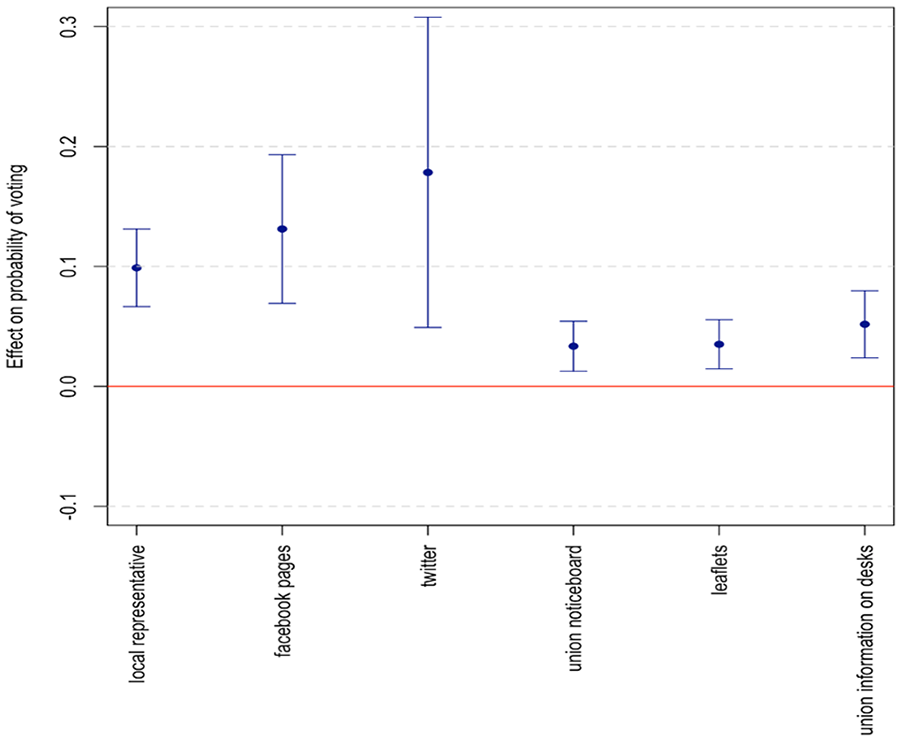
Average marginal effects of union communication on voting.
An array of sensitivity tests based on alternative regression models and comparisons of means and frequencies were used to check the robustness of the results. First, the two samples (the initial sample without demographics from the first wave of the survey and the second sample including demographics used in the above analysis from the second and third waves of data collection) already act as a robustness test. Initially, we compared means and frequencies of all variables in the two different samples that produced similar results. Second, we ran the same regression models in both samples. Both samples produced similar results in the same direction. Third, as an additional robustness test, we merged both samples (removing demographics) and once again ran the same regression models. Results were consistently similar. Finally, we ran regression models using factors, where results were once again similar. We also checked for multicollinearity in the logistic regression models. Generalized variance inflation factors (GVIF) (Fox and Monette, 1992) were computed for each covariate. These variance inflation factors are specifically designed to handle, among others, cases including categorical variables with more than two categories. In all cases, these factors did not exceed 1.4, thus providing clear evidence against multicollinearity (max GVIF = 1.394 for the logistic regression without factors and max GVIF = 1.289 for the logistic regression with factors).
Discussion
Understanding why people do or do not vote in strike ballots is ever more important, not least as there are considerably more ballots than there are strikes and strike ballots are mandatory in a significant number of countries including Australia, Canada and 11 EU member states (Labour Research, 2022). Such research is particularly important at a time of increased strike activity (Hodder and Mustchin, 2024). By examining this issue through a survey of union members, we extend the existing literature in this area (Richards and Ellis, 2022) and make important contributions to literature on mobilization theory (Jiang and Korczynski, 2016; Kelly, 1998; López-Andreu, 2020), instrumentality (Charlwood, 2002; Clark, 2009), commitment (Kelly and Kelly, 1994) and the correlates of member participation in trade union strike ballots (Creighton et al., 2019).
Our results were mostly consistent with expectations drawn from the literature insofar as strike ballot participants were more likely to have a strong sense of grievance, albeit about working conditions rather than pay; they were more likely to have been exposed to trade union communications; and they displayed significantly higher levels of trade union commitment. The grievance results are intriguing because variations in strength of feeling about pay and pensions, the focus of the 2019 dispute, were not significantly associated with the decision to vote or abstain in the strike ballot. One reason for this seeming anomaly emerges from the raw data, which show almost no variation in responses about the importance of pay and pensions as 98% of respondents felt very strongly about pay. In other words, a lack of variation in scores on this particular IV eliminated its role as a predictor of ballot participation. However, the findings raise an interesting question about mobilization theory (Kelly, 1998, 2018), which has tended to assume the issues generating strong feelings of grievance will be the ones that are translated into bargaining demands, which will then in turn motivate participation in collective action. In the present case, there was a pervasive sense of grievance about pay but that alone was unrelated to participation in the strike ballot; additional grievances about working conditions were strongly associated with ballot voting, suggesting that under certain conditions multiple grievances may be required to stimulate participation in collective action, or in this case, in the ballot for action.
In relation to instrumentality, two of the three results are consistent with expectations from the literature (e.g. Charlwood, 2002; Clark, 2009) insofar as they show negative and non-significant relationships respectively between two measures of the variable that are rooted in individual reasons for joining a union (e.g. financial services, and support with an individual problem at work). However, the instrumentality item relating to the protection and improvement of pay and pensions at work was not significantly related to participation in a strike ballot over pay, a curious and intriguing result. One possible explanation for this result emerges from the survey item in which non-participants in the strike ballot were asked to indicate reasons for their abstention. As reported earlier, the clear preponderance of answers turned on the perceived costs and the likely ineffectiveness of strike action; in other words, on the instrumentality of the union’s strike plan. On the face of it, therefore, some of our evidence points to the irrelevance of instrumentality, while other evidence points to its relevance in the explanation of strike ballot participation. One potential solution to this conundrum is to theoretically rethink the meaning of instrumentality and argue that it actually comprises two sets of beliefs: one covering beliefs about trade unionism in general and a second referring to beliefs about specific trade union actions on specific issues. An individual may believe simultaneously that while unions in general make a difference to people’s working lives, this particular strike action is unlikely to be effective.
Building on this last point, our results can be split between what we may call ‘rational’ reasons and ‘technical reasons’ for abstention. Rational reasons (which are linked to mobilization theory) include grievances, the perceived ineffectiveness of action, the financial cost of taking action and doubts about reaching the ballot threshold, and these accounted for around 76% of all reasons given for not voting. Technical reasons for not voting include ‘losing the ballot paper’, ‘forgetting to vote’ and claiming ‘not to have received a ballot paper’. These technical reasons clearly matter in terms of reaching a ballot threshold, often being the focus of ‘get the vote out’ campaigns (Richards and Ellis, 2022), but, at least in our sample, they were less important than rational reasons. However, the suggestion often put forward by unions in ‘get the vote out campaigns’ is that these technical reasons are highly significant and easier to overcome than the rational reasons union members may have for not voting.
In response, it could be argued that the relationship between these two classes of reason is not as straightforward as our data might suggest. If members disagree with proposed industrial action and prefer that it would not go ahead, they have two choices – to vote ‘no’ or to abstain and help lower the ballot turnout below the critical 50% threshold. Since the introduction of the Trade Union Act (2016), it is increasingly possible that abstentions do not simply reflect those unsure of how to vote. What we may also be seeing is a ‘rational logic of abstention’, in which members opposed to industrial action deliberately choose not to vote, but offer technical or arguably socially acceptable reasons when asked why they did not vote. Our inference is further supported when compared with the union’s internal data gathered via the organizing app ahead of the ballot, which detailed that 40% of members did not respond to the queries as part of the ‘get the vote out’ campaign and accurately predicted the turnout (PCS, 2019b). There are also parallels here with Bryson’s (2008) findings on multiple reasons for not joining a union: when first asked, many non-union respondents say they have ‘never been asked to join’ but subsequent probing showed that beneath this ‘technical reason’ lay other serious objections to membership such as financial cost and perceived lack of union effectiveness. Further qualitative research is needed to examine these issues in more detail.
Involvement with union communications was significantly and strongly associated with ballot participation although the direction of causation remains unclear. It could be that union messages and notices about the forthcoming strike ballot, as well as the activities of workplace union representatives, reinforced people’s feelings of grievance as well as their levels of commitment to the union and thereby increased their propensity to vote. However, the reverse direction of causation is equally possible, and plausible. We know that only a minority of union members received text messages (27.2%), spoke to a local union representative (23.0%), received a phone call (16.4%) or joined in Facebook discussions (8.6%). It could be that more highly aggrieved and more committed union members were more willing to contact local reps and engage with various forms of union communication. More likely is a virtuous circle of causation in which a sense of grievance and high union commitment lead to more engagement with union communications, which in turn reinforces feelings of grievance and commitment and culminate in a greater propensity to vote in the strike ballot.
Even if the effects of each of these types of union communication (such as text messages, or posting on noticeboards), is small – just a percentage point or two – the combined effects could make the difference between a lawful and an unlawful dispute. First, the tone, frequency and channel of communication about likely strike effectiveness and strike costs are critical (Hyman, 2007: 207). Strike messages are often framed in terms of grievance content; for example, the injustice of current pay levels and workloads, or the ability of the employer to pay (see Kelly, 1998, 2018). Clearly, grievance messaging is critical but since reasons for not voting often turn on the costs and impact of industrial action, there needs to be a balance between grievance content and detail of the forms, benefits and costs of collective action. On the whole, union strike ballot communications tend not to indicate the type and duration of action that may be taken should the ballot be successful. Further research is needed as to the extent to which this type of information may impact union members’ strike decision making.
Second, a recent feature of union campaigning is the telephoning and texting of members to encourage them to vote (see also Lyddon, 2021: 492). While this is extremely time-consuming for activists, often very frustrating (as members may not respond) and can generate member complaints, it does make a significant, positive difference to voter turnout.
Third, union visibility at the workplace through notices, leaflets and member meetings can also make a key difference to turnout. This supports earlier research, which shows the importance of a strong visible union presence at the workplace for joining intentions and strike action (Hodder et al., 2017). All of these findings suggest that a relatively high level of union organization is key to success, which in turn might suggest that ongoing campaigns and bargaining activity create a fertile environment for mobilization. While our findings relate to the importance of union visibility in a physical workplace, they also support the importance of a union presence on social media. This is important, particularly in the context of the Covid-19 pandemic, where several unions have reported increased levels of membership engagement at online meetings. These reports are consistent with previous research on the organizing and mobilizing potential of the Internet and social media (Wood, 2015), although some caution is needed with regards to their use. Analysis of engagement with official union social media accounts suggests a limited level of membership engagement. Houghton and Hodder (2021) argue that unions are rarely successful at engaging high levels of their membership online, specifically noting in the case of PCS that while the union had 180,311 members in 2019, they had only attracted 13,288 subscribers to their Facebook page and 29,543 Twitter followers. Houghton and Hodder (2021: 235–236) go on to state that: ‘This means (assuming all followers and subscribers are union members, which is unlikely) the social media penetration of PCS accounts for just 16.4% (on Twitter) or 7.4% (on Facebook) of the union’s membership’.
Union commitment, as expected, was also positively associated with participation in the strike ballot, as the literature suggested. However, we also found that two of our demographic variables – age and ethnicity – were associated with participation since older, White males are more likely to have voted in the strike ballot. We know from the correlation matrix that these two demographics are also positively linked to commitment and there is other evidence to suggest that older union members may show higher levels of union commitment, although the evidence is mixed (e.g. Snape et al., 2000). It is therefore possible that the significant demographic results are serving as proxy variables, indirectly capturing the effects of union commitment.
Conclusion
This article has examined the factors that influence union members’ participation in strike ballots. In doing so, we make a number of contributions to the academic literature in the areas of mobilization theory, union instrumentality, participation and commitment. First, we have shown that the role of grievances in mobilization is more complex than theory might suggest (Kelly, 1998, 2018), viz. a grievance about issue X, leads to a demand for improvement in X, a campaign and some form of collective action. In our case, there were multiple grievances among the union’s members, activists and leaders, and a disconnect between the ostensible key grievance – pay – and the grievances that motivated participation in the strike ballot – working conditions.
Second, we have shown that non-participants or abstainers in strike ballots are not neutral or undecided in terms of how to vote, but are, in many cases, actively opposed to strike action. This has implications for the assessment of union power in a dispute where only a narrow majority votes for, and supports, strike action. In other words, ballot abstainers are most likely to cross picket lines and weaken union power (assuming our findings are valid). This has implications for the literature on union instrumentality and commitment.
Third, although union communications are associated with member participation in the strike ballot, they tend to focus on grievances and on the role of government (blame attribution), just two elements in mobilization theory, and have little to say about strike action. This is a potentially significant omission because data from non-voters suggests the costs and benefits of action were critical factors in their abstention from the strike ballot. Again, these findings have important implications for the literature on union instrumentality, participation and commitment.
Overall, our findings suggest that participation in strike ballots is significantly more prevalent among members with a strong sense of grievance, a high level of trade union commitment and a high level of exposure to, and engagement with, trade union communications about strike action. It is also more likely among older, white males. In contrast, those less committed to the union, with a weaker sense of grievance, a lower level of union commitment and more individual reasons for union membership, as well as younger, female and ethnic minority members, are less likely to participate in a strike ballot. These are important and troubling findings as the union has more women members than men, and has been actively attempting to increase union participation among young members, women members and those from ethnic minorities (see PCS, 2019a). These findings reinforce approaches to union participation rooted in mobilization theory, in the concept of union commitment and in the role of communications as mechanisms for attitudinal change and development.
Finally, we should mention several methodological issues with regards to our findings, starting with the question of correlation and causation. For example, does a high level of union workplace visibility encourage more people to vote? Or does a higher level of people intending to vote lead to more workplace leaflets, notices and meetings? We contend that both statements are likely to be true and there is a virtuous causal circle but we cannot be certain. While the lack of demographic data in the first sample used for the analysis was unfortunate, we found no evidence for systematic data differences between the first (larger N = 19,031) and the second (smaller N = 7821) samples. We are therefore reasonably confident of the representativeness of the second sample used for the regression analyses. However, we significantly oversampled those who voted as they comprised over 80% of our samples compared with just 47% in the relevant population. Securing data from non-participants in a social process or activity is always challenging but because two standard variables in our study – union commitment and instrumentality – behaved as expected and displayed the usual correlates, we are reasonably confident about the integrity of our findings. Moreover, we obtained data from such a large number of non-voters – 2619 in sample 1 and 1324 in sample 2 – that the likelihood of significant sampling bias is low. While we did control for demographics (e.g. age and gender), we did not control for salary, hours (full-time or part-time), contract type (permanent or temporary), years in the union and job tenure. Each of these areas would be valuable considerations in future research. Equally interesting would be to extend our research into other unions, into other, non-pay issues and to explore in depth the significance of contractual divisions within the workforce.
Footnotes
Acknowledgements
The authors would like to thank Professor Paul Sissons (Editor) and the anonymous reviewers for their helpful comments during the review process. We would also like to thank Peter Lockhart at the PCS.
Funding
The authors disclosed receipt of the following financial support for the research, authorship, and/or publication of this article: Ioulia Bessa discloses receipt of the following financial support from the Economic and Social Research Council (grant number ES/S012532/1) as part of the Digital Futures at Work Research Centre (Digit), which is gratefully acknowledged.
