




Abstract
Unions are successful at mobilizing voter turnout, but does this success translate to voting down-ballot? Raising this question brings together two disparate strains of research on ballot-roll off and union voter mobilization. Using data from the Cooperative Election Study (2012, 2016, and 2020), we find that union voters are more likely to vote in down ballot U.S. House, Senate, and gubernatorial elections. Though members of union households are less likely to vote down-ballot than nonunion voters. We consider the implications of these findings for research on union mobilization and ballot roll-off.
The average citizen is most likely to influence the government through voting. Yet many Americans will not exercise their right to vote. Even when not faced with de jure or de facto restrictions on casting a ballot, many Americans simply do not. Among those that do, voters do not always complete their ballot. While union members have a strong history of electoral participation, little is known about how regularly these individuals complete ballots, especially when information about each race might vary considerably.
Voting for races at the top of the “ticket” (e.g., President) and not in down-ballot races is referred to as ballot roll-off. Understanding roll-off is important because although each election appearing on a ballot affects the lives of citizens, not all races receive the same attention. For example, while municipal or state government officials craft policy with greater impact on citizen's day-to-day lives than Congress, few Americans can name their state legislator or governor (Rosen 2018). If citizens do cast a vote down-ballot, they are likely to rely on heuristics, like party affiliation, to help them decide (Dancey and Sheagley 2013; Schaffner and Streb 2002). Furthermore, a significant part of the electorate will choose not to vote at all in these elections, silencing their voices. Political scientists have paid more attention to voter mobilization than down-ballot voting (Gershtenson 2003; Huckfeldt and Sprague 1992; P.L. Francia and Bigelow 2010), but we consider that part of voter mobilization is increasing voters’ information about races. To look at the linkage between voter mobilization and down-ballot voting we focus on unions.
Labor unions are a notable force in electoral politics because they encourage their members to turn out when members may otherwise not (Francia 2012; 2006; Leighley and Nagler 2007; Dark 2001). They provide members with information on voter registration and elections, including their preferred candidates. Thus, like party affiliation, unions can be a powerful heuristic for members to vote, particularly in low information and low salience elections. We contend that this should be beneficial in also prompting union members to vote deeper on their ballots than the average voter. Thus, by bringing together the disparate literature on union mobilization and ballot roll-off, we explore whether union electoral influence extends beyond merely turning members out and into voting down-ballot. Specifically, does being a union voter make one more likely to vote down-ballot? Roll-offs often occur because voters lack the necessary information to vote in lower-ballot races. Unions frequently give their members plenty of information about elections and candidates to encourage them to vote, which can have a spillover effect on union households. Therefore, union voters should be better equipped to vote down-ballot.
Ballot Roll-Off
Brady, Verba and Schlozman (1995, 271) describe the reasons for one to not participate in elections as coming down to “because they can’t, because they don’t want to, or because nobody asked.” The phenomenon of voter roll-off tends to fall into the first category because roll-off voters tend to not have the ability or resources to make decisions down ballot (Vanderleeuw and Liu 2002). Thus, these voters fail to complete their entire ballot. Voter roll-off typically occurs with races that fall physically further down (or on the back of) the ballot. These races often include ones that do not typically come to mind with voters such as statewide races (e.g., judges), and local races (e.g., city councilor and school board). Additionally, ballot referendums or initiatives also fall down ballot. Explanations for roll-off include ballot structure, information deficits, and contest salience (Bullock and Dunn 1996).
Roll-Off in Congressional Races
Roll-off research tends to focus on races further down the ballot with lower visibility, as these elections are where roll-off is more likely to occur. Elections further up the ballot such as U.S. Senate, U.S. House of Representatives, and gubernatorial elections benefit from higher levels of visibility and therefore are better understood by the average voter. Some research related to the U.S. House and roll-off focuses on redistricting with differing results on whether it influences roll-off (Hayes and McKee 2012; Winburn and Wagner 2010). Other congressional roll-off research focuses on primary election structure, in particular California's primary and its influence on under-voting in congressional races (Bonneau and Zaleski 2021; Fisk 2020). Union membership provides additional informational cues to voters. If increased visibility and knowledge about state level races help voters to cast meaningful ballots, then membership in organizations that increase knowledge, like unions, should also minimize roll-off.
Ballot Structure
Different aspects of the physical (or electronic) ballot can contribute to voters becoming fatigued as they vote and rolling off as a result. For example, the length of the ballot can influence the likelihood of rolling-off, with longer ballots more likely to experience roll-off further down than shorter ones (Augenblick and Nicholson 2016). How the ballot is structured can play a role in whether a voter completes their ballot or not as ballots that contain more confusing language or placement of elections are more likely to correlate with higher rates of roll-off (Darcy and Schneider 1989; Reilly and Richey 2011; Walker 1966). Furthermore, different forms of ballot administration (such as lever machines, punch cards, or ELECTronic machines) can influence voter roll-off by how they present the ballot or draw voters’ attention to potentially forgotten elections (Darcy and Schneider 1989; Nichols 1998).
Salience and Information Deficiency
Information, or lack thereof, also plays a pivotal role in a voter's decision to roll-off as voters often choose to not participate in an election where they do not feel sufficiently informed to decide. However, an issue or candidate's salience can help bridge information gaps by making a race more relevant to a voter and cause them to vote. Examples of salience include race, partisanship, and media attention.
On racial salience, racial heuristics of candidates and the divisiveness of political contests affects roll-off among African American voters (Vanderleeuw and Liu 2002; Vanderleeuw and Sowers 2007). For example, the racial makeup of candidates in a race influences roll-off, with elections featuring an African American candidate versus a white candidate featuring lower levels of roll-off among African American voters (Vanderleeuw and Liu 2002).
Partisanship is perhaps the most notable salience cue, as it provides a simple heuristic on the ballot. For example, in low-profile judicial elections, states which feature partisan labels have lower levels of roll-off than those states that host nonpartisan elections (Kritzer 2016). Beyond judicial races, candidate extremism can influence roll-off in U.S. House of Representatives elections (Miller 2022). Miller found that a candidate away from the ideological center of a race is associated with lower levels of roll-off, suggesting that while extreme candidates could put off moderate voters, they energize voters within their own party and the opposite party to polls, leading to a reduction of roll-off.
Finally, a more direct information theory of voting is that although most citizens are willing to vote, they fail to do so because they are unable to evaluate their choices on the ballot (Fahey, Weissert and Uttermark 2018). To make up for this gap in information, voters turn to various authorities they view as credible to assist them in making informed decisions. For example, they can turn to campaign literature, “people who have similar interests,” interest group endorsements, and media such as newspapers (Fahey, Weissert and Uttermark 2018, 95). In fact, the national decrease in newspaper circulation correlates with an increase in roll-off in presidential elections (Chapp and Aehl 2021). Ballot roll-off decreases in districts with higher per capita newspaper circulation, and this effect is more pronounced in districts with lower electoral competition (Chapp and Aehl 2021). We turn now to considering how unions mobilize voters and how that is expected to also relate to down-ballot voting.
Theory and Hypotheses
Unions participate in politics in a variety of ways, but perhaps most notably in their ability to mobilize voters. Union mobilizing in elections can be best understood through the mechanisms of providing civic training and fostering political identities in their members, information provision, and directly mobilizing members into political and collective action (Kerrissey and Schofer 2013). Each of these addresses the three reasons presented by Brady, Verba and Schlozman (1995) for not voting, and in ways that we also expect to impact not only going to the polls but voting further down the ballot.
Civic Training and Fostering Identity
Unions directly cultivate civic skills in their members, which, in turn, can translate to political activity. For example, they have formal and informal training to teach their members civic skills like lobbying, phone banking, and conducting workplace negotiations (Kerrissey and Schofer 2013). Unions regularly encourage members to directly participate in the political process by urging them to vote through get-out-the-vote drives, registration drives, and so on. Moreover, activities related to labor-management relations such as contract negotiations can spill over to influence political involvement of members. These mechanisms are successful, as union members are more politically active than nonmembers in a range of activities including voting, protesting, etc. (Kerrissey and Schofer 2013). This phenomenon is even more pronounced in individuals with low levels of education. Lastly, the democratic structure of unions also gives members experience in political participation through voting for officers and contracts and participating in strikes (Ahlquist 2017).
Unions also foster member identity through political discussion at meetings and exposing members to the union's political stances. By influencing members to identify more strongly with their union, unions indirectly contribute to these members participating further in politics (Kerrissey and Schofer 2013). This socialization and its policy implications manifest in a variety of ways. For example, union members are more likely to identify as “working class” (Franko and Witko 2023). And, regarding racial dynamics, white union members prioritize different electoral issues and are more likely to be sympathetic to policies like affirmative action than white nonunion voters (Francia and Bigelow 2010; Frymer and Grumbach 2021). Union identity and socialization are proffered as causes for these types of observations. In fact, union identity building can even influence members to support policies that are seemingly against their economic interests, such as in the case of the International Longshore and Warehouse Union and its members harboring antifree trade views that are seen to be broadly beneficial to labor, despite their potential direct benefit for dockworkers (Ahlquist, Clayton and Levi 2014).
Union identity may also spill over into the political behavior of union households. While the literature on union households in this respect is lacking, general literature on household political socialization offers insight. Familial voting considerably reinforces individual voter behavior in either positive or negative ways (Glaser 1959). Parents can also pass on their partisan affiliation and political interests to children (Jennings and Niemi 1968; Jennings, Stoker and Bowers 2009; Tedin 1974), though this may be conditional on their ability to perceive their parents’ politics (Ojeda and Hatemi 2015). Finally, there is considerable evidence that spouses also reinforce each other's views and behaviors, be it through socialization (i.e., convergence toward each other) or assortative mating (Alford et al. 2011; Jennings, Stoker and Bowers 2009; Klofstad, McDermott and Hatemi 2013; Smith et al. 2012).
With the importance of the home in political socialization in mind, Kim (2022, 165) argued that “when a union member is aware of the roles of unions and what to do as a member in the coming election, his or her family members are more likely to learn about their roles and the issues in the election.” In sum, what a union leader communicates with a member is likely to be transferred from that member to members of their family. This in turn could contribute to a union-oriented political socialization of the broader members in a union household.
Information Provision and Direct Mobilization
MacDonald (2021) identifies two key methods that unions employ to increase the political knowledge of their members. The first is direct provision of political information like emails, flyers, etc. These methods give members information on candidates and issues preferred by the union and provide union members with an advantage over their nonunion counterparts since members do not need to go out of their way to seek information. This advantage is notable since voters often have trouble finding information about candidates’ stances on issues and turn to heuristics and shortcuts instead (Bernhard and Freeder 2020). The more information one has, the better they will be able to participate in elections. Furthermore, this will be an important advantage in the context of roll-off as voters often roll-off because they lack the information needed to vote in each race (Vanderleeuw and Sowers 2007). Additionally, this method of informing often works in synergy with strategies to directly mobilize union members to the polls. These strategies consist of contact between union leadership and their members to encourage them to engage in political activity. Some ways leaders mobilize their members are through campaign activities like get-out-the-vote drives, phone banking, and more (Kim 2016). These efforts not only reach current members, but also retired members and union households.
Another notable mobilization tool utilized by union leadership is the endorsement of candidates. This is a direct communication of a union's preferred candidate from leadership to members and the public. This tool can be effective but is limited in its scope. Older research suggests that while union membership may not influence the direct decision to vote, it does influence candidate selection (Juravich and Shergold 1988; Rapoport, Stone and Abramowitz 1991).
Union endorsements also serve as signals to nonunion voters. McDermott (2006) found that both hypothetical and real endorsements of Democratic candidates by the AFL-CIO make liberal voters more likely to vote for them and conservatives less likely. Labor endorsements can help nonunion liberals vote given that labor has historically supported the most liberal candidates in each race and has ties to the Democratic Party. Because of this signal, it can then serve the opposite for conservative voters, assisting them in knowing which candidates to stay away from.
The second information mechanism identified by MacDonald (2021) is workplace discussion. Union workplaces facilitate greater workplace discussion and dissemination of political information. MacDonald found that unions significantly influence political knowledge among less educated individuals. This second method is an important mechanism of mobilization in that it comes from the bottom-up rather than from leadership, and it can spillover into union households (Kim 2022). The organizational structure of unions makes them more likely to enable these discussions than other organizations because they encourage discussion on workplace related issues in a variety of contexts like meetings, workshops, and conventions. Furthermore, frequency and intensity of information dissemination among unions is higher in states with greater union membership than states with weaker membership.
Unions thus have the potential to help fill the information gap that often contributes to roll-off voting. The literature on unions shows that they are significant in their ability to mobilize members to the polls. Much of this mobilization is accomplished through identity-building and providing information to members which would address all three categorizations of potential nonvoters (Brady, Verba and Schlozman 1995). In particular, the ability of unions to increase their members’ political knowledge, train them to be more civically engaged, and directly mobilize them to support specific candidates should make union members more likely to vote down ballot than the average nonunion voter. Each of these mechanisms makes union members better informed and the races more salient to them than they normally would be.
Additionally, union information provision should have a spillover effect. Union leaders can communicate their political views to members who can then distribute these views through workplace discussions and at home. Therefore, union mobilization can trigger a chain reaction of indirect mobilization. An important area for this spillover to occur within is the home, which has long been recognized as an important vehicle for political socialization. Since union members are frequently exposed to political socialization, they are likely to pass on some of the information they received from their union to their family members. Given a union's abilities to inform and mobilize their members, and the spillover effects of indirect mobilization, we theorize that unions are effectively able to address the information gap that leads to voter roll-off and influence union members, as well as members of union households, to vote down ballot.
Based on prior roll-off research, we do not expect the effects of union signals to be uniform. Unions are not the only source of information regarding elections. Engagement with mass media can have a positive effect on political participation, including voting (McLeod, Scheufele and Moy 1999). That said, union members receiving political information from their union, but are otherwise not engaged with political affairs, would still have an advantage over nonunion voters who are not actively following political news. This is because the union is helping to fill the information gap left by not following the news.
Non-white voters have historically tended to have fewer resources related to voting compared to white voters (Leighley and Vedlitz 1999; Verba et al. 1993), which results in greater roll-off. Unions, however, provide the resources needed to vote to their members when mobilizing them, and previous research suggests that these resources help make Latino and Asian union members more likely to turnout than Latino and Asian nonmembers (Francia and Orr 2014; Kim 2016; Kim 2022). Although the literature is unclear on whether African American union members are more likely to turnout out than their nonmember counterparts, there is some evidence suggesting they are more likely to engage in a variety of other political activities such as working in a political party, contacting a member of congress, etc. (Wilkerson 2022). The civic training they receive from the union and engaging in these political activities socializes participants to be aware of down-ballot races and drive salience toward these offices. Thus, the sharpening of civic skills and information provision that has assisted unions in driving non-white members to the polls when they might otherwise not also helps them be better equipped to vote down-ballot in elections with larger information gaps.
Finally, formal education can increase one's political knowledge, develop civic skills, and help drive political interest (Brady, Verba and Schlozman 1995; Mayer 2011). Greater education correlates with greater participation in voting, including voting down ballot (Mayer 2011; Vanderleeuw and Liu 2002; Verba and Nie 1972). Unions can provide political information and salience to less formally educated members through the mechanisms previously discussed, and there is evidence that union members with lower levels of education are more likely to vote (Kerrissey and Schofer 2013). Therefore, we expect that union members with lower levels of education should be at an advantage in voting down ballot over their nonunion counterparts.
Data and Methodology
To test our hypotheses, we use regression to evaluate whether there is a relationship between union membership and union household membership and voting down ballot in the 2012, 2016, and 2020 general elections. We use the Cooperative Election Study (CCES), an online survey conducted by YouGov that collects individual level data (Ansolabehere and Schaffner 2013; Ansolabehere and Schaffner 2017; Schaffner, Ansolabehere and Luks 2021). Because we are using several election cycles, and CCES questions can change with each election, we use the Cumulative CCES Common Content database to ensure our measures are consistent across elections (Kuriwaki 2022). The CCES survey is carried out in two waves, a pre-election survey sent out from late September to late October, and a postelection survey conducted in November. The pre-election survey gathers information on demographics, political attitudes, how much news one consumes, and more. The postelection survey also asks respondents whether they voted in the election and who they voted for. Accordingly, we only used the postelection survey, capturing actual voting instead of intentions. We only use CCES cumulative data since 2012 because that was the first year the survey collected data on union and union household membership. Fixed effects for each election and state are included in each model to address unobserved election-related heterogeneity.
We have five dependent variables. The first dichotomous measure captures whether (1) or not (0) a respondent voted in any of the three included down-ballot races: House, Senate, or Governor. The next three are dichotomous measures of each specific down-ballot race. Finally, a fifth represents the total count of down-ballot votes cast. We use logistic regression to model the first four dichotomous dependent variables and Poisson regression to model the total count of votes.
We filtered out any respondent who did not vote in a general election, as they could not roll-off. To do this we used the validated measure of General Election Turnout. Importantly, not everyone finishes completing their CCES survey. Due to this there are three categories of answers for vote choice: did vote, did not vote, or no answer. We assume that individuals that did not answer their vote choice questions did so because they did not vote in that race, and therefore we treated these answers the same as a did not vote response. There is a substantial amount of missingness for the House, Senate, and Governor voting measures. For example, while there are 16,305 recorded responses on voting for governor in our data, 2,343 records (14 percent) for this measure are missing. It is possible that some of these voters did in fact vote in a governor's race and missed answering the question but seems more likely that they did not answer the question because they did not vote in that race. 1 Additionally, it is worth noting that respondents often mis-remember having voted rather than acknowledge that they did not (Selb and Munzert 2013). This tendency means that roll-off is likely to be underreported.
Additionally, many U.S. House races have only one major party (Democratic or Republican) candidate contesting and therefore voters lack a meaningful choice in these elections. To account for races with only a single major party candidate we made a variable, “no competition,” to indicate whether an election had no major party competition (1) and test whether a lack of competition influenced down-ballot voting. Essentially, voters have less incentive to vote in a House race if there is no competitor. Additionally, not all voters can vote down-ballot in a Governor or Senate election because their state may not have one on the ballot. Thus, we added dummies for whether (1) or not (0) a state had a governor or senate election each year to the any down-ballot vote and total votes models.
Finally, we recoded retired union members as nonunion voters. While these voters may still exhibit the training and socialization effects of union membership on voting, they are likely not receiving direct union communications related to specific down-ballot races in each election. Thus, we want to test the direct associations of current union membership and being a union household on down ballot voting. 2
Our key independent variables capture whether a respondent is a current union member or in a union household, both of which are dichotomous. CCES contains three answers for both union members and union household questions: yes currently, yes formerly, and no. Both the yes answers are combined into one category. We use interactions to test our hypotheses regarding the conditional effects of union membership on voting due to levels of news literacy, race, and education.
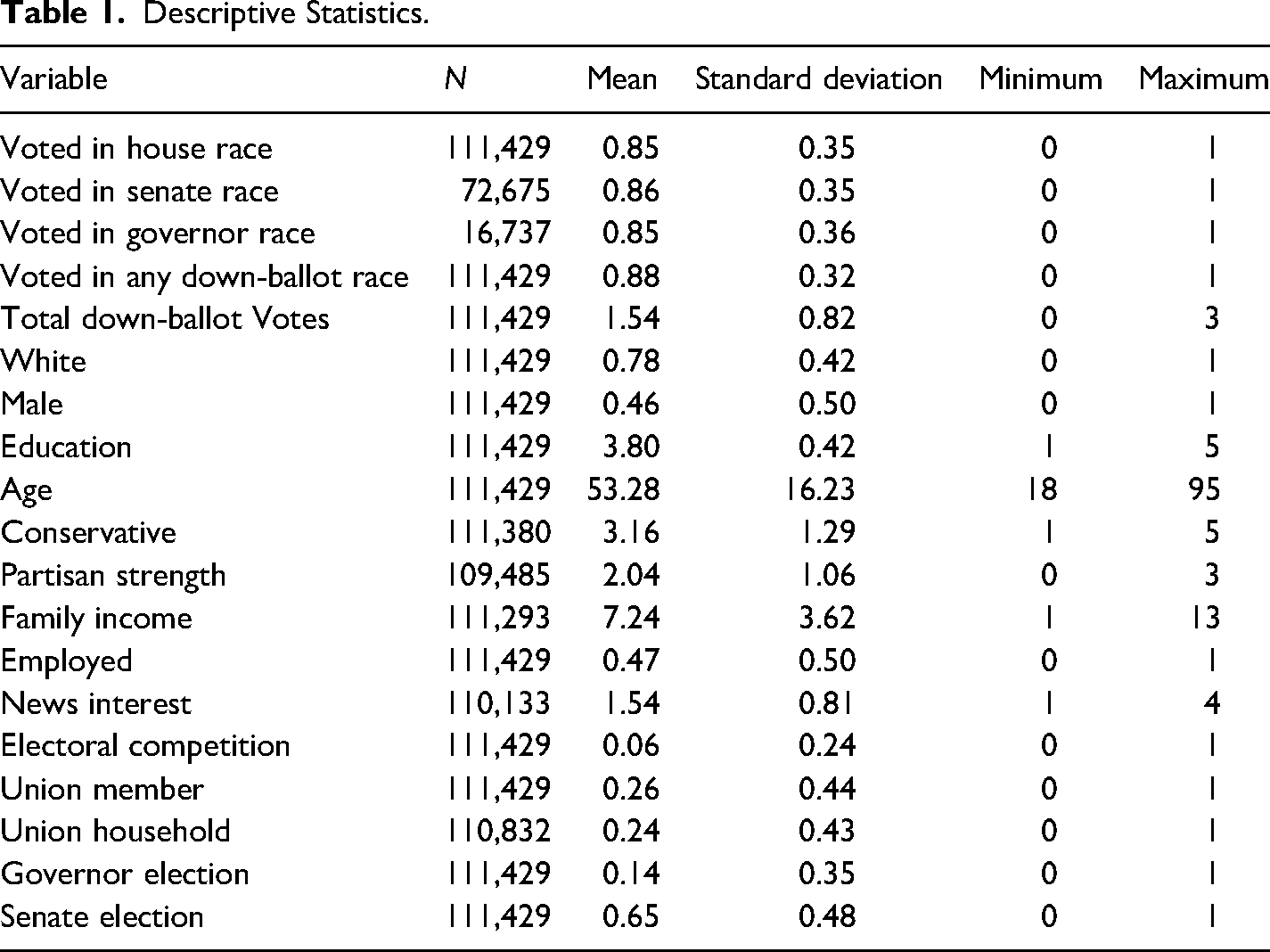
Control variables include race, gender, education, age, ideology, partisan strength, family income, employment status, news interest, and electoral competition. Race and gender are both coded dichotomously, white (1) versus non-white (0) and male (1) versus female (0). Education is coded as an ordinal scale with six components: no high school (1) diploma, high school graduate (2), having some college education (3), having an associate's degree (4), having a bachelor's degree (5), and having a postgraduate degree (6). Age is calculated by the year of the survey minus a respondent's date of birth. Ideology is a five-point scale from very liberal (1), liberal (2), moderate (3), conservative (4), and very conservative (5). Partisan strength is measured as independent (0), lean Democrat or Republican (1), not very strong Democrat or Republican (2), strong Democrat or Republican (3). Family income is based on 12 self-reported income ranges starting at less than $10,000 (1), $10,000–$20,000 (2), to $150,000 or more (12). Employment status is dichotomous: employed full- or part-time (1), not employed (0). News interest is a four-point scale asking respondents if they follow the news “most of the time” (1), “some of the time” (2) “only now and then” (3) or “hardly at all” (4). Descriptive statistics for the included variables appear in Table 1. 3
Descriptive Statistics.
Results
The results from the logistic and Poisson regression models are reported in Table 2. The results are presented as odds ratios for the first four models and incident rate ratios for the final count model. A value greater than 1 represents a variable that increases the odds/rate of down-ballot voting and value less than 1 means the odds/rate of voting are decreasing. The raw log-odds and log-rate coefficients are included in Appendix A (Table A1). Union membership has a statistically significant and positive association with down-ballot voting in all five models. Specifically, union membership increases the odds of voting in any, House, Senate, and gubernatorial races by 5, 10, 9, and 30 percent, respectively. Thus, each model provides support for the primary hypothesis that union membership has a positive association with down-ballot voting. However, the expected spillover effects on other members of union households are not present. In fact, when compared to nonunion voters, being in a union households decreases the odds of voting in every type of election, except for the Senate.
Determinants of Down-Ballot Voting in Any, House, Senate, and Gubernatorial Elections and in Total Votes Cast.
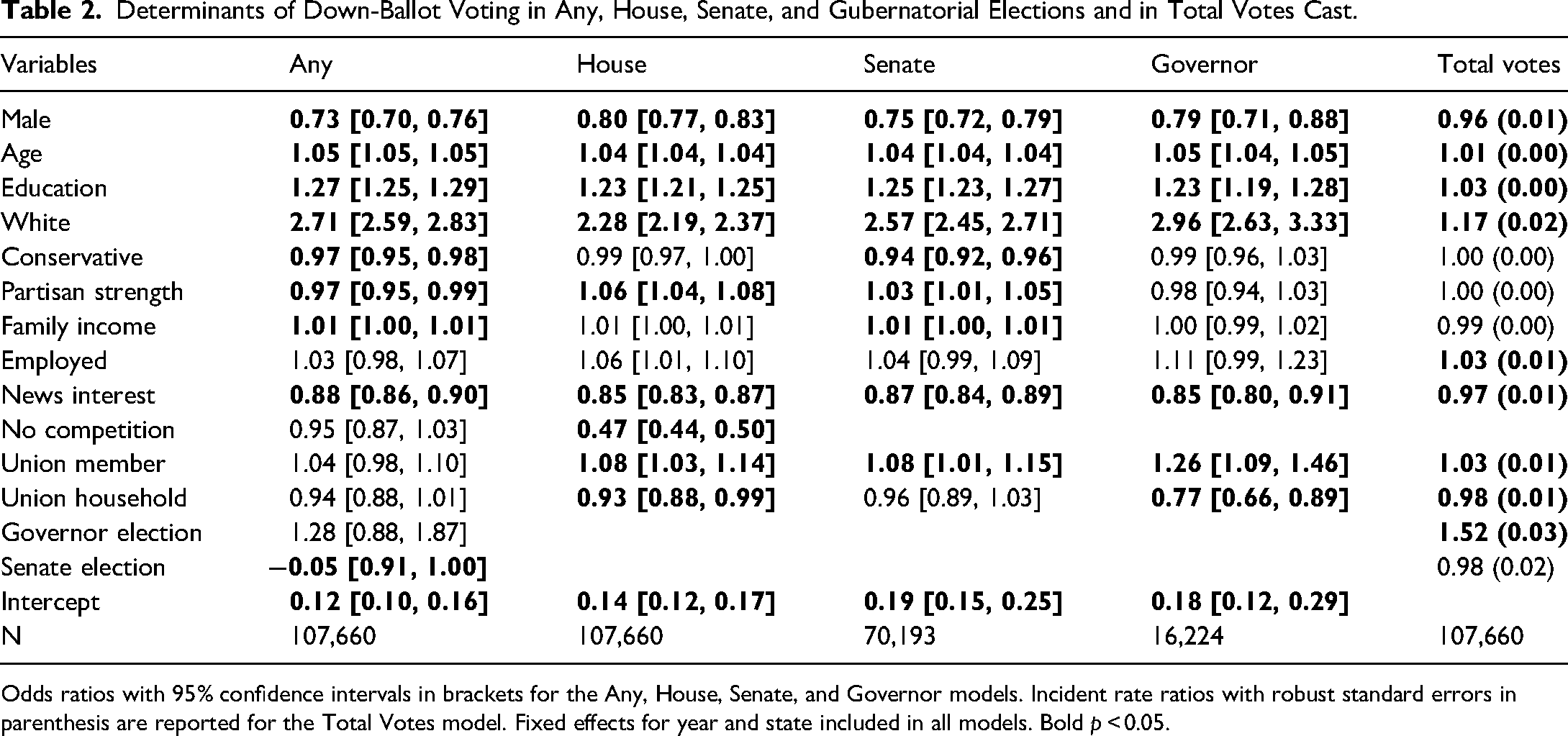
Odds ratios with 95% confidence intervals in brackets for the Any, House, Senate, and Governor models. Incident rate ratios with robust standard errors in parenthesis are reported for the Total Votes model. Fixed effects for year and state included in all models. Bold p < 0.05.
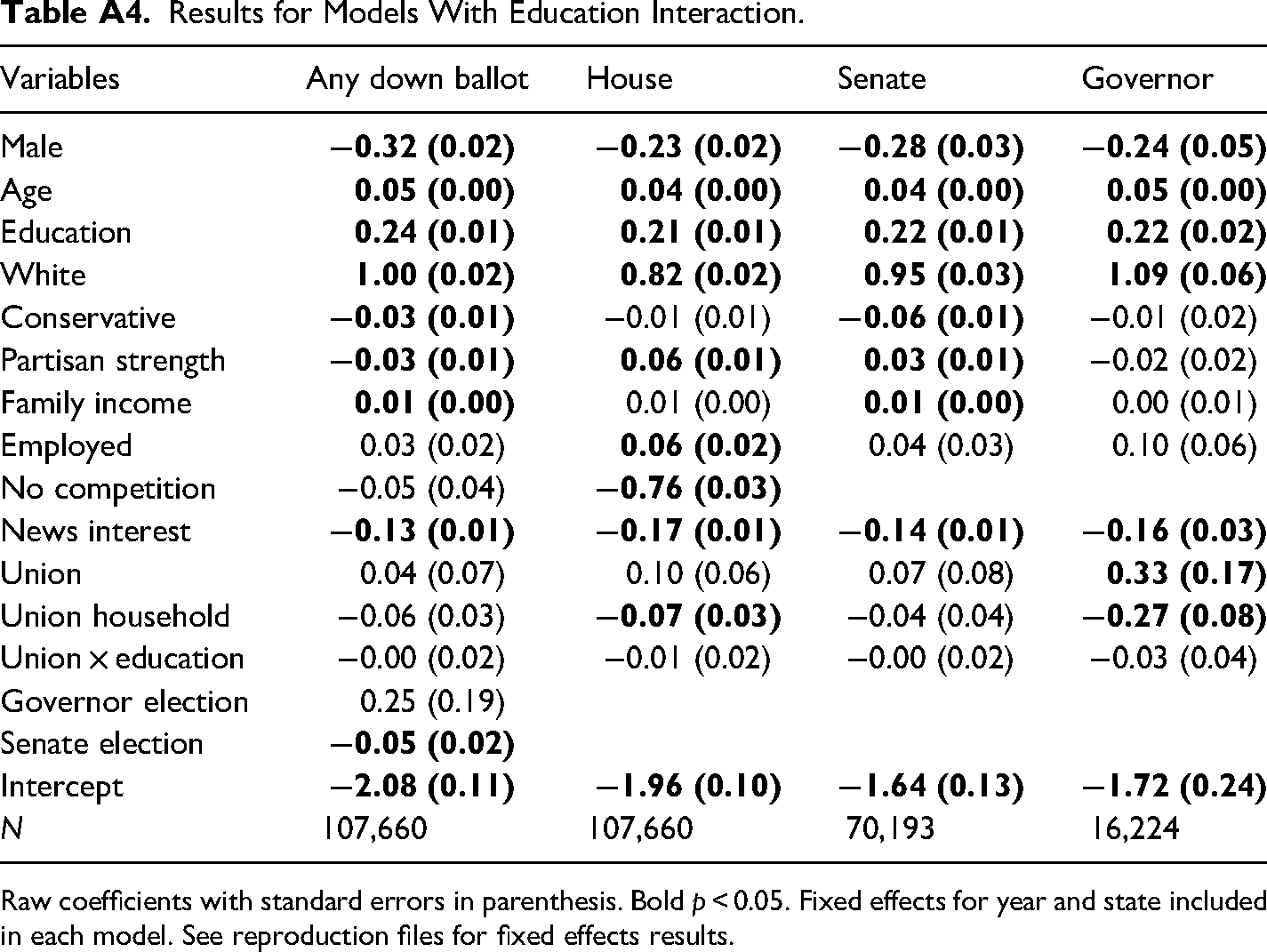
Statistically significant results were present for most control variables tested. As expected from the literature, white voters are more likely to vote down ballot than their non-white counterparts. Women are more likely to vote down-ballot than men. Older voters are more likely to vote down-ballot. The more educated a voter is, the more likely they are to vote down-ballot. Conservatives are less likely to vote down-ballot in all but the Governor model. The greater one's family income is, the more likely they are to vote in any, House, and Senate races. Greater news interest correlates with lower roll-off, given the reverse coded nature of the news literacy variable. For House races, the lack of meaningful competition in the race correlates with substantially higher odds of roll-off. Finally, contrary to the expectations derived from the broader roll-off literature, we found no statistically significant conditional effects for news literacy, race, or education. Full results for all models with interactions are provided in Appendix A, Tables A2–A4.
Discussion
While much has been written about the role unions play in mobilizing their members to the polls, little is understood about whether those efforts translate into more complete ballots. Using data on federal elections, we offer a conservative test of the theory that union information and socialization translate not only in a greater propensity to turn out, but also a lower propensity to roll-off. It is conservative because we used higher profile House, Senate, and gubernatorial elections. Overall, we found mixed support for the hypotheses that resulted from our joining the union mobilization and ballot roll-off literatures. The direct and positive association that is expected between union membership and down-ballot voting was consistent across all models. While much of the roll-off literature focuses on lower salience elections, we find this association even with higher salience House, Senate, and gubernatorial elections. These races receive considerably more money and media attention, which increases their visibility to voters, yet union affiliation is still correlated with a greater likelihood of voting down ballot.
The expected positive spillovers to members of union households, however, were not present. In fact, voters in union households, but who are not directly union members themselves are less likely to vote down-ballot than nonunion voters. Particularly in House and Governor races. In sum, the findings suggest that union information provision not only helps in turning out union voters, as found in prior research, but also in those union voters casting a ballot in more races. But those effects are not shared within households. While we expected such positive spillovers, the combination of findings is consistent with direct election information provision by unions to members making the difference. We argue that this is further supported by the fact that when retired union members are included as “union voters” in the analyses, the positive associations are washed out. Taken all together these findings are consistent with the argument that information provision not only helps to drive union voter turnout (MacDonald 2021; McDermott 2006), but also greater ballot completion.
When testing the expected conditional relationships between union membership and one's news interests, race, and education that are also derived from the roll-off literature, none of the hypotheses are supported. They are consistent, however, with research showing that, regardless of union status, white voters are less likely to roll-off than non-white (Vanderleeuw and Engstrom 1987; Vanderleeuw and Liu 2002; Vanderleeuw and Sowers 2007) and those with greater political knowledge, as measured by both overall education and news interest, are less likely to roll off (Chapp and Aehl 2021; Fahey, Weissert and Uttermark 2018). While these factors still matter broadly, they do not condition the effect of union membership on down-ballot voting.
The roll-off literature thus far has primarily focused on already low-salience races (e.g., local elections) that usually feature less interest as federal and gubernatorial elections (Augenblick and Nicholson 2016; Kritzer 2016; Vanderleeuw and Liu 2002; Vanderleeuw and Sowers 2007). Therefore, it would be worthwhile to study whether union relationships deter roll-off in these low-salience races. In the aggregate, comparing roll-off in states based on union density or whether they have right-to-work laws would also be valuable to evaluate union influence on voting down ballot. Labor unions have been in decline. Unionization in the United States peaked throughout in the 1940s and 1950s where roughly one-third of American workers were represented by a union (Romero and Whittaker 2023, 3). Since its peak in 1945 at 34.2 percent, private sector unions have been in steady decline, with 10.1 percent of all workers being in a union in 2022 (Bureau of Labor Statistics 2023, 1). Additionally, laws that limit union shop types, known as “right-to-work,” have spread across the states since the 1950s (Hertel-Fernandez 2018). As of writing, there are 26 states with right-to-work laws. These laws limit union workplaces to having to operate under an “open shop” agreement, meaning that although a union has the exclusive right to represent all workers in a specific workplace, it may not take union dues from nonmembers who do not wish to pay. 4
Moreover, the U.S. Supreme Court significantly hindered public sector unions with its decision in Janus v. AFSCME (2018). The Court ruled that agency shop agreements between unions and state and local governments violate the First Amendment of the U.S. Constitution by compelling nonmembers to pay agency fees to the union, which they found tantamount to forcing subsidizing of speech which may violate an individual's conscience. This decision effectively put all public sector unions in the same status as private sector unions in right-to-work states as they must now all operate under open shop agreements. These downward trends in density and bargaining power for unions come despite the active role that unions play in politics as election mobilizers and an active interest group lobbying state and federal legislators. Understanding the broader effects of changes in unionization on voting behavior, including down-ballot voting, is important for determining the potentially changing impact of unions in American politics.
Limitations
There are limitations to this analysis. While we included fixed effects for election years and states to address unobserved heterogeneity at both levels, there may be individual-level characteristics that are not accounted for in the model. This could bias the results that are meaningful in terms of estimating the effect of union membership on down-ballot voting. The results are thus necessarily correlational. Moreover, the use of self-reported voting data could bias the results if respondents were not truthful in reporting voting in down-ballot races (Bernstein, Chadha and Montjoy 2001). There is another potential limit in the model specification. Due to our use of the CCES Common Content, we were unable to include other resource, ability, and campaign-specific variables in the models (Brady, Verba and Schlozman 1995). These may also influence down-ballot voting.
Conclusion
Unions spend considerable resources to socialize and train their members to be civically engaged. We argued that the mechanisms utilized by unions to turn out members in elections should similarly encourage members to vote in down-ballot races. This expectation arises from bringing together the existing, but separate, political science research on union mobilization and down-ballot voting. We found consistent support for a positive association between direct union membership and down-ballot voting, however the opposite association was found for union household members. These findings provide nuance in the intersection between unions and elections and raise further inquiries to resolve between unions, elections, and voting down-ballot. To better understand these nuances, we suggested different directions for future researchers including intersections between unions and low-salience elections and unions and minority voters.
These findings have broader implications regarding American civic practice since convincing one to go to the polls may not necessarily mean they give full civic commitment once they arrive. Although roll-off only happens among a small fraction of voters in high salience elections, and thus may not appear impactful in elections where candidates win by thousands of votes, it is important to remember the smaller scale of equally important state and local elections. If union membership matters even in the high salience elections tested herein, it may matter even more in lower salience races. To highlight this, in 2022 the Pennsylvania Democratic Party won a majority of seats in the Pennsylvania House of Representatives for the first time in 12 years. Their one-seat majority can be attributed to a single legislative district in Delaware County that the Democratic candidate won by a razor-thin 59 more votes than their Republican opponent, flipping the seat and the chamber. In state and local races that come down to winning by margins in the ones, tens, or hundreds, who does and does not roll-off can be an important influence.
Footnotes
Acknowledgements
The authors would like to thank Dr. Gina Brelsford for her generous comments on a prior version of this manuscript.
Declaration of Conflicting Interests
The authors declared no potential conflicts of interest with respect to the research, authorship, and/or publication of this article.
Funding
The authors received no financial support for the research, authorship, and/or publication of this article.

Notes
Author Biographies
Appendix A
Results for Models With Education Interaction.
| Variables | Any down ballot | House | Senate | Governor |
|---|---|---|---|---|
| Male |
|
|
|
|
| Age |
|
|
|
|
| Education |
|
|
|
|
| White |
|
|
|
|
| Conservative |
|
−0.01 (0.01) |
|
−0.01 (0.02) |
| Partisan strength |
|
|
|
−0.02 (0.02) |
| Family income |
|
0.01 (0.00) |
|
0.00 (0.01) |
| Employed | 0.03 (0.02) |
|
0.04 (0.03) | 0.10 (0.06) |
| No competition | −0.05 (0.04) |
|
||
| News interest |
|
|
|
|
| Union | 0.04 (0.07) | 0.10 (0.06) | 0.07 (0.08) |
|
| Union household | −0.06 (0.03) |
|
−0.04 (0.04) |
|
| Union × education | −0.00 (0.02) | −0.01 (0.02) | −0.00 (0.02) | −0.03 (0.04) |
| Governor election | 0.25 (0.19) | |||
| Senate election |
|
|||
| Intercept |
|
|
|
|
| N | 107,660 | 107,660 | 70,193 | 16,224 |
Raw coefficients with standard errors in parenthesis. Bold p < 0.05. Fixed effects for year and state included in each model. See reproduction files for fixed effects results.