




Abstract
Across Western democracies, the public sector has undergone significant changes following successive waves of marketisation. Such changes find material expression in an organisation’s logic and associated vocabulary. While marketisation may be adopted, a growing body of research explains how it is often resisted as public sector professionals reject its logic and vocabulary. We contribute to this debate by detailing additional, theoretically important responses. Rather than simply rejecting or adopting both the logic and vocabulary of marketisation, this article shows how UK museum professionals decouple these. Our analysis shows how museum professionals either fashion generic market vocabulary (e.g. customer, value) to pursue local projects or sustain terms such as public and culture to cling to longer-standing ideals of publicness. Partly because of the nature of cultural goods, we propose the museum sector as a paradigm case to illustrate this phenomenon, but our argument has broader implications for the public sphere.
Introduction
Across Western democracies, the work of professionals in the public sector has been significantly transformed through marketisation (Aroles et al., 2022; Elmagrhi and Ntim, 2024; Honingh and Karsten, 2007; McGrath-Champ et al., 2023; Taylor et al., 2021; Tidmarsh, 2022). Marketisation essentially ‘disseminates the model of the market to all domains and activities’ (Brown, 2015: 31), heralding competitiveness, effectiveness and profitability as core values. This reshapes the ways in which public organisations operate and alters how public sector professionals define and understand their core purpose. At the macro- or state-level, this can be described in terms of a move away from hierarchical towards market modes of governance (Rhodes, 2000). The ways in which professionals in the public and not-for-profit sectors react to and experience such change can be understood in terms of shifts in logics, ‘socially constructed historical pattern of material practices, assumptions, values, beliefs and rules’ (Thornton and Ocasio, 1999: 804) and vocabularies, ‘clusters of repetitive words, attributes, and referential texts’ (Suddaby and Greenwood, 2005: 43). Both logics and vocabularies explain embedded agency (Friedland and Alford, 1991); in other words, they offer a way to trace macro-level, state stances to governing the public sector (a shift from hierarchies to markets) down to particular fields and to organisations within those fields (Saz-Carranza and Longo, 2012).
Market incursions in traditionally protected fields – realms of the public sphere that are not left open purely to market forces, such as health, education and culture – can produce tensions as ‘professional discretion gives way to financial rationalization’ (Davis and Marquis, 2005: 341). In addition, owing to the weight of history, many museums are locked into resource dependencies or face coercive pressures to conform to expected norms and structures (see Alexander, 2018). While sociological research has been conducted on the impact of marketisation on the cultural sector generally (see notably Alexander, 2008, 2018), there is less understanding of marketisation in museums and how specifically museums have responded to marketisation. The museum sector is a theoretically interesting context in which to explore the tensions arising from marketisation given the discretionary nature of the services they provide (see Craik, 2005; Gray, 2009), the difficulty of demonstrating ‘value for money’ (Alexander, 2018) due to the intangible nature of culture, and finally the diversity of governance structures and complexity of the financial situation of museums (Aroles et al., 2022). Against this backdrop, focusing on both the logic and vocabulary of marketisation, this article aims to address the following research question: How do museum professionals respond to marketisation in the UK?
To that end, this article draws from a longitudinal study of museums in England and Scotland, mobilising multiple data sources gathered at two time periods. Our research placed particular emphasis on the ways in which museums responded to two macro-level, societal shocks – ‘Austerity’ and the Covid-19 pandemic. Each ushered in significant change across the sector, particularly in terms of pressures on funding and revenue generation. Both upheavals were very different in their causes and character, yet challenged many museums’ basic business models. We analysed museum professionals’ perception of their impact in terms of a longer trend of marketisation – examining their reactions to increasing emphasis on the logic and vocabulary of the marketplace during each change. The first study (2017/2018) entailed conducting 30 on-site, qualitative interviews, collecting observational data in the form of museum tours and analysing documentary evidence. The second study (2021) was footprinted on the same design and focused on the same organisations. This involved conducting a further set of 21 online, qualitative interviews and review of available online materials.
This article makes two main contributions to the sociological literature. First, it identifies and explains four ideal types that illustrate museums’ responses to marketisation. We summarise these in terms of four characteristic stances: Entrepreneur’s stance, Campaigner’s stance, Bricoleur’s stance and Cynic’s stance. To date, responses of public and non-profit organisations to marketisation have typically been understood in terms of adoption (willingly or not) (Brown and Carasso, 2013; Townley, 2002) or resistance (Eikenberry, 2009; Glynn, 2000), with some research exploring the emergence of hybrid models (see for instance Bromley and Powell, 2012; Cullen, 2019). Going beyond a dichotomy of acceptance or rejection, our article shows how some museum professionals respond to the challenges of marketisation by decoupling market logic and market vocabulary. This analysis advances our understanding of responses to marketisation in public and not-for-profit organisations.
Second, this article explores how some museum professionals decouple language from logic, thus remaining committed to the original ethos of museums and their contribution to the public good and to an ideal of ‘publicness’. This results in two distinct stances not identified in previous literature: (i) accepting the logic of marketisation while rejecting its vocabulary or (ii) co-opting the vocabulary of marketisation while resisting its logic. Altogether, this article adds to the sociological literature on how professionals have responded to market pressures in the cultural sector. Significantly, the relevance of the responses typologised in this article extend beyond the remits of the cultural sector. Specifically, we contend that our research lays the foundations for fine-grained, institutional-level analysis of the specific mechanisms through which such responses are materialised in other sectors where similar tensions are encountered.
Theoretical framework
Marketisation and the public sector
In broad terms, marketisation consists in the dissemination of ‘the model of the market to all domains and activities’ (Brown, 2015: 31). A ‘first wave’ of marketisation can be described in terms of the transnational phenomenon of New Public Management (Ferlie, 1996), which notably ushered in performance culture (Andrews et al., 2006), creation of internal markets (Pollitt, 2007), capitation and fees for service payments (Mrotek, 2001), outsourcing and privatisation (Wu, 2002), public–private partnerships (Deakin, 2002), ‘choice’ (Morrell, 2006), ‘public value’ (Moore, 1995), voucher schemes (Harrison and Wood, 1999) and managerialism (Klikauer, 2013). A ‘second wave’ of changes followed the Global Financial Crisis and severe contractions in government spending (Bozeman, 2010). At times this pitted different public services against each other in competition for dwindling resources (Krachler and Greer, 2015). Non-ringfenced services came under greater pressure as many public organisations were driven closer to the market in search of new revenue streams or savings (Aroles et al., 2022; Hyde et al., 2016; Morrell and Bradford, 2018). These waves of marketisation have influenced the extent to which many public services are seen as genuinely ‘public’: a continuation of long-established debates about the blurring of the public and private (Bromley and Meyer, 2017), and the roles of for-profit and not-for-profit organisations (Dees and Anderson, 2003).
The impact of marketisation has been examined in various empirical contexts broadly connected to the public sector or organisations pursuing the public good. In his study of probation services, Tidmarsh (2022) notably explores the underlying tensions between marketisation and more ‘traditional’ expressions or forms of professionalism, thus probing into the ways in which marketisation was challenging core activities and assumptions pertaining to a traditional profession. Similar tensions have been investigated in the context of higher education (Elmagrhi and Ntim, 2024) and education more broadly (McGrath-Champ et al., 2023); as well as in social services (Cortis and Van Toorn, 2022) and the healthcare sector (Bacon and Samuel, 2017; Brookes and Harvey, 2016). Changes induced by marketisation are typically materialised through alterations in terms of logics (Glynn, 2000; Thornton and Ocasio, 1999; Zorloni, 2010) and vocabularies (Aroles et al., 2023; Suddaby and Greenwood, 2005), highlighting the role discourse plays as professionals account for and navigate conflicts between commerciality and public service (Cohen et al., 2005).
Tensions in the cultural sector
During both waves of marketisation, many museums found themselves caught in tensions between their founding values and an encroaching market (see Sanders, 2015). Importantly, the commodification and marketisation of culture is not a new phenomenon (see Alexander, 1999; Gray, 2000; Menger, 1999). McRobbie (2002) argues that, since the 1990s, organisations in the cultural sector have become increasingly dominated by ever-more aggressive market philosophy. The effects of this philosophy have been noticeable at many different levels (see Alexander, 2008) and can be traced in terms of two complementary, deeply entwined forces that usher in a logic of commerce. The first is the well-documented rise of competitive pressures (Brown, 2015). The second is audit culture, because the growth in significance of performance metrics has put curators and museum managers on the back foot, often having to justify intrinsic and local values and projects in terms of externally derived and generic targets and measures (Zorloni, 2010).
In recent years, austerity measures have exacerbated these changes (Berry, 2016), reshaping the cultural sector in such a way that it needs to demonstrate ‘value for money’ (Alexander, 2018). What has been called ‘cultural accountancy’ (Menger, 1999) seeks to quantify the economic output of public spending on culture. Though profitability does not seem to be the best measure to assess activities dedicated to the common good, Herzlinger (1996: 99) recognises that ‘alternative measures of performance are hard to find’. Interestingly, though tensions between marketisation and culture may seem inevitable or even obvious, some scholars highlight how these different spheres are not necessarily diametrically opposed. Caves (2000) argues that although creative goods differ from goods in other sectors of the economy, cultural activities can be analysed using the same economic concepts: contracts and transactions, markets, and principles of supply and demand. Grampp’s (1989) book, Pricing the Priceless, which analyses the art world, museums and public policy towards the arts, takes a more strident neoclassical economics perspective, asserting ‘aesthetic value is a form of economic value just as every other form of value is’ (p. 21). These different perspectives invite more careful consideration as to how managerial and cultural imperatives play out when marketisation impacts the economy of the culture ‘industry’.
Responding to marketisation
The introduction of marketisation in the public and not-for-profit sphere has led to a variety of responses, largely premised on the (financial) situation of the organisation considered. Notwithstanding this variety, the responses of public and non-profit organisations to marketisation have often been understood and framed in terms of adoption (willingly or not) (Brown and Carasso, 2013; Townley, 2002), or resistance (Eikenberry, 2009; Glynn, 2000), with the idea that those positions can change and evolve over time due to changes in leadership or in the funding landscape for instance. A more limited body of literature has looked into how organisations can adopt a middle-ground position, essentially neither completely adopting or rejecting marketisation. These studies illustrate how coexistence and competition between various logics can lead to different forms of cooperation (Reay and Hinings, 2009) or hybridisation (Choi et al., 2011).
Research exploring the emergence of hybrid models (see for instance Bromley and Powell, 2012; Cullen, 2019) has explained how this can take different forms. Pache and Santos (2013) show organisations and their members deciding to adopt specific elements or dimensions of various competing strategies in order to retain a certain degree of legitimacy vis-a-vis a wide array of different stakeholders. They describe the tensions between navigating market-based principles while serving a social mission. In this example, organisational actors are seen to engage in what the authors call selective coupling. Co-optation has been identified as another strategy through which organisations can strike a balance between competing demands and interests (Anderson and Liff, 2018; Bolton et al., 2019). In their landmark article, Bromley and Powell (2012) argue that there are essentially two main forms of decoupling: either a gap between policy and practice, or a gap between means and ends. They argue that the first gap (policy and practice) tends to obfuscate the second (means and ends) and thus call for further empirical research into decoupling between means and ends. Managerial ignorance – where managers do not really probe into gaps between espoused practices and reality – is seen as one way in which there is a materialising of decoupling (Schaefer, 2019). We take a step further here, by explaining how museum professionals deliberately account for their work and purpose, often reshaping commercial language to respond to pressures of marketisation and the logic of commerce.
Methodological approach
Research context
There are approximately 2500 museums in the UK and slightly over half are accredited by the UK Museum Accreditation Scheme (Arts Council England, 2022). Accredited museums ascribe to nationally agreed standards by the Arts Council. The Museums Association (2022) lists eight types of museums. The financial situation of a museum is largely determined by its degree of reliance on public funding; however, given the diversity in this sector, museum governance can involve the private, public, third and academic sectors (Loach et al., 2017). Recent funding cuts and changes in the subsidy landscape for the UK cultural sector have affected museums differently – mainly owing to changes in their revenue streams (Aroles et al., 2022).
In the context of this article, we explore responses to marketisation in the museum sector through two macro-level, societal shocks: namely Austerity and Covid. Our two waves of research, approximately four years apart, are within established norms for longitudinal research (Neale, 2019). Qualitative longitudinal research is particularly effective in enabling the exploration of processual phenomena while being attentive and receptive to the context studied (see Ellingsæter and Jensen, 2019; Jacobs, 2002; Miller, 2011). This research design enabled us to identify trends and patterns in real time rather than through retrospection, also affording significant flexibility to pursue themes as they emerged through the research (Hermanowicz, 2013).
Data collection
Our approach to museum selection was purposive since we sought to cover different types and sizes of facility across a range of geographical areas. Overall, we contacted 109 museums and managed to secure a sample of 30 who agreed to partake in our research. The vast majority of those who declined cited an inability to participate because of lack of resources or time rather than lack of interest. The 30 museums sampled are in 20 cities across England and Scotland. They comprise 15 independent, nine local authority, three university and two national museums, plus one heritage site. It is worth noting that some museums – classified as independent, local authority-run or university-run – had unusual sets of accountabilities. As such, and consistent with heterogeneity across the sector, there was a great level of diversity in our sample. All 30 organisations are Arts Council accredited museums.
The first round of interviews took place in 2017/2018 and lasted around 60–90 minutes each. All interviews were carried out by the lead author in keeping with appropriate norms and ethical guidelines. Depending on the structure of the museum, our research involved interviewing different museum professionals including curators who were local council employees (local authority museums), government employees (national museums), volunteers (small independent museums), managers or chairmen of charities (independent museums). On several occasions, we interviewed managers or directors overseeing various sites; this was notably the case with museums run by local councils. The second round of interviews was footprinted on the same research design. The 30 museums initially sampled were contacted to partake in this second phase of the research. Twenty-one responded positively, and interviews were thus conducted. Eight answered negatively, mentioning time and financial constraints, while one did not return any calls or emails. All interviews took place in the second half of 2021 and via Zoom (due to travel restrictions). As in the previous round, interviews lasted between 60 and 90 minutes and were audio-recorded, then transcribed by the lead author.
During the first phase of the research, interviews were either preceded by, or followed, with a tour of the museum. On average, each tour lasted approximately three hours, amounting to 90 hours of observation in total. This resulted in copious field notes, which helped us to make sense of and contextualise the narratives that emerged from the interviews. In 25 of the 30 museums visited, the lead author also had the opportunity to speak more informally with other members of staff, which greatly contributed to shaping our understanding of these organisations. Overall, these tours were particularly useful in allowing us to gain first-hand understanding of the roles and functions of museums and to start unpacking the ways in which museums were responding to severe financial pressures accompanying marketisation.
Finally, we also collected and analysed secondary data in the form of financial reports, museums’ statements of purpose, annual reports as well as other documents related to the activities of the museum. Some of these were available on the websites of the museums visited while others were handed to us during the first round of interviews and these typically came to several dozen pages per museum. We also reviewed relevant policy pieces such as The Spending Review (2010) and Mendoza (2017) to get a sense of the ways in which funding for the cultural sector had evolved over the past 10 years. We also read the Annual Reports (2003 onwards) of the Museum Association and their Cuts Survey. These documents allowed us to gain a deeper understanding of the general context in which museums operate, while also providing specific information about, for example, targets, objectives, performance metrics, operating conditions and so on.
Data analysis
We analysed and coded our data using an inductive approach (Gioia et al., 2013), searching above all for emerging narrative themes but in a way that was also informed by the relevant policy context and literature. More precisely, we followed a three-stage process that involved first generating a series of first-order codes, then second-order themes (that sought to meaningfully group our first-order codes) and finally aggregate dimensions that, in essence, constitute the main findings of our research. We identified marketisation as a clear emergent theme in the first few interviews, concentrating more on this as these progressed. As an example of what sensitised us to marketisation and language use, a phrase several interviewees used was the need for museums to be more ‘business-savvy’. This and similar statements led us to consider relationships between the logic of the marketplace and its associated vocabulary – important themes that prompted us to then hone in on tensions arising from marketisation.
By rigorously working through both our research notes and the data we collected, we formulated a series of first-order codes that sought to capture the essence of our raw data. These first-order codes are, essentially, in vivo elements from interviews, informal discussions, observations and archival data. Our first-order codes cover matters of funding, accountability, access to resources, change (management), logic and organisational positionality, use of vocabulary, organisational culture, the role of visitors, museums’ role in society, and so on.
We then worked on crafting our second-order themes; this involved an iterative process of moving back and forth between our raw empirical data and our first-order codes, as well as visiting various debates and concepts within different streams of literature. Notable among these streams of literature was research documenting contemporary changes in the museum sector (for instance Loach et al., 2007; Scott, 2009; Selwood, 2010), research on marketisation and its impact (Elmagrhi and Ntim, 2024; McGrath-Champ et al., 2023; Tidmarsh, 2022) as well as research on decoupling (Bolton et al., 2019; Bromley and Powell, 2012; Pache and Santos, 2013). At this stage, we revised our first-order codes as we sought to develop ways of grouping these under the umbrella of wider themes, thus establishing connections between our emerging first-order codes and the existing literature. Eight main second-order themes resulted from this process, which can be split in two different, albeit linked, categories. The first category relates to engagement with the logic of the marketplace and the emphasis on publicness. It includes the four following themes: Diminution of publicness; Focus on publicness; Maintaining publicness; Concealed move away from publicness. The second category is connected to the relation of museums to the vocabulary of the marketplace and includes the four following themes: Re-branding the museum; Preserving the vocabulary of the museum; ‘Pitching’ the museum differently; Mimicking linguistic continuity.
This led us to the development of four aggregate dimensions: (i) Embracing the vocabulary and logic of the marketplace; (ii) Rejecting the vocabulary and logic of the marketplace; (iii) Co-opting the vocabulary of the marketplace to resist market logic – a tactic of paying ‘lip service’ to terms like customer and value; and (iv) Accepting inevitabilities of market logic but rejecting market vocabulary to cling to traditional ideals. In the first two aggregate dimensions, which have been documented in the literature (Brown and Carasso, 2013; Eikenberry, 2009; Glynn, 2000; Townley, 2002), vocabulary and logic are coupled; in the second two, they are decoupled. We summarise these in terms of four ideal-typic stances: Entrepreneur’s stance, Campaigner’s stance, Bricoleur’s stance and Cynic’s stance. In describing these stances, we do not imply the views of any one professional are synonymous with their museum (because not all members of any organisation share a single perspective). Nor are we suggesting that any one museum is definitively an entrepreneur, campaigner, bricoleur or cynic. Instead, these are categories to inform analysis and theorisation, intended to tell us something meaningful about the sector as a whole. This is in the same way that ideal types can be theoretically illuminating. Although they are simplifications and abstractions, they nonetheless can be helpful analytical tools that distil complexity and offer bases for comparison and contrast. Figure 1 provides an overview of the coding process. We structure our findings section around these four stances.
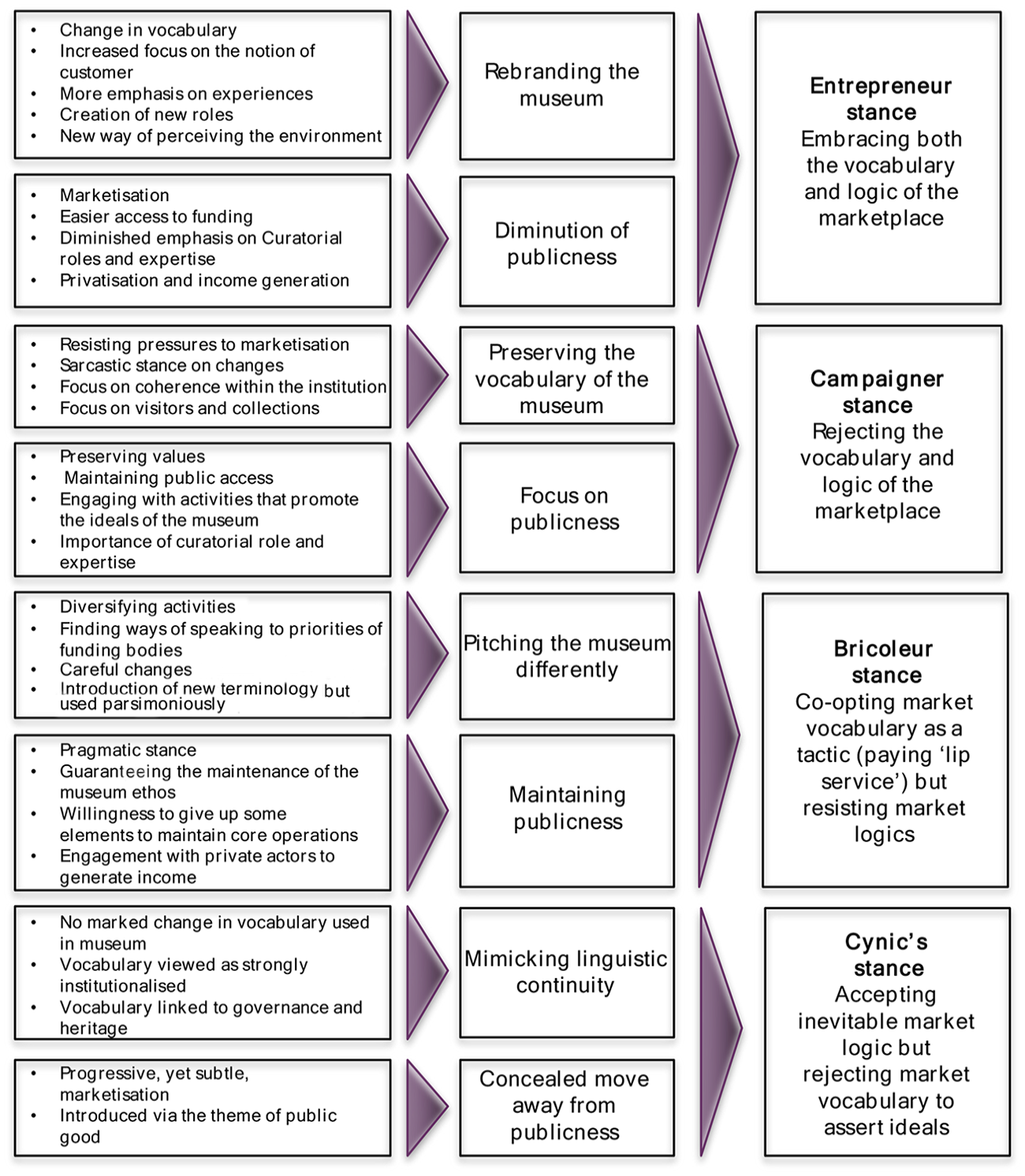
Coding structure.
Findings: Four responses to marketisation
The entrepreneur’s stance
An entrepreneur’s stance is characterised by the acceptance of both the vocabulary and the logic of marketisation. Notably throughout our interviews, the imperative for museums to realise value was materialised in terms of a changing relationship between museums and their visitors. Explicitly adopting a commercial perspective entailed considering audiences more carefully and more strategically. The deputy chief executive of an independent museum (Andy, 2018) explained that while the focus of museums used to revolve around preserving the collections and maintaining the buildings, it has now very clearly shifted to the ‘people side of things’. Visitors, as well as their experiences of the museum, have become central: ‘we need to make sure that we have a distinctive offer somehow’. A large amount of resources is then devoted to answering the two following questions: ‘how do we make sure that visitors have a nice time?’ and ‘how can we make sure they come back within two years?’. Similar points were made in other interviews. For instance, the chief operating officer of an independent museum (Mark, 2021) explained: ‘We have just converted from being a free entry into one that you have to pay to get into. And we’ve been pretty successful [over the] previous 12 months really, we’ve done quite well [. . .] we got a few less visitors, because we were charging them when we were free before, but we anticipated that. We’ve been able to invest in the museum, the fabric of the museum, but also exhibitions [and] various things, so it is going quite well actually.’ In both cases, the logic of marketisation was perceived as an opportunity to grow and further expand.
In some organisations, such changes were paralleled in a switch towards a more business-oriented vocabulary in the discourses of museum professionals. For instance, a museum manager in a mid-size local authority museum (Sofia, 2018) described how the vocabulary used in the sector had grown increasingly ‘businessy’, noting how, for instance, ‘it’s all part of the packaged experience we now have to offer’. Her perspective was that the influence of more businessy vocabulary positively influenced practice and had translated into changes in roles and day-to-day activities: ‘we wouldn’t talk about visitor experience before, but now there are visitor experience managers in many museums’. This was made tangible, in this museum, through various incentives for visitors to share their experience. A source of incoherence or at least ambiguity was the implications this had for the nature of their core goods. Rather than items and objects needing to be preserved for exclusively cultural or historical reasons – as they said primarily for the ‘public good’ – museum artefacts were discursively constructed as resources and ‘perceived more as assets’ (Mary, Director of an independent museum, 2021). Thus, this packaged experience meant collections became commodities that could be monetised to attract more visitors. Interviewees regularly explained how certain pieces ‘popular with visitors’ were increasingly attributed a heightened commercial and economic status, while others – perhaps received less enthusiastically by the public but which were culturally or historically of equal or greater importance – could be seen ‘increasingly as liabilities’ and subject to the view that ‘preserving them might be very costly’ (in terms of insurance costs notably). On various occasions, exhibitions were depicted (on posters and leaflets) as family-friendly or reflective of the local culture, in a bid to speak to the audiences targeted. These changes go beyond adoption of terminology; museum professionals explained how they alter a museum’s purpose and reframe how its core, cultural goods are perceived, signalling a new logic.
There was clear heterogeneity in terms of the museums where this ‘entrepreneur’s’ stance was discussed and presented by museum professionals: some (typically smaller local authority and independent museums) did not seem to have any alternatives, while others may have seen this commercial move as a noteworthy opportunity and a way of re-inventing and re-branding their organisation. The danger for this group – which has moved in line with both changes in vocabulary and the logic of shifting governance modes – is that both kinds of change can take them away from founding ideals and the goal of contributing to the public good. As a result, there may be a loss of integrity and purpose as well as a diminution of ‘publicness’. Another way to express this is that accepting these changes may be helpful in winning a short-term battle that relates to funding, but it could also mean losing a longer-term war about the primary nature and purpose of such organisations.
The campaigner’s stance
A campaigner’s stance is characterised by the rejection of both the vocabulary and the logic of marketisation. During our interviews, there was a clear sense from many professionals that museums needed to stand their ground and remain true to their values. The head of finance of a national museum (Tom, 2021) explained: ‘I think we have made some fairly fundamental shifts in how we operate and how we work [but] there’s a certain line you cannot cross when you are museum’. The pandemic had led to unique challenges. It heightened sensitivity to commercial pressure but had even raised questions to do with an organisation’s facticity – what might previously have been taken for granted as demonstrably real and tangible:
ultimately a museum is about a physical collection in a physical place. There’s certainly been more of interest in digital delivery in the sector, but I don’t think there’s really a sense that that would ever make up for having real people come to a real physical location . . . We should not forget why we exist.
He further insisted on the fact that it was important for museums to remain aligned with their original purpose and mission, thus resisting pressure to adopt practices alien to the sector. For many, even Covid did not mean there were sufficient grounds to accept either the logic or language of marketisation. In one interview, a team leader in a local authority museum (Michael, 2021) echoed a running theme in the first round of interviews: ‘we are now being looked at as a business, which goes against the ethos of museums really’. In both cases, as highlighted by museum professionals in those organisations, the logic of marketisation was rejected and perceived as being in direct conflict with the fundamental nature of museums.
The campaigner’s stance also involved rejection of the vocabulary of marketisation. Through the research, there were very clear cases where interviews resisted language choices that one would associate with the marketplace. For instance, a museum officer in a small local authority-run museum (Chloe, 2018) explained how they resisted: ‘pressure from the council and other actors to change our job titles to be more in line with other services’. In this particular instance, there were calls for curators to be renamed collection managers. The use of certain terms (such as customer, experience, market segment, competition, profitability, value, etc.) performs and materialises a different type of relationship between museums and those who pass through their doors. A collections manager in a heritage site (Noah, 2018) aptly noted that adopting a new vocabulary placed an overemphasis on experiences, which in turn might lead to ‘the Disneyfication of the sector and our very site, at the expense of our values’. Informally, this was also conveyed in the various tours conducted where museum staff were clearly cynical about some of the changes affecting the sector.
Interestingly, the campaigner’s stance was discussed by museum professionals in various types of organisations, from large independent (that may have the necessary resources to stand their ground) to smaller museums deeply invested in what they see as their primary mission (and some of whom would rather close than compromise their values). The rejection of market vocabulary may place a museum at a comparative disadvantage in terms of its competitive context (for instance, making it harder to argue for funding) but it can also provide a clear sense of purpose and identity. To continue our battle/war allegory, these museums may be winning a short-term battle that is to do with preserving traditions and logic – and even perhaps maintaining morale or an esprit de corps. However, they could be risking long-term viability because they are not developing a capability to mobilise the same kinds of discursive resources that their ‘competitors’ may draw on. At the same time, although antagonistic to changes in the wider environment, we need to note potential benefits from such resistance. It is not simply resistance for its own sake. The struggle this second group is undergoing can be internally important in terms of renewing the kinds of ideals that attracted many to work in the cultural sector in the first place.
The bricoleur’s stance
What we call a bricoleur’s stance is characterised by a rejection of the logic of marketisation combined with the co-optation and refashioning of the vocabulary of marketisation for the purpose of pursuing longstanding ideals. This stance allows stakeholders to adopt a superficial, contemporary fashion (co-opting market vocabulary) at the same time as holding onto an underlying, traditional style (resisting market logic). Depending on the size of the museum, these could be global ideals (such as playing an international or national role) or more local (associated with a particular place) as articulated by various museum professionals. The director of an independent museum (Alexa, 2021) argued that ‘publicly funded cultural activities shouldn’t have to justify their own good [. . .] yet we need to find a way of speaking to new priorities’. We identified several cases where key stakeholders in organisations were adopting a new vocabulary without, as they explained, fundamentally altering their practice. As described by a development manager in a local authority museum (Anita, 2018), when working on a funding bid, ‘we always have to put some fluff on it’, highlighting how museums mobilise a certain vocabulary and its imagery to reach their goal. Overall, this led many museum professionals to be pragmatists, both in how they engage with the changing priorities of funding bodies and in terms of how they pitch themselves.
The director of a university museum (Ethan, 2021) explained:
I think we’re trying to find a different slightly different language for the future. We don’t want to talk about new normal because that feels like we’re just going back to the way things were. Somebody said, ‘Well you know after the Black Death the Renaissance happened’. You know we come back stronger and we try and change some of the stuff that might have stopped us doing more of the good things.
In the course of the interview, he further explained that his phrase ‘language for the future’ was a reference to a more modern, business-receptive language that would allow his museum to operate in the way they were always intending to. This language for the future was very present in some of the documents produced by museums, in particular that addressed to potential funding sources. In other words, giving ground on the vocabulary used was not too much of an issue if it meant being able to retain their core original logic and purpose.
Again, across our sample, with the exception of comparatively large museums, museum professionals in various types of organisations seemed to articulate this stance, ranging from university-run museums to small and medium-sized local authority museums. The ‘bricoleur’ actively invokes a vocabulary of ‘customer’ and ‘value’ that resonates strongly with both the entrepreneur’s and campaigner’s stances, but they do so in a way that enables market logic to be resisted. Returning again to our battle/war trope, this stance brings together a coalition of the unlikely. We describe it as a coalition of the unlikely because the bricoleur’s stance actively aligns protagonists with terms that are seemingly in tension with longstanding ideals relating to the public good. However, whereas the first two stances understand changes in vocabulary and changes in governance as happening in tandem, this stance decouples them. At a micro level, this means curators and managers focus resolutely on the symbolic and cultural significance of collections for visitors and the wider public. Rather than straightforwardly adopting or rejecting market vocabulary, the ideal-typic ‘bricoleur’ gathers up and assimilates these terms.
The cynic’s stance
A cynic’s stance is characterised by an acceptance of the logic of marketisation combined with a strong rejection of the vocabulary of marketisation. With heavy understatement, the director of a university museum (Joseph, 2017) aptly noted that: ‘the whole museum sector is aware that public funds are unlikely to go up’. These trends are well in line with a general recommendation from Mendoza (2017: 18): ‘Museums need to be cultural enterprises. They must consider and plan how to operate in a mixed economy of public and private funding and commercial income, adapting business models where appropriate’. Describing the effect of starting to act like businesses, the director of an independent museum (Alexa, 2017) lamented, ‘very few members of staff now focus on the core purpose of the museum – work directly connected to the collections’. While she argued that she would like ‘more resources to be spent on collections’ and less on ‘visitors and their experiences’, she later conceded that, in terms of time and resource allocation, a market focus was ‘now very much needed for a museum to remain open’. A senior staff member in a national museum (Jane, 2017) echoed this point, stating that while ‘everyone wants the museum to be really successful [. . .] people understand that they now have to do things geared towards tourists and bringing in money’. There was increasingly an acceptance among museum professionals that they needed to ‘engage with certain commercial activities in order to preserve the collections and keep the museum open’. Similarly, a programmes officer in a local authority museum (Emma, 2021) suggested the logic was simple – that by offering ‘a good experience to visitors’ the museum could subsequently ‘attract more visitors and then invest the money into the maintenance and redevelopment of the site’. Notwithstanding this position, they made it clear in the interviews that they strongly rejected the vocabulary that accompanies marketisation. Such views were typically echoed during the tours of these organisations.
The director of an independent museum (Ben, 2018) described how, to generate income, they had ‘commercialised the archives’; for example, charging private companies for the privilege of consulting certain historical records of national significance. He suggested that ‘while not ideal’, this had gone some way to ‘solving the museum’s cash flow problems’. He went on to explain that monetising their collections in this way allowed them to retain a dimension of publicness that they believed to be essential to their identity. In that context, they clearly described the process as that of maintaining linguistic continuity (giving the example of keeping existing job titles, discussing culture over business, etc.) while altering their practices and rethinking the logic through which they operate. They understood such positioning not just as a form of resistance to marketisation but a stance of defiance.
The managers and curators who adopted this cynic’s stance were still facing inescapable pressures that accompanied a logic of marketisation. Yet, as in the original sense kunikos, they held tenaciously to terms such as visitor, public and culture. In common with the bricoleur’s stance, this stance also decouples the logic and vocabulary of marketisation but in a way that is less about tactics or expedience and instead describes a more defiant emphasis on traditional ideals. To an extent, professionals in different kinds of organisations seemed to embody this stance, although it seemed more common among local authority and independent museums, perhaps because these were comparatively less reliant on competing for public funds and also because their purpose was tied much more to the values of a community and place.
Discussion
Marketisation and decoupling
Our findings show a nuanced, differentiated account of the ways in which museum professionals have sought to respond to marketisation. Through our longitudinal research, we explored different reactions to the logic and vocabulary of marketisation, the main source of our contribution being that these two do not necessarily work in tandem. Rather than taking terms such as ‘value’, ‘customer’ or ‘experience’ as important in themselves, we sought to understand how these terms are deployed, in which context and how their introduction is perceived by museum professionals. As highlighted through our interviews, the vocabulary of marketisation – typically associated with terms such as value and customer – has been accepted in some museums and resisted in others, a process documented in the literature (see Brown and Carasso, 2013; Eikenberry, 2009; Glynn, 2000; Townley, 2002). This is what describes our entrepreneur’s and campaigner’s stances. In other cases, however, acceptance or rejection of this vocabulary was not paralleled in changing practices. Beyond acceptance and rejection, certain museum professionals explained how they co-opted and refashioned the vocabulary of marketisation to advance longstanding logic and ideals – an effective decoupling of vocabulary and logic. We called this position the bricoleur’s stance, which takes shape in a ‘coalition of the unlikely’ (Djelic, 2013; Yandle, 1983). Finally, a fourth stance – the cynic’s stance – consisted in making concessions to the inevitabilities of market logic but clinging to traditional terms and thereby preserving longer-standing ideals even in the face of wider changes. Both the bricoleur’s and cynic’s stances creatively materialise non-aligned practices and processes, thus developing sources of resistance to marketisation. Figure 2 provides an overview of these four ideal-typic stances.
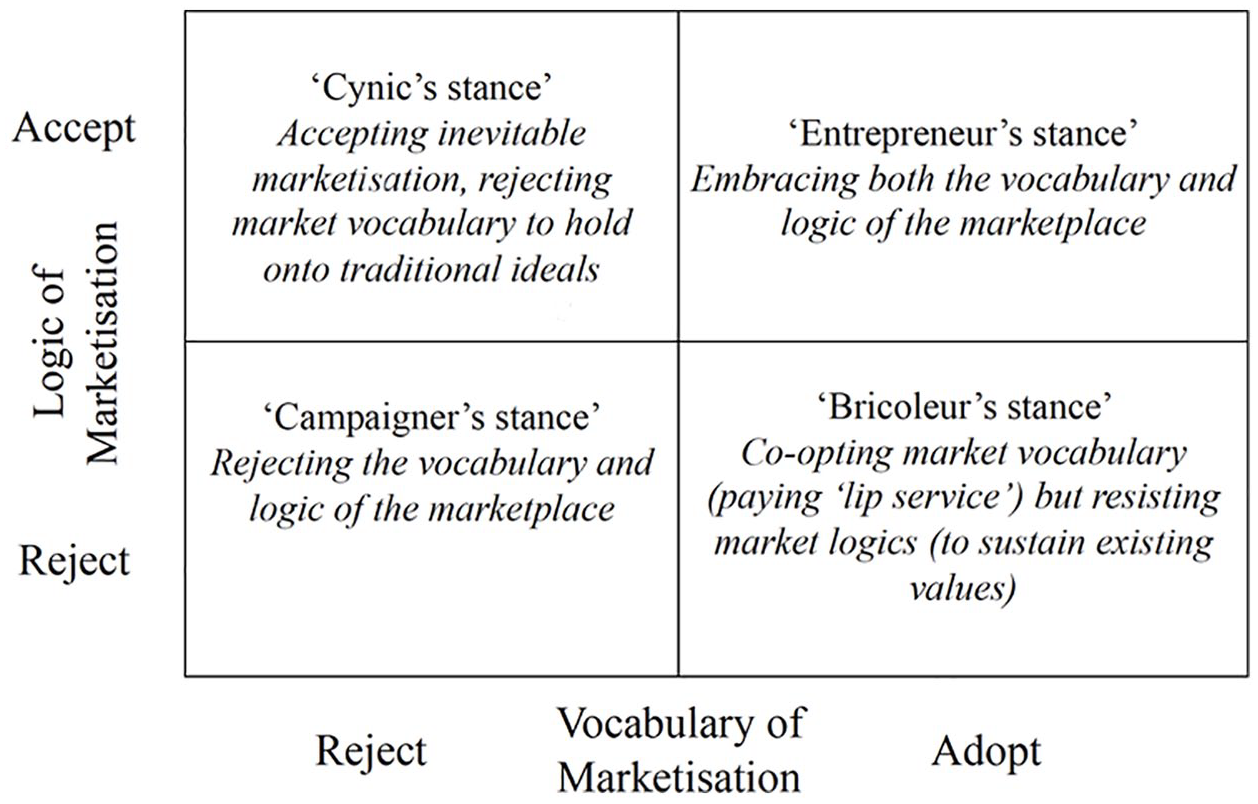
Four stances responding to the marketisation of the cultural sector.
In terms of their founding principles, the rationales for many organisations in the cultural sector often explicitly invoke ideals that resist or challenge the vocabulary and logic of the marketplace. In terms of vocabulary, the gap between founding principles and market logics is often highlighted by terms such as ‘the public good’ (Morrell and Bradford, 2018; Sanders, 2015). In terms of underlying logic, ‘culture’ itself is a freighted term because it implies non-market justifications for what makes something valuable (Glynn, 2000). Mixing and creatively re-combining elements of competing strategies can serve to maintain a certain degree of legitimacy vis-a-vis various sets of stakeholders, such as funders, visitors, partner organisations, etc. (see Pache and Santos, 2013). Importantly, museum professionals play a pivotal role in enacting and navigating these complex decoupling positions, with ‘the actions and interests of individuals as a central determinant of decoupling’ (Bromley and Powell, 2012: 492).
Though one might expect some correlation between museum type and reactions to the logic and vocabulary of marketisation, we found it interesting that (for instance) the campaigner’s stance featured through discourses of museum professionals working in each of the different categories of museum. In terms of potential directions for future research, with a survey design and a larger sample it should be possible to see if there are clearer correlations between different responses to marketisation and museum type – perhaps reflecting different funding models or organisational factors such as size, budget and history, as well as the type of cultural goods. This would involve developing sub-scales to operationalise the four ideal-typic responses. Another consideration worth exploring with a larger sample would be the role of values and perhaps even political orientations of museum professionals or senior executives.
Despite a variety of responses, all organisations seem to be at risk of being subverted by marketisation. In organisations where the entrepreneur’s stance was discussed, we found evidence that there has been a widespread adoption of what Stark (2011) calls a ‘commerciality doctrine’. The risk of adopting a commerciality doctrine for any non-profit is that, ‘allowing part of its (art-stimulating) activities to become profit oriented not only fails to lift those activities into the nonprofit sphere but might itself tumble over onto the for-profit side of the line’ (Stark, 2011: 15). A similar point could be made about the bricoleur’s stance. Co-opting strategies is inherently risky (see Andersson and Liff, 2018) inasmuch as when actors co-opt a practice or a terminology, they inevitably become more familiar with it. We can thus postulate that museums adopting a bricoleur’s stance are becoming more accustomed to the vocabulary of the market (that they pay lip service to) and this in turn might lead to unintended, hard-to-resist changes in practice. This could foster role and identity conflicts. There is a comparable risk for the cynic’s stance. It might be increasingly difficult to maintain a more traditional language in the face of a new logic. Widening of this gap could lead to similar incoherence or alienation. We see incoherence in terms of potential conflicts between someone’s sense of what their role should be about and what they might have to do in practice – for instance, museum curators having to engage in fundraising activities. In terms of alienation, a widening gap between language and logic might lead to situations where a given organisation, and its members, end up being trapped in a situation (from which they cannot extricate themselves) that is not sustainable – for example, where pretending to pursue the public good is nothing more than a symbolic token. Perhaps with the exception of the entrepreneur’s stance, the campaigner’s, bricoleur’s and cynic’s stances are not necessarily stable over time; there could be transitions between stances or these could become untenable in the wake of moves towards marketisation.
Museums and the ideal of publicness
The UK museum sector has come under particular pressure because spending on such services as museums, galleries and libraries tends to be seen as discretionary rather than a necessity – in contrast to core public services like education or policing. The goods associated with cultural organisations are also seen as less tangible than many of those in the public sector. This leads to a situation where museums have to justify their relevance – a form of cultural accountancy (Menger, 1999). Townley (2002: 168) makes a similar point in the context of the USA, that ‘changes in public funding have prompted museums to try to justify their value, to establish a value beyond being custodians of heritage’. Yet it is inherently difficult to establish a return on investment when it comes to spending on organisations that are predominantly to do with heritage or aesthetic and cultural phenomena (Böhm and Land, 2009). Although political regimes often seek to manipulate the culture industry, and though museum professionals play a pivotal role in creating public value (Kershaw et al., 2022), it is often more difficult to associate spending on ‘culture’ with a direction of policy (Gray, 2009). For many reasons then, it is harder for organisations like museums, galleries and libraries to demonstrate that they represent ‘value for money’ (Alexander, 2018). This forces museums to adopt a clear stance vis-a-vis marketisation and highlights the theoretical significance of this sector as a site for understanding. A contribution we make to this debate here is to offer empirical evidence that shows how cultural accountancy takes shape in terms of adoption (the entrepreneur’s stance) or co-option (bricoleur’s stance) of market vocabulary. In turn, this opens the door to investigating how museums are valued and how, as organisations, they adapt to respond to such valuation schemes.
In important respects, the intangible and distinctive nature of cultural goods (del Barrio et al., 2012) could form the basis of a good argument for preserving the ‘publicness’ of museums. Public funding is often reserved for situations where it is otherwise challenging to establish a market for goods. This can come about because such goods are non-rivalrous – that is, where one person’s consumption of a good does not detract from another’s consumption. It can also come about because such goods are non-excludable – that is, when one person consumes a good, it is impossible to prevent another consuming too (Hudson and Jones, 2005). These two conditions make it difficult for there to be a market and as a result governments may have to fund the protection or provision of such goods through taxation. Cultural goods relating to heritage and aesthetics can be thought of as public goods – particularly where (as in the UK) most museums are free and open to all. Importantly, too, the free and fair provision of cultural goods is an ideal that we would associate with an enlightened society – effective and benevolent governance in the common interest (Morrell, 2009).
In the public sector, there is significant debate regarding the appropriate governance mode for resource allocation. The most far-reaching and contentious reforms to the public sector often come about by importing private sector practices and marketisation (Isaksson et al., 2018; Newman and Clarke, 2009). Several theorists have suggested marketisation causes particular problems for public organisations because of basic differences in terms of ultimate values, such as the public interest or public good (Morrell, 2009). For museums, during funding cuts, sales and performance metrics are increasingly important and this can cause tensions in terms of how managers and curators try to live out their organisation’s longer-standing ideals relating to the public good and culture (Aroles et al., 2022; Camarero and Garrido, 2009).
Conclusion
Our article advances our understanding of decoupling (Bolton et al., 2019; Bromley and Powell, 2012; Pache and Santos, 2013; Williamson et al., 2020) and contributes to research investigating public and not-for-profit organisations and marketisation (Elmagrhi and Ntim, 2024; McGrath-Champ et al., 2023; Tidmarsh, 2022) by proposing a typology of four ideal types that account for the ways in which professionals in the public and not-for-profit sectors develop creative responses to competing demands. To reject the vocabulary of the marketplace and its logic entirely might jeopardise the future of a museum, because museums often have to compete and tender for scarce sources of funding. At the same time, blindly adopting the vocabulary and logic of the marketplace might alter the identity of the museum and compromise its core purpose. Beyond rejection and adoption (where market vocabulary and logic are coupled), the distinctive features of the museum sector helped us to identify and analyse less widely studied but theoretically important forms of resistance. These may be more effective because they decouple vocabulary from logic. Co-opting the vocabulary of the marketplace (accepting its terminology but rejecting its logic) supports a coalition of the unlikely. Rejecting the vocabulary of marketisation even while accepting its inevitability may allow museums to cling on to longer-standing ideals. A museum’s response to marketisation is determined by environmental (political context), institutional (prestige, history, governance, etc.), organisational (size, budget, type of audience, etc.), as well as individual (leadership’s objectives and inclinations) factors.
Mapping these four ideal-typic stances opens the door to future research on the mechanisms through which such positions are maintained over time as well as on the processes through which a museum can move from one response to another. In addition, our analysis of stances, in terms of vocabulary and logic, carries wider implications that extend to fields such as healthcare and education. An interesting consideration for future research is whether the vocabulary associated with a change in logic is always open to being co-opted. For example, ‘customer’ has a direct and immediate referent, but policy discourse is often more vague. An example in healthcare is the rhetoric of ‘patient choice’. This conveys a sense of empowerment and personalisation as well as perhaps a moral obligation, but also signals a governance mechanism where funding follows the patient (Morrell, 2006). Because it has no direct referent it cannot as easily be translated or ‘swapped’. This may mean it is harder to repurpose.
Footnotes
Data access statement
Data supporting this study are not publicly available due to assurances of confidentiality given to interviewees and institutions.
Funding
The authors received no financial support for the research, authorship, and/or publication of this article.
