




Abstract
For the United Kingdom, the 2008 financial crisis coupled with the subsequent economic austerity programme forced many public institutions to engage in various cost-cutting and fundraising ventures. In parallel, corporate ideologies came to dominate how academics, officials and professionals debated public activities, in turn profoundly affecting the provision of communal services. This paper explores how ‘corporate colonization’ (sensu Deetz, 1992), fuelled by austerity, claims public institutions for commercial interests. Drawing on in-depth interviews with senior staff, this paper demonstrates how retrenchment of external support in the UK museum sector has been an uneven process, resulting in the manifestation of three experiential states of corporate colonization: organizational perennity, organizational perseverance and organizational precarity. We thus investigate the differential and uneven ways in which corporate colonization affects organizations pertaining to the UK cultural sector. Overall, we argue that the austerity culture in the UK affects museums in largely negative ways by forcing them to respond to the progressive need to satisfy short-term financial interests.
Introduction
In the aftermath of the financial crisis of 2008/09, the UK government pursued a programme of economic austerity to address the growing problems of fiscal deficit. This included establishing a Comprehensive Spending Review (2010), an outcome of which was the stipulation of formalized funding cuts for public services. This involved cutting the budgets of government departments by an average of 19 per cent over four years (The Spending Review, 2010, p. 5). One department particularly affected by these measures was Culture, Media and Sport – responsible for 16 prominent British cultural institutions – whose aggregate resource budget fell from £1.56 billion in 2007/08 to £1.1 billion by 2014/15. A similar trend has been observed at a more regional level; the County Councils Network (2019) found that council funding dedicated to museums, libraries, arts and culture has been reduced by almost £400m over the past ten years. In the case of museums, in particular, an independent review – The Mendoza Review (2017, p. 9) – suggested that for the decade following the financial crisis, overall funding for the sector had ‘reduced by 13% in real terms’. These cuts, however, have not been applied uniformly and thus have impacted museums in very different ways.
Through in-depth interviews with curators, managers and directors of museums in England and Scotland, this investigation sets out to explore the differential effects that austerity measures have had on the UK museum sector. More precisely, the paper focuses on the challenges currently faced by the sector, with a particular emphasis on the widening roles, obligations and responsibilities of museums and their managers. Some of these issues have been touched upon within the museum studies literature (see Lindqvist, 2012; Loach, Rowley, & Griffiths, 2017; McCall & Gray, 2014; Scott, 2009; Selwood, 2010) but through investigating very different concerns to those central to this analysis. The current paper is concerned with exploring manifestations and experiences of corporate colonization (sensu Deetz, 1992), which broadly refers to the process through which the logic of corporations takes prevalence over all spheres of life (Deetz, 1992). This concept, which has been mobilized in different contexts, including the healthcare sector and the private sphere (see for example Denker & Dougherty, 2013; Hyde, Burns, Hassard, & Killett, 2014), provides an insightful lens through which to unpack the situation of the UK museum sector.
Our paper aims to understand how corporate colonization, in an era dominated by government policies of economic austerity, can be seen as the vehicle that claims museums for commercial interests. We do not claim that austerity per se engendered corporate colonization, but rather that austerity policies acted as catalysts that both fostered and enhanced already-existing trends, some of which formalized under New Public Management (Hood, 1991). Here, the paper distinguishes between three levels of corporate colonization, which translate into three experiential states for museums: organizational perennity, organizational perseverance and organizational precarity. These states, which reflect the extent to which corporate colonization has come to control the core activities of museums, are placed on a continuum or gradient of colonization – in turn, this implies that there is a certain degree of liminality between our three experiential states. In Deetz’s work, corporate colonization is very much presented as a uniform force affecting all aspects of life equally. Here we show that various institutions within the same sector are affected differentially through processes of corporate colonization – a process by which our paper develops Deetz’s original concept in new theoretical ways.
Specific types of museum (e.g. independent, university-run or national) are not systematically attached to one or another of these experiential states, for a multitude of factors (e.g. importance of collections, local political support, systems of governance, etc.) contribute to shaping a museum’s responses to colonizing tendencies. We argue that the scale of cuts to public sector funding drives corporate colonization, diverting public services from their ‘traditional’ goals towards an insidious form of ‘anything goes’ commercialism – a situation of ‘culture for sale’. Increasing financial pressures beget the redefinition of museum priorities in line with the logics of an increasingly ‘market-driven’ sector – one in which funding agencies exert significant power over the strategic choices available to organizations in the museum sector and where ‘winners’ and ‘losers’ subsequently emerge.
Language, we argue, plays a key role in constructing this reality, with corporate colonization being played out through the terminology increasingly mobilized in museums. As Grey (1999, p. 577) noted succinctly in this regard, ‘the ascription of the term “management” to various kinds of activities is not a mere convenience but rather something which has certain effects’. In line with Deetz’s argument, we see language as the vehicle through which corporate values, norms and priorities are conveyed. While language here does not act as the driving force in changing museums, it helps cement new organizational practices, so in a sense also actively contributes to the process of corporate colonizing. Part and parcel of this process involves discursive closure through which only the path ‘offered’ by corporate practices is enacted as adequate for the future of museums, with language working ideologically to present a particular version of social reality as natural and unalterable.
The paper is structured as follows. Following this introduction, the second section examines the notion of corporate colonization as developed in the original thesis of Stanley Deetz (1992) as well as the marketization of the cultural and creative spheres. In the third section we present an overview of the methodology underlying the study, while in the fourth we discuss the empirical data in the light of the conceptual framework that emerged through our research. The fifth section discusses the findings of our investigation in the context of related studies in the field. Finally, the conclusion offers an opportunity to reflect on the implications of corporate colonization for the relevance and future well-being of the cultural sector in general.
Corporate Colonization and the Creative and Cultural Sectors
Theorizing corporate colonizing
As a concept, colonization has been mobilized in many different ways in the organization studies literature: for instance, to investigate the multifaceted relations between dominant and dominated groups (Banerjee, 2000; Banerjee & Linstead, 2001, 2004; Boussebaa, Morgan, & Sturdy, 2012) or to delve into the colonizing effects of management concepts and techniques across boundaries (Frenkel & Shenhav, 2003, 2006; Muzio & Faulconbridge, 2013). A significant contribution to our understanding of the latter, in particular, comes from the seminal work of Stanley Deetz (1992). Concerned with themes of democracy, communication and politics in the United States context, he proposed the notion of corporate colonization of the lifeworld (sensu Habermas, 1984) to both depict and make sense of the spread of organizational and corporate ideologies and practices into most aspects of everyday life. 1
Conceptually informed by Foucault’s (1972, 1979) work on power and discipline and Habermas’ (1984, 1987) theory of communication, Deetz (1992) explored the manifold ramifications of the corporate colonization of the lifeworld. He carefully dissected the processes through which, as they grow more powerful, corporations become extremely successful in progressively colonizing and then eventually controlling the institutions and practices of society. For Deetz (1992, p. 17), this process concerns all aspects of life, as ‘the corporate sector has become the primary institution in modern society, overshadowing the state in controlling and directing of individual lives and influencing collective social development’. Deetz (2008) examined how modern corporations were becoming the new sites of public decision-making, with effects extending beyond the boundaries of organizations; affecting both home and family. In addition, he contended that the colonization of the lifeworld, coupled with and reinforced by a widespread process of deinstitutionalization (as ‘traditional’ structures are superseded by corporations), has a direct effect on individuals with regard to the meanings they mobilize when creating their selves. For Deetz (1992), this corresponds to a process of inner colonization (see Habermas, 1984, 1987). In Deetz’s words, ‘the corporate colonization of other social institutions suppresses competing identity formation and defines the context for an inner colonization whereby the individual forms the self intentionally for work relations’ (1992, p. 297).
Deetz (1992) highlighted how corporate ideology and practices, ‘through representational marginalization, reduction of alternative interests to economic costs, socialization of members, and the shift of responsibility to the individual’ (1992, p. 56), suppress possibilities of potential conflicts by imposing values and priorities that naturally take prevalence over other existing alternatives. In other words, the argument is made that corporate colonization is particularly difficult to resist, for it simultaneously anticipates and incorporates attempts at resistance (Learmonth, 2009). Control and resistance in fact become mutually constitutive forces in daily life (Mumby, 2005), as subjectively construed identities are appropriated and disciplined in realms well beyond the organization (Brown & Lewis, 2011; Casey, 1999; Hancock & Tyler, 2004).
Language plays a key role, not only in substantiating the aforementioned removal of resistance, but in the process of corporate colonization more broadly. For Deetz (1992), language is in itself an institutional practice and acts a vehicle spreading specific values and ideas. In the discursive field of institutions or organizations (Foucault, 1972), ‘certain dominant forms of reasoning and articulations stand in the stead of other valuational schemes’ (Deetz, 1992, p. 176), which in turn leads to discursive closure (the purported superiority of one value system leading to the disappearance of the other). Importantly, discursive closure lays the ground for systematically distorted communication, which happens when genuine conversation (sensu Habermas, 1984) cannot take place. This entails discrediting arguments as being trivial, refocusing attention from the system to the individual, naturalizing decisions that privilege the few over the many, and avoiding sensitive topics that may contradict the preferred corporate view.
For Deetz (1992), ideology, which can be defined as ‘frameworks of thinking and calculation about the world’ (Hall, 1985, p. 99), amounts to systematically distorted communication, reminding us that ‘the subject as mediated through language is always ideologically produced’ (p. 137). Distorted communication is pivotal to the ascent of corporate thinking. Finally, Deetz (1992, pp. 130–131) argued that ‘social groupings and interests, types of rationality, and the concept of profit are social productions’ and that ‘the questions are thus not whether these things exist, have power or explain organizational behaviour, but how they come to exist, coexist and interrelate in the production and reproduction of corporate organizations and work in the process of inner and outer colonization’. Importantly, this process relies on the use of language, which may then operate as an ideological practice. In that sense, language can work ideologically to present a particular version of social reality as natural and unalterable, thus cementing particular viewpoints and practices.
Deetz’ work has received a lot of scholarly interest, with his concept of corporate colonization explored in various empirical contexts, featuring most notably in research on the health sector, digital spaces and domestic life. Hyde et al. (2014) investigate the colonization of the ageing body in the NHS, with a focus on how the body gets ‘appropriated’, which in turn leads to the formation of new subjectivities. As they argue, ‘the organization of care includes processes of corporate colonization whereby the lifeworlds of people living in care homes can become increasingly overshadowed, or even displaced, by corporate cultures’ (2014, p. 1700). O’Donovan (2007), also concerned with the health sector, highlights how even social movement organizations (connected to health organizations) can be colonized (see King, 2004, on the corporatization of breast cancer activism). Another productive line of inquiry has looked at the structuring of family life around the demands and logics of work organization (see Dempsey & Sanders, 2010; Denker & Dougherty, 2013; Medved & Kirby, 2005), pondering over the ways in which corporate values and ideologies are reinforcing gendered stereotyping. Finally, somehow closer to Deetz’s original argument, and in particular its connection to the theme of democracy, Dahlberg (2005) argues that critical communication is being undermined by a corporate colonization of cyberspace, with digital spaces losing their potential to develop a strong democratic culture. This point is reinforced by Salter (2005, p. 304), who states that ‘the colonization tendencies facing the web are premised on the tension between the capitalist system and the lifeworld’ (Salter, 2005, p. 304).
As this literature demonstrates, Deetz’s conceptual framework is particularly insightful when it comes to accounting for the ways in which various spheres of life (e.g. private and public) have been colonized and disciplined through corporate logics. Further work is needed however to make sense of the differential and uneven ways in which corporate colonization affects organizations. By doing so, this paper also contributes to exploring how corporate colonization translates in and through daily practices, and importantly delves further into the unequal effects of corporate colonization on organizations operating within the same sector. Here, we focus on the UK cultural sector in order to unravel the manifold manifestations of corporate colonizing activities.
The marketization of the creative and cultural sectors
The role and place of creative and cultural industries have been much debated (see Banks, 2007), with many different value systems and ideas put forward as representing the essence of cultural and creative activities (see Böhm & Land, 2009; Hesmondhalgh & Baker, 2011; Hesmondhalgh & Pratt, 2005; Menger, 1999). Illustrating this point, Hesmondhalgh and Meier (2018, p. 1555) argued that ‘the main ways in which people get access to cultural experiences are subject to frequent, radical and disorienting shifts’, thus highlighting the connections between ‘service providers’ (e.g. museums, art galleries, artists, etc.), ‘service users’ (e.g. museum visitors) and gatekeepers.
Discussing the rise of the creative industries policy discourse, Newsinger (2015, p. 304) notes that it ‘allowed the values and practices of the private sector to increasingly determine the organisation and management of the cultural sector’. Slater and Tonkiss (2001, p. 155) argue that ‘marketisation involves a cultural dialectic; at once the autonomization of culture and its commercialization’. The marketization of culture has been noticeable at many different levels (see Alexander, 2008) and can be seen to derive from two distinct, but deeply entwined, areas. The first is the rise of markets and competitive pressure. The second is the managerialism of audits, with the rise of performance metrics that have put professionals on the back foot, always having to justify themselves according to externally derived and enforced targets and measures. Managerialism thus provides the front-line operating procedures of marketization (see Brown, 2015). Importantly, this is clearly not a new phenomenon in itself (see Gray, 2000; Menger, 1999); for instance, McRobbie (2002) argues that since the mid 1990s the cultural industry sector has become increasingly dominated by an ever-more aggressive market philosophy. Rather, the changes mentioned by Newsinger (2015) and others seem to consist a step further in the manifestation of ideological changes that emerged in the 1980s (see Böhm & Land, 2009), some of which were formalized through New Public Management in the UK (see Hood, 1991), a pervasive and powerful form of managerialism (Klikauer, 2013) that reshaped many sectors, including the cultural and creative spheres.
In recent years, both austerity measures and neoliberal policies exacerbated these changes (Berry, 2016) and reshaped the cultural sector in such a way that it needs to demonstrate its ‘value for money’ (Alexander, 2018) – a form of ‘cultural accountancy’ that seeks to quantify the economic output of public spending on culture (Menger, 1999). Such changes, which are typically connected to moves towards the commodification (Gray, 2000; Newsinger, 2015), privatization (Wu, 2002), instrumentalization (Gray, 2007) and marketization (Alexander, 2008) of culture, entail, among other things, a greater focus on performance management (see Newman & Clarke, 2009) and the reframing of culture around various cost-cutting and expense-minimizing or return-maximizing exercises (Zorloni, 2009). Importantly though, some scholars have sought to further problematize the relation between the spheres of art and commerce (see for instance Caves, 2000), highlighting how they may not necessarily rely on diametrically opposed principles (i.e. cultural and creative activities have always had their own economy). In line with this research, we endeavour to further problematize this relation by carefully exploring how managerial and cultural imperatives and priorities play out in practice and by delving into the mechanisms underlying the prevalence of one over the other and the consequences of such changes.
Methodology
Research context
The empirical research on which this article is based is drawn from the UK cultural sector, and more precisely that of the management and organization of museums. There are approximately 2600 museums in the UK and slightly over half are accredited (The Mendoza Review, 2017). The Museum Association (2018) lists eight different types of museums: national museums with ‘collections considered to be of national importance’; local authority museums housing ‘collections that reflect local history and heritage’; university museums with collections related to ‘specific areas of academic interest’; independent museums that ‘are owned by registered charities and other independent bodies and trusts’; historic properties and heritage sites; National Trust properties; regimental museums and armouries; and unoccupied royal palaces. In parallel, the structure of museums can be complex with systems of governance that involve variously the public, private, third and academic sectors (Loach et al., 2017).
Data collection
Our approach to museum selection was purposive (Robinson, 2014). We sought to cover different types and sizes of facility, across a range of geographical areas, in order to achieve broad relevance for our findings. The sample included fifteen independent, nine local authority, three university and two national museums, plus one heritage site (see Table 1). Importantly, all the sites visited were Arts Council ‘accredited’ museums. It is worth noting that some museums, classified as independent, local authority-run or university-run, had unusual governance structures; for instance, we encountered cases where an independent museum would be operating in a building owned by the local council, or where the council would own the collections, or where some employees would be working for the council while others were employees of the museum (as a charity). As such, there was a great level of diversity underlying apparently homogeneous groups. Depending on the structure of the museum, our research involved interviewing local council employees (local authority museums), government employees (national museums), volunteers (small independent museums), managers or chairmen of charities (independent museums), as well as other museum professionals.
Data Collection.
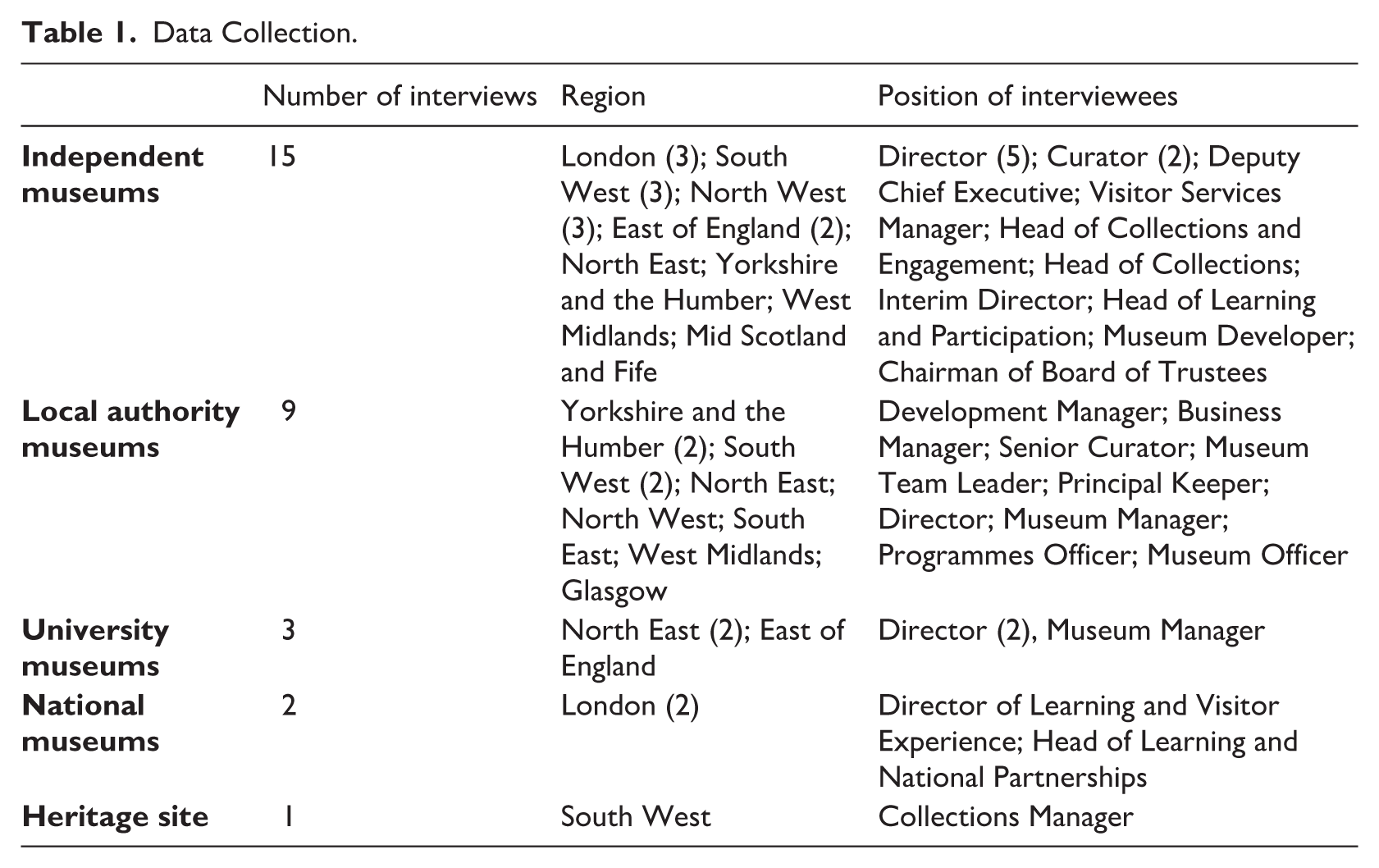
The research forming the empirical content of this article is based primarily on a series of semi-structured interviews conducted in 2017–2018 with curators, managers (including general managers, development managers, heads of learning, heads of collection, etc.) as well as directors of museums. On several occasions, managers or directors overseeing various sites were interviewed (this was notably the case with museums run by local councils). The first author conducted one formal and substantive interview in each of the 30 museums visited, with these organizations being located in 20 cities across England and Scotland. The majority of interviews lasted around 60 to 90 minutes, during which time hand-written notes were made to record the answers given to the questions forming the mainstay of the investigation. Importantly, interviews were in most cases preceded or followed by a tour of the museum. These tours were useful in allowing us to gain first-hand understanding of the roles and functions of museums. They resulted in the production of a large number of observational field notes, which helped us to make sense of and contextualize the accounts that emerged from the interviews. Shortly after the interview and visit, the first author would go through the data collected (interview and field notes) in order to clarify them before sharing them with the two other authors. Three-way meetings would then ensue to discuss the interview and make sure that there were no misunderstandings or grey areas. The interview process was stopped once we reached a point of ‘data saturation’ (Guest, Bunce, & Johnson, 2006; Saunders et al., 2018), with the same concerns and problems recurrently emerging through the interviews.
The process of interview data collection was also enriched by various documentary sources, and specifically through the study of internal and external reports, museums’ statements of purpose, annual reports, etc. These documents allowed us to gain a deeper understanding of the general context in which museums operate, while also providing specific information about, for example, targets, objectives, operating conditions, etc. in the museums selected for our investigation. Altogether, this enabled us to develop a more holistic appreciation of the complex context in which UK museums operate. In line with standard ethical practice (Bell & Bryman, 2007), we chose to disclose neither the names of museums where the interviews took place nor the names of our interviewees.
Data analysis
Our research process illustrates the practice of crystallization (Ellingson, 2009), as it involved several researchers, relying on different types of data and exploring various conceptual and theoretical frameworks, with the goal of producing a thorough, complex and yet inevitably partial account of the issue explored (Tracy, 2010). All three authors worked on analysing the data throughout the whole process, which involved three main phases.
The first phase of the process took the form of qualitative content analysis, which involved identifying, coding and categorizing the ‘raw data’ collected (i.e. interview and field notes as well as documentary evidence). During this phase, we ‘manually’ produced codes, rather than such classifications being generated with the aid of qualitative computer-based software coding (see Neuman, 2006). Our research (and interview) questions initially concerned challenges currently faced by the museum sector, with a particular emphasis on the widening roles, obligations and responsibilities of museums and their managers/administrators. As the research progressed, the positioning of museums as organizations that, to remain afloat, must be more ‘business-savvy’ – and thus adopt more of a corporate operating logic – emerged as the key theme of our research, and notably framed the later stages of the investigative process. Importantly, the focus on the concept of corporate colonization (Deetz, 1992) emerged both in discussions among all three researchers (early in the process) as well as through the interviews themselves (albeit with participants using a different terminology, but essentially describing the same process).
In the second phase of analysis, we conducted a detailed re-reading of the hand-written interview accounts and observational field notes, in order to ensure the robustness and consistency of the codes we generated. Themes were then identified and subsequently cross-checked by the researchers in team discussions. This method resulted in a number of direct quotations being chosen and empirical vignettes being created to explain managers’ sense-making accounts of core issues facing their organizations. As we worked through the data to produce themes, we engaged with concepts and debates within various areas of academic research. Notable among them was Deetz’s (1992) original concept of corporate colonization as well as research that has mobilized his and similar arguments in management and organization studies (see Bloom & Rhodes, 2018; Bresnen, Hyde, Hodgson, Bailey, & Hassard, 2015; Brown & Lewis, 2011; Dempsey & Sanders, 2010; Hyde et al., 2014; Learmonth, 2005, 2009). It also entailed engaging with research on the marketization of the cultural and creative industries (e.g. Böhm & Land, 2009; Caves, 2000; McRobbie, 2002; Menger, 1999) as well as research documenting contemporary changes in the museum sector (Lindqvist, 2012; Loach et al., 2017; McCall & Gray, 2014; Scott, 2009; Selwood, 2010).
In the third and final phase of analysis, we sought to formalize our themes in order to articulate the main contributions of the investigation and place our findings in the context of existing research in the area. Both conceptually and empirically, our attention revolved around the different ways in which processes of corporate colonization were manifesting themselves in the UK museum sector. This led us to propose three states of corporate colonization, derived from Deetz’s seminal work, namely organizational perennity, organizational perseverance and organizational precarity, and to reflect on the role played by language in the manifestation of these three different states of corporate colonization.
The Corporate Colonization of the UK Museum Sector
A diverse landscape
From the perspective of the UK economy as a whole, public funding allocated to museums (from both the national and local governments) has decreased significantly over the past decade. A manager in a large national museum explained how there had been a reduction of about 35% in government funding compared to that received almost a decade ago, forcing the museum in question to rethink significantly the ways in which it operated and to review carefully its priorities. A local authority museum director, overseeing various sites, reported a similar trend, highlighting that the funding currently received from the council corresponds only to about 60% of what it was in 2011. Capturing the essence of the current situation, the director of a university museum stated that ‘the whole museum sector is aware that public funds are unlikely to go up’. This was confirmed in most interviews. Importantly, these trends echo a general recommendation from the Mendoza Review (2017, p. 18) that: ‘Museums need to be cultural enterprises. They must consider and plan how to operate in a mixed economy of public and private funding and commercial income, adapting business models where appropriate.’ Clearly, this has had implications for the entire museum sector, ranging from more limited exhibition programmes to organizational restructuring and employee redundancies (see Table 2).
Museum ‘Cuts Surveys’.
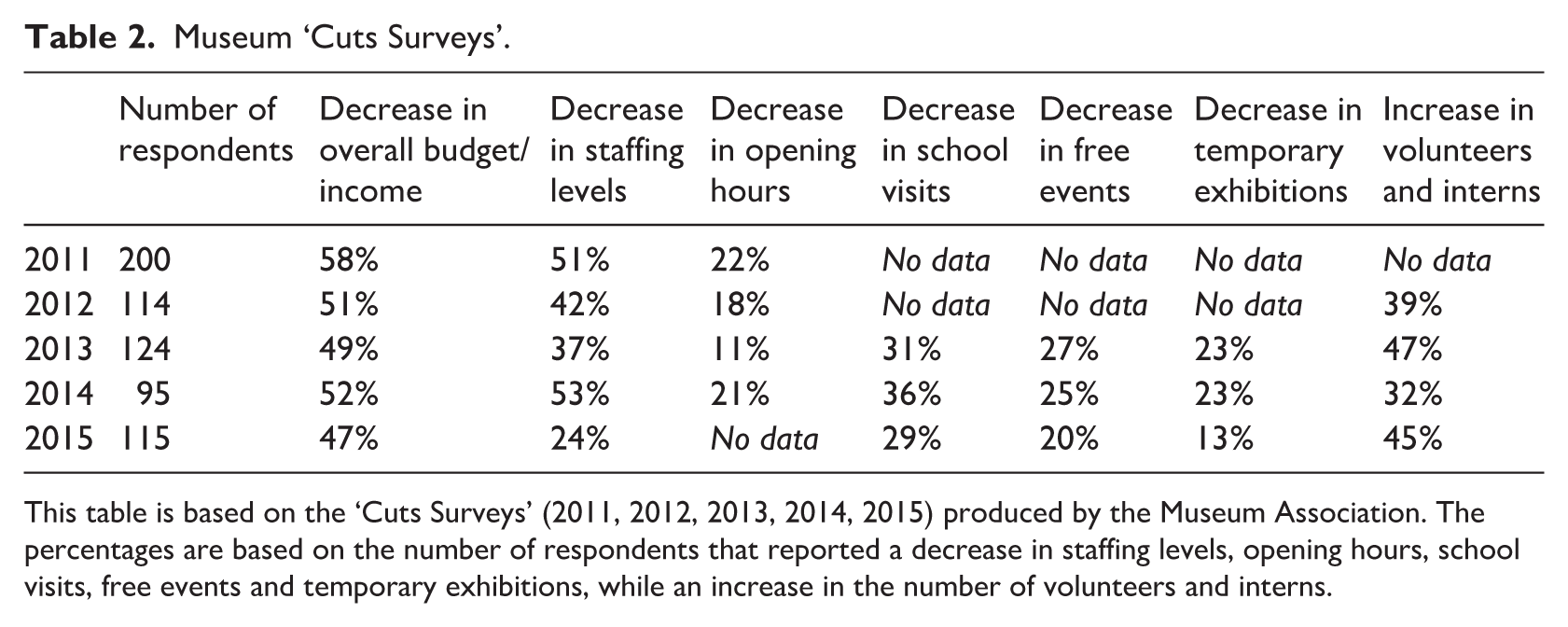
This table is based on the ‘Cuts Surveys’ (2011, 2012, 2013, 2014, 2015) produced by the Museum Association. The percentages are based on the number of respondents that reported a decrease in staffing levels, opening hours, school visits, free events and temporary exhibitions, while an increase in the number of volunteers and interns.
The manager of a local authority museum highlighted how ‘museums have gone past a model where they were simply displaying artefacts and concerned with scholarly matters’. He went on to explain that such a broadcasting mode of operating was no longer seen as sustainable both within and without the museum sector. A senior manager in a national museum echoed this point, commenting ‘now museums have to operate in many different ways’ – subsequently developing this theme by describing the multitude of programmes and initiatives in which the museum was currently engaged in addition to the more ‘traditional’ functions they were expected to perform. Across the board, museums have sought to diversify their streams of income in order to compensate for losses in public funding coupled with increased competition for external funding. Our interviewees explained that this has taken different forms, including charging for admissions, after-hours events, school workshops and guided tours (all formerly free); monetizing curators’ time (e.g. consultancy fees, payment for lectures, etc.); greater engagement with corporate and venue hire (e.g. weddings, birthdays, films, etc.); closer connections with businesses (e.g. corporate partnerships, sponsorship packages, company entertaining, etc.); development of chargeable event programmes and adult learning activities; systematic fundraising activities (e.g. gifts, ‘friends’ schemes, donations, etc.), and so on.
Income diversification strategies have not been set up without a certain degree of reluctance, for as one museum director argued, ‘publicly funded cultural activities shouldn’t have to justify their own good’. Expressions such as being ‘business-savvy’ and ‘financially literate’, and as having ‘commercially-driven plans’, came up in all but one of the research interviews. A team leader in a local authority museum captured the fundamental issue connected to this corporatization of the UK cultural sector, suggesting ‘we are now being looked at as a business, which goes against the ethos of museums really’. A business manager overseeing various local authority museums explained how the language of commerce and finance had pervaded the sector, allowing for ‘the rampant philistines’ to openly question the worth of cultural organizations. He continued by suggesting the questions political decision-makers were now asking the sector were: ‘why should cultural activities receive public funding?’, ‘what is the return on that investment?’ and ‘why should we be investing in this or that project?’. A development manager, working for a local authority, noted that ‘it’s becoming harder to justify spending money on culture for the sake of culture’, pointing to the difficulty and challenges in demonstrating ‘value’ (see Holden, 2004). This is not to say that museums have never been concerned with financial matters, but rather that these were seen to prevail over what one might describe as the more traditional activities of museums. A strong opposition between the cultural aspirations of the museums and its commercial undertakings was articulated by more experienced museum staff, whose background was mostly curatorial and who had known the sector prior to its wide-scale marketization.
When we reflect on Deetz’s (1992) work and focally in relation to our data, the extent to which museums have had to engage with these economic and competitive strategies has translated, we argue, into different levels of corporate colonizing. In particular, we outline three cases. The first concerns museums that have not been overly impacted by reductions in public funding: typically national museums, they have been able to compensate public funding cuts through external grants, a steady stream of donations and other forms of revenue. The second case covers museums that have witnessed a substantial drop in terms of public funding: these museums have had to revise their strategies, rethink their operations and diversify their streams of income in order to face a challenging financial situation. Finally, the third case concerns museums that have experienced severe funding cuts and decreased chances of securing external grants: these museums have had to engage in a myriad of strategies to make ends meet. The evidence from our investigation suggests there are three principal states that museums are experiencing currently in this regard – organizational perennity, organizational perseverance and organizational precarity. These are states that we now seek to explain.
State 1: Organizational perennity
Monday, late morning. There is clearly a sense of grandeur connected to this place. The main exhibits are very clearly signposted but it is difficult to know where to start. The place is crowded and instinctively I follow the main movements of the crowd. Some of the key artifacts are difficult to access – some visitors probably came just to see one artifact in particular. The museum, its cafe and souvenir store are all very lively. One can tell the place is in motion. Donation boxes are scattered around –they contain notes from many different countries. This is in line with the international character of the audience. (Field note)
The above is an observational field note from a visit to a museum that illustrates a case of organizational perennity. Organizational perennity, we argue, is reflective of the level of corporate colonization commonly encountered and experienced in contemporary UK society – one that is increasingly visible, for example, in sectors such as healthcare (Hyde, Granter, Hassard, & McCann, 2016) and education (Geppert & Hollinshead, 2017; Huzzard, Benner, & Kärreman, 2017; McCann, Granter, Hyde, & Aroles, 2020) among others. Funding cuts are not acting here as an accelerating factor in the colonization of the museum sector, instead they are part of the changing landscape of the public and cultural sectors in the UK generally (see for instance Alexander, 2018). Museums found at this state do face significant difficulties but their perennity remains entirely unquestioned.
If, in the light of substantial government funding cuts, national museums have had to rethink the ways in which they operate, their survival has actually never been questioned. Regardless of what happens in the wider economy, these emblematic institutions will remain open. They might experience (and have experienced) leadership changes, restructuring strategies and redundancy plans, but funding will always be secured, one way or another. Thus, while they too are experiencing a process of corporate colonization, their perennity remains, for the time being, unchallenged. National museums are not the only type of UK museums in this situation. While largely dominated by hundreds of small providers, independent museums in the UK also comprise around 100 museums with incomes over £1 million, a quarter of which have incomes over £5 million (Association of Independent Museums, 2019). These museums are also in a situation of organizational perennity, in that the importance of their collections – together with the fact that they have been financially independent for a number of years – have led them to develop a wide range of strategies to facilitate their continuing survival. University museums would also belong to this category.
Importantly, as we noted, it does not mean that museums at that level do not experience difficulties. A university museum director explained how, some 20 years ago, the central priority would be to save and preserve the museum’s building(s) and collections. In the current climate, however, the deputy chief executive of an independent museum described how ‘the focus has clearly shifted to the “people side of things”’. In particular, as the museum charges entrance fees, he highlighted how vital it was to focus on the visitors and their experience in order to encourage people to come back and to ensure that good publicity would attract new visitors. The director of an independent museum also highlighted how a growing number of museum staff now have to focus on ‘attracting visitors’ and ‘enhancing their experience’. While necessary in terms of generating income, s/he emphasized that this comes at a cost, as less time is spent on developing new interpretations of the collections, classifying newly acquired items or simply updating the exhibits. Likewise, they explained how museums need to put more time and energy into completing applications for external funds (for National Lottery or Arts Council funding, for example), which sees less time being available for maintaining or improving the collections.
While these practices can function to solve various cash flow problems for museums, they also generate a number of professional problems and organizational concerns. A museum manager recalled how difficult it was for curatorial staff to accept management’s decision to begin charging for ‘consulting’ time. Indeed, for many, this was seen as running counter to the ‘traditional ethos’ of the museum (or as alien to their profession as curator). This is a typical example of curators objecting to the commercialization of museum artefacts (see Christianson, Farkas, Sutcliffe, & Weick, 2009). It is worth emphasizing that this institution, like others at this state, had been shielded from the impact of earlier funding cuts and, as such, its staff were rather antagonistic to anything ‘commercially motivated’.
Aside from having to redefine their priorities, museums under this experiential state have also had to rethink the ways in which they conduct their daily operations, and notably the cultural events they promote. The head of collections in a large independent museum explained that some 15 years or so ago, the facility would simply organize an exhibition if it was deemed interesting from a curatorial perspective. Over the years, however, they have had to adapt a very different approach by looking initially at the costs associated with an exhibition, along with attendance predictions, before deciding whether or not to proceed. An external consultant now evaluates how many visitors will likely attend such or such an exhibition, and thus if it is likely to be profitable, in which case the exhibition will be organized. This is not to say that such costing did not exist prior to these changes but rather that cost and financial predictions increasingly set the tone for cultural programmes. Yet, the director of learning of a large national museum explained that while sometimes exhibitions might be commercially driven, there is bound to be an ‘intellectual rationale’ behind the set-up of an exhibition. The same applies to the retail issues connected to the exhibition: what is sold is inspired by the collections and nothing else. Echoing this point, a visitor services manager in an independent museum explained that sometimes the museum turns down business if it feels it is not appropriate. On one occasion, for example, the museum in question refused to host an event around the history of cigars and smoking as the subject matter was perceived as out of kilter with the mission and ethos of the museum. The same manager noted, however, that while at present the museum did not face significant pressure to accept every commercial opportunity that presented itself, there were concerns emerging as to how long this situation will last.
State 2: Organizational perseverance
Thursday afternoon. The museum is pleasant and well organized. The place isn’t very big. Entrance is free but donations are welcome and encouraged. One can also become a ‘friend’ of the museum and be invited to various events. There is a group of children seated on the floor – they seem particularly interested by what the curator/volunteer (?) says about the item he holds. All the collections gravitate around the same topic and a lot of work has gone in the interpretation and display of the artifacts. On the way out, the shop stands on the left. (Field note)
The above is an observational field note from a visit to a museum that illustrates a case of organizational perseverance. Organizational perseverance is aligned with a form of corporate colonization stimulated by substantial funding cuts and a stagnating economic environment. These are forces which, in combination, can serve to accelerate the corporatization of the cultural sphere. In other words, recent spending cuts (both at the national and regional level), coupled with increased difficulties in terms of securing financial support from external bodies, have greatly affected the viability of these museums. This has forced them to embrace even more the logic of corporatization by constantly prospecting for new ‘commercial’ opportunities. Such ventures may indeed be somewhat anathema to the habitual identity of museums as cultural organizations and to many museum employees, whose work may have customarily involved the conservation of artefacts rather than the generation of revenue.
While some larger independent museums have not been overly affected by the logics of corporate colonization, others are in a more difficult situation. Indeed the ‘independence’ of largely self-determining museums can actually be a double-edged sword. In fact, some of the museums we visited have been repeatedly threatened with closure. With two-thirds of independent museums having incomes of under £100,000 p.a., and a quarter having incomes of under £10,000 p.a. (Association of Independent Museums, 2019), this is hardly surprising. We found that some museums run by local authorities shared similar concerns to those of medium and smaller independent museums and would also be in the situation of organizational perseverance; that is, being constantly on the look-out for new opportunities in an attempt to continue operating.
The increasing scarcity of external funding forces museums to realign their priorities. In practice, this involves finding ways of speaking directly to the priorities of the main funding bodies, a point that recurrently emerged in interviews with members of staff working in both independent and local authority museums. This, however, only works in certain cases. A development manager, in charge of three local authority museums, explained that for funding bids to sound as appealing as possible it is pivotal to have a thorough understanding of what the local council wants. Not without a touch of irony, she commented in this regard, ‘we always have to put some fluff on it’, highlighting how museums sometimes need to ‘go the extra mile’ to secure funding. Furthermore, funding bodies have varying priorities and interests; what the local council might value can be very different from what the Arts Council or organizations in public, private or tertiary sectors would be likely to fund. Museums thus need to juggle between priorities, and there is always a risk that they might become distracted from core aims and objectives in the process.
An additional concern for these museums is that the forms of funding available from such sources can rarely be used to support the core material needs of the museum. In other words, such funds can be used for temporary exhibitions or projects with the local community, but not to maintain the main museum collections or the structure and fabric of the building. With museums needing ‘substantial resources to keep and conserve their collections, as well as to cover the attendant costs of maintaining their operations’ (Lindqvist, 2012, p. 3), this is a serious concern. On various occasions, museum professionals, from both local authority and independent museums, voiced their concerns over the difficulty in obtaining funds to cover the operating costs of the museum on a daily basis, with smaller museums particularly suffering from the situation of being maintained, as the curator of an independent museum suggested, increasingly by ‘ring doughnut funding’, that is funding only available for ‘non-central activities’. One independent museum, in particular, was in dire need of funding to restore the glasshouse on top of its roof, but could not get financial support. This is not an atypical problem given that museums are often ‘listed’ buildings and thus may require expensive forms of renovation. In this context of increasingly scarce resources for repair and restoration one museum manager noted, ‘for museums, it is do or die. . . some saw the meteor coming and planned the need to be more business-savvy, others reacted too late’.
A further point to note on funding under this experiential state is the importance of local politics. The principal keeper of a local authority museum explained pithily that ‘local elections are always stressful, for who gets elected will have a major impact’. Some councillors are more versed in museum matters than others, which in practice can affect drastically a council’s cultural priorities. Yet, as noted by a curator in a different local authority museum, some councils see investment in culture as a ‘win-win situation’. In other words, a view that if culture is promoted then more visitors might be attracted to the city and in theory businesses may be more likely to relocate there. This also applies to independent museums, with the chairman of a board of trustees describing how the situation of such museums can change markedly based on the support received from local government.
The fact that to diversify their income streams museums in this experiential state are increasingly resorting to corporate and other forms of venue hire is not however without its problems; for with private hire some parts of a building or site might be closed off, which poses a challenge to the public ethos of such organizations. An independent museum director recalled how on several occasions the museum had been forced to reject bids to hold temporary exhibitions because on the date requested the museum had already secured a booking for a private party. The introduction of corporate logics into such public or third sector organizations – devoted primarily to promoting the ‘public good’ – can therefore be seen as of potentially questionable value by the traditional consumers of museum services, namely the general public. While in most cases there remains (in most cases) the possibility for museums to reject, for example, corporate or other forms of venue hire, because of poor perceived fit with institutional ethos, a manager expressed concerns that this is most likely to change in the near future. It became apparent therefore that the notional ‘traditional’ visitors to museums are those likely to be affected by burgeoning funding losses. As a development manager suggested, the concept of ‘reducing the subsidy without compromising the offer’ is nonsensical, for under such circumstances the quality of service provided by museums will inevitably be impaired.
State 3: Organizational precarity
Tuesday afternoon. The welcome in the reception area is a warm one – the volunteers are very keen to provide information about the museum and make themselves available. While not huge, the museum is by no means small. I follow the signs to discover the exhibitions. Some of the collections depict aspects of local history; other cabinets seem to come from a natural history museum. Quite a disparate assemblage. The interpretations are very interesting but probably need to be freshened up, as does the building actually. . . Around the corner, a table with pencils, colouring paper and some toys has been set up for children. Not many visitors in sight. Might simply be because it’s a weekday. (Field note)
The above is an observational field note from a visit to a museum that illustrates a case of organizational precarity. Organizational precarity corresponds to the situation in which there is almost total cessation in traditional funding, leaving museums financially powerless and forced to focus on short-term strategies and plans. The word ‘total’ has a dual meaning here: it refers both to funding cuts in quantitative financial terms and to the ‘totalizing’ effects of those cuts. Here, it is the economics of austerity – rather than government decree – that is totalitarian. The institution becomes ‘totally’ corporately colonized when financial anxiety becomes the major factor influencing strategic, management and operational decisions. Under this classification, the imperatives governing organizational activities are those linked predominantly to business decisions and commercial actions, for the survival of these organizations is more often than not at stake.
Throughout our interviews, it appeared the museums seemingly most at risk under the current climate are medium-sized providers run by local councils, small independent museums and newly independent museums that were previously under council authority. In all three cases, their heavy reliance on external funding, combined with the ‘corporate spirit’ they have recently been obliged to embrace, have put them in an extremely difficult position vis-a-vis future viability. In many cases, they have limited scope for action, as they are on the receiving end of having to adapt to new priorities, fashions and trends. In this experiential state, the imperative to diversify sources of income is paralleled by the need to cut costs, which has involved, for some museums, various restructuring initiatives, including making staff redundant. A team leader in a local authority museum described a tough restructuring exercise promoted in 2017: the council had to save over £1m and for that museum, it meant losing their curators as well as the general manager. Such account was corroborated by a programmes officer in another local authority museum who documented similar experiences of how ‘the sector has been squeezed’ and plagued generally by restructuring plans and the need to make redundancies.
Likewise, the collections manager at a heritage site explained that another such site in the same city had lost several members of staff, was losing money and is no longer seen by the local authority as a worthwhile investment. In certain cases, restructuring took a more extreme turn with museums losing all their staff. A development manager recounted how a museum previously under the control of the local authority was ‘made independent’ and is now entirely run by volunteers. The privatization of local authority museums is actually not a new phenomenon (see for instance Kawashima, 1999); the recurrent loss of staff has been reported in the annual Cuts Survey conducted by the Museum Association (see Table 2). This can leave museums in a highly vulnerable position in that they often must submit, and surrender, to the logic of corporate colonizing in order to survive. In such a situation (which has been mentioned by several of our interviewees), the possibility of meaningful conflict is suppressed due to an imbalance in power relations (Deetz, 1992). While museum professionals may challenge this state of affairs, they nonetheless must abide by the implicit rules of its ‘ideological hegemony’, as they no longer benefit from the autonomy required to behave otherwise (see McRobbie, 2002).
In parallel, one of the manifestations of corporate colonization at this level has been the prioritization of business plans and strategies to the detriment of museum artefacts. This has fostered a paradoxical relation between business strategies and museum artefacts: museum artefacts are pivotal in order to attract visitors and yet they can create problems if, for instance, they incur a cost to preserve. In other words, there is an inherent conflict between the monetization of museum activities and the need to maintain them. An independent museum visited had to donate some of its artefacts because it could no longer act as custodians for them, while another had long been considering selling artefacts in order to solve cash flow problems, a point which was also discussed in. the Museum Association’s 2014 Cuts Survey. This is a clear instance of ‘total’ colonization – where museum artefacts have been inscribed in a process of ‘object corporatization’ in the drive to ‘sell’ exhibitions.
The increased shift towards adopting ‘moneymaking’ tactics, together with a tighter alignment with the priorities of external funding bodies, has translated into a greater focus on short-term strategies for these museums. In certain cases, a significant proportion of employees are funded for specific projects, reinforcing the difficulty in having any long-term plan or strategy, for employees may depart fairly quickly if the next funding bid is unsuccessful. This can put museums in a very difficult position; for if a bid is unsuccessful, museums may not have the requisite resources to underwrite an application the following year. Two senior museum managers explained how, having lost employees funded through dedicated projects, they were no longer in a position to put together significant funding bids, hence making the future of their organizations very uncertain.
Museums under this experiential state then often appear caught in a vicious circle from which they cannot extricate themselves – one that appears to reinforce many of their current difficulties. Overall, this has led museum professionals to be pragmatic, both in the ways in which they engage with the changing priorities of funding bodies and with regard to the activities they have to undertake in order for their organizations to remain afloat. A programmes officer in a local authority museum suggested the logic was simple – that by offering ‘a good experience to visitors’ the museum could subsequently ‘attract more visitors and then invest the money into the maintenance and redevelopment of the site’. Ultimately a lack of resources, the ever-growing reliance on volunteers and the imperative to focus on short-term strategies directly impact the quality of services cultural institutions can provide to the public.
Discussion
Three states of corporate colonization
Austerity measures, translated into a series of funding cuts for the UK public sector, have exacerbated the conquest of the cultural sector by business and corporate rationalities that slowly started in the late 1980s. Museums need to reconcile contrasting and sometimes conflicting operational identities, reflecting various and changing conservational, educational, social and commercial logics (see Böhm & Land, 2009; Burton & Scott, 2003). The introduction and enactment of new imperatives, priorities and requirements have translated into the manifestation of processes of corporate colonization (Deetz, 1992) in the UK museum sector. Hyde et al. (2014, p. 1700) found that ‘age and ageing are seen as salient organizing principles in the corporate colonization of the body’. Here, we see austerity as the main organizing principle in the corporate colonization of the UK museum sector.
The role of museums is under increasing scrutiny by different public organisms, leading to a situation where they have to justify their relevance, amounting to a form of cultural accountancy (Menger, 1999). Townley (2002, p. 168) made a similar point in the context of the USA, that ‘changes in public funding have prompted museums to try to justify their value, to establish a value beyond being custodians of heritage’. Discussing corporate colonization, O’Donovan (2007) notes that a low level of statutory help accounts for the fact that many organizations not only accept but also set out to develop connections with corporate partners, thus pointing to the intricate relation between lack of funding and corporate colonization, a dimension on which our analysis concurs.
While Deetz’s conceptual framework accounts for the ways in which society at large has had to embrace the logic of corporations (thus exploring corporate colonizing at a macroscopic level), it does not capture how corporate colonization affects organizations and institutions differentially through daily practices. Our interviews highlight how corporate colonization has manifested itself very differently ‘on the ground’, with a multitude of parameters (e.g. the size of a museum, its structure and governance, the importance of its collections, the presence or absence of political support, strategic leadership, local demography, reliance on public funding, etc.) influencing the process. This led us to distinguish between three levels of corporate colonization, which translate into three experiential states for museums, namely organizational perennity, organizational perseverance and organizational precarity. Table 3 summarizes these three states comparatively in terms of their characteristic features.
Experiential states and features of colonization.
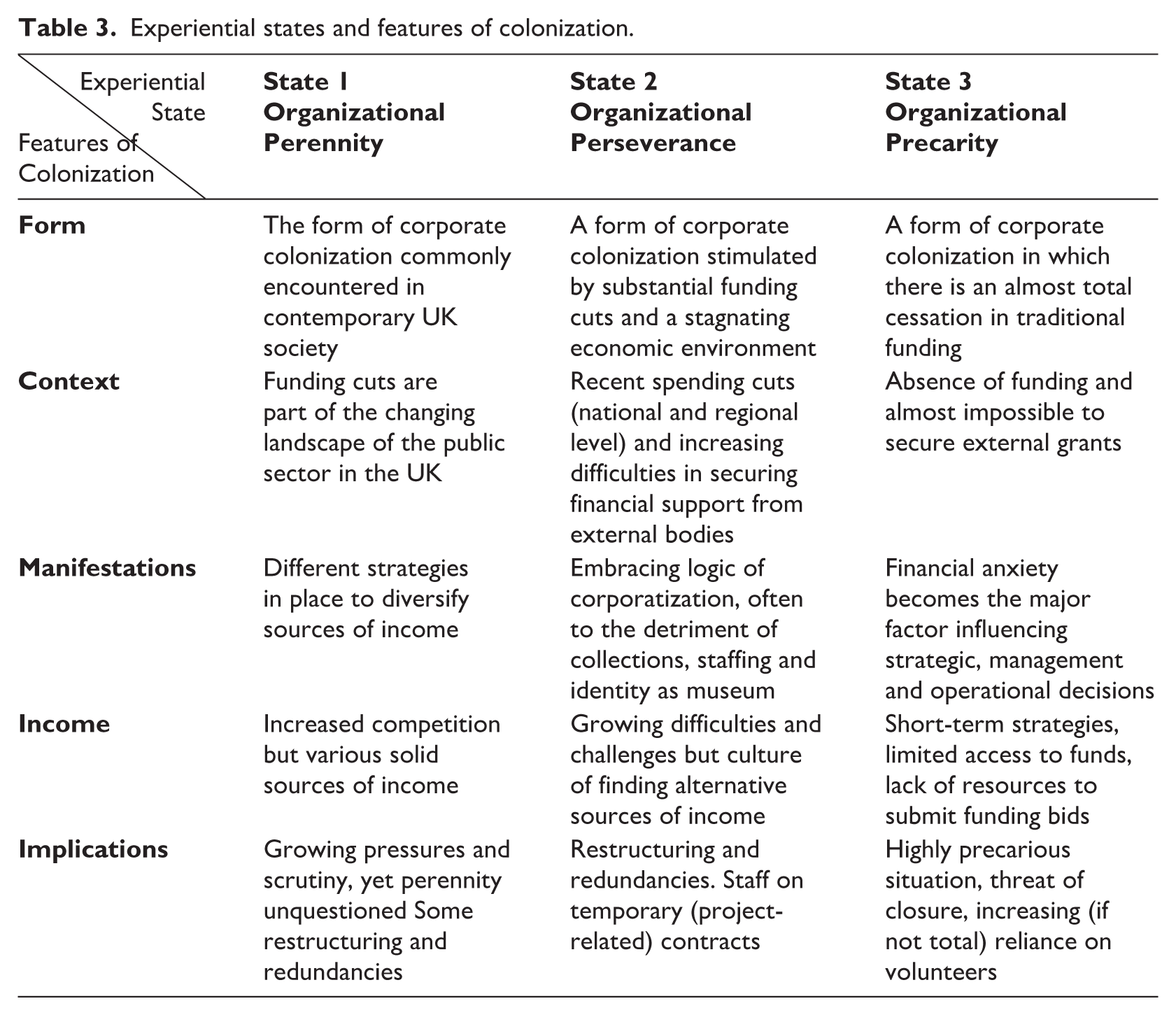
These states, we argue, capture the multifaceted nature of corporate colonization, as they allow us to go beyond the image of corporate colonization as simply a motive force uniformly affecting organizations. As such, the analysis advanced in this paper develops Deetz’ original concept in new theoretical ways. In particular, we contend these experiential states reflect the heterogeneous manifestations of corporate colonizing on the museum sector.
Language, communication and ideology: Cementing corporate colonization
Across all three states – organizational perennity, organizational perseverance and organizational precarity – there is no doubt that language, in agreement with Deetz’ argument, has played a key role in corporatizing the museum sector. We do not see language as initiating the changes depicted in our empirical accounts, but rather acting as the vehicle through which the values, norms and ideas of corporations progressively find their place in the museum sector. Importantly, it does not mean that language plays a passive role – we argue that language helps in substantiating, intensifying and cementing these changes in related social and economic terms.
The import, from the private sector, of the language of market and consumerism across contexts is not however necessary a recent or exceptional phenomenon (see Bresnen et al., 2015; Finn, 2008; Learmonth, 2009; Parker & Dent, 1996). In the context of the UK museum sector, this language has become imbued progressively with a strong corporate resonance – with museums being more ‘business-savvy’, operating as ‘cultural businesses’, and crucially incorporating and promoting the image of the visitor as ‘customer’. The customer has come to replace the artefact as the main ingredient in the recipe for a successful and attractive museum. Indeed, the notion of visitor as customer has often been mobilized to justify the taking of particular strategic decisions in order to follow particular strategic paths (see Dahlberg, 2005; Finn, 2008; Hyde et al., 2014). This is not to say that these concerns were inexistent prior to austerity (see for instance McRobbie, 2002; Newsinger, 2015) or that no common grounds can be articulated between cultural and commercial values (see Caves, 2000), but rather that one system of valuing and articulating the future of museums is increasingly prevailing over the other.
Furthermore, the language of performance management is also increasingly pervading the museum sector. In museums the aforementioned focus on customers, profits and business strategies has been paralleled by the introduction of various metrics used to assess organizational performance. Indeed, Selwood (2010) notes how the performance frameworks of public institutions are not designed in ways that can account meaningfully for the cultural impact of museums. Nevertheless, in many cases such institutions have to produce metrics or engage in bureaucratic activities simply to ‘tick the boxes’ (Brown, 2015). This perhaps suggests increasing goal displacement in the provision of museum services – where the importance now attached to the metrics and accountabilities of ‘deliverology’ (Barber, Mofit, & Kihn, 2011) becomes as great as (or even greater than) that placed on the actual provision and delivery of cultural artefacts and information. This, in turn, corresponds to the manifestation of a new discursive field (Deetz, 1992) for museums.
Changes in the language increasingly in use in the UK cultural sector play a key role in the struggle of museums to justify their worth. For museums, this translated into a form of cultural accountancy that seeks to quantify the economic output of public spending on culture (Menger, 1999). In this context, museums need to be more than just cultural institutions, as at once they must be seen to address various economic and social issues (see Böhm & Land, 2009). Museums are thus reinvented as ‘more business-like’, ‘more responsive’ and ‘more flexible’, while in reality they are struggling to meet what we might see as their fundamental purpose. Indeed, the idea of monetizing assets has important implications; for not only does it place museums and artefacts in a ‘value chain’, but it also ties their existence and legitimacy to a market value. In other words, the perception of museum artefacts as being valuable primarily in historical or cultural terms gives way to them being perceived as resources whose primary aim is a financialized and performative one of yielding commercial success through positive return on investment.
Changes in vocabulary (e.g. curators becoming collection managers, collections seen as assets, visitors presented as customers, the creation of learning and development teams, etc.) highlight how language can work ideologically to present a particular version of social reality as natural and unchallengeable. In the context of total colonization, the authority of the language of corporations becomes unconditional, as it functions initially to marginalize and subsequently exclude alternative possibilities for perceiving, describing and relating the substance and ‘worth’ of cultural materials and resources. This represents an instance of discursive closure (Deetz, 1992) whereby one argument is discredited in such a way that another may then prevail – in other words, one value system (that of management and corporations) is articulated as superior to that of its predecessor (that of culture and collections).
Conclusion
This paper sought to investigate the effects of the recent era of (post global financial crisis) economic austerity on cultural institutions, and specifically through the analysis of how processes of corporate colonization manifested in the UK museum sector. We contend that museums have been affected differentially by these changes and that three broad levels of ‘corporate colonization’ have led to the emergence of three experiential states for museums, namely organizational perennity, organizational perseverance and organizational precarity. Each of these translates into different sets of practices and strategies. These three states, which present a certain degree of liminality, draw our attention to the heterogeneous and multifaceted character of a process, corporate colonization, which was originally perceived as an all-encompassing and uniform force (Deetz, 1992).
We argue that the financial crisis acted as a catalyst that fostered existing trends in the UK museum sector. The austerity culture in the UK affects museums in largely negative ways by forcing them to respond to the progressive need to satisfy short-term financial interests. Our paper explored how museums have had to change some of their practices (e.g. increasingly monetizing their material assets, re-align their priorities (i.e. prioritizing financial over ‘collection-oriented’ considerations) and mobilize a different language in an attempt to remain afloat in a fast-changing and above all ‘market-driven’ environment. We argue that this approach has caused structural weakening of museums through austerity measures, which ought to be subjected to critical scrutiny if we are to sustain notions of public value and public good. The reforms are all the more insidious for their stealth, without proper oversight and without adequate public accountability (Brown, 2015). This exemplifies the triumph of corporate philosophy, business rhetoric and the colonizing of the ‘public good’, all of which had been forecast by Deetz himself (1992, p. 23), who noted that ‘the state is not the only institution increasingly residing in the shadow of corporate organization. The family and community, educational institutions, and the mass media all feel the effects.’
Footnotes
Funding
The author(s) disclosed receipt of the following financial support for the research, authorship, and/or publication of this article: This investigation was supported by two research awards from the Alliance Manchester Business School.
