




Abstract
This article engages with the role of technological upgrading for work in agriculture, a sector commonly disregarded in debates about the future of work. Foregrounding migrant work in Dutch horticulture, it explores how technological innovation is connected to the scope and security of employment. Besides, it proposes a heuristic that connects workers’ experience to sectoral dynamics and the wider agri-food chain. Our analysis reads data from a small-scale qualitative study with different actors in the Dutch agri-food sector through the lens of the global value chain literature. Nuancing pessimistic predictions of widespread technological unemployment, we find product upgrading into high value-added products, and process upgrading, such as through climate control in greenhouses, to offer the potential for more and secure employment. However, higher work intensity and the dismantling of entitlements for rest and reproduction to ‘make people work like machines’ represent the underbelly of these dynamics.
Keywords
Introduction
There are actually two worlds [in Dutch agriculture]. One world uses drones, robots to harvest asparagus. Huge investments are made to improve quality, to save money, save energy. On the other hand, there is a vast demand for cheap labour.
Trade union representative to the Social and Economic Council of the Netherlands (SER)
Processes of automation and digitalisation in the world of work raise challenging questions about the future of employment. This includes concerns about worsening labour conditions and the risk of ‘technological unemployment’, characterised by Keynes (2010: 325) as ‘unemployment due to our discovery of means of economizing the use of labour’. These apprehensions have historical antecedents, from the Luddite rebellion against the use of cost-saving technology to Marx’s prediction of a subsumption of labour under the total process of machinery (Karakilic, 2022).
Empirical analyses help to assess and nuance these concerns. Frey and Osborne’s (2017) influential study predicts that 47% of all jobs in the US labour market are at high risk of complete automation over the next decade or two. More recent studies covering different parts of the world suggest, in contrast, that Frey and Osborne’s methodology may have led to an overestimation of the effects of technological changes and that these are likely to vary by type of technological innovation, sector and skill level (e.g. Acemoglu and Restrepo, 2020; Arntz et al., 2016; Maloney and Molina, 2019; Parschau and Hauge, 2020; Zhou et al., 2020). More specifically, Pettersen’s (2019) review underlines that complex knowledge work may be assisted and enhanced, but not replaced, by computers (Pettersen, 2019: 1065), while Arntz et al. (2016) argue that workers engaged in manual work are likely to bear the brunt of structural shifts related to automation.
This article engages with the role of technological change for workers in the agri-food sector, an industry commonly disregarded in analyses of technological unemployment. The Netherlands’ position as the world’s second agricultural exporter in 2021 backed by a high degree of technological innovation makes it an interesting case for the exploration of the effects of technological advances. Yet, currently, agriculture is an afterthought in debates on the future of work in the Netherlands. Listing automation as one of the three most significant ongoing developments with potentially far-reaching consequences for the amount and conditions of work, in Engbersen et al.’s (2020: 22–24) recent advice to the Dutch government, the discussion of new technologies focuses on the services sector. The Social and Economic Council of the Netherlands (SER, 2016, 2021) foregrounds the opportunities of the ongoing ‘digital transition’ for welfare but largely delinks this trend from its advice on labour market and agriculture.
We zoom in on workers in Dutch horticulture, the country’s most successful and most labour-intensive agricultural sub-sector. By reaching record values of 122.3 billion euros in 2022, the Netherlands reaffirmed its position as one of the world’s largest agricultural exporters, with horticultural – flower, vegetable and fruit – cultivation achieving the single-highest export value. As highlighted in the introductory quote, the precariousness that defines the situation of the migrant workers who form the backbone of this ‘highly competitive industry in a wealthy country’ (Kroon and Paauwe, 2014: 20) is the flipside of its export successes.
We explore the role of technological change in Dutch horticulture for these workers through the lens of what the scholarly work on global value chains (GVCs) has termed ‘economic upgrading’. Economic upgrading refers to improvements in firms’ ability ‘to move to more profitable and/or technologically sophisticated capital- and skill-intensive economic niches’ in a GVC (Gereffi, 1999: 51–52). While early GVC studies narrowly focused on firms, the impacts of technological upgrading on workers have been studied in the more recent literature that relates such economic upgrading to social upgrading. It distinguishes the quantitative amount and qualitative characteristics of employment as different aspects of social upgrading in GVCs (e.g. Milberg and Winkler, 2011: 344). These match concerns for technological unemployment on the one hand and precarious work on the other as possible consequences of ongoing automation, robotisation and digitalisation.
The use of this conceptual lens enables both empirical and conceptual contributions. Our analysis not only provides fresh perspectives on a sector largely ignored in the scholarly literature on the future of work. Moreover, it proposes a heuristic to conceptualise the dynamics we observe. Albeit based on a small sample, the qualitative data we analyse enable us to distinguish diverse forms of technological upgrading. By focusing on an OECD country, we address GVC studies’ bias towards ‘developing countries’ that assumes that rich countries provide high value-added activities to the value chain (Fernandez-Stark and Gereffi, 2019: 63).
The article proceeds by conceptualising technological change in the agri-food sector through a GVC lens (‘Technological change in the agri-food sector through a global value chains lens’ section), and subsequently introduces the study’s methodology. To embed the analysis in the context of the Dutch horticultural sector, the importance of migrants – largely from Central and East European (CEE) countries – for, and recent technological trends in, horticulture are briefly explained in the background section ‘Contextualising migrants and machines in the Netherlands’ high-tech horticulture’. The section ‘Exploring the effects of technological upgrading on migrant labour’ presents and discusses our empirical data. Building on the patterns we identify, the ‘Discussion’ section formulates a heuristic to relate social upgrading to different forms of technological advances. While ongoing processes of automation bring a double whammy of technological unemployment and high precarity for the remaining workers, we also identify potential for social upgrading through product innovation and process advances that do not directly affect the labour process. The concluding section summarises our contributions to the literature and provides an outlook for intervention and research.
Technological change in the agri-food sector through a GVCs lens
According to the critical GVC literature, the coexistence of the ‘two worlds’ of high tech and low labour standards in agriculture sketched in the opening quote is not coincidental. This literature identifies precarious migrant labour as constitutive of value creation in globalised agri-food chains (e.g. McGrath, 2013; Phillips, 2016). It contrasts with early conceptualisations of GVCs, which view economic upgrading as an unequivocally desirable process.
Commonly, four types of such upgrading are being distinguished. They include: process upgrading, for example, by introducing superior technology; product upgrading by moving into the production of higher value items; functional upgrading, which entails an increase in the overall skill and value-added content of the activities; and, finally, chain or intersectoral upgrading, where firms move into new industries (Fernandez-Stark and Gereffi, 2019: 61). Product and process upgrading are often mutually dependent; for instance, when technological upgrading of the production process leads to a new category of products (Matheis and Herzig, 2019: 130; Ponte and Ewert, 2009: 1638). These two types of upgrading have been the focus of agri-food chain analyses (Matheis and Herzig, 2019: 127).
The recognition that not all producers and workers involved in GVCs gain from upgrading led to the more recent distinction of economic and social upgrading (Barrientos et al., 2011; Milberg and Winkler, 2011). With Barrientos et al. (2016: 1274), we understand social upgrading as access to better employment opportunities, improved working conditions and wages, as well as firmer guarantees of enabling rights, such as freedom of association and non-discrimination. Distinguishing different pathways of social upgrading, Barrientos et al. (2011: 336) speak of ‘labour-intensive upgrading’ where workers move to types of labour-intensive employment characterised by better working conditions, while ‘higher-skill upgrading’ occurs where, for instance, education and training facilitate workers’ moves towards better-paid employment. For agri-food chains, in particular, the mismatch between economic and social dynamics is obvious where economic upgrading strategies translate into job insecurity and the associated vulnerability of livelihoods (Matheis and Herzig, 2019: 132; Ponte and Ewert, 2009: 1647).
The GVC literature identifies key value chain actors that mediate the effects of upgrading for workers. In buyer-driven GVCs dominated by powerful transnational corporations, these lead firms’ market power plays a central role. It enables them to pass on competitive pressure on prices to growers and workers in the form of low labour costs and flexible and vulnerable labour arrangements (e.g. Barrientos et al., 2016: 1277; Rossi, 2019: 273).
The impact of economic upgrading on workers may be segmented by activity. Matheis and Herzig (2019: 127) observe that process upgrading can imply a replacement of manual tasks by a machine, leading to a decrease in positions demanding less skill and for workers without formal contracts, while workers are still in demand for tasks in maintenance, supervision and training.
Further, Barrientos et al. (2011: 330) draw attention to the role of third-party labour contractors in seasonal employment in agri-food chains. While enabling growers to offset production or market risks and minimise labour costs, and potentially helping workers to enhance their continuity of employment between different producers, ‘it can also open up space for unscrupulous agents who expose workers to high levels of exploitation both on and off site’.
Bearing these dynamics identified in the GVC literature in mind, our analysis presented in ‘Exploring the effects of technological upgrading on migrant labour’ and the ‘Discussion’ links the high-tech features of the Dutch horticultural sector with the low status of CEE migrant farmworkers employed in it – features that we further describe in the contextualising section. Our analysis asks how ongoing economic upgrading through technological advances in horticultural processes and products affects migrant workers’ potential for social upgrading through employment opportunities and secure working conditions. The following section describes the methodology used to generate the data that underlie this analysis.
Methodology
To explore the changes in employment and working conditions resulting from technological upgrading in agri-food chains, we conducted a small qualitative study in the Dutch horticultural sector.
Semi-structured interviews were considered sufficiently flexible to engage with both quantitative shifts in and changing conditions of CEE migrant workers’ employment, while simultaneously allowing for comparison between different (groups of) interview partners. As detailed in the ‘Contextualising migrants and machines in the Netherlands’ high-tech horticulture’ section below, this approach was also motivated by the absence of relevant statistical employment data. The resulting in-depth conversations focused on employment levels and working conditions in Dutch horticulture, and how new technologies influence these.
The diversity in our sample was motivated by the benefits of data triangulation. Through chain sampling, we sought to represent diverse groups of actors – from migrant workers to representatives of trade unions, employers, government bodies, as well as academics – among our interview partners. We assumed that their different perspectives would enable us to analyse dynamics in horticultural work from several angles, that way deepening the analysis and enabling discovery. This triangulation brings together the commonly disjoined knowledge on technological upgrading – especially from employers and government representatives – with experiences of social upgrading in the form of employment opportunities and labour conditions from workers and their representatives. Academic perspectives straddle both forms of upgrading. Table 1 reflects our research participants’ diversity in occupation, but also in nationality and gender, that resulted from this approach.
Research participants’ backgrounds.
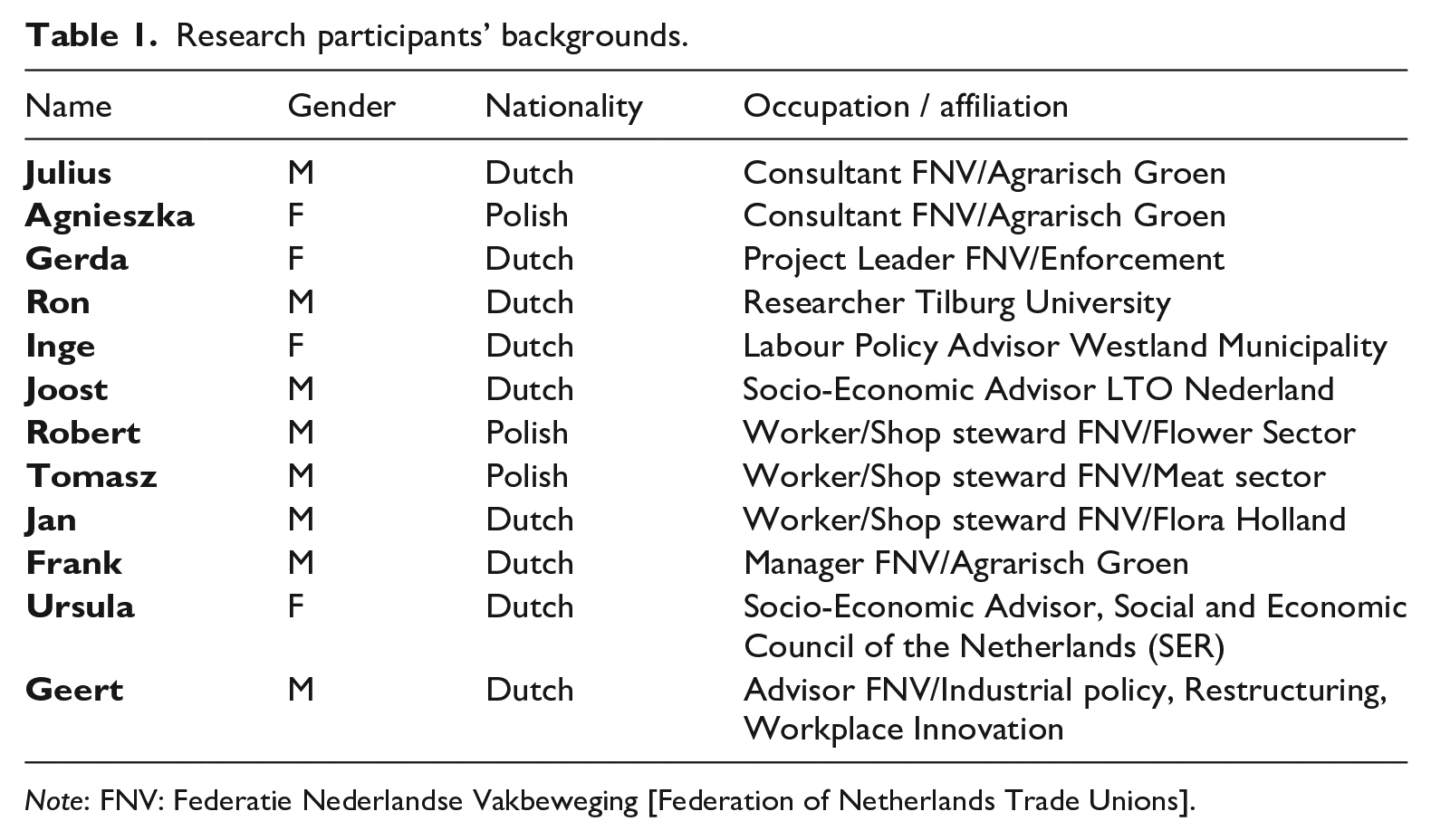
Note: FNV: Federatie Nederlandse Vakbeweging [Federation of Netherlands Trade Unions].
Existing contacts to the Netherlands Trade Union Confederation FNV representatives in the agricultural sector enabled access to many of the interviewees. Especially for migrant farmworkers, this was a challenging process. Previous research demonstrated that CEE migrant farmworkers in the Netherlands are often reluctant to talk about their experiences, fearing that it might negatively affect their employment status (McGauran et al., 2016: 7). In our study, too, motivating migrant workers to participate proved challenging. Those who did were active FNV members and held regular immigration status as EU nationals.
The participating workers’ social characteristics reflected the general position of CEE migrants in horticulture outlined in the contextualising section. Employed in manual jobs, their nationality matches the dominance of Polish nationals among the group of CEE migrant workers in Dutch horticulture. This dominance is also steeped in their older history of migration to the Netherlands. Polish nationals gained full access to the Dutch labour market in 2007, while Bulgarians and Romanians faced a transitional regime until 2014. The resulting limited data on the embodied experience of migrant workers with new horticultural technologies highlights the heuristic character of our analysis and the need for follow-up research.
Based on informed consent, all but one of the 12 resulting interviews were recorded, transcribed and analysed together with the notes that were taken during every conversation. To protect interviewees’ identities, their names were changed. The interview data were coded based on an initial code list inspired by Pajnik’s (2016: 161) framework for the analysis of migrant precarity in European labour markets. It foregrounds the role of features of the labour process (including technological upgrading), the governance of immigration and employment, as well as workers’ social identities. The resulting codes were enriched inductively based on the interview data. The coded material was subsequently annotated, focusing on data segments that were labelled with both a group of codes related to ‘Technology’ and either the code ‘Employment: quantity’ or ‘Employment: quality’.
The coding process enabled us to identify connections between technological upgrading in Dutch horticulture and its implications for CEE migrants’ employment and the security of their work. Based on Standing (2011: 7–13), we understand employment quality as being characterised by different labour-related securities with their absence representing precarious work. These securities range from income via employment security to protection against accidents and illness at work, termed work security by Standing (2011). Rodgers (1989) adds structural causes and consequences to Standing’s (2011) characterisation when pointing out that employers typically have a high degree of control over precarious work and that it is characterised by low incomes.
Contextualising migrants and machines in the Netherlands’ high-tech horticulture
Migrant labour in the Dutch agri-food chain
CEE migrants have shouldered a large share of work in Dutch horticulture since the EU enlargements in 2004 and 2007 enabled their intra-union mobility. Figure 1 reflects their increased involvement compared with the sector’s output change during the past decade. It comes as no surprise then that regions with the highest concentration of CEE migrant workers map onto the centres of horticultural production. Many open field fruit and vegetable farms are located in the southern provinces of North Brabant and Limburg, while North Holland is a hub for flower bulb production and other open field floriculture. The Westland municipality in South Holland is the capital of greenhouse horticulture.
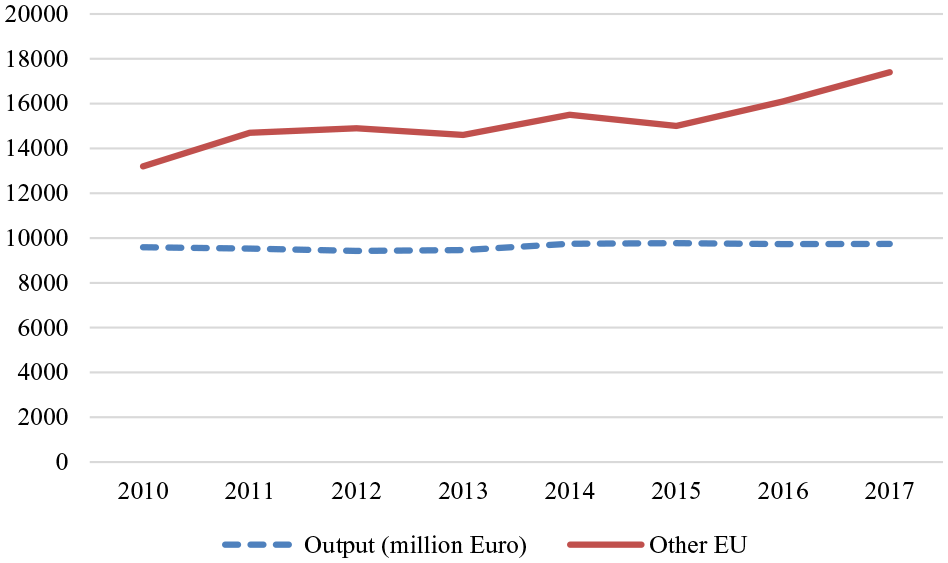
Output and directly employed EU employees in Dutch horticulture, 2010–2017.
The exact number of migrant workers in Dutch agriculture is disputed. In 2020, Statistics Netherlands (Centraal Bureau voor de Statistiek, CBS) counted 21,300 workers from EU countries as directly employed in agriculture. Polish citizens represent the largest group among them, followed by workers from Romania and Bulgaria (CBS, 2022). Yet, these numbers invisibilise the bulk of migrant workers who are employed indirectly via temporary work agencies. Besides, CBS figures may exclude seasonal workers working a maximum of four out of six months in the Netherlands as registration is not mandatory for them (Inspectie SZW, 2021: 12–13). Horticultural employers estimate the sector to provide structural employment to 139,000 people, with the number rising to 248,000 during peak periods (Dutch Horticulture, 2023).
Mirroring insights of the GVC literature, migrant farmworkers’ conditions in the Netherlands are powerfully shaped by retailers. They are key actors in the ‘supermarket model’ of agri-food chain governance. The horticultural chain in the Netherlands reflects Dolan and Humphrey’s (2000: 152) characterisation of this model as oligopolistic competition. Like in their description of the UK retail landscape, in the Netherlands the traditional auction system for agricultural goods has been bypassed by retailers who control the supply chain through direct contracts with growers (Kroon and Paauwe, 2014: 25). In 2021, the five biggest supermarkets in the Netherlands held a combined market share of 81%, a percentage that has risen over the years (Distrifood, 2022). While this concentration has gone hand in hand with large price margins for retailers, retail prices of labour-intensive fruits and vegetables have declined, and farmers’ income is under pressure with only large farmers being able to cope (Kroon and Paauwe, 2014: 25). As a result, over the years, farm numbers have shrunk, while acreage has remained stable or increased.
Similar to dynamics identified in buyer-driven agri-food chains in the global South, these lead firms’ price pressure is passed on to workers whose workload has been increasing while their real wages have declined. As observed elsewhere in value chain analyses (Matheis and Herzig, 2019: 127), this impact on workers is differentiated by task. In Dutch horticulture, labour demand is highest for two types of tasks (Kroon and Paauwe, 2014: 24). On the one hand, they comprise skill and knowledge-intensive tasks, like the application of fertiliser, the management of climate systems, sales and marketing, process automation and machine maintenance (Kroon and Paauwe, 2014: 24; Pekkeriet and Splinter, 2020: 15–16). On the other hand, they involve skilled work for which no specific education is needed, such as manual planting or harvesting of vegetables, fruit, or plants (Kroon and Paauwe, 2014: 24).
Workers in such directly cultivation-related tasks bear the brunt of the pressures typical of buyer-driven agri-food chains. Reflecting EU-wide patterns of labour market segmentation, most CEE labourers are employed in the second segment. This implies that they are particularly susceptible to experiencing low and insecure wages, flexible employment relations and physically hazardous conditions (Inspectie Sociale Zaken en Werkgelegenheid [SZW], 2019: 16; McGauran et al., 2016). As a result, the average hourly pay of workers from CEE countries is lowest in comparison with Dutch and other foreign workers. In 2017, over 70% to more than 80% of workers born in Romania, Poland, Bulgaria and Hungary held a job with an hourly rate of less than 15 euros (CBS, 2019).
Paralleling insights of the wider GVC literature (e.g. Barrientos et al., 2011), the high share of agency employment in the Dutch agri-food chain enables the shift of market risks to migrant farmworkers and the lowering of labour costs. This was enabled through the legalisation of indirect employment contracts with employment agencies in 1999. The relevant collective bargaining agreements (CBAs) provide agency workers with staggered economic and social entitlements. During the first phase of up to 78 weeks, their contracts may be terminated at any time and workers are paid for hours worked only, while workers in the last phase must be offered a permanent contract and receive payment even if there is no work for them (Inspectie SZW, 2021: 22). Dismissal after the first phase and reemployment after a period of unemployment is common, with the result being that most CEE migrants hold first phase contracts. This is reflected in a recent survey of the Netherlands Labour Authority among – largely CEE origin – migrant workers in which two out of three respondents held first phase contracts (Inspectie SZW, 2021: 22). The modest unemployment benefits that workers are entitled to are part of a business model that ensures maximum flexibility at low costs to growers.
Interlinked contracts further weaken migrant workers’ bargaining power. The common combination of agency employment contracts with housing, travel and insurance contracts makes CEE migrants highly dependent on their employers, limits their ability to ‘vote with their feet’ and increases employment agencies’ possibilities for abuse. Migrants’ lack of a collective voice in the labour market aggravates this situation. Despite promising initiatives, by and large, trade unions have not been effective in organising CEE migrant workers (De Beer and Berntsen, 2019: 257).
Shortages of skilled workers have been observed for both segments of the horticultural labour force. On the one hand, the recent economic growth in the Polish and Romanian economies and amendments in Polish taxation aimed to stem emigration have encouraged many migrants to return since the wage gap between their countries and the Netherlands has been narrowing (Pekkeriet and Splinter, 2020: 15). Therefore, more employers have started looking towards Ukraine, the Balkans or Southeast Asia in the hope of finding labourers willing to work for the prevailing wage (Inspectie Sociale Zaken en Werkgelegenheid [SZW], 2019: 5). For knowledge-intensive support tasks in greenhouse horticulture, Pekkeriet and Splinter (2020: 9, 16) identify bottlenecks, especially in tasks that combine knowledge of cultivation with IT skills. The lack of a skilled workforce and increased labour expenditure have convinced some producers that the orientation towards agricultural robots is a best possible solution for the future (De Wilde, 2016; Hemming, 2018).
Technological upgrading in Dutch horticulture
The significant role of government policies in catalysing technological upgrading of agricultural processes in the Netherlands (e.g. Hoste et al., 2017: 9–12) parallels the experience in other value chains (Gereffi, 2019). As a result, the Netherlands has been among the frontrunners when it comes to the technological upgrading of horticultural processes.
Significant process improvements have helped to turn some of the greenhouses from ‘energy guzzlers’ into energy sources (Hoffman and Loeber, 2016: 704). Tomato cultivation based on a combination of intensified thermal screen use and ventilation systems exemplifies this. It provides higher concentrations of CO2, which have enabled growers to reduce their energy input significantly (De Gelder et al., 2012). More energy efficient lighting, such as LED lighting, has contributed to the more than doubling of the tomato and sweet pepper yields over the last three decades (Marcelis et al., 2019: 3).
Product and process upgrading are intertwined in ‘smart farming’ and applications of genetics in Dutch horticulture. Smart farming involves the individualised treatment plants receive based on the analysis of sensor- and GPS-generated data. Both technologies have been applied to innovate horticultural products in the Netherlands. While smart farming allows for the customised production of specific batches for specific clients, genetics has been used, to cultivate plants with the desired taste, smell, colour and appearance (De Wilde, 2016: 44–45, 50–51).
The scope for automation in Dutch horticulture has shrunk in recent years, though. In greenhouses, most procedures have been automated, except for pruning and harvesting (Hemming, 2018; Hoste et al., 2017: 27; Pekkeriet and Splinter, 2020: 19). The ‘ceiling effect’ in technological innovation can be explained by the complexity of matching the human dexterity in dealing with living plants. This leads to a situation in which, for instance, the use of harvesting robots is presently by and large confined to experimental greenhouses (Hoste et al., 2017: 27–28; Pekkeriet and Splinter, 2020: 19).
In sum, while Dutch greenhouses have been forerunners in the automation of the labour process, innovative forms of climate control and product innovation through genetics, the uptake of process and product innovation in open field horticulture have been more varied.
The scholarly literature on the impact of such technological upgrading in GVCs on workers is both scant and inconclusive. Engineers and economists, in particular, often assume these and other forms of technological upgrading to promise positive impacts on working conditions (e.g. Marcelis et al., 2019: 2). Largely based on industrial dynamics in the global South, Gereffi (2019: 241), in contrast, argues that without flanking social or industrial policies to improve labour conditions, producers will remain stuck with low returns and high competitive pressures. In the following section, we explore the effects of technological upgrading in Dutch horticulture on migrant workers through our interviewees’ lenses.
Exploring the effects of technological upgrading on migrant labour
The types of technological upgrading in Dutch horticulture identified by our research participants form the starting point of our analysis. 1 We present these types in the following sub-section. Subsequent sub-sections cover their implications for social upgrading in the form of employment opportunities and working conditions.
Technological advances witnessed in the horticultural sector
The forms of technological upgrading distinguished in our interviews range from different technologies for climate control via LED lighting to extend the cultivating season to the automation and robotisation of different stages of cultivation in flower nurseries (Table 2).
Technological upgrading in Dutch horticulture observed by research participants.
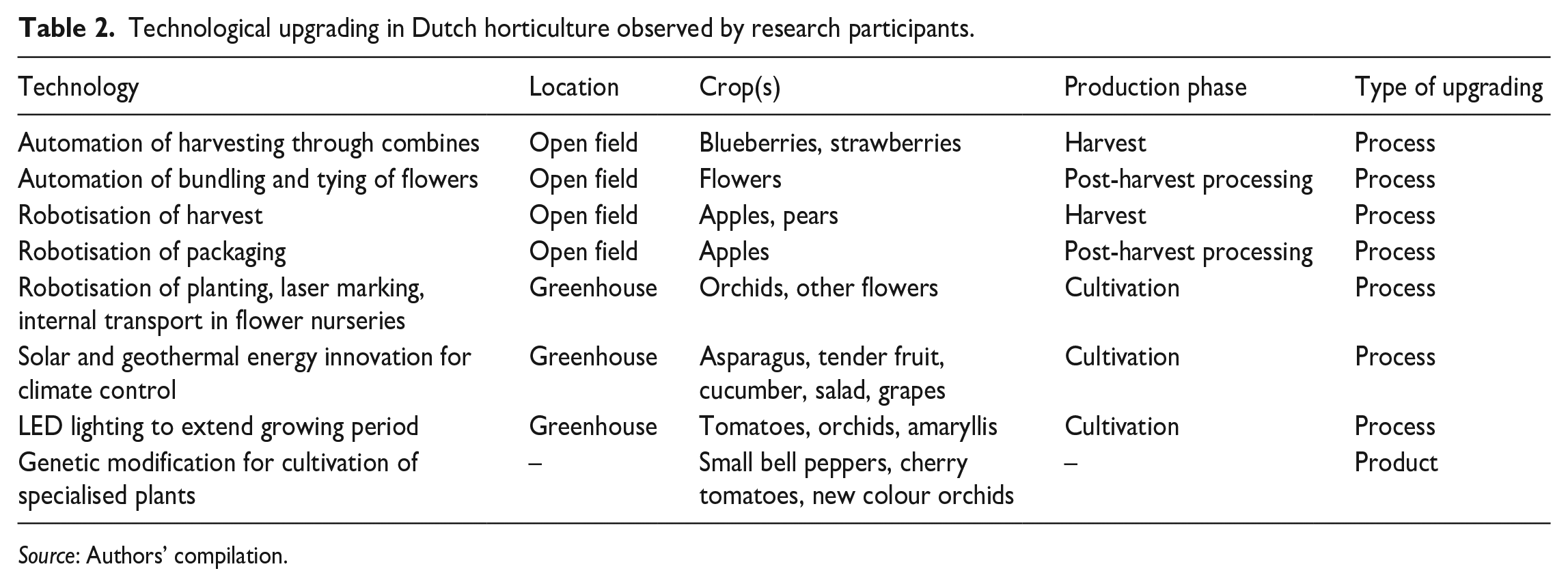
Source: Authors’ compilation.
Technological innovation applied in the Westland greenhouse economy affects the cultivation of a wide array of crops, from vegetables to flowers. Proudly, the policy advisor to Westland municipality highlighted the high degree of robotisation in orchid production: ‘You have to visit the orchid production. Every day, they produce 5 million orchids. [They are put on a] conveyor belt, planted in a pot, laser marked about their colour – all of that is done by a robot’ (interview, Inge, 2018).
Yet, lacking financial resources and the current insufficient sophistication of robots prevent a widespread uptake of robotics. Jan highlighted both hurdles when he shared that:
the CEO of a company wanted to automate completely these operations a couple of years ago, for example like Amazon that uses robots in their warehouse to distribute the goods. My supervisors investigated for many months, and it costed an awful lot of money, but they decided not to do it because all the machines, all the robots that perform that stuff [. . .] have to operate on the perfectly flat floor and that is not the case with our building. (Interview, Jan, 2018)
In open field agriculture, technological upgrading was observed in the harvest and post-harvest processes. The harvest of tender fruit, such as blueberries, is sometimes mechanised through combines and extended into the night through special lights. The delicate nature of these crops presents a challenge to automation, though. A trade union consultant concluded that, so far: ‘Employers prefer regular pluckers, they are more careful with the fruit’ (interview, Agnieszka, 2018). Given their current lack of sophistication, in open field agriculture, harvesting robots, such as for apples or asparagus, are still employed on an experimental basis only. Post-harvesting automation in open field horticulture that the research participants described involves, for instance, the automatic bundling and tying of flowers in floricultural enterprises.
In addition to upgrading of the production process, some of the interviewees identified product innovations. Orchid producers in Westland, for instance, have multiplied the number of varieties based on customers’ demand (interview, Inge, 2018). Ron cited tomato growers pointing out that they no longer cultivate ‘water bombs’ (i.e. poorly tasting, standard tomatoes), but have moved into innovative varieties, such as cherry tomatoes or mini bell peppers (interview, Ron, 2018). In line with a common understanding of successful product upgrading leading to an increase in unit prices (Ponte and Ewert, 2009: 1638), as observed in other agri-food chains (Dolan and Humphrey, 2000: 155; Gereffi, 2019: 247), growers saw such crop innovation as a way to increase their margins (interview, Ron, 2018).
Technological unemployment among CEE migrant workers in Dutch agriculture?
Do these innovations trigger technological unemployment in Dutch horticulture? This question does not yield a straightforward ‘yes–no’ answer. We identify three different – in part counterrotating – dynamics: firstly, investment that saves labour use per unit of production; secondly, the technology enabled extension of the cultivation period that leads to an annual increase in labour demand; and, lastly, employment generation through market extension.
While our interview data reflect the current early stage of robotisation in Dutch horticulture, they corroborate that automation has already replaced human labour in different parts of the sector. Jan, who has been employed in horticulture since the 1990s, observed that in flower nurseries, automation is not a new phenomenon:
When it comes to nursery, there has been a lot of automation going on, but it hasn’t been recent, it has been happening for years now. Some nurseries have many robots moving and shipping young plants from one side to another and moving plants from one side of the greenhouse to another. That part of the cultivation has been automated for years now. (Interview, Jan, 2018)
As a result, employment in these tasks was reduced drastically.
Price effects of automation might nuance such substitution of human labour by machines. For orchid cultivation, the Westland policy advisor observed that: ‘Only one person is managing this process. It is almost without people’ (interview, Inge, 2018). Yet, she qualified this observation with an opposing trend. When mentioning the increasing sophistication of pepper harvesting robots that she had witnessed, Inge asserted that this robotisation did not reduce the demand for migrant workers: ‘But I see more migrants, not less!’. She related this to an expansion in production (interview, Inge, 2018). Parschau and Hauge (2020: 127) explain a similar effect through the possibility of lowering prices due to automation. Allowing producers to win market shares, this in turn increases labour demand.
The introductory quote reflects that labour-saving technologies and the employment of a low-paid migrant labour force represent alternative strategies to increase farms’ profitability. Different interview partners highlighted that company size matters for growers’ technological investment. For instance, Robert, who had worked in floriculture for the past six years, assumed that for larger companies able to afford it, investment in automation will pay off in the long run, as productivity increases will surpass the initial costs (interview, Robert, 2018). Trade union advisor Geert observed that: ‘If you are not in the higher end, then you would not invest in technology’ (interview, Geert, 2018). For other growers, the different comparative advantages of the employment of migrant labour add up: no upfront investment is required like in the case of technological innovation, indirect employment relations ensure that growers can recruit and discharge workers following the seasonality of demand, and last but not least – as reflected in Agnieszka’s point about workers’ greater care with the crop – human labour is more flexible compared with technology. From employers’ perspective, the only disadvantage is migrant workers’ need for social reproduction that distinguishes them from robots and other technologies, something discussed in more detail below.
In contrast to automation, advances in climate control and lighting in greenhouses have stabilised or even increased labour demand. Agnieszka described how asparagus, grape and strawberry cultivation in Limburg were shifted from open fields to greenhouses. She pointed out that this is advantageous for CEE migrants as the longer cultivation cycle that this enables stabilises workers’ employment. Policy advisor Inge corroborated this: ‘It is not true that people are staying for a short period. Maybe in [open field cultivation of] strawberries, but not in Westland. Work in the greenhouses is stable. Now the work continues until November, from February’ (interview, Inge, 2018). These assumptions are supported by a 2017 survey among Westland growers. More than a quarter of the respondents expected labour demand to grow in 2018, while about 70% assumed demand to remain stable (Cremers, 2018: 8).
Finally, product innovation is seen as a cause of rising labour demand. Inge pointed out that technologies that enable product upgrading, for instance, into a greater variety of orchids, create new jobs. She related this to customers’ higher expectations. Pekkeriet and Splinter (2020: 14) elaborate that, for pot plant companies in particular, the demand for added-value products has made delivery more time-consuming: ‘The orders are becoming smaller and more customer-oriented (e.g. your own stickers, cover and chosen pot). Not only the physical actions themselves take time, but also the organisation of the orders.’ Researcher Ron, too, observed that the cultivation of new crops, such as mini bell peppers, creates more employment. According to Pekkeriet and Splinter (2020: 15–16), such employment growth is likely to take place in supporting tasks, such as energy management, sales and marketing, process automation, personnel management and administration, machine maintenance and in logistics where employees have to deal with the increasing diversity of products. Given the segmentation of horticultural employment with most regular employees being Dutch nationals, it is questionable whether these new jobs will benefit CEE migrant workers.
How technological upgrading shapes CEE migrants’ working conditions
If the effects of upgrading on employment levels in Dutch horticulture are ambiguous, the implications of technological innovation on working conditions are complex, to say the least. Below, we distinguish three dynamics that emerge from our interview data. Firstly, process automation comes with increased intensity and precarity of work for the remaining migrant workers. Secondly, the technology-enabled extension of the cultivation period holds both the promise of greater employment security and the pitfall of longer working hours, often under harsh climatic conditions. Finally, the higher price margins associated with product innovation may enable direct contractual relations between growers and migrant workers, in turn enhancing the latter’s employment and income security.
According to the interviewed migrant workers, labour-saving automation goes hand in hand with higher labour intensity for the remaining workers. While not perceiving technological unemployment, Tomasz did observe increases in speed and overall workload resulting from technological upgrading (interview, Tomasz, 2018). Robert elaborated: ‘When you’re working with the machine, the pace of the machine determines your pace, so basically there is always someone that would push you to go faster and to provide more efficient results’ (interview, Robert, 2018). Trade union consultant Julius suggested that workers compete with a machine’s productivity when he stated: ‘Employers see those people like machines, you have to produce as much as you can’ (interview, Julius, 2018). Agnieszka highlighted that it is the fear of dismissal that drives workers to accept such unhealthy conditions: ‘one person often does four people’s work. [. . .] It’s inhumane work, they do this to keep their job’ (interview, Agnieszka, 2018).
The loss of control over the work pace buttressed by the threat of dismissal implies precarity for workers. As explained in the contextualising section, the dominance of first phase contracts among CEE migrant farmworkers that offer flexibility to employers implies employment insecurity for workers. This combination of a high degree of employers’ control over the work and the resulting insecurity, as well as low wages for workers, is characteristic for precarious work.
In contrast, technological upgrading that extends the cultivation period also brings advantages for workers. The discussion above already suggested that the shift from open field to greenhouse horticulture stabilises the level of migrant workers’ employment, translating into greater employment security for workers (interview, Agnieszka, 2018).
The technological extension of the harvest affects working conditions in other ways, too. The use of harvesting combines, for instance, in the blueberry harvest, enables longer working days: ‘With the help of special lamps, people can continue working at night’ (interview, Agnieszka, 2018). Triggered by the perishability of such tender fruit, this leads to a high amount of overtime that CEE workers make. Workers appreciate the resulting higher earnings; however, they are often not paid the overtime premium they are entitled to and not even the hourly minimum wage stipulated by the CBA (interviews, Julius and Agnieszka, 2018). As a result, ‘they do not have any social life’ (interview, Agnieszka, 2018). In other words: humans’ reproductive needs are being ignored to bring workers’ productivity closer to that of machines.
Migrant workers – framed as prototypical homo economicus whose separation from their original environment frees them from social obligations – form an ideal here (McGovern, 2007: 218). It enables growers to contest the obligation to cater for migrant workers’ reproductive needs. They depict migrant workers as solely oriented towards making money quickly to return to their country of origin subsequently (interview, Frank, 2018). Trade union consultant Julius sketches this perception as: ‘“Migrants don’t want to play football with their kids on Saturday”. There is a perception that they embrace the idea of working throughout the weekend’ (interview, Julius, 2018). The resulting narrow space for migrant workers’ social reproduction is exemplified in the fact that in the Westland municipality with its large foreign workforce of an estimated 12,000, less than 100 children of migrant workers are registered (interview, Inge, 2018). If migrant workers’ productivity is compared with machines, as Julius suggested, what needs to be aligned from employers’ perspective is indeed the time for and associated cost of workers’ social reproduction.
While shifting cultivation to greenhouses has undoubtedly benefited some workers because they no longer have to endure harsh weather conditions in the fields, this also comes with challenges. The Westland policy advisor flagged that: ‘Work in greenhouses is very difficult, you have to start early at 5 a.m. in summer, it will be 50 degrees in the afternoon’. Here, plants and their needs are more central than those of the worker – and the ‘[p]lants seem to be able to cope with higher temperatures that do not feel comfortable for humans’ (Pekkeriet and Splinter, 2020: 20).
In contrast to the different forms of horticultural process upgrading, Ron was optimistic that technological upgrading of products can lead to an improvement in working conditions. He observed that the higher margins achieved through product innovation create the financial space that enables growers to employ workers directly: ‘there are a couple of companies that started engaging workers directly. They offer direct labour contracts, they improve working conditions’ (interview, Ron, 2018). Such a shift from agency-based recruitment would be an important contribution to increase migrant workers’ employment and income insecurity. His optimism is mirrored by Pekkeriet and Splinter (2020: 15–16) who assume that new tasks created by product differentiation require a higher level of knowledge and are likely to be carried out in comparatively better working conditions, such as free from noise, free from machines’ work pace and under good climatic conditions. It remains to be seen whether migrant farmworkers benefit from them.
Discussion
Building on the above insights that emerged from our interview data, this section develops a conceptual heuristic that relates forms of technological upgrading to their potential for social upgrading.
Figure 2 summarises the broad pattern of how the identified types of technological upgrading in Dutch horticulture translate into levels and conditions of employment. The vertical axis captures changes in the amount of employment, broadly distinguishing employment generation due to technological upgrading from technological unemployment. Distinguishing secure from precarious conditions, the horizontal axis summarises implications for working conditions.
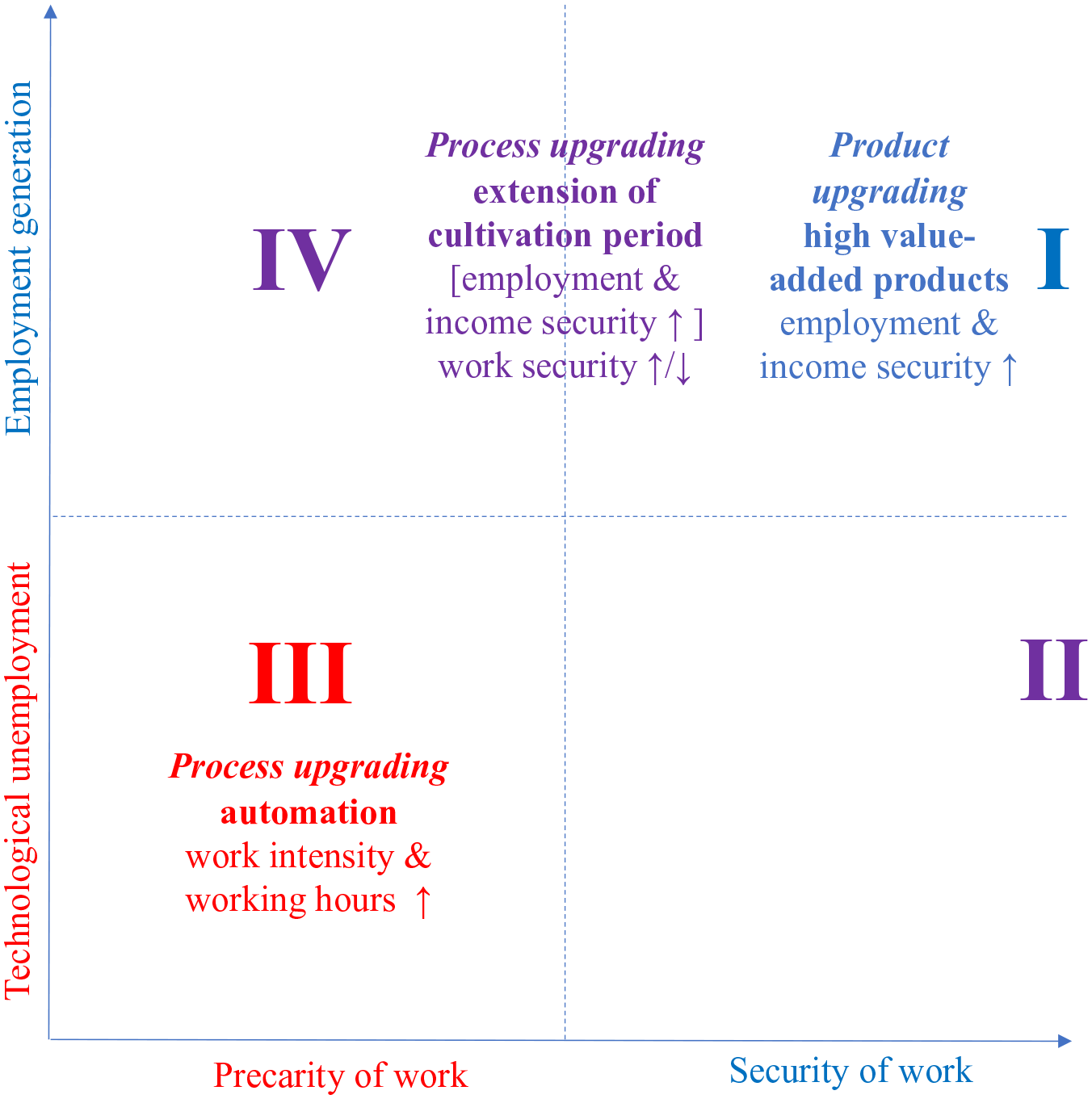
Connecting technological upgrading with the amount and security of employment.
Quadrant I depicts the most positive scenario for workers; yet, simultaneously, it seems to be the most speculative of the observed dynamics. Product upgrading through innovation in vegetable and flower varieties has increased customers’ product demand and requires more care in the preparation of orders. Both translate into employment generation. These dynamics parallel historical experiences with product upgrading identified in the future of work literature (e.g. Mokyr et al., 2015: 36) and more recent findings from agri-food chains in South and East Africa (Barrientos et al., 2016: 1276). At the same time, product upgrading has increased growers’ margins. As expressed through the upward-pointing arrows in Figure 2, this enables them to offer greater employment and income security to horticultural workers.
Whereas this scenario can be related to Barrientos et al.’s (2011) notion of higher-skill upgrading, the question remains of whether these more attractive new jobs benefit CEE migrant workers. As outlined in the section ‘Contextualising migrants and machines in the Netherlands’ high-tech horticulture’, the horticultural labour market is segmented, with migrant workers being concentrated in tasks directly related to the primary horticultural production process (Kroon and Paauwe, 2014: 24) and Dutch nationals forming the majority of those in charge of knowledge-intensive tasks. Overall, Dutch employees are perceived to be entitled to greater economic and social security (e.g. Remery et al., 2002: 486–487). The targeting of Dutch educational institutions in employers’ and trade unions’ promotion of technical job opportunities in horticulture (Arkesteijn, 2019: 23) suggests that product upgrading through horticultural innovation is likely to attract a young and local rather than a migrant workforce.
Combining technological unemployment and precarious work, the scenario summarised in Quadrant III, in contrast, seems most bleak – yet, most common. While it is unclear whether migrant workers’ present tasks in cultivation, harvesting and post-harvesting operations can be automated further or a ‘ceiling’ in such technological advances has been reached, technological unemployment has been the direct consequence of process upgrading through automation. The remaining workers performing these tasks are made to ‘work like machines’: adjusting to machines’ rhythm while competing with their productivity simultaneously. This logic translates into high work intensity and long working hours, as reflected in the upward-pointing arrows in Figure 2. The long working hours squeeze the time available for migrant workers’ social reproduction. Besides, their bargaining power is weakened by the threat of dismissal. Taken together, this situation can aptly be characterised as highly precarious.
Against this backdrop, it is surprising that even trade union representatives seem to welcome technological upgrading through automation. Geert seemed to regret that: ‘as long as there is an availability of cheap labour, companies will not be incentivised to invest in new technologies’ (interview, Geert, 2018). Is this related to trade unions’ failure to effectively organise CEE migrant workers? Or to the expectation that technological innovation enhances the competitiveness of Dutch agriculture? In the mid- and long-term, this could represent an important mechanism to guarantee jobs. As some of the empirical contributions to the future of work debate demonstrate, more short term, downward price effects of automation and a resulting rise in demand might compensate for employment declines (Arntz et al., 2016: 23–24; Parschau and Hauge, 2020: 127).
Compared with the bleak implications of automation and the promises of product innovation, process upgrading that leads to an extension of the cultivation period comes with a mixed bag of effects on CEE migrant workers. This locates this scenario between Quadrants I and IV. Other factors remaining stable, innovations (e.g. in climate control and lighting) have increased growers’ annual labour demand. Potentially, this can translate into greater employment security. It is unclear, though, whether individual workers benefit in terms of more stable contracts and income, hence the brackets around possible increases in employment and income security in Figure 2. Given that these innovations do not influence the labour-intensive character of the horticultural tasks, this scenario comes close to Barrientos et al.’s (2011: 336) labour-intensive upgrading.
The impact of this scenario on work security – as protection against unhealthy conditions – is ambiguous. Some of the innovations covered in this scenario may shield workers from harsh outdoor conditions since they shift cultivation into the greenhouse. Yet, working in greenhouses comes with challenging climatic conditions, too. Labour process theory helps to make sense of these mixed impacts of technological upgrading by relating them to their influence on workers’ bargaining power (e.g. Prause, 2021). Improved thermal screens in greenhouses, for instance, neither directly compete with CEE migrants’ labour nor deskill the tasks that greenhouse workers perform. As a result, while the subordination of humans to plants’ rapid growth comes with the endurance of difficult climatic conditions and health hazards, there are possible benefits to reap in terms of greater stability of employment and income.
Conclusion and outlook
Engaging with the effects of technological upgrading in Dutch horticulture for CEE migrant workers, this article contributes to the scholarly literature on the future of work with fresh empirical perspectives and conceptual innovation.
Empirically, our study addresses the gap regarding agriculture in debates around the future of work, despite the sector’s crucial role for a significant share of the global labour force. Empirical analyses of the future of work among technological advances either focus on industrial production (e.g. Acemoglu and Restrepo, 2020; Parschau and Hauge, 2020) or, when covering multiple sectors, mention agriculture in passing (e.g. Arntz et al., 2016; Frey and Osborne, 2017; Maloney and Molina, 2019; Zhou et al., 2020). We zoom in on the case of the Netherlands, which is significant on account of the country’s highly productive agriculture, built on the twin pillars of migrant labour and technological innovation.
Conceptually, we contribute to the GVC literature by specifying the relation between economic and social upgrading through an analysis that foregrounds employment and working conditions. While the analytical distinction between economic and social upgrading has been made for more than a decade, GVC analysis has not theorised their relation beyond the general insight that ‘economic upgrading may lead to social upgrading, but that it is neither a necessary nor a sufficient condition’ (Rossi, 2019: 277). Technological sophistication is central to the forms of economic upgrading that GVC analysis distinguishes (Milberg and Winkler, 2011: 343), yet surprisingly few studies of economic upgrading unpack the underlying technologies.
The distinction of technologies for process and product upgrading allows us to specify the relationship between economic and social upgrading for the context of Dutch horticulture. We find that process upgrading through automation that results in making the remaining labour force ‘work like machines’ causes both technological unemployment and heightens the precarity of the workers who stay employed. Upgrading through product innovation, in contrast, holds the promise of increasing both labour demand and price margins. That can translate not only into greater employment security but also into higher wages and more social rights, potentially leading to ‘higher-skill upgrading’ (Barrientos et al., 2011: 336). Advances in process technologies that extend the cultivation period do not directly influence the organisation of the labour process. This may explain workers’ more mixed experience with this type of economic upgrading. The associated offer of more employment opportunities and greater employment and income security for horticultural workers may come at the expense of risks for workers’ health and safety through long working hours and the exposure to harsh climatic conditions.
Beyond the case of Dutch horticulture, the heuristic presented above speaks to the wider debate on the future of work. Firstly, as visibly summarised in Figure 2, they add the factor of the security – or precarity – of work to this literature’s commonly one-dimensional focus on the risk of job displacement. Secondly, the analytical tools of GVC analysis help to nuance pessimistic predictions of technological unemployment. Once the type of technological advance is considered more carefully, then the potential for more – and more secure – employment may be identified as a result of product innovation or changes in the production process that do not compete with or deskill labour, whereas labour-saving process automation comes with the double whammy of employment losses and increased precarity of work for the remaining workers. Finally, while the literature on the future of work rarely ventures beyond workers’ occupation and sector of employment, the scenarios we present in the Discussion section acknowledge the significance of workers’ social identities in who is affected by technological upgrading and how.
Furthermore, our analysis enriches the often firm-centric GVC scholarship. The growing number of workers involved in GVCs and the concern for their labour conditions motivated the distinction of economic and social upgrading (Barrientos et al., 2011). Subsequent conceptual and empirical contributions to the GVC literature, however, have often held on to the firm-centric approach to GVC analysis, with quantitative studies using the country or industry as a unit of analysis (see review in Rossi, 2019: 275–276). In contrast, the strong presence of workers and worker representatives among our research participants and the interviews’ focus on implications for workers enables deeper insights into how a horticultural labour force segmented by immigration status is affected by technological upgrading. These findings imply that CEE migrant workers bear the brunt of the negative effects of technological advances on the scope and security of employment. Besides the greater precarity that tends to come with automation, migrant workers may also benefit from technological upgrading that extends the cultivation period – bringing ‘labour-intensive upgrading’ in the form of more – and more stable – employment. ‘Higher-skill upgrading’ that involves not only greater employment security but also higher wages and more social rights, in contrast, seems to remain the reserve of Dutch nationals who are recruited for more knowledge-intensive tasks and who are seen as entitled to greater economic and social security.
These results echo critical value chain studies’ findings that the social and legal construction of migrants as ‘others’ facilitates profitability in buyer-driven agri-food chains (McGrath, 2013; Phillips, 2011). As detailed in the ‘Contextualising migrants and machines in the Netherlands’ high-tech horticulture’ section, labour regulation that normalises migrants’ widespread indirect employment with phased social and economic rights, the interlinked employment and housing contracts they hold, and their lack of effective trade union representation are three key mechanisms that weaken CEE migrants’ bargaining power. The resulting lower labour costs enable growers to cope with the price pressure from retailers, while modest entitlements to social security help workers to endure periods of unemployment.
Reading our empirical material from the perspective of workers’ bargaining power also enables us to identify levers for change. While growers’ labour governance seeks to increase the productivity of workers in tandem with machines to survive the competitive pressures of agri-food chains, numerous examples illustrate that workers do not work like machines, but that workers’ adaptability is unmatched by automated processes. This adaptive capacity gives workers structural power that results from their significance in the agri-food chain (Wright, 2000: 962), especially amidst growers’ difficulties to recruit workers.
While the currently weak levels of organisation of CEE migrant workers in the Netherlands form an obstacle to realising this structural power, individual examples of collective action, such as a strike against wage theft and poor housing conditions among Polish nursery workers in Brabant (No author, 2015), are promising. To strengthen migrant workers’ collective organisations, trade unions need to question their widespread frame that migrants facilitate their own exploitation by undercutting the wage and working time norms stipulated in the CBA. This frame reproduces the ‘othering’ of migrant workers, rather than building solidarity.
The actualisation of CEE migrant workers’ diverse power resources may contribute to ‘shifts in what is considered an “innovation”’ (Hoffman and Loeber, 2016: 706) – namely from economic upgrading for few large horticulturalists to social upgrading for many actors involved in Dutch horticultural production – including CEE migrant workers.
Last but not least, the dynamics depicted in Figure 2 call for further investigation. Based on a small sample and a purposive sampling approach, our results do not lend themselves to generalisation. They represent empirically grounded hypotheses to be tested and refined based on a larger number of observations. In particular, there is a need to, firstly, conduct more in-depth interviews with migrant farmworkers, and, secondly, generate and employ survey data, to engage with shifts in employment due to technological upgrading in a more rigorous manner. The dynamics we have traced also offer potential for cross-country comparison of the implications of technological advances in agri-food chains. Such comparative studies might be particularly relevant and enlightening among the competing producers and countries in which they are located. Overall, such follow-up research is relevant not just to illuminate future scenarios in the world of work, but also to gauge to role of labour and technology for food security.
Footnotes
Acknowledgements
We gratefully acknowledge excellent research assistance by Tyler Williams as well as helpful feedback by Peter Knorringa and three anonymous reviewers. All remaining errors are solely ours.
Funding
The authors disclosed receipt of the following financial support for the research, authorship, and/or publication of this article: The research underlying this article was supported by the Research Innovation Facility of the International Institute of Social Studies of Erasmus University Rotterdam (ISS), the Netherlands, and a grant by the Toyota Foundation.
