




Abstract
This article investigates a sample of almost nine million workers from 24 European countries in 2014 to conclude how involvement in global value chains (GVCs) affects working conditions. We use employer–employee data from the Structure of Earnings Survey merged with industry-level statistics on GVCs based on the World Input-Output Database. Given the multidimensional nature of the dependent variable, we compare estimates of the Mincerian wage model with zero-inflated beta regressions focused on other aspects of working conditions (overtime work and bonus payments). Wages prove to be negatively related to involvement in GVCs: workers in the more deeply involved sectors have lower and less stable earnings, implying worse working conditions. However, they are also less likely to have to work overtime. We prove that the analysis of social implications of increasing involvement of countries in global production must compare wage effects of GVCs with other aspects of complex changes in workers’ well-being.
Introduction
The proliferation of global production networks (GPNs) or global value chains (GVCs), 1 which now account for more than two-thirds of world trade (World Trade Organization (WTO), 2019), has profoundly altered industrial relations between countries. Unsurprisingly, the bulk of research in this field concerns the economic impact of GVCs on countries and firms (among others: Gereffi and Fernandez-Stark, 2016). Scholars have paid less attention to the effects on workers while typically indicating the social impact of production fragmentation as a promising research topic (among others: Barrientos et al., 2011b; Posthuma, 2010). Many articles examine the way in which production fragmentation affects the demand for skills, the task composition of labour force, or labour-market polarisation (among others: Autor and Dorn, 2013; Baumgarten et al., 2013; Murphy and Oesch, 2017). However, the labour-market outcomes of globalisation still remain largely unexplained, either by trade or by technology (for a meta-analysis see Muendler, 2017). Much less attention has been paid to how inclusion in globally integrated value chains affects working conditions. Importantly, the network of social relationships within global supply chains should be analysed deeper, i.e. not only in economic but also in social terms, as all economic transactions are socially embedded (Reinecke et al., 2018). There is a need to shift the perspective from an economic to a social one to make GVC analysis more balanced. This article seeks to fill this gap by providing a more complex view on the working conditions along globally intertwined production structures.
Participation in GVCs brings economic benefits, but their translation into better working conditions is not automatic or self-evident. Where early studies on GVCs suggested a straightforward relationship between economic and social upgrading 2 (Kabeer and Mahmud, 2004; Nadvi et al., 2004), more recent research holds that this relationship is not fully demonstrated (Bernhardt and Pollak, 2016). On the one hand, cross-border production links may create job opportunities for marginalised workers, making the integration of groups typically discriminated against (e.g. women and the unskilled) possible. On the other hand, it may increase the pressure to cut labour costs, which often means worsening working conditions and less respect for labour standards (Plank et al., 2012). Moreover, the geographic dispersion of production in GVCs may also be an important determinant of precarious employment (Siegmann and Schiphorst, 2016).
The literature has a number of shortcomings. First of all, research on the economic and social upgrading of workers within globalised structures of production relates mainly to developing countries (Barrientos et al., 2011b; Milberg and Winkler, 2011; Nadvi et al., 2004), 3 such specific problems as human rights in GVCs (Buhmann et al., 2019), or, recently, the risks connected with technological advances within GVCs (WTO, 2019). Studies of developed countries are comparatively rare (Smith and Pickles, 2015). In particular, there is hardly any research on the social impact of GVCs in Europe beyond the purely economic effects on employment, productivity or wages. Yet we know that in recent decades working conditions in many European countries have changed, and not necessarily for the better. For instance, the share of part-time employment has grown significantly (Pirani and Salvini, 2015). 4 ‘Made in Europe’ is not automatically equivalent to ‘fair labour conditions’: for instance, many garment workers from east and south-east Europe earn less than the actual living wage, and the Clean Clothes Campaign’s November 2017 report found 1.7 million garment workers living in poverty, with poor working conditions or overtime work. 5 Thus working conditions in Europe may well be an issue, but it is by no means clear whether or not the proliferation of GVCs has been a factor in lowering labour standards.
Secondly, there are methodological problems. Empirically, the concept of ‘social upgrading’ has been quantified mostly using country-level data (hence loss of individual, worker-specific dimensions) based exclusively on wages (Bernhardt and Pollak, 2016). This is an oversimplification, as the quality of employment depends not only on wage levels but also on such factors as non-standard payments, working hours and overtime, freedom of association, as well as workplace safety. Moreover, as the recent GVC literature notes (e.g. IBRD/World Bank, 2017), precise indicators are needed to capture all the dimensions of cross-border production links, including a position of industries within the production chain.
This article addresses these shortcomings, focusing on GVCs as one potential determinant of working standards in a sample of almost nine million workers from 24 European countries. The question is how the inclusion of a domestic industry in GVC, or its position within the chain, affects the working conditions of its employees. At the same time, other factors that help determine employment and wages, such as workers’ individual characteristics and a degree of job routinisation, are taken into account. To this end, linked employee–employer data from the Structure of Earnings Survey (2014) are merged with industry-level measures of GVC involvement from the World Input-Output Database (WIOD). Thanks to the joint coverage of both enterprises and workers’ characteristics, it is possible to quantify various aspects of employment conditions, such as wages, overtime work and bonus payments as a share of total earnings. GVC involvement is measured by novel concepts of global import intensity (GII) (Timmer et al., 2016) and ‘upstreamness’ (Antràs et al., 2012).
Section 2 presents the key concepts and reviews the literature on GVCs, social upgrading, decent work and working conditions. Section 3 describes the data and the methodology. Section 4 reports and discusses the estimation results. Section 5 presents conclusions.
Social upgrading and decent work: Key concepts and past evidence on the impact of GVCs on working conditions
As a major factor in social transparency, accountability and cohesion (ILO, 2016), understood as ‘working toward the well-being of all the members of a society’, labour rights (closely related to human rights) are of interest to sociologists and economists (Taglioni and Winkler, 2016: 200). The issue of labour rights may be embedded within integrative social contract theory (ISCT), as in Donaldson and Dunfee (1994), extending society’s principial ethical foundations to business contexts. ISCT can be applied to identify global hypernorms governing labour standards (Hartman et al., 2003).
However, these general rights need to be analysed in a more detailed way to allow their measurement within the sociology of global production. The geographic dispersion of production implies the need to integrate labour processes into GVCs, going beyond the governance of interfirm relations, as the fragmentation of value chains significantly affects skills, flexibility, work organisation and employment security (Flecker et al., 2013). Taglioni and Winkler (2016) stress the impact of integration into GVCs on living standards (wages, working conditions, economic security) where a country’s position within the chain is one of the determinants of opportunities for social upgrading.
Notwithstanding these efforts to integrate social values into GVC analysis, a number of lacunae remain. Selwyn (2013) mentions three main limitations: first, the ILO’s concept of social upgrading 6 has limited power and its real impact on companies’ behaviour is modest; second, little is said about the processes and mechanisms for social upgrading; and last, the exploitation of labour tends to be downplayed, focusing instead on institutional arrangements between state, capital and labour, which ignores the real reasons for labour inequalities. Wages alone are not any sufficient indicator of social upgrading, and are not any reliable gauge of working conditions in the broader sense either (Bernhardt and Pollak, 2016). A broader view has been taken, among others, by: Lee et al. (2016), who consider – in addition to wages – hours, overtime, hiring and contract practices, as well as health and safety conditions; by Kabeer and Mahmud (2004), who associate working conditions with permanent job status, maternity benefits, paid leave, accommodations, medical care, and overtime pay; by Barrientos et al. (2016), who define social upgrading by work opportunities, measurable labour standards and enabling rights; by Bair and Gereffi (2001), who focus on safety, exploitation, compliance with local labour laws, and sanitary conditions at the workplace; by Rossi (2013), who considers work environment, overtime, job and social security, as well as enabling rights. The range of aspects affecting the quality of work is thus quite considerable.
The empirical literature on social consequences of trade (and globalisation in general) and proliferation of GVCs has produced contrasting findings. While some studies confirm a positive relationship (Bair and Gereffi, 2001; Nadvi et al., 2004), others assert that economic upgrading (a gain in productivity for a firm or an industry) does not necessarily translate into social upgrading for workers. This thesis, typical of institutionalist political economy, is consistent with the ILO’s Decent Work Agenda. Economic upgrading within GVCs may even be coupled with deterioration in working conditions, insofar as relocation in the labour-intensive sectors, where offshoring is typical, may be driven by low wages, worse employment arrangements, precarious work and employment conditions (Barrientos et al., 2011a). Knorringa and Pegler (2006) argue that GVC participation may have an adverse effect on labour conditions owing to segmentation, job insecurity and longer working hours.
Another strand of work consists of case studies, mostly concluding again that economic upgrading is no guarantee of social upgrading (among others: Barrientos et al., 2011b, 2016; Flecker and Meil, 2010). In short, the bulk of the literature on trade integration, GVCs and labour standards refers to developing countries, but there have been some studies concerning the impact on workers in the developed world, with significant research on the US economy and the impact of globalisation on wages (among others, see Ebenstein et al., 2014; Shen and Silva, 2018).
The evidence for Europe is relatively limited. Among few cross-country studies, Van Aerden et al. (2015), using the European Working Conditions Survey, find a clear relationship between working conditions and general well-being, contending that flexible and de-standardised work arrangements cannot ensure long-term employment sustainability. Some empirical research examines how GVCs affect European wages (among others: Baumgarten et al., 2013; Geishecker et al., 2010; Parteka and Wolszczak-Derlacz, 2019), 7 which are taken as an imperfect indicator of social upgrading. Still, it is difficult to draw general conclusions on this question for Europe since much of the research takes a narrow industry- or country-specific perspective.
The special issue of Competition and Change (‘Putting labour in its place: global value chains and labour process analysis’, Taylor et al., 2013) 8 focuses on the integration of the labour process theory with international supply chain studies and describes some specific, but significant, European case studies. Flecker et al. (2013) find an alarming state of labour processes in the Austrian parcel delivery industry (extremely fragmented, with large transnational companies at one end and self-employed drivers at the other end of the value chain). This means that risk, costs and flexibility are shifted downwards along what the authors call ‘risk-and-flexibility-transfer chains’. Labour law on working time, overtime and benefits is circumvented by abusing performance-based payment schemes, and ultimately the couriers’ work is intensified and unstable. In the Romanian electronic industry (Pawlicki, 2013), such local factors as workforce stability create upgrading opportunities, which in turn enable companies to have greater organisational and production efficiency. Weinkopf (2009) studied German financial service and utility call centres, showing that working conditions are worse for subcontractors than at in-house centres, owing to lack of institutional protection (e.g. collective bargaining agreements on wages). Hummels et al. (2016), with data on Denmark, found that workers in export-oriented companies more frequently suffer work accidents and illness. However, some positive aspects have been found too. Smith and Pickles (2015) document that workers in export-oriented companies in the Slovakian garment industry have higher wages and better working conditions (but they are also more exposed to job loss due to external shocks). Lloyd and James (2008) weigh the impact of supply chains on occupational health and safety in the UK food processing industry, reporting a considerable decline in the number of accidents and moderate improvement in labour conditions, despite supply chain pressures.
In our view, given this fragmentary evidence, the link between GVCs and social upgrading in Europe is a highly complex empirical issue, requiring a broader methodological approach and a cross-country dataset, which we describe below. Recalling a broader view of working conditions, we aim to facilitate the development and implementation of better social relations within GVCs.
Methodology and data
In order to determine the association between GVCs and working conditions, we have built a combined worker–industry dataset, merging micro-data from the Structure of Earnings Survey (SES) with industry-level statistics on GVCs based on the World Input-Output Database (WIOD). The SES is a large, cyclical four-yearly international enterprise survey (conducted in 2002, 2006, 2010, 2014). It gives comparable information on the relationships between earnings and individual characteristics of employees and employers. 9 This study uses the latest wave of the SES (reference year 2014), described in Eurostat (2014) and involving workers from 24 European countries (listed in Table A1 in the online supplementary materials). The overall sample consists of 8,932,178 observations.
Given data availability and conventions used in the literature, the dependent variables selected include three SES indicators of working conditions: wage (average gross hourly earnings in relation to the sectoral mean), overtime (share of overtime in total hours worked) and bonus payments (share of bonus payments in total earnings). Descriptive statistics (by country and industry) are presented in Table A2 and Table A3, detailed specification of variables in Table A5, and correlations between various measures of working conditions in Table A4 in the online supplementary material.
Higher wages, lower overtime share and lower bonus share are interpreted as signs of better working conditions. 10 This reading follows the literature, which generally holds that excessive overtime and longer hours, imposed by tight delivery schedules and cost-cutting, may worsen workers’ well-being (among others: Posthuma, 2010) and have an adverse impact on quality of life (Drobnič et al., 2010). Long hours commonly serve as a proxy for destandardised working arrangements, which in turn are related to employment quality (Van Aerden et al., 2015). For bonus payments, the assessment is less straightforward. Mkoka et al. (2015) note that unfair allocation of allowances and bonuses may undermine employee morale and lower labour standards. A study based on the British Household Panel Survey (Pouliakas, 2010) finds instead that bonus payments have a fairly insignificant influence on job satisfaction and productivity. Importantly, Schweiker and Groß (2017), based on the German Structure of Earnings Survey, find that bonus payments may significantly increase wage inequality, and this flexibilisation of pay may aggravate earnings insecurity. Against this background, it is considered that a larger share of bonus payments may engender insecurity and hence unsatisfactory working conditions.
As is shown in Figure 1, working conditions vary considerably across Europe. Salaries in western and northern Europe are much higher than in central and eastern countries. 11 The highest average hourly wages are reported in Norway (€26.34), Sweden (€19.70), and Luxembourg (€19.79) whereas the lowest are reported in Romania (€3.34) and Bulgaria (€2.94). By sector (Table A3 in the supplementary materials), average hourly wages range from €9.73 in manufacturing to €12.77 in education. As to overtime, the highest shares are in the Czech Republic, Italy, France and Malta (more than 1.3% of total hours); workers from Lithuania, Belgium, Spain and Latvia show the smallest shares (less than 0.2%). The third proxy – share of bonus payments – is highest in Spain, Italy and Portugal while lowest in the Netherlands, Sweden and Norway.
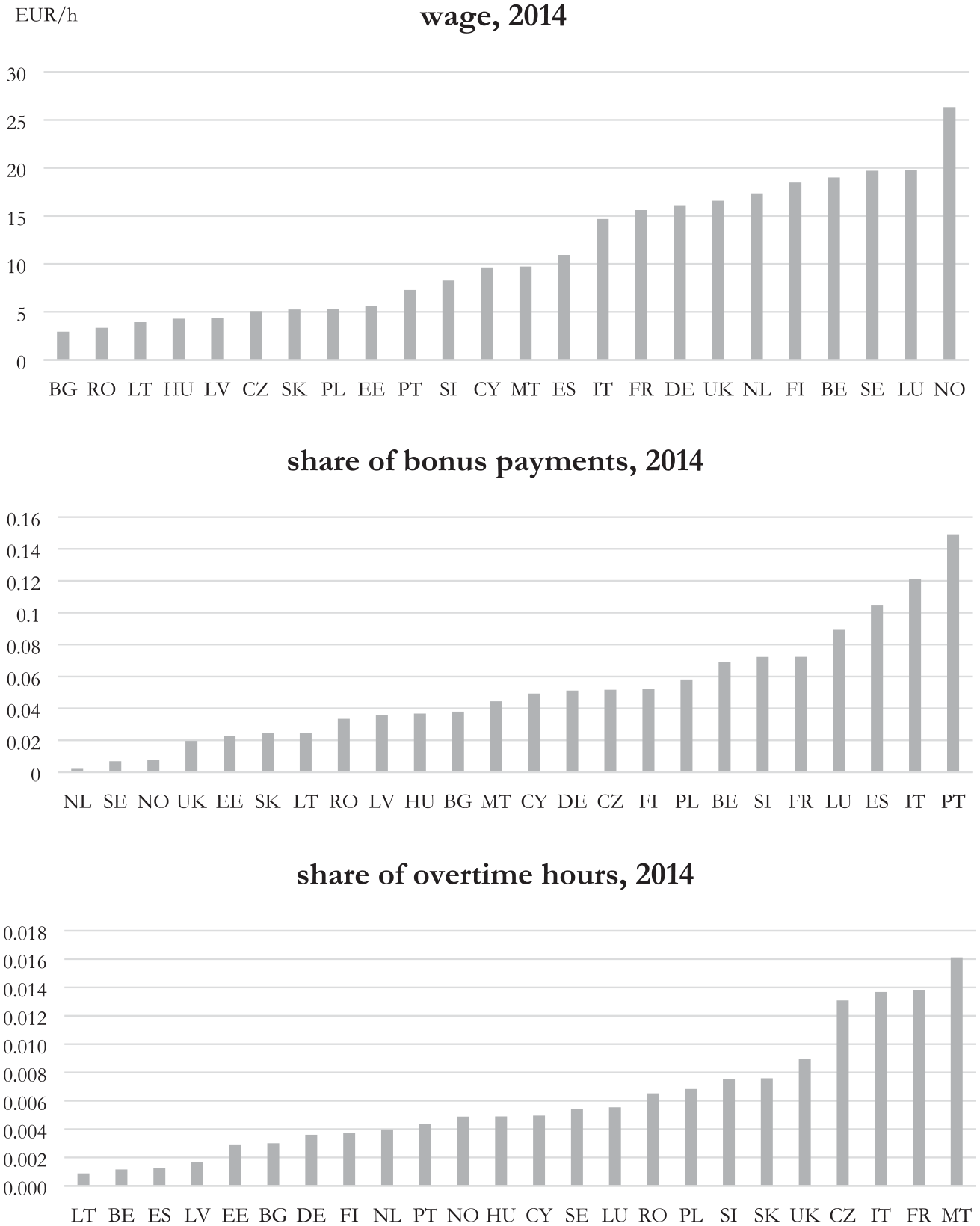
Working conditions in European countries.
To seek out the determinants of these proxies for working conditions, we consider individual, company, industry and country characteristics. The first two are derived from the SES: sex, age, education, type of employment contract, seniority in the enterprise and size of enterprise. Table A5 (see online supplementary material) presents the descriptive statistics for all these micro-variables, which also define the composition of our sample. Half of the observations are men (51%), 53% are aged 30–49 years, 18% are under 30 years old, and 48% have a medium level of educational attainment. The large majority (83%) are employed full time, 31% have worked in their enterprise for less than four years, 13% for less than one year, and 54% are employed in small and medium enterprises (SMEs) (under 250 employees). Following the task-based approach to labour market analysis (Autor et al., 2014; Baumgarten et al., 2013), we control for the degree of job routinisation using the routine task intensity (RTI) index 12 developed by Lewandowski et al. (2019).
A crucial step in the construction of our database is matching individual worker data with the sectoral indicators of GVC derived from the World Input-Output Database (November 2016 release), as in Timmer et al. (2015). The WIOD has input-output data for 43 countries and 56 sectors according to the ISIC Rev. 4 classification (the list of WIOD sectors is presented in Table A6 in the online supplementary material). The SES shows the employee’s industry (according to NACE Rev. 2), so the WIOD is matched with the SES on the basis of the statistical classification of economic activities. 13 This matching procedure allows us to check whether GVC involvement is an important determinant of working conditions for European workers.
Two measures of international production fragmentation within GVCs, each of them both sector-specific and country-specific, are used. The first one is the index of global import intensity of production (GII) proposed by Timmer et al. (2016), which counts imports of goods and services from all stages of production, thus traces the entire value chain, whereas the classic gauges of offshoring or such GVC measures as the share of foreign value added typically count the final stage of production only. Most recently, GII has been used by Szymczak et al. (2019). 14 The index ranges from 0 to 1; values closer to 1 indicate greater dependence of domestic sectors on foreign inputs (hence greater GVC involvement). Our measure here is the relative change in GII between 2004 and 2014 (∆GII/GII), aiming at capturing the increase in sectoral involvement in GVCs (Figure 2 shows considerable cross-country variability).
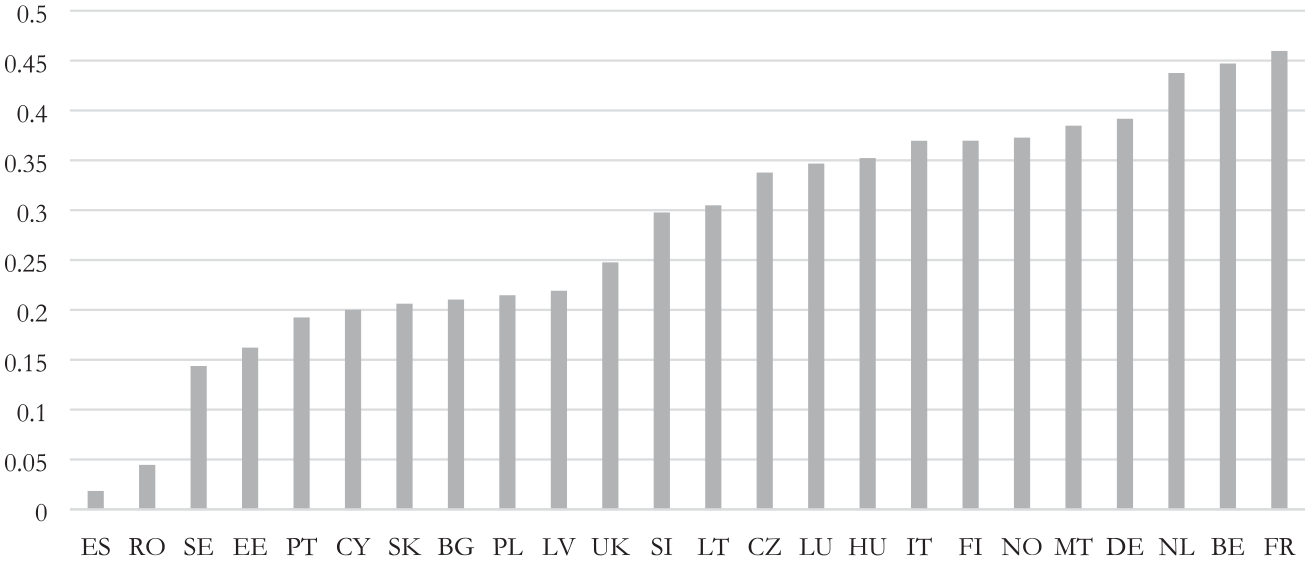
Global import intensity (GII); total growth rate (2004–2014).
The recent literature makes it clear that, in addition to the intensity of foreign inputs, the relative position of an industry in the value chain is important as a wage determinant. Accordingly, we use the upstreamness (UP) constructed by Antràs et al. (2012), i.e. the national industry position in the global production chain, as an additional control variable (our second measure of international production fragmentation). Obviously, the greater the upstreamness, the further the industry is from final output: UP of 1 designates a strictly downstream industry, i.e. one whose output is a final good.
Empirical analysis
Model specification
To determine the association between GVCs and working conditions, the following regression is estimated:

where i denotes workers, j the sector of employment, c country. The dependent variable
Specifically, we have:



The independent variables include
The estimation method chosen depends on the nature of dependent variables. To estimate eq. (2) we use weighted regression with robust standard errors, clustered at industry level, where the weights are based on the grossing-up factor for employees (from the SES), normalised by the number of observations per country. 19 For models (3) and (4) we use two-part models with zero-inflated beta regression (Buis, 2010), which is suitable for the characteristics of our variables expressed as proportions and bounded in an interval [0, 1]. In addition, they contain a significant number of observations at the boundary values of zero (83% of overtime and 43% of bonus payment observations are equal to zero, designating workers who work no overtime, or receive no bonuses). In these cases, the models have two parts: a logistic regression model is estimated for the set of observations equal to 0, and a beta model for those between 0 and 1; and the change in production fragmentation can have different effects in the two parts. 20 In particular, we determine whether greater GVC involvement produces a greater probability of overtime work and bonus payments (using the logit model) and the way in which this involvement affects the shares of overtime and bonuses (beta regression).
The results
The results of regression (2) are reported in Table 1. The coefficients for all individual and firm characteristics are of the expected sign. On average, men, older workers, better educated workers, those with more seniority and those performing less routine tasks earn more. Similarly, other things being equal, the wages of those employed in large enterprises and on permanent rather than fixed-term or apprenticeship contracts are higher. Our special focus, however, is on the effects of the change in GVC involvement for a given industry. We can see that a higher relative change in GII is correlated with lower relative wages – the indication is that integration into GVCs may result in worsening of working conditions; wages in particular. In other words, the gains from trade intensification are not shared evenly and depend on the involvement of a given country and industry in the global production sharing process, which is in line with previous studies (Baumgarten et al., 2013; Geishecker et al., 2010). The improvement in working conditions at lower-tier suppliers seems to be more uncommon than at the top tier. This may result in a negative correlation between economic upgrading (gauged by productivity growth) and social upgrading, or improvement in working conditions.
Estimation results – the association between global value chains (GVCs) and working conditions assessed via wages.
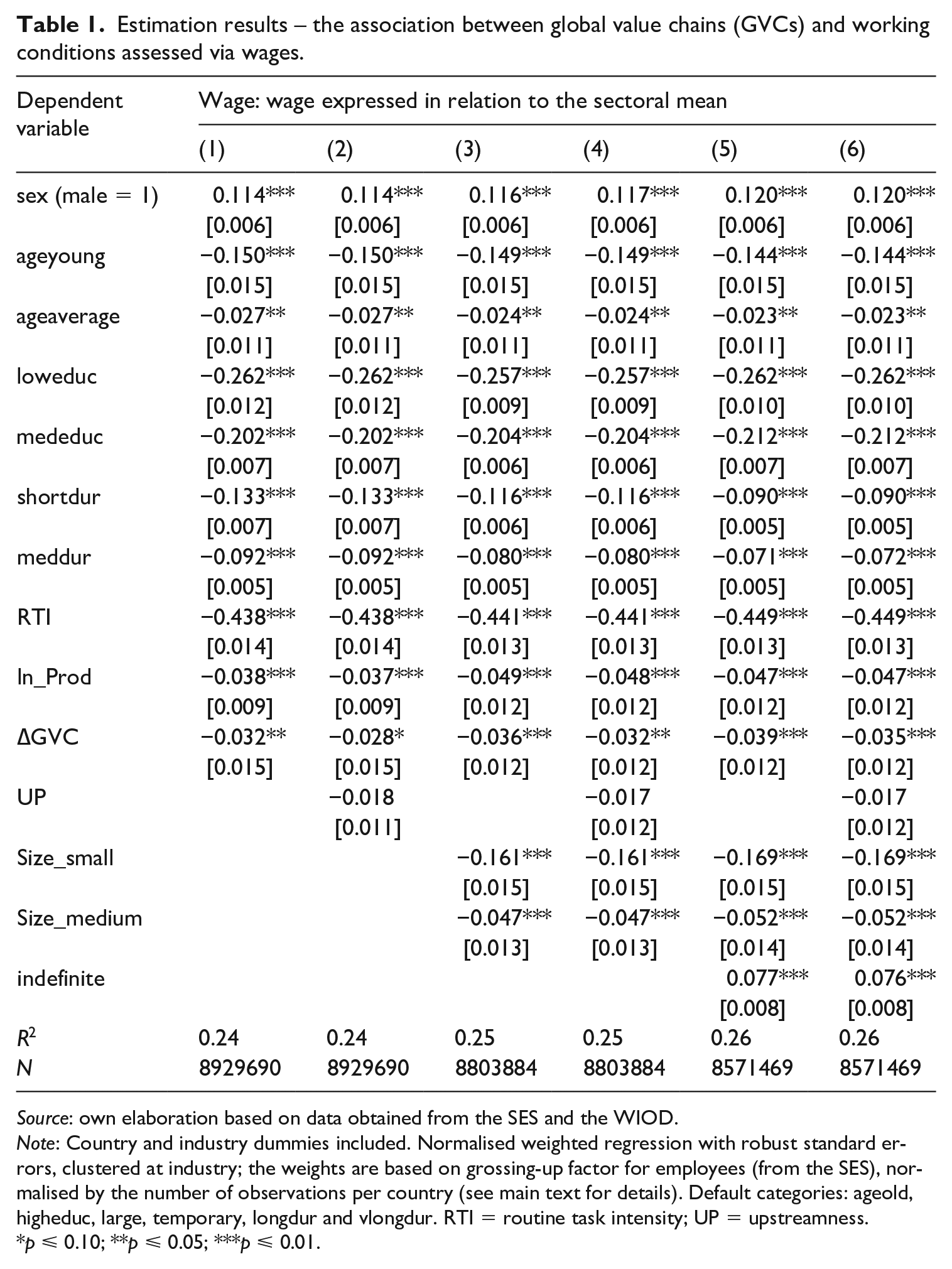
Source: own elaboration based on data obtained from the SES and the WIOD.
Note: Country and industry dummies included. Normalised weighted regression with robust standard errors, clustered at industry; the weights are based on grossing-up factor for employees (from the SES), normalised by the number of observations per country (see main text for details). Default categories: ageold, higheduc, large, temporary, longdur and vlongdur. RTI = routine task intensity; UP = upstreamness.
p ⩽ 0.10; **p ⩽ 0.05; ***p ⩽ 0.01.
In the next step, we have estimated equations (3) and (4), with the shares of overtime hours and bonus payments as dependent variables. We show the results separately for the beta model for these two sets (upper panel of Table 2) and the logit model predicting whether an employee will work overtime or receive a bonus (lower panel) presenting both regression coefficients and marginal effects in order to provide a direct interpretation of the results. In both models we use the same predictors – the same individual, firm and sectoral characteristics – as in eq. (2). We do not report them here, as the focus is on GVC variables again. The results differ quite markedly between overtime share and bonus share. As production fragmentation (relative change in GII) increases, the probability of reporting zero overtime work increases while that of receiving zero bonus payments decreases. Although it has been hypothesised (see e.g. Posthuma, 2010) that pressure from buyers for fast delivery may impose greater labour flexibility and generate more overtime work, we find no evidence of this in our European sample countries. On the contrary, workers in the most highly fragmented sectors rarely have overtime hours, but they are more likely to receive bonus payments. Looking deeper, however, we find that for workers who are already receiving bonus payments, as GVC involvement increases the predicted share of bonus payments decreases.
Estimation results: the association between global value chains (GVCs) and working conditions assessed via overtime hours and bonus payments.
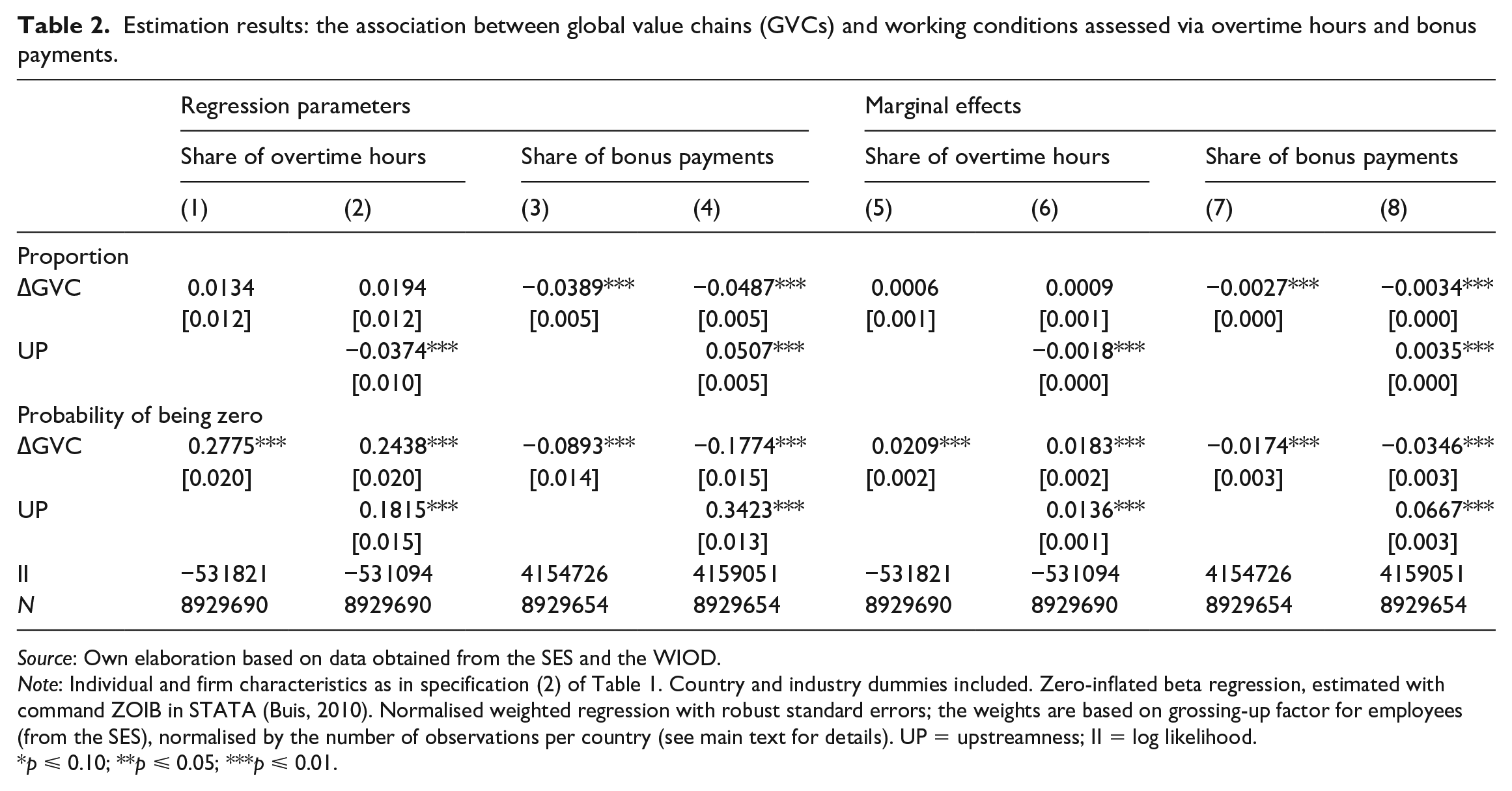
Source: Own elaboration based on data obtained from the SES and the WIOD.
Note: Individual and firm characteristics as in specification (2) of Table 1. Country and industry dummies included. Zero-inflated beta regression, estimated with command ZOIB in STATA (Buis, 2010). Normalised weighted regression with robust standard errors; the weights are based on grossing-up factor for employees (from the SES), normalised by the number of observations per country (see main text for details). UP = upstreamness; II = log likelihood.
p ⩽ 0.10; **p ⩽ 0.05; ***p ⩽ 0.01.
Our approach allows us to quantify the strength of the link between GVC and working conditions; in other words, to assess the economic significance of the results. Technically speaking, taking the highest ϑ coefficient estimate from Table 1, a 1-percentage point (pp) increase in DGII/GII is associated with an average decrease in relative wage of up to 3.9 pp (for a worker earning the mean wage, €11.33 an hour, this is equivalent to €0.44 an hour). Further, conditional on having bonus payments, a 1-pp increase in DGII/GII is associated with a 0.34-pp decrease in the share of total earnings accounted for by bonuses (marginal effect from spec. (8), upper panel): for the average worker, this means 8.16% rather than the original 8.5% in bonuses. These effects are not large, especially from the time perspective. Recall that we gauge the cumulative effect of the increase in GVC involvement over a period of ten years.
Our results also confirm that the association between GVC involvement and labour standards is not straightforward. It may be connected with a distinct role of different actors engaged at various stages of the chain. The governance within GVC, including social strategy of a leading firm, may be crucial for suppliers’ social well-being. For instance, the evidence concerning mobile value chains (Jindra et al., 2019) confirms that the strategy of the leading firm has a great impact on social benefits (limits to overtime, health and safety regulations, or one-off bonuses) of the supplier.
Moreover, GVC position may be associated with the indicators of working conditions in different ways. In the sectors further from the production of final goods (those with higher UP), we observe a negative relationship (the probability of zeros increases) with overtime and bonus payments, but no association with relative wages (the coefficient for UP is not statistically significant in Table 1). That is, our results indicate that heightened flexibility through non-standard employment is more significant in the downstream portions of the value chain (Flecker et al., 2013). In our case, worse working conditions are reflected in more overtime hours and a higher share of bonus payments, which makes remuneration less stable and such a job, accordingly, less desirable.
That is to say, our results suggest that the relationship between GVC involvement and workers’ well-being needs to be analysed from a broader perspective since this definitely cannot be described as a win-win situation, which has been emphasised since the early studies on social upgrading (Barrientos et al., 2011b). We find that greater dependence on foreign inputs may affect working conditions in a diversified fashion, depending on the particular nature of the dependence. Workers in the sectors more closely involved in GVCs earn less, are less likely to work overtime, but are more likely to receive bonus payments. This may mean greater insecurity, insofar as wage stability is recognised as an important factor for decent working conditions. As to overtime work, however, our data provide evidence of a beneficial association with integration into GVCs. That is, in the sectors more heavily engaged in global production sharing, overtime work is less common and less prolonged. In this way, we show that greater involvement in GVCs does not automatically result in social upgrading. One possible explanation relates to downward price pressure, with a negative social impact of economic mechanisms (Taglioni and Winkler, 2016).
Several extensions and a sensitivity analysis, plus robustness checks, are presented in Appendix B and Appendix C in the online supplementary materials. We start from the institutionalist view that social upgrading may depend on a legal framework, including bargaining rights (Taglioni and Winkler, 2016). To inquire into the link between GVCs and working conditions conditional upon cross-country institutional differences, we split our sample according to the prevalent wage bargaining schemes. Appendix B shows that the negative relationship between global production and wages is found mainly in countries with centralised (thus less flexible) wage bargaining schemes, while for overtime hours and bonus payments the correlation is no longer present. Our further extensions indicate that the ties between GVCs and wages are stronger in ‘old’ EU member states while in ‘new’ members it depends on country-specific institutional frameworks. We also considered different types of value chain, analysing separately the links with high-income countries and GVCs on the basis of flows of intermediate inputs from developing countries; in the latter case, GVCs and wages are linked negatively.
Conclusions
This article looks at social upgrading from a value chain perspective. Previous research on the effects of GVCs has tended to use wages (Baumgarten et al., 2013; Geishecker et al., 2010), making it difficult to draw conclusions on a more broadly defined concept of socio-economic well-being. We contribute to the assessment of the social implications of increasing involvement in global value chains by testing the assumption, often made implicitly, that in addition to economic benefits, integration into GVCs also automatically improves workers’ overall well-being. In this way, we expand the existing discussion on the relationship between economic and social upgrading within GVCs (Milberg and Winkler, 2011). Moreover, we acknowledge the value of different actors in moderating social relations at work in GVC, recently postulated in the literature (Reinecke et al., 2018). Importantly, we consider the association between GVCs and working conditions in Europe. In most of the literature, this type of analysis has been conducted mainly for developing economies (Barrientos et al., 2011a, 2016; Milberg and Winkler, 2011; Nadvi et al., 2004; Rossi, 2013), tackling the problems typical of low-income countries, while for Europe the evidence is country- and/or industry-specific (Flecker et al., 2013 for Austria; Hummels et al., 2016 for Denmark; Pawlicki, 2013 for Romania; Smith and Pickles, 2015 for Slovakia; Weinkopf, 2009 for Germany).
We contribute extensive empirical data on workers from Europe, with several different proxies for working conditions. With almost nine million observations based on detailed SES employee–employer data on 24 European countries in 2014, combined with WIOD sector-level data on the cross-border flows of intermediate inputs, we can quantify the magnitude of GVC involvement quite precisely. We gauge it by the global import intensity of production (GII) while capturing the relative position of domestic industries within global production chains as well. Controlling for individual, sectoral, firm and occupational factors, we pay more attention to the sociological implications of global production. In addition, we address some of the methodological issues raised by the complexity of such socio-economic analysis, adopting such alternative methods as weighted regression and zero-inflated beta regression to estimate our various proxies for working conditions (namely wages, overtime work and bonus payments).
The main finding is that in the industries that experienced substantial increases in GVC involvement between 2004 and 2014, wage trends were worse than in those where the intensification was less significant. But when indicators other than pure hourly wage are considered, the relationship turns ambiguous. Workers in sectors with deeper GVC involvement (i.e. those that are more dependent on foreign inputs) are less likely to work overtime, which may be beneficial for their well-being, but they are also more likely to have less stable remuneration. Yet for employees whose earnings already consist partly of bonus components, the share of bonus payments in total earnings drops when GVC participation intensifies, which may mean more stable earnings. Remembering that we are looking at developments in production ties over a decade, our estimates suggest a modest strength of the relationship between GVCs and our measures of working conditions. Additionally, our sensitivity analysis for workers in different groups of European countries confirms that the association between global production chains and workers’ well-being is context-dependent.
Our results focus on the understanding of the social dimension of work within GVCs. Global production linkages are multidimensional and underpinned by relations among many actors. Our study thus shows the usefulness, even the necessity, of discussing the sociological mechanisms triggered by global production structures. Recent literature focuses on the role of transnational, inter-organisational and inter-stakeholder relationships in GVCs, which may be crucial for creating social connections (Reinecke et al., 2018). In particular, brokers (like sourcing agents) (Soundararajan et al., 2018), non-government organisations (Kaine and Josserand, 2018) or such institutions as the ILO (Thomas and Turnbull, 2018) may be relevant sources of pressure on the improvement of labour standards. Putting it differently, it is essential to understand under which conditions social upgrading may be possible, including the role of governance within a GVC (Jindra et al., 2019), governance at a local level and influence from non-state actors (Bair and Palpacuer, 2015; Gereffi and Lee, 2016).
In short, our study demonstrates that the relationship between GVCs and social upgrading is complex, not unambiguous. Obviously, our evidence, due to the cross-sectional character of the data, may be treated as an indication of the possible association between GVCs and working conditions, rather than a purely causal relationship. 21 This notwithstanding, we have demonstrated that it is important to consider aspects of working conditions beyond wages alone, because the links between production fragmentation and workers’ socio-economic situation are not one-dimensional. Unless we go beyond wages alone, it is impossible to fully evaluate the implications of this global phenomenon for labour. As we concentrate on the quality of labour within the GVC framework and explore those interrelations empirically, we confront the social implications of countries’ intensifying engagement in global production networks, expanding the analysis of possible effects of GVCs on workers’ overall well-being.
Supplemental Material
sj-pdf-1-wes-10.1177_0950017020986107 – Supplemental material for Working Conditions in Global Value Chains: Evidence for European Employees
Supplemental material, sj-pdf-1-wes-10.1177_0950017020986107 for Working Conditions in Global Value Chains: Evidence for European Employees by Dagmara Nikulin, Joanna Wolszczak-Derlacz and Aleksandra Parteka in Work, Employment and Society
Footnotes
Acknowledgements
The authors are grateful to the reviewers and conference/seminar participants for providing constructive comments, which significantly improved the content of this article – specifically to the participants of the 3rd Annual IZA/World Bank/NJD/UNU-WIDER Jobs and Development Conference ‘Better Jobs for Development’ and cyclical seminars at The Economic Sciences Department, Faculty of Management and Economics, Gdańsk University of Technology ( ).
).
Funding
The authors disclosed receipt of the following financial support for the research, authorship, and/or publication of this article: This research has been conducted within the project financed by the National Science Centre, Poland (Narodowe Centrum Nauki – NCN) – decision number DEC-2015/19/B/HS4/02884.
Supplementary material
The supplementary material is available online with the article.
Notes
References
Supplementary Material
Please find the following supplemental material available below.
For Open Access articles published under a Creative Commons License, all supplemental material carries the same license as the article it is associated with.
For non-Open Access articles published, all supplemental material carries a non-exclusive license, and permission requests for re-use of supplemental material or any part of supplemental material shall be sent directly to the copyright owner as specified in the copyright notice associated with the article.
