




Abstract
The article explores the association between within-household couples’ parental leave take-up strategies and parents’ earning capacity (hourly wages) and their workplace characteristics. The results, based on the social security register data from Luxembourg, reveal that a couple strategy where both partners take parental leave is more likely when the partners have equal earning capacity, when the mother works in the sector of education, health and social services rather than in other sectors, and when the father is employed in a larger-sized company. Couples where the mother earns more than the father are more likely to opt for a strategy where neither parent takes any leave. The economic sector moderates the effect of fathers’ wages on the probability of choosing the strategy where both partners take leave.
Keywords
Introduction
Parental leave policies allow eligible mothers and fathers to dedicate some of their time to childcare, while retaining the right to return to their previous job. These policies promote, among other things, equality in the gender division of labour (Bünning and Hipp, 2022; Morosow and Cook, 2022). The success of a parental leave policy depends on its usage among the target population of eligible parents. If the usage among mothers or fathers is lower than expected, the policy objectives may not be met. The evaluation of parental leave take-up and its determinants helps us to understand how different segments of the eligible population respond to the policy and which groups of parents benefit the most from the parental leave policy.
Existing research on parental leave take-up has focused mainly on analysing the individual leave-taking behaviour of mothers and fathers separately (e.g. Duvander, 2014; Geisler and Kreyenfeld, 2019; Han et al., 2009; Sundström and Duvander, 2002). Despite theoretical arguments suggesting that for parents living in a couple, decisions about career interruptions due to childcare are not made in isolation, but in the dynamic intra-couple context (Amilon, 2007; Becker, 1981; Geisler and Kreyenfeld, 2019), qualitative research that would explore within-household leave-taking strategies (e.g. whether parental leave is taken only by the mother, only by the father, by both parents) is scarce (for exceptions, see Bartel et al., 2015; Lappegard, 2012; Wood and Marynissen, 2019). Consequently, very little is known about the possible determinants of the within-couple leave-taking strategies. In particular, there is limited quantitative evidence about the association between within-couple leave-taking strategies, earnings capacity and the workplace characteristics of both parents.
The current article aims to address these gaps by answering the following research questions. First, for eligible parents living in a couple, how are their earning capacity (wages) and the relative differences in wages associated with their leave-taking strategies (i.e. whether only one of them, both, or neither takes parental leave)? Second, is there any relationship between couples’ leave-taking strategies and the workplace characteristics of mothers and fathers? Lastly, does the effect of wages on couples’ take-up strategies depend on the categories of company size and economic sector?
The leave-taking behaviour of parents living in a couple is inevitably affected by the couple’s context and the need to coordinate work–family strategies. Hence, focusing on joint take-up strategies allows for exploring more complex dyadic relationships, which is not possible when analysing mothers’ and fathers’ take-up behaviour separately. The article contributes to the literature on determinants of parental leave take-up in several ways. First, income and relative income between partners are strong predictors of individual mothers’ and fathers’ leave take-up (Lappegård, 2008, 2012; Naz, 2010; Sundström and Duvander, 2002). This article is one of the first ones to explore quantitatively the association between income and relative income between partners and intra-couple leave-taking strategies. Second, the literature revealing that workplace characteristics are important predictors of individual parental leave uptake is growing (e.g. Anxo et al., 2007; Brandth and Kvande, 2019; Bygren and Duvander, 2006; Geisler and Kreyenfeld, 2019; Lapuerta et al., 2011; Naz, 2010; Romero-Balsas et al., 2013; Samtleben et al., 2019). However, there are few population-level quantitative studies that analyse the effect of parents’ workplace characteristics on intra-couple leave-taking strategies (for an exception, see Lappegård, 2012). This is mainly due to the missing data covering the workplace characteristics of both parents across time. This article provides novel empirical evidence showing whether and to what extent within-couples’ leave-taking strategies are associated with the selected workplace characteristics of both parents. Third, this article is the first to explore the interaction effect of the parents’ wages and workplace characteristics on intra-couple leave-taking behaviour. Exploring this interaction helps us to understand how economy sector or size of company moderate the take-up strategies of low-earners and high-earners.
The case study of Luxembourg is used for the following reasons. The population-level analysis exploring the relationship between couples’ parental leave strategy and the parents’ workplace and income characteristics requires data that include a wide range of information about the children, the two parents and their employers. The availability of such data is limited (Eriksson et al., 2022). One of the few works of research exploring the links between couples’ take-up strategies and the workplace and earnings characteristics of both partners is Lappegård’s (2012) study on Norway. Hence, in the absence of any cross-country representative data, the current study uses unique social security records data from Luxembourg to augment the limited empirical evidence on couples’ take-up strategies and their determinants for this country.
Theory and existing evidence
In Western Europe, during the past six decades the gendered division of labour, in which men are considered as breadwinners engaged in paid labour and women as being in charge of unpaid domestic tasks, has evolved into a dual-earner model, where both men and women in couples are engaged in paid work (Pfau-Effinger, 2004; Warren, 2007). Countries vary in range between these two types.
Work–family reconciliation policies such as parental leave are designed to reduce the negative consequences of parenthood (e.g. longer career interruptions due to childcare, lower competitiveness in the labour market and lower income) and to promote gender equality in the division of labour (Gornick and Mayers, 2003). Parental leave has a positive impact on mothers’ return to work after childbirth (e.g. Akgunduz and Plantenga, 2013; Han et al., 2009; Ondrich et al., 2003; Ruhm, 1998; Valentova, 2019). Extending leave to fathers alone promotes their involvement in childcare and housework, and reduces the level of partners’ disagreements over the division of household labour (e.g. Schober, 2014). In this way, parental leave policy promotes the more equal parenthood represented by the dual-earner model (Eydal and Rostgaard, 2014) or as part of the path towards a ‘one-and-a-half’ worker model, in which women remain the principal childcare provider and only a secondary breadwinner (Naz, 2010).
Despite the changes to the division of labour between men and women, women still tend to take longer career breaks due to childcare than men (OECD, 2020a). Men are most often less likely to use parental leave than women are. In some countries, such as Denmark, Iceland, Norway, Portugal and Sweden, the disparity is only small; however, this remains an exception (OECD, 2020b). This situation could have a negative impact on women’s further labour market outcomes (e.g. competitiveness in the labour market, career promotion and wages), as well as on gender equality (Mari and Cutuli, 2020; Ruhm, 1998).
Focus on couples’ parental leave strategies
Leave take-up strategies of parents living in a couple can only be fully understood by also considering the intra-couple dynamics and not only the characteristics of each parent separately. For instance, Becker (1981) presents the concept of the family as a rational unit, following the economic assumptions of maximizing behaviour, stable preference and arid equilibria in markets to allocate their time to childcare and careers. According to this approach, a parent’s higher earning potential makes their employment interruptions less attractive for the household. As men may have greater financial resources than women, the potential economic loss for the family is thus greater when men rather than women interrupt their career or take leave due to childcare.
The fundamental assumption of the above approach, based on rational utility as maximizing the unitary and harmonious concept of couple strategies, was challenged by the concept of intra-household conflict and bargaining (Katz, 1997; Lundberg and Pollak, 1996). The bargaining model considers the higher income of fathers as an asset for men when negotiations take place within couples (Lundberg and Pollak, 1996). In this approach, the partner with the higher resources (e.g. income, education level, or social class) will use their power to constrain the other partner to fulfil what is considered as unpleasant, unpaid domestic labour (Bittman et al., 2003).
The aforementioned resources are not the only ones that can be used in the process of couple negotiations. Twamley’s (2019) UK study reveals partners’ mutual influence on parental leave choices via relational resources conceptualized as skills of daily interaction and negotiations. Gender-conscious couples achieve balanced negotiations, and mothers use their relational skills more efficiently to negotiate parental leave sharing. In couples with less gender consciousness, women use their relational skills more implicitly, while explicitly demonstrating efforts to maintain their partner’s masculine identity.
The intra-couple dynamics regarding the division of labour (and, consequently, parental leave) are also related to parents’ gender-role attitudes (Duvander, 2014; Kaufman and Bernhardt, 2015; Valentova, 2013) and gendered ideas about appropriate caring roles (Almqvist, 2008).
Couple dynamics and parental leave take-up analyses
In the literature on parental leave policy take-up, the couple dynamic approach is used in two ways. First,
Second,
Greater parental leave take-up has been evidenced among fathers when they are partnered with a higher-educated woman (e.g. Bygren and Duvander, 2006; Geisler and Kreyenfeld, 2011). Considering the educational homogamy (i.e. highly educated women tend to have highly educated partners) and related earning homogamy in a couple, women with higher education can afford to dedicate time to unpaid parental childcare or can outsource childcare services (Steiber and Haas, 2009).
Income affects the parental leave-taking decision in several ways. First, even with a relatively high wage-replacement rate of leave benefits, take-up translates into a temporary drop in income for the parent on leave and consequently for the entire household. Parental leave is more likely to be taken by the partner who experiences a lower wage drop (Almqvist, 2008; Bygren and Duvander, 2006; Eerola et al., 2021; Närvi and Salmi, 2019). Families with higher and more stable pre-childbirth incomes are better able to accommodate a leave-related income loss (Bygren and Duvander, 2006; Geisler and Kreyenfeld, 2011; Gobbi et al., 2018; Lapuerta et al., 2011). As social class is often operationalized using a family income variable (Javornik and Kurowska, 2017; McKay et al., 2016), the findings regarding the effect of family income could proxy the effect of social class.
Second, the parents’ leave take-up decision might be shaped by the anticipated wage penalty that follows the parental leave take-up. Data from the Nordic countries (Albrecht et al., 2015; Morosow and Cooke, 2022), Germany (Mari and Cutuli, 2020; Ondrich et al., 2003; Schonberg and Ludsteck, 2007) and Luxembourg (Bia et al., 2021) suggest that mothers who take parental leave, particularly over longer periods, are more likely to experience lower post-childbirth wages compared with mothers who did not take leave. As parents can anticipate this post-leave wage penalty, a parent with a lower income in a couple might be more likely to take leave.
For the spouse’s effect on take-up of fathers’ parental leave usage, Moreno-Mínguez et al. (2022) suggest that fathers’ parental leave take-up in Spain depends on the family household’s characteristics and the woman’s connection to the job market. According to Naz (2010), fathers in Norway are more likely to take parental leave if their partner is working full-time, has a higher level of education and earns a higher income. The level of take-up by fathers is also greater when both parents have the same or a similar level of education and income. Lappegård (2008, 2012) claims that in Norway, an equal income between partners is associated with more gender-equal use of parental leave; that is, a greater take-up of long leave among fathers. A high level of income for fathers is associated with lower use of fathers’ parental leave. Sundström and Duvander (2002) demonstrate that in Sweden, higher earnings of a mother as well as of a father are associated with a higher rate of fathers’ leave take-up, although the effect of the fathers’ earnings is greater in magnitude.
Couple-related workplace characteristics
Work organizations may play an important role in the implementation of statutory parental leave by facilitating (or not) the leave take-up among employees (Bygren and Duvander, 2006; Van Breeschoten et al., 2019). Organizations with more external institutional pressures (e.g. public sector) are more likely to indirectly facilitate leave take-up by enhancing awareness of the available policy as well as a higher sense of entitlement among employees (Lewis and Smithson, 2001; Van Breeschoten et al., 2019). Organizations are also more likely to facilitate leave up-take when they believe it will be financially advantageous. When costs related to parental leave policy administration are too high, the perception of the policy among employers might be less positive and informal support of employers for these policies decreases (Valentova et al., 2021, 2023; Wheatley, 2017). The level of perceived organizational support towards parental leave can either motivate or discourage employees from using these policies (Tremblay and Genin, 2011).
Individual leave take-up is associated with individuals’ structural workplace characteristics. Mothers and fathers who are more likely to take parental leave are those working in large companies, where the costs related to parental leave implementation and administration are less than in smaller companies (e.g. Bygren and Duvander, 2006; Geisler and Kreyenfeld, 2019; Samtleben et al., 2019). Leave take-up is in general higher in female-dominated companies (Lapuerta et al., 2011) and in the public sector (including public administration, education, health and social services) than in the private sector (Anxo et al., 2007). Employers in the public sector are less profit-driven than private companies, they are more pressured by state institutions to implement existing statutory policies and they put less pressure on the ideal-work norm, which might lead to the greater feeling of deservingness of leave policies among employees than in the private sector (Bygren and Duvander, 2006; Lewis and Smithson, 2001).
Individual take-up also depends on the attitudes, norms and actions of co-workers and the manager (Brandth and Kvande, 2019). Fathers are more likely to take parental leave if they work in family-friendly and father-friendly companies (Acker, 1990; Haas and Hwang, 2019). Overall, employers perceive that fathers are more expected to have a higher level of work attachment (i.e. the ideal-worker norm) than mothers and that parental leave is more legitimate for mothers than for fathers (Brandth and Kvande, 2019; Naz, 2010; Samtleben et al., 2019; Valentova et al., 2023). Men’s parental leave requests tend to be accommodated informally (e.g. via worktime flexibility), whereas women use more formal provisions (e.g. parental leave) (Van Breeschoten et al., 2019).
Notably less research has been realized concerning the role of the partners’ workplace characteristics in individual leave take-up. For an exception, see Bygren and Duvander (2006), who examine the effect of partners’ employer’s characteristics on the parental leave take-up of fathers in Sweden. If the mother is working in a female-dominated workplace, then the father is less likely to take parental leave: a situation that may be explained by the low costs of absence in female-dominated workplaces. Consequently, if the mother works in a male-dominated workplace, her longer absence due to parental leave could be viewed negatively by the employer, leading to the increased probability of the father’s leave take-up.
Very little is also known about the relationship between the partners’ workplace characteristics and leave-taking strategies within couples. For an exception, see Lappegård (2012), who analyses the relationship between couples’ leave practices and parents’ workplace situation in Norway, and argues that workplace characteristics are not related to leave that involves exclusively fathers’ rights (i.e. the ‘fathers’ quota’). However, fathers’ take-up exceeding the fathers’ quota appears to be greater if their partner is employed in a workplace with larger costs associated with long absences from work; that is, working in the private sector and in male-dominated and large-sized workplaces.
Links between take-up, wage and workplace characteristics
Greater resources in terms of education and higher wages are associated with egalitarian gender-role attitudes and division of labour between partners that in turn is also associated with greater take-up of parental leave among fathers (Kaufman and Bernhardt, 2015; Lappegård, 2012). However, the claims that high-wage earners are more egalitarian are not fully corroborated by existing literature. Gerstel and Clawson (2018) argue that men in high-status occupations with high earnings (e.g. doctors) are expected to work long hours and often prefer a traditional gender division of labour within their family, in which the man is considered as the main breadwinner and the woman is expected to adapt to this and to be more in charge of unpaid labour. England et al. (2016) and Samtleben et al. (2019) show that employers invest more in high-skilled and better-paid employees, and also have higher expectations regarding the work commitment and continuous availability of such employees. The costs of replacing an employee who intends to take parental leave vary significantly in line with the employee’s skill level. It is more difficult to temporarily replace a high-skilled and well-paid employee with complex work tasks than a low-skilled employee (Acker, 1990; Samtleben et al., 2019). This is particularly the case when a parent works in a smaller-size company (e.g. Samtleben et al., 2019).
Decisions about parental leave among parents living as a couple are also affected by the general societal context, such as the country’s cultural norms, gender regime (Pfau-Effinger, 2004), availability of other policies including childcare facilities (Anxo et al., 2007; Lapuerta et al., 2011; Ruhm, 1998) and the existing design of parental leave policy such as paid leave benefit or leave flexibility (Javornik and Kurowska, 2017; Lapuerta et al., 2011; Warren, 2015).
In this article, the effects of key explanatory variables on couples’ take-up strategies are estimated while controlling for a wide range of factors, including the general context. The context is controlled for by introducing the period effect (in line with Han et al., 2009) in all estimated models. The period effect is measured by the year of childbirth. Hence, in the current article, the socio-economic context and changes to it are accounted for. For further details about the period effect see the online Appendix, Section 1.
Parental leave parameters
In the 1990s, Luxembourg had prevailing continental (pro-male-breadwinner) family-policy features (Thévenon, 2016), such as the absence of parental leave policies, joint taxation and a lack of subsidized statutory childcare. However, over the past three decades, the policy landscape in Luxembourg has undergone substantial changes, moving towards a dual-earner model. The introduction of parental leave in 1999 is an example of this policy shift.
The universal non-transferrable parental leave policy that was in force from 1999 to December 2016 (a substantive reform) was fully job protected. The eligibility requirements for parental leave were a minimum of one year’s employment with the same employer prior to the start of leave, and a reduction of at least 50% of working hours in the case of taking part-time leave. Eligibility for the parental leave scheme also depends on the duration of the contract, in that the end date of the requested parental leave cannot exceed the duration of the legal employment contract. Each eligible parent can take either a period of six months’ full-time leave or 12 months’ part-time leave. The total duration of parental leave is six months for all beneficiaries. Chosen leave must be taken in its entirety and without interruptions. If an eligible parent requests part-time leave, the request must be formally approved by the employer. This condition does not apply to full-time leave. The leave can be taken up directly after the mandatory maternity leave to the fifth birthday of the child or after adoption of a child. For eligible parents who live in a couple, there is a requirement that one of the parents takes the leave period immediately after maternity leave or the adoption of a child – the so-called first parental leave. The second parent may then take a period of leave at any time until the child reaches the age of five – the so-called second parental leave. If one parent does not take leave immediately after maternity leave, the right to it is forfeited. However, the second parental leave can be taken by either of the eligible parents at any time until the child turns five. Parental leave is paid, and the flat-rate benefit up to 2006 was equal to 1496 euros for full-time leave. In 2007, the benefit increased to 1778 euros, which was approximately equivalent to the minimum wage for an unqualified worker.
The total number of leave beneficiaries increased from 1433 in 1999, to 3168 in 2007, and to 4256 in 2014. The proportion of male users out of the total number of those taking parental leave increased from 6.3% at the end of 1999 to 24.7% in 2014 (MIFA, 2015). Information about take-up rates covering the 5-year eligibility period is limited and covers only segments of the population of parents over time. The report on Luxembourg (Zhelyazkova et al., 2015) indicates that for parents of children born in 2003, mothers’ leave take-up was 66% and fathers’ was 13%. For eligible first time parents of children born between 1999 and 2007, the average leave take-up rate was 46% among mothers compared with 11% among fathers. For eligible first-time parents of children born between 2005 and 2015, the average leave take-up rate was 75% among mothers and 17% among fathers (Valentova et al., 2022).
The parameters of the parental leave policy in Luxembourg did not change from its introduction in 1999 until December 2016. As the observation period of this study covers the period 2005–2015, all the analysed parents were exposed to the same parental leave provision. For further details about the policy context see the online Appendix, Section 1.
Data
The data used were from the social security administrative records of the General Inspection of Social Security (IGSS) and cover the entire population of people with a social security affiliation in Luxembourg. For details on IGSS data, see the online Appendix, Section 3.
The data cover the period from 2004 to 2015, and link information about the total population of children, parents and employers fulfilling the criteria below. The analysed population was restricted to persons living in a couple in Luxembourg. Only parents eligible for parental leave were considered, because only those who were legally entitled to benefit from the policy can decide whether to take leave. Eligibility was measured by a newly created proxy variable that combines the key conditions of eligibility stipulated by law.
Further, the study only included parents of a firstborn child. Focusing on first-time parents is a common practice in analyses of parental leave usage and its effects (e.g. Bygren and Duvander, 2006; Lappegård, 2012; Mari and Cutuli, 2020; Morosow and Cook, 2022). The restriction to first-time parents was also pragmatic, because in the case of multiple parenthood, the IGSS data prior to 2016 did not allow the information on parental leave take-up to be linked to a particular child.
Only parents of children born between 1 January 2005 and 31 December 2010 were selected. The choice of these cohorts of children was justified by the fact that the IGSS data contain the information necessary to create the parental leave eligibility variable only from 2005 onward. The latest cohort of children (children born on 31 December 2010) was chosen due to the fact that the data are available only up to 31 December 2015 and it is necessary to follow each child during the first 5 years after birth – the period during which parents can use parental leave.
Owing to focus on couples and workplace characteristics, single parents and those where information about the employer was missing at the time of childbirth were inevitably excluded. By fixing the time of observing the employers’ characteristics to childbirth, it was possible to compare the context of employers for the parents who took parental leave sometime in the course of 5 years, as well as for those who did not. In line with conventional practice (Mari and Cutuli, 2020), the sample was restricted to dependent employees, meaning that self-employed parents were excluded from the study. This decision was also driven by the fact that in the social security IGSS data, self-employed individuals had missing information for several key variables such as earnings and number of hours worked.
The dataset contained 4059 individual children born between 1 January 2005 and 31 December 2010 to parents in the group specified above, out of which 2709 of the mothers and 3357 of the fathers were eligible for at least one period of parental leave during the 5 years following childbirth, and hence could have benefited from the parental leave policy. There were 2441 couples where both mother and father were eligible, and accordingly these couples were used for the analyses. In this final sample, the eligible mothers were clustered within 1085 employers and fathers within 1165 distinct employers.
Methodology
A multinomial logistic regression was used in the analyses. Multinomial logistic regression is a method used to predict a nominal dependent (outcome) variable given one or more independent variables. In the current article, the outcome variable is nominal and measures couples’ take-up strategies, meaning whether or not one or both parents took parental leave. As partners cannot take parental leave at the same time, their take-up can be realized at any point and at different times during the 5 years following childbirth. A joint take-up variable was accordingly created, summarizing information about the father’s and mother’s take-up at the end of the 5-year period. Owing to the ‘composite nature’ of the outcome variable, which does not vary across time, it was not possible to employ panel-data methods.
The independent variables used describe the pre-birth situation, unless stipulated otherwise (in line with Samtleben et al., 2019). This baseline was set because, in Luxembourg, an official demand to take the first parental leave (and, consequently, to make couples’ take-up strategies) had to be made before the beginning of the obligatory maternity leave.
To estimate whether the effect of wages on take-up strategies is moderated by selected workplace characteristics, the interaction terms between hourly wage and company size and economic sector were added to the multinomial logistic model. The results are presented as average marginal effects (ME). In the case of interactions, margins of the wages over two workplace characteristics (company size and economic sector) were estimated, then contrasts with the previous margins were calculated. 1
Outcome variable
The outcome variable measures couples’ take-up strategies
Key independent variables
The first key independent variable is
The categorization expressed as a multiple of MSS also proxies the wage replacement rate of the leave benefit as leave benefit is approximately equal to minimum wage. For details on the hourly wage variable and for justification of its categorization, see the online Appendix, Section 3: ‘Wage variables’. The analyses were also replicated using quartiles of hourly wages, yielding similar results, which confirms the robustness of the results.
The second key variable is
The third key variable is
Control variables
Characteristics of parents (both mother and father)
(1) Nationality (categorical variable): Luxembourger, Portuguese, French, other EU-27 and non-EU (all nationalities outside the EU). (2) Age at childbirth (continuous). (3) Categorized employment status (due to a substantial difference in behaviour between parents working full-time and those working part-time) (Bünning and Hipp, 2022): 35 hours per week or more, 35 and less hours per week (as working 20 hours per week is an eligibility criteria for parental leave and the article covers only eligible individuals, this category includes only persons working between 35 and 20 hours). (4) Work experience (categorical): 0–5 years, 6–10 years, 11 years and more. (5) Private employee or civil servant (binary).
Child’s characteristics
(1) Child’s year of birth: controlling for the year of birth is important, as accounting for time allowed the possible effect of context and other policies and their changes over time to be accounted for (categorical: 2005–2010). (2) Child’s gender (binary).
Workplace-related characteristics
(1) Extent of feminization at the workplace (binary: more than 60% female employees or not). (2) Proportion of white-collar workers at the workplace (binary: more than 60% of white-collar workers or not). (The proportion of part-timers and employees aged less than 45 years among staff were also used as control variables. Owing to negligible size and insignificance of these effects, these controls were not included in the final analyses presented in the article.)
Descriptive statistics of selected control variables are available in Table 1. Descriptive statistics of all control variables are provided in the online Appendix, Table 2.
Descriptive statistics of the independent variables used in the analyses by four categories of couples’ take-up strategies.
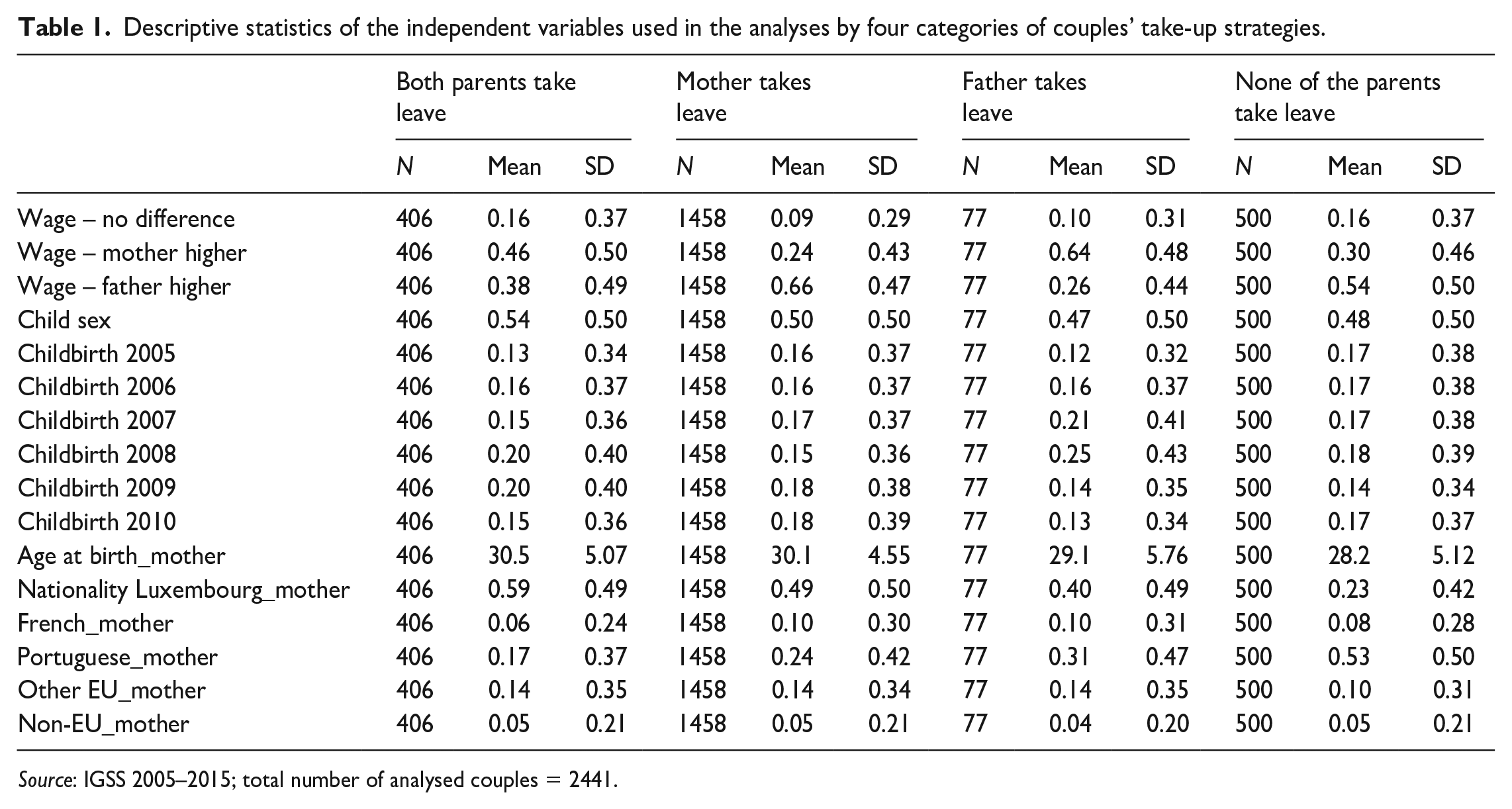
Source: IGSS 2005–2015; total number of analysed couples = 2441.
Results
A descriptive analysis shows that out of all the analysed couples, in 20.5% (500), neither the mother nor the father took parental leave. In 59.7% of the couples (1458), only the mother took a period of parental leave. In 16.6 % (406), both parents took leave, and in 3.1% (77), only the father took it.
The results of the multinomial model are presented in Table 2. The presentation of the full model with controls is in the online Appendix, Table 3. As the used data cover the entire population of parents fulfilling the selection criteria in Luxembourg, it is not a random sample. Hence, it is more appropriate to see the significance tests as indicators of the robustness of the coefficients and not as significance in the classical probabilistic sense (in line with Bygren and Duvander, 2006).
Marginal effects. Estimates of individual and partners’ wages and workplace characteristics on couples’ within-household parental leave take-up strategies.
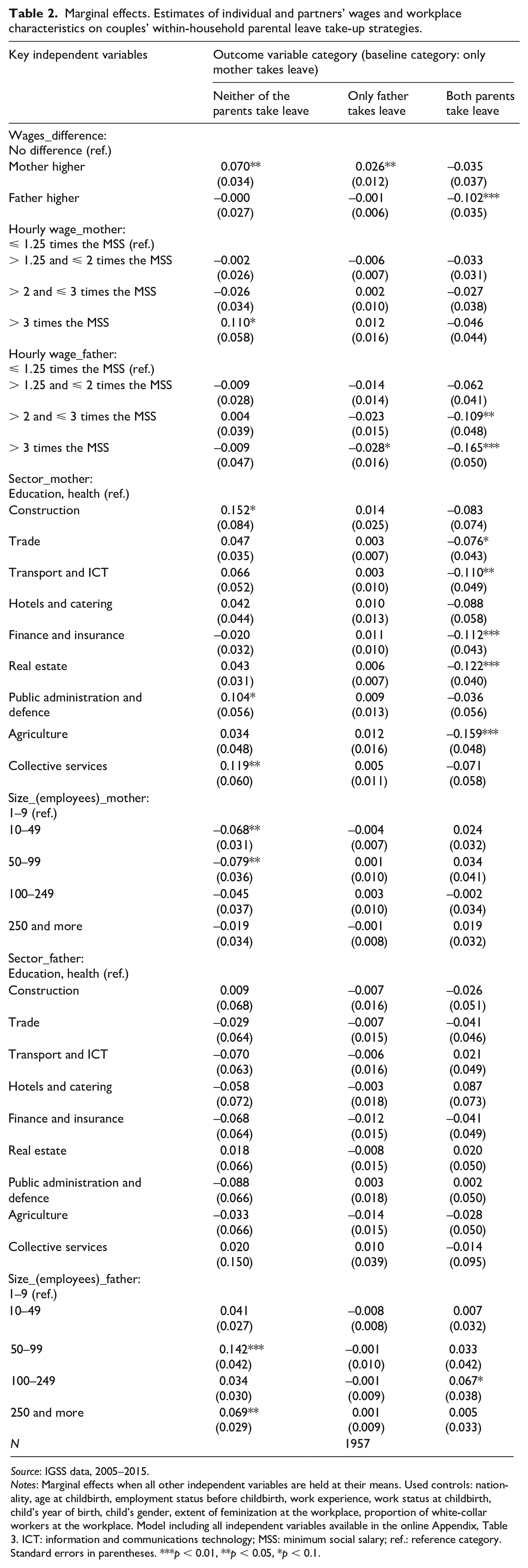
Source: IGSS data, 2005–2015.
Notes: Marginal effects when all other independent variables are held at their means. Used controls: nationality, age at childbirth, employment status before childbirth, work experience, work status at childbirth, child’s year of birth, child’s gender, extent of feminization at the workplace, proportion of white-collar workers at the workplace. Model including all independent variables available in the online Appendix, Table 3. ICT: information and communications technology; MSS: minimum social salary; ref.: reference category. Standard errors in parentheses. ***p < 0.01, **p < 0.05, *p < 0.1.
The probability
The probability of both partners taking parental leave decreases in line with mothers’ increasing earning capacity; however, the association is weak in terms of magnitude. Compared with couples where the mother has the lowest wage, in couples where the mother’s wages are 1.25–3 times the MSS, the parents are 3 percentage points less likely to opt for this take-up strategy. In couples where the woman earns three or more times the MSS, the likelihood is 5 percentage points lower. The probability of both parents taking the allowed leave also decreases in line with the father’s increasing wages. In couples where the father earns two to three times the MSS, the probability to opt for the strategy where both parents take leave is 11 percentage points lower than in couples where the father’s hourly wage approaches the minimum wage (i.e. the reference category). Among couples where the father earns three times the MSS and more, the probability is 17 percentage points lower. Hence, hypothesis 2 is corroborated.
With regard to workplace characteristics, the strategy in which both parents take leave is more likely if the mother works in the sector of education, health and social services. If the mother works in the other sectors (i.e. in transport and ICT, finance, real-estate and agriculture), this is associated with a lower likelihood of both parents taking leave. There is no variance in the probability of both partners taking parental leave depending on the size of the company in which mothers are employed. Fathers’ economic sector for work is not related substantially to the likelihood of both parents taking leave, with the exception of the hotels and catering sector. Fathers working in this sector have a higher probability to opt for this couple strategy than those working in the baseline sector. The likelihood of both parents taking leave does vary depending on fathers’ company size. When fathers work in larger-size companies (between 100 and 250 employees), the probability of both parents taking leave is 7 percentage points higher than when fathers work in the smallest companies.
The probability that
Focusing on the likelihood of choosing the strategy where
Substantial variation is found in the probability of choosing this strategy, depending on the company size of both parents. If the mother works in a larger company, compared with a very small one, this decreases the probability that neither partner will take parental leave. The effect of the father’s company size is inverse: working in companies larger than 10 employees increases the probability of this strategy. In companies with 50–99 employees, it is actually 14 percentage points higher.
If the mother works in a sector other than education, health and social services, this is associated with a higher likelihood that neither of the couple will take parental leave. The association between the mother’s economic sector and the couple not taking any leave is particularly notable when mothers are employed in the sectors of construction (15 percentage points), collective services (11 percentage points), public administration (10 percentage points) and transport and ICT (7 percentage points). The finding that mothers’ employment in the public administration sector is correlated with couples’ non-take-up may be surprising. However, it could be explained by the fact that employees in public administration may benefit from some sector-specific family–work arrangements that are not available to employees in other sectors. If a father works in a different sector than that of education, health and social services, the probability that neither of the parents takes leave decreases. The notable difference is when a father works in public administration. In that situation, the likelihood that neither parent takes leave is 9 percentage points lower than for the reference sector. Hence, hypothesis 4 is corroborated only with regard to company size.
To describe how the effect of the mother’s and father’s wages on leave-taking strategies are moderated by their workplace characteristics, the models included the interactions between mothers’ wages and economic sector separately, and then the wages and the company size are estimated. Then, the interactions between fathers’ wages and company size and economic sector are analysed. Margins of the wages over company size and economic sector are estimated and then they are contrasted with the previous margins. The results of our analyses based on contrasts are presented in the online Appendix, Table 1.
Regarding the interaction between wage and workplace characteristics, it is observed that the effect of parents’ wages on couples’ leave-taking strategies does not vary substantially depending on the company size. Similarly, the mothers’ economic sector does not moderate the effect of their wages on the choice of the couples’ strategy. However, the effect of fathers’ wages on the strategies varies, depending on the economic sector. The moderating effect of the economic sector (such as construction, trade and collective services) is observed for the two highest wage categories. These findings partially support hypothesis 5. This implies that the economic sector of the fathers’ workplace is strongly associated with the leave-taking strategies of couples in which the father is a high earner.
Discussion and conclusion
In the article, the associations between intra-couple leave-taking strategies, and the wages and selected workplace characteristics of the partners are analysed, while controlling for a wide range of other factors. The moderating effect of the workplace characteristics on the relationship between wages and take-up strategies within couples is also explored.
The findings stemming from the analyses offer information about the importance of equal earning capacity between parents living in a couple. Eligible parents having an equal hourly wage is associated with a higher likelihood that both of them will take parental leave. Living in a couple where the mother has the higher earning capacity is associated with a greater likelihood that only the father will take parental leave, or that neither of the partners will. These findings are in line with evidence from other countries, such as Nordic countries and Germany, showing parents’ relative contribution to the household income shapes their leave-taking decisions, and parental leave is more likely to be taken by the partner who experiences a lower wage drop (Almqvist, 2008; Bygren and Duvander, 2006; Eerola et al., 2021; Geisler and Kreyenfeld, 2011; Närvi and Salmi, 2019).
Hence, the available evidence from different studies converges and corroborates the premise of the previously mentioned bargaining theory (Katz, 1997; Lundberg and Pollak, 1996) in two ways. First, the findings suggest that partners’ equality in terms of economic resources, and consequently presumably also in terms of negotiation power, further translates into equality in the division of childcare activities – in this case, parental leave take-up. The likelihood that both partners in a couple will take parental leave is also associated with their workplace characteristics. The probability of choosing this strategy increases when mothers work in the sector of education, health and social services, and when fathers do not work in small-sized companies. Second, when a mother has a higher earning capacity than her partner, the couple is more likely to opt for a strategy in which either only the father takes leave, or neither parent does.
However, the relative resources cannot fully explain the couples’ leave-taking behaviour. As the data used do not include information about gender-role and employment attitudes, it is not possible to test the effects of these factors on our dependent variable. As the most frequent intra-couple strategy is the one in which only the mother takes leave, it is impossible to exclude the influences of other factors, such as women’s maternal gate-keeping and mothers’ reluctance to give up control over childcare on the intra-couple leave-taking decision (Hook, 2006) and the persistence of gendered parenting and gender-role attitudes (in line with Almqvist, 2008; Duvander, 2014; Wood and Marynissen, 2019).
For the effect of parents’ workplace characteristics on couples’ take-up strategy, the strategy in which both parents take leave is more likely if the mother works in the sector of education, health and social services, which corroborates claims of Bygren and Duvander (2006) that leave take-up is more accepted and organizationally facilitated (in sectors that are traditionally female dominated. Both parents are also more likely to take leave if the father works in a larger-size company (between 100 and 250 employees). This is in line with previous research on individual take-up (Bygren and Duvander, 2006; Valentova et al., 2022; Van Breeschoten et al., 2019), which stipulates that implementing the policy is less demanding in larger companies due to the lower administrative costs of replacing people on leave and reintegrating people returning after taking it.
Analyses exploring whether the effect of parents’ earning capacity interacts with their workplace characteristics demonstrate that the effect of wages on the probability of choosing the couple strategy where both parents take leave depends on the economic sector of the fathers’ employer. High-waged fathers working in construction, trade and agriculture are substantially less likely to opt for this strategy than their counterparts employed in other economic sectors. Hence, the take-up strategies of high-waged fathers vary substantially across economy sectors, indicating that sector plays an important role in leave-taking decisions. This could be interpreted as being due to the willingness or capacity of high-earners to negotiate the parental leave deal being weakened by the expectations of their employers, or by the difficulty to replace such employees in case of leave in these sectors (England et al., 2016; Samtleben et al., 2019). Alternatively, they may differ from fathers in other sectors in terms of feelings of leave deservingness (Lewis and Smithson, 2001). In line with Eriksson et al. (2022), if fathers’ leave take-up is to a great extent associated with the workplace context and not only by individual- or couple-level factors, the economic incentives given to individual fathers would be less effective because they alone cannot alter the workplace regime. Policies also targeting employers and their organizational culture would be needed to facilitate a more gender-equal leave-taking.
Some limitations of the study should be considered. As Luxembourg has a family-policy context that may differ from other countries, there are limits to the generalizability of the results. To obtain cross-country generalizable results, longitudinal (or retrospective) comparable data would be needed for more countries, covering couples with children and allowing for measuring the eligibility for parental leave, parental leave take-up, the earning capacity of partners and information about their workplaces. However, in the absence of such data, it is worthwhile to carry out a single-country study (in line with Bygren and Duvander, 2006; Eriksson et al., 2022; Ziefle and Gangl, 2014). The existing quantitative population-level studies exploring the relationship between couples’ take-up strategies, and the workplace and income characteristics of both partners, is limited to single-country studies, exclusively Nordic countries (e.g. Lappegård 2012). Analysing a country such as Luxembourg with a continental family-policy regime legacy (Thévenon, 2016) allows observation of whether there are some convergent trends across countries with different family-policy regimes. Moreover, in line with Bygren and Duvander (2006), it is plausible to assume that the findings presented here can be extrapolated at least to countries with a similar family-policy regime legacy and developments towards a more family-oriented policy model supporting increased dual-earner arrangements, such as, for example, Germany or Austria (Thévenon, 2016).
Another limitation is that the data used do not include information on education. However, the variable used to measure the hourly wage proxies human capital, which also captures the effect of education to a certain extent. The data also do not include any information about gender-role attitudes, which are important determinants of leave-taking behaviour (Duvander, 2014). This prevents suggesting alternative explanations for the findings.
Future research could include parents of multiple children, as this would increase the number of observations and allow for analyses comparing the role of individual and partner characteristics depending on the composition of families in terms of siblings. Further, it would be useful to explore, when data are available, how the policy reform of December 2016 has affected couples’ take-up strategies, and whether the effects of some workplace characteristics have changed.
Supplemental Material
sj-docx-1-wes-10.1177_09500170241229281 – Supplemental material for How do parents care together? Dyadic parental leave take-up strategies, wages and workplace characteristics
Supplemental material, sj-docx-1-wes-10.1177_09500170241229281 for How do parents care together? Dyadic parental leave take-up strategies, wages and workplace characteristics by Marie Valentova in Work, Employment and Society
Footnotes
Acknowledgements
The results and the opinions presented in this publication should be attributed to the author of the publication and do not reflect in any case the opinions of the IGSS. The author would like to thank Anne-Sophie Genevois from LISER for her contribution regarding data management and the referees for their valuable and helpful comments.
Funding
The author disclosed receipt of the following financial support for the research, authorship, and/or publication of this article: The research and publication of this article was supported by the Luxembourg National Research Fund (FNR), grant identification: FNR CORE 2016 C16/SC/11324101/ PARENT – Evaluation of parental leave in Luxembourg, focus on couples’ strategies and the role of workplace characteristics.

Supplemental material
Supplemental material for this article is available online.
Notes
References
Supplementary Material
Please find the following supplemental material available below.
For Open Access articles published under a Creative Commons License, all supplemental material carries the same license as the article it is associated with.
For non-Open Access articles published, all supplemental material carries a non-exclusive license, and permission requests for re-use of supplemental material or any part of supplemental material shall be sent directly to the copyright owner as specified in the copyright notice associated with the article.
