




Abstract
As more people work outside standard employment, the foundations of work solidarity are contested. How does work solidarity arise in atypical forms of work that are characterised by flexible, autonomous and self-dependent organisation, such as in solo self-employment? Drawing on a discursive approach to work solidarity, this article emphasises how market dependence can serve as a boundary construction to create work solidarity. Empirically, this study engages in a discourse analysis on Soforthilfe, a policy measure introduced by the German government to financially assist solo self-employed people during the Covid-19 lockdown. In this discourse, market dependence serves to identify this social group’s need (social boundary) and to set out the corresponding policies for financial assistance (substantive boundary). Four solidarity norms – relief, equality, preservation and quasi-equivalence – support this boundary construction. The article contributes to the current discourse on work solidarity by identifying an additional boundary construction.
Introduction
In the neoliberal era, work solidarity is perceived to have an increasingly limited range. As work becomes more individual, flexible and precarious, the workforce differentiates into segments that share different experiences of work (Castells, 2009). Work scholars are observing an increasing alienation among workers, fewer worker movements, and social policies that are beneficial to the market (Baccaro and Howell, 2017; Morgan and Pulignano, 2020). While work solidarity has long been considered essential to empowering labour in capitalist societies (Morgan and Pulignano, 2020), its seeming decline raises an important question: How can work solidarity, defined as the willingness to share resources within a social group with those in need (Stjerno, 2004), be formed beyond the collective identity of the working class and in increasingly differentiated and distant social situations (Becker et al., 2018; Doellgast et al., 2018a)?
The core of this problem is that work solidarity has lost its self-evidence, which has led researchers to revisit the concept (Beck and Brook, 2020; Morgan and Pulignano, 2020). In particular, discursive approaches to work solidarity have gained traction, as they offer an analytical rather than a normative view of the concept (Kneurer et al., 2022; Schnabel and Tranow, 2020). Discursive approaches suggest that work solidarity is the subject of a collective interpretation of work interdependencies (Beck and Brook, 2020): there is not just one type of work solidarity but multiple work solidarities, and each focuses on specific boundary constructions (Kneurer et al., 2022; Lee and Staples, 2018; Schnabel and Tranow, 2020). These boundary constructions define who is part of the social group that shares its resources with workers in need and in what way.
The discursive approach suggests that boundary constructions around standard employment have historically been shaped and bounded (Beck and Brook, 2020). They serve as effective narratives shaping work relations, labour organisation and even welfare states (Lessenich, 2020), but are socially disputed (Kneurer et al., 2022; Lamont, 2000). With the rise of atypical forms of work, these standard boundary constructions of work solidarity are under growing pressure and additional plural boundary constructions are needed. However, there is little research on how those forms of work that fall outside standard employment – be it because they are atypical (such as solo self-employment), illegal (such as bogus self-employment) or invisible (such as care work at home) – construct different boundaries and provoke ambivalent expectations for work solidarity.
This study examines additional boundary constructions in work solidarity relationships, building on the analytical idea that solidarity is bounded in discourse (Lamont and Molnár, 2002; Portes, 1998; Schnabel and Tranow, 2020). As Lamont and Molnár (2002) discuss, focusing on boundary constructions may generate new theoretical insights into the social process of solidarity. This is particularly relevant in the neoliberal world of work, in which an increasing number of workers fall outside standard boundaries and need solidarity specific to their social situations.
To explore these additional boundary constructions, this study examines the single case of solos, as solo self-employed workers are referred to in the following, who, more than any other form of atypical work, represent a neoliberal blurring of work solidarity. Solos, such as delivery drivers, craft workers, coaches, artists, freelance programmers and designers, earn their income wholly or partly by performing services for the market without an employment contract or employing staff in turn (Bögenhold, 2018; Mezihorak et al., 2023; Pongratz, 2020). This analysis used the early lockdown period of the Covid-19 pandemic in Germany as the point of entry. During this crisis, solos’ work conditions were put under stress and, for the first time, discussed publicly. This study uses the discourse on financial support for solos, known as Soforthilfe, to reconstruct the boundaries that determine who is the subject of solidarity in terms of legitimacy and financial support for the solo self-employed.
Methodologically, this study conducts a discourse analysis based on semi-structured interviews with 43 interview partners from three discourse parties (politicians, journalists and solos). It explores the constructed boundary of work solidarity negotiated in the discourse as well as the underlying solidarity norms. It becomes apparent that the market dependence of solos forms the central reference point in the discursive negotiation of solidarity. Four competing solidarity norms are identified – relief, equality, preservation and quasi-equivalence – each of which specifically refers to solos’ market dependence as the constructed boundary for solidarity.
The findings contribute to the sociological discourse on solidarity and work by suggesting that market dependence can be understood as an additional boundary for work solidarity beyond standard employment, thus complementing established work solidarity narratives. This is particularly significant against the backdrop of the increasing marketisation of labour. As Polanyi (1944) notes, the institution of the market not only has a coordinating and competitive moment but also the potential for work solidarity, which is worth thinking through, especially regarding the social position of solos or other atypical and market-dependent forms of work.
Not one but multiple boundaries of work solidarity
Concepts of solidarity that respond to the changing working world in neoliberal capitalism – such as ‘post-traditional solidarity’ (Honneth, 1996), ‘international solidarity’ (Seeliger, 2018) or ‘digital solidarity’ (Stalder, 2013) – commonly embrace Durkheim’s (1992) organic solidarity, which sees solidarity emerging not from sameness or similarity but from interdependence in a society based on the division of labour. In this respect, work solidarity becomes dependent on the collective interpretation of these interdependencies (Beck and Brook, 2020). It is understood as the willingness to share resources with others who are in need (Stjerno, 2004), and depends on the definitions of the agents and actors of solidarity.
Therefore, discursive approaches to work solidarity account for ‘the dynamic and interactive character of solidarity as subject to permanent societal and political renegotiation’ (Kneurer et al., 2022: 366). With whom and how solidarity should be practised is an interpretive struggle (Lee and Staples, 2018), and in this sense work solidarity becomes an ‘essentially contested concept’ (Gallie, 1956). In discourses on work solidarity, expectations of solidarity are thematised, reflected upon and interpreted. Conflicting ideas about belonging, togetherness and collective responsibility are negotiated (Schnabel and Tranow, 2020). Further, work solidarity is defined, maintained and shifted (Morgan and Pulignano, 2020).
Each discourse around solidarity includes the drawing of boundaries because negotiating solidarity is necessarily selective regarding the membership of a social group and its limited resources. To draw boundaries, social actors use conceptual distinctions and interpretative strategies to create, maintain and contest social differences (Lamont and Molnár, 2002). When these social differences manifest as unequal access to, or distribution of, resources and opportunities, social boundaries arise. Such a discursive understanding of boundary-making broadens the application of the concept of bounded solidarity (Portes, 1995, 1998). Rather than operating with predefined social groups (e.g. ethnic groups, unions or nations), this understanding leaves the definition of agents and actors of solidarity open to negotiation and in need of boundary construction. To distinguish between whom and how solidarity should be practised, Schnabel and Tranow (2020) propose differentiating between social and substantive boundaries.
Social boundaries refer to groups of persons or collectives that (do not) belong to a social group and act in solidarity (Lamont, 2000). Social groupings can only become social boundaries when they are widely agreed upon; that is, when they translate into identifiable patterns of solidarity. Kneurer et al. (2022) make the case for considering the different levels on which discursive negotiations of social boundaries take place: the individual or micro level, where individual citizens position themselves towards one another; the meso level, where socially organised actors with specific interests, such as unions, employer organisations, media, etc., claim their members’ interests from a position linked to particular fields of action; and the macro level of political actors and institutions, where policymakers legitimise their decisions towards the public, citizens and media. The effective construction of social boundaries occurs at all three levels.
Substantive boundaries define which material or immaterial resources members of the solidarity group owe to each other and the amount (Schnabel and Tranow, 2020). This form of boundary construction complements the dimensions of social boundaries outlined by Lamont and Molnár (2002) and underlines the dimensions of shared support (material and immaterial) within a solidarity group. Substantive boundaries are based on the idea that the members of a social group acting in solidarity make appropriate contributions to the collective good.
According to Tranow (2012), solidarity norms are the central mechanisms for social and substantive boundary constructions because they express expectations that certain actors should perform and others should benefit from (Bolton and Laaser, 2020; Portes, 1998). In this sense, solidarity makes visible ‘manifestations of a shared sense of injustice and common purpose’ (Beck and Brook, 2020: 6). Hence, uncovering these solidarity norms is important for understanding the boundary construction of work solidarity.
Thus, discursive approaches to work solidarity offer a conceptual approach to studying work solidarity. They differ from a substantial part of the literature, which is based on a normative understanding of solidarity as an a priori principle, by describing the conditions of solidarity boundaries as a prerequisite for analysing and explaining the occurrence and different constructions of solidarity (Kneurer et al., 2022).
From this perspective, a specific and powerful boundary construction for work solidarity exists around standard employment and capital–labour cleavage. This is based on the dependence of wage workers on the owners of capital (Atzeni, 2010; Lessenich, 2020; Marx, 1990), which is unequal and more existential for wage workers than for capital owners (Lessenich, 2020; Offe and Wiesenthal, 1985). The capital–labour cleavage defines (standard) wage workers as belonging within the social boundary that forms a solidarity group, which helps those exposed to stark exploitation and unbearable working conditions (Atzeni, 2010; Lessenich, 2020). The solidarity group of workers mobilises forces to protect precarious workers and oppose capital (Atzeni, 2010; Lee and Staples, 2018). The substantive boundary construction favours policies that secure minimum wage standards, bearable working conditions, financial unemployment and sickness insurance. This boundary construction has been inscribed in labour movements, labour law and the organisation of the welfare state (Atzeni, 2010; Becker et al., 2018; Esping-Anderson, 1999; Tassinari and Maccarrone, 2020). Thus, the capital–labour cleavage has been a powerful boundary construction for work solidarity, but at no time has it been the only one (Lessenich, 2020).
Every boundary construction creates uncertainty for those who do not fit into the solidarity group, and thus fall into an interpretation gap. For example, work scholars from feminist and migration research critique the exclusivity of work solidarity constructed around standard employment, which makes skilled male wage workers without a migration background the prototypical representative of a collective worker identity (Lee and Staples, 2018; Morgan and Pulignano, 2020). Consequently, atypical, invisible and illegal work arrangements fall outside of the drawn categories and create an interpretation gap. These workers somehow operate on the sidelines of the capital–labour boundary: atypical workers, such as freelancers or solos, do not offer their work on the labour market but as self-entrepreneurs (Mezihorak et al., 2023; Pongratz, 2020); invisible workers, such as domestic care workers, work without wage and employment contracts (Anderson, 2000; Hatton, 2017); and illegal workers, such as in bogus self-employment, work as if they were employed but without a legitimate contract (Dimitriadis, 2023; Majetic, 2022).
As an increasing number of workers fall outside standard employment in the neoliberal world of work, there is a need for different boundary constructions that acknowledge their specific situations to foster work solidarity (Lamont and Molnár, 2002; Morgan and Pulignano, 2020). However, little research decodes this multiplicity of work solidarity and how it emerges (Lessenich, 2020). Discursive approaches provide tools to examine multiplicity. As Lamont and Molnár (2002) suggest, focusing on boundary construction may generate new theoretical insights into the social process of work solidarity. A better understanding of existing or eroding solidarity boundaries ‘is relevant as it has an impact on the management of solidarity for social cohesion and for policy solutions’ (Kneurer et al., 2022: 367).
The case: Solidarity with solos? Learning from the discourse on Soforthilfe in Germany
This study focuses on work solidarity with solos as an example of the segment of the working world that falls into an interpretation gap under standard boundary constructions. The goal is to uncover potential additional boundary constructions, in both social and substantive dimensions, that may allow solidarity with and among solos.
Solos are referred to here as workers who earn their income wholly or partly by providing services for the market without an employment contract or employing staff in turn (Bögenhold, 2018; Mezihorak et al., 2023; Pongratz, 2020). Solo self-employment has been seen as the epitome in the neoliberal world of work, which enables and demands the autonomous and flexible organisation of a worker’s own labour (Bologna, 2018; Castel, 2003). It is one of the most common forms of atypical work and is often precarious – that is, insecure, temporary and risky from the worker’s perspective (Bührmann and Pongratz, 2010; Doellgast et al., 2018a; Kalleberg, 2009).
Solos hardly fit within the capital–labour cleavage and thus fall into an interpretation gap under standard boundary constructions: like entrepreneurs, solos operate on the market and, like employees, concentrate entirely on their own performance (Pongratz, 2020). Although solos encompass a largely heterogeneous group in terms of tasks performed and income achieved, they are commonly described as one-person businesses or entrepreneurial workers. As such, solos share an immediate dependence on product markets (Castells, 2009; Pfeiffer, 2021). Employment relationships and risks are individualised (Morgan and Pulignano, 2020; Srnicek, 2017).
Work scholars have emphasised that solos struggle to organise work solidarity. For example, Tassinari and Maccarone (2020) show how gig workers, as solos, need to construct their shared work situations and set social boundaries. In their ethnographic work, Mezihorak et al. (2023) suggest that solos form an underrepresented group that struggles to achieve representation in established industrial relations. New associations for solos address the interpretation gap by declaring that solos are not bosses or employees but their own bosses. Finally, policy debates on the inclusion of solos in social security systems across different European countries (Fachinger, 2017; Spasova and Wilkens, 2018) show how solos often remain on the margins of systems constructed around standard employment. When solos seek solidarity, it is unlikely that established boundary constructions for standard employment will be a fruitful path for them, making them a particularly suitable case for analysing additional boundary constructions for work forms that fall outside standard employment.
Following a discursive approach to work solidarity, this study selects the discourse on Soforthilfe, which occurred during the early Covid-19 pandemic in Germany, to highlight potential additional boundary constructions for work solidarity with solos. In March 2020, the German federal and state governments agreed to drastically restrict social contact to contain the spread of Covid-19. These measures acted as a gigantic brake on production and transport as well as social and cultural life (Suckert, 2022). They restricted the ability of solos in many industries to offer their services, resulting in massive declines in income (Kritikos et al., 2020). To cushion the economic impact of these contact restrictions on the work of solos, the German government rapidly launched a temporary emergency measure called Soforthilfe (literally, emergency aid). The discourse on Soforthilfe occurred between March and November 2020 at the micro, meso and macro levels and centred on who should help solos in what way and why.
This discourse is particularly instructive for solos, and their specific vulnerability is publicly discussed for the first time as an independent social group. In Germany, solos have become a vital component of the workforce. In 2018, approximately 2.32 million individuals, or more than half of all self-employed people, worked alone (Maier and Ivanov, 2018). However, their status remains unclear within a German welfare system that is built around standard employment (Fachinger, 2017; Schulze Buschoff, 2019). For example, participation in the retirement system is highly dependent on industry, and participation in the unemployment system is practically impossible. Solos must provide for the life-course risks independently. This poses a challenge to many because, as Kranzusch et al. (2020) estimate, for the year 2018, 41.4% of all solos had a net income of less than €1500 per month. Over the past few years, few and often temporary attempts have been made to organise the interests of solos, including petitions, protests and working groups within associations and unions (Pongratz and Abbenhardt, 2018). However, solos have always been perceived as a subgroup of various professions, or of the self-employed in general. In public discourse on Soforthilfe, solos were negotiated for the first time as a single occupational group in connection with work policies aimed at sharing resources with solos in need.
Soforthilfe provided €50 billion in direct financial assistance to small companies with fewer than 10 employees and to solos. Soforthilfe can be used to cover the costs of operating a (one-person) business. In parallel, the protective shield in the event of a loss of earnings provides easier access to subsistence minimum benefits, also referred to as Hartz IV, for an initial period of six months, which should help cover living costs. To understand the policy architecture behind Soforthilfe, it is essential to understand the reference to Hartz IV, which was introduced in 2004 as a merger of unemployment insurance and social security. Hartz IV addresses unemployed people and is granted irrespective of their previous employment history and contributions to unemployment insurance. It provides housing costs and a small living stipend, and the standard amount corresponds to minimum subsistence. As Soforthilfe could not be used to cover living costs, which essentially represented the main costs of many solos, solos were forced to apply for Hartz IV. As Hartz IV is needs-oriented, individuals usually have to use their savings before receiving them, but the protective shield included a higher limit that allowed solos to keep some of the assets they had saved for retirement or other life-course risks. Nevertheless, this social benefit has been stigmatised. For many of those affected, Hartz IV stands for a loss of social respectability with which they find it difficult to come to terms (Dörre, 2014).
The discourse on Soforthilfe provides a window into the negotiations of solidarity with the solos. It allows an examination of the social and substantive boundaries drawn and the solidarity norms used to legitimise the sharing of resources with solos. It provides insights into the legitimation of this specific social policy architecture and how it is contested at the meso and micro levels. Although this discourse is tied to a specific national context, it provides insights into boundary constructions for work solidarity with atypical work that falls outside the boundary constructions of standard employment and can indicate important directions towards understanding the multiplicity of work solidarity.
Methods and data
This study takes a qualitative approach to analyse how the boundaries of work solidarity with solos are discursively negotiated (Flick, 2019; Lamont and Molnár, 2002). More precisely, it is based on discourse analysis that focuses on Soforthilfe. Semi-structured interviews were conducted with three groups of discourse producers (Keller, 2004): politicians (P), journalists (J) and solos (S). These discourse producers act on three distinct levels of boundary negotiation, as identified by Kneurer et al. (2022: 372): politicians act on the political-institutional or macro level, journalists on the media or meso level, and solos on the individual or micro level.
In total, 43 discourse participants were interviewed between July and November 2020. The interview partners were purposefully selected to capture the breadth of negotiations at all three levels. At the macro level, the sample included 13 state and federal politicians from different parties who had either been involved in the design and implementation of policies or had actively opposed them. At the meso level, the sample included eight journalists who were particularly active in researching and reporting on the topic and published in diverse outlets, including daily as well as weekly (online) newspapers, regional and national outlets and radio stations. Both journalists and politicians reported on or discussed the full breadth of heterogeneous forms of solo work, including the grey areas of bogus self-employment. Given the study’s qualitative approach, it was not possible to represent the full spectrum of solos at the micro level. Thus, three professions were selected as examples based on their meaningfulness in answering the research questions. The key selection criterion was the degree to which the professionals were affected by contact restrictions, which varied substantially. Craftspeople, coaches and artists were selected as examples of mildly, moderately and severely affected individuals. Within these professions, solos were sampled by their financial situation (household income and savings) to capture both precarious and better-off solos, and by their dependence on digital platforms to capture digital and traditional forms of solo self-employment. Finally, a balance between male and female solos from different age groups was established.
Semi-structured interviews were conducted to collect the data. The interview guidelines were designed to capture arguments for and against financial support for the solos. While the guidelines were slightly adapted to each discourse party, they essentially comprised five thematic blocks: (1) their own positioning in the discourse; (2) a description of the first lockdown and its consequences; (3) an assessment by Soforthilfe; (4) an assessment of fraud cases; and (5) the current and future situation of solos. The interviews lasted 45–120 minutes.
The analysis was guided by the open notion of solidarity outlined above, with particular focus on the boundaries of solidarity. The material was analysed with a strong focus on what was said and the emerging normative patterns of justification contained therein. Structuring content analysis (Kuckartz, 2018, 2019) was used to identify arguments on whether solos should receive financial assistance (social boundaries) and how financial assistance should be designed (substantive boundaries). The analysis revealed four underlying solidarity norms: relief, equality, preservation and quasi-equivalence. The coding of the material moved between data analysis and engaging with relevant literature. The phases of intensively examining selected text passages alternate with the phases of abstraction, adjustment and classification of individual categories into a final category system (Kuckartz, 2018; Strauss and Corbin, 1990). Market dependence was identified as a central-ordering phenomenon.
Evidence: Boundary construction and solidarity norms
Analysis of the discourse on Soforthilfe showed overwhelming agreement across different levels of discourse production that solos needed immediate financial support because of their high dependence on a distressed market. However, the exact design of public financial support remains controversial. The analysis identified four underlying solidarity norms, three of which shared market dependence as a boundary construction for solidarity.
Social boundary
The discourse on Soforthilfe revealed a broad consensus that solos were a social group needing help. The social boundary – that is, the boundary drawn around the group of persons or collectives that do (not) belong to the social group acting in solidarity (Lamont, 2000) – encompassed all those who saw themselves as being exposed to a health emergency caused by an unfamiliar virus and, above all, to the contact restrictions imposed by the federal government. This group shared the experience of having to restrict social contact and organise daily working life differently and concern about financial losses and the dooming ‘slippery slope’ (J4) for the economy. Social boundary construction implied a national boundary that was not reflected upon but was taken for granted.
Within these social boundaries, the degree to which people were affected by contact restrictions and the associated economic consequences were unequally distributed. The solos were addressed as a subgroup, particularly those in need of assistance. Media and policymakers repeatedly emphasised how ‘from the beginning’ (J4) it was clear that solos were ‘very, very badly affected’ (P11) or were ‘actually the most affected group’ (P10). In this early phase of the Covid-19 pandemic, solos were identified as the ‘losers’ (J4) of the crisis. They ‘were among the hardest hit, [this] was clear from the beginning’ (J2), with ‘the smaller the business, the greater the sense of solidarity’ to the point that they took on an ‘absolute victim role’ (J4). This perspective is also shared at the micro level. Particularly in the early Covid-19 phase, the solos clearly identified the need for help. The majority of solos interviewed (20 out of 22) reported massive losses in revenue: ‘I’ve already lost a large part of my planned annual income’ (S6) or ‘then of course all the trade fair jobs went down the drain’ (S9).
The central reference point for need is the sole dependence on customer orders. Solos were ‘all self-employed people who take care of their own livelihood’ (P10), who ‘actually have to get along with their clients somehow’ (P1) and therefore had a ‘very volatile income’ (J8). Solos had chosen the ‘risk path’ (P4) and thus bore ‘an entrepreneurial risk’ (J7). Like entrepreneurs, solos were ‘quite agile’ (J1) in responding to adverse market conditions, and tried to ‘seize opportunities’ (J8) when conditions changed or ‘develop[ed] concepts quite quickly to keep the business going’ (J6).
Overall, solos appeared in the discourse on Soforthilfe primarily as a particularly vulnerable group. Solos were ‘precarious’ in that they not only had a low income but also no possibility of accumulating reserve assets. They lacked a ‘cushion’ (J1) and, had ‘no reserves’ (P2), so that they ‘could not bridge more than two months or so’ (J4), ‘maybe keep their heads above water for a month’ (J6) or ‘live from hand to mouth’ (P1). This exaggeration of solos’ precariousness made it possible to differentiate them not only from larger companies and corporations or from employees, but also from better-earning solos and freelancers.
Contact restrictions could ‘threaten the existence’ (S6) of solos as a vulnerable group within the social boundaries of the solidarity group. The existential nature of this threat was based on a perceived lack of integration into ‘social security systems’ (P13). Solos were portrayed as ‘lone fighters’ (J1, J3, J5, J7) and ‘that’s no secret now, if it doesn’t work out, then you get Hartz IV’ (P4). So, if no income could be generated via the market, ‘it can happen quite quickly that the plug is pulled’ (J2) and ‘then the existential fear simply rises insanely’ (J1). Many solos ‘were naked from one moment to the next’ (P1) and ‘the ground was pulled out from under their feet, so to speak, economically’ (S14). Thus, the empirical material shows that social boundaries were drawn along the immediate market dependence of solos (Bögenhold and Staber, 1991).
This market dependence, as the discourse on Soforthilfe underlined, turned sour as state-imposed contact restrictions manipulated the market in an extraordinary way. It was the federal government and the states that ‘carried out these cuts themselves’ (J2), so it was ‘a political decision’ (J5, P12) to deny solos their market access and thus to ‘forcibly discontinue or extremely downsize’ (S4) their business activities and to give them ‘a de facto occupational ban’ (J4, P11). ‘It is not the self-employed who have stopped their activities, but it has been prohibited by the state’ (P7). ‘There is a difference if I am not allowed to fulfil my services or if I am not capable of attracting customers’ (J7). Thus, the economic crisis was ‘self-inflicted by the state’ (J2) and the responsibility for exposing the solos to their market dependence ‘actually lies with the state’ (J4).
Substantive boundary
In principle, the Soforthilfe measure for the self-employed and solos is considered helpful and reasonable. It was repeatedly emphasised that ‘politics acted FAST’ (J3) and ‘reacted immediately to the political decision’ (J5) of contact restrictions. The reactions of the solos to the financial support were ‘initially very positive’ (J7, P4). Some even recognised a paradigm shift in economic policy: ‘We, me and many others were very surprised that the federal government was going into this on such a massive scale. [. . .] Quite a lot is now being written about the renaissance of the strong state after decades of neoliberalism’ (J2). The solos also initially reacted positively, especially with regard to speed. However, critical voices were also heard that evaluated the speed as ‘negligent’ (S1).
While the discourse showed a broad consensus regarding social boundaries, there were differences and controversies within the discourse on the concrete design of Soforthilfe. The amount, use and degree of obligation of state assistance were assessed. Hence, the substantive boundary – that is, the boundary drawn around which material or immaterial resource members of the solidarity group owe each other and in which amount (Schnabel and Tranow, 2020) – was disputed.
Amount
Some voices in the Soforthilfe discourse referred to the amount of financial support provided for solos as generous, as illustrated by the term ‘Scholz bazooka’ (J2) – after the German Finance Minister at the time, Olaf Scholz. Others considered the amount adequate and viewed the state assistance programme as a ‘great lever’ (P3) that ‘saved a great many people from bankruptcy’ (J2). However, there were also concerns about ‘whether the amount is enough’ (J1), as it was not linked to solos’ actual turnover (J2, J5, P13).
Use
Another critical issue in the discourse on Soforthilfe was the strict use of temporary public financial support for operating expenses, not living expenses. This political decision had to be understood as an orchestration with the Hartz IV subsistence minimum benefits. The reasoning suggested ‘that Hartz IV should be applied and assistance can be given for basic living expenses’ (P9, also P13). However, in the Soforthilfe discourse, many solos essentially generate only the entrepreneur’s wage. ‘My living expenses ARE my operating expenses’ (S15), an artist explained. A policy ‘that addresses operating expenses and systematically excludes entrepreneurial wages from operating expenses then doesn’t do them justice’ (J5). If Soforthilfe ‘does not serve to cover living expenses, then most of the self-employed are left out’ (J4). Some political parties, but in particular the solos themselves, therefore judged differentiation into operating expenses on the one hand and living expenses on the other as ‘far from real life’ (S1, S9, P4, P9).
Degree of obligation
There was broad agreement in the discourse that Soforthilfe could only be claimed if the formulated criteria were met, and must otherwise be returned. Despite a quick disbursement of the money, the financial assistance should not have been distributed ‘with a watering can’ (J3) and ‘would have to be limited in some way’ (S7). Instead, ‘we naturally looked at whether it made sense. Was it justified to claim assistance?’ (J3). Particularly, on the part of the solos, the question was raised as to whether only those who saw themselves in a situation that threatened their existence or all those affected by a loss of income were entitled to financial support. Unjustified receipt of Soforthilfe was not tolerated under any circumstance. In this context, two cases are critically discussed. First, intentional fraud, which was evaluated as ‘background noise’ (J2) or as an expected ‘windfall’ (P4) that could always occur when access to money seems uncomplicated. Second, unintentional fraud, which occurred because of changed criteria or the initial misjudgement of future economic development, should have led to a standard recovery of funds: It was actually the case that some of the solos were unsure whether they had done something wrong, whether they might have been guilty of fraud. And whether they should now pay back. Hence, tens of thousands of people were asking themselves ‘How should I act now?’. (J4)
Other social policies
Very present in the negotiation of the substantive boundary of solidarity with solos was the relation of Soforthilfe as temporary financial support for permanent social security policies. In particular, Hartz IV was treated as a ‘not necessarily unattractive’ (P9) alternative for solos in the media and politics. The extended version of Hartz IV, which was introduced at this time, allowed for ‘somewhat more generous limits for the asset test’ (P5). Thus, exceptions in which self-employed people made private provisions for their retirement and other life risks were considered (P8, P12, J3). In this context, a strong stigmatisation of Hartz IV (J2) – as a last resort available for securing one’s livelihood in the event that solo self-employment failed – was emphasised. ‘It was gladly sold as scandal. The poor solos now have to manage to live on Hartz IV’ (J3). This position is clearly contrary to that of the solos. However, since the contact restrictions were not a matter of personal failure but were caused by politically decided restrictions on market activity, solos were seen as being unjustly pushed into the extended basic social welfare system. None of the interviewed solos felt Hartz IV was viable. On the contrary, the reference to Hartz IV was seen as ‘degrading’ (S6). Strong rejection of social security and the use of private means was evident, since the loss of revenue was not the fault of the solos.
Solidarity norms
Underlying the social and substantive boundaries of solidarity are normative ideas about when and why help should be provided (Portes, 1998; Tranow, 2012). The four solidarity norms identified in the discourse on Soforthilfe are relief, equality, preservation and quasi-equivalence. These norms can explain why solos are unanimously assessed as a group in need of financial support (social boundary); however, there are great differences in how financial support should be designed (substantive boundary).
Norm of relief
The first solidarity norm revolves around relief during acute emergencies. The imposed contact restrictions – and thus the massive state intervention in market activity – were understood as an initial shock and tantamount to a natural disaster. The task was to help those who had ‘experienced hard times’ (J2) and been ‘hit particularly hard by the crisis’ (P4). It was a matter of ‘first emergency relief’ (J5) for those in need, without reciprocation. Solos experienced the contact restrictions as exposure to an ‘external shock’ (S1): ‘We just stand there, because basically it’s like a natural disaster’ (S6). ‘Quite fundamentally, I would like to see people in need supported’ (S13), when someone ‘reaches the limit of their existence’ (S13).
Soforthilfe was to be granted immediately and as a flat-rate benefit – that is, speedily and unbureaucratically. Flat-rate benefits constitute a special form of relationship, as there is no legal obligation to help. As such, Soforthilfe was a ‘mechanism that is actually similar to flood relief’ (J1). The call for immediate help also implied a moral obligation: ‘Relatively simple. If I decide politically that we want to save these people’s lives by shutting down the economy, then politically I also have to help the people affected’ (J5). This immediate relief should only be taken up by those who ‘honestly needed it. If you didn’t need it, then you should pay it back’ (S22). For example, S2 decided against taking Soforthilfe because he was ‘existentially secure’ and wanted to leave Soforthilfe to those ‘who seriously needed it’ (S2) or ‘who are really suffering now’ (S9). One must weigh ‘who is hit hard and who is not’ (S9) when allocating financial assistance. The norm of relief labels solos as being in need, a designation that, in some cases, runs counter to their self-identity as autonomous or independent.
Norm of equality
The norm of equality emphasises that everyone affected by contact restrictions and the loss of earnings is equal. ‘It’s just, well, how should I put this, EVERYONE, so everyone is bleeding somehow. Yes? So, there are very few industries where there are no slumps at all’ (S4). Being equal, thus, refers to equality among market actors who cannot pursue their market activities to their usual extent without this being their fault. Thus, the justification for why one should show solidarity was not linked to an existential emergency (as in the case of the norm of relief), but to experiencing a loss of earnings through no fault of one’s own: ‘So I wouldn’t have died if I hadn’t gotten it, but of course I don’t understand why I should have taken the hit, because it was an external shock’ (S1). Accordingly, the norm of equality was linked to a call for financial compensation for the experienced loss of earnings: I’m standing on my own two feet and the money I’m not getting now is at least €5000. And that’s why I’m applying for Soforthilfe now because this sum pretty much replaced what I would have made in those first three months. (S22)
Compared with the norm of relief, the norm of equality extended the social boundary to those who were affected but not existentially threatened. The demand for equal treatment has been oriented in two directions. On the one hand, comparisons were made with employees who received short-time working benefits regardless of the existential threat to them: ‘I mean, not every employee, if he gets 60% less, has to mortgage his house right away’ (S1); on the other, comparisons were drawn with larger companies. Solos ‘play exactly the same role as the rest of the economy. Car manufacturers and airlines and whatever else’ (S18). So why should the self-employed ‘as a good taxpayer and someone who actually has a loss of earnings’ (S15) not get help when ‘the government has billion-dollar assistance packages for Lufthansa?’ (S15). The question raised was ‘whether it is at all right’ (S18) that ‘big companies like Lufthansa get all the support’ (S18) and solos did not. ‘It would be nice if EVERYONE working in our country, no matter how big the company, was seen as equal’ (S18).
Norm of preservation
The norm of preservation did not focus on acute needs, but rather on what was worth preserving in the long term. Here, the advocacy for Soforthilfe fed on the idea that solos, as a component of a capitalist structure, were necessary and, therefore, worth preserving. Soforthilfe should help to avoid liquidity problems (P4, P9, P13) and thus ‘keep economic life going’ (P12) and secure business tax revenues and municipal prosperity in the long term. Furthermore, solos were treated as part of the entrepreneurial community and it was ‘known what an innovative force they have’ (P11). They created ‘a job and contribute[d] to income and tax’ (S1) and brought ‘meaningful services to the market somehow’ (S2). They were seen as a ‘driving force for our whole economy’ (S4).
If solos were left unprotected from market dependence, this would be ‘fatal for start-up activity in Germany, because then, in the future, very, very many people would re-consider whether they are still prepared to become self-employed or to set up companies’ (P2). The aim was to support the ‘entrepreneurial infrastructure’ (J5). Immediate assistance did not have to help every individual, with some arguing that solos did not contribute to job retention or the expected market adjustments. It was more a matter of preserving the big picture and avoiding an ‘implosion of the German economy’ (J2). Overall, the norm of preservation identifies solos as part of the essential economic infrastructure and points to the state’s duty to secure a functioning economic infrastructure (Brown, 2015).
Norm of quasi-equivalence
The final solidarity norm rested upon an insurance principle typical of welfare state systems: only those who paid in were entitled to insurance in case of a claimable incident. In the discourse on Soforthilfe, two different positions can be observed in Soforthilfe’s discourse. On the one hand, it was pointed out that the equivalence principle of social insurance did not apply here since solos had ‘never paid into the system’ (P11). Many freelance professionals had built up their own health or pension funds and thus shown themselves to be ‘lacking in solidarity with the welfare state’ (P1) or had built up private reserves that should now be used. In the case of giving up self-employment, ‘Hartz IV is the means that the welfare state provides’ (P4, similar to J3, J4, P5, P9). The journalist J3 pointed out: ‘There are no other rules for solos, like for any other citizen. And insofar . . . I could not see the scandalous thing about it’. Solos agreed that the Soforthilfe was seen ‘as the last resort’ (S4), ‘for example, if my business doesn’t go well’ (S4). An artist also said that they did not have ‘such an attitude that I think I have to be taken care of by the state’ (S13).
The opposing position tried to understand the norm of equivalence in a broader sense: ‘You can also counter that solos de facto can’t enter the social security systems or that it’s very unattractive to enter’ (J4). In this respect, quasi-contributions in the form of taxes (income tax, trade tax) should be recognised in addition to mandatory and voluntary contributions: ‘Solos pay taxes just like other people’ (S15).
Discussion
This analysis uses the discourse on Soforthilfe for solos as a window into the circumstances under which additional boundary constructions for work solidarity can arise that address subgroups of atypical workers who fall outside standard employment. The findings trace themes central to the neoliberal world of work and add to the understanding of constructed boundaries and norms of solidarity (Lamont and Molnár, 2002; Portes, 1998; Schnabel and Tranow, 2020). By adopting a discursive approach to solidarity, this study describes the conditions of solidarity boundaries as a prerequisite for analysing the occurrence of solidarity rather than understanding solidarity as a normative principle (Kneurer et al., 2022).
In summary, market dependence – a central criterion that social scientists have long described as a unifying feature for the heterogeneous group of solos (Bögenhold and Staber, 1991; Castells, 2009; Pongratz, 2020; Scase and Goffee, 1980) – is taken up in the public discourse on Soforthilfe and becomes the central point of reference for an additional boundary construction for work solidarity. Table 1 relates the four identified norms of solidarity to social and substantive boundary constructions and proposes that market dependence serves as a touchpoint in these constructions (with one exception).
Market dependence: Touchpoint for boundary constructions and solidarity norms.
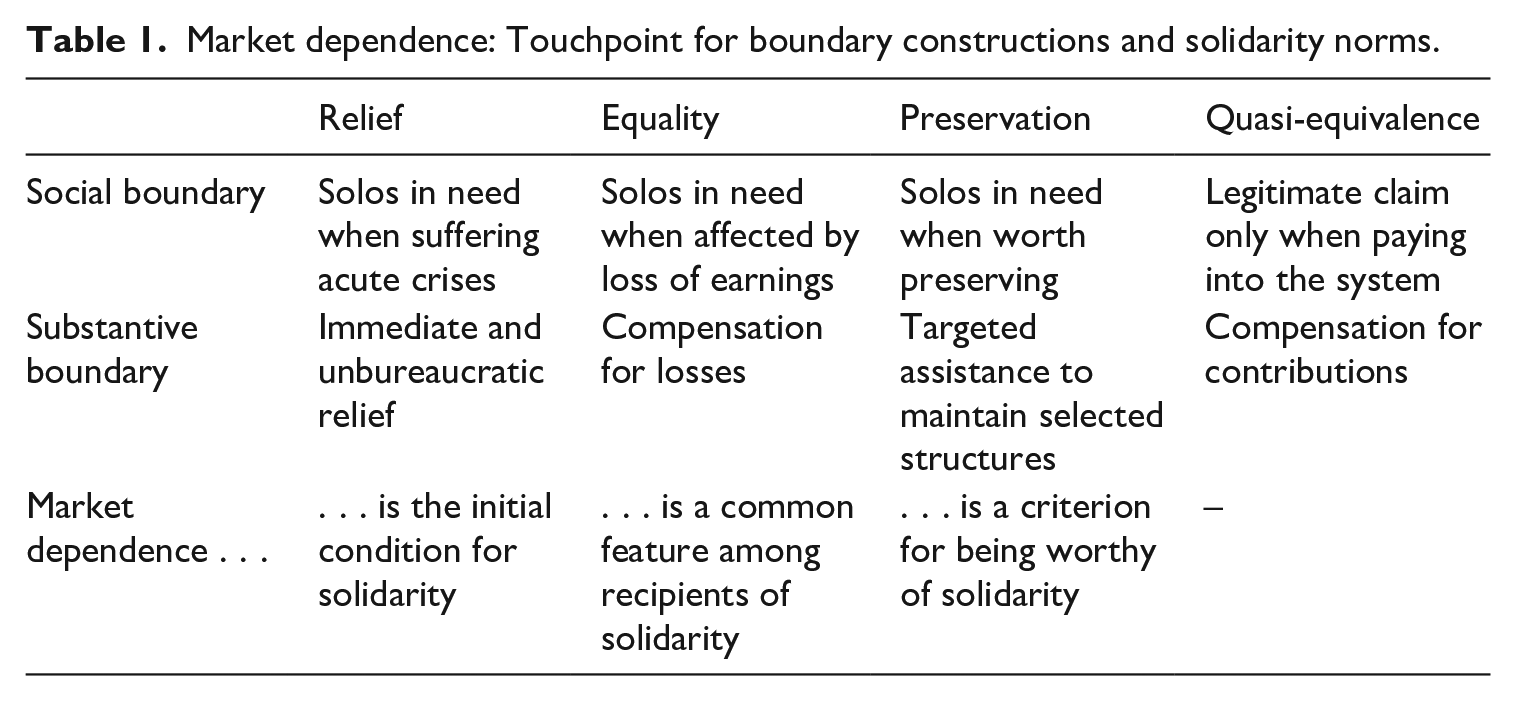
As the findings demonstrate, market dependence determines which group of people – in this case, solos – has a chance of receiving attention, care and support. During the early Covid-19 pandemic, a new group that shared a common fate (Portes, 1998) was formed around those affected in their work by contact restrictions. Within this social group, solos have been unambiguously identified as a subgroup, particularly in need for help (Stjerno, 2004). This need for help stems from market dependence. Following Satz (2010), product markets turned noxious during the Covid-19 pandemic and thus became highly harmful to the individual welfare of solos. Social differences manifest in an unequal degree to which they are affected by contact restrictions and social boundaries arise (Lamont and Molnár, 2002).
This identification of the solos’ need for public financial support is prominent in the discourse on Soforthilfe and is evident across discourse levels irrespective of industry, political orientation, or region. The rationale for why solos need financial support, however, differs across the four solidarity norms: the norm of relief identifies a need as solos are suffering an acute crisis; the norm of equality as solos are affected by the loss of earnings; the norm of preservation as solos are a threatened but structurally important part of the economy; and the norm of quasi-equivalence as solos are a group that, at least partially, contributes to the welfare system.
Although solos have been identified as groups in need of financial support within social boundaries, they still find themselves in a zone of uncertainty when negotiating substantive boundaries. The design of the Soforthilfe is embedded in institutionalised forms of welfare state policies (such as Kurzarbeitergeld [short-term working benefits] or Hartz IV), which are based on a different boundary, namely worker protection along the capital–labour cleavage. However, solos were excluded from protection. Owing to their similarity to entrepreneurs, solos are interpreted as business owners. Hence, they can claim assistance only for operating costs (and basic social welfare), as provided for the maintenance of a business or in the case of business failure, but they cannot claim losses for their market income to cover living expenses. The substantive design of Soforthilfe excludes solos and takes them to the verge of illegality.
At the same time, the four norms of solidarity provide for very different levels of assistance in terms of the amount, use and degree of obligation, and these differences contribute to disagreement over substantive boundaries. While the norm of relief provides immediate, unbureaucratic and unconditional financial support, the norm of equality focuses on compensation for lost earnings, the norm of preservation calls for structural support and the norm of quasi-equivalence seeks to account for prior contributions to the welfare system.
The norms of relief, equality and preservation share a strong reference to the immediate market dependence of solos, whereas the norm of quasi-equivalence is more heavily oriented towards the welfare state’s social insurance principle. In the case of the relief norm, the immediate market dependence of solos is an initial condition, similar to having a residence in a flood zone. State-imposed contact restrictions are a crisis event that occurs, like a flood. The norm of equality emphasises market dependence as a common feature among market participants. According to this, solidarity should be granted to market-dependent persons who suffer a loss of earnings through no fault of their own, due to a political decision and not due to personal failure. The norm of preservation subsumes solos into a capitalist infrastructure that must be preserved because of their market dependence. The situation is different, however, in the case of the norm of quasi-equivalence, where the worker protection narrative institutionalised in the welfare state holds. Here, solidarity with solos is tied to a voluntary and conscious declaration of membership in this solidarity group (e.g. through contributions) or to a fictitiously constructed substitute membership.
None of these norms is entirely new; rather, they seek to borrow from existing solidarity norms and forms of support (Portes, 1998; Schnabel and Tranow, 2020). In the discourse on Soforthilfe, the norm of relief corresponds to flood aid, the norm of equality to compensation payments, the norm of preservation to economic aid and the norm of quasi-equivalence to an insurance-based system such as unemployment insurance. Thus, the specificity of a negotiation of (non-)solidarity with solos is seen less in the novelty of these solidarity norms than in a particular configuration with market dependence as a shared boundary construction.
Especially at the beginning of the Covid-19 pandemic, the idea of short-term and solidarity-based financial support for solos revealed a gap in the current arrangements, namely the marginal position of solos in the unemployment insurance system (Fachinger, 2017). However, the expressed solidarity with solos was not sufficient to systematically support solos in the long run, clarify the issue of covering living expenses, or make system adjustments. Instead, the norm of relief reveals the tendency that Simmel (1983) referred to in relation to the poor; it spans the relationship of inequality between those who give help and those who receive it. Unlike legally guaranteed access to financial support, the recipients of Soforthilfe are only accepted by the solidarity group for a short time, and their contribution remains controversial.
Finally, the discourse analysis reveals the paradoxical role of the state in the construction of solidarity with solos. Discourse participants at all levels identified state policies on contact restrictions as the cause of the precarious situation of solos and blamed the state for their predicament. On the other hand, discourse participants argued for solidarity with solos not because of these policies but because of their market-dependent situation. This interpretation is in line with Brown (2015), who suggests that neoliberal subjects are given no guarantee of their lives by the state. Thus, market dependence appears to be the underlying condition for solo self-employment. In this setting, Soforthilfe could be interpreted as a state intervention to stabilise the economy, which is claimed to be an act of solidarity with solos by the state without any acknowledgement that the state contributed to the predicament of solos in the first place.
Conclusion
In line with a discursive approach to work solidarity (Beck and Brook, 2020; Kneurer et al., 2022; Schnabel and Tranow, 2020), this article proposes that market dependence is an additional boundary of work solidarity. Within a social group of workers who share a common fate, solidarity is still oriented towards helping other workers who are in need. However, in the case of solo self-employment as an atypical form of work, solidarity is not oriented against capital in the sense of capital–labour cleavage (Atzeni, 2010), but against harmful markets (Satz, 2010). Market dependence as a social boundary (Lamont and Molnár, 2002; Schnabel and Tranow, 2020) defines those whose livelihoods depend on product market access as members of a solidarity group. Substantive boundary negotiations then revolve around helping those whose market access is blocked, be it due to individual life events (such as accidents, illnesses, maternity, or old age) or externally induced market closures.
This study demonstrates that the boundary construction of market dependence has the potential to create work solidarity beyond standard employment. Solo self-employment, as atypical work, comes with flexibility and autonomy, but also with new dependencies on customers and stakeholders (Bögenhold, 2018; Pongratz, 2020). For instance, businesses frequently contract solos to increase their flexibility and buffer their workforce against market risks (Doellgast et al., 2018b; Pfeiffer, 2021). This also means that solos as one-person businesses fall into an interpretation gap when it comes to constructing work solidarity based on the capital–labour cleavage (Pongratz, 2020). Market dependence represents an alternative touchpoint for constructing the social and substantial boundaries of solidarity. As a boundary, market dependence allows solos to become visible and accepted parts of the solidarity group. Identifying market dependence as an additional boundary construction is an important step in decoding the multiplicity of solidarity (Kneurer et al., 2022). The potential of market dependence to create work solidarity may be particularly relevant for research on solo associations and labour initiatives advocating the interests of solos (Mezihorak et al., 2023; Tassinari and Maccarrone, 2020).
The identified potential to create work solidarity on the grounds of market dependence as a boundary construction can be generalised to other forms of atypical work that are economically vulnerable and dependent on the market (Castells, 2009; Doellgast et al., 2018b). Furthermore, other forms of work that fall outside standard employment, such as invisible or illegal work, may come with specific solidarities formed around additional boundary constructions. The sustainability of these additional boundaries in creating work solidarity largely depends on the dominance and strength of work solidarity around standard employment. As seen in the case of Germany, any negotiation of solidarity with solos occurs in the context of the strong dominance of the social welfare system and work policies centred on standard employment. Interestingly, the norm of equality was voiced only at the micro level in this study. Solos make claims for solidarity not (yet?) heard at the meso and macro levels. Overall, future research on work solidarity could more explicitly search for additional boundary constructions, their presence at various levels and their interrelations to map the multiplicity of work solidarity. Furthermore, exploring the consequences of disputed boundaries on the levels of policy change, advocacy and individual behaviour opens up promising avenues for future research on work solidarity.
Footnotes
Acknowledgements
The author team was supported by Arne Maibaum, Lena Himmler and Jannik Garner in conducting the interviews and during the analysis process – we sincerely thank them for their work. We would also like to thank Karen Shire, Christine Wimbauer, Hans Pongratz, Dieter Bögenhold and other members of the working group ‘Arbeit der Selbstständigen’ who discussed partial results of our project with us at various times. Finally, we would like to thank Valeria Pulignano and the anonymous reviewers for their constructive comments and guidance through the review process as well as Amanda Dixon at the Max-Planck-Institute for the Study of Societies and the Sage Editorial team for their support in editing the article.
Funding
The authors disclosed receipt of the following financial support for the research, authorship, and/or publication of this article: The study presented here was made possible by funding from the Berlin University Alliance.
