




Abstract
Digital labour platforms are able to structure work to limit paid working time, extract fees from workers to access labour, and shift costs associated with occupational safety and health (OSH) compliance onto platform workers. We call this unpaid work the ‘platform discount’. Unpaid labour is embedded within platforms’ competitive strategies as platforms operate with labour oversupply while clients use multiple platforms to search for the cheapest option (multi-homing effect). The authors study pathways through law that would limit the incidence of unpaid work by revisiting three areas of the legal framework: working time, safety and health, and access to work/labour intermediation. The authors argue that reclassification, suggested, among others, by the draft Platform Work Directive, can reduce the platform discount for the misclassified workers, but will leave solo self-employed unprotected. The authors explore two possible strategies to reduce the platform discount for the solo self-employed working on labour platforms: 1) a broader understanding of the concept of working conditions on digital labour platforms covering both standard employees and solo self-employed; 2) proceeding area by area, with the extension of occupational safety and health to the solo self-employed on digital labour platforms being the most feasible and promising from a regulatory standpoint.
Keywords
Introduction
Labour platforms derive profit from building multi-sided infrastructures connecting workers with clients while benefitting from regulatory advantages and compliance gaps in comparison to traditional employers. The ‘platform discount’ is rooted in using labour of individual service providers rather than of employees, and fragmenting work into smaller, more specific tasks, with a corresponding reduction in remuneration. By using advanced yet opaque 2 technologies, platforms can still maintain vigilant oversight over work in a form that recalls the managerialism of a traditional workplace setting. These technologies allow labour platforms authority traditionally associated with managerial prerogatives. In turn, this power allows them to reduce the costs and obligations associated with employment, while not necessarily being in explicit violation of employment regulation. How this situation has developed is itself a commentary on how work is valued or, more accurately, under-valued.
To retain workers, platforms purportedly offer the rewards of merit 3 – the harder you work, the more you earn – and yet, this proposition is rendered dubious considering the general public's understanding of algorithmic control. Studies convey the disparity between the promise of achievement and upward mobility presented by platforms, and the unpredictable reality of operating within these structures. 4 Suggestive of the inherent precariousness of this source of income, the instances of unpaid work 5 speak to how service providers are effectively subsidising platforms by providing unpaid working time, bearing the risks associated with safety and health, and even paying to access work itself. These circumstances manifest the ‘platform discount’, a regulatory advantage enabling platforms to benefit from unpaid work. As such, the notion of ‘platform discount’ is broader than ‘wage theft’ that describes non-compliance with minimum wage violations, 6 as it refers to operations that are not clearly illegal but might also exploit the grey area of employment regulation. 7
Employment status has been one frequently considered method for addressing issues with platform work. So far, a few propositions have been put forward in this line. 8 Perhaps most notable is the European Commission's draft Platform Work Directive. 9 Originally, it contained a legal presumption of the existence of an employment relationship premised upon meeting certain criteria. This presumption has been the subject of much discussion. Amendments to the draft directive included the removal of the criteria indicating the presumption (these criteria, in a modified form, have been moved to arguments against finding a presumption set out in Article 5(3)), and the assertion that the presumption is not automatic, absent platform companies having the ‘possibility to rebut the presumption of employment before a decision for reclassification is taken. 10 We discuss the amended presumption in the draft directive further in section 5 below. Nevertheless, we contend that issues with digital labour platforms and unpaid work are not exclusively a matter of classification – as platforms continue to generate unpaid labour also when they use employment contracts. 11 Tackling unpaid work on platforms requires engagement with the social and economic conditions under which platform labour is performed. 12
We formulate two alternative propositions regarding how the platform discount can be reduced: 1) through revisiting the concept of working conditions by extending the regulatory framework applicable to all persons providing work within labour platforms regardless of the contractual forms used to mediate labour, entailing applicable changes in each regulatory area or; 2) alternatively, by expanding the scope of occupational safety and health regulations as a ‘backdoor’ solution in limiting unpaid labour, without targeting the concept of working conditions. We develop our argument while expanding upon the already applicable regulatory framework pertaining to working time, safety and health, and the regulations on labour intermediaries. 13 This approach is not intended to conflict with reclassifying platform workers, which we support, and draws from the direction suggested by the suite of actions put forward by the European Commission, such as the Platform Work Directive proposal, the Guidelines on EU competition law on collective agreements (hereinafter: Guidelines on solo self-employed) and the EU strategic framework on health and safety at work 2021–2027. Together, these measures broadly involve working conditions for individuals carrying out labour within the European Union, and consider a scope of application that is not tied exclusively to an employment relationship as set out in law. While the focus of this article is EU law and discussions on the Platform Work Directive, we also refer to national level developments both within and beyond the EU. We discuss EU labour law as it pertains to work on labour platforms, centring on the concept of the platform discount. References to national laws are intended to complement this elaboration of EU labour law. Additionally, this article adopts an interdisciplinary, socio-legal approach to the analysis of problems associated with platform work. The resulting legal and policy discussion draws from rich and extensive empirical data.
This article is organised as follows. We start by discussing the methods we used to study the practices of platforms. Then, we reflect upon the varieties of unpaid labour generated by platforms’ practices within three dimensions – working time, safety and health, and access to work. Next, we study regulatory possibilities and case law within each of these fields that would help to mitigate the platform discount. Further, we formulate two alternative strategies regarding how to deal with unpaid work within labour platforms. Finally, we conclude the article.
Research methods
To offer an accurate regulatory response, one must study how platforms are able to benefit from the platform discount. To study platforms’ practices and their impact on working conditions, we refer to the existing literature and our own empirical data gathered within the ERC-funded ResPecTMe project, 14 where we conducted 191 interviews with platform workers. Our study was conducted in five European countries – Belgium, France, Italy, the Netherlands, and Poland. It covered IT workers, graphic designers, translators, and copywriters performing work on online freelance platforms (e.g., Upwork, Jellow, Malt, AddLance, Useme) and offline workers working on food delivery platforms (e.g., Deliveroo, Glovo, MyMenu, Stava, Just Eat Takeaway) and care and cleaning platforms (e.g., Yoopies, Care.com, Aide au top). The interviews lasted between 1 hour and 4.5 hours and were conducted between February 2020 and August 2021 online and face-to-face. An overview of interviews is presented in Table 1.
Overview of respondents
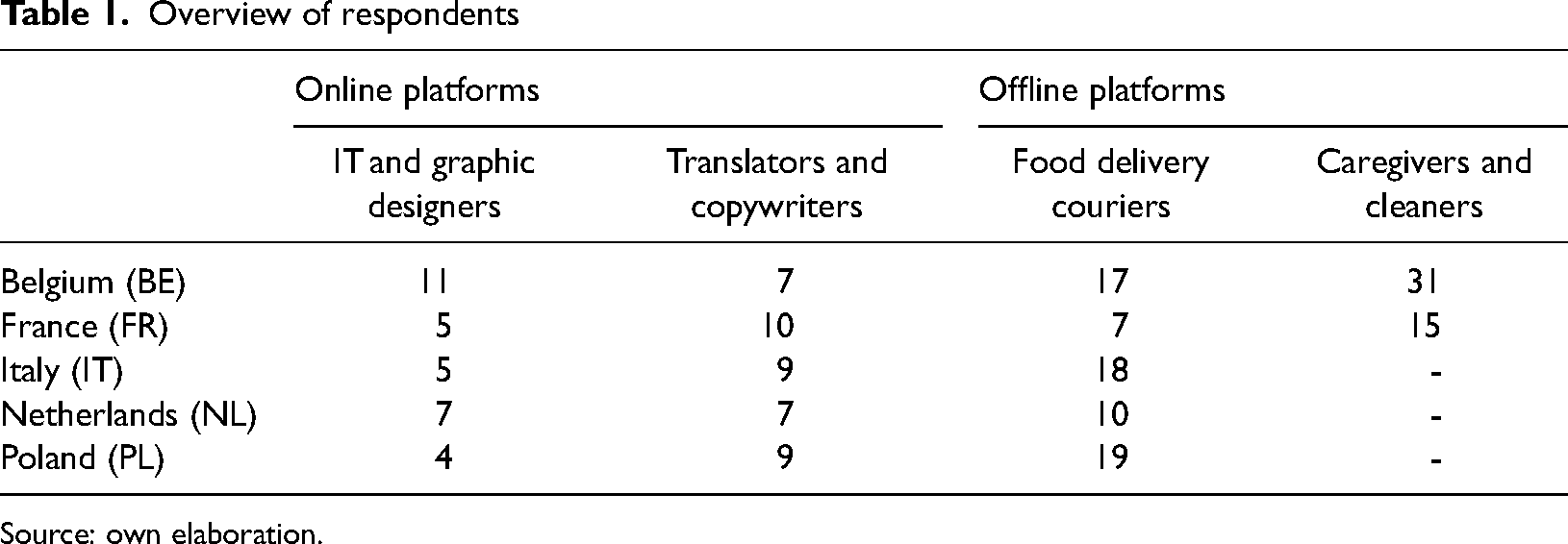
Overview of respondents
Source: own elaboration.
Interviewees were asked to tell the story of their working lives, and then a number of semi-structured questions were posed about working conditions (working time, earnings, work intensity, issues related to safety and health), employment contracts, relations with the platform, and other problems they experienced at their work. Additionally, we conducted 30 expert interviews with policymakers, platform managers, trade unionists and academics to understand legal frameworks and gain insight into regulatory challenges related to platform work. Interviews were transcribed, translated (if necessary), and analysed by the authors in NVivo software using first open coding, and then reassembling and grouping codes into wider categories related to the provision of unpaid labour. Quotes from the interviews presented in this article are identified by codes indicating the country where the interview was conducted and the researcher who conducted the interview. 15
Platforms narrowly define what constitutes paid activity to minimise their financial outlays, while transferring costs related to the organisation of work to platform workers. In most cases, this process relies upon fragmentation of the tasks required to perform activity and/or structuring of legal responsibility in a way that enables platforms to circumvent some of the obligations imposed upon traditional employers. We discuss unpaid work arising in these aspects of platform work using the following dimensions: working time, safety and health, and access to work.
Types of unpaid labour within the working time dimension
Labour platforms tend to organise work to exclude from the scope of remuneration some of the time or activities necessary to complete tasks, not remunerating workers for the entirety of activities required to complete the task. Quantitative studies have also consistently found that labour platforms generate substantial unremunerated working time. A European Commission report found that platform workers on average spend 8.9 hours per week doing unpaid tasks against 12.6 hours doing paid tasks. 16 An ILO study found that online workers spend around one third of their effective working time being unpaid. 17 Pulignano and others 18 found that workers on selected offline platforms engage in unpaid waiting time for half of their working days. This time is attributable to a lack of orders, and time spent searching for orders and restaurants when there are problems on the side of the platforms or clients. Within online platforms, freelancers might spend as much as one third of their working days engaging in such unpaid activities. 19
A platform using a piece-rate system excludes remuneration for elements of the tasks which are nonetheless required. For instance, offline platforms might pay workers only for specific completed tasks, such as doing a ride or delivery: ‘since they have removed guaranteed rates […] I get paid only for completing the order’ (PLKM09); ‘On Uber, there is only payment per delivery’ (ITCM23). The activities necessary to complete the task, including collecting the delivery, covering the distance to pick up for a passenger, and waiting for the order, are either severely underpaid or completely set aside: ‘[for the purpose of remuneration] the time that you spend sitting still and the time you spend waiting at a restaurant for the order do not exist’ (ITCM33); ‘I have received 9 PLN [ca. 2 EUR] for the 1.5 h waiting at McDonalds’ (PLKM13).
Even if platforms remunerate workers based upon working time, they tend to adopt restrictive rules for calculating this paid time.
20
Food delivery platforms might reduce paid service time to the time when food delivery couriers complete deliveries between the restaurant and the client while excluding time required to return to the hub or engage in equipment maintenance – ‘when the shift finishes, we have to clean the bag […] and the bike […] we don’t get money for that’ (PLKM23). Cleaning platforms can exclude travel required by a platform cleaner to commute to location: ‘I am not paid to travel to the client […] I had to pay for the bus myself’ (BECM15). Secondly, platforms remunerating for working time might intentionally shorten the shifts to the detriment of workers: ‘[the platform] often shortens my shift, e.g., when I deliver the food at 7.50 p.m. and I have a shift until 8.00 p.m. […] taking away my [paid] hours’ (PLKM24).
Similarly, online platforms that allow for settling tasks in a time-based manner adopt managerial practices resulting in underreporting of working time. Upwork's time tracker, used for settling project remuneration based on working time, supervises workers’ activity. This system demands a particular type of approach to work: ‘whilst you’re working, you need to keep it running so that it takes screenshots of your desktop, everything that you’re doing’ (FRCM02), ‘counting the keystrokes and mouse clicks’ (PLKM04). The tracker excludes the time segment when it detects that the worker is not actively working at the moment the screen shot is taken. A brief period of inactivity can result in the exclusion of the whole segment from paid remuneration: ‘when I'm taking a break, the counting restarts after another 10-min segment. Sometimes, I would work as long as 1.5 h for one billed hour. […] Sometimes, while logging time, I get interrupted by a call or someone's knocking at the door, and so on. It's pretty tiring when you're logging time, especially when you get interrupted three minutes into your 10-min segment […] then my Work Diary shows empty segments […] I’m not getting paid for the empty slots’ (PLKM04).
Types of unpaid labour within the safety and health dimension
Safety and health problems within platform work are prevalent while platform workers are largely outside of the scope of the occupational safety and health regulatory framework due to the non-standard nature of this work. At the same time, labour platforms are especially common within sectors particularly prone to occupational safety and health issues such as online work 21 and logistics (ride-hailing and food delivery). 22 In a European Commission study, around half of offline platform workers claimed that they were exposed to safety and health risks, manifesting the massive scope of the problem. 23 This comes with substantial financial costs for workers having to contribute their resources, including money and time, to improve their safety and health. The safety and health-related costs come in a few forms in the case of platform work.
First, since platforms often do not assume liability for compliance with safety and health regulations at work, workers bear these increasing risks and costs. Platform workers must organise protective equipment themselves: as ‘they did not give us hand gel […] I supplied myself with the majority of protective gear I used during the lockdown’ (ITCM17). In the UK, 70% of offline platform workers had to buy their own equipment to improve safety and health.
24
Online platform workers can also be forced to bear the costs of buying equipment to improve their own safety and health: ‘I work at an adjustable desk, nice chair, and a huge monitor, I bought all the necessary equipment to make my work easier, more ergonomic. Because I started having back problems from sitting too long.’ (PLKM06). ‘who parked under a skyscraper, blocking a portion of the sidewalk, because there was no other available spot to park, I was running late with the delivery, I had to park there, when I got off the car, some man was standing there, saying that he was going to report me to the police’ (PLKM17). ‘you need to ride 100 km per day. […] and sometimes these are heavy weights, it is supposed to be a minimum of 10 kilograms, but it still weights on a bike, if you need to transport it’ (PLKM09). ‘a huge problem with arm, it was hurting a lot. […] it did happen to me that I overworked like one day, but then the next day, I couldn't work’ (FRCM06); ‘there were times when I worked seven days a week, starting at 8 a.m. and not finishing until 8 p.m. I got sight problems and needed to get myself glasses. My back hurts, I got sore muscles, I started seeing a physio’ (PLKM28). ‘I can’t take my eyes off my phone. I’m waiting for an email, I want to reply to it right away […] because I need to be the one who replies immediately, the better one. I can never fully relax’ (PLKM28).
Types of unpaid labour within the access to work/labour intermediation dimension
Platforms might charge fees or require investments for service providers to gain effective access to work. 30 Some labour platforms might require workers to ‘pay for the chance to earn’ (NLLV01), i.e., to access work. They may also require workers to organise or maintain means of production or standards necessary to perform tasks. This can largely impact the actual profitability of platform work, and even generate losses for workers. In this way, workers are either paying for being linked with clients or effectively substituting platforms’ functioning, which should be understood as unpaid work.
Within offline platforms, workers might be required to buy some equipment from the platform to access any work: ‘with Uber you have to buy a bike, you have to buy the clothes, you have to buy a bag, you have to buy all that’ (BECM05); ‘when you took a bag from Uber Eats, they have deducted it from your earnings […] say bag costed 180 PLN, they deducted it 3 times per 60 PLN in the following 3 weeks’ (PLKM10).
Secondly, platforms might expect workers to effectively organise their means of production (like cars on ride-hailing platforms) to even be able to access the platform, as in the case of food delivery and ride-hailing and evidenced by a respondent who ‘bought a Smart [car] specifically for Glovo’ (PLKM15). The same can be required by online platforms, where a freelancer noted: ‘obviously had to make some investments because I had to buy this magnificent microphone […] I paid a thousand euros’ (ITCM21). Another operational cost is software, as explained by one of our respondents: ‘Adobe package is really, really expensive’ (PLKM28).
Finally, both online and offline platforms might offer a ‘premium account where you have more possibilities of exposure’ (ITCM21)’ to increase chances of getting the job. For instance, care.com workers may ‘pay to get the premium account, I paid 10 EUR for this […] per month’ (BECM14), while on Freelance Network ‘membership was 120 EUR for a year’ (BEMFVP01). These investments may never pay off, as evidenced by our respondent who ‘did not get anything back from them, not one assignment’ (BEMFVP01).
Unpaid labour at the intersections
The three dimensions identified above can also intersect in the context of unpaid labour provision within labour platforms. For instance, problems such as evidenced by a respondent, who ‘before work repaired my bike and did a bit of maintenance myself; what I earned did not cover these costs’ (BEMF39), or another one who claimed that ‘the work intensity is sometimes very high, but I don’t get a break until there are no orders from clients’ (PLKM25). Here, we see how the offloading of equipment maintenance (which is necessary for the provision of the work) or the failure to provide workers with paid breaks at work might involve both working time and safety and health dimensions. Similarly, workers might be required to spend significant amounts of unpaid time on training, which could be understood as unpaid in two dimensions, namely, working time and safety and health. This is evidenced by a respondent highlighting that before a platform hires a courier ‘there is a training day [which involves…] a small of test [and…] and the training itself: you do two deliveries following a driver who trains you and you do two deliveries […] it was not paid’ (BECM10).
Unpaid revisions required by clients might involve both a working time and access to labour dimension if platform workers fear that receiving a bad review will impact upon their rating and therefore their effective access to work, as in the case of a respondent who noted they are ‘not paid for revisions and clients expect revisions to be unlimited until they are happy’ (PLKM28). Platform workers who buy equipment to improve safety and health face unpaid work issues that cut across both access to work and safety and health dimensions, as in case of a respondent who ‘bought a special helmet for safety reasons […] thanks to this I don’t have my ears covered while riding a bicycle, I can hear what's going on around me’ (PLKM10). Finally, overworking on platforms as a means to maintain reputation, i.e., in the case of algorithmically calculated personal ratings of workers that assess quality of work and determine access to work,
32
might involve all three dimensions, exposing platform workers to unpaid or underpaid overtime and posing risks to their safety and health to preserve ongoing effective access to work, as exemplified by a respondent willing to maintain their good reputation who claimed the following: ‘I’ve been overworking myself: forget about holidays, forget about weekends, forget about vacation. I get up, I get to work, I do as much as I can.’ (FRGIGCM02).
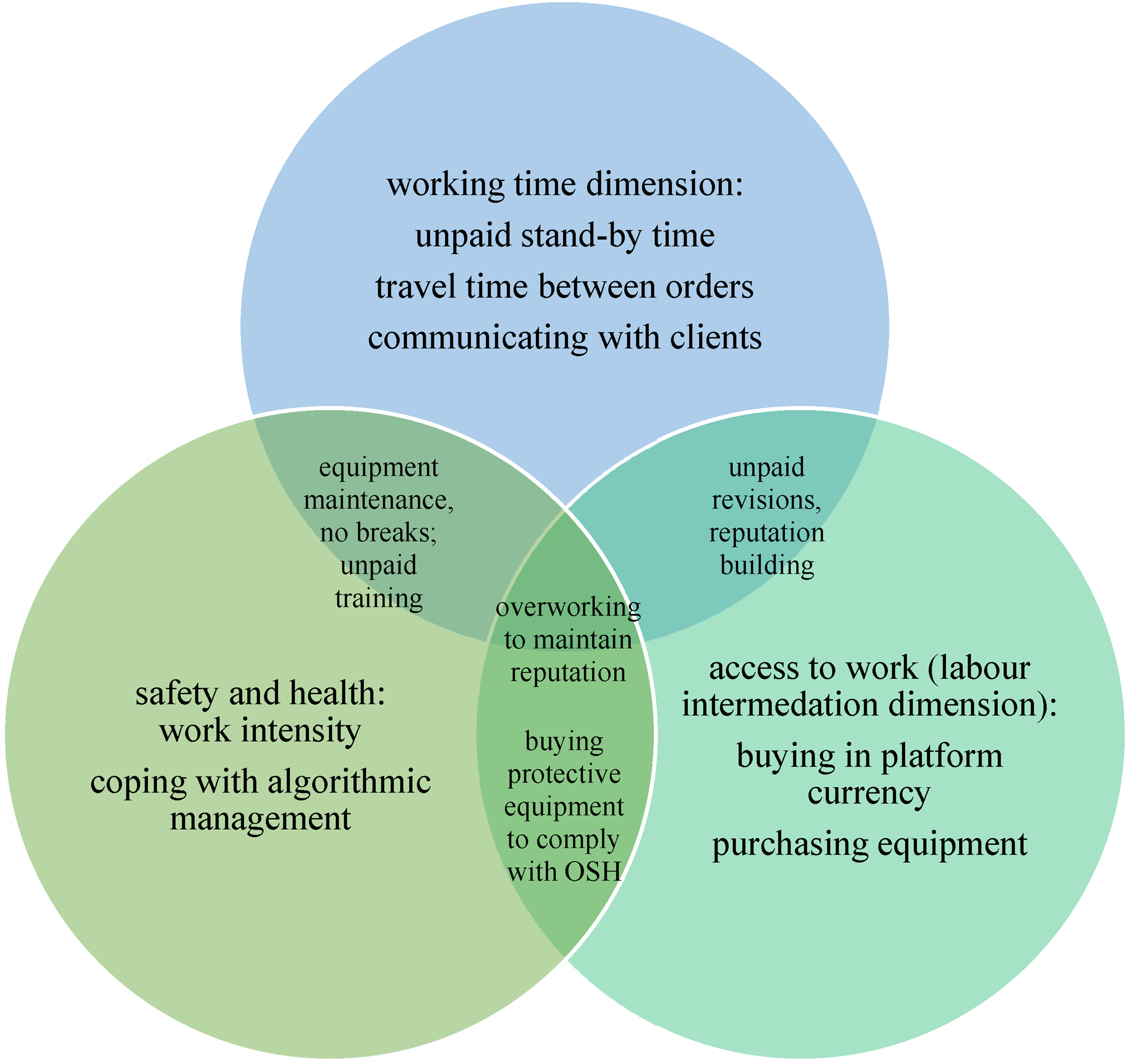
Platform discount – varieties of unpaid labour within the platform economy. Source: own elaboration.
The ability of platforms to structure work in a way that allows them to commodify unpaid labour across the above three dimensions impacts on their competitive strategies within wider product and service markets. We argue that this impact occurs in two interrelated ways that contribute to embedding the platform discount as an inherent feature of the platforms’ business models, 33 making platforms distinct from other employers that ‘simply’ violate employment regulation.
First, the performance of unpaid work happens in the context of labour platforms operating within multi-sided markets where the same services are offered across similar platforms, while customers engage in multihoming, i.e., using different platforms to find the cheapest products or services. 34 Multihoming fosters competition between platforms based on costs associated with employment (as similar, if not the same, products and services are offered across different platforms), making pressure on labour costs essential for labour platforms’ competitive strategies. 35 This in turn increases incentives for labour platforms to engage in the generation of unpaid labour by restructuring tasks in a way that limits paid working time, increases the costs associated with accessing labour, and saves on safety and health.
Second, since platforms are able to limit their own costs associated with working time, safety and health, and labour intermediation, they are capable of operating with a significant labour oversupply. As highlighted by one of our respondents, platforms ‘have no costs: 10 couriers can be logged in, be available, and Glovo [food delivery platform] pays exactly nothing’ (PLKM13). This labour oversupply increases competition between platform workers, forcing them to provide unpaid labour as a means of improving their employability (reputation/ratings) within labour platforms. For instance, food delivery riders can be forced to undertake unpaid working time to retain high ratings within the platform and be able to register shifts, because platforms can always accept new workers since they have very limited costs associated with employment 36 while ‘there's no buffer [… as platforms] can employ those people up to the roof’ (PLKM10). Online freelancers can be forced to do unpaid revisions for clients to achieve higher visibility in the context of fierce competition within online platforms which are able to admit virtually all service providers due to the costs associated with hiring being close to zero. Such actions are necessary in the context of oversupply of workers on platforms, as ‘companies try to choose among 50 profiles sometimes the top-rated profiles’ (BECM02), and ‘when a client posts a job you find that 300 people have applied for it’ (NLMR06) while ‘people on platforms search for the cheapest and fastest freelancers’ (BEMF03). In addition to the cost limitations noted immediately above, platforms further insulate themselves from financial losses by creating income-generating opportunities from the inherent competition amongst the plethora of service providers.
In this context, platforms generate unpaid work within the dimensions of working time, safety and health and access to work in the context of regulatory ambiguities –which we call the ‘platform discount’. This must be seen as a primary feature of labour platforms that results in a situation where platforms’ operations are effectively subsidised by their workers.
Reviewing regulatory areas in the context of the platform discount
The above discussion illustrates how labour platforms lower their costs by assuming narrow definitions of remunerated work, and also create income-generating opportunities through in-platform competition. Reducing the risk of unpaid work carried out by service providers within labour platforms requires (re)consideration of the rules applicable to:
working time: providing clear guidelines distinguishing between working and non-working time; occupational safety and health (hereinafter: OSH): imposing upon platforms the obligation to ensure compliance with OSH standards; labour intermediation: limiting the costs that platforms can generate for workers to regulate access to work.
In this section, we review all three areas.
Tackling unpaid labour within the working time dimension
While platforms generate a substantial amount of unpaid labour within the working time dimension, it is possible to include these activities within the scope of paid working time based on the case law of the Court of Justice of the European Union (CJEU) on the Working Time Directive. The CJEU's rulings provide guidelines on treating stand-by time and travel time as working time, which can be adapted to platform work. The presumption of employment in the proposed Platform Work Directive will likely facilitate this change. While their application to platform work will not cover all the unremunerated activities performed by platform workers, it may still limit platform workers' unpaid working time.
Three observations must be made in the context of applicability of the Working Time Directive.
First, the Working Time Directive applies only to ‘workers’ having an employment relationship assessed on an objective basis (involving all the factors and circumstances characterising the relationship), implying a hierarchical relationship between workers and employers. 37 As a result, by assuming such a restrictive application of the Working Time Directive we could limit the risk of unpaid work in the working time dimension for those platform workers who would have employment contracts, leaving genuine solo self-employed platform workers still exposed. Even in its amended form, the proposed Platform Work Directive principally relies upon a presumption of an employment relationship as a way of improving working conditions within platform work. While the presumption may result in a domino effect triggering application of various other provisions of EU level labour law, 38 in order to limit unpaid working time on labour platforms for the genuine self-employed, one would have to find another pathway. This alternative is discussed further in Section 5 below.
Secondly, while the Working Time Directive has been adopted to indirectly deal with the issues related to pay by reclassifying some of the (paid) working time, it must be noted that aside from paid holidays (Art.7(1)), the Directive does not apply to remuneration. 39 The CJEU permits distinctions in payment, such as for travel time. 40 And so, although working time is to be remunerated, remuneration is not required to be uniform for all working time. This is because the primary goal of the Working Time Directive is setting down minimum requirements for the organisation of working time (and more specifically, rest time) in the context of the safety and health of workers. We will return to this point.
Thirdly, and what stems from its limited scope, it must be noted that intensity of work has been found to be outside of the Working Time Directive. 41
One should also note that Article 6 of Directive 2022/2041 on adequate minimum wages in the European Union provides that variations and deductions in pay that go below the relevant statutory minimum wage respect the principles of non-discrimination and proportionality. It can be argued that this Article should apply to stand-by and travel time.
Stand-by time
CJEU decisions on stand-by time focus on workers who are required to be available to respond to an employer's call to work at short notice, and to arrive ready-to-work within a short period of time. The general rule from the CJEU is that stand-by time spent by an individual in the course of activities carried out for the employer is to be classified either as working time or a rest period, with distinctions based upon the constraints placed on workers by employers. A primary distinction is whether workers are required to remain at the place of work while on stand-by. Stand-by time during which ‘no actual activity is carried out by the worker for the benefit of his or her employer does not necessarily constitute a “rest period”’. 42 Stand-by time is working time, even when the worker sleeps during this period 43 because ‘he has to remain apart from his family and social environment and has less freedom to manage the time during which his professional services are not required.’ 44 It should be noted that the CJEU deploys a broad notion of the workplace for stand-by time: it is ‘any place where the worker is required to exercise an activity on the employer's instruction, including where that place is not the place where he or she usually carries out his or her professional duties.’ 45 Where the worker is required to be physically present and available at the workplace during the stand-by period, this constitutes carrying out duties for the employer, thereby falling within the meaning of working time for the purposes of Article 2 of Working Time Directive. 46 Where an individual is not required to remain at the workplace, but instead must be somewhere designated by the employer (that is, to be available to the employer and ready to provide services quickly), this too can constitute an activity carried out for the employer. If the worker is not free to select a place to stay during stand-by periods, 47 it will be regarded as falling within the meaning of working time. In Matzak, the CJEU reiterated that working time means that employers’ requirements ‘objectively limit’ 48 workers’ personal and social opportunities. In Stadt Offenbach the Court concluded that ‘constraints imposed on the worker [by the employer] are such as to affect, objectively and very significantly, the possibility for the latter freely to manage the time during which his or her professional services are not required and to pursue his or her own interests.’ 49 Conversely, if the constraints imposed did ‘not reach such a level of intensity’, only the time ‘linked to the provision of work actually carried out during that period constitutes “working time”’. 50 Dublin City Council added to this topic by highlighting that if workers had a very limited response time of ‘a few minutes’, it must be viewed as working time because workers are ‘strongly dissuaded from planning any kind of recreational activity, even of a short duration’. 51 Still, the CJEU concluded in Dublin City Council 52 that the individual's time was not so constrained as to constitute working time.
Using offline platforms as an example, the idle stand-by time that many platform workers experience between tasks (waiting time in its various forms) would fall within such an extended definition of working time. This is because workers remain at the disposal of platforms (and apart from family and social environments). 53 That is, it is possible for the platforms to contact the workers while their capability to organise their time is not autonomous and is effectively restricted. 54 It should be noted that many platforms – not only offline, but also online – require workers to be instantaneously available, potentially even punishing workers for lack of responsiveness, e.g., restricting access to work by lowering their ratings or even financially sanctioning them - a point which intersects with the labour intermediation dimension.
Travel time
Another concept developed under the Working Time Directive is travel time, that is, the time it takes a worker to travel, under the direction of an employer, to a place that is not her regular place of work. In the context of platform work, this can involve having to spend time covering the distance between the place of first and last delivery/pick-up in the case of food delivery and ride-hailing platforms, and also commuting to and from clients in the case of generalist offline platforms for tasks like cleaning, childminding, repairing, etc.
In Tyco, 55 the CJEU considered that commute of workers who do not have fixed places of work between their homes and their first and last customers of the day constitutes working time. In arriving at this conclusion, the court noted several factors. The journeys undertaken by company workers formed a ‘necessary means of providing those workers’ technical services to … customers.’ 56 To focus on the provision of those technical services alone as working time ‘would distort [the] concept [of working time] and jeopardise the objective of protecting the safety and health of workers.’ 57 Although workers may determine the route taken to reach these customers, it does not obscure the fact that ‘they are at their employer's disposal.’ 58 Moreover, ‘given that travelling is an integral part of being a worker without a fixed or habitual place of work, the place of work of such workers cannot be reduced to the physical areas of their work on the premises of their employer's customers.’ 59
Tackling unpaid labour in the safety and health dimension
Crucial elements of the regulatory framework on safety and health at the EU level are in principle rooted in the OSH Framework Directive, which pertains only to workers and excludes the self-employed. The same happens in most Member States, where OSH protection is limited only to employees. 60 Self-employment, a contractual arrangement common to digital labour platforms, is generally excluded from the OSH regulatory framework, thereby making platform workers responsible for their own safety and health and for bearing the costs of OSH compliance; although there have been successful attempts to reclassify workers from the point of view of OSH regulations specifically resulting from strategic litigation. 61 Moreover, due to the non-standard nature of work, platform workers are generally excluded from participation in bodies tasked with OSH management, such as safety and health committees.
While platforms can make workers bear the costs associated with organising the protective equipment necessary from an OSH standpoint, traditional employers are prevented from doing so by Article 4(6) of Directive 89/656/EEC, 62 which stipulates that ‘personal protective equipment shall be provided free of charge by the employer, who shall ensure its good working order and satisfactory hygienic condition by means of the necessary maintenance, repair and replacements’. The OSH Framework Directive also provides in Article 6(5) that ‘measures related to safety, hygiene and health at work may in no circumstances involve the workers in financial cost’.
Second, while platform workers do not benefit from the OSH protective framework, they are also responsible for other forms of compliance with OSH regulations. While some (but not all) platforms might organise safety and health training, workers might be required to pay for this due to the non-standard nature of their work and they will not be paid for the working time spent while engaged in this training. The existing OSH regulatory framework clearly forces employers to bear the costs of training. Article 12(4) of the OSH Framework Directive requires that training ‘may not be at the workers’ expense or at that of the workers’ representatives’ and ‘must take place during working hours’. Article 4(8) of the Directive 89/656/EEC provides that ‘the employer shall arrange for training and shall, if appropriate, organise demonstrations in the wearing of personal protective equipment’.
Third, the OSH protective framework also covers minimum breaks at work provided by the Working Time Directive, which sets minimum periods of daily rest, weekly rest, annual leave, breaks and maximum weekly working time and certain aspects of night work, shift work and patterns of work to provide ‘minimum safety and health requirements for the organisation of working time’ (Article 1). The Working Time Directive, as explained above in the section on working time, applies only to standard employees and not self-employed.
Application of the 2022 draft of the Platform Work Directive to the problem of exclusion from OSH is again limited due to the assumption that most of the problems will be dealt with by the legal presumption of the existence of an employment relationship. Reclassified platform workers will thus benefit from OSH regulatory protection applicable to standard employees. For the solo self-employed, however, the proposed Platform Work Directive has limited relevance. They will only be entitled to information on algorithmic management impacting upon working conditions, including their OSH, provided in Article 6, without coverage by the OSH regulation protection. At the same time, regulatory propositions that were put forward recently also exclude non-standard platform workers from OSH protection.
Tackling unpaid labour within the access to work/labour intermediation dimension
As indicated above, labour platforms often charge fees or effectively require investment from workers to access work. Several authors already have put forward convincing claims that labour platforms – operating as intermediaries matching workers with clients/employers – abuse the current regulatory structures pertaining to labour intermediaries which they substantially resemble. 63 Many labour platforms indeed effectively function as labour intermediaries as their core business relies upon job-matching between clients/employers and service providers/workers while typically labour intermediaries face limitations at international and European levels in terms of charging workers fees. These rules are circumvented by the use of self-employment instead of genuine employment status.
At the European level, Article 6(3) of the Temporary Work Directive restricts temporary work agencies by prohibiting them from ‘charg[ing] workers any fees in exchange for arranging for them to be recruited by a user undertaking, or for concluding a contract of employment or an employment relationship with a user undertaking after carrying out an assignment in that undertaking’. At the international level, Article 3 of the ILO Fee-Charging Employment Agencies Convention (Revised), 1949 (No. 96) prohibits employment agencies from charging fees. Article 7.1 of the ILO Private Employment Agencies Convention, 1997 (No. 181) provides that ‘private employment agencies shall not charge directly or indirectly, in whole or in part, any fees or costs to workers’, allowing for exceptions in Article 7(2) only under specific, narrow circumstances. Fee-charging here must be understood as both asking for a registration fee, which would cover the common practice of asking platform workers to buy in-platform currency or equipment from the platform (which is compulsory to get access to work), as well as taking a percentage of the jobseeker's wage, which covers another common practice of platforms of taking a fee from the worker's wage for completed tasks. 64 One must also stress that while ILO Conventions typically cover only a situation where workers are assigned by labour intermediaries (platform) to employers, the Temporary Work Directive could also be applicable to situations where workers provide work directly to clients/customers, which is typical for many popular platforms like household services platforms, 65 although this requires establishing that the client/customer is a user undertaking which, case law tells us, presents challenges. 66
All the aforementioned provisions are based upon an assumption that labour cannot be treated as a simple commodity sold on the market. 67 The fact that labour is not a commodity means on one hand that one cannot agree to regulation of work solely through supply-demand and price-setting mechanisms. The dignity-related aspect must also be considered. On the other hand, the idea that labour is not a commodity highlights, amongst other points, that no worker should be required to pay to work, since work is not something that can be bought by either the employer or the worker. 68 Platforms can avoid these restrictions by presenting themselves as technological intermediaries rather than employment agencies or temporary work agencies subject to regulatory constraints, and by treating service providers as clients of a service rather than as workers. If rules restricting the operations of labour intermediaries were consistently applied to platforms, they would be prevented from charging fees and transferring the costs associated with access to work to workers.
Apart from preventing platforms from charging fees and transferring costs to workers through labour intermediation, the regulations on labour intermediaries provide for a minimum level of protection of workers assigned to work via labour intermediaries (Article 11 of the ILO Private Employment Agencies Convention, 1997 (No. 181)) or even working conditions ‘at least those that would apply if they had been recruited directly by that undertaking to occupy the same job’ (the equal treatment principle from Article 5 of the Temporary Work Directive would be applicable if workers were assigned to businesses also hiring regular employees). More consistent application of such rules could have much broader implications for working conditions going beyond the platform discount. It must be noted that current regulatory structures behind the ILO Conventions limiting fee -by employment agencies were designed to prevent economic abuse and to promote public involvement in organisation of the labour market. 69 The spread of private, unregulated labour intermediaries such as labour platforms manifests a failure of public agencies to effectively build public employment services allowing for fair and free access to the labour market. At the European level, the Temporary Work Directive was put in place to counteract the various challenges emerging as a result the outsourcing of labour and the disintegration of workplaces in the 1990s and 2000s. 70 While workplaces began to utilise non-standard forms of employment to reduce employer responsibility and to undermine workers’ solidarity, policymakers designed regulations on labour intermediaries precisely to prevent the harmful impact of such reorganisations on the working conditions which are threatened by the rise of labour platforms.
Based upon the 2022 European Parliament's version, it is unclear how the Platform Work Directive will operate with regard to the issues related to fee-charging. The Platform Work Directive itself does not explicitly restrict platforms from charging workers for access to work. At the same time, in the case of reclassification, which is the presumed method for improving working conditions for platform workers within the Platform Work Directive, some restrictions can be imposed, including application of the Temporary Work Directive, as also provided in the explanatory memorandum to the Directive. 71 However, in such cases, fees may still be charged by platforms if workers continue to operate as self-employed workers.
Legal strategies for reducing unpaid labour on labour platforms
In the preceding pages, we have put forward the argument that the numerous regulatory advantages allowing platforms to exploit unpaid work (the platform discount) can be grouped into three dimensions. We have also pointed to legal actions which could address the platform discount. It is apparent in this discussion that the binary divide between employment status and independent contractor status constitutes a formidable obstacle to addressing these issues. In this part, we consider how the legal presumption of the existence of an employment relationship (particularly as contained in the proposed Platform Work Directive), usually suggested as a pathway to dealing with employment-related issues with labour platforms, will impact on the platform discount. While legal presumption will help (re)classified individuals, those falling outside of the presumption working on digital labour platforms will still be impacted by the platform discount. To address the vulnerabilities experienced by the solo self-employed on labour platforms, who are a significant cohort of service providers on these platforms, we contend that a focus on working conditions for individuals operating on digital labour platforms is a more appropriate organising focus.
In this part, we provide two propositions on the regulation of unpaid work which both centre around working conditions on digital platforms. In doing so, we interpret recent legislative efforts by the European Commission as setting out a broader understanding of working conditions. We note that this direction is a by-product of the Commission's interpretation of its capacity within Article 153(1) TFEU, to ‘support and complement the activities of the Member States’ in ‘(b) working conditions’. We see this development in a few examples. For instance, the Guidelines on solo self-employment (although only in the context of competition law) define working conditions as ‘matters such as remuneration, rewards and bonuses, working time and working patterns, holiday, leave, physical spaces where work takes place, health and safety, insurance and social security, and conditions under which solo self-employed persons are entitled to cease providing their services or under which the counterparty is entitled to cease using their services’. 72 Similarly, the draft Platform Work Directive extends rights regarding algorithmic management on digital labour platforms to ‘every person performing platform work in the Union who does not have an employment contract or employment relationship’. 73 Finally, the draft Regulation laying down harmonised rules on Artificial Intelligence (‘AI Act’) sets down rules for the ‘AI systems used in employment, management and access to self-employment’, 74 protecting workers with a different status in the same fashion. Together, these recent efforts by the Commission 75 suggest a(n) (incremental) step away from employment status as the dominant means of regulating work. This change also seems to be slowly reflected in EU case law that has traditionally adopted a strict understanding of working conditions protection as being linked to the employment status. 76 In JK, for example, the CJEU ruled that Article 3(1)(c) of the Council Directive 2000/78/EC of 27 November 2000 establishing a general framework for equal treatment in employment and occupation, which covers non-discrimination in relation to ‘employment and working conditions, including dismissals and pay’ should be applicable ‘in the context of the pursuit of a self-employed activity’. 77
Below, we commence our consideration of working conditions as an organising principle by examining some of the challenges facing the legal presumption in the draft Platform Work Directive. Our aim is to illustrate that addressing unpaid platform labour requires a multi-pronged approach because the legal presumption may not provide the desired clarity. Moreover, we contend that instances of unpaid platform labour underline a need to revisit employment status as the gateway to the protection of working conditions.
Beyond the binary divide: the limitations of the legal presumption, and reorganising regulation around working conditions
The proposed Platform Work Directive largely centres on a determination of employment status for platform workers as a way of limiting unpaid work. Labour law, both at the European level and in most European jurisdictions, predominantly (though not exclusively) operates within a binary divide – an individual is either an employee with a set of rights and access to the social protection system, or an independent contractor who is in principle responsible for their own working conditions. 78 If platform workers are reclassified as employees, European case law and statutory provisions can, to a large extent, be adapted to limit unpaid labour as explained above in section 4. Employment status has been the gateway for employment protections and most of the literature agrees that reclassifying platform workers as employees is an important step, which we in principle support. However, there are issues with the legal presumption that prompt us to propose a more fundamental change.
First, while the legal presumption in the Platform Work Directive is supposed to be broad, it is contingent upon a few factors. As noted above, the original proposed directive contained a legal presumption of the existence of an employment relationship premised upon meeting certain criteria. Amendments to the draft directive included the removal of the criteria indicating the presumption (a modified form of these criteria are found in Article 5(3)). The amendments underscore that the presumption is not automatic, and that platform companies have the ‘possibility to rebut the presumption of employment before a decision for reclassification is taken’. 79 The amended text of the draft directive contains more measures supporting enforcement (obligations placed upon Member States) than the original proposal contained. We draw attention to a few considerations identified in the amended Article 4(3) which require Member States to invest more time and money in the enforcement of misclassification amongst digital labour platforms, and set a number of targets and procedural requirements for Member States (Article 4(3)(c, ca, d, da, db, dc). We interpret these additional steps as stemming from the realisation that enforcement of the employment presumption will be challenging.
A further point for consideration is the clarity of the amended directive. An effort has been taken to narrow Article 4(3)'s scope by removing reference to ‘avoiding capturing the genuine self-employed’ from the original version and replacing it with a reference to protecting workers ‘performing work in the context of an employment relationship.’ This aim is unclear since certain parts of the Platform Work Directive also apply to those outside of an employment relationship (Articles 6, 7, 8). The interaction between this directive and Directive 2019/1152 (transparent and predictable working conditions), furthermore, is ambiguous.
Another hurdle is that the legal presumption is likely to be problematic in its application for both the CJEU and national courts, particularly given the already existing ambiguities in the case law. 80 In particular, the primacy of facts principle can be subverted by legal arbitrage and a search may be undertaken for regulatory loopholes by platforms with a view to avoiding obligations associated with employment status. This can take the shape ofthe targeted use of workers’ flexibility where extensive use of technology obscures managerial practices, as manifested in Yodel 81 : ‘more leeway in terms of choice of the type of work and tasks to be executed, of the manner in which that work or those tasks are to be performed, 82 and of the time and place of work, and more freedom in the recruitment of his own staff are the features which are typically associated with the functions of an independent service provider’. 83 Still, the Court has added that the aforementioned applies if ‘first, the independence of that person does not appear to be fictitious and, second, it is not possible to establish the existence of a relationship of subordination between that person and his putative employer.’ 84 This statement of law emphasises subordination in a way that views ‘leeway’ in the performance of this labour as antithetical to labour regulation, and therefore a commercial matter. While some contend that the Yodel ruling resulted from a narrow and formalistic approach of the Court, 85 we agree with Bogg and Ford's view that the decision reveals ‘the difficulties of a “subordination” test in situations of casual work where there is no contractual stability between the parties.’ 86
Secondly, the impact of the legal presumption of the existence of employment status within the platform economy is expected to be limited, even by the European policymakers. The estimated number of people who work through digital platforms in the EU is over 28 million, and it is expected increase to 43 million by 2025. 87 The Commission has estimated that up to 5.51 million individuals may be subject to reclassification. 88 This figure may be low given the prevalence of self-employment in some sectors of the platform economy like logistics (ride-hailing and food delivery) and remote online work. 89 The draft Platform Work Directive assumes the presence of both employees and the self-employed on platforms. The directive effectively leaves a significant number of individuals, who will continue operating as solo self-employed under conditions where unpaid work is structurally generated (as we have outlined above), with limited protection. Some form of protection pertaining to algorithmic management of work performance extends to ‘persons performing platform work who do not have an employment contract or employment relationship.’ 90 This will mean that there are individuals (‘person[s] performing platform work’, pursuant to Article 2(1)(3) of the proposed directive) who may perform ‘platform work’ (Article 2(1)(2)), and who are part of a ‘digital labour platform’ (Article 21)(1)), but who are not ‘platform worker[s]’ (Article 2(1)(4)). There may be some understandable confusion in relation to this situation, as well as the possibility of it leading to further complications regarding the application of the legal presumption. Since a legal presumption is not a panacea, 91 it should be treated as a tool and not the full toolbox. Other pathways to reducing the platform discount and improving working conditions within digital labour platforms can be considered.
Some jurisdictions have developed a fully-fledged intermediary status that covers some workers who are not covered by an employment relationship. Outside of the EU, the UK operates a ‘worker’ 92 status through which individuals are found to be in an employment relationship, but the full suite of entitlements afforded to employees is not available. Workers will qualify for minimum wage and holiday pay - a point illustrated by the UK Supreme Court's decision in Uber v Aslam. 93 Ontario (Canada) uses a dependent contractor status in addition to the orthodox binary divide. 94 In relation to the certification of a trade union for digital platform labourers, the Ontario Labour Relations Board found Foodora riders to be dependent contractors, and therefore capable of constituting a bargaining unit. 95 The Italian quasi-subordinate status (collaborazione coordinata e continuativa) creates an intermediate status between subordinated and fully autonomous self-employed, where workers who remain self-employed are partially covered by both social security and healthcare insurance. 96 In Poland, some of the civil law contractors hired on so-called ‘contracts for mandate’ can also be considered to be within this intermediate category, as they are covered by both social security and healthcare protection and are entitled to an hourly minimum wage. 97 German law has an intermediate category in the Collective Agreements Act (Tarifvertragsgesetz). Persons belonging to this category may conclude collective agreements. Finally, the advent of platforms has contributed to the emergence of a more specific intermediary status within platform work – an example being the French El Khomri Law. 98 These are examples of legislative and court solutions providing some piecemeal level of protection of working conditions for the workers falling outside the binary divide of subordinated employees.
The introduction of an intermediate category, it has been contended, will ‘lead to evasive strategies being opted for by employers, thereby undermining the concept of employee and leaving persons formerly afforded complete protection with less protection in the end’. 99 Furthermore, the addition of an intermediary category has been viewed as ‘counterproductive’ as it can increase complexity. 100 It may, additionally, be argued that whatever form the new regulation takes, employers will adapt, thereby ‘opening new uncertainties’. 101 Historically, evasive strategies and complexity would seem to be inevitable.
Based upon the foregoing, we argue that it is reasonable to question the approach of continuing to link protections pertaining to working conditions to a narrowly defined status, regardless of whether it is employment status or an intermediate category. The issues related to working conditions and – in the context of digital labour platforms – the generation of unpaid labour stemming from the platform discount affects those engaged in employment contracts, those with other non-standard forms of employment, as well as solo self-employed individuals. Even putting aside any issues with the legal presumption, these groups of individuals have limited protections (largely limited to algorithmic management). The grey area between employees and the solo self-employed has been problematic for employment regulation for some time. Compounding this difficulty, the premise (subordinated individuals, who are in a situation of power imbalance, performing work for others) for separating these two groups does not warrant the absoluteness attributed to it, due to the blurring of boundaries in contemporary labour law that are especially identifiable in digital labour platforms. One of the options is ensuring that the regulation of working conditions includes employees, all the existing intermediary categories of workers, as well as the solo self-employed. We focus on the solo self-employed working from digital labour platforms in order to establish some discussion points for including this cohort as one that should benefit from the protection of working conditions. We focus on this cohort for two reasons. First, they are already in a challenging position when considering how the legal framework leaves them more vulnerable to exploitation. Second, this vulnerability is further exploited on digital labour platforms, particularly given the variety of ways in which unpaid labour is embedded within these frameworks.
An attempt to include solo self-employed platform labour within the framework traditionally associated with the protection of employees has been made by the Guidelines on solo self-employment, which facilitate the conclusion of collective agreements by economically dependent solo self-employed individuals and their counterparties so that these agreements do not constitute anti-competitive behaviour as set out in Article 101 TFEU. The Guidelines define economic dependency as a situation where an individual who ‘earns, on average, at least 50% of his/her total annual work-related income from a single counterparty.’ 102 The European Commission's Joint Research Centre reports of 2018 and 2020 identified the 50% threshold for qualifying as being in a situation of economic dependence. The JRC classified individuals who worked more than 20 hours per week for and earned at least 50% of their income from platforms as being mainly employed by platforms. 103
It could be argued that the Guidelines on solo self-employed constitute a basis for the reduction of unpaid labour thanks to the potential for collective bargaining for the self-employed. While we support providing the self-employed with the right to bargain, it must be highlighted that the self-organisation process is expected to be challenging and its results are largely unpredictable, 104 particularly for online freelancers who are notorious for being difficult to organise and represent. 105 As a result, if collective bargaining will lead to some form of regulation for the self-employed, it will certainly take time and effort from both workers and trade unions, and so far – with the exception of Nordic countries – the results of collective bargaining are not promising. 106 The collective representation process could be facilitated by including a reference to Article 15 of the proposed Platform Work Directive – which requires Members States to ensure that labour platforms create possibilities for persons performing platform work to contact and communicate with each other, and be contacted by representatives through the digital labour platform infrastructure – within Article 10 of the same proposed directive which extends protection for the rights enumerated in Article 10 to persons outside of an employment relationship. We contend that this addition constitutes an important step in facilitating platform-based self-employed individuals in exercising their collective bargaining rights.
Nevertheless, the seemingly inextricable presence of employment status within various legal jurisdictions prompts us to consider an alternative entry point for our argument that working conditions can be an organising principle for the regulation of labour on digital platforms.
Exploring intersections as an alternative pathway: the self-employed and OSH as a step forward
While disentangling EU working conditions from the employment status for platform labour is our preferred pathway, it is also a difficult one due to the way in which case law and legal scholarship have evolved, highlighting the necessary link between the protection of working conditions and being an employee. 107 As a result, high level policy action would be required to disentangle working conditions (or the concept of ‘worker’) from employment status to reshape the current understanding of these concepts, spread across different acts such as, among others, the Charter of Fundamental Rights, Working Time Directive, Directive on Transparent and Predictable Working Conditions 108 etc., and manifested in case law.
Thus, we also suggest an alternative based on the expansion of protections within one regulatory area while exploiting the concept of intersections mentioned previously in the article. Such an approach facilitates more limited action while addressing an important part of the platform discount due to the way in which platforms effectively generate unpaid labour. Taking a measured step may facilitate what we believe to be a much-needed and serious engagement with the shortcomings of the binary divide.
We suggest the extension of safety and health protections relating to the working conditions of the solo self-employed providing labour through digital platforms as a possible pathway. Our proposal builds on existing OSH measures which do not necessarily follow the binary divide. The fact that OSH does cross this divide is in itself an important point to keep in mind. On that point, the draft Platform Work Directive has taken this step as it relates to algorithmic management. Article 7 of the amended draft directive considers the safety and health impact of automated decision-making, with the EU Parliament addition that if risks to safety and health are found to be unavoidable during the impact assessment, then the platforms are to immediately cease the system's use (Article 7 (2b)). Article 6(1)(1)(b) of the amended draft directive is another example. It requires information to be shared with relevant parties regarding systems which ‘significantly affect those platform workers’ working conditions, in particular … their occupational safety and health’. Reinforcing our argument, this information, pursuant to an EU Parliament amendment (Article 6(1)(1)(a)) is to be provided irrespective of these systems being managed by the platform or a company that provides such management services.
Extending OSH protection, more broadly, to solo self-employed would be in line with regulatory approaches existing in several Member States where employers/clients are required to ensure OSH compliance regardless of the nature of the contractual relationship between the parties. For instance, the Bulgarian Act of 16 December 1997 on OSH includes the self-employed within the scope of OSH protection (Article 1), defining the self-employed as workers for the purpose of the OSH protection within the Act (Article §1.2a of the supplementary provisions). Article 304 of the Polish Labour Code provides that the employer is obliged to ensure the conditions of safety and health at work of individuals performing work on a basis other than an employment relationship in a work establishment or in a place designated by the employer, as well as to anyone conducting business activity on their own account in the work establishment or in a place designated by the employer. Article 4.3.e) of the Spanish Act of 11 July 2007 on self-employment provides that the self-employed have a right to protection of their safety and health in their work, while the Italian Legislative Decree of 9 April 2008 on safety and security in workplace also applies the self-employed (Article 4). Conversely, in many other Member States, such as Austria, 109 France, 110 Finland, 111 Ireland 112 and Spain, 113 self-employed workers are responsible for their own health and safety and are excluded from OSH protection.
Consistent application of OSH regulations to platform-based self-employed could have a manifold impact upon the platform discount. First, it would force platforms to incur costs associated with OSH-related issues in a narrow sense, solving problems with unpaid labour within the safety and health dimension. For example, it would be a means of limiting excessive work intensity; providing the self-employed with a level of oversight over the work intensity in accordance with the OSH Framework Directive; and limiting some problems with algorithmic management forcing workers to engage in dangerous behaviour.
Second, due to the generation of unpaid labour by platforms at the intersections of the dimensions, tackling problems within the OSH dimension would have an impact on these intersections, effectively reducing the platform discount in the ‘neighbourhood’ areas. It would prevent platforms from shifting costs associated with OSH compliance onto workers, including e.g., the necessity to organise protective equipment (intersection with the labour intermediation dimension), or participate in unpaid training (intersection with working time dimension), which both contradict the Framework Directive and the Directive 89/656/EEC.
Third, providing the self-employed with OSH rights in relation to labour platforms can be a step towards the application of the working time regulations for the self-employed and contribute to tackling unpaid labour within the working time dimension. It is worth noting that the rationale for the regulation of working time within the Working Time Directive has been improving workers safety and health and reducing work intensity caused by excessive and unregulated working time. A good example comes from road transportation regulations at the EU level which apply, to a large extent, to both standard employees and self-employed drivers 114 in the context of both improving road safety, and also impacting on their personal safety and health (Article 1 of Directive 2002/15/EC) and working conditions (Article 1 of Regulation 561/2006).
This, however, requires solving a number of practical problems that go beyond the scope of the article. Some of the elements of the OSH protective framework are easy to apply, such as requiring platforms to cover expenses for protective equipment. Some others, such as those relating to the health and safety of workplaces of online freelancers, involve a much more difficult regulatory task. 115
As a result, in our view, providing the solo self-employed with OSH protection should be seen as an important step towards disentangling the protection of working conditions from the employment status, not only in the context of the prevention of unpaid labour within the safety and health dimension, but also having a potential spiralling effect on working time dimension in particular. Here, OSH protection could operate in conjunction with the Working Time Directive to limit the excessive and harmful effects on safety and health when work is undertaken without sufficient breaks. The potential effects of the application of the OSH framework are schematically presented below (Graph 2).
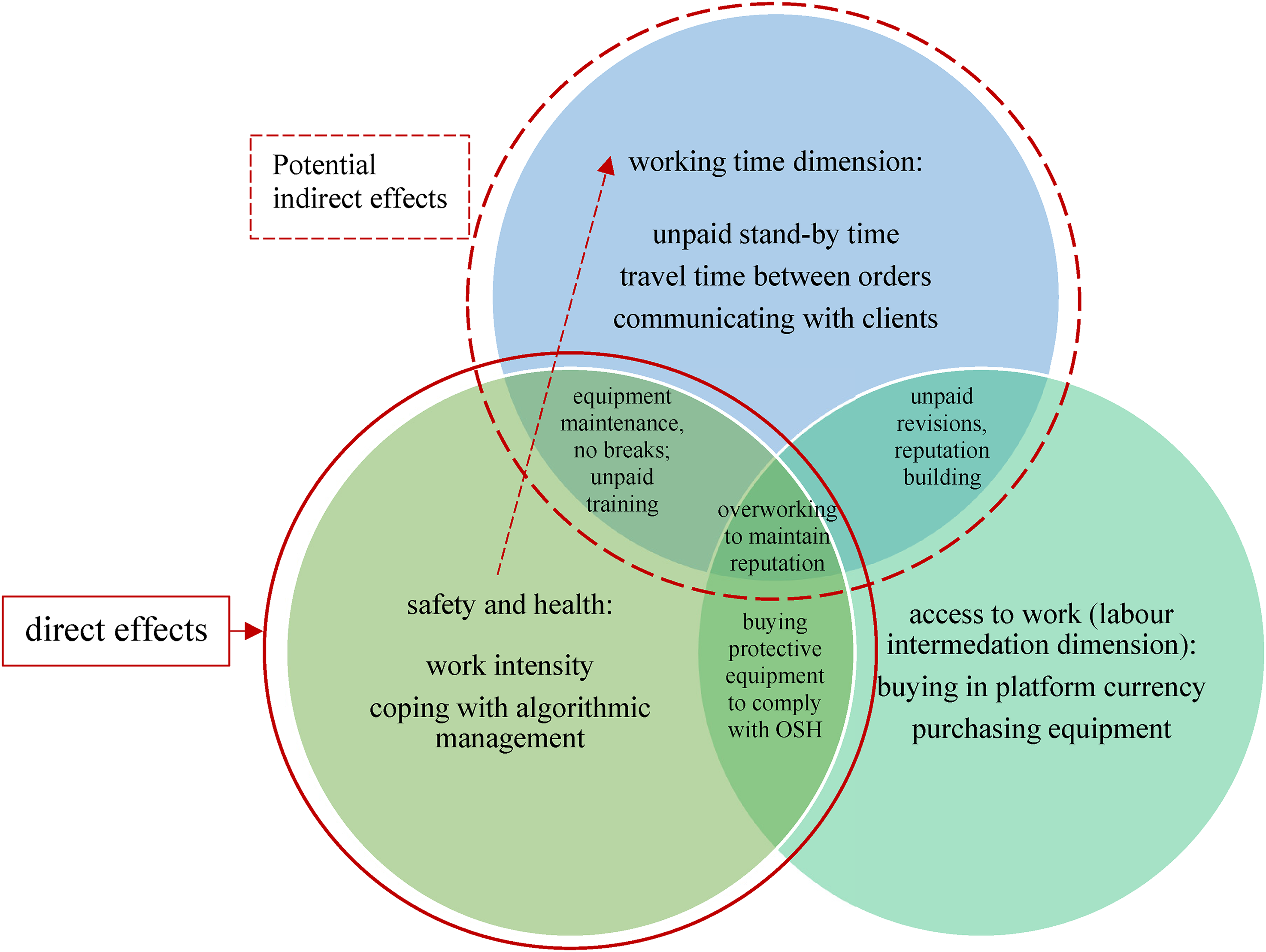
Potential effects on the reduction of the platform discount through an extension of OSH protection to the solo self-employed on labour platforms. Source: own elaboration.
Fourth and finally, apart from reducing the platform discount, application of the OSH framework would also have other fundamental benefits related to e.g., stress management, work-life balance, social support, and career development. 116 Such issues are indirectly important for the reduction of unpaid labour as well, given that platforms tend to generate lock-in effects and hinder the opportunities for the self-employed to transition out of the platform economy, while forcing them to provide unpaid labour, as exemplified in the previous sections.
We also recognise that this step may be taken in different directions. For example, the extension of some but not all employment protections to solo self-employed individuals operating on digital labour platforms may entrench the situation found with some intermediate categories regarding employment classification. The ‘ranking’ of certain protections (some viewed as so important that they should not be dependent on employment status) 117 may be another outcome. Still, we not only see a general movement in this direction, but we contend that digital labour platforms compel consideration of frameworks which address the challenges posed therein.
We recognise that this step is not without drawbacks. For example, the extension of some but not all employment protections to solo self-employed individuals operating on digital labour platforms may be seen as a political alternative to their reclassification, or - even worse - as enabling the further circumvention of employment relationship. In our view, however, this does not prevent reclassification. Rather, we view it as recognition of the extent to which current forms of solo self-employment on digital labour platforms may resemble standard employment relationships and should be given an adequate form of protection that is not tied to the necessity to determine employment status.
Extending OSH protections to the self-employed providing labour through platforms at the EU level would require moving beyond the non-binding instruments such as the Council Recommendation on improving the protection of the health and safety at work of the self-employed, which encourages Member States to promote the safety and health of self-employed through legislation, incentives, information campaigns and trainings; and the Council Recommendation on access to social protection for workers and the self-employed, which encourages Member States to provide sufficient access to social protection for the self-employed. These instruments are soft law and only incentivise regulatory steps from the Member States.
In this article, we have focused on those conducting work via labour platforms and the conditions in which they perform work. We contend that unpaid labour is a structural feature of functioning of labour platforms which can utilise the platform discount, i.e., exploit regulatory advantages and generate unpaid labour for platform workers across three main areas: working time, safety and health, and the labour intermediation dimension. In particular, we note that a substantial part of the unpaid labour exists at the intersections of these areas – which manifests itself in the ambiguous ways in which platforms have been capable of restructuring work. While a regulatory framework provides us with ways of dealing with the platform discount in each of the aforementioned dimensions, existing solutions largely rely upon the attribution of employment status and require that currently non-standard platform workers are reclassified. Preventing misclassification has been the orthodox direction set, most recently by the European Commission in its draft Platform Work Directive.
While we support the direction that the Commission is taking, we believe that the application of a legal presumption will be challenging and will likely be circumvented by new technological models adopted by digital labour platforms. Historically speaking, employers have been able to by-pass regulatory obstacles by exploiting institutional loopholes in different ways. 118 Subcontracting and outsourcing are two of the most relevant methods that employers have used to exploit these loopholes, and the emergence of labour platforms reflects this business model. The continuation of subcontracting and outsourcing is likely as the regulatory panorama that the Platform Work Directive provides for a possibility that both (reclassified) platform employees and solo self-employed will provide labour. Furthermore, the presumption of the existence of an employment relationship is expected to have a narrow impact by the policymakers themselves and is highly likely to face substantial problems in its application due to existing ambiguities within the case law.
We thus suggest two additional and alternative pathways to dealing with the platform discount and improving working conditions within the platform economy. First, we suggest the disentanglement of the protection of working conditions from the employment status, allowing it to apply to regulatory protection in the areas of working time, safety and health, and labour intermediation to all persons performing work who are economically dependent on platforms, regardless of the classification of their contractual relationship. We believe that the Guidelines on solo self-employed provide an example of how such broader approach could be structured. While this is this preferred pathway, it is also a challenging one due to the strict reliance of case law and existing EU-level regulatory framework on a narrowly-defined employment status.
Thus, we propose also a second pathway which involves action within one regulatory area while exploiting the concept of intersections to potentially expand it into other areas. We contend that the extension of OSH protection to the solo self-employed is a promising approach. Providing workers with such protections would not only limit unpaid labour generated within the safety and health dimension, such as requirements from platforms to organise protective equipment and engage in excessive work intensity, but it would also limit unpaid work in other dimensions due to the existence of intersections, thus preventing workers from having to spend unpaid time doing OSH training or having to provide the equipment necessary to access the platform. Finally, application of the OSH framework opens the back door for the application of some of the working time regulations based upon the Working Time Directive due to the rationale of the latter – workers’ safety and health.
Footnotes
Declaration of conflicting interests
The authors declared no potential conflicts of interest with respect to the research, authorship, and/or publication of this article.
Funding
The authors disclosed receipt of the following financial support for the research, authorship, and/or publication of this article: This work was supported by the European Research Council, and the Flemish Research Council FWO, (grant number Grant Agreement number 833577, G073919N).
