




Abstract
This article foregrounds the working experience of a knowledge worker in the United Kingdom across three years (2019–2022) that included periods of ‘lockdown’ and other social restrictions resulting from the COVID-19 pandemic. Across seven separate interview extracts, it offers a longitudinal narrative on the lived experience of substituting a workday comprising a long-distance commute by car to work ‘standard’ hours for an extended workday telecommuting from home. Over time the worker paradoxically recognises that telecommuting entails added pressures of work intensification, extensification and greater domestic responsibility but this is preferable to returning to a long-distance dissatisfying commute. The reflexive narrative reveals how he embraces the pressures of telecommuting through job crafting to re-identify as an autonomous professional and more engaged care-giving parent. The article contributes to the literature on hybrid/flexible forms of work organisation emerging from the pandemic by indicating the importance of micro-level considerations and implications for gender equality.
Keywords
Introduction
The World Health Organisation’s declaration of the COVID-19 pandemic in March 2020, and subsequent legislative restrictions on social interaction, triggered a ‘seismic shift in working arrangements’ (Barrero et al., 2021: 1). The ubiquity of domestic digital technologies enabled a transition from ‘commuting to work’ to ‘working from home’, i.e. telecommuting. While there is evidence of this being an enduring shift (Aksoy et al., 2022; Raghavan et al., 2021) with many workers reluctant to return to physically commuting, there remain managerial concerns about productivity and loss of control, and broader political concerns about the implications for the financial viability of public transport systems and the vibrancy of local retail infrastructures (Microsoft, 2022; Neate, 2022; ONS, 2022; Spicer, 2022). Within a classical sociological framework, this historical shift in working patterns, and the related resistance, reflect an interplay between processes of social change, by which social forms become transformed, and continuity, by which society is maintained and reproduced (Tonkiss, 1998).
What follows are extracts from a series of seven longitudinal interviews with ‘John’ (pseudonym), a technical knowledge worker in the United Kingdom (UK) who, pre-pandemic, commuted long distance by private car. In the first (pre-pandemic) extract he explains that commuting had become ‘natural’ to him, but his dissatisfaction with aspects of commuting are also clear. By the time of the second interview John has been telecommuting for eight months. He reflects back on his experience of the daily commute and indicates how it served as a transitionary period of ‘decompression’ (Sandow, 2014: 529), bridging ‘work’ on one side and ‘home’ on the other (Nippert-Eng, 1996). The remaining interview extracts reveal competing and shifting forces for change and continuity in regard to the locus of John’s work performance.
In the fifth extract John recalls the physical strain of commuting (Kluger, 1998) and alternates between confidence that the company will cede to his preference for continuing to telecommute and concern that management are indicating that he will need to return to commuting. Reflecting contemporaneous Government data on the attitudes of ‘higher earners’ (ONS, 2022), he points to there being a collective resistance to a return to pre-pandemic working patterns. Then again in the sixth extract John presents his employer as wanting to return to pre-pandemic work patterns, i.e. a return to ‘continuity’. Through a functionalist sociological lens of homeostasis (Parsons, 1951) we might consider the organisation as a self-regulating organism that, for survival, orientates itself towards integrating and adjusting to an external force for change (i.e. the pandemic) while also attempting to maintain/restore underlying internal conditions for continuity purposes.
By the final extract John reports that he has settled into a new normal of primarily telecommuting, and bridles at the thought of returning to a daily commute: ‘How did I survive before?’ This contrasts with his reporting of work-life balance difficulties experienced during ‘lockdown’ (as was common (Palumbo, 2020)). He perceives his new normal as giving him greater flexibility, but paradoxically he has adopted new routines (e.g. working after the children go to bed) that enable him to navigate between ‘work’ and ‘home’ identities more easily. In line with previous studies of knowledge workers (Leclercq-Vandelannoitte et al., 2014; Mazmanian et al., 2013), he asserts the identity of a more autonomous and productive professional. As such he implicitly portrays extending his workday to communicate across time zones or perform ‘simple’ tasks as being beneficial. The ‘responsible autonomy’ that offers him the perception of status and responsibility (Friedman, 1977) results in him imposing a form of self-engaged ‘connectedness’ (Umney, 2018: 142) that drives his productivity (Galanti et al., 2021). His management’s camouflaged control (Callaghan and Thompson, 2001) is identifiable in his self-surveillance of performance monitoring data.
Thus, the longitudinal narrative explains an apparent paradox. By shifting from commuting to telecommuting, John faces: the diminishing of his home as private sanctuary (Zuboff, 2019); new expectations of working evenings via an ‘electronic leash’ (Bisht et al., 2023; Marcum et al., 2018); and an additional domestic workload. Yet he comes to recognise the circumstances of the pandemic as an opportunity to offload a dissatisfying commute (Stutzer and Frey, 2008) and spend more time with his family. He creates a ‘garden’ workspace away from the house and reflexively recrafts his job to accentuate an ‘online advisory’ role; and by reconstituting his late night working as an integral aspect of his professional identity, he embraces work extensification.
Through John’s reflections we can also sense how his employer may have come to recognise the potential in telecommuting for: increased productivity (Aksoy et al., 2022) including via work intensification and extensification (Felstead and Henseke, 2017); reduced overhead costs (ONS, 2022); and labour cost savings by accessing global labour markets (Read, 2006).
By taking a longer temporal lens to the debate on commuting to work we are reminded that it was only through progress in transportation technologies and related economic investment in infrastructure (i.e. roads, railways, etc.) that opportunities for long-distance commuting to work became a viable proposition for some workers, particularly higher-paid knowledge workers (Kirk, 2021; Sandow, 2014). Those earlier technological advancements increased the options for workers able to commute while simultaneously extending the pool of labour available for employers. Through this longer lens we might consider how the technology-enabled shift in working practices wrought by the pandemic does not so much evidence linear social progress as a widespread return to pre-industrial norms of homeworking (Edgell and Granter, 2020). It invites us to place John’s reflexive ‘journey’ within a discontinuous flow of history, with the pandemic a point of discontinuity at which the discourse concerning long-distance commuting to work shifts (Darby et al., 2022; Foucault, 1970).
The pre-pandemic discourse normalised large numbers of office workers individually commuting to physically work together. John’s narrative points to the normalisation of more flexible organisation of workforces in the acknowledgement that those digital technologies that facilitated telecommuting (notably, video conferencing and remote supervision) may afford symbiotic benefits to (some) individuals and organisations (Aksoy et al., 2022; Saia et al., 2022; Wheatley, 2017). As such, we might consider that the pandemic has had unintended political consequences, reshaping power dynamics within social relationships and altering ‘social structures for technologies that influence how people are going to work, communicate, travel, consume and so forth’ (Winner, 1980: 127). Specifically, evidence points to the pandemic experience fundamentally changing both workers’ and employers’ attitudes to commuting and telecommuting (Aksoy et al., 2022), and, as suggested in John’s reflections, this has implications for the gender equality agenda.
John reports on his pre-pandemic commute in terms that resonate with the male ‘breadwinner’ role that can be traced back to historical gender-based divisions of labour, acknowledging that this was enabled by his working wife’s adoption of a familial ‘caregiver’ role. As Chatman et al. (2022) argue, while the functional relevance of these roles may have become increasingly obsolete, related stereotypes linger to maintain a patriarchal power structure. Other studies have shown that commuting is often an unviable option for women because of care responsibilities and they may self-impose tight geographical limits to ‘their’ labour markets (Wheatley, 2017; Williams et al., 2008). The suggestion is that with the UK labour market offering more homeworking opportunities for knowledge workers (Darby et al., 2022) we may expect an incremental erosion of the employment inequalities associated with commuting (Chung et al., 2021). As Saia et al. (2022: 7) have argued in relation to new homeworking opportunities for people with disabilities, the pandemic, as a point of discontinuity, may serve the broader equal opportunities agenda: ‘The pendulum has swung, but we need to make sure it never becomes still.’ However, if organisations embrace telecommuting because it may offer advantages from work extensification, this may disproportionately disadvantage women for similar reasons that make long-distance commuting unviable for many (Nemoto, 2013). So, as telecommuting becomes more prevalent, social policymakers and employers need to deeply consider how it impacts on their equality and diversity agenda (Darby et al., 2022).
Background to John’s reflections
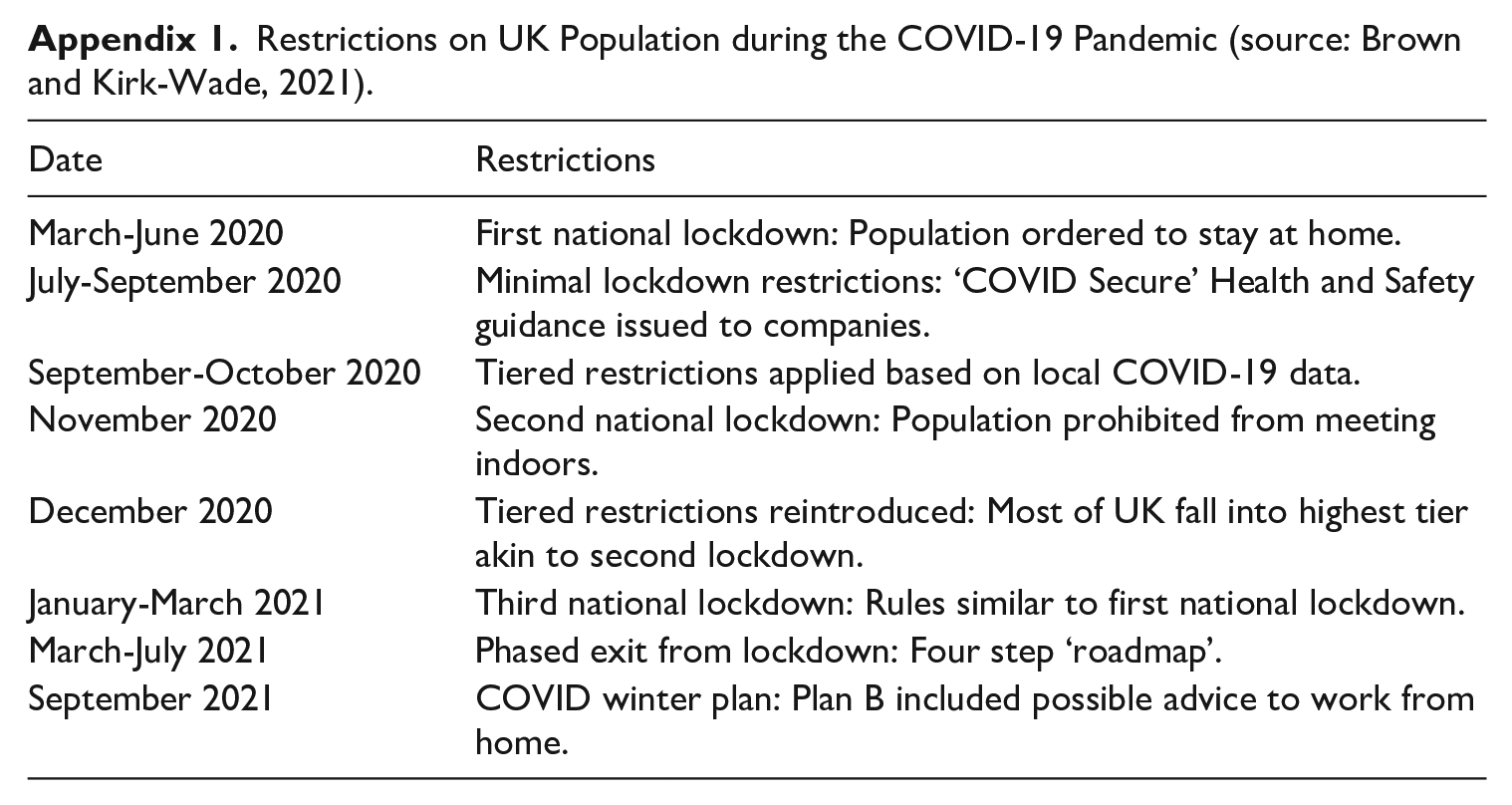
John, aged 38, has for the last ten years been an engineering design specialist at a company that designs and manufactures construction equipment. He lives in the East Midlands of England and pre-pandemic was commuting by car 65 miles (105 km) each way, five days a week. John was originally interviewed shortly before the pandemic for a project related to fatherhood and reported that he had a long commute to work and that his wife, ‘Ruth’ (pseudonym), assumed almost all daily domestic responsibilities (including taking and collecting their two pre-school children to/from a childminder). At various points across the pandemic, John was invited to reflect on how his work and home life experiences were changing. In particular we were interested in how he was experiencing working from home and felt about returning to commuting. At the start of the period covered by John’s narrative, Ruth was working locally for a public sector organisation in a full-time office-based role with operational level supervisory responsibilities. She remained in this role across the period. John has been involved in the preparation of this article, including editing the interview extracts that follow. Each extract is headed by the month of the interview followed by an indicative comment on the state of the pandemic, the cumulative number of COVID-related deaths in the UK 1 , and a note on the loci of John’s and Ruth’s work at that time. Appendix 1 lists by date the key phases of public restrictions including ‘lockdowns’ during this period.
John’s reflections
September, 2019
Pre-Pandemic: Six months before first UK national lockdown. John is commuting to an office; Ruth is working locally in an office.
Five, six years ago, when I got a house with my wife I decided to commute to work on a workday. Doing so much driving has become natural to me like I have always done it. I spend more than three hours every day going to work. My work journey starts at 6:15am and I leave the office at 4pm to avoid the traffic. The traffic conditions are unpredictable. When there is a bad day of traffic, I can spend four hours or more commuting. Every day I try to reach the company car park by 7:45am so I can get to the office by 8am. My company is located on a large industrial site with more than 2000 employees. Due to the location most people drive to work, and parking can be a nightmare. The car park allocated to me is not close to my office and there is always a long queue in the afternoon, so sometimes it can take an hour just to leave. When I tried to address my long commute and the car park issue with management, I hit a brick wall with no reply. I was then given a warning for parking at the wrong car park. The commute to work can be stressful although this is not necessarily coming from the journey but other related matters, such as parking.
November, 2020
UK enters second national lockdown (Brown and Kirk-Wade, 2021); 60,618 deaths. John and Ruth are both working from home.
It has been eight months since my partner and I started to work from home. It is tiring and unrelenting, all absorbing. I have no personal time. Every hour is spent working or looking after the children, preparing food, encouraging them to eat, getting them dressed, brushing their teeth, leaving the house, preparing snacks, changing their clothes, preparing food again, reading to them, getting them to nap, preparing food for when they wake up et cetera, so by the time they go to bed at 7:30pm I will fall asleep too. We try to juggle who looks after them when the other works, but these slots are between one and three hours so it takes a big chunk of time to get back into the work mode and remember where you left off.
During the time of commuting, I had a regular slot where I could just listen to podcasts. It was also a time to reflect on issues: think about a problem, what you could have done differently in certain situations. It can help with innovation and my job is innovative. While the commute could be hard work, it could also be a thick boundary between work and home. At work I could be in my work role and have my work identity, and at home I’d have my home identity. That time in the middle was like a bridge between the two, which you’re crossing and meditating at that time, and it’s a space on your own. When I was commuting to work, there was a clear separation between work and home. I didn’t bring my computer home. When I got home I could switch off from work and focus on what the kids needed. Equally the commute gave me a break from the kids during work hours. I didn’t have to think about teaching them how to spell their names or wiping their bums.
The work and childcare juggling means we are both trying to make up the hours we have missed during the day, by working at night. So, we never actually get to spend any evenings or weekends together as a family. The job is now more like an 8am to 11pm work/childcare juggling zone. It is great that my work is quite understanding, but I do feel guilty about not being available for some meetings or to answer questions in the normal working hours of 8am to 5pm. I have downloaded all the Microsoft applications to my mobile so that if a colleague needs to contact me during childcare, I can still respond, so I am never completely free of work during my home life. This is a big change.
The expectation of being a father is very different from my father’s time when it was very much the woman stays at home and the man goes out to work. That is what I was doing before, commuting to the office. Now it’s completely not like that. Speaking with my colleagues I think everyone is doing the same: we are all juggling.
May, 2021
UK in phased exit from lockdown. Government concern about new ‘Indian’ variant (BBC, 2021a); 128,566 deaths. John and Ruth are both working from home.
Being a father with a full-time job, working from home during the COVID pandemic, I need to fit myself around the children. The childminder is a lifesaver. Once we could get them to the childminder for a day, it freed us from all the constant attention they need and the short duration work windows. The day flies by and before you know it, it is time to pick up the kids. The children are a priority when they get home: we can juggle and take turns in doing the full-time job 100 per cent, so there is always somebody there for them. We just keep each other informed with what important meetings are coming up and plan around each other.
The responsibilities of my wife and I have definitely changed since I stopped commuting. Before, my wife would drop off and pick up the kids from childcare and do all the cooking and sacrifice more of her work time, while now I can take more ownership of that. I quite like going for the ten-minute walk to the childminder’s. In a commuting situation, I don’t get a chance to get some fresh air; then getting back home with the kids, I will sit down on the floor to play with them. I think it’s beneficial just to get away from work: have a change of scenery.
September, 2021
New positive evidence of efficacy of full vaccination against COVID-19 (ONS, 2021). COVID ‘booster’ vaccine rollout begins (BBC, 2021b); 137,968 deaths. John is working from home; Ruth is mainly working from home but has recently been going into the office occasionally.
I work in a ‘garden office’, an independent space away from the main house. It was a storage space but when I started to work from home I cleared it out and set it up with a desk, computer monitors and a laptop. I’ve got a nice view from the window. It’s quite a nice environment. It’s also good to be away from people I work with in some respects, because the job I do is very technical. So, if I’m sat at a desk in an open plan office as I was, there’s always someone coming to the desk and asking questions and that makes it very difficult to focus on one thing at a time. Here, I can shut myself off while doing a job and just ignore the messages coming in via [Microsoft] ‘Teams’ or the like.
The expectations on us responding to emails or any form of online communication is varied. Different parts of the business group have different expectations. Production-oriented personnel are expected to be on site and available for urgent production issues, but I’m more of a design person who is quite free to do what they want. As long as you do what you need to do, nobody really checks on you: the time you are online or offline. There’s a bit more flexibility from my boss, though other bosses might be different.
Now that I do not need to commute, I am probably more isolated and focused on my work. I don’t have that input about current affairs and other things that I had when commuting. I was always linking things happening at work, the projects I was working on, with current affairs, but I wouldn’t do that so much now. Prior to the COVID pandemic, while I needed to commute to work, I could separate work and life; now it is more tricky.
I do find myself working at 11 o’clock at night, just to get availability of some people in the US [United States of America], but then there’s also the requirement to discuss with Chinese colleagues in the morning the next day. So you can end up working late and then getting up early to meet both requirements. This is pretty much self-driven: wanting to resolve issues.
I have ‘Teams’ on all the time. That’s how people contact and talk to each other. I’ve now got it on my phone, which is dangerous because you see the evening messages as well. We’re a US company. If there’s something going on in the US they send us messages via ‘Teams’ and you’ve got to decide whether to respond immediately or wait until tomorrow when you’re back online. That’s sometimes challenging.
November, 2021
Government concerns about ‘very high’ COVID-19 rates and public complacency (Therrien, 2021); 146,322 deaths. John is working from home with very occasional commutes into the office; Ruth is flexibly ‘hybrid’ working (i.e. from home and the office).
I think my physical health has benefited from not commuting to work. I had this long-standing neck issue, which had been developing. By stopping the drive to work, after only a few months, I recovered, so, it must have been related to that long time driving in a seated position. I think the concentration you always have to give when you’re driving also affected me. While the commute could be hard work, it could also be that time that was a boundary between work and home, my work identity and home identity. Now, you’re switching constantly: you know, you’re putting your ‘father hat’ on, and then you’re having a ‘Teams’ call with someone in the States. So, you’ve got to be more agile.
We do discuss the possibility of going back to work as before the pandemic. I think there’s an expectation that this working from home option will continue going forward; that we won’t be required in the office 100 per cent of the time. I think the realisation that it’s really easy to get in touch with people has just accelerated by the experience of working from home.
There was a consultation, asking people what we would like to do after the COVID restrictions. I spoke to many of my colleagues and a lot of us expressed the benefits of being able to work from home. Many reflected on how we did extra work including attending meetings after scheduled working hours. We put more weight into our work rather than work less, but the company is talking about everyone returning to the office. What was the point of the consultation if they decide that everyone will be returning to the office? The thought of that long commute every day makes me very anxious, and I am not looking forward to returning to the office. Surely, this is not going to help with my wellbeing.
I really enjoy being at home. Being able to keep this lifestyle would really help me. I have been networking with different people across the globe. I think it’s allowed me to focus on individual work tasks and longer-term projects, rather than have a broken-up work pattern where I am constantly interrupted by burning issues. I have been back to the office a couple of times recently. I had forgotten how long the drive was; even though I was not there the full day, it was quite tiring just coming back in the afternoon.
March, 2022
COVID infections rise ‘as expected’ by Government (Hall, 2022); 168,967 deaths. John is working from home with very occasional commutes into the office; Ruth is flexibly ‘hybrid’ working.
People are being encouraged to go back to work and most people are back two days a week. The language from the management has changed and there is pressure to return to the office. When I came back into the office, I was not productive. I ended up being ‘caught’ by many people so was not then able to do my work in the office.
My manager has been very supportive and relaxed about where I work. However, I think the pressure to be in the office might be reinforced after the summer. I really don’t want to be at the office. The thought of returning to the long commute has put a great level of stress on me; not only the thought of the long commute but also how unproductive I will be. I dread to think about returning to the office. I can just about cope with two days a week at the office. More than that and I don’t know.
September, 2022
World Health Organisation suggest that the end of the pandemic is in sight (UN News, 2022); 192,000 deaths. John is working from home with very occasional commutes into the office; Ruth is mainly working at the office with some flexibility to work from home.
I now work pretty much full time from home. There is the odd request to come in, once or twice a quarter: if there are new starters or a strategy meeting. This is perfect for me. I can save all that driving time and money, especially with the price of fuel at the moment. Every time I drive in, I think, ‘How did I survive before?’ because it’s so tiring. I can access people quickly through ‘Teams’ while in the past I would have walked around site trying to find them. Some groups decided to be together one or two days a week. My manager sees my role as suitable for remote working as I’m more accessible online to provide technical assistance. I’m more productive. We track our work, and you can see there’s a 25 to 30 per cent increase in the number of engineering requests I’m able to close. It’s a significant benefit and my manager understands that. In the past, managers just made sure you were there to work on the tasks that came in. They introduced a traffic light system during the lockdown, which managers use to prioritise, manage and track the progress of work performed remotely. Managers are now more focused on productivity, getting things moving and closed. I used the data from the system at my appraisal meeting to evidence what I have delivered and to discuss my workload.
My role has shifted more to one of assisting junior colleagues recruited in India and China and then trained to work remotely to the UK timeline. Being more available online stretches out my day but it also gives me flexibility to do other things like go for a run at lunchtime and pick up the kids at 3:30pm. After getting the kids to sleep I can start working again at 9pm, simple tasks that require less thinking. I can stretch that shift out till 11pm.
I think my wife appreciates me working from home because she’s got work requirements and can’t just drop everything to pick up the kids. When they are hungry and tired it helps that I can take over from her. Before the pandemic I wouldn’t get involved in childcare; during the pandemic I could share the workload for the daily routines and that has continued. She still does the majority of the cooking and preparing their lunches, but I get more involved.
The pandemic has changed what jobs I would apply for. I really see the benefits of working remotely and wouldn’t want to work where I would need to commute or be ‘in person’.
Footnotes
Appendix
Restrictions on UK Population during the COVID-19 Pandemic (source: Brown and Kirk-Wade, 2021).
| Date | Restrictions |
|---|---|
| March-June 2020 | First national lockdown: Population ordered to stay at home. |
| July-September 2020 | Minimal lockdown restrictions: ‘COVID Secure’ Health and Safety guidance issued to companies. |
| September-October 2020 | Tiered restrictions applied based on local COVID-19 data. |
| November 2020 | Second national lockdown: Population prohibited from meeting indoors. |
| December 2020 | Tiered restrictions reintroduced: Most of UK fall into highest tier akin to second lockdown. |
| January-March 2021 | Third national lockdown: Rules similar to first national lockdown. |
| March-July 2021 | Phased exit from lockdown: Four step ‘roadmap’. |
| September 2021 | COVID winter plan: Plan B included possible advice to work from home. |
Acknowledgements
The authors thank Professor Angela Knox and the three anonymous reviewers for their encouraging and insightful feedback on earlier versions of this article.
Funding
The authors received no financial support for the research, authorship, and/or publication of this article.
